
Chapter 4 Linear Motion Pages 46 60 4


- Slides: 17
Chapter 4 Linear Motion Pages 46 - 60
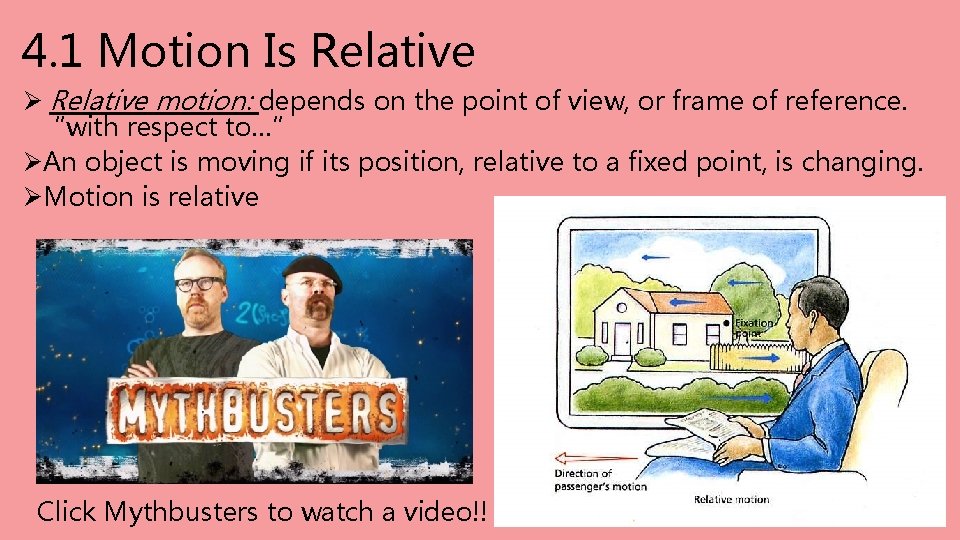
4. 1 Motion Is Relative Ø Relative motion: depends on the point of view, or frame of reference. “with respect to…” ØAn object is moving if its position, relative to a fixed point, is changing. ØMotion is relative Click Mythbusters to watch a video!!
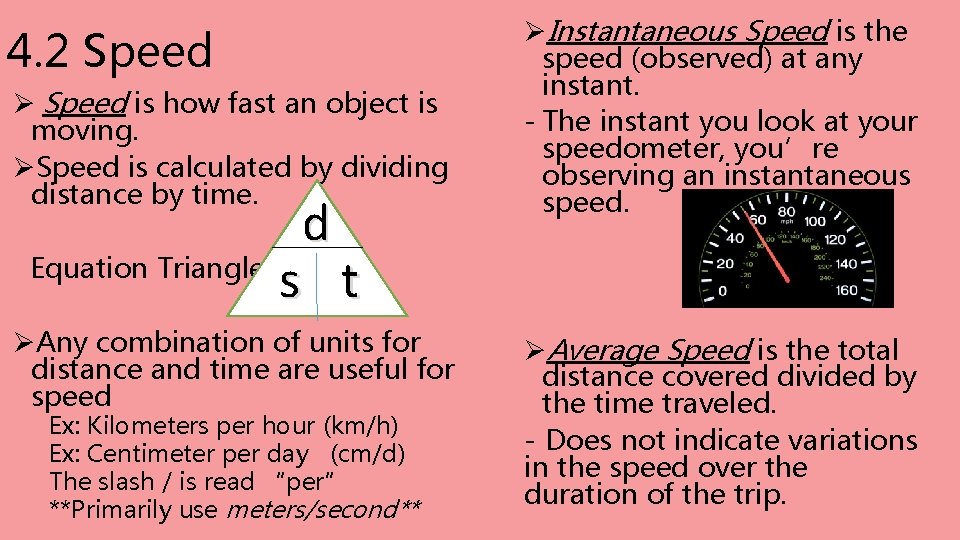
4. 2 Speed Ø Speed is how fast an object is moving. ØSpeed is calculated by dividing distance by time. d Equation Triangle s t ØAny combination of units for distance and time are useful for speed Ex: Kilometers per hour (km/h) Ex: Centimeter per day (cm/d) The slash / is read “per” **Primarily use meters/second** ØInstantaneous Speed is the speed (observed) at any instant. - The instant you look at your speedometer, you’re observing an instantaneous speed. ØAverage Speed is the total distance covered divided by the time traveled. - Does not indicate variations in the speed over the duration of the trip.
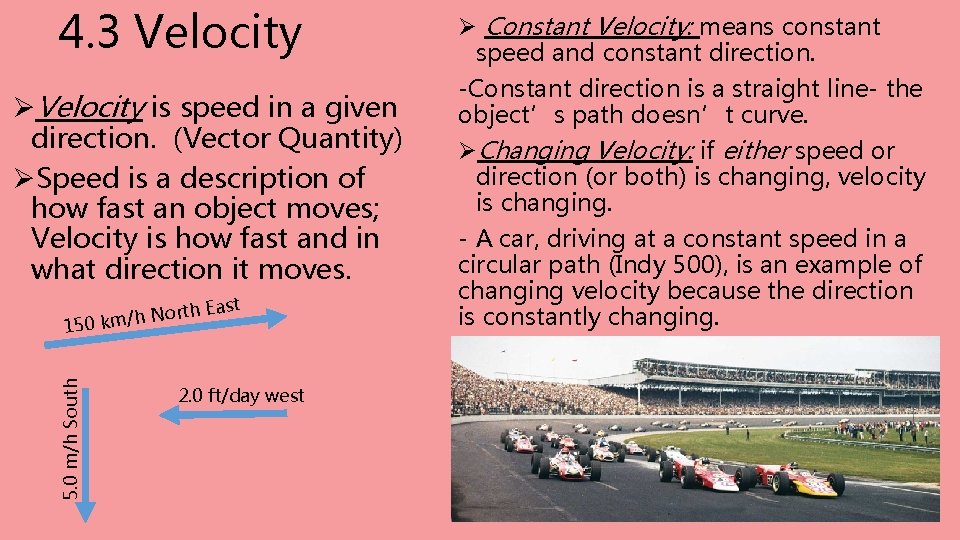
4. 3 Velocity ØVelocity is speed in a given direction. (Vector Quantity) ØSpeed is a description of how fast an object moves; Velocity is how fast and in what direction it moves. East h t r o N 0 km/h 5. 0 m/h South 15 2. 0 ft/day west Ø Constant Velocity: means constant speed and constant direction. -Constant direction is a straight line- the object’s path doesn’t curve. ØChanging Velocity: if either speed or direction (or both) is changing, velocity is changing. - A car, driving at a constant speed in a circular path (Indy 500), is an example of changing velocity because the direction is constantly changing.
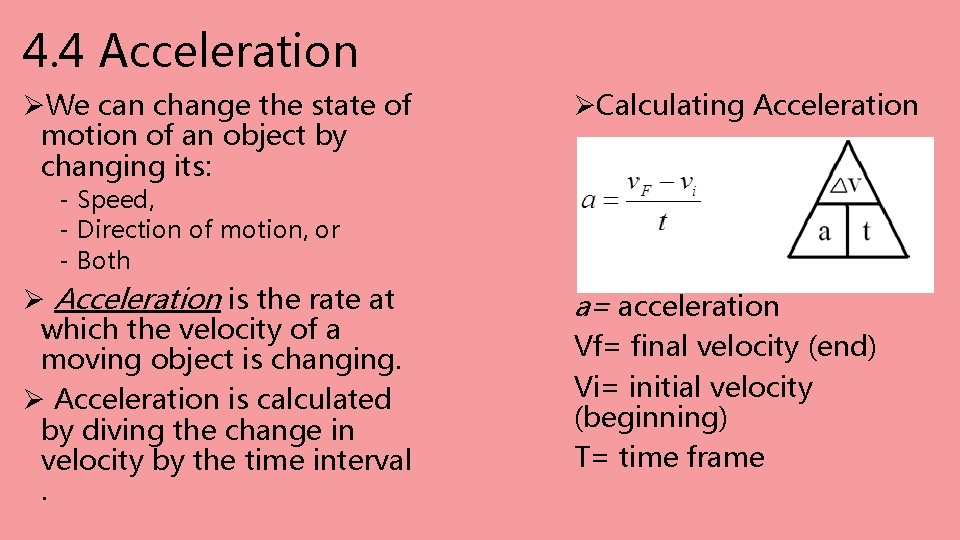
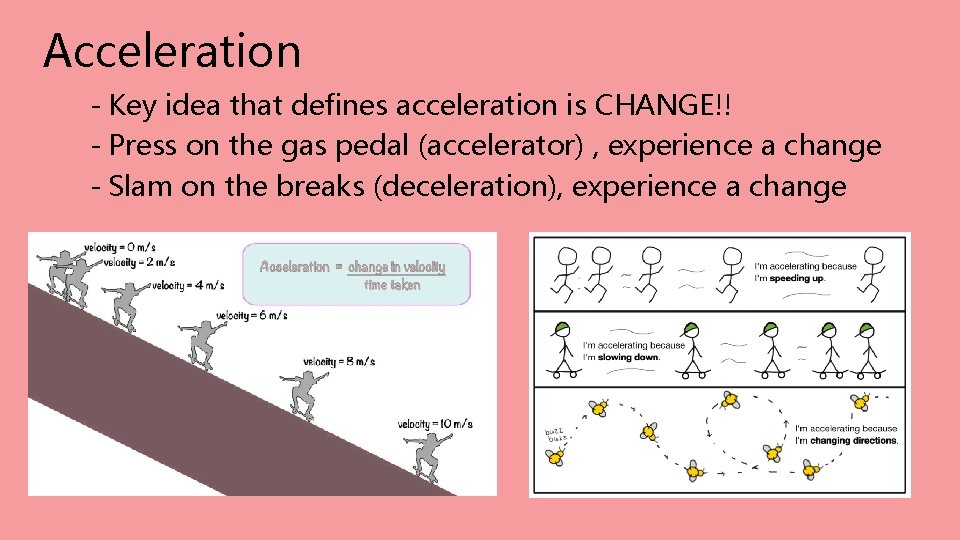
4. 4 Acceleration ØWe can change the state of motion of an object by changing its: ØCalculating Acceleration Ø Acceleration is the rate at which the velocity of a moving object is changing. Ø Acceleration is calculated by diving the change in velocity by the time interval. a= acceleration - Speed, - Direction of motion, or - Both Vf= final velocity (end) Vi= initial velocity (beginning) T= time frame
Acceleration - Key idea that defines acceleration is CHANGE!! - Press on the gas pedal (accelerator) , experience a change - Slam on the breaks (deceleration), experience a change
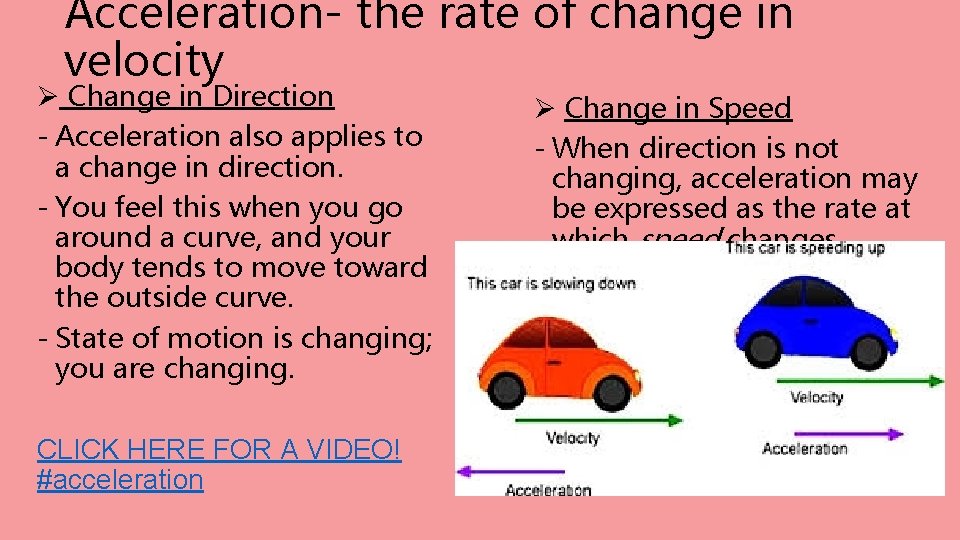
Acceleration- the rate of change in velocity Ø Change in Direction - Acceleration also applies to a change in direction. - You feel this when you go around a curve, and your body tends to move toward the outside curve. - State of motion is changing; you are changing. CLICK HERE FOR A VIDEO! #acceleration Ø Change in Speed - When direction is not changing, acceleration may be expressed as the rate at which speed changes.
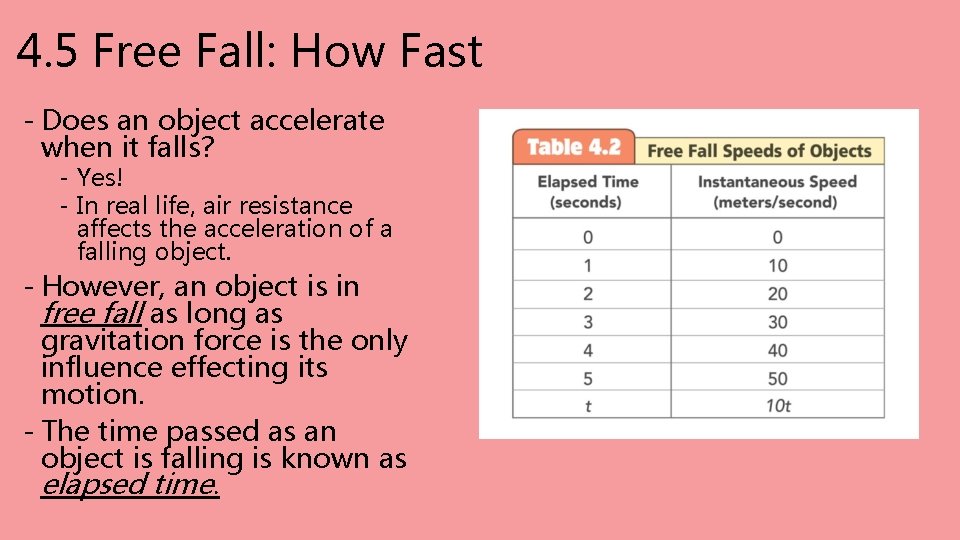
4. 5 Free Fall: How Fast - Does an object accelerate when it falls? - Yes! - In real life, air resistance affects the acceleration of a falling object. - However, an object is in free fall as long as gravitation force is the only influence effecting its motion. - The time passed as an object is falling is known as elapsed time.
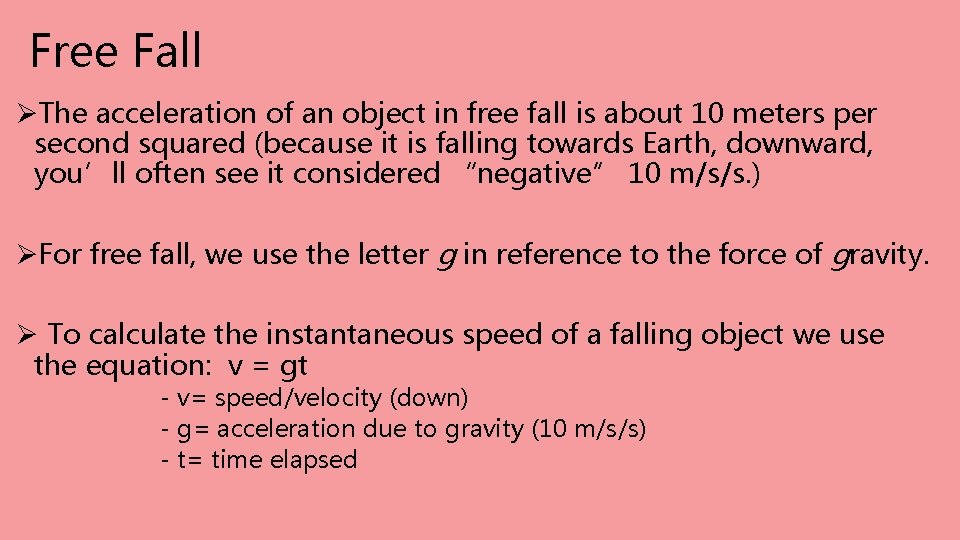
Free Fall ØThe acceleration of an object in free fall is about 10 meters per second squared (because it is falling towards Earth, downward, you’ll often see it considered “negative” 10 m/s/s. ) ØFor free fall, we use the letter g in reference to the force of gravity. Ø To calculate the instantaneous speed of a falling object we use the equation: v = gt - v= speed/velocity (down) - g= acceleration due to gravity (10 m/s/s) - t= time elapsed
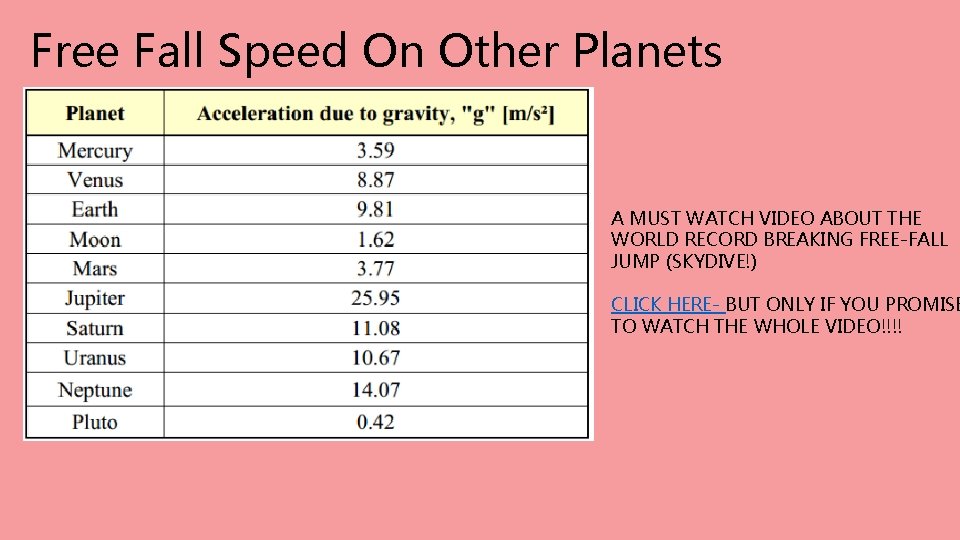
Free Fall Speed On Other Planets A MUST WATCH VIDEO ABOUT THE WORLD RECORD BREAKING FREE-FALL JUMP (SKYDIVE!) CLICK HERE- BUT ONLY IF YOU PROMISE TO WATCH THE WHOLE VIDEO!!!!
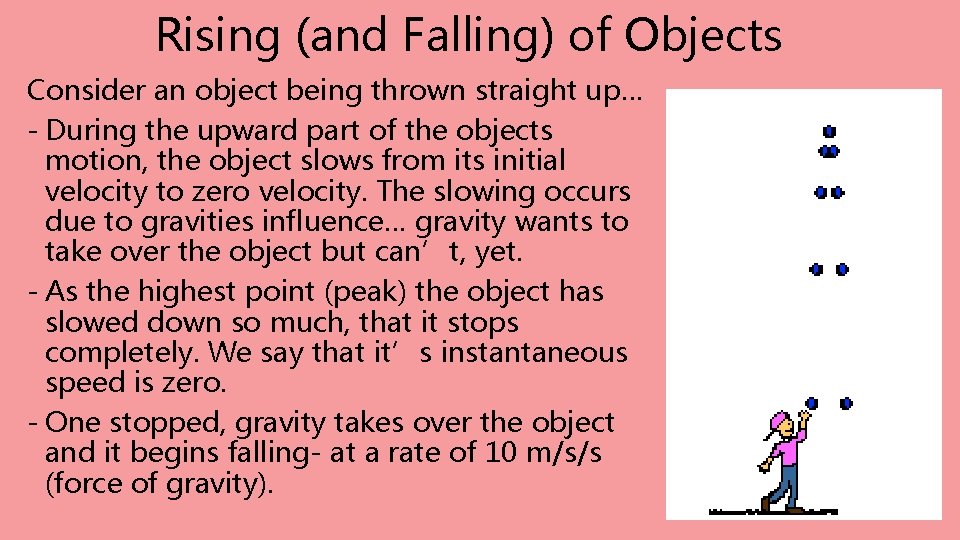
Rising (and Falling) of Objects Consider an object being thrown straight up… - During the upward part of the objects motion, the object slows from its initial velocity to zero velocity. The slowing occurs due to gravities influence… gravity wants to take over the object but can’t, yet. - As the highest point (peak) the object has slowed down so much, that it stops completely. We say that it’s instantaneous speed is zero. - One stopped, gravity takes over the object and it begins falling- at a rate of 10 m/s/s (force of gravity).
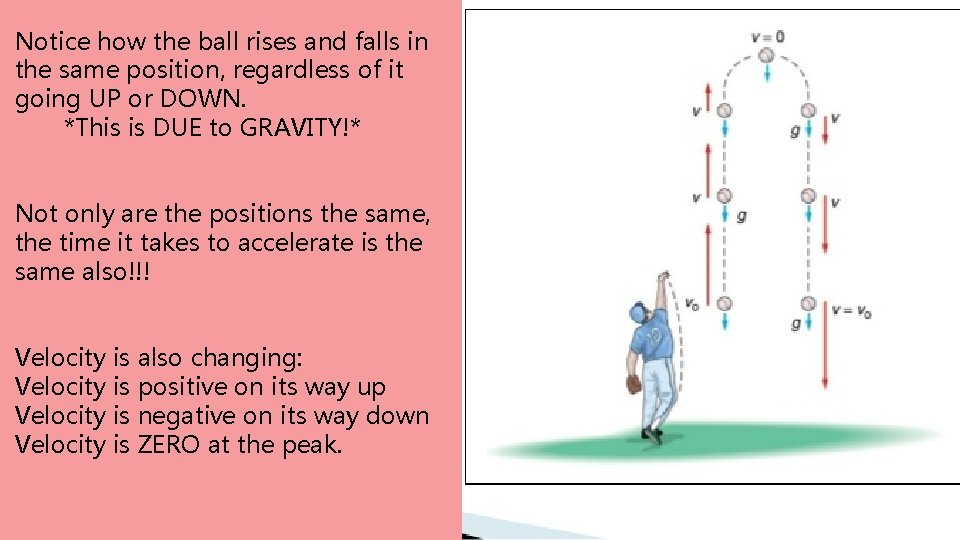
Notice how the ball rises and falls in the same position, regardless of it going UP or DOWN. *This is DUE to GRAVITY!* Not only are the positions the same, the time it takes to accelerate is the same also!!! Velocity is also changing: Velocity is positive on its way up Velocity is negative on its way down Velocity is ZERO at the peak.
IS IT TRUE THAT… - If you drop a penny from the top of _______ and it hits someone, it will kill them? ! LET THE MYTHBUSTERS SOLVE THIS!!! CLICK ON THE PENNY!
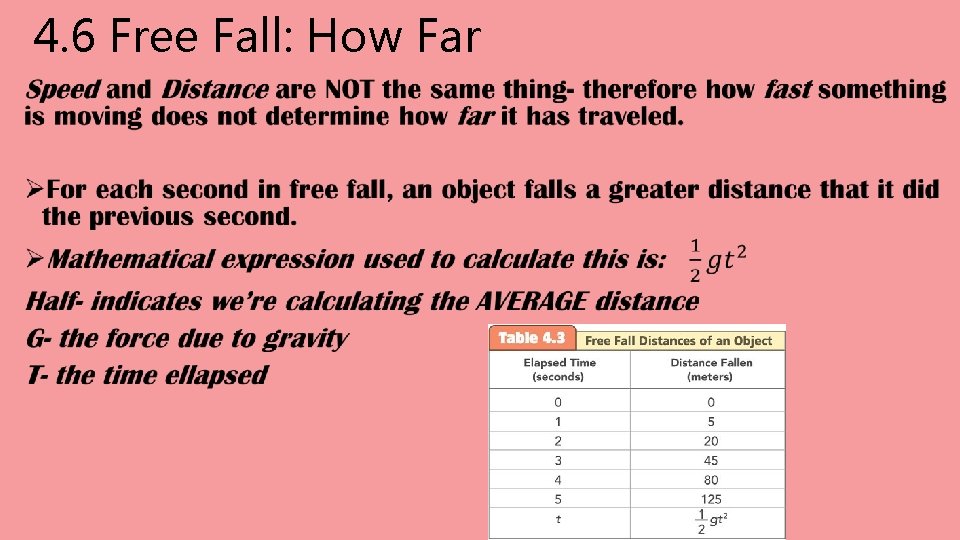
4. 6 Free Fall: How Far •
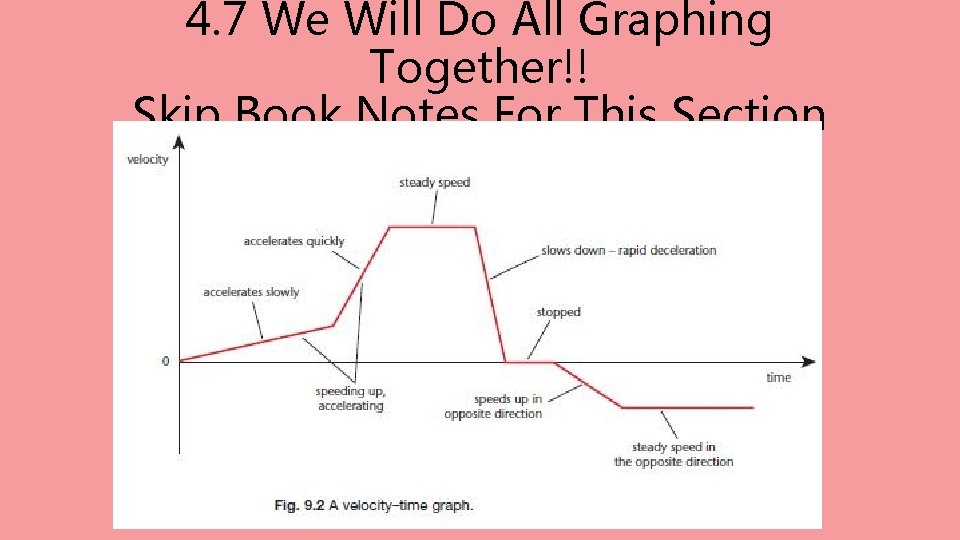
4. 7 We Will Do All Graphing Together!! Skip Book Notes For This Section
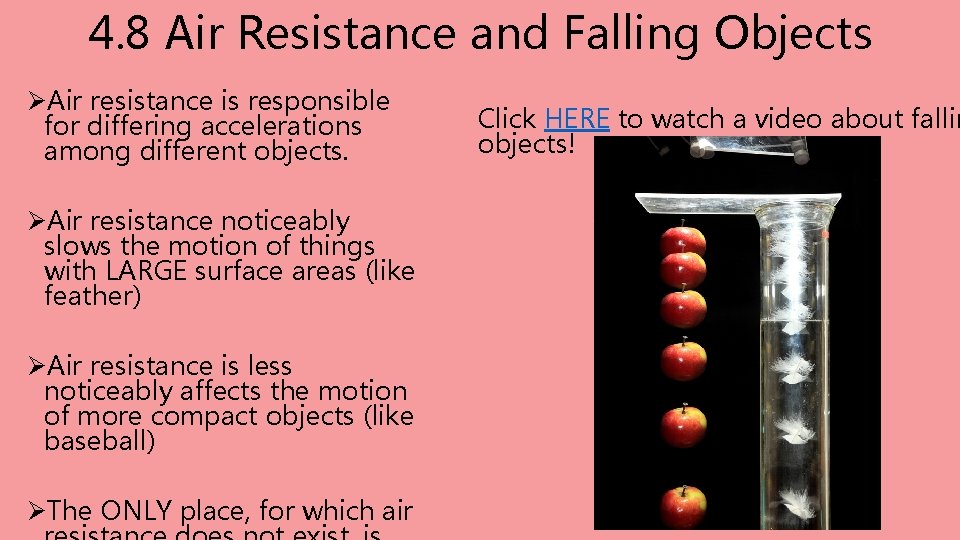
4. 8 Air Resistance and Falling Objects ØAir resistance is responsible for differing accelerations among different objects. ØAir resistance noticeably slows the motion of things with LARGE surface areas (like feather) ØAir resistance is less noticeably affects the motion of more compact objects (like baseball) ØThe ONLY place, for which air Click HERE to watch a video about fallin objects!
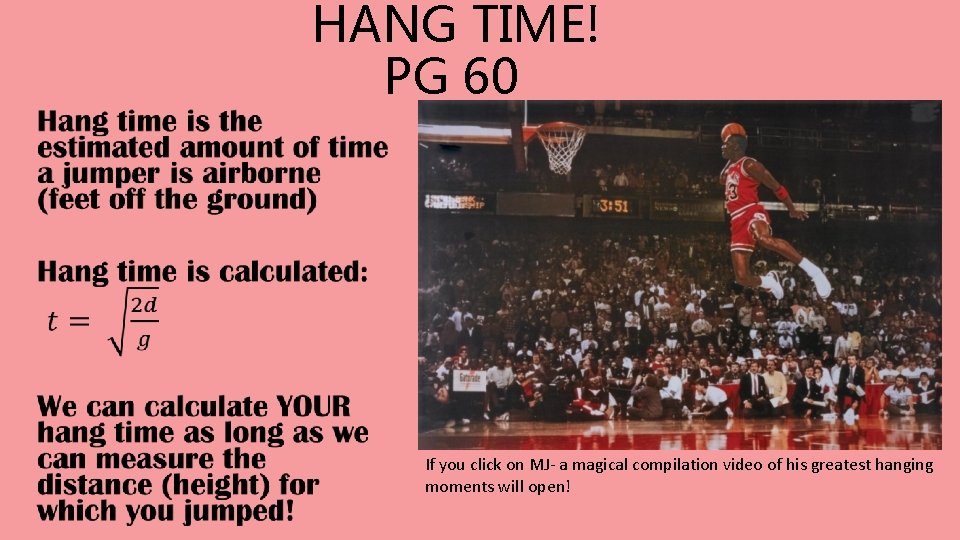
HANG TIME! PG 60 If you click on MJ- a magical compilation video of his greatest hanging moments will open!