
Lecture 7 Nonlinear Recursions Time series prediction HillValley
![Nonlinear recursion • Post-nonlinear combination of predecessors • z[t]=tanh(a 1 z[t-1]+ a 2 z[t-2]+…+](https://slidetodoc.com/presentation_image_h/a3edc7855bd46b87033226fa6f48476f/image-2.jpg "Nonlinear recursion • Post-nonlinear combination of predecessors • z[t]=tanh(a 1 z[t-1]+ a 2 z[t-2]+…+")
![Data generation • z[t]=tanh(a 1 z[t-1]+ a 2 z[t-2]+…+ a z[t- ])+ e[t], t=](https://slidetodoc.com/presentation_image_h/a3edc7855bd46b87033226fa6f48476f/image-4.jpg "Data generation • z[t]=tanh(a 1 z[t-1]+ a 2 z[t-2]+…+ a z[t- ])+ e[t], t=")
![Nonlinear recursion • MLPotts: z[t]=F(z[t-1], z[t-2], …, z[t- ])+ e[t], t= , …, N](https://slidetodoc.com/presentation_image_h/a3edc7855bd46b87033226fa6f48476f/image-13.jpg "Nonlinear recursion • MLPotts: z[t]=F(z[t-1], z[t-2], …, z[t- ])+ e[t], t= , …, N")

![Lorenz >> NN=20000; >> [x, y, z] = lorenz(NN); >> plot 3(x, y, z,](https://slidetodoc.com/presentation_image_h/a3edc7855bd46b87033226fa6f48476f/image-24.jpg "Lorenz >> NN=20000; >> [x, y, z] = lorenz(NN); >> plot 3(x, y, z,")
![Paired data x=[]; len=3; for i=1: n-len p=Y(i: i+len-1)'; x=[x p]; y(i)=Y(i+len); end figure;](https://slidetodoc.com/presentation_image_h/a3edc7855bd46b87033226fa6f48476f/image-38.jpg "Paired data x=[]; len=3; for i=1: n-len p=Y(i: i+len-1)'; x=[x p]; y(i)=Y(i+len); end figure;")
![Learning and prediction M=input('keyin the number of hidden units: '); [a, b, r]=learn_MLP(x', y',](https://slidetodoc.com/presentation_image_h/a3edc7855bd46b87033226fa6f48476f/image-39.jpg "Learning and prediction M=input('keyin the number of hidden units: '); [a, b, r]=learn_MLP(x', y',")
![Paired data x=[]; len=5; for i=1: n-len p=Y(i: i+len-1)'; x=[x p]; y(i)=Y(i+len); end 數值方法](https://slidetodoc.com/presentation_image_h/a3edc7855bd46b87033226fa6f48476f/image-43.jpg "Paired data x=[]; len=5; for i=1: n-len p=Y(i: i+len-1)'; x=[x p]; y(i)=Y(i+len); end 數值方法")
![Learning and prediction M=input('keyin the number of hidden units: '); [a, b, r]=learn_MLP(x', y',](https://slidetodoc.com/presentation_image_h/a3edc7855bd46b87033226fa6f48476f/image-44.jpg "Learning and prediction M=input('keyin the number of hidden units: '); [a, b, r]=learn_MLP(x', y',")
- Slides: 45
Lecture 7 Nonlinear Recursions ØTime series prediction ØHill-Valley classification ØLorenz series 數值方法 2008, Applied Mathematics NDHU 1
Nonlinear recursion • Post-nonlinear combination of predecessors • z[t]=tanh(a 1 z[t-1]+ a 2 z[t-2]+…+ a z[t- ])+ e[t], t= , …, N 數值方法 2008, Applied Mathematics NDHU 2
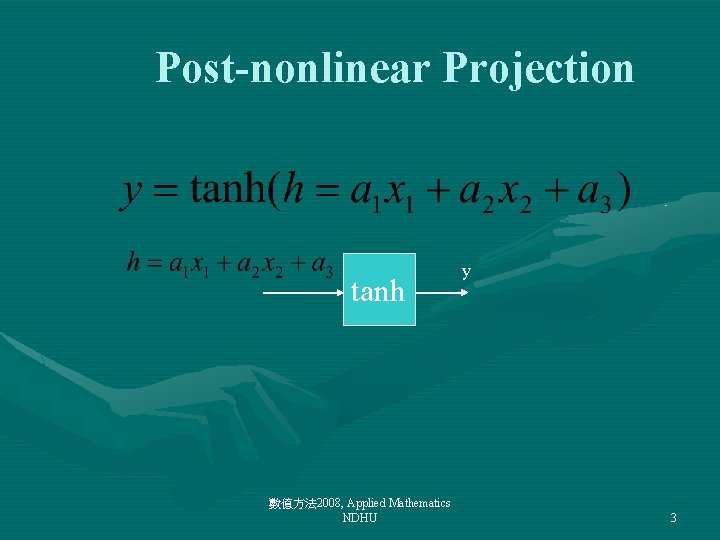
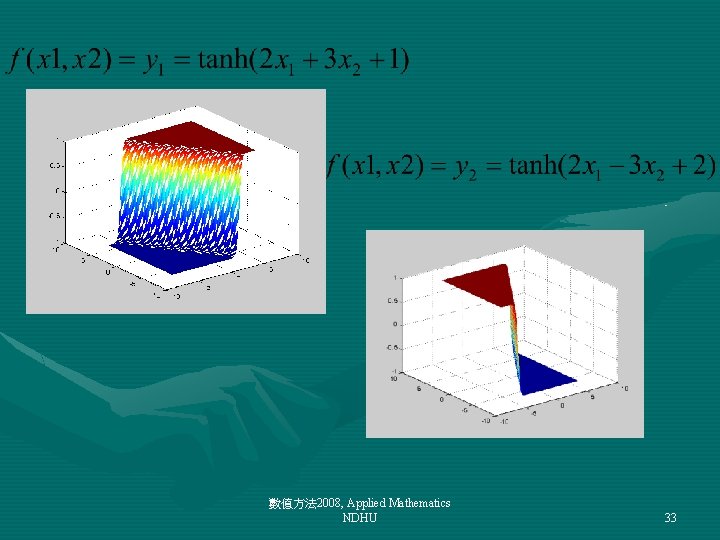
Post-nonlinear Projection tanh 數值方法 2008, Applied Mathematics NDHU y 3
Data generation • z[t]=tanh(a 1 z[t-1]+ a 2 z[t-2]+…+ a z[t- ])+ e[t], t= , …, N tanh 數值方法 2008, Applied Mathematics NDHU 4
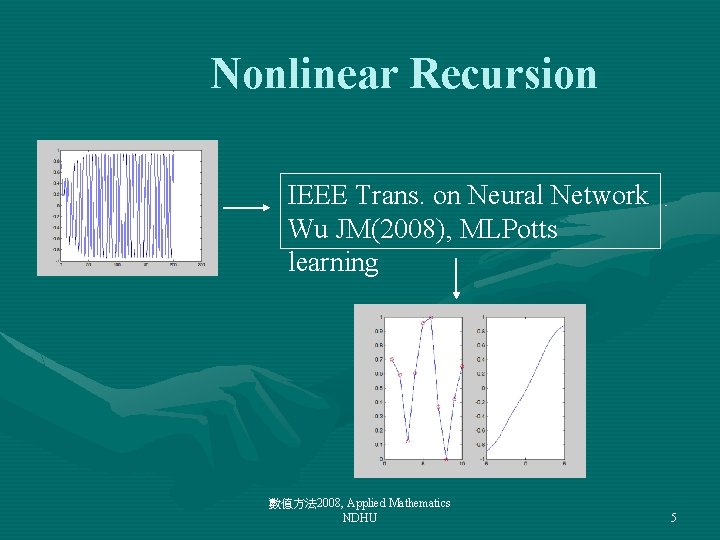
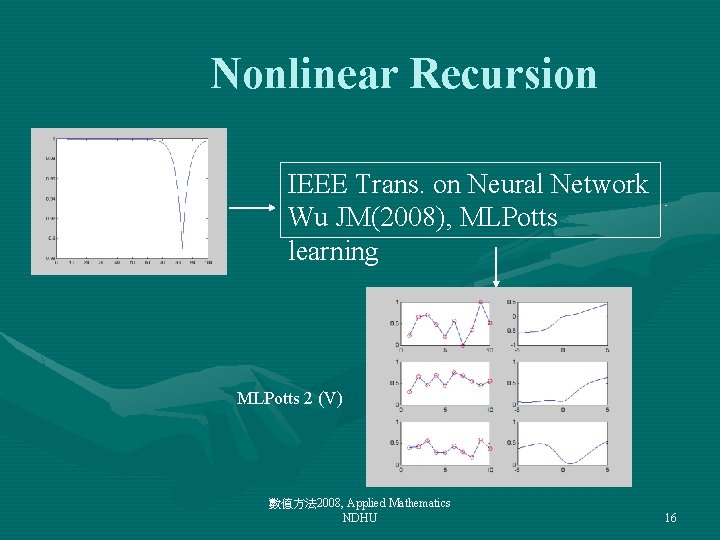
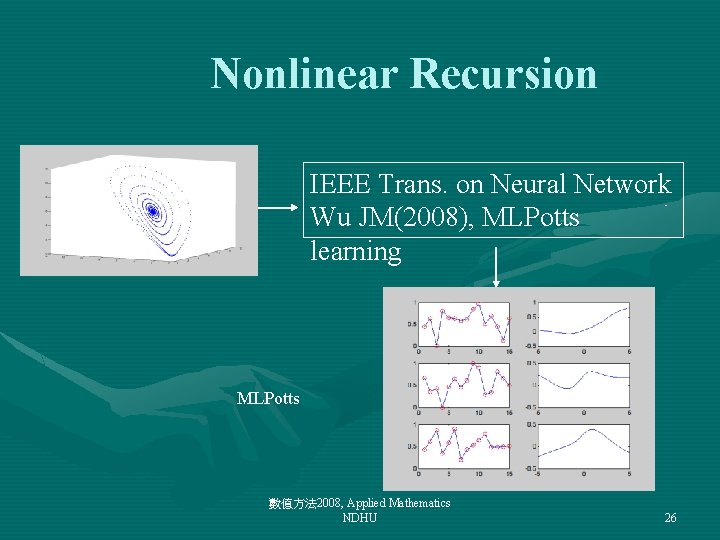
Nonlinear Recursion IEEE Trans. on Neural Network Wu JM(2008), MLPotts learning 數值方法 2008, Applied Mathematics NDHU 5
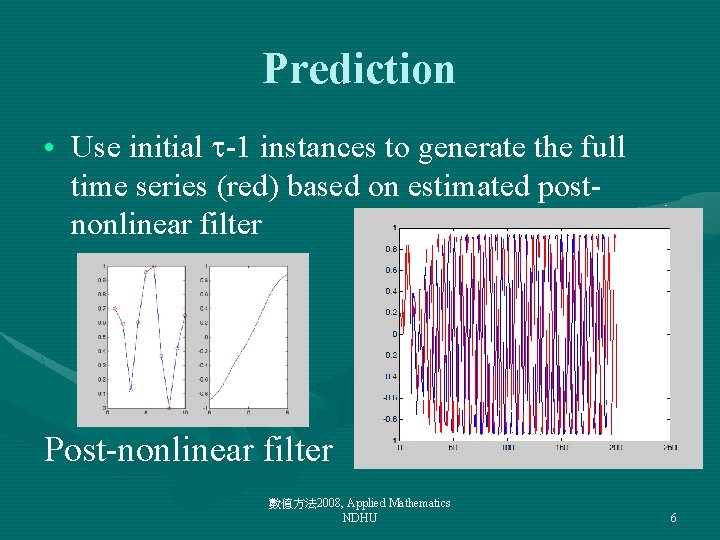
Prediction • Use initial -1 instances to generate the full time series (red) based on estimated postnonlinear filter Post-nonlinear filter 數值方法 2008, Applied Mathematics NDHU 6
Nonlinear recursions: hill-valley • Classify hill and valley UCI Machine Learning Repository 數值方法 2008, Applied Mathematics NDHU 7
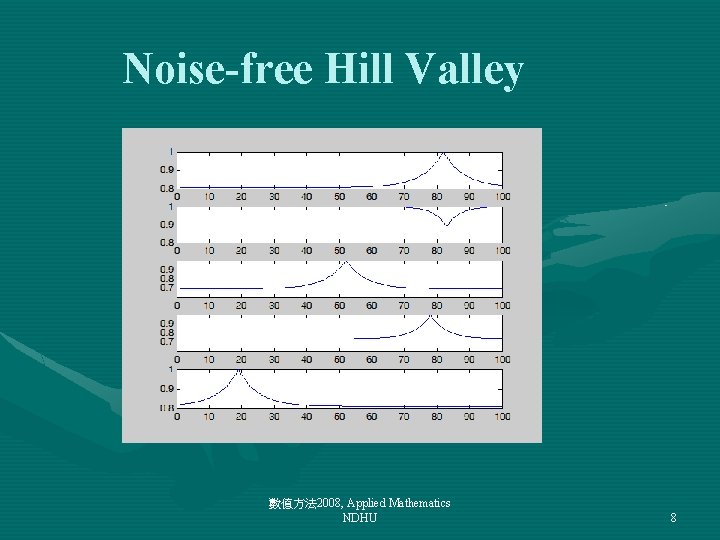
Noise-free Hill Valley 數值方法 2008, Applied Mathematics NDHU 8
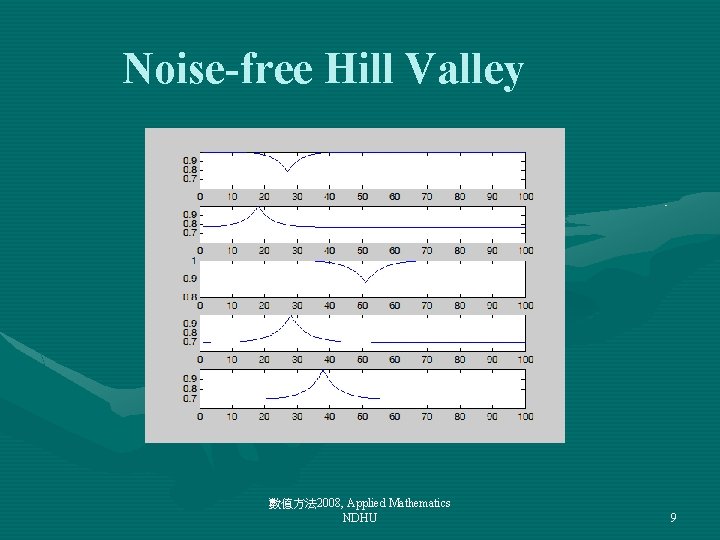
Noise-free Hill Valley 數值方法 2008, Applied Mathematics NDHU 9
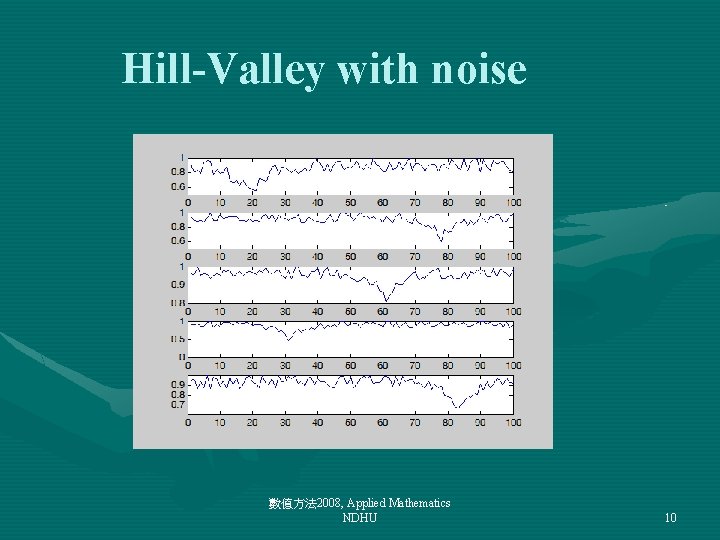
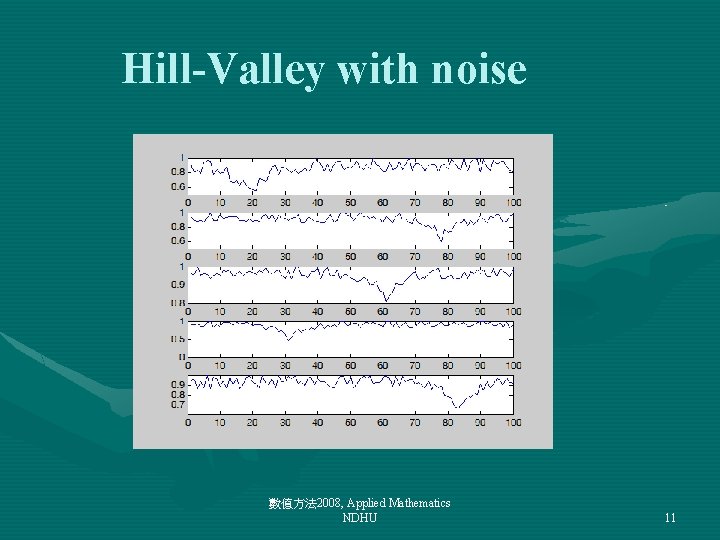
Hill-Valley with noise 數值方法 2008, Applied Mathematics NDHU 10
Hill-Valley with noise 數值方法 2008, Applied Mathematics NDHU 11
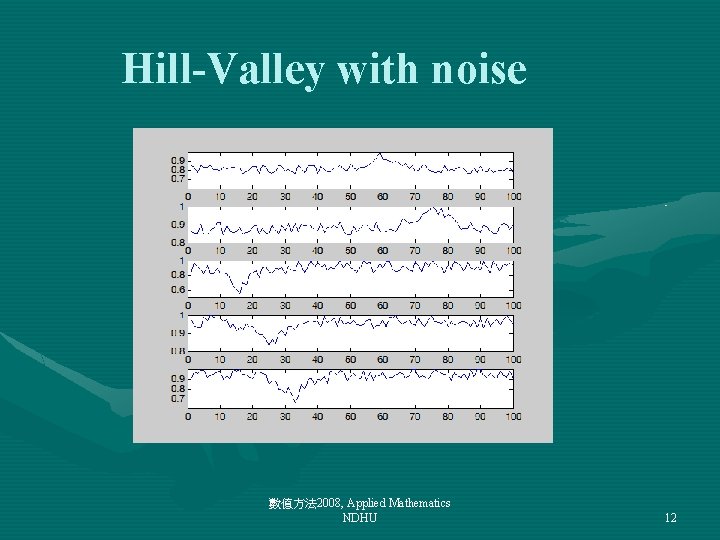
Hill-Valley with noise 數值方法 2008, Applied Mathematics NDHU 12
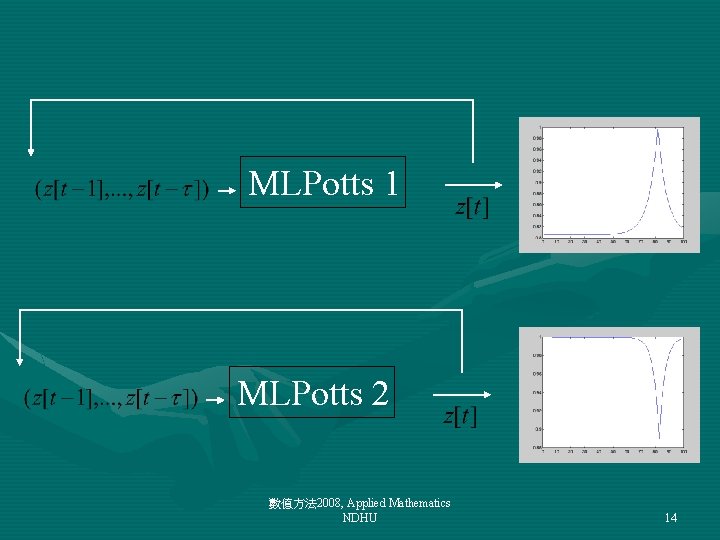
Nonlinear recursion • MLPotts: z[t]=F(z[t-1], z[t-2], …, z[t- ])+ e[t], t= , …, N MLPotts 1 數值方法 2008, Applied Mathematics NDHU 13
MLPotts 1 MLPotts 2 數值方法 2008, Applied Mathematics NDHU 14
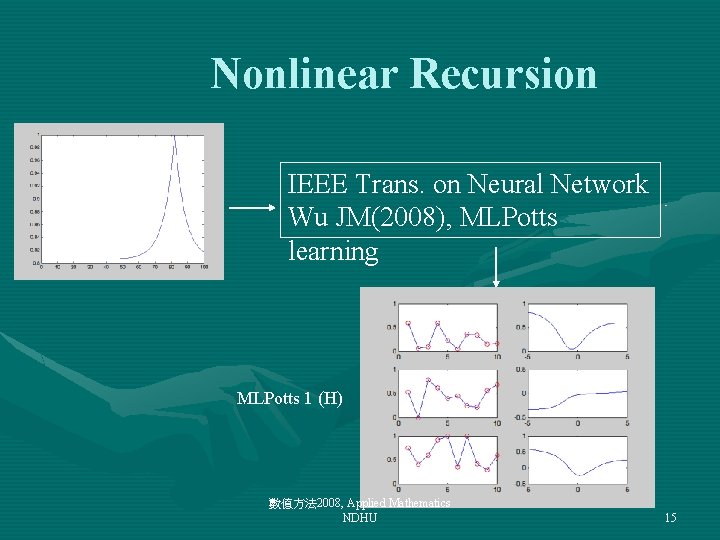
Nonlinear Recursion IEEE Trans. on Neural Network Wu JM(2008), MLPotts learning MLPotts 1 (H) 數值方法 2008, Applied Mathematics NDHU 15
Nonlinear Recursion IEEE Trans. on Neural Network Wu JM(2008), MLPotts learning MLPotts 2 (V) 數值方法 2008, Applied Mathematics NDHU 16
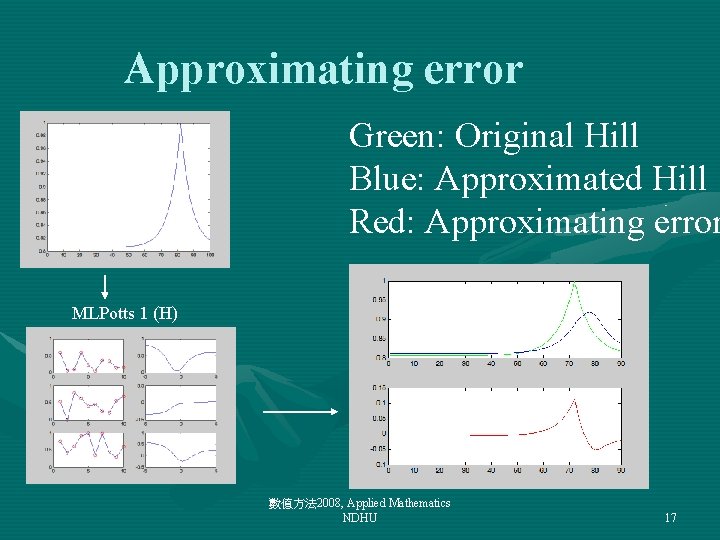
Approximating error Green: Original Hill Blue: Approximated Hill Red: Approximating error MLPotts 1 (H) 數值方法 2008, Applied Mathematics NDHU 17
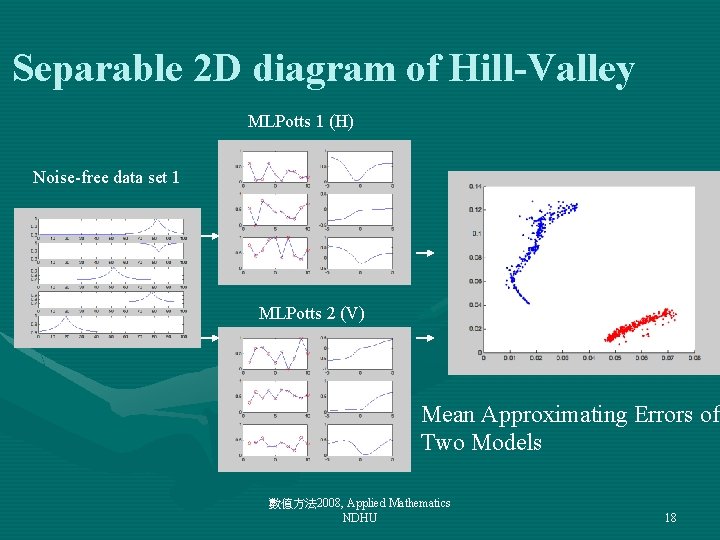
Separable 2 D diagram of Hill-Valley MLPotts 1 (H) Noise-free data set 1 MLPotts 2 (V) Mean Approximating Errors of Two Models 數值方法 2008, Applied Mathematics NDHU 18
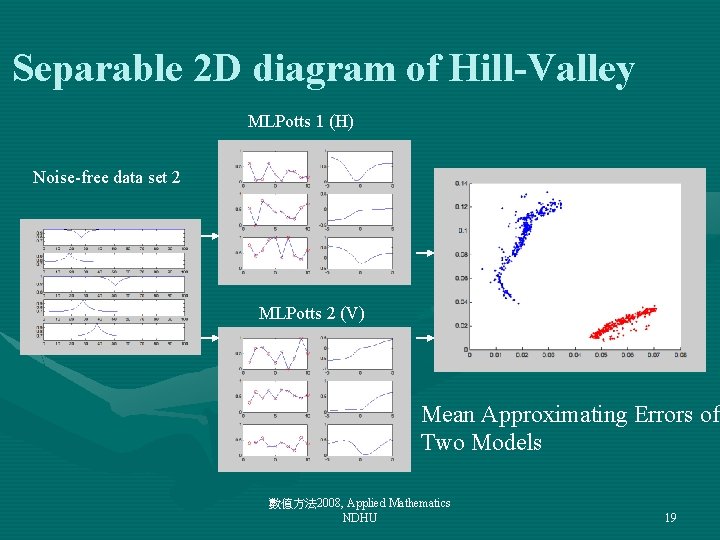
Separable 2 D diagram of Hill-Valley MLPotts 1 (H) Noise-free data set 2 MLPotts 2 (V) Mean Approximating Errors of Two Models 數值方法 2008, Applied Mathematics NDHU 19
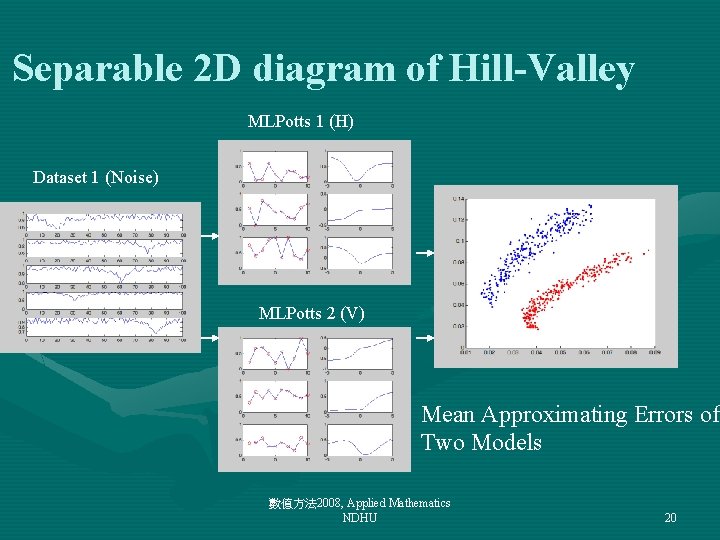
Separable 2 D diagram of Hill-Valley MLPotts 1 (H) Dataset 1 (Noise) MLPotts 2 (V) Mean Approximating Errors of Two Models 數值方法 2008, Applied Mathematics NDHU 20
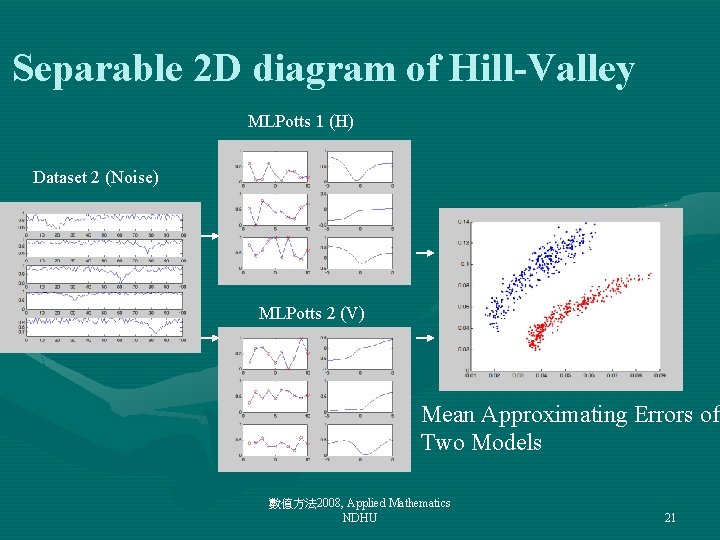
Separable 2 D diagram of Hill-Valley MLPotts 1 (H) Dataset 2 (Noise) MLPotts 2 (V) Mean Approximating Errors of Two Models 數值方法 2008, Applied Mathematics NDHU 21
Chaos Time Series • Eric's Home Page 數值方法 2008, Applied Mathematics NDHU 22
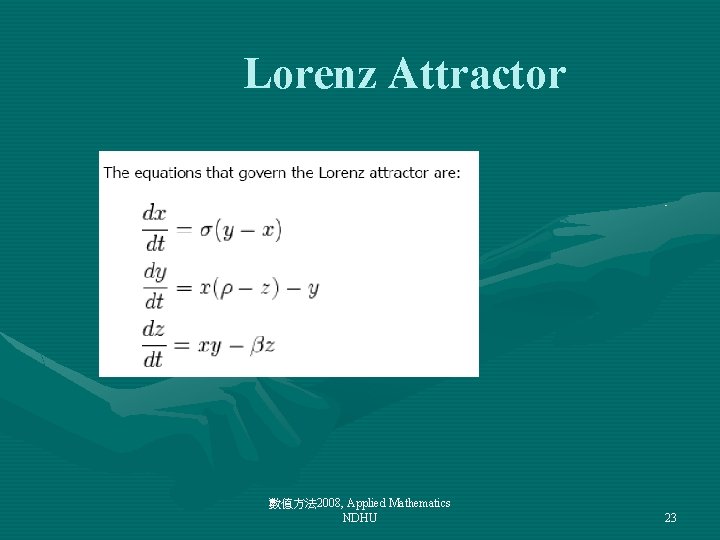
Lorenz Attractor 數值方法 2008, Applied Mathematics NDHU 23
Lorenz >> NN=20000; >> [x, y, z] = lorenz(NN); >> plot 3(x, y, z, '. '); 數值方法 2008, Applied Mathematics NDHU 24
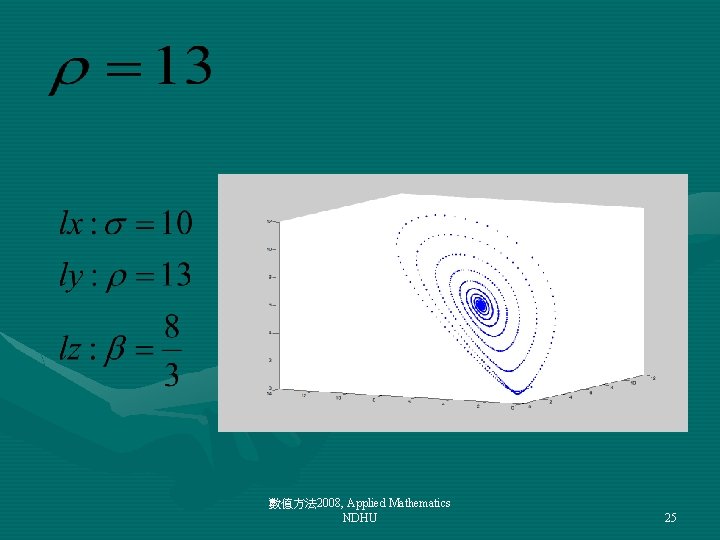
數值方法 2008, Applied Mathematics NDHU 25
Nonlinear Recursion IEEE Trans. on Neural Network Wu JM(2008), MLPotts learning MLPotts 數值方法 2008, Applied Mathematics NDHU 26
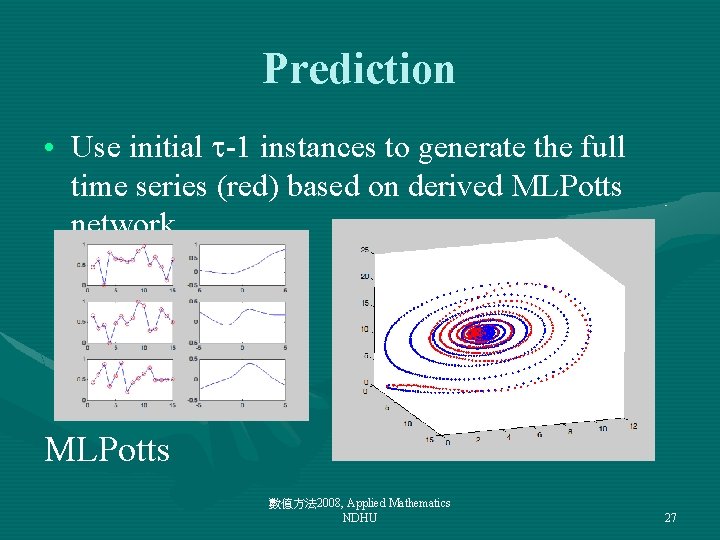
Prediction • Use initial -1 instances to generate the full time series (red) based on derived MLPotts network MLPotts 數值方法 2008, Applied Mathematics NDHU 27
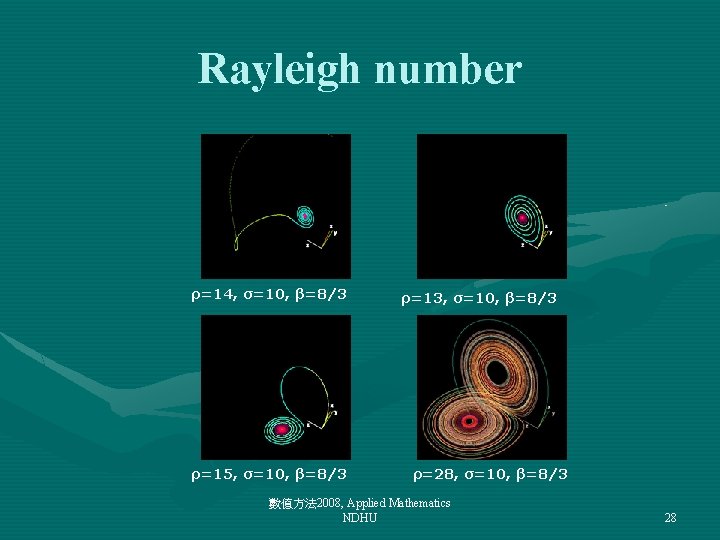
Rayleigh number ρ=14, σ=10, β=8/3 ρ=15, σ=10, β=8/3 ρ=13, σ=10, β=8/3 ρ=28, σ=10, β=8/3 數值方法 2008, Applied Mathematics NDHU 28
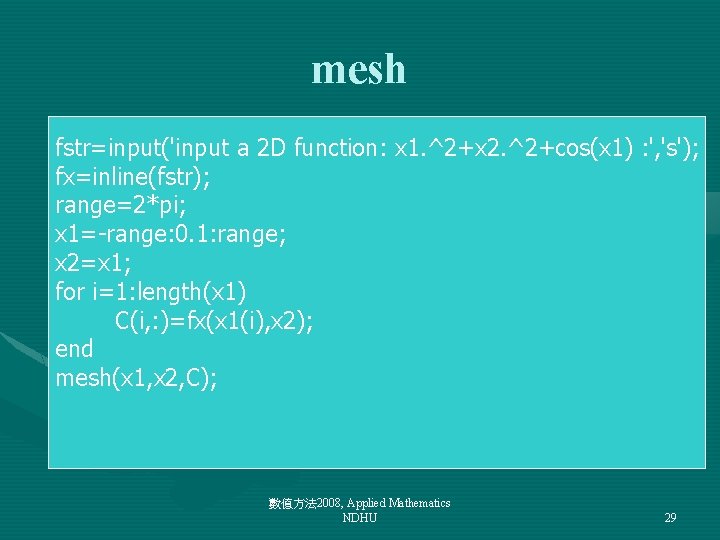
mesh fstr=input('input a 2 D function: x 1. ^2+x 2. ^2+cos(x 1) : ', 's'); fx=inline(fstr); range=2*pi; x 1=-range: 0. 1: range; x 2=x 1; for i=1: length(x 1) C(i, : )=fx(x 1(i), x 2); end mesh(x 1, x 2, C); 數值方法 2008, Applied Mathematics NDHU 29
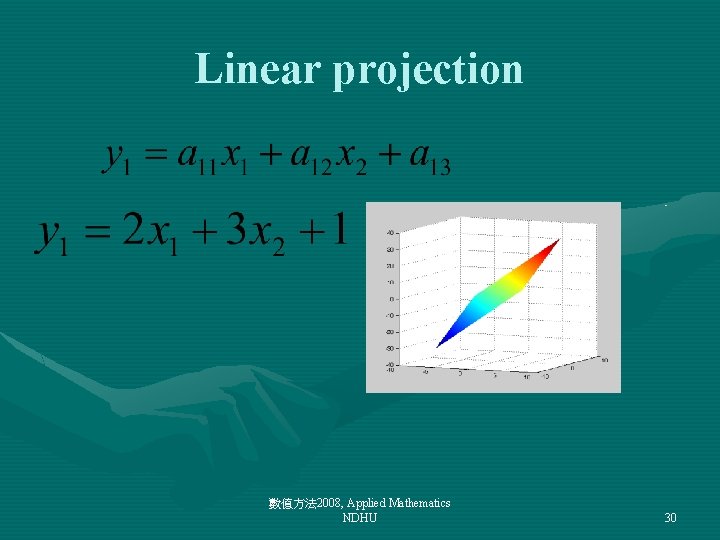
Linear projection 數值方法 2008, Applied Mathematics NDHU 30
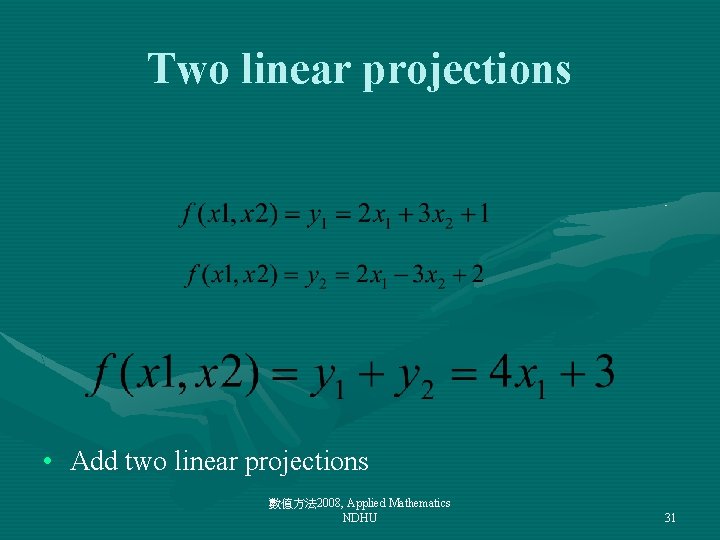
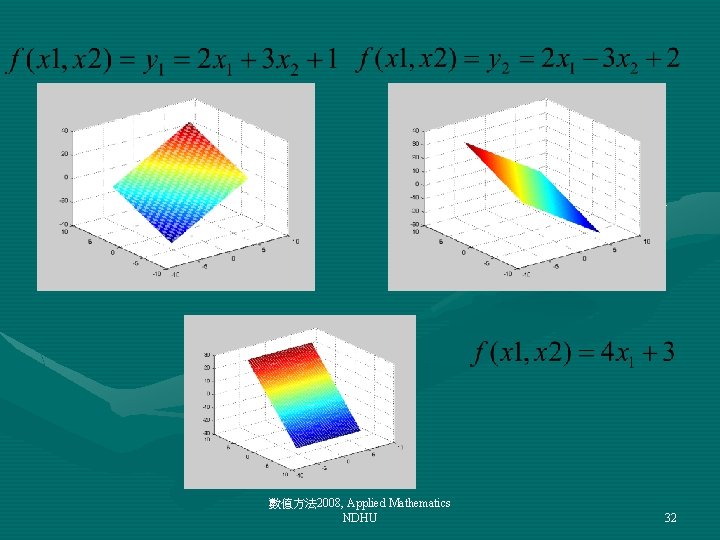
Two linear projections • Add two linear projections 數值方法 2008, Applied Mathematics NDHU 31
數值方法 2008, Applied Mathematics NDHU 32
數值方法 2008, Applied Mathematics NDHU 33
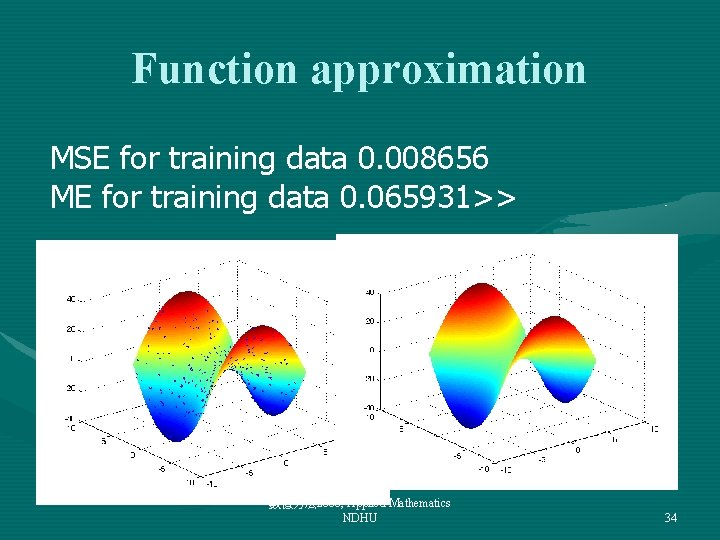
Function approximation MSE for training data 0. 008656 ME for training data 0. 065931>> 數值方法 2008, Applied Mathematics NDHU 34
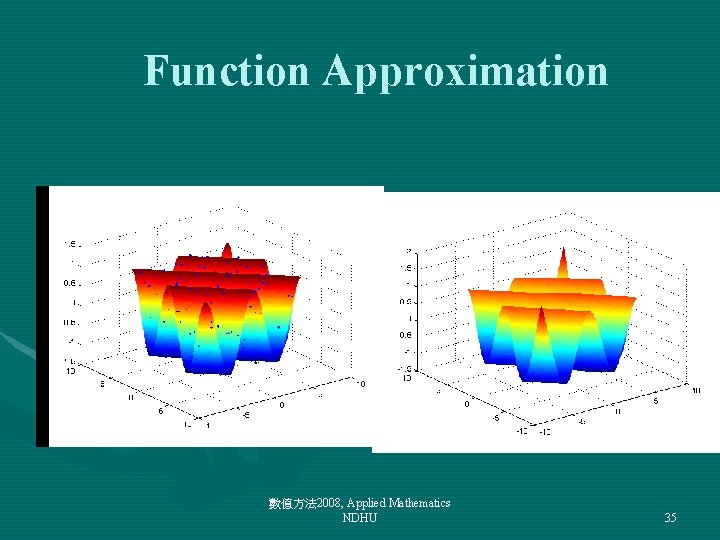
Function Approximation 數值方法 2008, Applied Mathematics NDHU 35
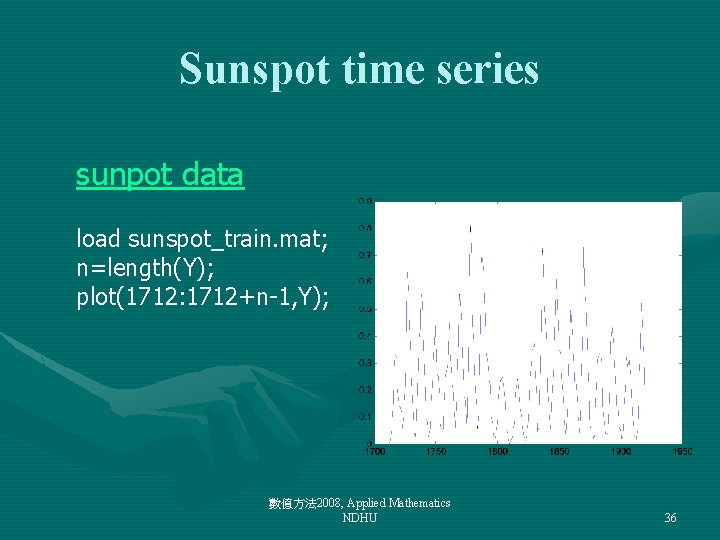
Sunspot time series sunpot data load sunspot_train. mat; n=length(Y); plot(1712: 1712+n-1, Y); 數值方法 2008, Applied Mathematics NDHU 36
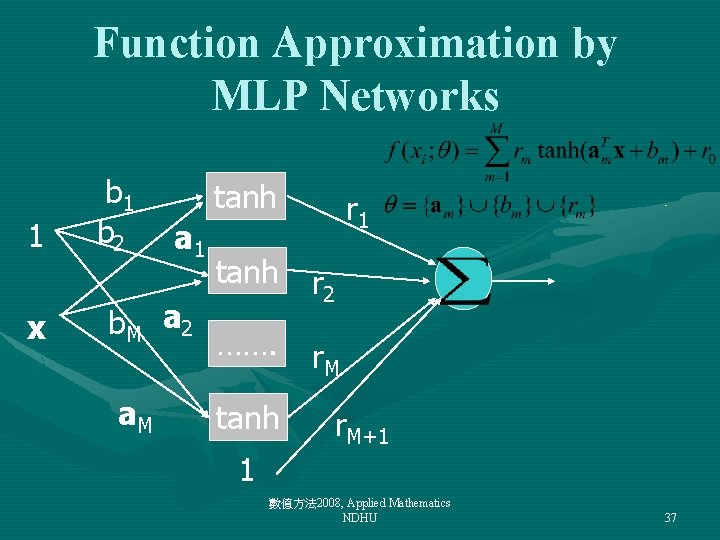
Function Approximation by MLP Networks 1 x b 1 b 2 tanh a 1 b. M a 2 a. M r 1 tanh r 2 ……. r. M tanh r. M+1 1 數值方法 2008, Applied Mathematics NDHU 37
Paired data x=[]; len=3; for i=1: n-len p=Y(i: i+len-1)'; x=[x p]; y(i)=Y(i+len); end figure; plot 3(x(2, : ), x(1, : ), y, '. '); hold on; 數值方法 2008, Applied Mathematics NDHU 38
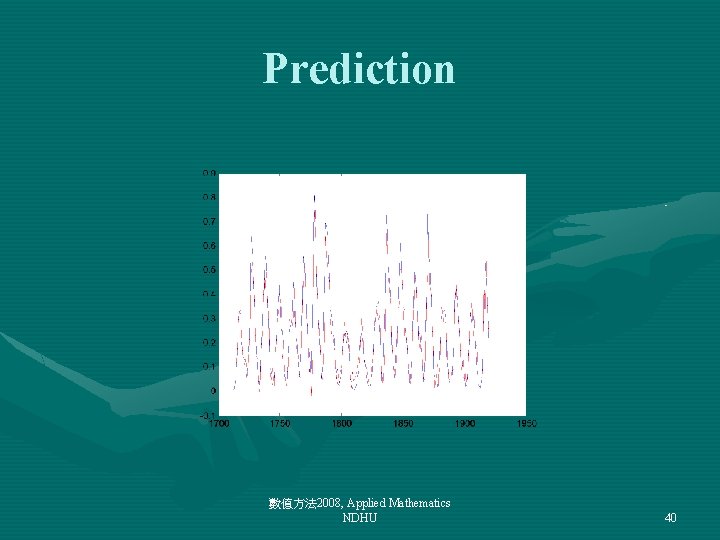
Learning and prediction M=input('keyin the number of hidden units: '); [a, b, r]=learn_MLP(x', y', M); y=eval_MLP 2(x, r, a, b, M); hold on; plot(1712+2: 1712+2+length(y)-1, y, 'r') MSE for training data 0. 005029 ME for training data 0. 052191 K 數值方法 2008, Applied Mathematics NDHU 39
Prediction 數值方法 2008, Applied Mathematics NDHU 40
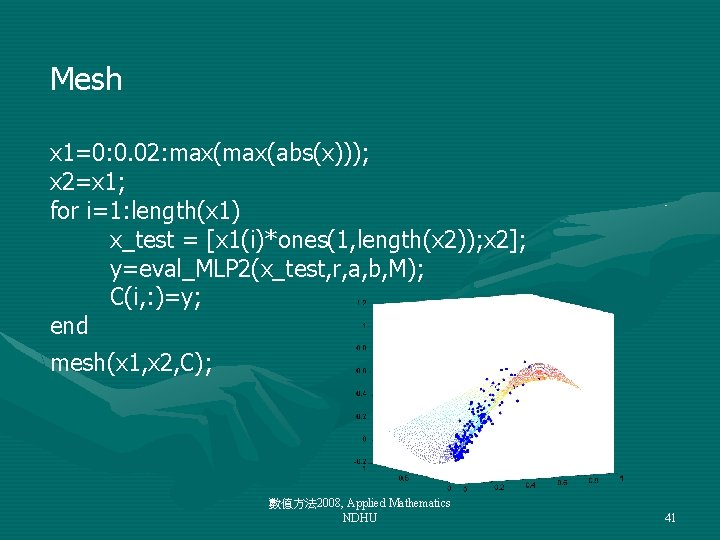
Mesh x 1=0: 0. 02: max(abs(x))); x 2=x 1; for i=1: length(x 1) x_test = [x 1(i)*ones(1, length(x 2)); x 2]; y=eval_MLP 2(x_test, r, a, b, M); C(i, : )=y; end mesh(x 1, x 2, C); 數值方法 2008, Applied Mathematics NDHU 41
Sunspot Source codes 數值方法 2008, Applied Mathematics NDHU 42
Paired data x=[]; len=5; for i=1: n-len p=Y(i: i+len-1)'; x=[x p]; y(i)=Y(i+len); end 數值方法 2008, Applied Mathematics NDHU 43
Learning and prediction M=input('keyin the number of hidden units: '); [a, b, r]=learn_MLP(x', y', M); y=eval_MLP 2(x, r, a, b, M); hold on; plot(1712+2: 1712+2+length(y)-1, y, 'r') ? ? ? 數值方法 2008, Applied Mathematics NDHU 44
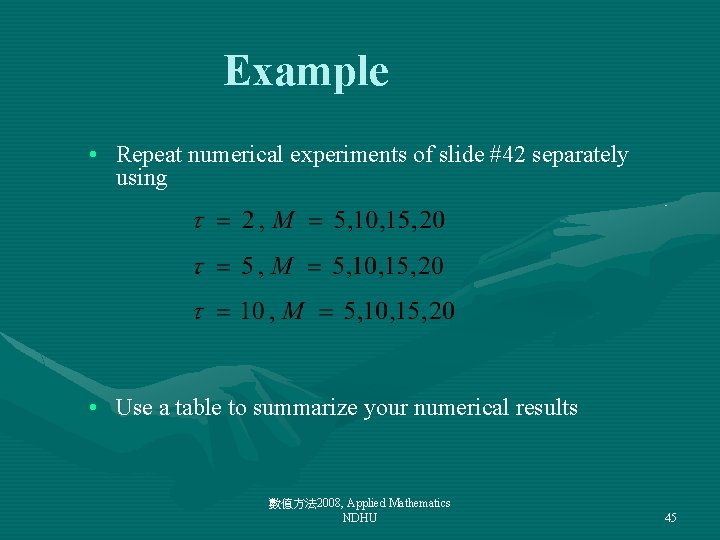
Example • Repeat numerical experiments of slide #42 separately using • Use a table to summarize your numerical results 數值方法 2008, Applied Mathematics NDHU 45