
Knowledge Management July 28 th 2011 Administration Quiz

- Slides: 41
Knowledge Management July 28 th, 2011
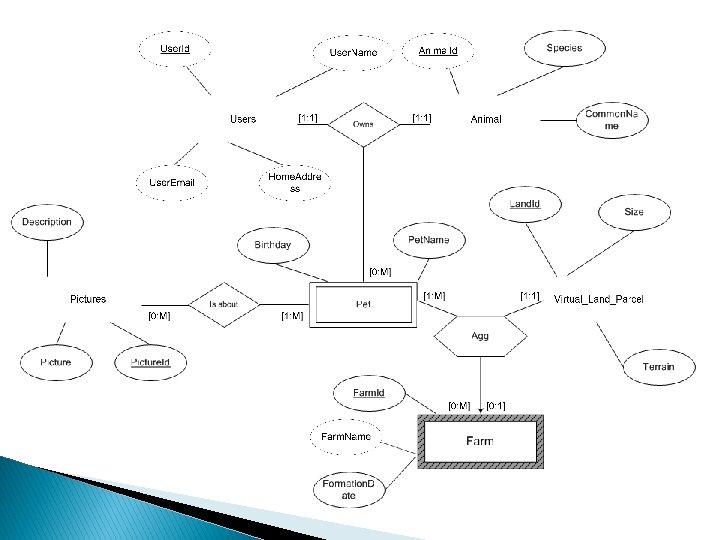
Administration � Quiz today � Tomorrow a fun activity � Go over ER Diagram and Relational Schema � Coming to the end of our “data” module of this course with today’s lecture on “knowledge management”
Learning Objectives � Create an ER Diagram and Relational Database Schema (Recap) � Describe at a high-level how you turn a relational database schema into a working database � Define Knowledge � Compare and contrast explicit knowledge and tacit knowledge � Define Knowledge Management Systems (KMS) � Outline the Knowledge Management Cycle
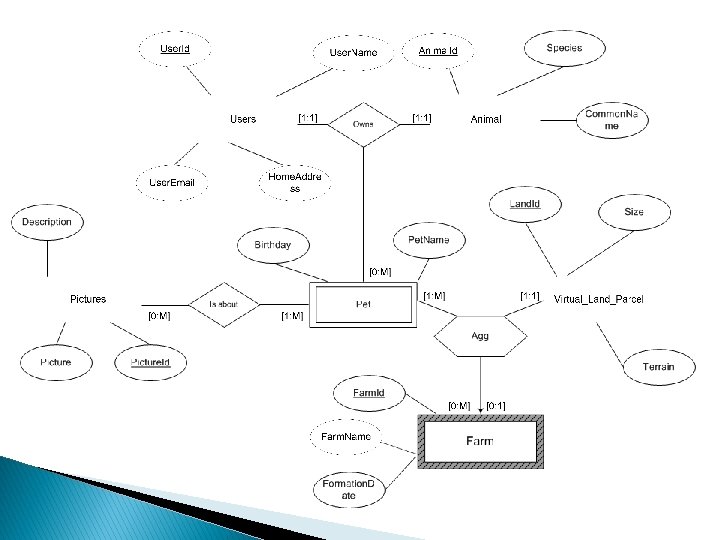
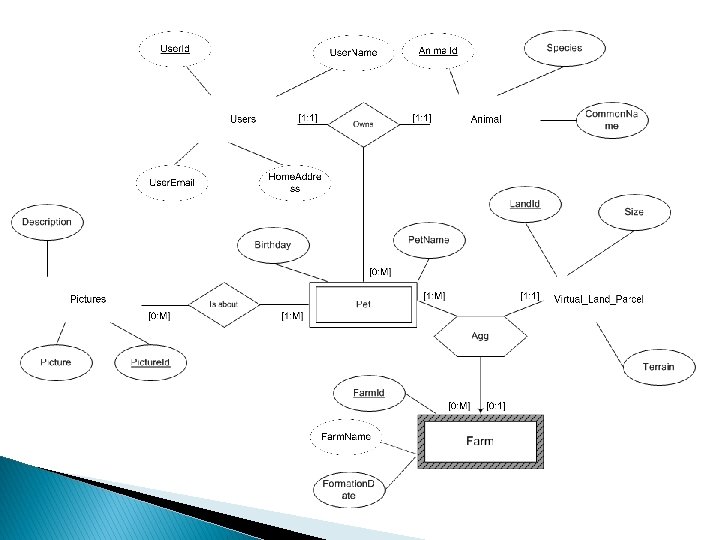
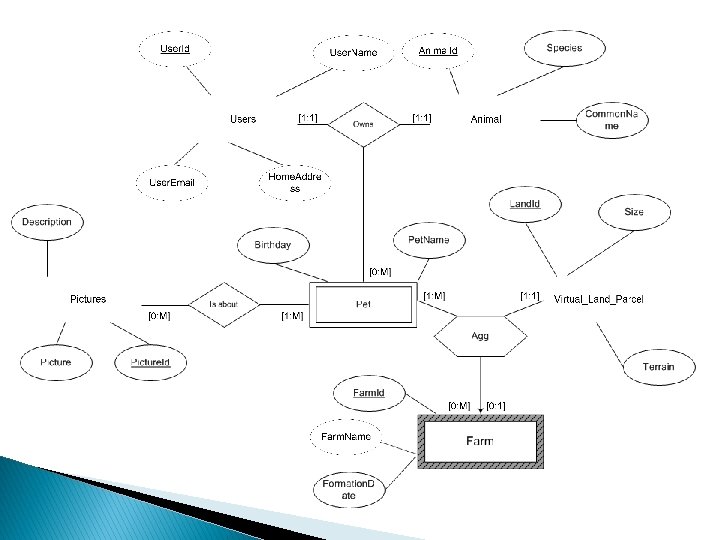
Assignment 3 Recap � ER Diagram and Relational Database Schema � Repetition, repletion … leads to learning � Average 79. 79% � High: 98% � Rebuttal Process
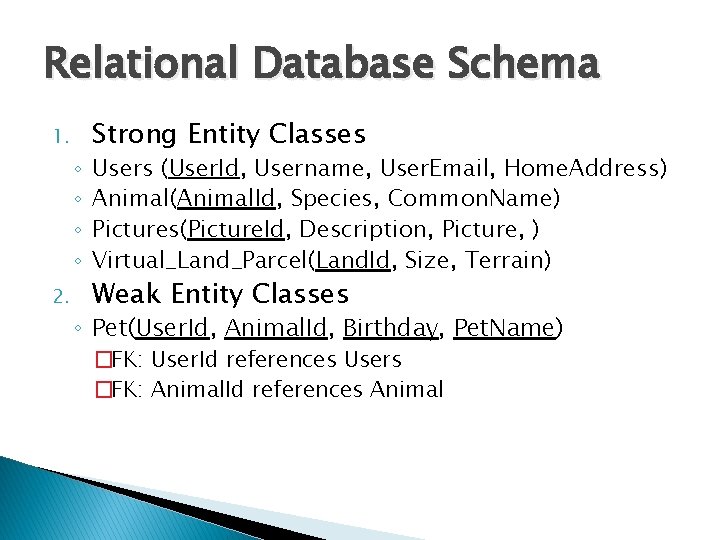
Relational Database Schema 1. ◦ ◦ 2. Strong Entity Classes Users (User. Id, Username, User. Email, Home. Address) Animal(Animal. Id, Species, Common. Name) Pictures(Picture. Id, Description, Picture, ) Virtual_Land_Parcel(Land. Id, Size, Terrain) Weak Entity Classes ◦ Pet(User. Id, Animal. Id, Birthday, Pet. Name) �FK: User. Id references Users �FK: Animal. Id references Animal
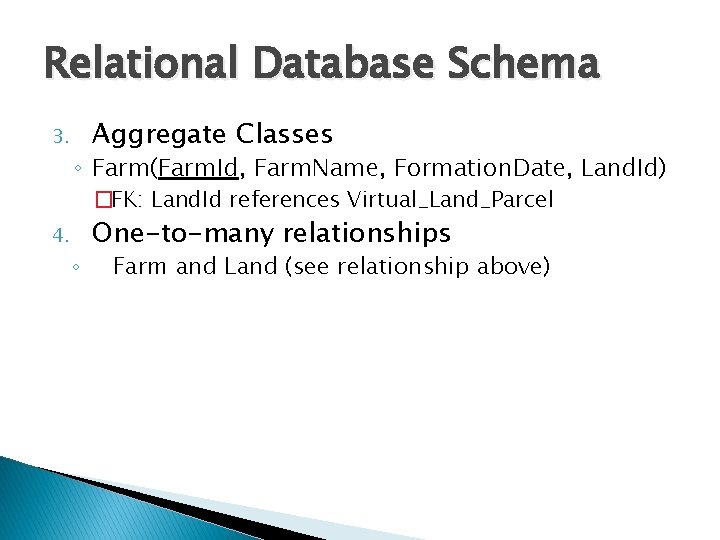
Relational Database Schema 3. Aggregate Classes ◦ Farm(Farm. Id, Farm. Name, Formation. Date, Land. Id) �FK: Land. Id references Virtual_Land_Parcel 4. ◦ One-to-many relationships Farm and Land (see relationship above)
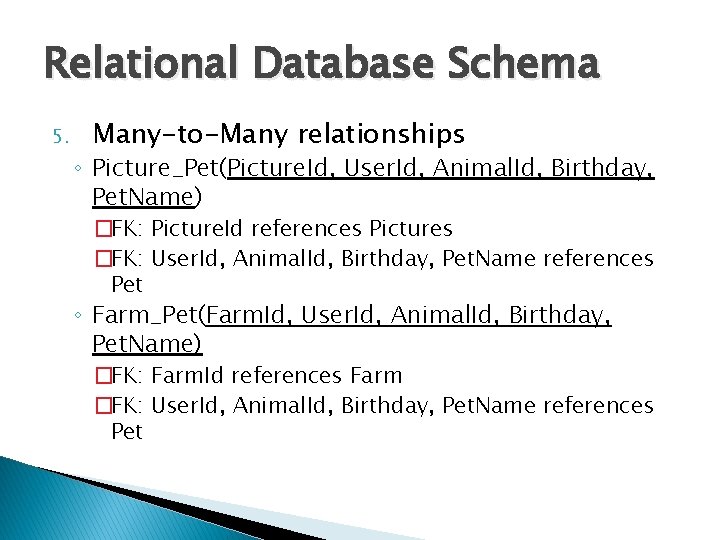
Relational Database Schema 5. Many-to-Many relationships ◦ Picture_Pet(Picture. Id, User. Id, Animal. Id, Birthday, Pet. Name) �FK: Picture. Id references Pictures �FK: User. Id, Animal. Id, Birthday, Pet. Name references Pet ◦ Farm_Pet(Farm. Id, User. Id, Animal. Id, Birthday, Pet. Name) �FK: Farm. Id references Farm �FK: User. Id, Animal. Id, Birthday, Pet. Name references Pet
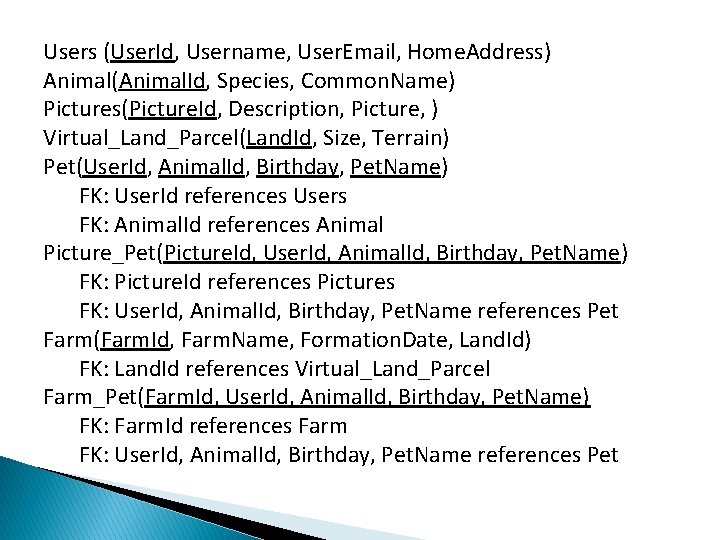
Users (User. Id, Username, User. Email, Home. Address) Animal(Animal. Id, Species, Common. Name) Pictures(Picture. Id, Description, Picture, ) Virtual_Land_Parcel(Land. Id, Size, Terrain) Pet(User. Id, Animal. Id, Birthday, Pet. Name) FK: User. Id references Users FK: Animal. Id references Animal Picture_Pet(Picture. Id, User. Id, Animal. Id, Birthday, Pet. Name) FK: Picture. Id references Pictures FK: User. Id, Animal. Id, Birthday, Pet. Name references Pet Farm(Farm. Id, Farm. Name, Formation. Date, Land. Id) FK: Land. Id references Virtual_Land_Parcel Farm_Pet(Farm. Id, User. Id, Animal. Id, Birthday, Pet. Name) FK: Farm. Id references Farm FK: User. Id, Animal. Id, Birthday, Pet. Name references Pet
Questions?
Great, I have a relational database schema…. . What next? � We need to communicate the relational database schema to a database application on a computer.
How do we do that � SQL ◦ http: //www. w 3 school s. com/sql/ � Structured Language Query ◦ a database computer declarative language designed for managing data in relational database management systems
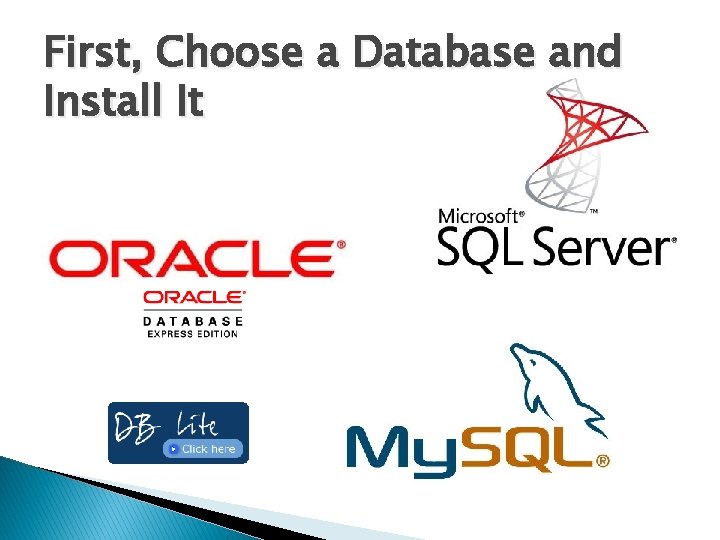
First, Choose a Database and Install It
Configuring � Set password � Security � Ports � Management preferences
Second, Create a Database � CREATE DATABASE animal_lingo ◦ https: //p 3 nlmysqladm 001. secureserver. net/grid 50 /1529/index. php? unique. Dns. Entry=testmis 111. db. 7 217657. hostedresource. com ◦ security
Third, convert relational table to SQL and execute � http: //www. w 3 schools. com/sql/
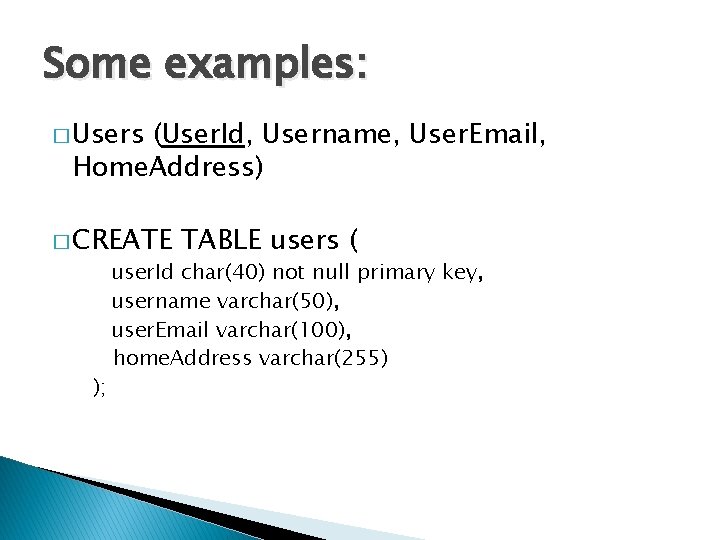
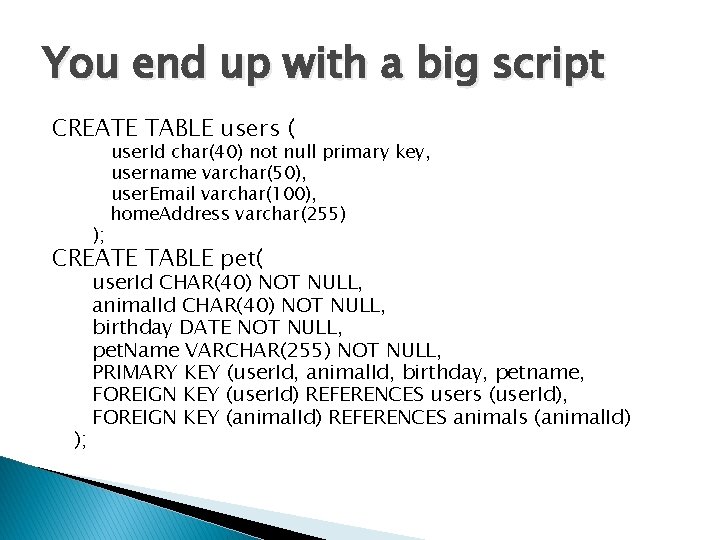
Some examples: � Users (User. Id, Username, User. Email, Home. Address) � CREATE ); TABLE users ( user. Id char(40) not null primary key, username varchar(50), user. Email varchar(100), home. Address varchar(255)
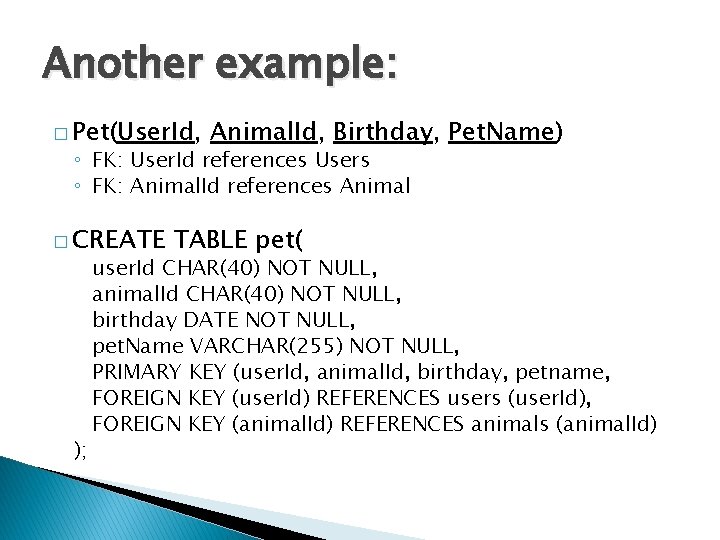
Another example: � Pet(User. Id, Animal. Id, Birthday, Pet. Name) ◦ FK: User. Id references Users ◦ FK: Animal. Id references Animal � CREATE ); TABLE pet( user. Id CHAR(40) NOT NULL, animal. Id CHAR(40) NOT NULL, birthday DATE NOT NULL, pet. Name VARCHAR(255) NOT NULL, PRIMARY KEY (user. Id, animal. Id, birthday, petname, FOREIGN KEY (user. Id) REFERENCES users (user. Id), FOREIGN KEY (animal. Id) REFERENCES animals (animal. Id)
You end up with a big script CREATE TABLE users ( ); user. Id char(40) not null primary key, username varchar(50), user. Email varchar(100), home. Address varchar(255) CREATE TABLE pet( ); user. Id CHAR(40) NOT NULL, animal. Id CHAR(40) NOT NULL, birthday DATE NOT NULL, pet. Name VARCHAR(255) NOT NULL, PRIMARY KEY (user. Id, animal. Id, birthday, petname, FOREIGN KEY (user. Id) REFERENCES users (user. Id), FOREIGN KEY (animal. Id) REFERENCES animals (animal. Id)
Finally, you can insert, updated, delete, and view data in your program
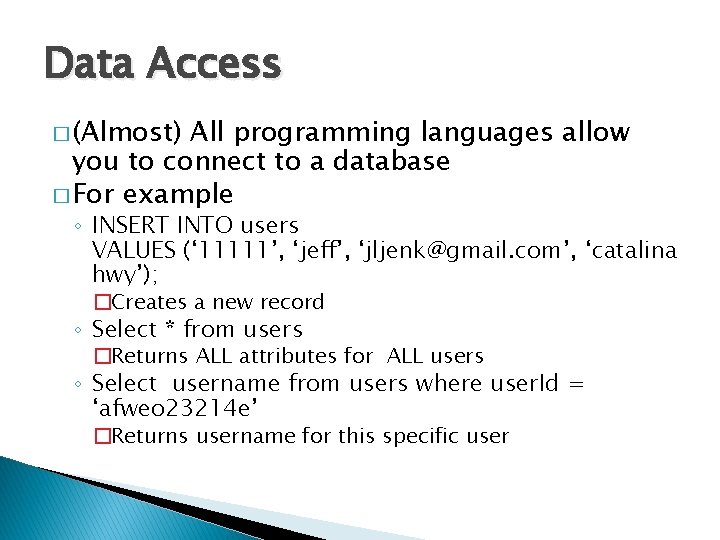
Data Access � (Almost) All programming languages allow you to connect to a database � For example ◦ INSERT INTO users VALUES (‘ 11111’, ‘jeff’, ‘jljenk@gmail. com’, ‘catalina hwy’); �Creates a new record ◦ Select * from users �Returns ALL attributes for ALL users ◦ Select username from users where user. Id = ‘afweo 23214 e’ �Returns username for this specific user
� You can do a lot of stuff … whole classes are dedicated to this � http: //www. w 3 schools. com/sql/
Knowledge Management
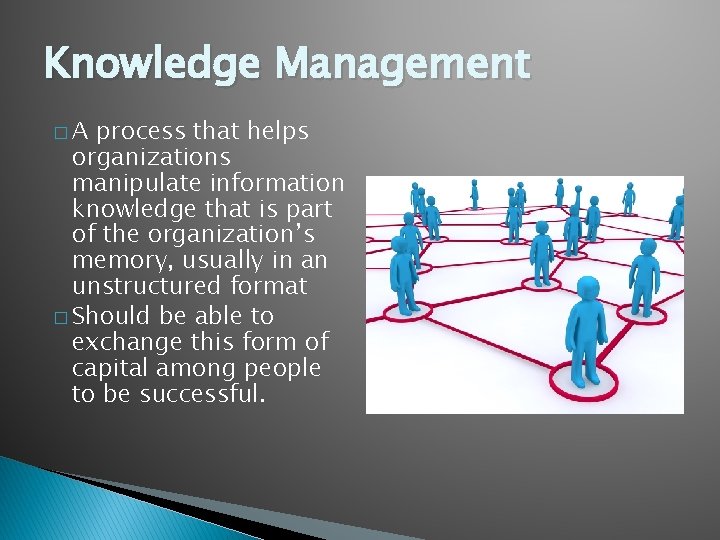
Knowledge Management �A process that helps organizations manipulate information knowledge that is part of the organization’s memory, usually in an unstructured format � Should be able to exchange this form of capital among people to be successful.
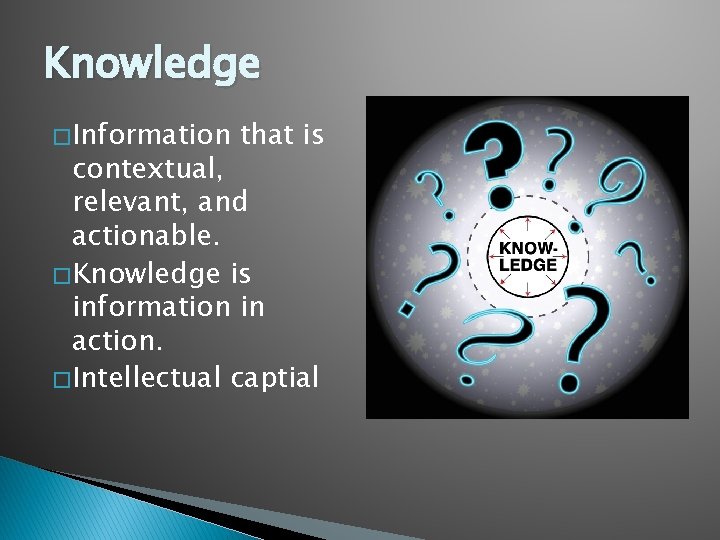
Knowledge � Information that is contextual, relevant, and actionable. � Knowledge is information in action. � Intellectual captial
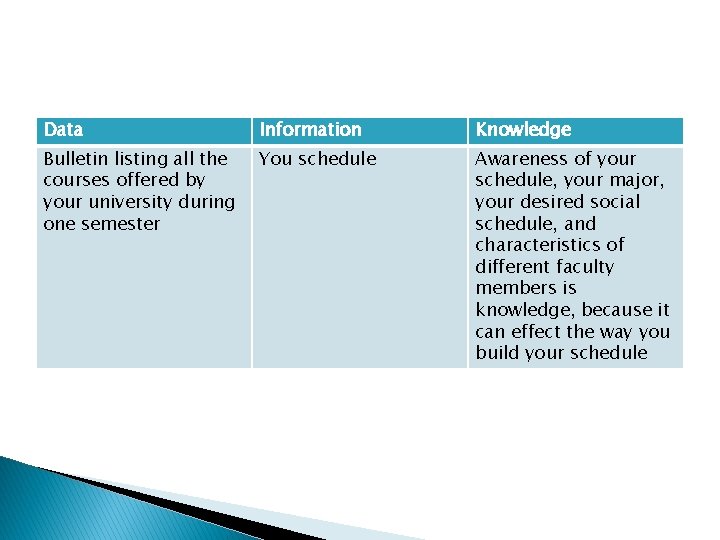
Data Information Knowledge Bulletin listing all the courses offered by your university during one semester You schedule Awareness of your schedule, your major, your desired social schedule, and characteristics of different faculty members is knowledge, because it can effect the way you build your schedule
Two types of knowledge � Explicit Knowledge � Tacit Knowledge
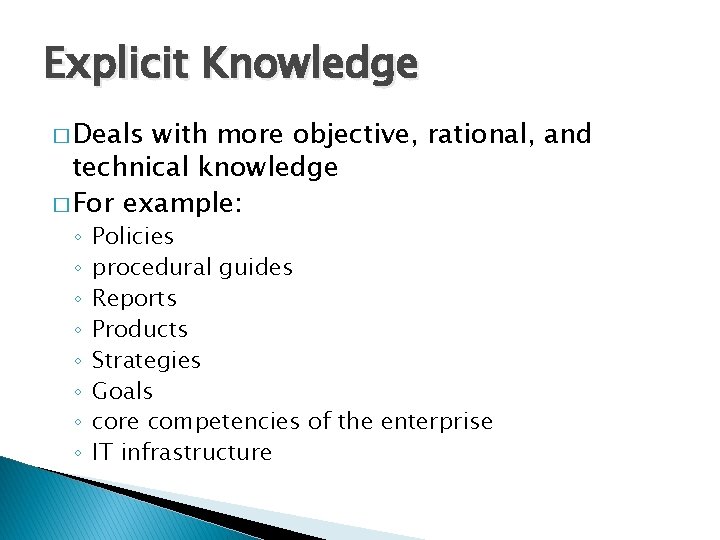
Explicit Knowledge � Deals with more objective, rational, and technical knowledge � For example: ◦ ◦ ◦ ◦ Policies procedural guides Reports Products Strategies Goals core competencies of the enterprise IT infrastructure
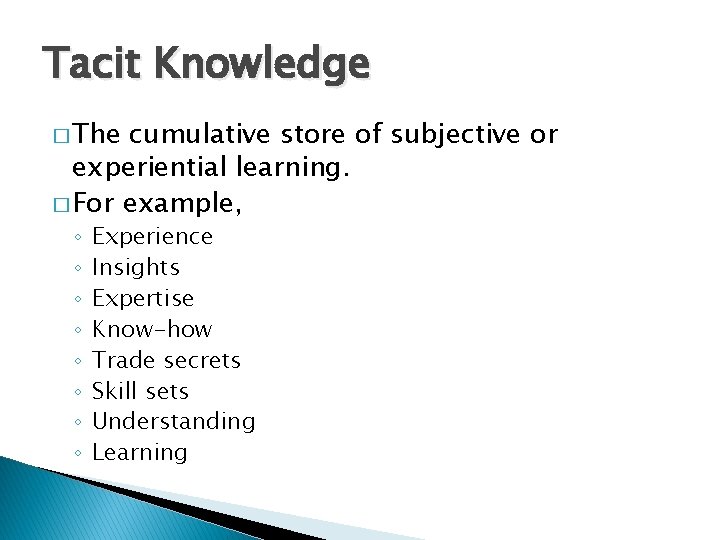
Tacit Knowledge � The cumulative store of subjective or experiential learning. � For example, ◦ ◦ ◦ ◦ Experience Insights Expertise Know-how Trade secrets Skill sets Understanding Learning
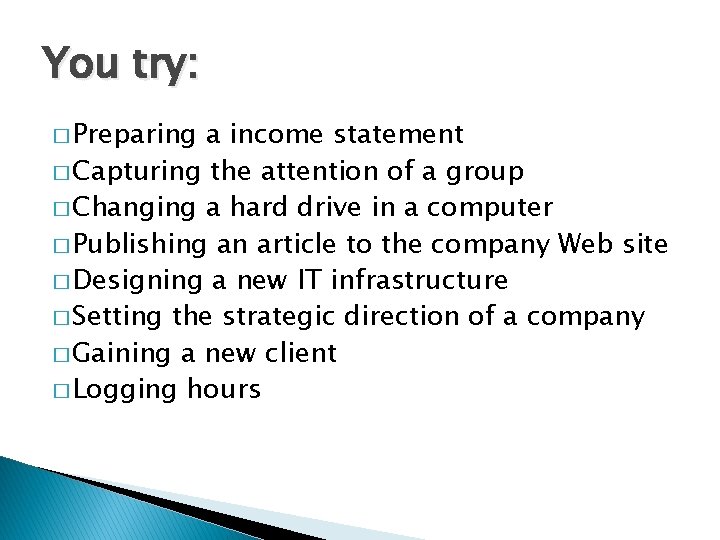
You try: � Preparing a income statement � Capturing the attention of a group � Changing a hard drive in a computer � Publishing an article to the company Web site � Designing a new IT infrastructure � Setting the strategic direction of a company � Gaining a new client � Logging hours
Knowledge Management System � Refer to the use of modern information technologies—the Internet, intranets, extranets, Lotus notes, data warehouses—to systematize, enhance, and expedite intrafirm and interfirm knowledge management
For example � Wikis � Training manuals � Document repositories � Databases � Social networks � Knowledge Management Software
Which is harder to capture? � Explicit Knowledge or Tacit Knowledge
Why is knowledge hard to capture?
How would you build a system or process to address these problems? What do you think a knowledge management system should look like?
Credits: � Rainer and Cegielski 3 rd Edition, “Introduction to Information Systems—Supporting and Transforming Business”
Questions about Quiz?
Quiz � Closed book, closed neighbor � Good luck!