INTRODUCTION No work is completely risk free and






- Slides: 113
INTRODUCTION • No work is completely risk free and all health care professionals should have some basic knowledge about workforce populations, work and related hazards, and methods to control hazards and. improve health
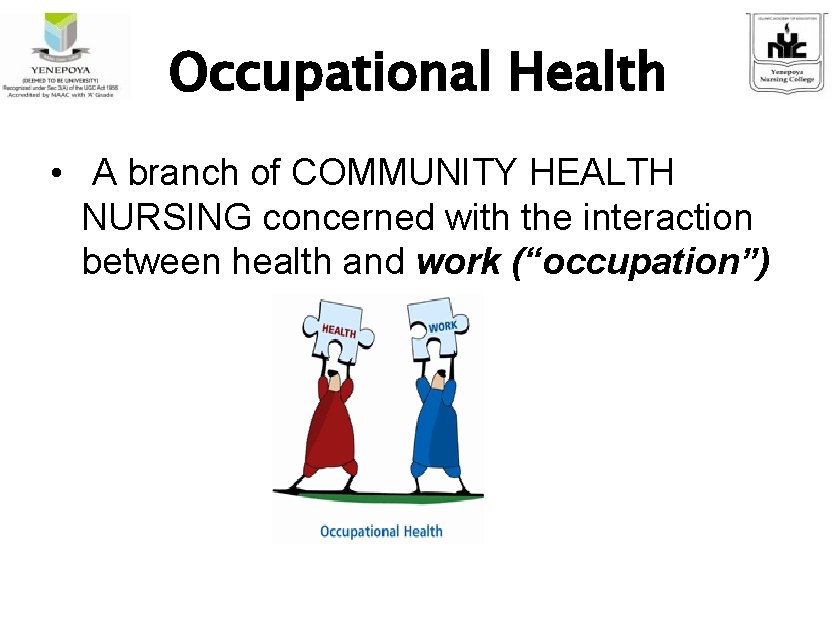
Occupational Health • A branch of COMMUNITY HEALTH NURSING concerned with the interaction between health and work (“occupation”)
DEFINITION: • The joint international labor organization committee on Occupational health, 1950 defined occupational health as “The highest degree of physical, mental and social well-being of workers in all occupations. ”
GOALS • To reduce industrial accidents. • To prevent occupational hazards/ diseases. • To achieve maximum human efficiency and machine efficiency. • To reduce sick absenteeism.
OBJECTIVES OF OCCUPATIONAL HEALTH: • To maintain and promote the physical, mental and social well being of the workers. • To prevent occupational diseases and injuries. • To adapt the work place and work environment to the needs of the workers i. e application of ergonomics principle. • It should be preventive rather than curative.
OCCUPATIONAL HEALTH It represents a dynamic equilibrium between the worker and his occupational environment.
ERGONOMICS • MEANING -"fitting the job to the worker” • Design the workplace and the job to fit the worker. • It deals with designing and changing the workplace to ensure employees are not injured or made unusually uncomfortable when working.
OCCUPATIONAL HAZARD: • A working condition that can lead to illness or death. • Danger to health, limb, or life that is inherent in, or is associated with, a particular occupation, industry , or work environment. • Occupational hazards include risk of accident and of contracting occupational diseases.
CLASSIFICATION: • A worker may be exposed to five types of hazards, depending upon his/her occupation: • Physical Hazards • Chemical Hazards • Biological Hazards • Mechanical Hazards • Psychosocial Hazards
Physical Hazards • • 1. Heat and Cold In India, the most common physical hazard is heat. The direct effects of heat exposure are burns, heat exhaustion, heat stroke and heat cramps; The indirect effects are decreased efficiency, increased fatigue and enhanced accident rates. Many industries have local “hot spots” – ovens and furnaces, which radiate heat.
• Radiant heat is the main problem in foundry, glass and steel industries, while heat stagnation is the principal problem in jute and cotton textile. • High temperatures are also found in mines. • Physical work under such conditions is very stressful and impairs the health and efficiency of the workers.
• Important hazards associated with cold work are chilblains, erythrocyanosis, immersion foot, and frostbite as a result of cutaneous vasoconstriction and hypothermia
2. Light • The workers may be exposed to the risk of poor illumination or excessive brightness. • The acute effects of poor illumination are eye strain, headache, eye pain, lachrymation, congestion around the cornea and eye fatigue. • The chronic effects on health include “miner’s nystagmus”. • Exposure to excessive brightness or “glare” is associated with discomfort, annoyance and visual fatigue.
• Intense direct glare may also result in blurring of vision and lead to accidents. • There should be sufficient and suitable lighting, natural or artificial, wherever persons are working.
3. Noise • Noise is a health hazard in many industries. The effects of noise are of two types: • (i) Auditory effects - which consist of temporary or permanent hearing loss • (ii) Non-auditory effects – which consist of nervousness, fatigue, interference with communication by speech, decreased efficiency and annoyance. • The degree of injury from exposure to noise depends upon a number of factors such as intensity and frequency range, duration of exposure and individual susceptibility.
4. Vibration • Vibration, especially in the frequency range 10 to 500 Hz. • May be encountered in work with pneumatic tools such as drills and hammers. • Vibration usually affects the hands and arms. After some months or years of exposure, the fine blood vessels of the fingers may become increasingly sensitive to spasm (white fingers). • Exposure to vibration may also produce injuries of the joints of the hands, elbows and shoulders.
5. Ultraviolet Radiation • Occupational exposure to ultraviolet radiation occurs mainly in arc welding. • Such radiation occurs mainly affects the eyes, causing intense conjunctivitis and keratitis (welder’s flash). • Symptoms are redness of the eyes and pain, these usually disappear in a few days with no permanent effect on the vision or on the deeper structures of the eye.
6. Ionizing Radiation • Ionizing radiation is finding increasing application in medicine and industry, e. g. x-rays and radio active isotopes. • Important radio-isotopes are cobalt 60 and phosphorus 32. • Certain tissues such as bonemarrow are more sensitive than others and from a genetic standpoint, there are special hazards when the gonads are exposed.
• The radiation hazards comprise genetic changes, malformation, cancer, leukaemia, ulceration, sterility and in extreme cases death. • The International Commission of Radiological Protection has set the maximum permissible level of occupational exposure at 5 rem per year to the whole body.
2. Chemical Hazards • The chemical hazards are on the increase with the introduction of newer and complex chemicals. • Chemical agents act in three ways: 1. local action, 2. inhalation and 3. ingestion. • The ill-effects produced depend upon the duration of exposure, the quantum of exposure and individual susceptibility
1. Local Action • Some chemicals cause dermatitis, eczema, ulcers and even cancer by primary irritant action; some cause dermatitis by an allergic action. • Some chemicals, particularly the aromatic nitro and amino compounds such as TNT and aniline are absorbed through the skin and cause systemic effects. • Occupational dermatitis is a big problem in industry.
2. Inhalation (i) Dusts are finely divided solid particles with size ranging from 0. 1 to 150 microns. • They are released into the atmosphere during crushing, grinding, abrading, loading and unloading operations. • Dusts are produced in a number of industries – mines, foundry quarry, pottery, textile, wood or stone working industries.
• Dust particles larger than 10 microns settle down from the air rapidly. • Particles smaller than 5 microns are directly inhaled into the lungs and are retained there. This fraction of the dust is called “respirable dust”, and is mainly responsible for pneumoconiosis.
• Dusts have been classified into inorganic and organic dusts; soluble and insoluble dusts. • The inorganic dusts are silica, mica, coal, asbestos dust, etc. ; • The organic dusts are cotton, jute etc. • The soluble dusts dissolve slowly, enter the systemic circulation and are eventually eliminated by body metabolism.
• The insoluble dusts remain, more or less, permanently in the lungs. They are mainly the cause of pneumoconiosis. • The most common dust diseases are silicosis and anthracosis
(ii)Gases • Exposure to gases is a common hazard in industries. • Gases are sometimes classified as simple gases (e. g. oxygen, hydrogen), asphyxiating gases (e. g. carbon monoxide, cyanide gas, sulphur dioxide, chlorine) and anesthetic gases (e. g. chloroform, ether, trichlorethylene). • Carbon monoxide hazard is frequently reported in coal-gas manufacturing plants and steel industry.
(iii) Metals and their Compounds • A large number of metals and their compounds are used throughout industry. • The chief mode of entry of some of them is by inhalation as dust or fumes. • The industrial physician should be aware of the toxic effects of lead, antimony, arsenic, beryllium, cadmium, cobalt, manganese, mercury, phosphorus, chromium, zinc and others. • The ill-effects depend upon the duration of exposure and the dose or concentration of exposure.
3. Ingestion • Occupational diseases may also result from ingestion of chemical substances such as lead, mercury, arsenic, zinc, chromium, cadmium, phosphorus, etc. • Usually these substances are swallowed in minute amounts through contaminated hands, food or cigarettes. • Much of the ingested material is excreted through faeces and only a small proportion may reach the general blood circulation
3. Biological hazards • Workers may be exposed to infective and parasitic agents at the place of work. • The occupational diseases in this category are brucellosis, leptospirosis, anthrax, hydatidosis, tetanus, encephalitis, fungal infections etc. , • Persons working among animal products (e. g. hair, wool) and agricultural workers are specially exposed to biological hazards.
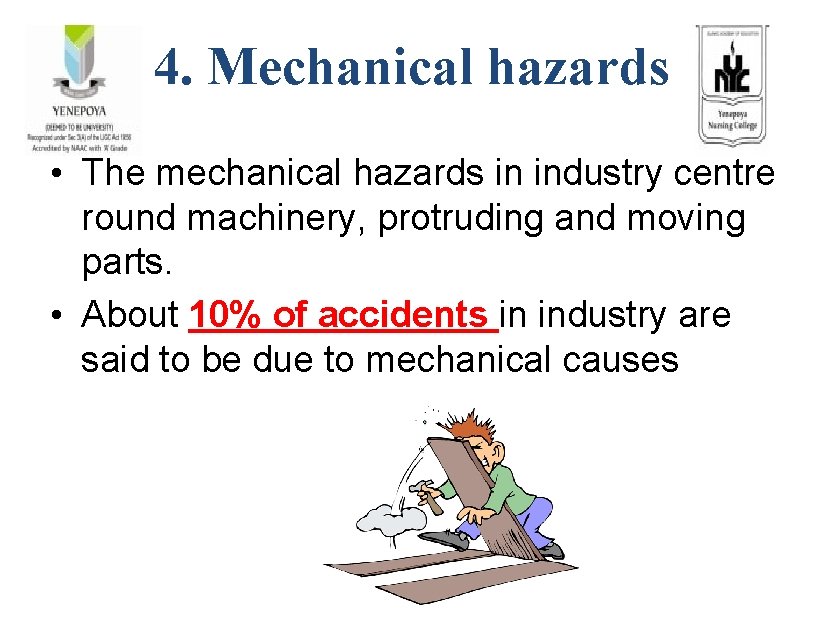
4. Mechanical hazards • The mechanical hazards in industry centre round machinery, protruding and moving parts. • About 10% of accidents in industry are said to be due to mechanical causes
5. Psychosocial hazards • The psychosocial hazards arise from the workers’ failure to adapt to an unknown psychosocial environment. • Frustration, lack of job satisfaction, insecurity, poor human relationships, emotional tension are some of the psychosocial factors which may undermine both physical and mental health of the workers.
• The capacity to adapt to different working environments is influenced by many factors such as education, cultural background, family life, social habits etc, .
• The health effects can be classified in two main categories – a) Psychological and behavioural changes – including hostility, aggressiveness, anxiety, depression, tardiness, alcoholism, drug abuse, sickness absenteeism b) Psychosomatic ill health – including fatigue, headache; pain in the shoulders, neck and back; propensity to peptic ulcer, hypertension, heart disease and rapid aging.
I. Diseases due to physical agents: 1. Heat: Heat hyperpyrexia, heat exhaustion, heat cramps, burns and local effects such as prickly heat 2. Cold: Trench foot, frost bite, chilblains 3. Light: Occupational cataract, miner’s nystagmus 4. Pressure: Air embolism, blast (explosion) 5. Noise: Occupational deafness 6. Radiation: Cancer, leukaemia, aplastic anaemia, pancytopenia
7. Mechanical factors : Injuries, accidents 8. Electricity : Burns
II. Diseases due to chemical agents 1. Gases: Gas poisoning CO 2, CO, CS 2, NH 3, N 2, H 2 S, HCL, SO 2 2. DUST (Pneumoconiosis) Inorganic dusts: Ø Coal dust - Anthracosis Ø Silica - Silicosis. Ø Asbestos - Asbestosis(lung disease) Ø Iron - Siderosis. Organic (VEGETABLE)dusts : Ø Cane fiber - Bagassosis Ø Cotton dust – Byssinosis ØTobacco --Tobacossis Ø Hay or grain dust – Farmer’s lung.
3. Metals and their compounds: Toxic hazards from lead, mercury, cadmium, manganese, beryllium, arsenic, chromium etc 4. Chemicals –Acids, alkalies, pesticides 5. Solvent – carbon bisulphide, benzene, trichloroethylene, chloroform etc.
III. Diseases due to biological agents: Leptospirosis, anthrax, fungal infections, tetanus etc. IV. Occupational cancer: Cancer of skin, lungs, bladder V. Occupational dermatosis: Dermatitis, eczema VI. Diseases of psychological origin: Industrial neurosis, hypertension, peptic ulcer, etc
HEALTH PROBLEMS DUE TO INDUSTRIALIZATION 1. a. b. c. d. ENVIRONMENT SANITATION PROBLEMSHousing- slums Water pollution- industrial waste Air pollution- toxic fumes, gases, smoke , dust Sewage disposal– pollution of water supply, contamination of soil with parasites 2. COMMUNICABLE DISEASES—TB, Veneral diseases, food and water brone disease 3. FOOD SANITATION—typhoid fever and viral hepatitis 4. MENTAL HEALTH– faliure to adjustment leads to mental illness, psychoneurosis, , behaviour disorder etc.
5. ACCIDENTS 6. SOCIAL PROBLEMS 7. MORBIDITY AND MORTALITY—chronic bronchitis and lung cancer
MEASURES FOR HEALTH PROTECTION OF WORKERS. ILO/WHO COMMITTEE RECOMMNEDATIONS (1953) 1. Nutrition. 2. Communicable disease control. 3. Environmental sanitation. – – – – – Water supply Food Toilet Proper garbage & waste disposal. General plant cleanliness. Sufficient space. --- Minimum 500 cu. ft Lighting. ---- 50 -75 foot candles Ventilation , temperature Protection against hazards. Housing
MEASURES FOR HEALTH PROTECTION OF WORKERS. 4. Mental health: GOALS: Ø To promote health and happiness of workers. Ø To detect signs of stress and strain and take necessary measures. Ø Treatment of employees suffering from mental illnesses. Ø Rehabilitation of those who become ill.
5. Measures for women and children. Ø Maternity leave for 12 weeks Ø Antenatal, natal and postnatal services Ø The factories act prohibits night work -7 pm – 6 am Ø Prohibits work underground Ø Provides creches in factories for more than 30 women workers employed. Ø No child below the age of 14 shall be employed 6. Family planning services– adopt the small family norms 7. Health education
PREVENTION OF OCCUPATIONAL DISEASE
Prevention of occupational diseases • The various measures adopted for prevention of occupational diseases may be grouped under three heads: 1. Medical 2. Engineering 3. Statutory or legislative
1. MEDICAL MEASURES 1. PRE PLACEMENT EXAMINATION: • Pre placement examination is done at the time of employment and includes • The worker’s medical, family, occupational and social history; a thorough physical examination and biological and radiological testing, urine and blood examination, special tests for endemic disease.
2. Periodical examination: • Periodical medical checkup of workers is very necessary when they handle toxic or poisonous substances due to their slow development leads to their non recognition in their earlier stages. • The frequency and the content of the examinations will depend upon the type of occupational exposure.
• Ordinarily workers are examined once a year. • But in certain occupational exposures(lead, toxic dyes, radium) monthly examinations are indicated. • Sometimes , even daily examinations may be needed such as when irritant chemicals like dichromate (Allergic Dermatitis) are handled.
3. MEDICAL AND HEALTH CARE SERVICES • In India, the Employees State Insurance Scheme provides medical care not only for the workers but also his family. • Within the factory, first aid services should be available. Immunization is another accepted function of an occupational health service.
4. NOTIFICATION Ø National Laws and Regulations(Factories Act, 1976; Mines Act, 1952; Dock Labourers ACT, 1948; etc) requires the notification of cases and suspected cases of occupational diseases. Ø In the factories Act, a list of 22 diseases is included while in the Mines Act 3 diseases And in the Dock’s Regulations 8 diseases are listed. Ø These diseases are recognized internationally for the purpose of workmen’s compensation.
• The main purpose of notification in industry is to initiate measures for prevention and protection and ensuring their effective application; • and to investigate the working conditions and other circumstances which have caused or suspected to have caused occupational diseases.
5. SUPERVISION OF WORKING ENVIRONMENT • Periodic supervision of working environment provides information of primary importance in the prevention of occupational disabilities. • The physician should pay frequent visits to the factory in order to acquaint himself with the various aspects of working environment such as temperature, lighting, ventilation, humidity, noise, cubic space, air pollution, and sanitation.
• He should be acquainted with the raw materials , processes and products manufactured.
6. MAINTENANCE AND ANALYSIS OF RECORDS • Proper records are essential for the planning, development and efficient operation of an occupational health service. • The workers health record and occupational disability record must be maintained.
7. HEALTH EDUCATION AND COUNSELLING: • Health education should start before the worker enters the factory. • All the risks involved in the industry in which he is employed and the measures to be taken for personal protection should be explained to him. • The correct use of protective devices like masks and gloves should also be explained.
• Simple rules of hygiene-hand washing, cutting the nails, bodily cleanliness and cleanliness of clothes. • He should be frequently remained about the dangers in the industry through the media of health education such as charts, posters and handbills. • The purpose of health education is to assist the worker in the process of adjustment to working, home and community environment.
II. ENGINEERING MEASURES • 1. DESIGN OF THE BUILDING: • The type of floor, walls, height, ceiling, roof and doors and windows, cubic space are all matters which should receive attention in the original plan of the building which is put up by the industrial architect.
2. GOOD HOUSE KEEPING: • It covers general cleanliness, ventilation, lighting, washing, food arrangements and general maintenance. • Good house keeping is a fundamental requirement for the control or elimination of occupational hazards. • The walls, ceilings, and passages should be white washed at least once a year. • The dust which settles down on the floor, edges, beams, machinery and other stationary objects should be promptly removed by vaccum cleaners or by wetting agents.
• Masks, gloves, aprons and other protective equipment should be kept clean and in a state of good repair. • To prevent accidents the right thing should be in the right place. • The outside of the plant should also be kept clean and tidy.
3. GENERAL VENTILATION: • There should be good general ventilation in factories. • It has been recommended that in every room of a factory, ventilating openings shall be provided for each worker employed in such room, and the openings shall be such as to admit a continued supply of fresh air.
• In rooms where dust is generated there should be an efficient exhaust ventilation system • The Indian factories Act has prescribed a minimum of 500 c. ft. of air space for each worker.
4. MECHANISATION: • The plant should be mechanized to the fullest possible extent to reduce the hazard of contact with harmful substances • Dermatitis can be prevented by if hand mixing is replaced by mechanical devices. • Acids can be conveyed from one place to another by means of pipes.
5. SUBSTITUTION: • Substitution means the replacement of a harmful material by a harmless one or one of lesser toxicity. • A classic example is the substitution of white phosphorous by phosphorous sesquisulphide in the match industry, which resulted in the elimination of necrosis of jaw. • Zinc or iron paints can be used in place of harmful lead paints; silver salts can be used in place of mercury salts; acetone can be used in place of benzene.
6. DUSTS: • Dusts can be controlled at the point of origin by water sprays; e. g wet drilling of rock. • Inclusion of a little moisture in the materials will make the process of grinding, sieving and mixing comparatively dust free.
7. ENCLOSURE: • Enclosing the harmful materials and processes will prevent the escape of dust and fumes into the factory atmosphere. • For example, grinding machinery can be completely enclosed.
8. ISOLATION: • Sometimes it may be necessary to isolate the offensive process in a separate building so that workers not directly connected with the operation are saved from exposure. • Certain operations are done at night in the absence of the usual staff.
9. LOCAL EXHAUST VENTILATION: � By providing local exhaust ventilation dusts, fumes and other injurious substances can be trapped and extracted “at source” before they escape into the factory atmosphere. �The heart of the local exhaust ventilation is the hood which is placed as near as possible to the point of origin of the dust or fume or other impurity.
� Dusts, gases and fumes are drawn into the hood by suction and are conveyed through ducts into collecting units. � In this way, the breathing zone of workers may be kept free of dangerous dust and poisonous fumes.
10. PROTECTIVE DEVICES: Respirators and gas masks are among the oldest devices used to protect workers against air-borne containments. There are two classes of respirators: �I)those which remove contaminants from air, �ii) those to which fresh air is supplied
� The other protective devices comprise ear plugs, ear muffs, helmets, safety shoes, aprons, gloves, gum boots, barrier creams, screens and goggles. � The worker should be instructed in the correct use of protective devices, and should know what kinds to use, when to use, and how to use.
11. ENVIORNMENTAL MONITORING • It is concerned with periodical environmental surveys, especially sampling the factory atmosphere to determine whether the dusts and gases escaping into the atmosphere are within the limits of permissible concentration. • Thermal environment, ventilation, lighting would also have to be monitored.
12. STATISTICAL MONITORING: • It comprises review at regular intervals of collected data on health and environmental exposure of occupational groups. • The main objective of these reviews is to evaluate the adequacy of preventive measures and occupational health criteria, including permissible exposure levels.
13. RESEARCH: • Research for improvement of, or in connection with manufactured product. • Study of the permissible limits of exposure to dusts and toxic fumes , occupational cancer, accident prevention, industrial fatigue, and vocational psychology are some aspects of research in occupational health.
III. LEGISLATION/LEGAL MEASURES • Factory laws, therefore, have been framed in every country to govern the conditions in industry and to safe guard the health and welfare of the worker. The most important factory laws in India are: • 1)The Factories Act, 1948 • 2) The employees state insurance Act, 1948
THE FACTORIES ACT (1948) • The first Indian Factories Act dates back as 1881. The Act was revised and amended several times, the latest being the Factories(Amendment )Act, 1987. • A brief description of the act is given below:
1. SCOPE: • The Act defines factory as an establishment employing 10 or more workers work and where power is being used , and 20 or more where power is not used.
2. HEALTH, SAFETY AND WELFARE Ø In addition to such matters as cleanliness, lighting and ventilation, the Act provides for the treatment of wastes and effluents and for their disposal, the elimination of dusts and fumes, the control of temperature, supply of cool drinking water during summer. • A minimum of 500 Cu. ft of space for each worker has been prescribed for factories installed after 1948 act and before 1948 a minimum of 350 cu. ft.
SAFETY MEASURES • Some of the safety provisions relate to the casing of new machinery, devices for cutting off the power, hoists and lifts, cranes and other lifting devices, protection of eyes and precautions against dangerous fumes, explovsive and inflammable material. • The Act provides that no worker shall be required to lift or carry loads which are likely to cause him injury.
SPECIFIC WELFARE: • The Act contains a separate relating to specific welfare measures e. g. washing facilities, facilities for storing and drying clothes, facilities for sitting, first aid appliances, shelters, rest rooms and lunch rooms canteens. • The Act specifies that wherein more than 250 workers are ordinarily employed, a canteen shall be provided. • The 1976 amendment provides for crèches in every factory wherein 30 women workers are ordinarily employed. • In every factory, wherein 500 or more workers are ordinarily employed, there should be welfare officer.
3)EMPLOYMENT OF YOUNG PERSONS: • The Act prohibits the employment of children below the age of 14 years and Adolescents should be duly certified by the certifying officer/surgeons regarding the fitness for work. • Adolescent employees are allowed to work only between 6 A. M. &7 P. M.
4)Hours of work: • The hour has prescribed a maximum of 48 working hours per week, not exceeding 9 hours per day with rest for at least ½ hour after 5 hours of continuous work. • For Adolescents, the hours of work have been reduced from 5 to 4 and half per day. • The total number of hours of work in a week including overtime should not exceed 60 hrs.
5)LEAVE WITH WAGES: • The Act lays down that besides weekly holidays, every worker will be entitled to leave with wages after 12 months of continuous service at the following rate; adult-one day for every 20 days of work, children-one day for every 15 days of work. • The leave can be accumulated up to 30 days in case of adults and 40 days in case of children.
6)OCCUPATIONAL DISEASES: • It is obligatory on the part of the factory management to give information regarding specified accidents which cause death, serious bodily injury or regarding occupational diseases contracted by the employees.
7)EMPLOYMENT IN HAZARDOUS PROCESS : • A site appraisal committee does examination of the service conditions of employees in a factory. involving hazardous process were also made with workers participation in safety management.
The Employees State Insurance Act, 1948 • The ESI Act passed in 1948 (amended in 1975, 1984, 1989 and 2010) is an important measure of social security and health insurance in this country. • It provides for certain cash and medical benefits to industrial employees in case of sickness, maternity and employment injury.
ESI Act (1948) SCOPE • The Act extends to the whole of India. • The ESI Act of 1948 covered all power-using factories other than seasonal factories wherein 10 or more persons were employed (excluding mines, railways and defence establishments). 8
• The provisions of the ESI (Amendment) Act of 1975 were extended to the following new classes of establishments : Ø Small power-using factories employing 10 to 19 persons, and non-power-using factories employing 20 or more persons Ø Shops Ø Hotels and restaurants Ø Cinemas and theatres Ø Road-motor transport establishments and Ø News paper establishment Ø The scheme has been extended to private medical and educational institutions employing 20 or more persons in some states
• With effect from 2010 the Act covers all employees manual, clerical, supervisory and technical getting upto Rs. 15, 000 per month.
ESI Act- Administration • ESI Corporation • Chairman – The Union Ministry of labour • Vice Chairman- Secretary to Govt. of India
THE EMPLOYEE STATE INSURANCE ACT, 1948 Benefits to employees (1)Medical benefit (2)Sickness benefit (3)Maternity benefit (4 Disablement benefit (5) Dependent’s benefit (6) Funeral expenses 11/20/15 (7) Rehabilitation allowance 84
Medical benefit • The services comprises (1) Out-patient care (2) Supply of drugs and dressings (3) Specialist services in all branches of medicine (4) Pathological and radiological investigations (5) Domiciliary services (6) Antenatal, natal and postnatal services 11/20/15 5
(7) Immunization services (8) Family planning services (9) Emergency services (10) Ambulance services (11) Health education and (12) In-patient treatment.
Sickness benefit • The benefit is payable for a maximum period of 91 days, in any continuous period of 365 days. • 34 diseases for which Extended Sickness Benefit where the insured person has been in continuous employment for 2 years:
Maternity benefit • The benefit is payable in cash to an insured woman for confinement/miscarriage or sickness arising out pregnancy/confinement or premature birth of child or miscarriage. • For confinement, the duration of benefit is 12 weeks (84 days), for miscarriage 6 weeks and for sickness arising out of confinement - 30 days. • The benefit is allowed at about full wages. The rate of confinement expenses has been increased from Rs. 2, 500 to Rs. 5, 000 per confinement.
Disablement benefit • The Act provides for cash payment, besides free medical treatment, in the event of temporary or permanent disablement as a result of employment injury as well as occupational diseases. • The rate of temporary disablement benefit is about 90 per cent of the wages long as the temporary disablement lasts. • In case of total permanent disablement, the insured person is given life pension on the basis of loss of earning capacity determined by a medical board
Dependant's benefit • In case of death, as a result of employment injury, the dependants of an insured person are eligible for periodical payments. • Pension at the rate of 90 per cent of the wages is payable, shared by dependants in a fixed ratio, on monthly basis accordance.
6. Funeral expenses • Funeral benefit is a cash payment payable on the death of an insured person towards the expenses on his funeral, the amount not exceeding Rs. 10, 000.
7. Rehabilitation • On monthly payment of Rs 10, the insured person and his family members continue to get medical treatment after permanent disablement, or retirement.
Role of occupational health nurse / Industrial nurse
12 main functions specific to occupational health nursing • Health supervision of workers • Health surveillance of the work environment • Accident prevention • Prevention of occupational ill health • Treatment of illness and injury at work
• First aid course • Promotion of health and prevention of ill health • Giving counselling • Rehabilitation and resettlement into work; records and reports
• Co-operation (internally and externally) • Administration of the health unit • Research (including surveys)
5 Major Roles of the OHN • • • Clinician/Practitioner Administrator Educator Researcher Consultant
Clinician/Practitioner 1. 2. 3. 4. 5. 6. Assess work environment Assess workers health status Perform health surveillance Provide direct nursing care Conduct health education and counselling Collaborate, communicate and consult with Occ. Safety & Health (OSH) team 7. Maintain accurate, concise and complete records
8. Develop and implement programs to correct health and safety hazards 9. Institute personal protective programs 10. Initiate referrals to hospitals and clinics 11. Conduct health screening programs 12. Conduct health training programs 13. Manage workers compensation claims
Administrator 1. Maintain awareness of technology, legal & professional changes associated with OH and Safety 2. Coordinates in professional growth & education opportunities for staff 3. Formulates policies for OH and Safety 4. Develops, implements and evaluates OH service
Educator 1. Provide education programs to employers & employees 2. Promotes integration of OHN practice into nursing education 3. Planning & coordinating relevant education programs 4. Collaborates with other OHN regarding practice issues.
Researcher 1. Participates in the development & implementation of research 2. Disseminates research findings to others through presentation, publication & practice 3. Incorporates research results into own practice 4. Collaborates with other members of OH team in developing & conducting research
Consultant 1. Offer advise to the patient regarding the future treatment, or preventative measures to be taken at work when it is appropriate. 2. Offer advice to management regarding the health of the worker
Specific Roles of the OHN 1. Advisor 2. Counselor 3. Environmentalist 4. Hygienist 5. Interpreter 6. Rehabilitator 7. Safety expert 8. Supervisor
THANK YOU