Apply Risk Management Techniques Introduction to Project Risk
- Slides: 11
Apply Risk Management Techniques Introduction to Project Risk Certificate IV in Project Management 17871 Qualification Code BSB 41507 Unit Code BSBPMG 407 A Apply Risk Management Techniques
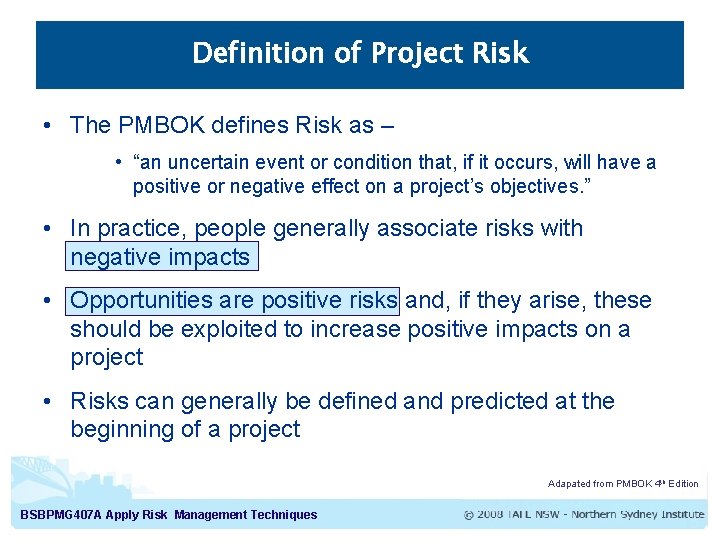
Definition of Project Risk • The PMBOK defines Risk as – • “an uncertain event or condition that, if it occurs, will have a positive or negative effect on a project’s objectives. ” • In practice, people generally associate risks with negative impacts • Opportunities are positive risks and, if they arise, these should be exploited to increase positive impacts on a project • Risks can generally be defined and predicted at the beginning of a project Adapated from PMBOK 4 th Edition BSBPMG 407 A Apply Risk Management Techniques
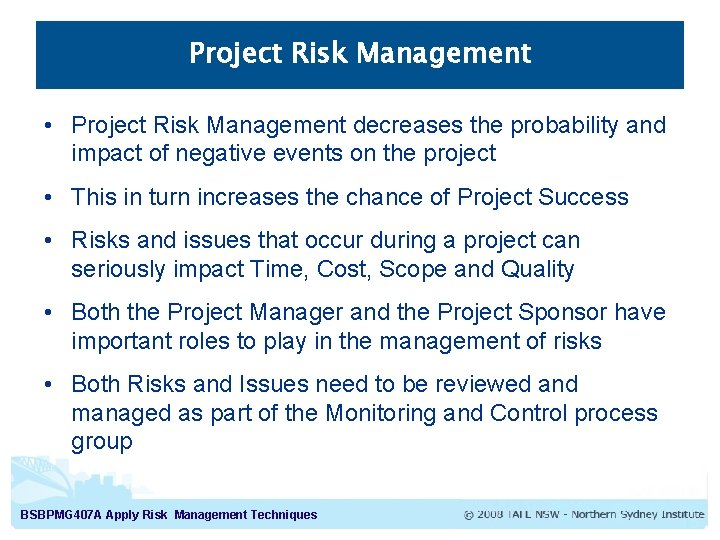
Project Risk Management • Project Risk Management decreases the probability and impact of negative events on the project • This in turn increases the chance of Project Success • Risks and issues that occur during a project can seriously impact Time, Cost, Scope and Quality • Both the Project Manager and the Project Sponsor have important roles to play in the management of risks • Both Risks and Issues need to be reviewed and managed as part of the Monitoring and Control process group BSBPMG 407 A Apply Risk Management Techniques
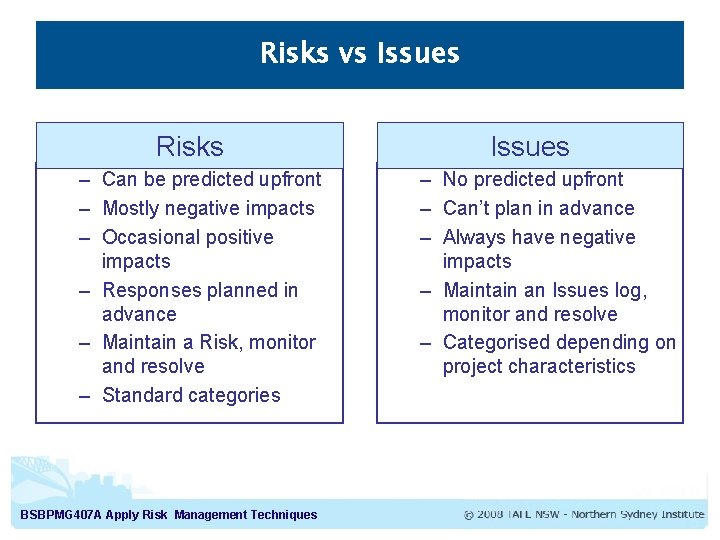
Risks vs Issues Risks – Can be predicted upfront – Mostly negative impacts – Occasional positive impacts – Responses planned in advance – Maintain a Risk, monitor and resolve – Standard categories BSBPMG 407 A Apply Risk Management Techniques Issues – No predicted upfront – Can’t plan in advance – Always have negative impacts – Maintain an Issues log, monitor and resolve – Categorised depending on project characteristics
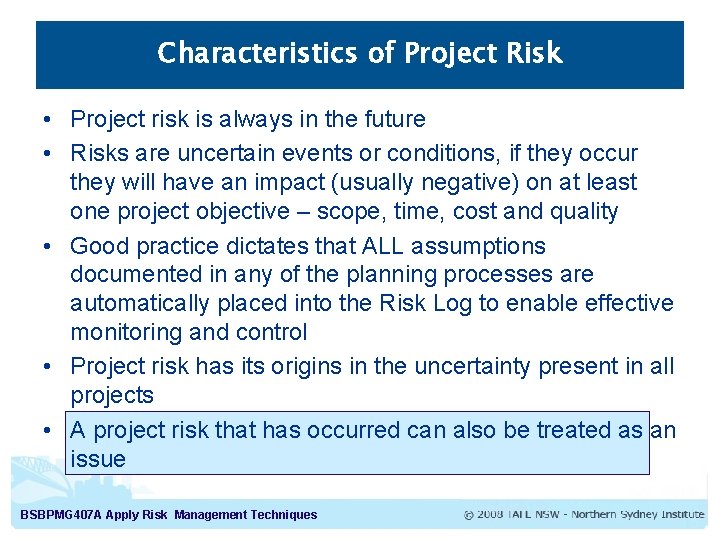
Characteristics of Project Risk • Project risk is always in the future • Risks are uncertain events or conditions, if they occur they will have an impact (usually negative) on at least one project objective – scope, time, cost and quality • Good practice dictates that ALL assumptions documented in any of the planning processes are automatically placed into the Risk Log to enable effective monitoring and control • Project risk has its origins in the uncertainty present in all projects • A project risk that has occurred can also be treated as an issue BSBPMG 407 A Apply Risk Management Techniques
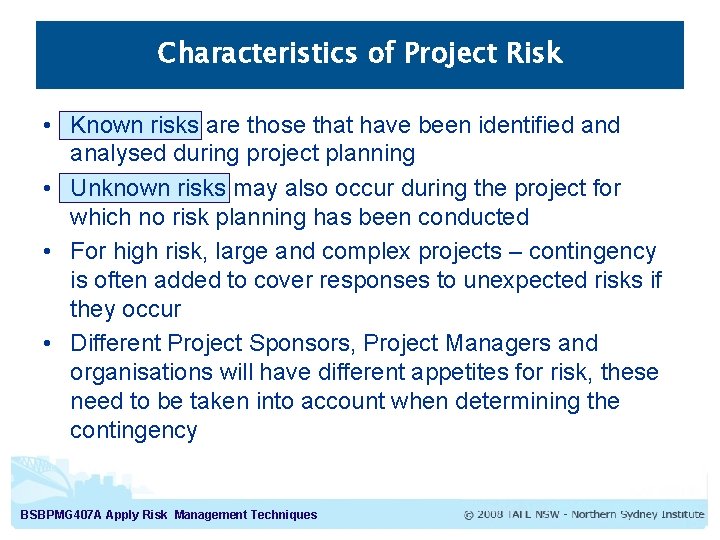
Characteristics of Project Risk • Known risks are those that have been identified analysed during project planning • Unknown risks may also occur during the project for which no risk planning has been conducted • For high risk, large and complex projects – contingency is often added to cover responses to unexpected risks if they occur • Different Project Sponsors, Project Managers and organisations will have different appetites for risk, these need to be taken into account when determining the contingency BSBPMG 407 A Apply Risk Management Techniques
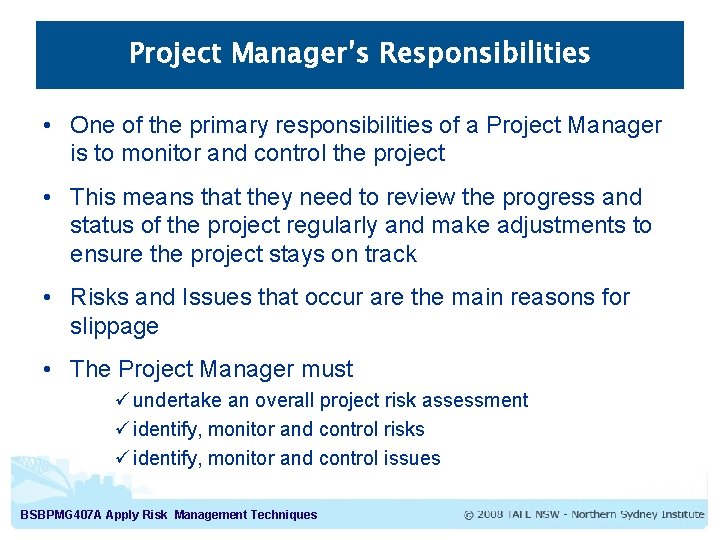
Project Manager’s Responsibilities • One of the primary responsibilities of a Project Manager is to monitor and control the project • This means that they need to review the progress and status of the project regularly and make adjustments to ensure the project stays on track • Risks and Issues that occur are the main reasons for slippage • The Project Manager must ü undertake an overall project risk assessment ü identify, monitor and control risks ü identify, monitor and control issues BSBPMG 407 A Apply Risk Management Techniques
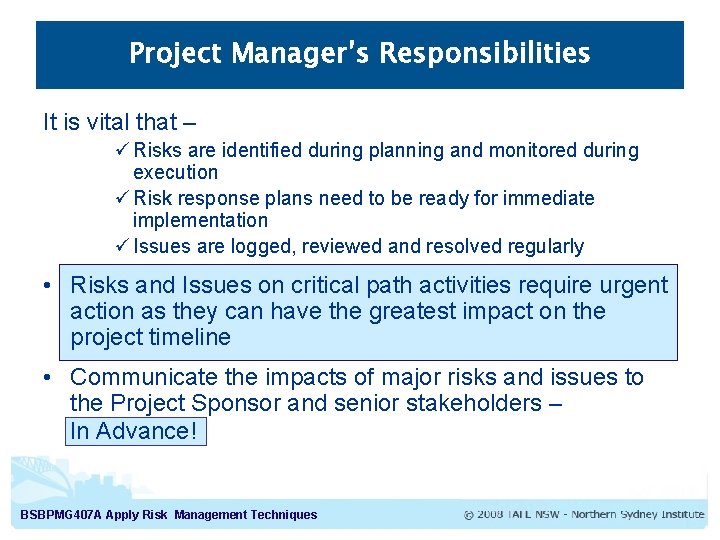
Project Manager’s Responsibilities It is vital that – ü Risks are identified during planning and monitored during execution ü Risk response plans need to be ready for immediate implementation ü Issues are logged, reviewed and resolved regularly • Risks and Issues on critical path activities require urgent action as they can have the greatest impact on the project timeline • Communicate the impacts of major risks and issues to the Project Sponsor and senior stakeholders – In Advance! BSBPMG 407 A Apply Risk Management Techniques
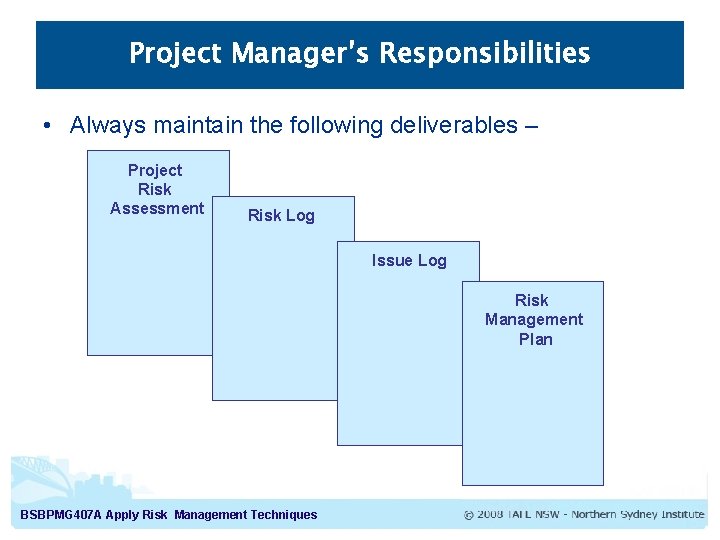
Project Manager’s Responsibilities • Always maintain the following deliverables – Project Risk Assessment Risk Log Issue Log Risk Management Plan BSBPMG 407 A Apply Risk Management Techniques
Project Sponsor’s Responsibilities • The Project Sponsor and senior stakeholders also have key roles when it comes to project risks • They need to – ü Participate in risk identification ü Participate in risk management planning ü Assist in both risk and issue resolution • Unfortunately they don’t always realise that they need to contribute and the burden can often unfairly fall to the Project Manager • One resolution is to clearly define the expectations that the project has on the Project Sponsor and senior stakeholders, including a Steering Committee if there is one BSBPMG 407 A Apply Risk Management Techniques
Next Steps Please proceed to Risk Processes Part 1 in the Learning Program. Best of Luck! BSBPMG 407 A Apply Risk Management Techniques