Intro to What is Science Science distinguishes itself



- Slides: 123
Intro to
What is Science? • “Science distinguishes itself from other ways of knowing and from other bodies of knowledge through the use of empirical standards, logical arguments, and skepticism. ” – National Science Standards, 2008
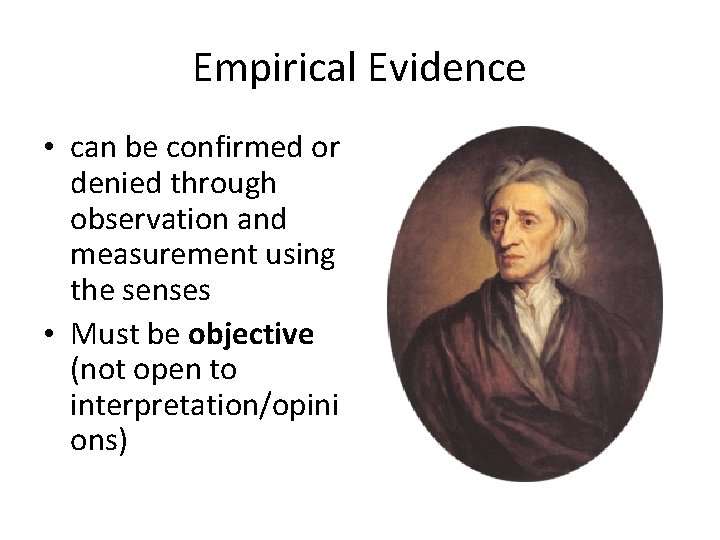
Empirical Evidence • can be confirmed or denied through observation and measurement using the senses • Must be objective (not open to interpretation/opini ons)
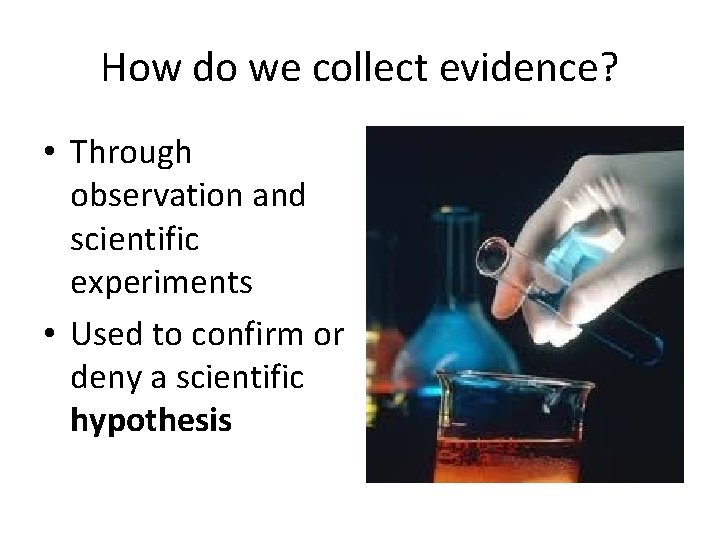
How do we collect evidence? • Through observation and scientific experiments • Used to confirm or deny a scientific hypothesis
Hypothesis • Is a proposed explanation for natural phenomena • Indicates a relationship between variables • Must be testable
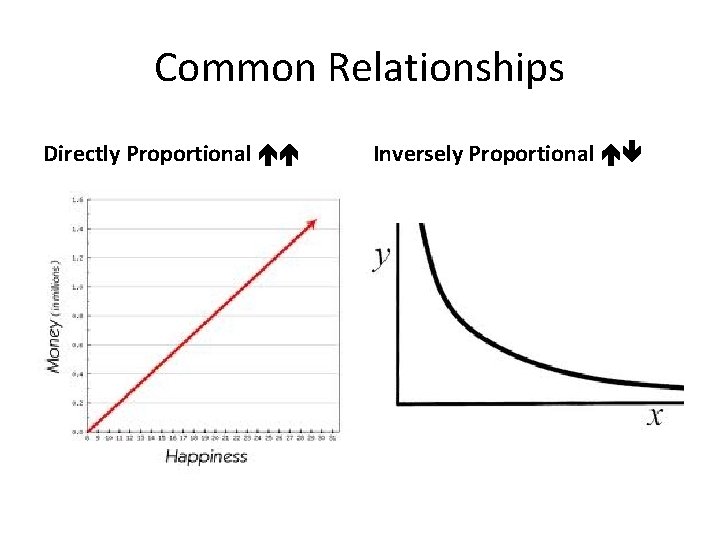
Common Relationships Directly Proportional Inversely Proportional
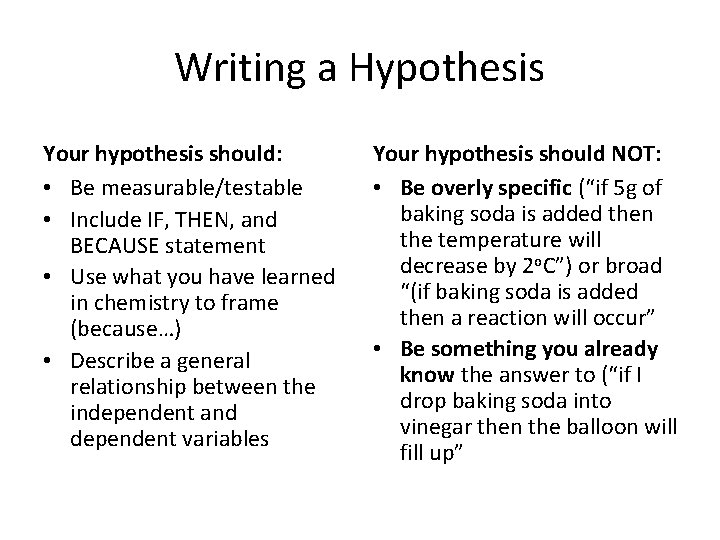
Writing a Hypothesis Your hypothesis should: • Be measurable/testable • Include IF, THEN, and BECAUSE statement • Use what you have learned in chemistry to frame (because…) • Describe a general relationship between the independent and dependent variables Your hypothesis should NOT: • Be overly specific (“if 5 g of baking soda is added then the temperature will decrease by 2 o. C”) or broad “(if baking soda is added then a reaction will occur” • Be something you already know the answer to (“if I drop baking soda into vinegar then the balloon will fill up”
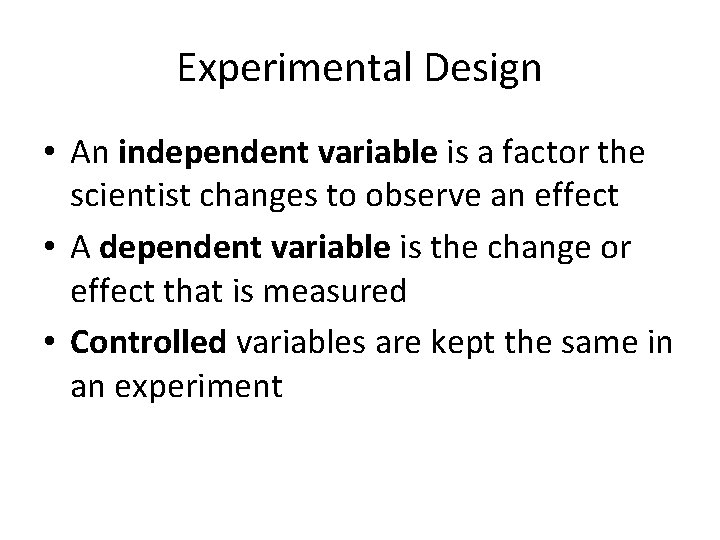
Experimental Design • An independent variable is a factor the scientist changes to observe an effect • A dependent variable is the change or effect that is measured • Controlled variables are kept the same in an experiment
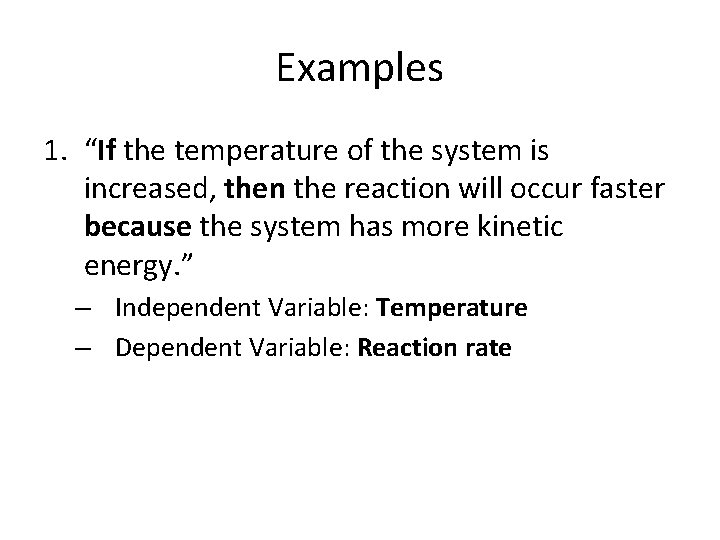
Examples 1. “If the temperature of the system is increased, then the reaction will occur faster because the system has more kinetic energy. ” – Independent Variable: Temperature – Dependent Variable: Reaction rate
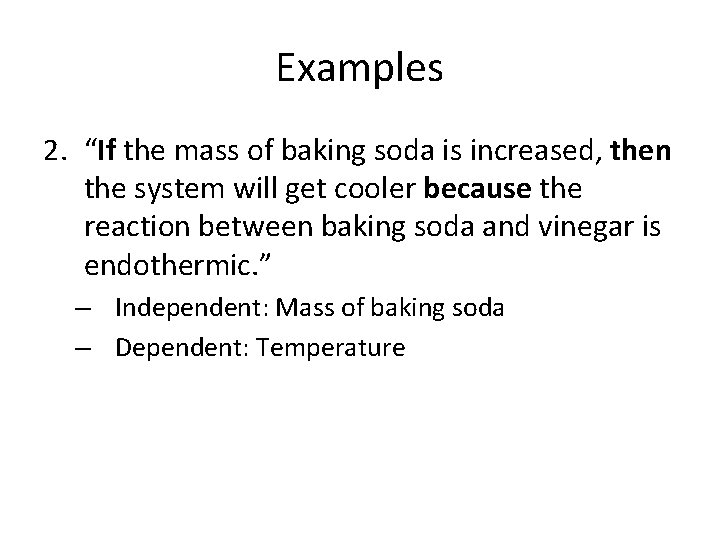
Examples 2. “If the mass of baking soda is increased, then the system will get cooler because the reaction between baking soda and vinegar is endothermic. ” – Independent: Mass of baking soda – Dependent: Temperature
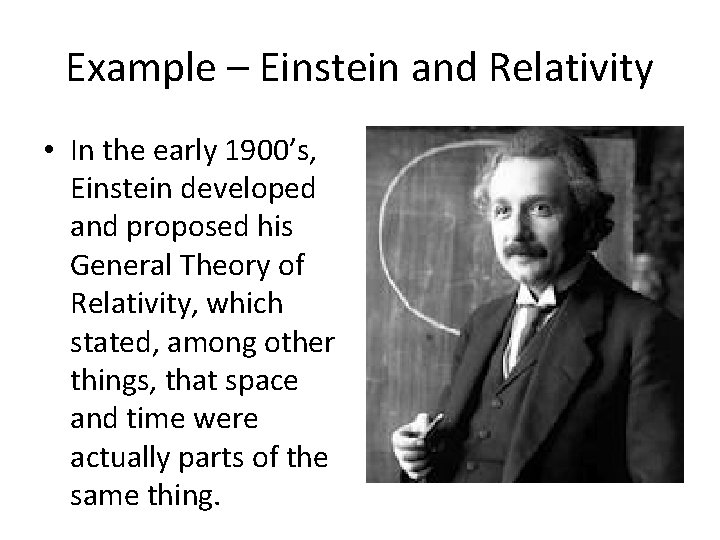
Example – Einstein and Relativity • In the early 1900’s, Einstein developed and proposed his General Theory of Relativity, which stated, among other things, that space and time were actually parts of the same thing.
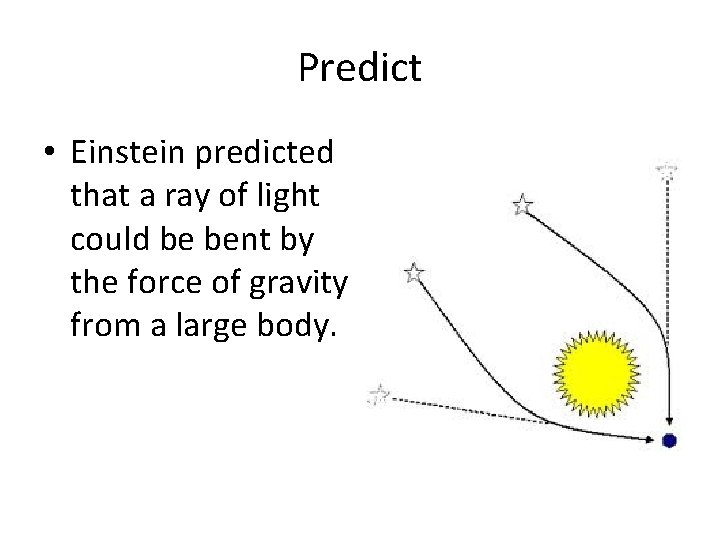
Predict • Einstein predicted that a ray of light could be bent by the force of gravity from a large body.
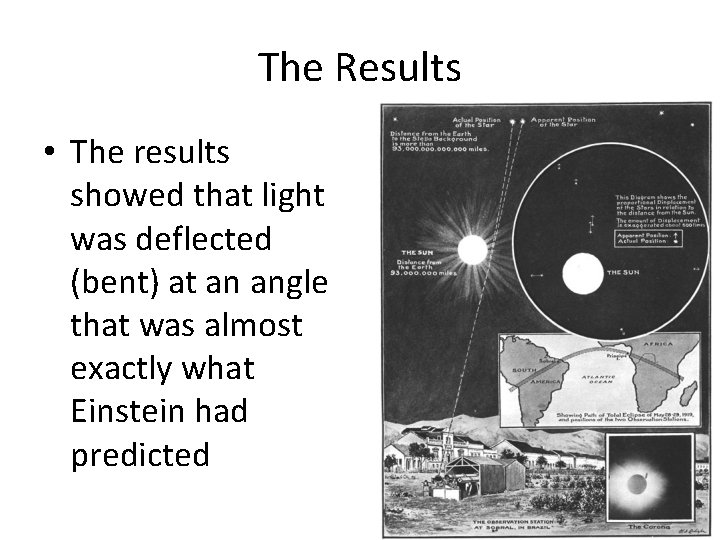
Observe • In 1919, Einstein’s theory was tested during a solar eclipse. Two British expeditions were organized to take pictures of a region of the sky centered on the Sun and compare these with photographs of the same stars taken a month later, when the Sun was no longer in that location.
The Results • The results showed that light was deflected (bent) at an angle that was almost exactly what Einstein had predicted
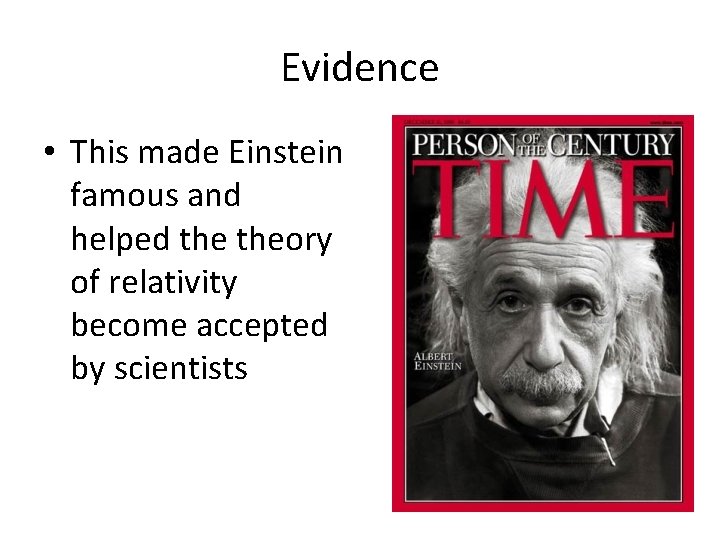
Evidence • This made Einstein famous and helped theory of relativity become accepted by scientists
Peer Review and Skepticism • All scientific ideas and understandings have gone through a process called peer review • Peers (other scientists) critique each other’s hypotheses and attempt to reproduce their results by repeating their procedures • Most scientific ideas are rejected
Models • Are tentative schemes or structures that correspond to real objects, events, or classes of events and have explanatory power • Can be physical objects, plans, mental constructs, mathematical equations, computer simulations, etc.
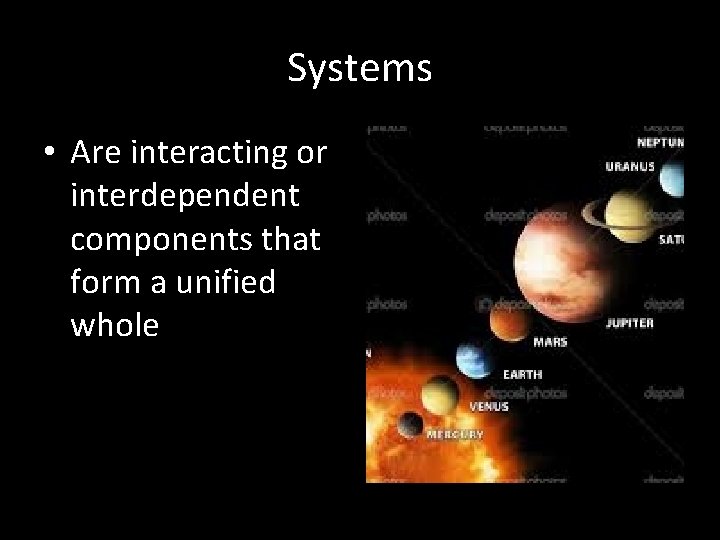
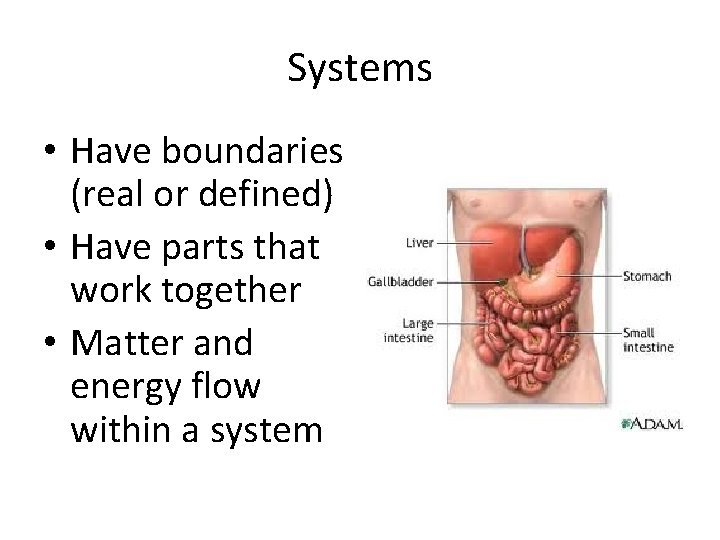
Systems • Are interacting or interdependent components that form a unified whole
Systems • Have boundaries (real or defined) • Have parts that work together • Matter and energy flow within a system
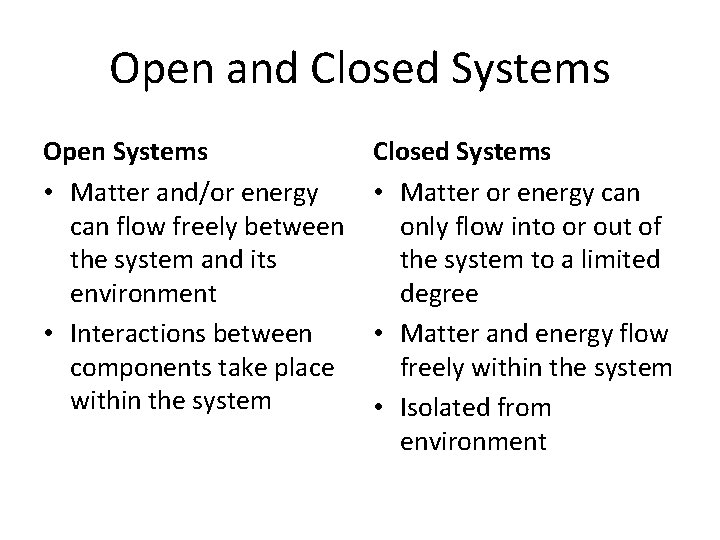
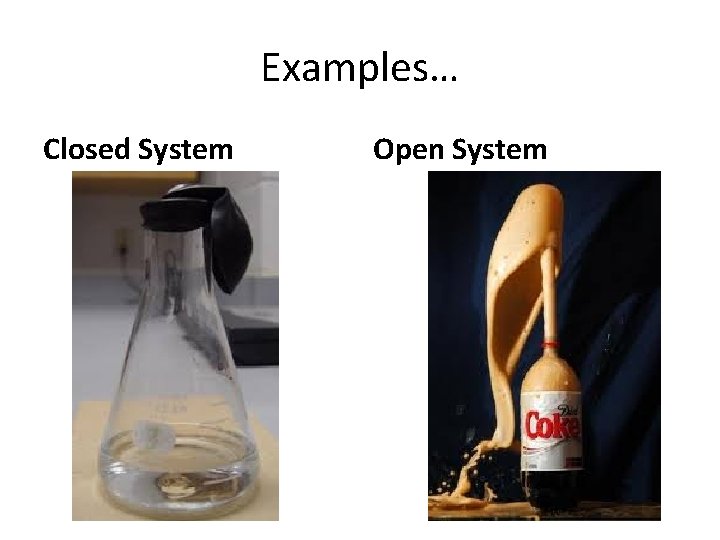
Open and Closed Systems Open Systems • Matter and/or energy can flow freely between the system and its environment • Interactions between components take place within the system Closed Systems • Matter or energy can only flow into or out of the system to a limited degree • Matter and energy flow freely within the system • Isolated from environment
Examples… Closed System Open System
Chemistry • The study of the structure, properties and composition of matter, and the changes that it undergoes
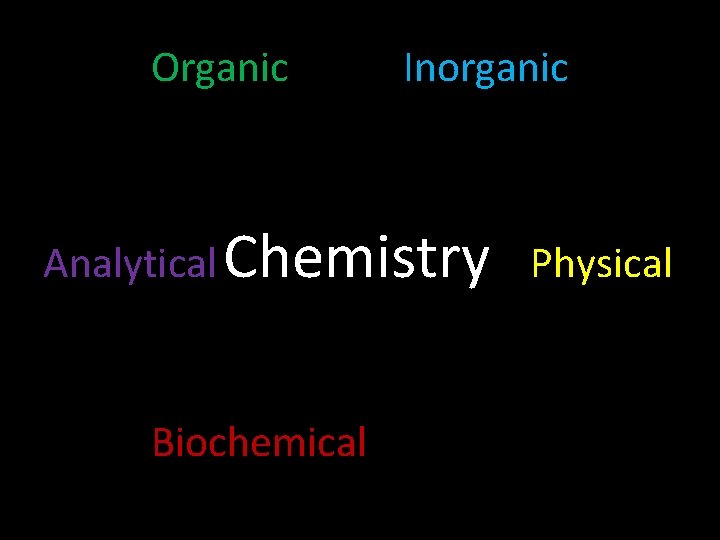
Organic Inorganic Analytical Chemistry Physical Biochemical
Matter • Anything that has mass and takes up space
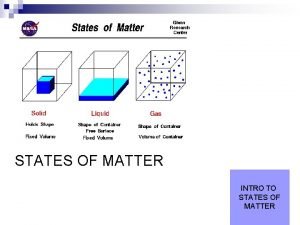
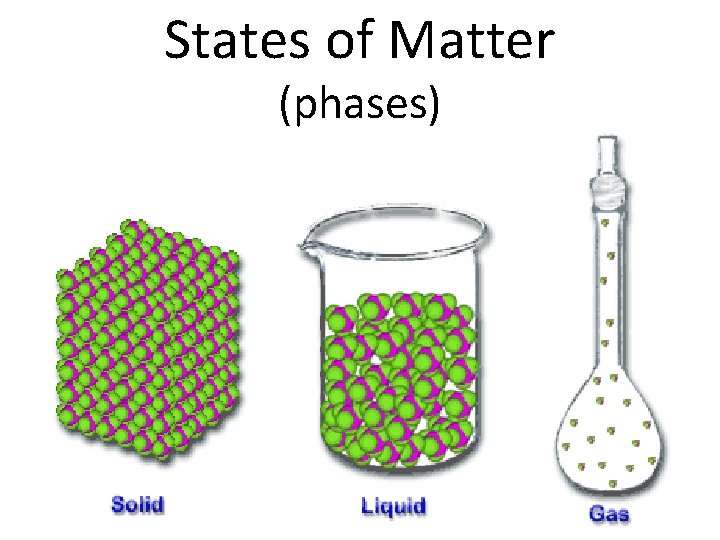
States of Matter (phases)
PROPERTIES AND CHANGES OF MATTER
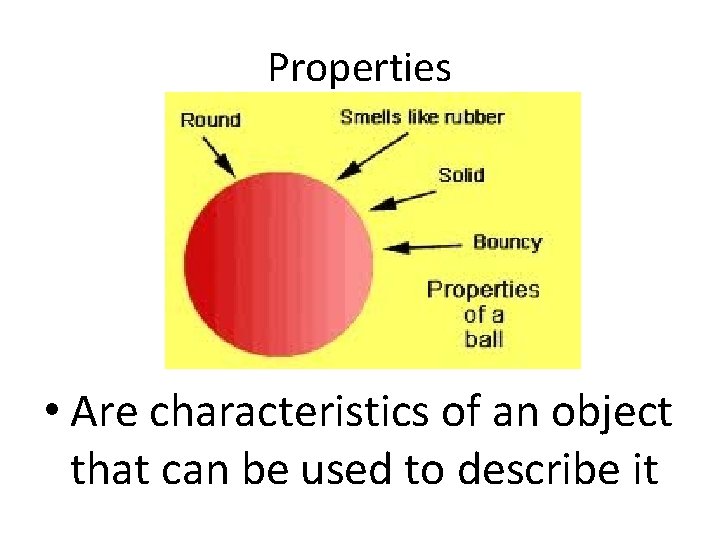
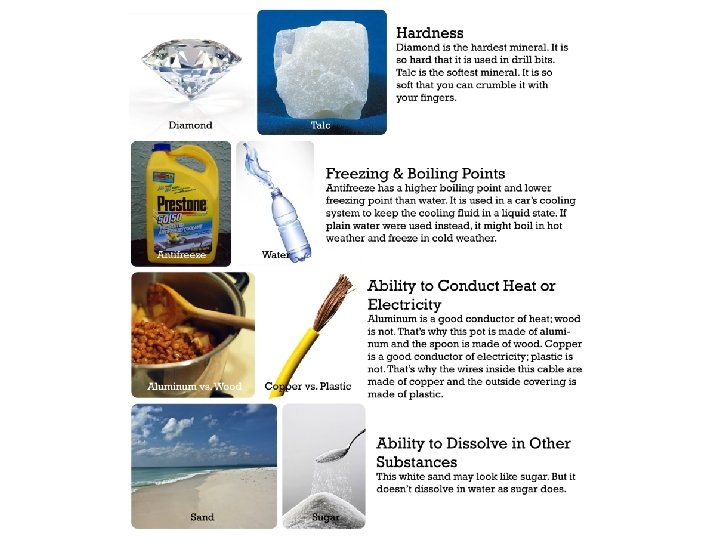
Properties • Are characteristics of an object that can be used to describe it
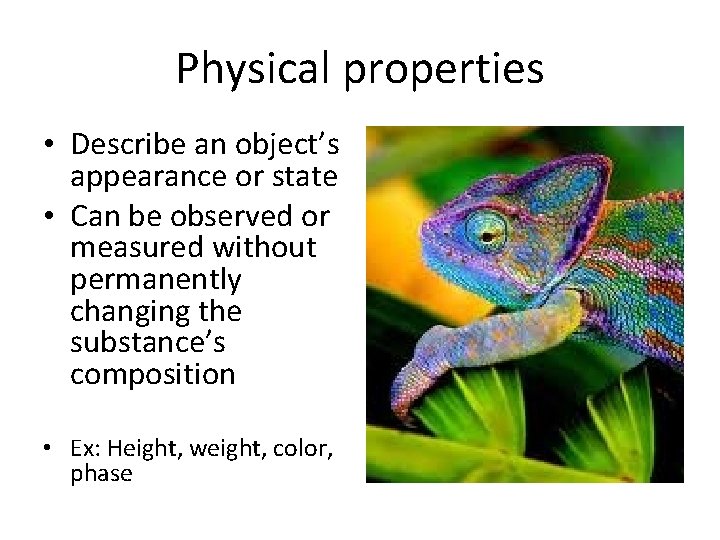
Physical properties • Describe an object’s appearance or state • Can be observed or measured without permanently changing the substance’s composition • Ex: Height, weight, color, phase
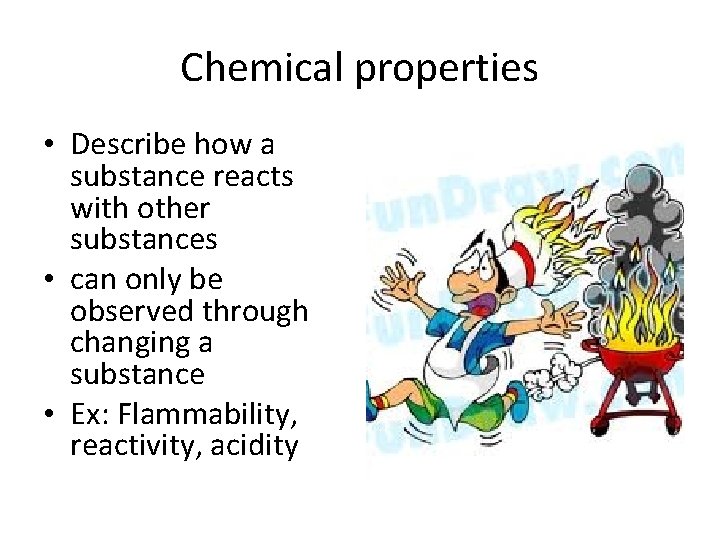
Chemical properties • Describe how a substance reacts with other substances • can only be observed through changing a substance • Ex: Flammability, reactivity, acidity
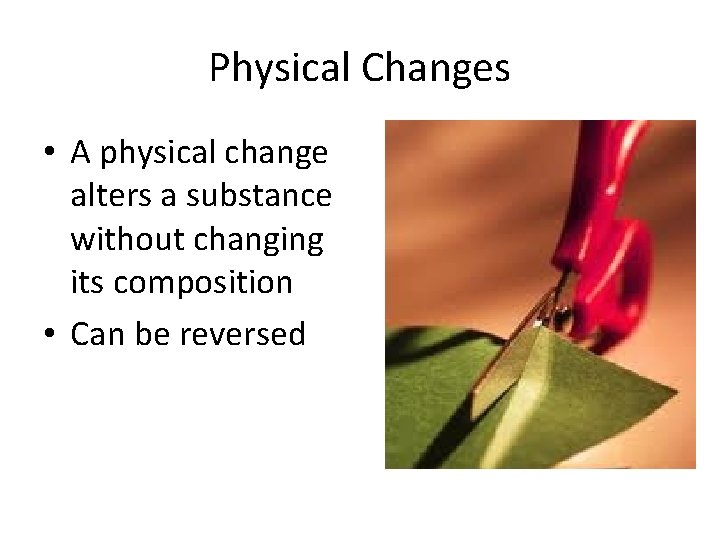
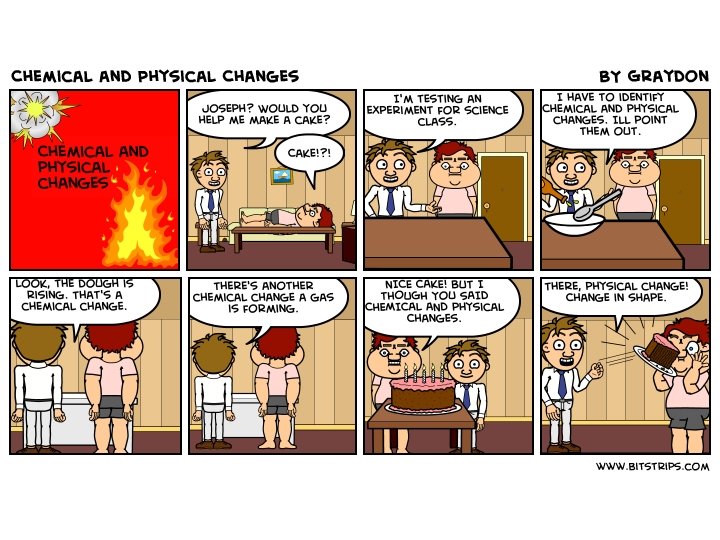
Physical Changes • A physical change alters a substance without changing its composition • Can be reversed
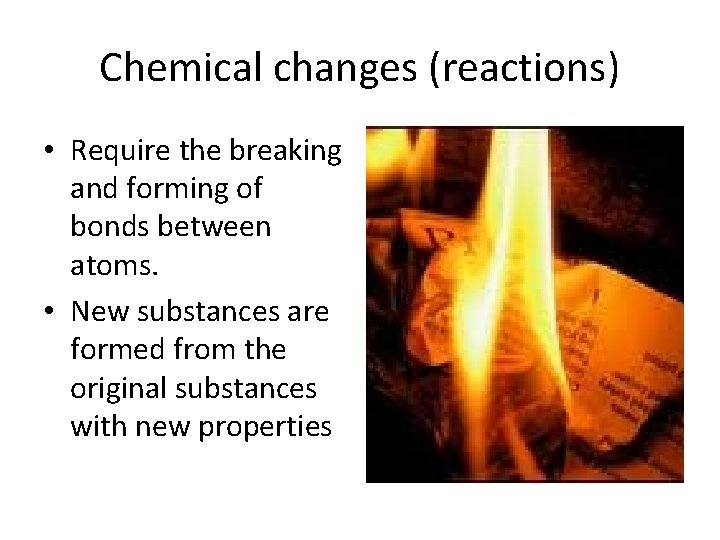
Chemical changes (reactions) • Require the breaking and forming of bonds between atoms. • New substances are formed from the original substances with new properties
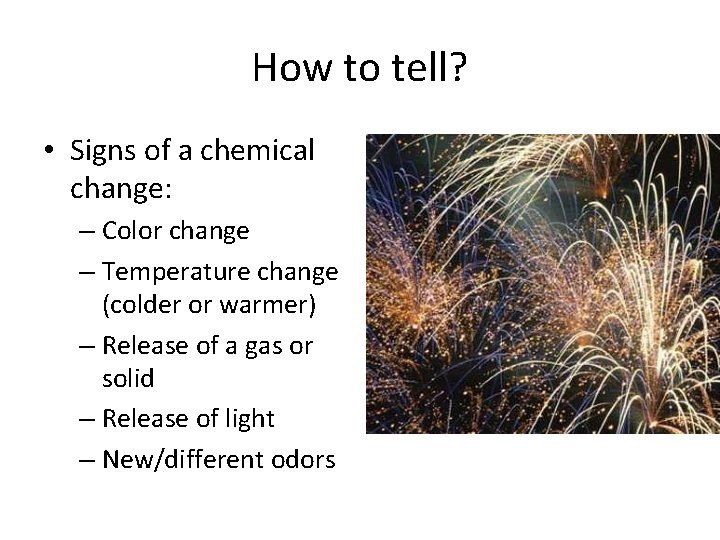
How to tell? • Signs of a chemical change: – Color change – Temperature change (colder or warmer) – Release of a gas or solid – Release of light – New/different odors
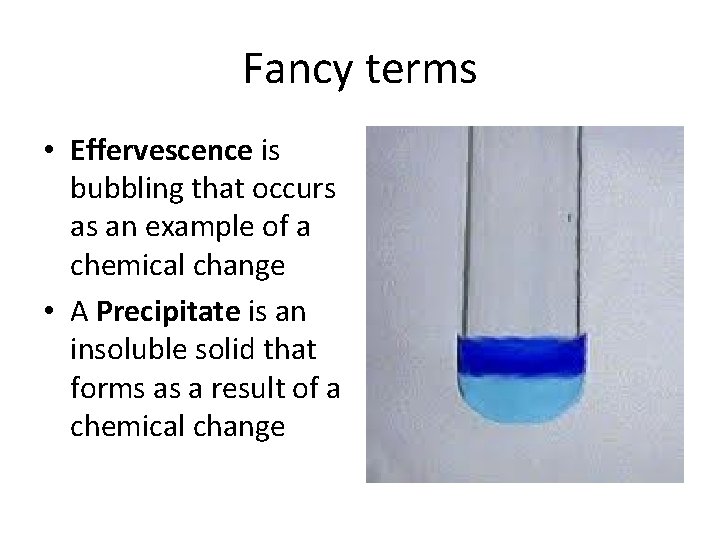
Fancy terms • Effervescence is bubbling that occurs as an example of a chemical change • A Precipitate is an insoluble solid that forms as a result of a chemical change
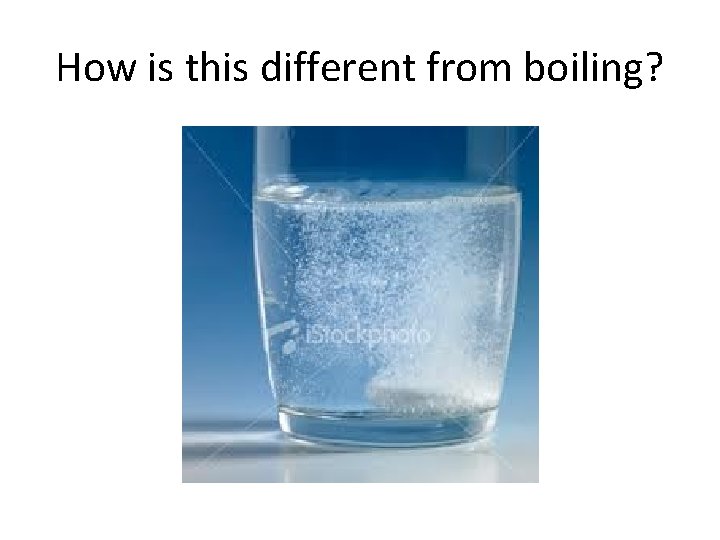
How is this different from boiling?
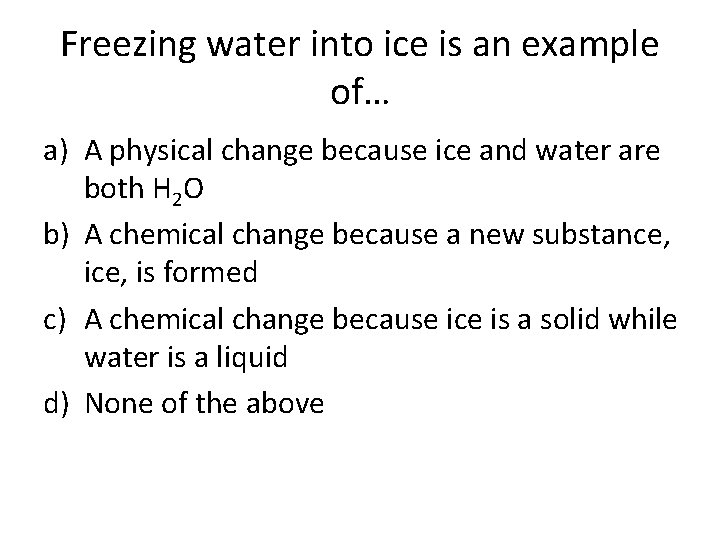
Freezing water into ice is an example of… a) A physical change because ice and water are both H 2 O b) A chemical change because a new substance, is formed c) A chemical change because ice is a solid while water is a liquid d) None of the above
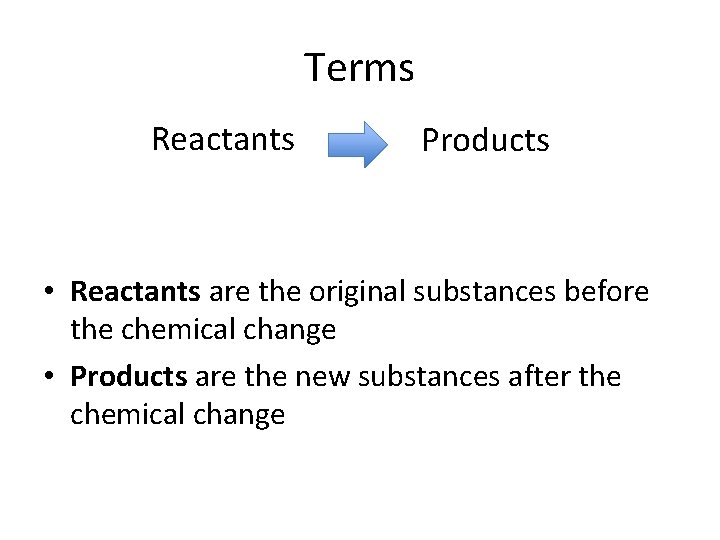
Terms Reactants Products • Reactants are the original substances before the chemical change • Products are the new substances after the chemical change
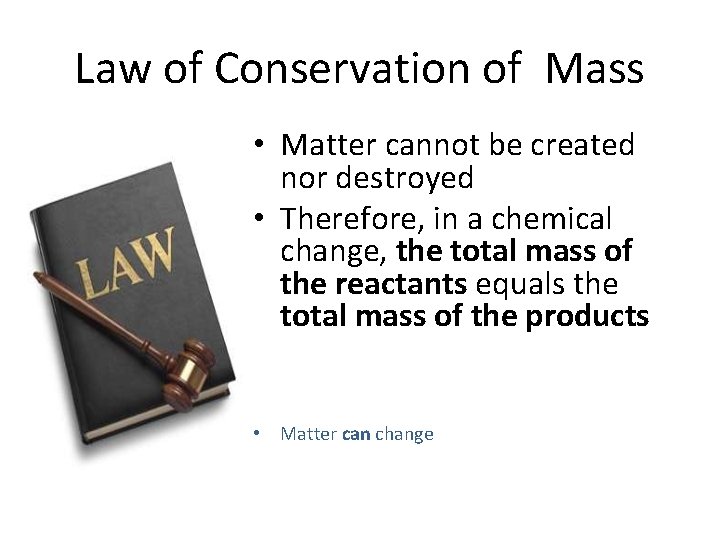
Law of Conservation of Mass • Matter cannot be created nor destroyed • Therefore, in a chemical change, the total mass of the reactants equals the total mass of the products • Matter can change
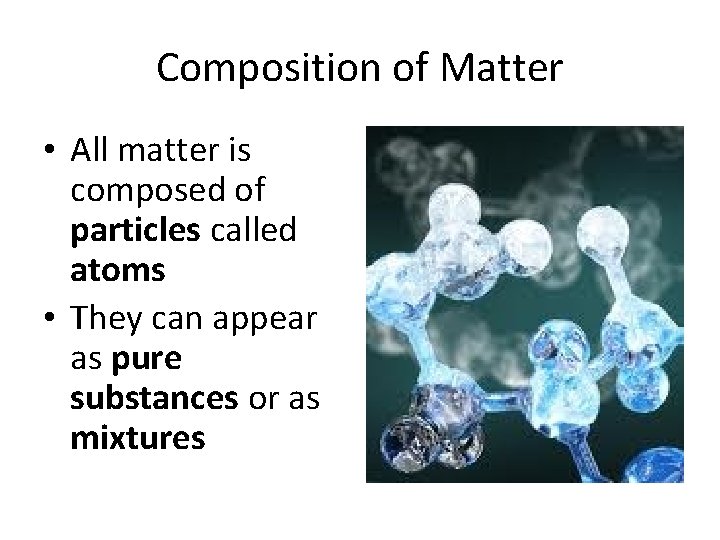
Composition of Matter • All matter is composed of particles called atoms • They can appear as pure substances or as mixtures
Pure
Substances and Mixtures • A pure substance is made up of the same group of elements that are chemically bonded together • A mixture is made up of 2 or more substances that are physically mixed together
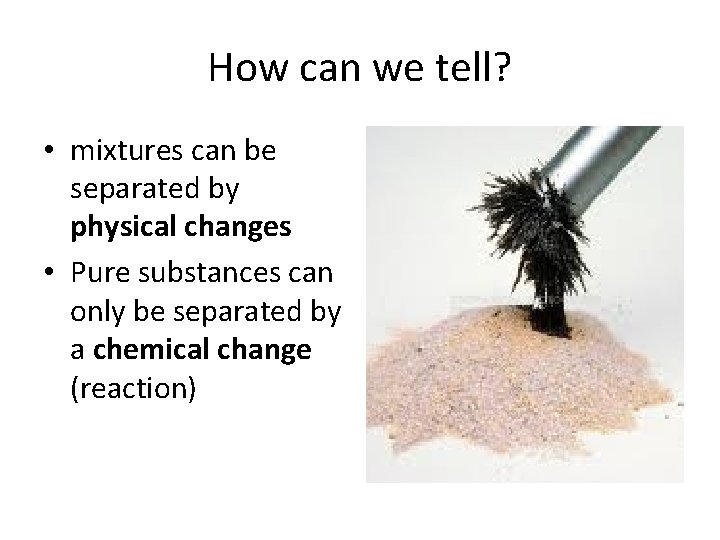
How can we tell? • mixtures can be separated by physical changes • Pure substances can only be separated by a chemical change (reaction)
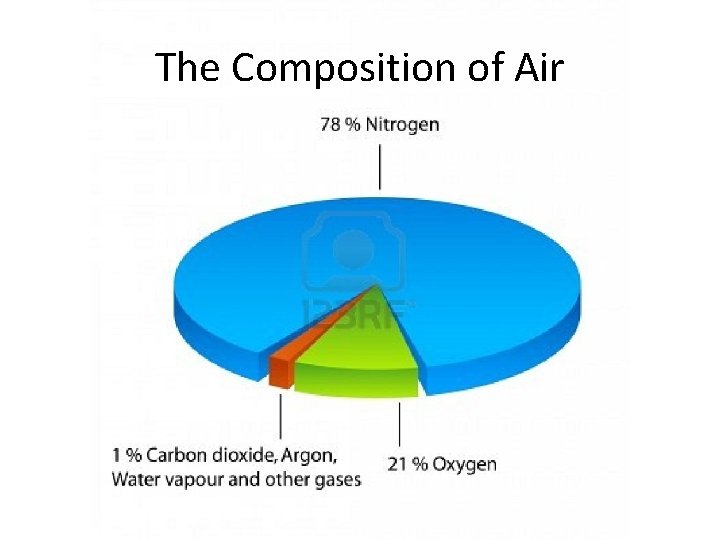
The Composition of Air
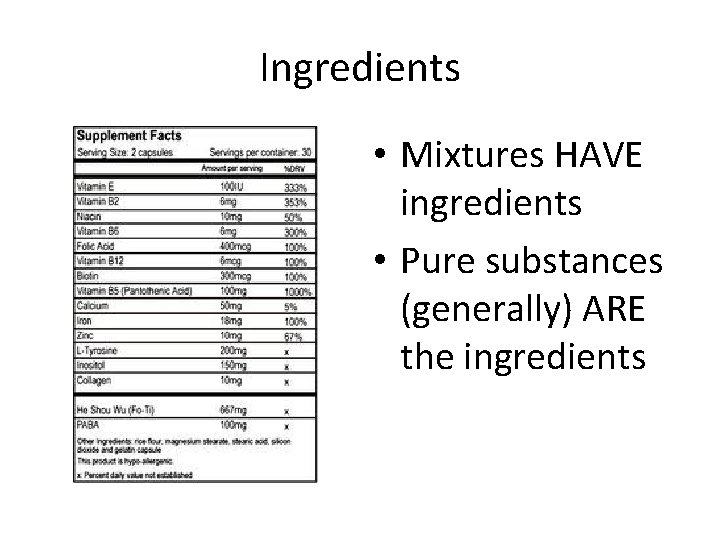
Ingredients • Mixtures HAVE ingredients • Pure substances (generally) ARE the ingredients
Pure Substances -Elements -Compounds
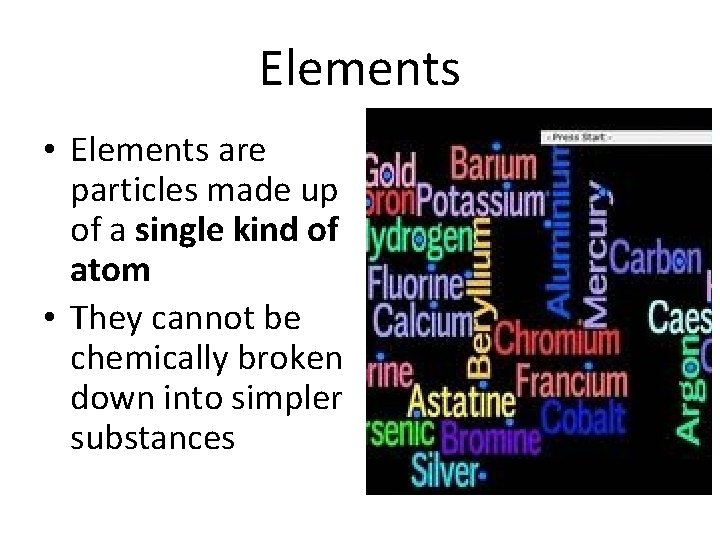
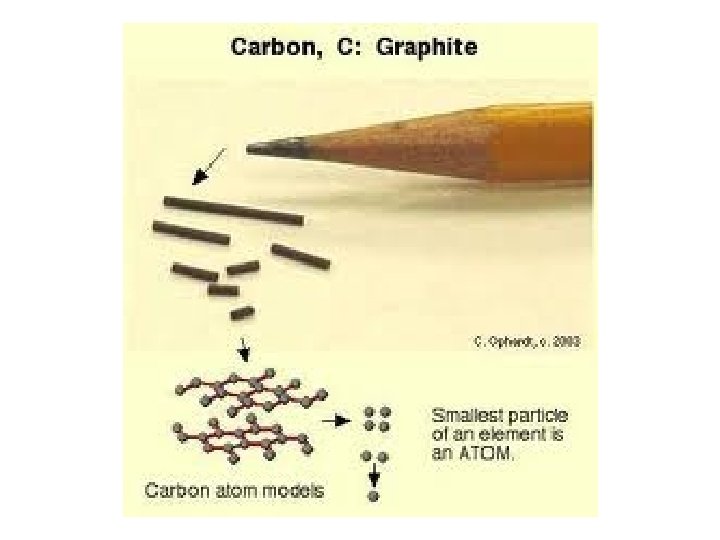
Elements • Elements are particles made up of a single kind of atom • They cannot be chemically broken down into simpler substances
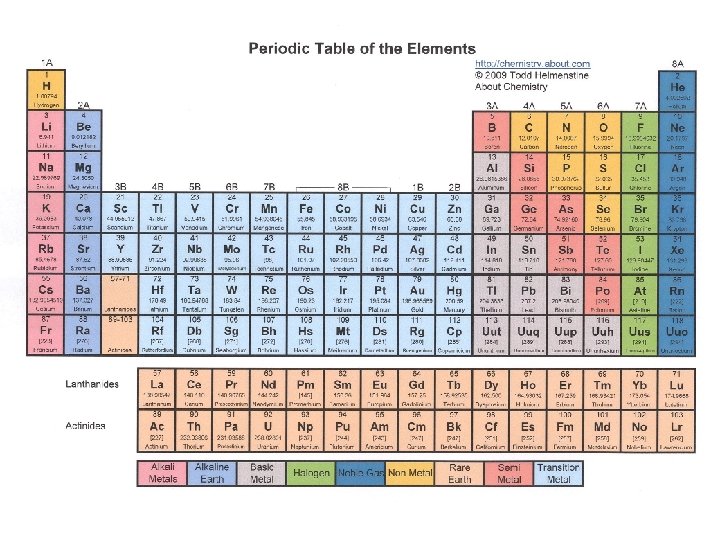
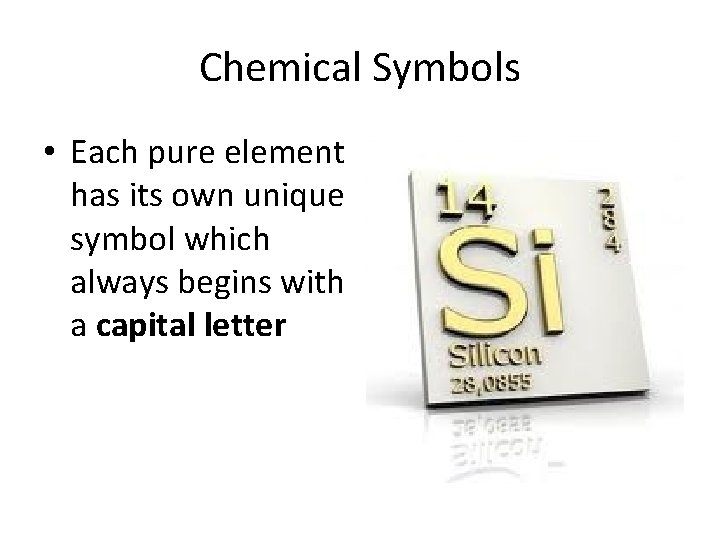
Chemical Symbols • Each pure element has its own unique symbol which always begins with a capital letter
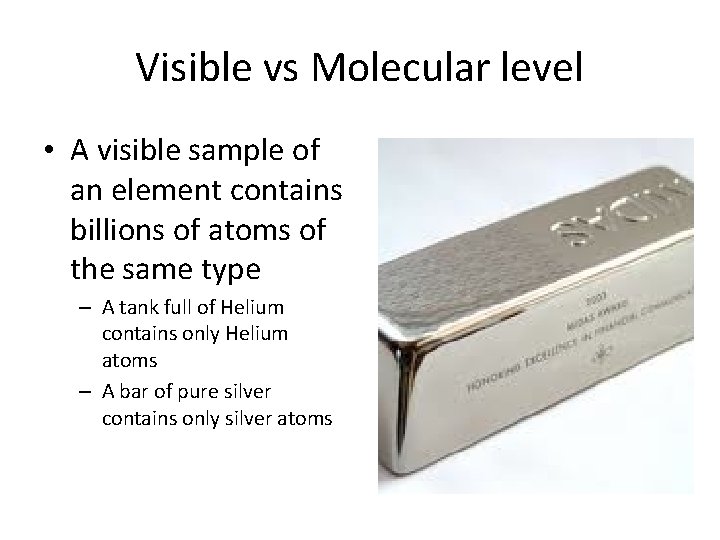
Visible vs Molecular level • A visible sample of an element contains billions of atoms of the same type – A tank full of Helium contains only Helium atoms – A bar of pure silver contains only silver atoms
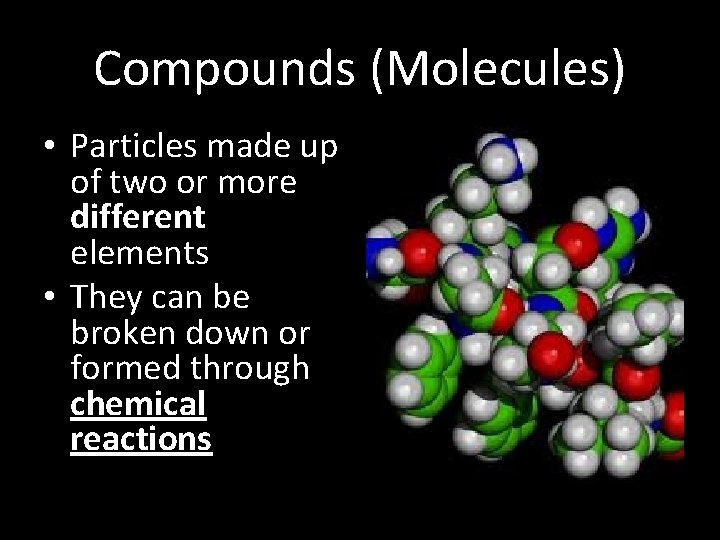
Compounds (Molecules) • Particles made up of two or more different elements • They can be broken down or formed through chemical reactions
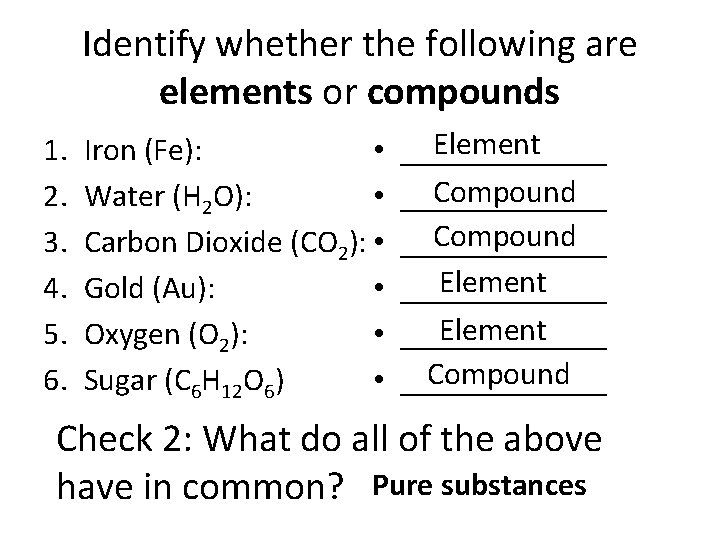
Identify whether the following are elements or compounds 1. 2. 3. 4. 5. 6. Iron (Fe): • Water (H 2 O): • Carbon Dioxide (CO 2): • Gold (Au): • Oxygen (O 2): • Sugar (C 6 H 12 O 6) • Element _____________ Compound _____________ Element _______ Compound _______ Check 2: What do all of the above have in common? Pure substances
MIXTURES AND SOLUTIONS
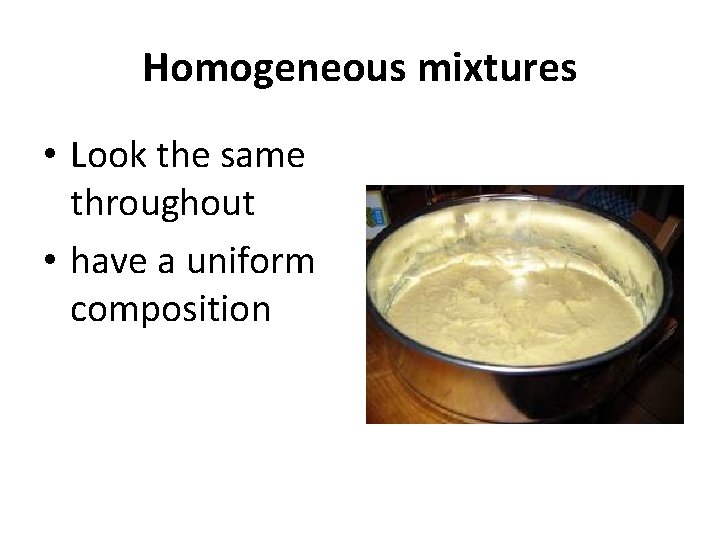
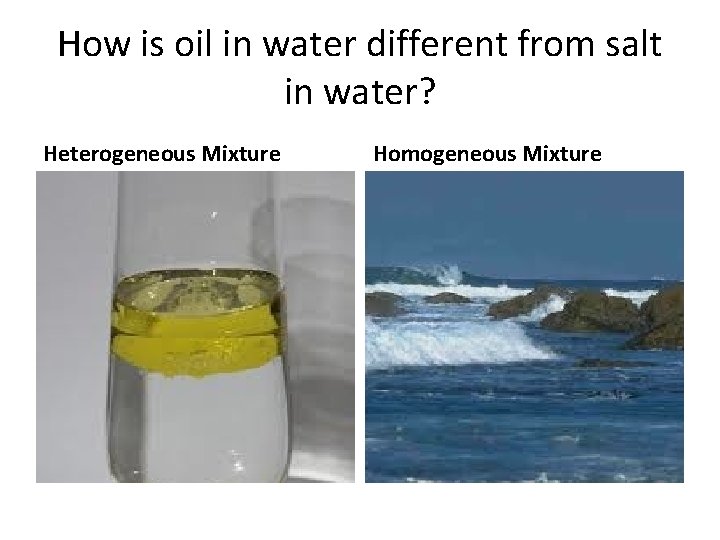
Homogeneous mixtures • Look the same throughout • have a uniform composition
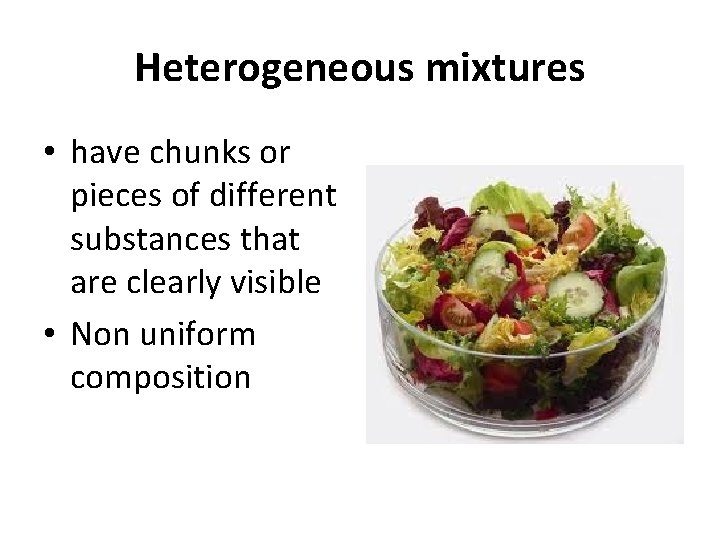
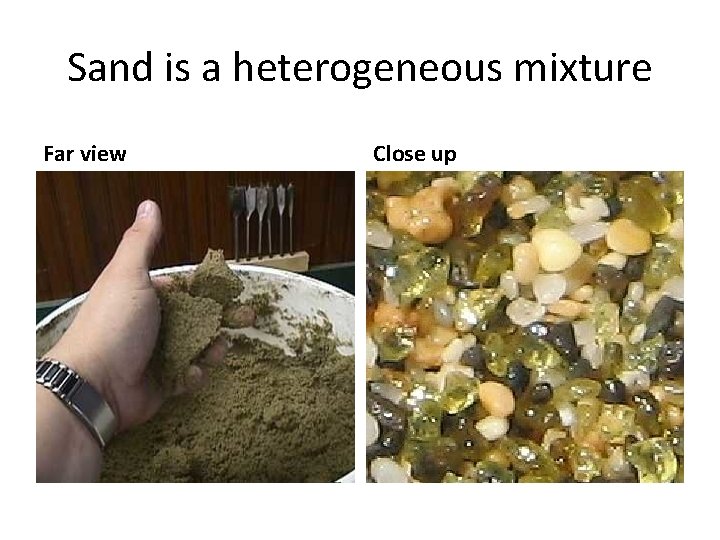
Heterogeneous mixtures • have chunks or pieces of different substances that are clearly visible • Non uniform composition
How is oil in water different from salt in water? Heterogeneous Mixture Homogeneous Mixture
Sand is a heterogeneous mixture Far view Close up
Remember! • Even though you can’t see the individual parts, homogeneous mixtures are still mixtures, not pure substances • The different substances are not chemically bonded together and can be separated through physical processes • E. g. : Distillation • Even when mixed together, substances retain their unique physical properties (melting point, boiling point, etc)
Measuring Matter Quantitative Measurements Qualitative Measurements • Use numbers (“quantity”) • Considered more objective • Use words (“quality”) • Considered more subjective Both are valid means of describing matter
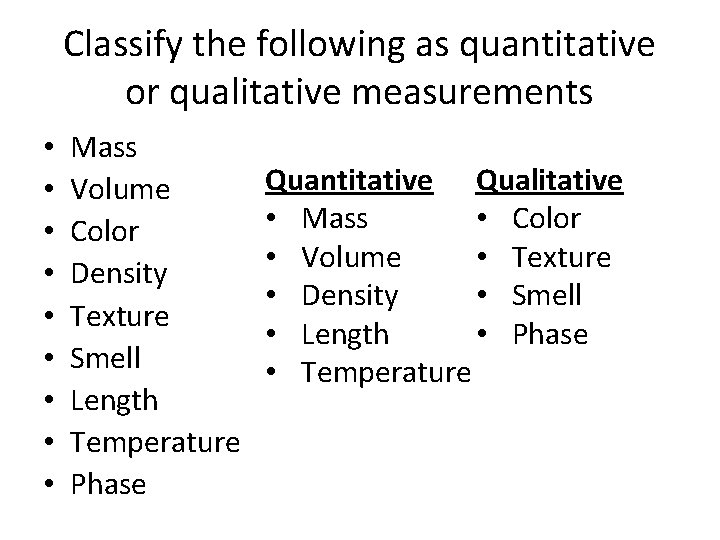
Classify the following as quantitative or qualitative measurements • • • Mass Volume Color Density Texture Smell Length Temperature Phase Quantitative Qualitative • Mass • Color • Volume • Texture • Density • Smell • Length • Phase • Temperature
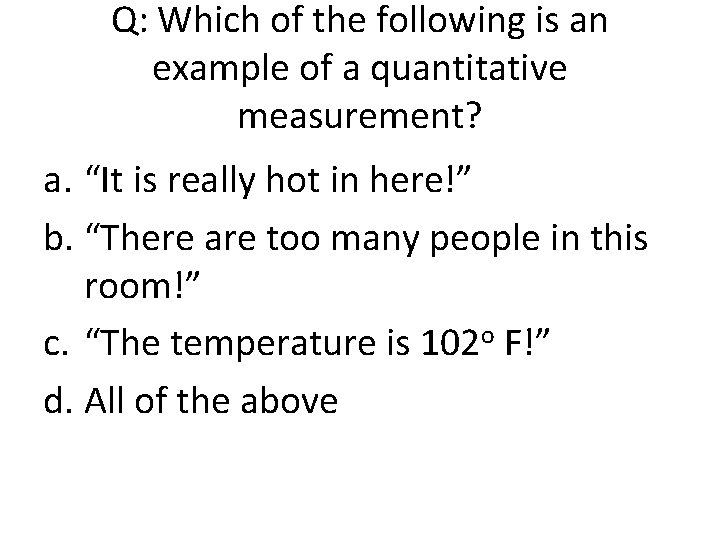
Q: Which of the following is an example of a quantitative measurement? a. “It is really hot in here!” b. “There are too many people in this room!” c. “The temperature is 102 o F!” d. All of the above
Units • Must always be used when making measurements • In science, the Système International (SI) or Metric System is used
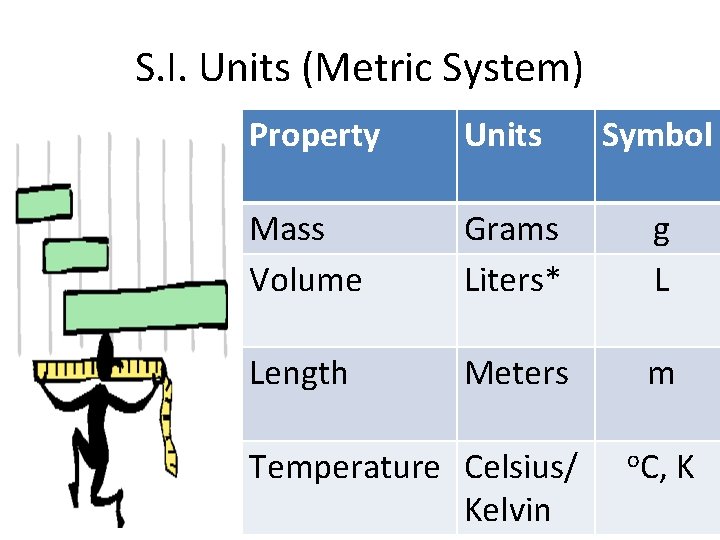
S. I. Units (Metric System) Property Units Symbol Mass Volume Grams Liters* g L Length Meters m Temperature Celsius/ Kelvin o. C, K
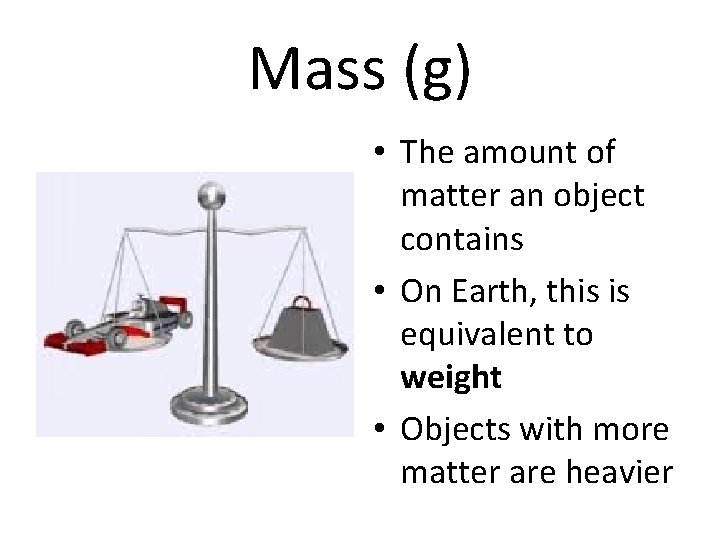
Mass (g) • The amount of matter an object contains • On Earth, this is equivalent to weight • Objects with more matter are heavier
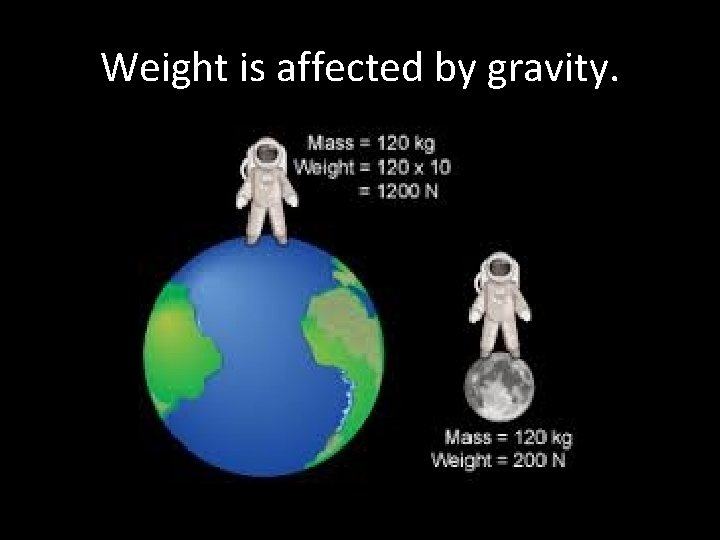
Weight is affected by gravity.
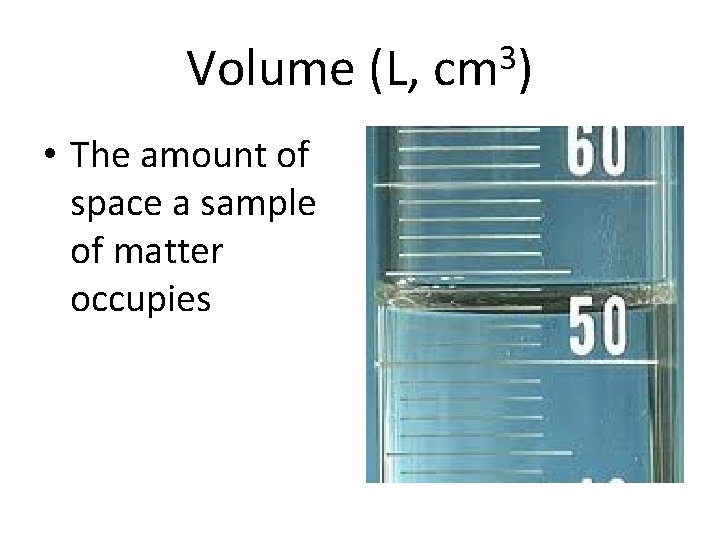
Volume (L, • The amount of space a sample of matter occupies 3 cm )
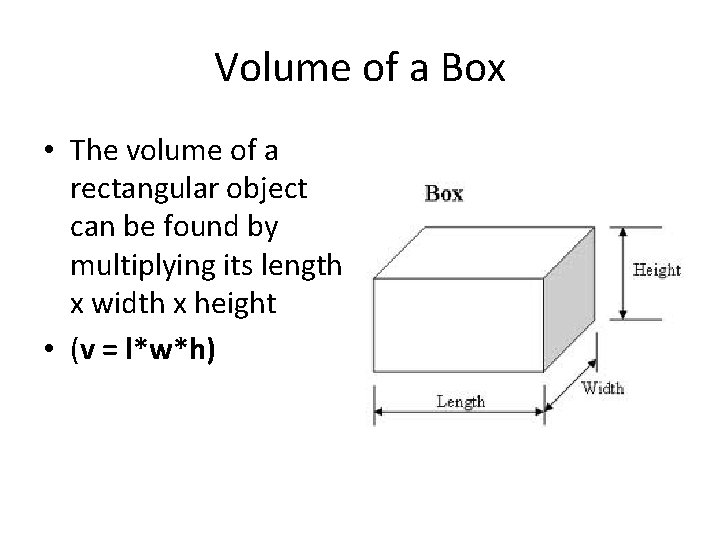
Volume of a Box • The volume of a rectangular object can be found by multiplying its length x width x height • (v = l*w*h)
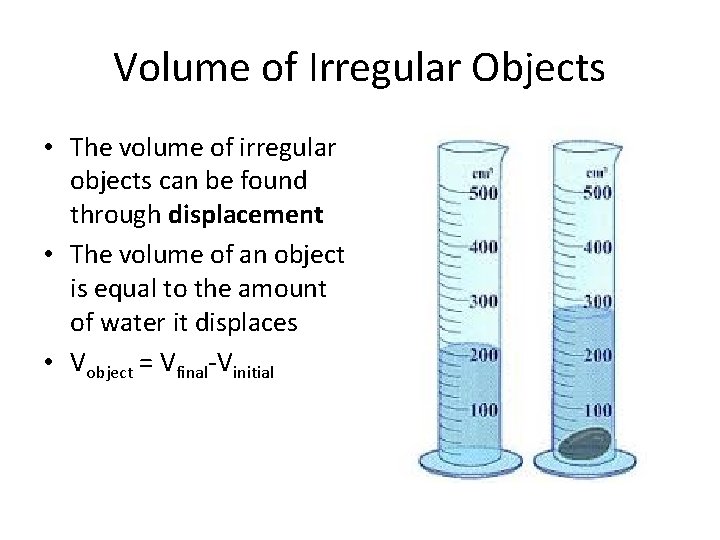
Volume of Irregular Objects • The volume of irregular objects can be found through displacement • The volume of an object is equal to the amount of water it displaces • Vobject = Vfinal-Vinitial
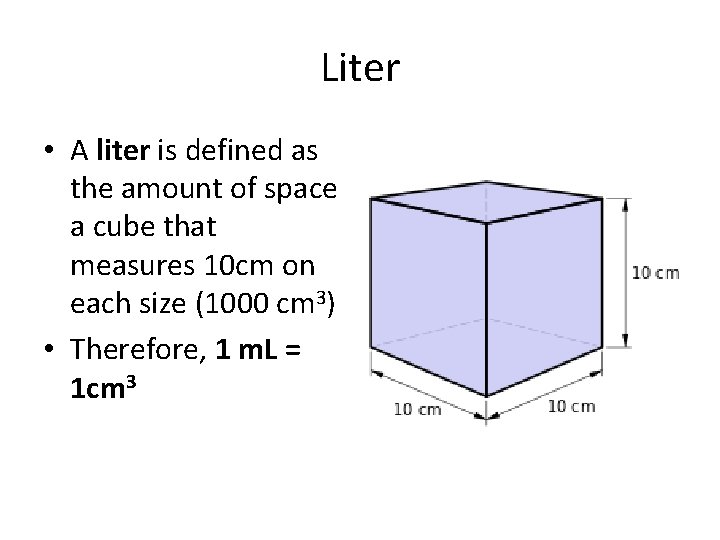
Liter • A liter is defined as the amount of space a cube that measures 10 cm on each size (1000 cm 3) • Therefore, 1 m. L = 1 cm 3
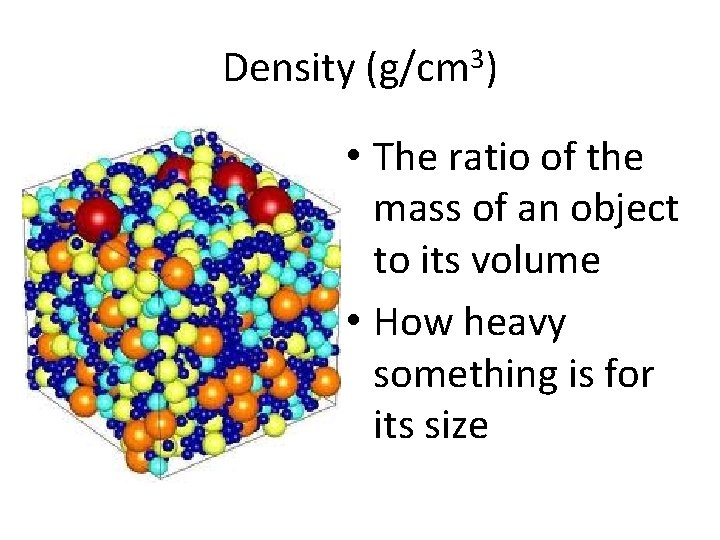
Density (g/cm 3) • The ratio of the mass of an object to its volume • How heavy something is for its size
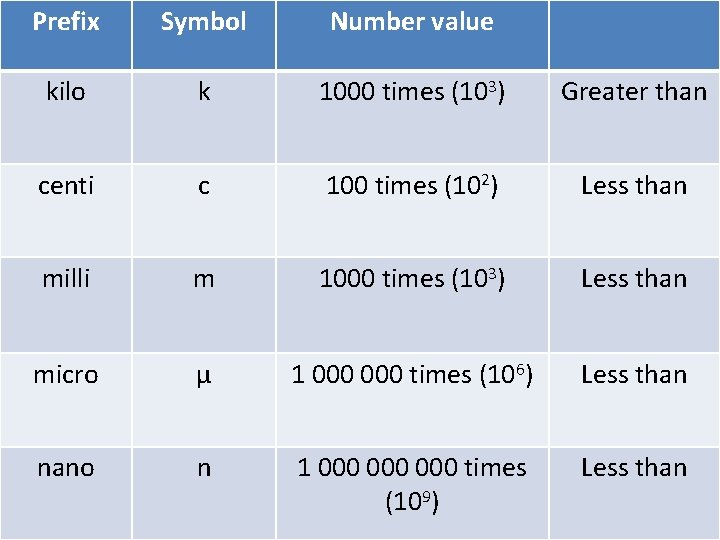
Prefix Symbol Number value kilo k Prefixes 1000 times (103) centi c 100 times (102) Less than milli m 1000 times (103) Less than micro μ 1 000 times (106) Less than nano n 1 000 000 times (109) Less than Greater than
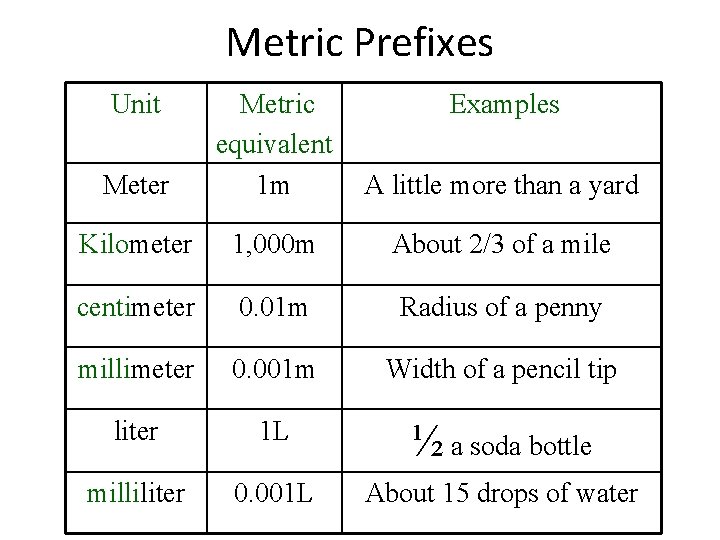
Metric Prefixes Unit Meter Metric equivalent 1 m Examples A little more than a yard Kilometer 1, 000 m About 2/3 of a mile centimeter 0. 01 m Radius of a penny millimeter 0. 001 m Width of a pencil tip liter 1 L ½ a soda bottle milliliter 0. 001 L About 15 drops of water
UNIT CONVERSIONS
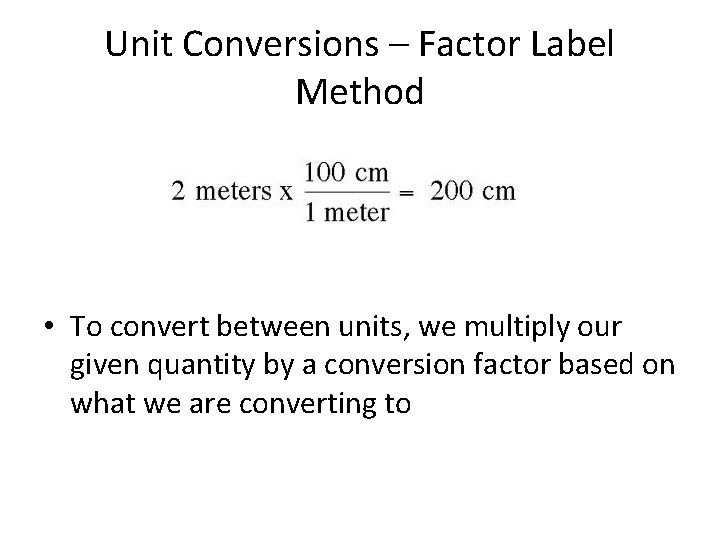
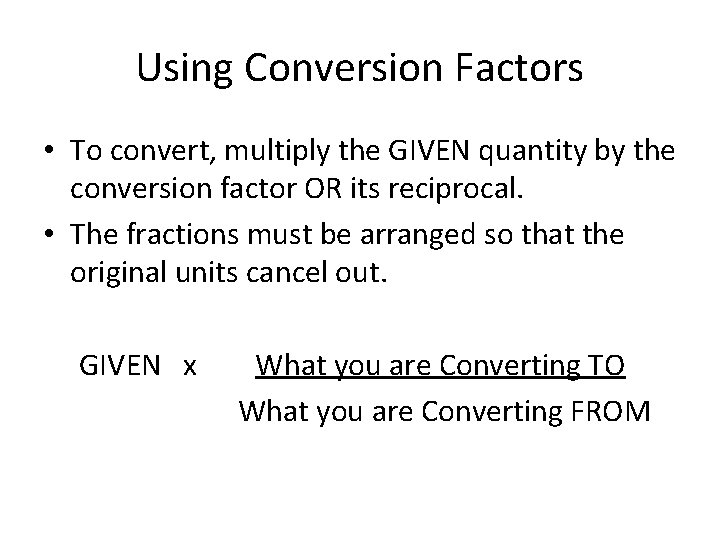
Unit Conversions – Factor Label Method • To convert between units, we multiply our given quantity by a conversion factor based on what we are converting to
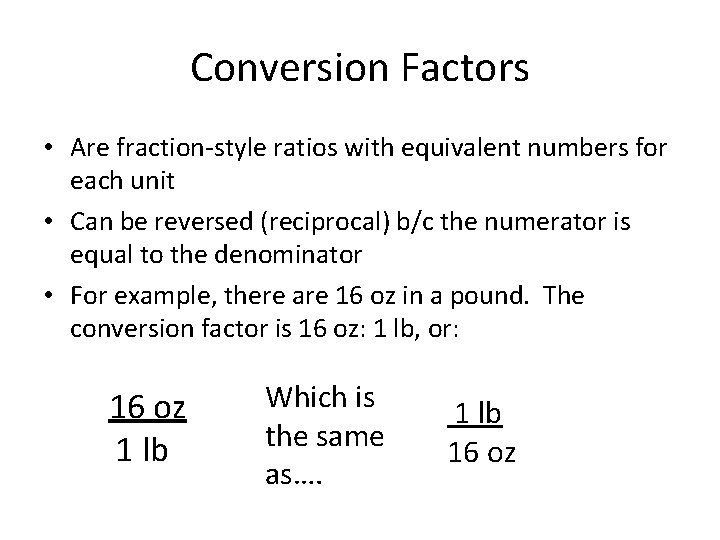
Conversion Factors • Are fraction-style ratios with equivalent numbers for each unit • Can be reversed (reciprocal) b/c the numerator is equal to the denominator • For example, there are 16 oz in a pound. The conversion factor is 16 oz: 1 lb, or: 16 oz 1 lb Which is the same as…. 1 lb 16 oz
Using Conversion Factors • To convert, multiply the GIVEN quantity by the conversion factor OR its reciprocal. • The fractions must be arranged so that the original units cancel out. GIVEN x What you are Converting TO What you are Converting FROM
Example – oz to lb Given • How many pounds are in 4 oz? 4 oz x 1 lb = 4 x 1 = 0. 25 lb 16 16 oz Because oz appear on both the top and bottom, they cancel out Or, mathematically, you could think: oz/oz = 1
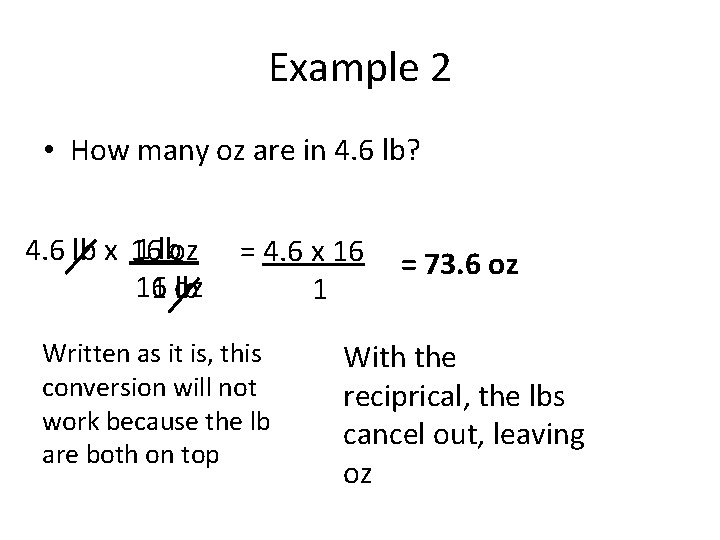
Example 2 • How many oz are in 4. 6 lb? 1 lboz 4. 6 lb x 16 161 oz lb = 4. 6 x 16 1 Written as it is, this conversion will not work because the lb are both on top = 73. 6 oz With the reciprical, the lbs cancel out, leaving oz
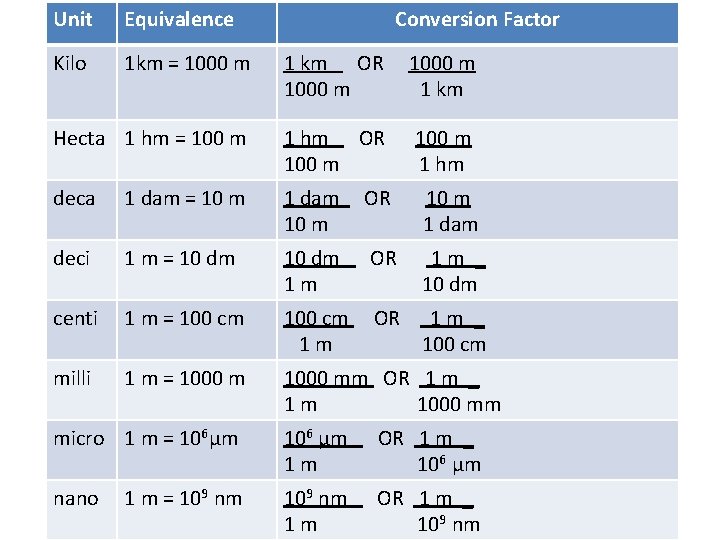
Unit Equivalence Conversion Factor Kilo 1 km = 1000 m 1 km OR 1000 m 1 km Hecta 1 hm = 100 m 1 hm OR 100 m 1 hm deca 1 dam = 10 m 1 dam 10 m OR 10 m 1 dam deci 1 m = 10 dm 1 m OR 1 m _ 10 dm centi 1 m = 100 cm 1 m OR 1 m _ 100 cm milli 1 m = 1000 mm OR 1 m _ 1 m 1000 mm micro 1 m = 106μm 106 μm 1 m OR 1 m _ 106 μm nano 109 nm 1 m OR 1 m _ 109 nm 1 m = 109 nm
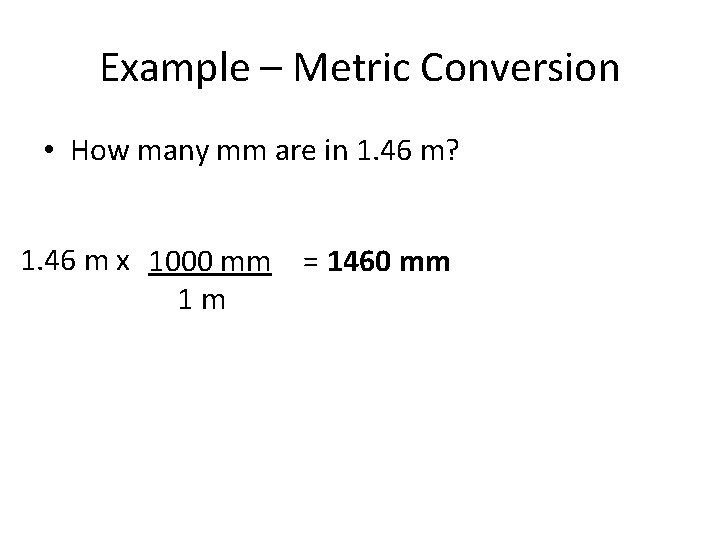
Example – Metric Conversion • How many mm are in 1. 46 m? 1. 46 m x 1000 mm = 1460 mm 1 m
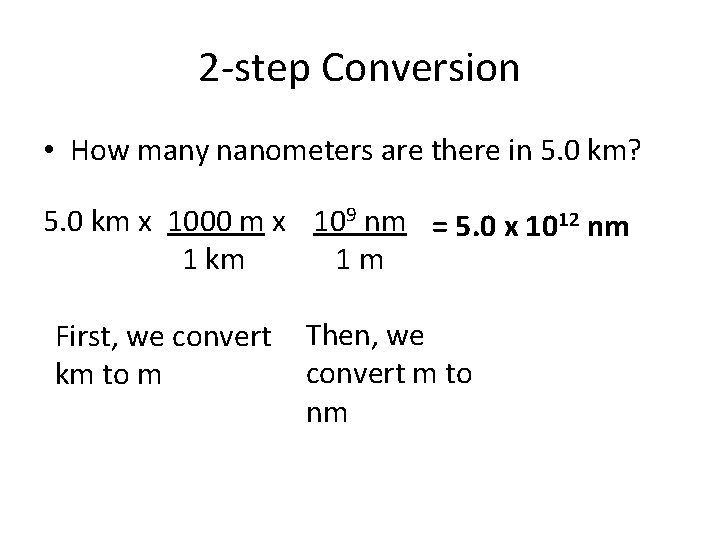
2 -step Conversion • How many nanometers are there in 5. 0 km? 5. 0 km x 1000 m x 109 nm = 5. 0 x 1012 nm 1 km 1 m First, we convert km to m Then, we convert m to nm
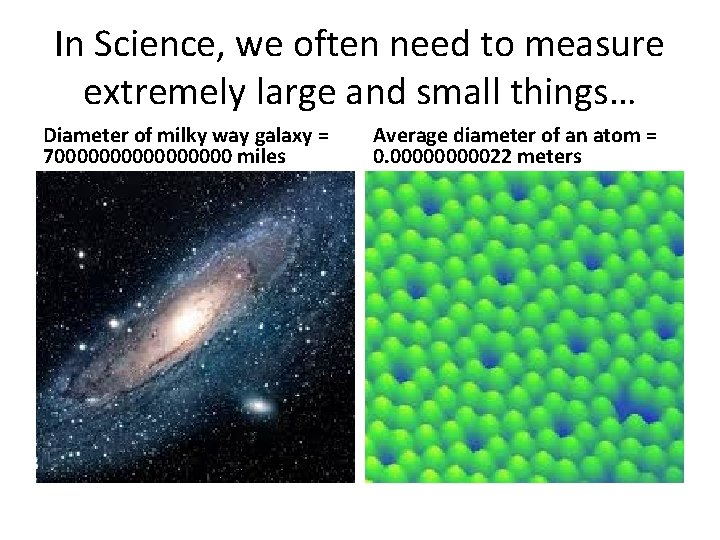
In Science, we often need to measure extremely large and small things… Diameter of milky way galaxy = 700000000 miles Average diameter of an atom = 0. 0000022 meters
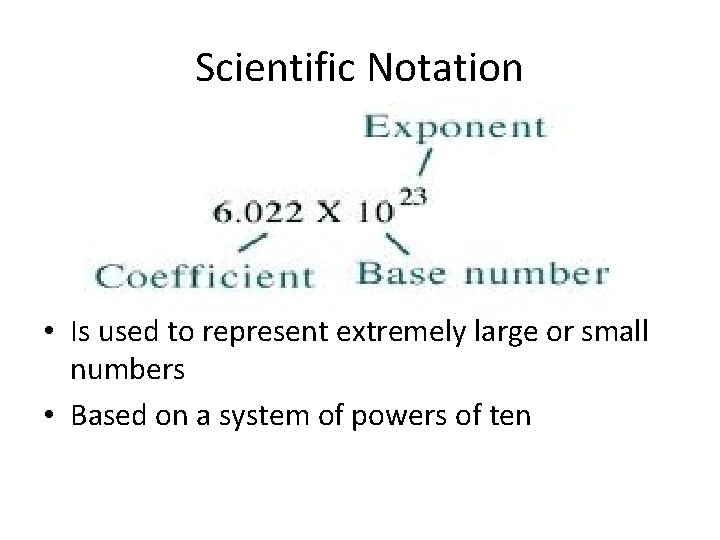
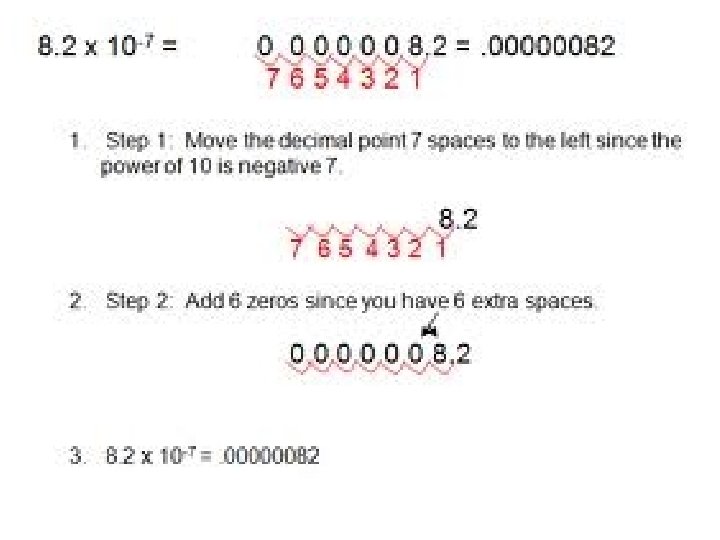
Scientific Notation • Is used to represent extremely large or small numbers • Based on a system of powers of ten
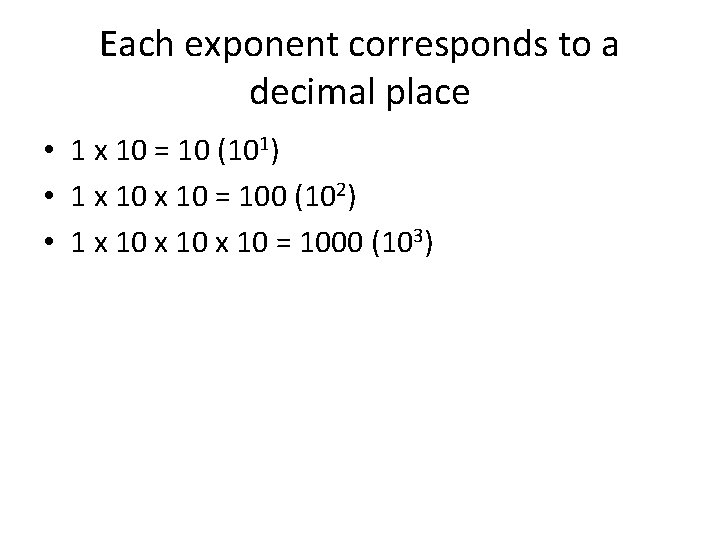
Each exponent corresponds to a decimal place • 1 x 10 = 10 (101) • 1 x 10 = 100 (102) • 1 x 10 = 1000 (103)
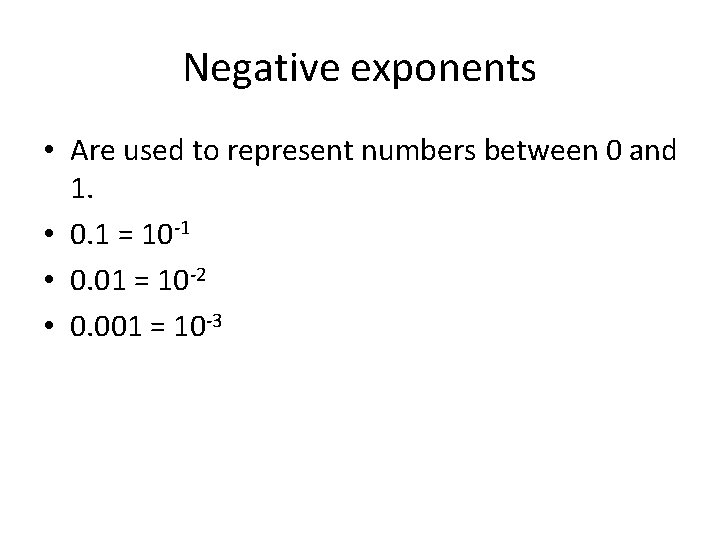
Negative exponents • Are used to represent numbers between 0 and 1. • 0. 1 = 10 -1 • 0. 01 = 10 -2 • 0. 001 = 10 -3
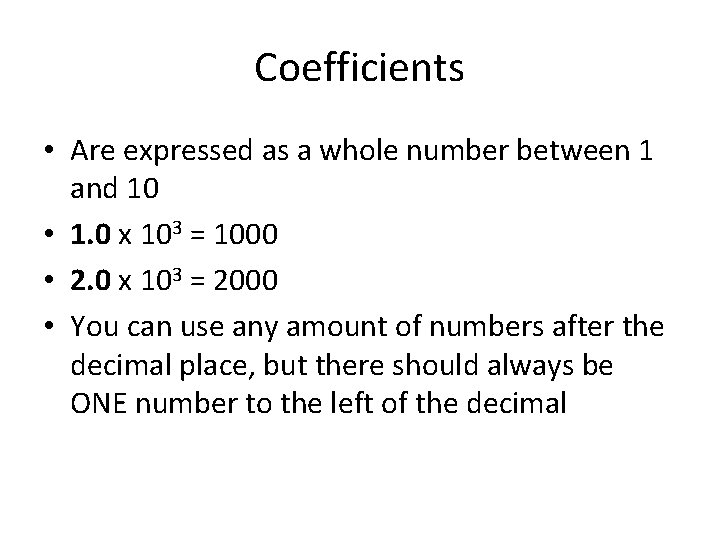
Coefficients • Are expressed as a whole number between 1 and 10 • 1. 0 x 103 = 1000 • 2. 0 x 103 = 2000 • You can use any amount of numbers after the decimal place, but there should always be ONE number to the left of the decimal
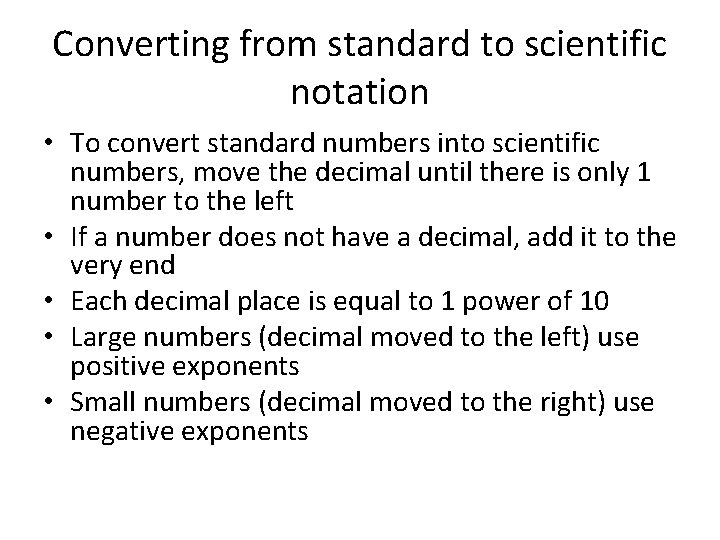
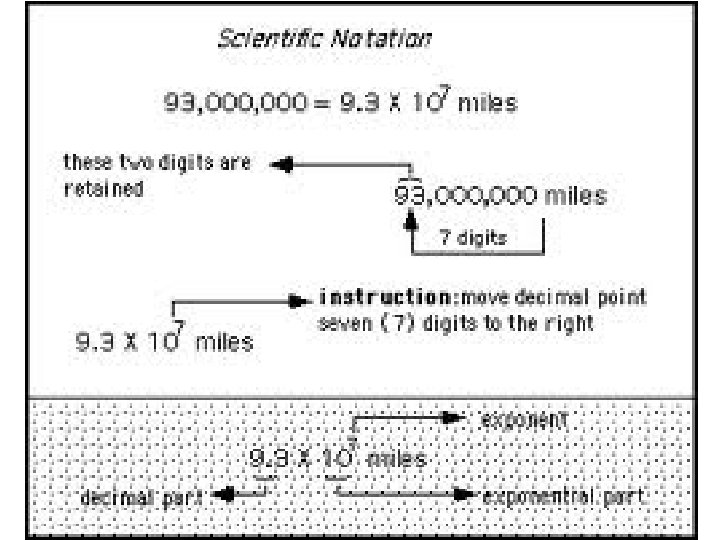
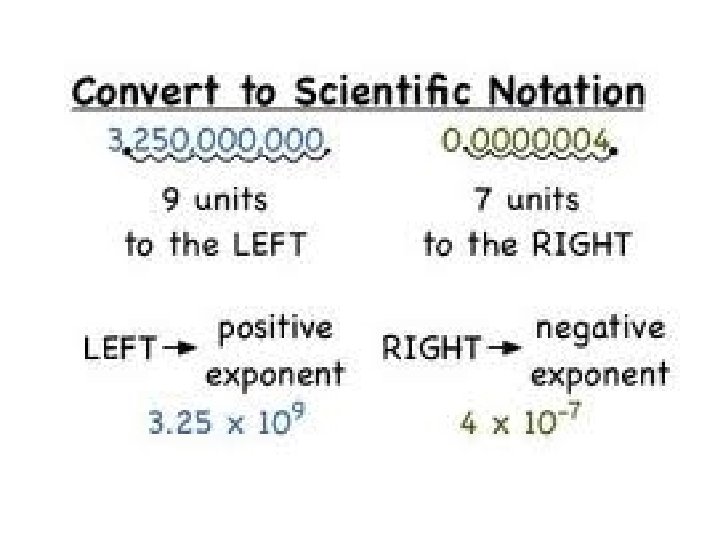
Converting from standard to scientific notation • To convert standard numbers into scientific numbers, move the decimal until there is only 1 number to the left • If a number does not have a decimal, add it to the very end • Each decimal place is equal to 1 power of 10 • Large numbers (decimal moved to the left) use positive exponents • Small numbers (decimal moved to the right) use negative exponents
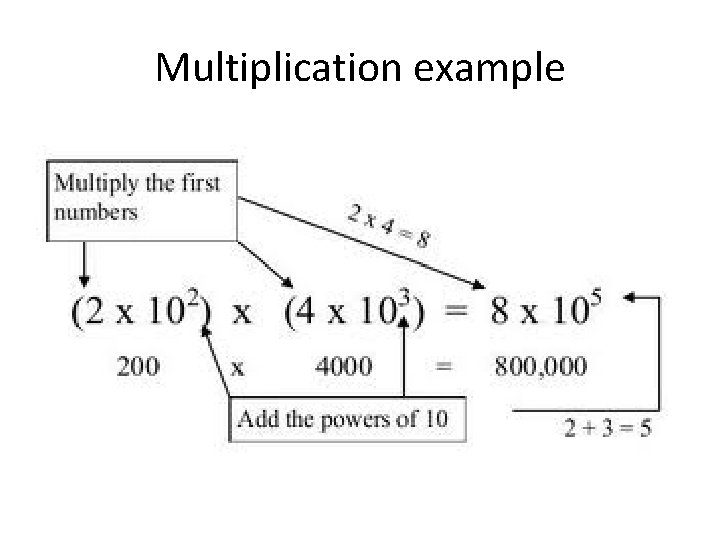
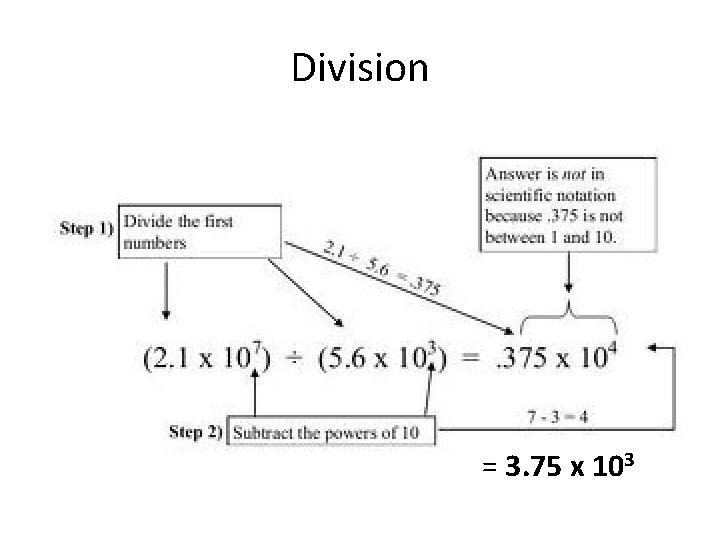
Multiplying and Dividing Scientific Numbers • When multiplying scientific numbers, multiply the coefficients and add the exponents • When dividing scientific numbers, divide the coefficients and subtract the exponents • If a scientific calculator is used, ALWAYS place the full scientific number in parentheses
Multiplication example
Division = 3. 75 x 103
Uncertainty and Error • ALL measurements have some degree of error and uncertainty
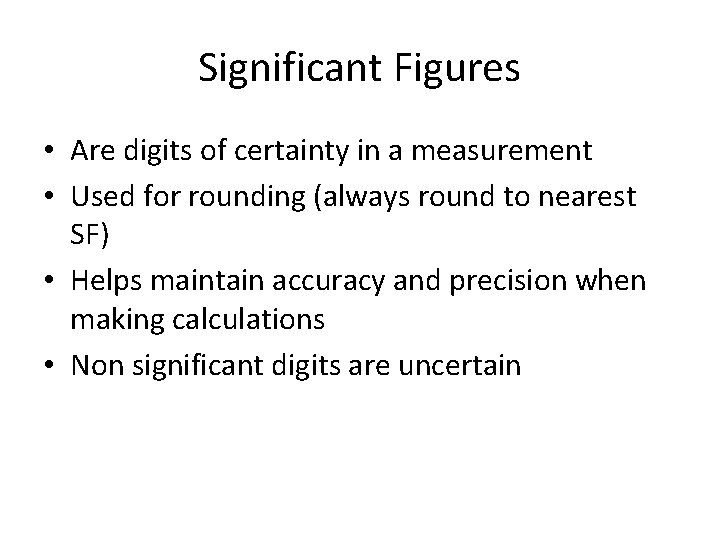
Significant Figures • Are digits of certainty in a measurement • Used for rounding (always round to nearest SF) • Helps maintain accuracy and precision when making calculations • Non significant digits are uncertain
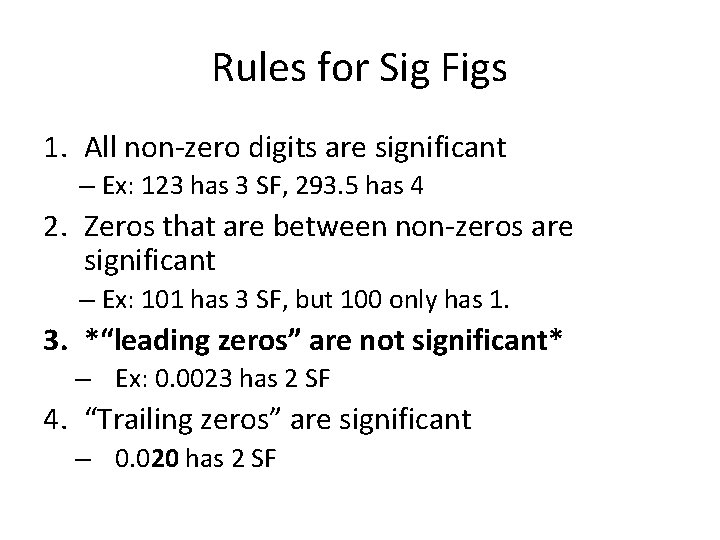
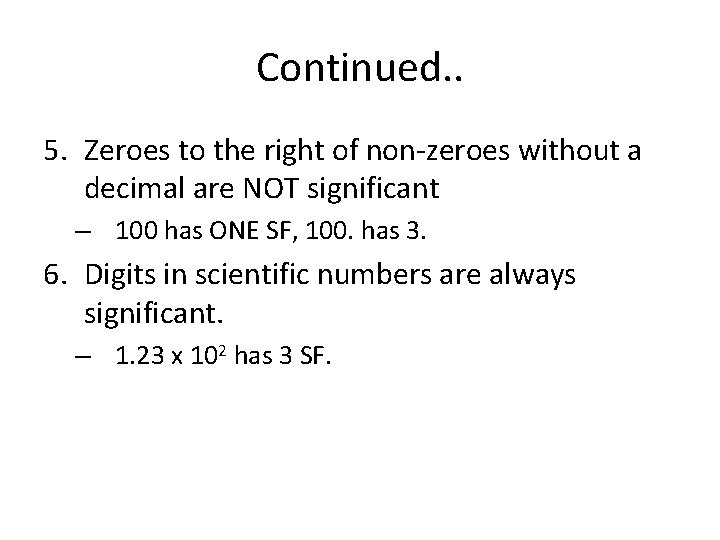
Rules for Sig Figs 1. All non-zero digits are significant – Ex: 123 has 3 SF, 293. 5 has 4 2. Zeros that are between non-zeros are significant – Ex: 101 has 3 SF, but 100 only has 1. 3. *“leading zeros” are not significant* – Ex: 0. 0023 has 2 SF 4. “Trailing zeros” are significant – 0. 020 has 2 SF
Continued. . 5. Zeroes to the right of non-zeroes without a decimal are NOT significant – 100 has ONE SF, 100. has 3. 6. Digits in scientific numbers are always significant. – 1. 23 x 102 has 3 SF.
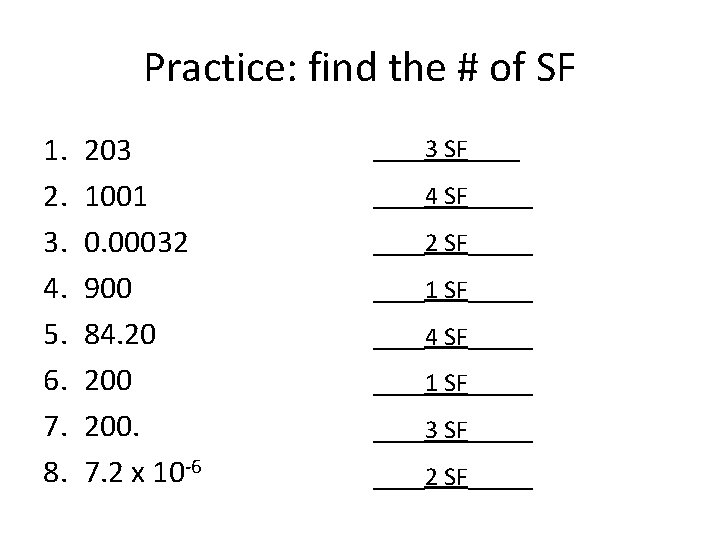
Practice: find the # of SF 1. 2. 3. 4. 5. 6. 7. 8. 203 1001 0. 00032 900 84. 20 200. 7. 2 x 10 -6 ____3 SF____4 SF_____2 SF_____1 SF_____4 SF_____1 SF_____3 SF_____2 SF_____
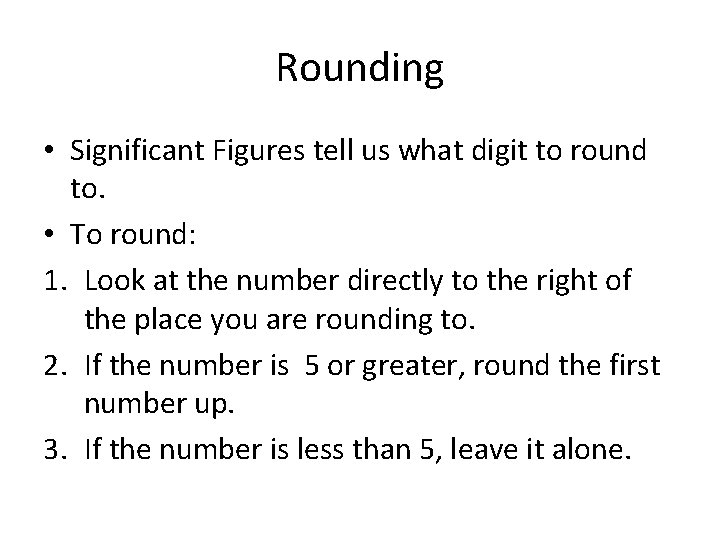
Rounding • Significant Figures tell us what digit to round to. • To round: 1. Look at the number directly to the right of the place you are rounding to. 2. If the number is 5 or greater, round the first number up. 3. If the number is less than 5, leave it alone.
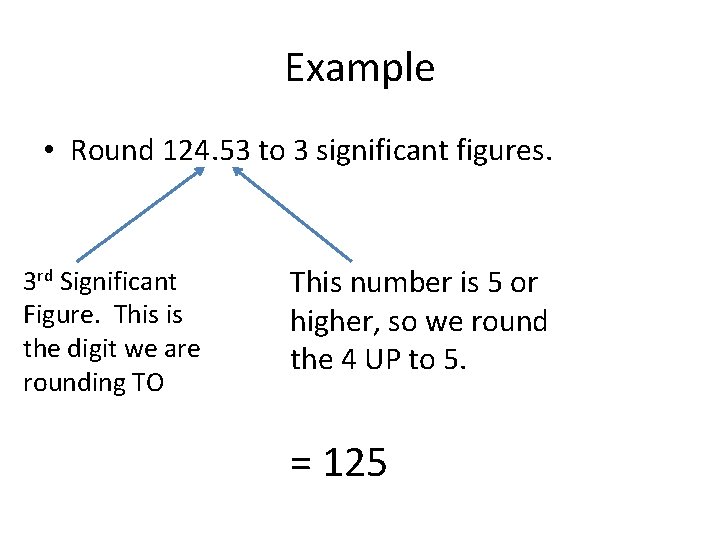
Example • Round 124. 53 to 3 significant figures. 3 rd Significant Figure. This is the digit we are rounding TO This number is 5 or higher, so we round the 4 UP to 5. = 125
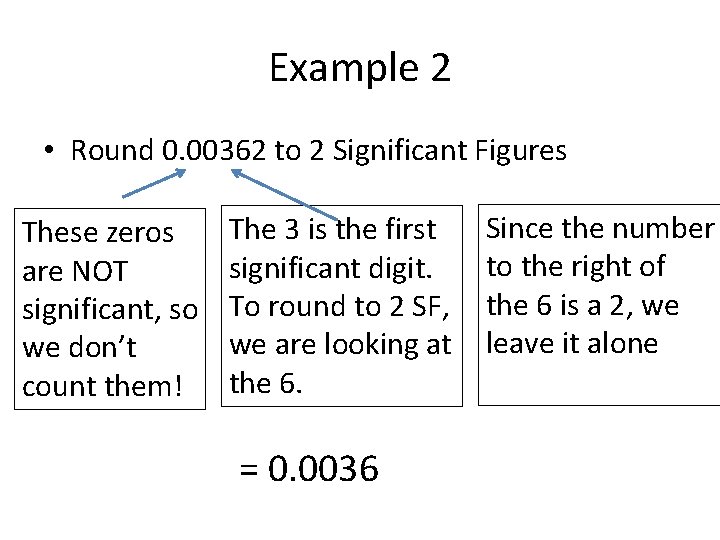
Example 2 • Round 0. 00362 to 2 Significant Figures These zeros are NOT significant, so we don’t count them! The 3 is the first significant digit. To round to 2 SF, we are looking at the 6. = 0. 0036 Since the number to the right of the 6 is a 2, we leave it alone
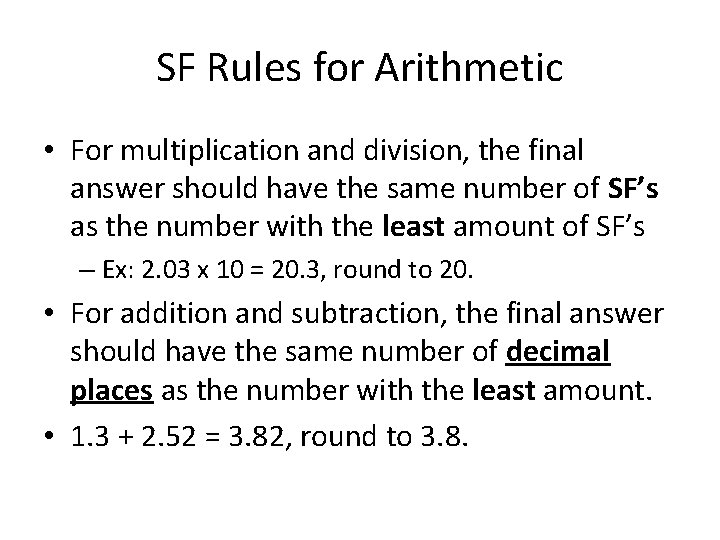
SF Rules for Arithmetic • For multiplication and division, the final answer should have the same number of SF’s as the number with the least amount of SF’s – Ex: 2. 03 x 10 = 20. 3, round to 20. • For addition and subtraction, the final answer should have the same number of decimal places as the number with the least amount. • 1. 3 + 2. 52 = 3. 82, round to 3. 8.
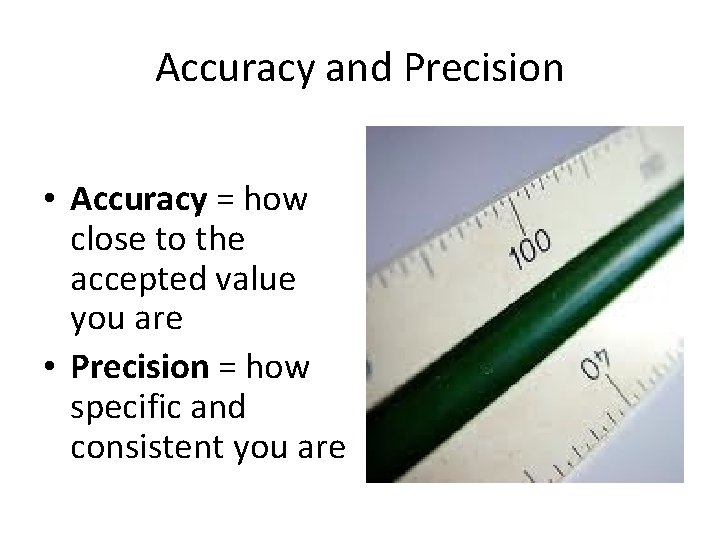
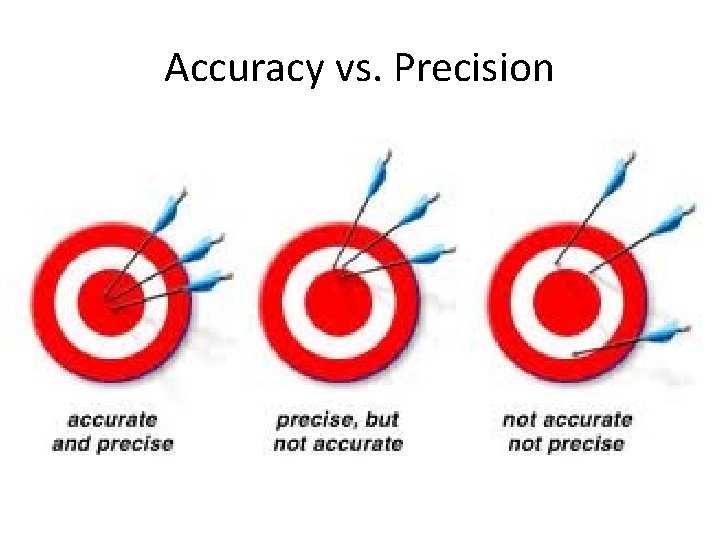
Accuracy and Precision • Accuracy = how close to the accepted value you are • Precision = how specific and consistent you are
Accuracy vs. Precision
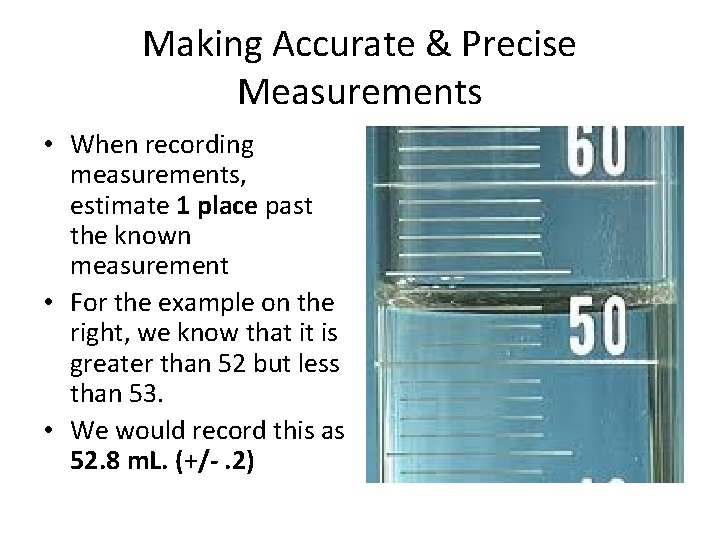
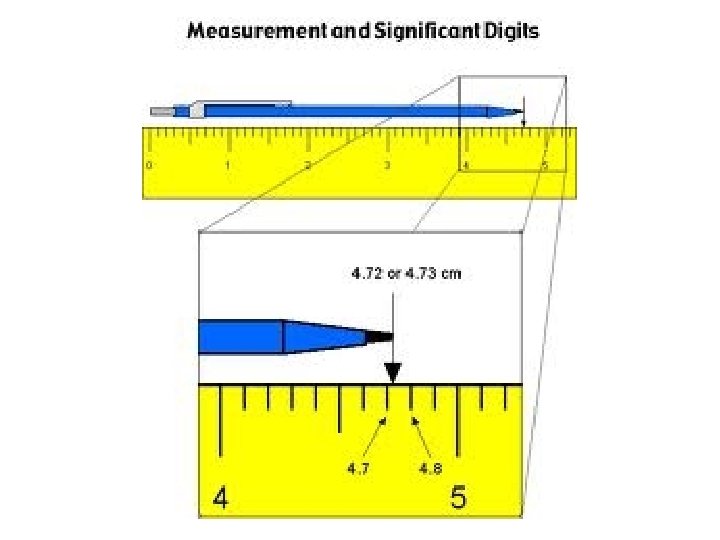
Making Accurate & Precise Measurements • When recording measurements, estimate 1 place past the known measurement • For the example on the right, we know that it is greater than 52 but less than 53. • We would record this as 52. 8 m. L. (+/-. 2)
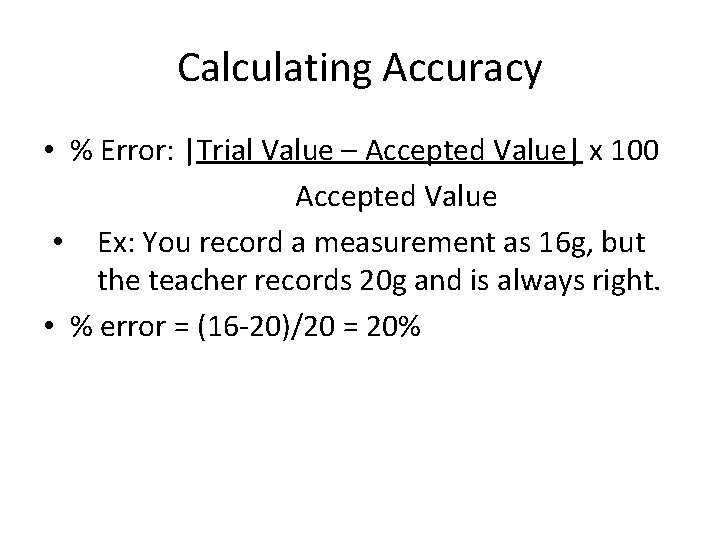
Calculating Accuracy • % Error: |Trial Value – Accepted Value| x 100 Accepted Value • Ex: You record a measurement as 16 g, but the teacher records 20 g and is always right. • % error = (16 -20)/20 = 20%
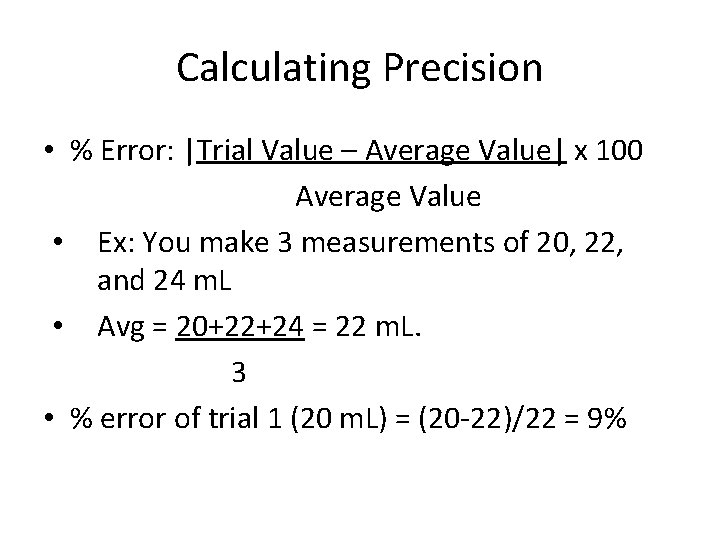
Calculating Precision • % Error: |Trial Value – Average Value| x 100 Average Value • Ex: You make 3 measurements of 20, 22, and 24 m. L • Avg = 20+22+24 = 22 m. L. 3 • % error of trial 1 (20 m. L) = (20 -22)/22 = 9%
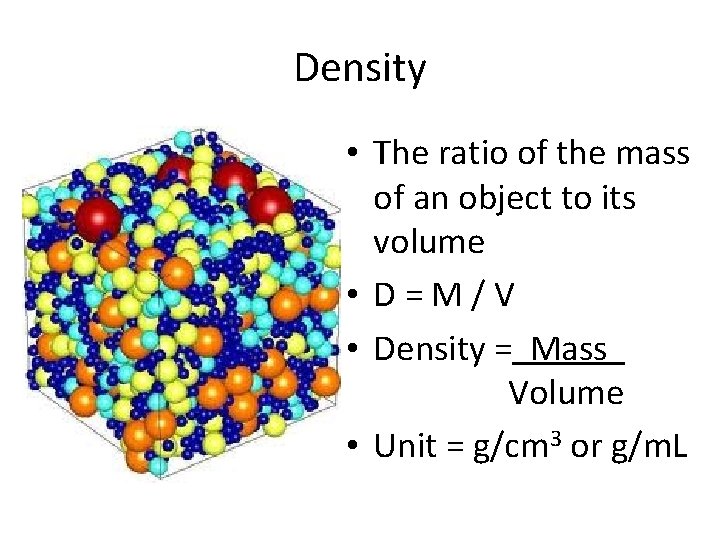
Density • The ratio of the mass of an object to its volume • D=M/V • Density = Mass Volume • Unit = g/cm 3 or g/m. L
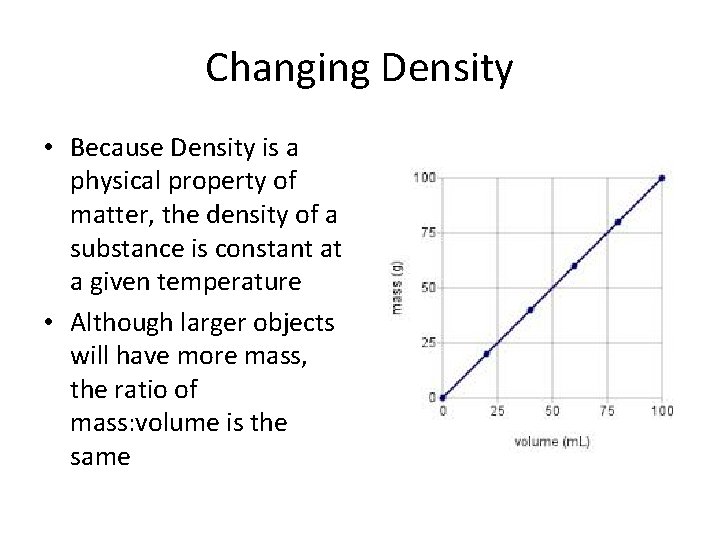
Changing Density • Because Density is a physical property of matter, the density of a substance is constant at a given temperature • Although larger objects will have more mass, the ratio of mass: volume is the same
Problem Solving in Chemistry Q: How do we solve problems if we don’t know how to set them up? A: We GUESS! Given (state what the problem gives you) Unknown (identify what you are solving) Equation (state the equation) Substitute (for each known variable) Solve for the unknown (X)
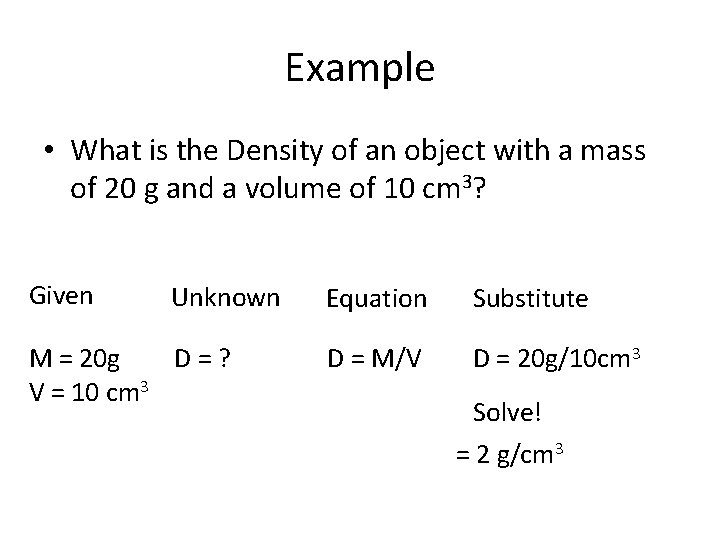
Example • What is the Density of an object with a mass of 20 g and a volume of 10 cm 3? Given Unknown M = 20 g D=? V = 10 cm 3 Equation Substitute D = M/V D = 20 g/10 cm 3 Solve! = 2 g/cm 3
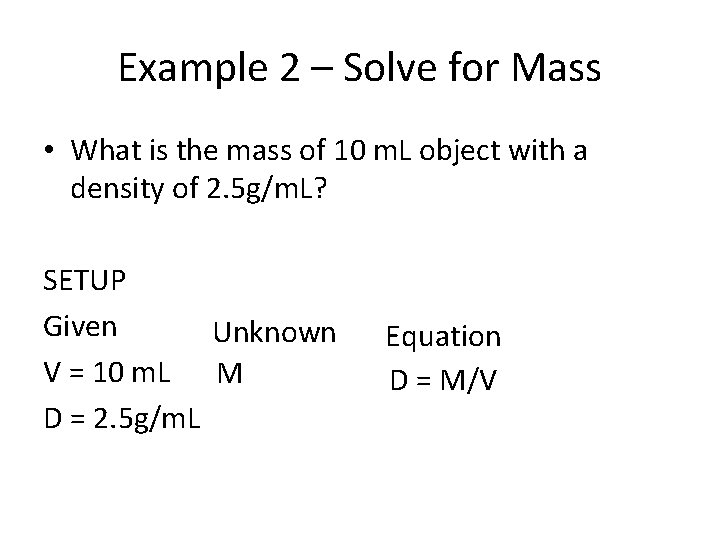
Example 2 – Solve for Mass • What is the mass of 10 m. L object with a density of 2. 5 g/m. L? SETUP Given Unknown V = 10 m. L M D = 2. 5 g/m. L Equation D = M/V
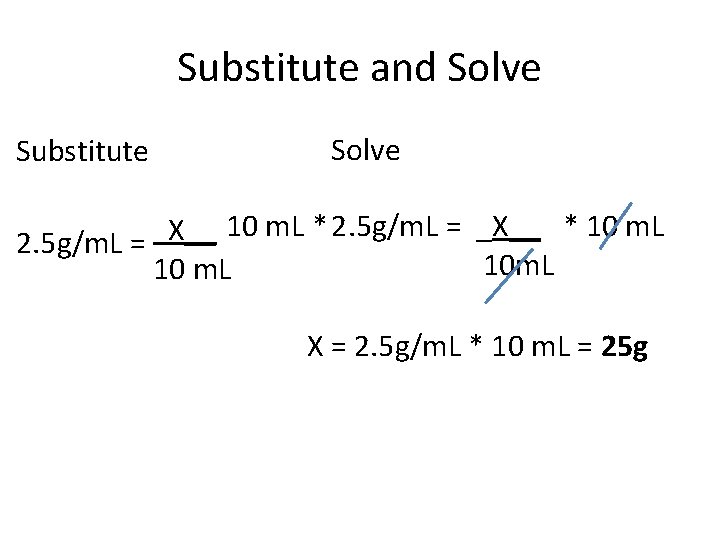
Substitute and Solve Substitute Solve 10 m. L * 2. 5 g/m. L = _X__ * 10 m. L X__ 2. 5 g/m. L = 10 m. L 10 m. L X = 2. 5 g/m. L * 10 m. L = 25 g
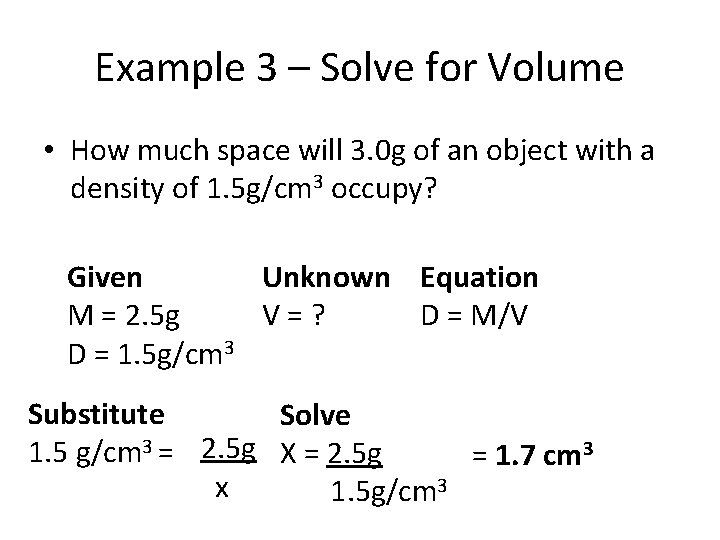
Example 3 – Solve for Volume • How much space will 3. 0 g of an object with a density of 1. 5 g/cm 3 occupy? Given Unknown Equation M = 2. 5 g V=? D = M/V D = 1. 5 g/cm 3 Substitute Solve 1. 5 g/cm 3 = 2. 5 g X = 2. 5 g = 1. 7 cm 3 x 1. 5 g/cm 3
RELATIVE DENSITY AND SPECIFIC GRAVITY
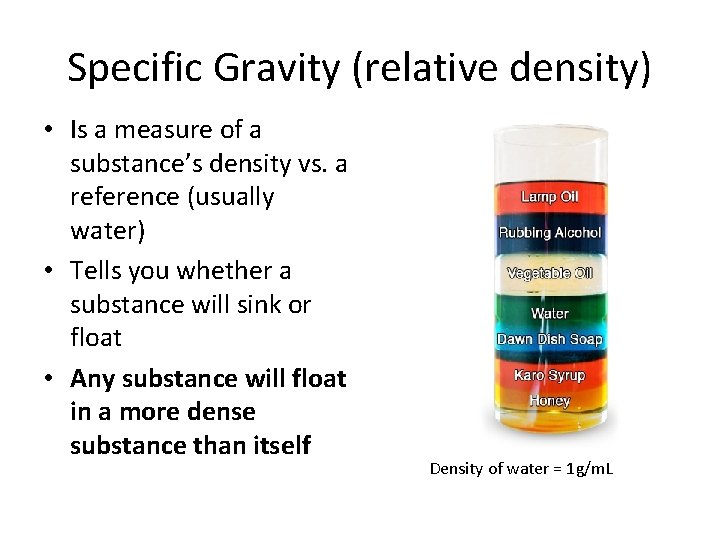
Specific Gravity (relative density) • Is a measure of a substance’s density vs. a reference (usually water) • Tells you whether a substance will sink or float • Any substance will float in a more dense substance than itself Density of water = 1 g/m. L
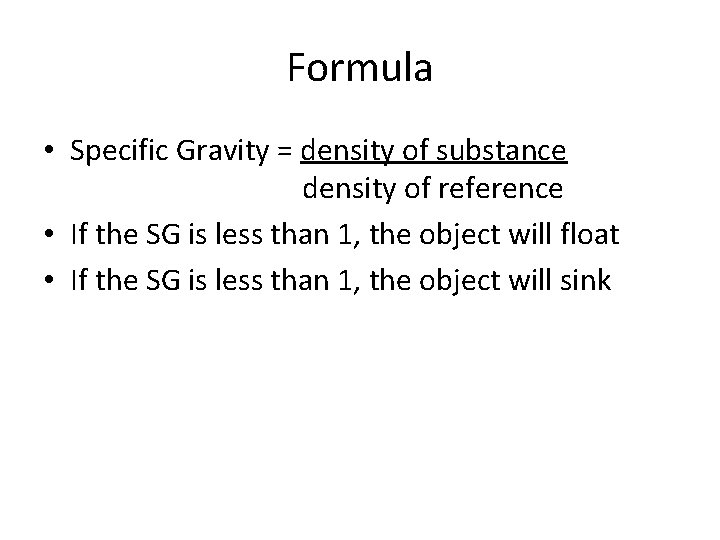
Formula • Specific Gravity = density of substance density of reference • If the SG is less than 1, the object will float • If the SG is less than 1, the object will sink
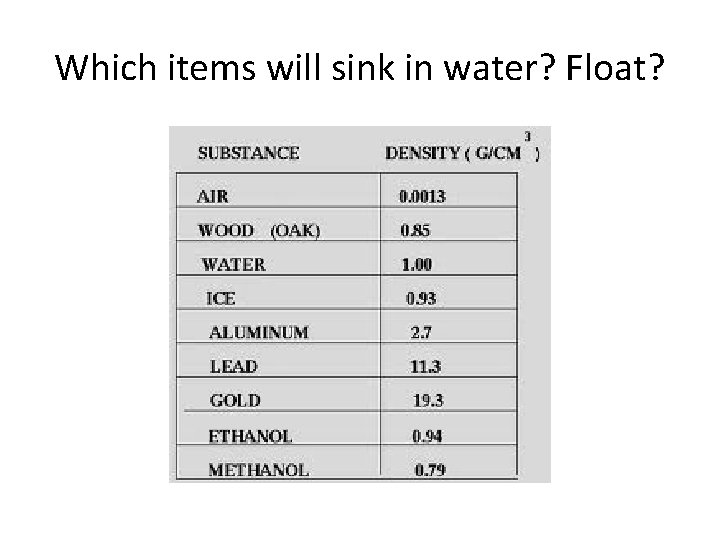
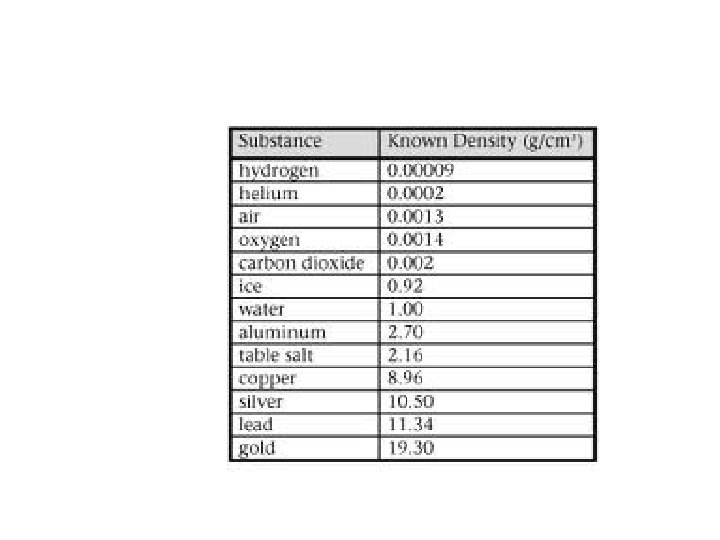
Which items will sink in water? Float?
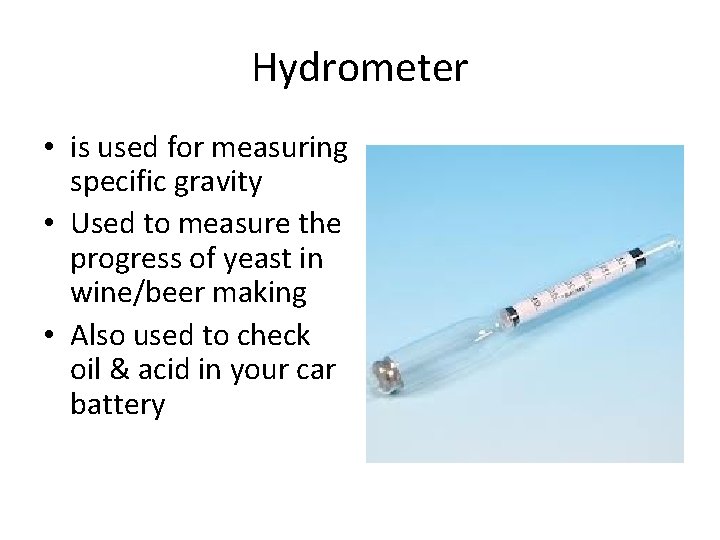
Hydrometer • is used for measuring specific gravity • Used to measure the progress of yeast in wine/beer making • Also used to check oil & acid in your car battery
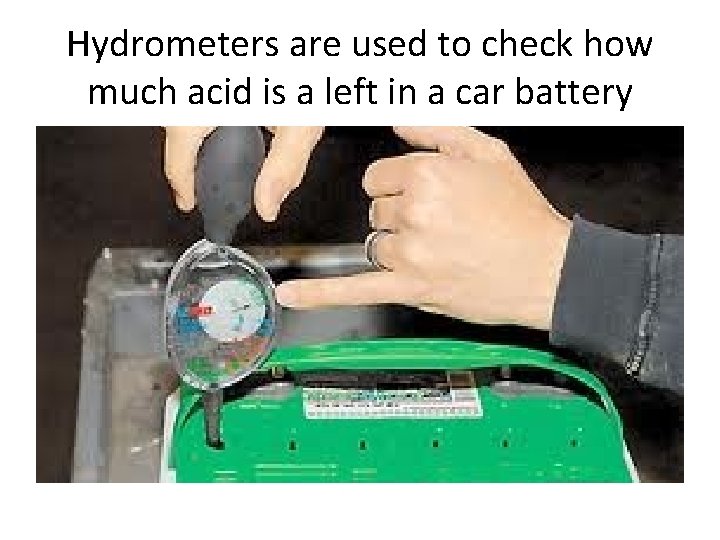
Hydrometers are used to check how much acid is a left in a car battery