
Transformations Exploring Rigid Motion in a Plane What


- Slides: 86
Transformations Exploring Rigid Motion in a Plane
What You Should Learn Why You Should Learn It § § § Goal 1: How to identify the three basic rigid transformations in a plane Goal 2: How to use transformations to identify patterns and their properties in real life You can use transformations to create visual patterns, such as stencil patterns for the border of a wall
Identifying Transformations (flips, slides, turns) § § § Figures in a plane can be reflected, rotated, or slid to produce new figures. The new figure is the image, and the original figure is the preimage The operation that maps (or moves) the preimage onto the image is called a transformation
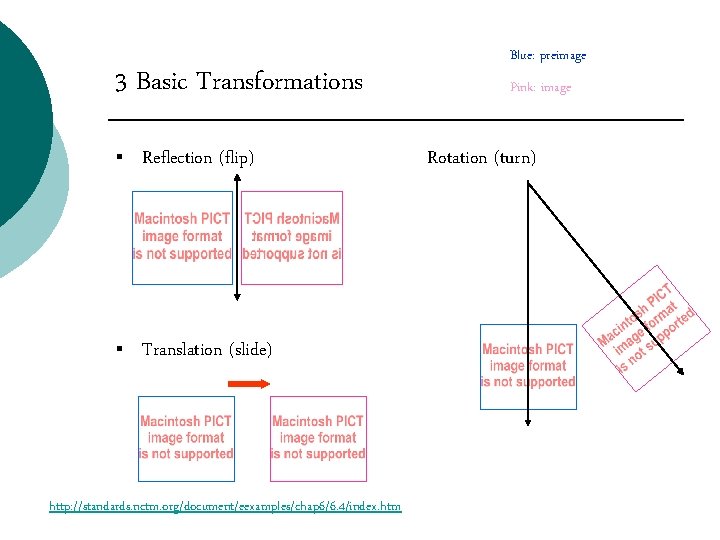
3 Basic Transformations § Reflection (flip) § Translation (slide) http: //standards. nctm. org/document/eexamples/chap 6/6. 4/index. htm Blue: preimage Pink: image Rotation (turn)
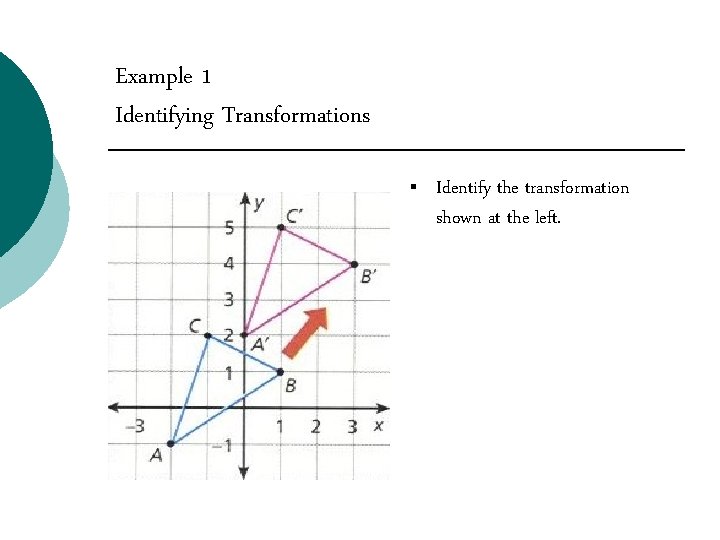
Example 1 Identifying Transformations § Identify the transformation shown at the left.
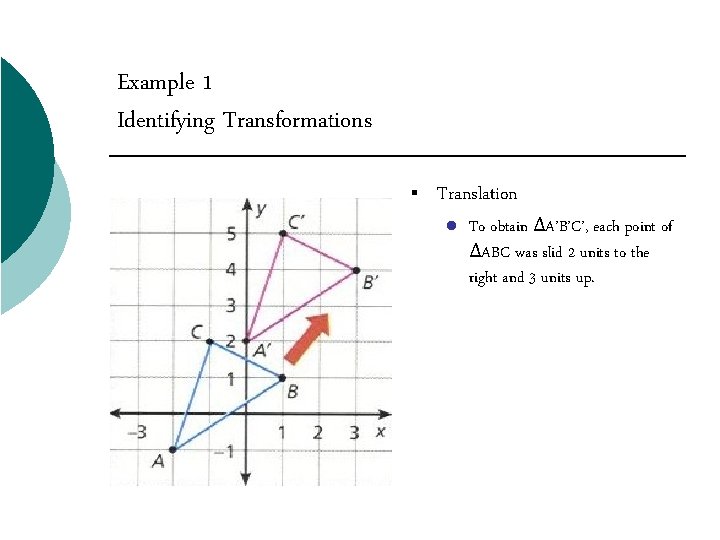
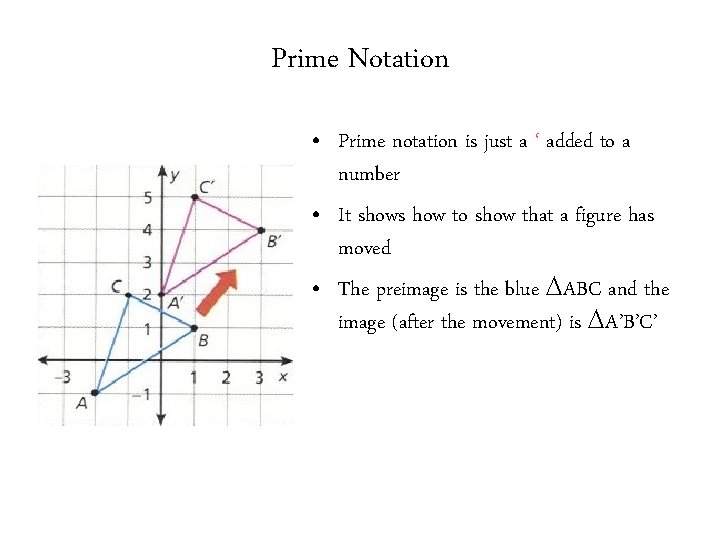
Example 1 Identifying Transformations § Translation l To obtain ΔA’B’C’, each point of ΔABC was slid 2 units to the right and 3 units up.
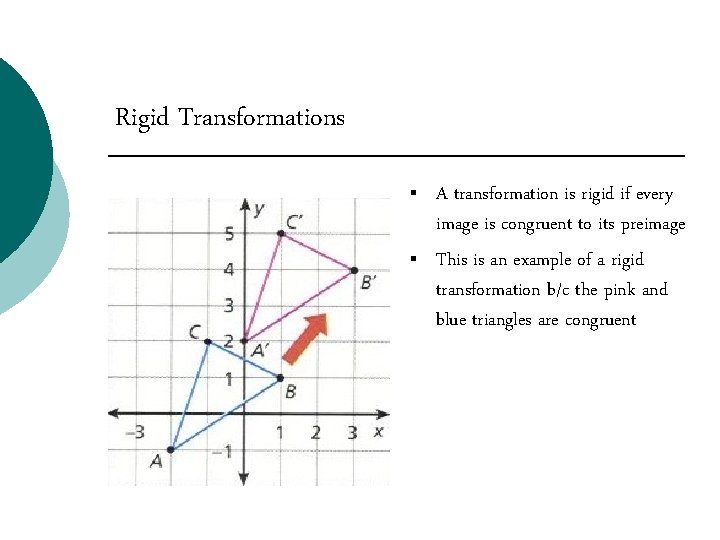
Rigid Transformations § § A transformation is rigid if every image is congruent to its preimage This is an example of a rigid transformation b/c the pink and blue triangles are congruent
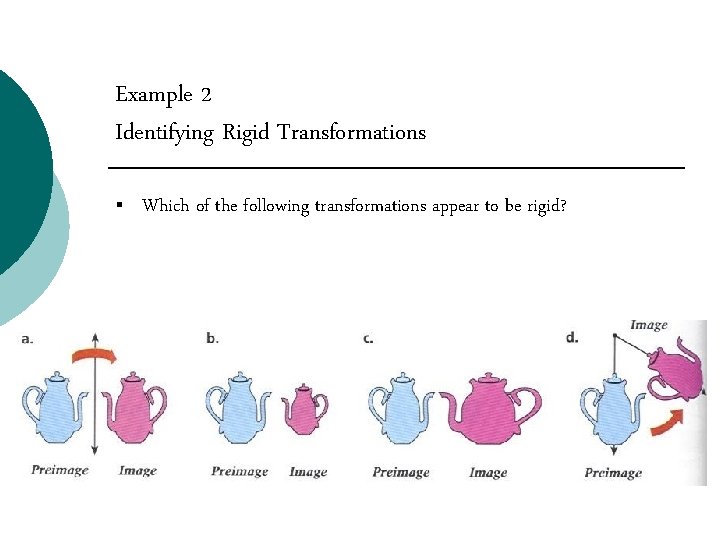
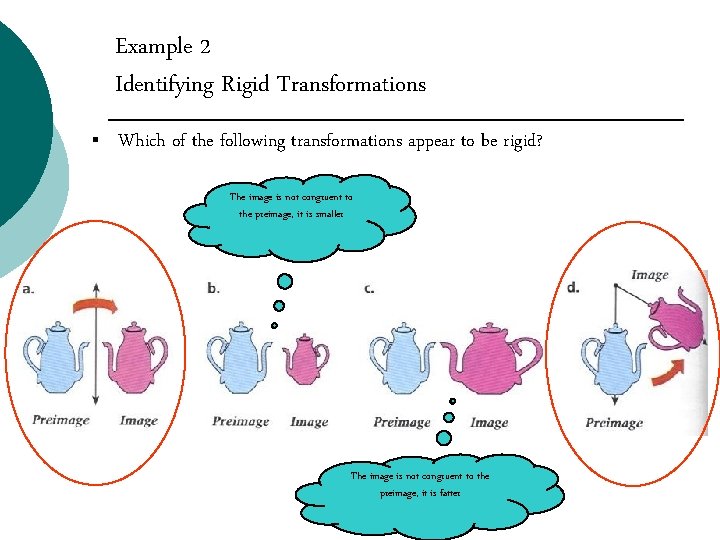
Example 2 Identifying Rigid Transformations § Which of the following transformations appear to be rigid?
Example 2 Identifying Rigid Transformations § Which of the following transformations appear to be rigid? The image is not congruent to the preimage, it is smaller The image is not congruent to the preimage, it is fatter
Definition of Isometry A rigid transformation is called an isometry ¡ A transformation in the plane is an isometry if it preserves lengths. (That is, every segment is congruent to its image) ¡ l It can be proved that isometries not only preserve lengths, they also preserves angle measures, parallel lines, and betweenness of points
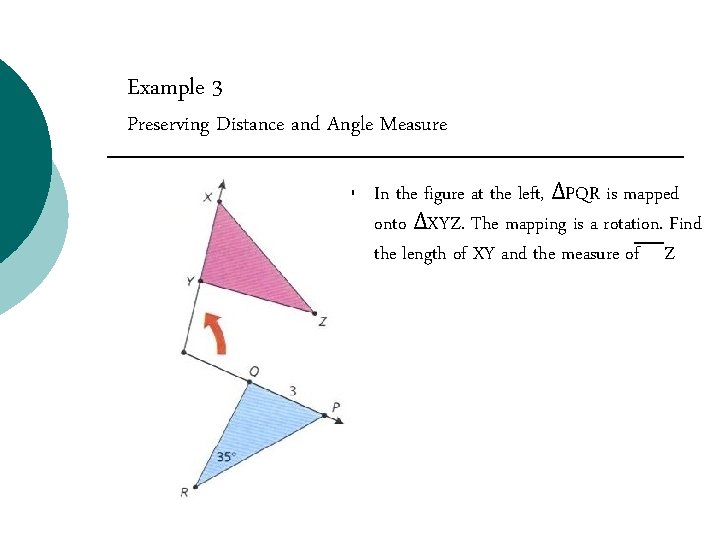
Example 3 Preserving Distance and Angle Measure § In the figure at the left, ΔPQR is mapped onto ΔXYZ. The mapping is a rotation. Find the length of XY and the measure of Z
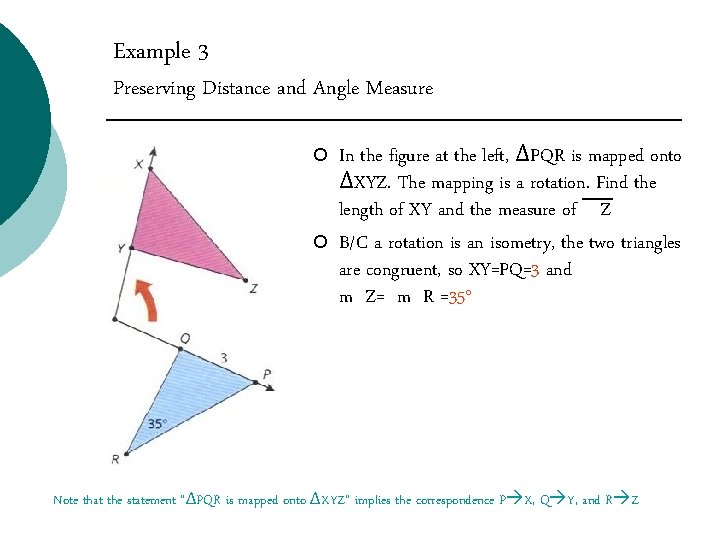
Example 3 Preserving Distance and Angle Measure ¡ ¡ In the figure at the left, ΔPQR is mapped onto ΔXYZ. The mapping is a rotation. Find the length of XY and the measure of Z B/C a rotation is an isometry, the two triangles are congruent, so XY=PQ=3 and m Z= m R =35° Note that the statement “ΔPQR is mapped onto ΔXYZ” implies the correspondence P X, Q Y, and R Z
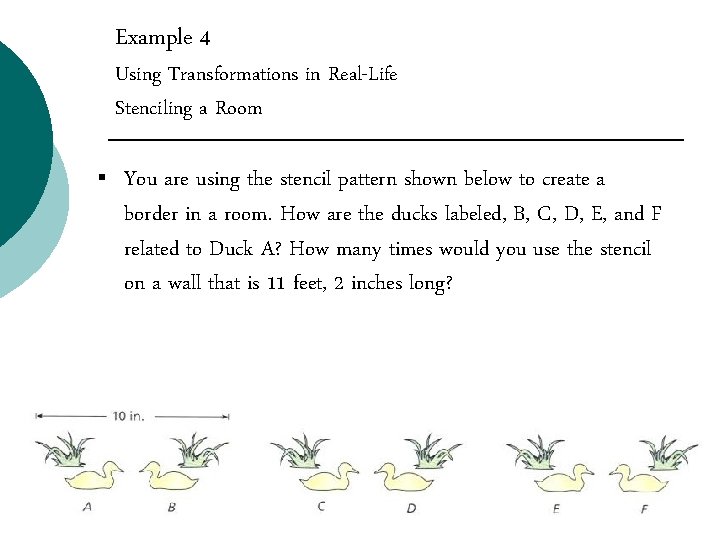
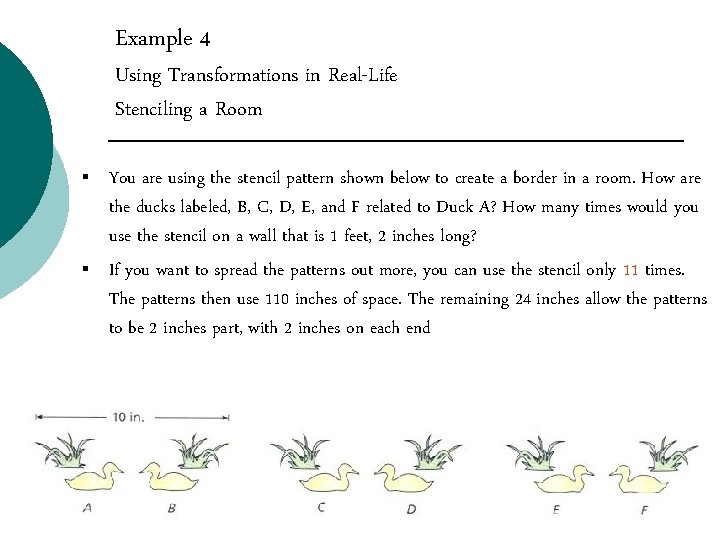
Example 4 Using Transformations in Real-Life Stenciling a Room § You are using the stencil pattern shown below to create a border in a room. How are the ducks labeled, B, C, D, E, and F related to Duck A? How many times would you use the stencil on a wall that is 11 feet, 2 inches long?
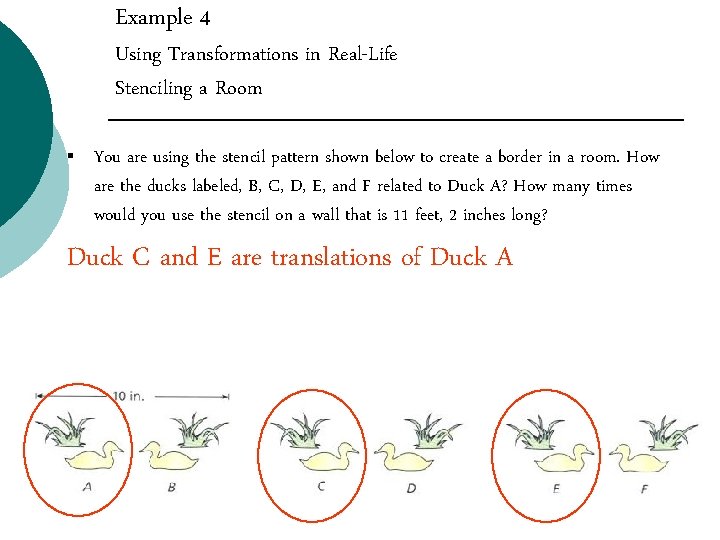
Example 4 Using Transformations in Real-Life Stenciling a Room § You are using the stencil pattern shown below to create a border in a room. How are the ducks labeled, B, C, D, E, and F related to Duck A? How many times would you use the stencil on a wall that is 11 feet, 2 inches long? Duck C and E are translations of Duck A
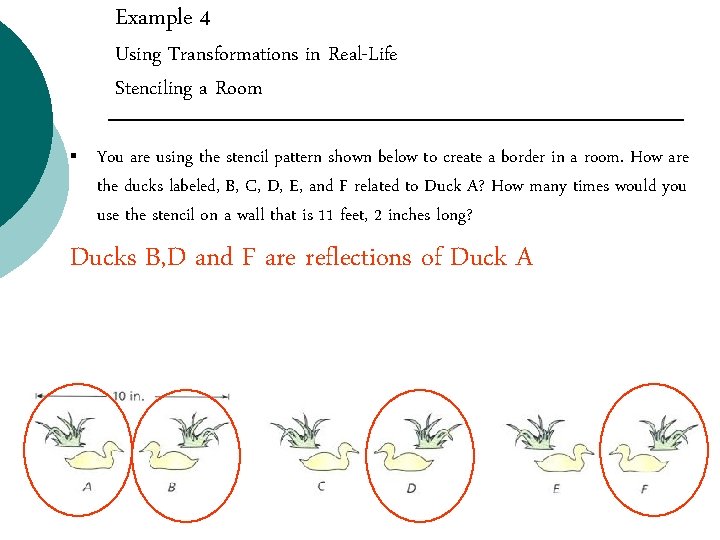
Example 4 Using Transformations in Real-Life Stenciling a Room § You are using the stencil pattern shown below to create a border in a room. How are the ducks labeled, B, C, D, E, and F related to Duck A? How many times would you use the stencil on a wall that is 11 feet, 2 inches long? Ducks B, D and F are reflections of Duck A
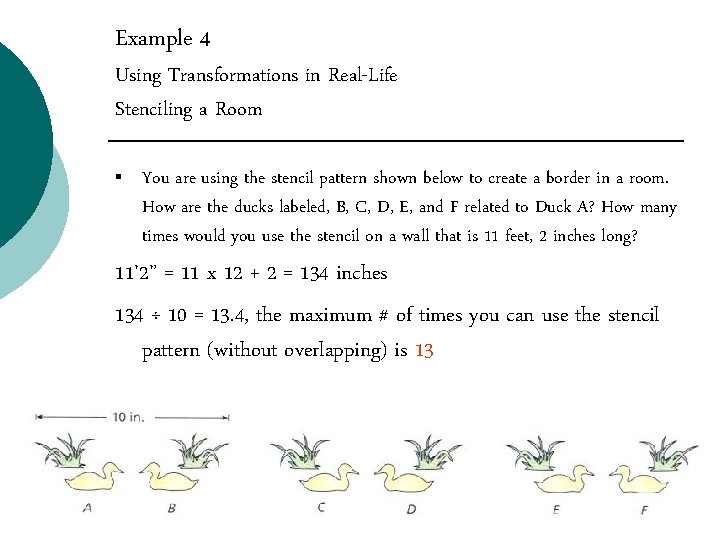
Example 4 Using Transformations in Real-Life Stenciling a Room § You are using the stencil pattern shown below to create a border in a room. How are the ducks labeled, B, C, D, E, and F related to Duck A? How many times would you use the stencil on a wall that is 11 feet, 2 inches long? 11’ 2” = 11 x 12 + 2 = 134 inches 134 ÷ 10 = 13. 4, the maximum # of times you can use the stencil pattern (without overlapping) is 13
Example 4 Using Transformations in Real-Life Stenciling a Room § § You are using the stencil pattern shown below to create a border in a room. How are the ducks labeled, B, C, D, E, and F related to Duck A? How many times would you use the stencil on a wall that is 1 feet, 2 inches long? If you want to spread the patterns out more, you can use the stencil only 11 times. The patterns then use 110 inches of space. The remaining 24 inches allow the patterns to be 2 inches part, with 2 inches on each end
Translations (slides)
What You Should Learn Why You Should Learn It o How to use properties of translations o How to use translations to solve real-life problems o You can use translations to solve real-life problems, such as determining patterns in music
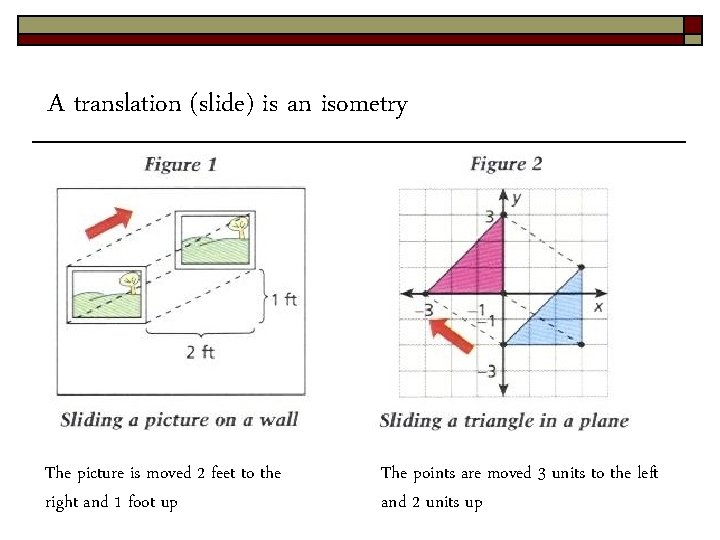
A translation (slide) is an isometry The picture is moved 2 feet to the right and 1 foot up The points are moved 3 units to the left and 2 units up
Examples • http: //www. shodor. org/interactivate/activiti es/transform/index. html
Prime Notation • Prime notation is just a ‘ added to a number • It shows how to show that a figure has moved • The preimage is the blue DABC and the image (after the movement) is DA’B’C’
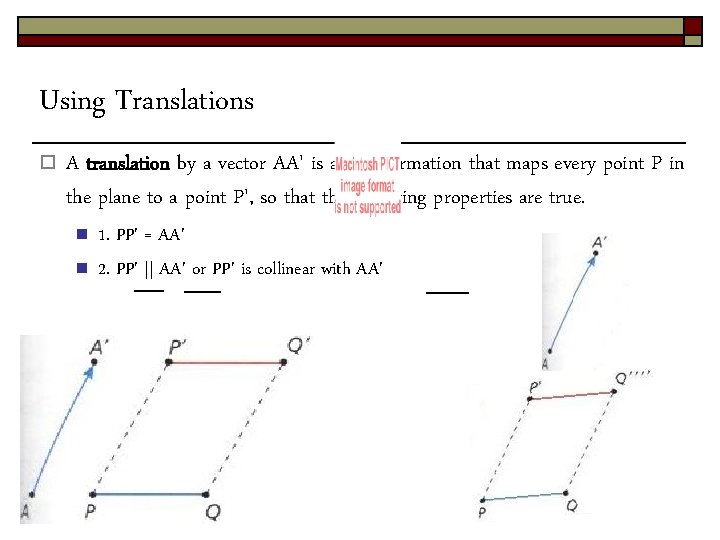
Using Translations o A translation by a vector AA' is a transformation that maps every point P in the plane to a point P', so that the following properties are true. n n 1. PP' = AA' 2. PP' || AA' or PP' is collinear with AA'
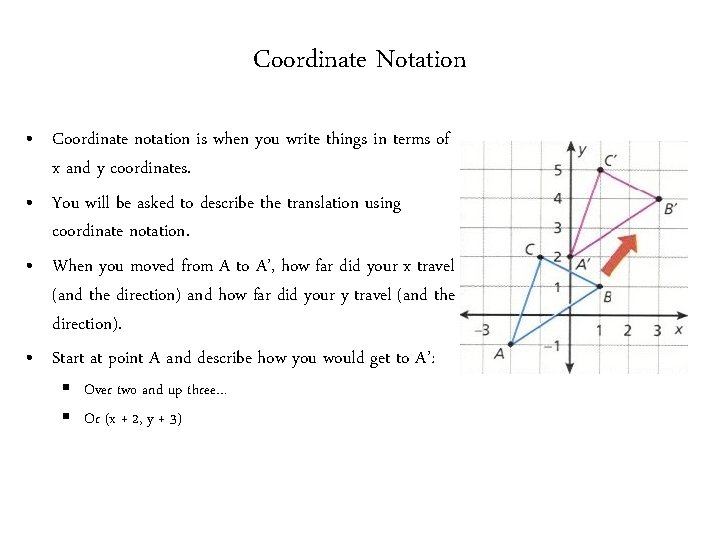
Coordinate Notation • Coordinate notation is when you write things in terms of x and y coordinates. • You will be asked to describe the translation using coordinate notation. • When you moved from A to A’, how far did your x travel (and the direction) and how far did your y travel (and the direction). • Start at point A and describe how you would get to A’: § Over two and up three… § Or (x + 2, y + 3)
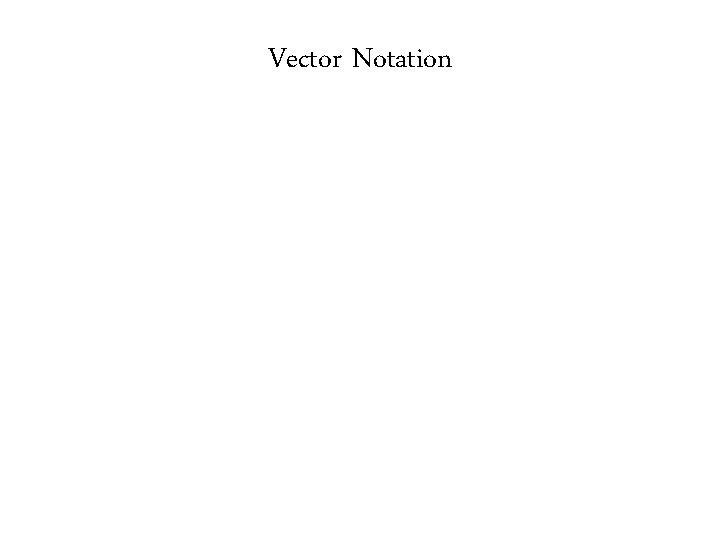
Vector Notation
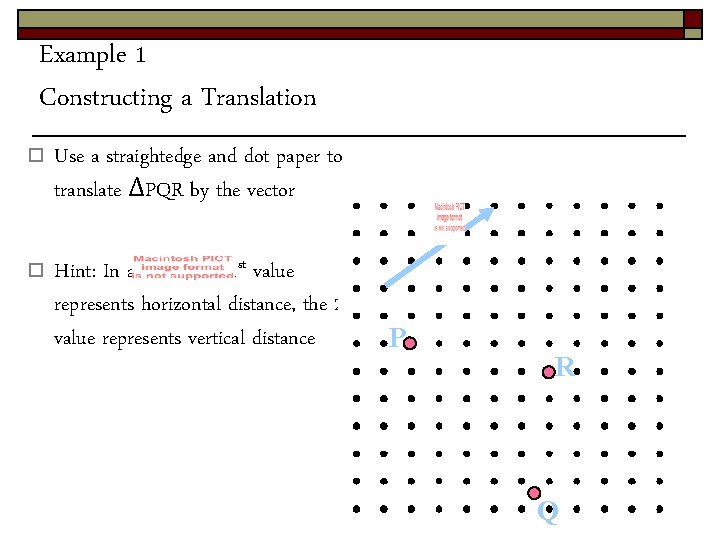
Example 1 Constructing a Translation o Use a straightedge and dot paper to translate ΔPQR by the vector o Hint: In a vector the 1 st value represents horizontal distance, the 2 nd value represents vertical distance P R Q
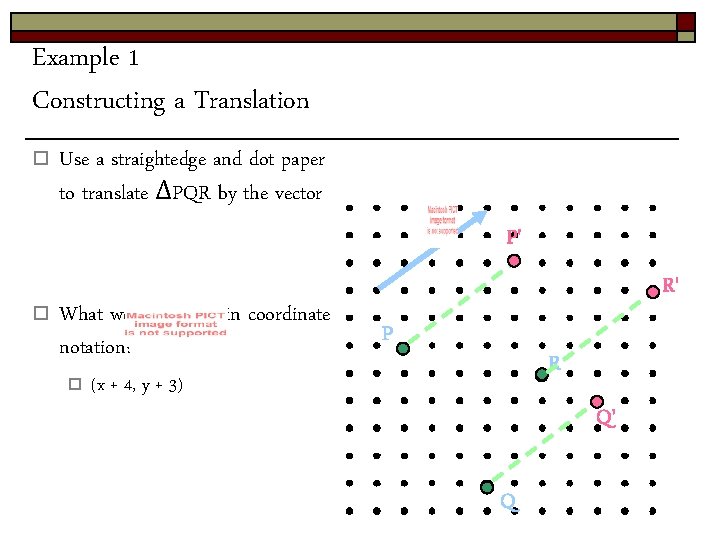
Example 1 Constructing a Translation o Use a straightedge and dot paper to translate ΔPQR by the vector P' o What would this be in coordinate notation? o R' P R (x + 4, y + 3) Q' Q
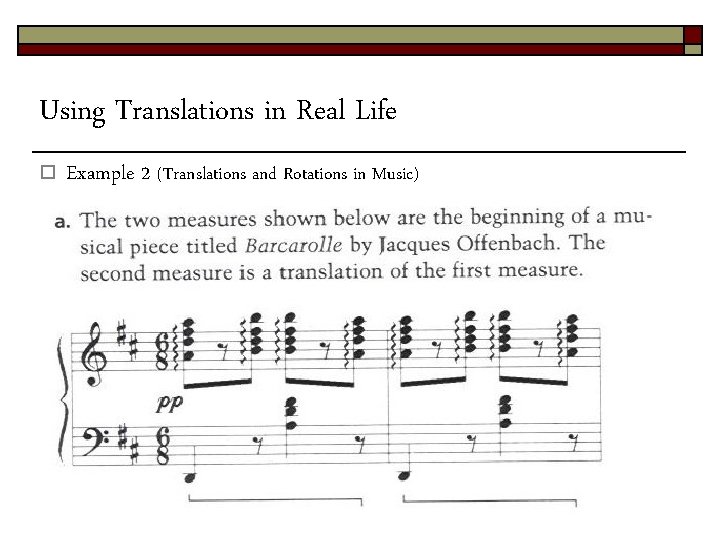
Using Translations in Real Life o Example 2 (Translations and Rotations in Music)
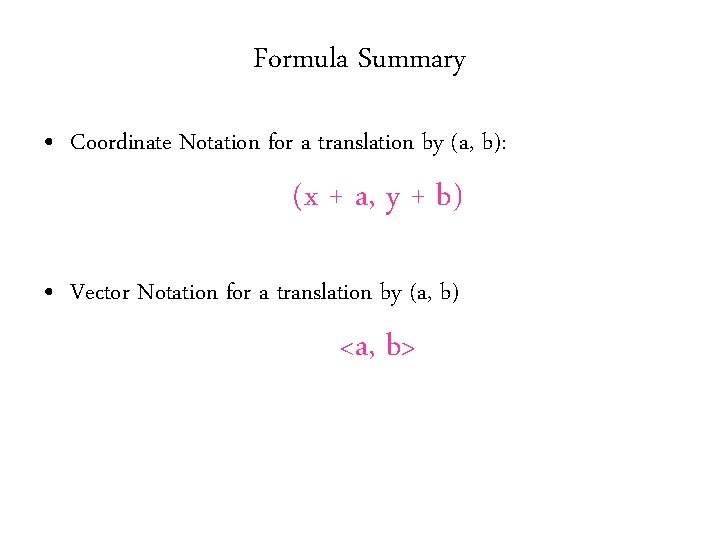
Formula Summary • Coordinate Notation for a translation by (a, b): (x + a, y + b) • Vector Notation for a translation by (a, b) <a, b>
Rot atio ns
What You Should Learn Why You Should Learn It l How to use properties of rotations l How to relate rotations and rotational symmetry l You can use rotations to solve real-life problems, such as determining the symmetry of a clock face
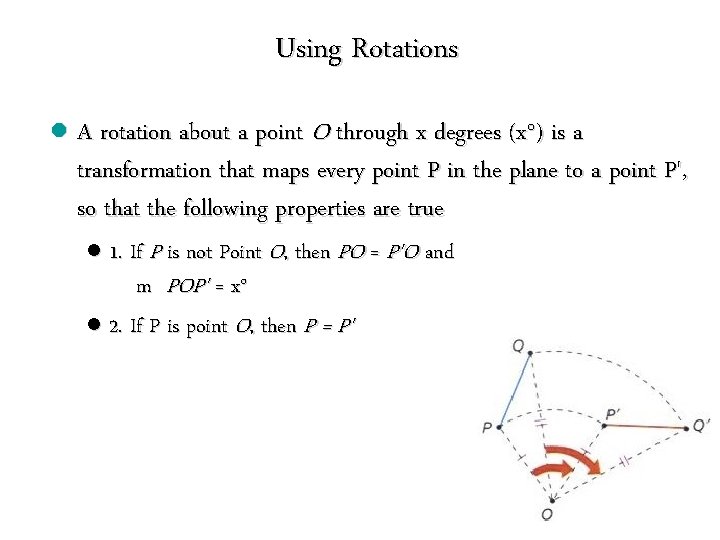
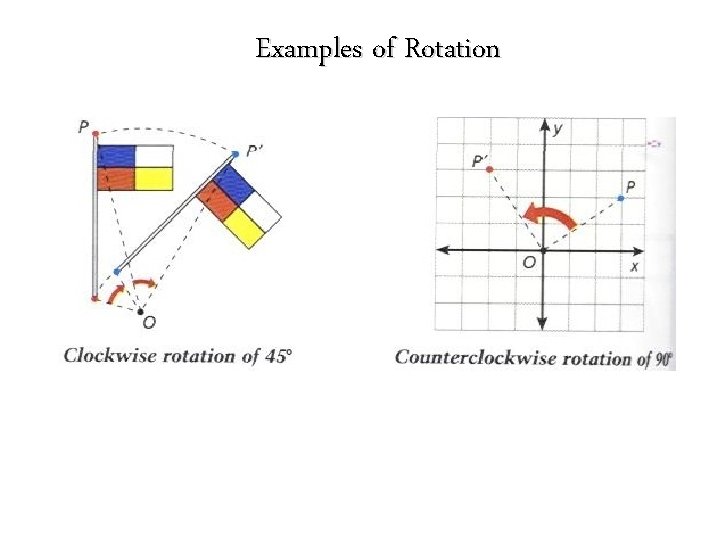
Using Rotations l A rotation about a point O through x degrees (x°) is a transformation that maps every point P in the plane to a point P', so that the following properties are true l 1. If P is not Point O, then PO = P'O and m POP' = x° l 2. If P is point O, then P = P'
Examples of Rotation
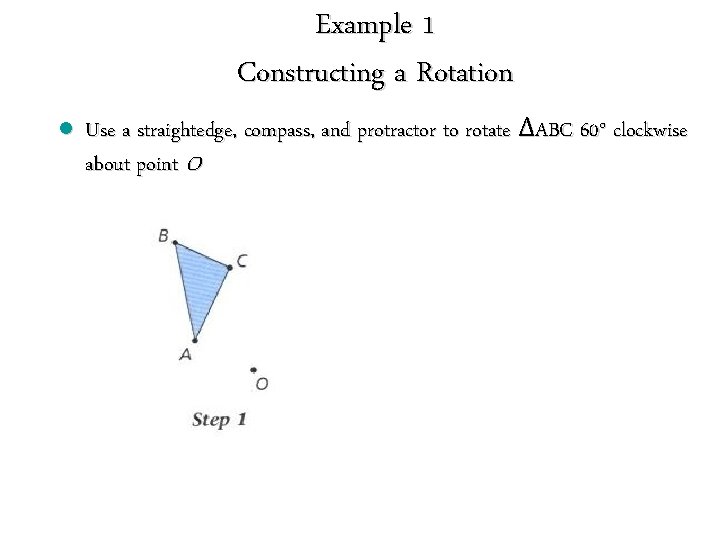
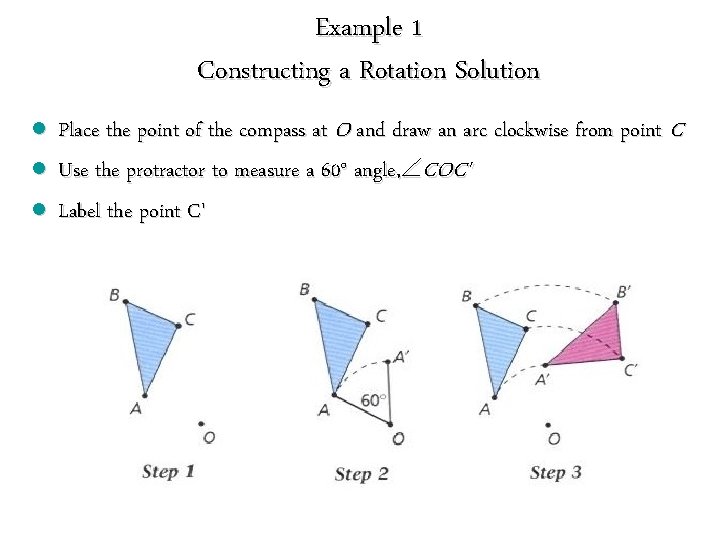
Example 1 Constructing a Rotation l Use a straightedge, compass, and protractor to rotate ΔABC 60° clockwise about point O
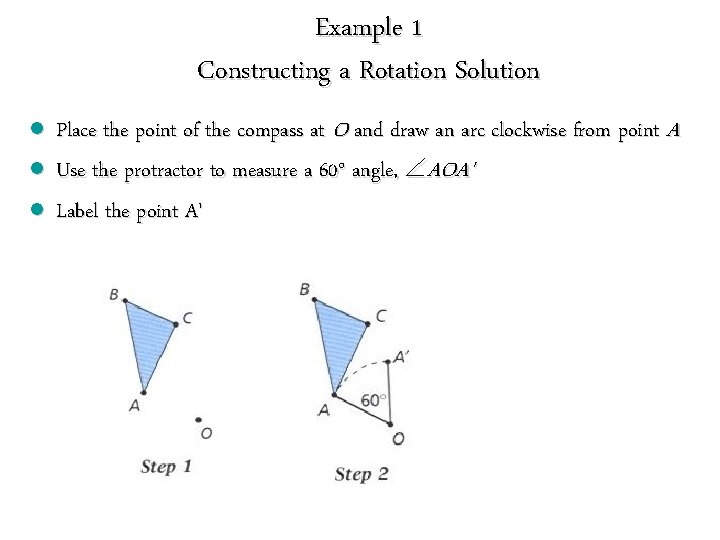
Example 1 Constructing a Rotation Solution l l l Place the point of the compass at O and draw an arc clockwise from point A Use the protractor to measure a 60° angle, AOA' Label the point A'
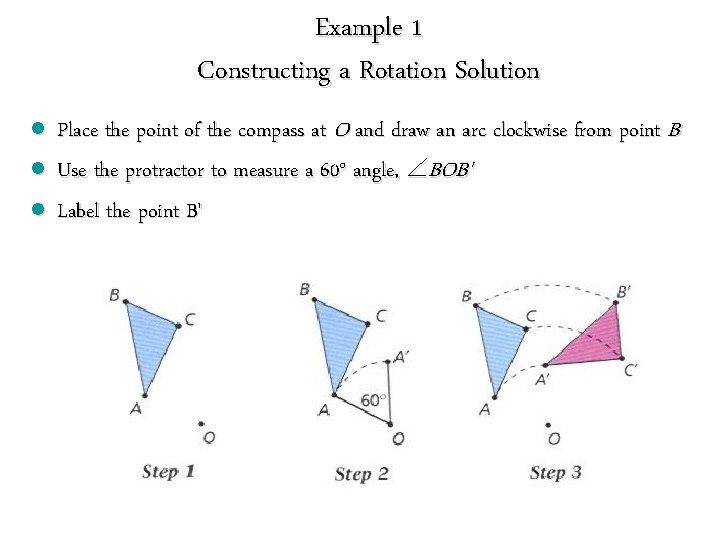
Example 1 Constructing a Rotation Solution l l l Place the point of the compass at O and draw an arc clockwise from point B Use the protractor to measure a 60° angle, BOB' Label the point B'
Example 1 Constructing a Rotation Solution l l l Place the point of the compass at O and draw an arc clockwise from point C Use the protractor to measure a 60° angle, COC' Label the point C'
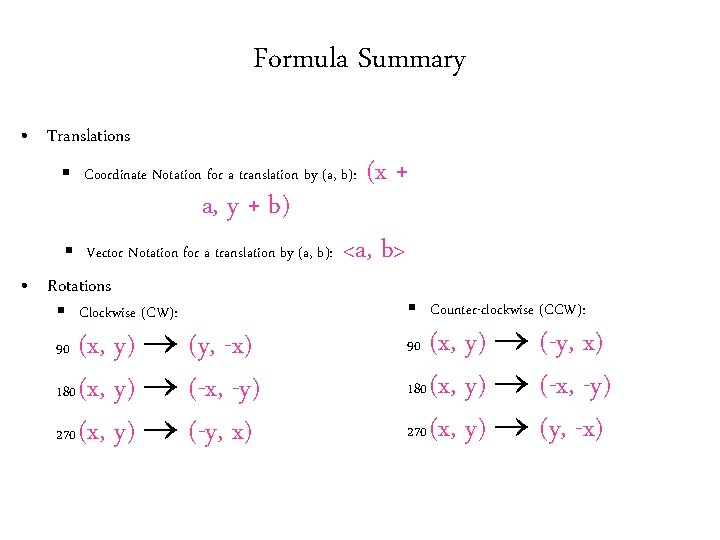
Formula Summary • Translations § Coordinate Notation for a translation by (a, b): a, y + b) § Vector Notation for a translation by (a, b): • Rotations (x + <a, b> § Clockwise (CW): § Counter-clockwise (CCW): 90 90 (x, y) (y, -x) 180 (x, y) (-x, -y) 270 (x, y) (-y, x) 180 (x, y) (-x, -y) 270 (x, y) (y, -x)
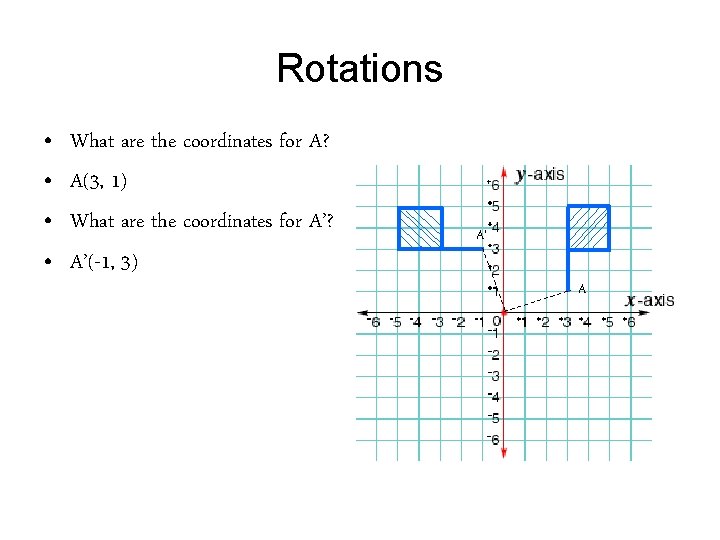
Rotations • • What are the coordinates for A? A(3, 1) What are the coordinates for A’? A’(-1, 3) A’ A
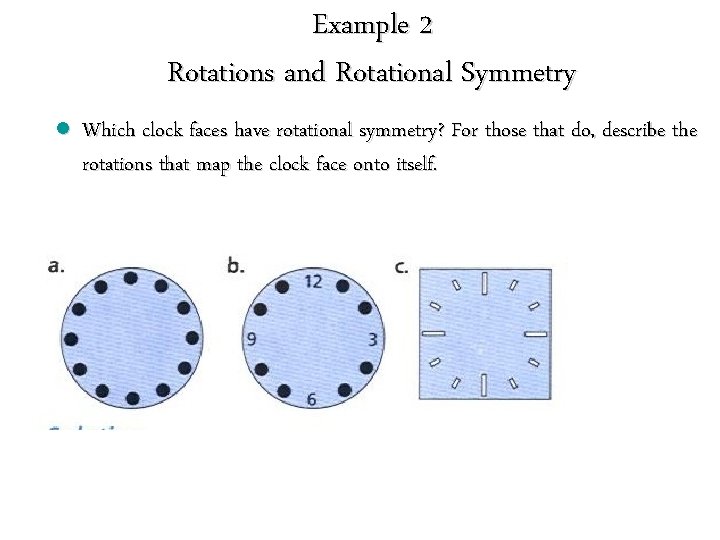
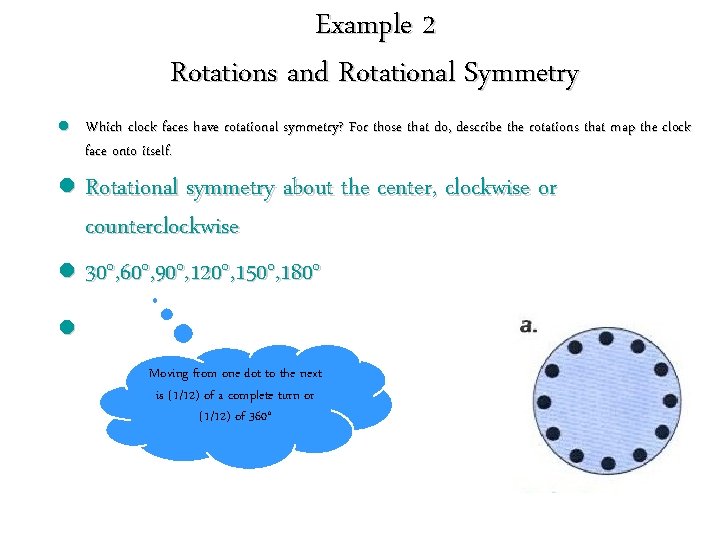
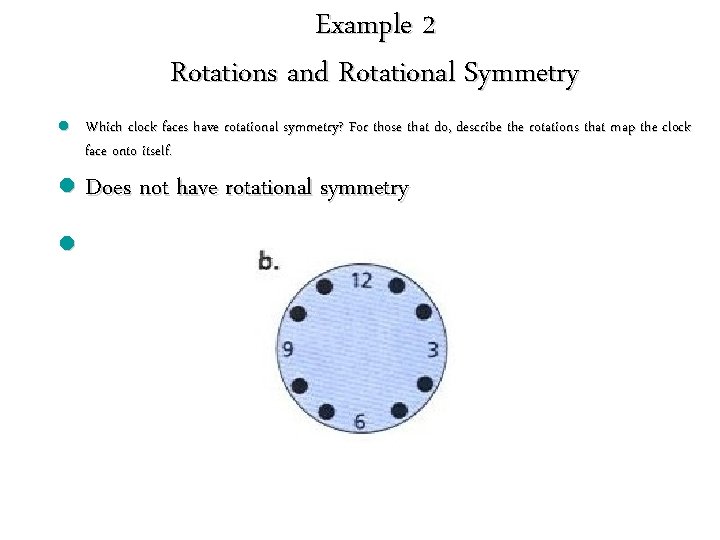
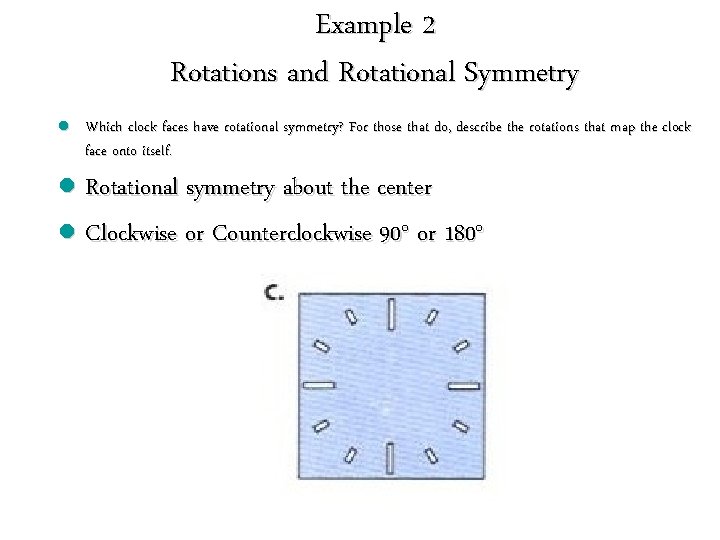
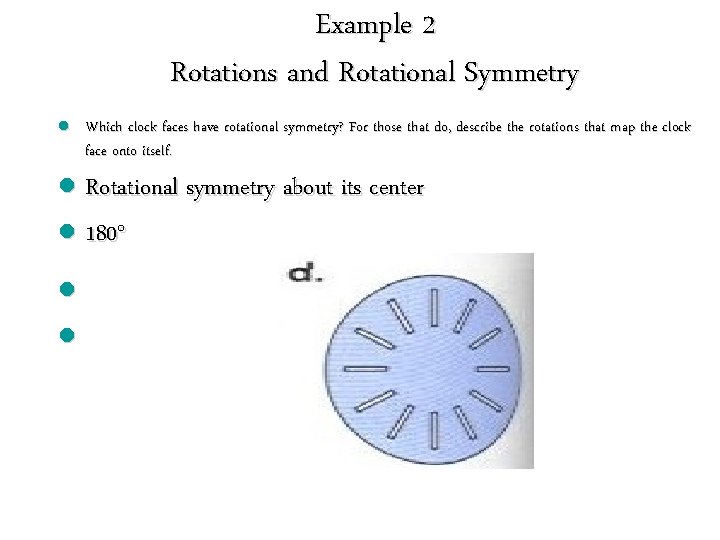
Example 2 Rotations and Rotational Symmetry l Which clock faces have rotational symmetry? For those that do, describe the rotations that map the clock face onto itself.
Example 2 Rotations and Rotational Symmetry l Which clock faces have rotational symmetry? For those that do, describe the rotations that map the clock face onto itself. l Rotational symmetry about the center, clockwise or counterclockwise l 30°, 60°, 90°, 120°, 150°, 180° l Moving from one dot to the next is (1/12) of a complete turn or (1/12) of 360°
Example 2 Rotations and Rotational Symmetry l Which clock faces have rotational symmetry? For those that do, describe the rotations that map the clock face onto itself. l Does not have rotational symmetry l
Example 2 Rotations and Rotational Symmetry l l Which clock faces have rotational symmetry? For those that do, describe the rotations that map the clock face onto itself. Rotational symmetry about the center l Clockwise or Counterclockwise 90° or 180°
Example 2 Rotations and Rotational Symmetry l l Which clock faces have rotational symmetry? For those that do, describe the rotations that map the clock face onto itself. Rotational symmetry about its center l 180° l l
Reflections
What You Should Learn Why You Should Learn It • Goal 1: How to use properties of reflections • Goal 2: How to relate reflections and line symmetry • You can use reflections to solve real-life problems, such as building a kaleidoscope
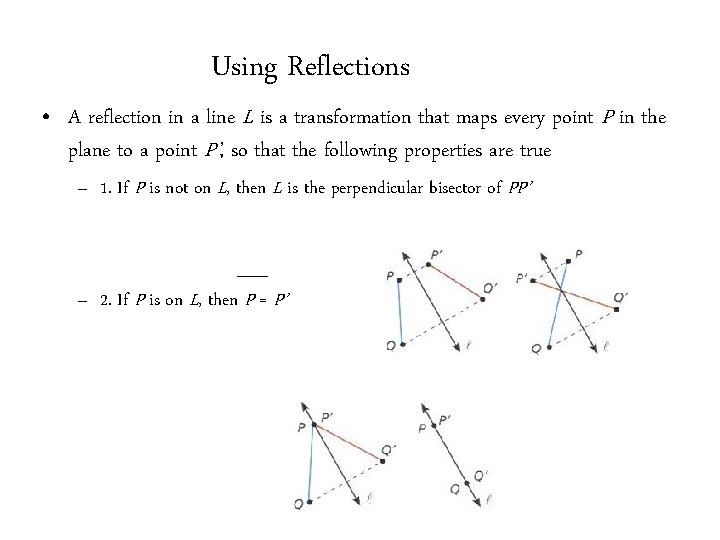
Using Reflections • A reflection in a line L is a transformation that maps every point P in the plane to a point P’, so that the following properties are true – 1. If P is not on L, then L is the perpendicular bisector of PP’ – 2. If P is on L, then P = P’
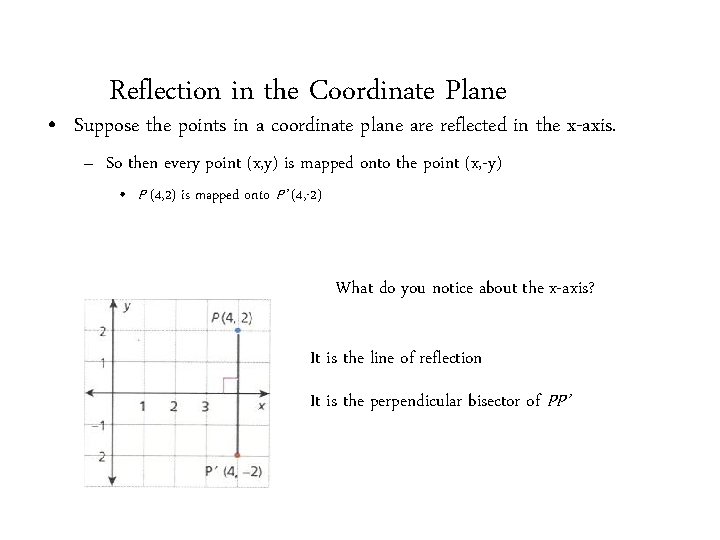
Reflection in the Coordinate Plane • Suppose the points in a coordinate plane are reflected in the x-axis. – So then every point (x, y) is mapped onto the point (x, -y) • P (4, 2) is mapped onto P’ (4, -2) What do you notice about the x-axis? It is the line of reflection It is the perpendicular bisector of PP’
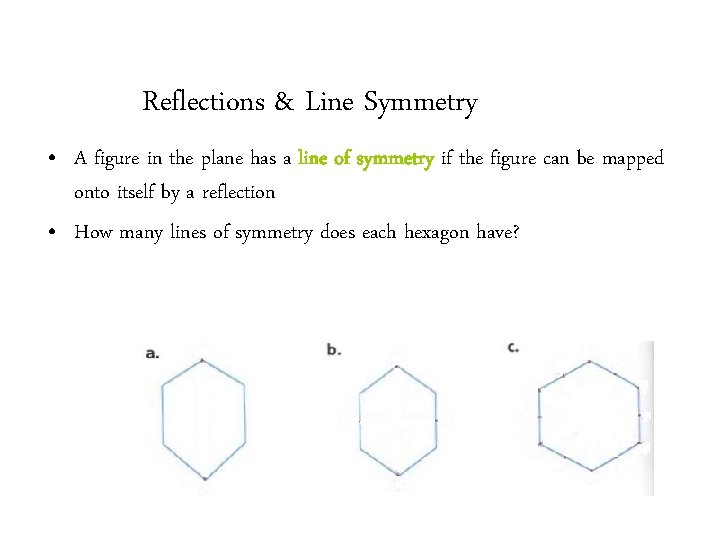
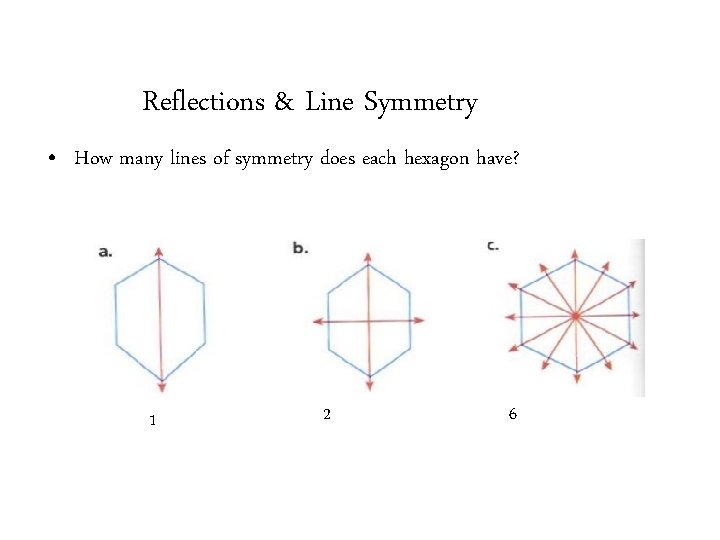
Reflections & Line Symmetry • A figure in the plane has a line of symmetry if the figure can be mapped onto itself by a reflection • How many lines of symmetry does each hexagon have?
Reflections & Line Symmetry • How many lines of symmetry does each hexagon have? 1 2 6
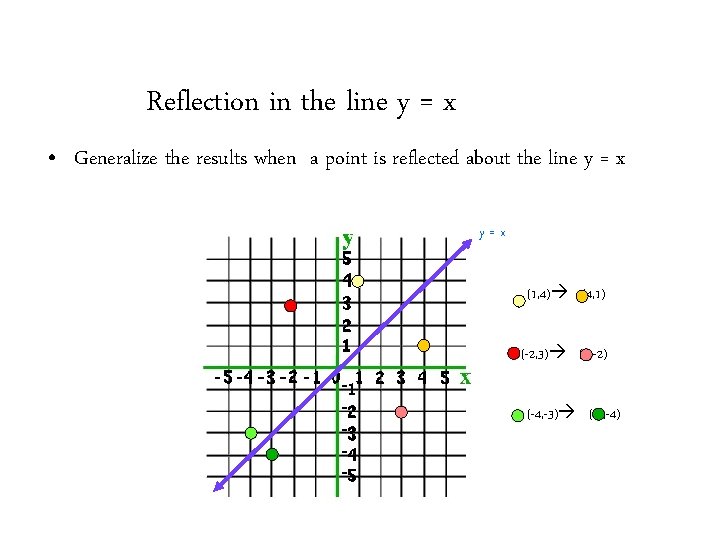
Reflection in the line y = x • Generalize the results when a point is reflected about the line y = x y=x (1, 4) (4, 1) (-2, 3) (3, -2) (-4, -3) (-3, -4)
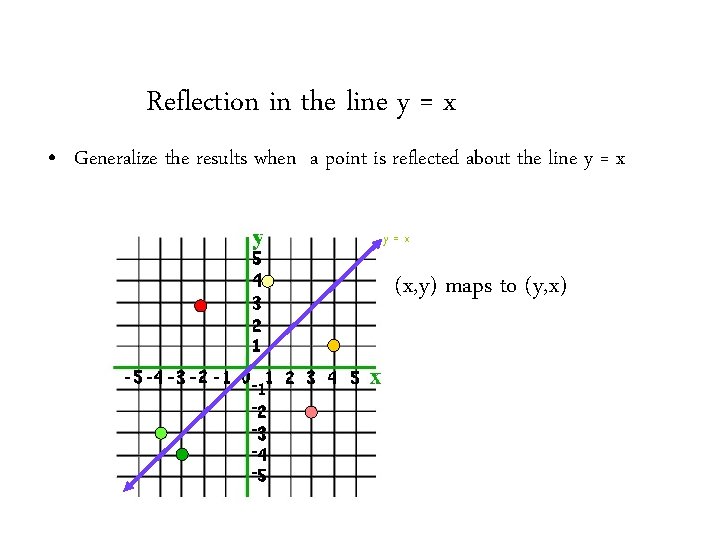
Reflection in the line y = x • Generalize the results when a point is reflected about the line y = x y=x (x, y) maps to (y, x)
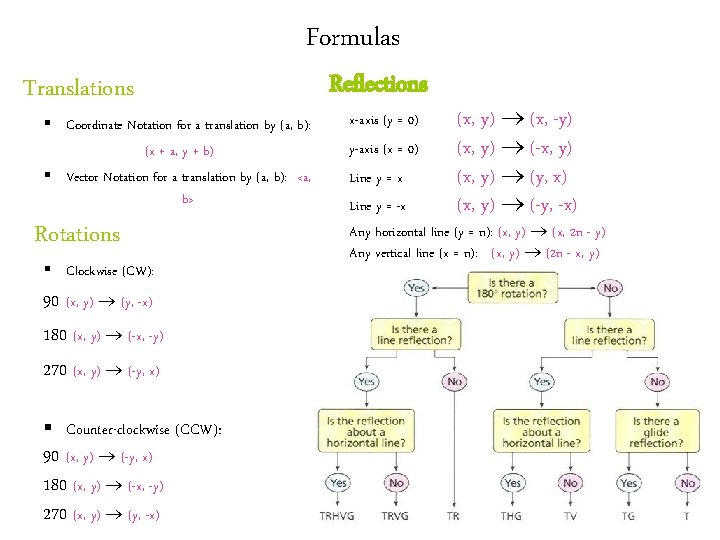
Formulas Translations § Coordinate Notation for a translation by (a, b): (x + a, y + b) § Vector Notation for a translation by (a, b): <a, b> Rotations § Clockwise (CW): 90 (x, y) (y, -x) 180 (x, y) (-x, -y) 270 (x, y) (-y, x) § Counter-clockwise (CCW): 90 (x, y) (-y, x) 180 (x, y) (-x, -y) 270 (x, y) (y, -x) Reflections x-axis (y = 0) y-axis (x = 0) Line y = x (x, y) (x, -y) (x, y) (-x, y) (x, y) (y, x) (x, y) (-y, -x) Line y = -x Any horizontal line (y = n): (x, y) (x, 2 n - y) Any vertical line (x = n): (x, y) (2 n - x, y)
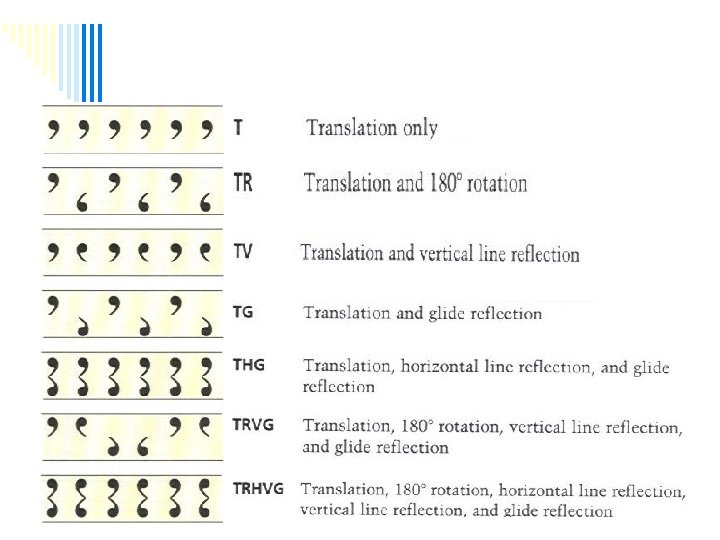
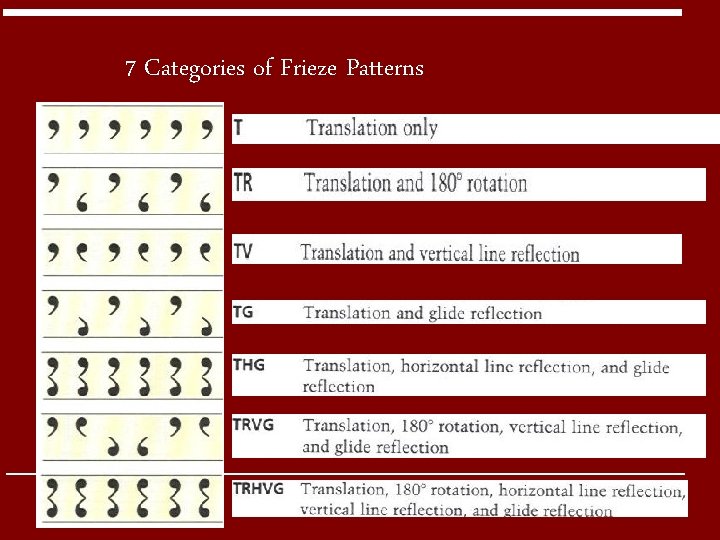
7 Categories of Frieze Patterns
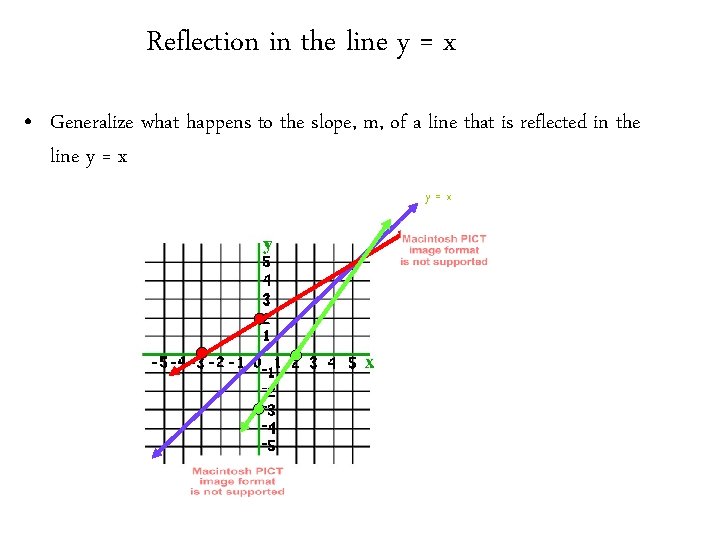
Reflection in the line y = x • Generalize what happens to the slope, m, of a line that is reflected in the line y = x y=x
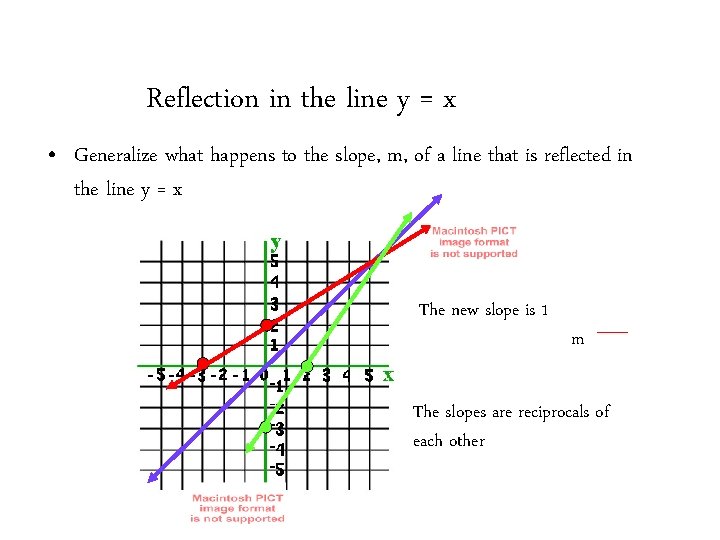
Reflection in the line y = x • Generalize what happens to the slope, m, of a line that is reflected in the line y = x The new slope is 1 m The slopes are reciprocals of each other
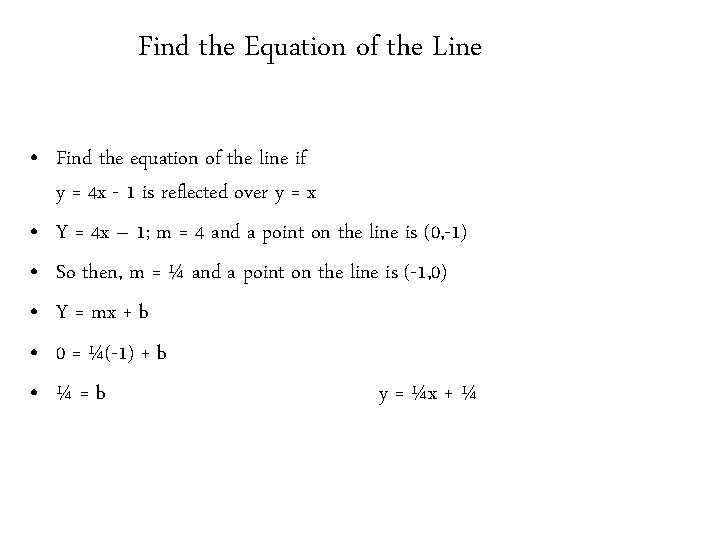
Find the Equation of the Line • Find the equation of the line if y = 4 x - 1 is reflected over y = x
Find the Equation of the Line • Find the equation of the line if y = 4 x - 1 is reflected over y = x • Y = 4 x – 1; m = 4 and a point on the line is (0, -1) • So then, m = ¼ and a point on the line is (-1, 0) • Y = mx + b • 0 = ¼(-1) + b • ¼=b y = ¼x + ¼
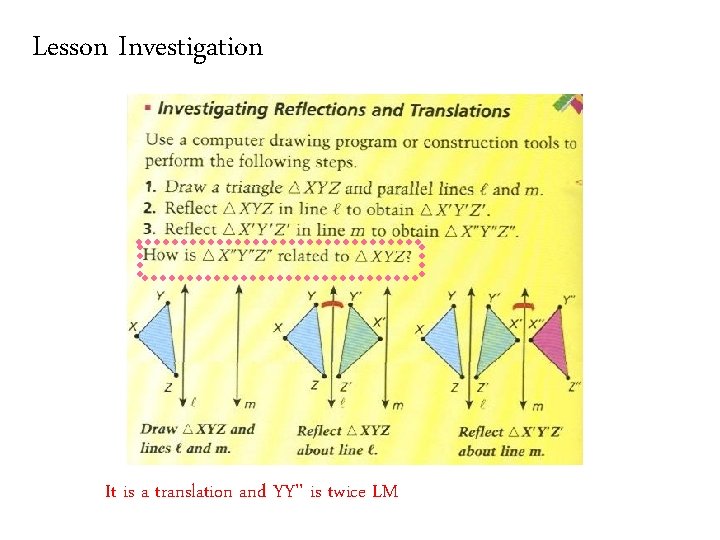
Lesson Investigation It is a translation and YY'' is twice LM
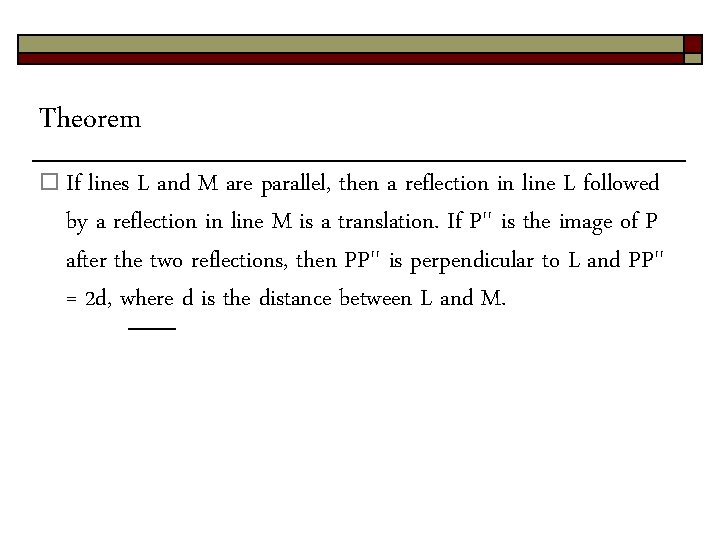
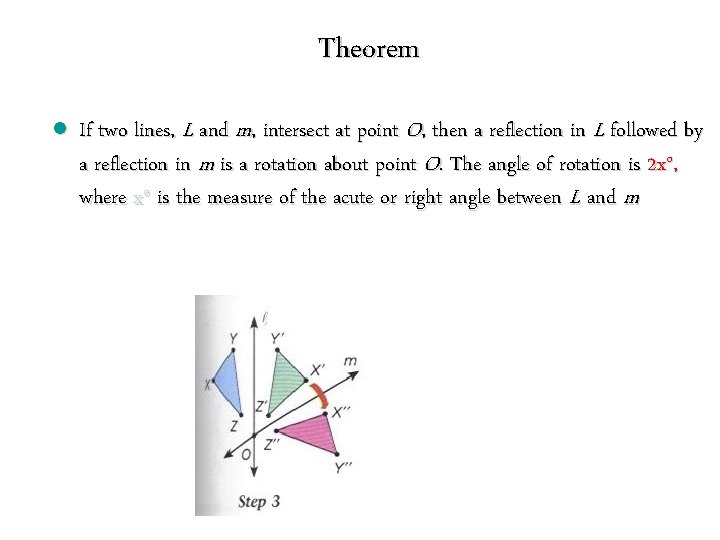
Theorem o If lines L and M are parallel, then a reflection in line L followed by a reflection in line M is a translation. If P'' is the image of P after the two reflections, then PP'' is perpendicular to L and PP'' = 2 d, where d is the distance between L and M.
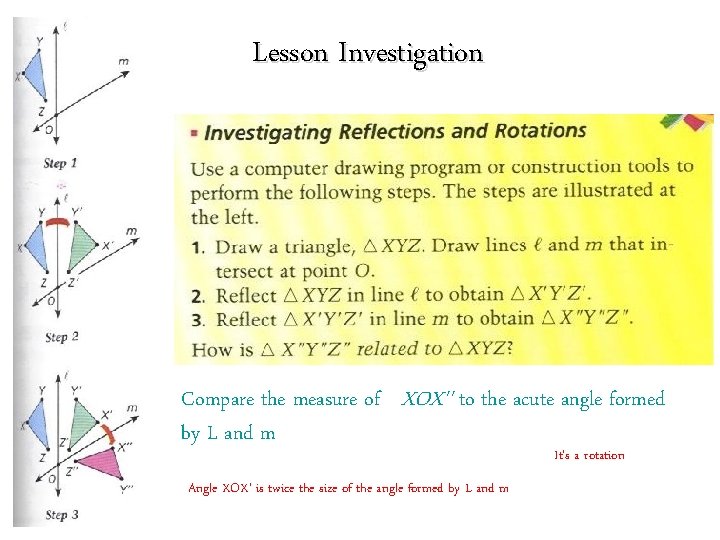
Lesson Investigation Compare the measure of XOX'' to the acute angle formed by L and m It’s a rotation Angle XOX' is twice the size of the angle formed by L and m
Theorem l If two lines, L and m, intersect at point O, then a reflection in L followed by a reflection in m is a rotation about point O. The angle of rotation is 2 x°, where x° is the measure of the acute or right angle between L and m
Glide Reflections & Compositions
What You Should Learn Why You Should Learn It l l l How to use properties of glide reflections How to use compositions of transformations You can use transformations to solve real-life problems, such as creating computer graphics
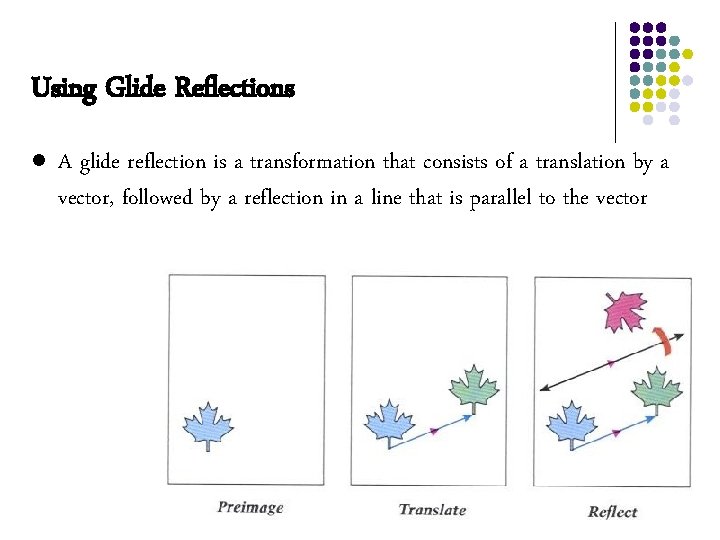
Using Glide Reflections l A glide reflection is a transformation that consists of a translation by a vector, followed by a reflection in a line that is parallel to the vector
Composition l When two or more transformations are combined to produce a single transformation, the result is called a composition of the transformations l For instance, a translation can be thought of as composition of two reflections
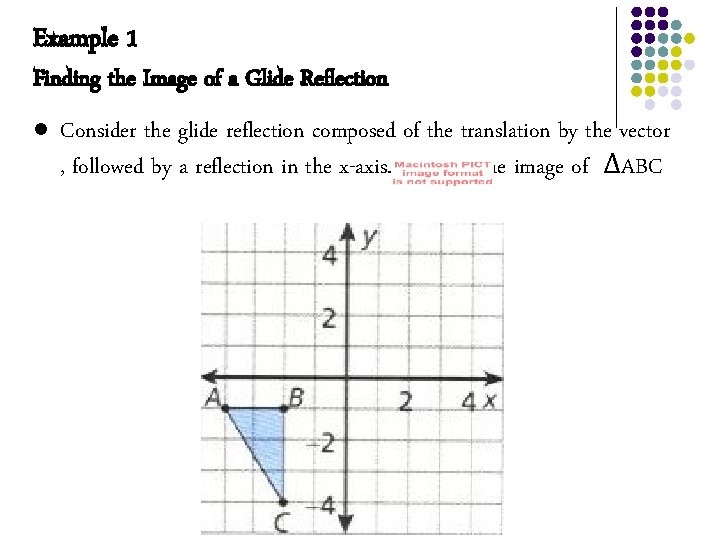
Example 1 Finding the Image of a Glide Reflection l Consider the glide reflection composed of the translation by the vector , followed by a reflection in the x-axis. Describe the image of ΔABC
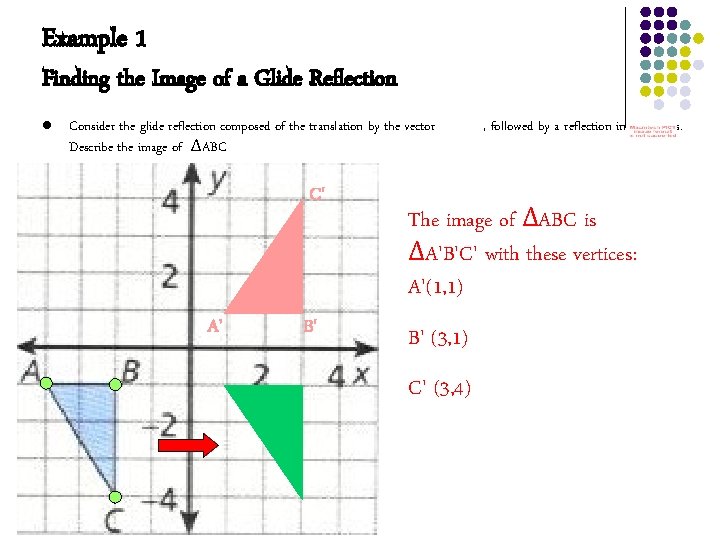
Example 1 Finding the Image of a Glide Reflection l Consider the glide reflection composed of the translation by the vector Describe the image of ΔABC C' A' B' , followed by a reflection in the x-axis. The image of ΔABC is ΔA'B'C' with these vertices: A'(1, 1) B' (3, 1) C' (3, 4)
Theorem l The composition of two (or more) isometries is an isometry l Because glide reflections are compositions of isometries, this theorem implies that glide reflections are isometries
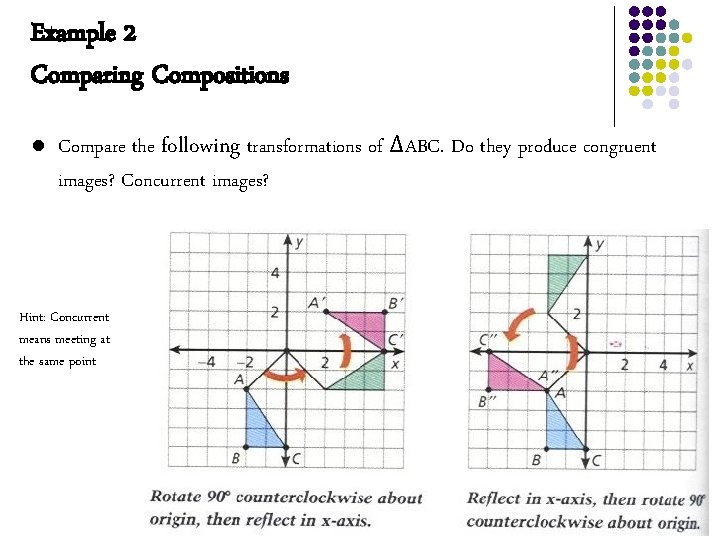
Example 2 Comparing Compositions l Compare the following transformations of ΔABC. Do they produce congruent images? Concurrent images? Hint: Concurrent means meeting at the same point
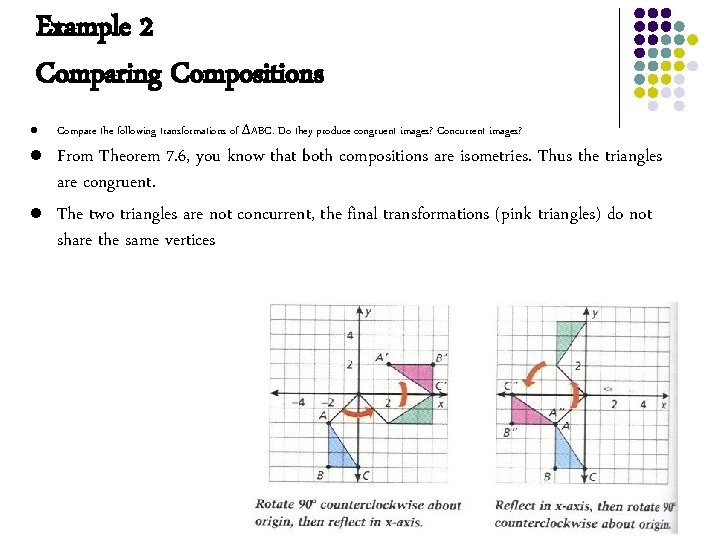
Example 2 Comparing Compositions l Compare the following transformations of ΔABC. Do they produce congruent images? Concurrent images? l From Theorem 7. 6, you know that both compositions are isometries. Thus the triangles are congruent. The two triangles are not concurrent, the final transformations (pink triangles) do not share the same vertices l
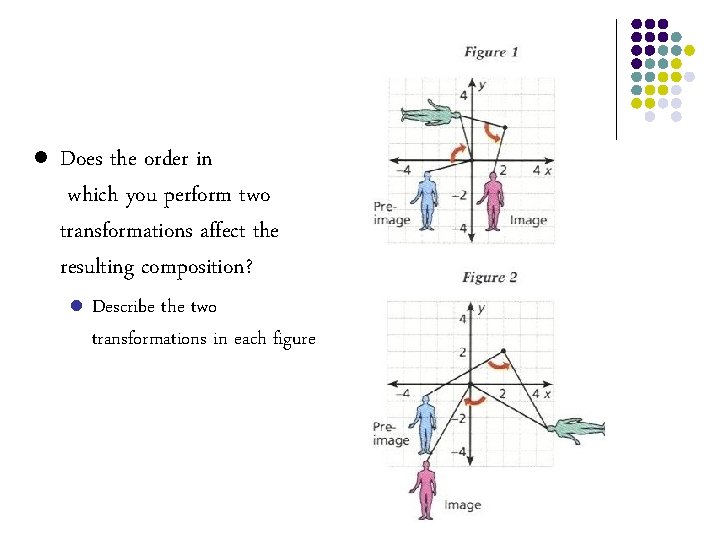
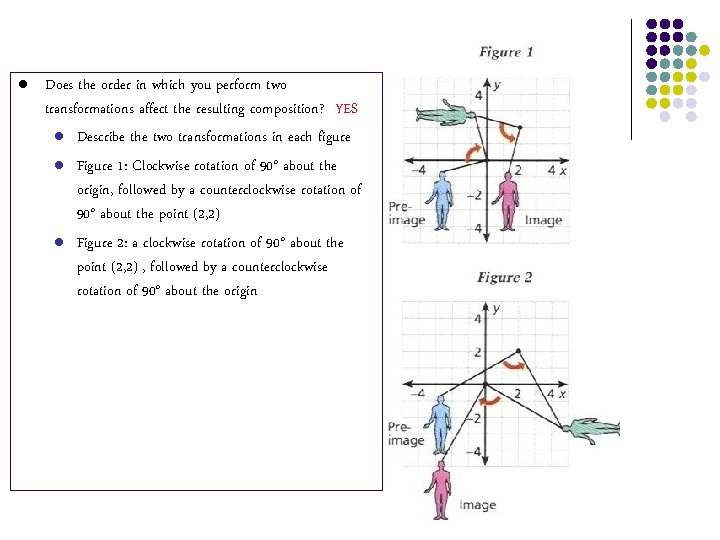
l Does the order in which you perform two transformations affect the resulting composition? l Describe the two transformations in each figure
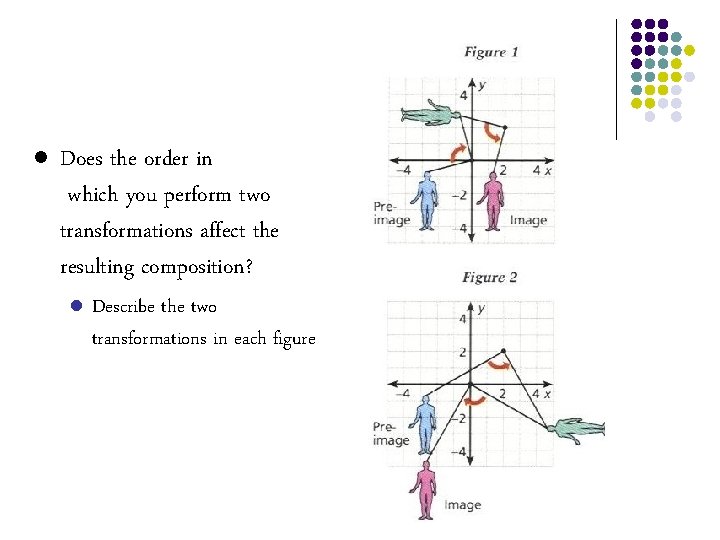
l Does the order in which you perform two transformations affect the resulting composition? l Describe the two transformations in each figure
l Does the order in which you perform two transformations affect the resulting composition? YES l Describe the two transformations in each figure l Figure 1: Clockwise rotation of 90° about the origin, followed by a counterclockwise rotation of 90° about the point (2, 2) l Figure 2: a clockwise rotation of 90° about the point (2, 2) , followed by a counterclockwise rotation of 90° about the origin
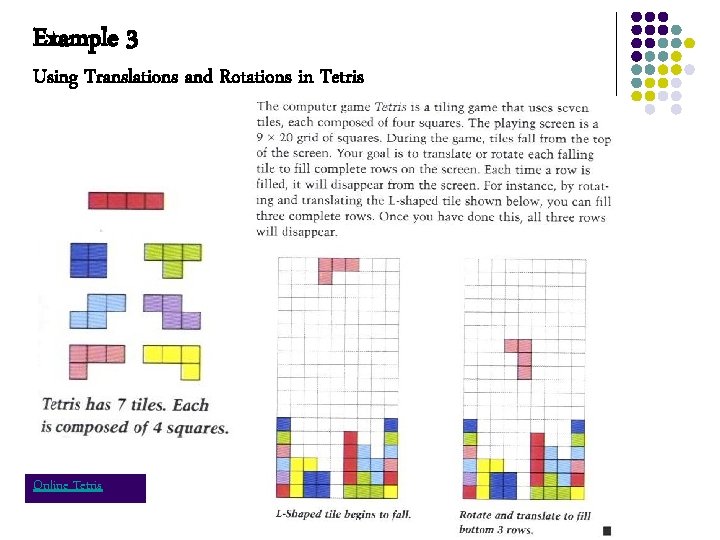
Example 3 Using Translations and Rotations in Tetris Online Tetris
Frieze Patterns
What You Should Learn Why You Should Learn It o How to use transformations to classify frieze patterns o How to use frieze patterns in real life o You can use frieze patterns to create decorative borders for real -life objects such as fabric, pottery, and buildings
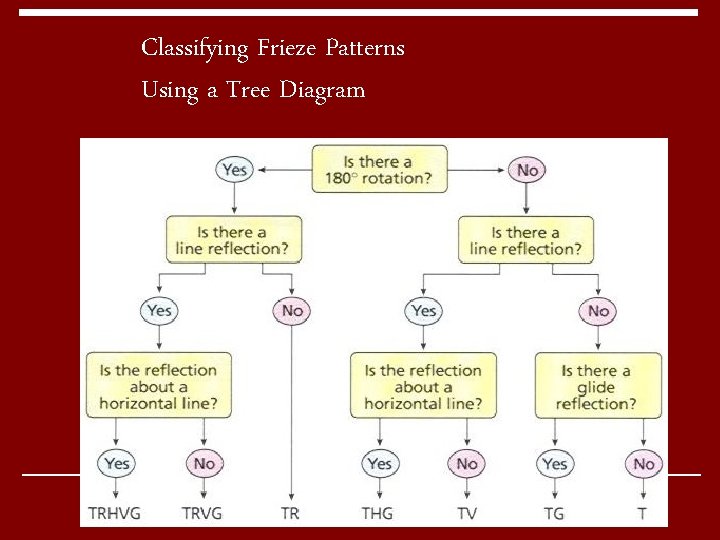
Classifying Frieze Patterns o A frieze pattern or strip pattern is a pattern that extends infinitely to the left and right in such a way that the pattern can be mapped onto itself by a horizontal translation n Some frieze patterns can be mapped onto themselves by other transformations: p A 180° rotation p A reflection about a horizontal line p A reflection about a vertical line p A horizontal glide reflection
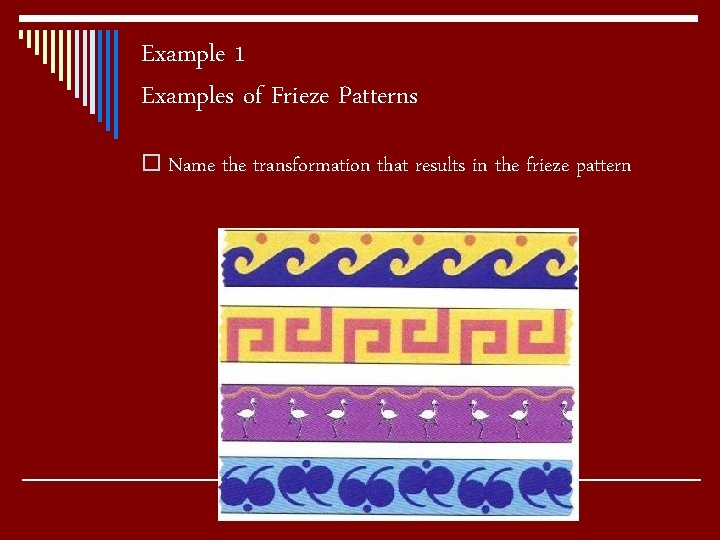
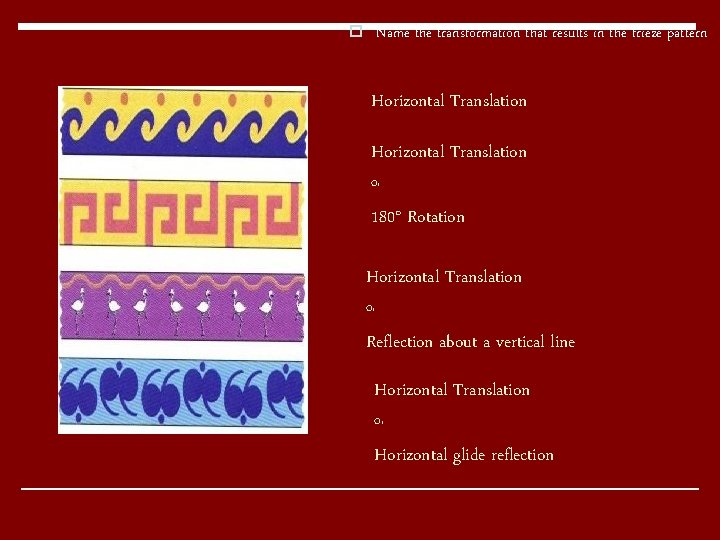
Example 1 Examples of Frieze Patterns o Name the transformation that results in the frieze pattern
o Name the transformation that results in the frieze pattern Horizontal Translation Or 180° Rotation Horizontal Translation Or Reflection about a vertical line Horizontal Translation Or Horizontal glide reflection
Frieze Patterns in Real-Life
7 Categories of Frieze Patterns
Classifying Frieze Patterns Using a Tree Diagram
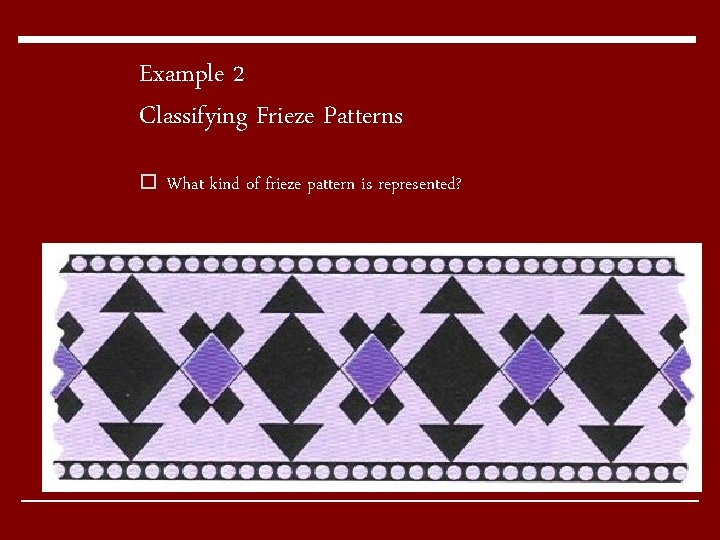
Example 2 Classifying Frieze Patterns o What kind of frieze pattern is represented?
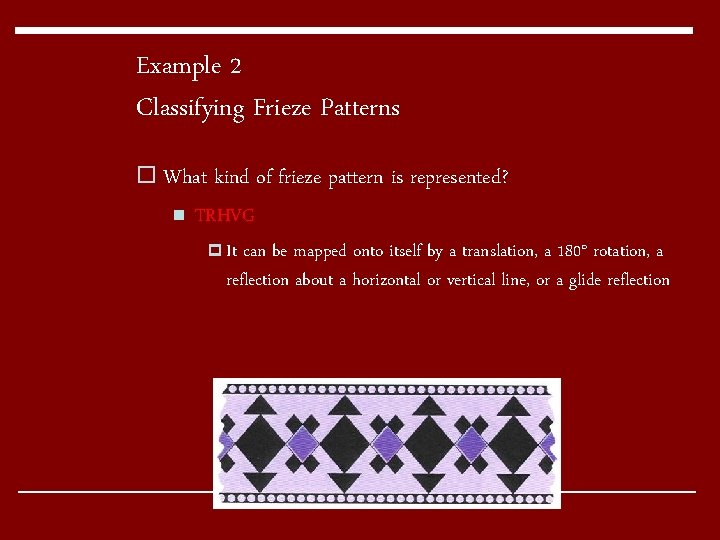
Example 2 Classifying Frieze Patterns o What kind of frieze pattern is represented? n TRHVG p It can be mapped onto itself by a translation, a 180° rotation, a reflection about a horizontal or vertical line, or a glide reflection
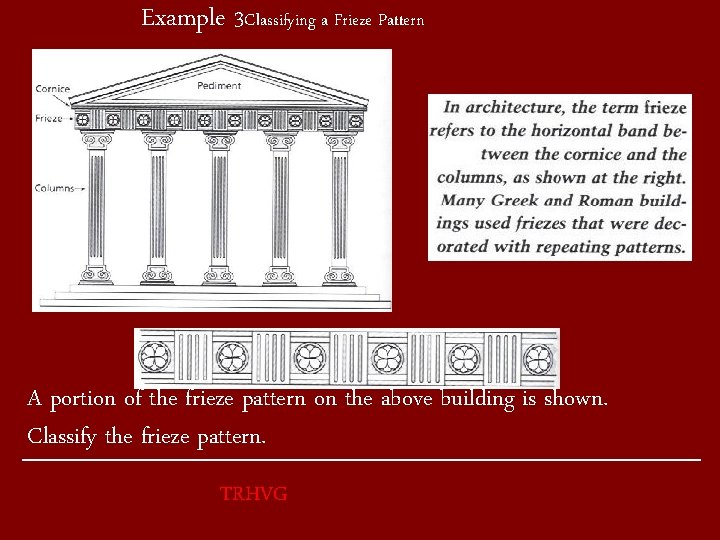
Example 3 Classifying a Frieze Pattern A portion of the frieze pattern on the above building is shown. Classify the frieze pattern. TRHVG