Industri ALLFNVLOTCO Asia MNCs Social Dialogue Yoon Hyowon

- Slides: 60
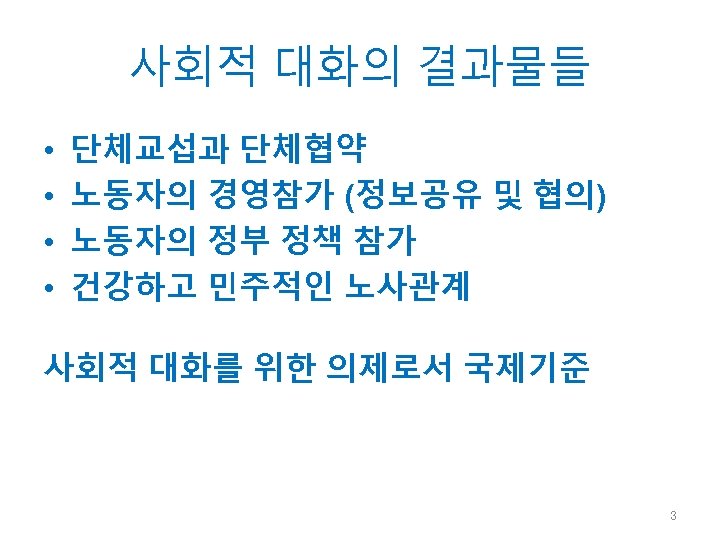
노조간부를 위한 국제기준 Industri. ALL/FNV/LO-TCO Asia MNCs & Social Dialogue Yoon Hyowon industriallyoon@gmail. com 1
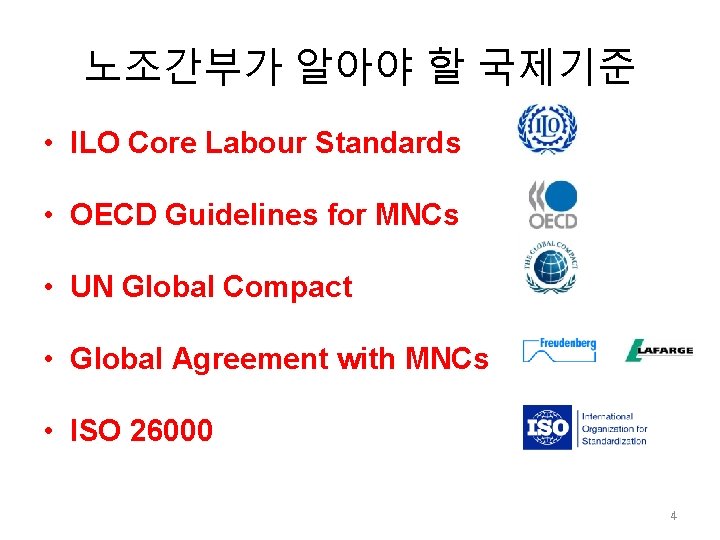
노조간부가 알아야 할 국제기준 • ILO Core Labour Standards • OECD Guidelines for MNCs • UN Global Compact • Global Agreement with MNCs • ISO 26000 4
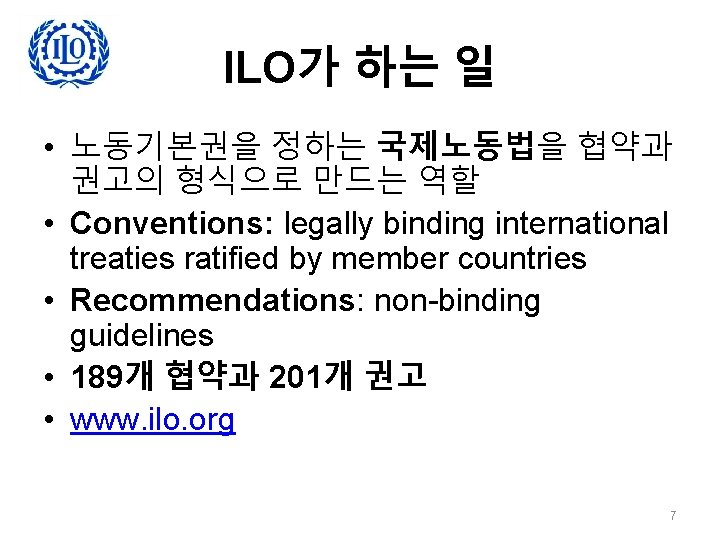
ILO가 하는 일 • 노동기본권을 정하는 국제노동법을 협약과 권고의 형식으로 만드는 역할 • Conventions: legally binding international treaties ratified by member countries • Recommendations: non-binding guidelines • 189개 협약과 201개 권고 • www. ilo. org 7
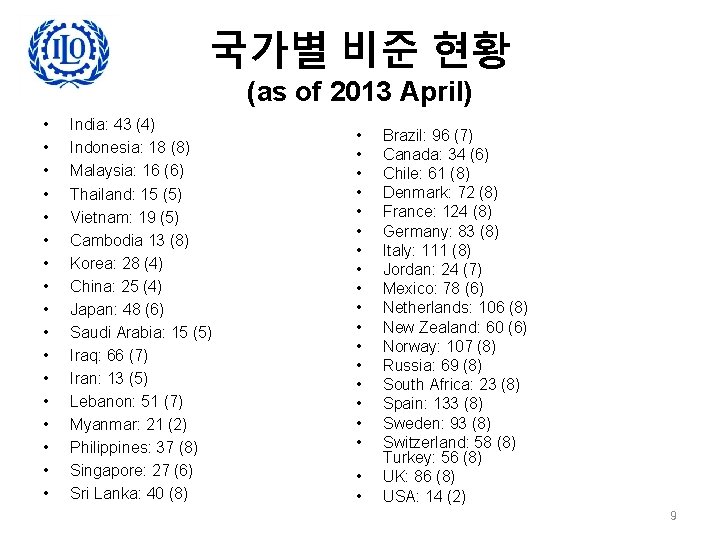
국가별 비준 현황 (as of 2013 April) • • • • • India: 43 (4) Indonesia: 18 (8) Malaysia: 16 (6) Thailand: 15 (5) Vietnam: 19 (5) Cambodia 13 (8) Korea: 28 (4) China: 25 (4) Japan: 48 (6) Saudi Arabia: 15 (5) Iraq: 66 (7) Iran: 13 (5) Lebanon: 51 (7) Myanmar: 21 (2) Philippines: 37 (8) Singapore: 27 (6) Sri Lanka: 40 (8) • • • • • Brazil: 96 (7) Canada: 34 (6) Chile: 61 (8) Denmark: 72 (8) France: 124 (8) Germany: 83 (8) Italy: 111 (8) Jordan: 24 (7) Mexico: 78 (6) Netherlands: 106 (8) New Zealand: 60 (6) Norway: 107 (8) Russia: 69 (8) South Africa: 23 (8) Spain: 133 (8) Sweden: 93 (8) Switzerland: 58 (8) Turkey: 56 (8) UK: 86 (8) USA: 14 (2) 9
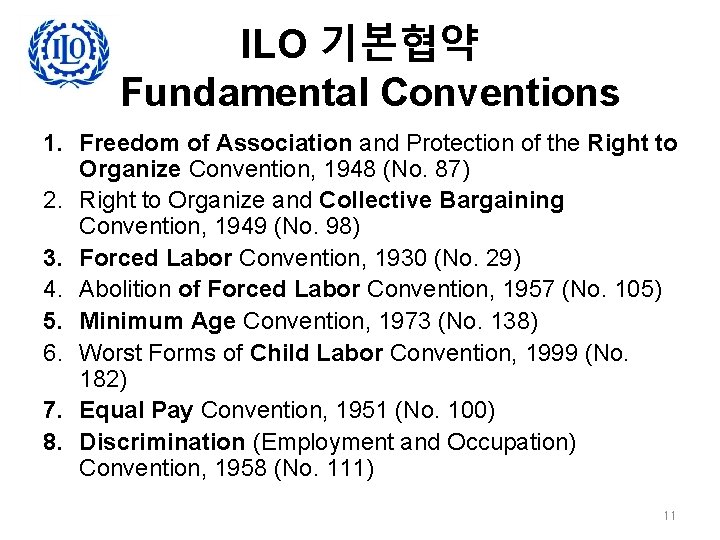
ILO 기본협약 Fundamental Conventions 1. Freedom of Association and Protection of the Right to Organize Convention, 1948 (No. 87) 2. Right to Organize and Collective Bargaining Convention, 1949 (No. 98) 3. Forced Labor Convention, 1930 (No. 29) 4. Abolition of Forced Labor Convention, 1957 (No. 105) 5. Minimum Age Convention, 1973 (No. 138) 6. Worst Forms of Child Labor Convention, 1999 (No. 182) 7. Equal Pay Convention, 1951 (No. 100) 8. Discrimination (Employment and Occupation) Convention, 1958 (No. 111) 11
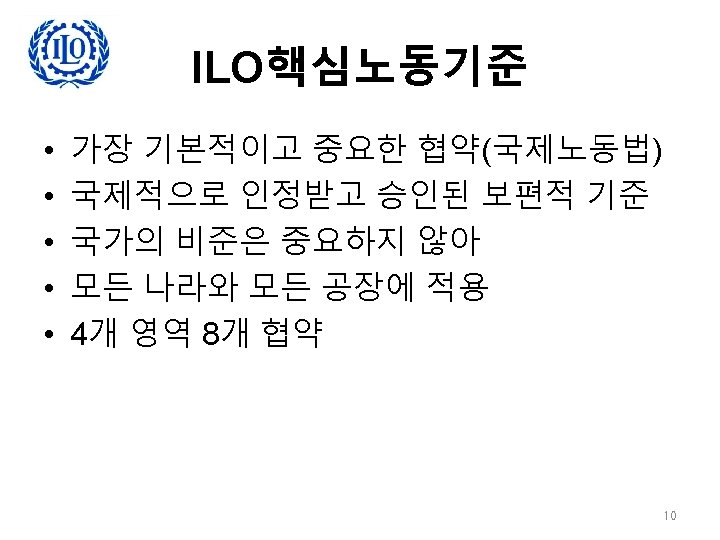
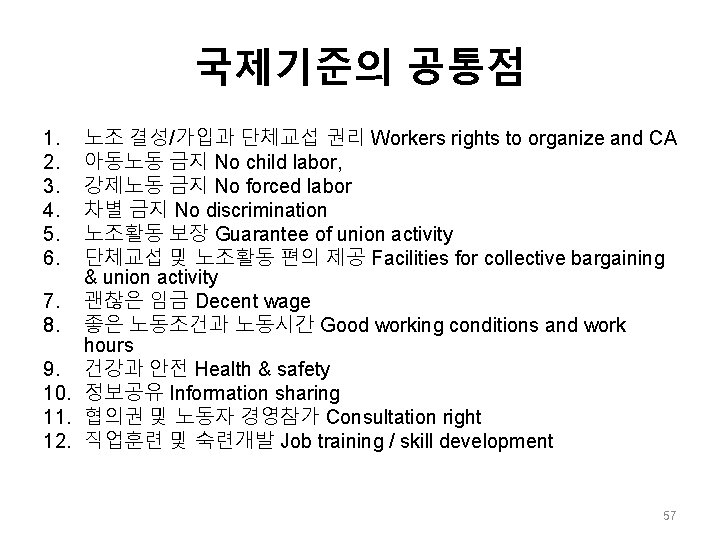
ILO 핵심노동기준 Core Labor Standards • 4 개 영역 – freedom of association & right to collective bargaining (C 87, C 98) – No forced labor(C 29, C 105) – No child labor(C 138, 182) – No discrimination (C 100, C 111) 12
결사의 자유 Freedom of Association • Workers have the freedom and right to organize their own organizations or join trade unions to represent 노동자 이익 their interests and defend 노동자 권리 their rights. • Employers or government can not interfere with union organizing or union activities. 13
결사의 자유 Freedom of Association • Workers have the freedom and right to Umbrella workers organization 상급 단체 like regional/national unions and industrial/national federation can directly engage in supporting workers and organizing unions. 14
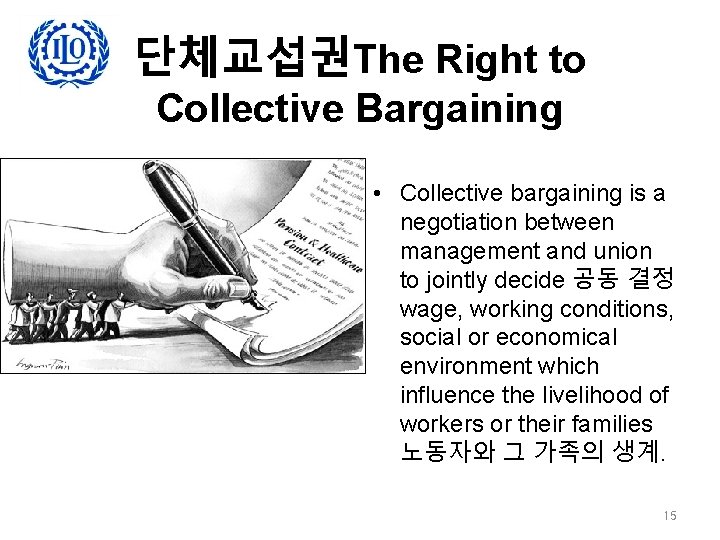
단체교섭권The Right to Collective Bargaining • Collective bargaining is a negotiation between management and union to jointly decide 공동 결정 wage, working conditions, social or economical environment which influence the livelihood of workers or their families 노동자와 그 가족의 생계. 15
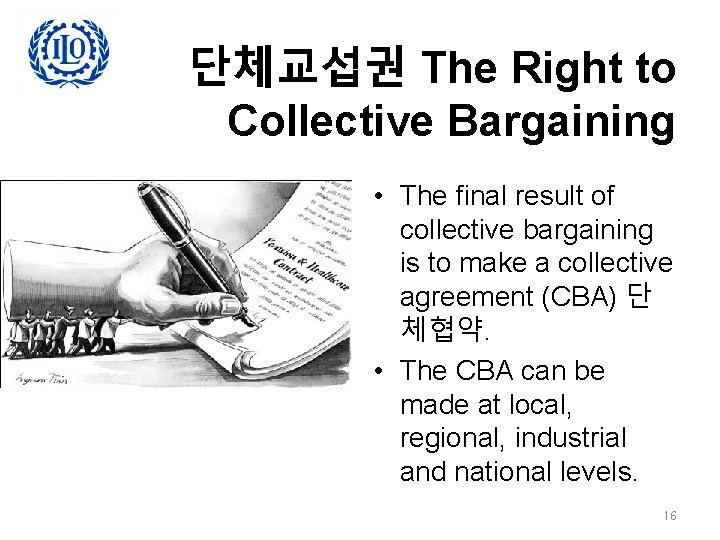
단체교섭권 The Right to Collective Bargaining • The final result of collective bargaining is to make a collective agreement (CBA) 단 체협약. • The CBA can be made at local, regional, industrial and national levels. 16
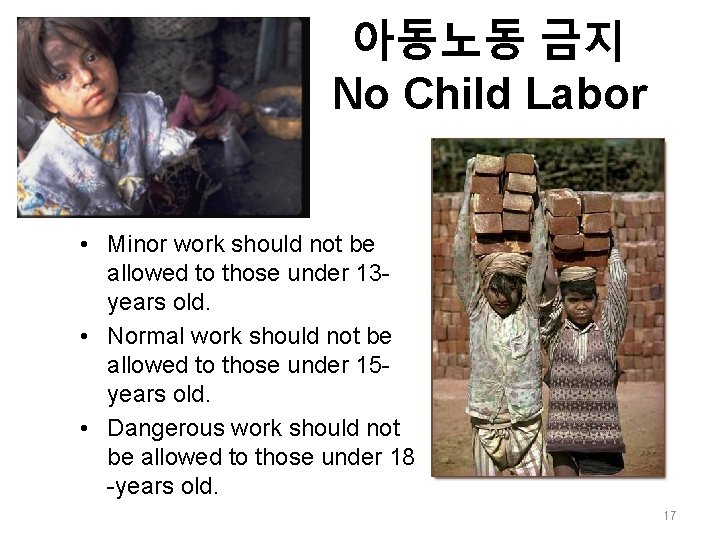
아동노동 금지 No Child Labor • Minor work should not be allowed to those under 13 years old. • Normal work should not be allowed to those under 15 years old. • Dangerous work should not be allowed to those under 18 -years old. 17
강제노동 금지Forced Labor • Doing work by threat and enforcement, without my agreement or approval • Overtime 연장근로 without dialogue with workers or unions 18
차별금지 No Discrimination • Equal pay for equal work, equal treatment for equal work 동일노동 동일임금 • Discrimination between men and women • Discrimination between regular and non-regular workers • What kind of discrimination do we experience in our workplace? 19
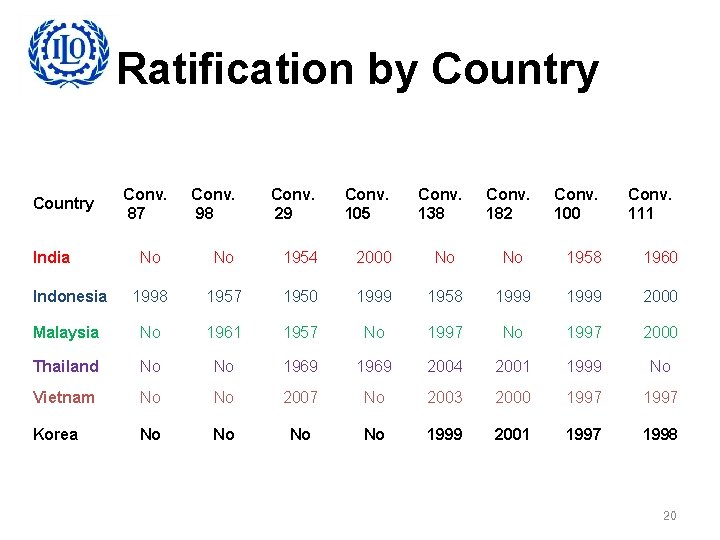
Ratification by Country Conv. 98 Conv. 29 Conv. 105 Conv. 138 Conv. 182 No No 1954 2000 No No 1958 1960 Indonesia 1998 1957 1950 1999 1958 1999 2000 Malaysia No 1961 1957 No 1997 2000 Thailand No No 1969 2004 2001 1999 No Vietnam No No 2007 No 2003 2000 1997 Korea No No 1999 2001 1997 1998 Country India Conv. 87 Conv. 100 Conv. 111 20
OECD 다국적기업 가이드라인 Guidelines for Multinational Enterprises 21
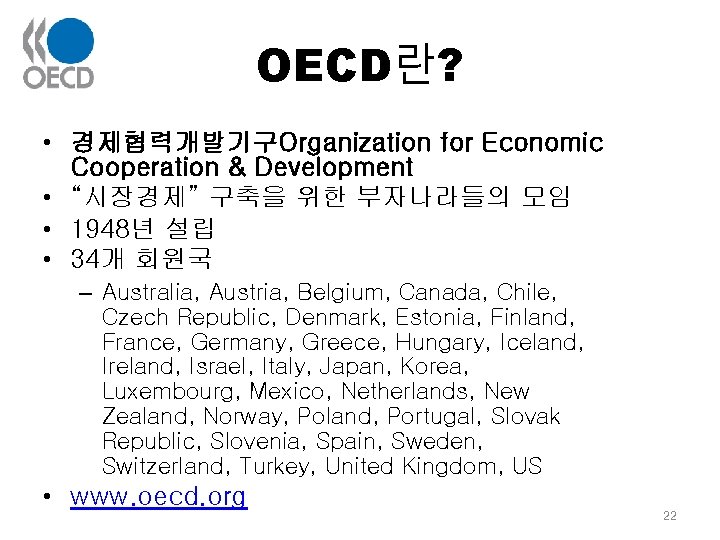
OECD란? • 경제협력개발기구Organization for Economic Cooperation & Development • “시장경제” 구축을 위한 부자나라들의 모임 • 1948년 설립 • 34개 회원국 – Australia, Austria, Belgium, Canada, Chile, Czech Republic, Denmark, Estonia, Finland, France, Germany, Greece, Hungary, Iceland, Ireland, Israel, Italy, Japan, Korea, Luxembourg, Mexico, Netherlands, New Zealand, Norway, Poland, Portugal, Slovak Republic, Slovenia, Spain, Sweden, Switzerland, Turkey, United Kingdom, US • www. oecd. org 22
OECD Guidelines for MNCs • International standard for “good corporate conduct” • 1976년 제정, 2000년과 2011년 대폭 개정. • “다국적기업은 경제적, 환경적, 사회적 진보에 기여해야 한다. ” • Not legally binding, but voluntary guidelines (recommendation) • 국가연락사무소 National Contact Point (NCP) • suppliers and subcontractors to apply the Guidelines 23
OECD Guidelines for MNCs • 다국적기업 – 1개 이상 나라에서 영업활동을 하는 기업 • 11개 장 – 1. Concept and principles, 2. General Policies, 3. Information Disclosure, 4. Human Rights, 5. Employment and Industrial Relations, 6. Environment, 7. Combating Bribery, 8. Consumer Interests, 9. Science & Technology, 10. Competition, 11. Taxation 24
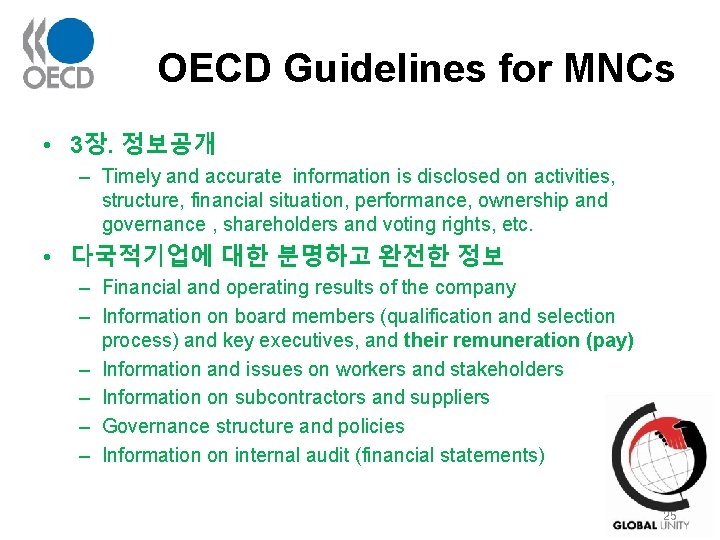
OECD Guidelines for MNCs • 3장. 정보공개 – Timely and accurate information is disclosed on activities, structure, financial situation, performance, ownership and governance , shareholders and voting rights, etc. • 다국적기업에 대한 분명하고 완전한 정보 – Financial and operating results of the company – Information on board members (qualification and selection process) and key executives, and their remuneration (pay) – Information and issues on workers and stakeholders – Information on subcontractors and suppliers – Governance structure and policies – Information on internal audit (financial statements) 25
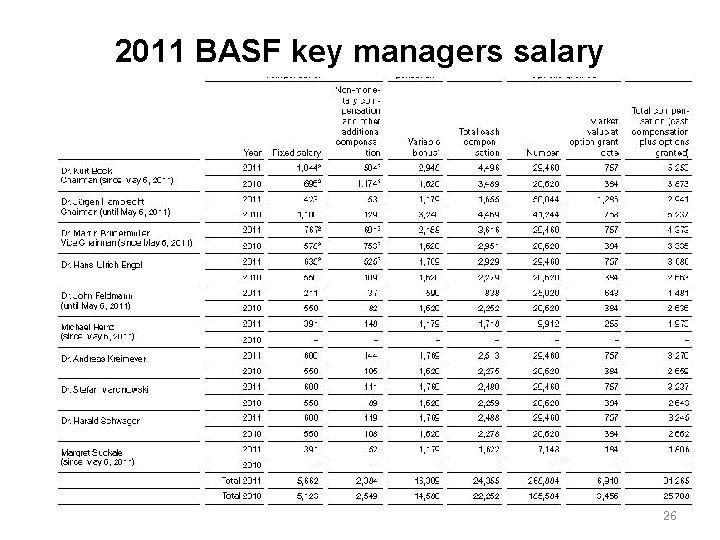
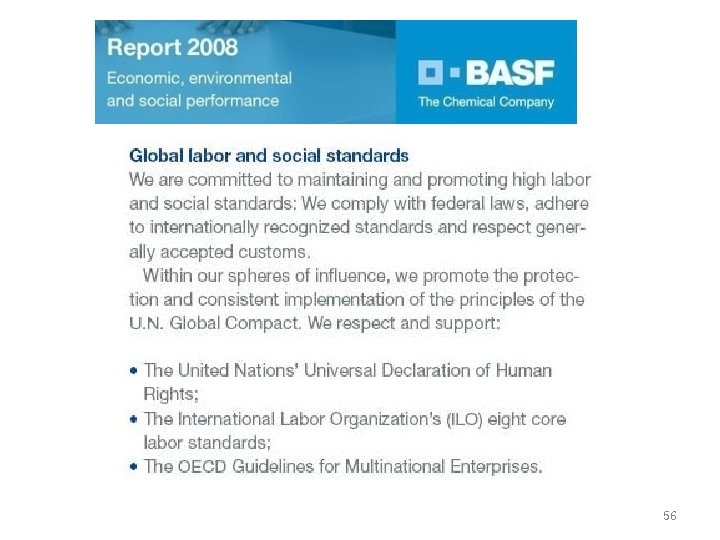
2011 BASF key managers salary 26
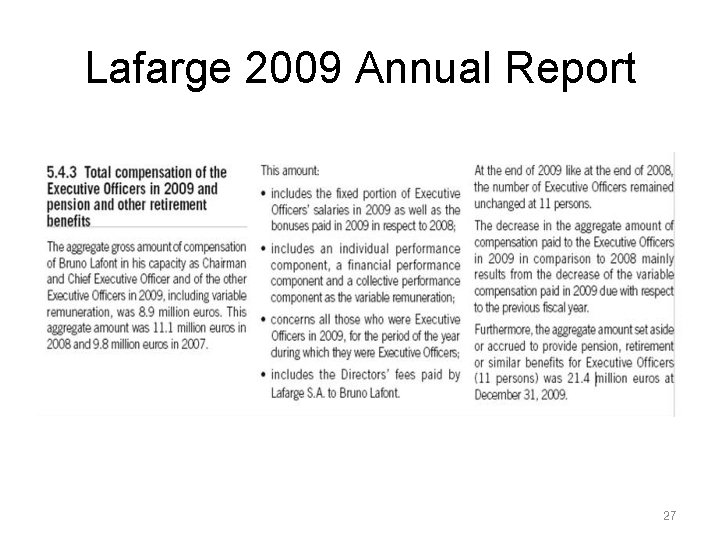
Lafarge 2009 Annual Report 27
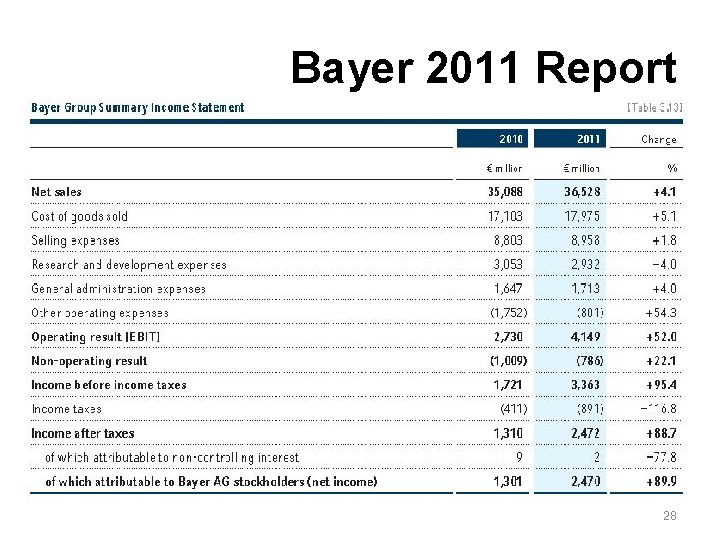
Bayer 2011 Report 28
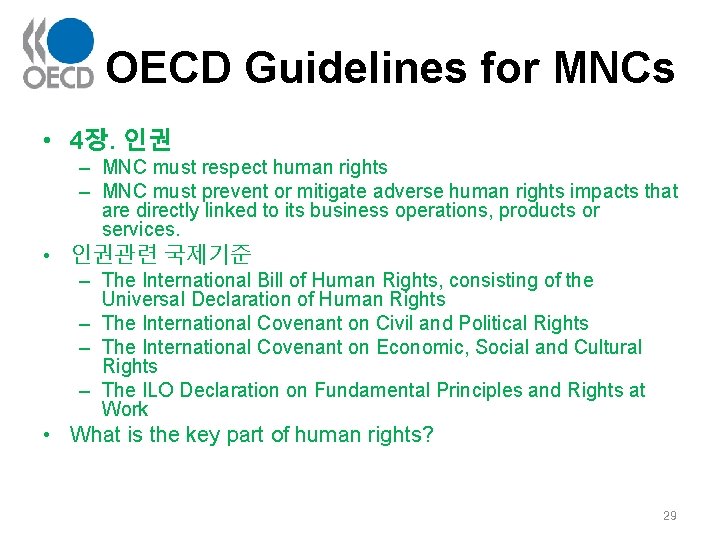
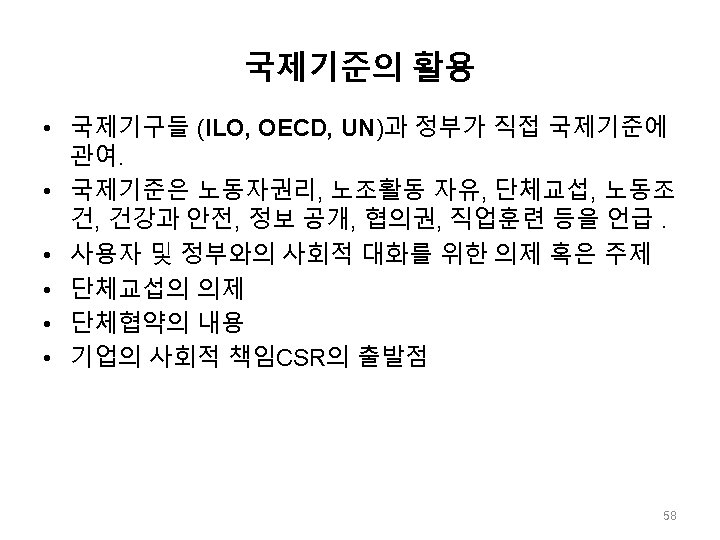
OECD Guidelines for MNCs • 4장. 인권 – MNC must respect human rights – MNC must prevent or mitigate adverse human rights impacts that are directly linked to its business operations, products or services. • 인권관련 국제기준 – The International Bill of Human Rights, consisting of the Universal Declaration of Human Rights – The International Covenant on Civil and Political Rights – The International Covenant on Economic, Social and Cultural Rights – The ILO Declaration on Fundamental Principles and Rights at Work • What is the key part of human rights? 29
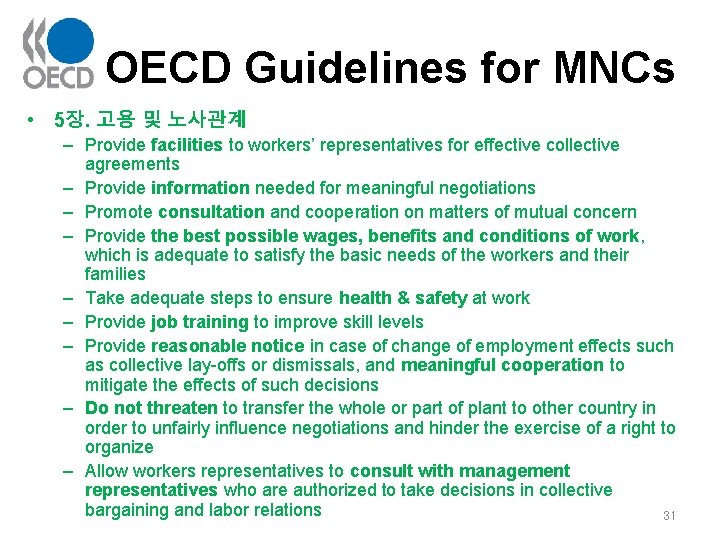
OECD Guidelines for MNCs • 5장. 고용 및 노사관계 – Provide facilities to workers’ representatives for effective collective agreements – Provide information needed for meaningful negotiations – Promote consultation and cooperation on matters of mutual concern – Provide the best possible wages, benefits and conditions of work, which is adequate to satisfy the basic needs of the workers and their families – Take adequate steps to ensure health & safety at work – Provide job training to improve skill levels – Provide reasonable notice in case of change of employment effects such as collective lay-offs or dismissals, and meaningful cooperation to mitigate the effects of such decisions – Do not threaten to transfer the whole or part of plant to other country in order to unfairly influence negotiations and hinder the exercise of a right to organize – Allow workers representatives to consult with management representatives who are authorized to take decisions in collective bargaining and labor relations 31
UN Global Compact 33
UN Global Compact • Kofi Annan 1999년 World Economic Forum에서 제안하여 2000년 7월 공식 출 범. • 유엔이 주도하는 기업의 사회적 책임 Corporate Social Responsibility (CSR) 관 련 국제기준 • 145개국 1만여 참가 조직, 7천여 기업 참여 • 4개 영역 10개 원칙 • www. unglobalcompact. org 34
UN Global Compact • • 인권 Human Rights 1. 2. MNC support human rights MNC do not abuse human right 3. 4. 5. 6. MNC respect the freedom of association and the right to collective bargaining Elimination of forced labor Abolition of child labor Elimination of discrimination at work 7. 8. 9. MNC support precautionary approach to environment Promote greater environmental responsibility Develop environmentally friendly technology 노동기준 Labor Standards 환경 Environment 반부패 Anti-Corruption 10. MNC should work against all forms of corruption 35
Freedom of Association & Collective Bargaining • • • Ensure that all workers are able to form and join a trade union of their choice without fear of intimidation or reprisal, in accordance with national law. Put in place non-discriminatory policies and procedures with respect to trade union organization, union membership and activity in such areas as applications for employment and decisions on advancement, dismissal or transfer. Do not interfere with the activities of worker representatives while they carry out their functions in ways that are not disruptive to regular company operations. Allow the collection of union dues on company premises, posting of trade union notices, distribution of union documents, and provision of office space. Provide workers’ representatives with appropriate facilities to assist in the development of effective collective agreement. 36
Freedom of Association & Collective Bargaining • • • Recognize trade union for the purpose of collective bargaining. Use collective bargaining as a constructive forum for addressing working conditions and terms of employment and relations between employers and workers. Address any problem-solving or other needs of interest to workers and management, including restructuring and training, redundancy procedures, safety and health issues, grievance and dispute settlement procedures, disciplinary rules, and family and community welfare. Provide information needed for meaningful bargaining. Balance dealings with the most representative trade union to ensure the viability of smaller organizations to continue to represent their members Inform the local community, media and public authorities of your company's endorsement of the UN Global Compact and its intention to respect its provisions, including those on fundamental workers' rights. 37
No Force Labour • • • Situations of forced labour are generally characterized by a lack of consent to work. Exploitative practices such as forced overtime Physical or psychological (including sexual) violence as a means of keeping someone in forced labour (as a threat against worker, family, or close associates) Deception or false promises about terms and types of work Slavery, Bonded labour or debt bondage, Physical abduction or kidnapping, Sale of a person into the ownership of another, Physical confinement in the work location (in prison or in private detention), The work or service of prisoners, Work required to punish opinion or expression of views ideologically opposed to the established political, social or economic system, The lodging of deposits (financial or personal documents) for employment, Full or partial restrictions on freedom of movement, Withholding and non-payment of wages (linked to manipulated debt payments, exploitation, and other forms of extortion), Deprivation of food, shelter or other necessities 38
No Child Labour • the term "child" covers all girls and boys under 18 years of age. • Developed countries – Light Work 13 Years – Regular Work 15 Years – Hazardous Work 18 • Developing countries – Light Work 12 Years – Regular Work 14 Years – Years Hazardous Work 18 Years • Exercise influence on subcontractors, suppliers and other business affiliates to combat child labour. 39
No Discrimination • Equal treatment for equal work • Equal treatment in terms of Recruitment, Remuneration, Hours of work and rest/ Paid holidays, Maternity protection, Security of tenure, Job assignments, Performance assessment and advancement, Training and opportunities, Job prospects, Social security, Occupational safety and health 40
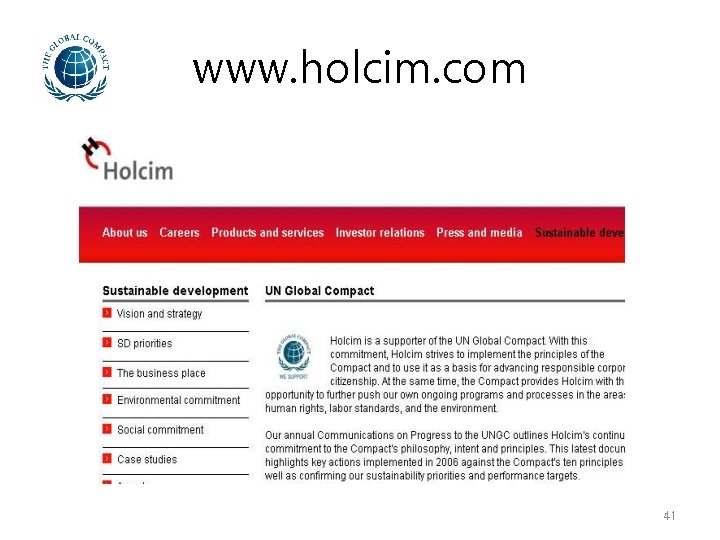
www. holcim. com 41
국제기본협약 Global Framework Agreement 42
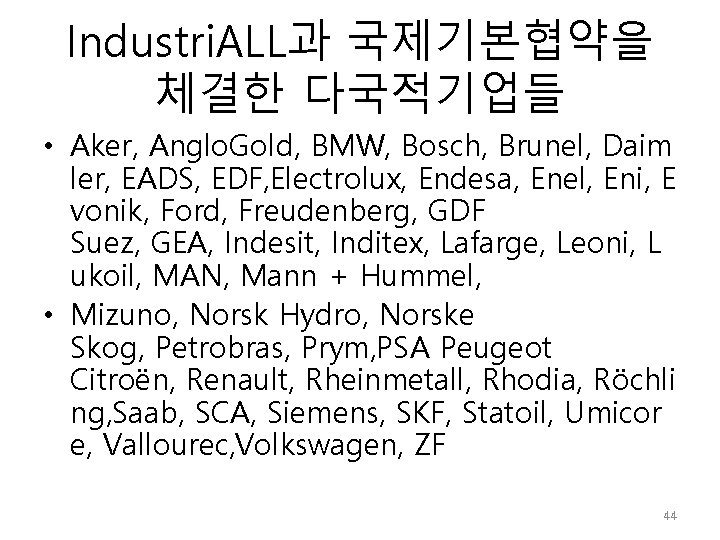
Industri. ALL과 국제기본협약을 체결한 다국적기업들 • Aker, Anglo. Gold, BMW, Bosch, Brunel, Daim ler, EADS, EDF, Electrolux, Endesa, Enel, Eni, E vonik, Ford, Freudenberg, GDF Suez, GEA, Indesit, Inditex, Lafarge, Leoni, L ukoil, MAN, Mann + Hummel, • Mizuno, Norsk Hydro, Norske Skog, Petrobras, Prym, PSA Peugeot Citroën, Renault, Rheinmetall, Rhodia, Röchli ng, Saab, SCA, Siemens, SKF, Statoil, Umicor e, Vallourec, Volkswagen, ZF 44
Industri. ALL-Lafarge 기본협약 강제노동 철폐 Abolition of forced labor 사업장 차별금지No discrimination at workplace 아동노동 폐지 Elimination of child labor 노조 조직 및 단체교섭 권리 Right to organizing trade union and collective bargaining • 생활임금 보장 Guarantee living wage • 건강 안전 노동조건 개선 Improve health, safety and working conditions • 직업훈련 제공 Provide Job training • • 45
Industri. ALL- Freudenberg 기본협약 • No forced labor and child labor • Equal opportunities and equal treatment on the job • Freedom of association and the respect for basic trade union rights • Right to organizing trade union and collective bargaining • No discrimination against trade union representatives • Health & safety at workplace • Flexible, efficient and customer-oriented forms of work organization 46
Norske Skog-Industri. ALL 기본협약 • Freedom of association & collective bargaining • No discrimination and equal opportunity • Health and safety at workplace • No forced labor • No child labor • Wages & benefits covering basic needs of the workers and their family • Employment status for workers based on permanent job – Irregular workers like temporary/part-time workers must receive the same terms conditions with comparable regular workers. 47
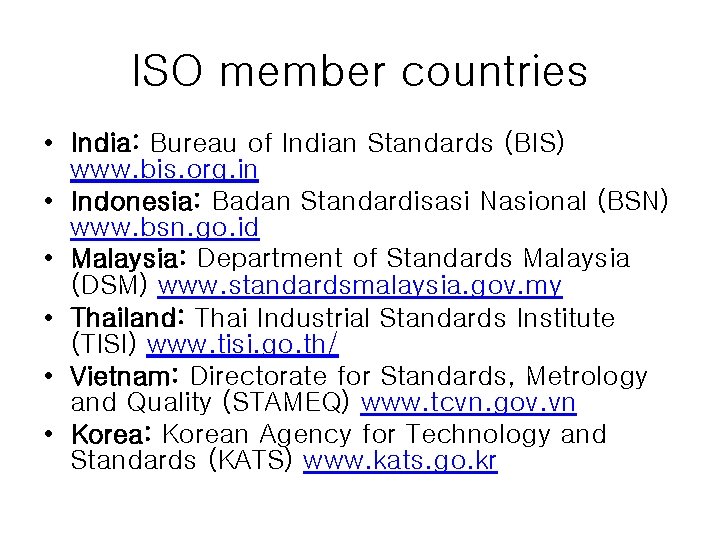
ISO member countries • India: Bureau of Indian Standards (BIS) www. bis. org. in • Indonesia: Badan Standardisasi Nasional (BSN) www. bsn. go. id • Malaysia: Department of Standards Malaysia (DSM) www. standardsmalaysia. gov. my • Thailand: Thai Industrial Standards Institute (TISI) www. tisi. go. th/ • Vietnam: Directorate for Standards, Metrology and Quality (STAMEQ) www. tcvn. gov. vn • Korea: Korean Agency for Technology and Standards (KATS) www. kats. go. kr
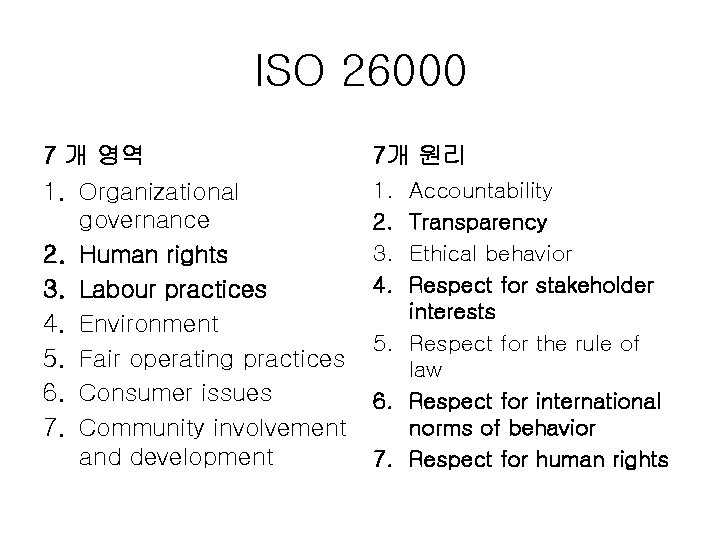
ISO 26000 7 개 영역 7개 원리 1. Organizational governance 2. Human rights 3. Labour practices 4. Environment 5. Fair operating practices 6. Consumer issues 7. Community involvement and development 1. 2. 3. 4. Accountability Transparency Ethical behavior Respect for stakeholder interests 5. Respect for the rule of law 6. Respect for international norms of behavior 7. Respect for human rights
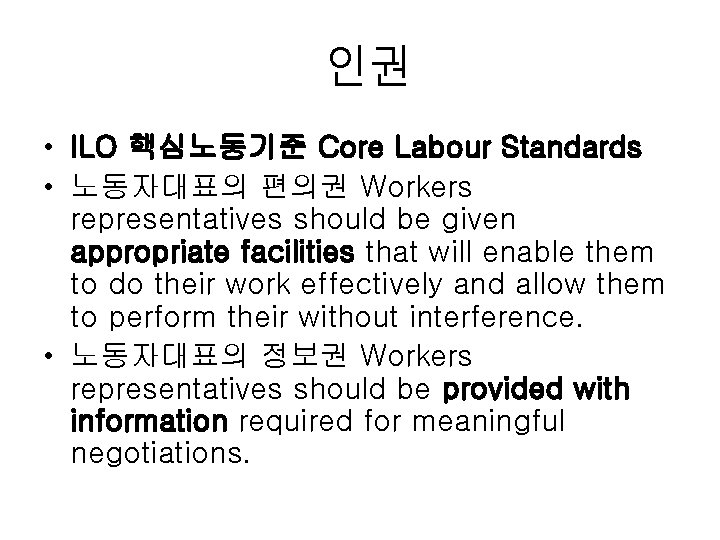
인권 • ILO 핵심노동기준 Core Labour Standards • 노동자대표의 편의권 Workers representatives should be given appropriate facilities that will enable them to do their work effectively and allow them to perform their without interference. • 노동자대표의 정보권 Workers representatives should be provided with information required for meaningful negotiations.
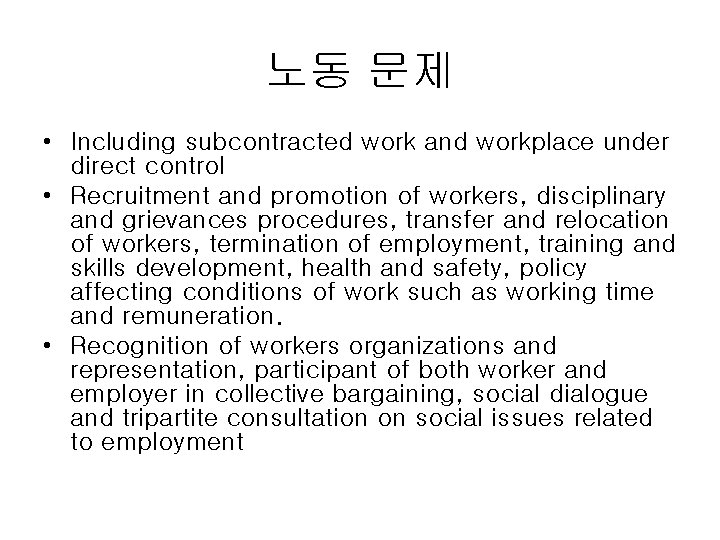
노동 문제 • Including subcontracted work and workplace under direct control • Recruitment and promotion of workers, disciplinary and grievances procedures, transfer and relocation of workers, termination of employment, training and skills development, health and safety, policy affecting conditions of work such as working time and remuneration. • Recognition of workers organizations and representation, participant of both worker and employer in collective bargaining, social dialogue and tripartite consultation on social issues related to employment
노조간부가 알아야 할 국제기준 • ILO Core Labour Standards • OECD Guidelines for MNCs • UN Global Compact • Global Agreement with MNCs • ISO 26000 55
56
국제기준의 공통점 노조 결성/가입과 단체교섭 권리 Workers rights to organize and CA 아동노동 금지 No child labor, 강제노동 금지 No forced labor 차별 금지 No discrimination 노조활동 보장 Guarantee of union activity 단체교섭 및 노조활동 편의 제공 Facilities for collective bargaining & union activity 7. 괜찮은 임금 Decent wage 8. 좋은 노동조건과 노동시간 Good working conditions and work hours 9. 건강과 안전 Health & safety 10. 정보공유 Information sharing 11. 협의권 및 노동자 경영참가 Consultation right 12. 직업훈련 및 숙련개발 Job training / skill development 1. 2. 3. 4. 5. 6. 57
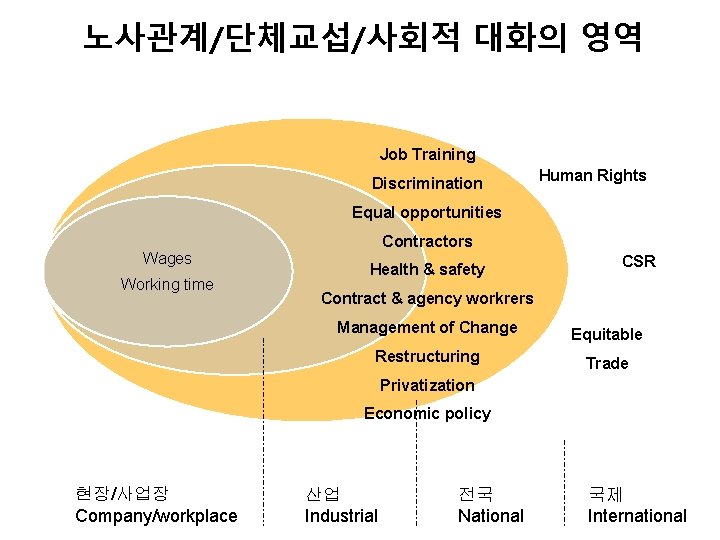
노사관계/단체교섭/사회적 대화의 영역 Job Training Discrimination Human Rights Equal opportunities Wages Working time Contractors Health & safety CSR Contract & agency workrers Management of Change Equitable Restructuring Trade Privatization Economic policy 현장/사업장 Company/workplace 산업 Industrial 전국 National 국제 International
Yoon Hyowon mobile: (+82) 10 2083 4715 industriallyoon@gmail. com 60