
Korean GravitationalWave Group Tai Hyun Yoon Korea Univ
- Slides: 27
Korean Gravitational-Wave Group Tai Hyun Yoon (Korea Univ. ) on behalf of the Korean Gravitational-Wave Group (KGWG) The LCGT Face-To-Face Meeting, ICRR August 3 -5, 2011
Outline I. Korean Gravitational-Wave Group (KGWG) II. Proposed Works 1. 2. 3. Experimental Involvement Data Analysis Astrophysical Research III. Facilities IV. Human Resources V. Summary
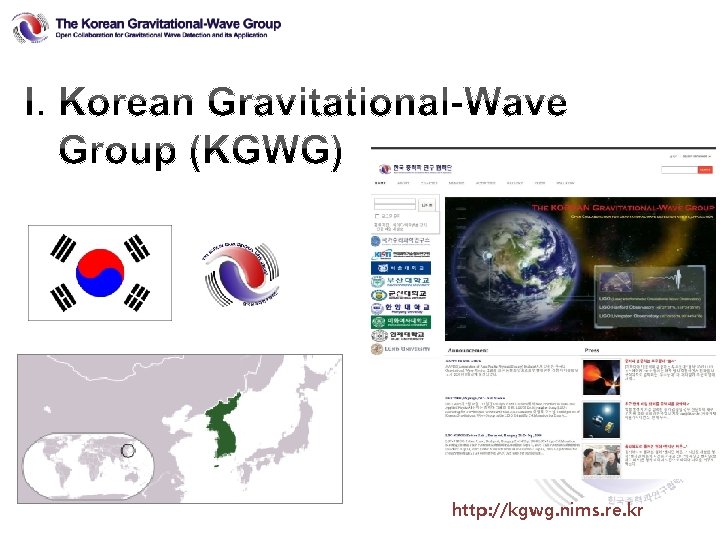
http: //kgwg. nims. re. kr
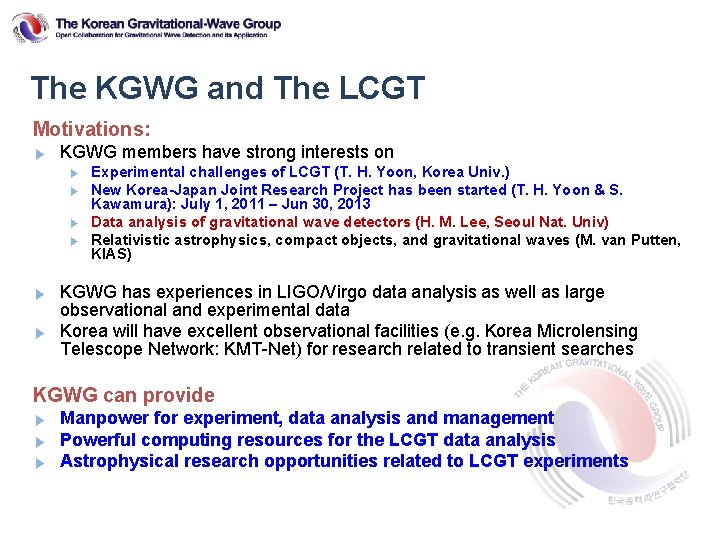
The KGWG and The LCGT Motivations: ▶ KGWG members have strong interests on ▶ ▶ ▶ Experimental challenges of LCGT (T. H. Yoon, Korea Univ. ) New Korea-Japan Joint Research Project has been started (T. H. Yoon & S. Kawamura): July 1, 2011 – Jun 30, 2013 Data analysis of gravitational wave detectors (H. M. Lee, Seoul Nat. Univ) Relativistic astrophysics, compact objects, and gravitational waves (M. van Putten, KIAS) KGWG has experiences in LIGO/Virgo data analysis as well as large observational and experimental data Korea will have excellent observational facilities (e. g. Korea Microlensing Telescope Network: KMT-Net) for research related to transient searches KGWG can provide ▶ ▶ ▶ Manpower for experiment, data analysis and management Powerful computing resources for the LCGT data analysis Astrophysical research opportunities related to LCGT experiments
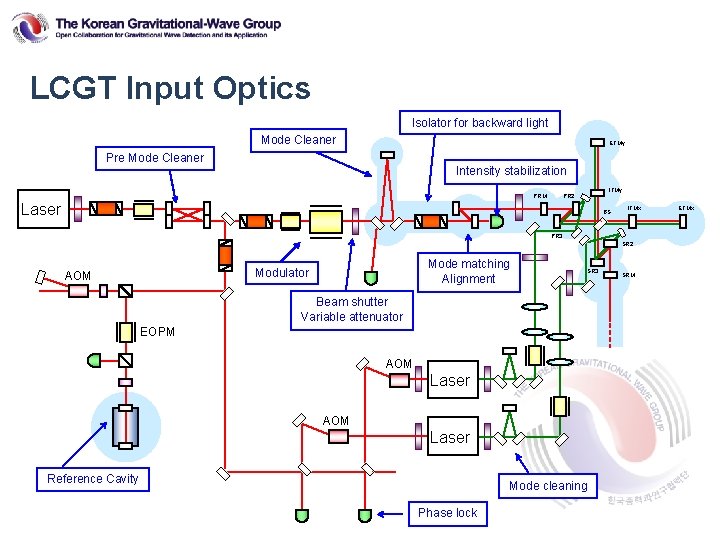
LCGT Input Optics Isolator for backward light Mode Cleaner ETMy Pre Mode Cleaner Intensity stabilization ITMy PRM PR 2 Laser BS ITMx PR 3 SR 2 Mode matching Alignment Modulator AOM SR 3 Beam shutter Variable attenuator EOPM AOM Laser Reference Cavity Mode cleaning Phase lock SRM ETMx
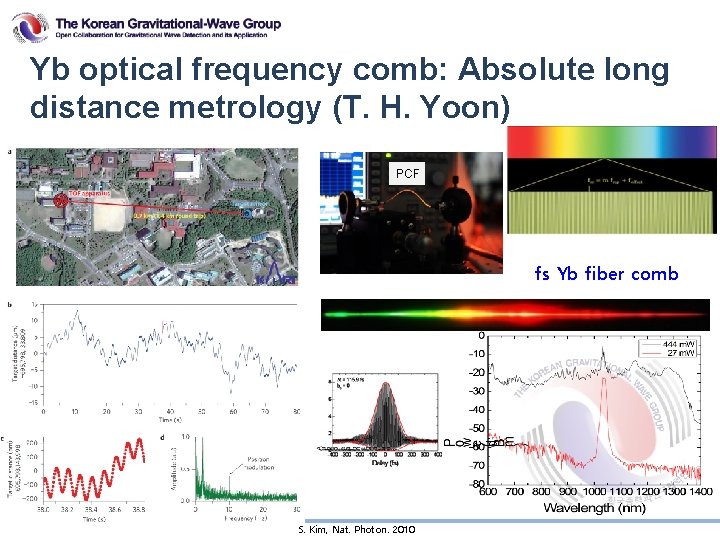
II-1 Experiments ▶ Master laser frequency stabilization: absolute frequency stabilization of NPRO (I 2) & line-width reduction by ULE (fiber) ring cavity (T. H. Yoon) ▶ Optical frequency comb metrology: Absolute long distance measurement (T. H. Yoon) ▶ High power (> 200 W) fiber amplifier: Yb-doped large-mode area photonic crystal fiber (Y. -H. Cha) ▶ Vibration isolation: Atomic interferometer (J. Kim)
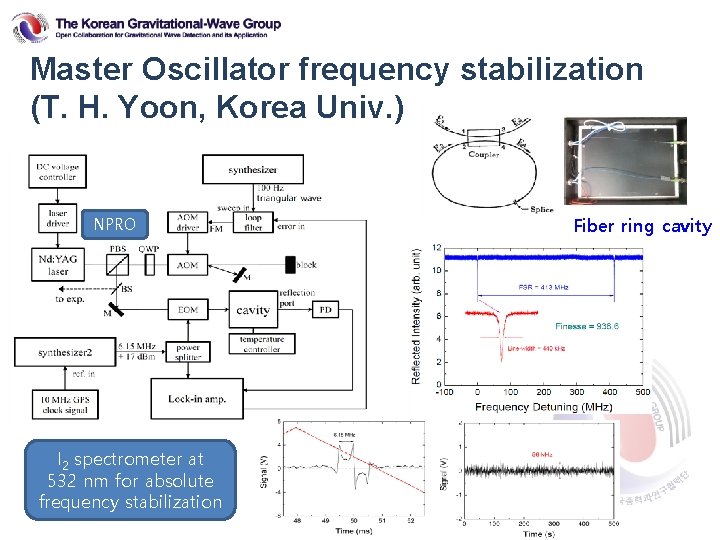
Master Oscillator frequency stabilization (T. H. Yoon, Korea Univ. ) NPRO I 2 spectrometer at 532 nm for absolute frequency stabilization Fiber ring cavity
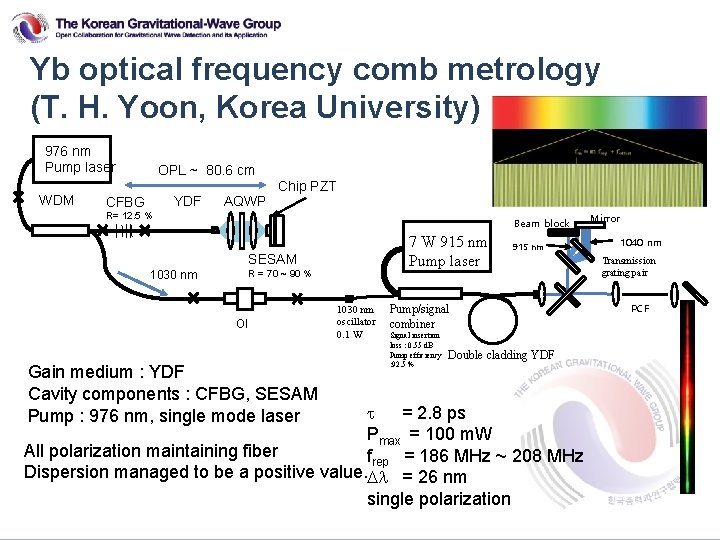
Yb optical frequency comb metrology (T. H. Yoon, Korea University) 976 nm Pump laser WDM OPL ~ 80. 6 cm YDF CFBG AQWP Chip PZT R= 12. 5 % Beam block 7 W 915 nm Pump laser SESAM 1030 nm R = 70 ~ 90 % OI Gain medium : YDF Cavity components : CFBG, SESAM Pump : 976 nm, single mode laser 1030 nm oscillator 0. 1 W 915 nm Pump/signal combiner Signal insertion loss : 0. 55 d. B Pump efficiency : 92. 5 % Double cladding YDF t = 2. 8 ps Pmax = 100 m. W All polarization maintaining fiber frep = 186 MHz ~ 208 MHz Dispersion managed to be a positive value. Dl = 26 nm single polarization Mirror 1040 nm Transmission grating pair PCF
Yb optical frequency comb: Absolute long distance metrology (T. H. Yoon) PCF fs Yb fiber comb S. Kim, Nat. Photon. 2010
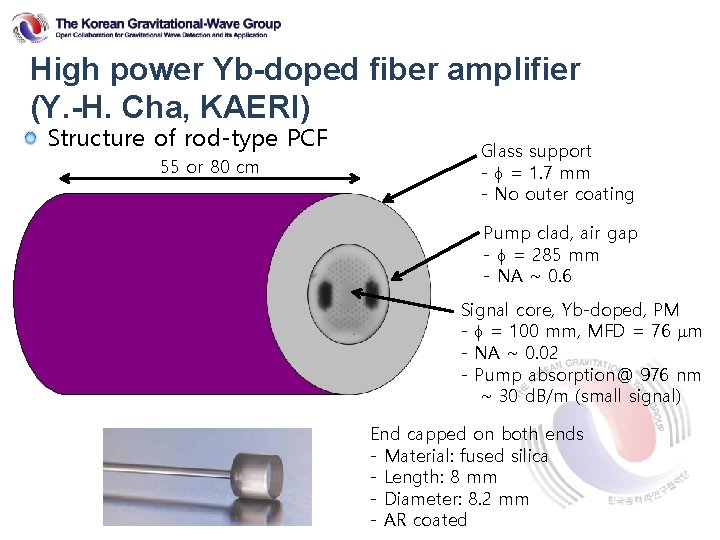
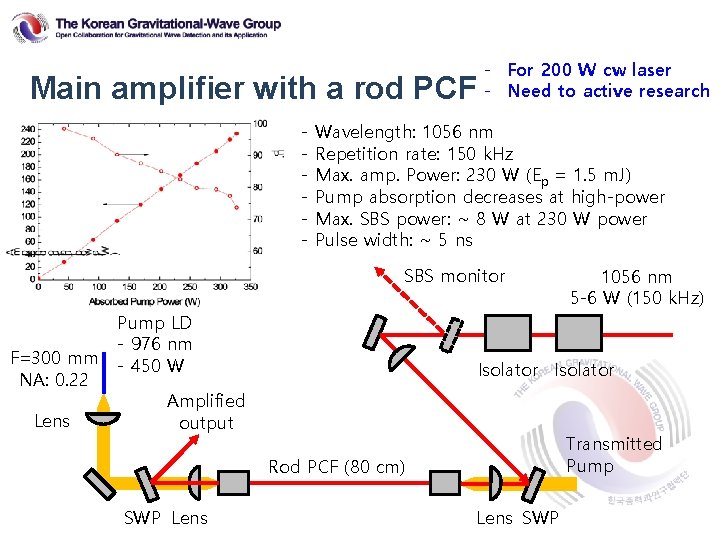
High power Yb-doped fiber amplifier (Y. -H. Cha, KAERI) Structure of rod-type PCF 55 or 80 cm Glass support - f = 1. 7 mm - No outer coating Pump clad, air gap - f = 285 mm - NA ~ 0. 6 Signal core, Yb-doped, PM - f = 100 mm, MFD = 76 mm - NA ~ 0. 02 - Pump absorption@ 976 nm ~ 30 d. B/m (small signal) End capped on both ends - Material: fused silica - Length: 8 mm - Diameter: 8. 2 mm - AR coated
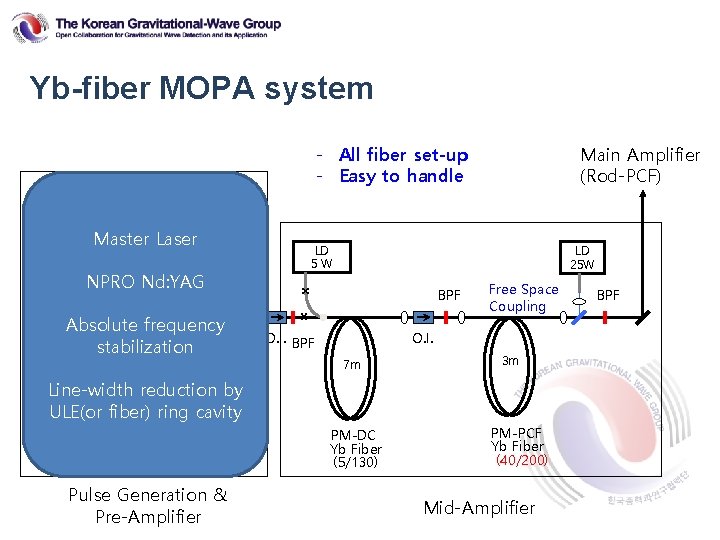
Yb-fiber MOPA system - All fiber set-up - Easy to handle DFB 20 m. W, 1056 nm OI Master Laser LD 0. 5 W x NPRO Nd: YAG x LD 25 W LD 5 W 2 m x x Absolute frequency AOM stabilization PM-SC Yb by Fiber reduction (6/125) BPF x DL Main Amplifier (Rod-PCF) x Free Space Coupling O. I. BPF 7 m 3 m Line-width ULE(or fiber) ring cavity PM-DC Yb Fiber (5/130) Pulse Generation & Pre-Amplifier PM-PCF Yb Fiber (40/200) Mid-Amplifier BPF
Main amplifier with a rod PCF - - For 200 W cw laser - Need to active research Wavelength: 1056 nm Repetition rate: 150 k. Hz Max. amp. Power: 230 W (Ep = 1. 5 m. J) Pump absorption decreases at high-power Max. SBS power: ~ 8 W at 230 W power Pulse width: ~ 5 ns SBS monitor F=300 mm NA: 0. 22 Lens Pump LD - 976 nm - 450 W Isolator Amplified output Transmitted Pump Rod PCF (80 cm) SWP Lens 1056 nm 5 -6 W (150 k. Hz) Lens SWP
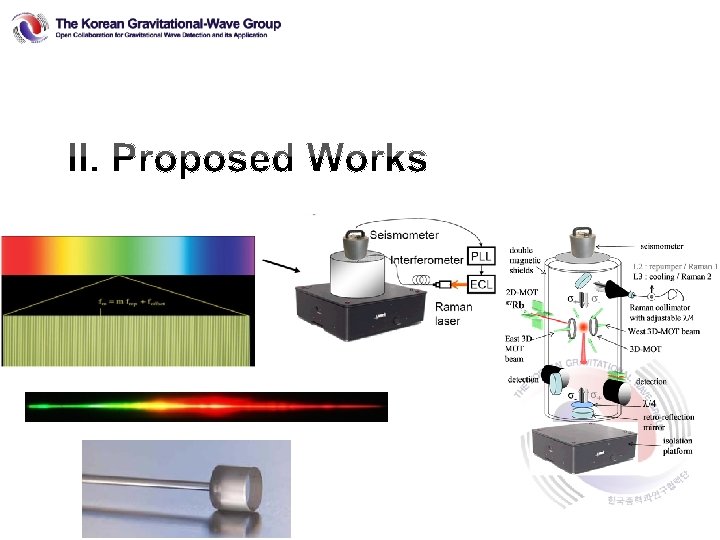
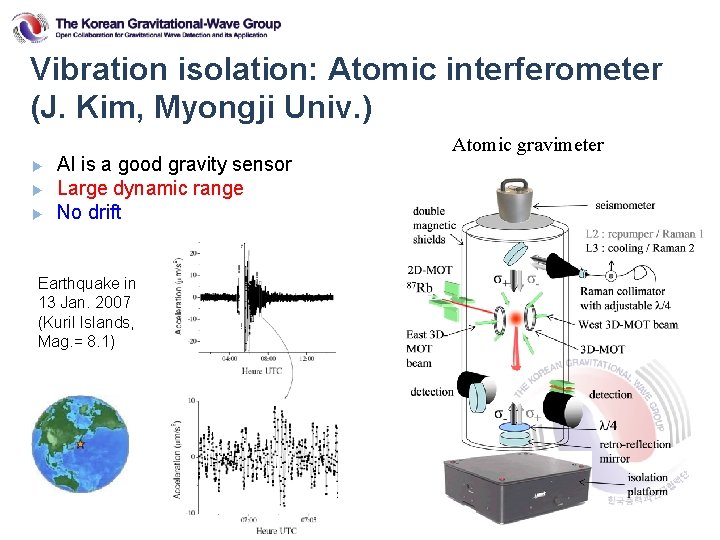
Vibration isolation: Atomic interferometer (J. Kim, Myongji Univ. ) ▶ ▶ ▶ AI is a good gravity sensor Large dynamic range No drift Earthquake in 13 Jan. 2007 (Kuril Islands, Mag. = 8. 1) Atomic gravimeter
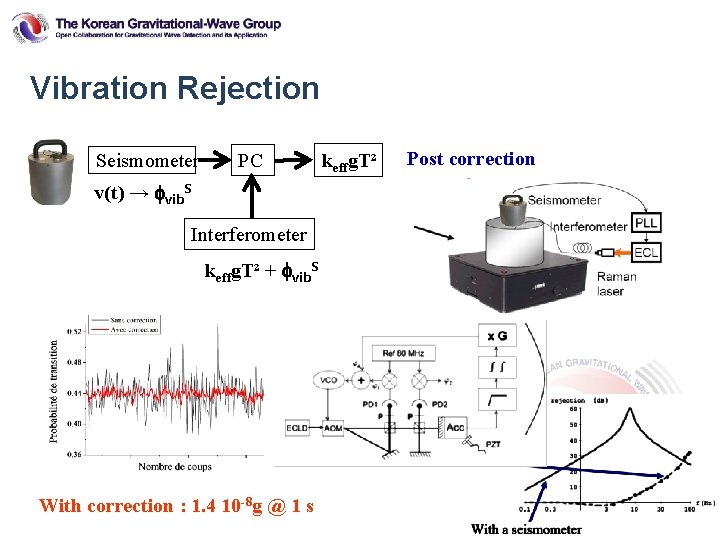
Vibration Rejection Seismometer PC v(t) → fvib. S Interferometer keffg. T² + fvib. S With correction : 1. 4 10 -8 g @ 1 s keffg. T² Post correction
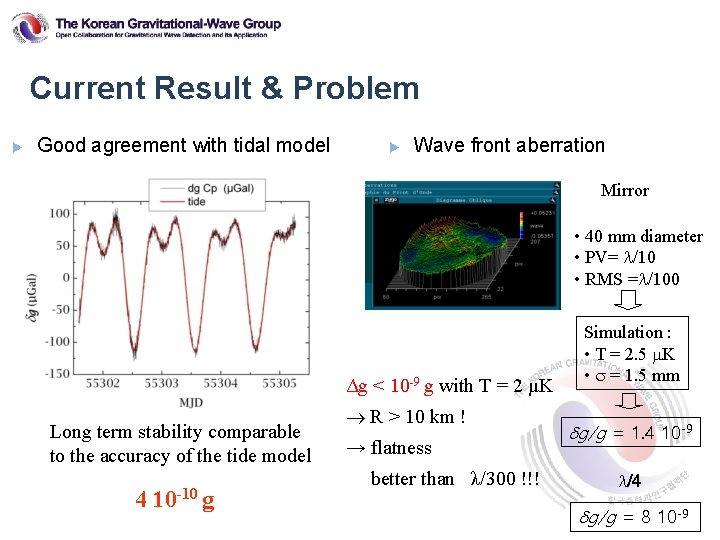
Current Result & Problem ▶ Good agreement with tidal model ▶ Wave front aberration Mirror • 40 mm diameter • PV= l/10 • RMS =l/100 Δg < 10 -9 g with T = 2 µK Long term stability comparable to the accuracy of the tide model 4 10 -10 g R > 10 km ! → flatness better than λ/300 !!! Simulation : • T = 2. 5 m. K • s = 1. 5 mm g/g = 1. 4 10 -9 l/4 g/g = 8 10 -9
II-2 Data Analysis Quality Control ▶ Parameter Estimation for Compact Binary Coalescence ▶ Fundamental research on gravitational wave detection algorithm ▶ Optical Followup Data Analysis ▶ Mass processing of the data ▶
II-3 Astrophysical and Theoretical Research Optical followup observations using Korean facilities ▶ Gravitational wave source related researches ▶ Binary formation and evolution in dense stellar systems ▶ Neutron star equation of states and binary evolution ▶ Pulsar glitch induced gravitational waves ▶ ▶ Others
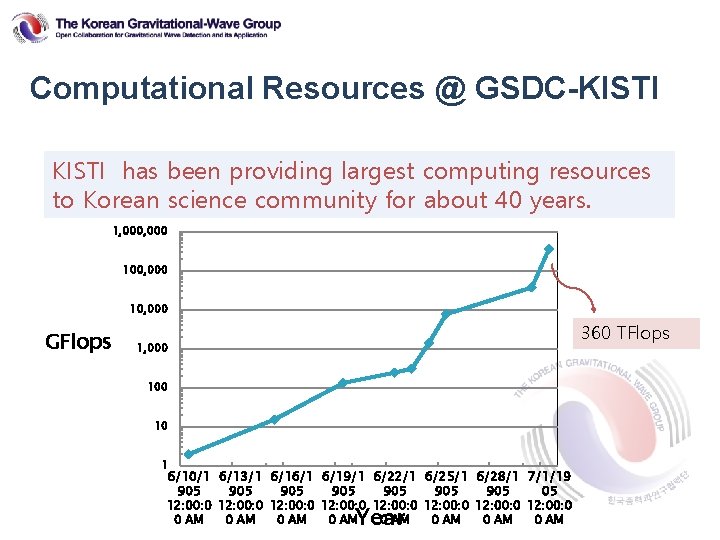
Computational Resources @ GSDC-KISTI has been providing largest computing resources to Korean science community for about 40 years. 1, 000 100, 000 10, 000 GFlops 360 TFlops 1, 000 10 1 6/10/1 6/13/1 6/16/1 6/19/1 6/22/1 6/25/1 6/28/1 7/1/19 905 905 05 12: 00: 0 12: 00: 0 0 AM 0 AM Year
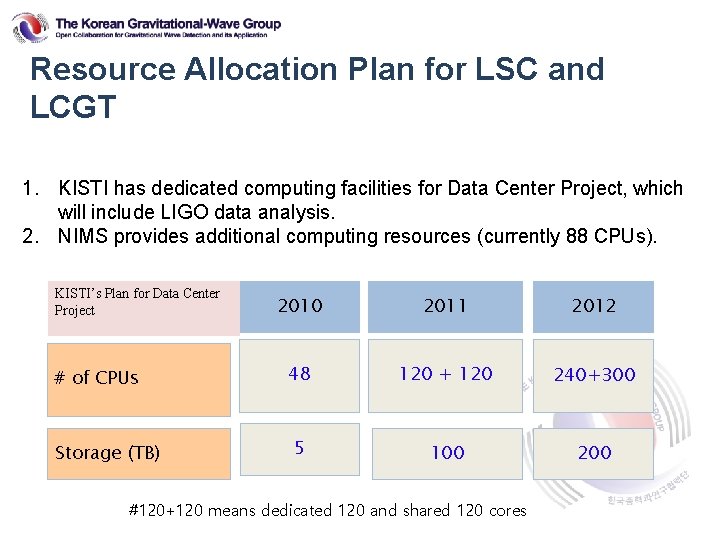
Resource Allocation Plan for LSC and LCGT 1. KISTI has dedicated computing facilities for Data Center Project, which will include LIGO data analysis. 2. NIMS provides additional computing resources (currently 88 CPUs). KISTI’s Plan for Data Center Project # of CPUs Storage (TB) 2010 2011 2012 48 120 + 120 240+300 5 100 200 #120+120 means dedicated 120 and shared 120 cores
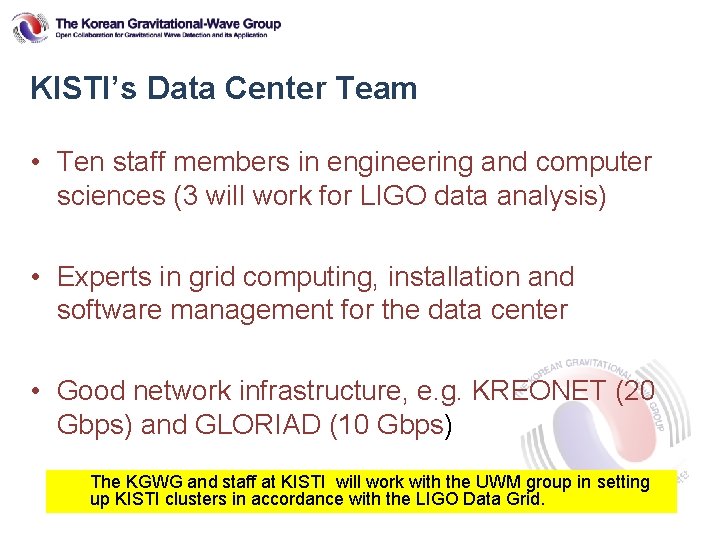
KISTI’s Data Center Team • Ten staff members in engineering and computer sciences (3 will work for LIGO data analysis) • Experts in grid computing, installation and software management for the data center • Good network infrastructure, e. g. KREONET (20 Gbps) and GLORIAD (10 Gbps) The KGWG and staff at KISTI will work with the UWM group in setting up KISTI clusters in accordance with the LIGO Data Grid.
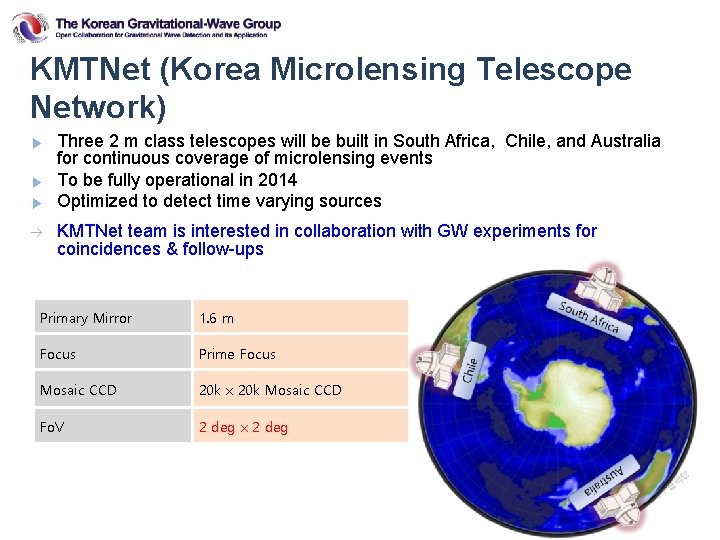
KMTNet (Korea Microlensing Telescope Network) ▶ ▶ ▶ à Three 2 m class telescopes will be built in South Africa, Chile, and Australia for continuous coverage of microlensing events To be fully operational in 2014 Optimized to detect time varying sources KMTNet team is interested in collaboration with GW experiments for coincidences & follow-ups Primary Mirror 1. 6 m Focus Prime Focus Mosaic CCD 20 k x 20 k Mosaic CCD Fo. V 2 deg x 2 deg
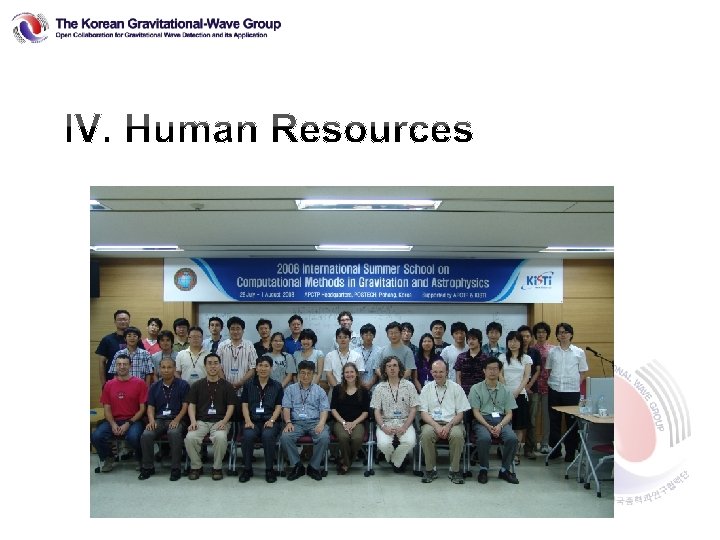
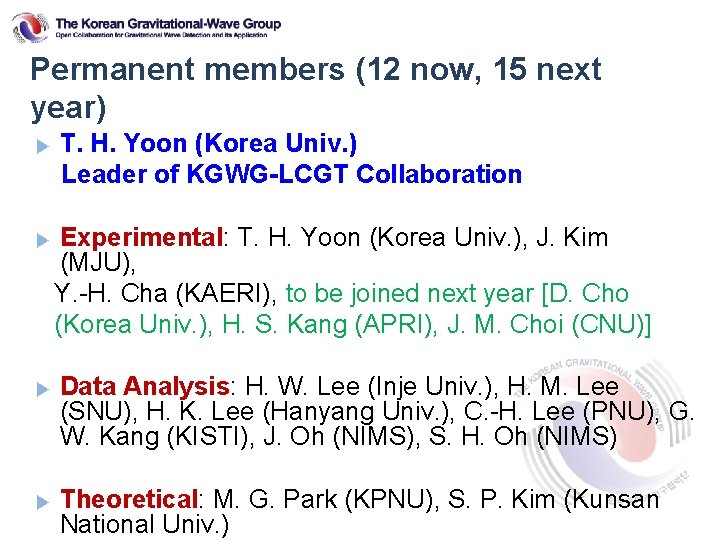
Permanent members (12 now, 15 next year) ▶ T. H. Yoon (Korea Univ. ) Leader of KGWG-LCGT Collaboration ▶ Experimental: T. H. Yoon (Korea Univ. ), J. Kim (MJU), Y. -H. Cha (KAERI), to be joined next year [D. Cho (Korea Univ. ), H. S. Kang (APRI), J. M. Choi (CNU)] ▶ Data Analysis: H. W. Lee (Inje Univ. ), H. M. Lee (SNU), H. K. Lee (Hanyang Univ. ), C. -H. Lee (PNU), G. W. Kang (KISTI), J. Oh (NIMS), S. H. Oh (NIMS) ▶ Theoretical: M. G. Park (KPNU), S. P. Kim (Kunsan National Univ. )
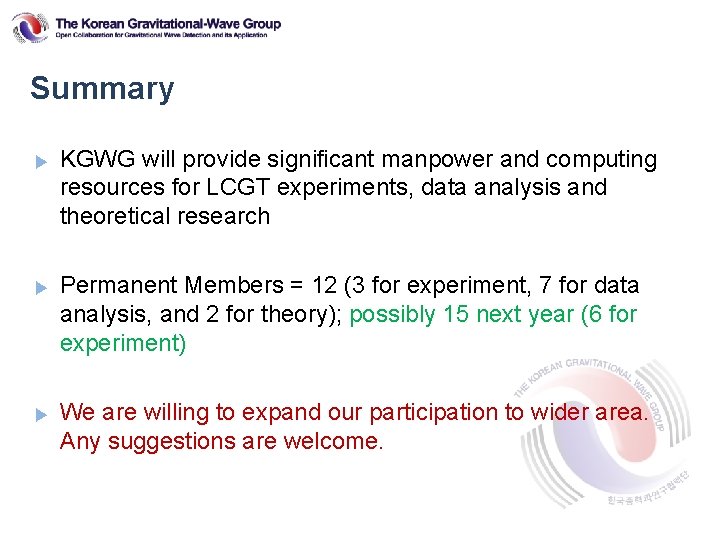
Summary ▶ KGWG will provide significant manpower and computing resources for LCGT experiments, data analysis and theoretical research ▶ Permanent Members = 12 (3 for experiment, 7 for data analysis, and 2 for theory); possibly 15 next year (6 for experiment) ▶ We are willing to expand our participation to wider area. Any suggestions are welcome.
Thank you very much!