Idaho State Police Forensic Services Evidence Packaging and
- Slides: 133
Idaho State Police Forensic Services Evidence Packaging and Preservation REV 3 9/15/20
Overview n n n n n Forensic Services Purpose Idaho Forensic Services History Accrediting Agencies NAS Report Forensic Services Customers Types of Analysis Performed by Regional Laboratory General Laboratory Information General Packaging Information Evidence Packaging & Supplies Shipping Information n n Drug Evidence Urine & Blood Kit Evidence (Toxicology) Breath Testing Fire Debris Evidence Trace Evidence Biological Evidence Firearms and Related Examinations Impression Evidence Fingerprints Trace/Headlamp/Questioned docs, etc.
IMPORTANT NOTES • Improper packaging and/or storage may compromise the evidence and/or jeopardize your case. • This course will cover the most commonly submitted evidence. If you encounter evidence that is not covered here: Call the ISPFS laboratory to ask us what the best collection & packaging method is. We are here to help you. • Contact your regional ISPFS laboratory at: Coeur d’Alene Meridian Pocatello 208 -209 -8700 208 -884 -7170 208 -239 -9900 We will assist at Crime scenes and Clan Labs if requested – contact I. S. P. Dispatch after hours. ISP dispatch will contact our Crime Scene Coordinator (CSC) and the CSC will call you directly to coordinate our response.
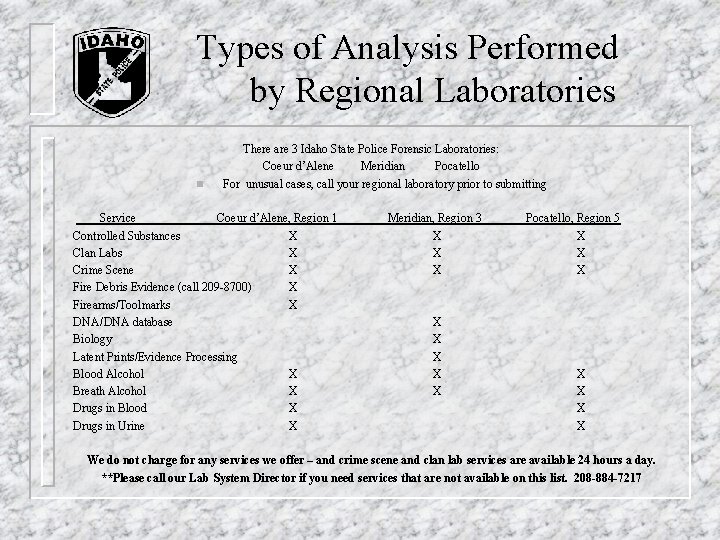
Types of Analysis Performed by Regional Laboratories n There are 3 Idaho State Police Forensic Laboratories: Coeur d’Alene Meridian Pocatello For unusual cases, call your regional laboratory prior to submitting Service Coeur d’Alene, Region 1 Controlled Substances X Clan Labs X Crime Scene X Fire Debris Evidence (call 209 -8700) X Firearms/Toolmarks X DNA/DNA database Biology Latent Prints/Evidence Processing Blood Alcohol X Breath Alcohol X Drugs in Blood X Drugs in Urine X Meridian, Region 3 X X X X Pocatello, Region 5 X X X X We do not charge for any services we offer – and crime scene and clan lab services are available 24 hours a day. **Please call our Lab System Director if you need services that are not available on this list. 208 -884 -7217
Website Our website is: https: //isp. idaho. gov/forensics/ • Current turnaround times • Other forms and logs • Email addresses and contact information • Newsletters and Notices from ISPFS HQ • Blood and breath alcohol forms, training, and methods • Types of evidence accepted • Analysis we perform in each lab • Prelog FAQs and Videos • CVs
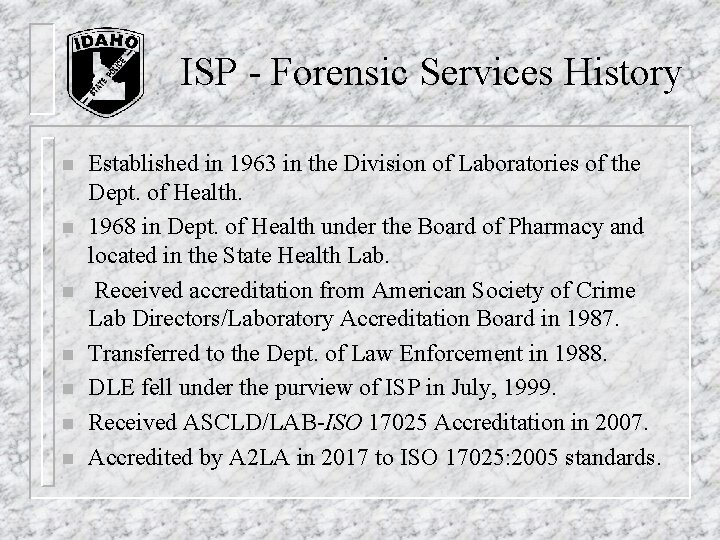
ISP - Forensic Services History n n n n Established in 1963 in the Division of Laboratories of the Dept. of Health. 1968 in Dept. of Health under the Board of Pharmacy and located in the State Health Lab. Received accreditation from American Society of Crime Lab Directors/Laboratory Accreditation Board in 1987. Transferred to the Dept. of Law Enforcement in 1988. DLE fell under the purview of ISP in July, 1999. Received ASCLD/LAB-ISO 17025 Accreditation in 2007. Accredited by A 2 LA in 2017 to ISO 17025: 2005 standards.
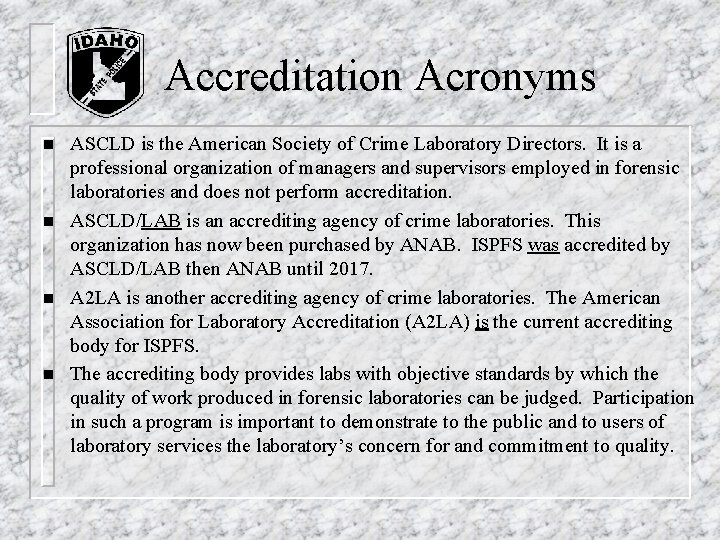
Accreditation Acronyms n n ASCLD is the American Society of Crime Laboratory Directors. It is a professional organization of managers and supervisors employed in forensic laboratories and does not perform accreditation. ASCLD/LAB is an accrediting agency of crime laboratories. This organization has now been purchased by ANAB. ISPFS was accredited by ASCLD/LAB then ANAB until 2017. A 2 LA is another accrediting agency of crime laboratories. The American Association for Laboratory Accreditation (A 2 LA) is the current accrediting body for ISPFS. The accrediting body provides labs with objective standards by which the quality of work produced in forensic laboratories can be judged. Participation in such a program is important to demonstrate to the public and to users of laboratory services the laboratory’s concern for and commitment to quality.
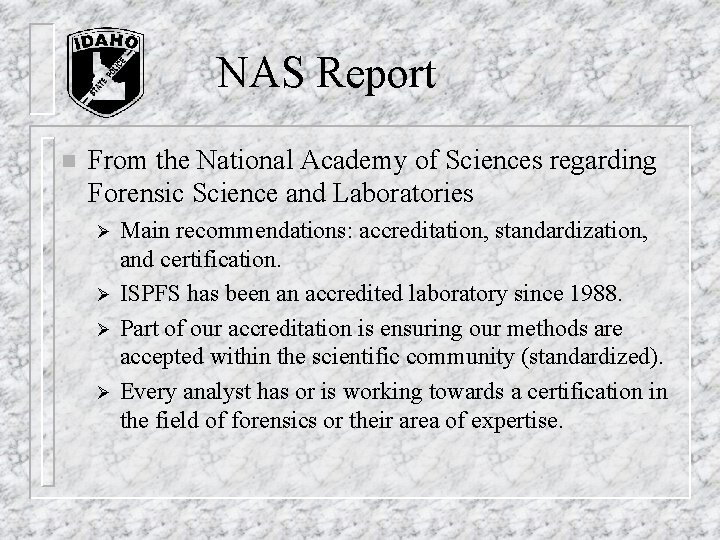
NAS Report n From the National Academy of Sciences regarding Forensic Science and Laboratories Ø Ø Main recommendations: accreditation, standardization, and certification. ISPFS has been an accredited laboratory since 1988. Part of our accreditation is ensuring our methods are accepted within the scientific community (standardized). Every analyst has or is working towards a certification in the field of forensics or their area of expertise.
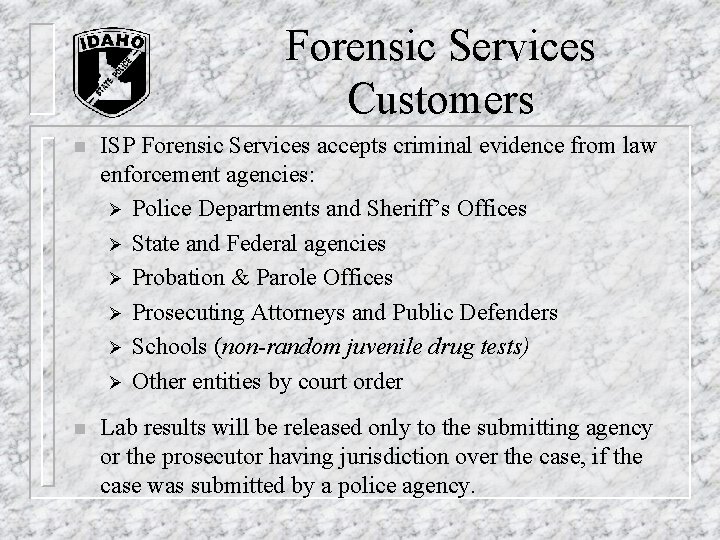
Forensic Services Customers n ISP Forensic Services accepts criminal evidence from law enforcement agencies: Ø Police Departments and Sheriff’s Offices Ø State and Federal agencies Ø Probation & Parole Offices Ø Prosecuting Attorneys and Public Defenders Ø Schools (non-random juvenile drug tests) Ø Other entities by court order n Lab results will be released only to the submitting agency or the prosecutor having jurisdiction over the case, if the case was submitted by a police agency.
Required Evidence Labeling and Proper Seals Agency Information Required On All Evidence Packaging: Agency name Agency case number Item number Description of evidence Chain of custody Suspect and/or Victim full name (DOB if possible) (recommended) A Proper Seal Prevents: Cross contamination with other evidence Loss of evidence from packaging Tampering by theft or adulteration
Evidence is Properly Sealed ONLY If: The evidence cannot escape the outer or inner packaging. Opening the container results in obvious damage/alteration to the packaging and/or its seal. All openings into package must be sealed. All non-factory package seals (evidence tape and/or heat seal and/or self-sealing) MUST be initialed. If you cover a factory seal with evidence tape and/or clear tape, it MUST be initialed also. If using heat sealed bags, seal each opening twice and test by trying to pull them apart. This will help guarantee that they are secured.
Packaging Information Appropriate Sized Packaging: Packaging containers must be large enough that they have room for: Required agency information Chain of custody Laboratory label Seal with initials Room for analyst access and resealing Do not roll down bags to fit a smaller item: To properly seal a paper bag, fold down once, secure with clear packing tape (avoid using staples, see “Sharps Packaging Continued”), seal with evidence tape and initial. This helps prevent seal breakage.
Sharps Packaging Syringes: Syringes must be contained in an appropriate biohazard safety tube. The evidence packaging must be clearly marked as containing a syringe. Improperly packaged syringes will be returned without analysis. In addition, syringes should be packaged separately if part of a multi-exhibit case. Other Sharps: Exposed knife blades and broken glass as well as other potentially sharp items such as: wire, metal, plastic, etc. , must be contained and secured within packaging that will be safe to handle.
Sharps Packaging Continued Staples: Staples are also considered a sharp. They pose a safety risk to anyone handling a package that they have been used on. In addition, they are not a secure seal when used alone and may cause damage to other packages during shipping or in storage. If you cannot seal your evidence without the use of staples, they must be secured by covering them with clear packing tape. To complete the seal, the packing tape must then be covered with evidence tape and initialed. Do Not Use Staples to Attach Paperwork to the Evidence Packaging. Evidence submitted with potentially sharp items that are not secured will be refused by the ISPFS lab.
ISP Supplied Evidence Packaging Evidence Envelopes: 9. 5 x 6. 5 and 10 x 13 Sexual Assault Kits (SAK) Hospitals Only Urine and Blood Collection Kits CODIS Kits (DNA Database) Accident Victim (A/V) Kits Coroners Only
Types of Outer Evidence Packaging Evidence Envelopes: can be used for most types of evidence Evidence Sacks or bags: clothing, bedding, shoes, other large items Evidence Specific Kits: urine, blood, sexual assault, CODIS Self Sealing Plastic Bags or Heat Sealed Bags: do not use for biological evidence Coolers and Ice Packs: for biological evidence when outside temperatures rise above 80° Friction Lid Cans: for fire debris Rolled Paper (kraft, butcher, etc. ): oversized items and trace evidence
Types of Outer Evidence Packaging Cardboard Boxes: sharps and items that will not fit into the other packaging and do not require special containment Specialty Gun and Knife Boxes and Zip Ties: for safety and securing the evidence Additional Items Needed for Packaging: Evidence Tape: Required on every seal unless using self-sealing plastic evidence bags or heat sealed bags. Biohazard Safety Tubes for syringes Ink Pen and/or Fine Line Permanent Marker: Initial directly on/or over the seal. Appropriate Size Packaging : (See “Packaging Information”)
DRUG EVIDENCE
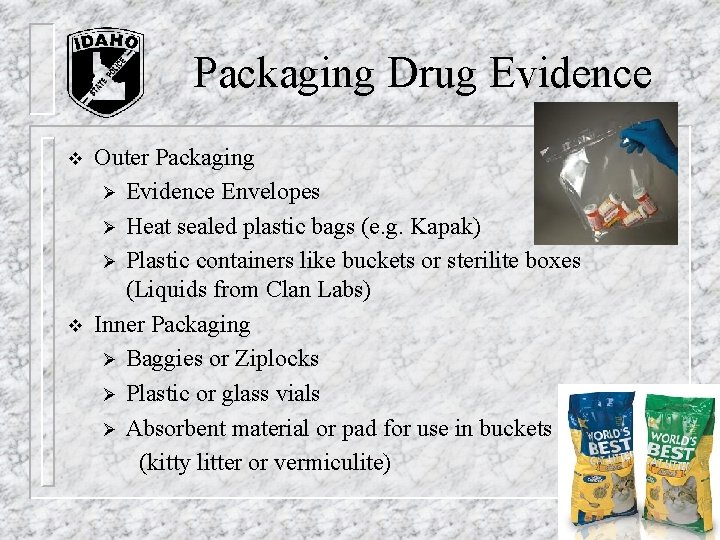
Packaging Drug Evidence v v Outer Packaging Ø Evidence Envelopes Ø Heat sealed plastic bags (e. g. Kapak) Ø Plastic containers like buckets or sterilite boxes (Liquids from Clan Labs) Inner Packaging Ø Baggies or Ziplocks Ø Plastic or glass vials Ø Absorbent material or pad for use in buckets (kitty litter or vermiculite)
DRUG EVIDENCE v Qualitative analysis v Quantitative analysis Ø Methamphetamine cases only Ø Ø Being federally prosecuted Only done in the ISPFS CDA Lab Done quarterly and no rush requests Cannabis typification (“hemp”) Ø Ø This test is only available for plant material from alleged interstate transportation of hemp allowable per federal law. Collect and submit approximates 10 grams from each sampling event, if the sample is damp about 20 grams for each sampling event.
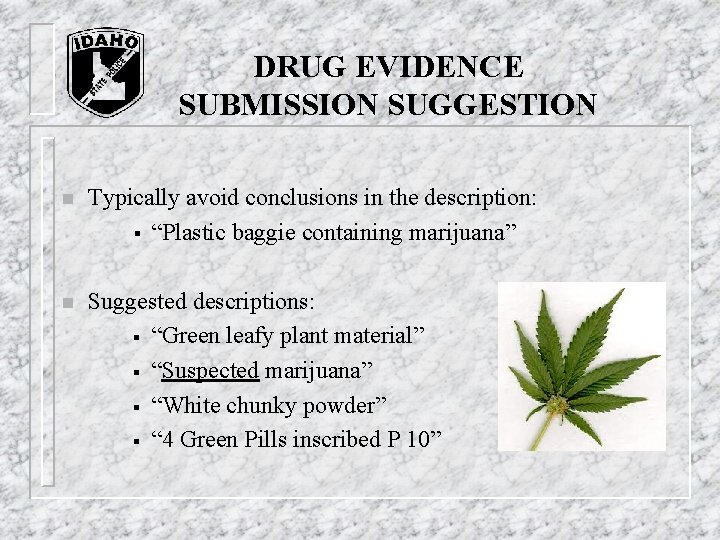
DRUG EVIDENCE SUBMISSION SUGGESTION n Typically avoid conclusions in the description: § “Plastic baggie containing marijuana” n Suggested descriptions: § “Green leafy plant material” § “Suspected marijuana” § “White chunky powder” § “ 4 Green Pills inscribed P 10”
PACKAGING DRUG EVIDENCE § All samples may not be analyzed ØThe analysis will provide justification of the highest charge. ØItems not analyzed will be noted on report. § Advise which item Probable Cause was based on ØTo ensure that item is selected for analysis.
PACKAGING: DRUG EVIDENCE q You do not have to transfer suspected drugs from original container unless you need that item fingerprinted. q If you think that fingerprinting might be needed: Repackage drugs separate from the original container Ø Use gloves Ø Submit it to Meridian for fingerprinting Ø Submit drugs to your regional ISPFS laboratory. Ø § *Remember to place proper seals*
PACKAGING: DRUG EVIDENCE Green leafy plant material. v Do not package wet plant material in plastic. § Plant material will mold. § Allow to dry prior to packaging. v Placing loose plant material directly into evidence envelope may cause the following problems: § Plant stems may tear paper. § The sample may be lost out corners of envelope. § Some material may remain in the envelope, affecting the total weight.
PACKAGING: DRUG EVIDENCE Powders, pills, blotter paper, suspected mushrooms, suspected peyote, etc. v Never place drug evidence directly into evidence envelope. § Inner container aids in preventing sample from being crushed, lost out of corners of envelope, and obtaining a more accurate weight. § Be sure they are dry.
PACKAGING: DRUG EVIDENCE Collection: n Similar suspected drugs found in the same location/area may be combined as one item. **Caution—extreme care should be taken if doing this and recommend consulting with the lab if this is going to be done**
DRUG EVIDENCE – CLAN LABS Clan Lab Samples: Ø Ø Ø Place small liquid samples in a glass bottle with Teflon lined lid, inserted into Nalgene bottle. Include the inventory form with clan lab submissions Verify that collection bottles are leak-free, with lids securely tightened, prior to placing into container. Vermiculite/cat litter or absorbant pad should surround all bottles. Evidence tape needs to run across the entire lid. § Follow the contour of the lid.
PACKAGING: DRUG EVIDENCE Clan Lab Evidence § If assisting with collection of liquids: Ø Submit multilayer liquids as one sample, i. e. do not separate into different vials. Ø Document/describe the presence of any container labels. § Be selective of what is submitted for analysis. Ø More is not always better.
PACKAGING: DRUG EVIDENCE Syringes § § § Safety issues may out-weigh the evidentiary value of the syringe. Submission must be clearly marked that it contains a syringe. Must be packaged in a syringe safe container
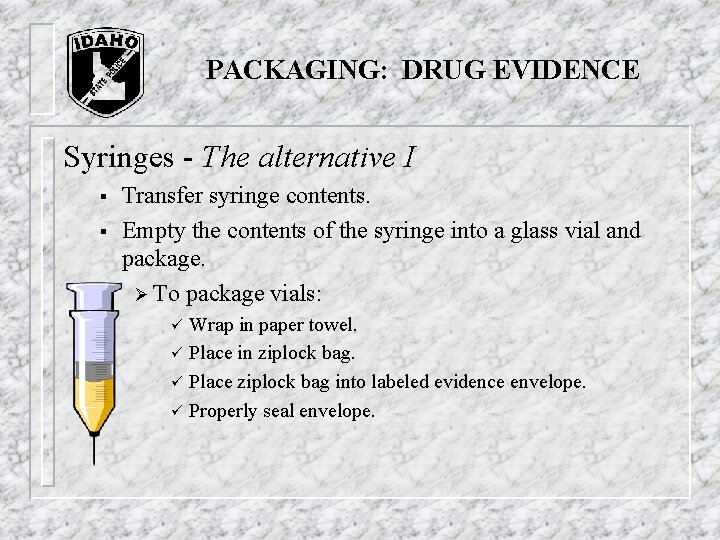
PACKAGING: DRUG EVIDENCE Syringes - The alternative I § § Transfer syringe contents. Empty the contents of the syringe into a glass vial and package. Ø To package vials: Wrap in paper towel. ü Place in ziplock bag. ü Place ziplock bag into labeled evidence envelope. ü Properly seal envelope. ü
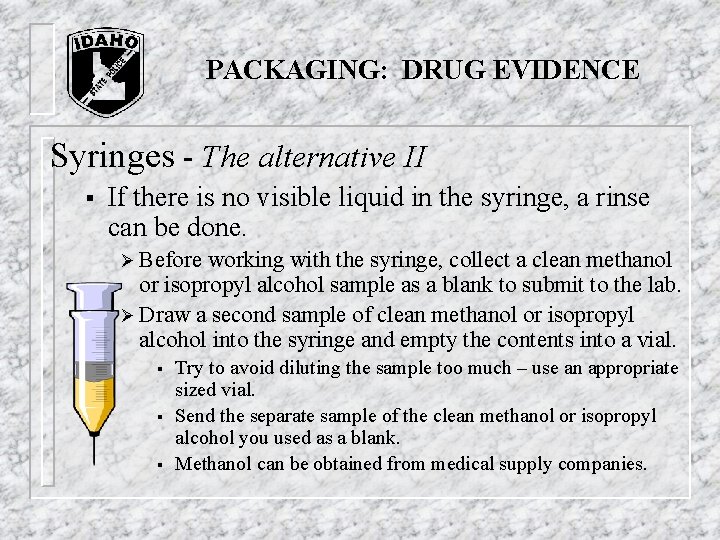
PACKAGING: DRUG EVIDENCE Syringes - The alternative II § If there is no visible liquid in the syringe, a rinse can be done. Ø Before working with the syringe, collect a clean methanol or isopropyl alcohol sample as a blank to submit to the lab. Ø Draw a second sample of clean methanol or isopropyl alcohol into the syringe and empty the contents into a vial. § § § Try to avoid diluting the sample too much – use an appropriate sized vial. Send the separate sample of the clean methanol or isopropyl alcohol you used as a blank. Methanol can be obtained from medical supply companies.
PACKAGING: DRUG EVIDENCE n Drug Evidence Cautions: § Controlled substance turnaround times are ~30 days. Remember to submit well in advance of the court date. § Render sharps safe to handle and label them as sharps. § Protect glass pipes and other glass and label the packaging. § If a presumptive field test is performed, do not send the field test in with your evidence. . Ø Corrosives in the kit can harm the evidence and injure anyone handling them. Ø Please record the NIK or field test results on evidence envelope.
TOXICOLOGY EVIDENCE
Toxicology n We accept urine or blood samples for analysis of drugs. n Possession cases should not generally be submitted except under extenuating circumstances (i. e. drug consumed to conceal evidence). n Blood, breath, or vitreous humor is the sample of choice for alcohol. n Blood and urine will be screened or drugs at the officer’s request if the blood alcohol level is below 0. 10 percent. n Analysis performed in Pocatello and Coeur d’Alene. n Both blood and urine samples will be returned to the submitting agency. n Check your blood kits for expiration dates. Return expired kits to the lab for re-tubing.
Special Reminders n n n The chain of custody for toxicology samples is on the box. Ensure all the pre-log information is completely filled out. This will allow the most appropriate screening and confirmation tests are run on the sample. Detection of a drug or a metabolite of a drug, alone, does not prove impairment. n If possible, collect two full tubes of blood. n Hospital tubes are generally unsuitable for toxicology testing.
Collection of Samples for Sexual Assault Cases n For sexual assaults when it is suspected that drugs were used to facilitate the sexual assault: § § COLLECT A URINE SAMPLE AS SOON AS POSSIBLE. Collect blood or urine in ISP provided kits if possible. Blood or urine can be analyzed, we typically recommend collecting a urine sample for drugs other than alcohol. The detection window is longer and we can test for a wider range of drugs in urine. For alcohol testing we recommend breath or blood. If toxicology testing is wanted and the assault occurred within the last 12 hours, collect both blood and urine. If it has been longer than 12 hours, only collect urine (unless also requesting alcohol testing). We can only screen for GHB in urine samples. If it has been longer than 12 hours since suspected ingestion, the sample will not be analyzed for GHB.
COLLECTION: BLOOD ALCOHOL Using the correct blood collection kit: n Collection instructions on the ISPFS website. n Gray top tube with 10% sodium fluoride (10 m. L tube with 100 mg sodium fluoride) plus an appropriate anticoagulant. – – IDAPA 11. 03. 01 / 18 -8004 No Idaho hospitals are currently certified to perform evidentiary blood alcohol analysis.
COLLECTION: TOXICOLOGY EVIDENCE Blood Toxicology q Only performed if BAC is less than 0. 10%. § § Same blood tube as for blood alcohol analysis. Analysis is performed at CDA and Pocatello labs.
PACKAGING: Urine Alcohol v. Urine alcohol has limitations Ø Must void before collection. Ø A qualifier will be on each report. “Urine alcohol results may be of questionable value. ” Ø Collect as last resort. §
PACKAGING: TOXICOLOGY KITS (Blood and Urine) n Urine and Blood Kit Reminders: – Keep evidence seal free of packing tape or labels. n Please tighten lids on urine bottles and mark which end should be stored upright to prevent leaking. n Make sure seals on the tubes are placed over the stopper.
Sample Tox Kits Demonstration
Storage of Urine Sample Urine samples - FREEZE! – – – Need to be frozen as soon after collection as possible. At the very least, they need to be refrigerated until shipped or delivered. (drugs in sample will degrade over time freezing slows this process) If possible, set sample in the freezer upright so that the urine does not freeze into the cap of the container. Tighten the lid!
Storage of Blood n Blood samples - REFRIGERATE! – – – Need to be refrigerated as soon after collection as possible. If you can’t refrigerate it, send it to us as soon as possible. DO NOT FREEZE BLOOD TUBES - THEY WILL BREAK! Your sample will be lost.
Toxicology Evidence Submission §The toxicology form was phased out §The chain of custody for the toxicology kits is now on the box. § Please do not submit the form if there is a chain of custody on the box itself. § Do not place into an evidence envelope. § Please answer all of the pre-log questions as thoroughly as possible—this is your chance to communicate with us any information you deem relevant
BREATH ALCOHOL
Breath Alcohol n Your regional breath testing coordinator handles: – – Recertification/calibration of all approved instruments Expert testimony Education/certification of BTS officers. Questions regarding instruments, simulators, and procedures
Breath Alcohol n Approved instruments for evidentiary breath testing in Idaho: – – n Lifeloc FC 20 Draeger 9510 Alco-sensor III/IIIa (no longer supported by ISPFS) Intoxilizer 5000/5000 EN (no longer supported by ISPFS) Other instruments are not recognized by ISPFS, will not be maintained by ISPFS, and are not valid for evidentiary testing.
Breath Alcohol n Certification/recalibration: – – Send to the lab that covers your region. Please include return address and BTS contact information. Please include CLEAN mouthpieces. Download/record data prior to submission. n May have to delete the data during maintenance. – – ISPFS will not save this data. Do not need to include the instrument log.
Breath Alcohol Repair: – – – Call RBTC at ISPFS for consultation on needed repair. Send directly to the manufacturer. Li Ion batteries must be replaced by the manufacturer. Manufacturers know to send the instruments to ISPFS after any repairs. ISPFS will return to you. If you get an instrument from the manufacturer by mistake, please send to CDA lab for calibration before use.
Breath Alcohol Jeremy Johnston – Coeur d’Alene n Rachel Cutler – Pocatello n Melissa (Nikka) Bradley– Meridian n John Garner– Meridian n
COLLECTION & PACKAGING: BIOLOGICAL EVIDENCE
COLLECTION & PACKAGING: BIOLOGICAL EVIDENCE An agency case report is required. n For sexual assault cases only submit the sexual assault kit, penile swabs (if applicable), and reference sample(s) initially. n If you have a large number of items please call the lab to discuss the submission. n
COLLECTION & PACKAGING: BIOLOGICAL EVIDENCE Wear gloves at all times and change frequently. n Do not cough, sneeze, or talk over evidence items. n Use single-use tools or clean reusable tools with alcohol or water after each sample. n
COLLECTION & PACKAGING: BIOLOGICAL EVIDENCE n Health hazards of biological evidence: § § HIV – virus most contagious in wet stains. Hepatitis – contagious for weeks in dried stains. § n Vaccine available for hepatitis. Do not eat, drink, or smoke at crime scenes.
COLLECTION & PACKAGING: BIOLOGICAL EVIDENCE n Enemies of biological evidence: § § § Moisture Bacteria Heat Sunlight HEMASTIX® Presumptive Blood Test § n This process will ruin the sample and you will not get DNA results. Air dry wet stains and swabs – do not use ovens, dryers, fans, or blow on the evidence.
COLLECTION & PACKAGING: BIOLOGICAL EVIDENCE n Package each item individually in paper: § § Bindles (don’t tape bindles) Envelopes Bags Boxes Do NOT use plastic bags, containers, glass vials or other nonporous materials. n Secure sharps (knives, etc. ) inside a box. n
COLLECTION & PACKAGING: BIOLOGICAL EVIDENCE Freezer: Packages containing dried stains. n Refrigerator: Packages containing liquid blood samples. n Room Temperature: n § § Packages containing smooth nonporous items (weapons, shoes, plastic bags, belts, etc. ). Packages containing evidence for both latent fingerprints & biological testing.
COLLECTION & PACKAGING: BIOLOGICAL EVIDENCE § All sexual assault kits collected in Idaho will be processed by the state lab except where: 1) 2) § There is no evidence to support a crime being committed (or it is no longer being investigated as a crime). The adult victim requests no further examination or testing occur on the sexual assault kit. If you have unsubmitted sexual kits that need to be submitted for processing, please contact the Meridian laboratory prior to submission.
COLLECTION & PACKAGING: BIOLOGICAL EVIDENCE n Sexual Assault Kits: § § Kits are available to medical facilities free of charge from ISP Forensic Services. There is an instruction sheet in the kit. All appropriate samples should be collected based on case circumstances. Package clothing SEPARATELY in paper bags. Be sure all necessary known reference samples have been collected.
COLLECTION & PACKAGING: BIOLOGICAL EVIDENCE n Known Reference Samples: § Buccal swab (saliva) – collect using 2 dry swabs simultaneously. Swab along the inside of both cheeks and gum line. § § Do not separate left and right side of mouth swabs into different items. Liquid blood – collect in purple top tube containing EDTA. Bloodstain card – collect via finger prick. Finger should be cleaned first. We do not accept casework reference samples collected using the DNA Database sample collection kits designed for convicted offenders.
COLLECTION & PACKAGING: BIOLOGICAL EVIDENCE n n n Penile swabs from male suspects and/or victims: § Use 2 moist swabs simultaneously to collect a single sample that includes the penile shaft, scrotum, and pubic area. § Let swabs air dry and package them together in paper. Do not use sexual assault kits for collection of suspect samples. Recently used condoms that contain fluid should have a clean piece of cotton gauze carefully placed inside prior to packaging.
COLLECTION & PACKAGING: BIOLOGICAL EVIDENCE n Collection of fetal tissue: § § § The medical personnel MUST separate fetal tissue from all other tissue. Fetal tissue should be placed in an airtight plastic container. Do NOT use any preservatives. Store frozen. Contact the Meridian laboratory prior to submission.
COLLECTION & PACKAGING: BIOLOGICAL EVIDENCE n Dry blood or semen stains: – – Option 1: Preferred method is to collect entire item if possible. § If item is large and porous (carpet, mattress, furniture, etc. ) the stained area can be cut out. § Place in appropriately sized paper container (bag, envelope, etc. ) and seal with evidence tape. Option 2: Collect stain off surface of large non-porous item (wall, countertop, etc. ). § Collect with 1 -2 swabs barely moistened with distilled water simultaneously and allow to dry prior to packaging in a sealed envelope. *Ensure possible stain patterns have been documented prior to swabbing or cutting an item.
COLLECTION & PACKAGING: BIOLOGICAL EVIDENCE n Wet blood or semen stains: – – Option 1: Preferred method is to collect entire item if possible. § If item is large and porous (carpet, mattress, furniture, etc. ) the stained area can be cut out. § Circle semen stained areas if exact location known. § Allow to air dry prior to packaging in an appropriately sized paper container (bag, envelope, etc. ) and seal with evidence tape. Option 2: Collect stain off surface of large non-porous item (wall, countertop, etc. ). § Collect with 1 -2 swabs or a clean piece of cotton cloth. You do not need to moisten the swabs/cloth when the sample is wet. § Allow to air dry prior to packaging in a sealed envelope. *Ensure possible stain patterns have been documented prior to swabbing or cutting an item.
COLLECTION & PACKAGING: BIOLOGICAL EVIDENCE § DNA Database Samples: § § § Video with collection instructions on ISP Forensic Services website. Submit to the Meridian laboratory. Not considered evidentiary due to not having documented chain of custody. Collected per Idaho DNA Database Act of 1996 (Idaho code 19 -5506). Do not use the DNA Database sample collection kits to collect casework reference samples.
FIREARMS
PACKAGING OF FIREARMS EVIDENCE n Indicate all exams required for firearm evidence so that they are done in the proper order to protect the evidence. – Some of the different exams: § Biology (Meridian) § Fingerprinting (Meridian) § Firing condition (Coeur d’Alene) § Distance determination (Coeur d’Alene) § Serial number restoration (Coeur d’Alene)
Services n n n Type & Caliber determination - Function testing – does firearm function correctly? Bullet & Cartridge case comparison – does bullet or cartridge come from specific firearm? Tool Mark comparison – did a specific tool make that mark? Distance Determinations – how far from muzzle to target? Serial Number restoration – restoration of obliterated serial numbers
Securing the Gun n n n UNLOAD! Call first if for some reason you can’t. Do not run zip ties down the barrel – this could destroy trace Semi-automatic – secure by zip tie through magazine well & out ejection port Double action – secure by opening cylinder and zip tie hammer to frame Single action – remove the cylinder Bolt action – remove the bolt
Package the Gun Package in a box or gun case and tie firearm securely to the bottom with multiple ties. Seal with evidence tape. n If a scope is present, remove it if not relevant to the case. n Use appropriate size box to the size of gun. n Do not dry fire or test fire the gun. n
Shipping the Gun UPS – handguns use Next Day Air only, long guns can go ground. Both can only be accepted at a UPS customer center (not a UPS Store) or a daily pick up. n Fed. EX – All guns go priority overnight and cannot be put in a drop box n Package ammunition separately. n
PACKAGING OF FIREARMS EVIDENCE n n Usually a comparative test. Collect bullets, cartridge cases and shotgun shell components, known and questioned. – – Collect all fragments possible. Record location found, either at scene or in gun. Package all fragments separately in tissue paper, not cotton. § If recovered at autopsy, allow to air dry before packaging. § Do not let the M. E. rinse off the bullet, it may rinse away possible trace evidence. § Label the source of each sample: [K] Known or [Q] Questioned. Do NOT mark bullet or cases – mark the package.
PACKAGING OF FIREARMS EVIDENCE n Firearms – – Record position of hammer, position of casings or live ammunition in firearm, and position of cylinder. Include the magazine with the firearm.
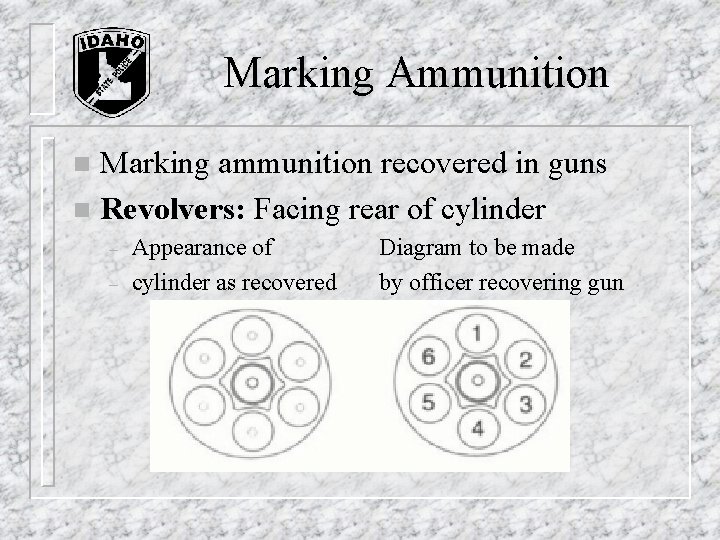
Marking Ammunition Marking ammunition recovered in guns n Revolvers: Facing rear of cylinder n – – Appearance of cylinder as recovered • Diagram to be made by officer recovering gun
NIBIN n n n National Integrated Ballistic Information Network Digitally record images of fired cartridge cases Search regional data bases for possible matches. Matches must be confirmed by examiner ISPFS will automatically enter any evidence submitted for firearms examination that meets entry criteria. If the firearm does not need to be examined the agency may fire the firearm submit the cartridge cases to the lab for entry.
NIBIN (cont’d) n Types of cases to submit: – – Test fires from guns used in the commission of a crime Cartridge cases retrieved from crime scenes Test fires from firearms in which the serial numbers have been obliterated Contact the CDA laboratory for information on eligibility and submission.
Gunshot Residue (GSR) n n n ISP does not provide this service. It only indicates the presence or absence of GSR. Presence of GSR does not distinguish between shooter and mere proximity to shooter. We do recommend if you collect samples, collect for SEM (Scanning electron microscope). Use GSR kit available from various sources Collect within as soon as possible after incident This test is for primer residue. Tests for powder residue (distance determination) we do perform.
Evidence for Distance Determination n Distance Determination. – – – Record position of cylinder, ammunition Photograph scene and autopsy with scale Garments - Dry first, lay flat on butcher paper, and roll or fold (prefer roll). Submit same gun and identical ammunition (different length barrel and different ammunition produce different results) Submit incident report and autopsy report
Tool Mark Comparative Test n n Package in wrapped & taped paper to prevent loss of trace and damage to the surface of the tool. Brace the wrapped tool inside the box. DO NOT attempt to “fit” the tool into the tool mark. If possible, submit the whole item to the laboratory.
Tool Marks n n n If it is not possible to submit the whole item – photograph the item at close, medium & distant ranges and submit photos Photograph marks before and during casting with Mikrosil, Accu. Trans AW, or other similar silicone casting materials and submit the pictures to the laboratory. Mark back of the card with date, initials, and a diagram indicating the position of the cast on the surface from which it was recovered.
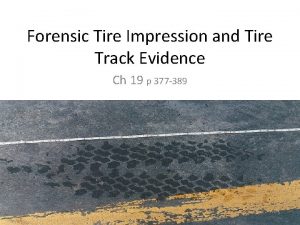
FOOTWEAR/TIRETRACK EVIDENCE n n n ISPFS does not currently provide this service. A shoe or tire impression is the direct physical contact of the footwear or a tire with a surface leaving visible or partially visible designs. The actual impressions are the best evidence. Photos and negatives would be the next best evidence. The lab will do test impressions on the shoes. For tire impressions – seize the vehicle and call the lab for assistance If you have tire impression casts – the lab will need the tires, too.
First – Photograph it n n n n n Preserve footwear/tiretrack impressions with a photograph – take extras! Use TIFF or RAW format if you can. If not, use JPEG. Highest resolution = fewest number of photographs Use your flash (with an off-camera cord) or a flashlight at an oblique angle to the impression, from all different sides, to illuminate the impression fully. Use a tripod if possible. Fill the camera frame with the whole impression Include a scale or ruler at the same level as the impression in the picture. Photograph perpendicular (90⁰) to the impression. Tire tracks are long – take overlapping photos. A tape measure laid alongside helps.
Photos continued n n n Photograph the impression from toe, heel, and both sides with three different lighting angles for a total of at least 12 photos. If using film, submit photographs and negatives to external lab – package in sealed evidence envelope. Digital images of impressions are evidence Don’t adjust, crop, or “fix” – the originals are required. Burn directly onto a CD or DVD & package in an evidence envelope.
Second – Cast it. n n n Use Dental Stone. Pre-measure 2 lbs of dental stone in zip-lock bags. For shoes – add 8 -9 oz of water to the bag and mix until like pancake batter. Pour to one side of impression and let flow into it. For tires – 10 lbs of dental stone/8 cups of water. Block off 3’ long area and pour onto a piece of cardboard & into impression. Optional—insert a paper clip or latent lift card into the cast for labeling purposes.
Third – Remove the Cast n n n Let the cast dry thoroughly! Uniquely label to distinguish from other casts. Wrap the casts in newspaper to transport. Dry for at least another 24 hours before packaging in paper for evidence. Do not use plastic or Styrofoam! Casts give off moisture for weeks and will mold and/or crumble if padded with anything but paper. Submit comparison shoes, if available, in brown paper bags.
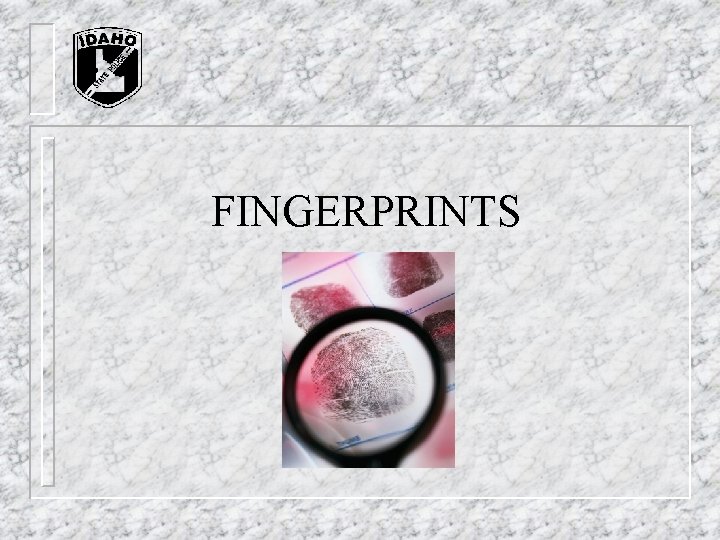
FINGERPRINTS
Fingerprint Evidence n Location of Fingerprints – Replay crime actions n – – Path traveled, objects touched, weapons or tools used, target locations, items damaged or destroyed, items left at the scene Use a flashlight/low angle of light to search Photograph before lifting n RAW or TIFF format (JPEG not recommended) n Camera at 90° angle with macro lens or setting n Include scale – Special techniques for blood
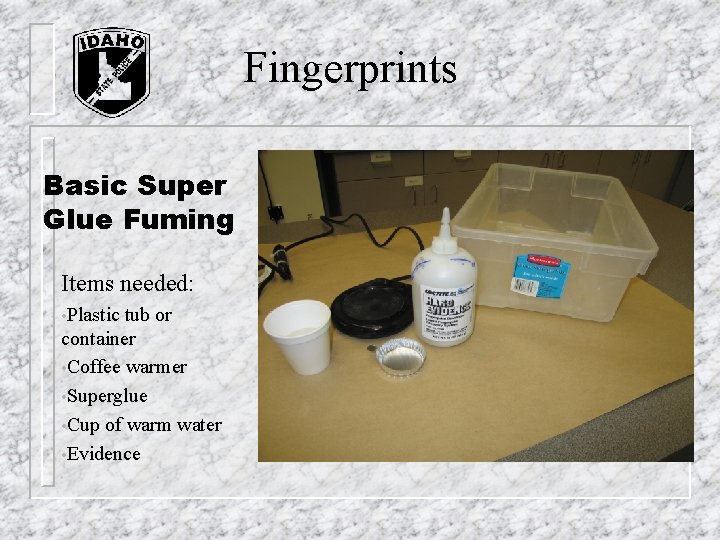
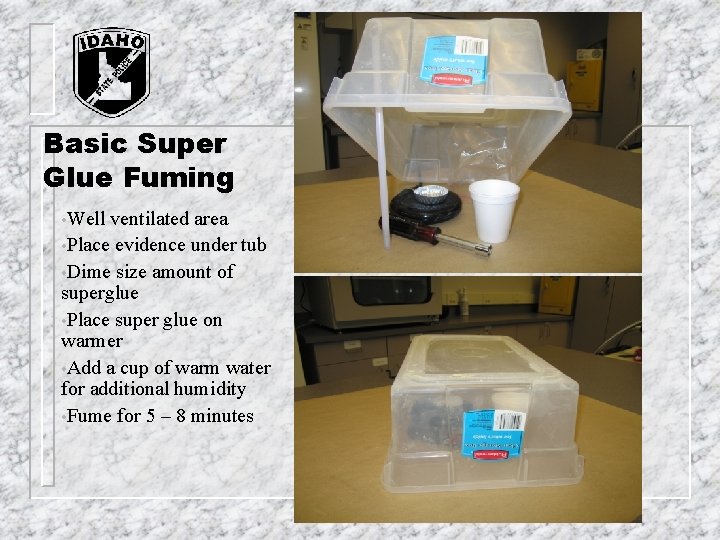
Fingerprints Basic Super Glue Fuming Items needed: • Plastic tub or container • Coffee warmer • Superglue • Cup of warm water • Evidence
Basic Super Glue Fuming • Well ventilated area • Place evidence under tub • Dime size amount of superglue • Place super glue on warmer • Add a cup of warm water for additional humidity • Fume for 5 – 8 minutes
Fingerprints n Submit directly to ISPFS if you have: – Evidence you want processed for latents: n – Submit as evidence Include all victim, suspect, subject information in pre-log (DOB, SS#, SID# and/or FBI# if known) – Include information on prior processing that was done Latent prints lifts or photographs you want compared and/or submitted to ABIS n n Submit as evidence Include all victim, suspect, subject information in pre-log (DOB, SS#, SID# and/or FBI# if known)
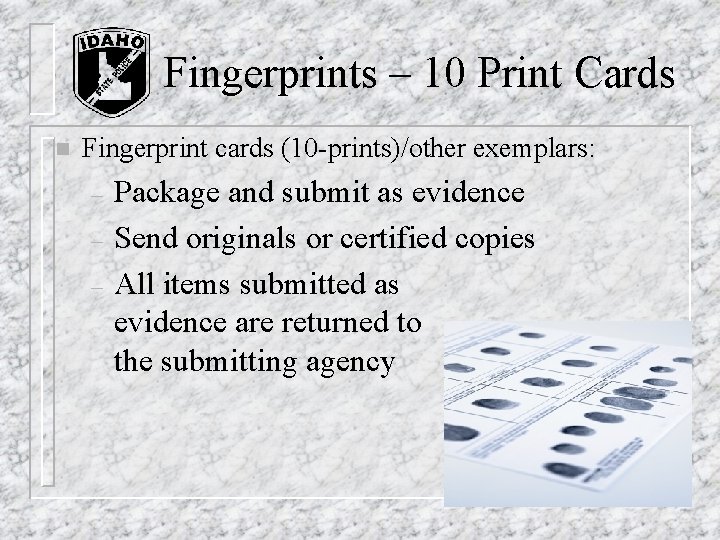
Fingerprints – 10 Print Cards n Fingerprint cards (10 -prints)/other exemplars: – – – Package and submit as evidence Send originals or certified copies All items submitted as evidence are returned to the submitting agency
Fingerprint § Only submit items that need testing § § All items must be pre-logged and meet evidence packaging requirements § § If you have a bag of “stuff” separate out and submit ONLY what needs to be tested (unnecessary item submissions slow turnaround times at the lab) This includes photographs, CD’s of photos, and 10 print cards for comparison ISP will compare all ABIS eligible prints to available s/s/v prints before entry to system. § If your agency has a latent examiner – comparisons to persons associated with the case should be completed prior to submission
Fingerprint n Small items are better processed in the lab than at the scene – – n Controlled environment Additional techniques available Do NOT wrap items in tissue paper, toweling, or pack in packing peanuts – – Latents are ~99% water & fragile Stabilize items in packaging n n Don’t want items rubbing/moving freely Containers with liquid: – remove liquid, add wick to absorb liquid (also for “empty” cans & bottles).
Fingerprints and drugs n Separate packaging for latents from drugs for testing n Plastic bags: n n n – Do not submit layers of drug packaging that are coated with grease or oil n n remove drugs place baggies between sheets of clean white paper package baggies from same location in same envelope separate these layers out prior to packaging Syringes: n must follow syringe procedure
Fingerprints n n n Paper and cardboard: – No special packaging Guns/knives: – Unload firearms & secure the chamber – Guns must be secured in a cardboard box. Ensure packing is suitable for heavy items so they don’t break loose and rip open the package Tape: – Leave it on the item or remove and place adhesive side down on heavy-gauge plastic.
Photographs as Evidence Photographs of shoe impressions, tire tracks and fingerprints are evidence. n Submit printed pictures AND negatives in sealed evidence envelope. n Copy digital photographs onto a CD, DVD, or thumb drive – submit in a sealed evidence envelope. n Analysts cannot accept emailed photos for comparisons (chain of custody). n
FIRE DEBRIS
Fire Debris Evidence Collection Supplies n Airtight Sample Containers – – – Friction lid cans and Heat-sealed Arson bags are the only FS approved packaging containers Prefer friction lid cans due to laboratory analysis considerations Friction Lid Cans § § Friction lid cans are clean, unused metal paint-type cans. Lined cans are preferred. Obtain cans from paint stores, evidence supply, container and packaging supply or scientific supply companies
Fire Debris Evidence Collection Supplies n Heat Sealable Pouch material – n Pouches versus Friction Lid Cans – – n Usually nylon, sold as Arson bags. DO NOTuse regular heat sealable evidence bags. Advantage: Used for items that do not fit in Friction lid cans Disadvantage: More difficult to work with, easily punctured. Vermiculite or Cat Litter (absorbent Material) n n Vermiculite from garden store, lighter but more expensive Cat litter – heavier but cheaper
Fire Debris Evidence n To properly interpret the evidence collected in the investigation of a fire, specific types of samples should be collected if possible: Ø Ø Questioned Samples Standard Comparison Samples Control Comparison Samples Blank Comparison Samples
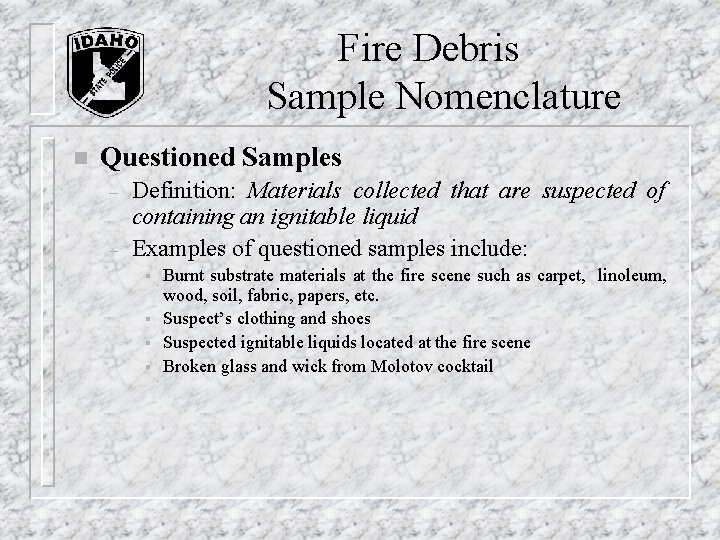
Fire Debris Sample Nomenclature n Questioned Samples – – Definition: Materials collected that are suspected of containing an ignitable liquid Examples of questioned samples include: § § Burnt substrate materials at the fire scene such as carpet, linoleum, wood, soil, fabric, papers, etc. Suspect’s clothing and shoes Suspected ignitable liquids located at the fire scene Broken glass and wick from Molotov cocktail
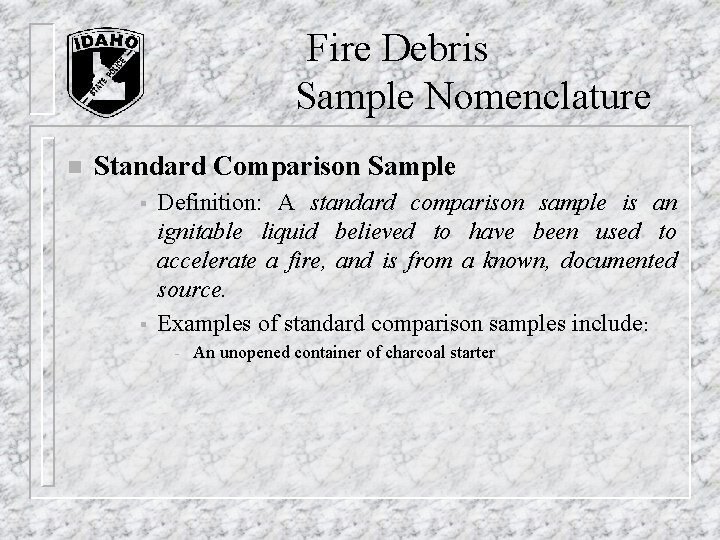
Fire Debris Sample Nomenclature n Standard Comparison Sample § § Definition: A standard comparison sample is an ignitable liquid believed to have been used to accelerate a fire, and is from a known, documented source. Examples of standard comparison samples include: An unopened container of charcoal starter
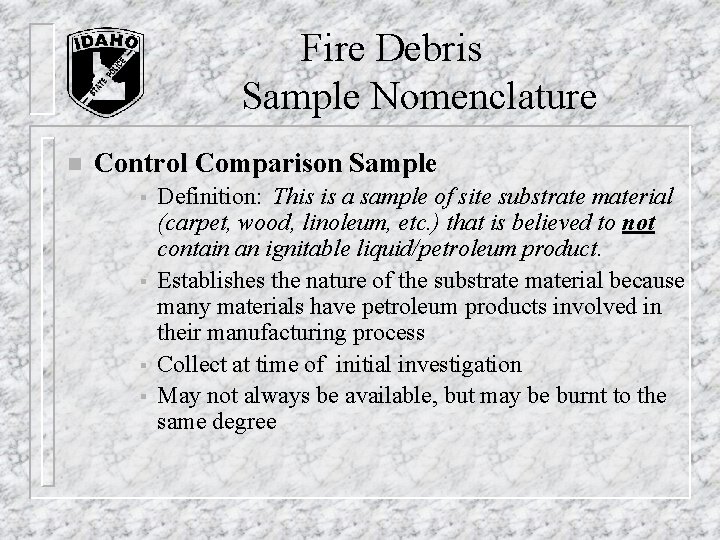
n Fire Debris Sample Nomenclature Control Comparison Sample § § Definition: This is a sample of site substrate material (carpet, wood, linoleum, etc. ) that is believed to not contain an ignitable liquid/petroleum product. Establishes the nature of the substrate material because many materials have petroleum products involved in their manufacturing process Collect at time of initial investigation May not always be available, but may be burnt to the same degree
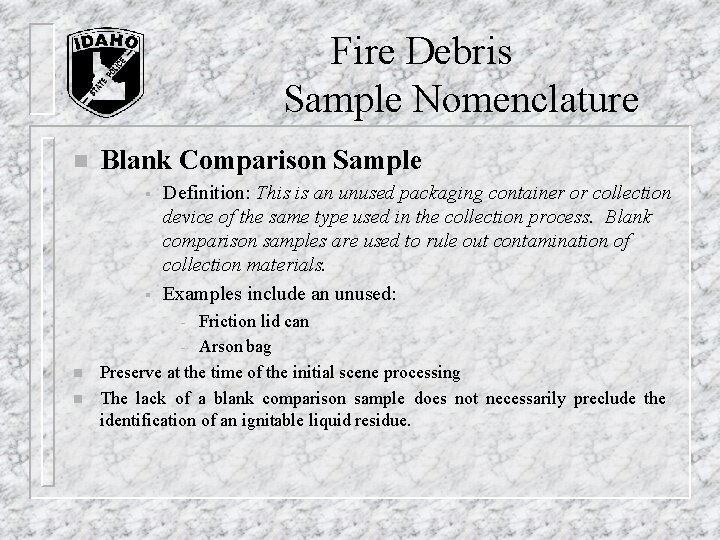
Fire Debris Sample Nomenclature n Blank Comparison Sample § § Definition: This is an unused packaging container or collection device of the same type used in the collection process. Blank comparison samples are used to rule out contamination of collection materials. Examples include an unused: Friction lid can Arson bag Preserve at the time of the initial scene processing The lack of a blank comparison sample does not necessarily preclude the identification of an ignitable liquid residue. n n
Collection Tools n Collection Materials n Polyethylene disposable transfer pipettes. – Vials – 1. 8 to 2 milliliter screw-top glass vials (Teflon -lined). – Prevent cross-contamination of samples by collecting samples using uncontaminated tools § Shovels, axes, knifes, gloves, pipettes, etc. should be cleaned or disposed of between samples § Do not use waterless or similar types of cleaners that may contain volatile solvents or scents
Fire Debris Storage of Supplies n Storage of Friction Lid Cans § § Store the cans with lids sealed in an environment free of contaminants Submit empty cans periodically with case samples for verification of lack of contamination n Storage of Pouch Material § Store with end of roll heat-sealed
Fire Debris Proper Packaging of Samples n Packaging of Liquid Samples – Liquid standard comparison samples or liquid questioned samples § § § Provide complete identifying information from any ignitable liquid product labels Place liquid into a two-milliliter screw-top vial using a disposable pipette Completely fill vial if possible A full vial retards evaporation Never ship the entire can or bottle of petroleum product to the laboratory. Doing so violates DOT shipping regulations.
n Fire Debris Proper Packaging of Samples Packaging of Liquid Samples (continued) – – Place each vial separately into a friction lid can and pack with absorbent material Apply friction lid securely, place evidence label or evidence envelope on friction lid can Seal can with evidence tape and initial and date seal Any original container holding questioned ignitable liquid should be retained until the adjudication of the case
Fire Debris Proper Packaging of Samples n. Packaging of empty questioned containers – Container(s) located at the scene may contain an ignitable liquid residue – Considerations § Fingerprints processing prior to submittal for ignitable liquid residue detection § Place suspect container into appropriately sized friction lid can or Arson bag
Fire Debris Proper Packaging of Samples n. Packaging of Debris and Clothing/Shoes – Place item into friction lid can or Arson bag and seal immediately § Size of container should be proportional to size of sample § Fill can or pouch no more than three-fourths full
Special Reminder n n Remember: most labs need a case report for these types. The following additional information is also helpful: § § § A description of any unusual circumstances Unusual odor Ignitable liquids normally present at the scene
Hairs and Fibers Do not contaminate at the scene n Small and hard to find n Use a strong light – Use a magnifying glass – Examples include: Hairs, fibers, glass, plastic, soil, wood shavings, plant material, plant seeds, cement fragments, etc. If trace is on an item that can be collected, collect the whole item. –
Trace Evidence—Hairs, Fibers, etc. n Hair, Fibers and Other Trace Evidence – Questioned sample § § – Place sample into clean, pre-folded piece of paper. Place paper inside of envelope, seal and label. Place envelope inside of completed evidence envelope, seal and initial. Clearly mark label as to who/where the sample came from Comparison Sample – – Collect representative sample [12 -20] with clean tweezers from several regions of head. Hairs should be pulled to include the root. Pubic hair can be cut at the skins surface Package as above.
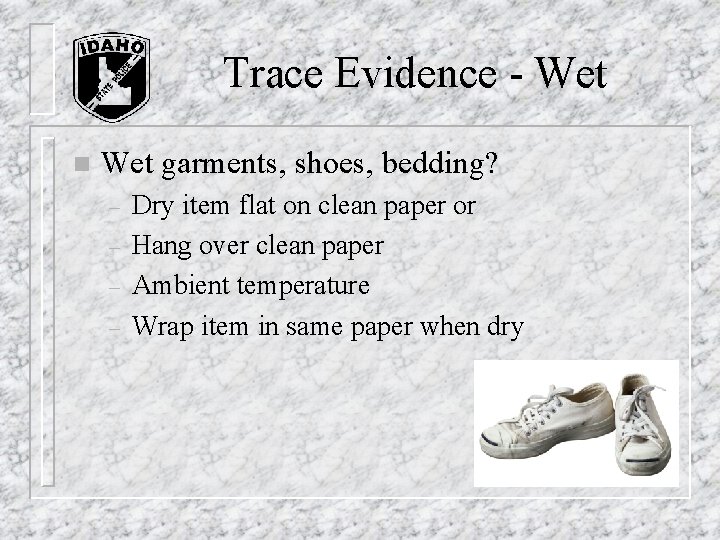
Trace Evidence - Wet n Wet garments, shoes, bedding? – – Dry item flat on clean paper or Hang over clean paper Ambient temperature Wrap item in same paper when dry
Trace Evidence - Dry Place item onto clean paper and fold n Placed folded paper package into evidence envelope or bag and seal properly n All clothing & items for trace and biological exams done this way. n
Paint Chips n n n Paint chips from vehicles is a comparison test – two samples from both suspect’s and victim’s vehicles. Remove all layers of paint by chipping Keep all samples in separate, sealed containers, such as folded papers or small vials. Keep questioned and known samples for comparison Label source of each sample and indicate if sample is known or questioned.
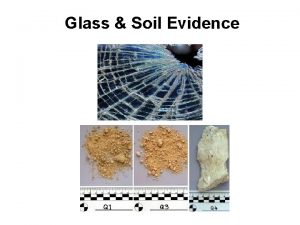
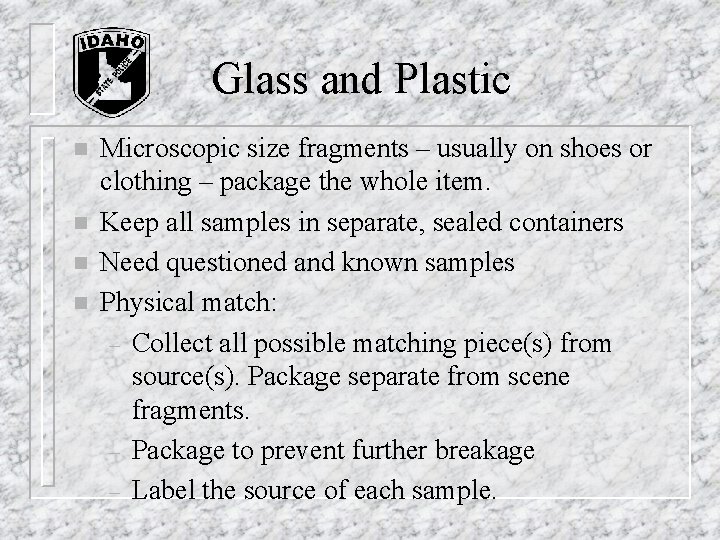
Glass and Plastic n n Microscopic size fragments – usually on shoes or clothing – package the whole item. Keep all samples in separate, sealed containers Need questioned and known samples Physical match: – Collect all possible matching piece(s) from source(s). Package separate from scene fragments. – Package to prevent further breakage – Label the source of each sample.
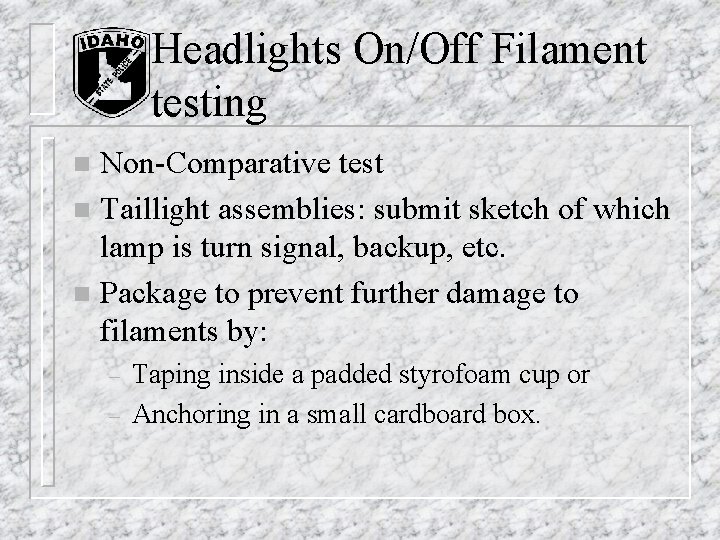
Headlights On/Off Filament testing Non-Comparative test n Taillight assemblies: submit sketch of which lamp is turn signal, backup, etc. n Package to prevent further damage to filaments by: n – – Taping inside a padded styrofoam cup or Anchoring in a small cardboard box.
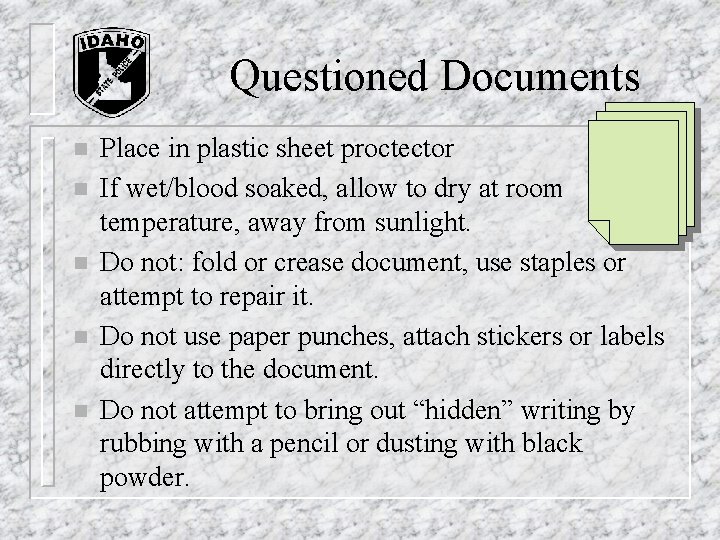
Questioned Documents n n n Place in plastic sheet proctector If wet/blood soaked, allow to dry at room temperature, away from sunlight. Do not: fold or crease document, use staples or attempt to repair it. Do not use paper punches, attach stickers or labels directly to the document. Do not attempt to bring out “hidden” writing by rubbing with a pencil or dusting with black powder.
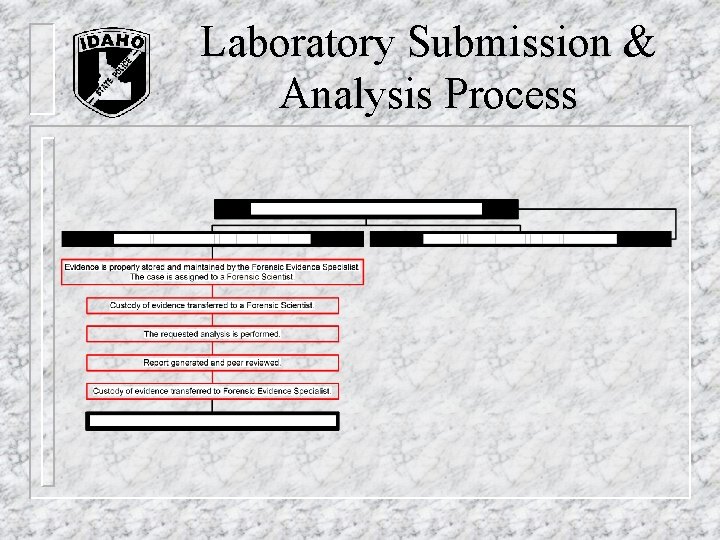
Laboratory Submission & Analysis Process
Return of Evidence §Forensic Evidence Specialists have the responsibility to ensure evidence quality § If you ship your evidence to the lab and there is an issue with the submission, your evidence will be returned with a letter explaining the issue and how to resolve it. § Some reasons for refusal are: • -Envelope/container does not have evidence tape across seal. • -The initials of the person who sealed the evidence are not present • -Envelope/container is open or the seals are broken upon arrival. • -It is unsafe or hazardous (spilled liquids, broken glass, razor blade, syringe). • -The item(s) were not pre-logged.
Chain of Custody n Complete chain of custody – Chain begins at time evidence is collected. – A written record of the names and dates for custody of an item of physical evidence. – Use your name (not “from: evidence to lab”, do not use badge number as signature). – When shipping evidence “To” should be indicated by: UPS, Certified Mail, U. S. Mail, etc.
General Evidence Issues §A completed ISP Pre-Log form MUST accompany all evidence. §All Evidence Packaging Must Have: § § § The s/s/v name, submitting agency, agency case number & exhibit number should be on the evidence envelope or on an evidence label attached to the evidence. A chain of custody (begins at time evidence is acquired). A proper seal with initials. §A case report must accompany your evidence for the following analysis requests: § § Biology Fire Debris Firearms When in doubt – send the report. §Include your court date if you have one
Discovery §All reports and associated note packets are available through the pre-log system immediately upon publication § § Separate button for each The chain of custody is not part of the note packet because it is not complete until the evidence is returned to the agency §The police agency who submitted the evidence and county prosecutor’s office both have access to the report and note packet § If submitted by public defender only their office will have access
Discovery § Discovery Information available on our website: § § Laboratory accreditation documentation All quality documents and analytical methods Analyst CV’s Any additional information will require a discovery request for release
Pre-Log § § § Pre-log is a computer program which allows an agency to enter case information, that can later be pulled into the lab system § The status of the case can be viewed in pre-log § Reports and note packets can be pulled from pre-log All Items of evidence are required to be pre-logged § The initial submission § When an additional item for the same case is submitted at a later date § Separate labs (FP to MER and TOX to POC)=separate pre-logs Please confirm the information entered is correct § Amended reports will NOT be issued for errors in pre-log entry
Accessing Pre-Log § Contact Karen Stringer at karen. stringer@isp. idaho. gov and include your POST ID and phone number in email § § § If trying to obtain access for another person in your office please include that person’s e-mail address At first log-in change your password Use only IE 11 (IE 11 and earlier) and Adobe Reader. Chrome, Firefox, Safari and others will appear to work, but they create internal errors that you may or may not see. § § Disable your popup blocker
Training for Pre-Log § Video training is found at: https: //isp. idaho. gov/forensics/evidence-submission/ Click on evidence submission tab § FAQs sheet § Pre-log Users Manual on ISPFS website § You can also call us anytime you have a question § Come in person! We have a kiosk and can walk you through it at the counter
Other Information n Please also note the Customer Agreement on the web site.
Evidence Shipping Supplies n n n Cardboard Boxes Packing materials such as: – Popcorn – Brown wrapping paper Clear Package Tape – Do not use evidence tape on a shipping box! Forensic Evidence Specialists do not break evidence seals and need access to the chain of custody and identification labels. – It also draws attention to shipping employees that evidence (possibly drug evidence) is enclosed.
General Shipping Notes n n We do not recommend shipping critical evidence. For instance, the only blood sample remaining from a deceased individual or the only piece of evidence that can link your suspect to the crime. Always take into consideration…if this evidence is lost in shipping, what impact will it have on the case. Can ship via UPS, USPS, FED EX. Whatever method you use, be sure you get a confirmation of delivery and can track the evidence.
Question and Answer Time