
WELCOME TO THE 2 ND ANNUAL IDAHO INTEGRATED


- Slides: 72
WELCOME TO THE 2 ND ANNUAL IDAHO INTEGRATED BEHAVIORAL HEALTH NETWORK CONFERENCE
Medication Therapy Management (MTM) Services Katie Erickson, Pharm. D, BCPS, BCACP April 26 th, 2019
Course Description Clinical pharmacy services are vast and ever changing. This talk will discuss the background and models of delivering pharmacist run medication therapy management programs along with the outcomes associated with such programs.
Disclosures § Nothing to disclose
Learning Objectives Discuss why pharmacist run medication therapy management (MTM) programs are desired Define what MTM is and other programs commonly confused with MTM Review models for delivering MTM Outline ways MTM pharmacists are incorporating themselves with care teams Explore outcomes associated with MTM programs
Outline 1. Why Medication Therapy Management? 2. What is MTM? 3. What isn’t MTM? 4. Goals of MTM Programs 5. MTM Models 6. How to Engage MTM Services 7. MTM Outcomes
Why Medication Therapy Management?
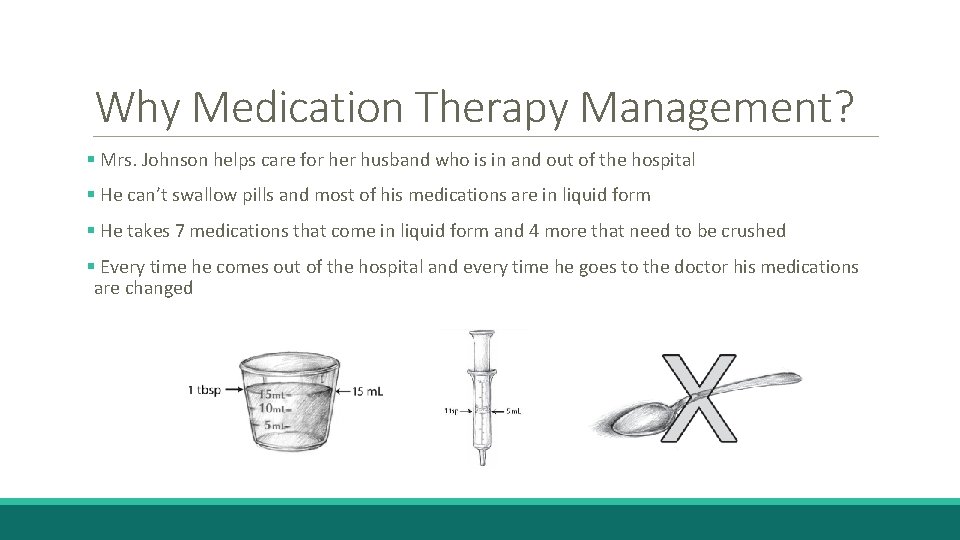
Why Medication Therapy Management? § Mrs. Johnson helps care for her husband who is in and out of the hospital § He can’t swallow pills and most of his medications are in liquid form § He takes 7 medications that come in liquid form and 4 more that need to be crushed § Every time he comes out of the hospital and every time he goes to the doctor his medications are changed
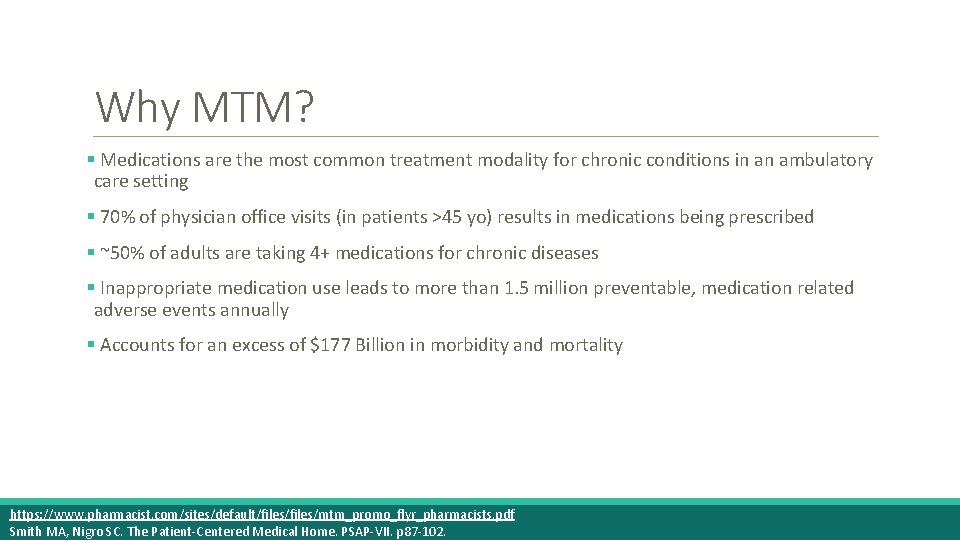
Why MTM? § Mrs. Johnson also has a history of diabetes, hypertension, and depression § She takes a total of 5 oral medications and 2 different kinds of insulin which she is prescribed to take multiple times a day § However it is hard for her to remember to take them because she is caring for her husband, all of the medical costs are becoming too much with their fixed income, and she is having more sad days than happy days lately
Why MTM? § Medications are the most common treatment modality for chronic conditions in an ambulatory care setting § 70% of physician office visits (in patients >45 yo) results in medications being prescribed § ~50% of adults are taking 4+ medications for chronic diseases § Inappropriate medication use leads to more than 1. 5 million preventable, medication related adverse events annually § Accounts for an excess of $177 Billion in morbidity and mortality https: //www. pharmacist. com/sites/default/files/mtm_promo_flyr_pharmacists. pdf Smith MA, Nigro SC. The Patient-Centered Medical Home. PSAP-VII. p 87 -102.
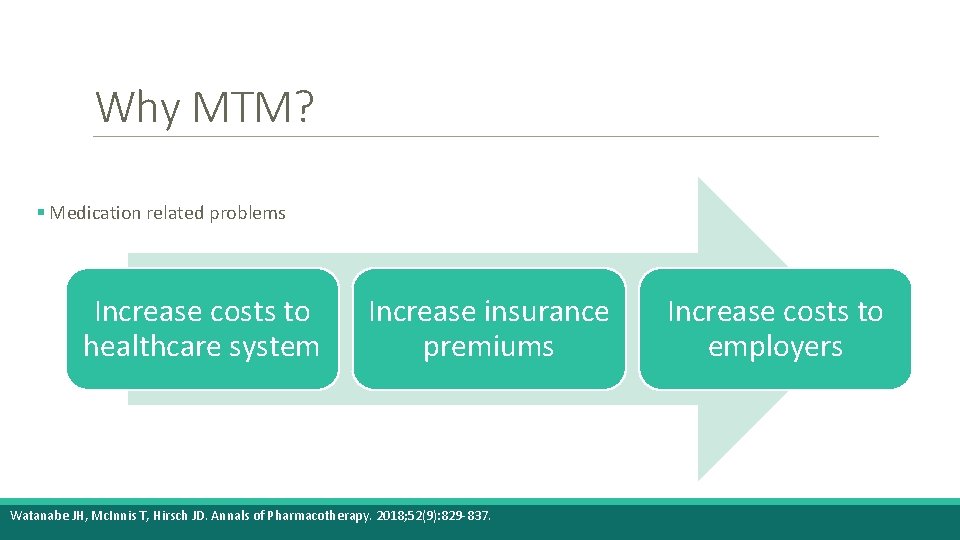
Why MTM? § Medication related problems Increase costs to healthcare system Increase insurance premiums Watanabe JH, Mc. Innis T, Hirsch JD. Annals of Pharmacotherapy. 2018; 52(9): 829 -837. Increase costs to employers
What is MTM?
What is MTM?
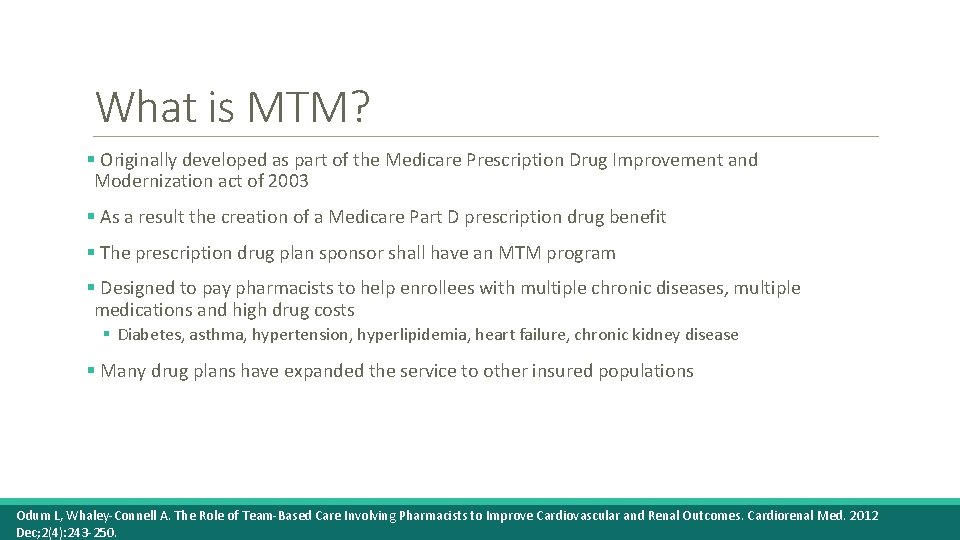
What is MTM? § Originally developed as part of the Medicare Prescription Drug Improvement and Modernization act of 2003 § As a result the creation of a Medicare Part D prescription drug benefit § The prescription drug plan sponsor shall have an MTM program § Designed to pay pharmacists to help enrollees with multiple chronic diseases, multiple medications and high drug costs § Diabetes, asthma, hypertension, hyperlipidemia, heart failure, chronic kidney disease § Many drug plans have expanded the service to other insured populations Odum L, Whaley-Connell A. The Role of Team-Based Care Involving Pharmacists to Improve Cardiovascular and Renal Outcomes. Cardiorenal Med. 2012 Dec; 2(4): 243 -250.
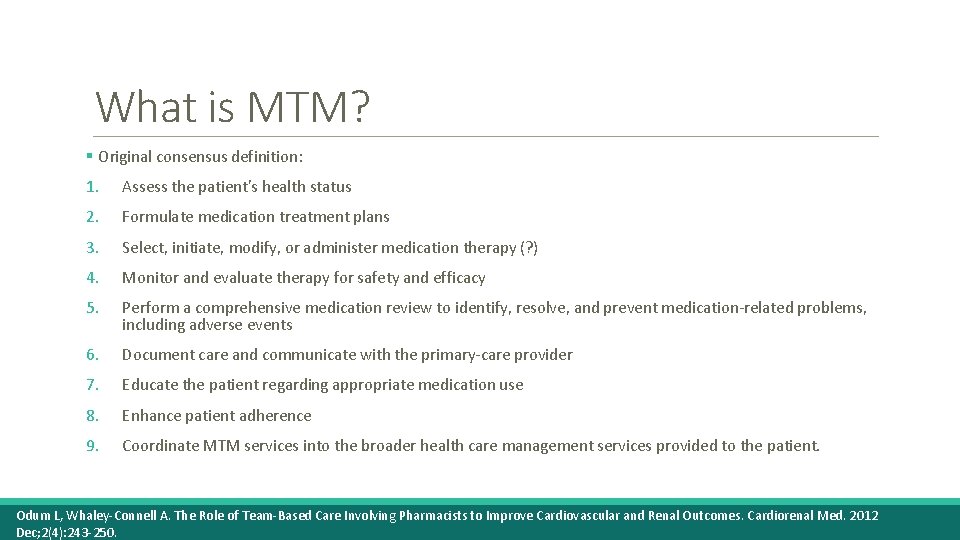
What is MTM? § Original consensus definition: 1. Assess the patient's health status 2. Formulate medication treatment plans 3. Select, initiate, modify, or administer medication therapy (? ) 4. Monitor and evaluate therapy for safety and efficacy 5. Perform a comprehensive medication review to identify, resolve, and prevent medication-related problems, including adverse events 6. Document care and communicate with the primary-care provider 7. Educate the patient regarding appropriate medication use 8. Enhance patient adherence 9. Coordinate MTM services into the broader health care management services provided to the patient. Odum L, Whaley-Connell A. The Role of Team-Based Care Involving Pharmacists to Improve Cardiovascular and Renal Outcomes. Cardiorenal Med. 2012 Dec; 2(4): 243 -250.
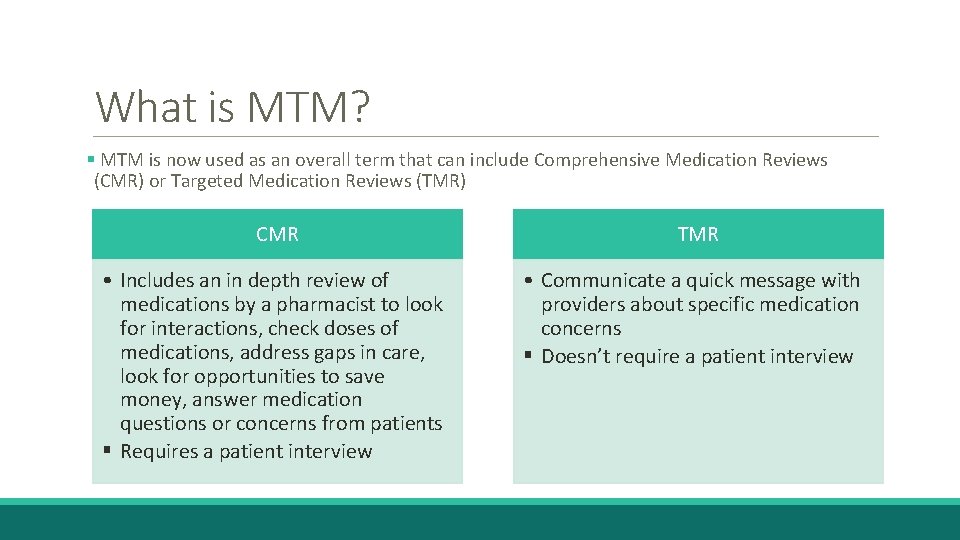
What is MTM? § MTM is now used as an overall term that can include Comprehensive Medication Reviews (CMR) or Targeted Medication Reviews (TMR) CMR TMR • Includes an in depth review of medications by a pharmacist to look for interactions, check doses of medications, address gaps in care, look for opportunities to save money, answer medication questions or concerns from patients § Requires a patient interview • Communicate a quick message with providers about specific medication concerns § Doesn’t require a patient interview
What is MTM? § Comprehensive medication reviews (CMR) is a Medicare Stars measure – resulting in a lot of emphasis on this part of the program
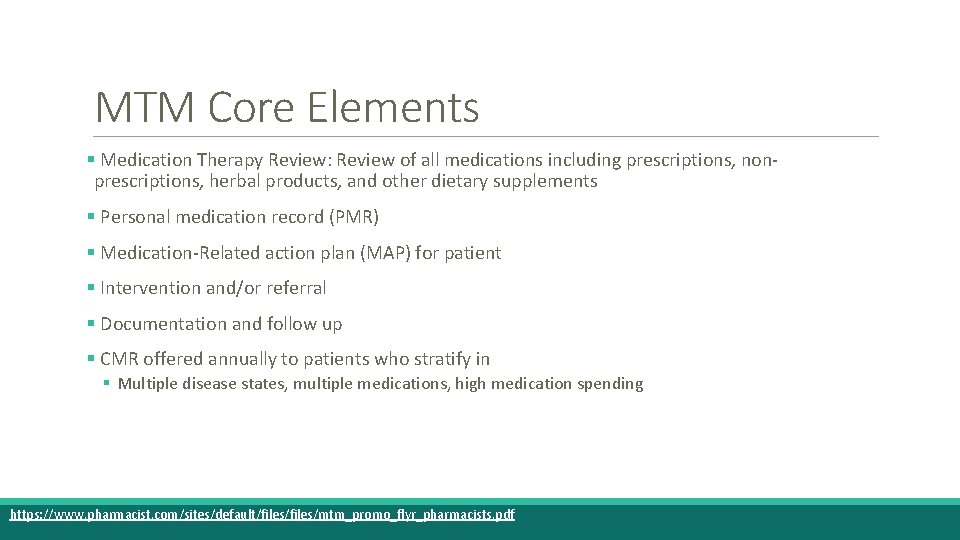
MTM Core Elements § Medication Therapy Review: Review of all medications including prescriptions, nonprescriptions, herbal products, and other dietary supplements § Personal medication record (PMR) § Medication-Related action plan (MAP) for patient § Intervention and/or referral § Documentation and follow up § CMR offered annually to patients who stratify in § Multiple disease states, multiple medications, high medication spending https: //www. pharmacist. com/sites/default/files/mtm_promo_flyr_pharmacists. pdf
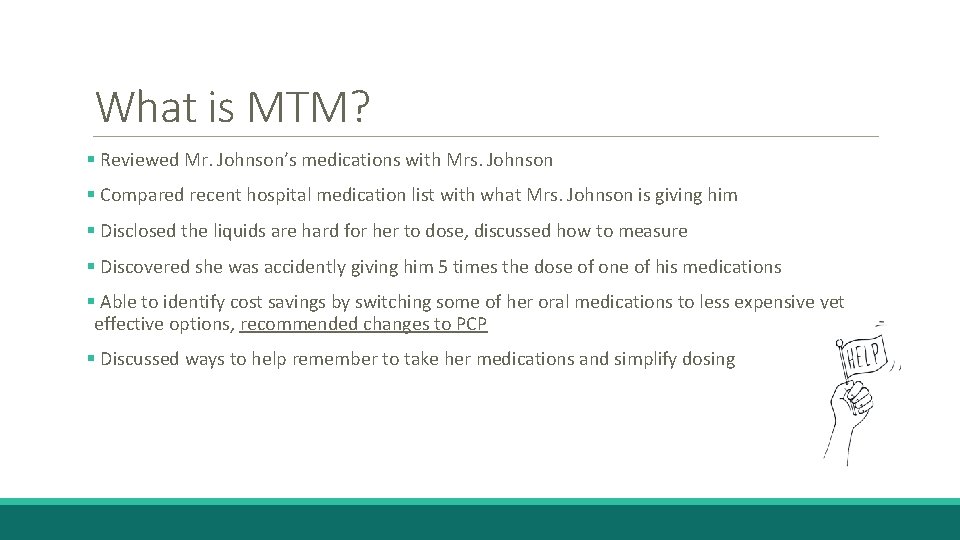
What is MTM? § Reviewed Mr. Johnson’s medications with Mrs. Johnson § Compared recent hospital medication list with what Mrs. Johnson is giving him § Disclosed the liquids are hard for her to dose, discussed how to measure § Discovered she was accidently giving him 5 times the dose of one of his medications § Able to identify cost savings by switching some of her oral medications to less expensive yet effective options, recommended changes to PCP § Discussed ways to help remember to take her medications and simplify dosing
What isn’t MTM?
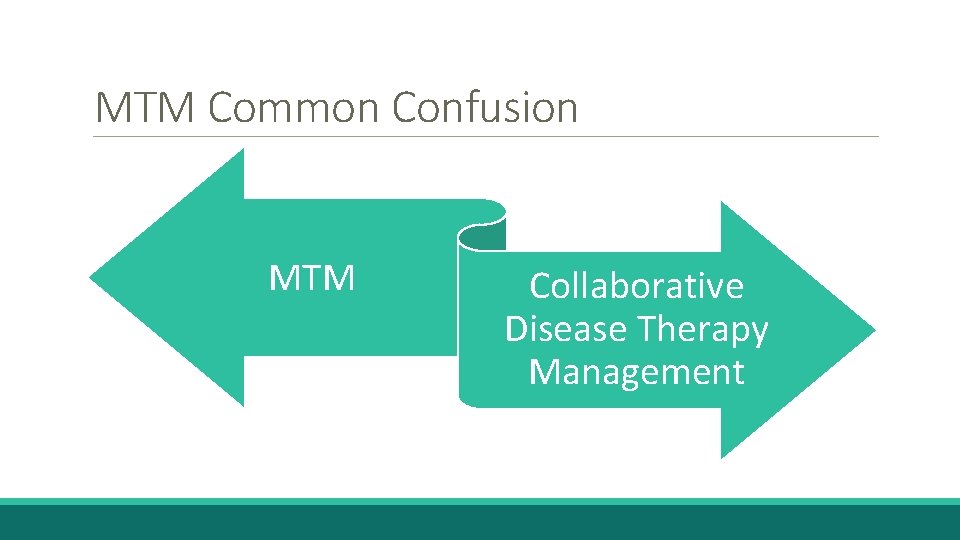
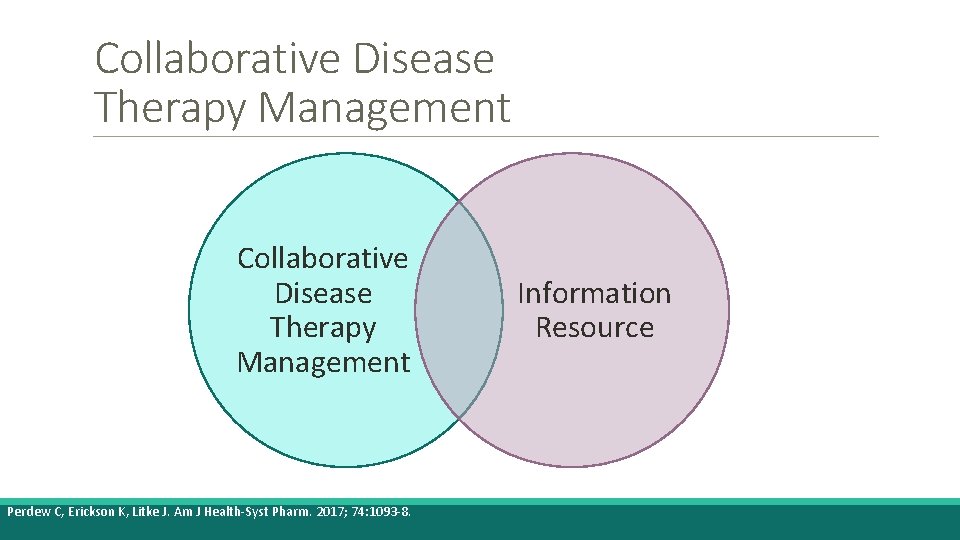
MTM Common Confusion MTM Collaborative Disease Therapy Management
Collaborative Disease Therapy Management § Comprehensive Medication Management/Collaborative Disease Therapy Management/Chronic Disease Management § Requires Collaborative Practice Agreement Collaborative Disease Therapy Management § Initiate, modify, and monitor drug therapy § Assess response to therapy § Order labs § Counsel and educate about medications § Usually integrated within ambulatory care clinic setting via face to face visit or telephone
Collaborative Disease Therapy Management § Services often include: Collaborative Disease Therapy Management § Diabetes management § Hypertension management § Annual Wellness Visits § Transitions of care § Tobacco cessation § Asthma/COPD § Pain
Collaborative Disease Therapy Management § Medication reconciliation § Polypharmacy reviews § In depth medication counseling Information Resource § Vaccination questions § Medication side effect profile reviews § Population health review § Basically…any medication related question!
Collaborative Disease Therapy Management § Reviewed Mr. Johnson’s medications with Mrs. Johnson § Compared recent hospital medication list with what Mrs. Johnson is giving him § Disclosed the liquids are hard for her to dose, discussed how to measure § Discovered she was accidently giving him 5 times the dose of one of his medications § Able to identify cost savings by switching some of her oral medications to less expensive yet effective options, able to make changes to regimen through collaborative practice agreement § Discussed ways to help remember to take her medications and simplify dosing § Follow up with patient at regular intervals to meet disease state goals
Collaborative Disease Therapy Management Perdew C, Erickson K, Litke J. Am J Health-Syst Pharm. 2017; 74: 1093 -8. Information Resource
MTM Information Resource Perdew C, Erickson K, Litke J. Am J Health-Syst Pharm. 2017; 74: 1093 -8.
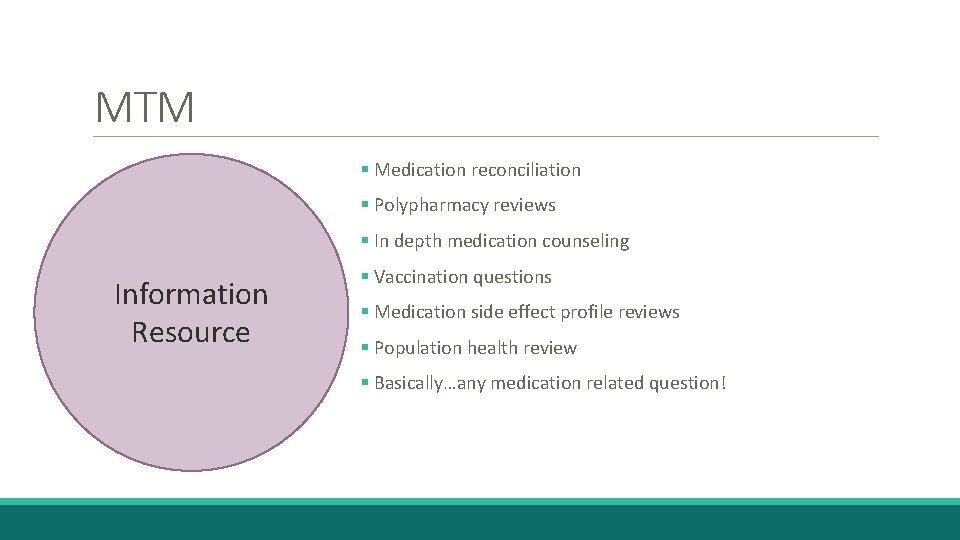
MTM § Medication reconciliation § Polypharmacy reviews § In depth medication counseling Information Resource § Vaccination questions § Medication side effect profile reviews § Population health review § Basically…any medication related question!
Goals of MTM Programs
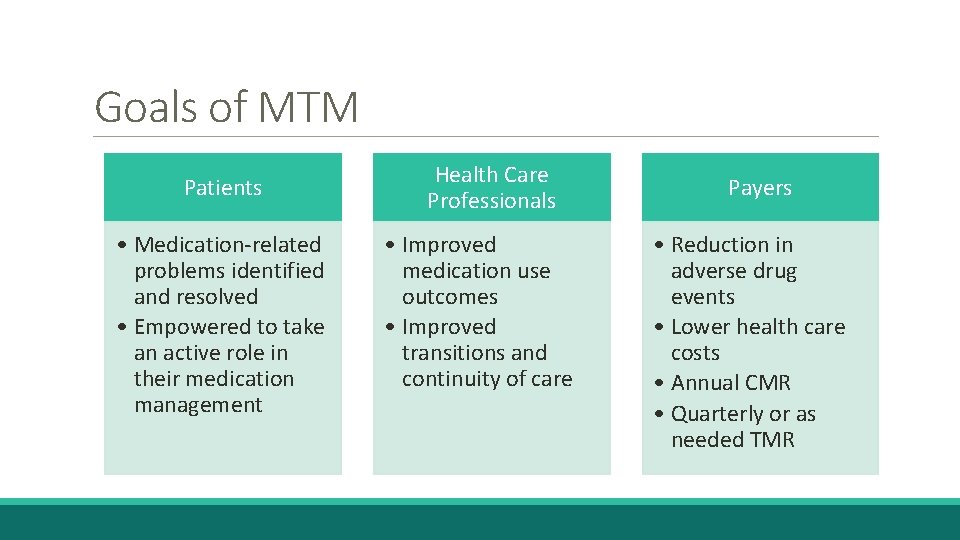
Goals of MTM Patients • Medication-related problems identified and resolved • Empowered to take an active role in their medication management Health Care Professionals • Improved medication use outcomes • Improved transitions and continuity of care Payers • Reduction in adverse drug events • Lower health care costs • Annual CMR • Quarterly or as needed TMR
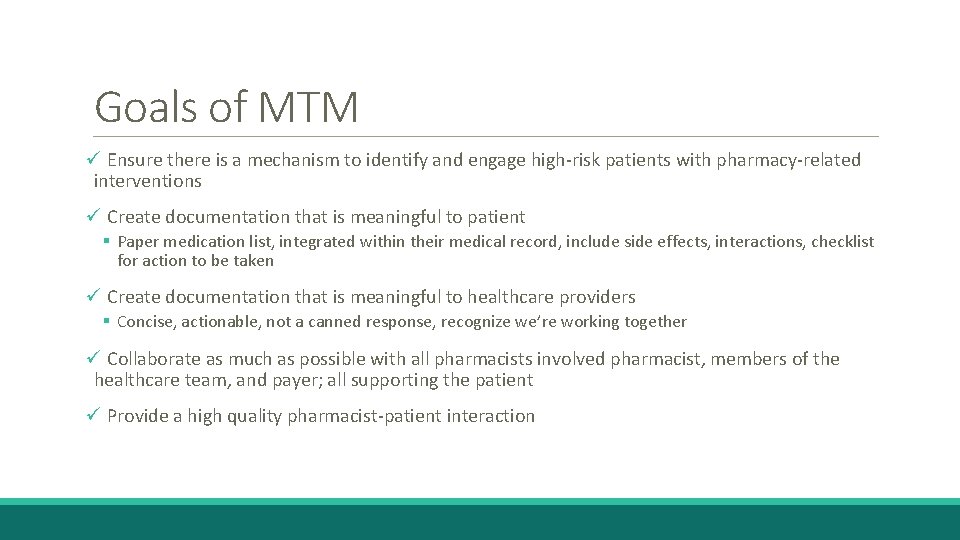
Goals of MTM ü Ensure there is a mechanism to identify and engage high-risk patients with pharmacy-related interventions ü Create documentation that is meaningful to patient § Paper medication list, integrated within their medical record, include side effects, interactions, checklist for action to be taken ü Create documentation that is meaningful to healthcare providers § Concise, actionable, not a canned response, recognize we’re working together ü Collaborate as much as possible with all pharmacists involved pharmacist, members of the healthcare team, and payer; all supporting the patient ü Provide a high quality pharmacist-patient interaction
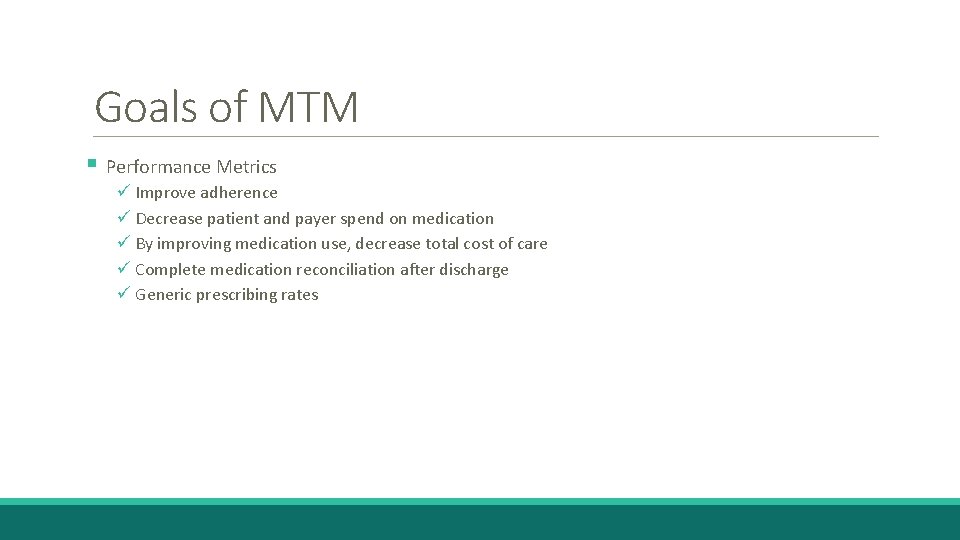
Goals of MTM § Performance Metrics ü Improve adherence ü Decrease patient and payer spend on medication ü By improving medication use, decrease total cost of care ü Complete medication reconciliation after discharge ü Generic prescribing rates
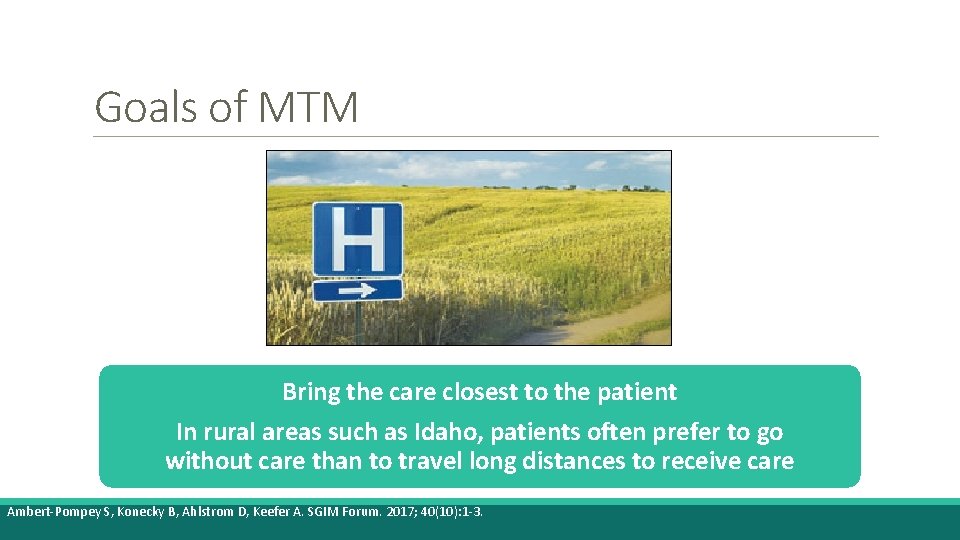
Goals of MTM Bring the care closest to the patient In rural areas such as Idaho, patients often prefer to go without care than to travel long distances to receive care Ambert-Pompey S, Konecky B, Ahlstrom D, Keefer A. SGIM Forum. 2017; 40(10): 1 -3.
MTM Models
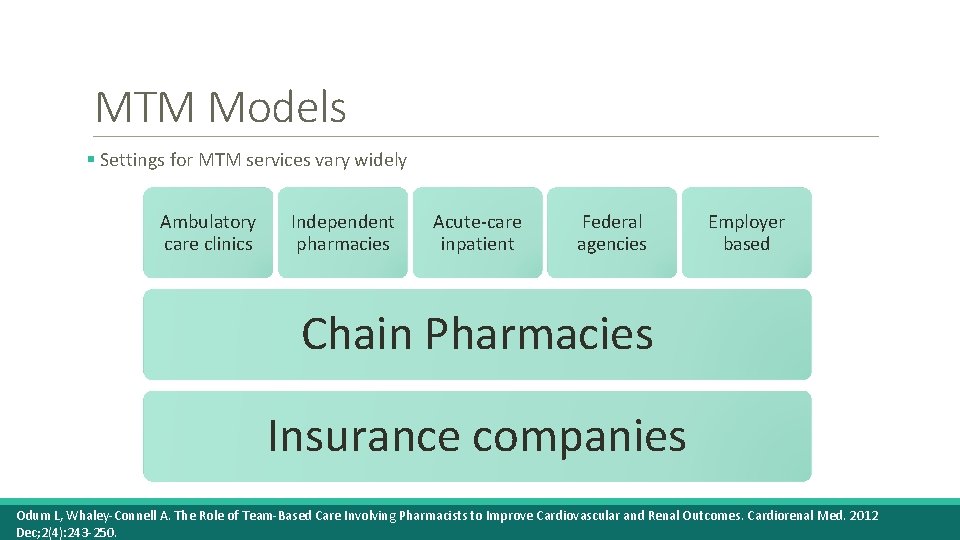
MTM Models § Settings for MTM services vary widely Ambulatory care clinics Independent pharmacies Acute-care inpatient Federal agencies Employer based Chain Pharmacies Insurance companies Odum L, Whaley-Connell A. The Role of Team-Based Care Involving Pharmacists to Improve Cardiovascular and Renal Outcomes. Cardiorenal Med. 2012 Dec; 2(4): 243 -250.
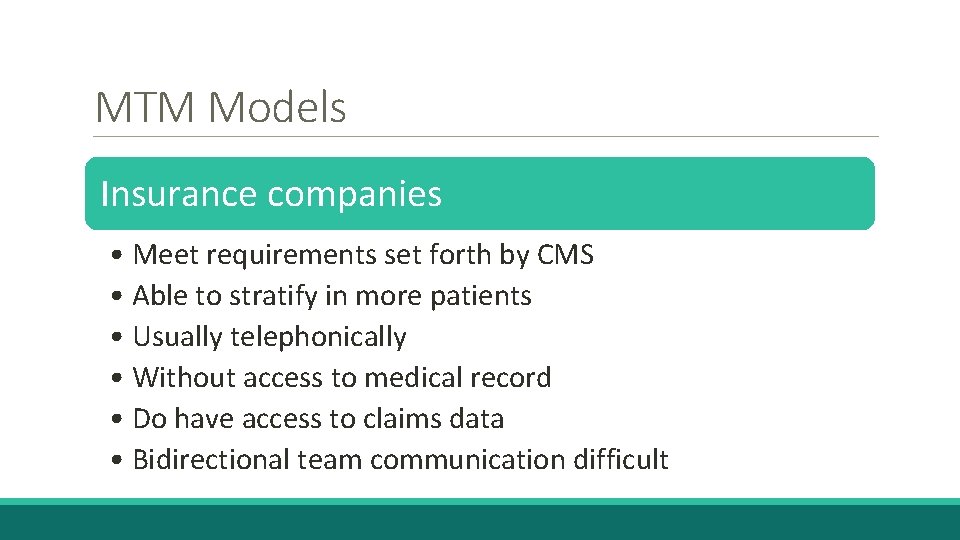
MTM Models Insurance companies • Meet requirements set forth by CMS • Able to stratify in more patients • Usually telephonically • Without access to medical record • Do have access to claims data • Bidirectional team communication difficult
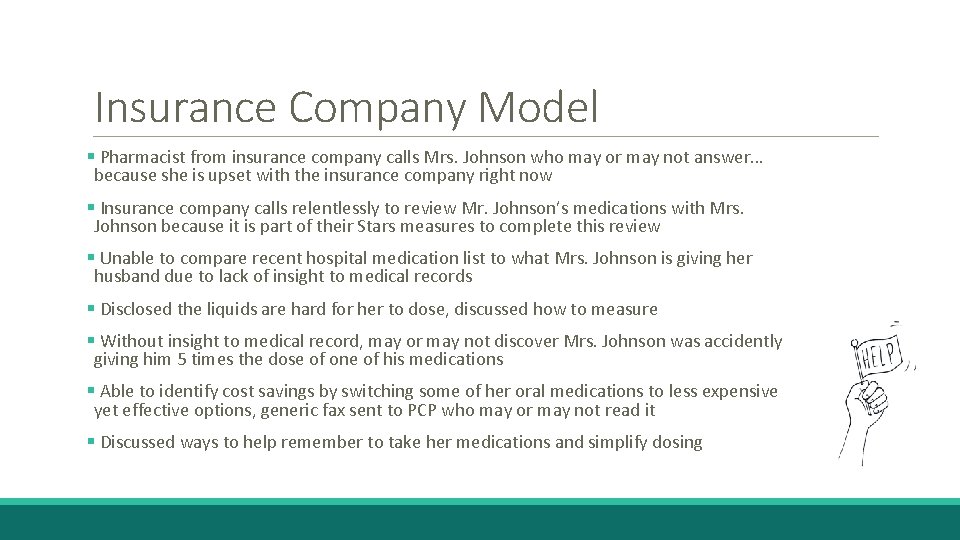
Insurance Company Model § Pharmacist from insurance company calls Mrs. Johnson who may or may not answer… because she is upset with the insurance company right now § Insurance company calls relentlessly to review Mr. Johnson’s medications with Mrs. Johnson because it is part of their Stars measures to complete this review § Unable to compare recent hospital medication list to what Mrs. Johnson is giving her husband due to lack of insight to medical records § Disclosed the liquids are hard for her to dose, discussed how to measure § Without insight to medical record, may or may not discover Mrs. Johnson was accidently giving him 5 times the dose of one of his medications § Able to identify cost savings by switching some of her oral medications to less expensive yet effective options, generic fax sent to PCP who may or may not read it § Discussed ways to help remember to take her medications and simplify dosing
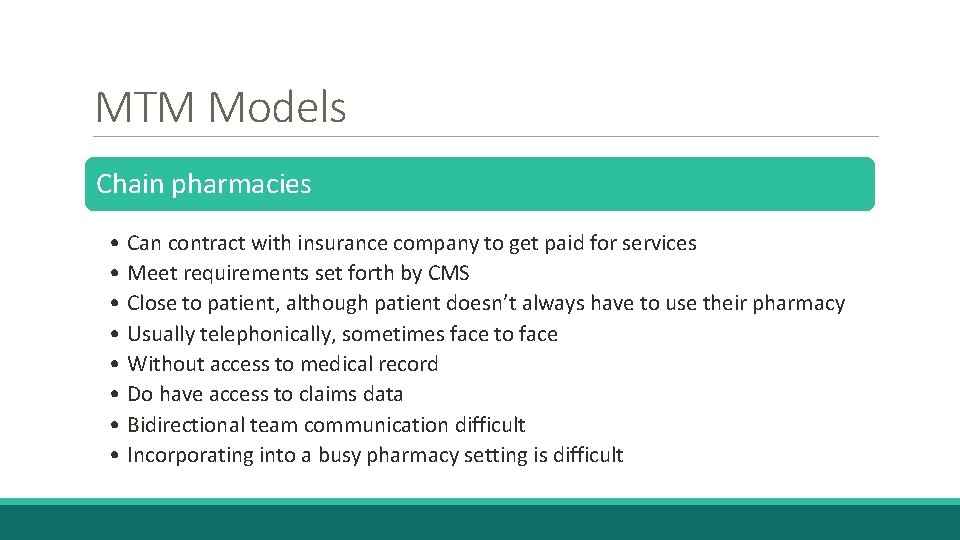
MTM Models Chain pharmacies • Can contract with insurance company to get paid for services • Meet requirements set forth by CMS • Close to patient, although patient doesn’t always have to use their pharmacy • Usually telephonically, sometimes face to face • Without access to medical record • Do have access to claims data • Bidirectional team communication difficult • Incorporating into a busy pharmacy setting is difficult
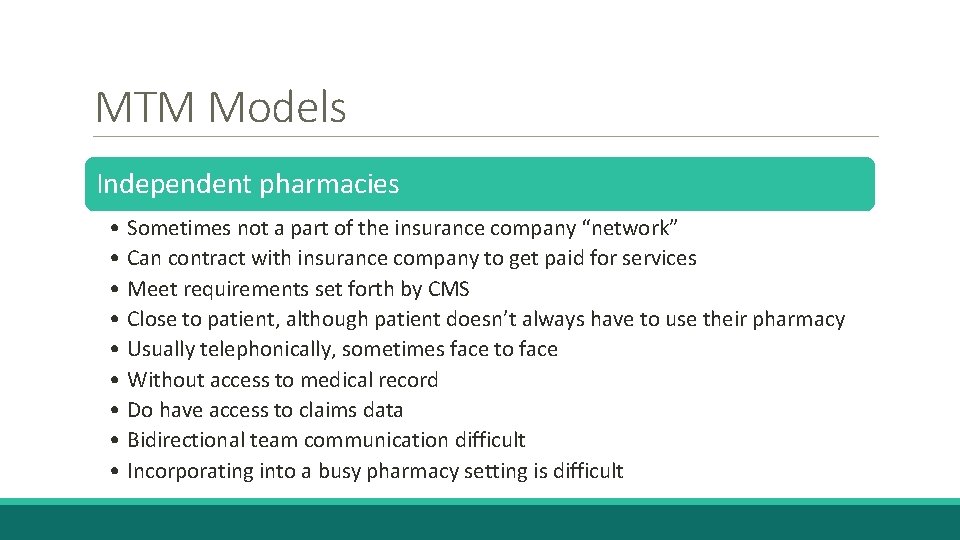
MTM Models Independent pharmacies • Sometimes not a part of the insurance company “network” • Can contract with insurance company to get paid for services • Meet requirements set forth by CMS • Close to patient, although patient doesn’t always have to use their pharmacy • Usually telephonically, sometimes face to face • Without access to medical record • Do have access to claims data • Bidirectional team communication difficult • Incorporating into a busy pharmacy setting is difficult
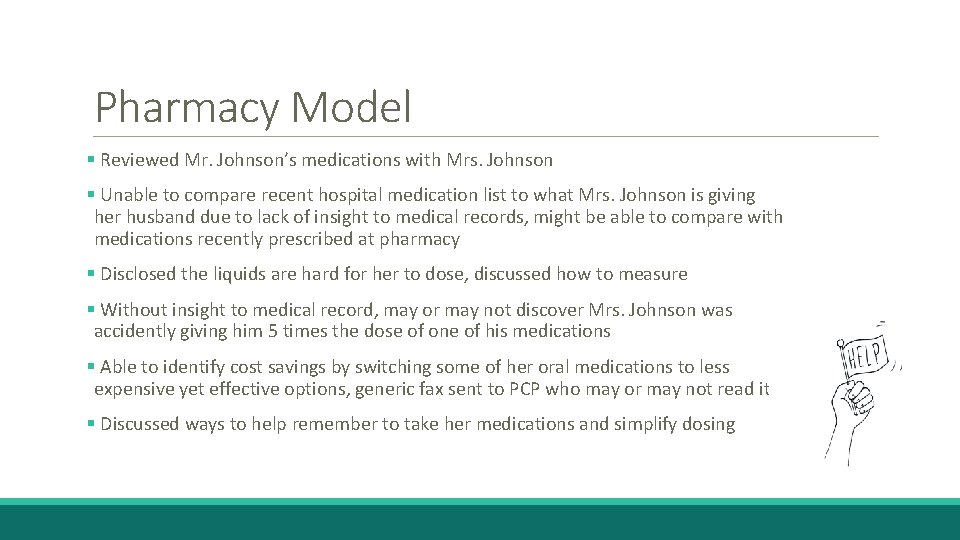
Pharmacy Model § Reviewed Mr. Johnson’s medications with Mrs. Johnson § Unable to compare recent hospital medication list to what Mrs. Johnson is giving her husband due to lack of insight to medical records, might be able to compare with medications recently prescribed at pharmacy § Disclosed the liquids are hard for her to dose, discussed how to measure § Without insight to medical record, may or may not discover Mrs. Johnson was accidently giving him 5 times the dose of one of his medications § Able to identify cost savings by switching some of her oral medications to less expensive yet effective options, generic fax sent to PCP who may or may not read it § Discussed ways to help remember to take her medications and simplify dosing
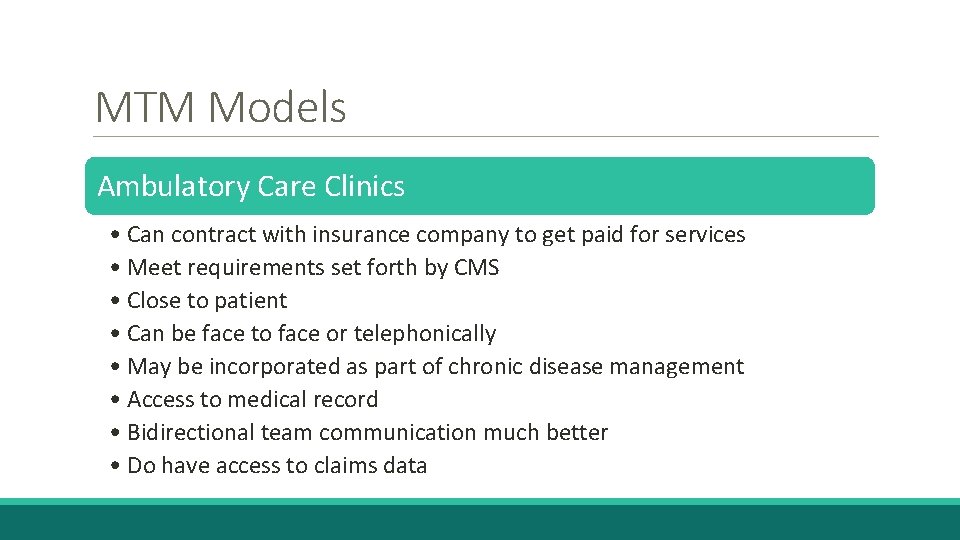
MTM Models Ambulatory Care Clinics • Can contract with insurance company to get paid for services • Meet requirements set forth by CMS • Close to patient • Can be face to face or telephonically • May be incorporated as part of chronic disease management • Access to medical record • Bidirectional team communication much better • Do have access to claims data
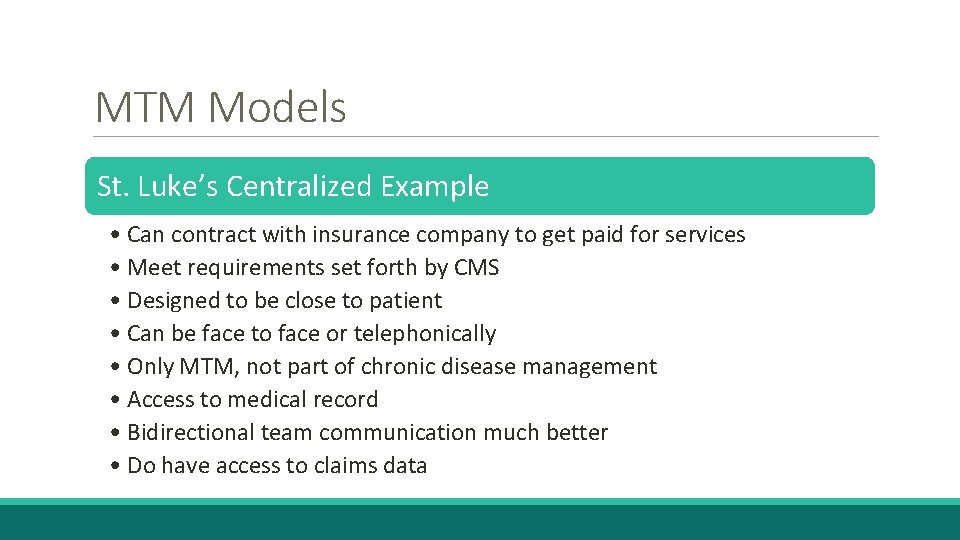
MTM Models St. Luke’s Centralized Example • Can contract with insurance company to get paid for services • Meet requirements set forth by CMS • Designed to be close to patient • Can be face to face or telephonically • Only MTM, not part of chronic disease management • Access to medical record • Bidirectional team communication much better • Do have access to claims data
Centralized Model With HER Access § Reviewed Mr. Johnson’s medications with Mrs. Johnson § Compared recent hospital medication list with what Mrs. Johnson is giving him § Disclosed the liquids are hard for her to dose, discussed how to measure § Discovered she was accidently giving him 5 times the dose of one of his medications § Able to identify cost savings by switching some of her oral medications to less expensive yet effective options, recommended changes to PCP in electronic medical record for bidirectional communication § Discussed ways to help remember to take her medications and simplify dosing
MTM Models Employer Based • Can contract with insurance company to get paid for services • Doesn’t need to meet CMS requirements • If within a health system or clinic will have access to records and have bidirectional team communication • Close to the patient • Can be face to face or telephonically • Could be either MTM and/or part of chronic disease management • Bidirectional team communication much better • Do have access to claims data
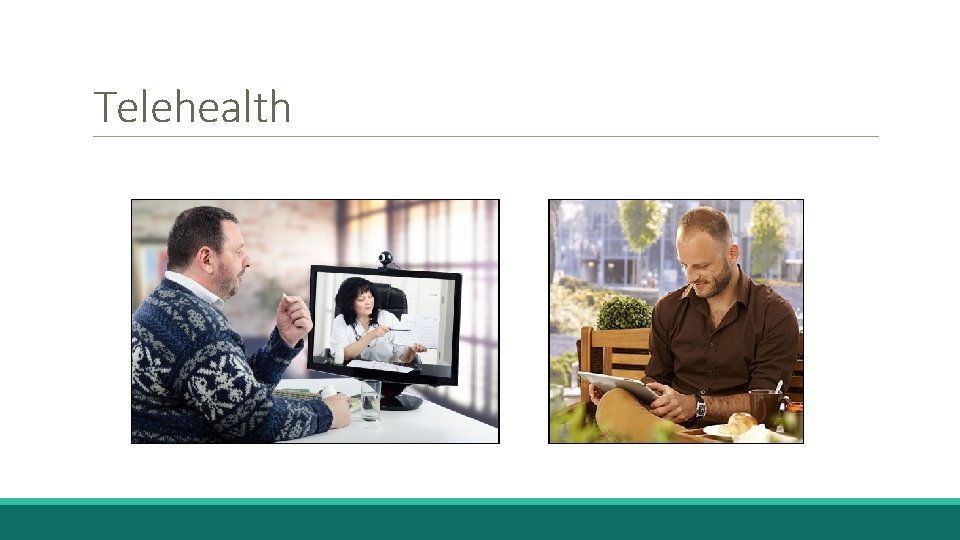
MTM Models Telehealth • Can be layered on top of any existing models • Closest to the patient • Can see into the patient’s home, how they store medications, how they are dosing medications, can use demos, visual into lifestyle • Technician support needed
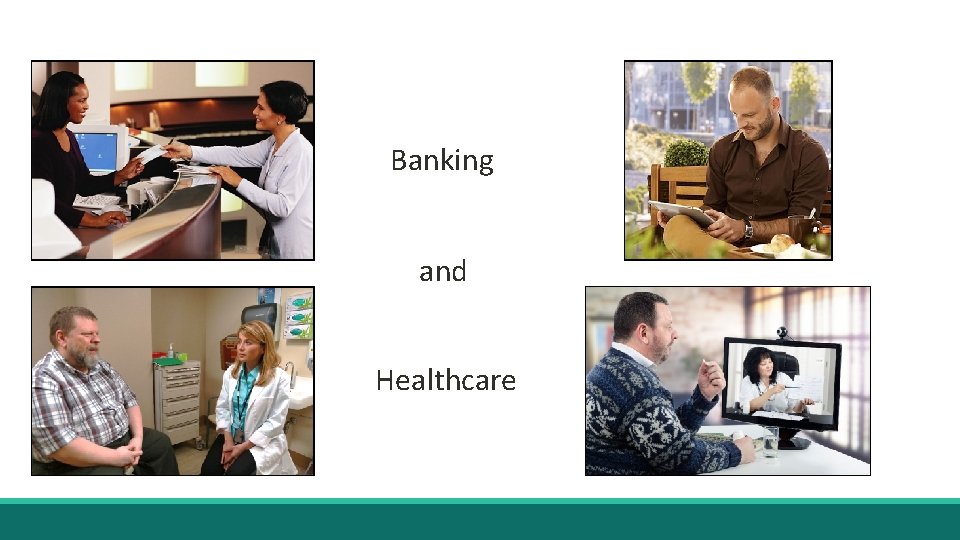
Banking and Healthcare
Telehealth
Telehealth What are barriers to implementing telehealth for MTM?
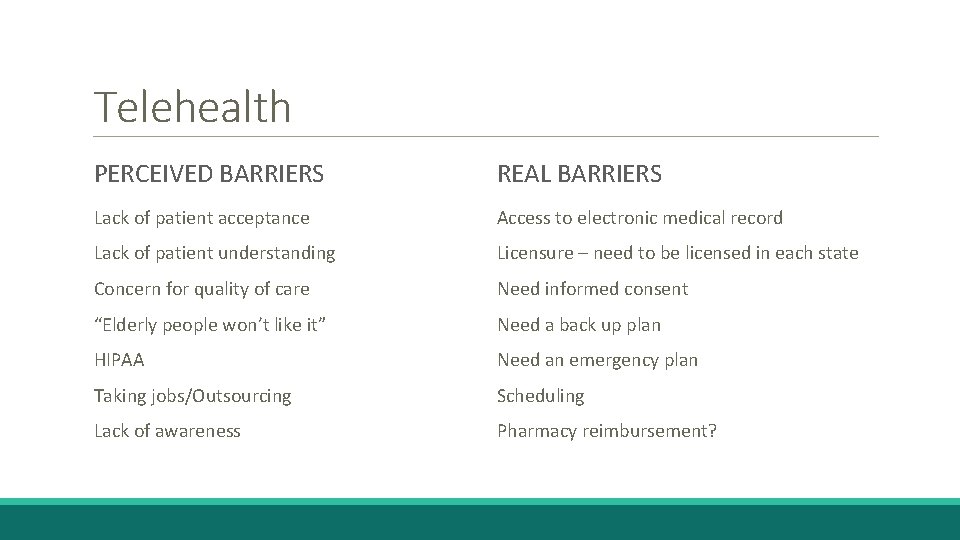
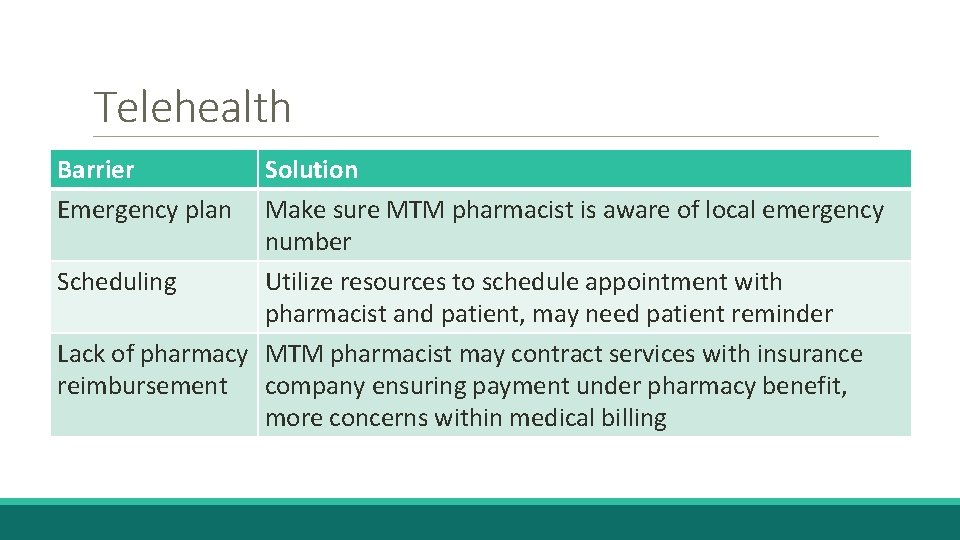
Telehealth PERCEIVED BARRIERS REAL BARRIERS Lack of patient acceptance Access to electronic medical record Lack of patient understanding Licensure – need to be licensed in each state Concern for quality of care Need informed consent “Elderly people won’t like it” Need a back up plan HIPAA Need an emergency plan Taking jobs/Outsourcing Scheduling Lack of awareness Pharmacy reimbursement?
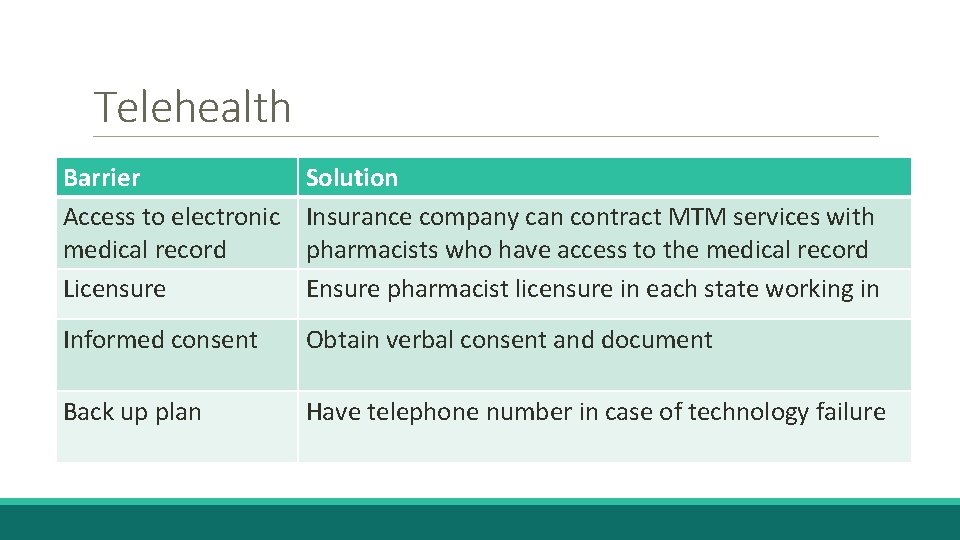
Telehealth Barrier Access to electronic medical record Licensure Solution Insurance company can contract MTM services with pharmacists who have access to the medical record Ensure pharmacist licensure in each state working in Informed consent Obtain verbal consent and document Back up plan Have telephone number in case of technology failure
Telehealth Barrier Emergency plan Solution Make sure MTM pharmacist is aware of local emergency number Scheduling Utilize resources to schedule appointment with pharmacist and patient, may need patient reminder Lack of pharmacy MTM pharmacist may contract services with insurance reimbursement company ensuring payment under pharmacy benefit, more concerns within medical billing
Population Health https: //medicalxpress. com/news/2016 -10 -approach-key-population-health. html
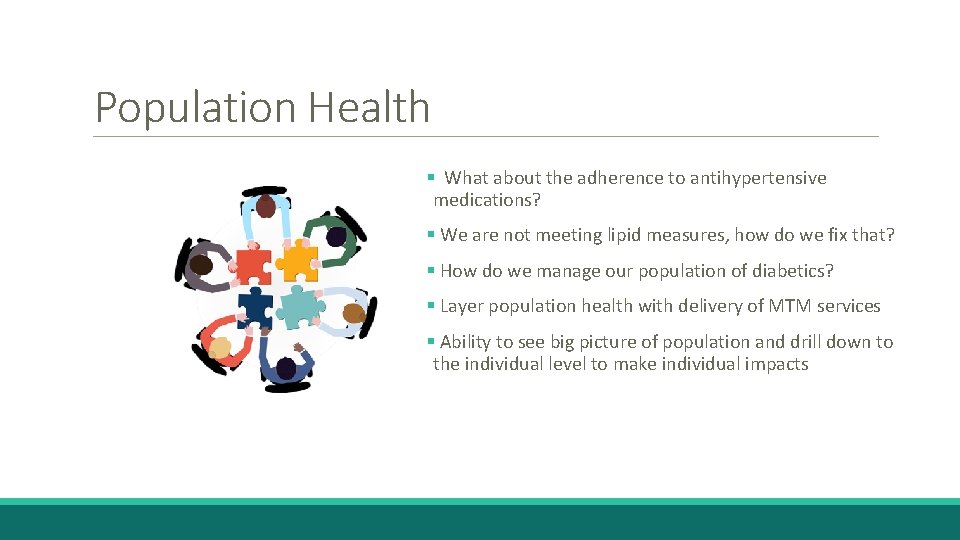
Population Health § What about the adherence to antihypertensive medications? § We are not meeting lipid measures, how do we fix that? § How do we manage our population of diabetics? § Layer population health with delivery of MTM services § Ability to see big picture of population and drill down to the individual level to make individual impacts
Enhanced MTM § CMS is piloting an “Enhanced MTM Model” in order to allow for greater flexibility in the delivery of the service § Looks at populations of patients at highest risk § More holistic approach to disease management within MTM vs only looking at reviewing medications § Likely more aligned with ideal of program instead of trying to get as many CMRs as possible
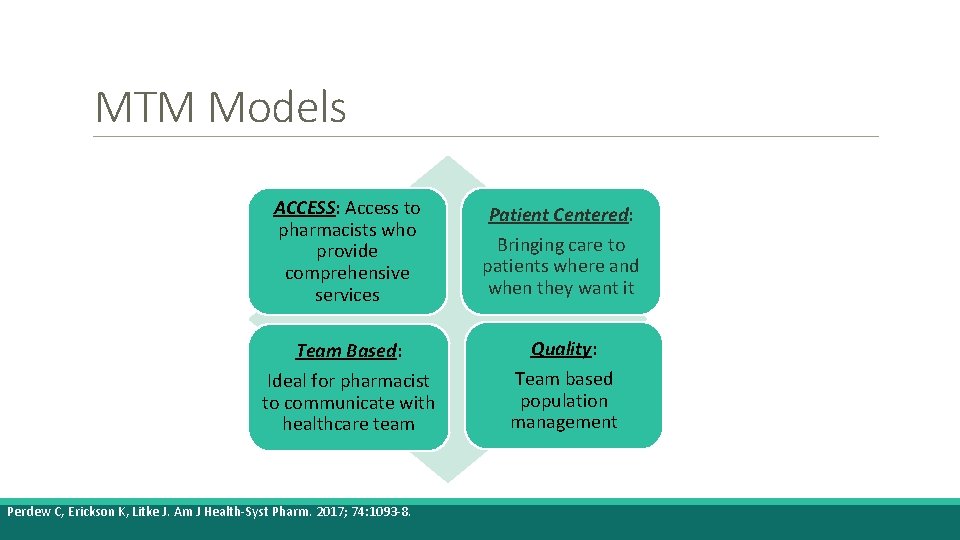
MTM Models ACCESS: Access to pharmacists who provide comprehensive services Bringing care to patients where and when they want it Team Based: Quality: Ideal for pharmacist to communicate with healthcare team Team based population management Perdew C, Erickson K, Litke J. Am J Health-Syst Pharm. 2017; 74: 1093 -8. Patient Centered:
MTM Models What are barriers to implementing MTM services?
MTM Models § Multiple people calling the patient, especially after a hospital discharge § Misunderstanding of pharmacist’s role within the healthcare team § Lack of awareness of pharmacist provided services § Difficulty from healthcare team in understanding how to engage in this type of service
How to Engage MTM Services?
How to Engage MTM Services? What would you do…?
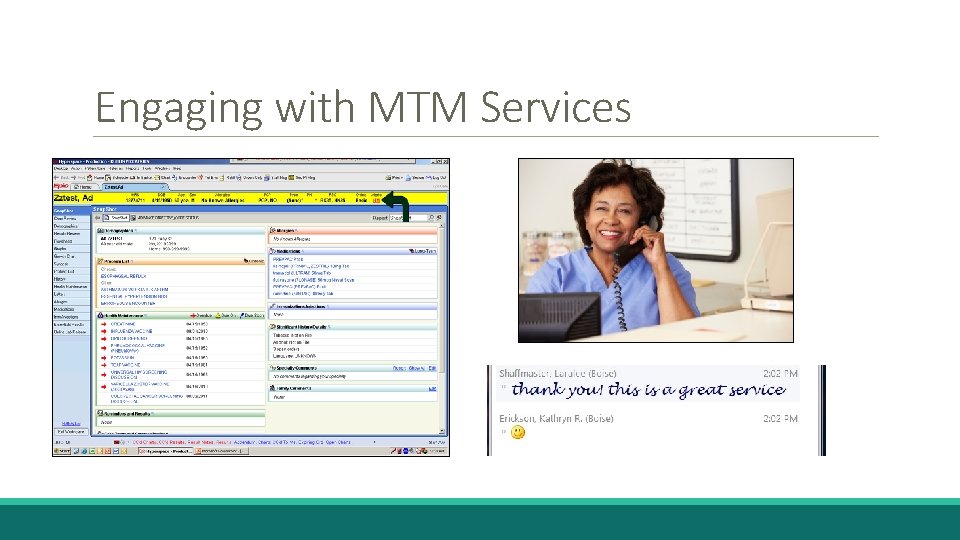
Engaging with MTM Services § Pharmacist embedded within clinic may provide services § Connect with patient’s pharmacy § Within a health system services may already be provided § Contact insurance company § “Helping patients get medications they need at a cost they can afford”
Engaging with MTM Services
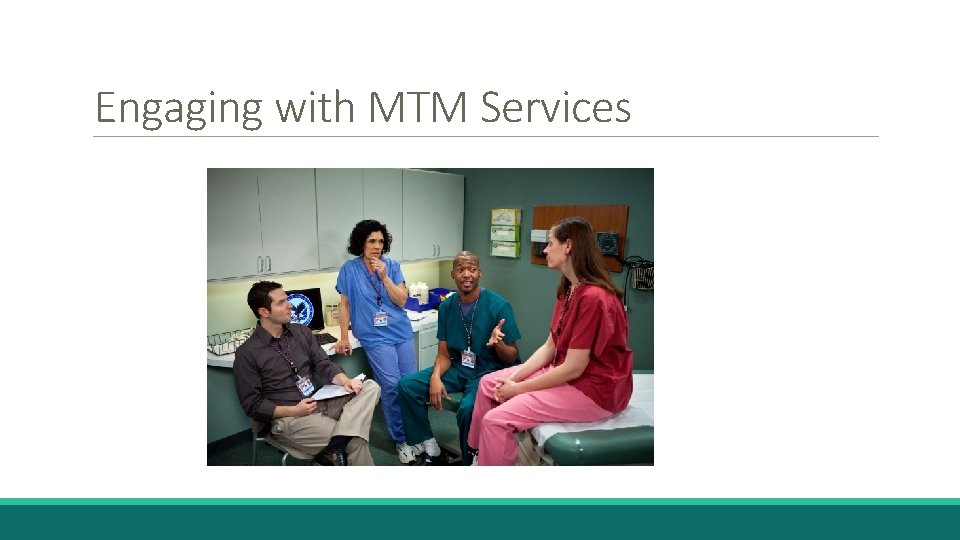
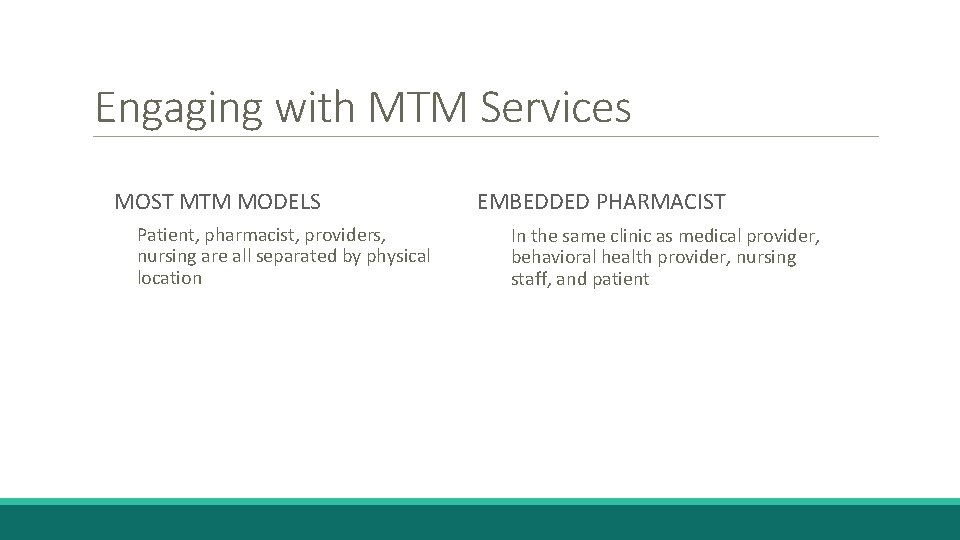
Engaging with MTM Services MOST MTM MODELS Patient, pharmacist, providers, nursing are all separated by physical location EMBEDDED PHARMACIST In the same clinic as medical provider, behavioral health provider, nursing staff, and patient
Engaging with MTM Services
Engaging with MTM Services § Communicating with Pharmacists § May be difficult in a busy pharmacy setting, could request best time to call back or request call back § Within electronic health record or within written format § Specific, evidence based, and comprehensive § Pharmacists Communicating with Prescribers § § § Training on empathy – putting themselves within the provider’s shoes Learning to let go of the excessive documentation taught in school Understanding that without records they may not understand the whole picture Medicine is not black and white Concise and actionable
MTM Outcomes
MTM Outcomes – Clinical Programs § Mr. Johnson, now on appropriate dose of his medication, may have avoided another hospitalization § Discovered a patient who had been dispensed the wrong insulin, communicated with dispensing pharmacy to fix dispensing error § Switched patients to less expensive inhalers, leading to $300/yr savings to patient and $3600/yr total healthcare savings § Completed a herbal supplement review, established relationship with patient § Resulted in contact when patient’s wife recently discharged from hospital on combination of opioids and benzodiazepines § She was not fully coherent, discovered she was taking more than needed of medications § Able to help straighten out regimen, calm husband, possible prevent readmission
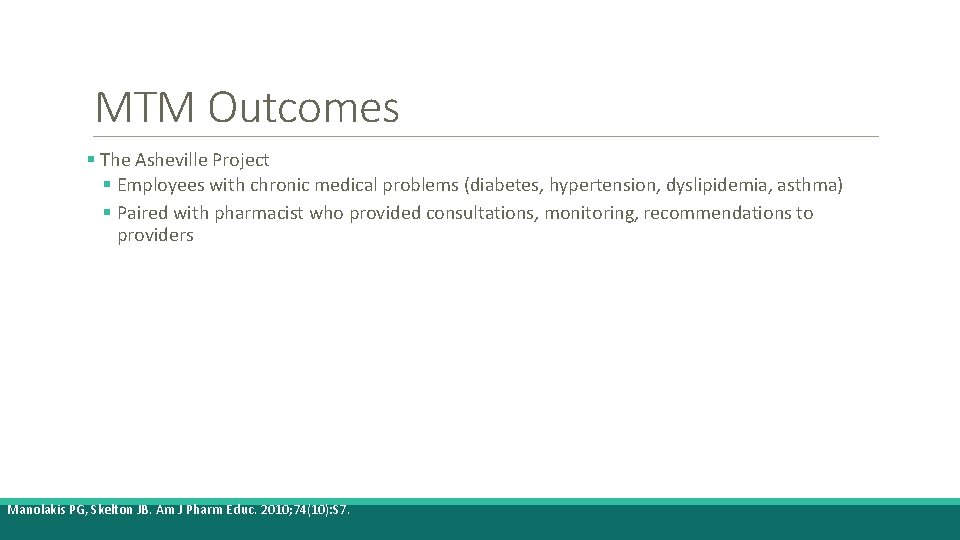
MTM Outcomes § The Asheville Project § Employees with chronic medical problems (diabetes, hypertension, dyslipidemia, asthma) § Paired with pharmacist who provided consultations, monitoring, recommendations to providers Manolakis PG, Skelton JB. Am J Pharm Educ. 2010; 74(10): S 7.
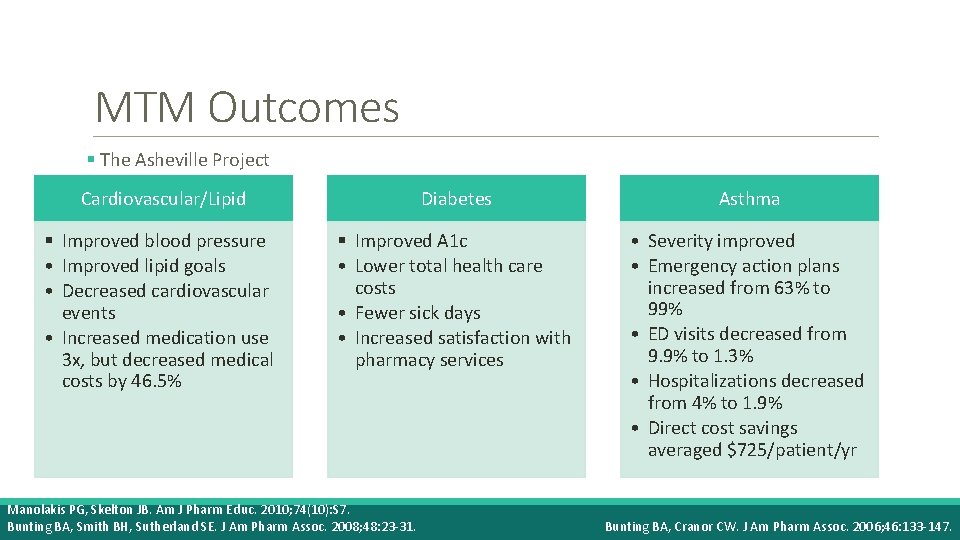
MTM Outcomes § The Asheville Project Cardiovascular/Lipid Diabetes Asthma § Improved blood pressure • Improved lipid goals • Decreased cardiovascular events • Increased medication use 3 x, but decreased medical costs by 46. 5% § Improved A 1 c • Lower total health care costs • Fewer sick days • Increased satisfaction with pharmacy services • Severity improved • Emergency action plans increased from 63% to 99% • ED visits decreased from 9. 9% to 1. 3% • Hospitalizations decreased from 4% to 1. 9% • Direct cost savings averaged $725/patient/yr Manolakis PG, Skelton JB. Am J Pharm Educ. 2010; 74(10): S 7. Bunting BA, Smith BH, Sutherland SE. J Am Pharm Assoc. 2008; 48: 23 -31. Bunting BA, Cranor CW. J Am Pharm Assoc. 2006; 46: 133 -147.
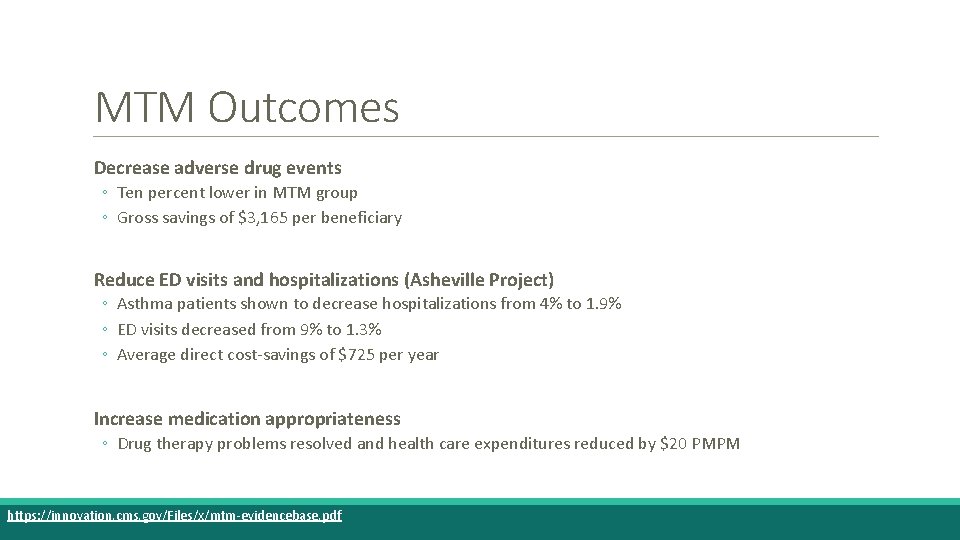
MTM Outcomes Decrease adverse drug events ◦ Ten percent lower in MTM group ◦ Gross savings of $3, 165 per beneficiary Reduce ED visits and hospitalizations (Asheville Project) ◦ Asthma patients shown to decrease hospitalizations from 4% to 1. 9% ◦ ED visits decreased from 9% to 1. 3% ◦ Average direct cost-savings of $725 per year Increase medication appropriateness ◦ Drug therapy problems resolved and health care expenditures reduced by $20 PMPM https: //innovation. cms. gov/Files/x/mtm-evidencebase. pdf
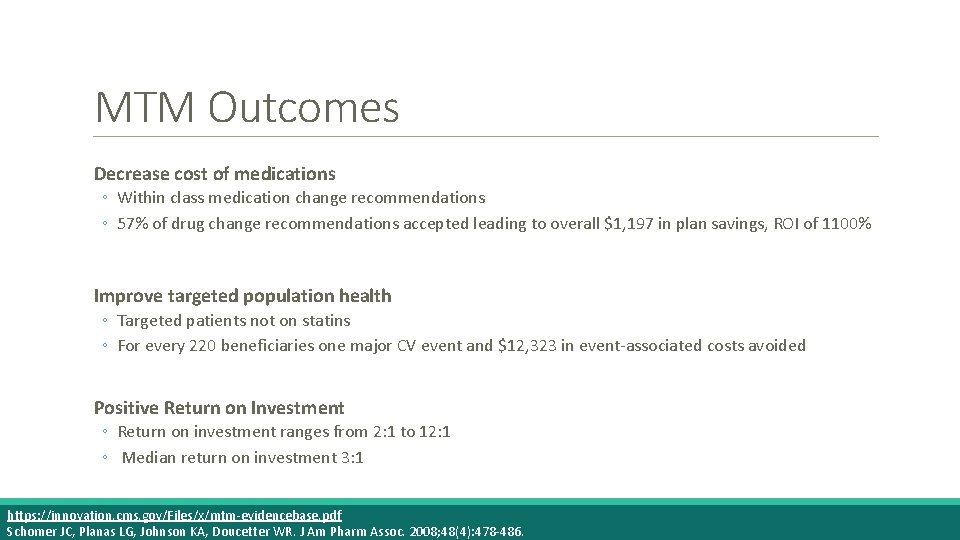
MTM Outcomes Decrease cost of medications ◦ Within class medication change recommendations ◦ 57% of drug change recommendations accepted leading to overall $1, 197 in plan savings, ROI of 1100% Improve targeted population health ◦ Targeted patients not on statins ◦ For every 220 beneficiaries one major CV event and $12, 323 in event-associated costs avoided Positive Return on Investment ◦ Return on investment ranges from 2: 1 to 12: 1 ◦ Median return on investment 3: 1 https: //innovation. cms. gov/Files/x/mtm-evidencebase. pdf Schomer JC, Planas LG, Johnson KA, Doucetter WR. J Am Pharm Assoc. 2008; 48(4): 478 -486.
MTM Outcomes § High quality pharmacist MTM services result in: § Improvements in proper use of medications leading to improved health outcomes and quality of life § Improved patient satisfaction § Decrease in total cost of care
Questions?