
Chapter 6 Police Culture Personality and Police Stress


- Slides: 29
Chapter 6 Police Culture, Personality, and Police Stress
Introduction • This chapter will discuss such concepts as the police culture or subculture • Law enforcement officers put their own safety and lives at risk in order to protect and serve • Police stress is a very serious issue facing the police • This chapter will attempt to define stress and show why it occurs, how it exhibits itself, and how police agencies can deal with it
The Police Culture or Subculture Combination of shared norms, values, goals, career patterns, lifestyles, and occupational structures Permeated by an idea of danger and distrust for civilians Traits of the police culture/subculture: Clannishness Isolation from the public Secrecy Honor Loyalty Individuality
The Police Culture or Subculture (cont. ) Ideal officer, according to police subculture: Takes risks (honor) Is first on scene to aid a fellow police officer (loyalty) Can handle any situation in his/her own way (individuality) Officers’ coping strategies: Humor (“gallows humor”) Keeping emotional distance from themselves and stressful events Blue wall of silence: Figurative protective barrier erected by police in which officers protect one another from outsiders, often even refusing to aid superiors or other officials in investigating wrongdoing of other officers
The Police Culture or Subculture THE BLUE WALL OF SILENCE • Trautman’s study of 2, 698 officers in 21 states • 46% witnessed misconduct but did not report it • 73% of those “pressuring the individuals to keep quiet” were supervisors • 79% of police academy recruits in 25 basic LE academies believed that a code of silence exists • Can destroy a police department • Reputation and integrity • Blue curtain • The Code of Silence Antidote (COSA) • Code of ethics • Training and reinfocement
The Police Personality WHAT IS THE POLICE PERSONALITY? • • • Authoritarianism Suspicion Hostility Insecurity Conservatism Cynicism
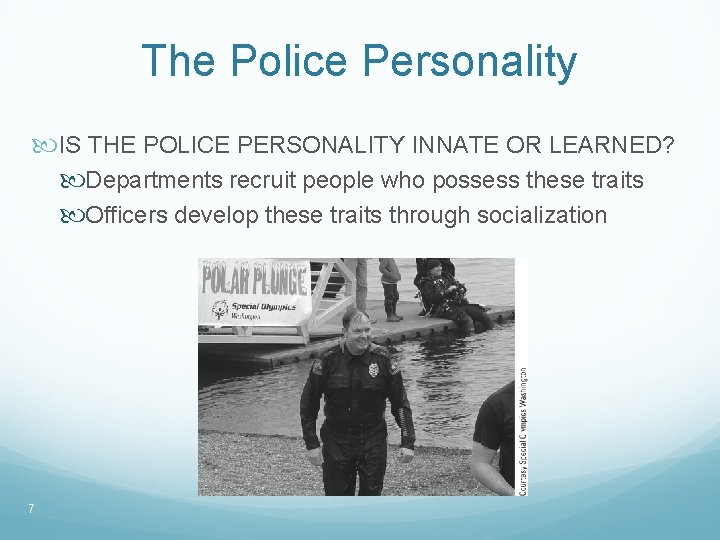
The Police Personality IS THE POLICE PERSONALITY INNATE OR LEARNED? Departments recruit people who possess these traits Officers develop these traits through socialization 7
The Police Personality POLICE CYNICISM Police cynicism is the attitude that there is no hope for the world View of humanity at its worst Produced by constant contact with offenders Deeply entrenched in the ethos of the police world Increases with length of service 8
Discussion Question How does police cynicism affect a police officer’s view? Does it have any effect on the relationship between the police and the public? How does it affect an officer’s career?
The Police Personality THE DIRTY HARRY PROBLEM The Dirty Harry problem: Do good ends ever justify the bad means? Moral dilemma of police officers Violating proper police procedure Policing is a moral occupation
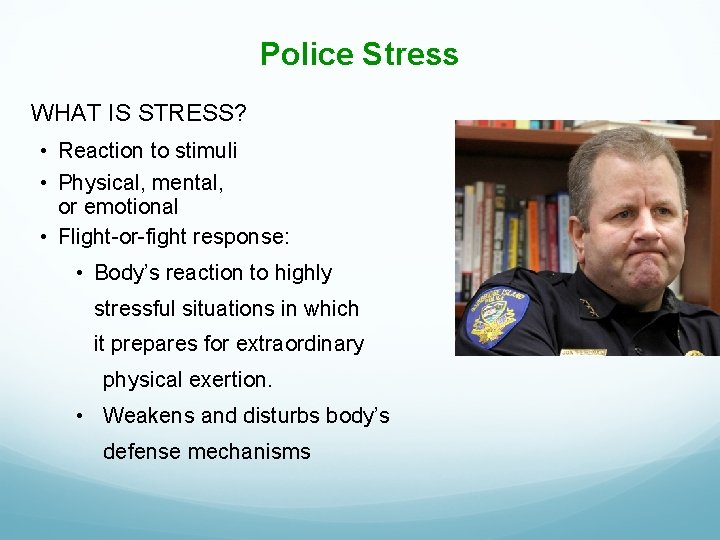
Police Stress WHAT IS STRESS? • Reaction to stimuli • Physical, mental, or emotional • Flight-or-fight response: • Body’s reaction to highly stressful situations in which it prepares for extraordinary physical exertion. • Weakens and disturbs body’s defense mechanisms
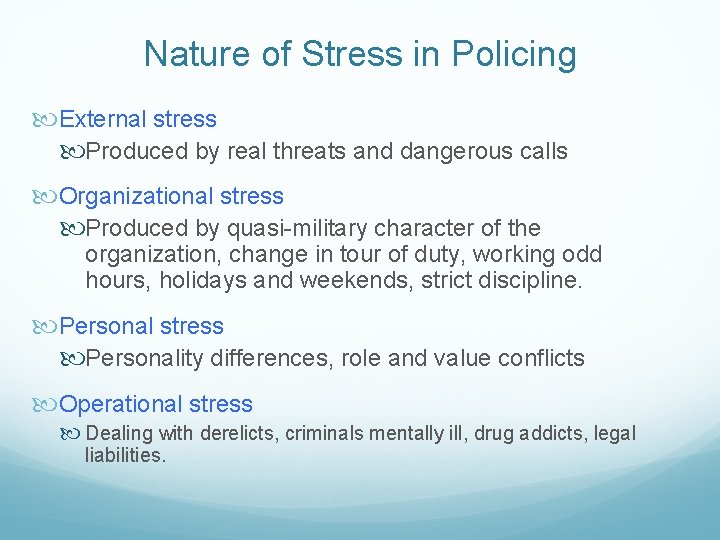
Nature of Stress in Policing External stress Produced by real threats and dangerous calls Organizational stress Produced by quasi-military character of the organization, change in tour of duty, working odd hours, holidays and weekends, strict discipline. Personal stress Personality differences, role and value conflicts Operational stress Dealing with derelicts, criminals mentally ill, drug addicts, legal liabilities.
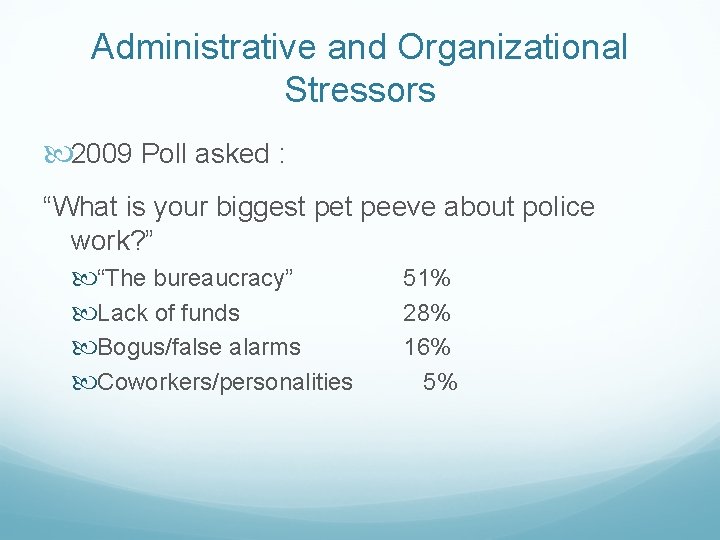
Administrative and Organizational Stressors 2009 Poll asked : “What is your biggest peeve about police work? ” “The bureaucracy” 51% Lack of funds 28% Bogus/false alarms 16% Coworkers/personalities 5%
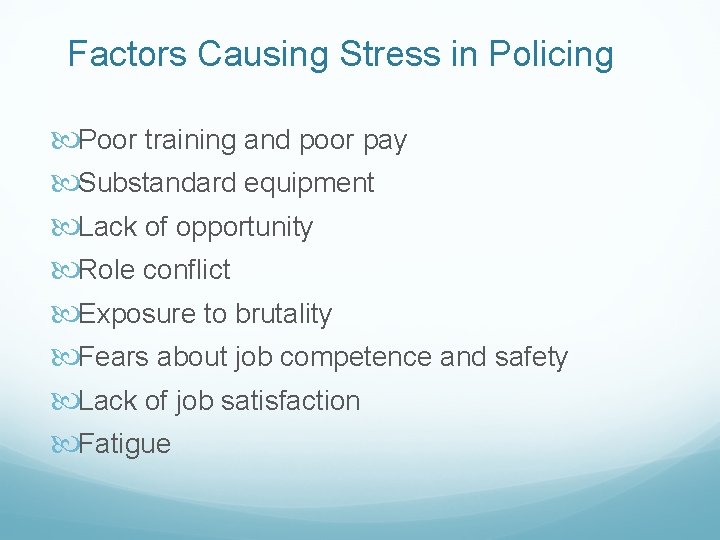
Factors Causing Stress in Policing Poor training and poor pay Substandard equipment Lack of opportunity Role conflict Exposure to brutality Fears about job competence and safety Lack of job satisfaction Fatigue
Effects of Stress on Police Officers Cynicism and suspiciousness Emotional detachment from various aspects of daily life Reduced efficiency Absenteeism and early retirement Excessive aggressiveness (which may trigger an increase in citizen complaints) Alcoholism and other substance abuse problems Marital or other family problems Heart attacks, ulcers, weight gain, and other health problems Suicide Posttraumatic stress disorder
Police Stress Post-Traumatic Stress Disorder Following traumatic or critical incident Officers do not want to appear “weak” Identify signs and symptoms Follow recommended steps Critical incident stress debriefing (CISD) As soon as possible All personnel 16
Life expectancy Average in U. S. Police More than 30 yrs. 71 for general public 57 3 X mortality rate 300% more likely to have problems with alcohol related risks Heart problems, hypertension, cancer, ulcers, diabetes, chronic headaches, anxiety-related disorders, asthma, excessive eating, decreased sex drive, fatigue, dizziness, muscle aches
LE personnel with additional stressors Women officers Minority officers Rural and small town patrol officers Investigators Managers/Supervisors
Police Stress STRESS AND POLICE FAMILIES Family disruption due to rotating shifts Unpredictable work environment Job-related personal change and family relationships Community expectations and demands Intrusion into family life
Police Stress POLICE DEPARTMENTS DEALING WITH STRESS U. S. Commission on Civil Rights, 1981 Police Organization Providing Peer Assistance (POPPA) Counseling Referrals Help line Manage in an efficient manner
Discussion Question What steps can be taken to help a police officer showing signs and symptoms of stress after a traumatic or critical incident? What are the greatest barriers to treating these officers? Discuss ways to break through these barriers.
Police Suicide OVERVIEW • Suicide rate 3 X higher than that of the general population • Most lethal threat in police history • 3 X as many police officers kill themselves as are those killed in the line of duty • Many elements of law enforcement contribute • Reluctance to ask for help • Become ingrained in police work • Isolated from other life roles
Police Danger OFFICERS KILLED IN THE LINE OF DUTY National Law Enforcement Officers Memorial (NLEOM) Concerns of Police Survivors Inc. (COPS) Risk of assaults far exceeds fatalities
OFFICERS KILLED IN THE LINE OF DUTY • National Law Enforcement Officers Memorial (NLEOM) • Concerns of Police Survivors Inc. (COPS) • Risk of assaults far exceeds fatalities • 48 officers feloniously killed in the line of duty in 2012 • 6 ambushed; 12 making arrests; 8 investigating suspicious persons; 8 traffic stops/pursuits; 4 disturbance calls; 5 in tactical situations; 3 transporting prisoners, 1 handling mentally ill, 1 conducting search or surveillance
OFFICERS KILLED IN THE LINE OF DUTY • 27 officers feloniously killed in the line of duty in 2013, a decrease of more than 44 percent • 7 ambushed; 3 responding to robberies; 3 investigating suspicious persons; 3 traffic stops/pursuits; 5 disturbance calls; 5 in tactical situations; and 1 as a result of an investigative activity. • Firearms used in 26 of the 27 deaths • 19 with handguns, 5 with rifles, 2 with shotguns • 6 officers fired their own weapon, 3 attempted, 2 had weapons stolen, 1 killed with his own weapon • 19 were wearing body armor
OFFICERS ASSAULTED IN THE LINE OF DUTY 52, 901 assaults committed in 2012 Contact with more than 45 million persons a year Stoic mentality Don’t make a big deal about it
Police Danger Regularly responding to people shooting at each other, stabbing each other, and beating each other “Unknown disturbances” calls Violence associated with drug business Risk of exposure to dangerous chemicals
Police Danger POLICE AND CONTAGIOUS DISEASES • • • Human immunodeficiency virus (HIV) AIDS Hepatitis B and C Officers are at special risk Precautionary measures
Summary • Police officers protect one another from outsiders • The police subculture leads to the police personality • Police cynicism is an attitude that there is no hope for the world • Stress is the body’s reaction to internal or external stimuli that upset the body’s normal state • Many factors lead to stress in police work • Suicide rate for police officers is three to six times that of the general population