Hereditary cancer the next generation Raymond Kim MDPh
- Slides: 61
Hereditary cancer, the next generation § Raymond Kim § MD/Ph. D, FRCPC, FCCMG, FACMG § Medical Geneticist § Princess Margaret Cancer Centre
Outline § Genetic terminology and concepts § Hereditary cancers § When to consider § Genetics assessment § Surveillance § Hereditary breast cancer syndromes § Hereditary colorectal cancer syndromes § Hereditary kidney cancer syndromes § Hereditary endocrine cancer syndromes § Genetic testing § Genetic counseling 2
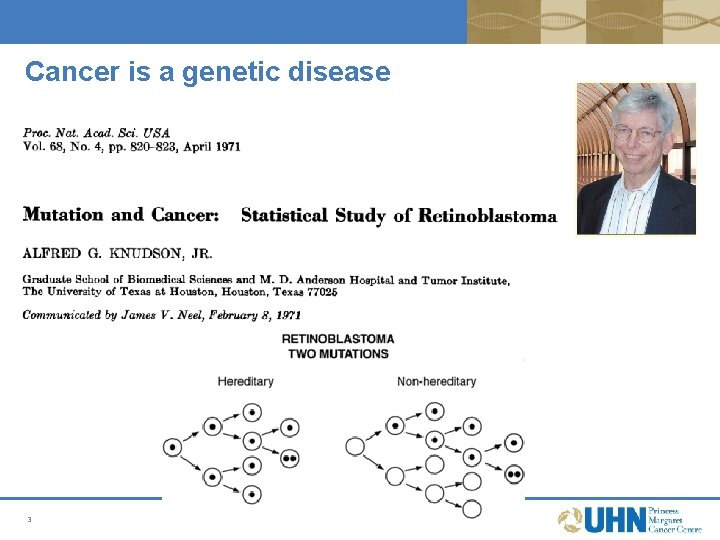
Cancer is a genetic disease 3
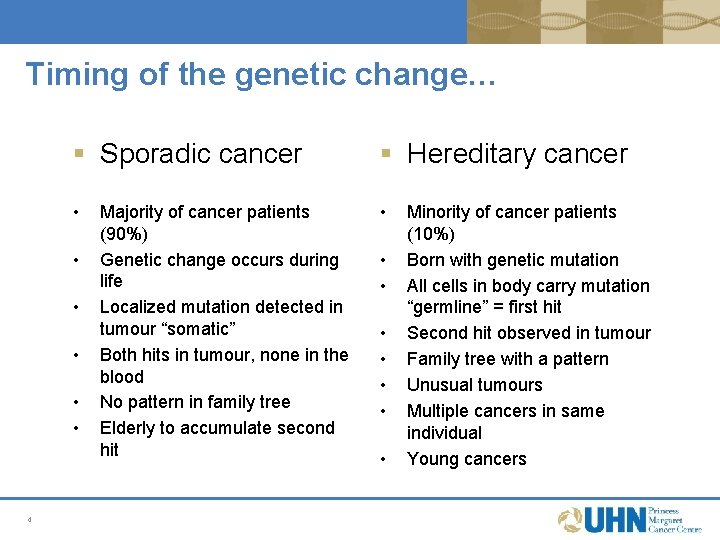
Timing of the genetic change… § Sporadic cancer § Hereditary cancer • • 4 Majority of cancer patients (90%) Genetic change occurs during life Localized mutation detected in tumour “somatic” Both hits in tumour, none in the blood No pattern in family tree Elderly to accumulate second hit • • Minority of cancer patients (10%) Born with genetic mutation All cells in body carry mutation “germline” = first hit Second hit observed in tumour Family tree with a pattern Unusual tumours Multiple cancers in same individual Young cancers
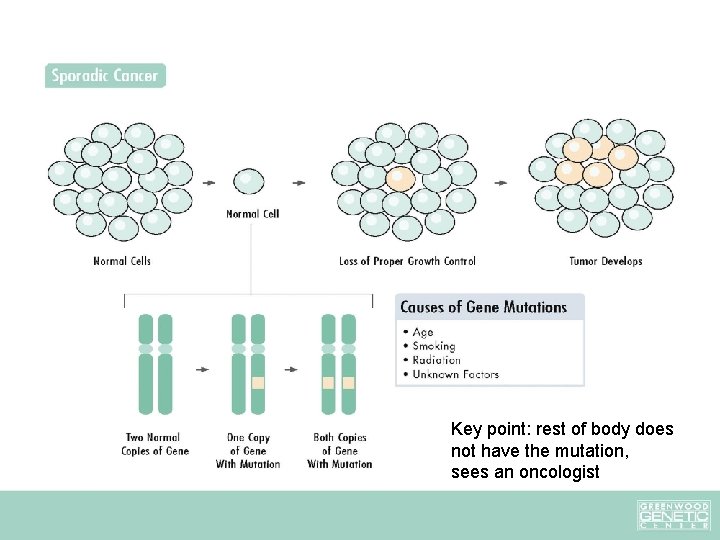
Key point: rest of body does not have the mutation, sees an oncologist
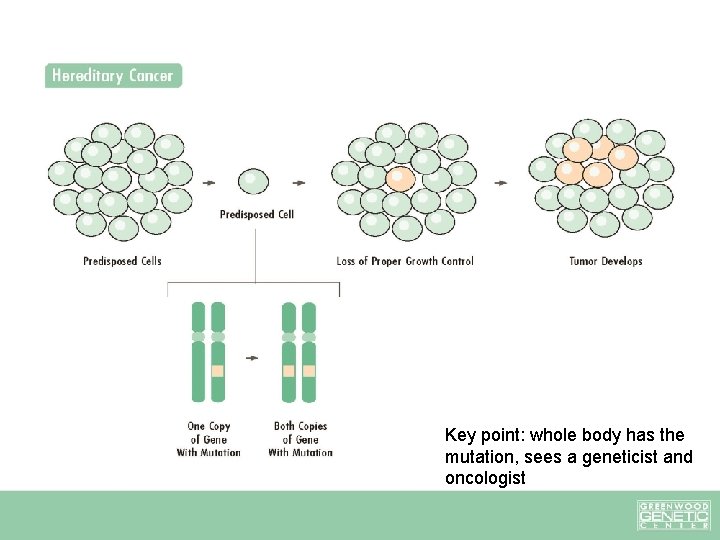
Key point: whole body has the mutation, sees a geneticist and oncologist
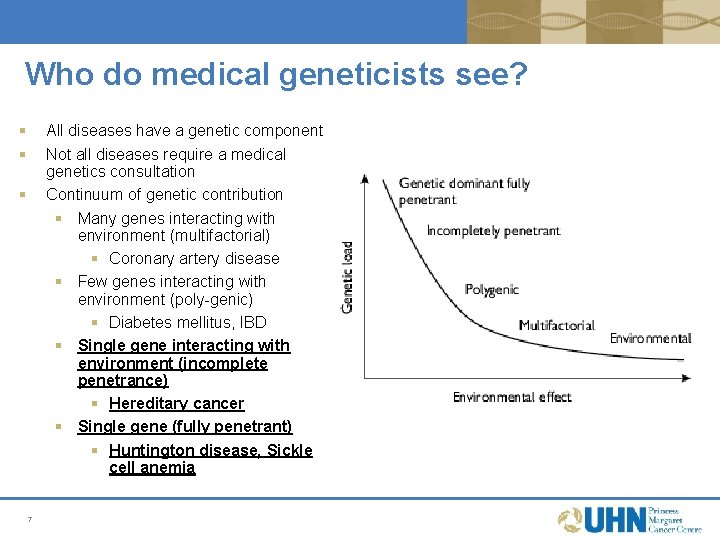
Who do medical geneticists see? § § All diseases have a genetic component Not all diseases require a medical genetics consultation Continuum of genetic contribution § Many genes interacting with environment (multifactorial) § Coronary artery disease § Few genes interacting with environment (poly-genic) § Diabetes mellitus, IBD § Single gene interacting with environment (incomplete penetrance) § Hereditary cancer § Single gene (fully penetrant) § Huntington disease, Sickle cell anemia § 7
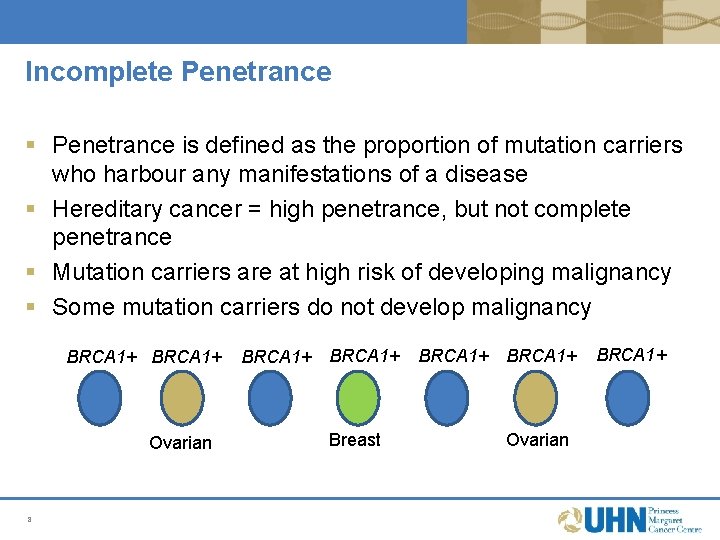
Incomplete Penetrance § Penetrance is defined as the proportion of mutation carriers who harbour any manifestations of a disease § Hereditary cancer = high penetrance, but not complete penetrance § Mutation carriers are at high risk of developing malignancy § Some mutation carriers do not develop malignancy BRCA 1+ Ovarian 8 BRCA 1+ Breast BRCA 1+ Ovarian BRCA 1+
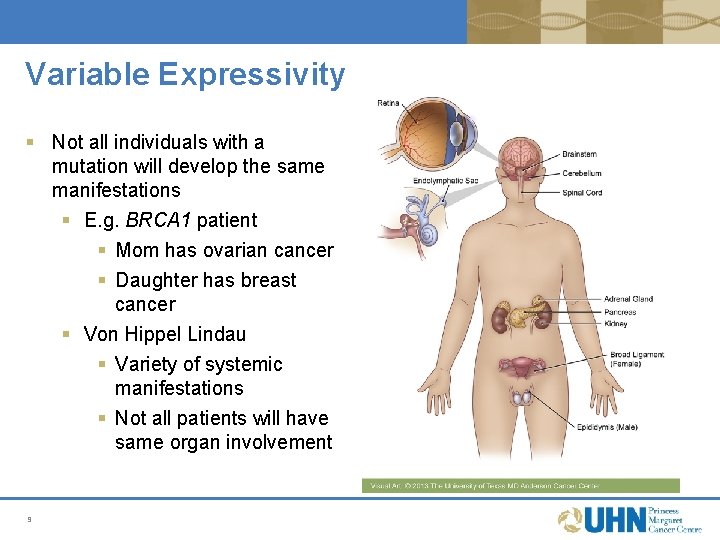
Variable Expressivity § Not all individuals with a mutation will develop the same manifestations § E. g. BRCA 1 patient § Mom has ovarian cancer § Daughter has breast cancer § Von Hippel Lindau § Variety of systemic manifestations § Not all patients will have same organ involvement 9
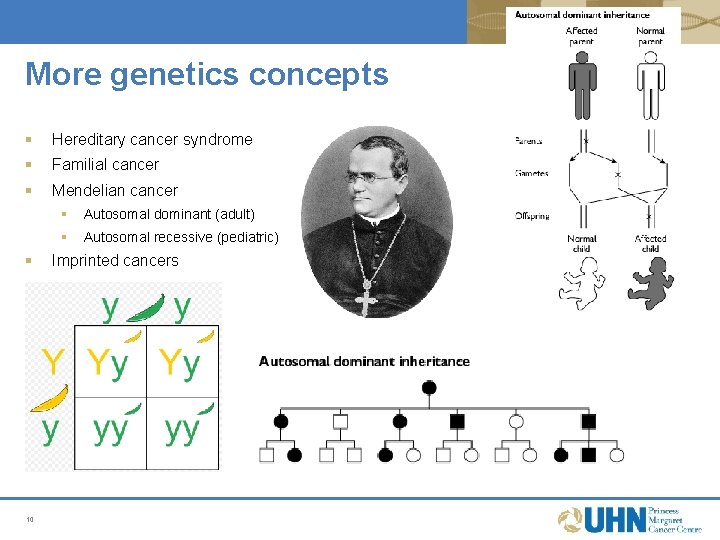
More genetics concepts § Hereditary cancer syndrome § Familial cancer § Mendelian cancer § 10 § Autosomal dominant (adult) § Autosomal recessive (pediatric) Imprinted cancers
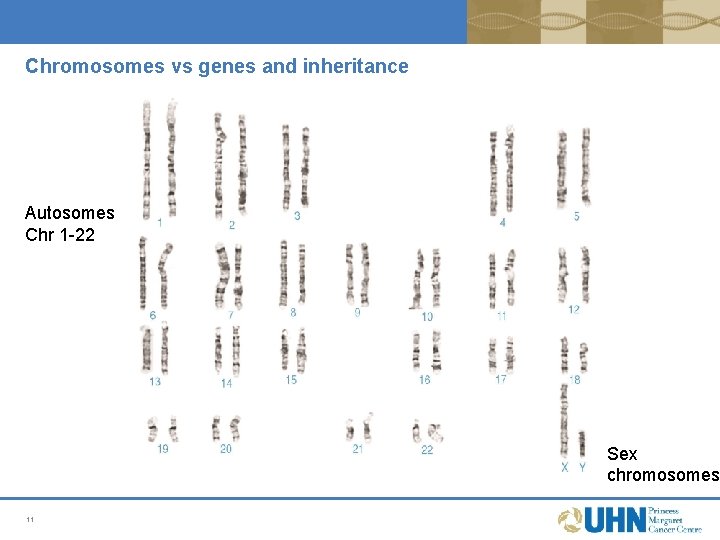
Chromosomes vs genes and inheritance Autosomes Chr 1 -22 Sex chromosomes 11
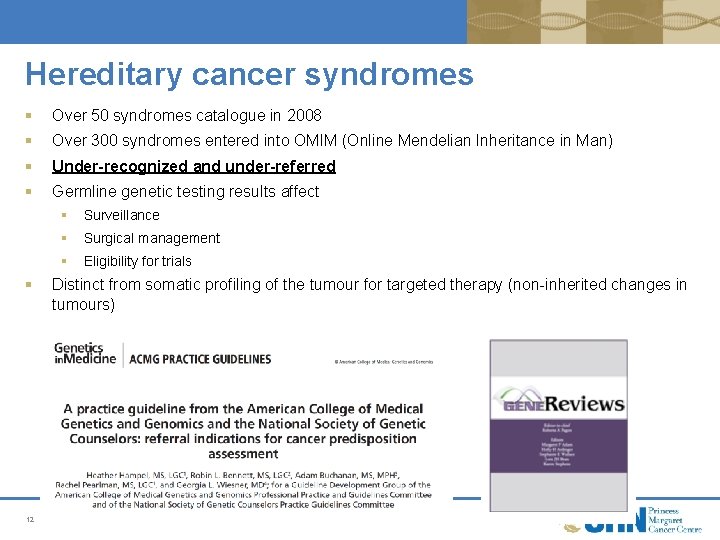
Hereditary cancer syndromes § Over 50 syndromes catalogue in 2008 § Over 300 syndromes entered into OMIM (Online Mendelian Inheritance in Man) § Under-recognized and under-referred § Germline genetic testing results affect § 12 § Surveillance § Surgical management § Eligibility for trials Distinct from somatic profiling of the tumour for targeted therapy (non-inherited changes in tumours)
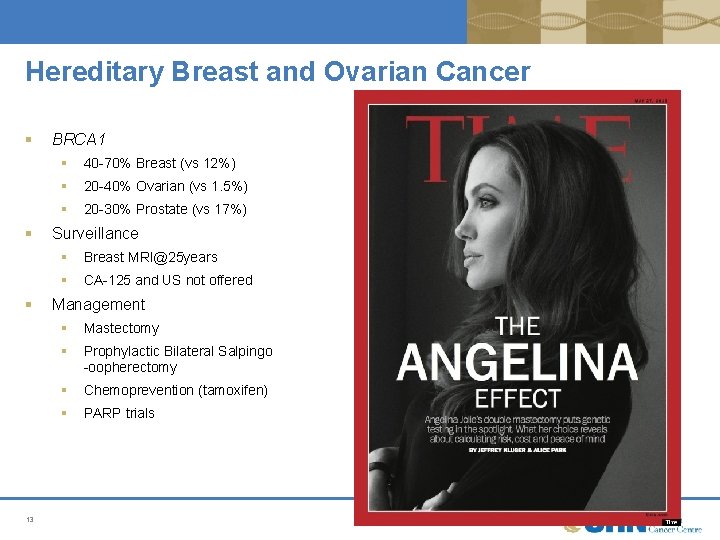
Hereditary Breast and Ovarian Cancer § § § 13 BRCA 1 § 40 -70% Breast (vs 12%) § 20 -40% Ovarian (vs 1. 5%) § 20 -30% Prostate (vs 17%) Surveillance § Breast MRI@25 years § CA-125 and US not offered Management § Mastectomy § Prophylactic Bilateral Salpingo -oopherectomy § Chemoprevention (tamoxifen) § PARP trials
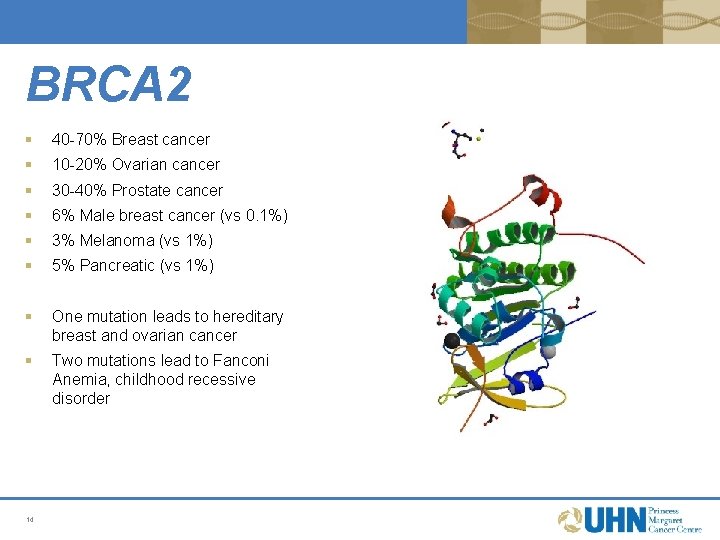
BRCA 2 § 40 -70% Breast cancer § 10 -20% Ovarian cancer § 30 -40% Prostate cancer § 6% Male breast cancer (vs 0. 1%) § 3% Melanoma (vs 1%) § 5% Pancreatic (vs 1%) § One mutation leads to hereditary breast and ovarian cancer § Two mutations lead to Fanconi Anemia, childhood recessive disorder 14
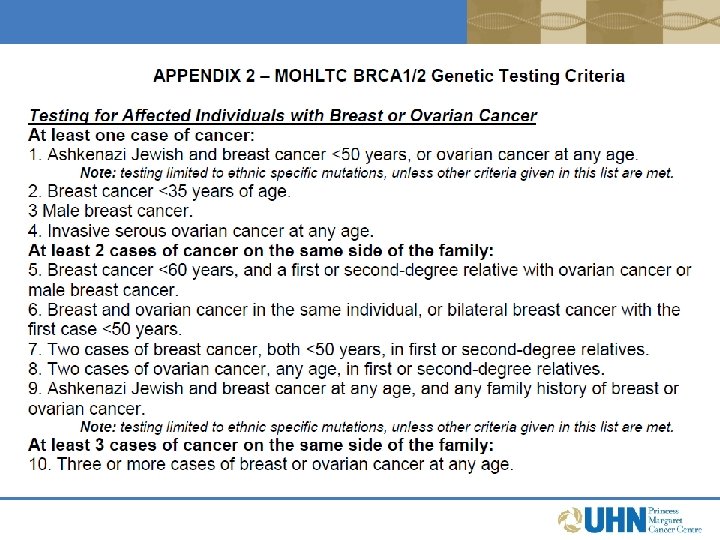
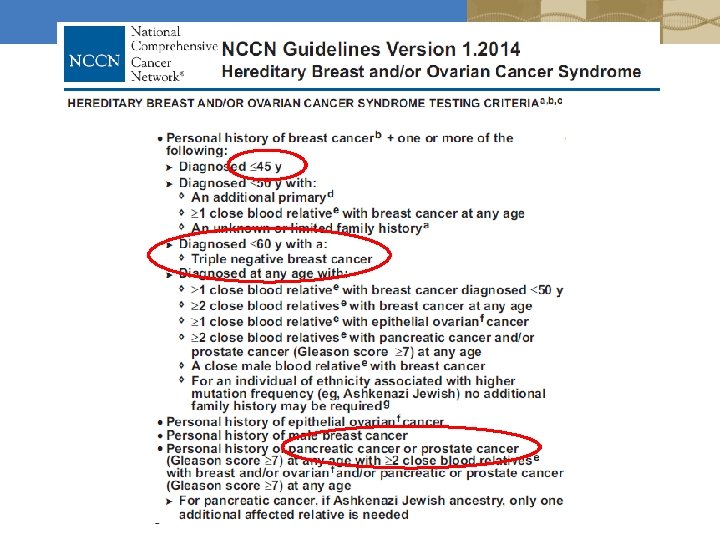
When to suspect BRCA 1/2 in the medical oncology clinic? § Patient is from a BRCA 1/2 family (need to ASK!) § Ethnicity: Ashkenazi Jewish § Bilateral breast cancer § Age: under 35 § Male Breast cancer § Invasive Serous Ovarian cancer § Medullary breast cancer ~11% BRCA 1 § Triple negative breast cancer <60 (NCCN) § Strong family history of breast and ovarian cancer § Variety of criteria, depends on age and number of family members affected § Ontario Ministry of Health Guidelines § National Comprehensive Cancer Network Guidelines § Guidelines exist to have a diagnostic yield ~10% 15
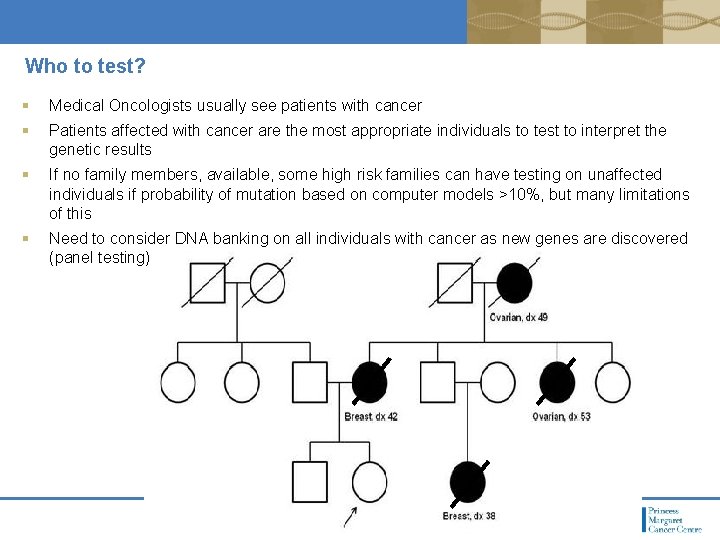
Who to test? § Medical Oncologists usually see patients with cancer § Patients affected with cancer are the most appropriate individuals to test to interpret the genetic results § If no family members, available, some high risk families can have testing on unaffected individuals if probability of mutation based on computer models >10%, but many limitations of this § Need to consider DNA banking on all individuals with cancer as new genes are discovered (panel testing)
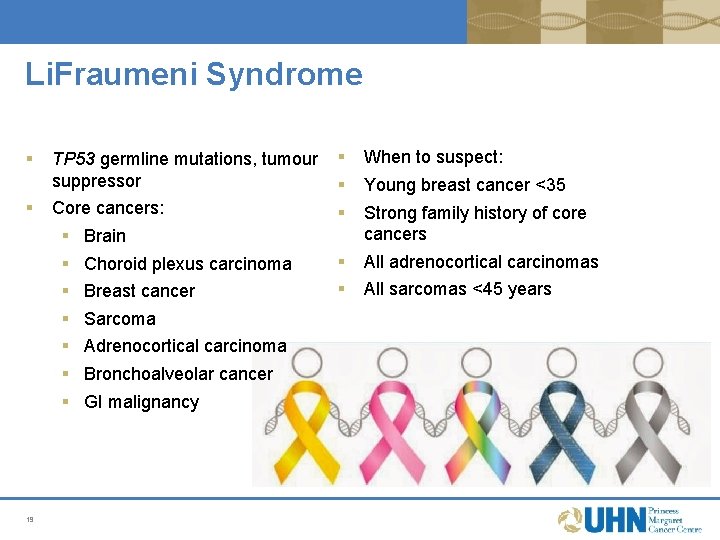
Li. Fraumeni Syndrome § § TP 53 germline mutations, tumour § suppressor § Core cancers: § § § § 19 Brain Choroid plexus carcinoma Breast cancer Sarcoma Adrenocortical carcinoma Bronchoalveolar cancer GI malignancy § § When to suspect: Young breast cancer <35 Strong family history of core cancers All adrenocortical carcinomas All sarcomas <45 years
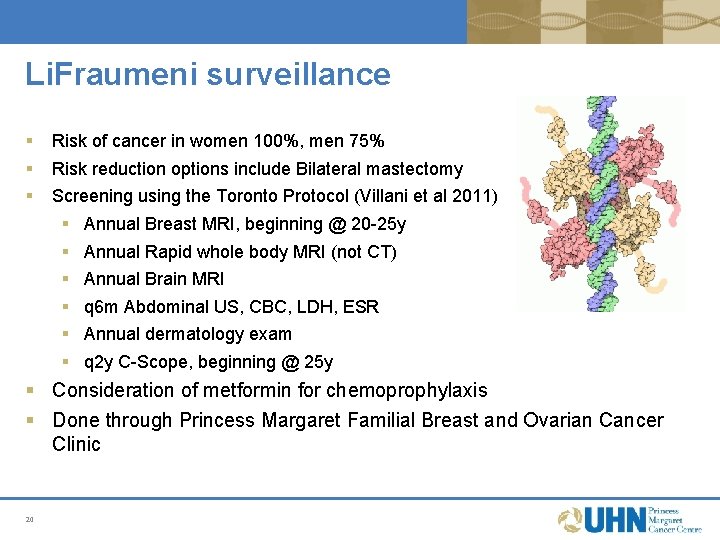
Li. Fraumeni surveillance § § § Risk of cancer in women 100%, men 75% Risk reduction options include Bilateral mastectomy Screening using the Toronto Protocol (Villani et al 2011) § § § Annual Breast MRI, beginning @ 20 -25 y Annual Rapid whole body MRI (not CT) Annual Brain MRI q 6 m Abdominal US, CBC, LDH, ESR Annual dermatology exam q 2 y C-Scope, beginning @ 25 y § Consideration of metformin for chemoprophylaxis § Done through Princess Margaret Familial Breast and Ovarian Cancer Clinic 20
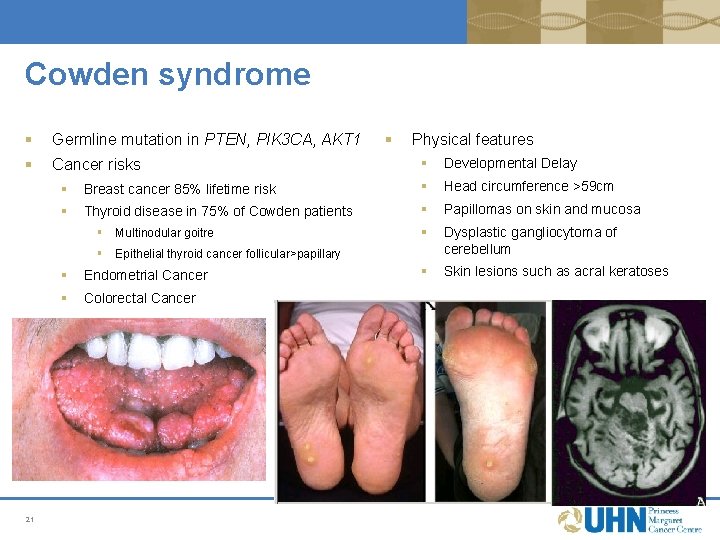
Cowden syndrome § Germline mutation in PTEN, PIK 3 CA, AKT 1 § Cancer risks § Physical features § Developmental Delay § Breast cancer 85% lifetime risk § Head circumference >59 cm § Thyroid disease in 75% of Cowden patients § Papillomas on skin and mucosa § Dysplastic gangliocytoma of cerebellum § Skin lesions such as acral keratoses § Multinodular goitre § Epithelial thyroid cancer follicular>papillary 21 § Endometrial Cancer § Colorectal Cancer
Surveillance in Cowden syndrome § § § § 22 Annual thyroid ultrasound from childhood High risk Breast screening MRI/mammography @30 Colonoscopy @35, q 5 years Renal ultrasound @40 Endometrial biopsy@30 Annual dermatologic exam Conducted through Princess Margaret Familial Breast and Ovarian Cancer Clinic
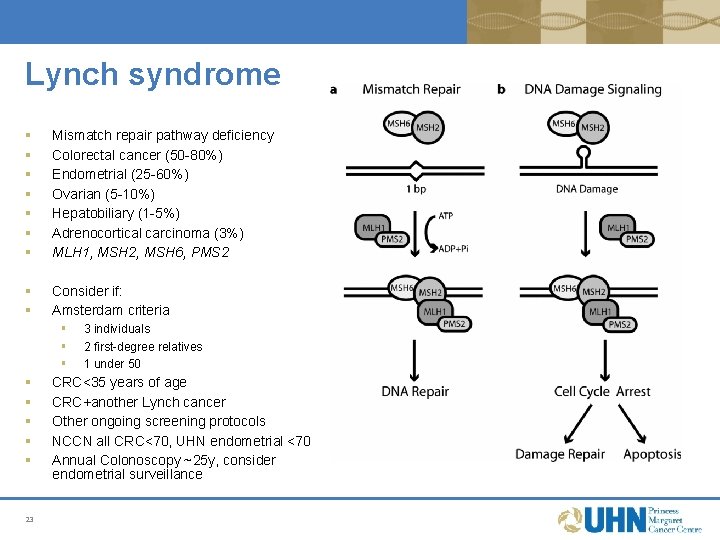
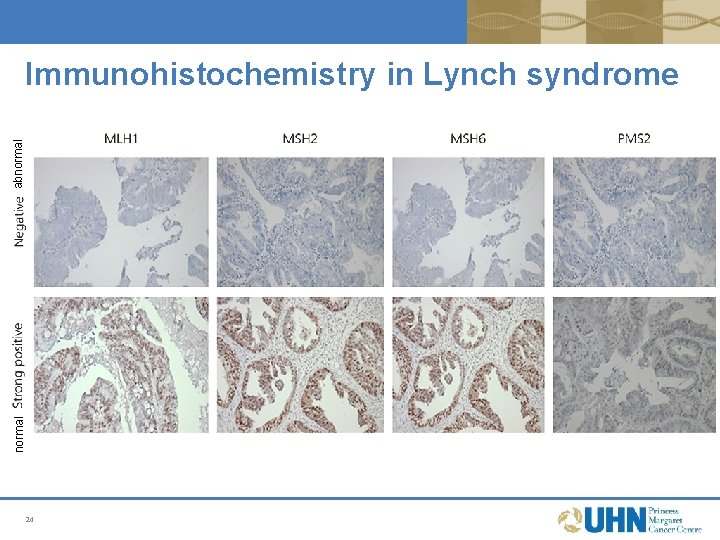
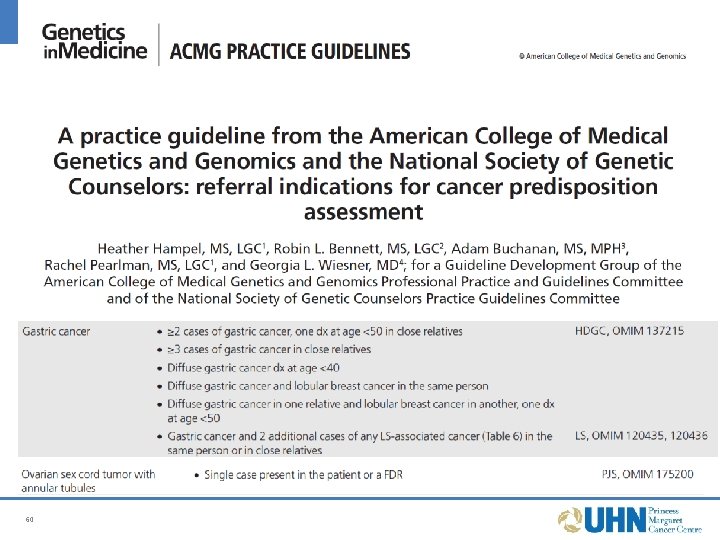
Lynch syndrome § § § § Mismatch repair pathway deficiency Colorectal cancer (50 -80%) Endometrial (25 -60%) Ovarian (5 -10%) Hepatobiliary (1 -5%) Adrenocortical carcinoma (3%) MLH 1, MSH 2, MSH 6, PMS 2 § § Consider if: Amsterdam criteria § § § § 23 3 individuals 2 first-degree relatives 1 under 50 CRC<35 years of age CRC+another Lynch cancer Other ongoing screening protocols NCCN all CRC<70, UHN endometrial <70 Annual Colonoscopy ~25 y, consider endometrial surveillance
normal abnormal Immunohistochemistry in Lynch syndrome 24
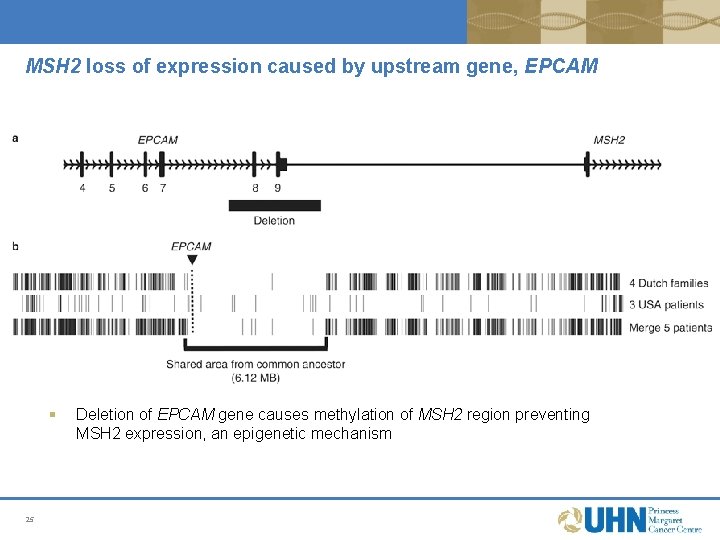
MSH 2 loss of expression caused by upstream gene, EPCAM § 25 Deletion of EPCAM gene causes methylation of MSH 2 region preventing MSH 2 expression, an epigenetic mechanism
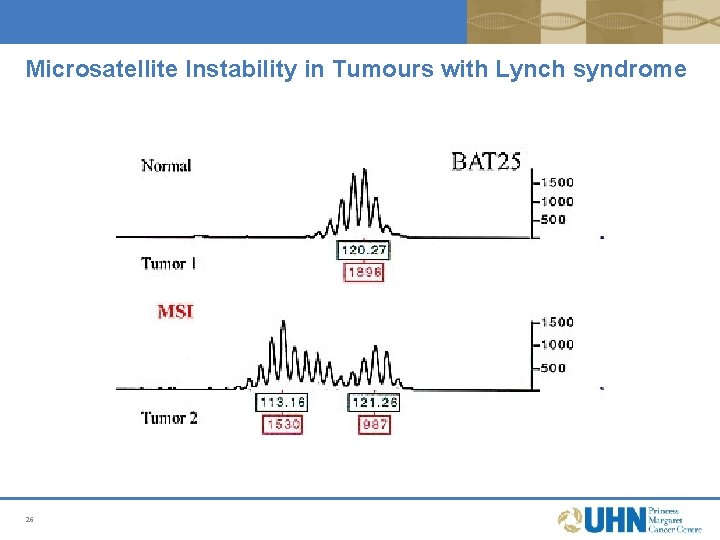
Microsatellite Instability in Tumours with Lynch syndrome 26
27
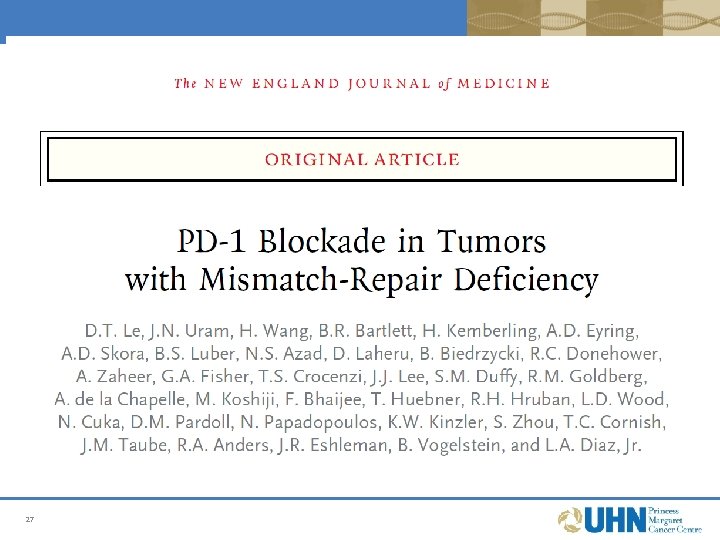
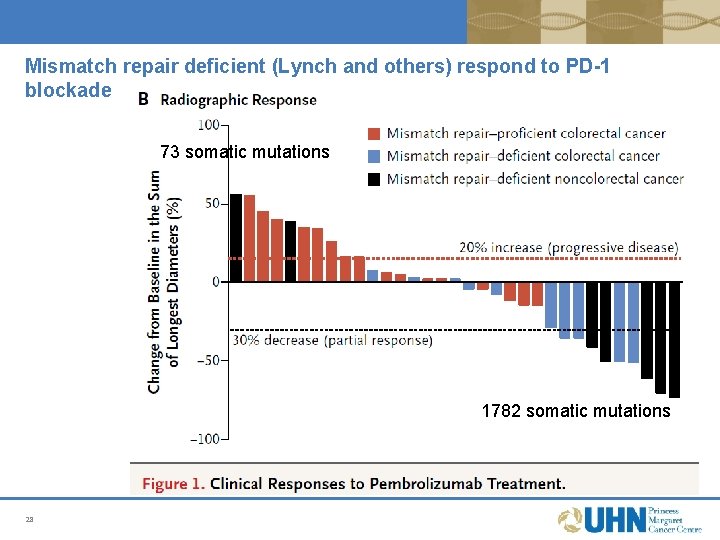
Mismatch repair deficient (Lynch and others) respond to PD-1 blockade 73 somatic mutations 1782 somatic mutations 28
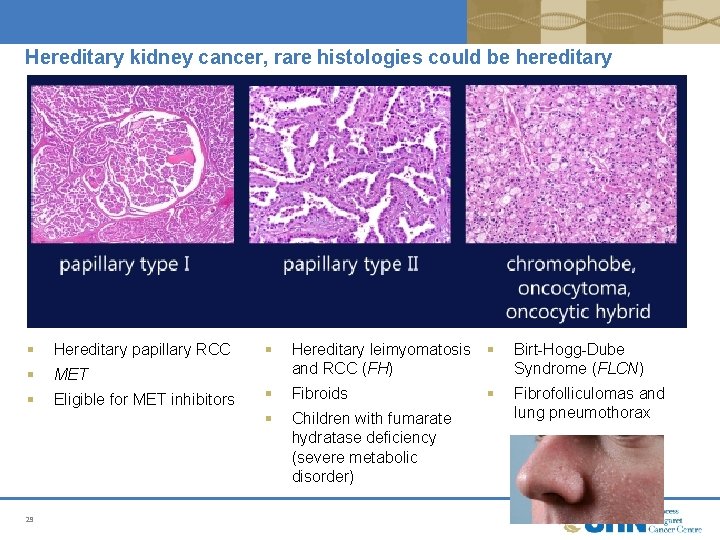
Hereditary kidney cancer, rare histologies could be hereditary § Hereditary papillary RCC § MET § Eligible for MET inhibitors 29 § Hereditary leimyomatosis § and RCC (FH) § Fibroids § Children with fumarate hydratase deficiency (severe metabolic disorder) § Birt-Hogg-Dube Syndrome (FLCN) Fibrofolliculomas and lung pneumothorax
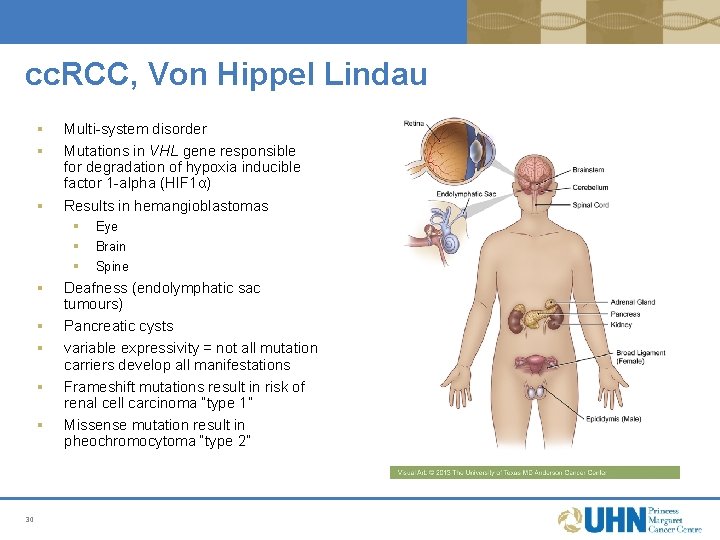
cc. RCC, Von Hippel Lindau § § § Multi-system disorder Mutations in VHL gene responsible for degradation of hypoxia inducible factor 1 -alpha (HIF 1α) Results in hemangioblastomas § § § § 30 Eye Brain Spine Deafness (endolymphatic sac tumours) Pancreatic cysts variable expressivity = not all mutation carriers develop all manifestations Frameshift mutations result in risk of renal cell carcinoma “type 1” Missense mutation result in pheochromocytoma “type 2”
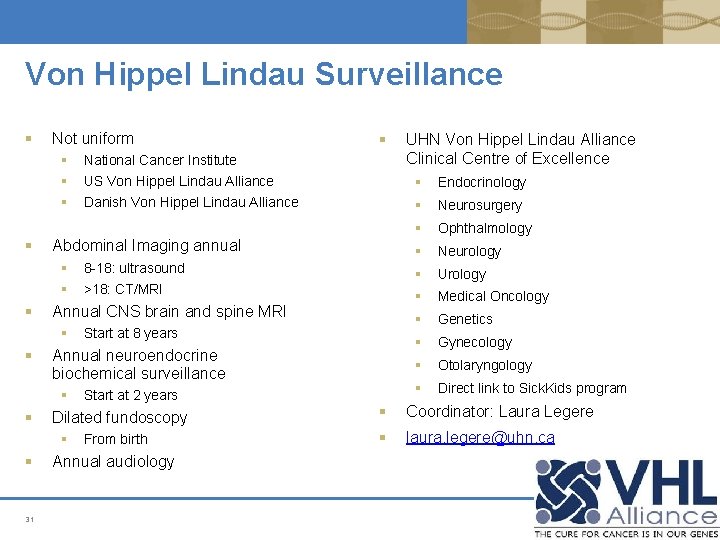
Von Hippel Lindau Surveillance § Not uniform § § § 31 Endocrinology Danish Von Hippel Lindau Alliance § Neurosurgery § Ophthalmology § Neurology § Urology § Medical Oncology § Genetics § Gynecology § Otolaryngology § Direct link to Sick. Kids program 8 -18: ultrasound >18: CT/MRI Start at 8 years Start at 2 years Dilated fundoscopy § § § Annual neuroendocrine biochemical surveillance § UHN Von Hippel Lindau Alliance Clinical Centre of Excellence US Von Hippel Lindau Alliance Annual CNS brain and spine MRI § § National Cancer Institute Abdominal Imaging annual § § From birth Annual audiology § Coordinator: Laura Legere § laura. legere@uhn. ca
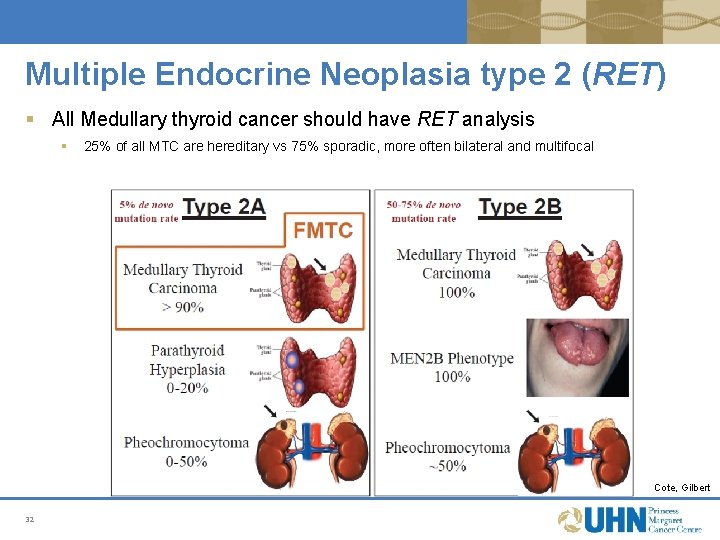
Multiple Endocrine Neoplasia type 2 (RET) § All Medullary thyroid cancer should have RET analysis § 25% of all MTC are hereditary vs 75% sporadic, more often bilateral and multifocal Cote, Gilbert 32
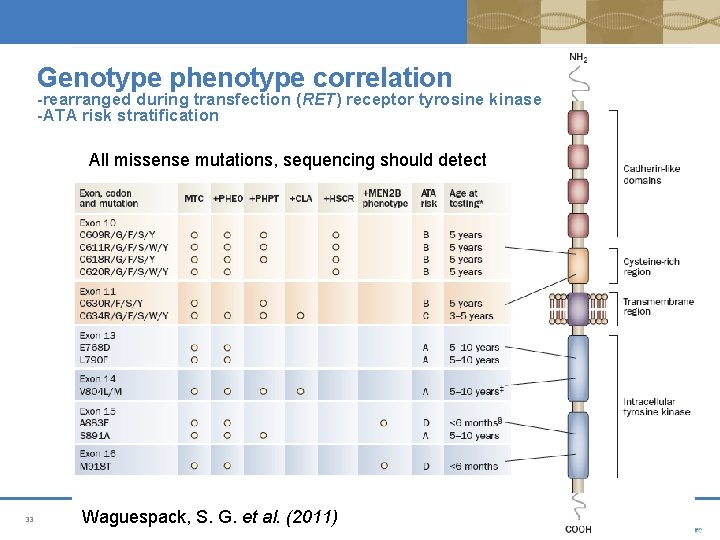
Genotype phenotype correlation -rearranged during transfection (RET) receptor tyrosine kinase -ATA risk stratification All missense mutations, sequencing should detect 33 Waguespack, S. G. et al. (2011)
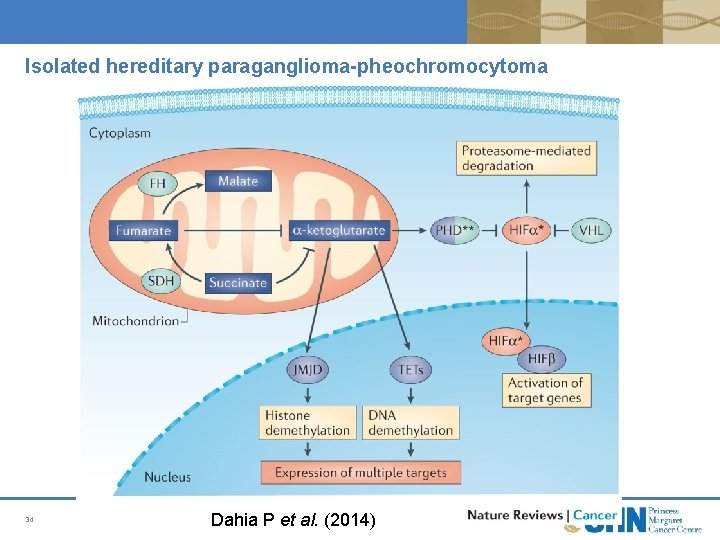
Isolated hereditary paraganglioma-pheochromocytoma 34 Dahia P et al. (2014)
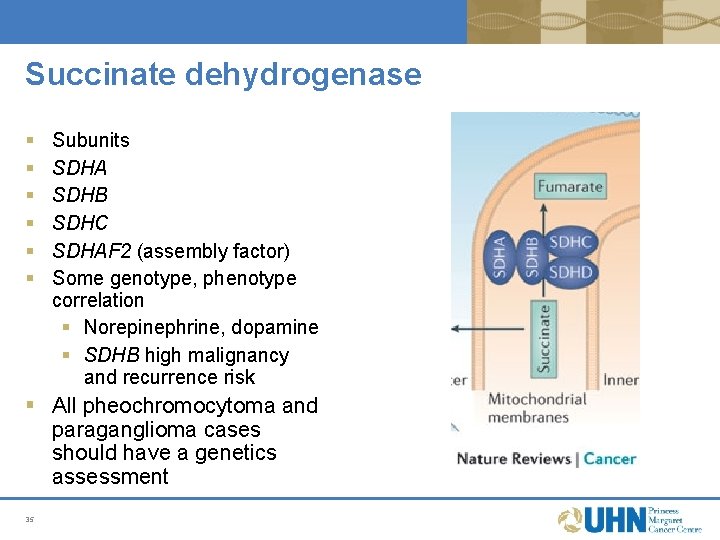
Succinate dehydrogenase § § § Subunits SDHA SDHB SDHC SDHAF 2 (assembly factor) Some genotype, phenotype correlation § Norepinephrine, dopamine § SDHB high malignancy and recurrence risk § All pheochromocytoma and paraganglioma cases should have a genetics assessment 35
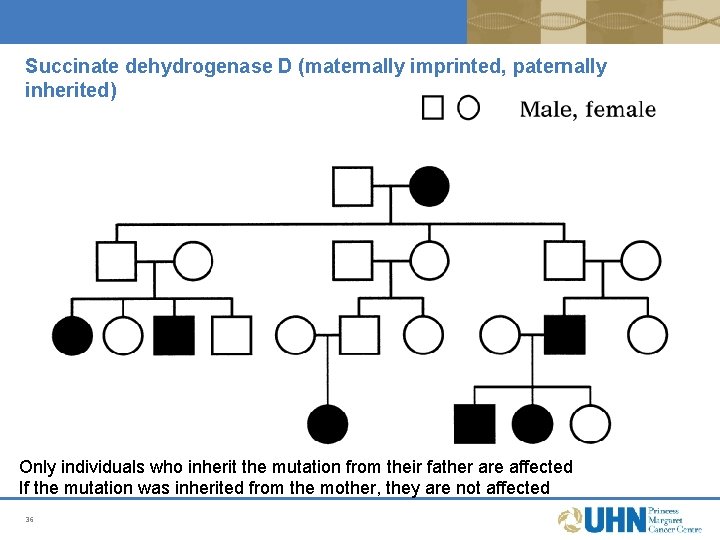
Succinate dehydrogenase D (maternally imprinted, paternally inherited) Only individuals who inherit the mutation from their father are affected If the mutation was inherited from the mother, they are not affected 36
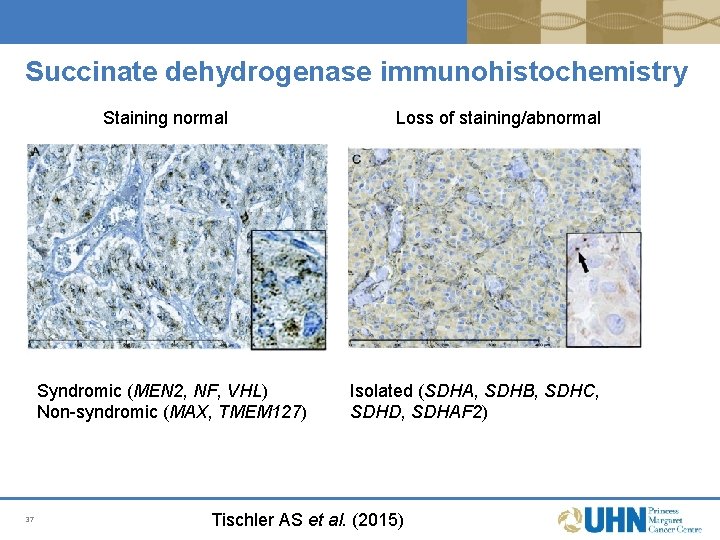
Succinate dehydrogenase immunohistochemistry Staining normal Syndromic (MEN 2, NF, VHL) Non-syndromic (MAX, TMEM 127) 37 Loss of staining/abnormal Isolated (SDHA, SDHB, SDHC, SDHD, SDHAF 2) Tischler AS et al. (2015)
Genetic Testing
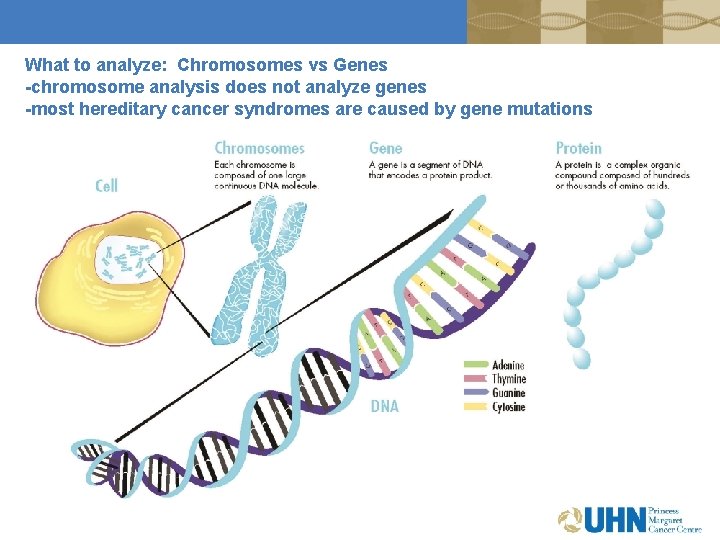
What to analyze: Chromosomes vs Genes -chromosome analysis does not analyze genes -most hereditary cancer syndromes are caused by gene mutations
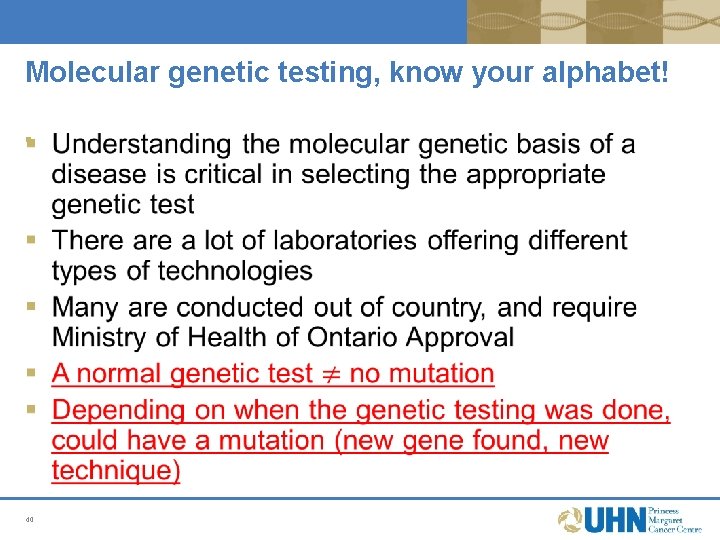
Molecular genetic testing, know your alphabet! § 40
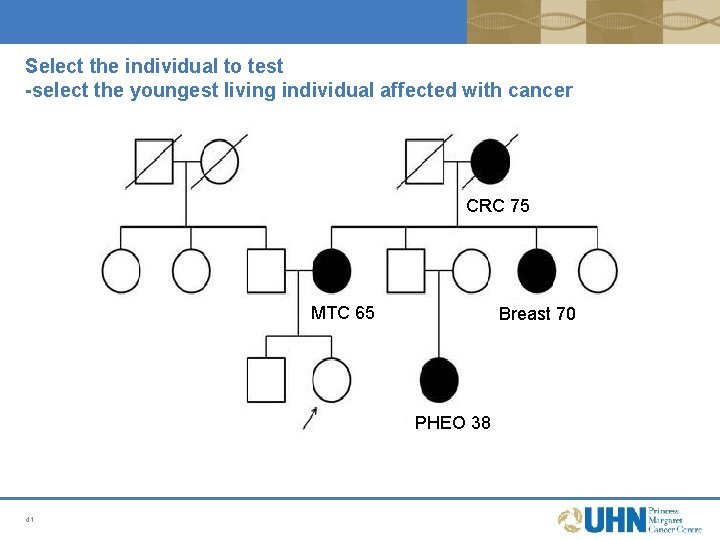
Select the individual to test -select the youngest living individual affected with cancer CRC 75 MTC 65 Breast 70 PHEO 38 41
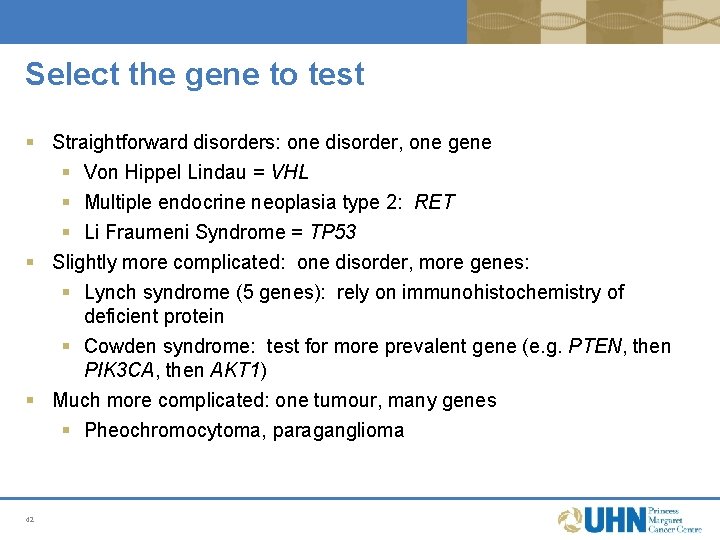
Select the gene to test § Straightforward disorders: one disorder, one gene § Von Hippel Lindau = VHL § Multiple endocrine neoplasia type 2: RET § Li Fraumeni Syndrome = TP 53 § Slightly more complicated: one disorder, more genes: § Lynch syndrome (5 genes): rely on immunohistochemistry of deficient protein § Cowden syndrome: test for more prevalent gene (e. g. PTEN, then PIK 3 CA, then AKT 1) § Much more complicated: one tumour, many genes § Pheochromocytoma, paraganglioma 42
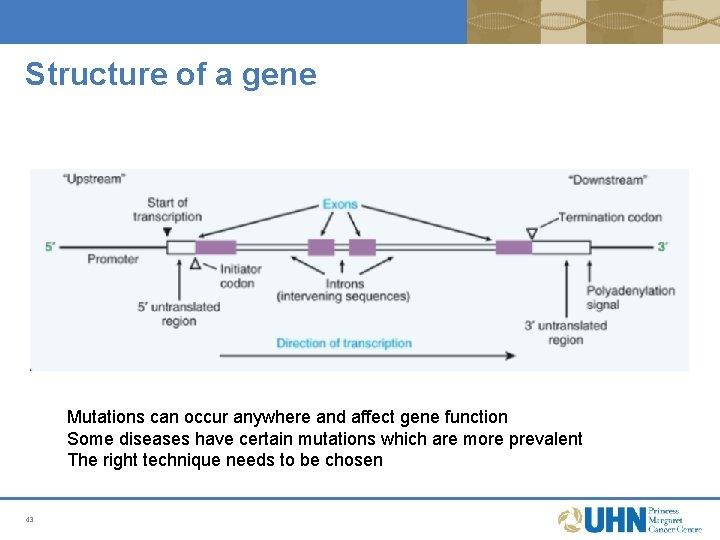
Structure of a gene Mutations can occur anywhere and affect gene function Some diseases have certain mutations which are more prevalent The right technique needs to be chosen 43
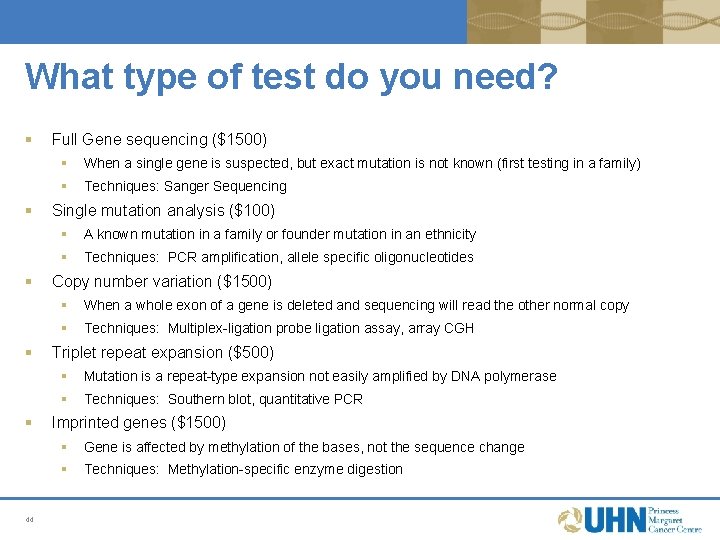
What type of test do you need? § § § 44 Full Gene sequencing ($1500) § When a single gene is suspected, but exact mutation is not known (first testing in a family) § Techniques: Sanger Sequencing Single mutation analysis ($100) § A known mutation in a family or founder mutation in an ethnicity § Techniques: PCR amplification, allele specific oligonucleotides Copy number variation ($1500) § When a whole exon of a gene is deleted and sequencing will read the other normal copy § Techniques: Multiplex-ligation probe ligation assay, array CGH Triplet repeat expansion ($500) § Mutation is a repeat-type expansion not easily amplified by DNA polymerase § Techniques: Southern blot, quantitative PCR Imprinted genes ($1500) § Gene is affected by methylation of the bases, not the sequence change § Techniques: Methylation-specific enzyme digestion
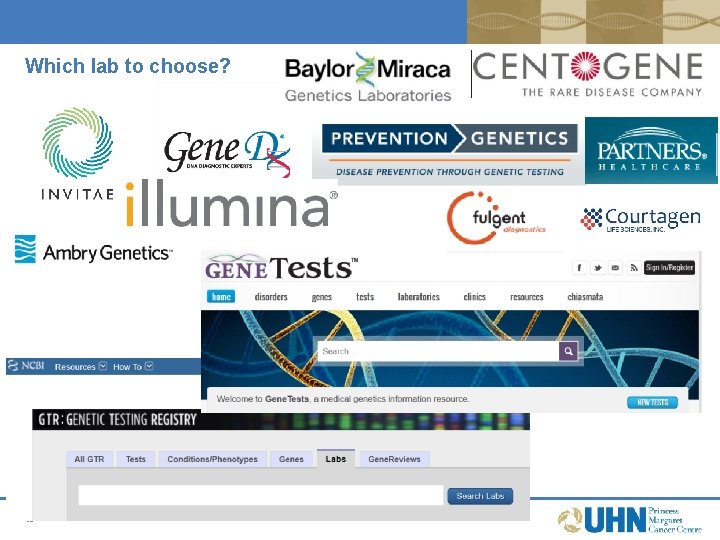
Which lab to choose? 45
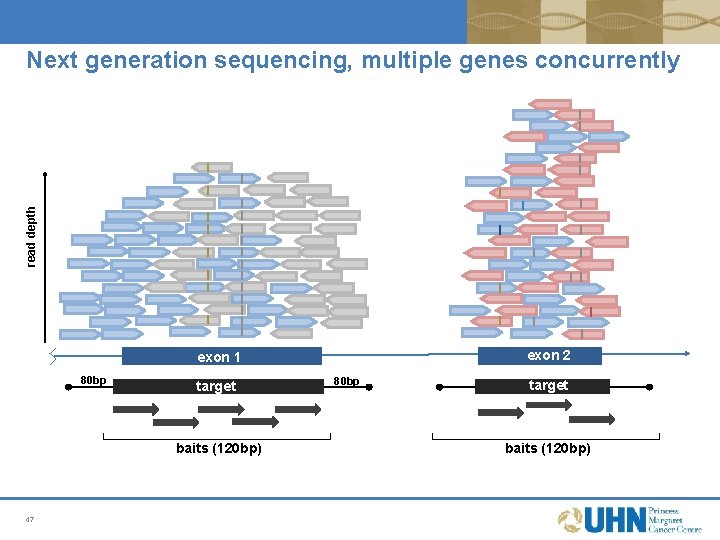
read depth Next generation sequencing, multiple genes concurrently exon 2 exon 1 80 bp target baits (120 bp) 47 80 bp target baits (120 bp)
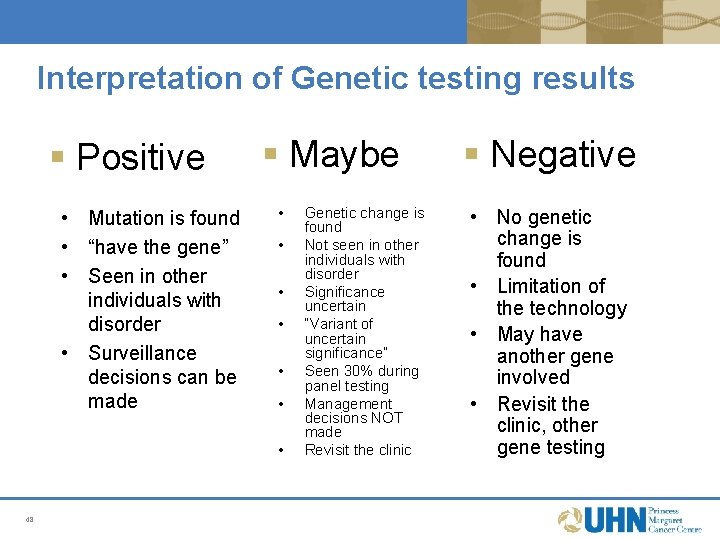
Interpretation of Genetic testing results § Positive • Mutation is found • “have the gene” • Seen in other individuals with disorder • Surveillance decisions can be made § Maybe • • 48 Genetic change is found Not seen in other individuals with disorder Significance uncertain “Variant of uncertain significance” Seen 30% during panel testing Management decisions NOT made Revisit the clinic § Negative • No genetic change is found • Limitation of the technology • May have another gene involved • Revisit the clinic, other gene testing
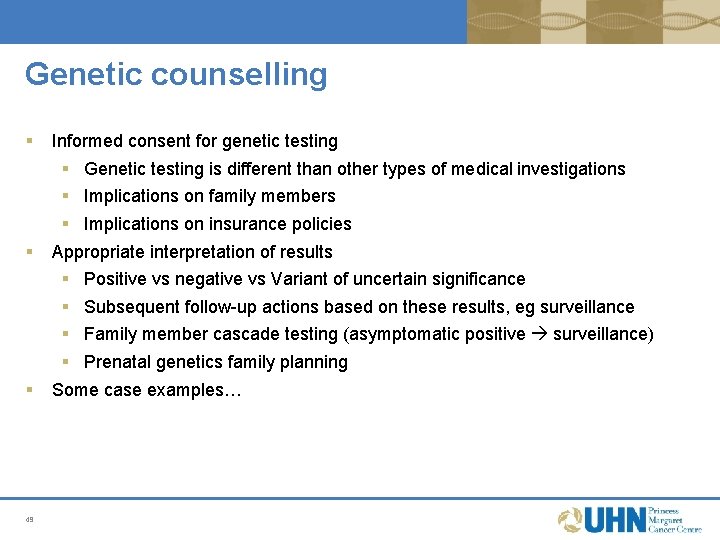
Genetic counselling § § § 49 Informed consent for genetic testing § Genetic testing is different than other types of medical investigations § Implications on family members § Implications on insurance policies Appropriate interpretation of results § Positive vs negative vs Variant of uncertain significance § Subsequent follow-up actions based on these results, eg surveillance § Family member cascade testing (asymptomatic positive surveillance) § Prenatal genetics family planning Some case examples…
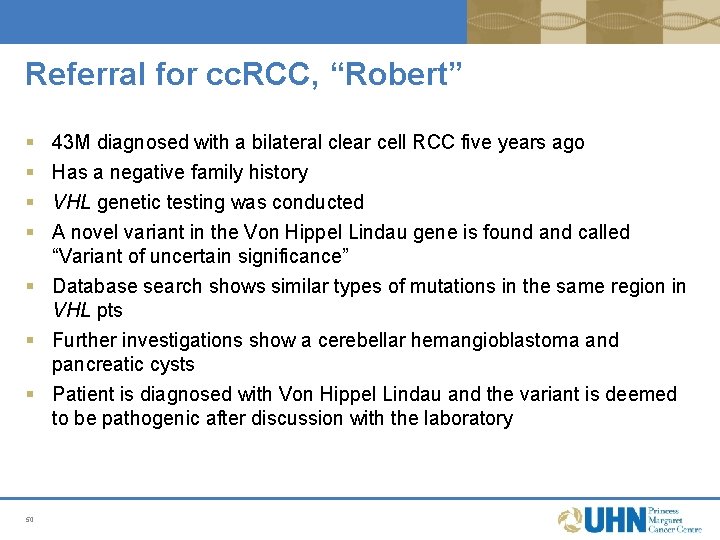
Referral for cc. RCC, “Robert” § § 43 M diagnosed with a bilateral clear cell RCC five years ago Has a negative family history VHL genetic testing was conducted A novel variant in the Von Hippel Lindau gene is found and called “Variant of uncertain significance” § Database search shows similar types of mutations in the same region in VHL pts § Further investigations show a cerebellar hemangioblastoma and pancreatic cysts § Patient is diagnosed with Von Hippel Lindau and the variant is deemed to be pathogenic after discussion with the laboratory 50
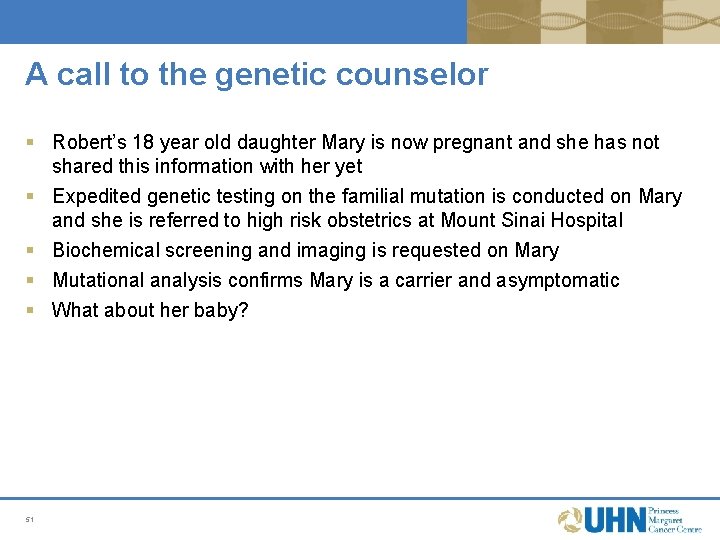
A call to the genetic counselor § Robert’s 18 year old daughter Mary is now pregnant and she has not shared this information with her yet § Expedited genetic testing on the familial mutation is conducted on Mary and she is referred to high risk obstetrics at Mount Sinai Hospital § Biochemical screening and imaging is requested on Mary § Mutational analysis confirms Mary is a carrier and asymptomatic § What about her baby? 51
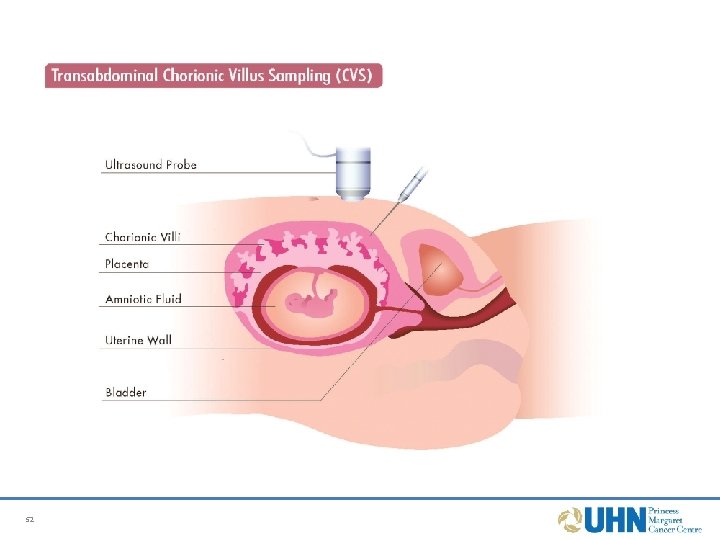
52
A call to the genetic counselor § Prenatal chorionic villus sampling at 10 weeks is conducted and the baby is a carrier of the VHL variant § After a long discussion Mary decides to terminate the pregnancy § Mary is enrolled in surveillance 53
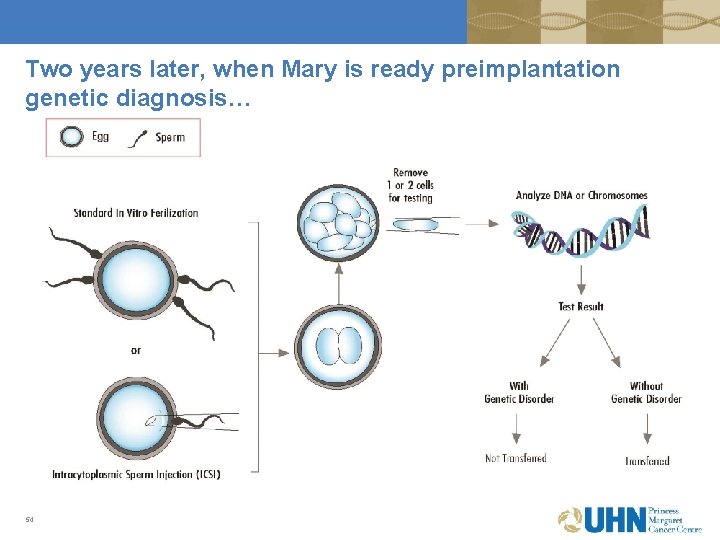
Two years later, when Mary is ready preimplantation genetic diagnosis… 54
A young breast cancer patient Charlotte § 29 year old lady with ER/PR neg, Her 2 positive breast cancer § Due to young age, gene panel is sent for genetic testing including: § BRCA 1, BRCA 2, TP 53, CDH 1, PTEN, STK 11 § § Has a mutation in TP 53, c. 1010 G>A; p. R 337 H Diagnosed with Li-Fraumeni syndrome Undergoes high risk surveillance She comes in and asks for her 2 year old daughter Mary to get tested § Do you test the daughter? 55
Family testing in hereditary cancer § The identification of a mutation in the family allows that mutation to be tracked in asymptomatic individuals “Predictive Genetic testing” § This facilitates early initiation of surveillance on family members to detect and prevent cancer § So, do you test Charlotte’s daughter Mary? § Yes, Mary is at 50% risk (1 st degree relative) of sharing the same mutation as Charlotte, and should have whole body MRI and surveillance for Li-Fraumeni syndrome 56
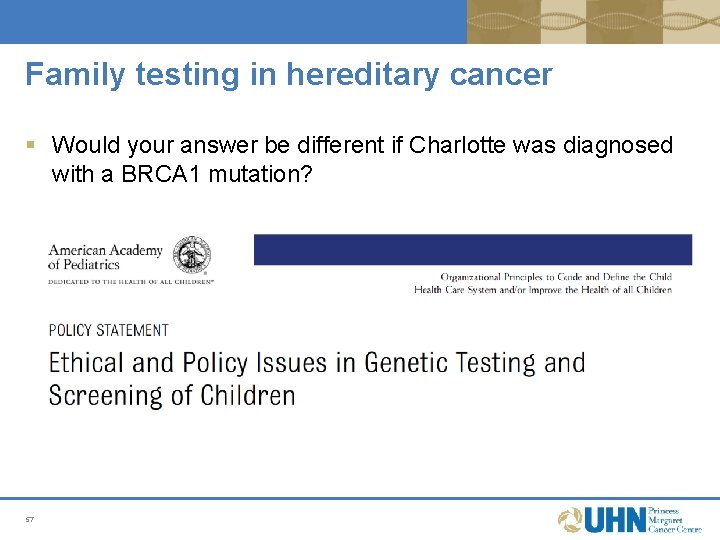
Family testing in hereditary cancer § Would your answer be different if Charlotte was diagnosed with a BRCA 1 mutation? 57
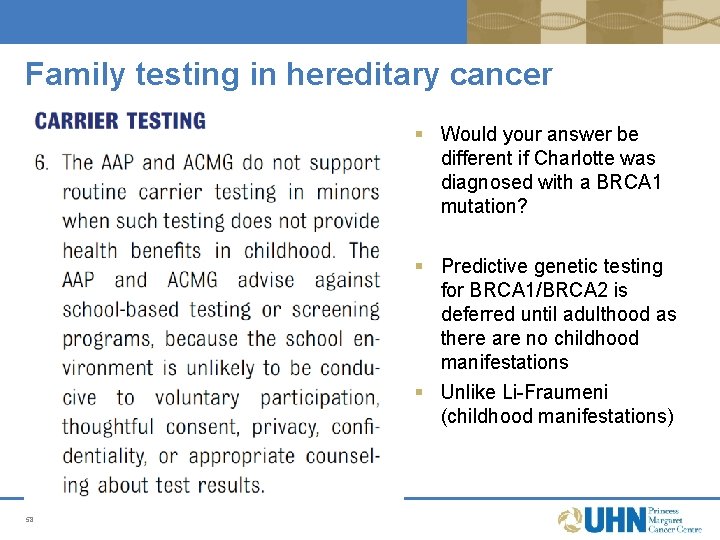
Family testing in hereditary cancer § Would your answer be different if Charlotte was diagnosed with a BRCA 1 mutation? § Predictive genetic testing for BRCA 1/BRCA 2 is deferred until adulthood as there are no childhood manifestations § Unlike Li-Fraumeni (childhood manifestations) 58
Outline § Genetic terminology and concepts § Hereditary cancers § When to consider § Genetics assessment § Surveillance § Hereditary breast cancer syndromes § Hereditary colorectal cancer syndromes § Hereditary kidney cancer syndromes § Hereditary endocrine cancer syndromes § Genetic testing § Genetic counseling 59
60
raymond. kim@uhn. ca 61