
RUOLO DEL NEXT GENERATION SEQUENCING NELLA DIAGNOSI E
- Slides: 32
“RUOLO DEL NEXT GENERATION SEQUENCING NELLA DIAGNOSI E NEL CONTROLLO DELLA TUBERCOLOSI” DM Cirillo, MD, Ph. D WHO Collaborating Centre for TB Laboratory Strengthening ITA-98 Supranational Reference Laboratory Milan Emerging Bacterial Pathogens Unit, San Raffaele Scientific Institute, Milan
SOMMARIO • INTRODUZIONE – LA DIAGNOSI DI TUBERCOLOSI E LE PROBLEMATICHE CORRELATE – NUOVI TEST PER MDR TB RACCOMANDATI DAL WHO • Whole Genome Sequencing PER LA DIAGNOSI E SORVEGLIANZA DI MDRTB – RESEQ-TB E CRYPTIC – Mutation Encyclopedia – STANDARDIZZAZIONE DEL REFERTO • • • ANALISI MOLECOLARE PER INDIRIZZARE UN TRATTAMENTO APPROPRIATO Whole Genome Sequencing PER L’IDENTIFICAZIONE DELLE TRASMISSIONI CONCLUSIONI
COI • DC è coinvolta della validazione di nuovi diagnostici per conto di FIND • DC è parte di Reseq TB e Cryptic
FENOTIPO O GENOTIPO? FENOTIPO • Lunghi tempi di crescita • Strumentazione, training, BSL 3 • Concentrazioni Critiche spesso non corrette GENOTIPO • Rapido • BSL 2 o BSL 1 • Completamente automatizzabile • Sensibilità? IL PUNTO NON E’ COME : CONTANO ACCURATEZZA E RAPIDITA’
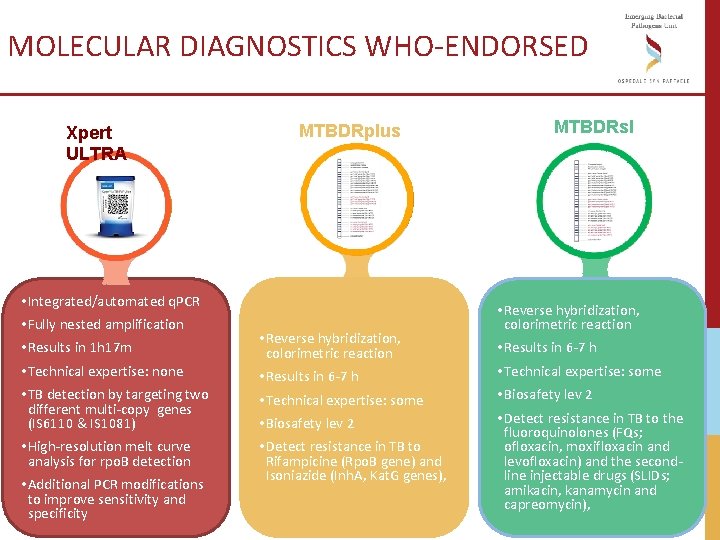
MOLECULAR DIAGNOSTICS WHO-ENDORSED Xpert ULTRA MTBDRplus • Integrated/automated q. PCR • Fully nested amplification • Results in 1 h 17 m • Technical expertise: none • TB detection by targeting two different multi-copy genes (IS 6110 & IS 1081) • High-resolution melt curve analysis for rpo. B detection • Additional PCR modifications to improve sensitivity and specificity • Reverse hybridization, colorimetric reaction • Results in 6 -7 h • Technical expertise: some • Biosafety lev 2 • Detect resistance in TB to Rifampicine (Rpo. B gene) and Isoniazide (Inh. A, Kat. G genes), MTBDRsl • Reverse hybridization, colorimetric reaction • Results in 6 -7 h • Technical expertise: some • Biosafety lev 2 • Detect resistance in TB to the fluoroquinolones (FQs; ofloxacin, moxifloxacin and levofloxacin) and the secondline injectable drugs (SLIDs; amikacin, kanamycin and capreomycin),
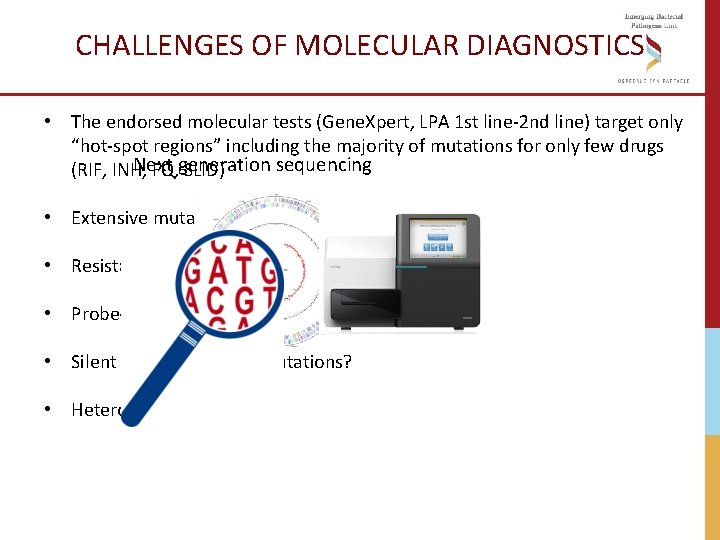
CHALLENGES OF MOLECULAR DIAGNOSTICS • The endorsed molecular tests (Gene. Xpert, LPA 1 st line-2 nd line) target only “hot-spot regions” including the majority of mutations for only few drugs Next generation sequencing (RIF, INH, FQ, SLID) • Extensive mutations (pnc. A)? • Resistance markers in multiple genes? • Probe-based: Can only detect known determinants • Silent and not relevant mutations? • Heteroresistance
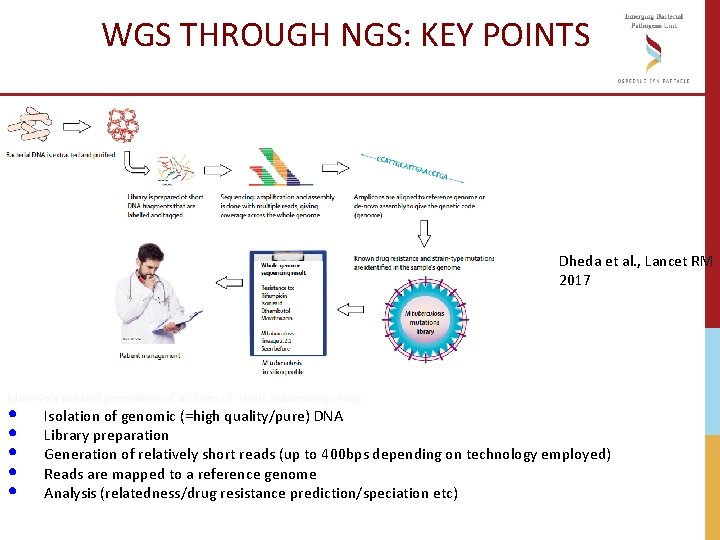
WGS THROUGH NGS: KEY POINTS Dheda et al. , Lancet RM 2017 Massively parallel generation of millions of short sequencing reads : • • • Isolation of genomic (=high quality/pure) DNA Library preparation Generation of relatively short reads (up to 400 bps depending on technology employed) Reads are mapped to a reference genome Analysis (relatedness/drug resistance prediction/speciation etc)
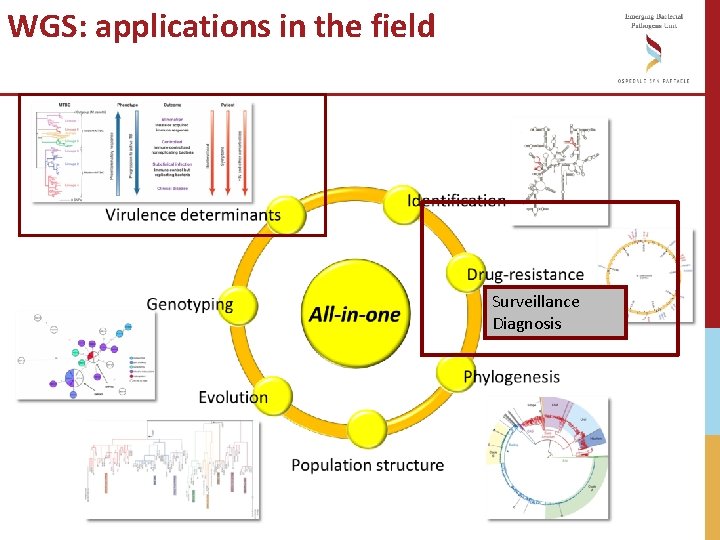
WGS: applications in the field Surveillance Diagnosis
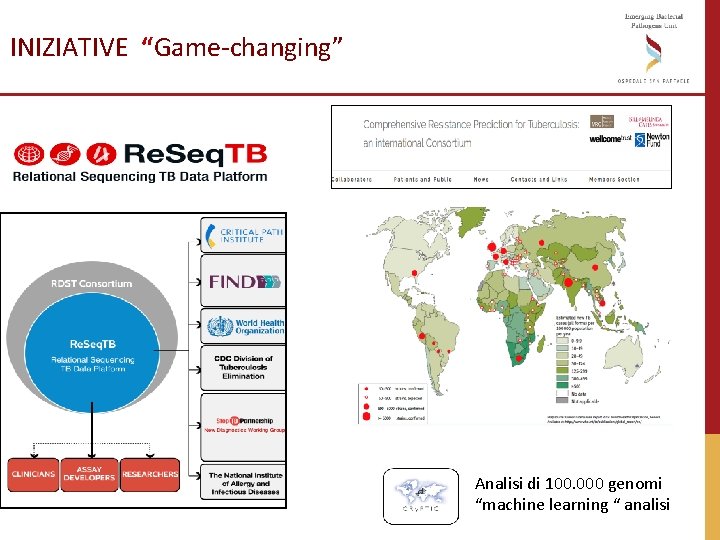
INIZIATIVE “Game-changing” Analisi di 100. 000 genomi “machine learning “ analisi
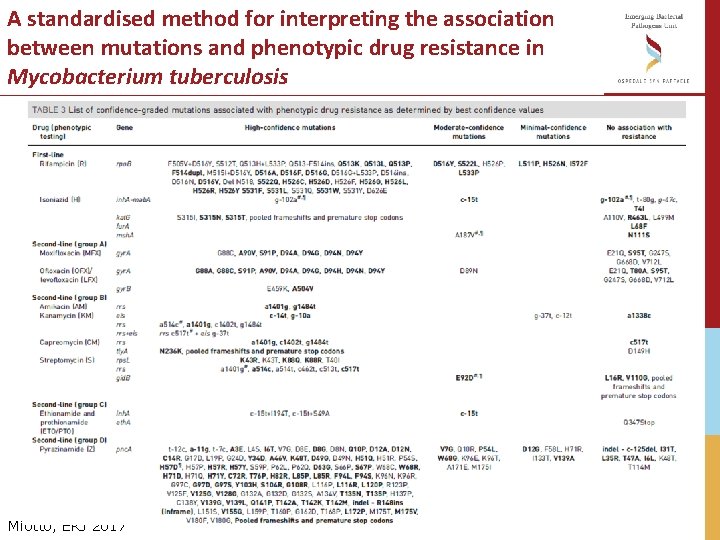
A standardised method for interpreting the association between mutations and phenotypic drug resistance in Mycobacterium tuberculosis Miotto, ERJ 2017
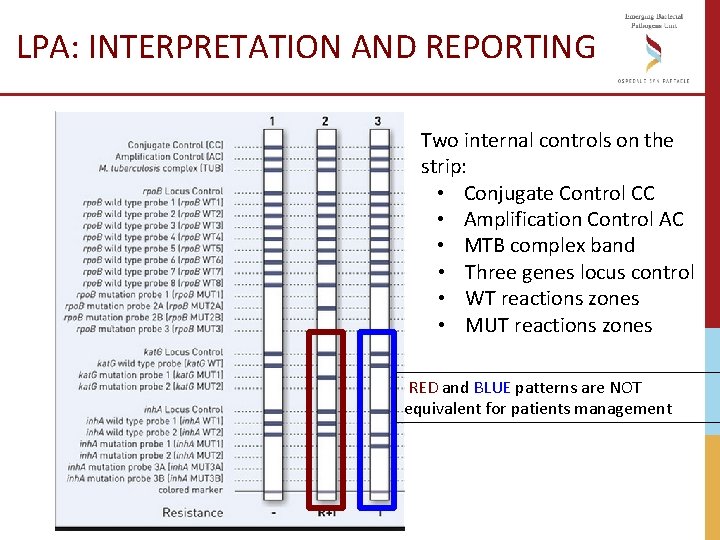
LPA: INTERPRETATION AND REPORTING Two internal controls on the strip: • Conjugate Control CC • Amplification Control AC • MTB complex band • Three genes locus control • WT reactions zones • MUT reactions zones RED and BLUE patterns are NOT equivalent for patients management
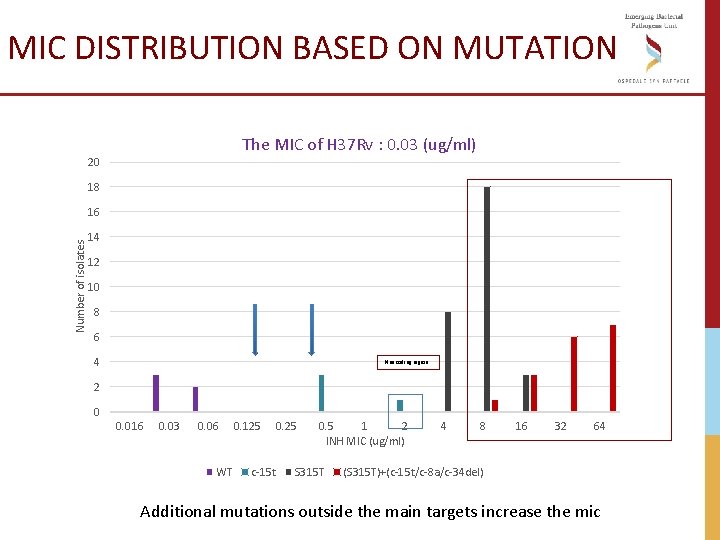
MIC DISTRIBUTION BASED ON MUTATION The MIC of H 37 Rv : 0. 03 (ug/ml) 20 18 Number of isolates 16 14 12 10 8 6 4 Plus coding region 2 0 0. 016 0. 03 0. 06 WT 0. 125 c-15 t 0. 25 0. 5 1 2 INH MIC (ug/ml) S 315 T 4 8 16 32 64 (S 315 T)+(c-15 t/c-8 a/c-34 del) Additional mutations outside the main targets increase the mic
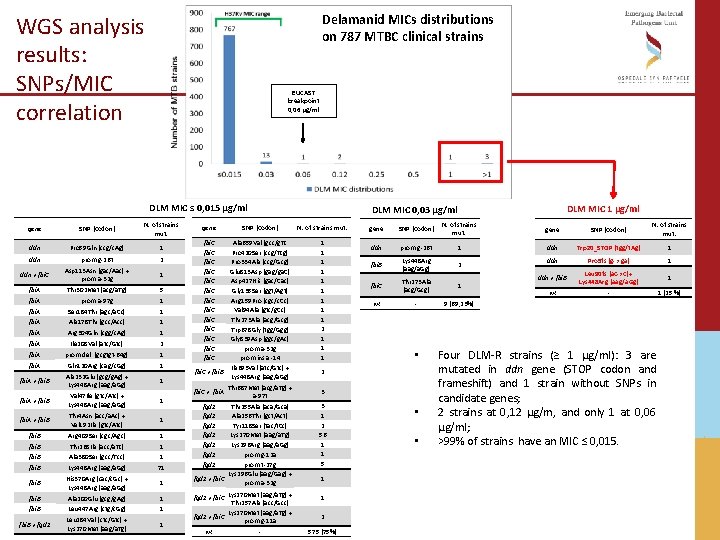
WGS analysis results: SNPs/MIC correlation Delamanid MICs distributions on 787 MTBC clinical strains EUCAST breakpoint 0, 06 µg/ml DLM MIC ≤ 0, 015 µg/ml gene SNP (codon) N. of strains mut. ddn Pro 59 Gln (ccg/c. Ag) 1 ddn prom g-26 t 2 ddn + fbi. C Asp 113 Asn (gac/Aac) + 1 prom a-32 g fbi. A Thr 302 Met (acg/a. Tg) 5 fbi. A prom a-97 g 1 fbi. A Ser 184 Thr (agc/a. Cc) 1 fbi. A Ala 178 Thr (gcc/Acc) 1 fbi. A Arg 304 Gln (cgg/c. Ag) 1 fbi. A Ile 208 Val (atc/Gtc) 2 fbi. A prom del (gcgtgt-64 g) 1 fbi. A Gln 120 Arg (cag/c. Gg) 1 fbi. A + fbi. B Ala 232 Glu (gcg/g. Ag) + Lys 448 Arg (aag/a. Gg) 1 fbi. A + fbi. B Val 47 Ile (gtc/Atc) + Lys 448 Arg (aag/a. Gg) 1 fbi. A + fbi. B Thr 4 Asn (acc/a. Ac) + Val 192 Ile (gtc/Atc) 1 fbi. B Arg 409 Ser (cgc/Agc) 1 fbi. B Thr 268 Ile (acc/a. Tc) 1 fbi. B Ala 380 Ser (gcc/Tcc) 1 fbi. B Lys 448 Arg (aag/a. Gg) 71 fbi. B His 370 Arg (cac/c. Gc) + Lys 448 Arg (aag/a. Gg) 1 gene SNP (codon) N. of strains mut. fbi. C fbi. C Ala 659 Val (gcc/g. Tc Pro 420 Ser (ccg/Tcg) Pro 334 Ala (ccg/Gcg) Glu 813 Asp (gag/ga. C) Asp 427 His (gac/Cac) Gly 135 Ser (ggt/Agt) Arg 159 Pro (cgc/c. Cc) Val 94 Ala (gtc/g. Cc) Thr 273 Ala (acg/Gcg) Trp 678 Gly (tgg/Ggg) Gly 839 Asp (ggc/g. Ac) prom a-32 g prom ins a -14 Ile 693 Val (atc/Gtc) + Lys 448 Arg (aag/a. Gg) 1 1 1 1 1 2 1 1 1 fbi. C + fbi. B fbi. C + fbi. A fbi. B Ala 200 Glu (gcg/g. Ag) 1 fbi. B Leu 447 Arg (ctg/c. Gg) 1 fbi. B + fgd 1 Leu 284 Val (ctc/Gtc) + Lys 270 Met (aag/a. Tg) 1 Thr 687 Met (acg/a. Tg) + a-97 t gene SNP (codon) N. of strains mut. ddn prom g-26 t 1 fbi. B Lys 448 Arg (aag/a. Gg) 2 fbi. C Thr 273 Ala (acg/Gcg) 1 wt - 9 (69, 23%) • 2 3 Thr 255 Ala (aca/Gca) Ala 256 Thr (gct/Act) Tyr 118 Ser (tac/t. Cc) Lys 270 Met (aag/a. Tg) Lys 296 Arg (aag/a. Gg) prom g-12 a prom t-27 g Lys 296 Glu (aag/Gag) + fgd 1 + fbi. C prom a-32 g 3 1 2 56 1 1 5 fgd 1 + fbi. C Lys 270 Met (aag/a. Tg) + Thr 257 Ala (acc/Gcc) Lys 270 Met (aag/a. Tg) + fgd 1 + fbi. C prom g-11 a wt - 1 fgd 1 fgd 1 DLM MIC 1 µg/ml DLM MIC 0, 03 µg/ml 1 2 575 (75%) • • gene SNP (codon) N. of strains mut. ddn Trp 20_STOP (tgg/t. Ag) 1 ddn Pro 5 fs (g-> ga) 1 ddn + fbi. B Leu 90 fs (ac->c) + Lys 448 Arg (aag/a. Gg) 1 wt - 1 (25 %) Four DLM-R strains (≥ 1 µg/ml): 3 are mutated in ddn gene (STOP codon and frameshift) and 1 strain without SNPs in candidate genes; 2 strains at 0, 12 µg/m, and only 1 at 0, 06 µg/ml; >99% of strains have an MIC ≤ 0, 015.
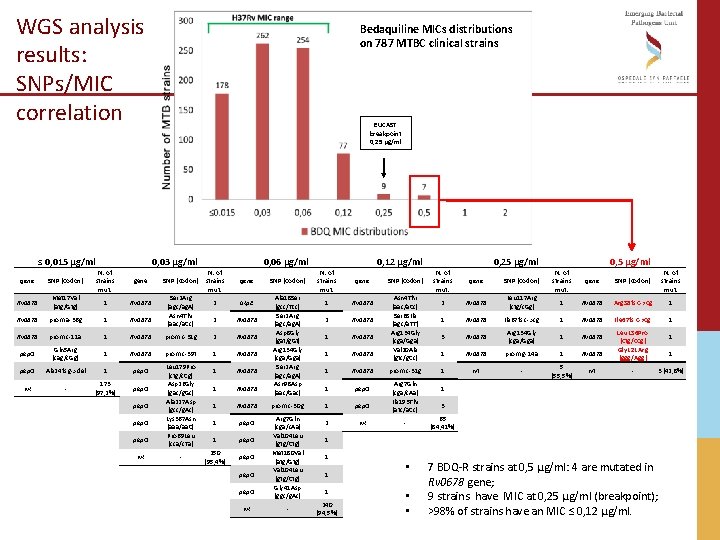
WGS analysis results: SNPs/MIC correlation ≤ 0, 015 µg/ml Bedaquiline MICs distributions on 787 MTBC clinical strains EUCAST breakpoint 0, 25 µg/ml 0, 03 µg/ml gene SNP (codon) N. of strains mut. Rv 0678 Met 17 Val (atg/Gtg) 1 Rv 0678 prom a-36 g 1 Rv 0678 gene 0, 06 µg/ml N. of SNP (codon) strains mut. Ser 2 Arg 2 (agc/ag. A) Asn 4 Thr 2 (aac/a. Cc) gene atp. E Rv 0678 prom c-11 a 1 Rv 0678 prom c-31 g 2 Rv 0678 pep. Q Gln 5 Arg (cag/c. Gg) 1 Rv 0678 prom c-39 t 1 Rv 0678 pep. Q wt Ala 24 fs g->del 1 - 173 (97, 2%) pep. Q wt Leu 179 Pro (ctg/c. Cg) Asp 26 Gly (gac/g. Gc) Ala 227 Asp (gcc/g. Ac) Lys 367 Asn (aaa/aa. C) Pro 69 Leu (cca/c. Ta) - 1 Rv 0678 1 pep. Q 250 (95, 4%) pep. Q wt SNP (codon) Ala 18 Ser (gcc/Tcc) Ser 2 Arg (agc/ag. A) Asp 8 Gly (gat/g. Gt) Arg 134 Gly (cga/Gga) Ser 2 Arg (agc/ag. A) Asn 98 Asp (aac/Gac) prom c-30 g Arg 7 Gln (cga/c. Aa) Val 104 Leu (gtg/Ctg) Met 180 Val (atg/Gtg) Val 104 Leu (gtg/Ctg) Gly 41 Asp (ggc/g. Ac) - 0, 12 µg/ml N. of strains mut. gene 1 Rv 0678 2 Rv 0678 1 pep. Q 1 pep. Q 2 wt SNP (codon) Asn 4 Thr (aac/a. Cc) Ser 68 Ile (agc/a. TT) Arg 134 Gly (cga/Gga) Val 20 Ala (gtc/g. Cc) prom c-31 g Arg 7 Gln (cga/c. Aa) Ile 193 Thr (atc/a. Cc) - 0, 25 µg/ml N. of strains mut. gene 2 1 0, 5 µg/ml SNP (codon) N. of strains mut. gene SNP (codon) N. of strains mut. Rv 0678 Leu 117 Arg (ctg/c. Gg) 1 Rv 0678 Arg 38 fs c->cg 1 Rv 0678 Ile 67 fs c->cg 1 3 Rv 0678 Arg 134 Gly (cga/Gga) 1 Rv 0678 prom g-14 a 1 Rv 0678 - 5 (55, 5%) wt 1 wt Leu 136 Pro (ctg/c. Cg) Gly 121 Arg (ggg/Agg) - 1 1 3 (42, 8%) 1 3 65 (84, 41%) 1 1 240 (94, 5%) • • • 7 BDQ-R strains at 0, 5 µg/ml: 4 are mutated in Rv 0678 gene; 9 strains have MIC at 0, 25 µg/ml (breakpoint); >98% of strains have an MIC ≤ 0, 12 µg/ml.
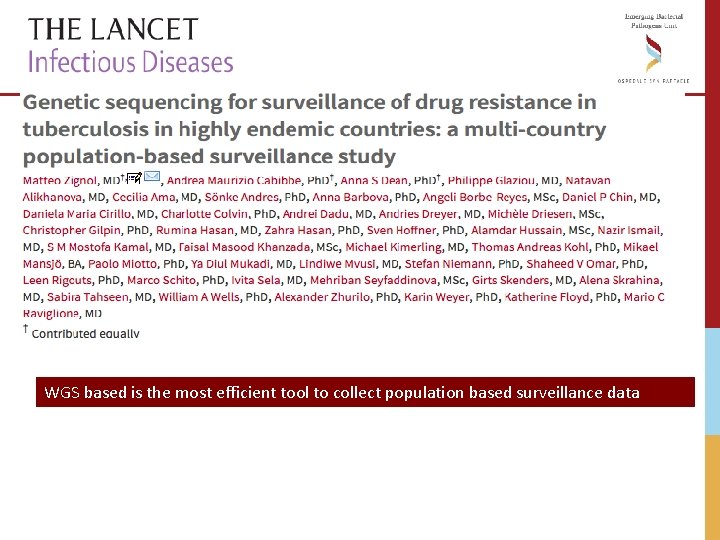
WGS based is the most efficient tool to collect population based surveillance data
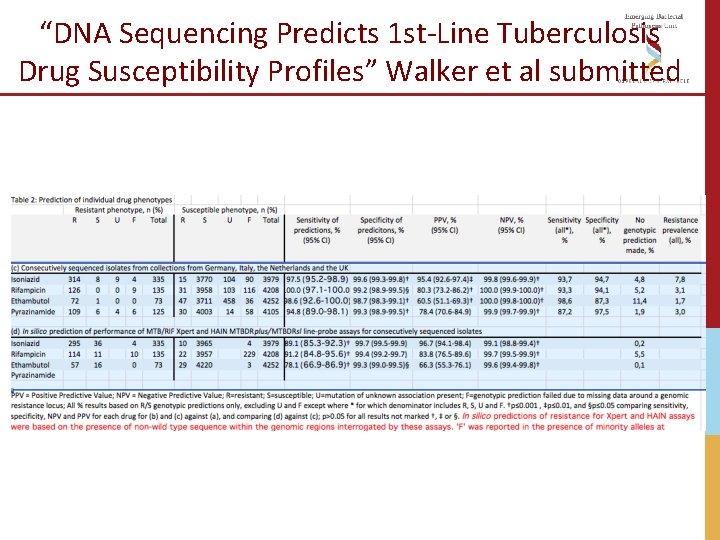
“DNA Sequencing Predicts 1 st-Line Tuberculosis Drug Susceptibility Profiles” Walker et al submitted
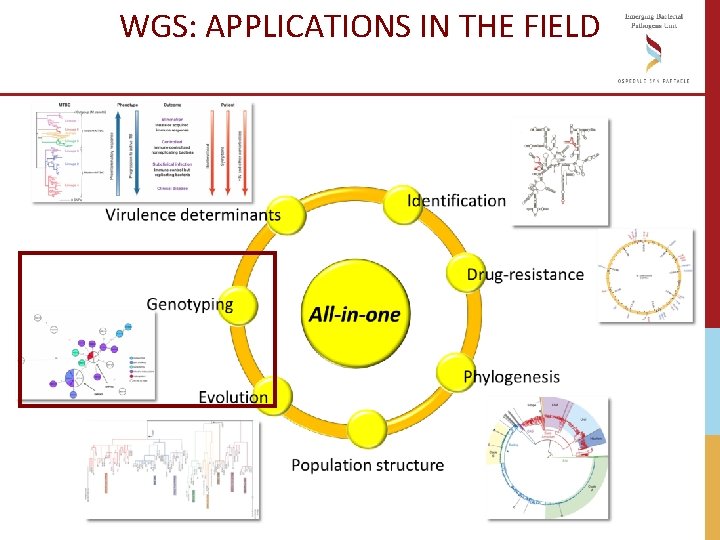
WGS: APPLICATIONS IN THE FIELD
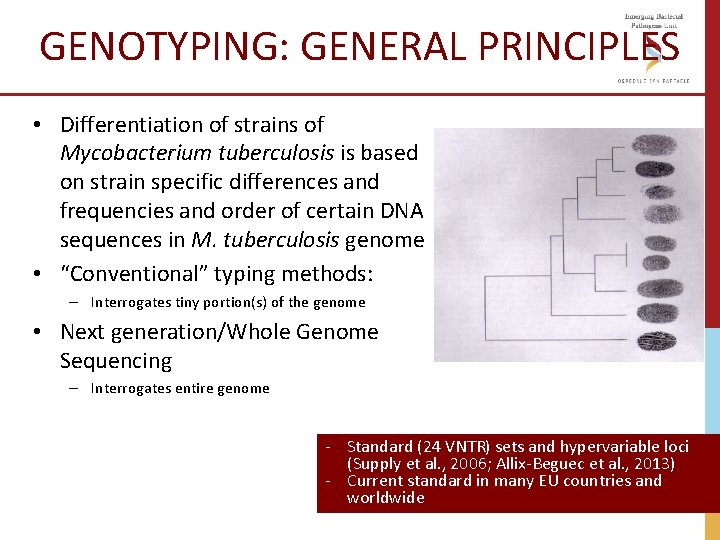
GENOTYPING: GENERAL PRINCIPLES • Differentiation of strains of Mycobacterium tuberculosis is based on strain specific differences and frequencies and order of certain DNA sequences in M. tuberculosis genome • “Conventional” typing methods: – Interrogates tiny portion(s) of the genome • Next generation/Whole Genome Sequencing – Interrogates entire genome - Standard (24 VNTR) sets and hypervariable loci (Supply et al. , 2006; Allix-Beguec et al. , 2013) - Current standard in many EU countries and worldwide
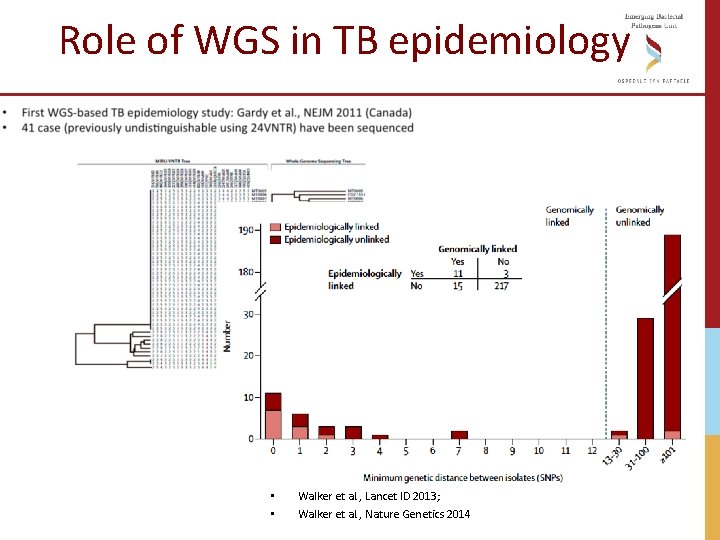
Role of WGS in TB epidemiology • • Walker et al. , Lancet ID 2013; Walker et al. , Nature Genetics 2014
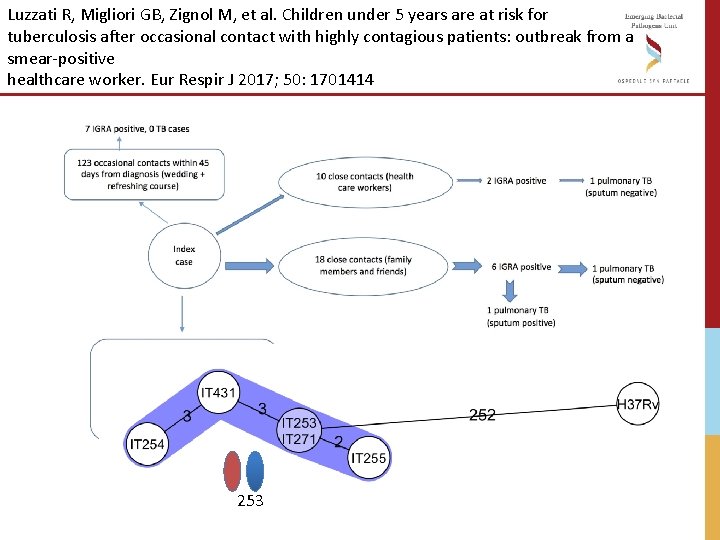
Luzzati R, Migliori GB, Zignol M, et al. Children under 5 years are at risk for tuberculosis after occasional contact with highly contagious patients: outbreak from a smear-positive healthcare worker. Eur Respir J 2017; 50: 1701414 253
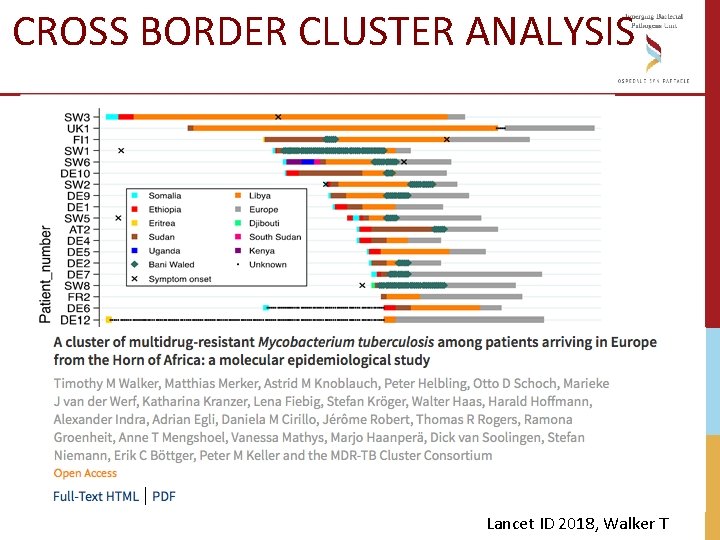
CROSS BORDER CLUSTER ANALYSIS 2016 Milano 2017 Lamezia Terme Lancet ID 2018, Walker T
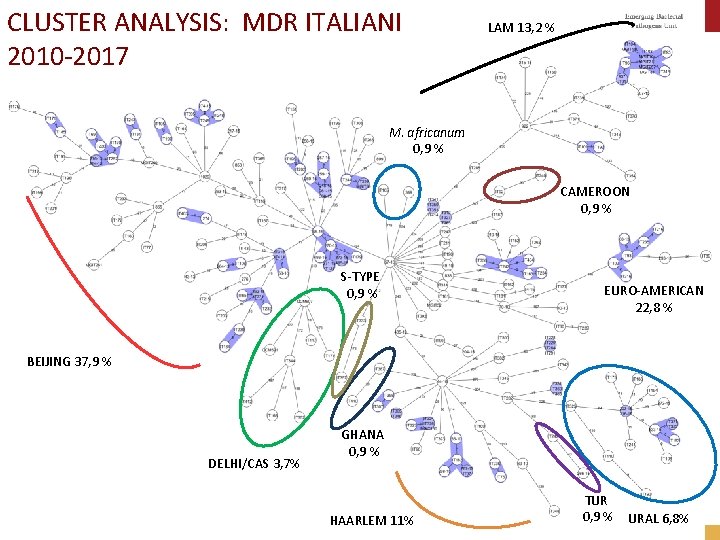
CLUSTER ANALYSIS: MDR ITALIANI 2010 -2017 LAM 13, 2 % M. africanum 0, 9 % CAMEROON 0, 9 % S-TYPE 0, 9 % EURO-AMERICAN 22, 8 % BEIJING 37, 9 % DELHI/CAS 3, 7% GHANA 0, 9 % HAARLEM 11% TUR 0, 9 % URAL 6, 8%
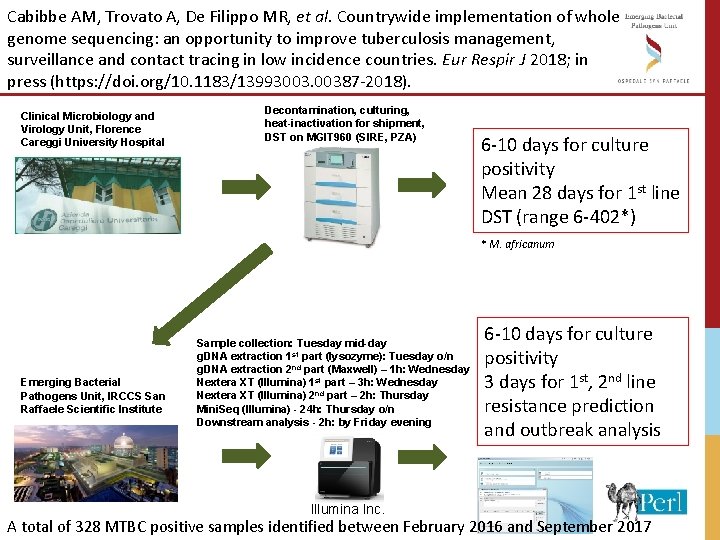
Cabibbe AM, Trovato A, De Filippo MR, et al. Countrywide implementation of whole genome sequencing: an opportunity to improve tuberculosis management, surveillance and contact tracing in low incidence countries. Eur Respir J 2018; in press (https: //doi. org/10. 1183/13993003. 00387 -2018). Clinical Microbiology and Virology Unit, Florence Careggi University Hospital Decontamination, culturing, heat-inactivation for shipment, DST on MGIT 960 (SIRE, PZA) 6 -10 days for culture positivity Mean 28 days for 1 st line DST (range 6 -402*) * M. africanum Emerging Bacterial Pathogens Unit, IRCCS San Raffaele Scientific Institute Sample collection: Tuesday mid-day g. DNA extraction 1 st part (lysozyme): Tuesday o/n g. DNA extraction 2 nd part (Maxwell) – 1 h: Wednesday Nextera XT (Illumina) 1 st part – 3 h: Wednesday Nextera XT (Illumina) 2 nd part – 2 h: Thursday Mini. Seq (Illumina) - 24 h: Thursday o/n Downstream analysis - 2 h: by Friday evening Illumina Inc. 6 -10 days for culture positivity 3 days for 1 st, 2 nd line resistance prediction and outbreak analysis A total of 328 MTBC positive samples identified between February 2016 and September 2017
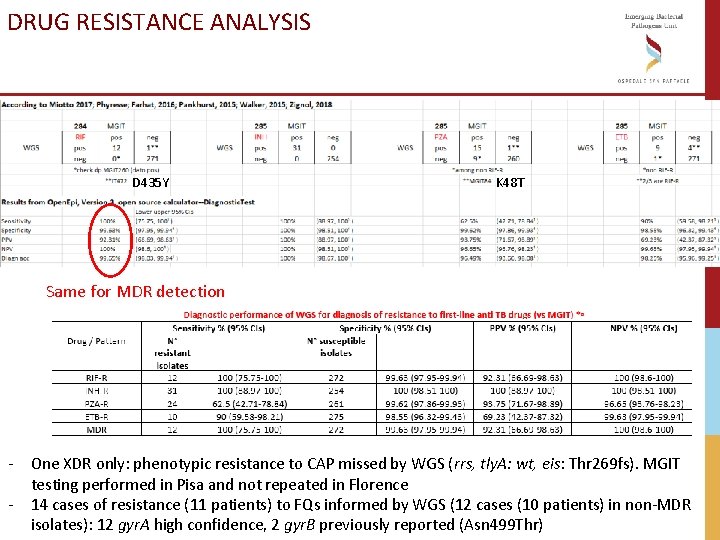
DRUG RESISTANCE ANALYSIS D 435 Y K 48 T Same for MDR detection - One XDR only: phenotypic resistance to CAP missed by WGS (rrs, tly. A: wt, eis: Thr 269 fs). MGIT testing performed in Pisa and not repeated in Florence - 14 cases of resistance (11 patients) to FQs informed by WGS (12 cases (10 patients) in non-MDR isolates): 12 gyr. A high confidence, 2 gyr. B previously reported (Asn 499 Thr)
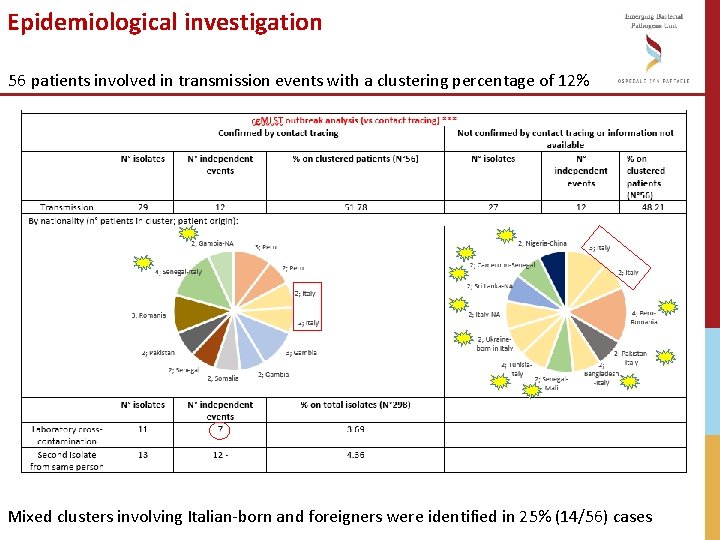
Epidemiological investigation 56 patients involved in transmission events with a clustering percentage of 12% Mixed clusters involving Italian-born and foreigners were identified in 25% (14/56) cases
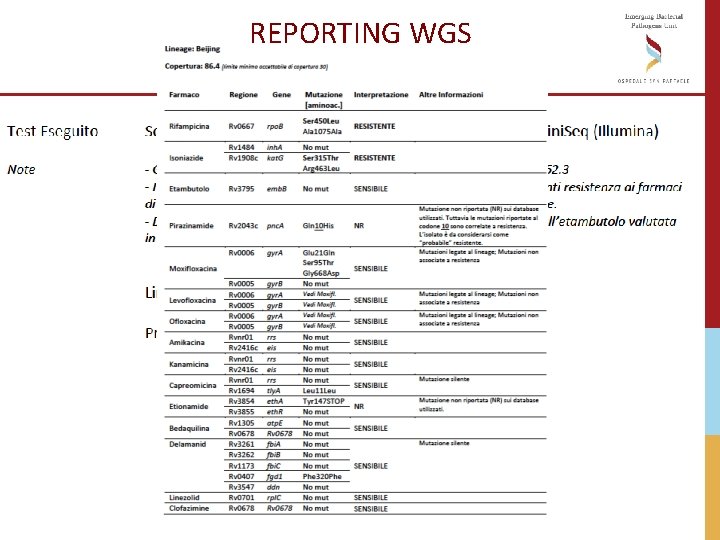
REPORTING WGS
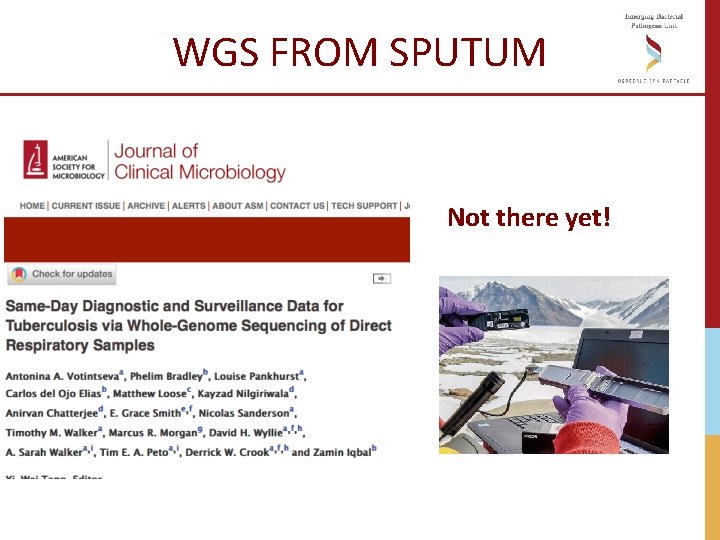
WGS FROM SPUTUM Not there yet!
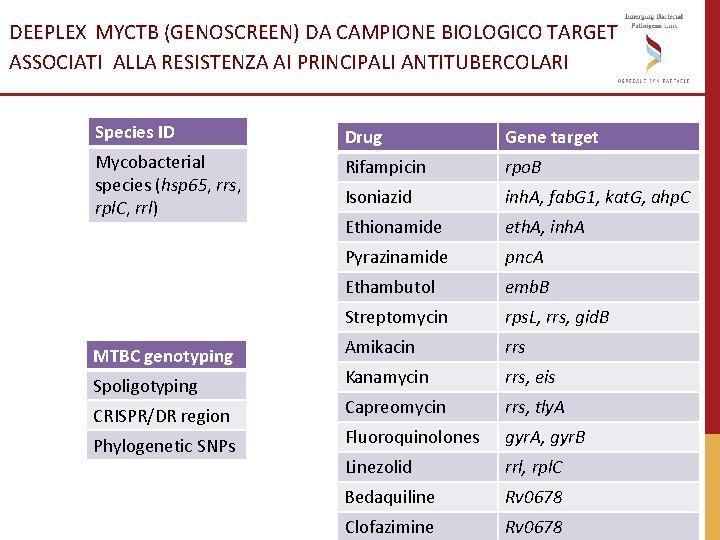
DEEPLEX MYCTB (GENOSCREEN) DA CAMPIONE BIOLOGICO TARGET ASSOCIATI ALLA RESISTENZA AI PRINCIPALI ANTITUBERCOLARI Species ID Drug Gene target Mycobacterial species (hsp 65, rrs, rpl. C, rrl) Rifampicin rpo. B Isoniazid inh. A, fab. G 1, kat. G, ahp. C Ethionamide eth. A, inh. A Pyrazinamide pnc. A Ethambutol emb. B Streptomycin rps. L, rrs, gid. B Amikacin rrs Kanamycin rrs, eis Capreomycin rrs, tly. A Fluoroquinolones gyr. A, gyr. B Linezolid rrl, rpl. C Bedaquiline Rv 0678 Clofazimine Rv 0678 MTBC genotyping Spoligotyping CRISPR/DR region Phylogenetic SNPs
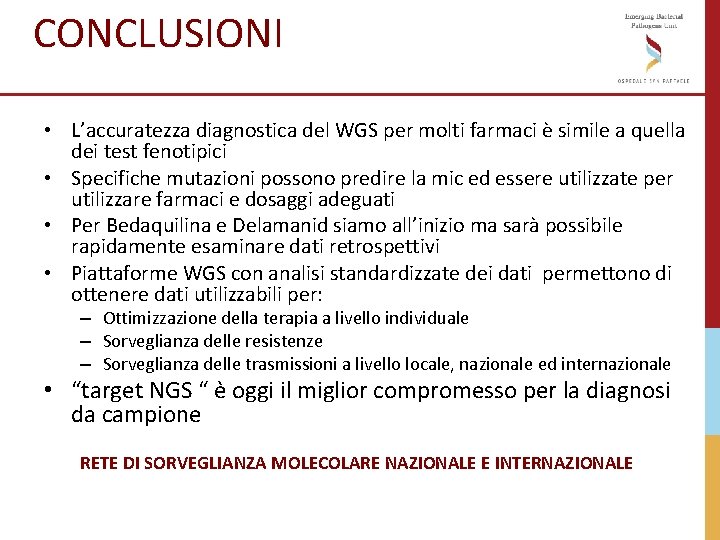
CONCLUSIONI • L’accuratezza diagnostica del WGS per molti farmaci è simile a quella dei test fenotipici • Specifiche mutazioni possono predire la mic ed essere utilizzate per utilizzare farmaci e dosaggi adeguati • Per Bedaquilina e Delamanid siamo all’inizio ma sarà possibile rapidamente esaminare dati retrospettivi • Piattaforme WGS con analisi standardizzate dei dati permettono di ottenere dati utilizzabili per: – Ottimizzazione della terapia a livello individuale – Sorveglianza delle resistenze – Sorveglianza delle trasmissioni a livello locale, nazionale ed internazionale • “target NGS “ è oggi il miglior compromesso per la diagnosi da campione RETE DI SORVEGLIANZA MOLECOLARE NAZIONALE E INTERNAZIONALE
RINGRAZIAMENTI Riccardo Alagna, Lucia Barcellini Simone Battaglia Emanuele Borroni Andrea Cabibbe Matteo Chiacchiaretta Maria Rosaria De Filippo, Lucinda Furci, Arash Ghodousi, Floriana Gona, Giovanna Graziano, Riccardo Ligresti, Paola Mantegani Paolo Miotto Camilla Riva Marco Rossi Giovanna Stancanelli Elisa Tagliani Enrico Tortoli Alberto Trovato Emerging Bacterial Pathogens Unit Federica Cugnata Paola Rancoita Clelia di Serio CUSSB OSR Genomic Center D. Goletti E Girardi IMNI A. Matteelli University of Brescia WHOCC TRADATE GB Migliori S D’Amato Ministero della Salute L Fattorini ISS SMIRA L. Codecasa M Ferrarese E Mazzola Lombardia Regional TB center GM Rossolini and coll, Careggi , Florence FIND/NDWG WHO M. Zignol ECDC S Niemann and coll, F. Drobniewsky, V. Nikolayesky D. Van Soolingen, A, ER Anthony ERLN TB Network P. Supply University of Lille E-detect TB consortium Partners and experts from Re. Seq TB Cryptic Consortium members D. Crook A. Gibertoni Cruz T. Walker
RINGRAZIAMENTI