
ETHEREUM BLOCKCHAIN NEXT GENERATION SMART CONTRACT AND DECENTRALIZED

ETHEREUM BLOCKCHAIN: NEXT GENERATION SMART CONTRACT AND DECENTRALIZED APPLICATION PLATFORM B. RAMAMURTHY © 2019, ALL RIGHTS RESERVED BINA@BUFFALO. EDU HTTP: //WW. CSE. BUFFALO. EDU/FACULTY/BINA TEACHING PROFESSOR COMPUTER SCIENCE AND ENGINEERING DIRECTOR, BLOCKCHAIN THINKLAB PROGRAM DIRECTOR, DATA-INTENSIVE COMPUTING PROGRAM
Introduction • We have been learning to program smart contracts. • Lets now look at the working of the blockchain, Ethereum blockchain as a whole from A-Z • Perhaps, this will help us be better programmers • We will explore the white papers and yellow papers written about Ethereum for this • References: ‘- • https: //github. com/ethereum/wiki/White-Paper 2
Topics for Discussion • Concepts from Ethereum white paper in Github: • • • Concept 1: Accounts Concept 2: Transaction Concept 3: Gas, Ether and Token Concept 3: Code execution Concept 4: State of blockchain Concept 5: applications ‘- • Cryptography and Key-pairs • Hashing and use of hashing in blaockchain • Summary 3
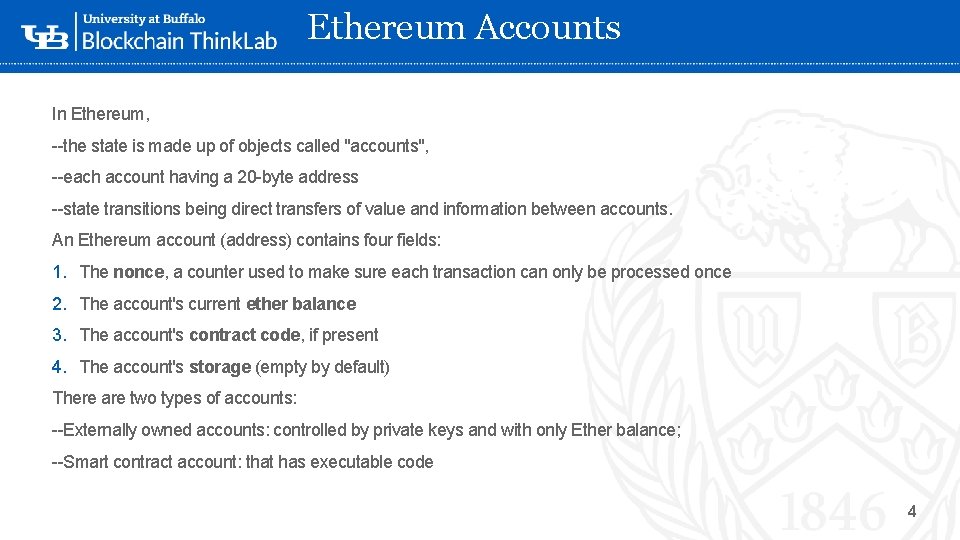
Ethereum Accounts In Ethereum, --the state is made up of objects called "accounts", --each account having a 20 -byte address --state transitions being direct transfers of value and information between accounts. An Ethereum account (address) contains four fields: 1. The nonce, a counter used to make sure each transaction can only be processed once ‘ 2. The account's current ether balance 3. The account's contract code, if present 4. The account's storage (empty by default) There are two types of accounts: --Externally owned accounts: controlled by private keys and with only Ether balance; --Smart contract account: that has executable code 4
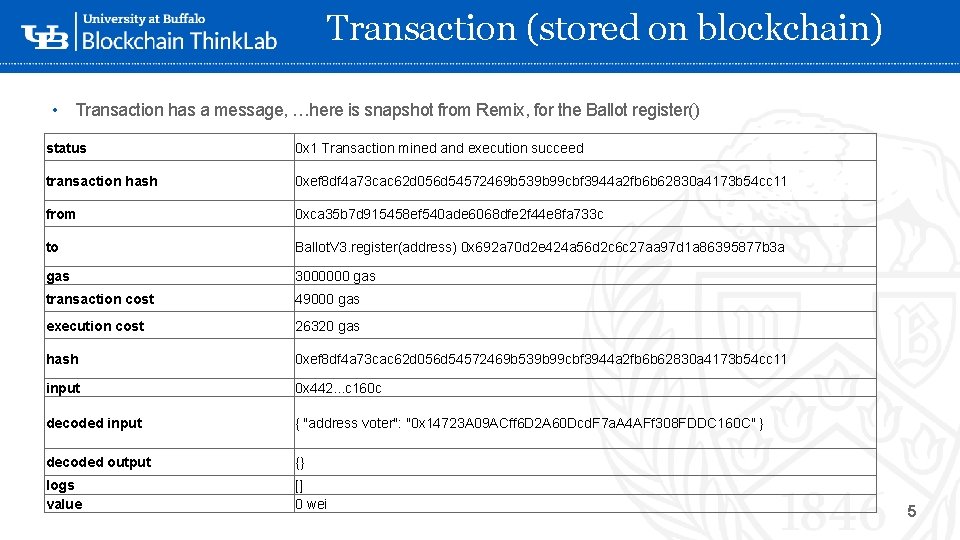
Transaction (stored on blockchain) • Transaction has a message, …here is snapshot from Remix, for the Ballot register() status 0 x 1 Transaction mined and execution succeed transaction hash 0 xef 8 df 4 a 73 cac 62 d 056 d 54572469 b 539 b 99 cbf 3944 a 2 fb 6 b 62830 a 4173 b 54 cc 11 from 0 xca 35 b 7 d 915458 ef 540 ade 6068 dfe 2 f 44 e 8 fa 733 c to Ballot. V 3. register(address) 0 x 692 a 70 d 2 e 424 a 56 d 2 c 6 c 27 aa 97 d 1 a 86395877 b 3 a gas 3000000 gas transaction cost 49000 gas execution cost 26320 gas hash 0 xef 8 df 4 a 73 cac 62 d 056 d 54572469 b 539 b 99 cbf 3944 a 2 fb 6 b 62830 a 4173 b 54 cc 11 input 0 x 442. . . c 160 c decoded input { "address voter": "0 x 14723 A 09 ACff 6 D 2 A 60 Dcd. F 7 a. A 4 AFf 308 FDDC 160 C" } decoded output {} logs value [] 0 wei ‘- 5
Ether, gas points, tokens • Why do you need gas points? Gas points and gas point limits are to address denial of service attacks and whimsical codes to be deployed on the blockchain. • Also your own code may not have tested and may mal function. • Ethers/Wei. . Other denominations: For payment towards transaction fees, also as cryptocurrency between accounts ‘ • Finally tokens: are smart contract representation of real world items. . Think about it. We will revisit it. • Think about it. . Think, think… 6
Code execution • The code in Ethereum contracts is written in a low-level; it is like byte code and it executes on a stack machine called "Ethereum virtual machine” or EVM • The operations or op codes have access to three types of space in which to store data: • The stack, a last-in-first-out container to which values can be pushed and popped ‘ • Memory, an infinitely expandable byte array • The contract's long-term storage, a key/value store. Unlike stack and memory, which reset after computation ends, storage persists for the long term. The code can also access the value, sender and data of the incoming message, as well as block header data, and the code can also return a byte array of data as an output. 7
While the Ethereum virtual machine is running, its full computational state can be defined by the tuple (block_state, transaction, message, code, memory, stack, pc, gas), where block_state is the global Where does execution take place? • A commonly asked question is "where" contract code is executed: it is executed in the local nodes’ EVM and in all the nodes that confirm the block and the Txs contained it. • Execution of a smart contract function is a part of the transaction and block validation and executed by the local node’s EVM ‘ • It is confirmed once added to a block to the blockchain. • If a transaction is added into block B, • The block is broadcast by will be executed by all nodes, now and in the future, that download and validate block B. . On their own EVM. 8
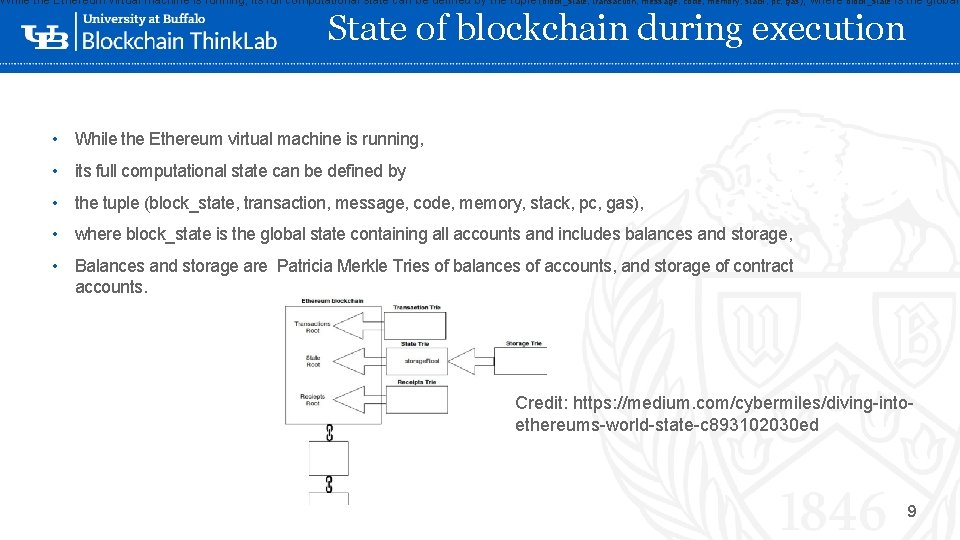
While the Ethereum virtual machine is running, its full computational state can be defined by the tuple (block_state, transaction, message, code, memory, stack, pc, gas), where block_state is the global State of blockchain during execution • While the Ethereum virtual machine is running, • its full computational state can be defined by • the tuple (block_state, transaction, message, code, memory, stack, pc, gas), • where block_state is the global state containing all accounts and includes balances and storage, • Balances and storage are Patricia Merkle Tries of balances of accounts, and storage of contract ‘accounts. Credit: https: //medium. com/cybermiles/diving-intoethereums-world-state-c 893102030 ed 9
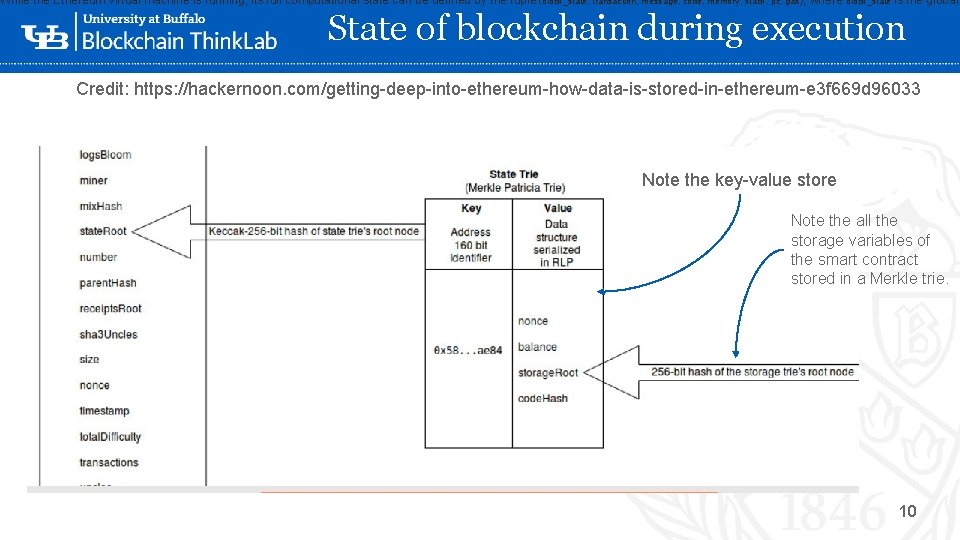
While the Ethereum virtual machine is running, its full computational state can be defined by the tuple (block_state, transaction, message, code, memory, stack, pc, gas), where block_state is the global State of blockchain during execution Credit: https: //hackernoon. com/getting-deep-into-ethereum-how-data-is-stored-in-ethereum-e 3 f 669 d 96033 Note the key-value store ‘- Note the all the storage variables of the smart contract stored in a Merkle trie. 10
Applications Three types of applications: 1. Pure cryptocurrency, financial systems for digital money, and tokens a. sub-currencies, financial derivatives, hedging contracts, savings wallets, wills, and ultimately even some classes of full-scale employment contracts. ‘ 2. Semi-financial applications, where money is involved but there is also a heavy non-monetary side to what is being done; a. Market place that we discussed in Lab 1 3. Non-financial applications a. Online voting and decentralized governance 11

Public-key Cryptography ‘- Dr. B. Ramamurthy Research Associate Professor bina@buffalo. edu http: //www. cse. buffalo. edu/~bina 12
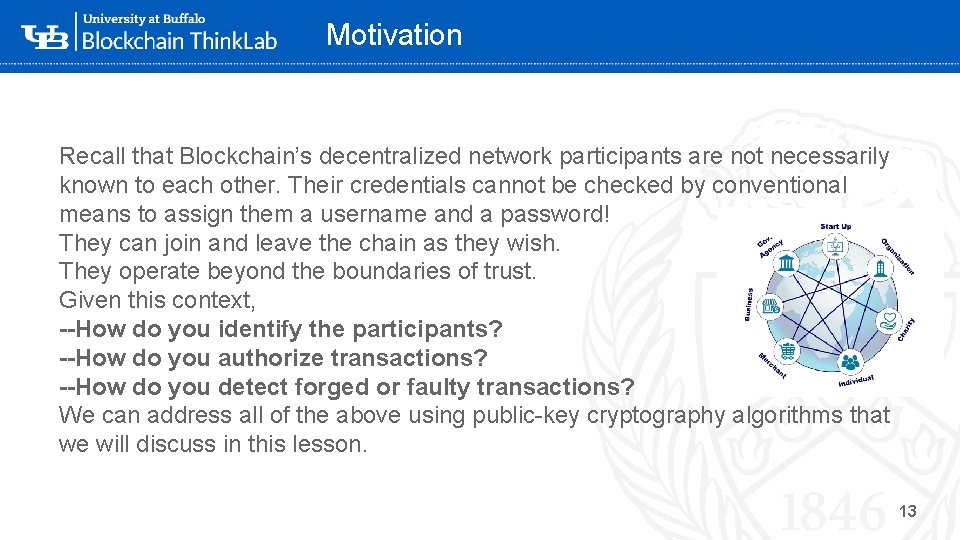
Motivation Recall that Blockchain’s decentralized network participants are not necessarily known to each other. Their credentials cannot be checked by conventional means to assign them a username and a password! They can join and leave the chain as they wish. ‘They operate beyond the boundaries of trust. Given this context, --How do you identify the participants? --How do you authorize transactions? --How do you detect forged or faulty transactions? We can address all of the above using public-key cryptography algorithms that we will discuss in this lesson. 13
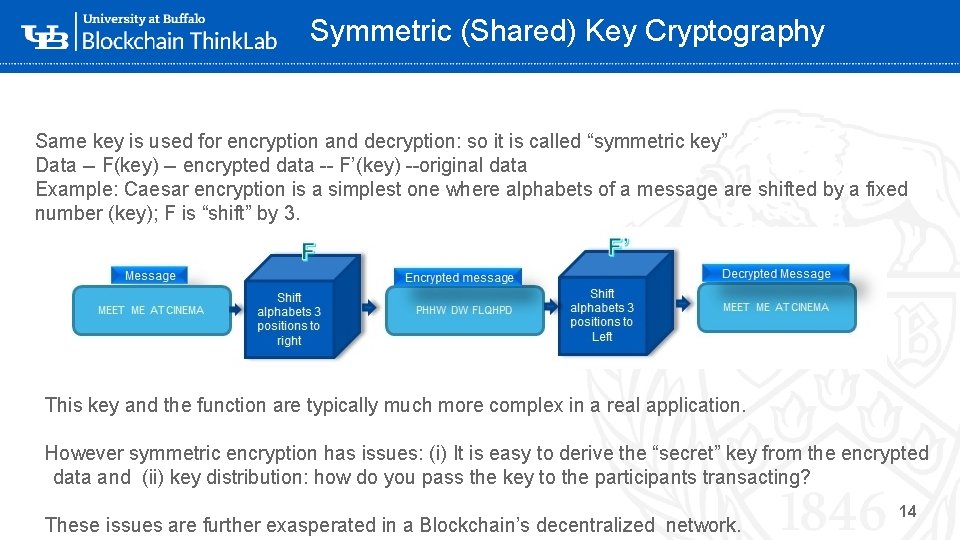
Symmetric (Shared) Key Cryptography Same key is used for encryption and decryption: so it is called “symmetric key” Data -- F(key) -- encrypted data -- F’(key) --original data Example: Caesar encryption is a simplest one where alphabets of a message are shifted by a fixed number (key); F is “shift” by 3. ‘- This key and the function are typically much more complex in a real application. However symmetric encryption has issues: (i) It is easy to derive the “secret” key from the encrypted data and (ii) key distribution: how do you pass the key to the participants transacting? These issues are further exasperated in a Blockchain’s decentralized network. 14
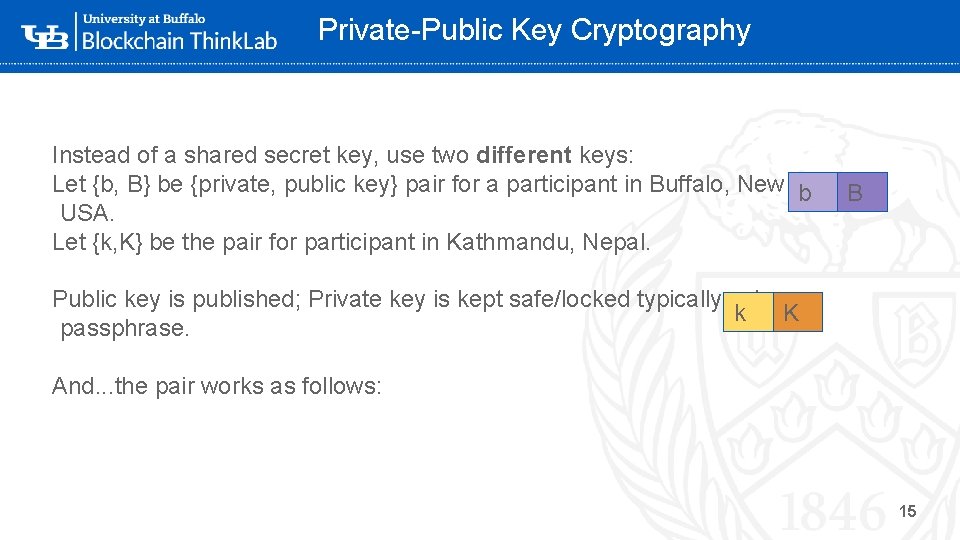
Private-Public Key Cryptography Instead of a shared secret key, use two different keys: Let {b, B} be {private, public key} pair for a participant in Buffalo, New York, b B USA. Let {k, K} be the pair for participant in Kathmandu, Nepal. ‘Public key is published; Private key is kept safe/locked typically using a k K passphrase. And. . . the pair works as follows: 15
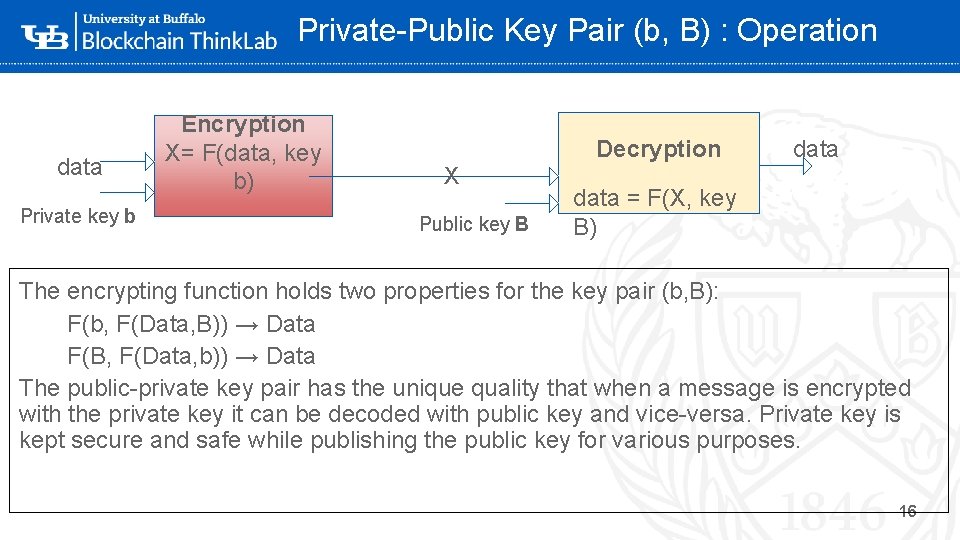
Private-Public Key Pair (b, B) : Operation data Private key b Encryption X= F(data, key b) X Public key B Decryption data = F(X, key B) ‘The encrypting function holds two properties for the key pair (b, B): F(b, F(Data, B)) → Data F(B, F(Data, b)) → Data The public-private key pair has the unique quality that when a message is encrypted with the private key it can be decoded with public key and vice-versa. Private key is kept secure and safe while publishing the public key for various purposes. 16
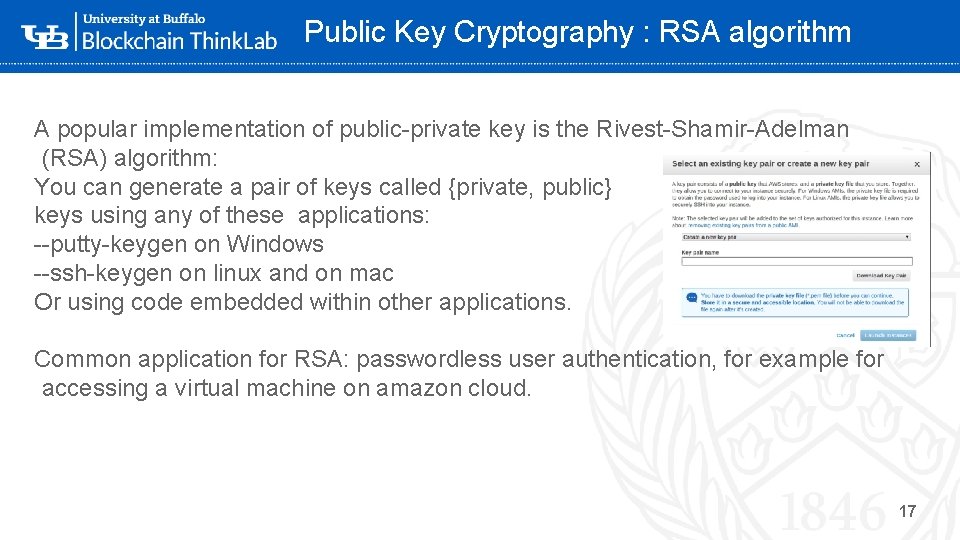
Public Key Cryptography : RSA algorithm A popular implementation of public-private key is the Rivest-Shamir-Adelman (RSA) algorithm: You can generate a pair of keys called {private, public} keys using any of these applications: --putty-keygen on Windows ‘--ssh-keygen on linux and on mac Or using code embedded within other applications. Common application for RSA: passwordless user authentication, for example for accessing a virtual machine on amazon cloud. 17
Elliptical Curve Cryptography (ECC) Though RSA is commonly used in distributed systems, the Blockchains need a more efficient and stronger algorithm. Efficiency is a critical requirement since public-key pair is used in many different situations in a Blockchain. Elliptic Curve Cryptography (ECC) family of algorithms is used in the Bitcoin as well ‘as Ethereum blockchain for generating the key pair. Why ECC, not RSA? ECC is stronger than RSA for given number of bits. 256 -Bit ECC key-pair is equivalent in strength to approimately 3072 bit RSA key-pair. Moreover, this 256 -bit structure allows for Blockchain operations (and hardware) to be optimized to 256 -bit integer arithmetic. 18
Example: Authenticate the Sender & Receiver We will examine just one common use of asymmetric key encryption: Let’s say a participant Buffalo wants to transact with a participant in Kathmandu. Instead of sending just a simple message, participant in Buffalo will send a transaction signed by Buffalo’s private key (b) and encrypted by Kathmandu’s public key (K): • E(K, E(Tx, b)) ‘Kathmandu will first decrypt the above using its private key (k) and then use Buffalo’s public key (B) to decrypt the signed transaction: • D(k, E(K, E(Tx, b)) → E(Tx, b) • D(B, E(Tx, b)) → Tx 19
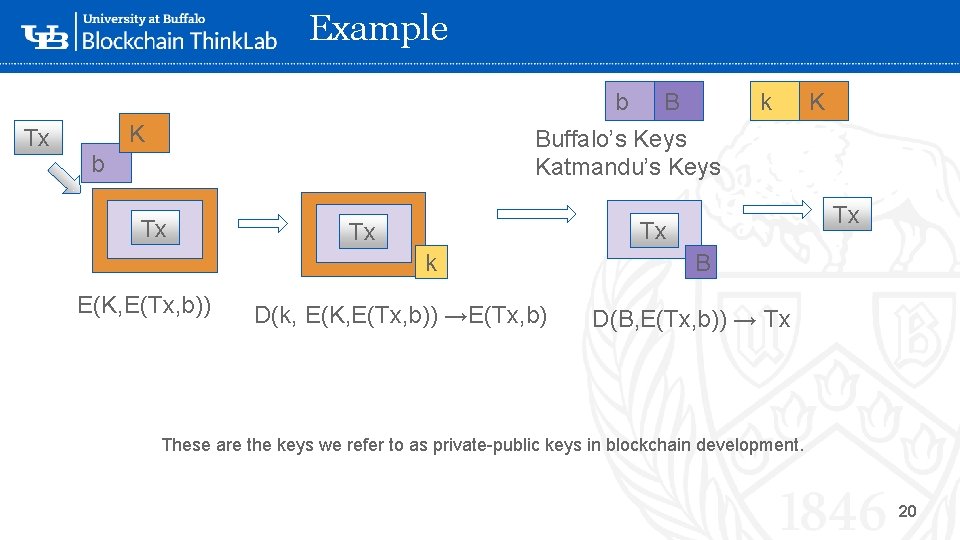
Example b Tx K B k K Buffalo’s Keys Katmandu’s Keys b Tx Tx Tx k E(K, E(Tx, b)) Tx D(k, E(K, E(Tx, b)) →E(Tx, b) ‘- B D(B, E(Tx, b)) → Tx These are the keys we refer to as private-public keys in blockchain development. 20

Hashing ‘- Dr. B. Ramamurthy Research Associate Professor bina@buffalo. edu http: //www. cse. buffalo. edu/~bina 21
Basic requirement of a hash function Algorithm chosen for a hash function should be (i) one way function (ii) It should be collision free or be exhibit extremely low probability of collision. ‘The first requirement is to make certain that one cannot derive the original items hashed from the hash value. (Given a function for f(x) it easy to evaluate y = f(x); But given y, it is infeasible to find x. ) The second requirement is to make sure that the hash value uniquely represents the original items hashed. These requirements are achieved by choosing a strong algorithm such as Secure Hash algorithms (SHA) and by using an appropriate number of bits in the hash value. Most Blockchains use 256 bits hash. 22
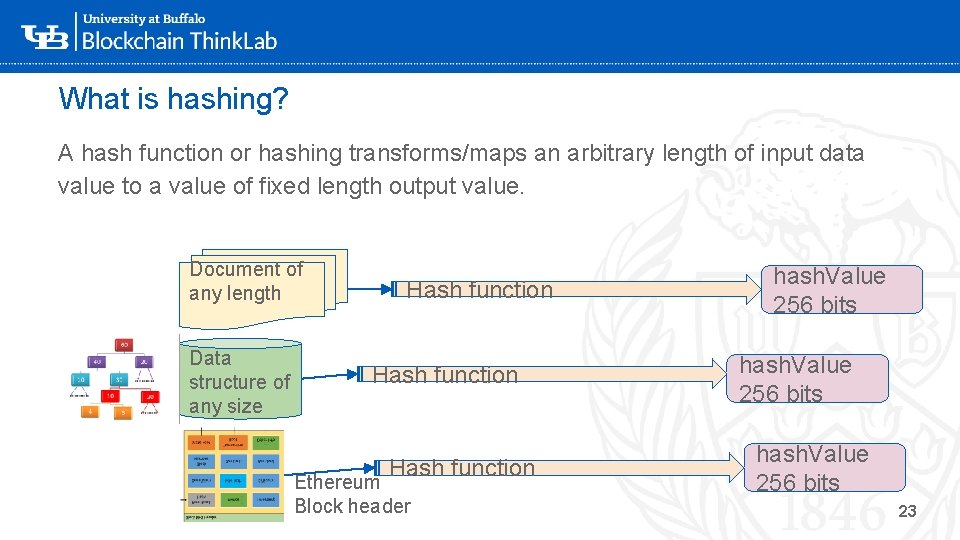
What is hashing? A hash function or hashing transforms/maps an arbitrary length of input data value to a value of fixed length output value. Document of any length Data structure of any size Hash function Ethereum Block header ‘- hash. Value 256 bits 23
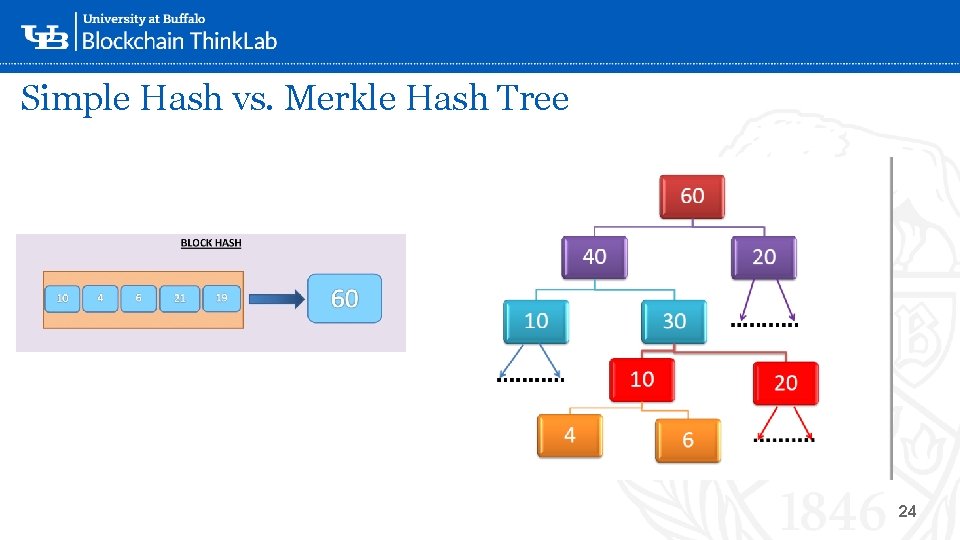
Simple Hash vs. Merkle Hash Tree ‘- 24
Simple vs Hierarchical Hashing is indeed very versatile. When do you use a hierarchical tree-structured organization for finding the hash? ‘--When you have a fixed number of items to be hashed, such as the items in a block header, use the simple hash. --When the number of items is variable: number of transactions, number of states, number of receipts, use hierarchical structure for computing the hash. Hierarchical structure helps the efficiency of repeated operations such as transaction verification and state changes from one block to the next. 25
How good is a 256 bits hash? Both Bitcoin and Ethereum use 256 bit hash. A 256 -bit hash value space is indeed very large; 2256 possible combinations of values: that is approximately: 1077 values: 10 followed by 77 zeros. 100000000000000000000000000000000000 ‘ 000000000000000000000000000000000000 Odds of a meteor hitting your house is higher than generating two of same hash value (256 bit) when applying this algorithm. 26
Where is Hashing used in the Blockchain? Hashing algorithm is used in techniques for 1. 2. 3. 4. 5. digital identity or account address, digital signatures, transaction hash, State hash, and block header hash. A b B ‘- 27
Some Uses of Hashing in the blockchain process --It can be used for digitally signing a transaction. This digital signature will be a hash of the transaction and encrypted with a private key of the participant. --It can also be used to detect tampering of the data. Any modification of a ‘transaction will result in a different hash value and will not match the original hash value, during the verification process and are rejected. --It provides a single concise representation of varying number and types of data fields in a block or a transaction. Instead of checking many different data elements you verify and validate just one value, the hash value. 28
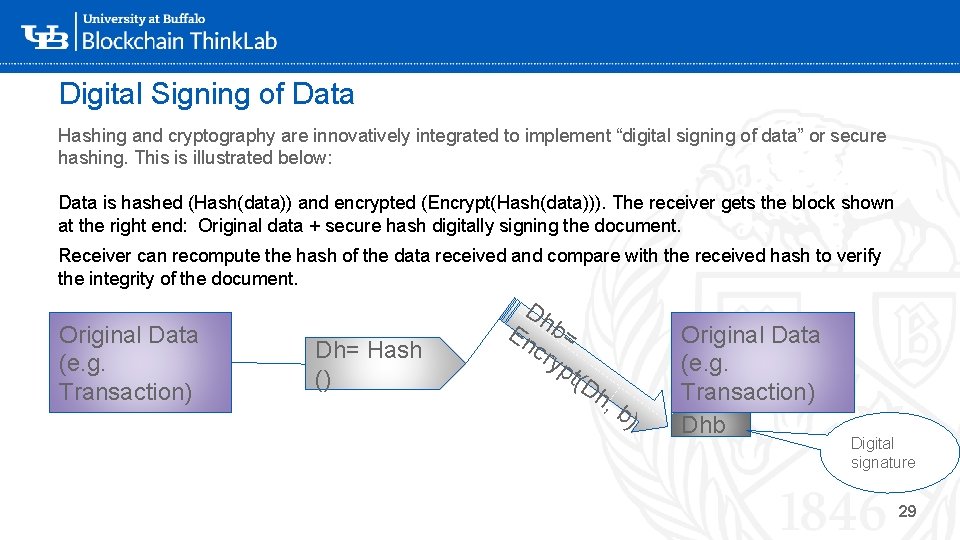
Digital Signing of Data Hashing and cryptography are innovatively integrated to implement “digital signing of data” or secure hashing. This is illustrated below: Data is hashed (Hash(data)) and encrypted (Encrypt(Hash(data))). The receiver gets the block shown at the right end: Original data + secure hash digitally signing the document. Receiver can recompute the hash of the data received and compare with the received hash to verify ‘the integrity of the document. Original Data (e. g. Transaction) Dh= Hash () Dh En b= cry pt( D h, b) Original Data (e. g. Transaction) Dhb Digital signature 29
Transactions in a Block A typical block has about 2000 Txs in Bitcoin and about hundreds of Txs in Ethereum. We need an efficient way to detect tampering and validate the transactions efficiently. Trick is in a “tree structure” and an associated hash: Merkle Patricia Tree hash. Hashes of the transactions in a block are processed in a tree structure. (We will ‘discuss only the tree structure here. The concept can be expanded to a trie structure. ) The Merkle tree hash is computed by pairwise hash computation starting from the leaf nodes. The final root hash is the hash of the transactions in the block. 30
Block Hash Block hash is an indeed important item in a Blockchain: It is computed by applying SHA 256 on all the items of the Block header. ‘Block has serves multi-purpose including: 1. For verifying the integrity of the Block and the transactions 2. For forming the chain by embedded previous block hash in the header 31
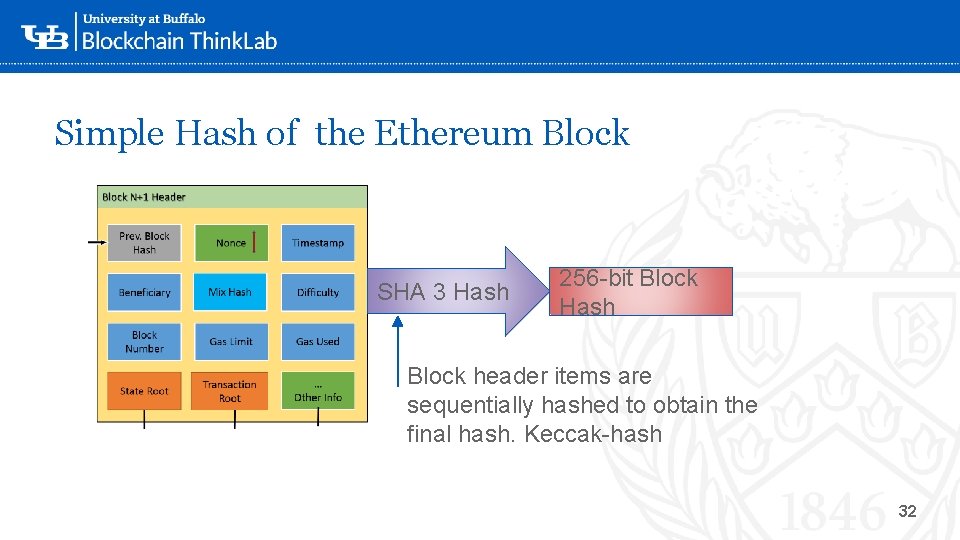
Simple Hash of the Ethereum Block SHA 3 Hash ‘ 256 -bit Block Hash Block header items are sequentially hashed to obtain the final hash. Keccak-hash 32
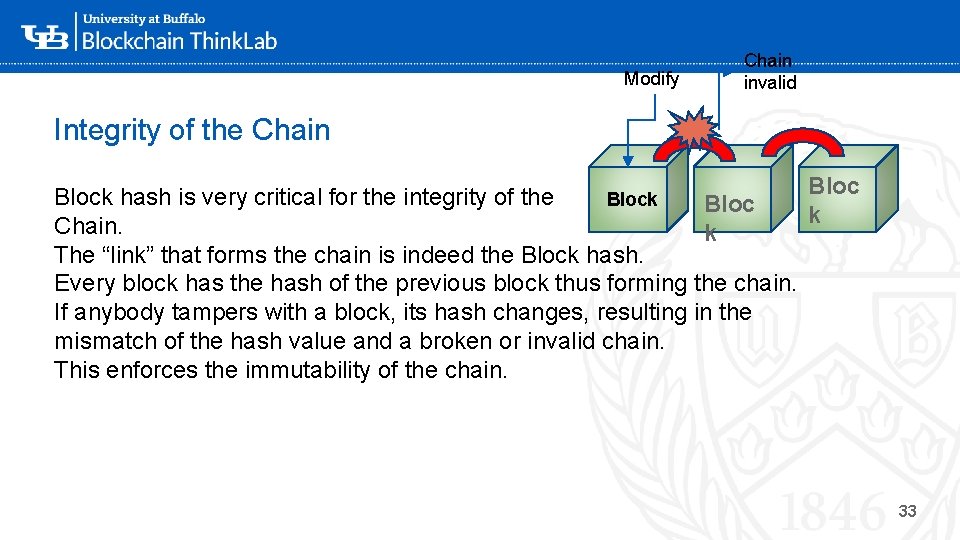
Modify Chain invalid Integrity of the Chain Block hash is very critical for the integrity of the Block Bloc k Chain. k The “link” that forms the chain is indeed the Block hash. ‘Every block has the hash of the previous block thus forming the chain. If anybody tampers with a block, its hash changes, resulting in the mismatch of the hash value and a broken or invalid chain. This enforces the immutability of the chain. 33

Extra slides ‘- 34
Blockchain: Validation & Verification Account ‘- Transactions Block Validate & Gather, Execute, Broadcast Transactions Consensus, Broadcast, Verify & Confirm Block 35
The Trust Trail Secure Blockchain Txs ‘Validate Txs Verify Gas, Resources Execute Txs Form Block; Consensus Process Finalize & Broadcast Block Others Verify Block Txs Add block to the Blockchain, Confirm Txs 36
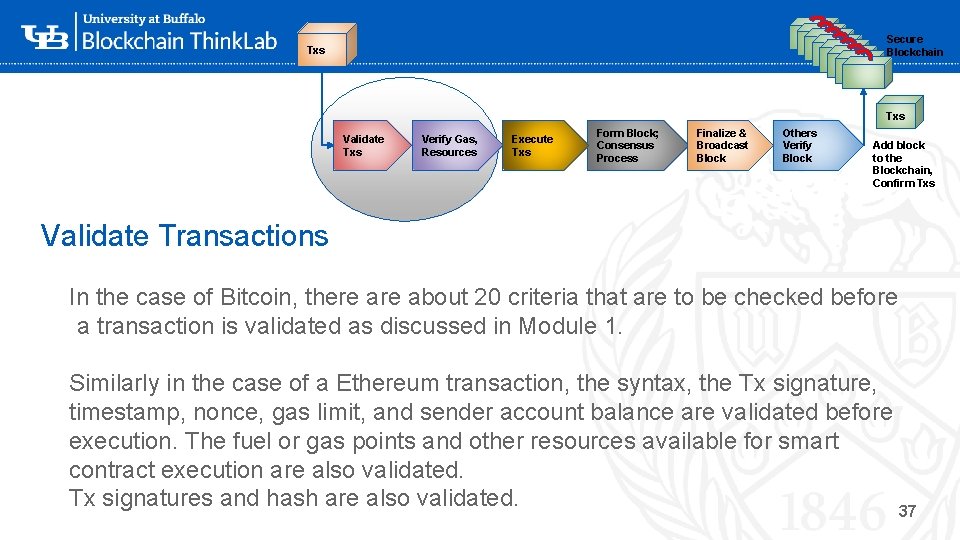
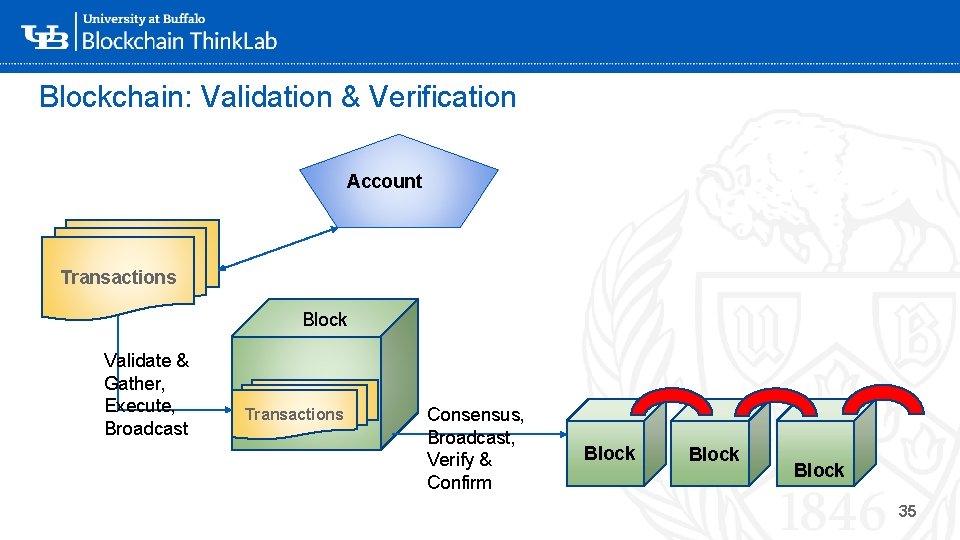
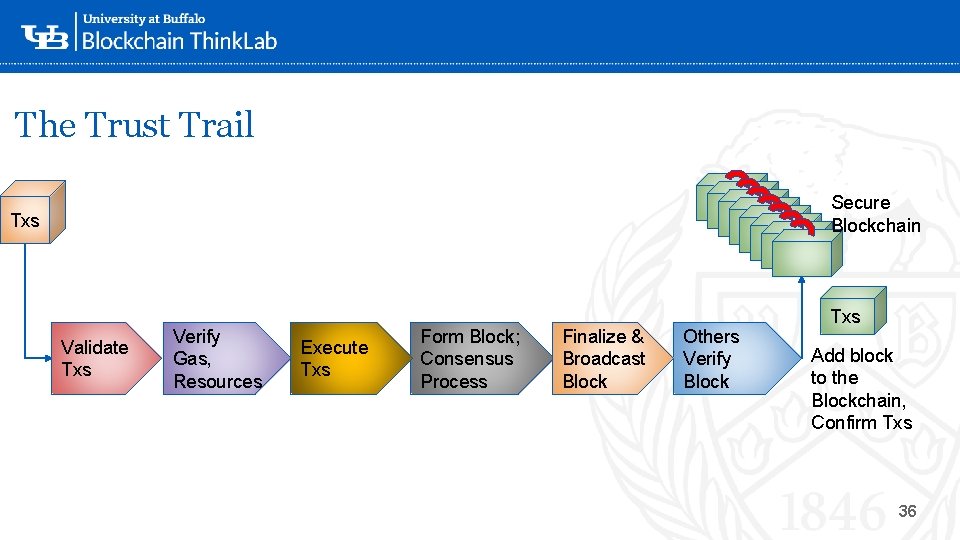
Secure Blockchain Txs Validate Txs Verify Gas, Resources Execute Txs Form Block; Consensus Process Finalize & Broadcast Block Others Verify Block Add block to the Blockchain, Confirm Txs Validate Transactions ‘In the case of Bitcoin, there about 20 criteria that are to be checked before a transaction is validated as discussed in Module 1. Similarly in the case of a Ethereum transaction, the syntax, the Tx signature, timestamp, nonce, gas limit, and sender account balance are validated before execution. The fuel or gas points and other resources available for smart contract execution are also validated. Tx signatures and hash are also validated. 37
Transaction Confirmation 1. User submits a transaction and gets back transaction hash as a receipt immediately. User can use eth. get. Transaction(<hash>) to view the metadata of the transaction. 2. This transaction goes into the pool of transactions 3. Miners have to choose this transaction and validate. If it’s a validate transaction he adds it to his block and starts solving the puzzle‘ 4. If the winner miner’s block contains the transaction which the user submitted then it goes into blockchain else it will again go into the transaction pool. 5. After the transaction is confirmed when we query using the eth. get. Transaction. Receipt(<hash>) it will return the details of the transaction like who mined it, when it was mined, gas spent, block number of the transaction etc, it will return null if the transaction was not confirmed. 38

Block Creation Process ‘- 39
Summary • We examined important concepts that enable the Ethereum blockchain including cryptography and hashing. • Also Ethereum protocol provides functions for various functions; Keccak, etc. • Look at the links provided to study for midterm. ‘- 40
- Slides: 40