Equity Volatility Managing and Profiting Greg Levinson Chief
- Slides: 44
Equity Volatility: Managing and Profiting Greg Levinson Chief Investment Officer Schooner Investment Group FPA Meeting July 21, 2010
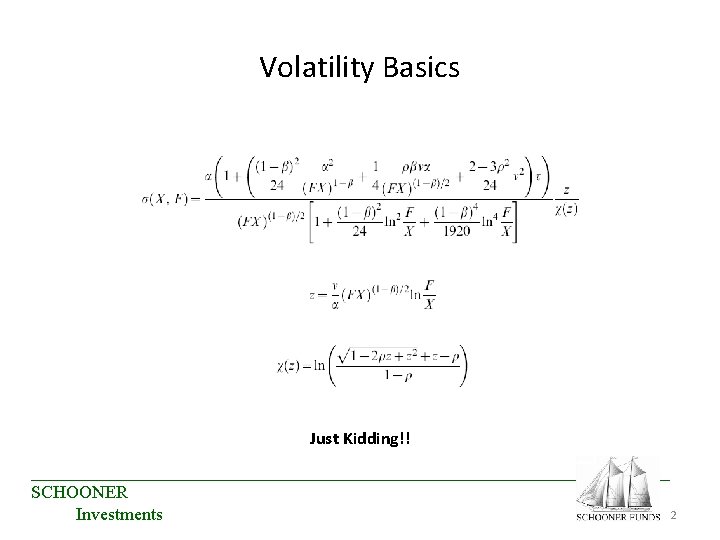
Volatility Basics Just Kidding!! ____________________________________ SCHOONER 2 Investments
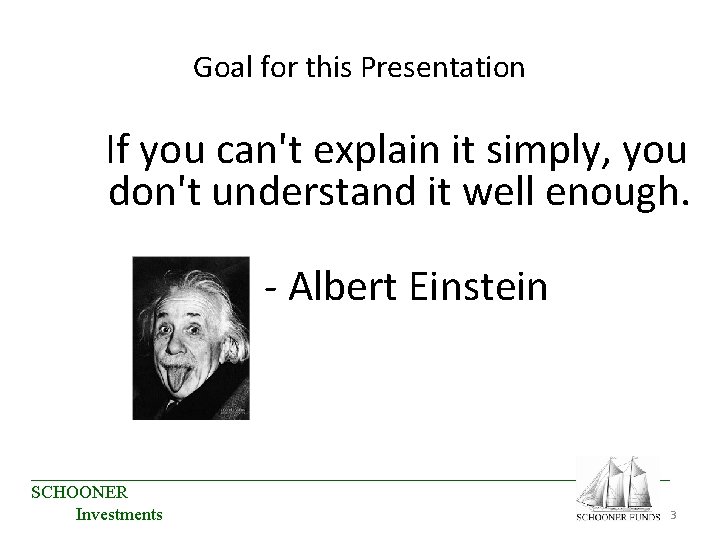
Goal for this Presentation If you can't explain it simply, you don't understand it well enough. - Albert Einstein ____________________________________ SCHOONER 3 Investments
Greg Levinson • Wharton School, University of Pennsylvania, 1995. • Former Managing Director BNP/Paribas – Cooper Neff. • Founder and Former Managing Member, Polaris Advisors LP. • Founder and Managing Member, Schooner Investment Group. ____________________________________ SCHOONER 4 Investments
About Schooner • Radnor, Pa Based RIA. • Boutique Specialty Manager focusing on equity volatility strategies. • Core Investment team has worked together over 15 years. • Formed in January 2008 to offer team’s investment expertise in liquid and transparent vehicles. • Institutional Investment Manager Only. – Advisor to 40 Act Mutual Fund. – Sub-advisor for other Advisors. ____________________________________ SCHOONER 5 Investments
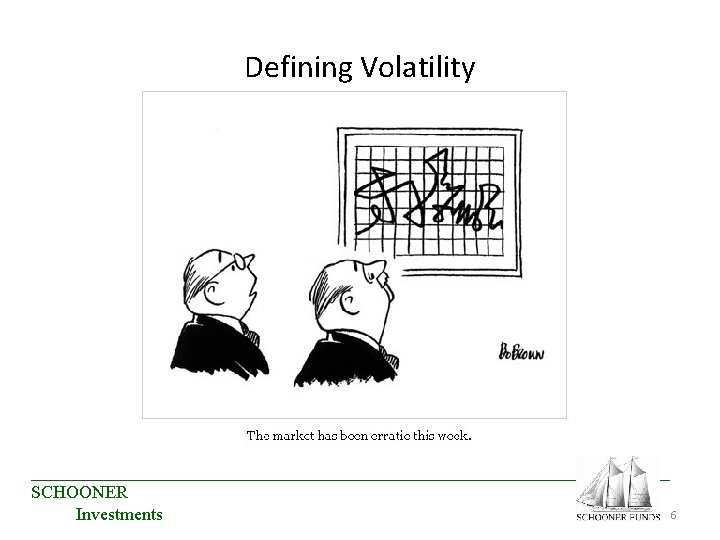
Defining Volatility ____________________________________ SCHOONER 6 Investments
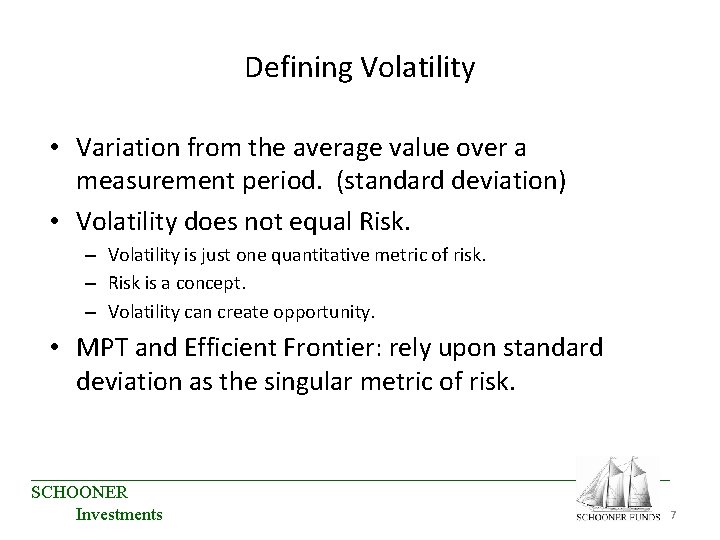
Defining Volatility • Variation from the average value over a measurement period. (standard deviation) • Volatility does not equal Risk. – Volatility is just one quantitative metric of risk. – Risk is a concept. – Volatility can create opportunity. • MPT and Efficient Frontier: rely upon standard deviation as the singular metric of risk. ____________________________________ SCHOONER 7 Investments
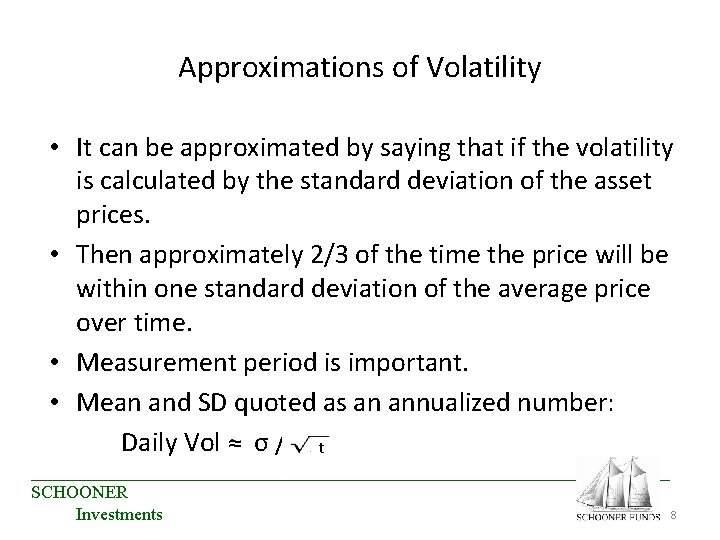
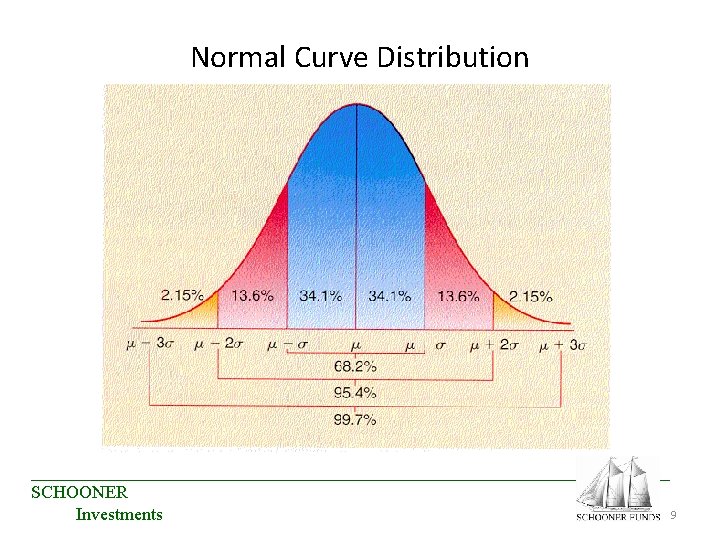
Approximations of Volatility • It can be approximated by saying that if the volatility is calculated by the standard deviation of the asset prices. • Then approximately 2/3 of the time the price will be within one standard deviation of the average price over time. • Measurement period is important. • Mean and SD quoted as an annualized number: Daily Vol = σ / t ____________________________________ SCHOONER 8 Investments
Normal Curve Distribution ____________________________________ SCHOONER 9 Investments
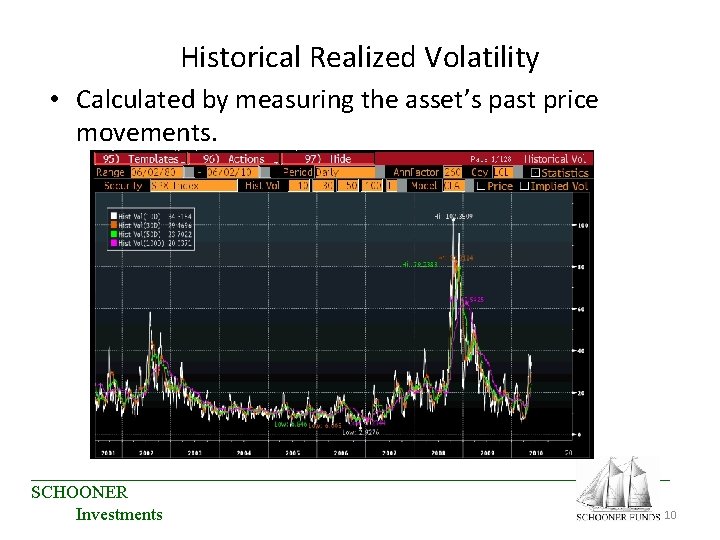
Historical Realized Volatility • Calculated by measuring the asset’s past price movements. ____________________________________ SCHOONER 10 Investments
Future Forecast Volatility ____________________________________ SCHOONER 11 Investments
Future Forecast Volatility • Forward volatility can never be known, because the time frame is the future. • Estimate is based upon more than the volatility history of the asset. • Takes into consideration any events that are known to be occurring during forecast period. ____________________________________ SCHOONER 12 Investments
Implied Volatility • Unlike other types of volatility, this is a property of the option (rather than of the asset). • Estimate, made by professional traders in the marketplace, of the future volatility of the asset. • The volatility, that when substituted into the equation used to calculate theoretical values, makes theoretical value equal to the actual price of the option in the marketplace. ____________________________________ SCHOONER 13 Investments
Volatility Price Example • SPY current price = 100 • If the price of 30 day, 100 strike puts or calls = $1 • Then implied volatility is 10 • Security Bullish / Vol Buyer : • Security Bearish / Vol Buyer : Buy Calls Buy Puts • If the price of 30 day, 100 strike puts or calls = $4 • Then implied volatility is 35 • Security Bullish / Vol Seller : • Security Bearish / Vol Seller : Sell Puts Sell Calls ____________________________________ SCHOONER 14 Investments
What is the VIX? ____________________________________ SCHOONER 15 Investments
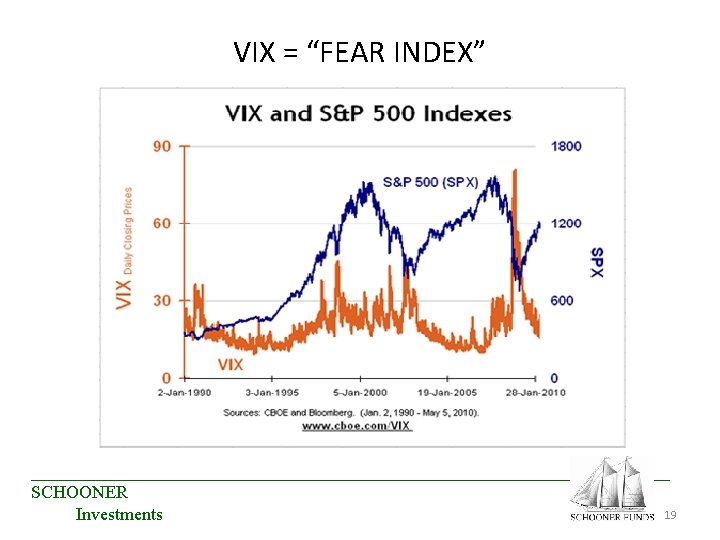
What Does VIX - CBOE Volatility Index Mean? • Index which shows the options market’s expectation of 30 -day volatility. • Constructed using the implied volatilities of a wide range of S&P 500 index options. • Intended to be forward looking and is calculated using both calls and puts. • VIX considered to be premier barometer of investor sentiment and market volatility. • VIX is a calculated index, not a security. ____________________________________ SCHOONER 16 Investments
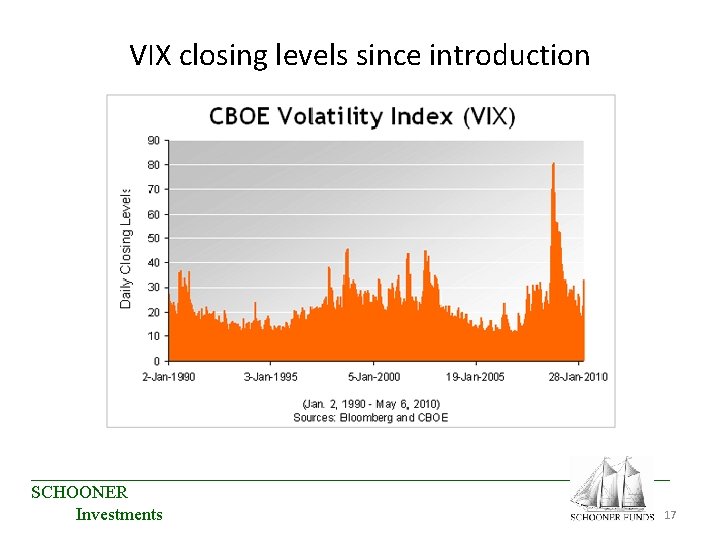
VIX closing levels since introduction ____________________________________ SCHOONER 17 Investments
VIX = “FEAR INDEX” ____________________________________ SCHOONER 18 Investments
VIX = “FEAR INDEX” ____________________________________ SCHOONER 19 Investments
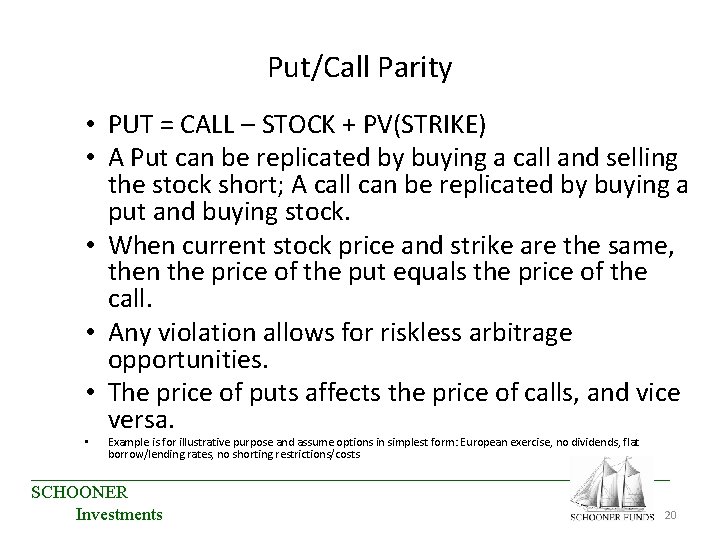
Put/Call Parity • PUT = CALL – STOCK + PV(STRIKE) • A Put can be replicated by buying a call and selling the stock short; A call can be replicated by buying a put and buying stock. • When current stock price and strike are the same, then the price of the put equals the price of the call. • Any violation allows for riskless arbitrage opportunities. • The price of puts affects the price of calls, and vice versa. • Example is for illustrative purpose and assume options in simplest form: European exercise, no dividends, flat borrow/lending rates, no shorting restrictions/costs ____________________________________ SCHOONER 20 Investments
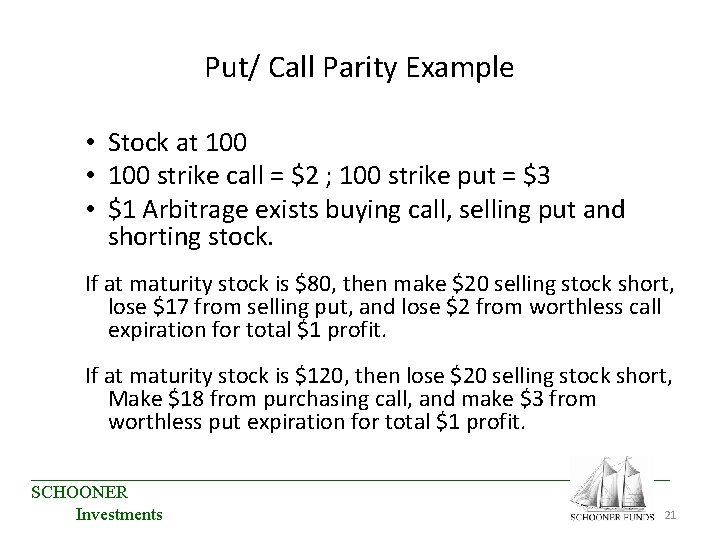
Put/ Call Parity Example • Stock at 100 • 100 strike call = $2 ; 100 strike put = $3 • $1 Arbitrage exists buying call, selling put and shorting stock. If at maturity stock is $80, then make $20 selling stock short, lose $17 from selling put, and lose $2 from worthless call expiration for total $1 profit. If at maturity stock is $120, then lose $20 selling stock short, Make $18 from purchasing call, and make $3 from worthless put expiration for total $1 profit. ____________________________________ SCHOONER 21 Investments
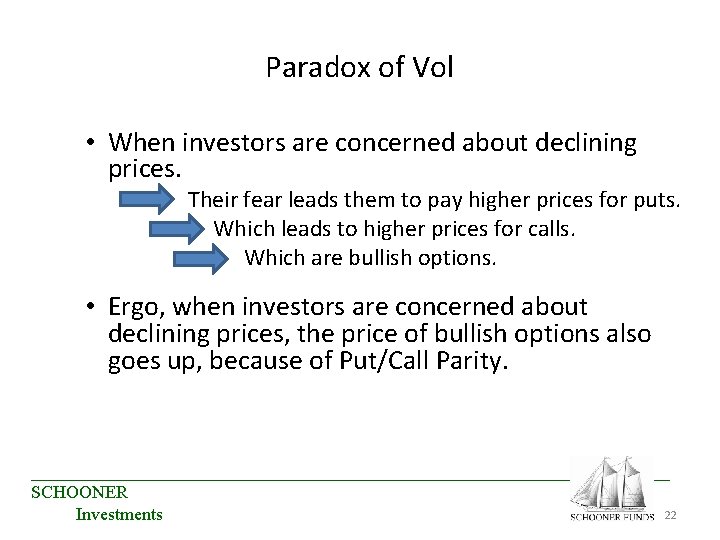
Paradox of Vol • When investors are concerned about declining prices. • Their fear leads them to pay higher prices for puts. • Which leads to higher prices for calls. • Which are bullish options. • Ergo, when investors are concerned about declining prices, the price of bullish options also goes up, because of Put/Call Parity. ____________________________________ SCHOONER 22 Investments
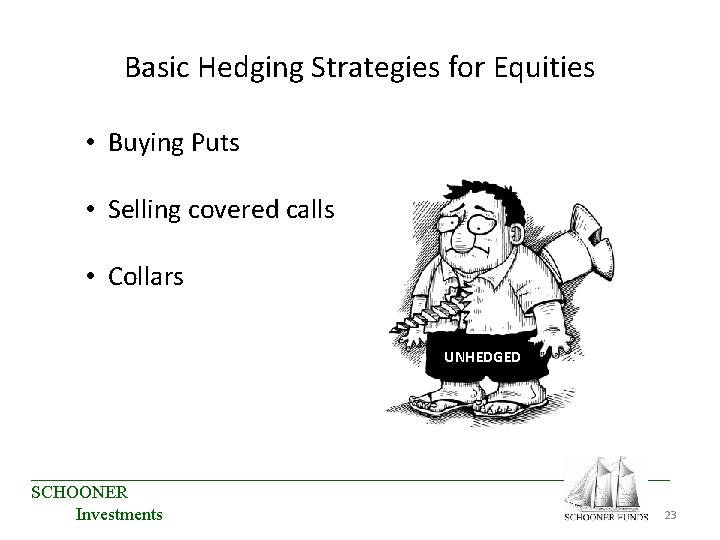
Basic Hedging Strategies for Equities • Buying Puts • Selling covered calls • Collars UNHEDGED ____________________________________ SCHOONER 23 Investments
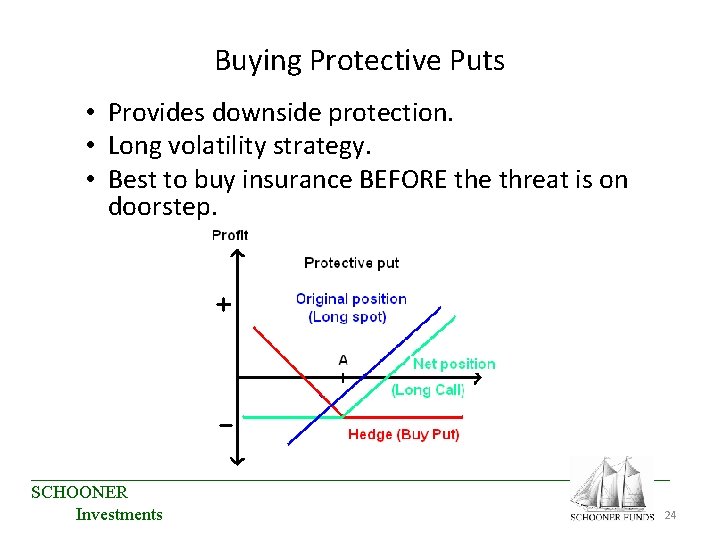
Buying Protective Puts • Provides downside protection. • Long volatility strategy. • Best to buy insurance BEFORE the threat is on doorstep. ____________________________________ SCHOONER 24 Investments
____________________________________ SCHOONER 25 Investments
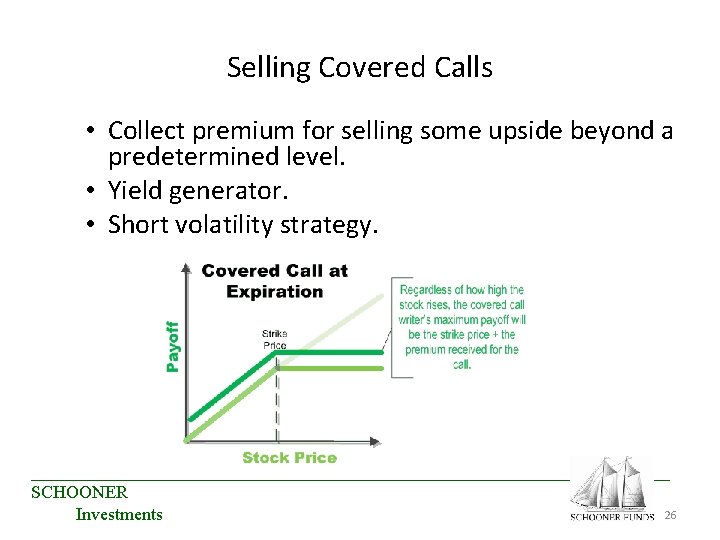
Selling Covered Calls • Collect premium for selling some upside beyond a predetermined level. • Yield generator. • Short volatility strategy. ____________________________________ SCHOONER 26 Investments
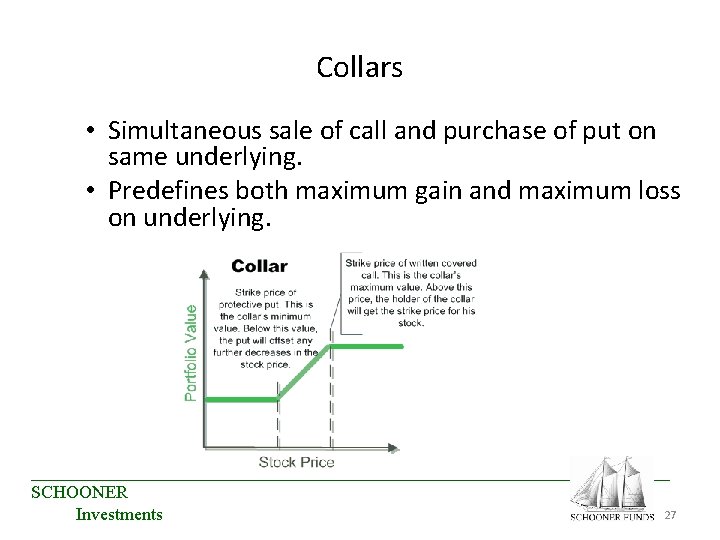
Collars • Simultaneous sale of call and purchase of put on same underlying. • Predefines both maximum gain and maximum loss on underlying. ____________________________________ SCHOONER 27 Investments
Volatility as an Asset Class • Changes in the “price of volatility” can be used as standalone or complimentary investment strategy. • Employ strategies to take advantage of varying volatility environments and fluctuations in the pricing of implied volatility. • Volatility allocation in a portfolio can lead to higher alpha, lower beta, and superior risk return profile in both bull and bear markets. ____________________________________ SCHOONER 28 Investments
Core Volatility Based Trading Strategies Basic • Buy - Writes (covered calls) • Convertibles Advanced • Correlation and dispersion trading • Variance swaps ____________________________________ SCHOONER 29 Investments
Covered Calls • Can be used portfolio wide on large baskets of core equity holdings. • Premium collected buffers losses from any declines in underlying equity positions. • Allows investor to retain upside exposure to equity holdings • Requires very disciplined investment strategy and trading expertise. • Must decouple volatility assessment from directional assessment. • Often self initiated by retail investors with disappointing results. ____________________________________ SCHOONER 30 Investments
Convertible Bond Basics • Fixed income instruments that have coupons lower than non convertible bonds of same issuer. • Holder has the right to exchange the bond into a specified number of shares of the underlying stock. • “Orphaned” and low profile hybrid asset class often overlooked by investors. • Most attractive during periods of credit stability and low / rising equity volatility. ____________________________________ SCHOONER 31 Investments
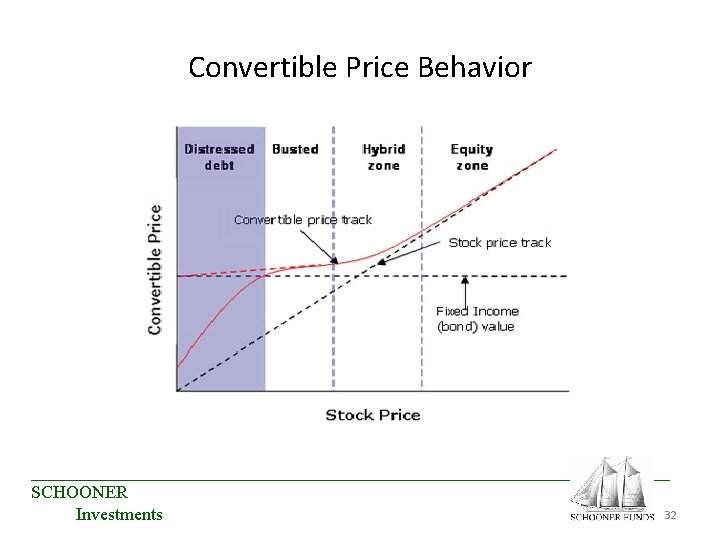
Convertible Price Behavior ____________________________________ SCHOONER 32 Investments
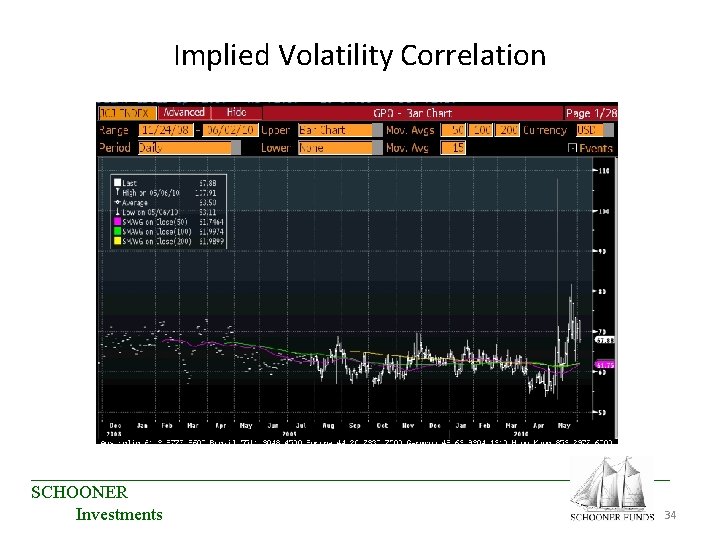
Volatility Arbitrage • Trading of index volatility against constituent single name volatility. • Index implied vol is function of underlying securities individual volatilities and correlations. • Index implied volatility < mean constituent implied volatility. • Core bet is on correlation. • Correlation typically ranges between. 5 and. 7 for SPX • Correlation spikes during times of distress. ____________________________________ SCHOONER 33 Investments
Implied Volatility Correlation ____________________________________ SCHOONER 34 Investments
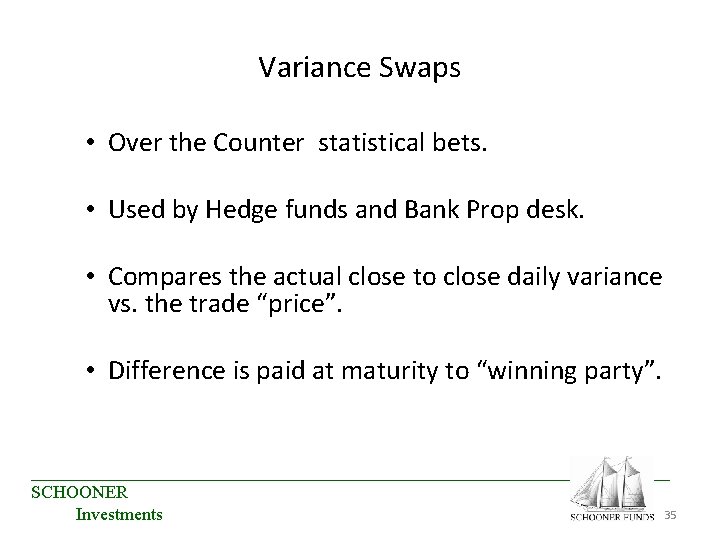
Variance Swaps • Over the Counter statistical bets. • Used by Hedge funds and Bank Prop desk. • Compares the actual close to close daily variance vs. the trade “price”. • Difference is paid at maturity to “winning party”. ____________________________________ SCHOONER 35 Investments
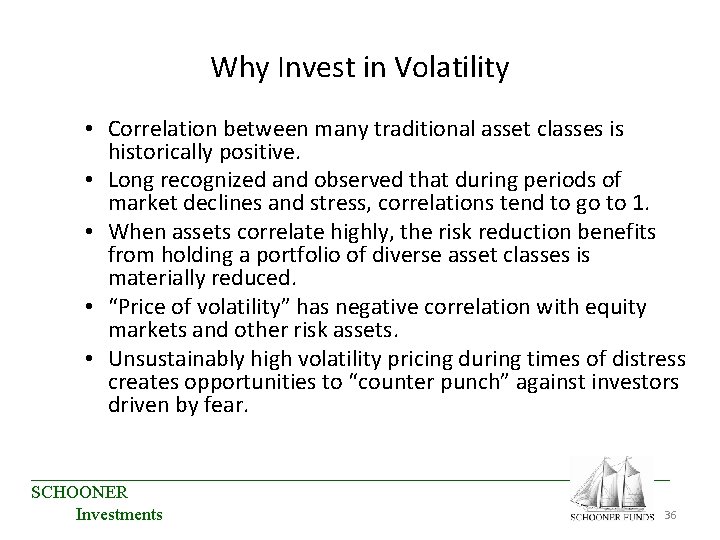
Why Invest in Volatility • Correlation between many traditional asset classes is historically positive. • Long recognized and observed that during periods of market declines and stress, correlations tend to go to 1. • When assets correlate highly, the risk reduction benefits from holding a portfolio of diverse asset classes is materially reduced. • “Price of volatility” has negative correlation with equity markets and other risk assets. • Unsustainably high volatility pricing during times of distress creates opportunities to “counter punch” against investors driven by fear. ____________________________________ SCHOONER 36 Investments
How to Invest in Volatility • VIX based ETFs • Hedge Funds • Mutual Funds ____________________________________ SCHOONER 37 Investments
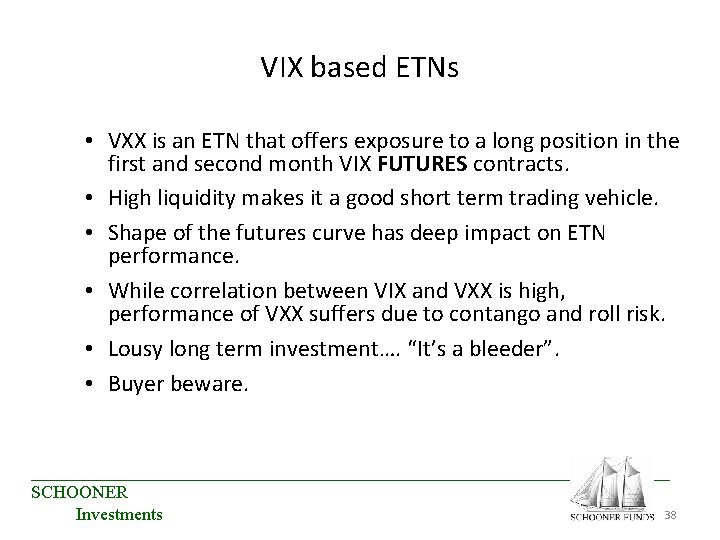
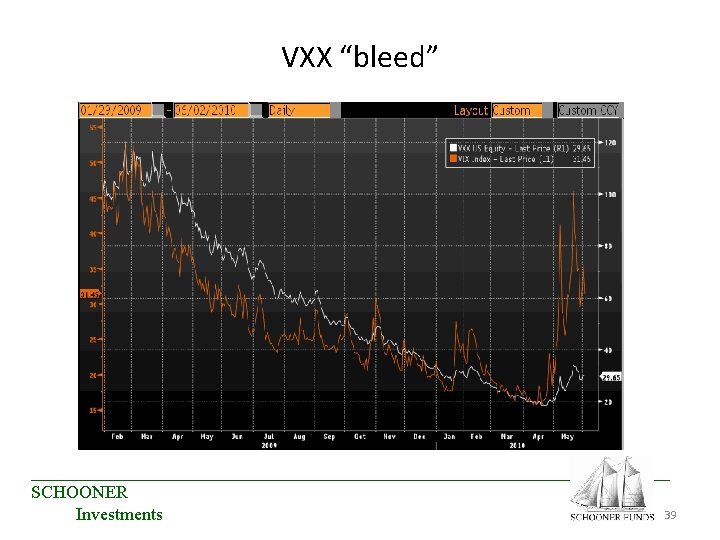
VIX based ETNs • VXX is an ETN that offers exposure to a long position in the first and second month VIX FUTURES contracts. • High liquidity makes it a good short term trading vehicle. • Shape of the futures curve has deep impact on ETN performance. • While correlation between VIX and VXX is high, performance of VXX suffers due to contango and roll risk. • Lousy long term investment…. “It’s a bleeder”. • Buyer beware. ____________________________________ SCHOONER 38 Investments
VXX “bleed” ____________________________________ SCHOONER 39 Investments
Hedge Funds • Pros • Can go anywhere and trade anything, pioneers. • Sophisticated strategies and generally high talent. • Cons • • • Poor liquidity and lack of transparency. No regulation. Possible high leverage. Expensive. High minimums. ____________________________________ SCHOONER 40 Investments
Mutual Funds • Pros • Daily liquidity and transparency. • Regulated. • Retail friendly. • Cons • Limited experience in sophisticated strategies. • Restrictive mandate or expertise. • Covered call only • Convertible only ____________________________________ SCHOONER 41 Investments
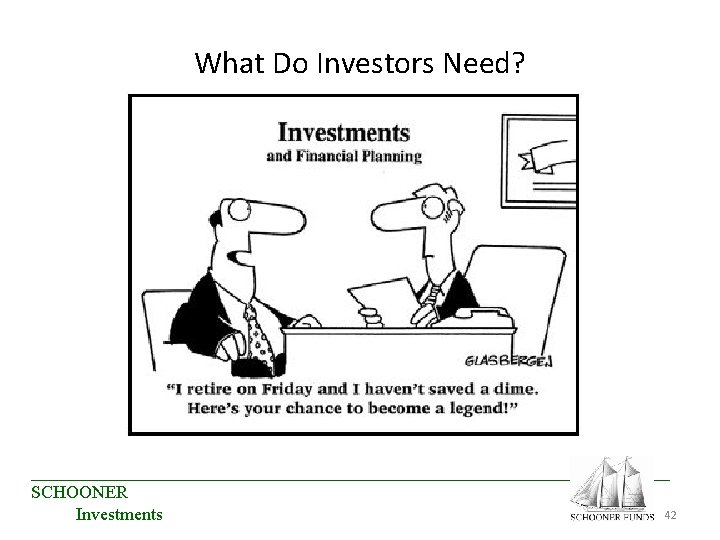
What Do Investors Need? ____________________________________ SCHOONER 42 Investments
What Do Investors Need? • • • Dampened volatility. Participation in equity market upside. Removal of catastrophic left tail risk. Exposure to volatility as an asset class. Liquidity. One solution is in the packs in front of you. Thank You. ____________________________________ SCHOONER 43 Investments
Legal Disclaimer For Registered Investment Professional Use Only Past performance does not guarantee future results. Mutual fund investing involves risk; principal loss is possible. Investments in debt securities typically decrease in value when interest rates rise. This risk is usually greater for longer-term debt securities. The fund may also use options and futures contracts, which have the risks of unlimited losses of the underlying holdings due to unanticipated market movements and failure to correctly predict the direction of securities prices, interest rates and currency exchange rates. The investment in options is not suitable for all investors. The fund may hold restricted securities purchased through private placements. Such securities can be difficult to sell without experiencing delays or additional costs. Before Investing, carefully consider Schooner Growth and Income Fund’s investment objectives, risks, charges, and expenses. Please see the prospectus containing this and other information. To obtain a prospectus please visit www. schoonermutualfund. com to download a copy, or call 866 -724 -5997. Please read it carefully before investing. Fund holdings and sector allocations are subject to change at any time and should not be considered a recommendation to buy or sell any security. The Fund is distributed by Quasar Distributors, LLC. These materials are not intended to constitute legal, tax or accounting advice or investment recommendations, and prospective investors should consult their own advisors about such matters. Any person who may subscribe for an interest in any of the investment vehicles must be able to bear the risk involved and must meet the suitability requirements related to such investment. The information contained in this Presentation is confidential and proprietary to the Funds, their investment vehicles, their investment managers, and Schooner Investment Group LLC. These materials are designed for the recipient and are for information purposes only and not for general distribution. This Presentation does not constitute an offer to sell or a solicitation of an offer to buy any securities. This Presentation is qualified in its entirety by reference to the detailed information set forth in the constituent documents of the Fund Investment Vehicles. Interests in the investment vehicles are being offered solely pursuant to Memoranda furnished to prospective subscribers on behalf of Schooner and no investment decision should be made until after the prospective subscriber has received and has had the opportunity to review a copy thereof. Schooner is not acting as your agent or advisor for the purposes of making an investment decision. Interests in the Fund investment vehicles may not be registered for offer or for sale under the laws of any jurisdiction, and may not be offered or sold except in compliance with applicable securities laws. The past results of other portfolios managed by Schooner Investment Group LLC and its key employees prior to initiation, are not necessarily indicative of future results. Neither the investment vehicles, nor the investment managers shall be liable for any errors or omissions in this content, or for All information contained herein regarding the investment program and principal terms are subject to revision. any actions taken in reliance thereon. Past performance is not an indication of future results. The return of the Funds may be lower or higher. By accepting this Presentation, the recipient agrees that it will keep its contents confidential, will not reproduce it in whole or in part and will not disclose the same to any third party (other than its financial and legal advisors) without the express written permission of Schooner or otherwise use this Presentation or the information contained herein for any purpose other than the evaluation by the recipient of the investment described herein. ____________________________________ SCHOONER 44 Investments