
Theory of Te V AGNs Amir Levinson Tel



- Slides: 28
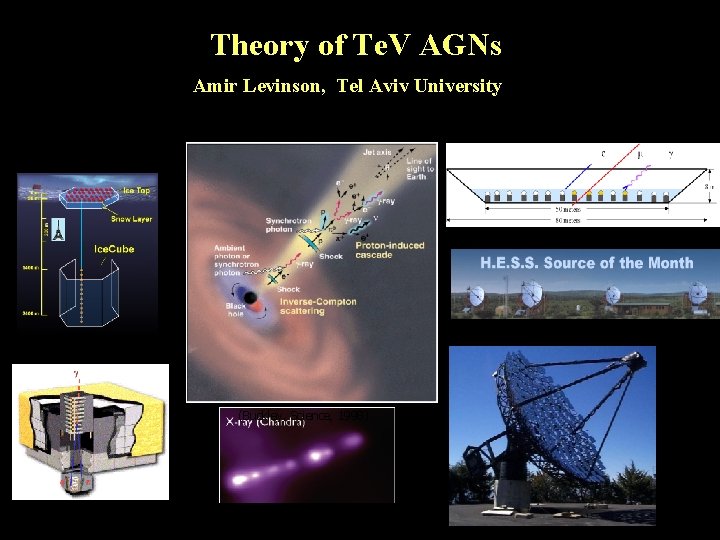
Theory of Te. V AGNs Amir Levinson, Tel Aviv University (Buckley, Science, 1998)
Open questions • What rapid variability tells us about the central engine? • Implications for kinematics of the source ? • Where is the location of the VHE emission zone ? • Emission mechanisms ? • Jet composition ?
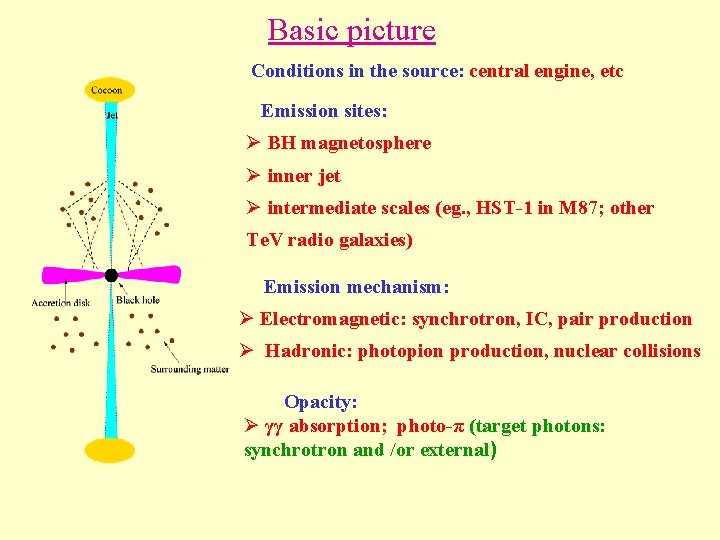
Basic picture Conditions in the source: central engine, etc Emission sites: Ø BH magnetosphere Ø inner jet Ø intermediate scales (eg. , HST-1 in M 87; other Te. V radio galaxies) Emission mechanism: Ø Electromagnetic: synchrotron, IC, pair production Ø Hadronic: photopion production, nuclear collisions Opacity: Ø γγ absorption; photo-π (target photons: synchrotron and /or external)
General remarks Ø Blazar emission is presumably multi-component. The new class (Te. V galaxies) seem to indicate emission from less beamed regions (BH magnetosphere? Boundary shear layers? ) one thus needs to be cautious in modeling spectra, etc. ! Ø Combination of very rapid variability + VHE emission can provide some general constraints on basic physics! Ø In general the structure may be quite involved, as seem to be indicated by e. g. , extreme flares
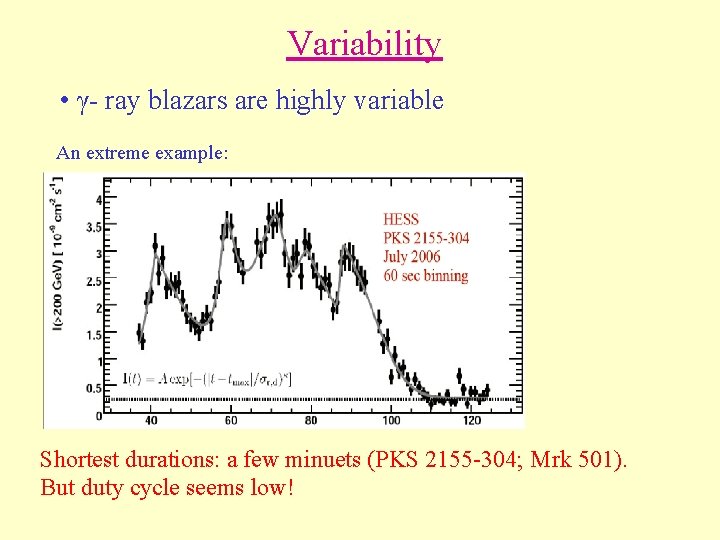
Variability • γ- ray blazars are highly variable An extreme example: Shortest durations: a few minuets (PKS 2155 -304; Mrk 501). But duty cycle seems low!
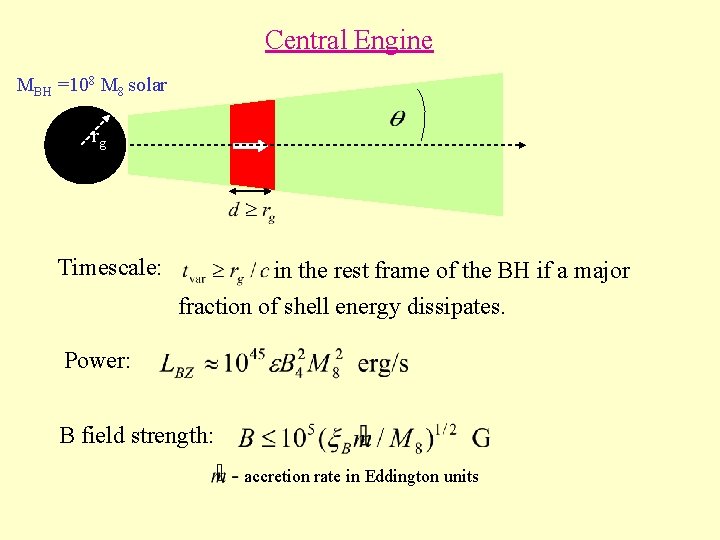
Central Engine MBH =108 M 8 solar rg Timescale: in the rest frame of the BH if a major fraction of shell energy dissipates. Power: B field strength: accretion rate in Eddington units
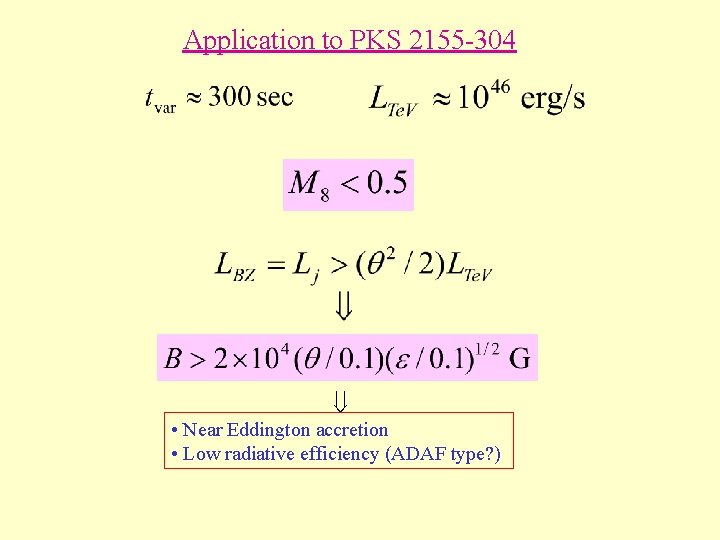
Application to PKS 2155 -304 • Near Eddington accretion • Low radiative efficiency (ADAF type? )
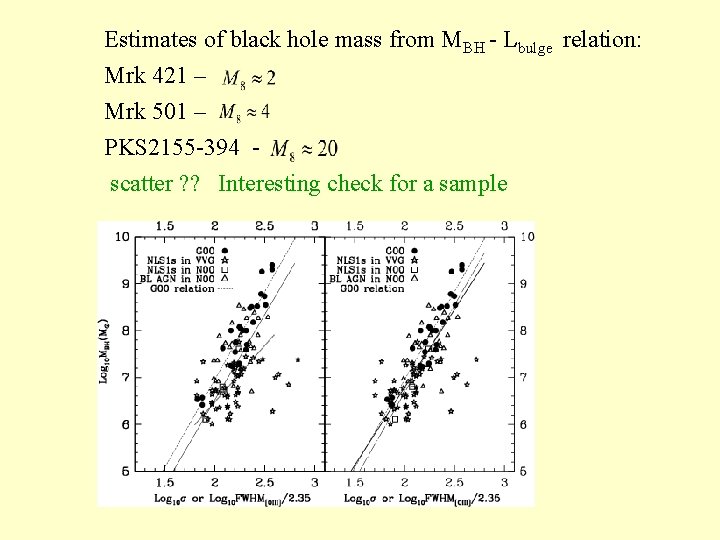
Estimates of black hole mass from MBH - Lbulge relation: Mrk 421 – Mrk 501 – PKS 2155 -394 scatter ? ? Interesting check for a sample
Alternatives: compact emission region within the jet ? Collision with external disturbance ? Jet in a jet ? Low duty cycle expected ! Other ?
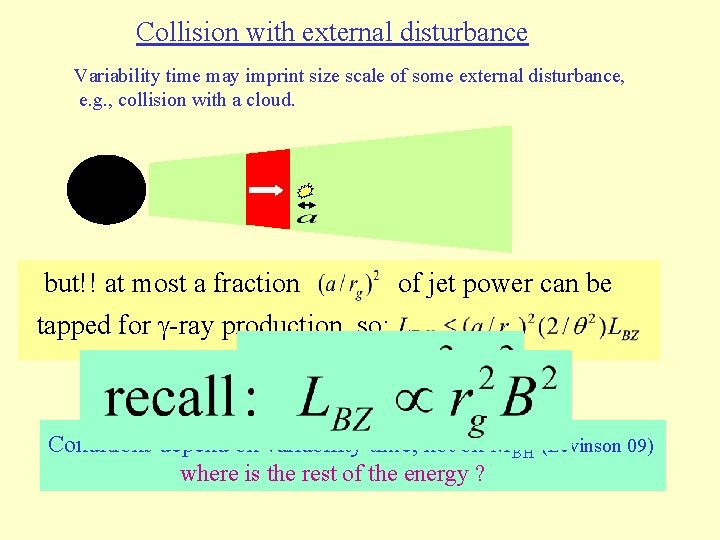
Collision with external disturbance Variability time may imprint size scale of some external disturbance, e. g. , collision with a cloud. but!! at most a fraction of jet power can be tapped for -ray production, so: Conditions depend on variability time, not on MBH (Levinson 09) where is the rest of the energy ?
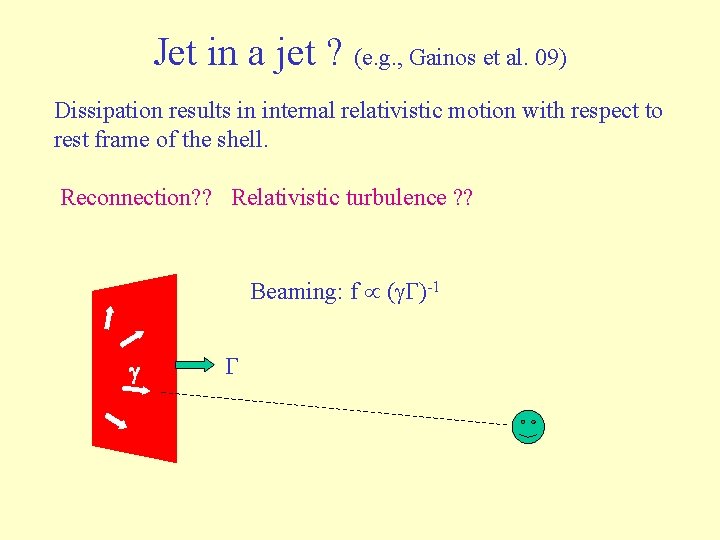
Jet in a jet ? (e. g. , Gainos et al. 09) Dissipation results in internal relativistic motion with respect to rest frame of the shell. Reconnection? ? Relativistic turbulence ? ? Beaming: f ( )-1
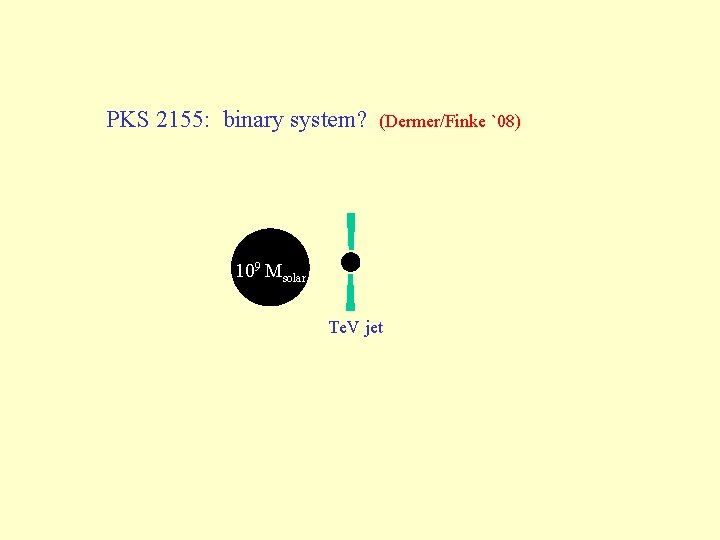
PKS 2155: binary system? (Dermer/Finke `08) 109 Msolar Te. V jet
-ray emission: kinematics & location • BH magnetosphere ? • Inner jet ? • Intermediate scales ? (e. g. , boundary shear layers) • Supercriticality? (photon breeding; converter; etc. )
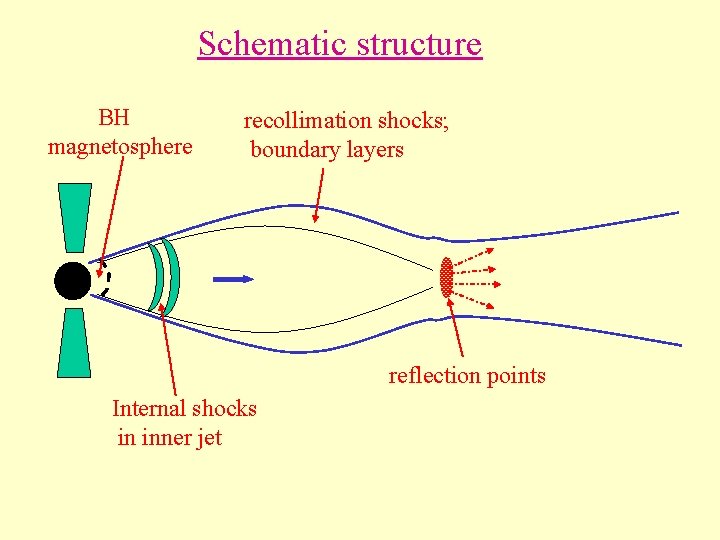
Schematic structure BH magnetosphere recollimation shocks; boundary layers reflection points Internal shocks in inner jet
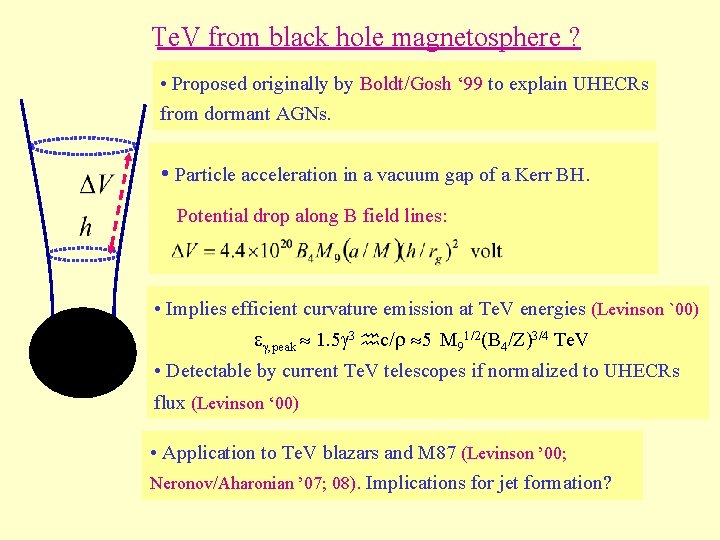
Te. V from black hole magnetosphere ? • Proposed originally by Boldt/Gosh ‘ 99 to explain UHECRs from dormant AGNs. • Particle acceleration in a vacuum gap of a Kerr BH. Potential drop along B field lines: • Implies efficient curvature emission at Te. V energies (Levinson `00) , peak 1. 5 3 c/ 5 M 91/2(B 4/Z)3/4 Te. V • Detectable by current Te. V telescopes if normalized to UHECRs flux (Levinson ‘ 00) • Application to Te. V blazars and M 87 (Levinson ’ 00; Neronov/Aharonian ’ 07; 08). Implications for jet formation?
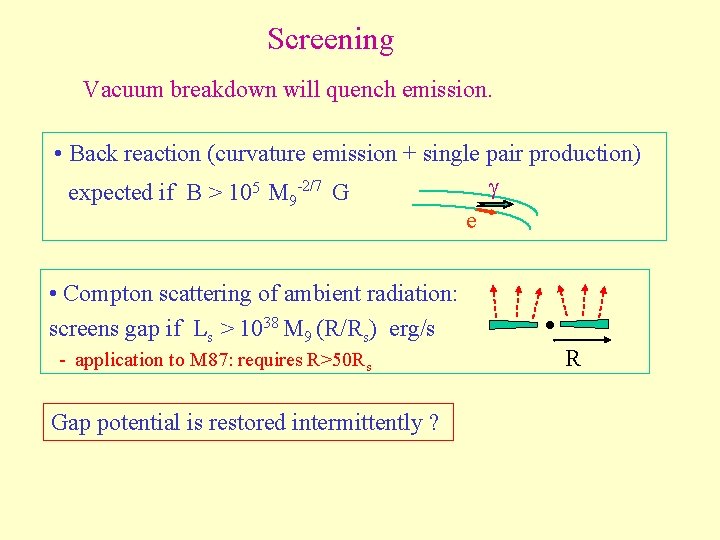
Screening Vacuum breakdown will quench emission. • Back reaction (curvature emission + single pair production) expected if B > 105 M 9 -2/7 G e • Compton scattering of ambient radiation: screens gap if Ls > 1038 M 9 (R/Rs) erg/s - application to M 87: requires R>50 Rs Gap potential is restored intermittently ? R
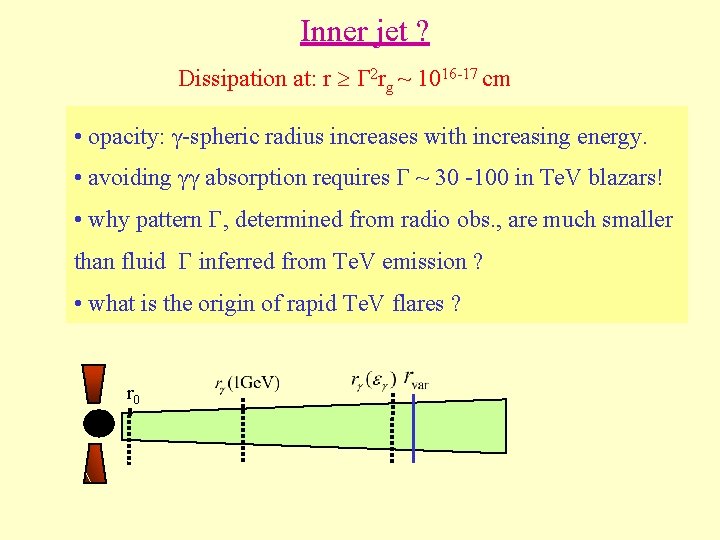
Inner jet ? Dissipation at: r Γ 2 rg ~ 1016 -17 cm • opacity: γ-spheric radius increases with increasing energy. • avoiding γγ absorption requires Γ ~ 30 -100 in Te. V blazars! • why pattern , determined from radio obs. , are much smaller than fluid inferred from Te. V emission ? • what is the origin of rapid Te. V flares ? r 0
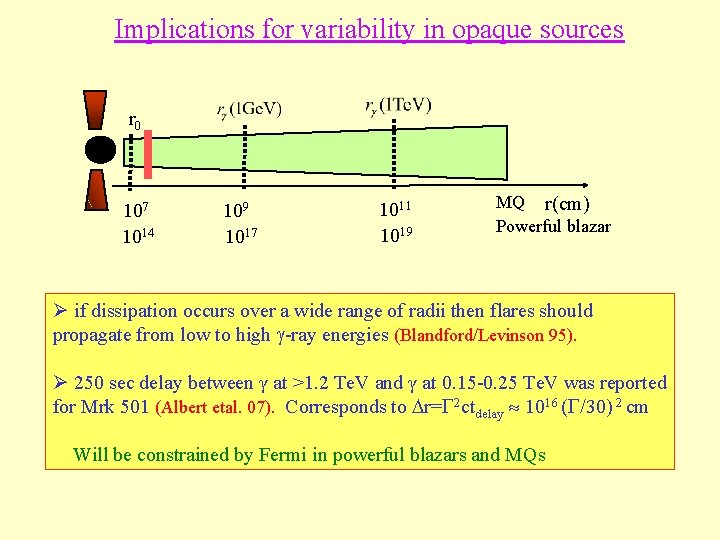
Implications for variability in opaque sources r 0 107 1014 109 1017 1011 1019 MQ r(cm) Powerful blazar Ø if dissipation occurs over a wide range of radii then flares should propagate from low to high -ray energies (Blandford/Levinson 95). Ø 250 sec delay between γ at >1. 2 Te. V and γ at 0. 15 -0. 25 Te. V was reported for Mrk 501 (Albert etal. 07). Corresponds to r= 2 ctdelay 1016 ( /30) 2 cm Will be constrained by Fermi in powerful blazars and MQs
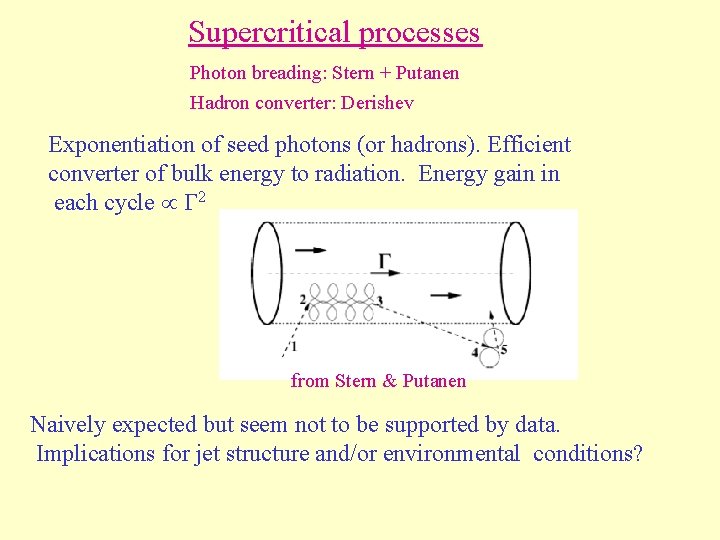
Supercritical processes Photon breading: Stern + Putanen Hadron converter: Derishev Exponentiation of seed photons (or hadrons). Efficient converter of bulk energy to radiation. Energy gain in each cycle 2 from Stern & Putanen Naively expected but seem not to be supported by data. Implications for jet structure and/or environmental conditions?
Intermediate scales: boundary layers and recollimation shocks • Interaction with the surrounding medium helps collimation and produces oblique shocks, shear layers, and recollimation nozzles. • A substantial fraction of the bulk energy dissipates in these regions and can lead to a less beamed (though sometimes highly variable as in HST-1 knot) emission. Relevant for radio Galaxies and blazars! (e. g. , Marscher, Sikora et al. )
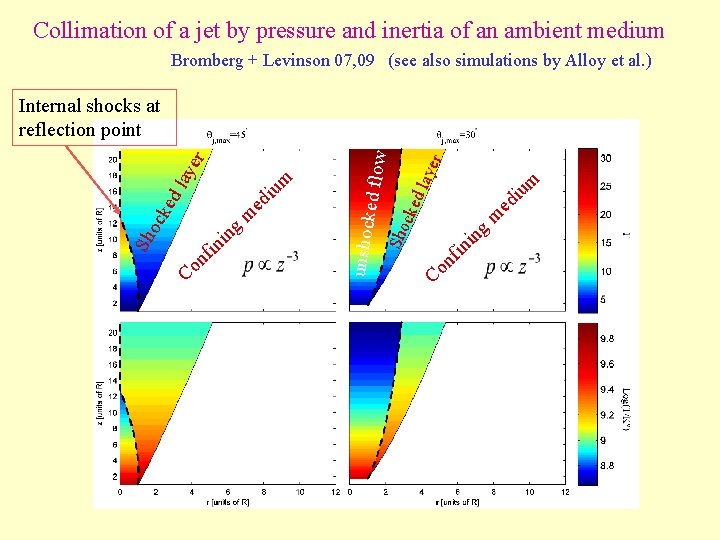
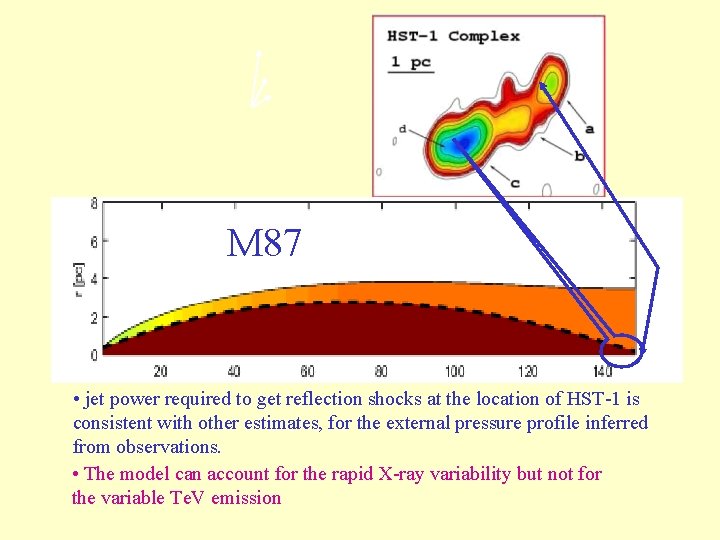
Collimation of a jet by pressure and inertia of an ambient medium Bromberg + Levinson 07, 09 (see also simulations by Alloy et al. ) Sh C on yer d la Sho cke g in if n e m ed flow ock ed m u di unshock lay er Internal shocks at reflection point i C f on g n ni m e um i d
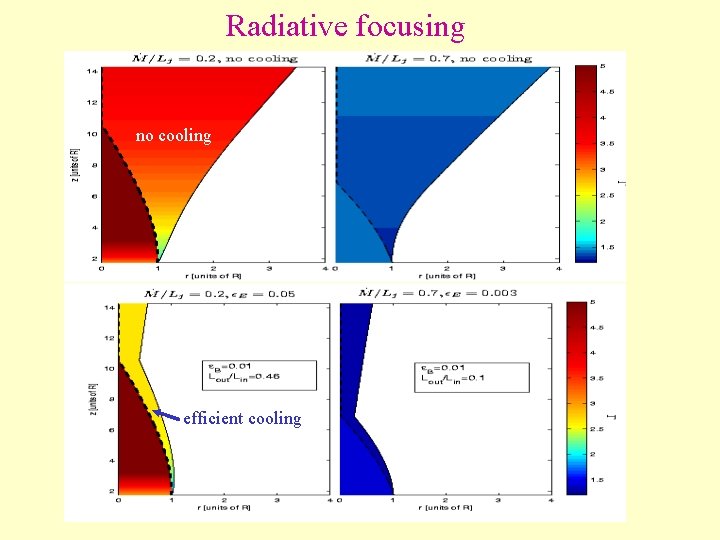
Radiative focusing no cooling efficient cooling
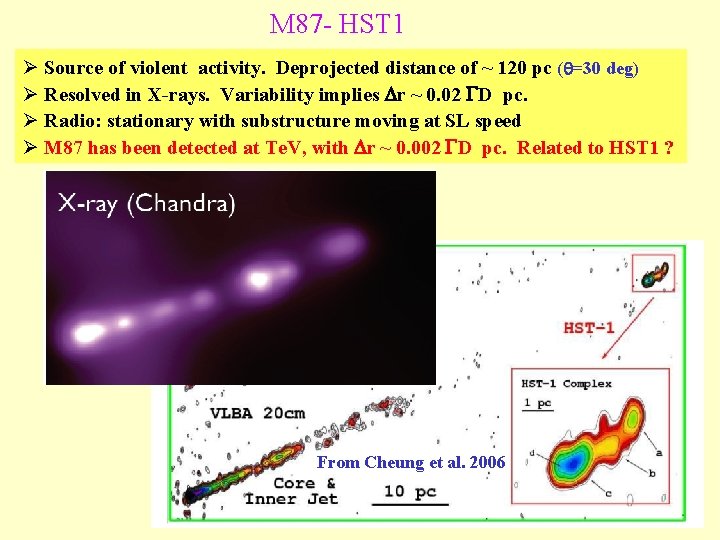
M 87 - HST 1 Ø Source of violent activity. Deprojected distance of ~ 120 pc (q=30 deg) Ø Resolved in X-rays. Variability implies Dr ~ 0. 02 GD pc. Ø Radio: stationary with substructure moving at SL speed Ø M 87 has been detected at Te. V, with Dr ~ 0. 002 GD pc. Related to HST 1 ? From Cheung et al. 2006
M 87 • jet power required to get reflection shocks at the location of HST-1 is consistent with other estimates, for the external pressure profile inferred from observations. • The model can account for the rapid X-ray variability but not for the variable Te. V emission
Summary • Rapid Te. V flares imply either small mass BH or, alternatively, a compact emission region within the jet (e. g. , collision with a small cloud). In any case, near Eddington accretion is required to account for flare luminosity. Look for disk emission during Te. V flares. • Large Doppler factors seem to be implied for Te. V blazars by -ray observations. Differ considerably from pattern speed in Te. V blazars. • VHE emission appears to be multi-component. Radio Galaxies reveal less beamed emission zones. Need further studies to better locate those regions. • Collimation may be an important dissipation channel, e. g. , HST-1 in M 87; BL Lac (Marscher); 3 c 345 (Sikora etal). Also in GRBs? Can this account for rapid variability at relatively large radii?
THE END
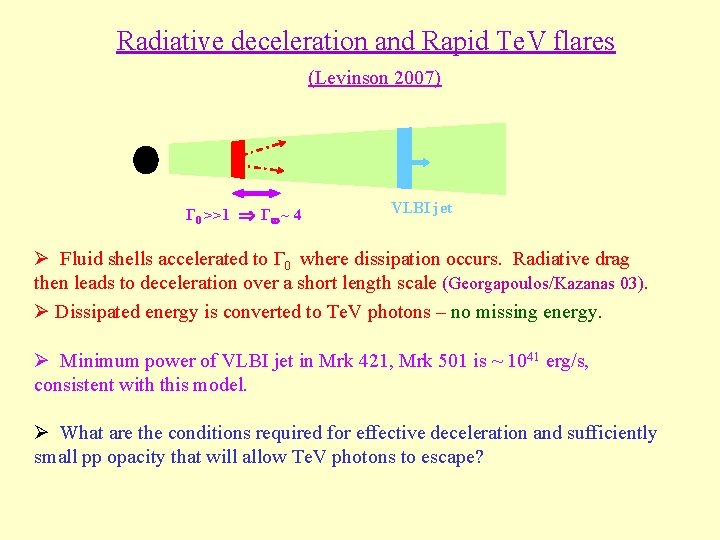
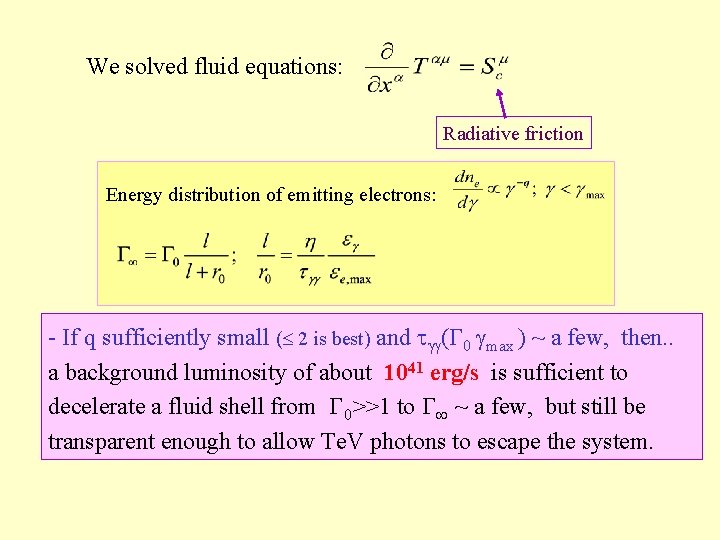
Radiative deceleration and Rapid Te. V flares (Levinson 2007) Γ 0 >>1 Γ ~ 4 VLBI jet Ø Fluid shells accelerated to Γ 0 where dissipation occurs. Radiative drag then leads to deceleration over a short length scale (Georgapoulos/Kazanas 03). Ø Dissipated energy is converted to Te. V photons – no missing energy. Ø Minimum power of VLBI jet in Mrk 421, Mrk 501 is ~ 1041 erg/s, consistent with this model. Ø What are the conditions required for effective deceleration and sufficiently small pp opacity that will allow Te. V photons to escape?
We solved fluid equations: Radiative friction Energy distribution of emitting electrons: - If q sufficiently small ( 2 is best) and (Γ 0 max ) ~ a few, then. . a background luminosity of about 1041 erg/s is sufficient to decelerate a fluid shell from 0>>1 to ~ a few, but still be transparent enough to allow Te. V photons to escape the system.