Electrochemical Techniques to Study Solid Materials Fritz Scholz







- Slides: 34
Electrochemical Techniques to Study Solid Materials Fritz Scholz Universität Greifswald Institut für Biochemie Lehrstuhl für Analytische Chemie und Umweltchemie (Editor-in-Chief Journal of Solid State Electrochemistry) Felix-Hausdorff-Straße 4, 17487 Greifswald, Germany Tel. : +49 -(0)3834 -864450, Fax: +49 -(0)3834 -864451 e-mail: fscholz@uni-greifswald. de http: //www. chemie. uni-greifswald. de/~analytik/ Copyright statement: Most of the figures and part of the text are subject to copyright restrictions, and should not be copied without permission of the copyright holders.
The Electrochemistry of Microparticles -3 -
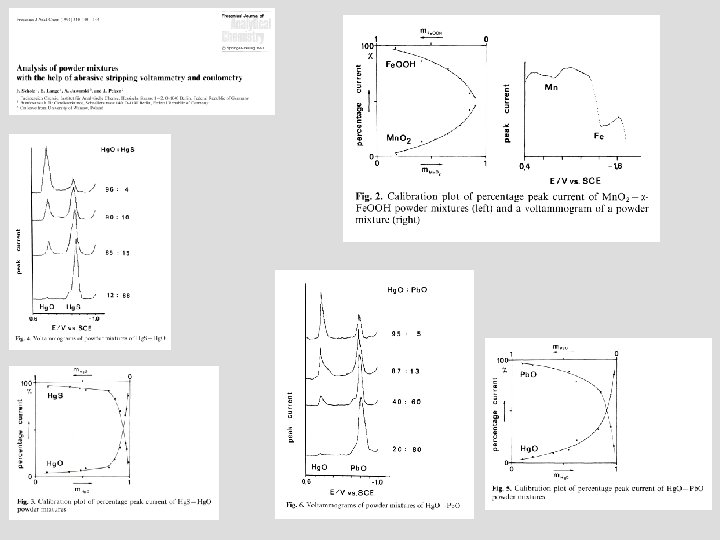
Powder Mixtures
Thermodynamic basis: Independence of the signals of each phase. (In contrast to mixed phase, i. e. , solid solutions) Analytical specificity: Each signal has a specific sensitivity (slope of the calibration plot ‘signal versus absolute amount’
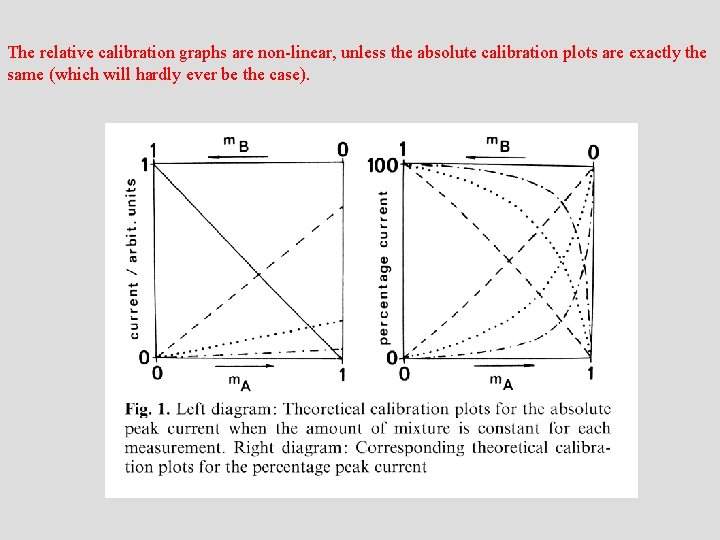
The relative calibration graphs are non-linear, unless the absolute calibration plots are exactly the same (which will hardly ever be the case).
Open problems of powder analysis : - what is the effect of size and shape of the particles on the “transfer efficiency” from the sample spot to the electrode? - is there any preferential transfer in case of powder mixtures? - can an electroactive component of an inert powder be analyzed with the help of an inner standard? Probably, yes. See next slide.
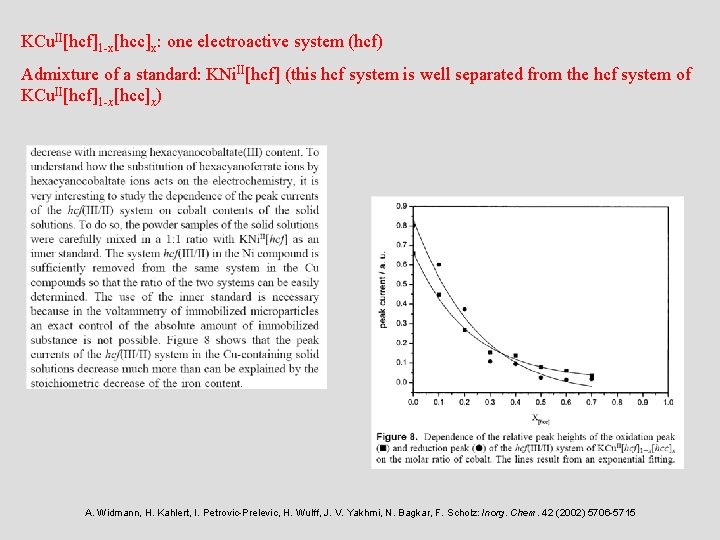
KCu. II[hcf]1 -x[hcc]x: one electroactive system (hcf) Admixture of a standard: KNi. II[hcf] (this hcf system is well separated from the hcf system of KCu. II[hcf]1 -x[hcc]x) A. Widmann, H. Kahlert, I. Petrovic-Prelevic, H. Wulff, J. V. Yakhmi, N. Bagkar, F. Scholz: Inorg. Chem. 42 (2002) 5706 -5715
Thermodynamic Data
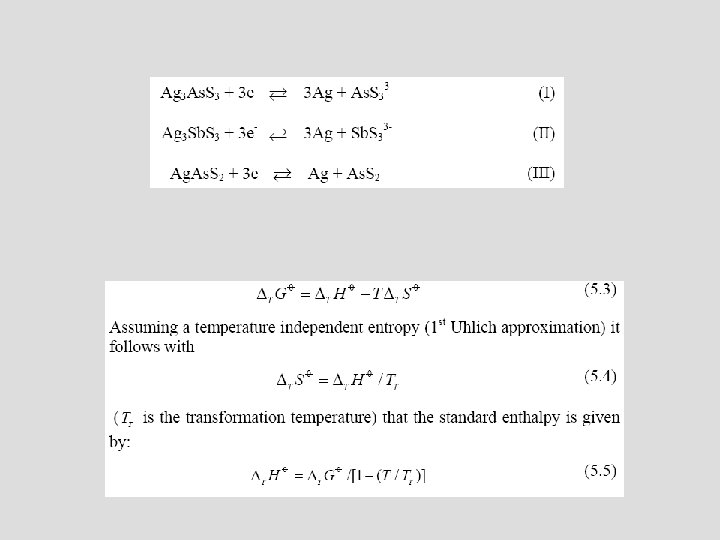
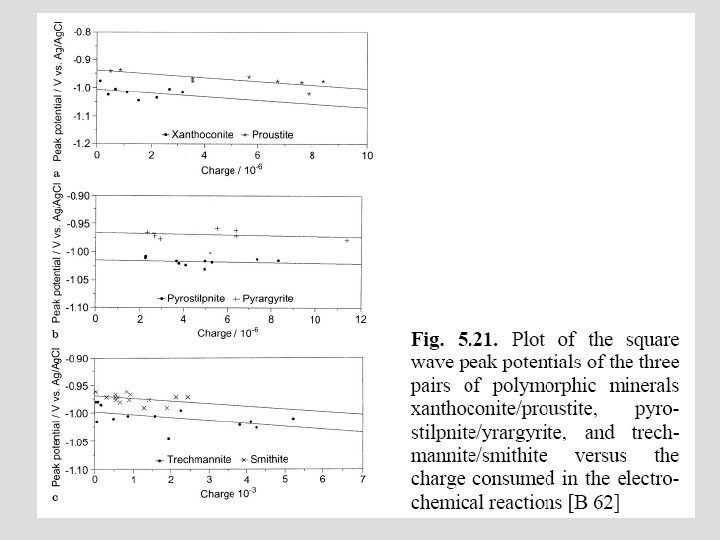
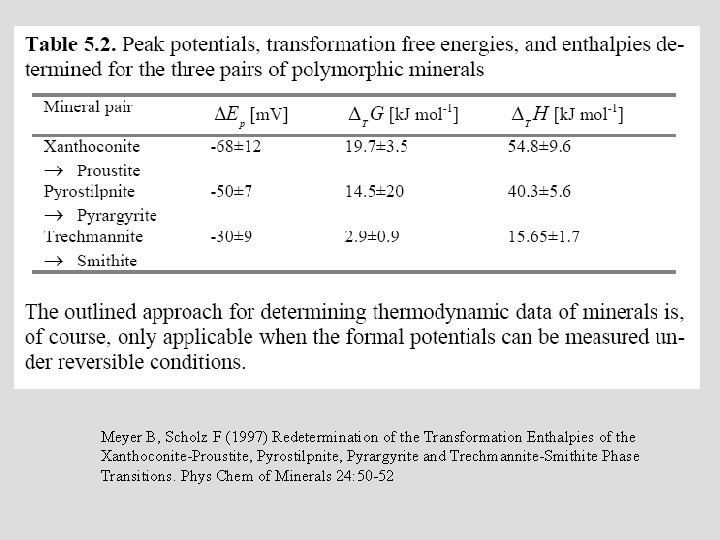
Transformation Enthalpies of Mineral Phases
Meyer B, Scholz F (1997) Redetermination of the Transformation Enthalpies of the Xanthoconite-Proustite, Pyrostilpnite, Pyrargyrite and Trechmannite-Smithite Phase Transitions. Phys Chem of Minerals 24: 50 -52
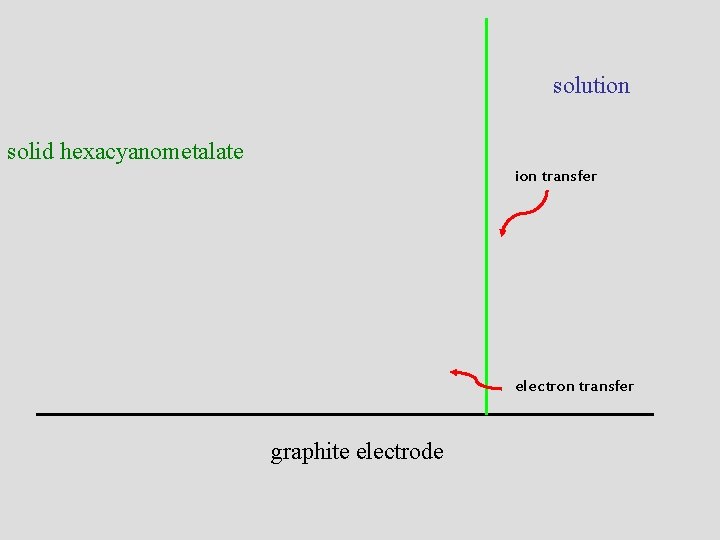
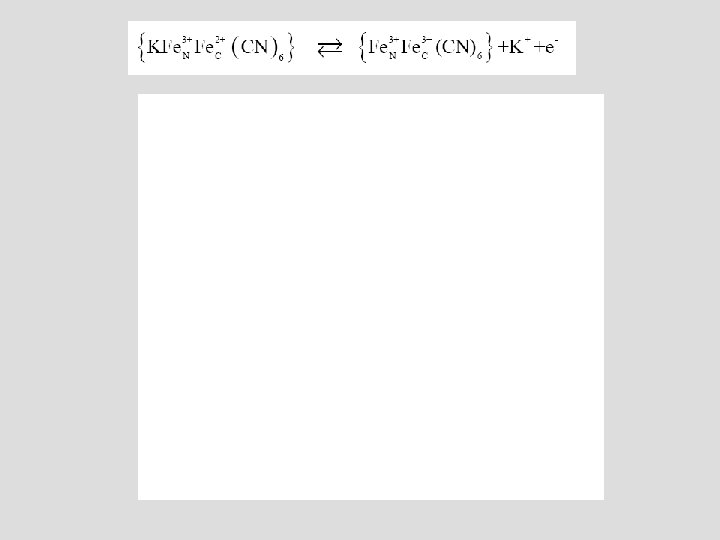
Polycyanometalates (hexacyanometalates, octacyanometalates) Insertion electrochemistry
solution solid hexacyanometalate ion transfer electron transfer graphite electrode
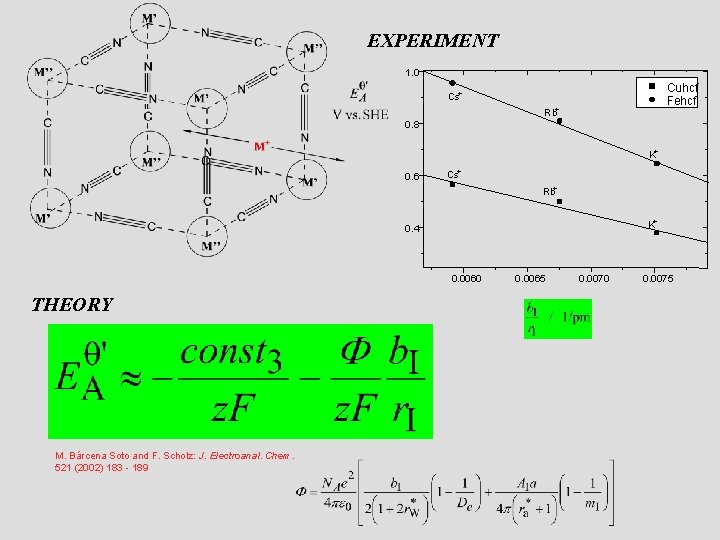
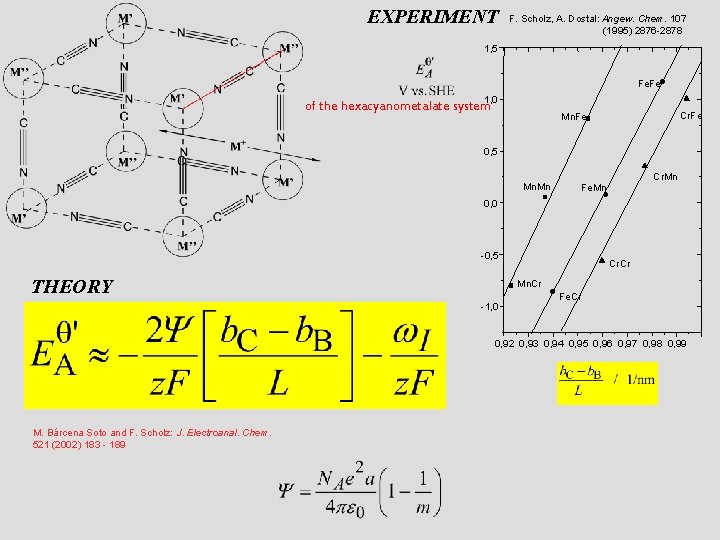
F. Scholz, A. Dostal: Angew. Chem. 107 (1995) 2876 -2878 M. Bárcena Soto and F. Scholz: J. Electroanal. Chem. 521 (2002) 183 - 189
EXPERIMENT 1. 0 Cuhcf Fehcf Cs+ Rb+ 0. 8 K+ 0. 6 Cs+ Rb+ K+ 0. 4 0. 0060 THEORY M. Bárcena Soto and F. Scholz: J. Electroanal. Chem. 521 (2002) 183 - 189 0. 0065 0. 0070 0. 0075
EXPERIMENT F. Scholz, A. Dostal: Angew. Chem. 107 (1995) 2876 -2878 1, 5 Fe. Fe of the hexacyanometalate system 1, 0 Cr. Fe Mn. Fe 0, 5 Mn. Mn Cr. Mn Fe. Mn 0, 0 -0, 5 THEORY Cr. Cr Mn. Cr -1, 0 Fe. Cr 0, 92 0, 93 0, 94 0, 95 0, 96 0, 97 0, 98 0, 99 M. Bárcena Soto and F. Scholz: J. Electroanal. Chem. 521 (2002) 183 - 189
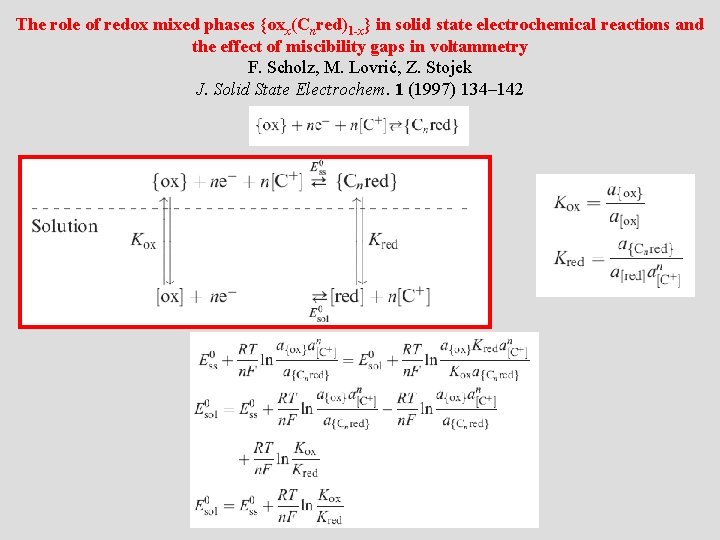
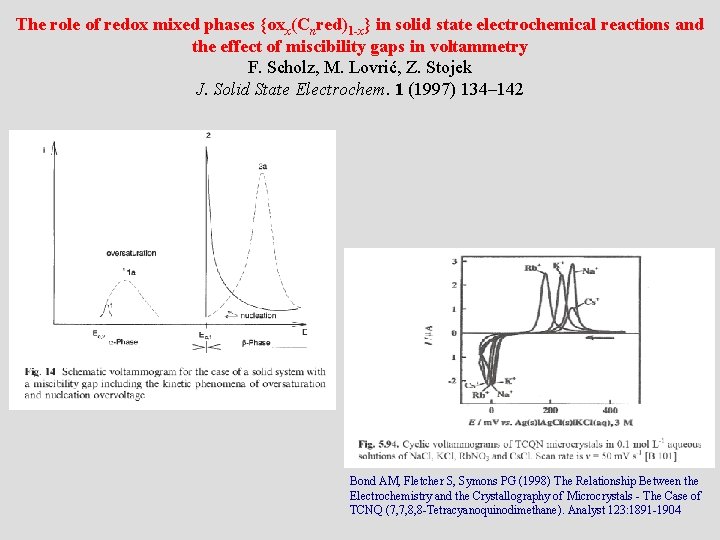
The role of redox mixed phases {oxx(Cnred)1 -x} in solid state electrochemical reactions and the effect of miscibility gaps in voltammetry F. Scholz, M. Lovrić, Z. Stojek J. Solid State Electrochem. 1 (1997) 134– 142
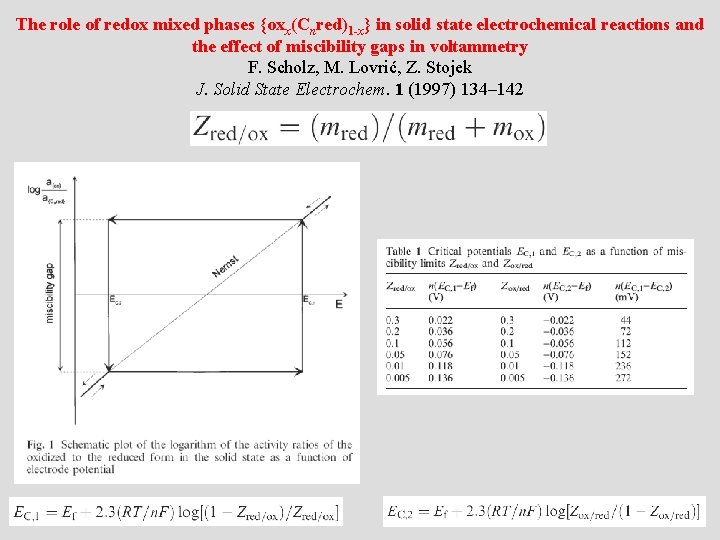
The role of redox mixed phases {oxx(Cnred)1 -x} in solid state electrochemical reactions and the effect of miscibility gaps in voltammetry F. Scholz, M. Lovrić, Z. Stojek J. Solid State Electrochem. 1 (1997) 134– 142
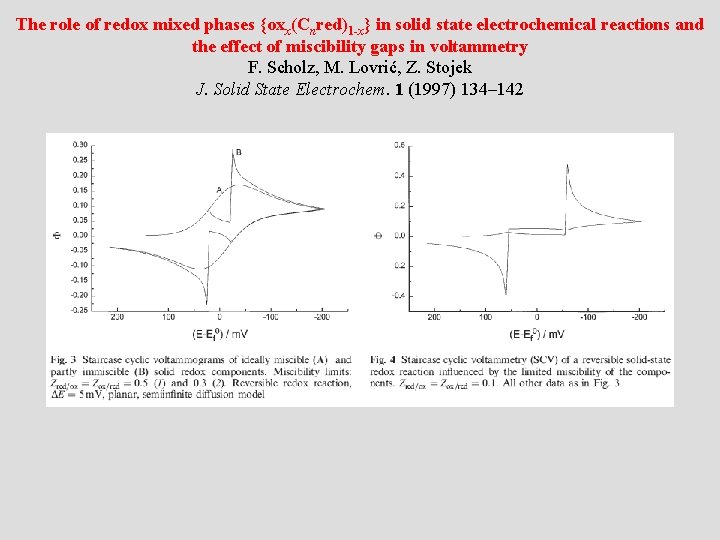
The role of redox mixed phases {oxx(Cnred)1 -x} in solid state electrochemical reactions and the effect of miscibility gaps in voltammetry F. Scholz, M. Lovrić, Z. Stojek J. Solid State Electrochem. 1 (1997) 134– 142
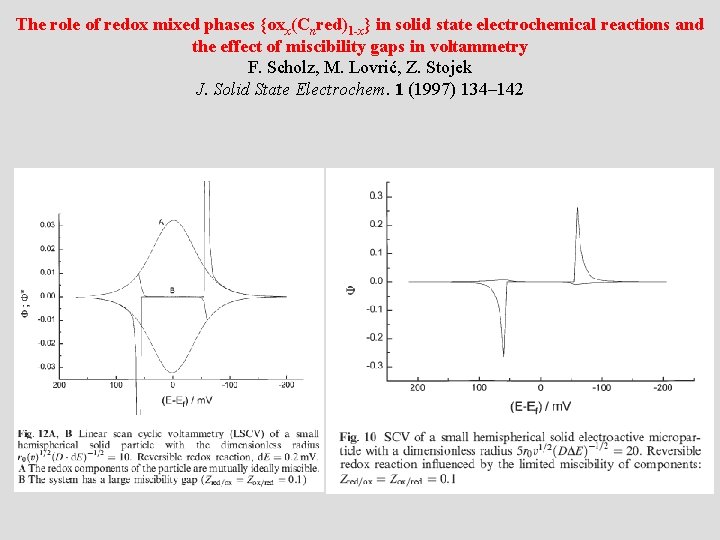
The role of redox mixed phases {oxx(Cnred)1 -x} in solid state electrochemical reactions and the effect of miscibility gaps in voltammetry F. Scholz, M. Lovrić, Z. Stojek J. Solid State Electrochem. 1 (1997) 134– 142
The role of redox mixed phases {oxx(Cnred)1 -x} in solid state electrochemical reactions and the effect of miscibility gaps in voltammetry F. Scholz, M. Lovrić, Z. Stojek J. Solid State Electrochem. 1 (1997) 134– 142
The role of redox mixed phases {oxx(Cnred)1 -x} in solid state electrochemical reactions and the effect of miscibility gaps in voltammetry F. Scholz, M. Lovrić, Z. Stojek J. Solid State Electrochem. 1 (1997) 134– 142 Bond AM, Fletcher S, Symons PG (1998) The Relationship Between the Electrochemistry and the Crystallography of Microcrystals - The Case of TCNQ (7, 7, 8, 8 -Tetracyanoquinodimethane). Analyst 123: 1891 -1904
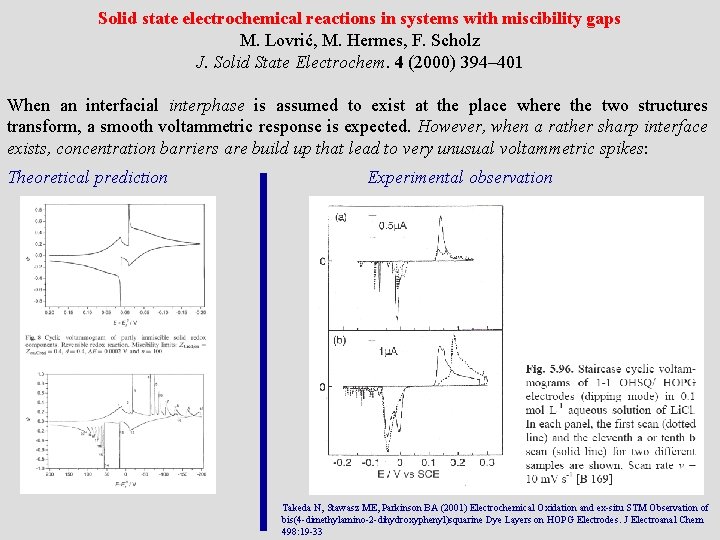
Solid state electrochemical reactions in systems with miscibility gaps M. Lovrić, M. Hermes, F. Scholz J. Solid State Electrochem. 4 (2000) 394– 401 When an interfacial interphase is assumed to exist at the place where the two structures transform, a smooth voltammetric response is expected. However, when a rather sharp interface exists, concentration barriers are build up that lead to very unusual voltammetric spikes: Theoretical prediction Experimental observation Takeda N, Stawasz ME, Parkinson BA (2001) Electrochemical Oxidation and ex-situ STM Observation of bis(4 -dimethylamino-2 -dihydroxyphenyl)squarine Dye Layers on HOPG Electrodes. J Electroanal Chem 498: 19 -33