David Elkind The Effects of Stress and Play












- Slides: 28
David Elkind: The Effects of Stress and Play on Children By: Meghan Bible and Jane Schuberg
Biography Born in Detroit, Michigan in 1931 He received his B. A. from UCLA in 1952 and his Ph. D. from UCLA in 1955 He was first exposed to Jean Piaget when he worked as a Research Assistant to David Rappaport at the Austen Riggs Center in Stockbridge, MA From 1964 to 1965, he worked at Piaget's Institut d'Epistemopologie Genetique in Geneva, Switzerland He is currently an Emeritus Professor in the Department of Child Development at Tufts University in Medford, Massachusetts
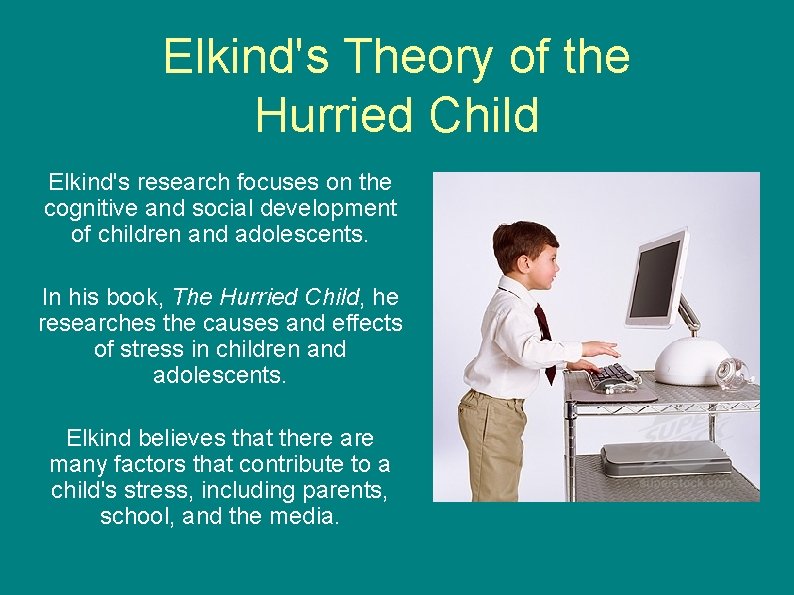
Elkind's Theory of the Hurried Child Elkind's research focuses on the cognitive and social development of children and adolescents. In his book, The Hurried Child, he researches the causes and effects of stress in children and adolescents. Elkind believes that there are many factors that contribute to a child's stress, including parents, school, and the media.
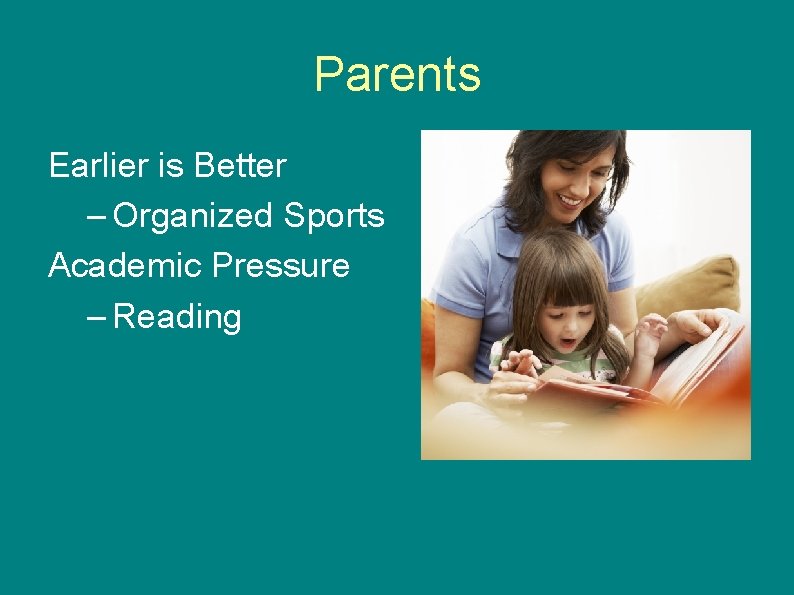
Parents Earlier is Better – Organized Sports Academic Pressure – Reading
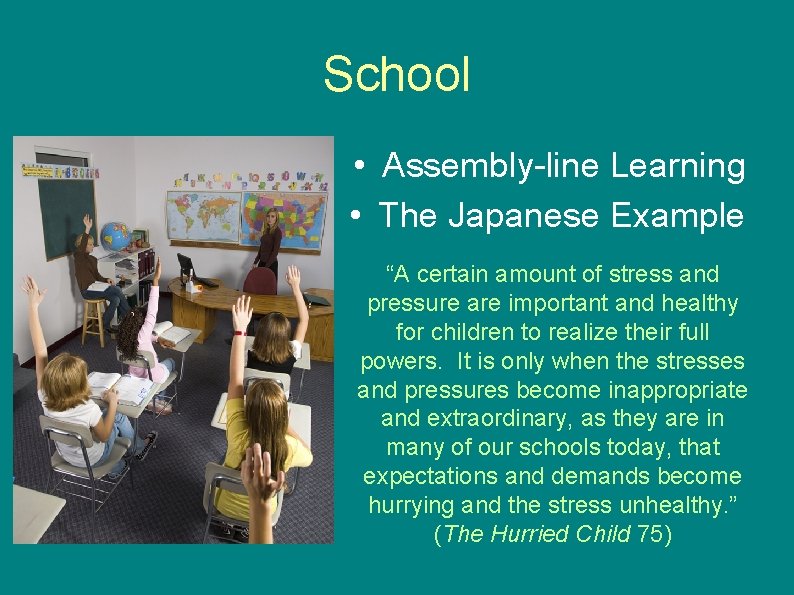
School • Assembly-line Learning • The Japanese Example “A certain amount of stress and pressure are important and healthy for children to realize their full powers. It is only when the stresses and pressures become inappropriate and extraordinary, as they are in many of our schools today, that expectations and demands become hurrying and the stress unhealthy. ” (The Hurried Child 75)
Media • Television • Magazines and Books • Music
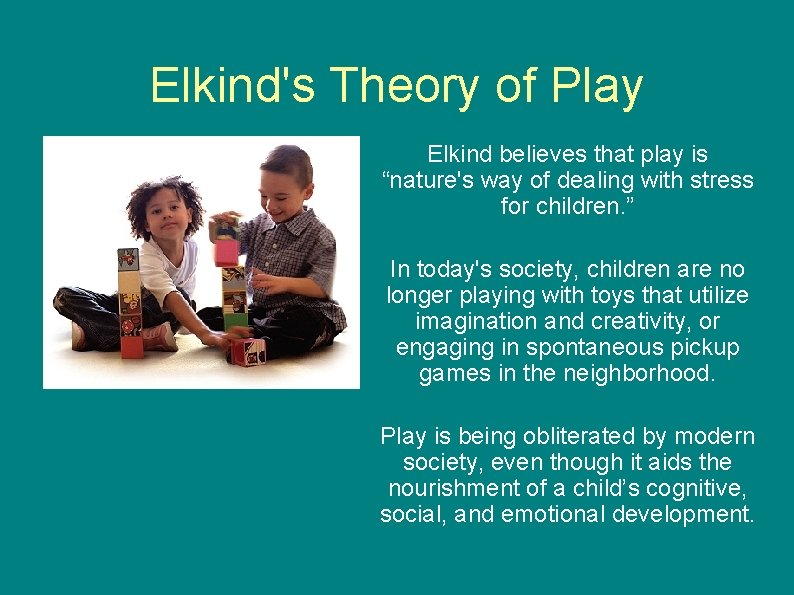
Elkind's Theory of Play Elkind believes that play is “nature's way of dealing with stress for children. ” In today's society, children are no longer playing with toys that utilize imagination and creativity, or engaging in spontaneous pickup games in the neighborhood. Play is being obliterated by modern society, even though it aids the nourishment of a child’s cognitive, social, and emotional development.
Terms to Define • Hurried • Stressor • Play
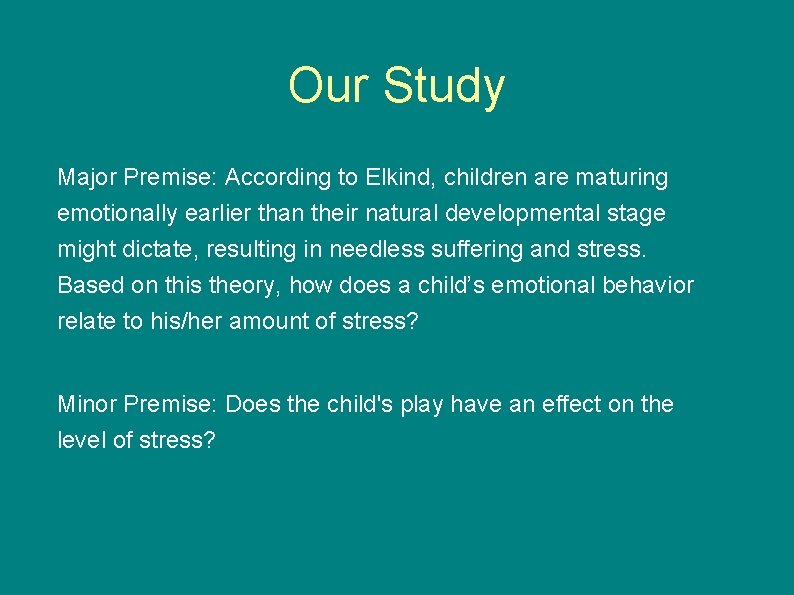
Our Study Major Premise: According to Elkind, children are maturing emotionally earlier than their natural developmental stage might dictate, resulting in needless suffering and stress. Based on this theory, how does a child’s emotional behavior relate to his/her amount of stress? Minor Premise: Does the child's play have an effect on the level of stress?
Hypothesis Based on Elkind’s idea of the relationship between stress and emotion, it can be hypothesized that a child’s degree of stress will correspond with his/her emotions.
Critical Questions • Will the stressed child show aggressive behavior and/or be more descriptive in his/her responses to questions that deal with emotion? • Will the unstressed child be calmer and exhibit appropriate coping mechanisms in his/her responses to questions that deal with emotion? • Does the unstressed child play more than the stressed child?
Survey Response Questions Name (first name only): ___________________ What would you do if someone called you a bad name to your face? Why? ________________________________________________________________________ Age: _____ Gender (circle one): male female Name of School: ______________________ How many brothers and sisters live in your house? _________ Is there anyone else that lives in your house that is not a parent or a sibling? Yes (Explain: _____________) No What chores are you responsible for at your house? ________________________________________________________________________ Do you play each day after school? If so, for how long each day? _______ Do you play more on the weekends? If so, for how long each day? ______ What do you do when you play? ________________________________________________________________________ What time do you go to bed? ____________ Is there a TV or computer in your room? If so, which one? ______ When you watch TV, what are the names of the shows that you watch? ________________________________________________________________________ What would you do if you heard someone say bad things about you behind your back? Why? ________________________________________________________________________ How do you feel when you know you are about to take a big test like the TAKS test? Why? ________________________________________________________________________ What would you do if a teacher embarrassed or punished you in front of the class? Why? ________________________________________________________________________ What do you do when you feel like people just do not understand you? Why? ________________________________________________________________________ How do you feel when your parent(s) do not listen to you? Why? ________________________________________________________________________ How would you feel if your parent(s) left you at home alone? Why? ________________________________________________________________________
Criteria That Contributes to Stress Home Life: People living in the house other than parents and siblings; bed time (Contributes to Stress) School: Standardized Tests (Contributes to Stress) Media: Television (Contributes to Stress) Social Conflicts (Effect/Evidence of Stress) Criteria That May Alleviate Stress Amount of Play Quotes by David Elkind 3 – High Stress 2 – Moderate/ Normal Stress 1 – Low/No Stressors are special demands that call for an extra effort of adaptation. “Adaptation energy” acts as an energy reservoir that allows us to deal with the contingencies of everyday life and is replenished each day by food and sleep. (Hurried Child, 164 -5) Other people besides parents and siblings live in the child’s home. Child goes to bed after 10 PM. Child either a. ) has other people besides parents and siblings living in the home, or b. ) goes to bed between 9 and 10 PM. Only parents and siblings live in the child’s home. Child goes to bed before 9 PM. “Children are pressured to meet uniform standards as measured by standardized tests. ” (Hurried Child, 50) “Testing is stressful at all age levels, but it adds to the pressure when test results are widely publicized” (Hurried Child, 56) Child responds using words such as “nervous, ” “stressed, ” or “fail. ” Child says that he/she is a “little” nervous or responds with mixed emotions (“confident and nervous”). Child responds using words such as “excited” or “don’t care. ” The majority of the TV shows the child watches are inappropriate for his/her age. (violent, contain sensual material, language) Half of the TV shows the child watches are inappropriate for his/her age. All of the TV shows the child watches are age-appropriate. “stress is the wear and tear on our bodies” (Hurried Child, 164) “conflict is just one, albeit a powerful, stressor” (Hurried Child, 164) Child shows an extreme amount of emotion by the tone and detail of his/her response. Act aggressively (“punch, ” “yell”). Uses words such as “angry, ” “mad, ” “frustrated, ” “hate. ” Child’s responses comprise of a negative emotion, but he/she takes no action. (child feels “bad” or “sad” but does nothing) Child responds in a “calm” manner and exhibits proper Coping mechanisms. Uses phrases such as “because I understand, ” “deal with it, ” “talk to them, ” “tell an adult” (child reacts positively) Quote by David Elkind -3 – Decreases Stress Significantly -2 – Decreases Stress Slightly -1 – Does Not Decrease Stress at All “Play is nature's way of dealing with stress for children” (Hurried Child, 218) The child engages in imaginative and self-initiated play for at least 4 hours per day. * Type of play (play with friends, ride my bike, crafts, etc. ) “With television, children have access to news, drama, and entertainment without having to translate words into images. The images are already there. ” (Hurried Child, 80) The child engages in imaginative and self-initiated play 2 -3 hours per day. The child engages in imaginative and self-initiated play for one hour or less per day. * Type of play (organized sports, electronic games that do not involve creativity or strategy)
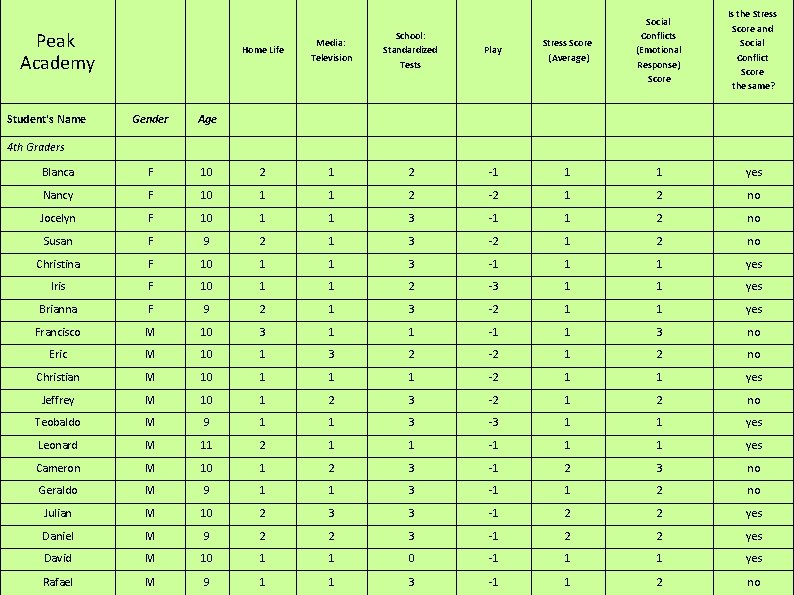
Peak Preparatory is a public charter school in downtown Dallas. 90% of the students enrolled in Peak come from lowincome households. The majority of the students are either one or two grade levels behind where they should be. The students have a longer school day than most students in DISD, and they also attend mandatory Saturday School and Summer School. Principal: Ms. Teresa Khirallah
Peak Academy Student's Name Home Life Media: Television School: Standardized Tests Play Stress Score (Average) Social Conflicts (Emotional Response) Score Is the Stress Score and Social Conflict Score the same? Gender Age Blanca F 10 2 1 2 -1 1 1 yes Nancy F 10 1 1 2 -2 1 2 no Jocelyn F 10 1 1 3 -1 1 2 no Susan F 9 2 1 3 -2 1 2 no Christina F 10 1 1 3 -1 1 1 yes Iris F 10 1 1 2 -3 1 1 yes Brianna F 9 2 1 3 -2 1 1 yes Francisco M 10 3 1 1 -1 1 3 no Eric M 10 1 3 2 -2 1 2 no Christian M 10 1 1 1 -2 1 1 yes Jeffrey M 10 1 2 3 -2 1 2 no Teobaldo M 9 1 1 3 -3 1 1 yes Leonard M 11 2 1 1 -1 1 1 yes Cameron M 10 1 2 3 -1 2 3 no Geraldo M 9 1 1 3 -1 1 2 no Julian M 10 2 3 3 -1 2 2 yes Daniel M 9 2 2 3 -1 2 2 yes David M 10 1 1 0 -1 1 1 yes Rafael M 9 1 1 3 -1 1 2 no 4 th Graders
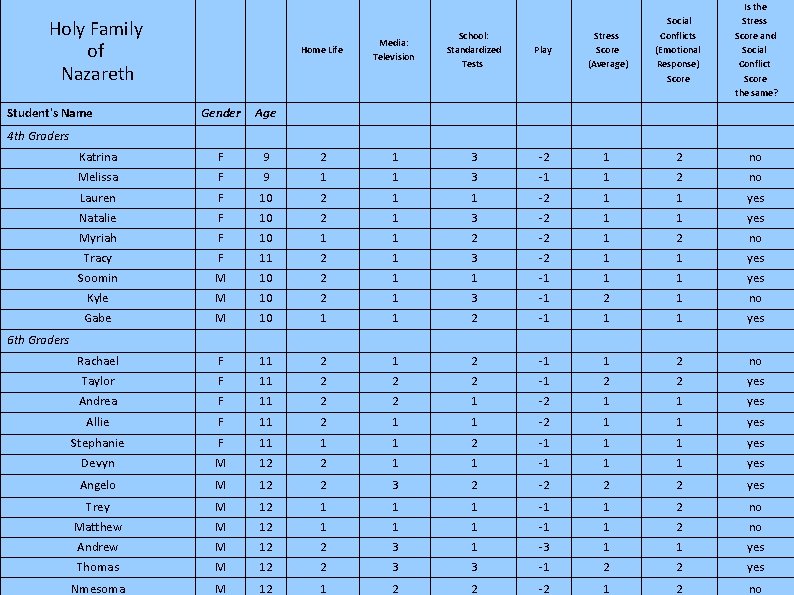
Holy Family School Holy Family is a private Catholic school located in Irving, TX. Compared to the public schools in the area, Holy Family is a much smaller community.
Holy Family of Nazareth Student's Name Home Life Media: Television School: Standardized Tests Play Data Collected Stress Score (Average) Social Conflicts (Emotional Response) Score Is the Stress Score and Social Conflict Score the same? Gender Age Katrina F 9 2 1 3 -2 1 2 no Melissa F 9 1 1 3 -1 1 2 no Lauren F 10 2 1 1 -2 1 1 yes Natalie F 10 2 1 3 -2 1 1 yes Myriah F 10 1 1 2 -2 1 2 no Tracy F 11 2 1 3 -2 1 1 yes Soomin M 10 2 1 1 -1 1 1 yes Kyle M 10 2 1 3 -1 2 1 no Gabe M 10 1 1 2 -1 1 1 yes Rachael F 11 2 -1 1 2 no Taylor F 11 2 2 2 -1 2 2 yes Andrea F 11 2 2 1 -2 1 1 yes Allie F 11 2 1 1 -2 1 1 yes Stephanie F 11 1 1 2 -1 1 1 yes Devyn M 12 2 1 1 -1 1 1 yes Angelo M 12 2 3 2 -2 2 2 yes Trey M 12 1 1 1 -1 1 2 no Matthew M 12 1 1 1 -1 1 2 no Andrew M 12 2 3 1 -3 1 1 yes Thomas M 12 2 3 3 -1 2 2 yes Nmesoma M 12 1 2 2 -2 1 2 no 4 th Graders 6 th Graders
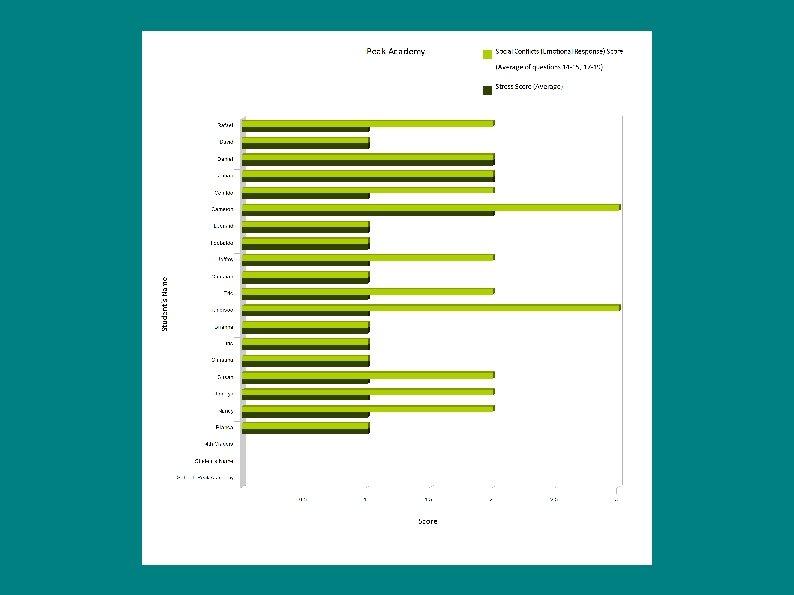
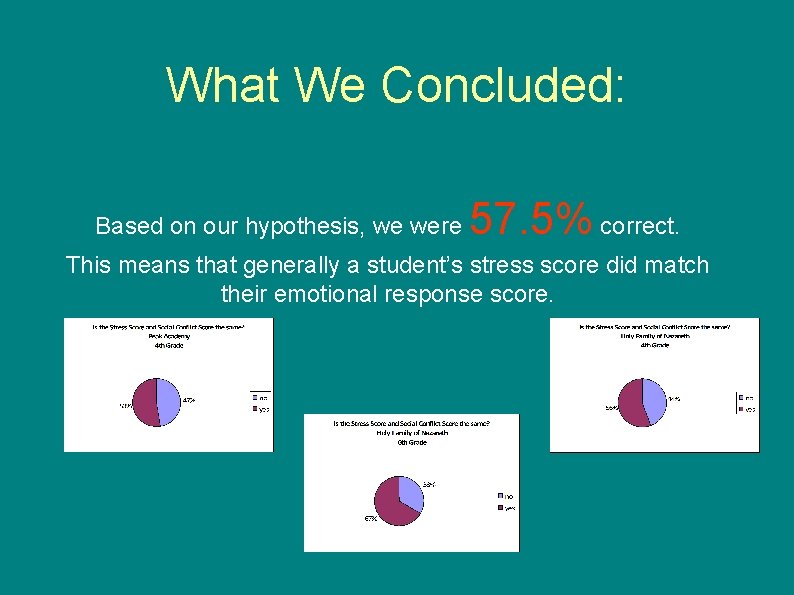
What We Concluded: Based on our hypothesis, we were 57. 5% correct. This means that generally a student’s stress score did match their emotional response score.
Limitations to Our Study: Students did not always write enough to give us a clear understanding of stress and/or emotions for evaluation, so in these instances we made decisions based on information we were given. Girls typically wrote more information than the boys, therefore the evaluation of the boys' surveys is likely to be less accurate.
If We Could Do It Over. . . We would have surveyed older children, such as 5 th or 6 th graders. We would interview the children one-on-one while they complete the survey so that we could guarantee good information.
Bibliography Elkind, David. The Hurried Child. 3 rd Ed. Cambridge, MA: Perseus Publishing, 2001. Elkind, David. The Power of Play. Cambridge, MA: Da Capo Press, 2007. Doorey, Marie. “David Elkind. ” 28 March 2009. <http: //www. novelguide. com/a/discover/gep_01_0021 7. htm>.