Domain Restrictions in Computational Social Choice Edith Elkind



- Slides: 34
Domain Restrictions in Computational Social Choice Edith Elkind University of Oxford
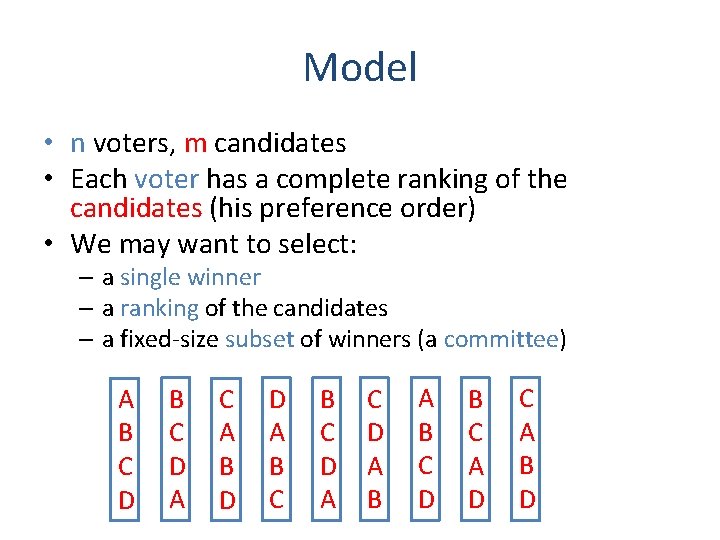
Model • n voters, m candidates • Each voter has a complete ranking of the candidates (his preference order) • We may want to select: – a single winner – a ranking of the candidates – a fixed-size subset of winners (a committee) A B C D A C A B D D A B C D A B C D B C A D C A B D
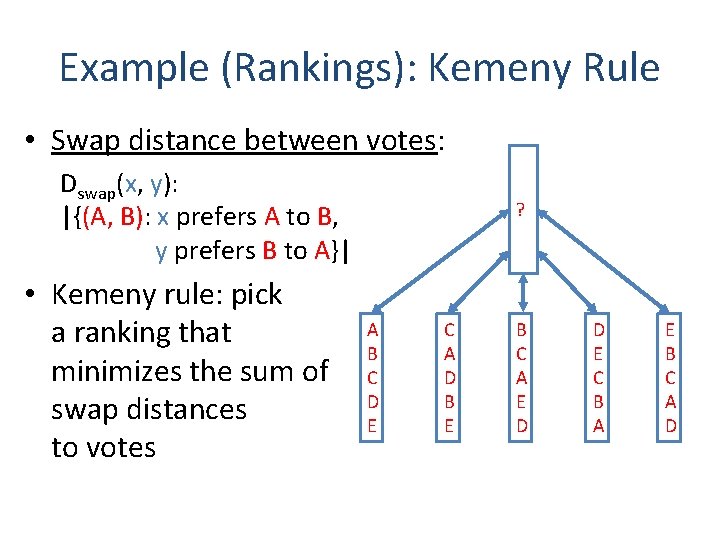
Example (Rankings): Kemeny Rule • Swap distance between votes: Dswap(x, y): |{(A, B): x prefers A to B, y prefers B to A}| • Kemeny rule: pick a ranking that minimizes the sum of swap distances to votes ? A B C D E C A D B E B C A E D D E C B A E B C A D
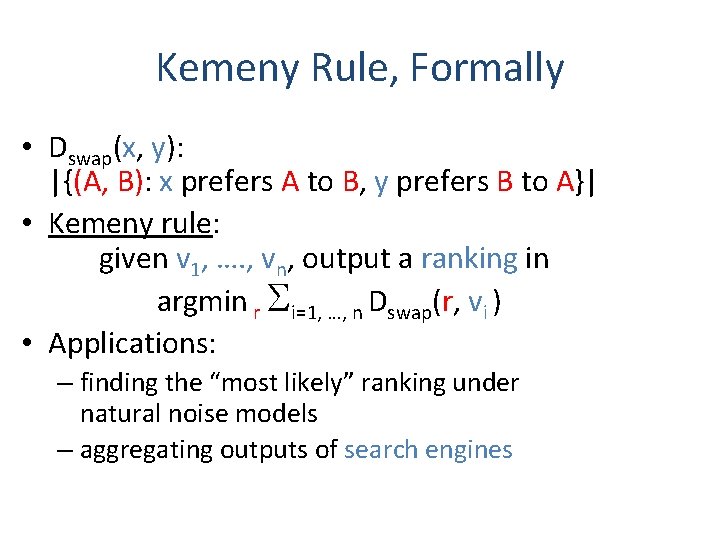
Kemeny Rule, Formally • Dswap(x, y): |{(A, B): x prefers A to B, y prefers B to A}| • Kemeny rule: given v 1, …. , vn, output a ranking in argmin r Si=1, …, n Dswap(r, vi ) • Applications: – finding the “most likely” ranking under natural noise models – aggregating outputs of search engines
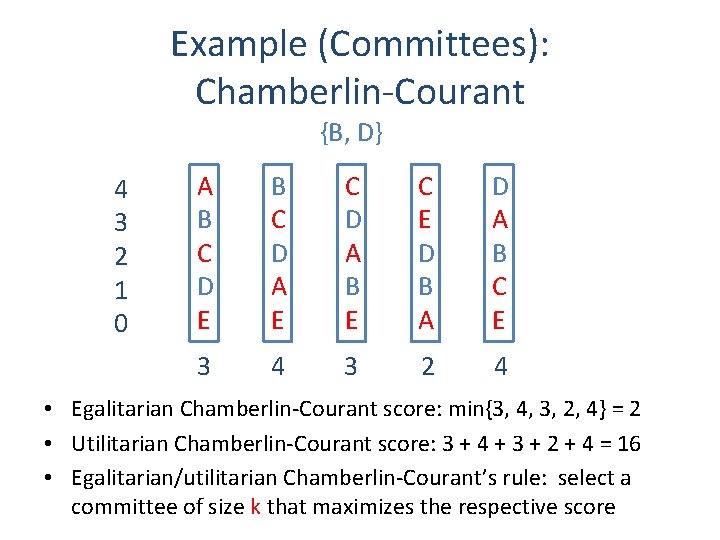
Example (Committees): Chamberlin-Courant {B, D} 4 3 2 1 0 A B C D E B C D A E C D A B E C E D B A D A B C E 3 4 3 2 4 • Egalitarian Chamberlin-Courant score: min{3, 4, 3, 2, 4} = 2 • Utilitarian Chamberlin-Courant score: 3 + 4 + 3 + 2 + 4 = 16 • Egalitarian/utilitarian Chamberlin-Courant’s rule: select a committee of size k that maximizes the respective score
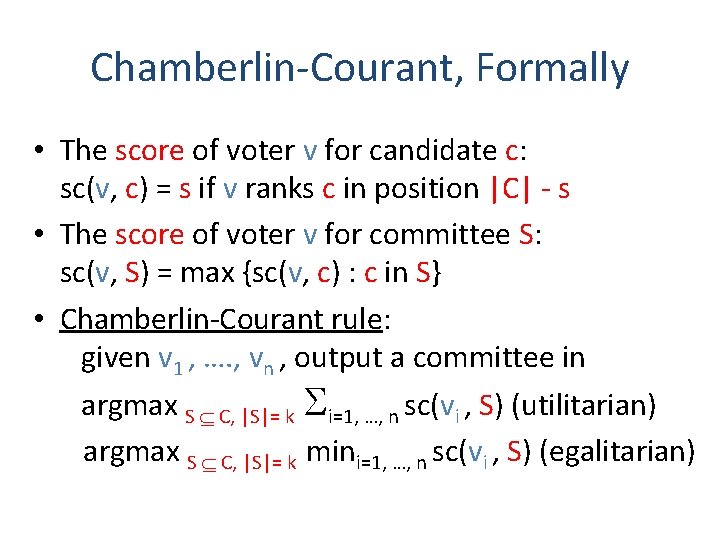
Chamberlin-Courant, Formally • The score of voter v for candidate c: sc(v, c) = s if v ranks c in position |C| - s • The score of voter v for committee S: sc(v, S) = max {sc(v, c) : c in S} • Chamberlin-Courant rule: given v 1 , …. , vn , output a committee in argmax S C, |S|= k Si=1, …, n sc(vi , S) (utilitarian) argmax S C, |S|= k mini=1, …, n sc(vi , S) (egalitarian)
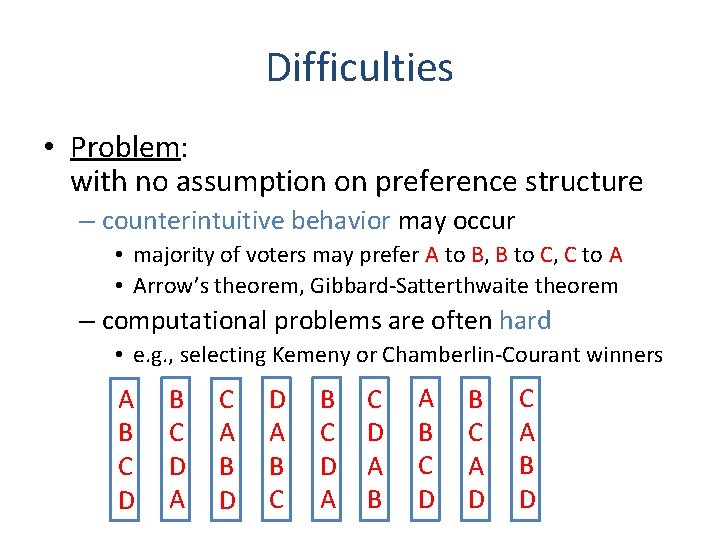
Difficulties • Problem: with no assumption on preference structure – counterintuitive behavior may occur • majority of voters may prefer A to B, B to C, C to A • Arrow’s theorem, Gibbard-Satterthwaite theorem – computational problems are often hard • e. g. , selecting Kemeny or Chamberlin-Courant winners A B C D A C A B D D A B C D A B C D B C A D C A B D
This Tutorial • Preferences are rarely completely arbitrary • If voters’ preferences are structured – impossibility results may disappear – algorithmic complexity results may disappear • We will see some examples of structured preferences for which this is the case: – single-peaked preferences – single-crossing preferences – and more
Plan • Restricted domains: definitions and social choice theoretic properties • Recognizing profiles that belong to restricted domains • Exploiting the structure: efficient algorithms for social choice problems
Single-Peaked Preferences • Definition: a preference profile is single-peaked (SP) wrt an ordering < of candidates (axis) if for each voter v: – if top(v) < D < E, v prefers D to E – if A < B < top(v), v prefers B to A • Example: – voter 1: C > B > D > E > F > A – voter 2: A > B > C > D > E > F – voter 3: E > F > D > C > B > A A B C D E F
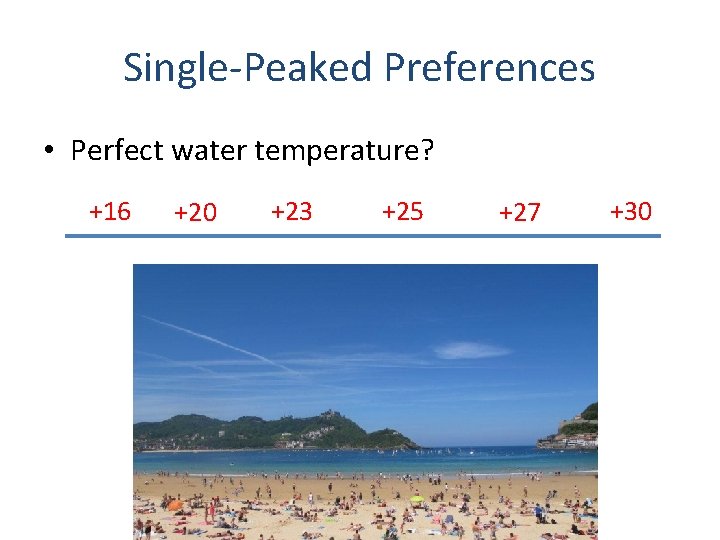
Single-Peaked Preferences • Perfect water temperature? +16 +20 +23 +25 +27 +30
SP Preferences: Transitivity • Theorem: in single-peaked elections, the (weak) majority relation is transitive • Lemma: there exists a candidate preferred to every other candidate by a (weak) majority of voters (the Condorcet winner (CW)) • Proof of theorem (assuming the lemma): – by the lemma, there is a CW, say a – delete a from all votes; the profile remains SP – use induction
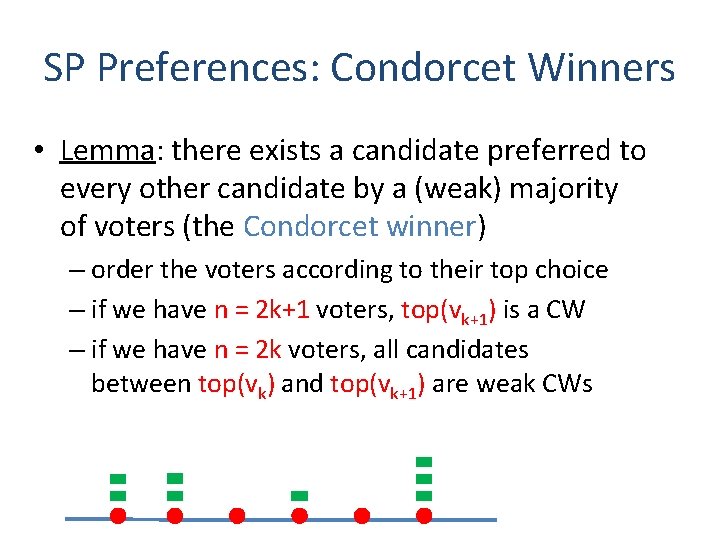
SP Preferences: Condorcet Winners • Lemma: there exists a candidate preferred to every other candidate by a (weak) majority of voters (the Condorcet winner) – order the voters according to their top choice – if we have n = 2 k+1 voters, top(vk+1) is a CW – if we have n = 2 k voters, all candidates between top(vk) and top(vk+1) are weak CWs
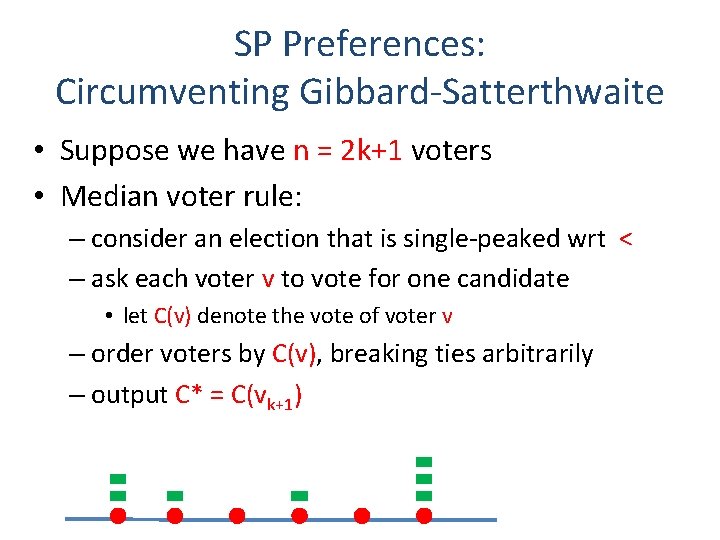
SP Preferences: Circumventing Gibbard-Satterthwaite • Suppose we have n = 2 k+1 voters • Median voter rule: – consider an election that is single-peaked wrt < – ask each voter v to vote for one candidate • let C(v) denote the vote of voter v – order voters by C(v), breaking ties arbitrarily – output C* = C(vk+1)
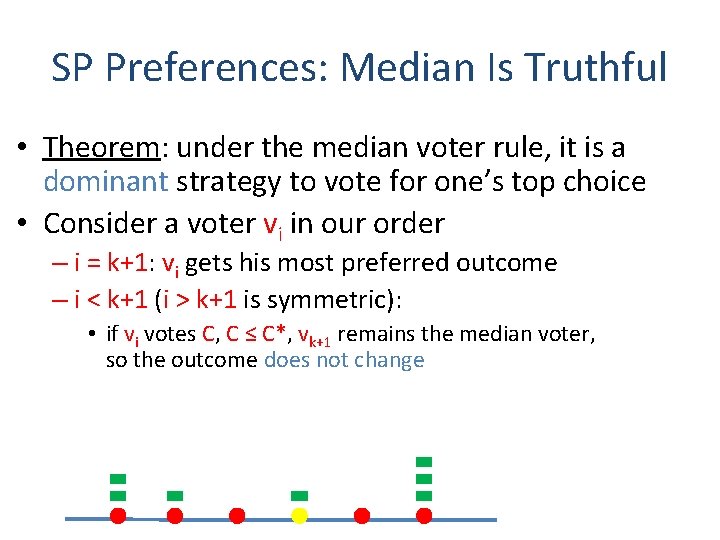
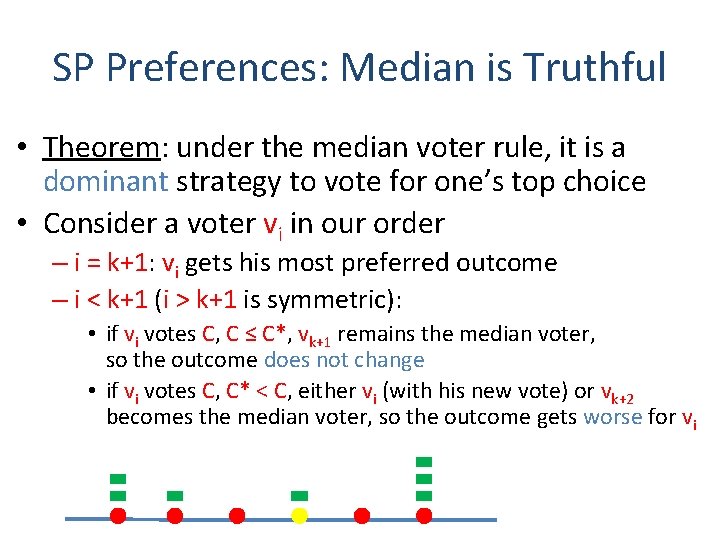
SP Preferences: Median Is Truthful • Theorem: under the median voter rule, it is a dominant strategy to vote for one’s top choice • Consider a voter vi in our order – i = k+1: vi gets his most preferred outcome – i < k+1 (i > k+1 is symmetric): • if vi votes C, C ≤ C*, vk+1 remains the median voter, so the outcome does not change
SP Preferences: Median is Truthful • Theorem: under the median voter rule, it is a dominant strategy to vote for one’s top choice • Consider a voter vi in our order – i = k+1: vi gets his most preferred outcome – i < k+1 (i > k+1 is symmetric): • if vi votes C, C ≤ C*, vk+1 remains the median voter, so the outcome does not change • if vi votes C, C* < C, either vi (with his new vote) or vk+2 becomes the median voter, so the outcome gets worse for vi
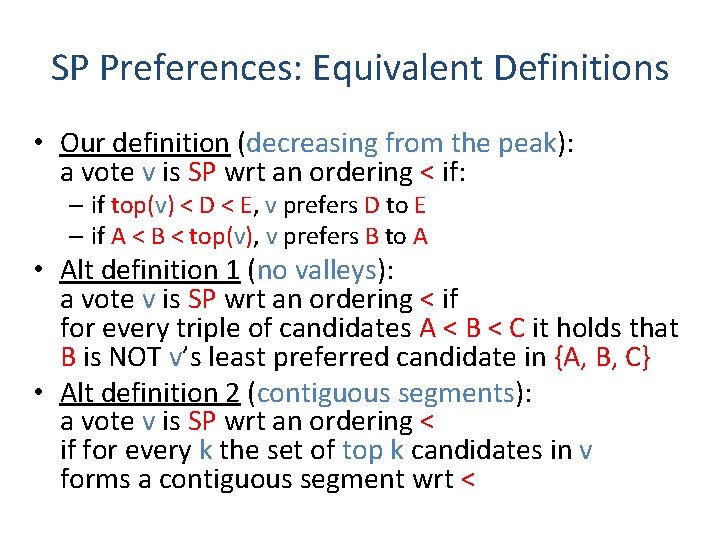
SP Preferences: Equivalent Definitions • Our definition (decreasing from the peak): a vote v is SP wrt an ordering < if: – if top(v) < D < E, v prefers D to E – if A < B < top(v), v prefers B to A • Alt definition 1 (no valleys): a vote v is SP wrt an ordering < if for every triple of candidates A < B < C it holds that B is NOT v’s least preferred candidate in {A, B, C} • Alt definition 2 (contiguous segments): a vote v is SP wrt an ordering < if for every k the set of top k candidates in v forms a contiguous segment wrt <
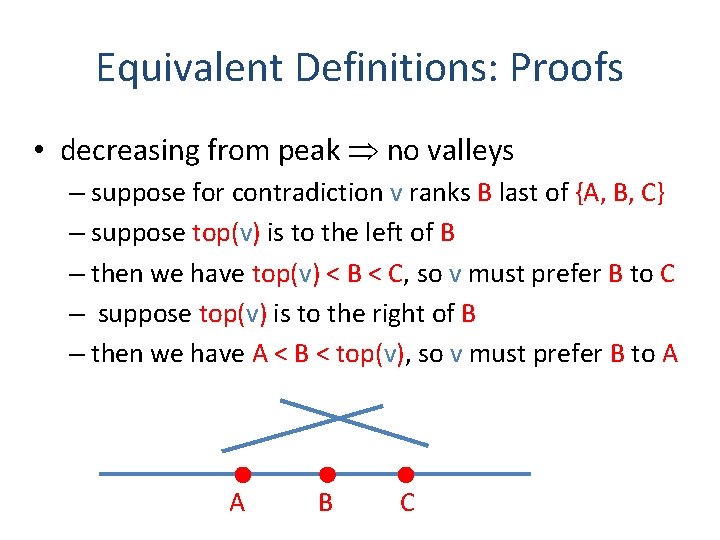
Equivalent Definitions: Proofs • decreasing from peak no valleys – suppose for contradiction v ranks B last of {A, B, C} – suppose top(v) is to the left of B – then we have top(v) < B < C, so v must prefer B to C – suppose top(v) is to the right of B – then we have A < B < top(v), so v must prefer B to A A B C
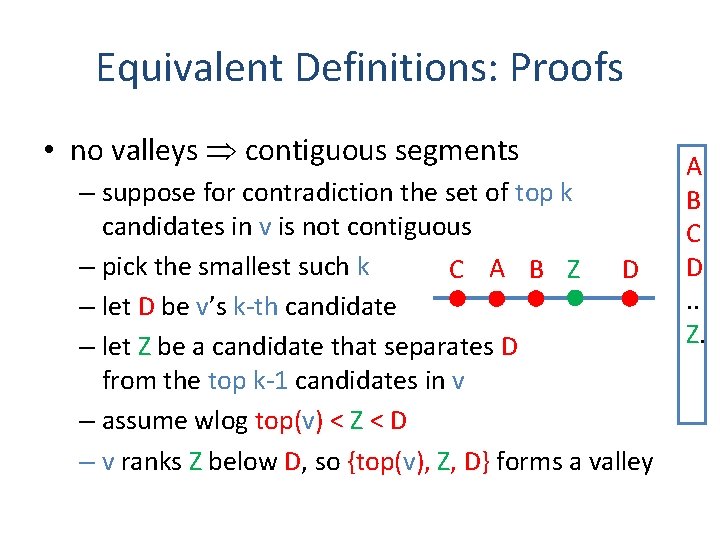
Equivalent Definitions: Proofs • no valleys contiguous segments – suppose for contradiction the set of top k candidates in v is not contiguous – pick the smallest such k C A B Z D – let D be v’s k-th candidate – let Z be a candidate that separates D from the top k-1 candidates in v – assume wlog top(v) < Z < D – v ranks Z below D, so {top(v), Z, D} forms a valley A B C D. . Z.
Equivalent Definitions: Proofs • contiguous segments decreasing from peak – suppose for contradiction top(v) < D < C, yet v prefers C to D – suppose v ranks C in position k – then v ranks D in position k+1 or lower – thus the set of top k candidates in v is not contiguous wrt < B A D C A B C. . D
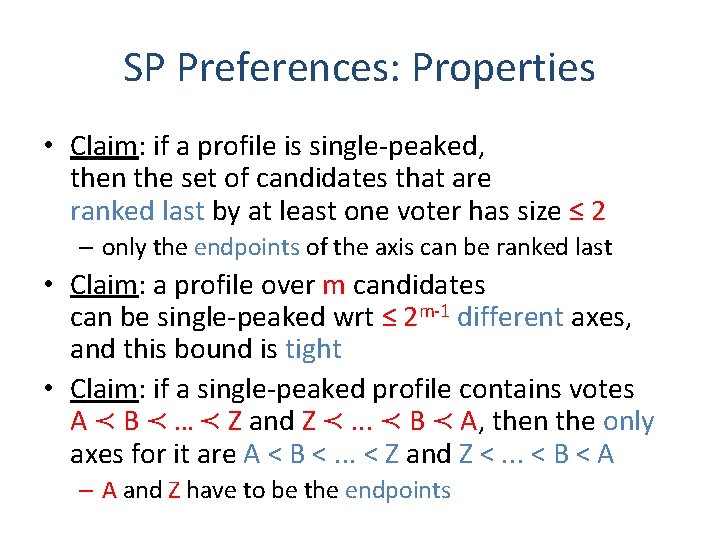
SP Preferences: Properties • Claim: if a profile is single-peaked, then the set of candidates that are ranked last by at least one voter has size ≤ 2 – only the endpoints of the axis can be ranked last • Claim: a profile over m candidates can be single-peaked wrt ≤ 2 m-1 different axes, and this bound is tight • Claim: if a single-peaked profile contains votes A ≺ B ≺. . . ≺ Z and Z ≺. . . ≺ B ≺ A, then the only axes for it are A < B <. . . < Z and Z <. . . < B < A – A and Z have to be the endpoints
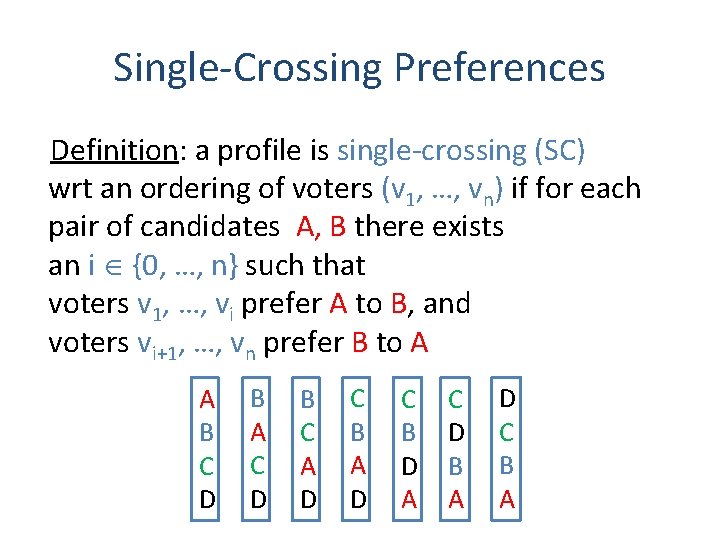
Single-Crossing Preferences Definition: a profile is single-crossing (SC) wrt an ordering of voters (v 1, …, vn) if for each pair of candidates A, B there exists an i {0, …, n} such that voters v 1, …, vi prefer A to B, and voters vi+1, …, vn prefer B to A A B C D B A C D B C A D C B D A C D B A D C B A
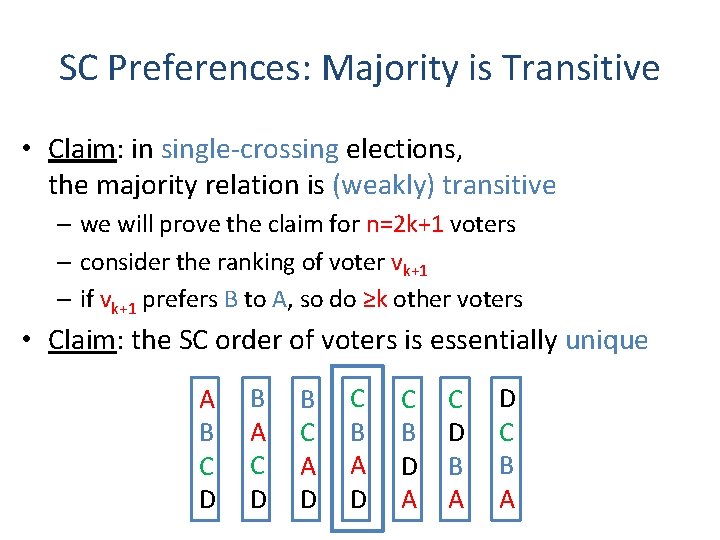
SC Preferences: Majority is Transitive • Claim: in single-crossing elections, the majority relation is (weakly) transitive – we will prove the claim for n=2 k+1 voters – consider the ranking of voter vk+1 – if vk+1 prefers B to A, so do ≥k other voters • Claim: the SC order of voters is essentially unique A B C D B A C D B C A D C B D A C D B A D C B A
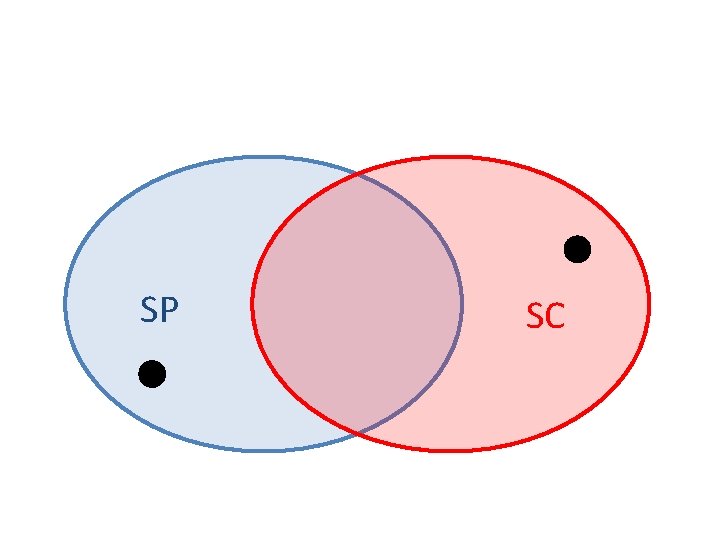
? ? ? SP SC
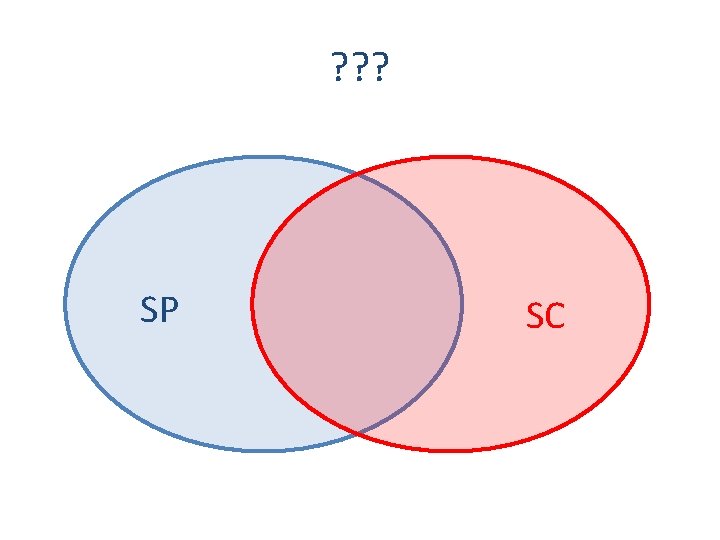
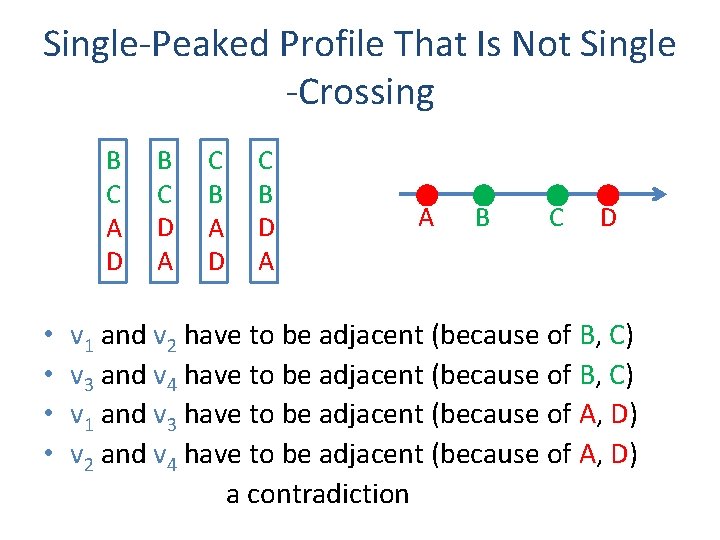
Single-Peaked Profile That Is Not Single -Crossing B C A D • • B C D A C B A D C B D A A B C D v 1 and v 2 have to be adjacent (because of B, C) v 3 and v 4 have to be adjacent (because of B, C) v 1 and v 3 have to be adjacent (because of A, D) v 2 and v 4 have to be adjacent (because of A, D) a contradiction
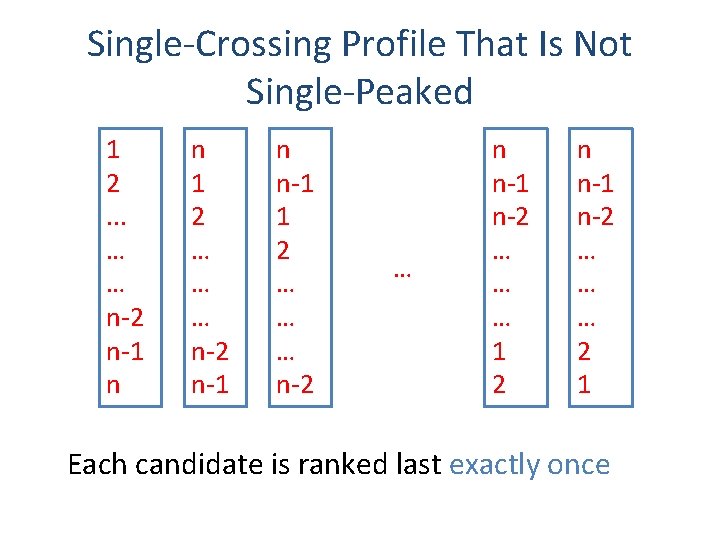
Single-Crossing Profile That Is Not Single-Peaked 1 2. . . … … n-2 n-1 n n 1 2 … … … n-2 n-1 n n-1 1 2 … … … n-2 … n n-1 n-2 … … … 1 2 n n-1 n-2 … … … 2 1 Each candidate is ranked last exactly once
SP SC
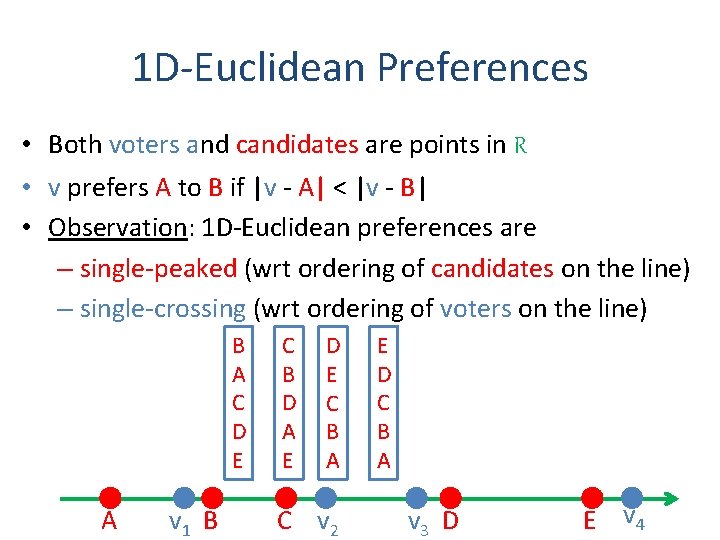
1 D-Euclidean Preferences • Both voters and candidates are points in R • v prefers A to B if |v - A| < |v - B| • Observation: 1 D-Euclidean preferences are – single-peaked (wrt ordering of candidates on the line) – single-crossing (wrt ordering of voters on the line) B A C D E A v 1 B C B D A E D E C B A C v 2 E D C B A v 3 D E v 4
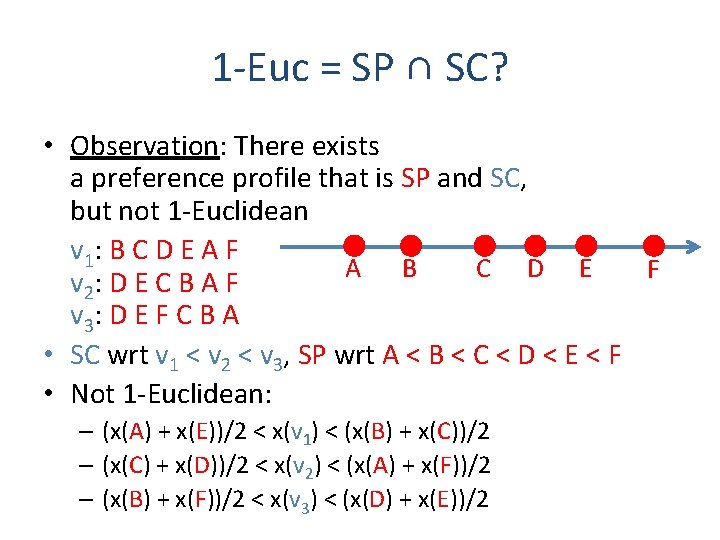
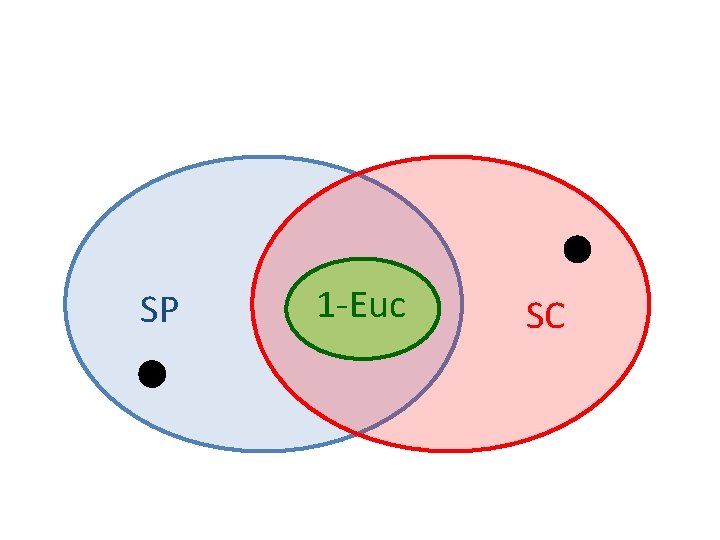
1 -Euc = SP ∩ SC? • Observation: There exists a preference profile that is SP and SC, but not 1 -Euclidean v 1: B C D E A F A B C D E F v 2: D E C B A F v 3: D E F C B A • SC wrt v 1 < v 2 < v 3, SP wrt A < B < C < D < E < F • Not 1 -Euclidean: – (x(A) + x(E))/2 < x(v 1) < (x(B) + x(C))/2 – (x(C) + x(D))/2 < x(v 2) < (x(A) + x(F))/2 – (x(B) + x(F))/2 < x(v 3) < (x(D) + x(E))/2
SP 1 -Euc SC
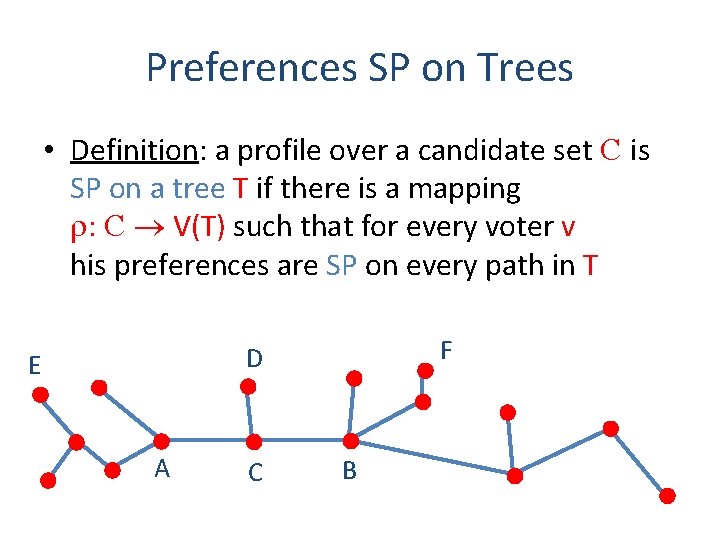
Preferences SP on Trees • Definition: a profile over a candidate set C is SP on a tree T if there is a mapping r: C V(T) such that for every voter v his preferences are SP on every path in T F D E A C B
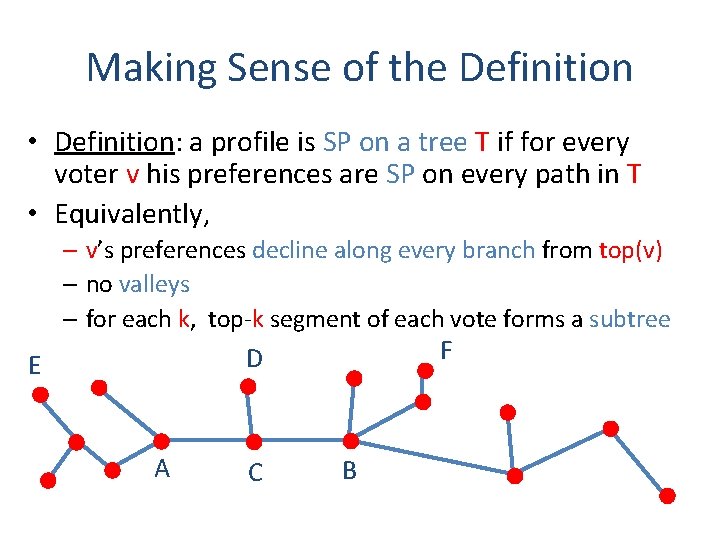
Making Sense of the Definition • Definition: a profile is SP on a tree T if for every voter v his preferences are SP on every path in T • Equivalently, – v’s preferences decline along every branch from top(v) – no valleys – for each k, top-k segment of each vote forms a subtree F D E A C B
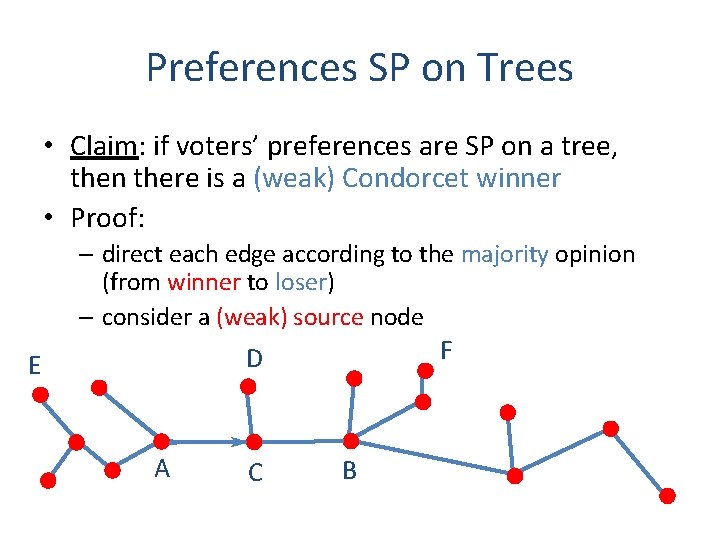
Preferences SP on Trees • Claim: if voters’ preferences are SP on a tree, then there is a (weak) Condorcet winner • Proof: – direct each edge according to the majority opinion (from winner to loser) – consider a (weak) source node F D E A C B
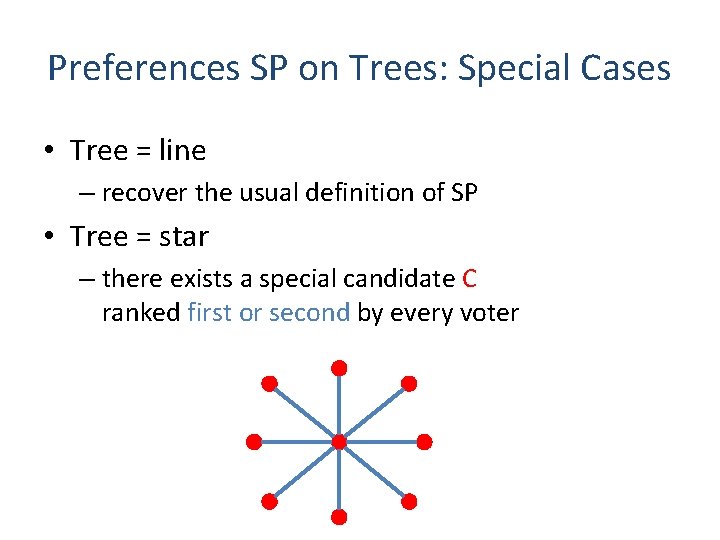
Preferences SP on Trees: Special Cases • Tree = line – recover the usual definition of SP • Tree = star – there exists a special candidate C ranked first or second by every voter