How Hard Is It To Manipulate Voting Edith


- Slides: 30
How Hard Is It To Manipulate Voting? Edith Elkind, U. of Warwick Helger Lipmaa, Tartu U.
Short Bio • High school diploma, School № 15, Tallinn, 1993 • M. Sc. , Moscow State University, Department of Mathematics, 1998 • Ph. D, Princeton University, 2005 • Now: Postdoctoral researcher, U. of Warwick, UK Research interests: algorithmic game theory, voting, algorithms, complexity…
Bib Info • Small Coalitions Cannot Manipulate Voting, Financial Cryptography 05 • Hybrid Voting Protocols And Hardness of Manipulation, ISAAC 05, to appear
What Is Manipulation? • In a small country far, far away there is an election coming up…
Manipulation: Example • 99 voters, 3 candidates (Red, Blue, Green). – 49 voters: R > B > G. – 48 voters: B > R > G. – 2 voters (Edith and Helger): G > B > R. • Aggregation rule: Plurality – each voter casts a vote for one candidate. – the candidate with the largest number of votes wins. – draws are resolved by a coin toss.
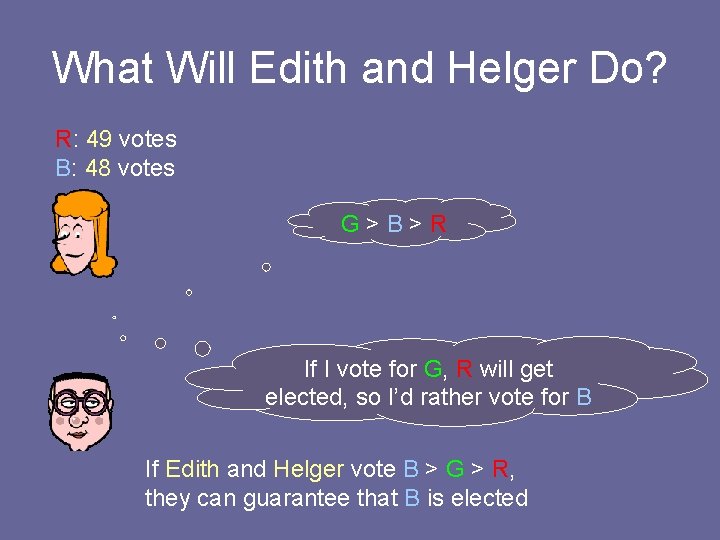
What Will Edith and Helger Do? R: 49 votes B: 48 votes G>B>R If I vote for G, R will get elected, so I’d rather vote for B If Edith and Helger vote B > G > R, they can guarantee that B is elected
Why Manipulation Is Bad • Aggregation rules are designed with certain social welfare criteria in mind. • Misrepresentation of preferences results in a suboptimal choice w. r. t. these criteria. • Also, election results do not reflect true distribution of preferences in the society: – maybe, in fact, in 2000 20% of the U. S. population prefered Nader to Gore to Bush?
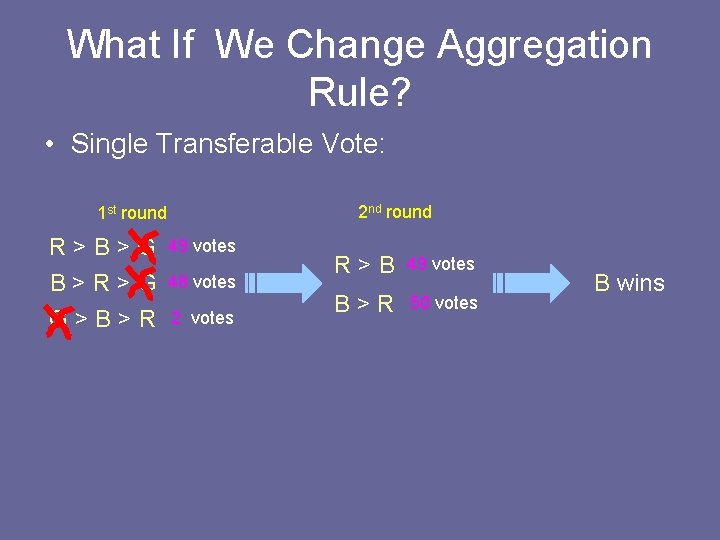
What If We Change Aggregation Rule? • Single Transferable Vote: 2 nd round 1 st round R>B>G B>R>G 49 votes G>B>R 2 votes 48 votes R>B 49 votes B>R 50 votes B wins • This time, Edith and Helger are better off voting honestly, but this will not always be the case… • Other popular voting schemes (Borda, Copeland) suffer from the same problem
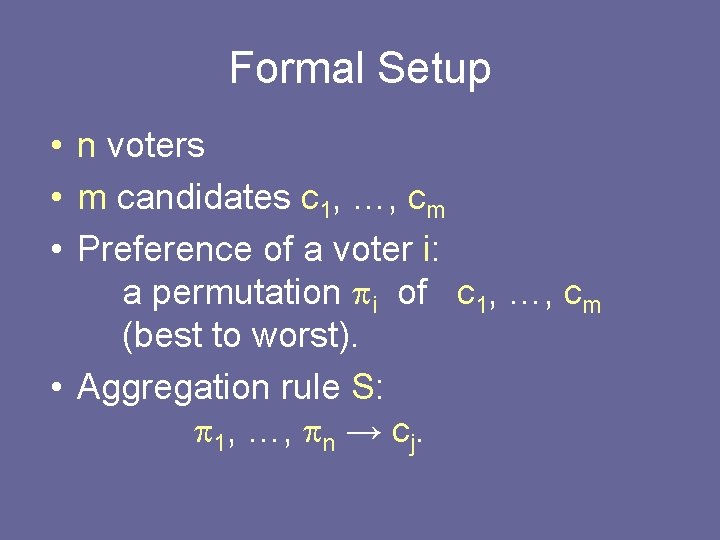
Formal Setup • n voters • m candidates c 1, …, cm • Preference of a voter i: a permutation pi of c 1, …, cm (best to worst). • Aggregation rule S: p 1, …, pn → cj.
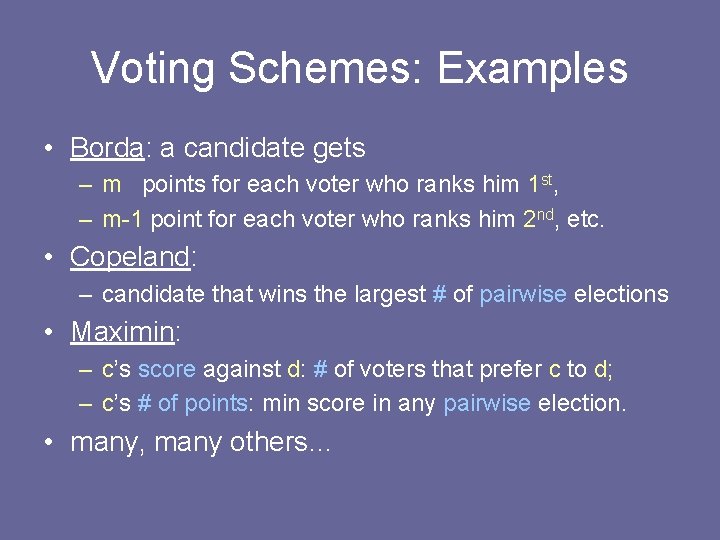
Voting Schemes: Examples • Borda: a candidate gets – m points for each voter who ranks him 1 st, – m-1 point for each voter who ranks him 2 nd, etc. • Copeland: – candidate that wins the largest # of pairwise elections • Maximin: – c’s score against d: # of voters that prefer c to d; – c’s # of points: min score in any pairwise election. • many, many others…
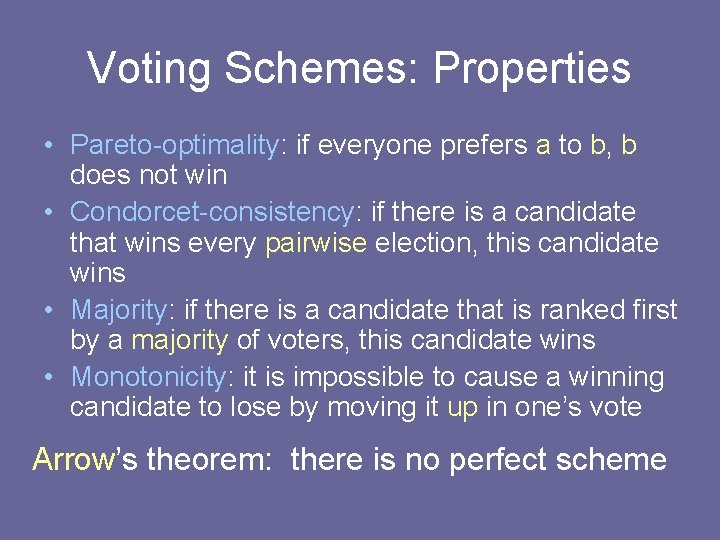
Voting Schemes: Properties • Pareto-optimality: if everyone prefers a to b, b does not win • Condorcet-consistency: if there is a candidate that wins every pairwise election, this candidate wins • Majority: if there is a candidate that is ranked first by a majority of voters, this candidate wins • Monotonicity: it is impossible to cause a winning candidate to lose by moving it up in one’s vote Arrow’s theorem: there is no perfect scheme
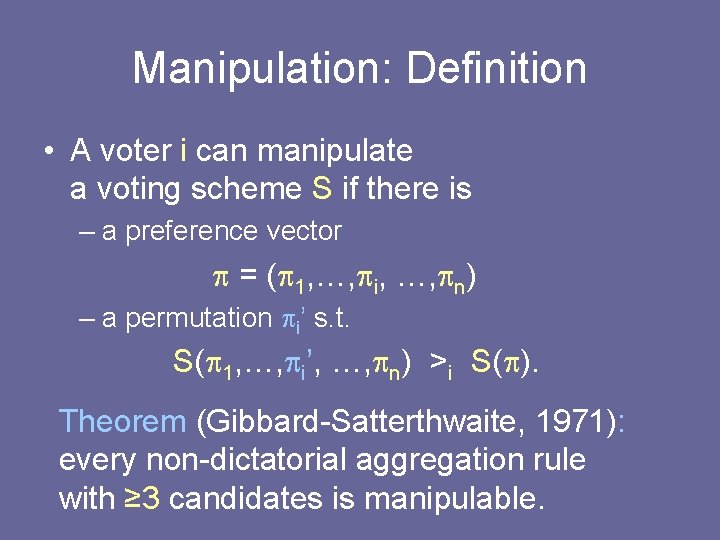
Manipulation: Definition • A voter i can manipulate a voting scheme S if there is – a preference vector p = (p 1, …, pi, …, pn) – a permutation pi’ s. t. S(p 1, …, pi’, …, pn) >i S(p). Theorem (Gibbard-Satterthwaite, 1971): every non-dictatorial aggregation rule with ≥ 3 candidates is manipulable.
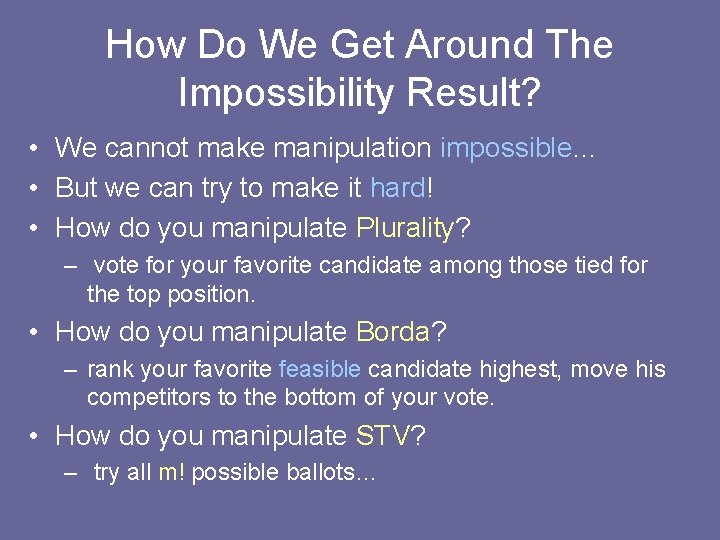
How Do We Get Around The Impossibility Result? • We cannot make manipulation impossible… • But we can try to make it hard! • How do you manipulate Plurality? – vote for your favorite candidate among those tied for the top position. • How do you manipulate Borda? – rank your favorite feasible candidate highest, move his competitors to the bottom of your vote. • How do you manipulate STV? – try all m! possible ballots…
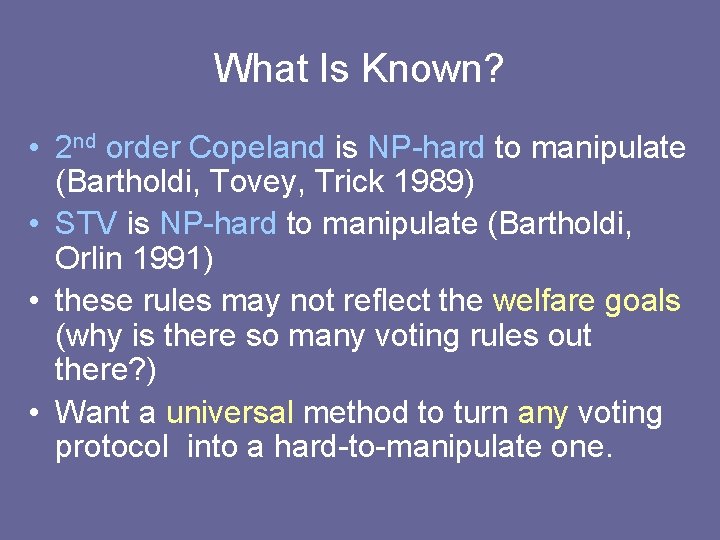
What Is Known? • 2 nd order Copeland is NP-hard to manipulate (Bartholdi, Tovey, Trick 1989) • STV is NP-hard to manipulate (Bartholdi, Orlin 1991) • these rules may not reflect the welfare goals (why is there so many voting rules out there? ) • Want a universal method to turn any voting protocol into a hard-to-manipulate one.
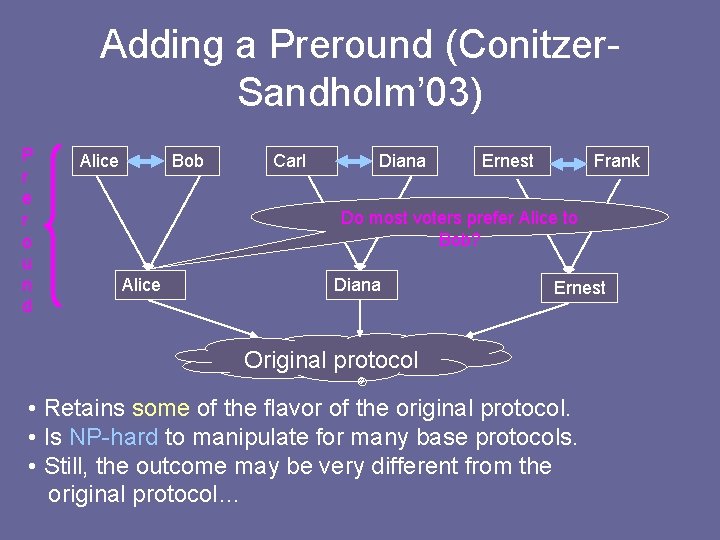
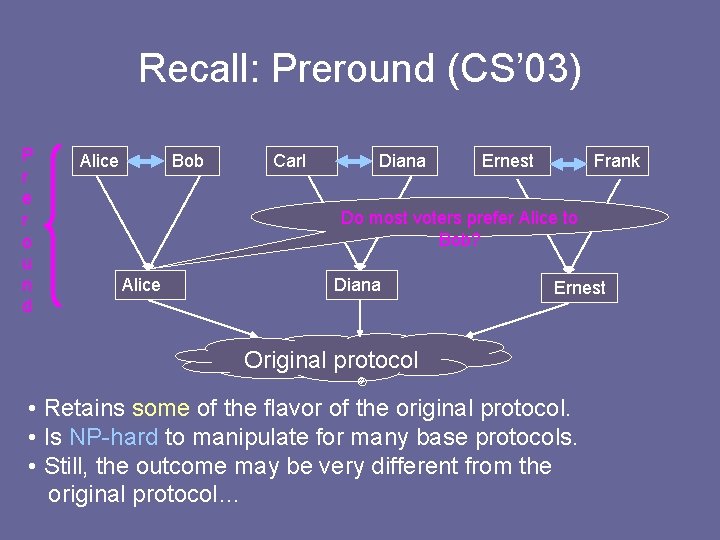
Adding a Preround (Conitzer. Sandholm’ 03) P r e r o u n d Alice Bob Carl Diana Ernest Frank Do most voters prefer Alice to Bob? Alice Diana Ernest Original protocol • Retains some of the flavor of the original protocol. • Is NP-hard to manipulate for many base protocols. • Still, the outcome may be very different from the original protocol…
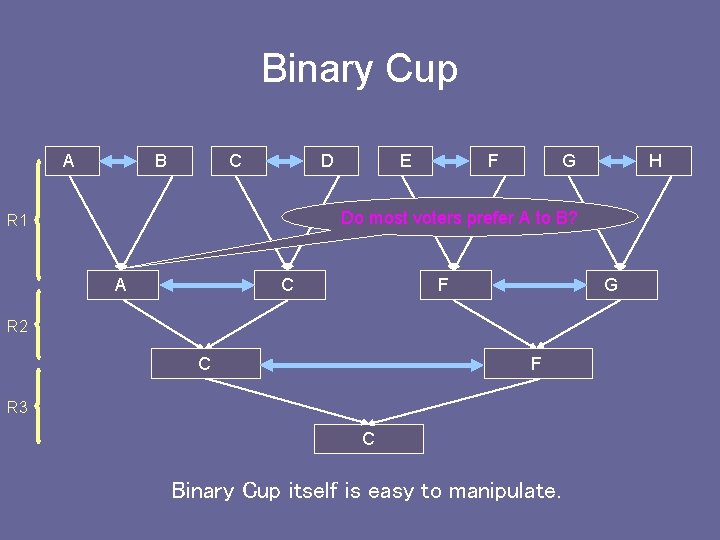
Binary Cup A B C D E G F H Do most voters prefer A to B? R 1 A C F G R 2 C F R 3 C Binary Cup itself is easy to manipulate.
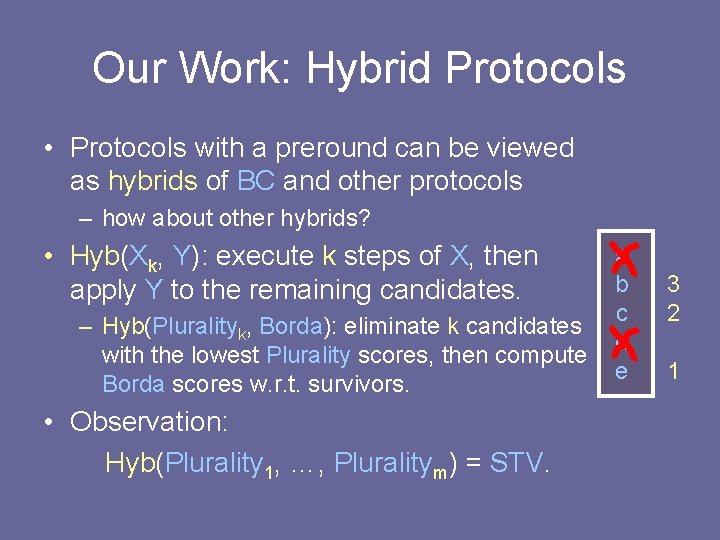
Our Work: Hybrid Protocols • Protocols with a preround can be viewed as hybrids of BC and other protocols – how about other hybrids? • Hyb(Xk, Y): execute k steps of X, then apply Y to the remaining candidates. – Hyb(Pluralityk, Borda): eliminate k candidates with the lowest Plurality scores, then compute Borda scores w. r. t. survivors. • Observation: Hyb(Plurality 1, …, Pluralitym) = STV. a b c d e 3 2 1
New Results • New protocols that are hard to manipulate: – Hyb(Xk, STV), Hyb(STVk, Y) (for any reasonable X, Y) – Hyb(Bordak, Plurality), Hyb(Maximink, Plurality) • Generally, Hyb(Xk, X) ≠ X (and may be much harder to manipulate) – manipulating Hyb(Bordak, Borda) is NP-hard • Extensions to utlity-based voting (voters rate candidates rather that rank them) – manipulating Hyb(High. Scorek, High. Score) is NP-hard
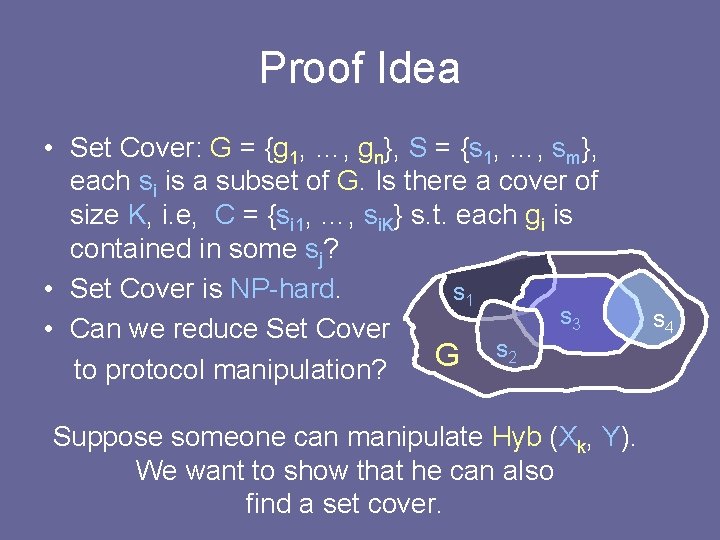
Proof Idea • Set Cover: G = {g 1, …, gn}, S = {s 1, …, sm}, each si is a subset of G. Is there a cover of size K, i. e, C = {si 1, …, si. K} s. t. each gi is contained in some sj? • Set Cover is NP-hard. s 1 s 3 • Can we reduce Set Cover s 2 G to protocol manipulation? Suppose someone can manipulate Hyb (Xk, Y). We want to show that he can also find a set cover. s 4
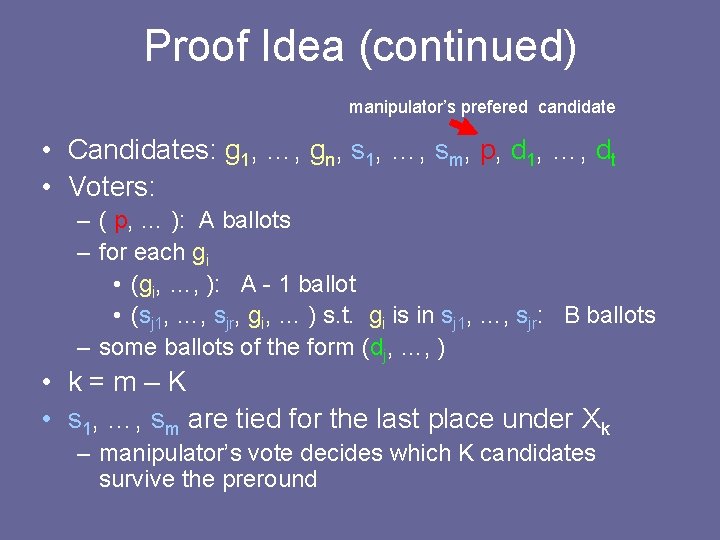
Proof Idea (continued) manipulator’s prefered candidate • Candidates: g 1, …, gn, s 1, …, sm, p, d 1, …, dt • Voters: – ( p, … ): A ballots – for each gi • (gi, …, ): A - 1 ballot • (sj 1, …, sjr, gi, … ) s. t. gi is in sj 1, …, sjr: B ballots – some ballots of the form (dj, …, ) • k=m–K • s 1, …, sm are tied for the last place under Xk – manipulator’s vote decides which K candidates survive the preround
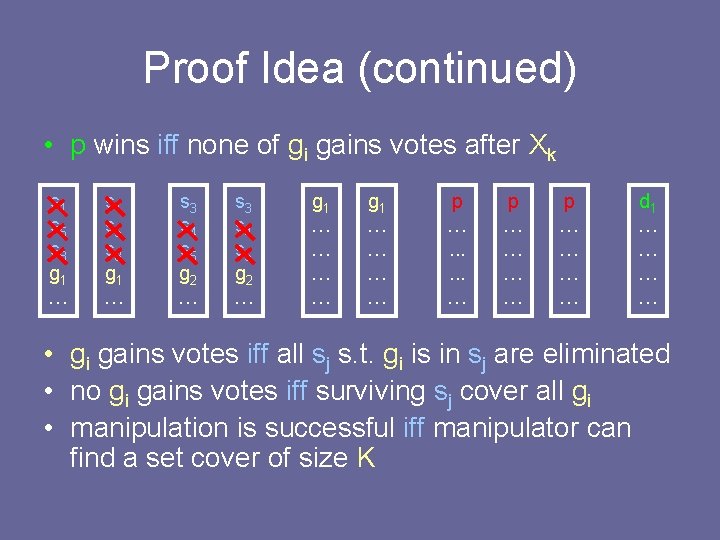
Proof Idea (continued) • p wins iff none of gi gains votes after Xk s 1 s 5 s 8 g 1 … s 3 s 4 s 5 g 2 … g 1 … … … … p …. . . … p … … … … d 1 … … • gi gains votes iff all sj s. t. gi is in sj are eliminated • no gi gains votes iff surviving sj cover all gi • manipulation is successful iff manipulator can find a set cover of size K
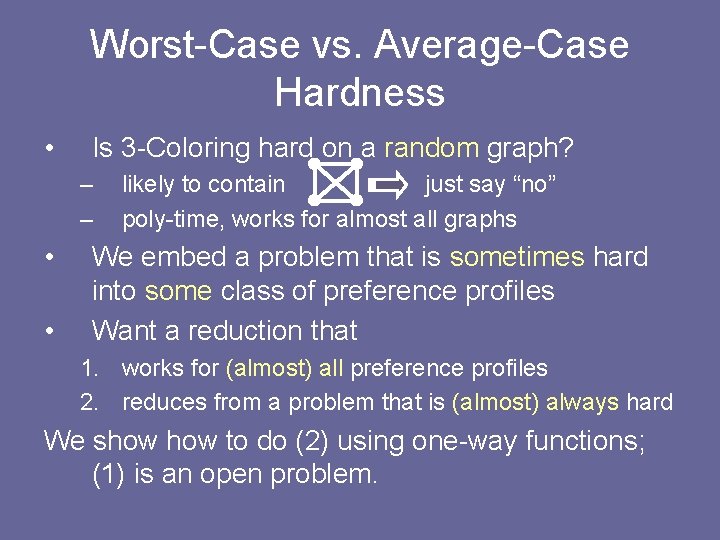
Worst-Case vs. Average-Case Hardness • Is 3 -Coloring hard on a random graph? – – • • likely to contain just say “no” poly-time, works for almost all graphs We embed a problem that is sometimes hard into some class of preference profiles Want a reduction that 1. works for (almost) all preference profiles 2. reduces from a problem that is (almost) always hard We show to do (2) using one-way functions; (1) is an open problem.
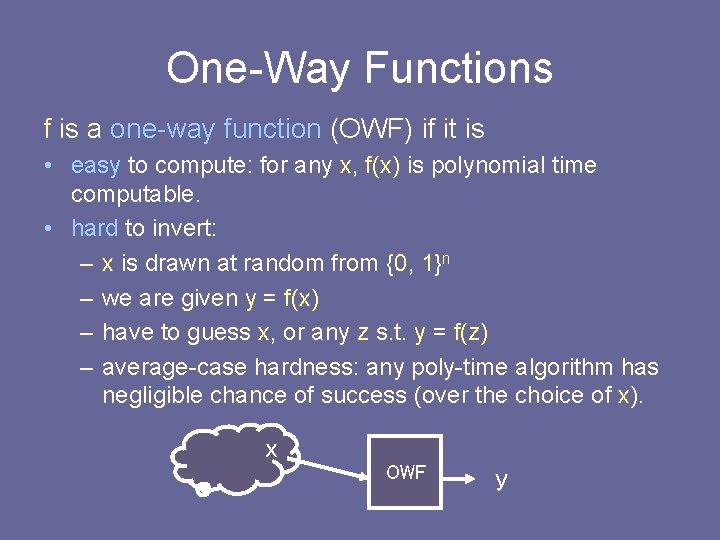
One-Way Functions f is a one-way function (OWF) if it is • easy to compute: for any x, f(x) is polynomial time computable. • hard to invert: – x is drawn at random from {0, 1}n – we are given y = f(x) – have to guess x, or any z s. t. y = f(z) – average-case hardness: any poly-time algorithm has negligible chance of success (over the choice of x). x OWF y
OWF: Properties • It is not known if OWF exist (implies P ≠ NP). – Multiplication of large primes is conjectured to be a OWF (factoring is believed to be hard) • OWF are widely used in cryptography – adversary’s task must be hard almost always, not just sometimes. • Can we make manipulation as hard as inverting OWF? – sort of: we embed inverting OWF into some preference profiles.
Recall: Preround (CS’ 03) P r e r o u n d Alice Bob Carl Diana Ernest Frank Do most voters prefer Alice to Bob? Alice Diana Ernest Original protocol • Retains some of the flavor of the original protocol. • Is NP-hard to manipulate for many base protocols. • Still, the outcome may be very different from the original protocol…
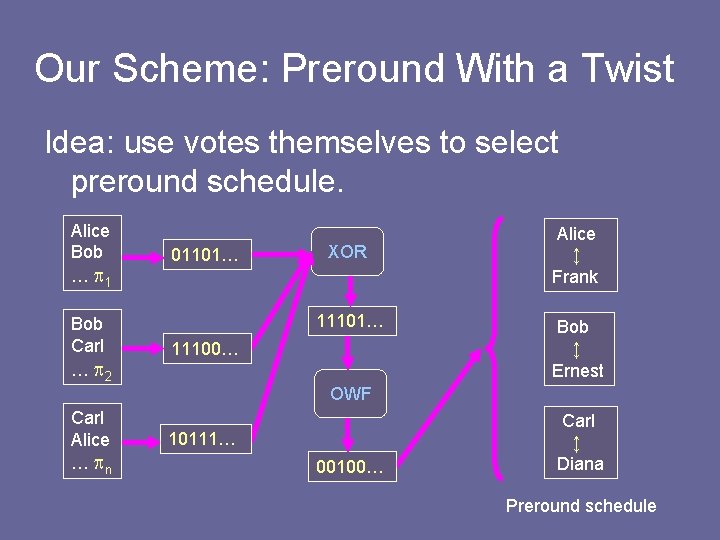
Our Scheme: Preround With a Twist Idea: use votes themselves to select preround schedule. Alice Bob … p 1 Bob Carl … p 2 01101… XOR 11101… 11100… Alice ↕ Frank Bob ↕ Ernest OWF Carl Alice … pn 10111… 00100… Carl ↕ Diana Preround schedule
Key Properties • No trusted source of randomness is needed. • Manipulating this protocol is as hard as inverting the underlying one-way function – even for a large coalition of conspiring would-be manipulators • Proof proceeds by constructing a vector of honest voters’ preferences s. t. there is a unique preround schedule that makes manipulators’ protégé a winner – still a worst-case construction…
Average-Case Hardness? • Can we make manipulation hard with high probability over honest voters’ preferences? • Do we want to make assumptions about the distribution of preference profiles? • In real life, not all preference profiles are equally likely…
Hyb(BC, Plurality): Easy for Any Preround Schedule • • • Candidates a, b, c 1, …, c 2 t+1, p k+1 voters: p > a > b > C, k ≈ n/3 k voters: a > b > p > C n-2 k-2 voters: C > p > a > b Manipulator: C > a > b > p Under any preround schedule – p survives – a cj survives – either a or b survives • In the final round, p competes against a or b – manipulator is better off voting a > b > p > C
Open Problems • Average-case hardness seems hard to achieve using a preround. Other approaches? • What is the maximum fraction of manipulators we can tolerate? – for most base protocols, we can prove security against 1/6 of all voters. Is it optimal? • Our results are for specific protocols. More general proofs?