
FFA and Leadership Foundations Parliamentary Procedure Basics AFNRBAS2
FFA and Leadership Foundations Parliamentary Procedure Basics AFNR-BAS-2. 4: Demonstrate communication skills individually and within group situations by using public speaking skills and parliamentary procedure abilities.
Four Main Objectives 1. focus on one item at a time 2. extend courtesy to everyone 3. observe the rule of the majority 4. protect the rights of the minority
Official Reference Robert’s Rules of Order is the official reference for parliamentary procedure.
Roles and Responsibilities The Chair ◦ the presiding officer ◦ addressed as “Mister Chairman” or “Madam Chairman” ◦ refers to themselves as “the Chair” ◦ acts as the traffic director and enforces the rules of order ◦ recognizes members/grants the floor ◦ states all motions, puts them to a vote, and announces the result ◦ only votes to make or break a tie
Roles and Responsibilities The Secretary ◦ keeps an official record of group proceedings (called “the minutes”) ◦ keeps the membership roll, committee lists, and sends out reports and agendas ◦ The Minutes should include all motions, whether each motion was sustained or lost, and the number of votes if counted.
Roles and Responsibilities The Members ◦ respect the rights of all members ◦ keep debate civilized and on topic
Gaining the Floor “The Floor” is the attention of the group (members and motions can have the floor) and the right to speak only one person may speak at a time stand to address the Chair - “Mr. Chairman. ” or “Madam Chairman. ” wait to be recognized give your motion or debate, then sit down when finished
Debate (a. k. a. Discussion) the member that made the motion has the right to speak first (still needs to be recognized) all members are entitled to debate twice per motion debate should pertain to the motion on the floor
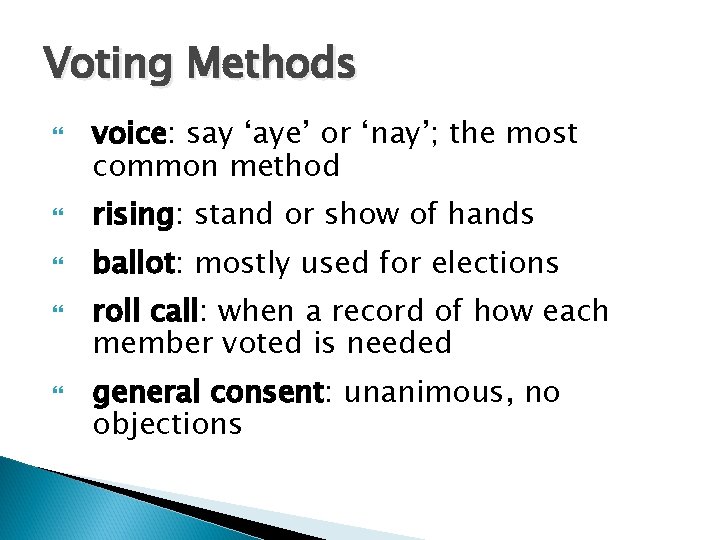
Voting Methods voice: say ‘aye’ or ‘nay’; the most common method rising: stand or show of hands ballot: mostly used for elections roll call: when a record of how each member voted is needed general consent: unanimous, no objections
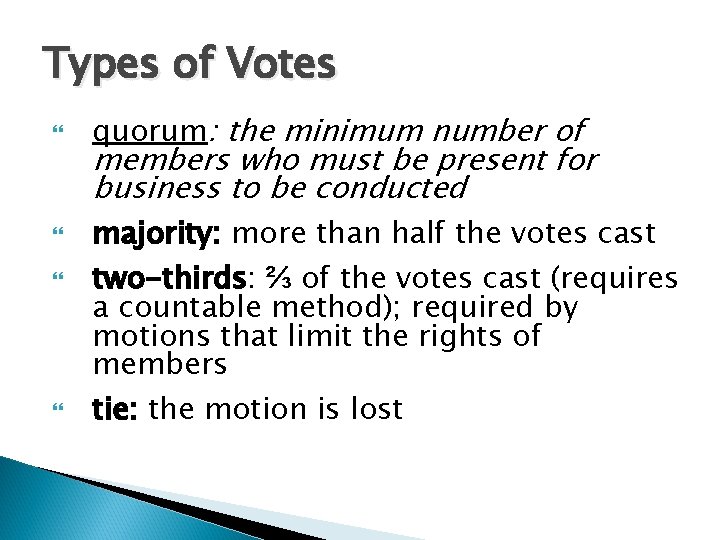
Types of Votes quorum: the minimum number of members who must be present for business to be conducted majority: more than half the votes cast two-thirds: ⅔ of the votes cast (requires a countable method); required by motions that limit the rights of members tie: the motion is lost
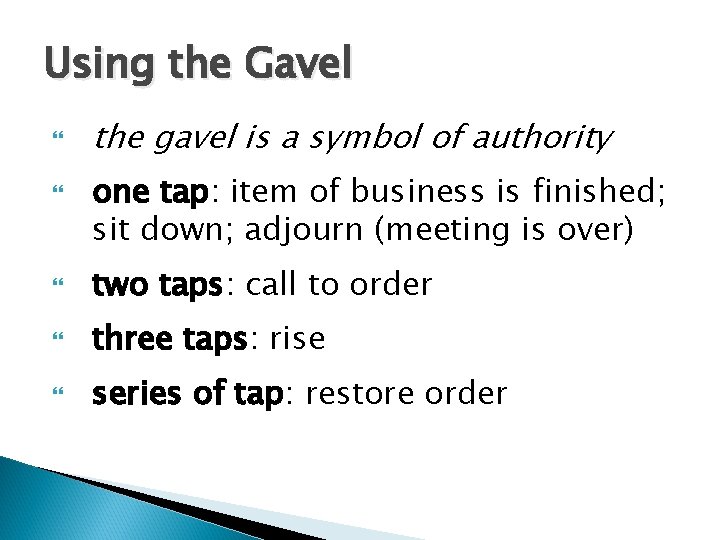
Using the Gavel the gavel is a symbol of authority one tap: item of business is finished; sit down; adjourn (meeting is over) two taps: call to order three taps: rise series of tap: restore order
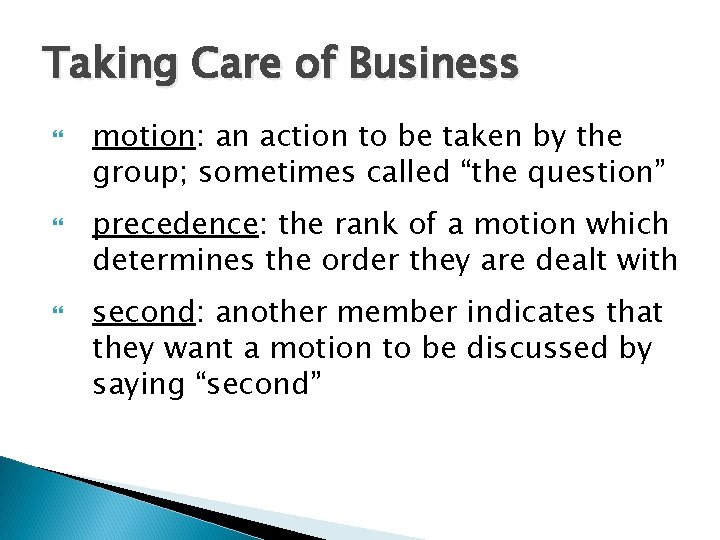
Taking Care of Business motion: an action to be taken by the group; sometimes called “the question” precedence: the rank of a motion which determines the order they are dealt with second: another member indicates that they want a motion to be discussed by saying “second”

Four Classes of Motions Privileged Subsidiary Incidental Motions That Bring a Question Again Before the Assembly
Main Motions lowest ranked motion most common motion proposes a specific action for the group to take “I move that…” or “I move to…” requires a second, debatable, amendable, majority vote
Amend modifies a motion by inserting or adding words, striking out, or substituting “I move to amend this motion by…” requires a second, debatable, amendable, majority vote
Commit or Refer allows a few members to investigate a matter before the group approves it “I move to refer this motion to a committee. ” requires a second, debatable, amendable, majority vote
Lay on the Table temporarily sets aside a pending motion for something that requires immediate action “I move that the motion be laid on the table. ” requires a second, not debatable, not amendable, majority vote
Limit or Extend controls debate by specifying the number of speakers or length of time for discussion “I move to limit debate to…” or “I move to extend the debate to…” requires a second, not debatable, amendable, two-thirds vote
Division of Assembly requires a revote by a countable method “I call Division of the Assembly. ” or “Division!” does not require a second, not debatable, not amendable, no vote

Question of Privilege attends to a matter of comfort or convenience “I rise to a question of privilege. ” does not require a second, not debatable, not amendable, no vote
Point of Order calls attention to a parliamentary error “I rise to a point of order. ” or “Point of order!” does not require a second, not debatable, not amendable, no vote
Recess provides a break in the meeting “I move that we recess…” requires a second, not debatable, amendable, majority vote
Adjourn immediately ends the current meeting “I move to adjourn. ” requires a second, not debatable, not amendable, majority vote
Thank you for learning with One Less Thing. “We make teaching Ag easier. ”
- Slides: 24