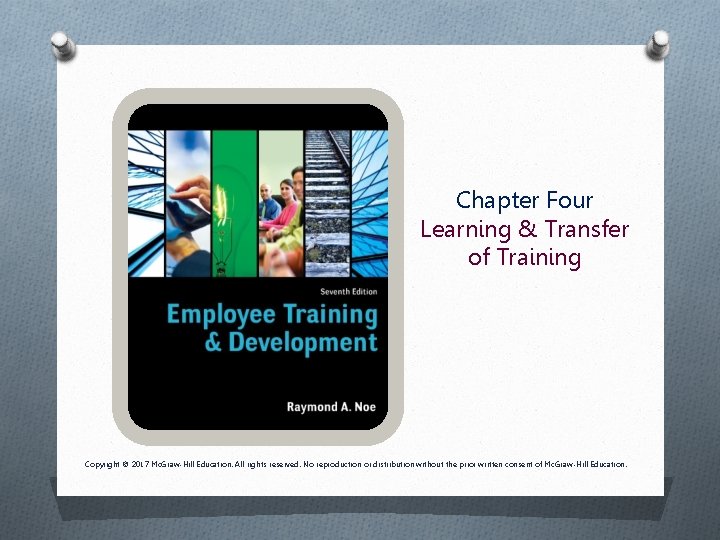
Chapter Four Learning Transfer of Training Copyright 2017
- Slides: 50
Chapter Four Learning & Transfer of Training Copyright © 2017 Mc. Graw-Hill Education. All rights reserved. No reproduction or distribution without the prior written consent of Mc. Graw-Hill Education.
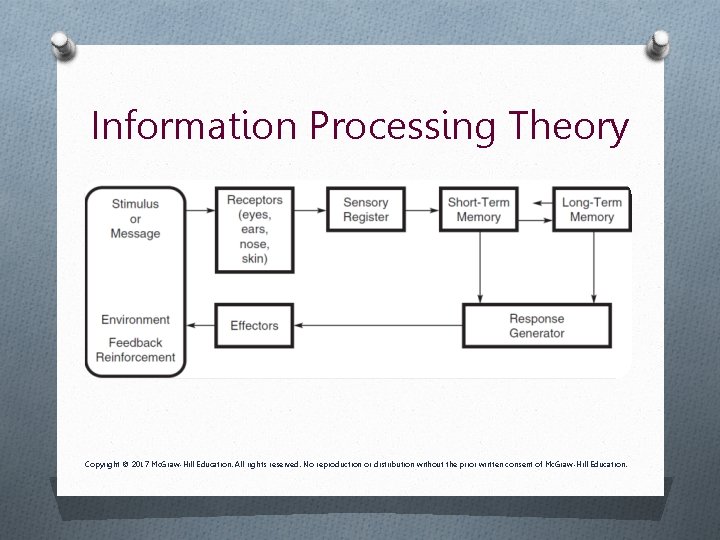
Objectives (1) O Discuss the five types of learner outcomes O Explain the implications of learning theory for instructional design O Incorporate adult learning theory into the design of a training program O Describe how learners receive, process, store, retrieve, and act upon information Copyright © 2017 Mc. Graw-Hill Education. All rights reserved. No reproduction or distribution without the prior written consent of Mc. Graw-Hill Education.
Objectives (2) O Discuss the internal conditions (within the learner) and external conditions (learning environment) necessary for the trainee to learn each type of capability O Discuss the implications of open and closed skills and near and far transfer for designing training programs Copyright © 2017 Mc. Graw-Hill Education. All rights reserved. No reproduction or distribution without the prior written consent of Mc. Graw-Hill Education.
Objectives (3) O Explain the features of instruction and the work environment that are necessary for learning and transfer of training Copyright © 2017 Mc. Graw-Hill Education. All rights reserved. No reproduction or distribution without the prior written consent of Mc. Graw-Hill Education.
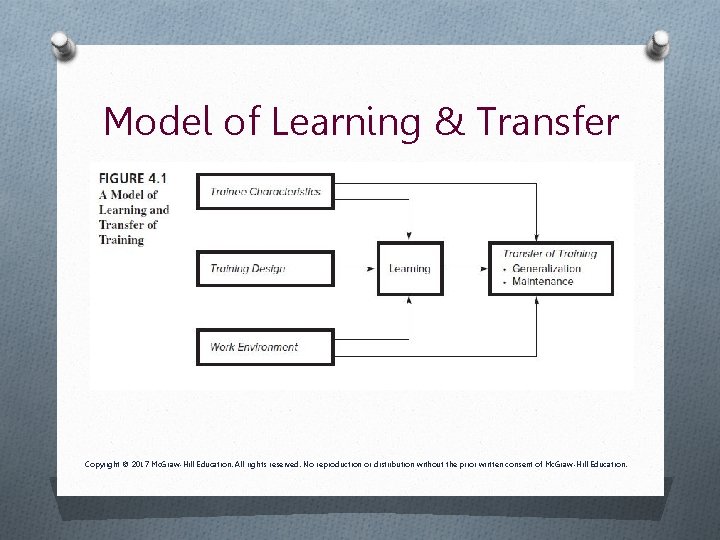
Learning & Transfer O Both learning and transfer are important O Learning refers to a relatively permanent change in human capabilities O Transfer refers to trainees applying what they have learned to their jobs Copyright © 2017 Mc. Graw-Hill Education. All rights reserved. No reproduction or distribution without the prior written consent of Mc. Graw-Hill Education.
Two Types of Transfer O Generalization refers to applying what was learned to situations that are similar but not identical to those in training O Maintenance refers to trainees continuing to use what they learned over time Copyright © 2017 Mc. Graw-Hill Education. All rights reserved. No reproduction or distribution without the prior written consent of Mc. Graw-Hill Education.
Model of Learning & Transfer Insert Figure 4. 1 Copyright © 2017 Mc. Graw-Hill Education. All rights reserved. No reproduction or distribution without the prior written consent of Mc. Graw-Hill Education.
Learning Outcomes (1) O Verbal Information o specialized knowledge, including names, labels, facts, and bodies of knowledge O Intellectual Skills o concepts and rules critical to solve problems, serve customers, and create products O Motor Skills o coordination of physical movements Copyright © 2017 Mc. Graw-Hill Education. All rights reserved. No reproduction or distribution without the prior written consent of Mc. Graw-Hill Education.
Learning Outcomes (2) O Attitudes o beliefs and feelings that predispose a person to behave in a certain way O Cognitive Strategies o strategies that regulate thinking and learning o they relate to decisions regarding what information to attend to, how to remember, and how to solve problems Copyright © 2017 Mc. Graw-Hill Education. All rights reserved. No reproduction or distribution without the prior written consent of Mc. Graw-Hill Education.
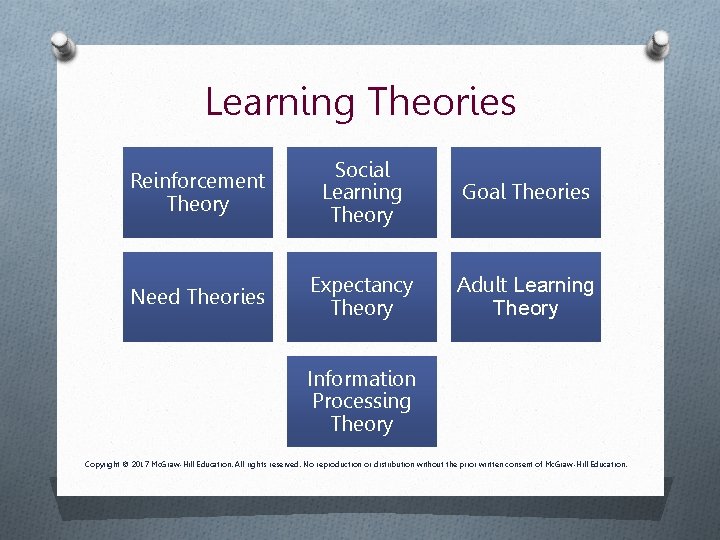
Learning Theories Reinforcement Theory Social Learning Theory Goal Theories Need Theories Expectancy Theory Adult Learning Theory Information Processing Theory Copyright © 2017 Mc. Graw-Hill Education. All rights reserved. No reproduction or distribution without the prior written consent of Mc. Graw-Hill Education.
Reinforcement Theory (1) O Individuals are motivated to perform or avoid behaviors because of past outcomes of behavior O Trainers need to identify what outcomes learners find most positive and negative and then link these outcomes to acquiring new knowledge and skills Copyright © 2017 Mc. Graw-Hill Education. All rights reserved. No reproduction or distribution without the prior written consent of Mc. Graw-Hill Education.
Reinforcement Theory (2) O Positive reinforcement is a pleasurable outcome resulting from a behavior O Negative reinforcement is the removal of an unpleasant outcome O Extinction is withdrawing positive or negative reinforcers to eliminate a behavior O Punishment involves providing an unpleasant outcome after a behavior Copyright © 2017 Mc. Graw-Hill Education. All rights reserved. No reproduction or distribution without the prior written consent of Mc. Graw-Hill Education.
Social Learning Theory (1) O Individuals learn by observing models of behavior, emulating behavior, and receiving reinforcement and rewards O Learning results from directly experiencing the consequences of using a skill, observing others, and seeing the consequences of their behavior Copyright © 2017 Mc. Graw-Hill Education. All rights reserved. No reproduction or distribution without the prior written consent of Mc. Graw-Hill Education.
Social Learning Theory (2) O Four processes involved in learning o Attention o Retention o Motor reproduction o Motivational processes Copyright © 2017 Mc. Graw-Hill Education. All rights reserved. No reproduction or distribution without the prior written consent of Mc. Graw-Hill Education.
Social Learning Theory (3) O Self-efficacy is important o an individual’s belief that he/she can successfully learn knowledge and skills O Self-efficacy can be increased through: o verbal persuasion o logical verification o modeling o past accomplishment Copyright © 2017 Mc. Graw-Hill Education. All rights reserved. No reproduction or distribution without the prior written consent of Mc. Graw-Hill Education.
Goal Orientation (1) O Learning orientation relates to trying to increase ability and competence in a task o People with a learning orientation view mistakes as useful for learning O Performance orientation refers to a desire to look good in comparison to others o Individuals with a performance orientation avoid mistakes because they do not want to appear foolish Copyright © 2017 Mc. Graw-Hill Education. All rights reserved. No reproduction or distribution without the prior written consent of Mc. Graw-Hill Education.
Goal Orientation (2) O Trainers should strive to promote a learning orientation among trainees o Set goals around experimentation o Deemphasize competition o Create a community of learning o Provide constructive feedback when trainees make mistakes Copyright © 2017 Mc. Graw-Hill Education. All rights reserved. No reproduction or distribution without the prior written consent of Mc. Graw-Hill Education.
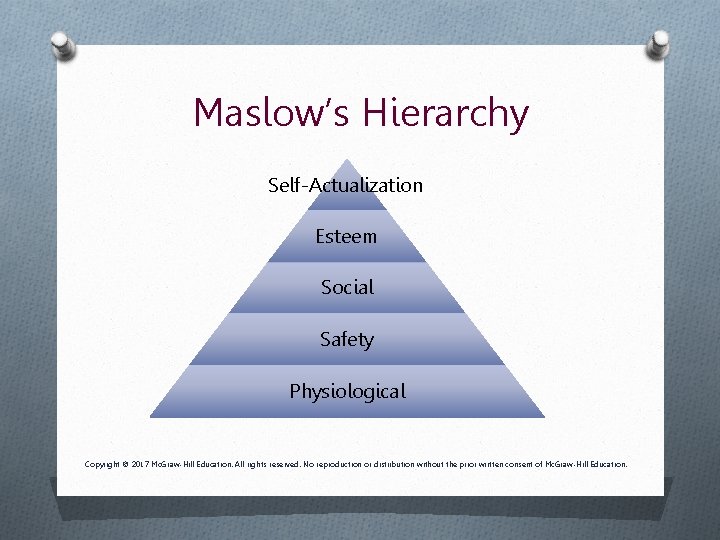
Maslow’s Hierarchy Self-Actualization Esteem Social Safety Physiological Copyright © 2017 Mc. Graw-Hill Education. All rights reserved. No reproduction or distribution without the prior written consent of Mc. Graw-Hill Education.
Alderfer’s Theory O Existence o physical needs such as food, clothing, and shelter O Relatedness o interpersonal needs in personal and professional settings O Growth o needs for personal development Copyright © 2017 Mc. Graw-Hill Education. All rights reserved. No reproduction or distribution without the prior written consent of Mc. Graw-Hill Education.
Mc. Clelland’s Theory O Need for achievement o need to achieve challenging goals, prove something, and recognition O Need for power o need to dominate and influence others O Need for affiliation o need to be a part of something and desire social relationships Copyright © 2017 Mc. Graw-Hill Education. All rights reserved. No reproduction or distribution without the prior written consent of Mc. Graw-Hill Education.
Needs Theory Implications O Trainers should attempt to understand learners’ needs, explain how training will meet needs, and adapt training O If certain basic needs are not met, motivation may suffer O Training should not necessarily attempt to meet all needs, however Copyright © 2017 Mc. Graw-Hill Education. All rights reserved. No reproduction or distribution without the prior written consent of Mc. Graw-Hill Education.
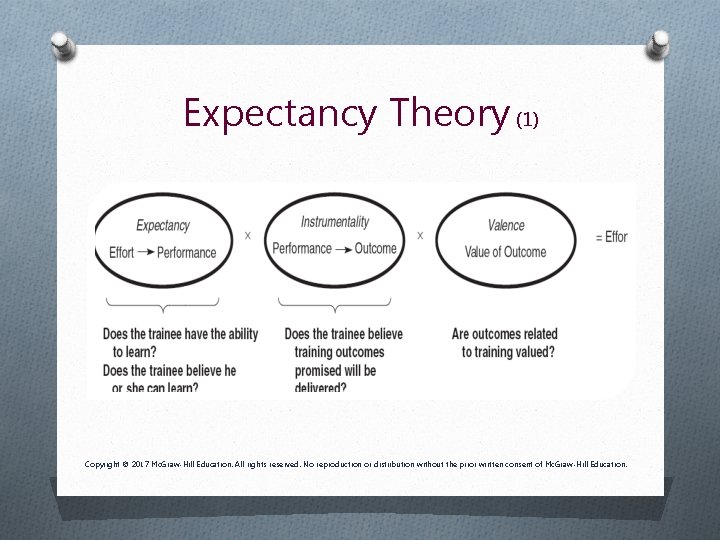
Expectancy Theory (1) Copyright © 2017 Mc. Graw-Hill Education. All rights reserved. No reproduction or distribution without the prior written consent of Mc. Graw-Hill Education.
Expectancy Theory (2) O Based on this model, trainers should: o ensure trainees are confident in their ability (expectancy) o provide and communicate valued rewards (valence) o ensure valued rewards are received if trainees successfully learn and transfer (instrumentality) Copyright © 2017 Mc. Graw-Hill Education. All rights reserved. No reproduction or distribution without the prior written consent of Mc. Graw-Hill Education.
Adult Learning Theory O Adults have the need to know “why” O Adults have a need to be self-directed O Adults bring more work-related experiences to the learning situation O Adults enter a learning experience with a problem-centered approach O Adults are extrinsically and intrinsically motivated Copyright © 2017 Mc. Graw-Hill Education. All rights reserved. No reproduction or distribution without the prior written consent of Mc. Graw-Hill Education.
Adult Learning Implications O Mutual planning and collaboration O Use learner experiences for examples and applications O Develop instruction based on learners’ interests and competencies O Provide opportunities for application O Ensure training is problem centered Copyright © 2017 Mc. Graw-Hill Education. All rights reserved. No reproduction or distribution without the prior written consent of Mc. Graw-Hill Education.
Information Processing Theory Copyright © 2017 Mc. Graw-Hill Education. All rights reserved. No reproduction or distribution without the prior written consent of Mc. Graw-Hill Education.
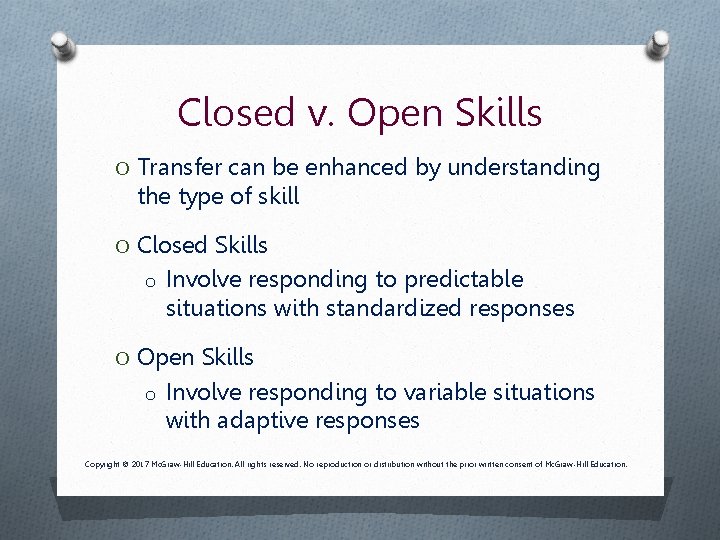
Closed v. Open Skills O Transfer can be enhanced by understanding the type of skill O Closed Skills o Involve responding to predictable situations with standardized responses O Open Skills o Involve responding to variable situations with adaptive responses Copyright © 2017 Mc. Graw-Hill Education. All rights reserved. No reproduction or distribution without the prior written consent of Mc. Graw-Hill Education.
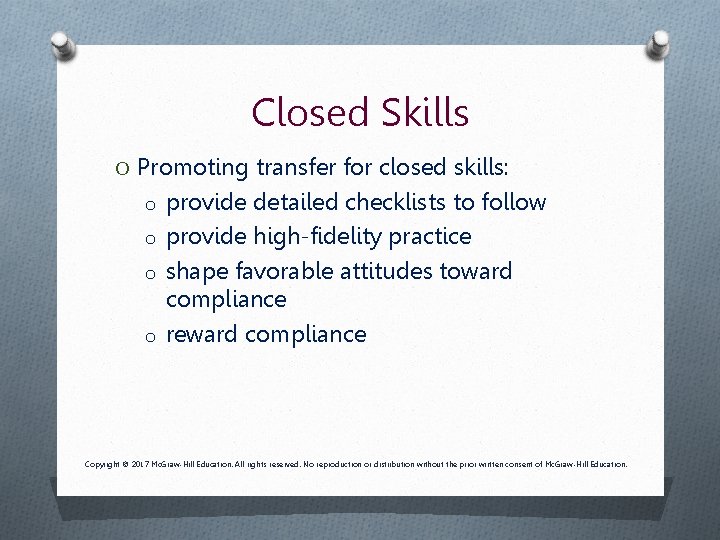
Closed Skills O Promoting transfer for closed skills: o provide detailed checklists to follow o provide high-fidelity practice o shape favorable attitudes toward compliance o reward compliance Copyright © 2017 Mc. Graw-Hill Education. All rights reserved. No reproduction or distribution without the prior written consent of Mc. Graw-Hill Education.
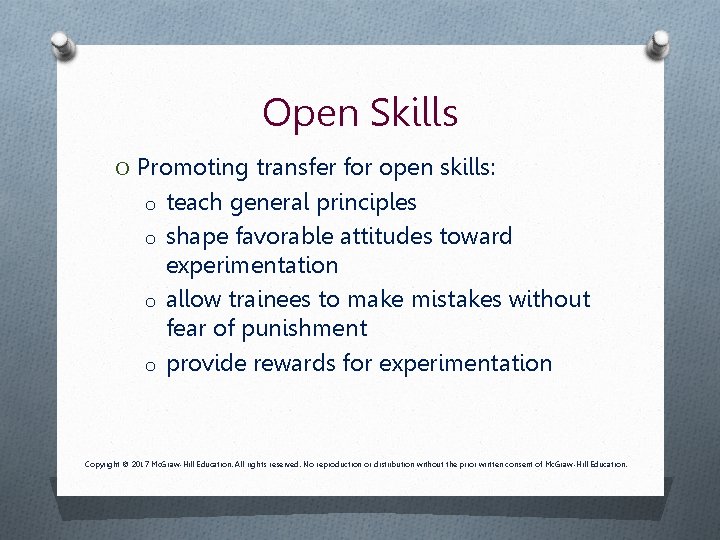
Open Skills O Promoting transfer for open skills: o teach general principles o shape favorable attitudes toward experimentation o allow trainees to make mistakes without fear of punishment o provide rewards for experimentation Copyright © 2017 Mc. Graw-Hill Education. All rights reserved. No reproduction or distribution without the prior written consent of Mc. Graw-Hill Education.
Theory of Identical Elements O Transfer will be maximized when the tasks, materials, and equipment in training are similar to the work environment O Identical elements are particularly important for promoting near transfer, applying learned capabilities exactly to the work situation Copyright © 2017 Mc. Graw-Hill Education. All rights reserved. No reproduction or distribution without the prior written consent of Mc. Graw-Hill Education.
Stimulus Generalization O Transfer is enhanced when the most important features, or general principles, are emphasized during training O The stimulus generalization approach is appropriate to promote far transfer, applying learned capabilities to the work environment when it is not identical to training Copyright © 2017 Mc. Graw-Hill Education. All rights reserved. No reproduction or distribution without the prior written consent of Mc. Graw-Hill Education.
Cognitive Theory of Transfer O Transfer depends on a trainee’s ability to retrieve learned capabilities O Meaningful material and coding schemes enhance storage and recall of training Copyright © 2017 Mc. Graw-Hill Education. All rights reserved. No reproduction or distribution without the prior written consent of Mc. Graw-Hill Education.
Mental & Physical Processes (1) O Learning depends on the learner’s cognitive processes, organizing the content in a mental representation, and relating the content to existing knowledge from longterm memory Copyright © 2017 Mc. Graw-Hill Education. All rights reserved. No reproduction or distribution without the prior written consent of Mc. Graw-Hill Education.
Mental & Physical Processes (2) O Learning is a function of eight processes: o expectancy o perception o working storage o semantic encoding o long-term storage o retrieval o generalizing o gratifying Copyright © 2017 Mc. Graw-Hill Education. All rights reserved. No reproduction or distribution without the prior written consent of Mc. Graw-Hill Education.
Learning Strategies O Different learning strategies influence how training content is coded o rehearsal: learning through repetition o organizing: finding similarities and themes o elaboration: relating the material to other more familiar knowledge Copyright © 2017 Mc. Graw-Hill Education. All rights reserved. No reproduction or distribution without the prior written consent of Mc. Graw-Hill Education.
The Learning Cycle O Learning can be considered a dynamic cycle involving four stages o concrete experience: trainees encounter a concreate experience o reflective observation: trainees think about the problem o abstract conceptualization: trainees generate ideas how to solve the problem o active experimentation: trainees implementation ideas to solve the problem Copyright © 2017 Mc. Graw-Hill Education. All rights reserved. No reproduction or distribution without the prior written consent of Mc. Graw-Hill Education.
Employees need to know the objectives O An objective may have three components o what the learner is expected to do or know o quality or level of acceptable performance o conditions under which the learner is expected to perform Copyright © 2017 Mc. Graw-Hill Education. All rights reserved. No reproduction or distribution without the prior written consent of Mc. Graw-Hill Education.
Employees need meaningful content O Content should be linked to current job experiences and tasks that have meaning O Material should be presented using familiar concepts, terms, and examples O Content should be aligned with personal and professional goals Copyright © 2017 Mc. Graw-Hill Education. All rights reserved. No reproduction or distribution without the prior written consent of Mc. Graw-Hill Education.
Employees need to practice O Practice should: o involve the trainee actively o include overlearning o take the appropriate amount of time o include the appropriate unit of learning Copyright © 2017 Mc. Graw-Hill Education. All rights reserved. No reproduction or distribution without the prior written consent of Mc. Graw-Hill Education.
Employees need a number of prepractice conditions O Provide strategies that will result in the greatest learning O Encourage trainees to reflect O Provide advanced organizers O Help trainees set challenging learning goals O Create realistic expectations for trainees O For training in teams, clarify roles and responsibilities Copyright © 2017 Mc. Graw-Hill Education. All rights reserved. No reproduction or distribution without the prior written consent of Mc. Graw-Hill Education.
Employees need practice involving experience O Learners need practice involving direct experience O Overlearning is needed, which involves continuing to practice the new skill or behavior beyond the point at which the learner has demonstrated proficiency more than once O Incorporate errors in the learning process Copyright © 2017 Mc. Graw-Hill Education. All rights reserved. No reproduction or distribution without the prior written consent of Mc. Graw-Hill Education.
Massed vs. Spaced Practice O Massed practice involves practicing continuously without rest O With spaced practice, individuals are given rest intervals within the practice session O Effectiveness of massed versus spaced practice varies by the characteristics of the task Copyright © 2017 Mc. Graw-Hill Education. All rights reserved. No reproduction or distribution without the prior written consent of Mc. Graw-Hill Education.
Whole vs. Part Practice O One option with practice is focusing on all tasks at the same time (whole practice) O Another option is practicing each component as soon as it is introduced in a training program (part practice) O Trainers should incorporate both types Copyright © 2017 Mc. Graw-Hill Education. All rights reserved. No reproduction or distribution without the prior written consent of Mc. Graw-Hill Education.
Employees need to commit content to memory O Make trainees aware of how they are creating, processing, and accessing memory O Training programs must be explicit on content and elaborate on details O Overlearning can help Copyright © 2017 Mc. Graw-Hill Education. All rights reserved. No reproduction or distribution without the prior written consent of Mc. Graw-Hill Education.
Employees need feedback O Employees need feedback about how well they are meeting training objectives O Feedback should be specific and follow the behavior as closely as possible Copyright © 2017 Mc. Graw-Hill Education. All rights reserved. No reproduction or distribution without the prior written consent of Mc. Graw-Hill Education.
Employees learn through observation, experience, and interaction O Individuals learn through observation and imitating the actions of models O Trainers should promote three key types of interaction: o Learner-content o Learner-instructor o Learner-learner Copyright © 2017 Mc. Graw-Hill Education. All rights reserved. No reproduction or distribution without the prior written consent of Mc. Graw-Hill Education.
Employees need the training program to be properly coordinated and arranged O O O Communicate courses to employees Prepare instructional materials Arrange the training facility and room Testing equipment that will be used Provide support during instruction Distribute evaluation materials Copyright © 2017 Mc. Graw-Hill Education. All rights reserved. No reproduction or distribution without the prior written consent of Mc. Graw-Hill Education.
Encourage trainee responsibility and self-management O Self-management refers to a person’s attempt to control aspects of decision making and behavior O Self-management training involves setting goals to use skills on the job, identifying obstacles and ways to overcome them, and self-administering rewards Copyright © 2017 Mc. Graw-Hill Education. All rights reserved. No reproduction or distribution without the prior written consent of Mc. Graw-Hill Education.
Ensure a supportive work environment O Characteristics of a positive climate for transfer include: o Supervisors and coworkers encourage transfer o Task cues to use new skills o Lack of punishment for using new skills o Extrinsic reinforcement consequences o Intrinsic reinforcement consequences Copyright © 2017 Mc. Graw-Hill Education. All rights reserved. No reproduction or distribution without the prior written consent of Mc. Graw-Hill Education.
Internal & External Conditions O Internal conditions are processes within the learner that are necessary for learning O External conditions are processes in the learning environment that are necessary for learning O External conditions should directly influence forms of instruction, and they should be designed to facilitate the internal conditions Copyright © 2017 Mc. Graw-Hill Education. All rights reserved. No reproduction or distribution without the prior written consent of Mc. Graw-Hill Education.