Heat Transfer Chapter 22 Conduction n n n



- Slides: 13
Heat Transfer Chapter 22
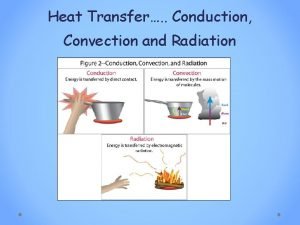
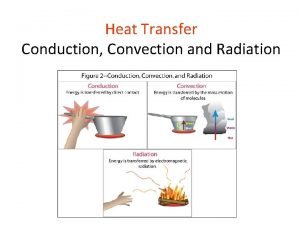
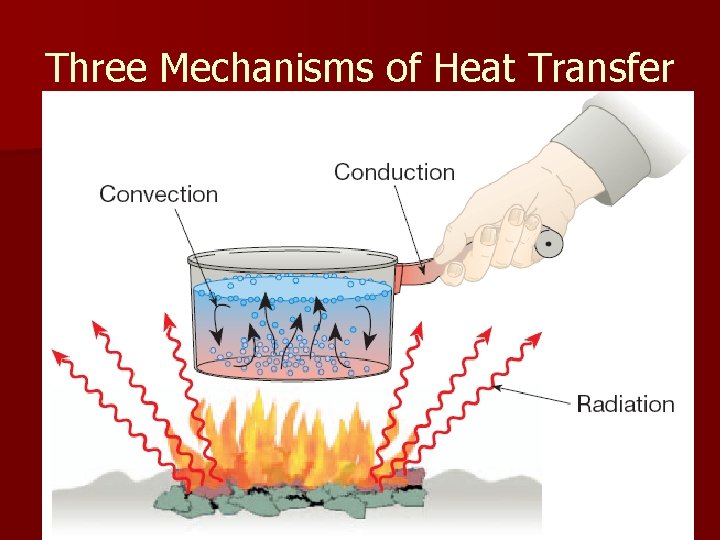
Conduction n n n Conduction – energy transfer from particle to particle within certain materials, or from one material to another when the two are in direct contact Conductors – materials that conduct heat well Metals are the best conductors (silver, copper, aluminum, and iron) Materials composed if atoms with “loose” outer electrons are good conductors of heat Insulators – materials which delay the transfer of heat (wood, wool, straw, paper, cork, and Styrofoam) Cold is simply the absence of heat, only heat is transferred through a conductor or insulator
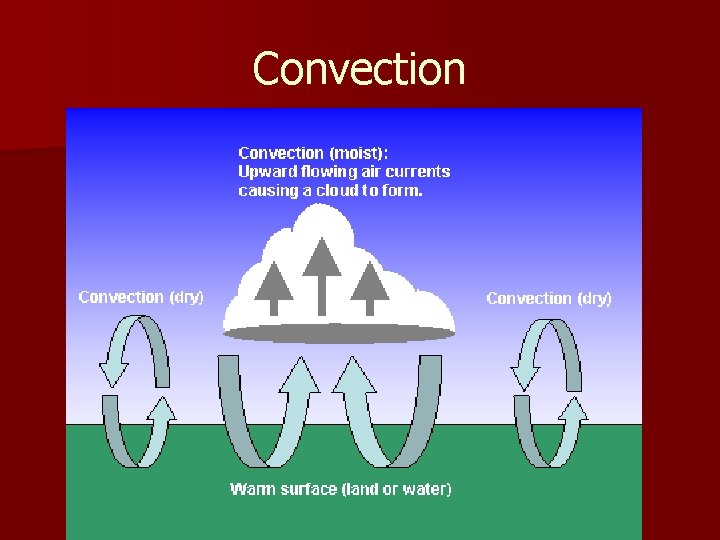
Convection n Convection – a means of heat transfer by movement of the heated substance itself, such as by currents in a fluid n Convection occurs in all fluids, whether liquid or gas n Convection is occurring all around you, the atmosphere, the ocean, Earth, the sun! n As warm air rises, it expands and cools n When the air has been cooled, it will sink back down again and warm up …
Convection
Radiation n Radiation – Energy transmitted by electromagnetic waves (i. e. the sun) n Radiant Energy – any energy, including heat, that is transmitted by radiation n All objects continually emit radiant energy in a mixture of wavelengths n The lower the temperature, the longer the wavelength
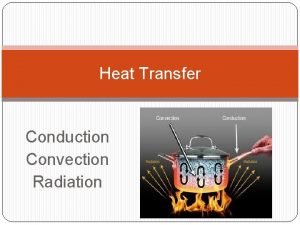
Three Mechanisms of Heat Transfer
Absorption of Radiant Energy n Absorption and reflection are opposite processes, a good absorber of radiant energy will reflect only a little amount of radiant energy n A perfect absorber will reflect no radiant energy and appear black n Good reflectors are poor absorbers of radiant energy
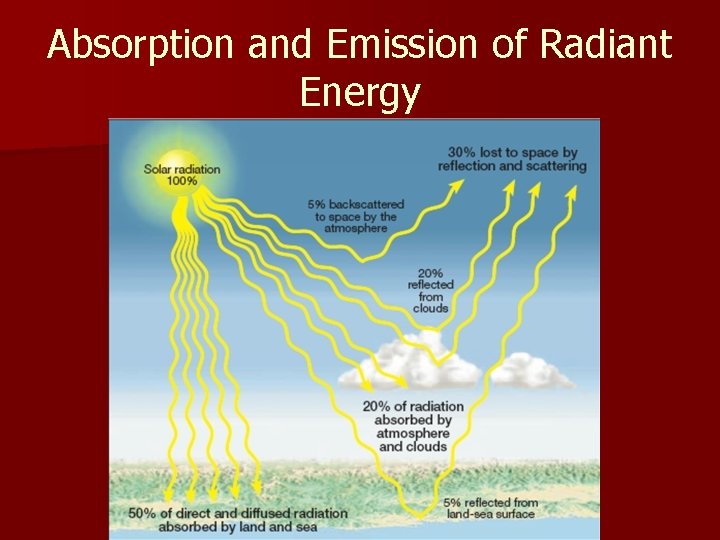
Emission of Radiant Energy n Good absorbers are also good emitters; poor absorbers are poor emitters n If a good absorber was not also a good emitter, then black objects would remain warmer than lighter colored objects and never come to thermal equilibrium with them n Each object is emitting as much energy as it is absorbing
Absorption and Emission of Radiant Energy
Newton’s Law of Cooling The rate of cooling of an object depends on how much hotter the object is than the surroundings The rate of cooling of an object – whether by conduction, convection, or radiation – is approximately proportional to the temperature difference ΔT between the object and its surroundings Rate of cooling ~ ΔT n Newton’s law of cooling also holds for heating n
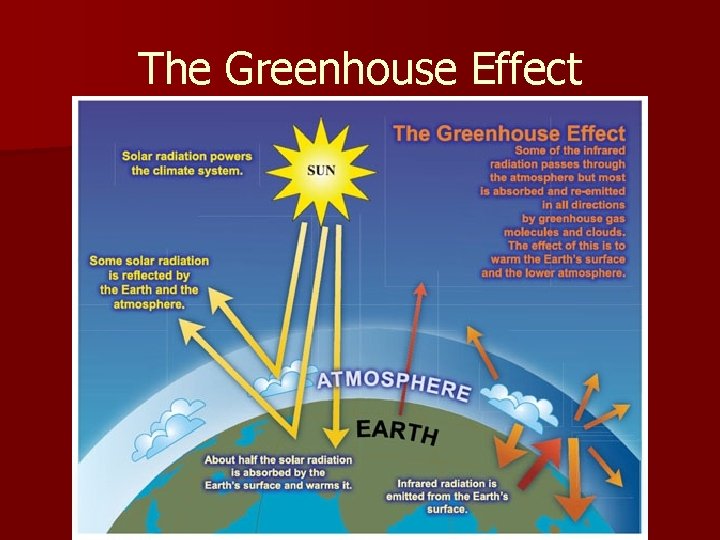
Global Warming n n Greenhouse Effect – The warming effect whose cause is that short-wavelength radiant energy from the sun can enter the atmosphere and be absorbed by Earth more easily than longwavelength energy from Earth can leave Earth absorbs the energy from the sun through the atmosphere As the atmosphere gets thicker from carbon dioxide, it will not allow as much energy to escape into space Terrestrial Radiation – Energy that Earth radiates
The Greenhouse Effect
Assignment n Read Chapter 22 (pg. 325 -336) n Do Chapter 22 #21 -30 (pg. 338) n Do Appendix F #1 -2 (pg. 681)