Chapter 5 Hair For three days after death

- Slides: 64
Chapter 5: Hair “For three days after death, hair and fingernails continue to grow but phone calls taper off. ” —Johnny Carson Comedian and television host
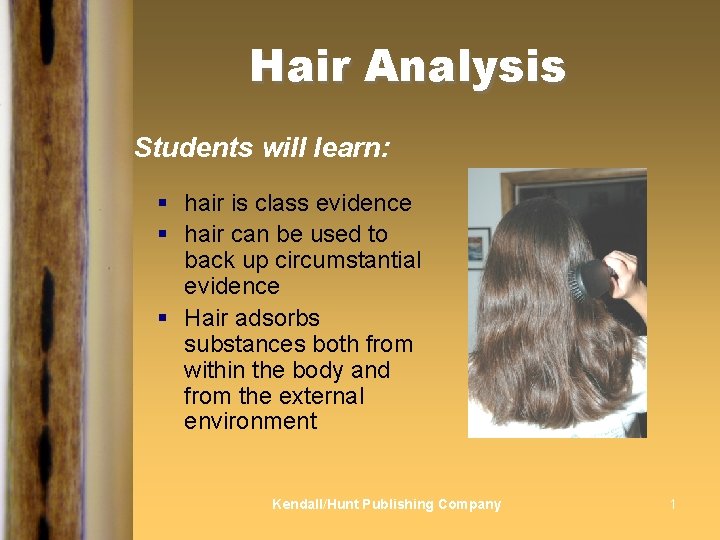
Hair Analysis Students will learn: § hair is class evidence § hair can be used to back up circumstantial evidence § Hair adsorbs substances both from within the body and from the external environment Kendall/Hunt Publishing Company 1
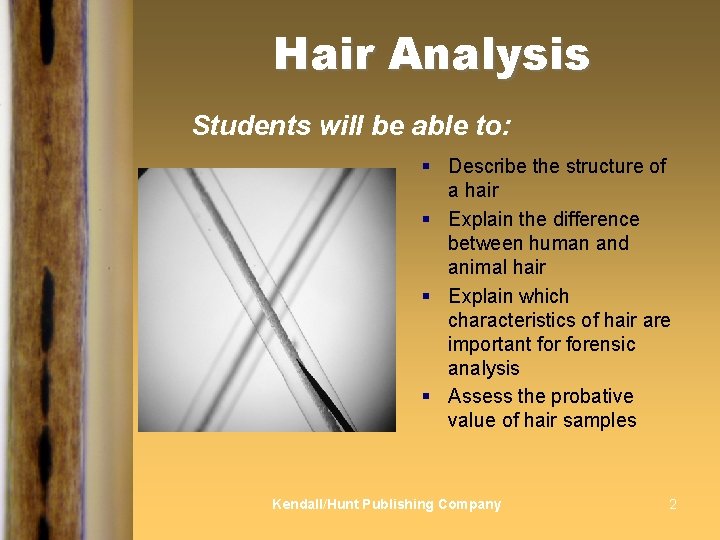
Hair Analysis Students will be able to: § Describe the structure of a hair § Explain the difference between human and animal hair § Explain which characteristics of hair are important forensic analysis § Assess the probative value of hair samples Kendall/Hunt Publishing Company 2
Hair is A slender threadlike outgrowth from the follicles of the skin of mammals Found all over our bodies Head Face Chest Limbs (arms and legs) Pubic region 3
Introduction § Human hair is one of the most frequently found pieces of evidence at the scene of a violent crime. It can provide a link between the criminal and the crime. § From hair one can determine: § § § If the source is human or animal Race (sometimes) Origin of the location on the source’s body Whether the hair was forcibly removed If the hair has been treated with chemicals If drugs have been ingested Kendall/Hunt Publishing Company 4
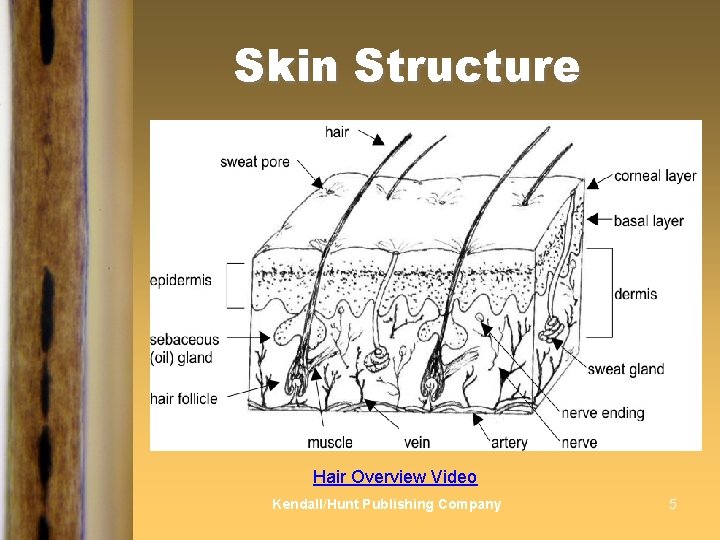
Skin Structure Hair Overview Video Kendall/Hunt Publishing Company 5
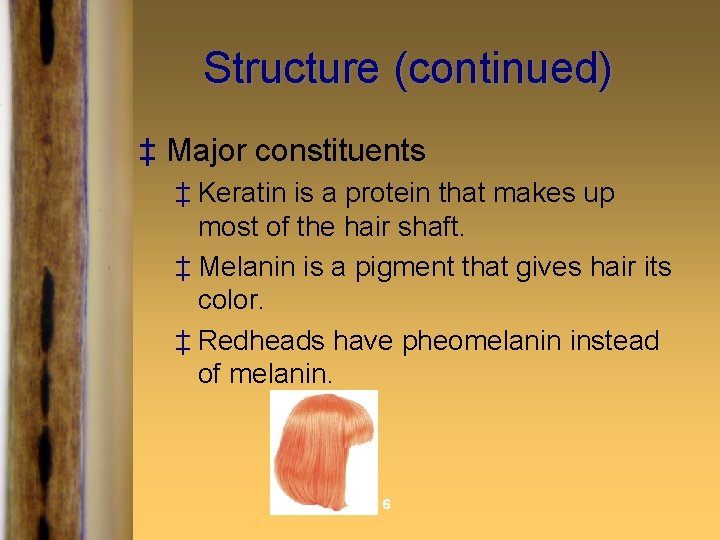
Structure (continued) ‡ Major constituents ‡ Keratin is a protein that makes up most of the hair shaft. ‡ Melanin is a pigment that gives hair its color. ‡ Redheads have pheomelanin instead of melanin. 6
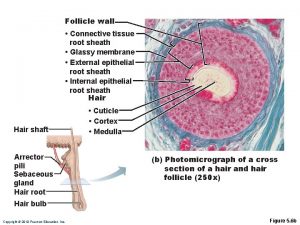
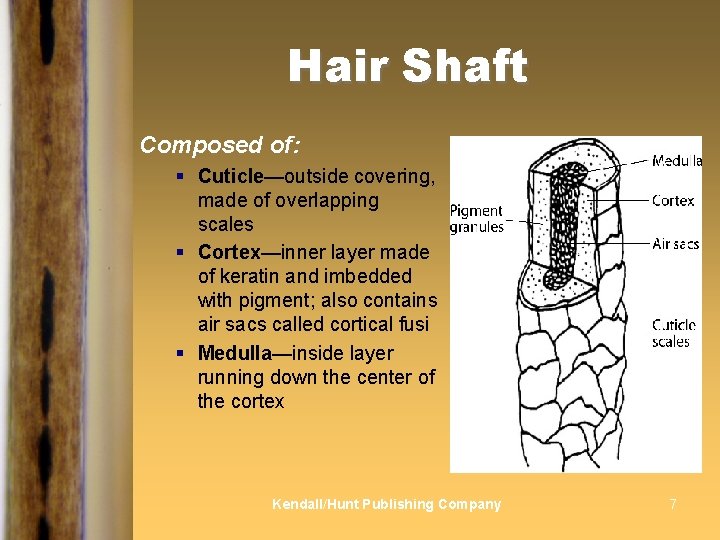
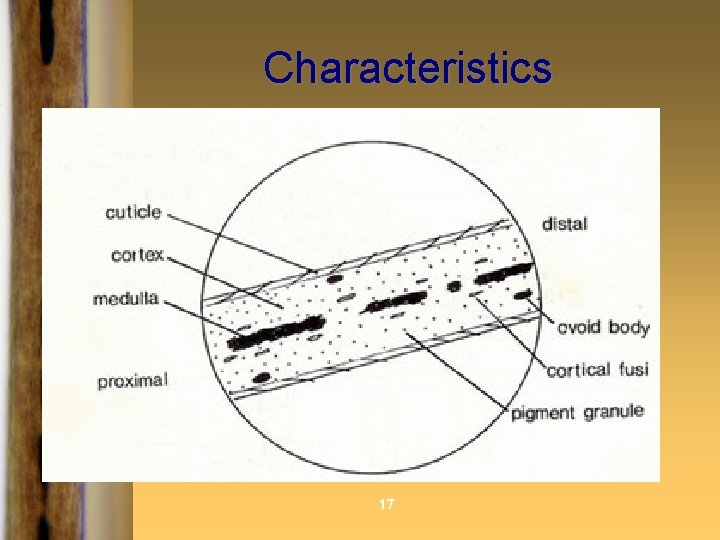
Hair Shaft Composed of: § Cuticle—outside covering, made of overlapping scales § Cortex—inner layer made of keratin and imbedded with pigment; also contains air sacs called cortical fusi § Medulla—inside layer running down the center of the cortex Kendall/Hunt Publishing Company 7
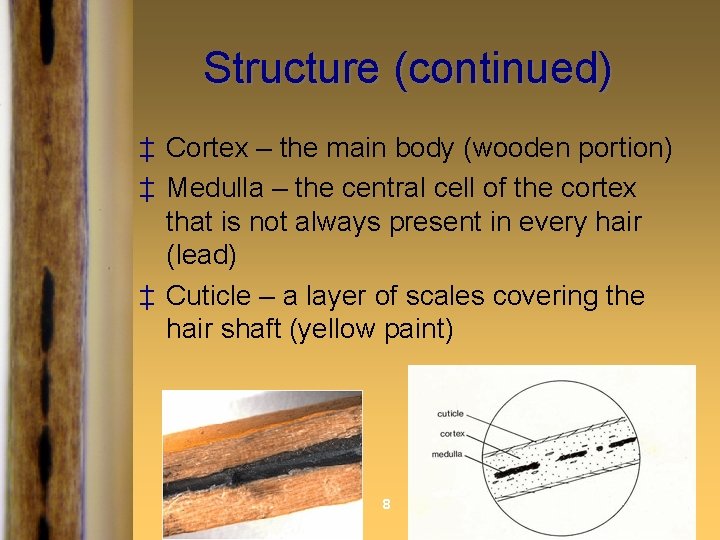
Structure (continued) ‡ Cortex – the main body (wooden portion) ‡ Medulla – the central cell of the cortex that is not always present in every hair (lead) ‡ Cuticle – a layer of scales covering the hair shaft (yellow paint) 8
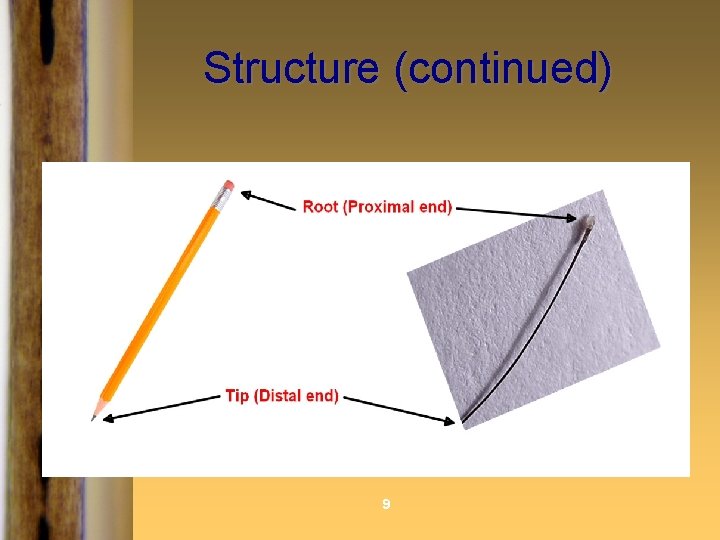
Structure (continued) 9
The Cortex The cortex gives the hair its shape. It has two major characteristics: § Melanin—pigment granules that give hair its color § Cortical fusi—air spaces, usually found near the root but may be found throughout the hair shaft Kendall/Hunt Publishing Company 10
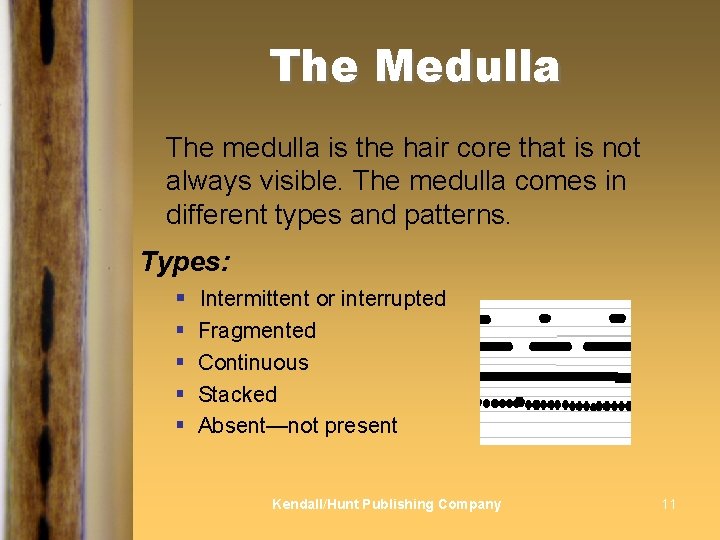
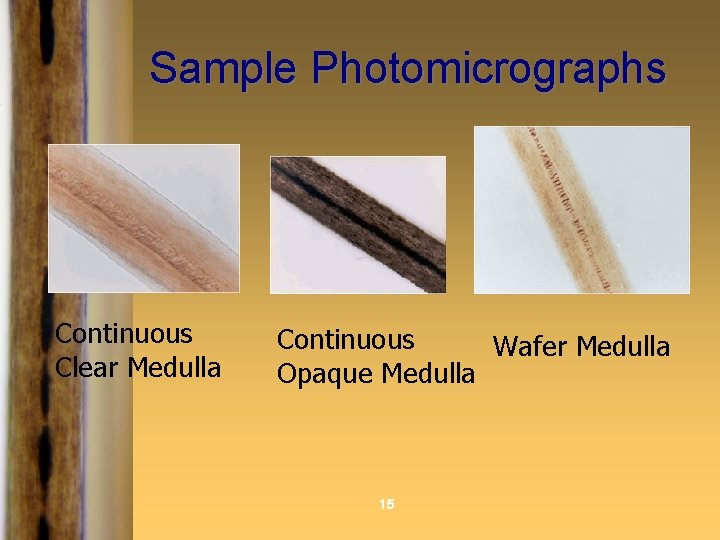
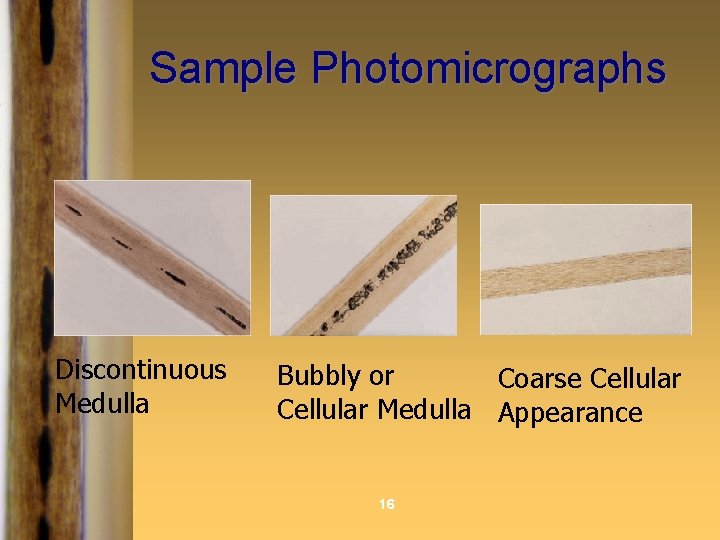
The Medulla The medulla is the hair core that is not always visible. The medulla comes in different types and patterns. Types: § Intermittent or interrupted § § Fragmented Continuous Stacked Absent—not present Kendall/Hunt Publishing Company 11
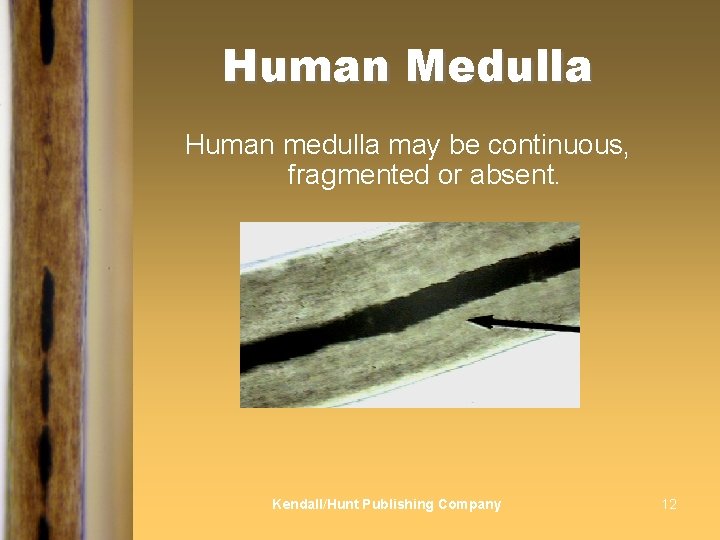
Human Medulla Human medulla may be continuous, fragmented or absent. Kendall/Hunt Publishing Company 12
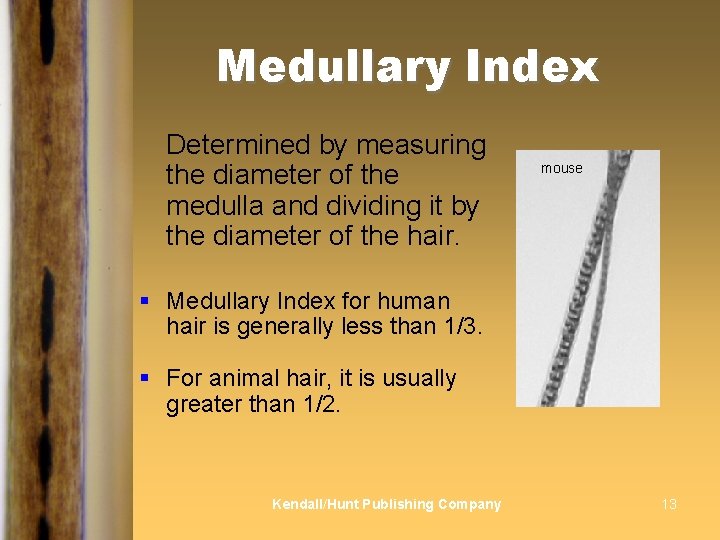
Medullary Index Determined by measuring the diameter of the medulla and dividing it by the diameter of the hair. mouse § Medullary Index for human hair is generally less than 1/3. § For animal hair, it is usually greater than 1/2. Kendall/Hunt Publishing Company 13
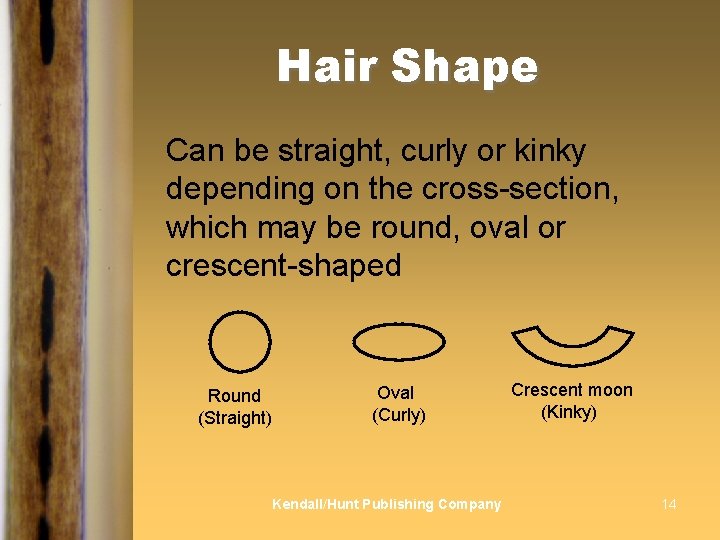
Hair Shape Can be straight, curly or kinky depending on the cross-section, which may be round, oval or crescent-shaped Round (Straight) Oval (Curly) Kendall/Hunt Publishing Company Crescent moon (Kinky) 14
Sample Photomicrographs Continuous Clear Medulla Continuous Wafer Medulla Opaque Medulla 15
Sample Photomicrographs Discontinuous Medulla Bubbly or Coarse Cellular Medulla Appearance 16
Characteristics 17
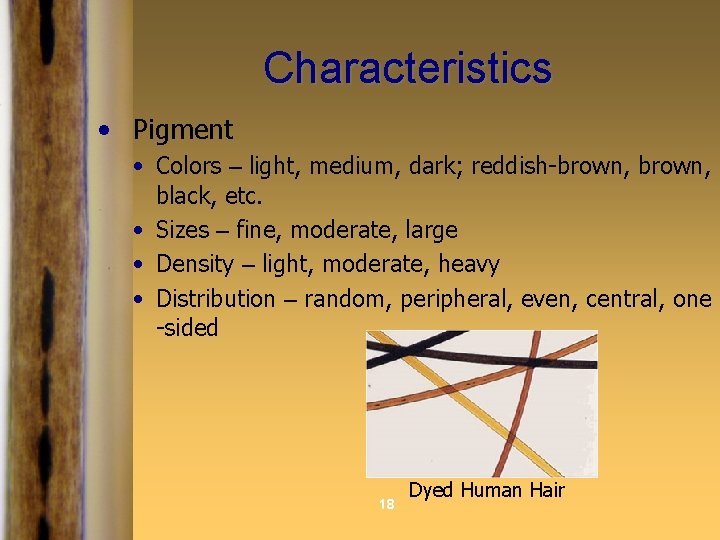
Characteristics • Pigment • Colors – light, medium, dark; reddish-brown, black, etc. • Sizes – fine, moderate, large • Density – light, moderate, heavy • Distribution – random, peripheral, even, central, one -sided 18 Dyed Human Hair
Characteristics (continued) Various Pigment Distributions One-Sided Peripheral in Human Hair Random in Animal Hair Central in Red Human Hair 19
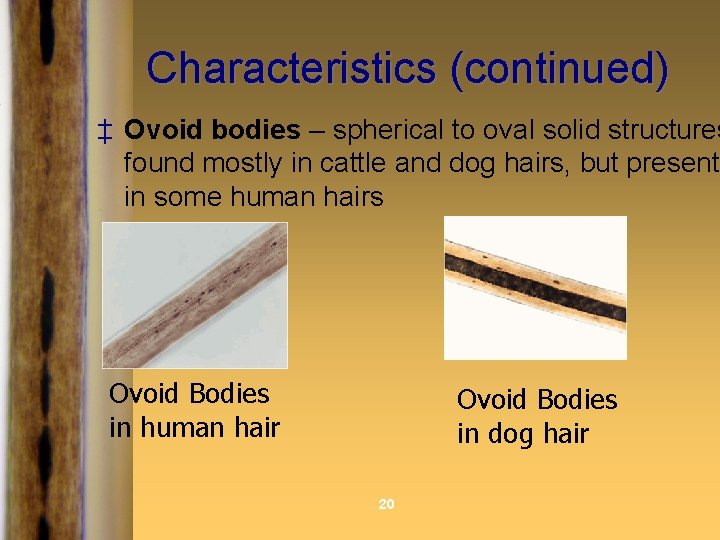
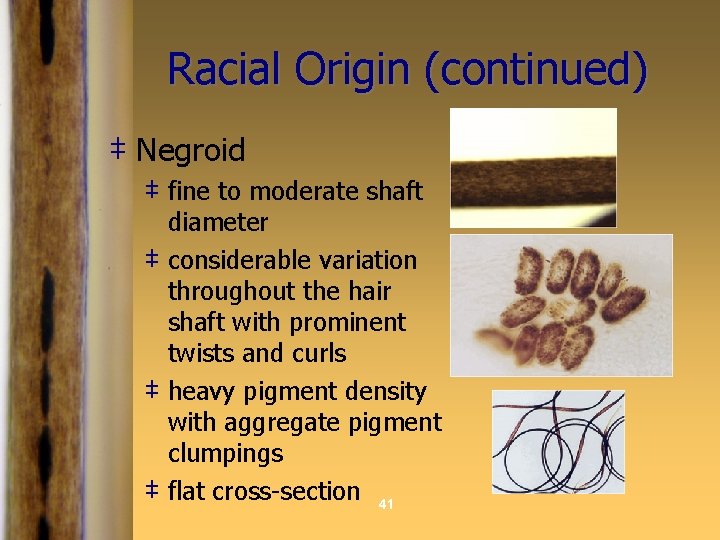
Characteristics (continued) ‡ Ovoid bodies – spherical to oval solid structures found mostly in cattle and dog hairs, but present in some human hairs Ovoid Bodies in human hair Ovoid Bodies in dog hair 20
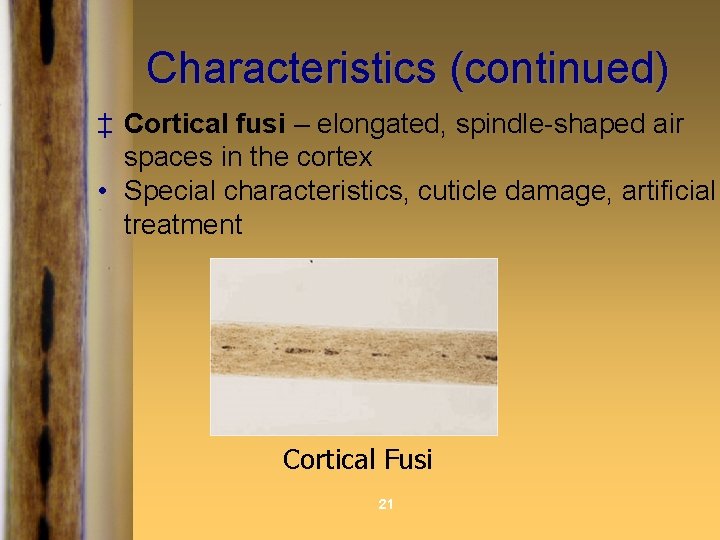
Characteristics (continued) ‡ Cortical fusi – elongated, spindle-shaped air spaces in the cortex • Special characteristics, cuticle damage, artificial treatment Cortical Fusi 21
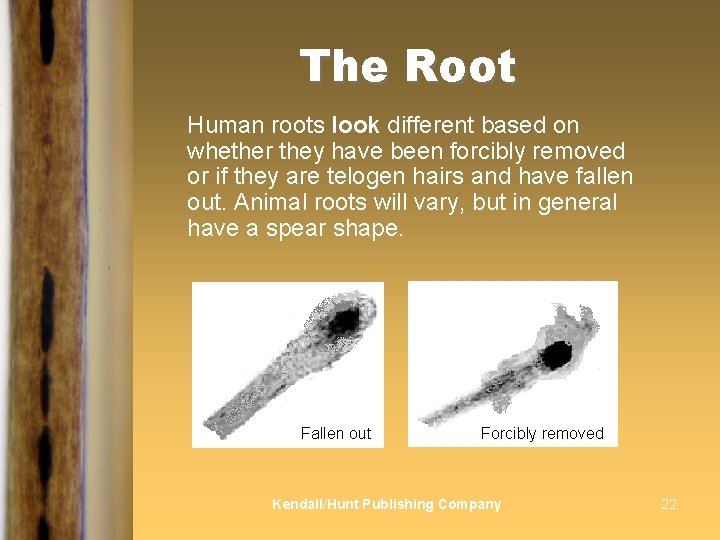
The Root Human roots look different based on whether they have been forcibly removed or if they are telogen hairs and have fallen out. Animal roots will vary, but in general have a spear shape. Fallen out Forcibly removed Kendall/Hunt Publishing Company 22
§ § Hair Comparison Color Length Diameter Distribution, shape and color intensity of pigment granules § Dyed hair has color in cuticle and cortex § Bleaching removes pigment and gives a yellow tint § Scale types § Presence or absence of medulla § Medullary type § Medullary pattern § Medullary index Kendall/Hunt Publishing Company 23
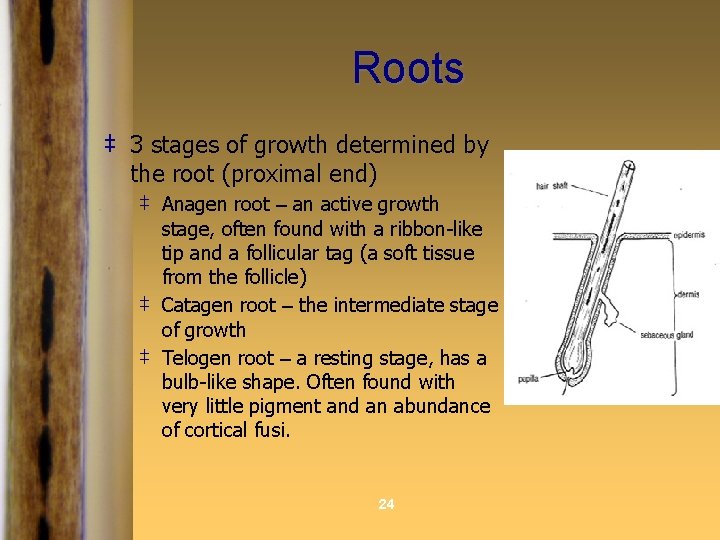
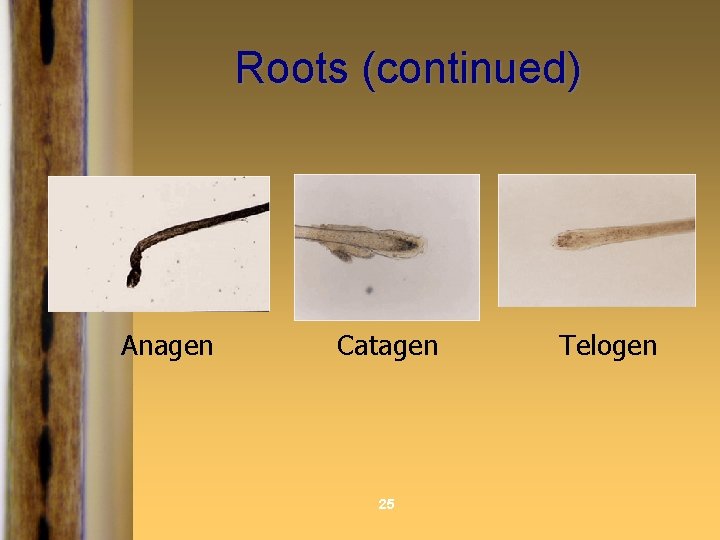
Roots ‡ 3 stages of growth determined by the root (proximal end) ‡ Anagen root – an active growth stage, often found with a ribbon-like tip and a follicular tag (a soft tissue from the follicle) ‡ Catagen root – the intermediate stage of growth ‡ Telogen root – a resting stage, has a bulb-like shape. Often found with very little pigment and an abundance of cortical fusi. 24
Roots (continued) Anagen Catagen 25 Telogen
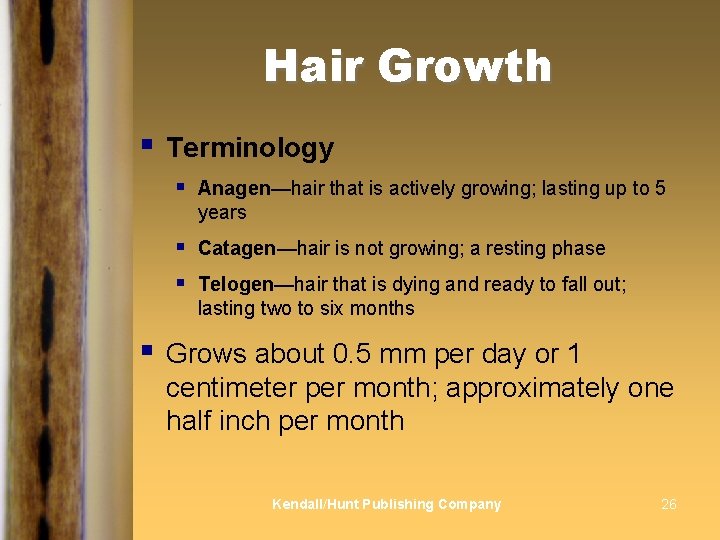
Hair Growth § § Terminology § Anagen—hair that is actively growing; lasting up to 5 years § § Catagen—hair is not growing; a resting phase Telogen—hair that is dying and ready to fall out; lasting two to six months Grows about 0. 5 mm per day or 1 centimeter per month; approximately one half inch per month Kendall/Hunt Publishing Company 26
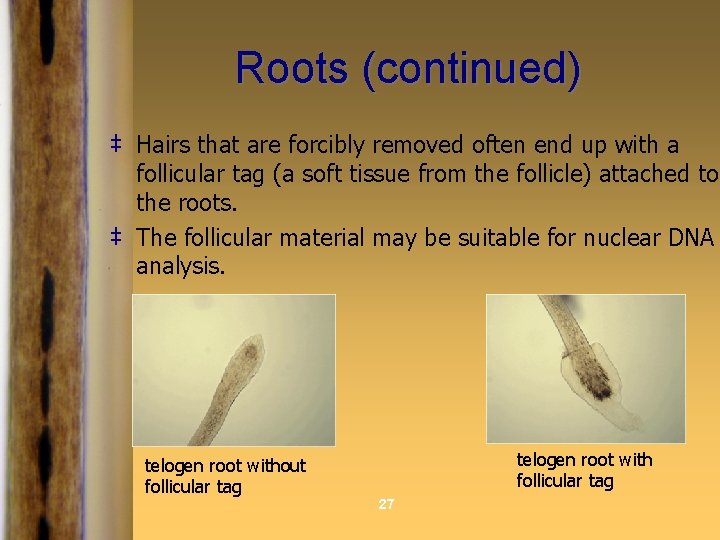
Roots (continued) ‡ Hairs that are forcibly removed often end up with a follicular tag (a soft tissue from the follicle) attached to the roots. ‡ The follicular material may be suitable for nuclear DNA analysis. telogen root without follicular tag telogen root with follicular tag 27
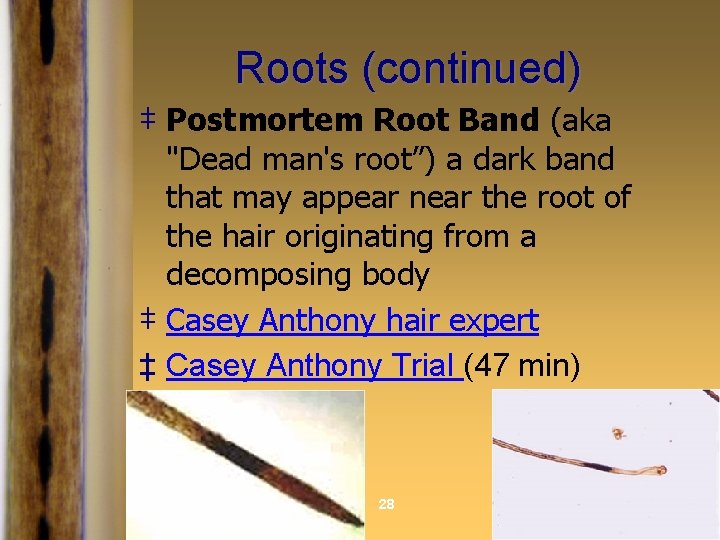
Roots (continued) ‡ Postmortem Root Band (aka "Dead man's root”) a dark band that may appear near the root of the hair originating from a decomposing body ‡ Casey Anthony hair expert ‡ Casey Anthony Trial (47 min) 28
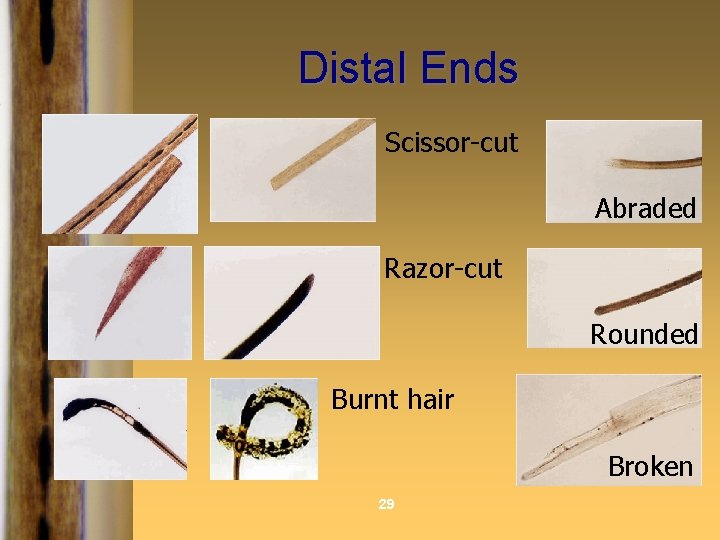
Distal Ends Scissor-cut Abraded Razor-cut Rounded Burnt hair Broken 29
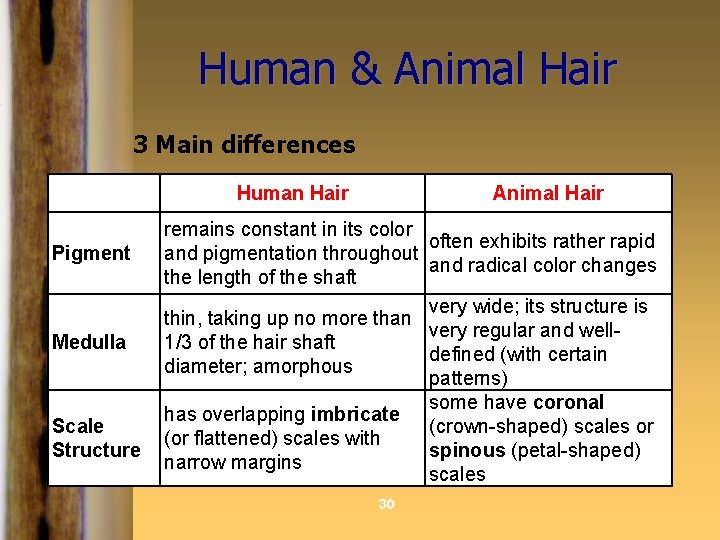
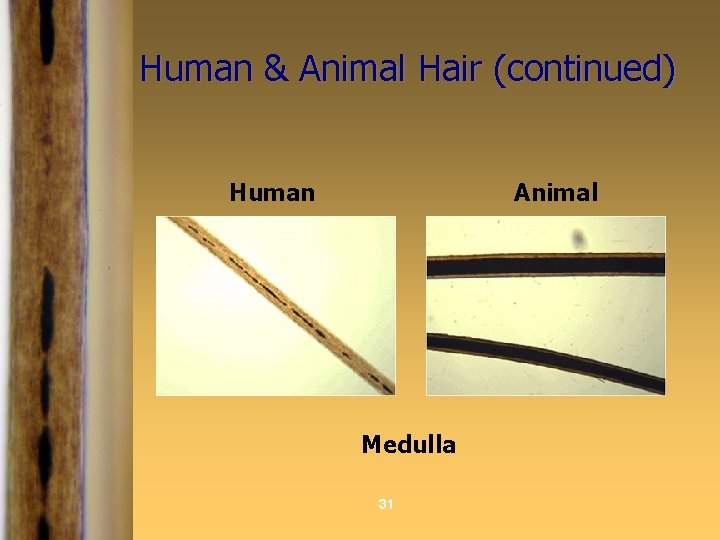
Human & Animal Hair 3 Main differences Human Hair Pigment Medulla Scale Structure Animal Hair remains constant in its color often exhibits rather rapid and pigmentation throughout and radical color changes the length of the shaft very wide; its structure is thin, taking up no more than very regular and well 1/3 of the hair shaft defined (with certain diameter; amorphous patterns) some have coronal has overlapping imbricate (crown-shaped) scales or (or flattened) scales with spinous (petal-shaped) narrow margins scales 30
Human & Animal Hair (continued) Human Animal Medulla 31
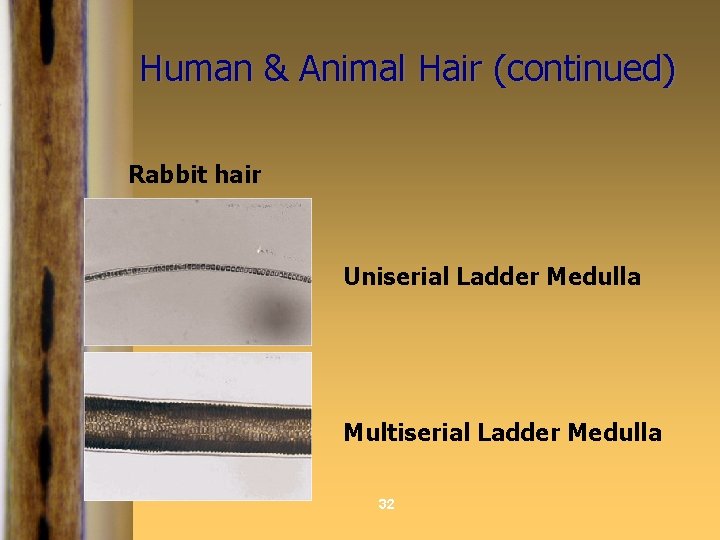
Human & Animal Hair (continued) Rabbit hair Uniserial Ladder Medulla Multiserial Ladder Medulla 32
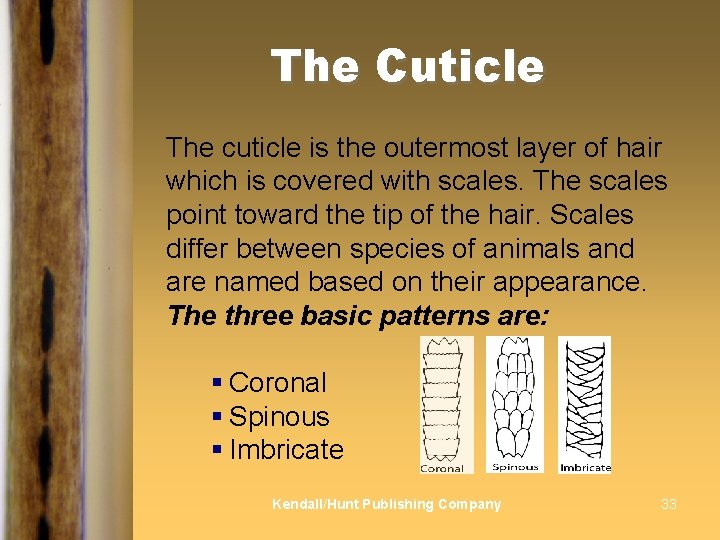
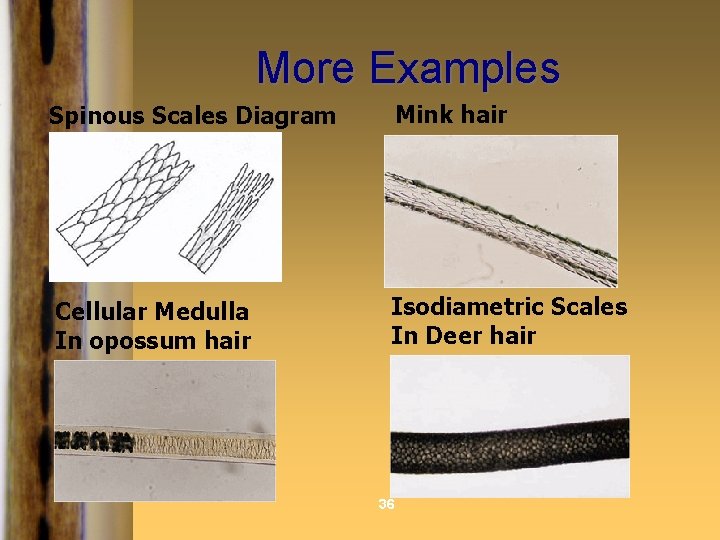
The Cuticle The cuticle is the outermost layer of hair which is covered with scales. The scales point toward the tip of the hair. Scales differ between species of animals and are named based on their appearance. The three basic patterns are: § Coronal § Spinous § Imbricate Kendall/Hunt Publishing Company 33
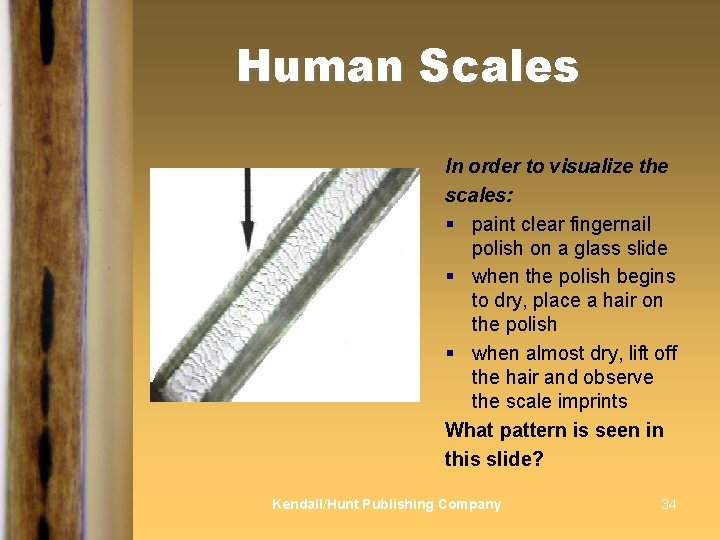
Human Scales In order to visualize the scales: § paint clear fingernail polish on a glass slide § when the polish begins to dry, place a hair on the polish § when almost dry, lift off the hair and observe the scale imprints What pattern is seen in this slide? Kendall/Hunt Publishing Company 34
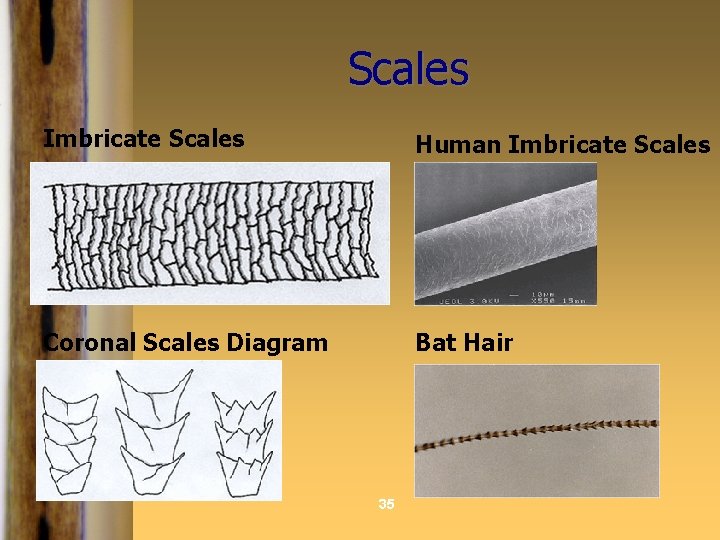
Scales Imbricate Scales Human Imbricate Scales Coronal Scales Diagram Bat Hair 35
More Examples Spinous Scales Diagram Mink hair Cellular Medulla In opossum hair Isodiametric Scales In Deer hair 36
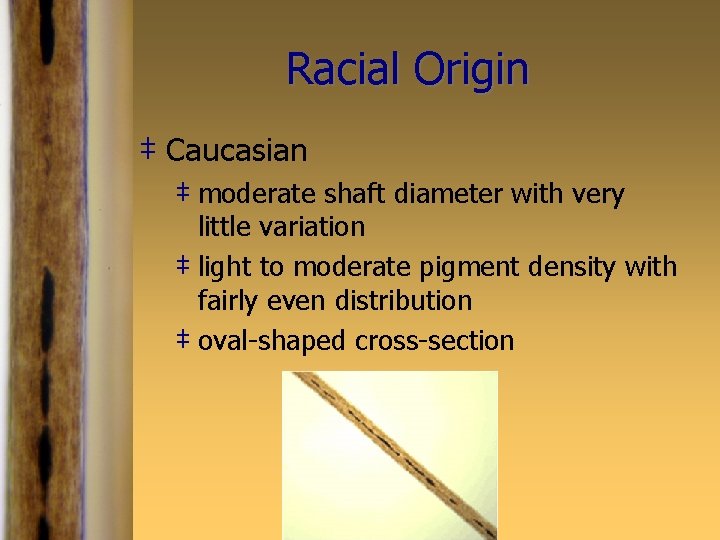
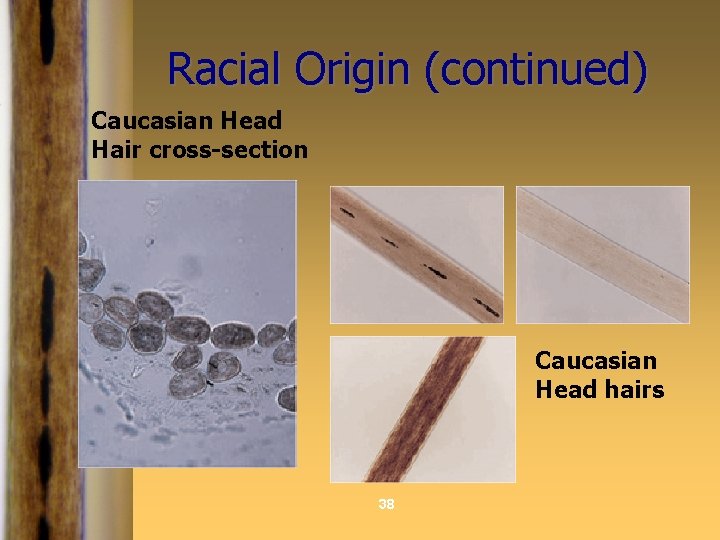
Racial Origin ‡ Caucasian ‡ moderate shaft diameter with very little variation ‡ light to moderate pigment density with fairly even distribution ‡ oval-shaped cross-section 37
Racial Origin (continued) Caucasian Head Hair cross-section Caucasian Head hairs 38
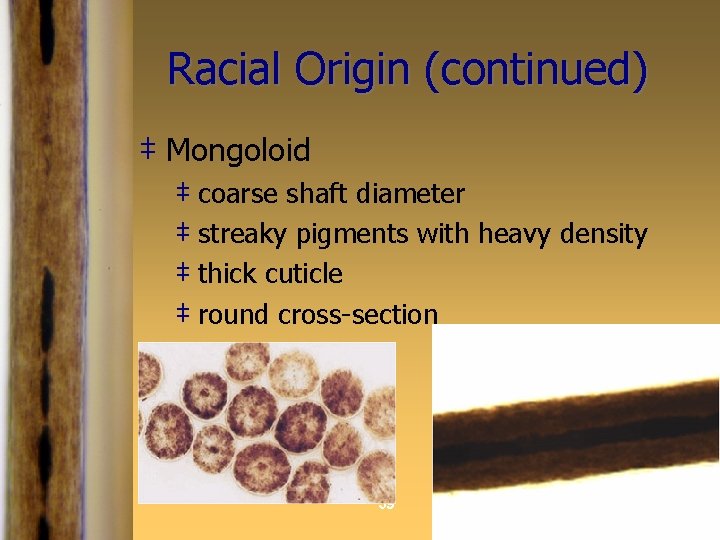
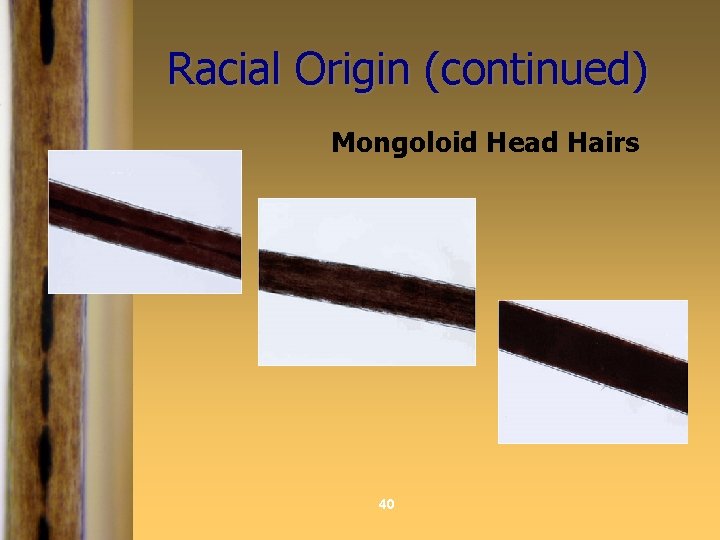
Racial Origin (continued) ‡ Mongoloid ‡ coarse shaft diameter ‡ streaky pigments with heavy density ‡ thick cuticle ‡ round cross-section 39
Racial Origin (continued) Mongoloid Head Hairs 40
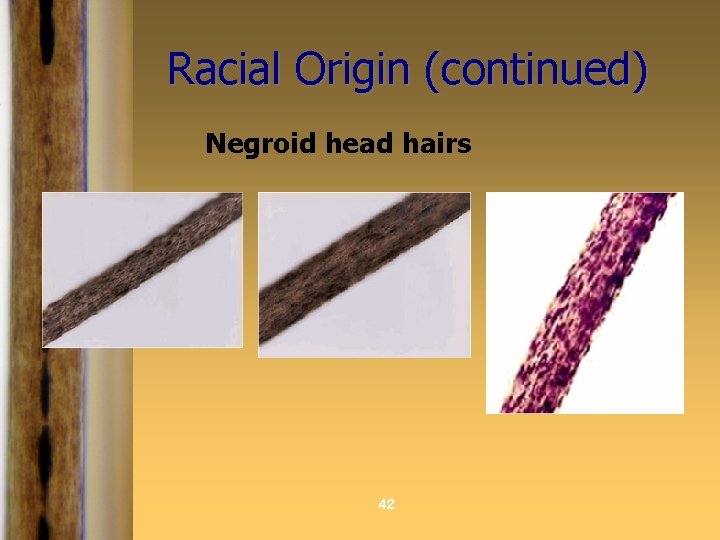
Racial Origin (continued) ‡ Negroid ‡ fine to moderate shaft diameter ‡ considerable variation throughout the hair shaft with prominent twists and curls ‡ heavy pigment density with aggregate pigment clumpings ‡ flat cross-section 41
Racial Origin (continued) Negroid head hairs 42
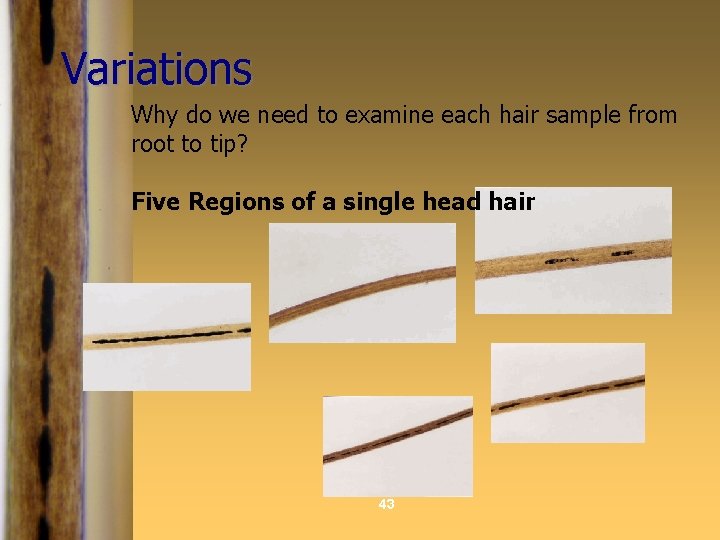
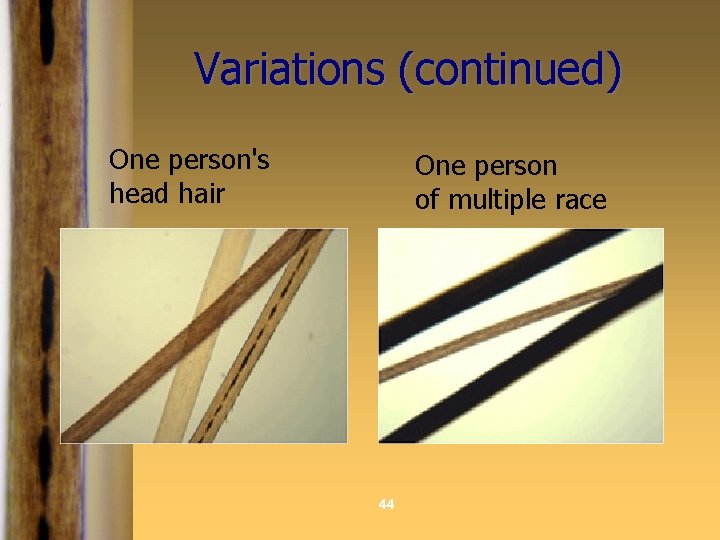
Variations Why do we need to examine each hair sample from root to tip? Five Regions of a single head hair 43
Variations (continued) One person's head hair One person of multiple race 44
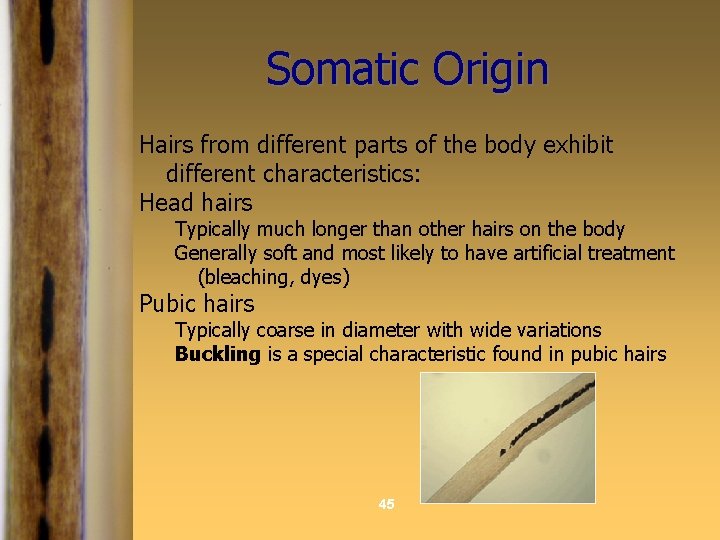
Somatic Origin Hairs from different parts of the body exhibit different characteristics: Head hairs Typically much longer than other hairs on the body Generally soft and most likely to have artificial treatment (bleaching, dyes) Pubic hairs Typically coarse in diameter with wide variations Buckling is a special characteristic found in pubic hairs 45
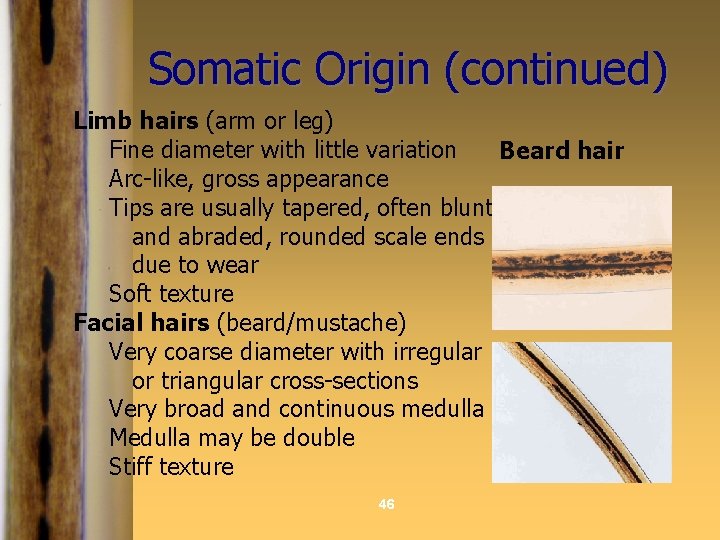
Somatic Origin (continued) Limb hairs (arm or leg) Fine diameter with little variation Beard hair Arc-like, gross appearance Tips are usually tapered, often blunt and abraded, rounded scale ends due to wear Soft texture Facial hairs (beard/mustache) Very coarse diameter with irregular or triangular cross-sections Very broad and continuous medulla Medulla may be double Stiff texture 46
Somatic Origin (continued) Chest hairs Moderate and variable shaft diameter; tips often darken in color Long and fine, arc-like, gross appearance May have granular medulla Stiff Auxiliary, or underarm, hairs Resemble pubic hairs in general appearance, but less buckling Medulla similar to limb hairs Fine tip Other body hairs Eyebrow – stubby, saber-like appearance Eyelash – short and stubby, with a saber-like appearance Trunk – a combination 47 of limb and pubic hairs – transitional hair
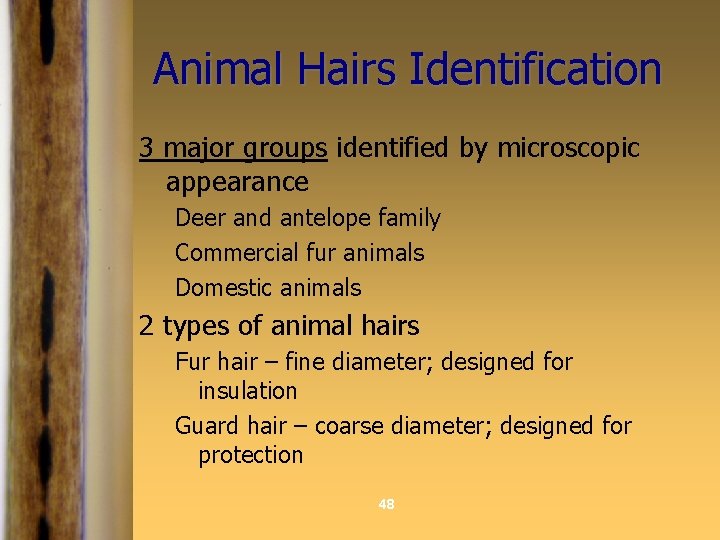
Animal Hairs Identification 3 major groups identified by microscopic appearance Deer and antelope family Commercial fur animals Domestic animals 2 types of animal hairs Fur hair – fine diameter; designed for insulation Guard hair – coarse diameter; designed for protection 48
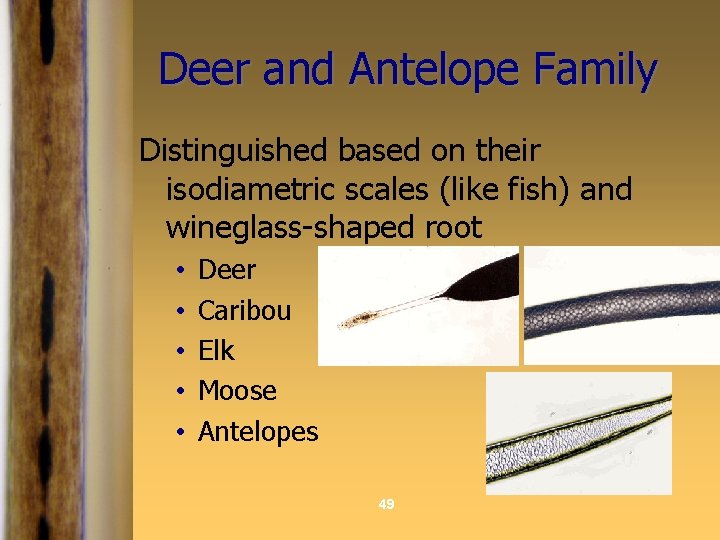
Deer and Antelope Family Distinguished based on their isodiametric scales (like fish) and wineglass-shaped root • • • Deer Caribou Elk Moose Antelopes 49
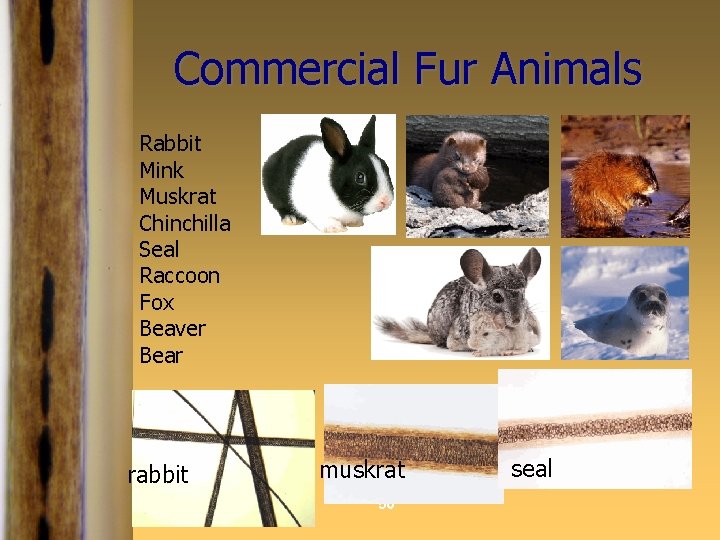
Commercial Fur Animals Rabbit Mink Muskrat Chinchilla Seal Raccoon Fox Beaver Bear rabbit muskrat 50 seal
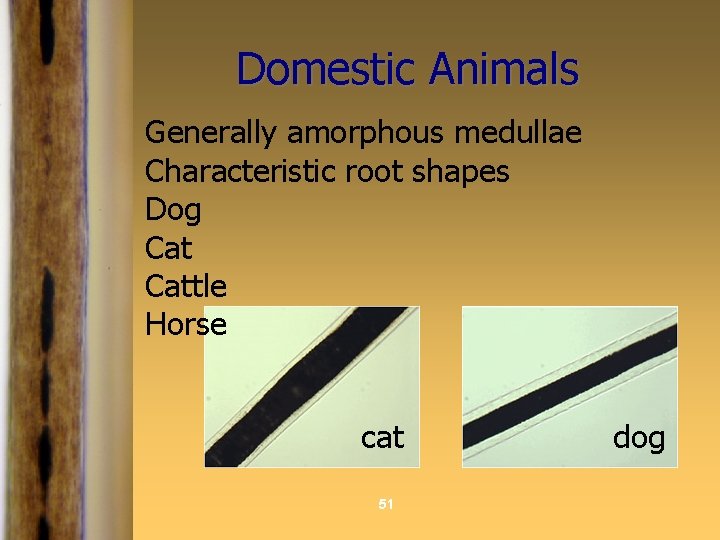
Domestic Animals Generally amorphous medullae Characteristic root shapes Dog Cattle Horse cat 51 dog
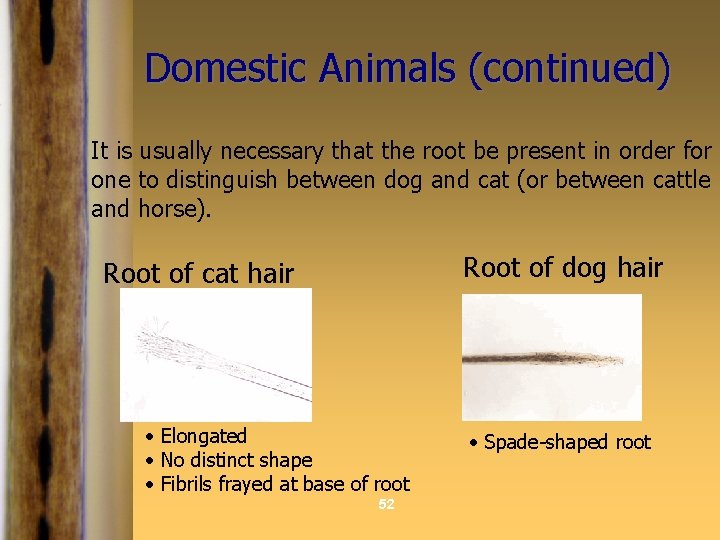
Domestic Animals (continued) It is usually necessary that the root be present in order for one to distinguish between dog and cat (or between cattle and horse). Root of dog hair Root of cat hair • Elongated • No distinct shape • Fibrils frayed at base of root 52 • Spade-shaped root
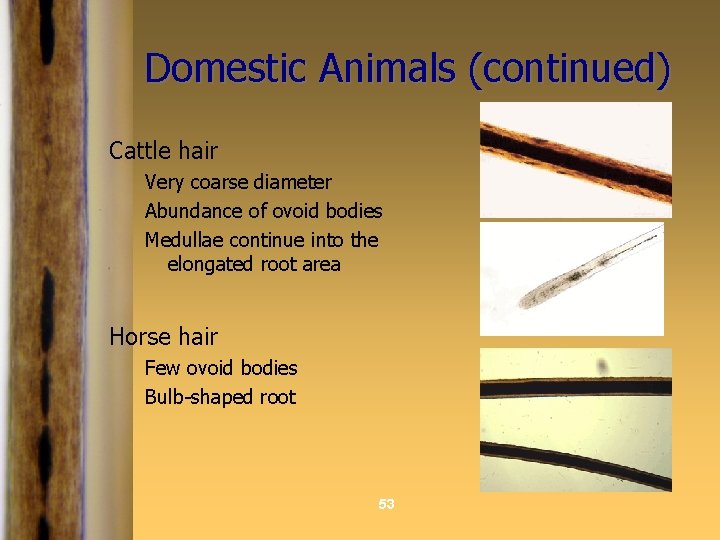
Domestic Animals (continued) Cattle hair Very coarse diameter Abundance of ovoid bodies Medullae continue into the elongated root area Horse hair Few ovoid bodies Bulb-shaped root 53
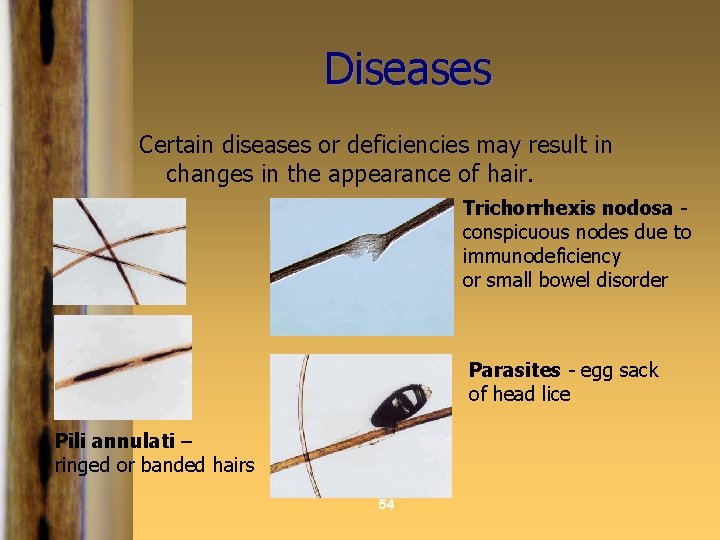
Diseases Certain diseases or deficiencies may result in changes in the appearance of hair. Trichorrhexis nodosa conspicuous nodes due to immunodeficiency or small bowel disorder Parasites - egg sack of head lice Pili annulati – ringed or banded hairs 54
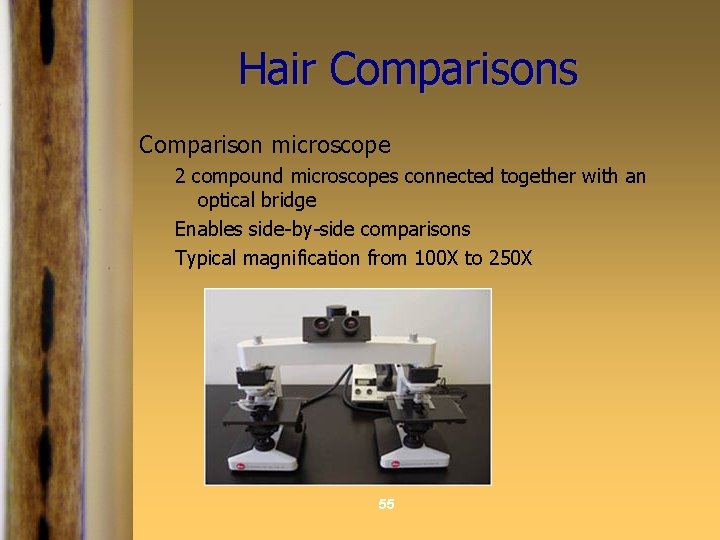
Hair Comparisons Comparison microscope 2 compound microscopes connected together with an optical bridge Enables side-by-side comparisons Typical magnification from 100 X to 250 X 55
Hair Comparisons (continued) Information NOT provided by a hair examination Age Gender Unless nuclear DNA analysis is performed on its follicular tag Information provided by a hair examination Is it human or animal hair? What is the possible race of the donor? What area of the body did it come from? Could it have originated from the donor of the known standards? Hair can also be used to distinguish between identical twins (who cannot be distinguished based on their DNA). because of the environmental effects on hair such as weather exposure, diet, artificial treatment, etc. 56
Hair Comparisons (continued) 3 basic conclusions that can be reached in hair comparisons: 1) Similar microscopical characteristics – the questioned hairs could have originated from the source of the known hair standards 2) Dissimilar microscopical characteristics – the questioned hairs did not originate from the source represented by the known hair standards 3) Both similar and slightly different microscopical characteristics – inconclusive 57
Significance of Hair Evidence The frequency of contact between a victim and a suspect, as well as the crime scene, is a big factor in interpreting the significance of hair evidence. Examples • The pubic hair of a recent ex-boyfriend found at the scene of a sexual assault • A husband who is suspected of murdering his wife at home • A missing child's hair in the backseat of a former nanny's car • A missing child's hair in the backseat of a cleaning lady's car • A stepfather's head hair found on a little girl's underwear • A stepfather's pubic hair found in the crotch area of a little girl's underwear 58
DNA from Hair § The root contains nuclear DNA. If the hair has been forcibly removed, some folicular tissue may be attached containing DNA. § The hair shaft contains abundant mitochondrial DNA, inherited only from the mother. It can be typed by comparing relatives if no DNA from the body is available. This process is more difficult and costly than using nuclear DNA. Kendall/Hunt Publishing Company 59
Collection of Hair § Questioned hairs must be accompanied by an adequate number of control samples. § from victim § from possible suspects § from others who may have deposited hair at the scene § Control Sample § 50 full-length hairs from all areas of scalp § 24 full-length pubic hairs Kendall/Hunt Publishing Company 60
Hair Toxicology § Advantages: § Easy to collect and store § Is externally available § Can provide information on the individual’s history of drug use or of poisoning. § Collections must be taken from different locations on the body to get an accurate timeline. Kendall/Hunt Publishing Company 61
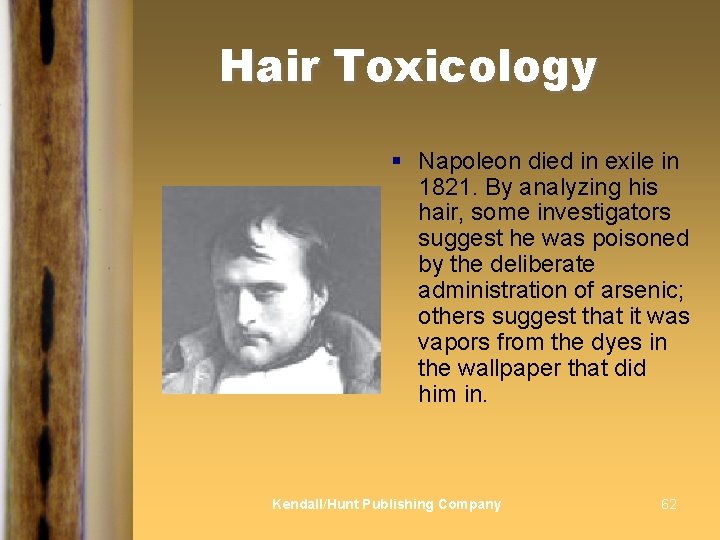
Hair Toxicology § Napoleon died in exile in 1821. By analyzing his hair, some investigators suggest he was poisoned by the deliberate administration of arsenic; others suggest that it was vapors from the dyes in the wallpaper that did him in. Kendall/Hunt Publishing Company 62
More about Hair For additional information about hair and other trace evidence, check out Court TV’s Crime Library at: www. crimelibrary. com/criminal_mind/forensics/trace/1. html Other Videos: FBI Hair flawed analysis video (April 2015) (2 min) Chapter Review Video (21 min) Forensic Files – Hair Overturned (22 min) Kendall/Hunt Publishing Company 63