Chapter 27 Nationalism and Revolutions Around the World

- Slides: 67
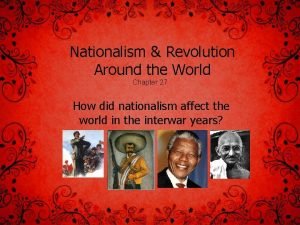
Chapter 27: Nationalism and Revolutions Around the World How did nationalism affect the world in the interwar years?
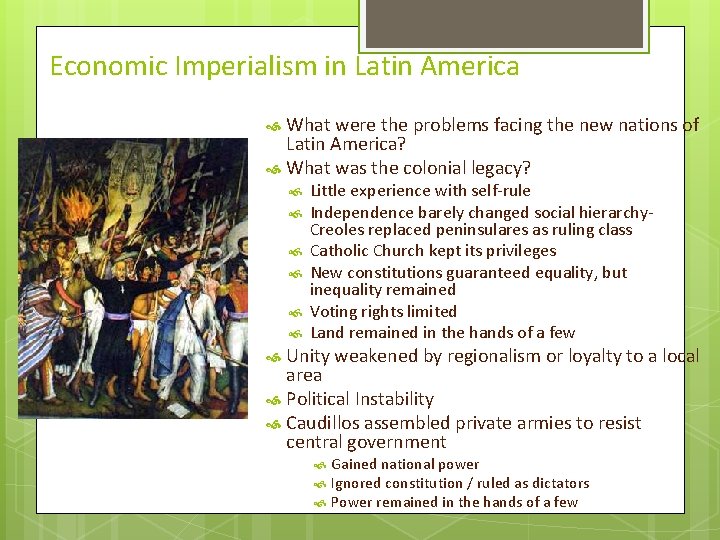
Economic Imperialism in Latin America What were the problems facing the new nations of Latin America? What was the colonial legacy? Little experience with self-rule Independence barely changed social hierarchy. Creoles replaced peninsulares as ruling class Catholic Church kept its privileges New constitutions guaranteed equality, but inequality remained Voting rights limited Land remained in the hands of a few Unity weakened by regionalism or loyalty to a local area Political Instability Caudillos assembled private armies to resist central government Gained national power Ignored constitution / ruled as dictators Power remained in the hands of a few
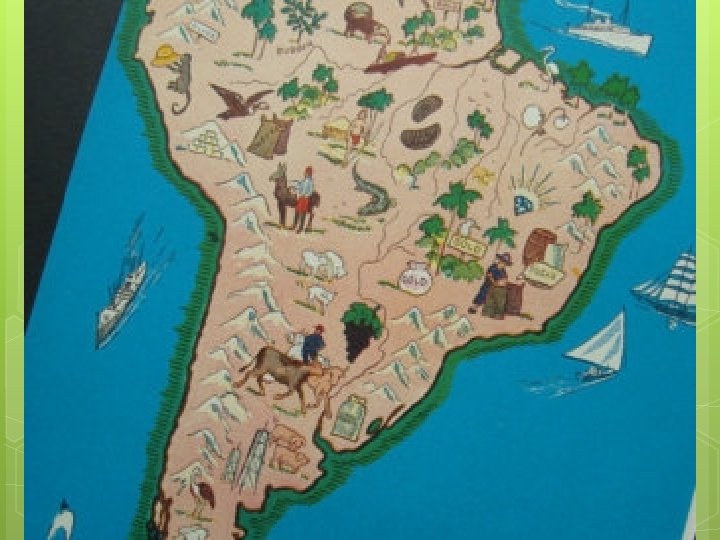
1900 s in Latin America’s economy was based on exports Latin America sent their natural resources and cash crops to industrial countries Latin America was buying products made from the industrial countries
Economics in Latin America Foreign Influence: Foreign goods flooded LA markets – effects? Under what conditions would America and Britain interject in Latin American affairs? Economic Growth after 1850: Foreign capital – mining and agriculture Foreign investment in ports and railroads Trade, investment, technology and migration: Latin American nations moved into the world economy Tiny elite at the top gained / poor at the bottom suffered
Governments Around Latin America Uruguay and Argentina had democratic constitutions Military and small group of wealthy held the power Middle class peasants had little say in their government
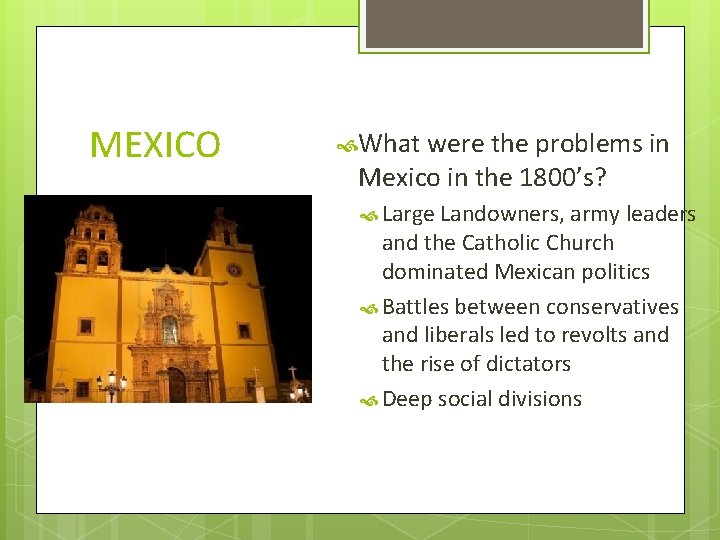
MEXICO What were the problems in Mexico in the 1800’s? Large Landowners, army leaders and the Catholic Church dominated Mexican politics Battles between conservatives and liberals led to revolts and the rise of dictators Deep social divisions
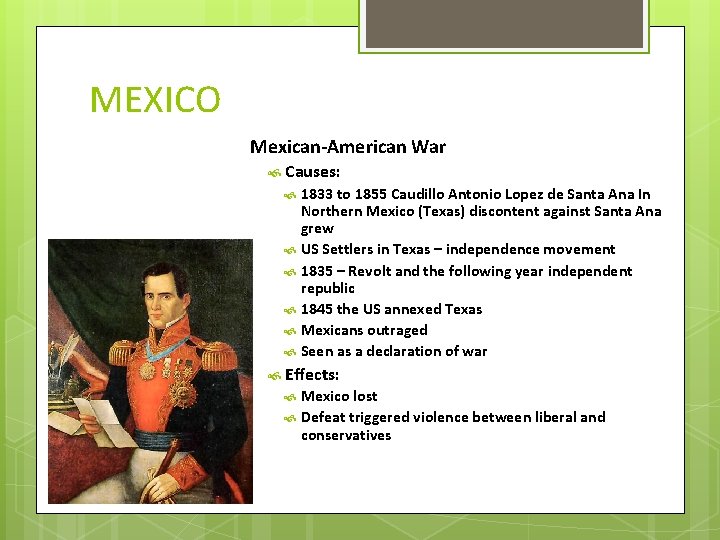
MEXICO Mexican-American War Causes: 1833 to 1855 Caudillo Antonio Lopez de Santa Ana In Northern Mexico (Texas) discontent against Santa Ana grew US Settlers in Texas – independence movement 1835 – Revolt and the following year independent republic 1845 the US annexed Texas Mexicans outraged Seen as a declaration of war Effects: Mexico lost Defeat triggered violence between liberal and conservatives
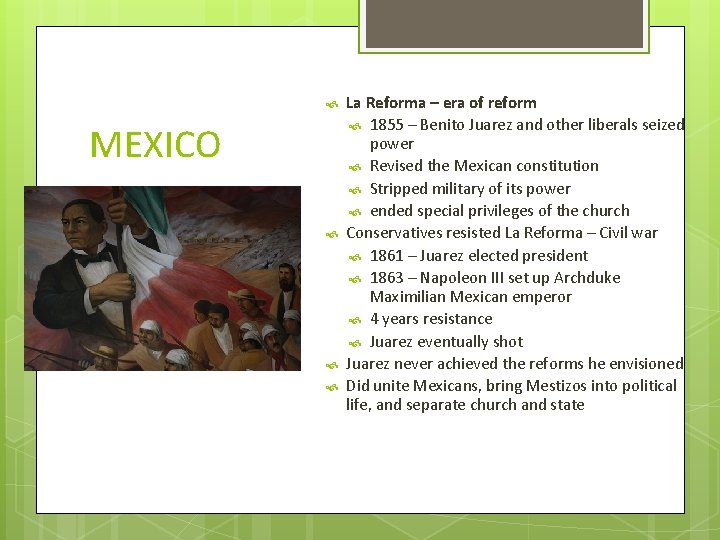
MEXICO La Reforma – era of reform 1855 – Benito Juarez and other liberals seized power Revised the Mexican constitution Stripped military of its power ended special privileges of the church Conservatives resisted La Reforma – Civil war 1861 – Juarez elected president 1863 – Napoleon III set up Archduke Maximilian Mexican emperor 4 years resistance Juarez eventually shot Juarez never achieved the reforms he envisioned Did unite Mexicans, bring Mestizos into political life, and separate church and state
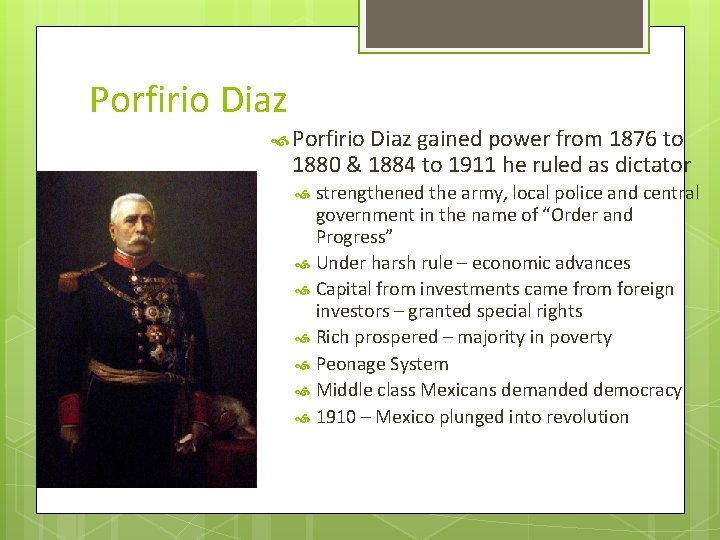
Porfirio Diaz gained power from 1876 to 1880 & 1884 to 1911 he ruled as dictator strengthened the army, local police and central government in the name of “Order and Progress” Under harsh rule – economic advances Capital from investments came from foreign investors – granted special rights Rich prospered – majority in poverty Peonage System Middle class Mexicans demanded democracy 1910 – Mexico plunged into revolution
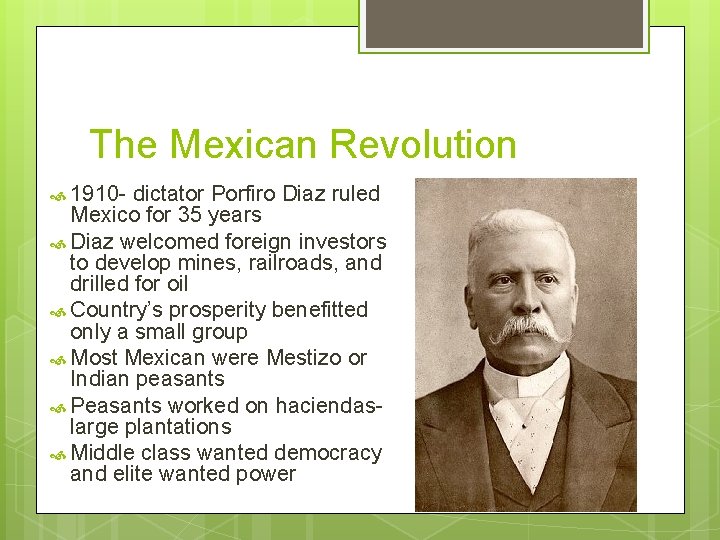
The Mexican Revolution 1910 - dictator Porfiro Diaz ruled Mexico for 35 years Diaz welcomed foreign investors to develop mines, railroads, and drilled for oil Country’s prosperity benefitted only a small group Most Mexican were Mestizo or Indian peasants Peasants worked on haciendaslarge plantations Middle class wanted democracy and elite wanted power
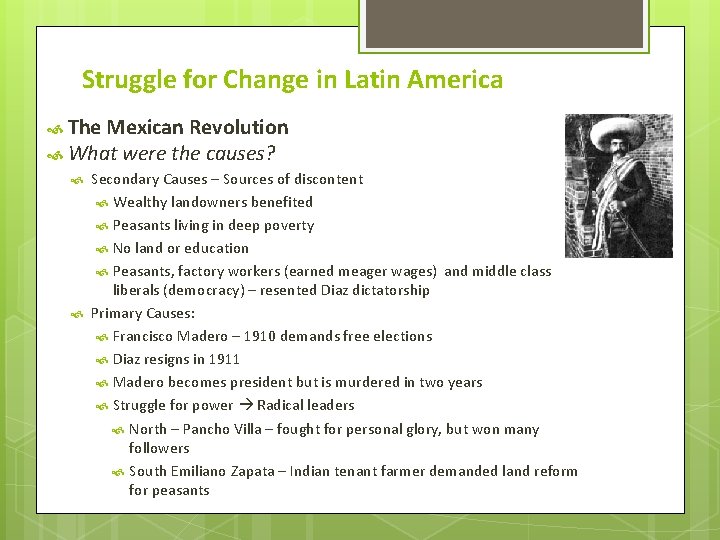
Struggle for Change in Latin America The Mexican Revolution What were the causes? Secondary Causes – Sources of discontent Wealthy landowners benefited Peasants living in deep poverty No land or education Peasants, factory workers (earned meager wages) and middle class liberals (democracy) – resented Diaz dictatorship Primary Causes: Francisco Madero – 1910 demands free elections Diaz resigns in 1911 Madero becomes president but is murdered in two years Struggle for power Radical leaders North – Pancho Villa – fought for personal glory, but won many followers South Emiliano Zapata – Indian tenant farmer demanded land reform for peasants
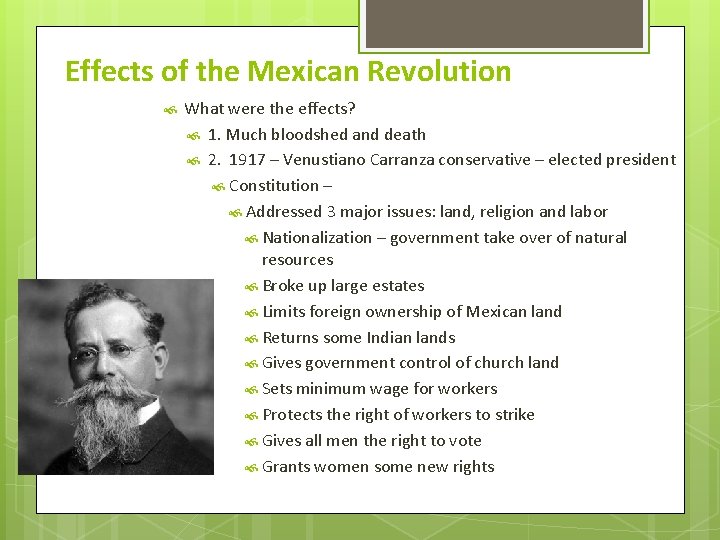
Effects of the Mexican Revolution What were the effects? 1. Much bloodshed and death 2. 1917 – Venustiano Carranza conservative – elected president Constitution – Addressed 3 major issues: land, religion and labor Nationalization – government take over of natural resources Broke up large estates Limits foreign ownership of Mexican land Returns some Indian lands Gives government control of church land Sets minimum wage for workers Protects the right of workers to strike Gives all men the right to vote Grants women some new rights
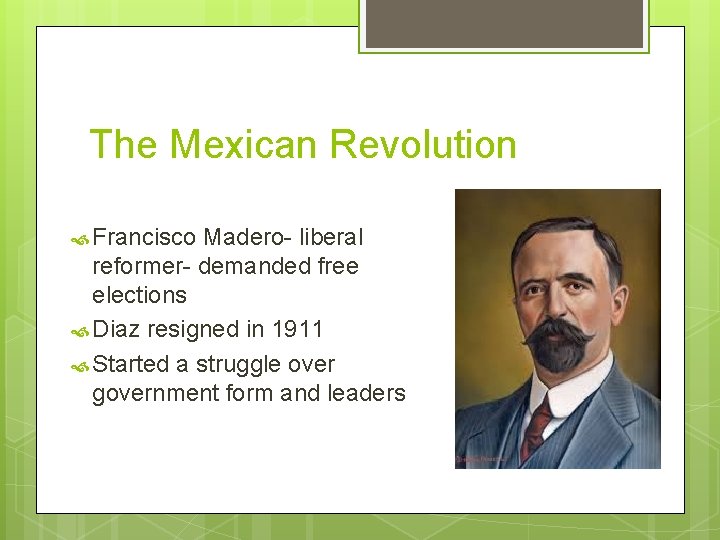
The Mexican Revolution Francisco Madero- liberal reformer- demanded free elections Diaz resigned in 1911 Started a struggle over government form and leaders
Revolutions Lead to Change 1917 - voters elected Venustiano Carranza president of Mexico Approved a new constitution that included land labor reform Constitution is still used today
Constitution of 1917 Addressed three major issues: land, religion, and labor Constitution strengthened government control over the economy The government placed restrictions on foreigners owning land Allowed nationalization- government takeover of natural resources
Constitution of 1917 Church land was made “property of the nation” Constitution set a minimum wage and protected workers right to strike Constitution gave suffrage to men Women could have the same jobs as men and same pay
The PRI Controls Mexico Carranza was overthrown in 1920 1929 - government established Institutional Revolutionary Party (PRI) PRI accommodated many groups in Mexican society Suppressed opposition and dissent Brought stability to Mexico Dominated Mexican politics from 1930 s to 2000
Reforms 1920 s- government helped some Indian communities regain lands that had been taken from them 1930 s- under President Lazaro Cardenasmillions of acres of land were redistributed to peasants under a communal land program Government supported labor unions and launched an effort to combat illiteracy
Reforms Mexico became the first Latin American nation to pursue real social and economic reforms for the majority of its people Government also controlled the economyspecifically the petroleum companies
Nationalism at Work in Latin America Spirit of nationalism- wanted to end economic dependence on the Industrial powers
Economic Nationalism WWI and the Great Depression impacted global economies Prices for Latin American exports plunged and demand dried up; cost of consumer goods rose Latin American economies depended on export trade Economic nationalism- emphasis on home control of the economy Local entrepreneurs set up factories to produce goods Governments raised tariffs to protect new industries Governments invested directly into new business
Political Nationalism Great Depression triggered political changes Liberalism was found not to work in Latin America People wanted a government that could control, direct, and protect each country’s economy
Cultural Nationalism Pride in one’s own culture was reflected in the revival of mural painting, a major art form of the Aztecs and Mayas
Good Neighbor Policy https: //www. youtube. com/watch? v=m. BRml. VEv. QO 4 US were considered the international policemen Driving Mexican Revolution- US stepped in to support the leaders that favored American interest 1930 s- President Franklin Roosevelt- Good Neighbor Policy- US pledges to lessen the interference in the affairs of Latin America
US in Latin America Monroe Doctrine America acted alone and issued the Monroe Doctrine The American continents are off limits to future colonization Platt Amendment Spanish American War 1898 - US joins Cuba’s effort for independence US forces Cuba to accept Platt Amendment: Gave use naval bases in Cuba and the right to intervene in Cuban affairs
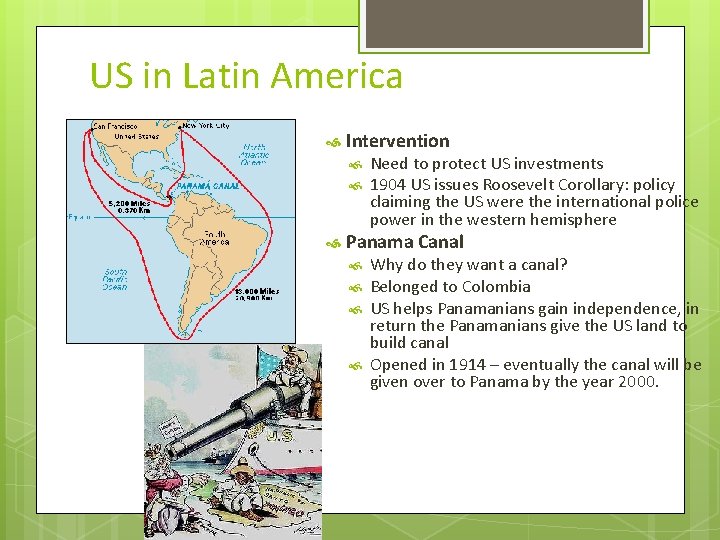
US in Latin America Intervention Need to protect US investments 1904 US issues Roosevelt Corollary: policy claiming the US were the international police power in the western hemisphere Panama Canal Why do they want a canal? Belonged to Colombia US helps Panamanians gain independence, in return the Panamanians give the US land to build canal Opened in 1914 – eventually the canal will be given over to Panama by the year 2000.
Section 2: Nationalism in Africa and the Middle East
Africans Resist Colonial Rule Early 1900 s- almost every part of Africa was a European colony Europeans forced Africans to work on farms and mines The money that was earned in this work was given to taxes and to the European governments Kenya and Rhodesia- white settlers forced Africans off the best land
Africans Resist Colonial Rule Only Europeans could grow crops Kenya- the British made all Africans carry an identification card, imposed a tax on only Africans, and restricted where they could live or travel In other areas of Africa, the Africans were forced to grow only cash crops which caused famine During WWI- more than 1 million Africans had fought on behalf of European powers
Opposing Imperialism Many western-educated Africans criticized imperial rule President Woodrow Wilson asked for selfdetermination Socialism began to grow Protests and opposition multiplied
Racial Segregation 1910 -1940 - whites strengthened their grip in South Africa Imposed racial segregation Goal: to ensure white economic, political, and social supremacy South Africans were evicted from the best land Europeans abolished the Africans right to vote
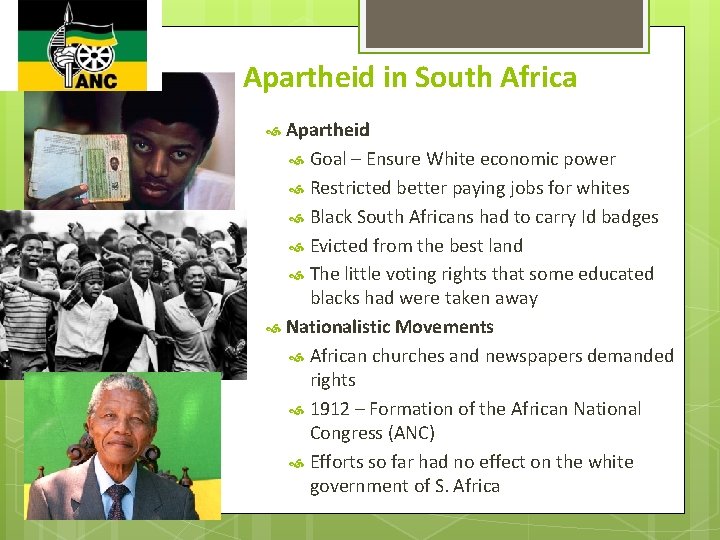
Apartheid Apartheid- policy of rigid segregation became law Nelson Mandela! South Africa
Apartheid in South Africa Apartheid Goal – Ensure White economic power Restricted better paying jobs for whites Black South Africans had to carry Id badges Evicted from the best land The little voting rights that some educated blacks had were taken away Nationalistic Movements African churches and newspapers demanded rights 1912 – Formation of the African National Congress (ANC) Efforts so far had no effect on the white government of S. Africa
Nationalism and an “Africa for Africans” Pan-Africanism- emphasized the unity of Africans and people of African descent world wide Marcus Garvey- wanted an “Africa for Africans” W. E. B Du. Bois- organized first Pan-African congress in 1919 Met at the Paris Peace Conference Western powers ignored their demands Pan-African Congress established cooperation among Africans and African leaders
Negritude Movement Negritude Movement- writers expressed pride in their African roots and protested colonial rule
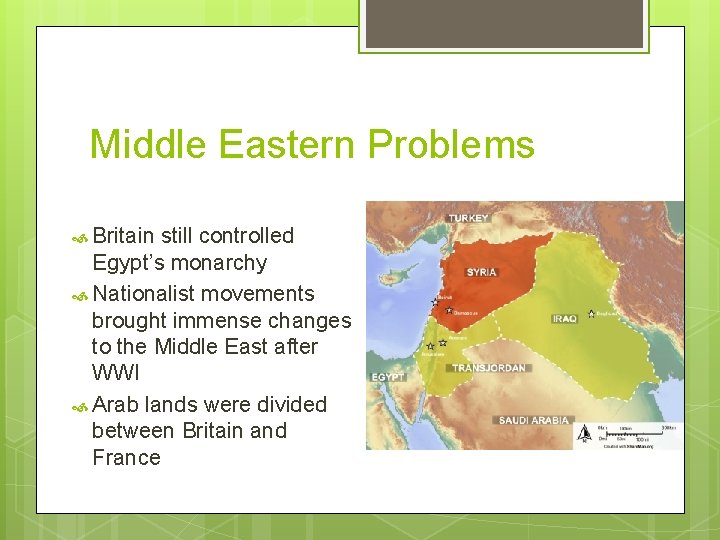
Middle Eastern Problems Britain still controlled Egypt’s monarchy Nationalist movements brought immense changes to the Middle East after WWI Arab lands were divided between Britain and France
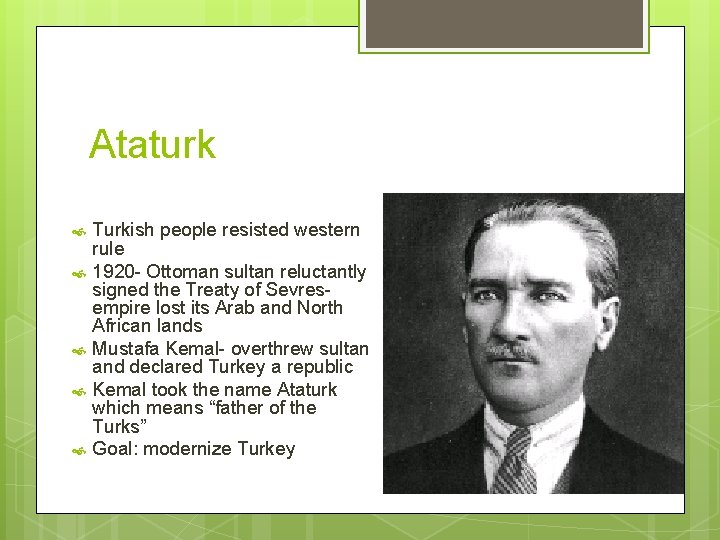
Ataturk Turkish people resisted western rule 1920 - Ottoman sultan reluctantly signed the Treaty of Sevresempire lost its Arab and North African lands Mustafa Kemal- overthrew sultan and declared Turkey a republic Kemal took the name Ataturk which means “father of the Turks” Goal: modernize Turkey
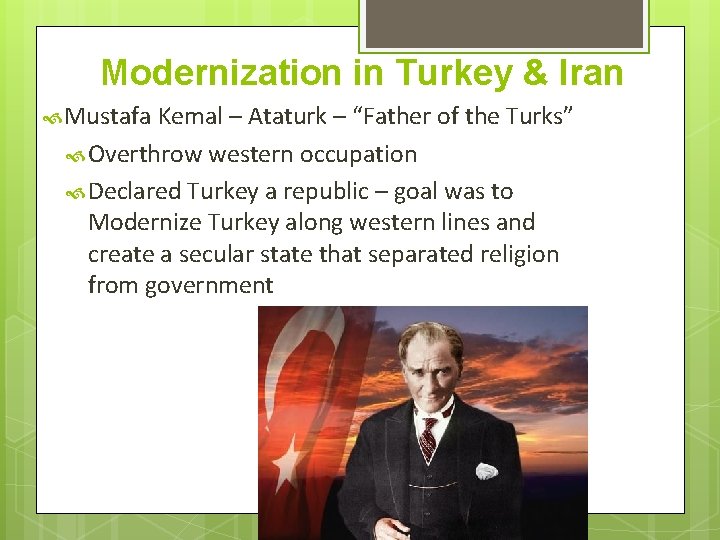
Modernization in Turkey & Iran Mustafa Kemal – Ataturk – “Father of the Turks” Overthrow western occupation Declared Turkey a republic – goal was to Modernize Turkey along western lines and create a secular state that separated religion from government
Westernization Transforms Turkey Ataturk government encouraged industrial expansion Government built railroads, set up factories Ruled with an iron hand Transformed Turkey into a strong and modern power
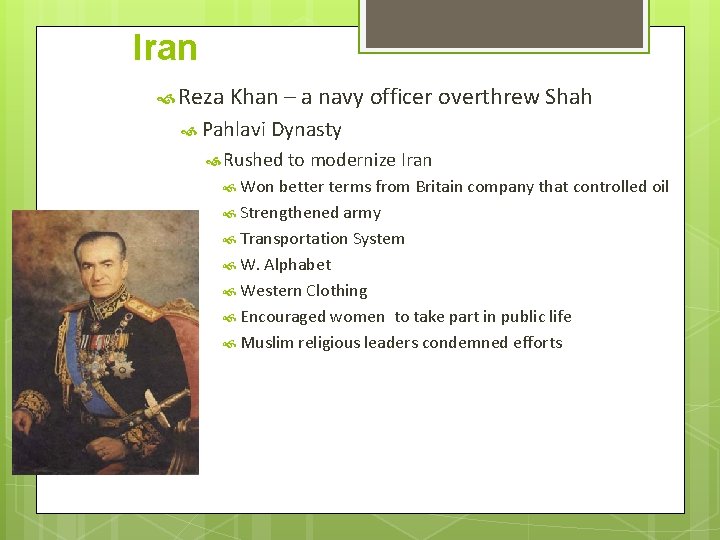
Iran Reza Khan – a navy officer overthrew Shah Pahlavi Dynasty Rushed to modernize Iran Won better terms from Britain company that controlled oil Strengthened army Transportation System W. Alphabet Western Clothing Encouraged women to take part in public life Muslim religious leaders condemned efforts
Nationalism and Reform in Persia Ataturk’s reforms inspired nationalists in Persians did not like European rule Reza Khan was the leader in Persia in 1925 Rushed to modernize Persia Built factories, roads, railroads, and strengthened the army Forced Persians to wear western clothing Changed the Islamic rule in the government to a secular law
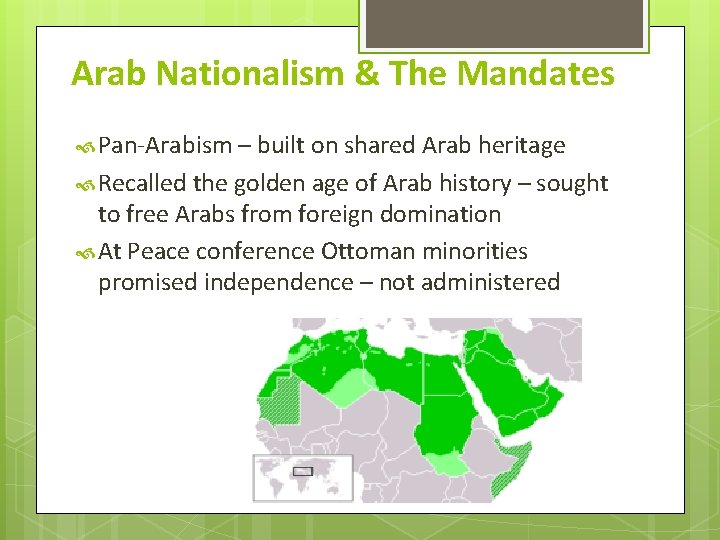
Oil and Pan Arabism Oil became a major factor after WWI and the Middle East is where the oil was Pan-Arabism- grew after WWI Arabian peninsula included Syria, Jordan, Iraq, Egypt, Algeria, and Morocco Sought to free the Arab people from western rulers
Betrayed at the Paris Peace Conference Arabs helped the Allies fight against the Central Powers Allies carved up the Ottoman Empire Gave France mandates in Syria and Lebanon Britain had mandates in Palestine and Iraq Britain gave a large part of Palestine mandate to Trans. Jordan
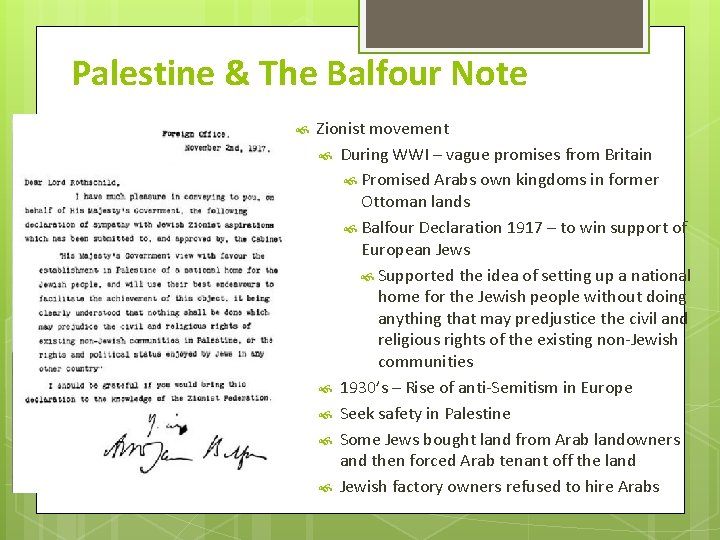
Promises in Palestine 1897 - Theodor Herzl Jewish people had the Zionist movement Jewish community lived in Palestine during Biblical times Balfour Declaration British attempt to advocate for setting up a “national home for the Jewish people” in Palestine
Struggle for Jewish People 1919 -1940 - Tens of thousands of Jews immigrated to Palestine due to the Zionist movement and anti-Semitism Arab people were already in Palestine Arabs at first welcomed the new wave of money and technology Arabs then began to place harsh restrictions on Jews
Arab Nationalism & The Mandates Pan-Arabism – built on shared Arab heritage Recalled the golden age of Arab history – sought to free Arabs from foreign domination At Peace conference Ottoman minorities promised independence – not administered
Palestine & The Balfour Note Zionist movement During WWI – vague promises from Britain Promised Arabs own kingdoms in former Ottoman lands Balfour Declaration 1917 – to win support of European Jews Supported the idea of setting up a national home for the Jewish people without doing anything that may predjustice the civil and religious rights of the existing non-Jewish communities 1930’s – Rise of anti-Semitism in Europe Seek safety in Palestine Some Jews bought land from Arab landowners and then forced Arab tenant off the land Jewish factory owners refused to hire Arabs
Section 3: India Seeks Self-Rule
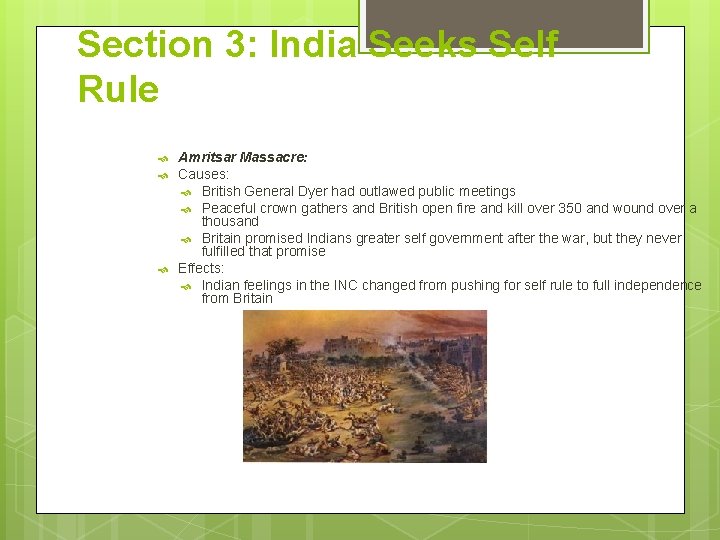
Section 3: India Seeks Self Rule Amritsar Massacre: Causes: British General Dyer had outlawed public meetings Peaceful crown gathers and British open fire and kill over 350 and wound over a thousand Britain promised Indians greater self government after the war, but they never fulfilled that promise Effects: Indian feelings in the INC changed from pushing for self rule to full independence from Britain
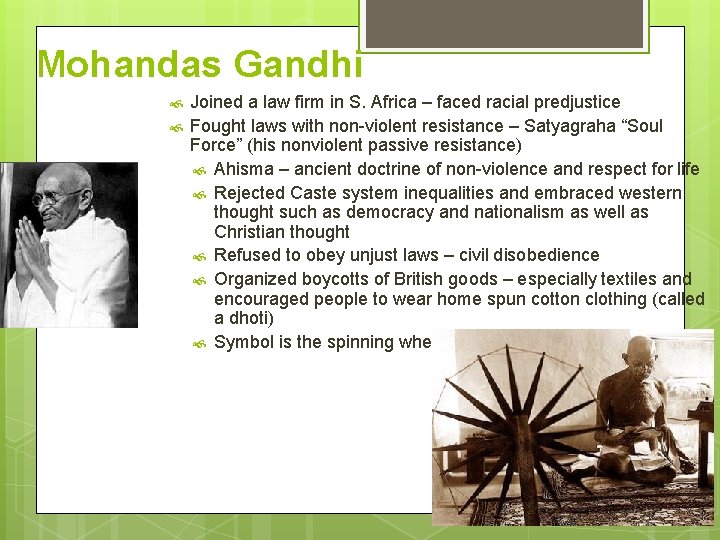
Mohandas Gandhi Joined a law firm in S. Africa – faced racial predjustice Fought laws with non-violent resistance – Satyagraha “Soul Force” (his nonviolent passive resistance) Ahisma – ancient doctrine of non-violence and respect for life Rejected Caste system inequalities and embraced western thought such as democracy and nationalism as well as Christian thought Refused to obey unjust laws – civil disobedience Organized boycotts of British goods – especially textiles and encouraged people to wear home spun cotton clothing (called a dhoti) Symbol is the spinning wheel
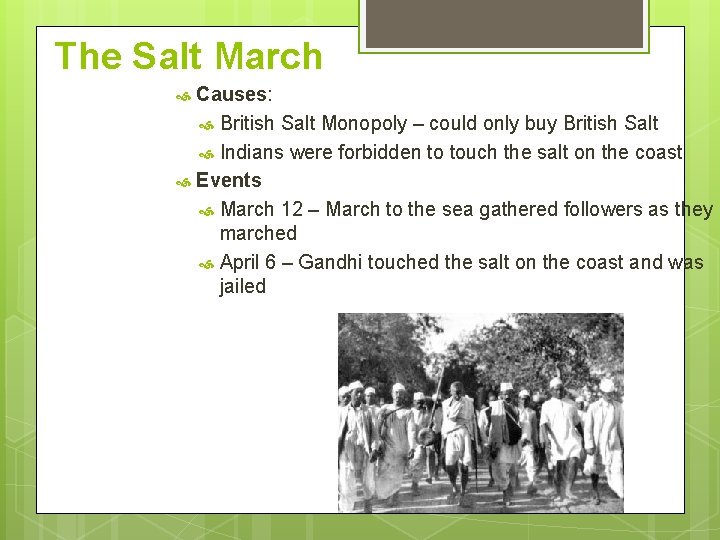
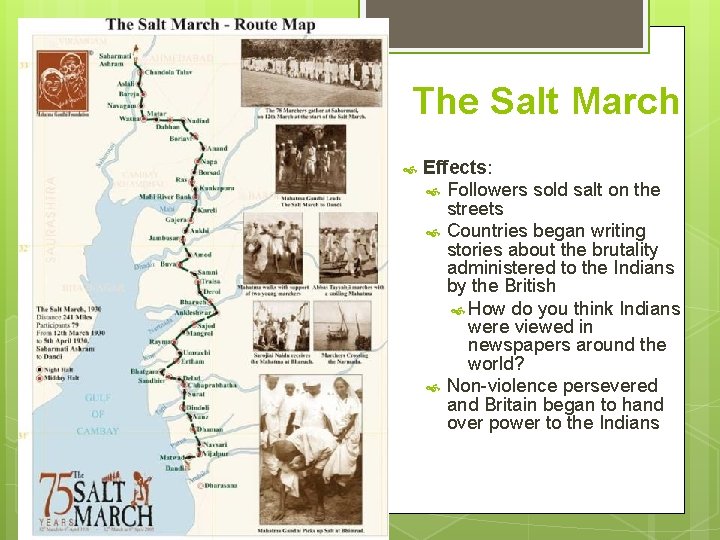
The Salt March Causes: British Salt Monopoly – could only buy British Salt Indians were forbidden to touch the salt on the coast Events March 12 – March to the sea gathered followers as they marched April 6 – Gandhi touched the salt on the coast and was jailed
The Salt March Effects: Followers sold salt on the streets Countries began writing stories about the brutality administered to the Indians by the British How do you think Indians were viewed in newspapers around the world? Non-violence persevered and Britain began to hand over power to the Indians
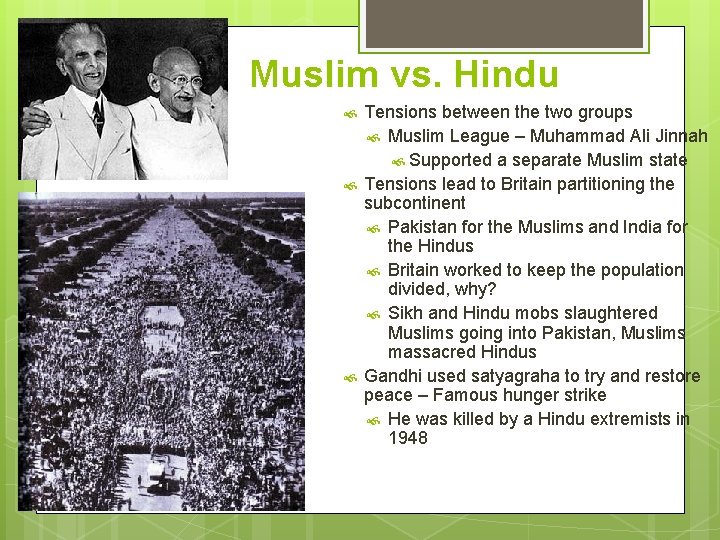
Muslim vs. Hindu Tensions between the two groups Muslim League – Muhammad Ali Jinnah Supported a separate Muslim state Tensions lead to Britain partitioning the subcontinent Pakistan for the Muslims and India for the Hindus Britain worked to keep the population divided, why? Sikh and Hindu mobs slaughtered Muslims going into Pakistan, Muslims massacred Hindus Gandhi used satyagraha to try and restore peace – Famous hunger strike He was killed by a Hindu extremists in 1948
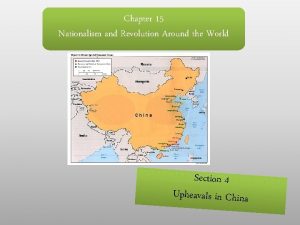
Section 4: Upheavals in China
Chinese Republic in Trouble Qing Dynasty collapsed in 1911 Three principles of the people- nationalism, democracy, and economic security China fell into chaos
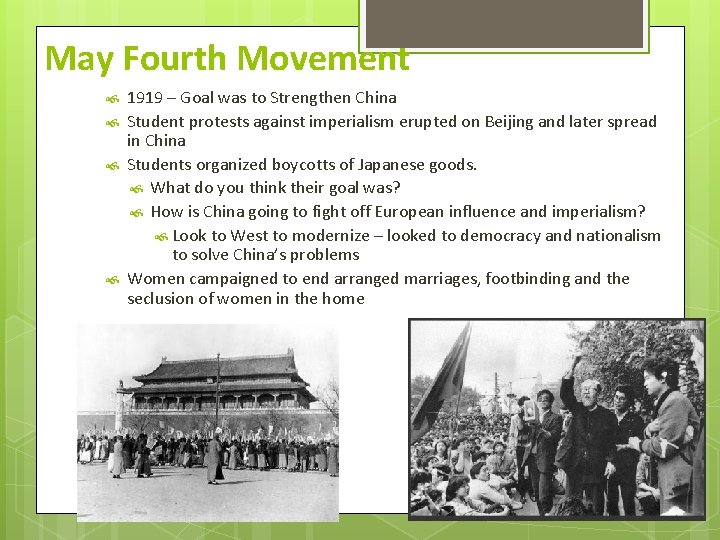
May Fourth Movement 1919 – Goal was to Strengthen China Student protests against imperialism erupted on Beijing and later spread in China Students organized boycotts of Japanese goods. What do you think their goal was? How is China going to fight off European influence and imperialism? Look to West to modernize – looked to democracy and nationalism to solve China’s problems Women campaigned to end arranged marriages, footbinding and the seclusion of women in the home
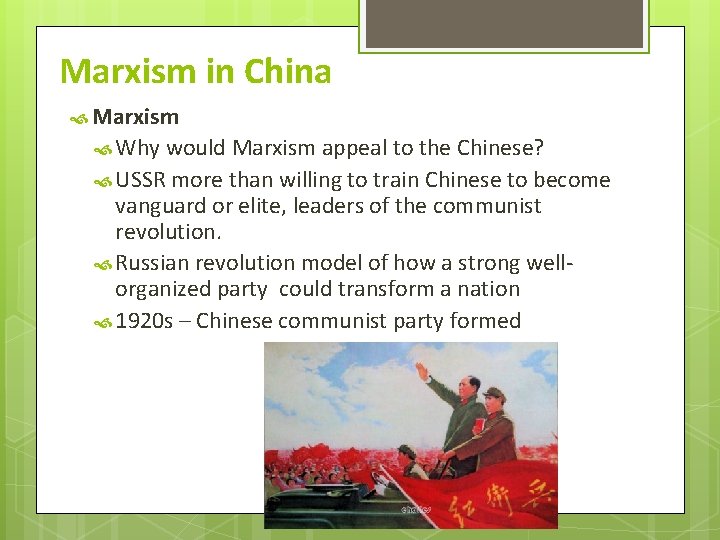
Marxism in China Marxism Why would Marxism appeal to the Chinese? USSR more than willing to train Chinese to become vanguard or elite, leaders of the communist revolution. Russian revolution model of how a strong wellorganized party could transform a nation 1920 s – Chinese communist party formed
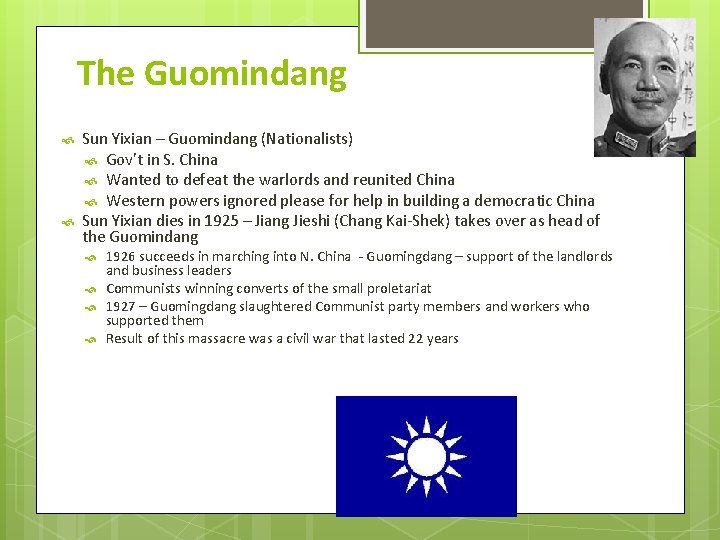
The Guomindang Sun Yixian – Guomindang (Nationalists) Gov’t in S. China Wanted to defeat the warlords and reunited China Western powers ignored please for help in building a democratic China Sun Yixian dies in 1925 – Jiang Jieshi (Chang Kai-Shek) takes over as head of the Guomindang 1926 succeeds in marching into N. China - Guomingdang – support of the landlords and business leaders Communists winning converts of the small proletariat 1927 – Guomingdang slaughtered Communist party members and workers who supported them Result of this massacre was a civil war that lasted 22 years
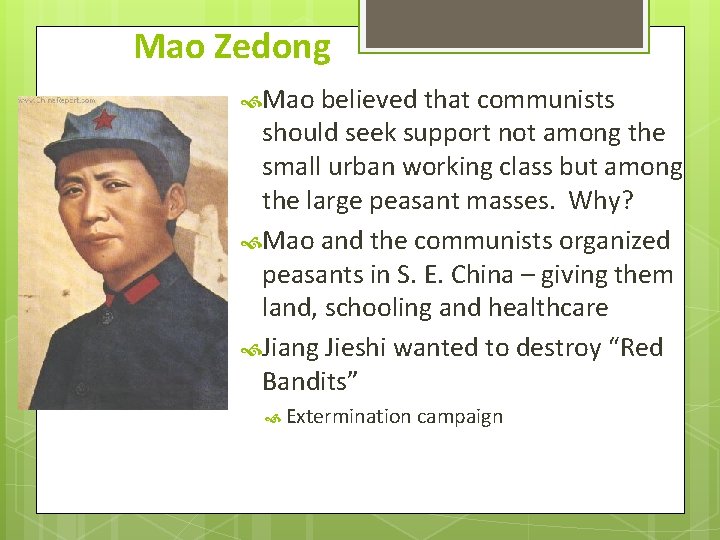
Mao Zedong Mao believed that communists should seek support not among the small urban working class but among the large peasant masses. Why? Mao and the communists organized peasants in S. E. China – giving them land, schooling and healthcare Jiang Jieshi wanted to destroy “Red Bandits” Extermination campaign
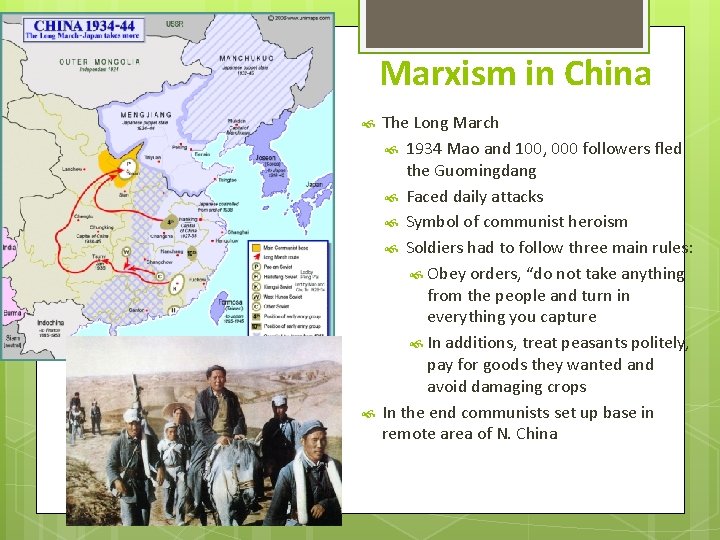
Marxism in China The Long March 1934 Mao and 100, 000 followers fled the Guomingdang Faced daily attacks Symbol of communist heroism Soldiers had to follow three main rules: Obey orders, “do not take anything from the people and turn in everything you capture In additions, treat peasants politely, pay for goods they wanted and avoid damaging crops In the end communists set up base in remote area of N. China
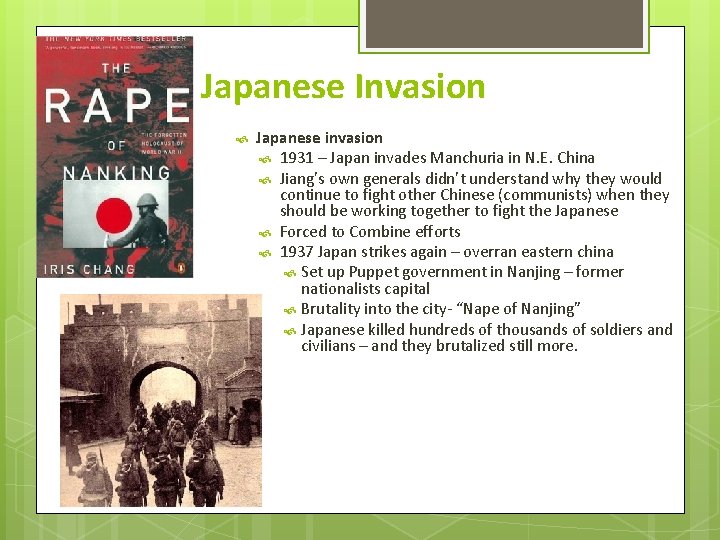
Japanese Invasion Japanese invasion 1931 – Japan invades Manchuria in N. E. China Jiang’s own generals didn’t understand why they would continue to fight other Chinese (communists) when they should be working together to fight the Japanese Forced to Combine efforts 1937 Japan strikes again – overran eastern china Set up Puppet government in Nanjing – former nationalists capital Brutality into the city- “Nape of Nanjing” Japanese killed hundreds of thousands of soldiers and civilians – and they brutalized still more.
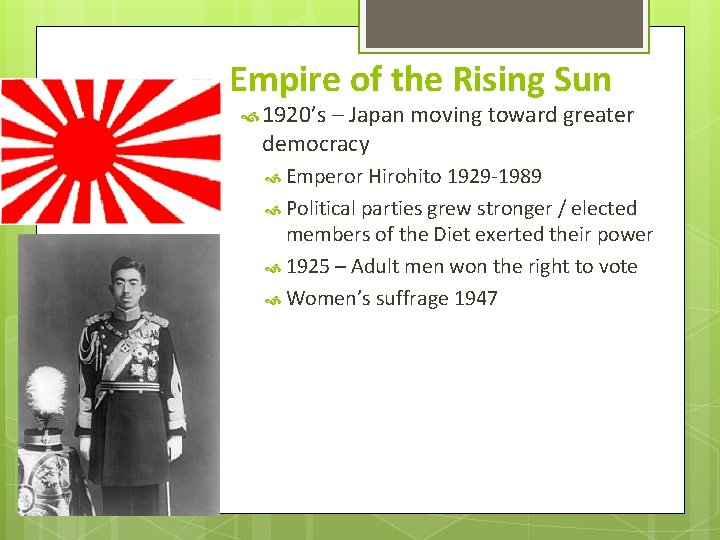
Empire of the Rising Sun 1920’s – Japan moving toward greater democracy Emperor Hirohito 1929 -1989 Political parties grew stronger / elected members of the Diet exerted their power 1925 – Adult men won the right to vote Women’s suffrage 1947
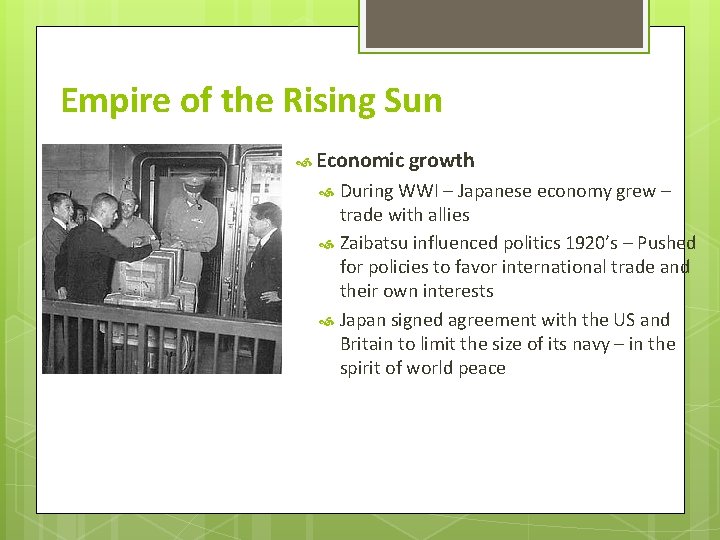
Empire of the Rising Sun Economic growth During WWI – Japanese economy grew – trade with allies Zaibatsu influenced politics 1920’s – Pushed for policies to favor international trade and their own interests Japan signed agreement with the US and Britain to limit the size of its navy – in the spirit of world peace
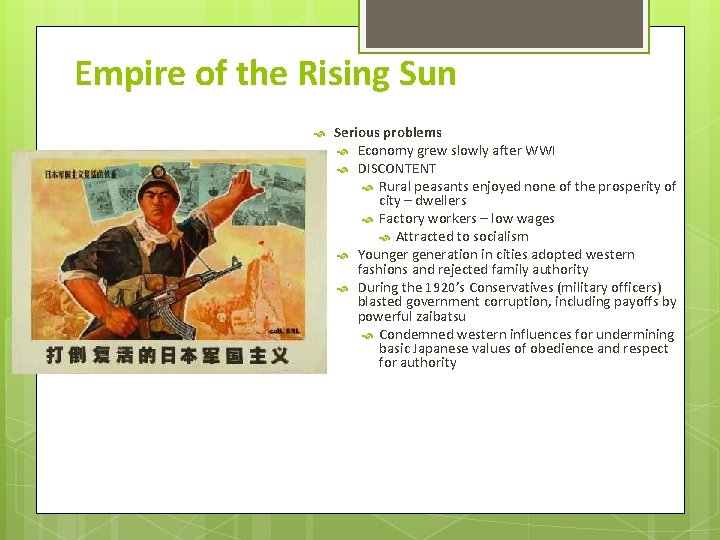
Empire of the Rising Sun Serious problems Economy grew slowly after WWI DISCONTENT Rural peasants enjoyed none of the prosperity of city – dwellers Factory workers – low wages Attracted to socialism Younger generation in cities adopted western fashions and rejected family authority During the 1920’s Conservatives (military officers) blasted government corruption, including payoffs by powerful zaibatsu Condemned western influences for undermining basic Japanese values of obedience and respect for authority
Empire of the Rising Sun Economic disaster Military and Ultranationalists condemned politicians for agreeing to western demands to stop overseas expansions Outraged by Racial policies in the US Took great pride in their achievements and history and resented the treatment by the Americans Nationalists wanted to expand – Raw materials and land for population Militarists in power Military leaders plotted to overthrow the government Briefly occupied Tokyo Civilian government survived but by 1937 forced to accept military domination Cracked down on socialists and most democratic freedoms Revived ancient culture and built a cult around the emperor who was believed to descended from the Sun goddess
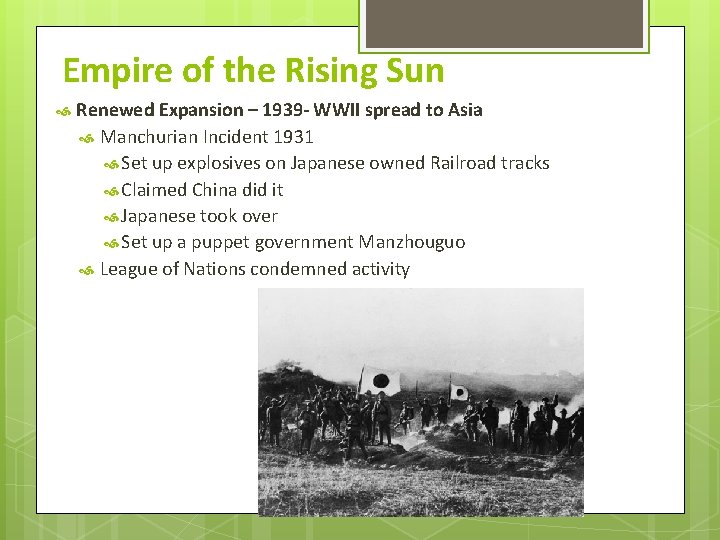
Empire of the Rising Sun Renewed Expansion – 1939 - WWII spread to Asia Manchurian Incident 1931 Set up explosives on Japanese owned Railroad tracks Claimed China did it Japanese took over Set up a puppet government Manzhouguo League of Nations condemned activity