Chapter 29 Nationalism and Revolution Around the World
- Slides: 37
Chapter 29: Nationalism and Revolution Around the World Section 1: Struggle for Change in Latin America Section 2: Nationalist Movements in Africa & the M. E. Section 3: India Seeks Self-Rule Section 4: Upheavals in China Section 5: Empire of the Rising Sun
Section 1: Struggle for Change in Latin America • Summary: – Desires for land, better wages and democratic reform led to the Mexican Revolution
Section 1: Struggle for Change in Latin America • After World War I, people all over the world wanted to control their own nations – Leaders spoke of Self-determination • In some lands, leaders called for revolution
Section 1: Struggle for Change in Latin America • Mexico was ruled by a dictator who welcomed foreign investors – Investors developed mines, built railroads and drilled for oil – However, all wealth and profits went to the land business owners
Section 1: Struggle for Change in Latin America • Most Mexicans were poor and had no land – In 1910, the people rebelled – They forced out the dictator, but the fight for sound government and freedom from foreign control lasted for years
Section 1: Struggle for Change in Latin America • In 1917, a new constitution sought to reform laws governing land, religion and workers – In the 1920 s, Mexican people became the first in Latin America to see real social and economic reform • Social change helped Indians to regain land, supported labor unions and spread education
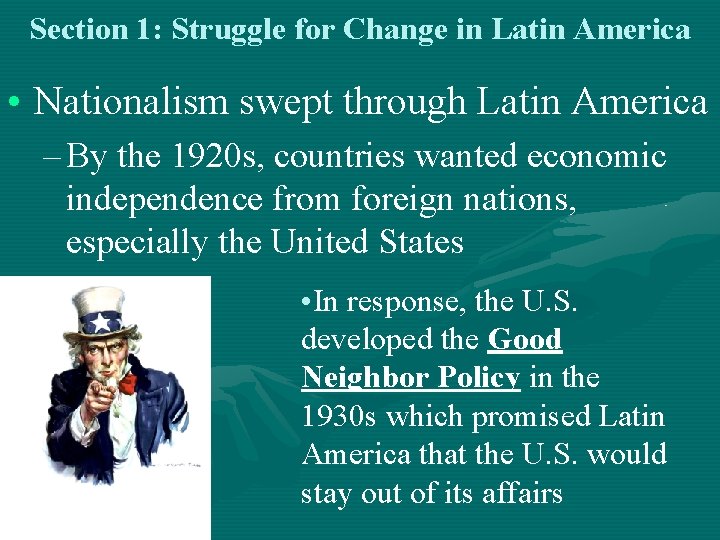
Section 1: Struggle for Change in Latin America • Nationalism swept through Latin America – By the 1920 s, countries wanted economic independence from foreign nations, especially the United States • In response, the U. S. developed the Good Neighbor Policy in the 1930 s which promised Latin America that the U. S. would stay out of its affairs
Section 1: Struggle for Change in Latin America • Nationalism affected artists and writers as well – Art, books and music showed a new pride in native culture
Section 2: Nationalist Movements in Africa & the M. E. • Summary: – Following World War I, nationalist movements grew in Africa and the Middle East
Section 2: Nationalist Movements in Africa & the M. E. • As World War I ended, the people of Africa were growing tired of their colonial status – They paid taxes to foreign nations, fought their wars and worked their farms
Section 2: Nationalist Movements in Africa & the M. E. • During the 1920 s and 1930 s, nationalists spoke of returning Africa to the Africans – There were few total revolts, but many protests – Only Egypt won its independence
Section 2: Nationalist Movements in Africa & the M. E. • Nationalist movements also grew in the Middle East – After World War I, the Allies had divided the lands of the Ottoman Empire • The Turks, however, would not accept foreign control • In 1923, they made Turkey a republic and replaced old Muslim traditions with western ideas • Nationalists in Iran followed Turkey’s lead
Section 2: Nationalist Movements in Africa & the M. E. • During World War I, many Arabs had helped the Allies – In return they had been promised independence • Instead, Britain and France took over territories, or Mandates, throughout the Middle East
Section 2: Nationalist Movements in Africa & the M. E. • In the 1920 s and 1930 s Arab Nationalists sought to be free of foreign control – They hoped to unite ALL Arabs into their own state
Section 2: Nationalist Movements in Africa & the M. E. • There was great conflict in the British mandate of Palestine – The Allies had promised Arabs land that included Palestine • They also pledged to set up a Jewish state in the same region – Even now, Arab and Jewish nationalists battle over this same land
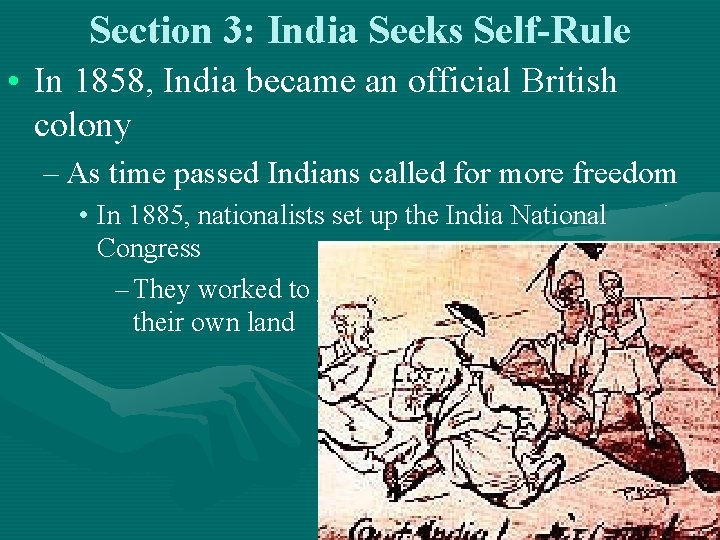
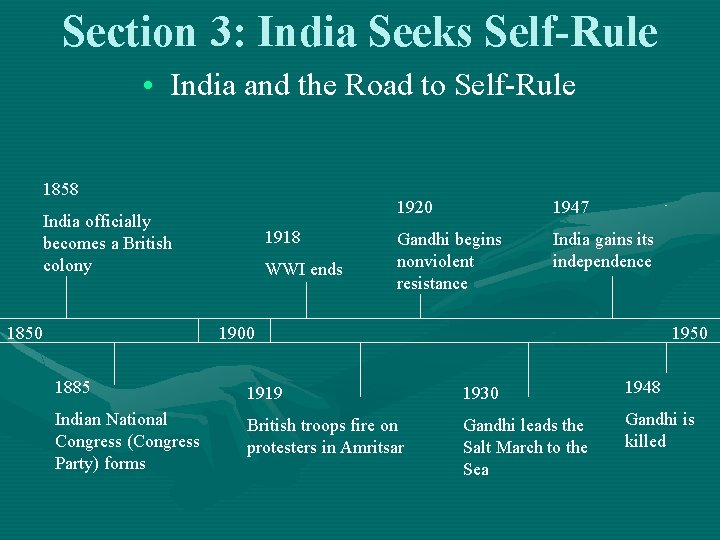
Section 3: India Seeks Self-Rule • In 1858, India became an official British colony – As time passed Indians called for more freedom • In 1885, nationalists set up the India National Congress – They worked to give Indians a voice in running their own land
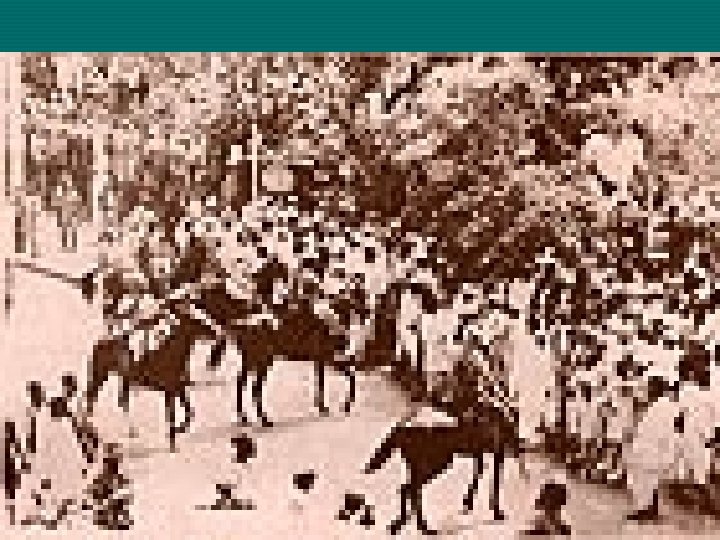
Section 3: India Seeks Self-Rule • World War I made the nationalist movement stronger – Indian soldiers had fought for Britain, yet they had few rights • Britain failed to fulfill its promise to grant India greater self-government – Post-war anger led to protest • On April 13 th, 1919, British troops killed nearly 400 protestors in the city Armritsar
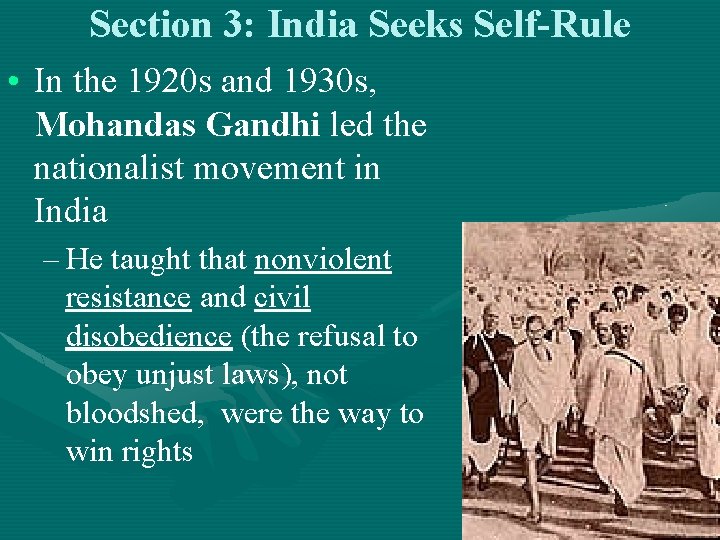
Section 3: India Seeks Self-Rule • In the 1920 s and 1930 s, Mohandas Gandhi led the nationalist movement in India – He taught that nonviolent resistance and civil disobedience (the refusal to obey unjust laws), not bloodshed, were the way to win rights
Section 3: India Seeks Self-Rule • Gandhi’s followers did not buy British goods or obey their laws • The Great Salt March was a protest of the British salt monopoly, although assaulted and beaten by police, Gandhi and his followers peacefully marched to the sea, and in the long run won their independence by turning public opinion against the
Section 3: India Seeks Self-Rule – Peaceful resistance won some rights – However, India did not gain full independence until 1947, one year before Gandhi died • Gandhi was assassinated by a political extremist who believed violence was necessary to achieve freedom
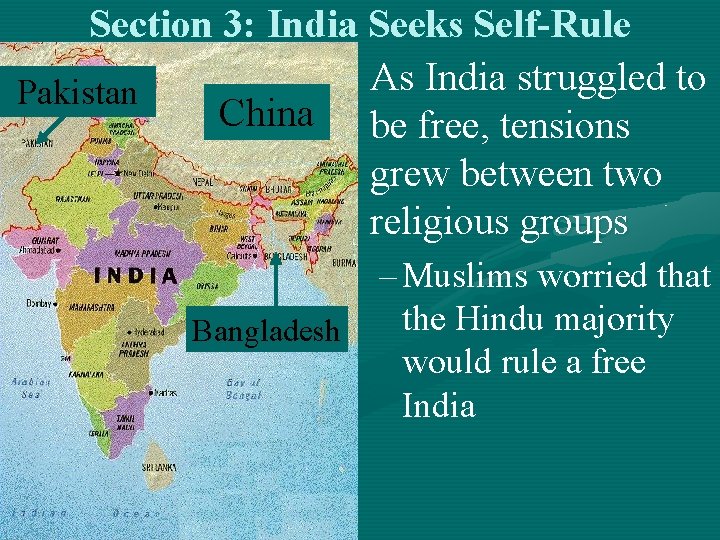
Section 3: India Seeks Self-Rule • As India struggled to Pakistan China be free, tensions grew between two religious groups Bangladesh – Muslims worried that the Hindu majority would rule a free India
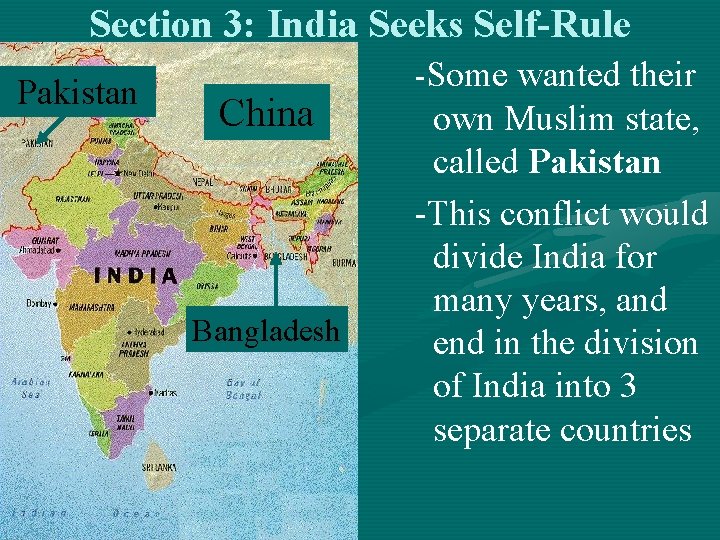
Section 3: India Seeks Self-Rule Pakistan China Bangladesh -Some wanted their own Muslim state, called Pakistan -This conflict would divide India for many years, and end in the division of India into 3 separate countries
Section 3: India Seeks Self-Rule • India and the Road to Self-Rule 1858 India officially becomes a British colony 1850 1918 WWI ends 1920 1947 Gandhi begins nonviolent resistance India gains its independence 1900 1950 1885 1919 1930 1948 Indian National Congress (Congress Party) forms British troops fire on protesters in Amritsar Gandhi leads the Salt March to the Sea Gandhi is killed
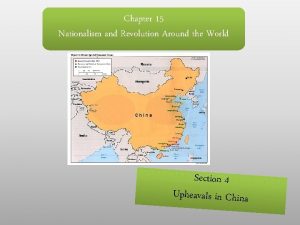
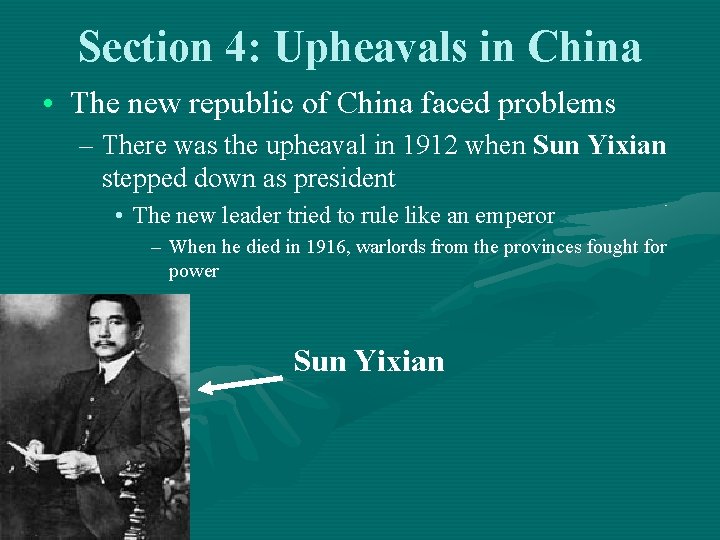
Section 4: Upheavals in China • The new republic of China faced problems – There was the upheaval in 1912 when Sun Yixian stepped down as president • The new leader tried to rule like an emperor – When he died in 1916, warlords from the provinces fought for power Sun Yixian
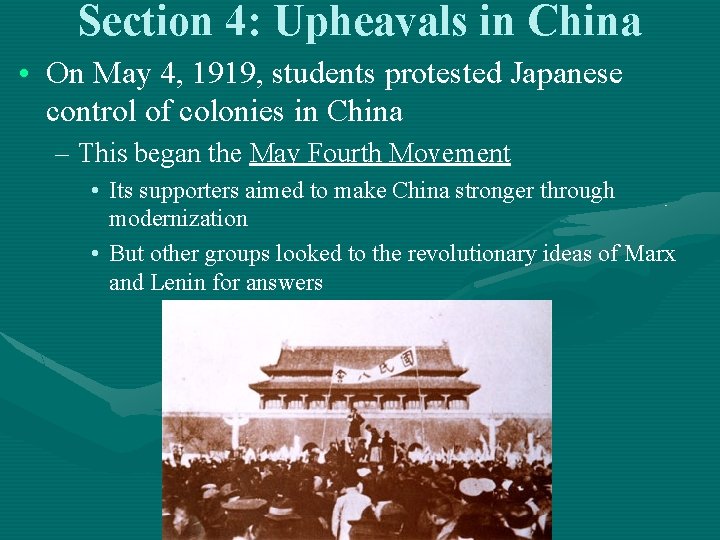
Section 4: Upheavals in China • On May 4, 1919, students protested Japanese control of colonies in China – This began the May Fourth Movement • Its supporters aimed to make China stronger through modernization • But other groups looked to the revolutionary ideas of Marx and Lenin for answers
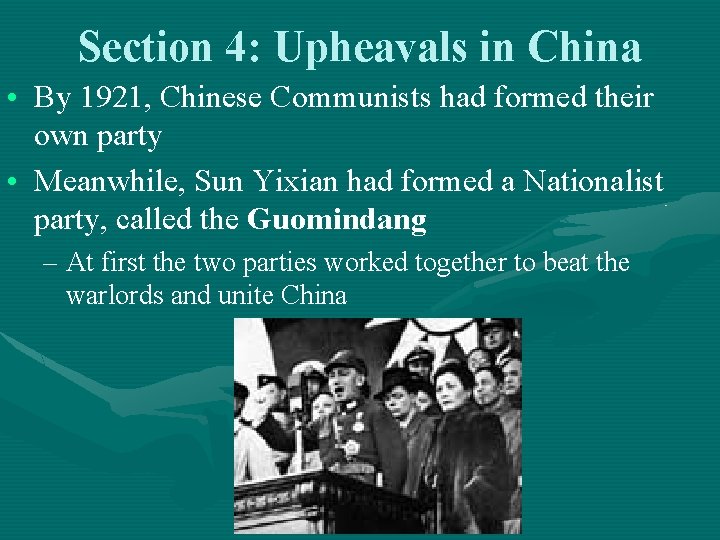
Section 4: Upheavals in China • By 1921, Chinese Communists had formed their own party • Meanwhile, Sun Yixian had formed a Nationalist party, called the Guomindang – At first the two parties worked together to beat the warlords and unite China
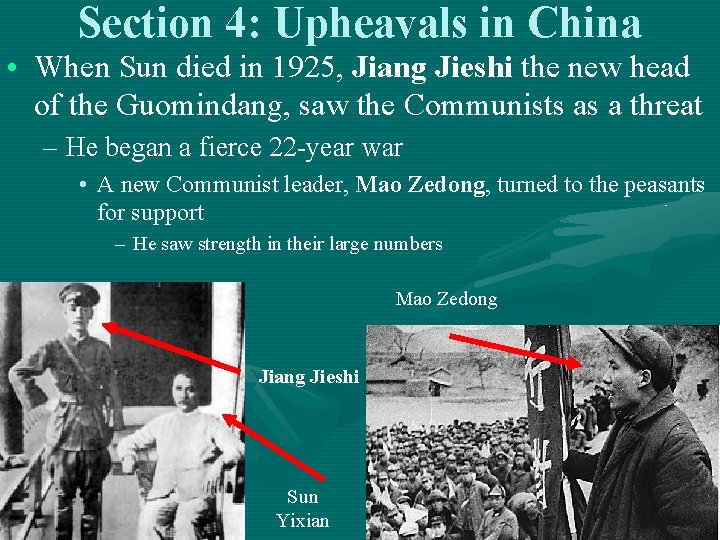
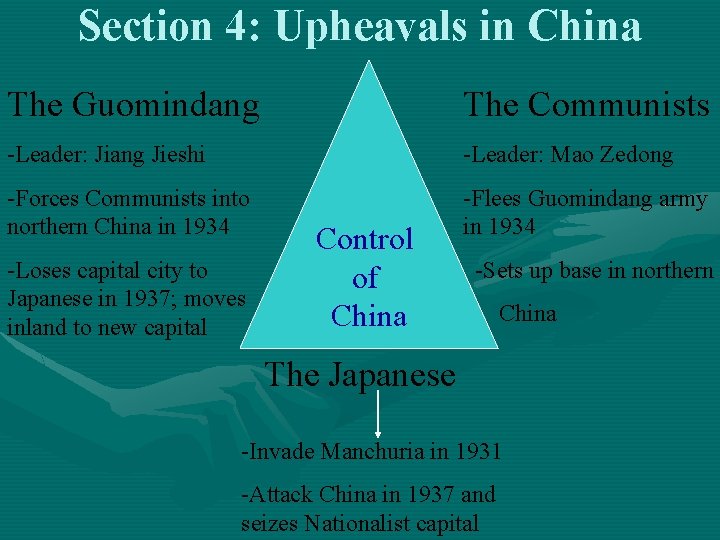
Section 4: Upheavals in China • When Sun died in 1925, Jiang Jieshi the new head of the Guomindang, saw the Communists as a threat – He began a fierce 22 -year war • A new Communist leader, Mao Zedong, turned to the peasants for support – He saw strength in their large numbers Mao Zedong Jiang Jieshi Sun Yixian
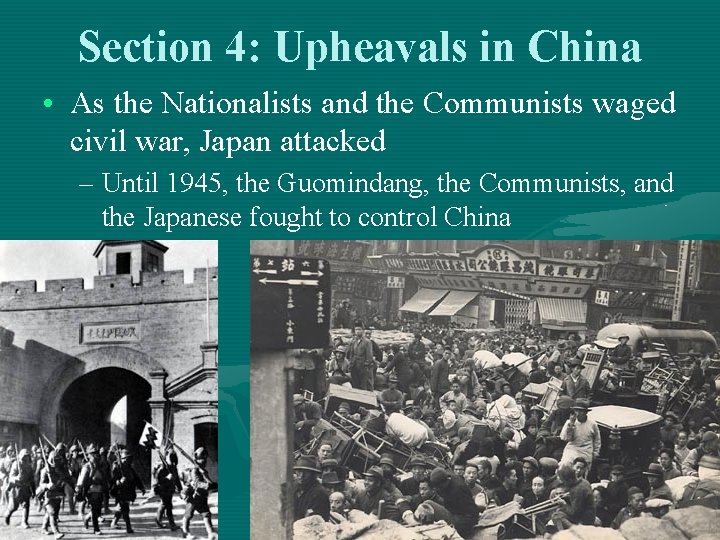
Section 4: Upheavals in China • As the Nationalists and the Communists waged civil war, Japan attacked – Until 1945, the Guomindang, the Communists, and the Japanese fought to control China
Section 4: Upheavals in China The Guomindang The Communists -Leader: Jiang Jieshi -Leader: Mao Zedong -Forces Communists into northern China in 1934 -Flees Guomindang army in 1934 -Loses capital city to Japanese in 1937; moves inland to new capital Control of China -Sets up base in northern China The Japanese -Invade Manchuria in 1931 -Attack China in 1937 and seizes Nationalist capital
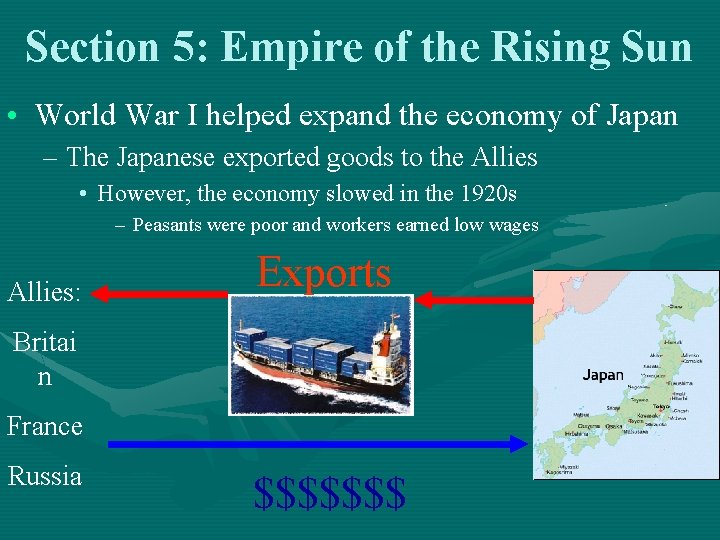
Section 5: Empire of the Rising Sun • World War I helped expand the economy of Japan – The Japanese exported goods to the Allies • However, the economy slowed in the 1920 s – Peasants were poor and workers earned low wages Allies: Exports Britai n France Russia $$$$$$$
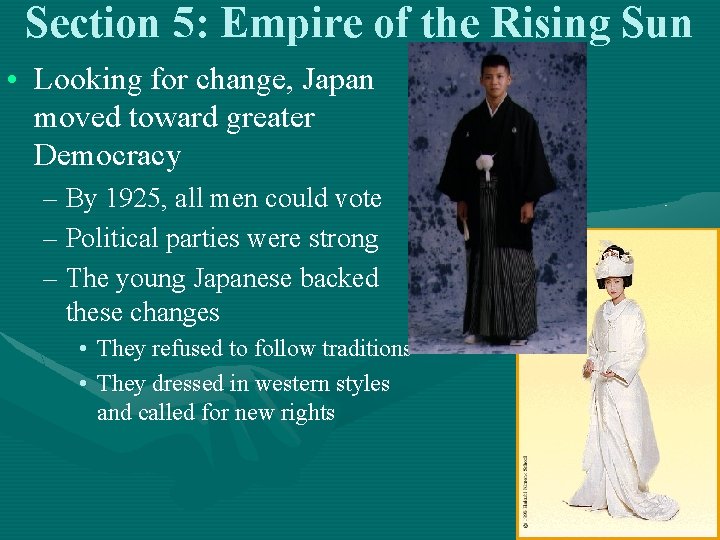
Section 5: Empire of the Rising Sun • Looking for change, Japan moved toward greater Democracy – By 1925, all men could vote – Political parties were strong – The young Japanese backed these changes • They refused to follow traditions • They dressed in western styles and called for new rights
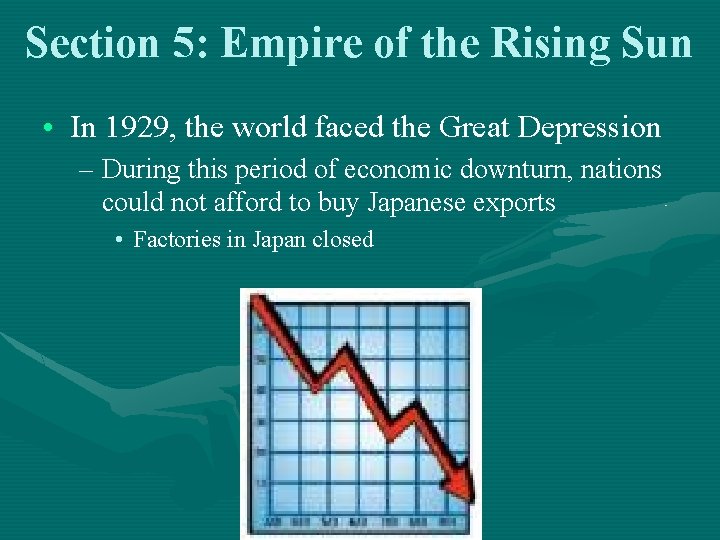
Section 5: Empire of the Rising Sun • In 1929, the world faced the Great Depression – During this period of economic downturn, nations could not afford to buy Japanese exports • Factories in Japan closed
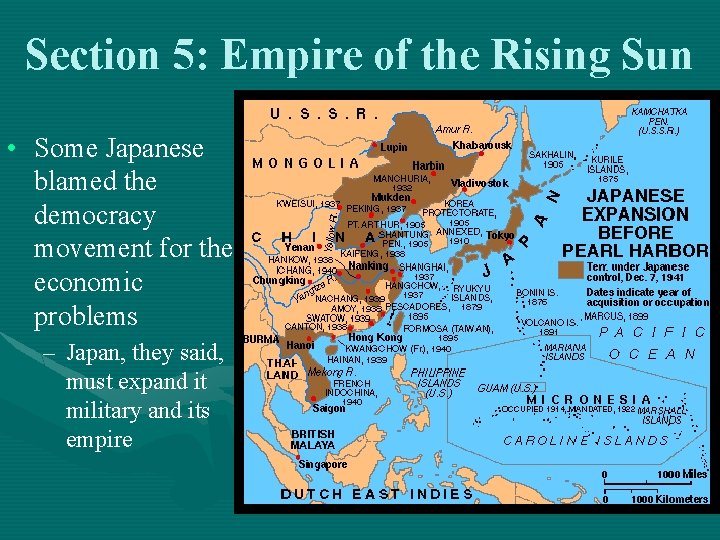
Section 5: Empire of the Rising Sun • Some Japanese blamed the democracy movement for the economic problems – Japan, they said, must expand it military and its empire
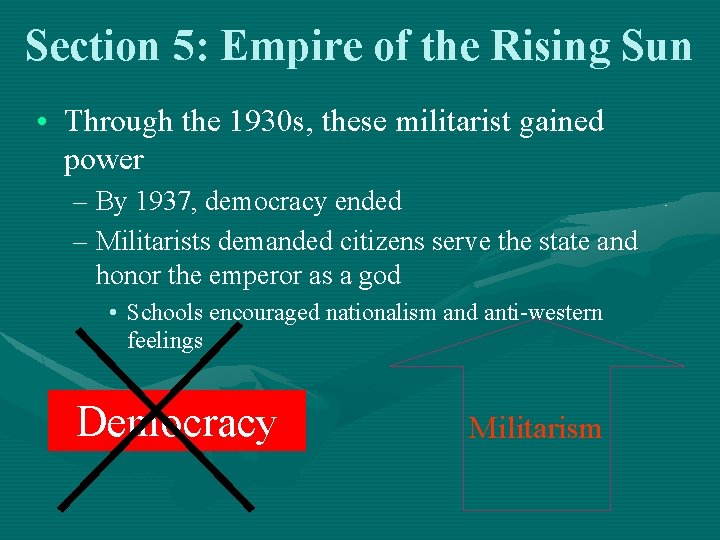
Section 5: Empire of the Rising Sun • Through the 1930 s, these militarist gained power – By 1937, democracy ended – Militarists demanded citizens serve the state and honor the emperor as a god • Schools encouraged nationalism and anti-western feelings Democracy Militarism
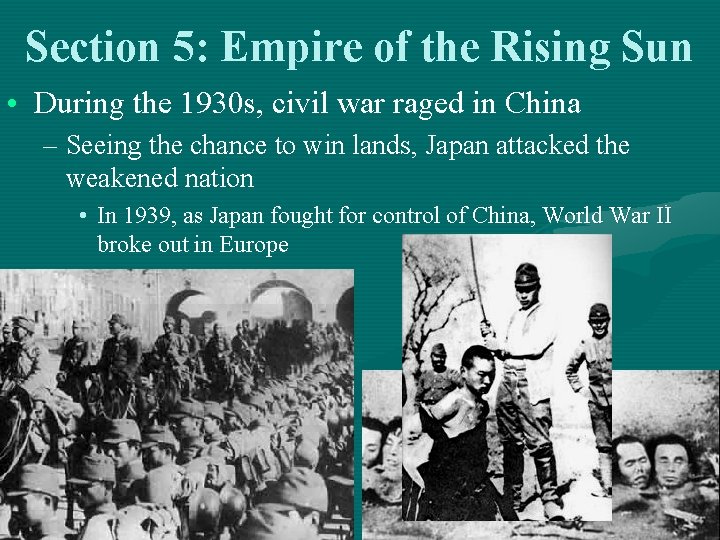
Section 5: Empire of the Rising Sun • During the 1930 s, civil war raged in China – Seeing the chance to win lands, Japan attacked the weakened nation • In 1939, as Japan fought for control of China, World War II broke out in Europe
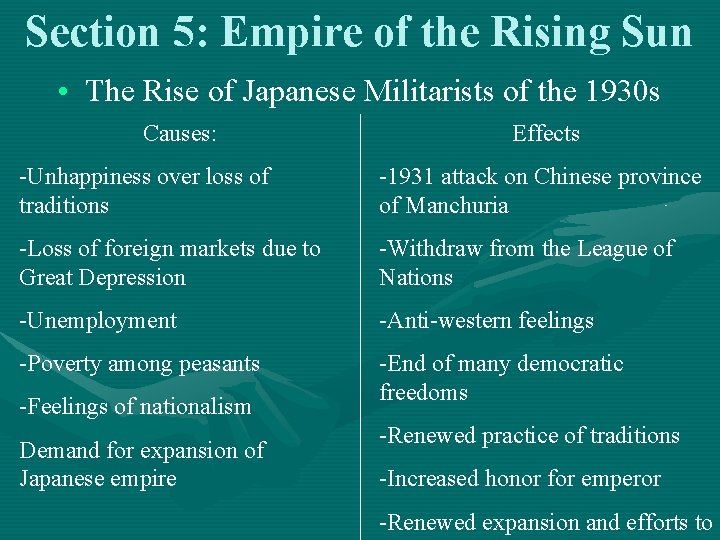
Section 5: Empire of the Rising Sun • The Rise of Japanese Militarists of the 1930 s Causes: Effects -Unhappiness over loss of traditions -1931 attack on Chinese province of Manchuria -Loss of foreign markets due to Great Depression -Withdraw from the League of Nations -Unemployment -Anti-western feelings -Poverty among peasants -End of many democratic freedoms -Feelings of nationalism Demand for expansion of Japanese empire -Renewed practice of traditions -Increased honor for emperor -Renewed expansion and efforts to