Chapter 22 An Introduction to Electroanalytical Chemistry 22
- Slides: 39
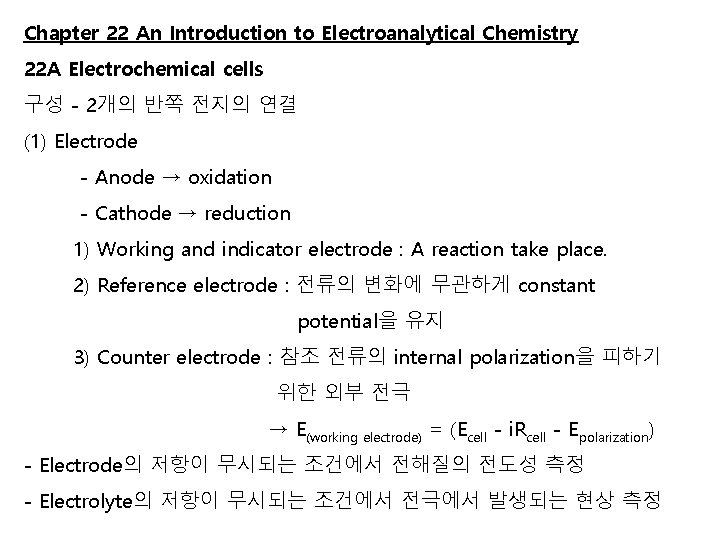
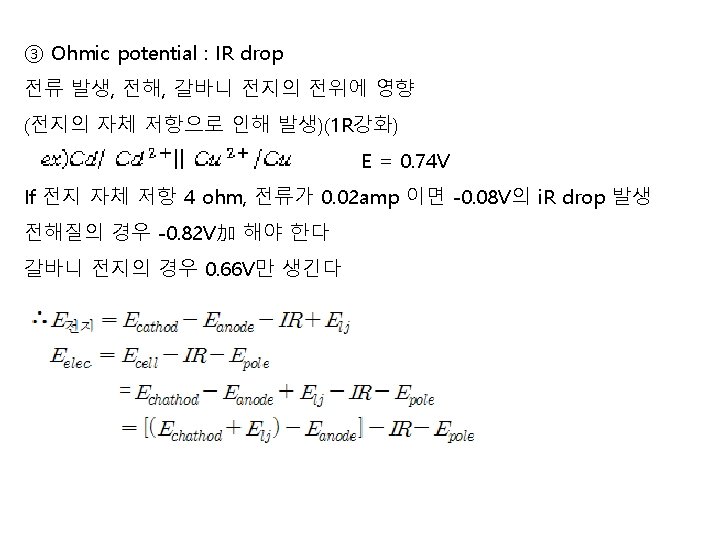
Chapter 22 An Introduction to Electroanalytical Chemistry 22 A Electrochemical cells 구성 - 2개의 반쪽 전지의 연결 (1) Electrode - Anode → oxidation - Cathode → reduction 1) Working and indicator electrode : A reaction take place. 2) Reference electrode : 전류의 변화에 무관하게 constant potential을 유지 3) Counter electrode : 참조 전류의 internal polarization을 피하기 위한 외부 전극 → E(working electrode) = (Ecell - i. Rcell - Epolarization) - Electrode의 저항이 무시되는 조건에서 전해질의 전도성 측정 - Electrolyte의 저항이 무시되는 조건에서 전극에서 발생되는 현상 측정
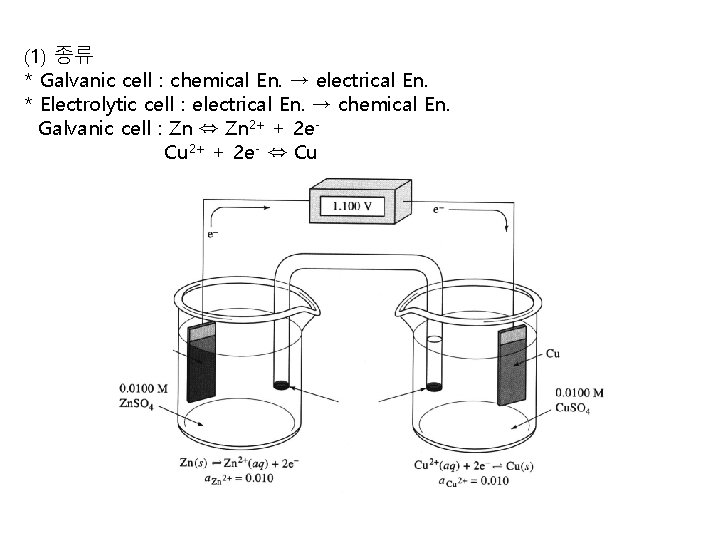
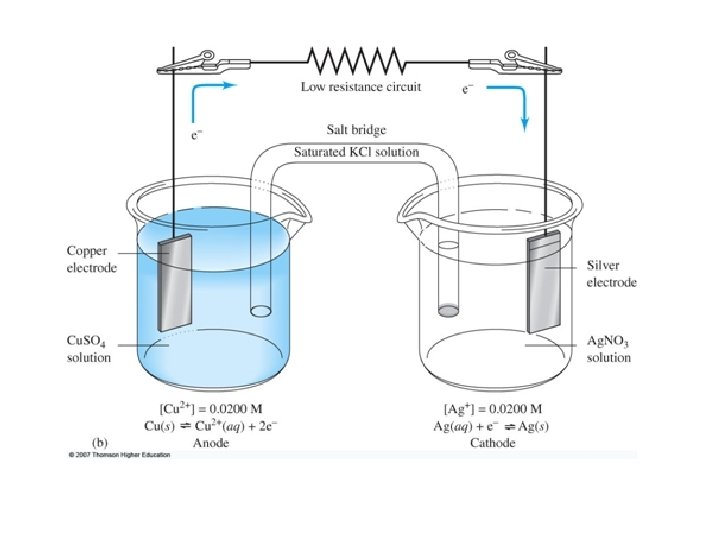
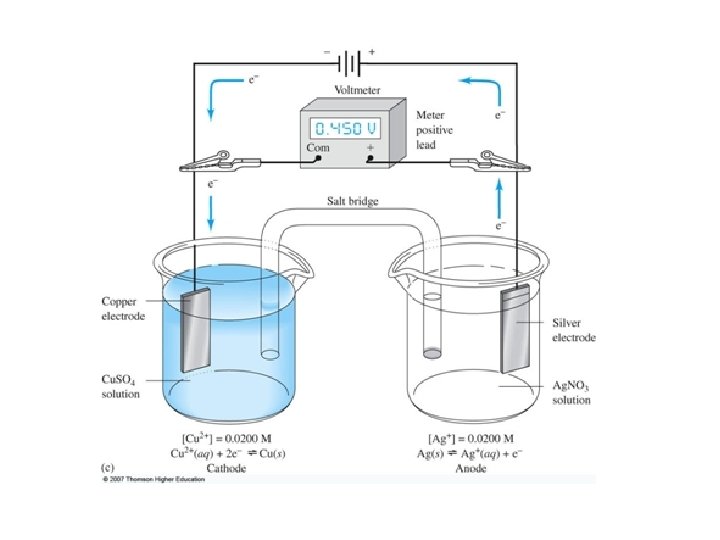
(1) 종류 * Galvanic cell : chemical En. → electrical En. * Electrolytic cell : electrical En. → chemical En. Galvanic cell : Zn ⇔ Zn 2+ + 2 e. Cu 2+ + 2 e- ⇔ Cu
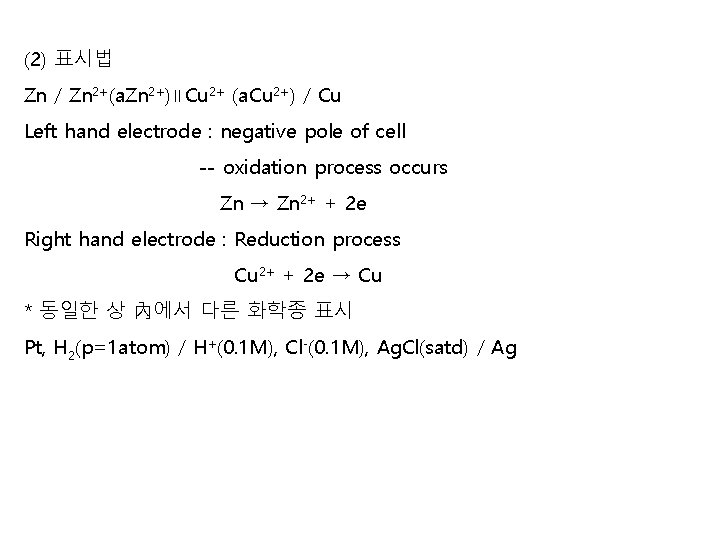
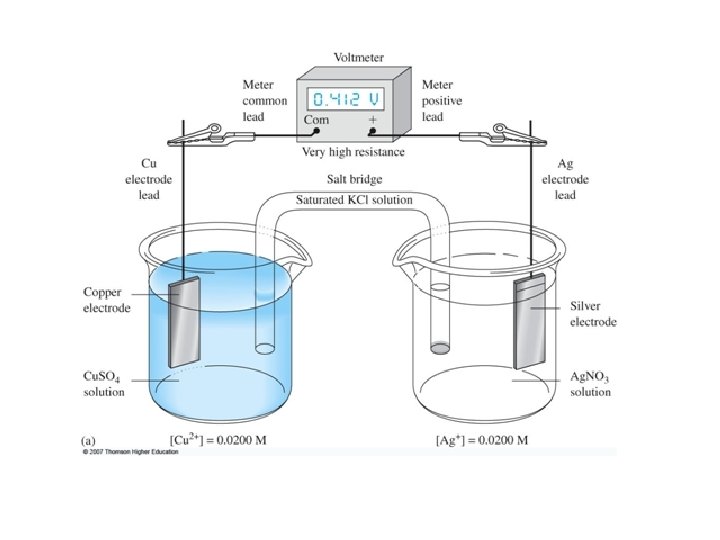
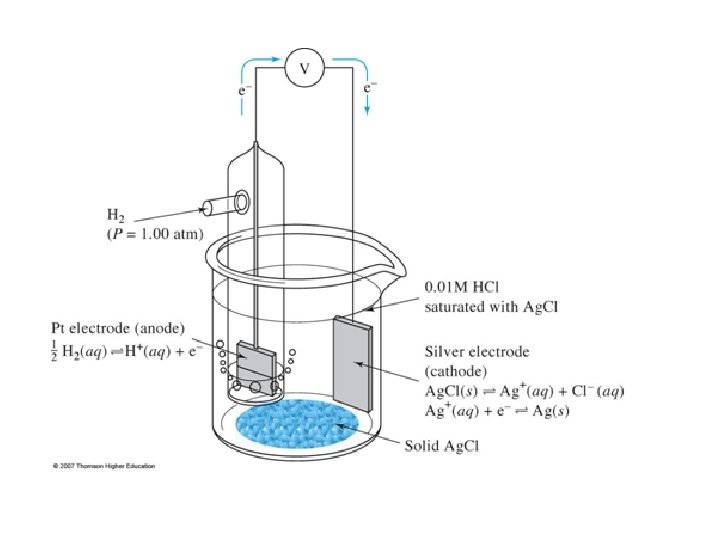
(2) 표시법 Zn / Zn 2+(a. Zn 2+)∥Cu 2+ (a. Cu 2+) / Cu Left hand electrode : negative pole of cell -- oxidation process occurs Zn → Zn 2+ + 2 e Right hand electrode : Reduction process Cu 2+ + 2 e → Cu * 동일한 상 內에서 다른 화학종 표시 Pt, H 2(p=1 atom) / H+(0. 1 M), Cl-(0. 1 M), Ag. Cl(satd) / Ag
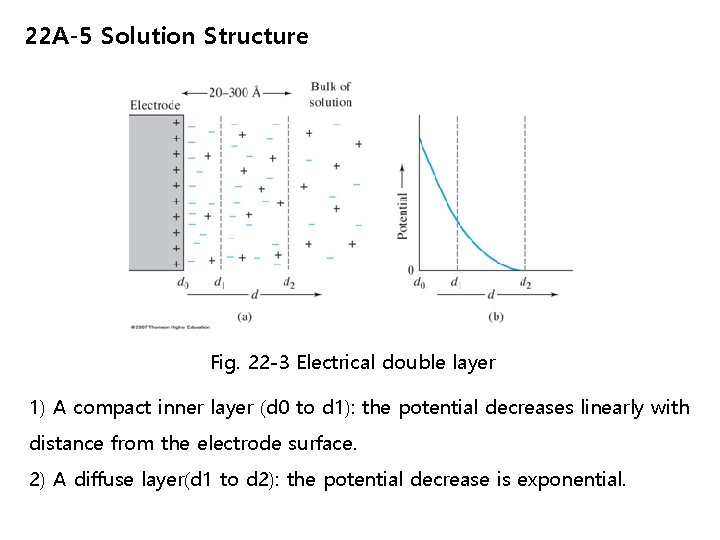
22 A-5 Solution Structure Fig. 22 -3 Electrical double layer 1) A compact inner layer (d 0 to d 1): the potential decreases linearly with distance from the electrode surface. 2) A diffuse layer(d 1 to d 2): the potential decrease is exponential.
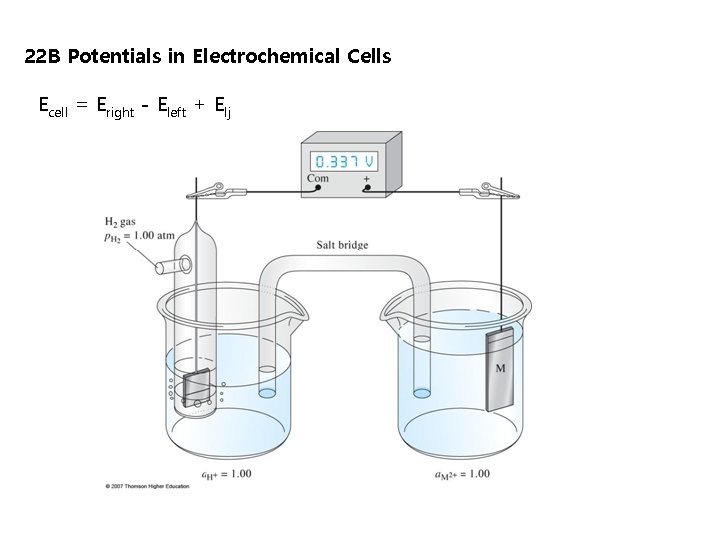
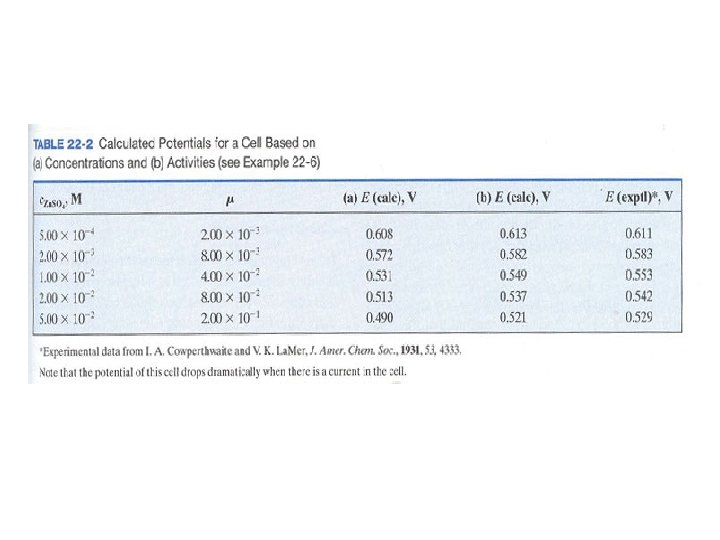
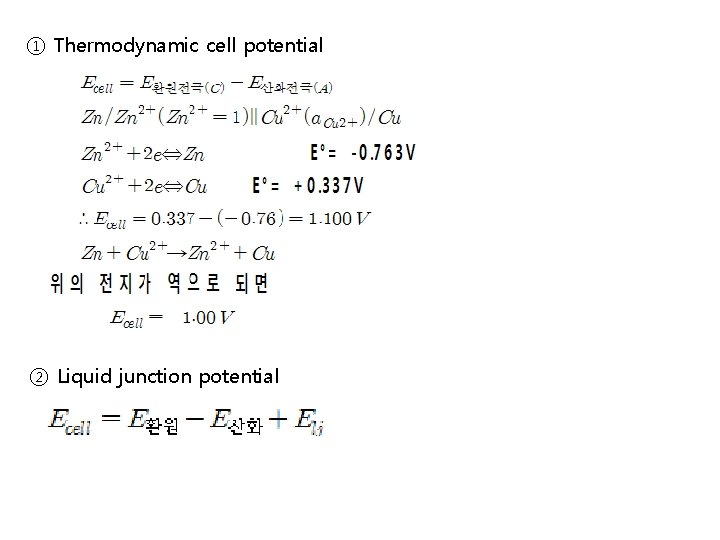
22 B Potentials in Electrochemical Cells Ecell = Eright - Eleft + Elj
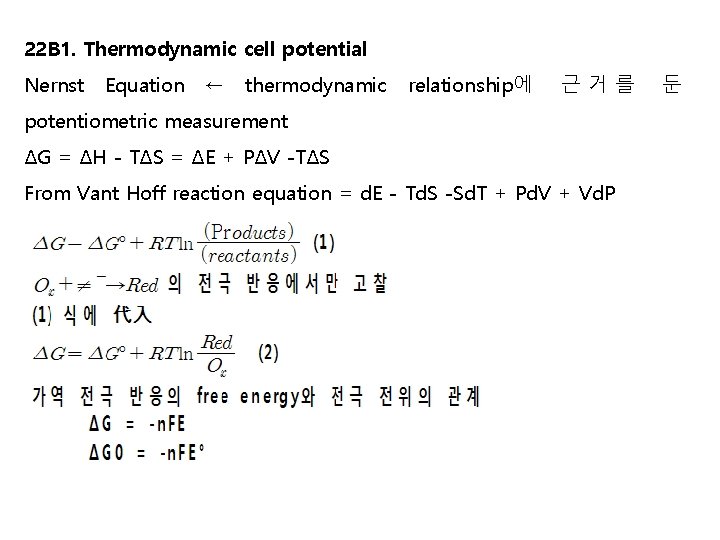
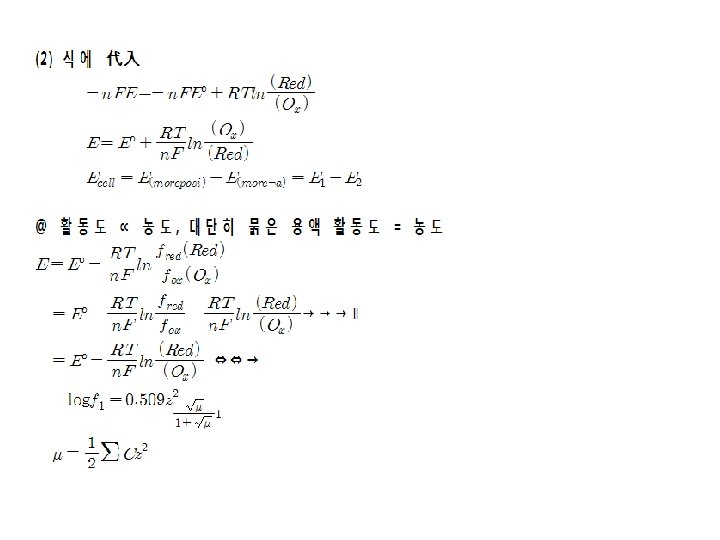
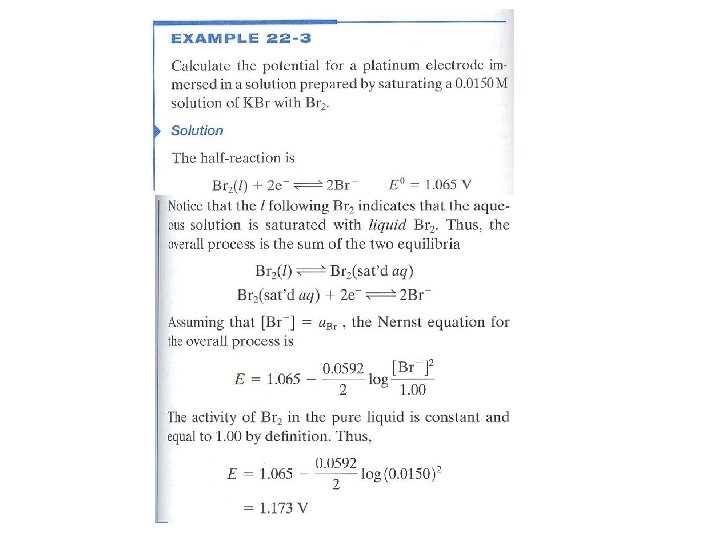
22 B 1. Thermodynamic cell potential Nernst Equation ← thermodynamic relationship에 근거를 potentiometric measurement ΔG = ΔH - TΔS = ΔE + PΔV -TΔS From Vant Hoff reaction equation = d. E - Td. S -Sd. T + Pd. V + Vd. P 둔
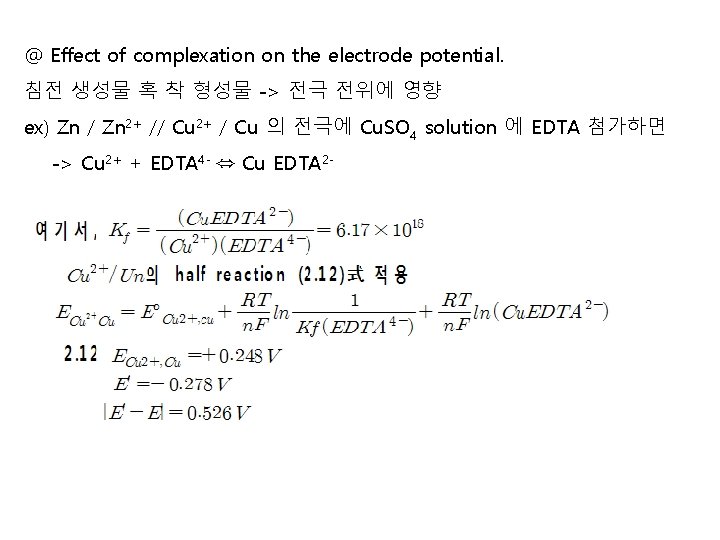
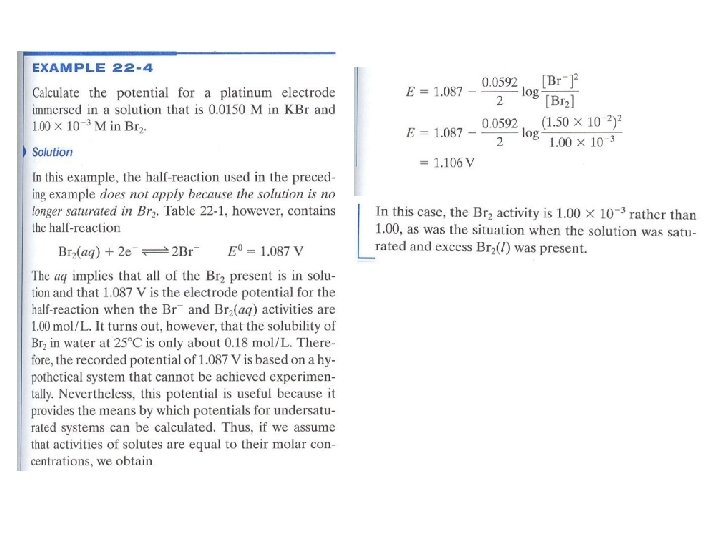
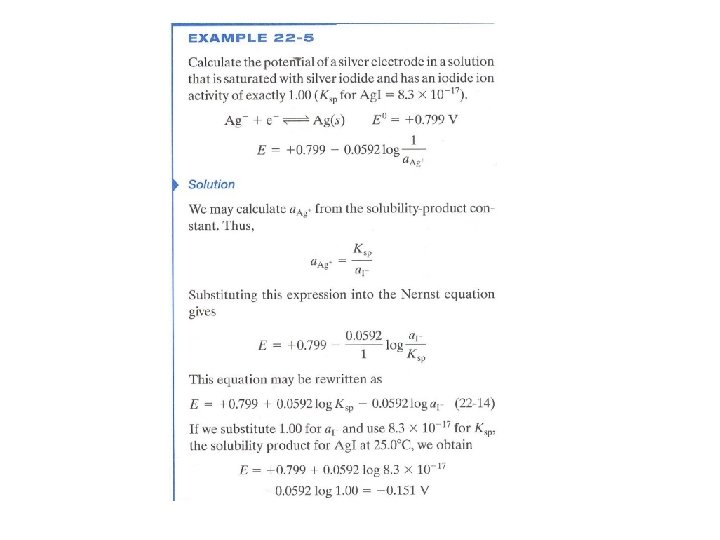
@ Effect of complexation on the electrode potential. 침전 생성물 혹 착 형성물 -> 전극 전위에 영향 ex) Zn / Zn 2+ // Cu 2+ / Cu 의 전극에 Cu. SO 4 solution 에 EDTA 첨가하면 -> Cu 2+ + EDTA 4 - ⇔ Cu EDTA 2 -
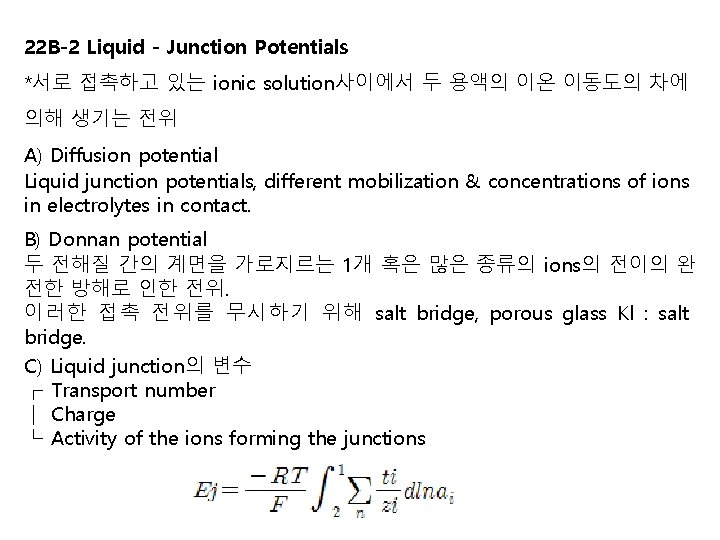
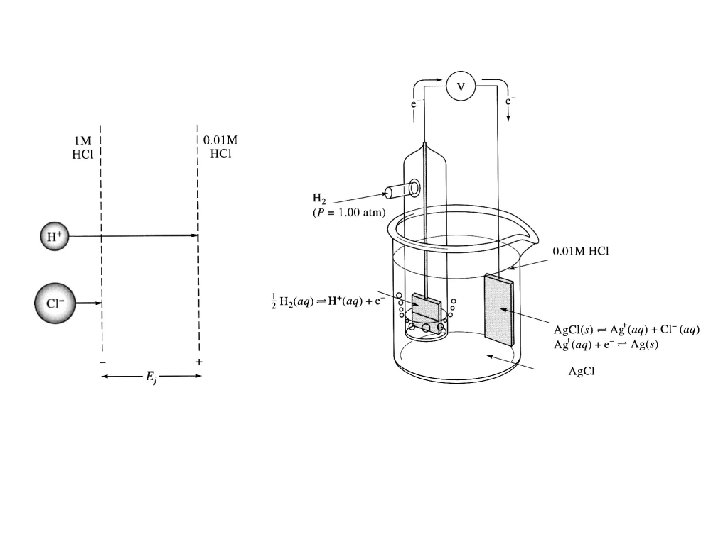
22 B-2 Liquid - Junction Potentials *서로 접촉하고 있는 ionic solution사이에서 두 용액의 이온 이동도의 차에 의해 생기는 전위 A) Diffusion potential Liquid junction potentials, different mobilization & concentrations of ions in electrolytes in contact. B) Donnan potential 두 전해질 간의 계면을 가로지르는 1개 혹은 많은 종류의 ions의 전이의 완 전한 방해로 인한 전위. 이러한 접촉 전위를 무시하기 위해 salt bridge, porous glass Kl : salt bridge. C) Liquid junction의 변수 ┏ Transport number ┃ Charge ┗ Activity of the ions forming the junctions
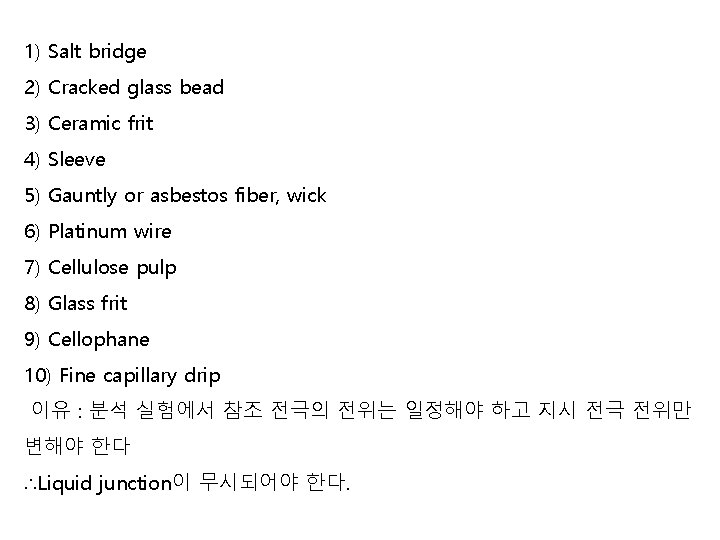
1) Salt bridge 2) Cracked glass bead 3) Ceramic frit 4) Sleeve 5) Gauntly or asbestos fiber, wick 6) Platinum wire 7) Cellulose pulp 8) Glass frit 9) Cellophane 10) Fine capillary drip 이유 : 분석 실험에서 참조 전극의 전위는 일정해야 하고 지시 전극 전위만 변해야 한다 ∴Liquid junction이 무시되어야 한다.
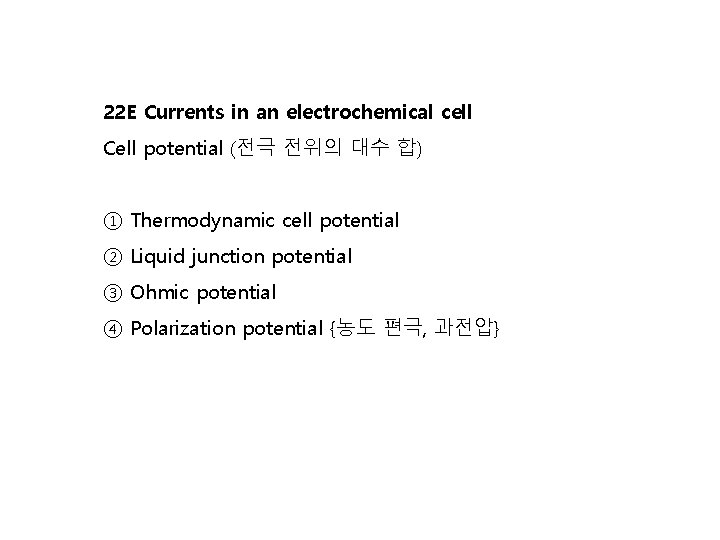
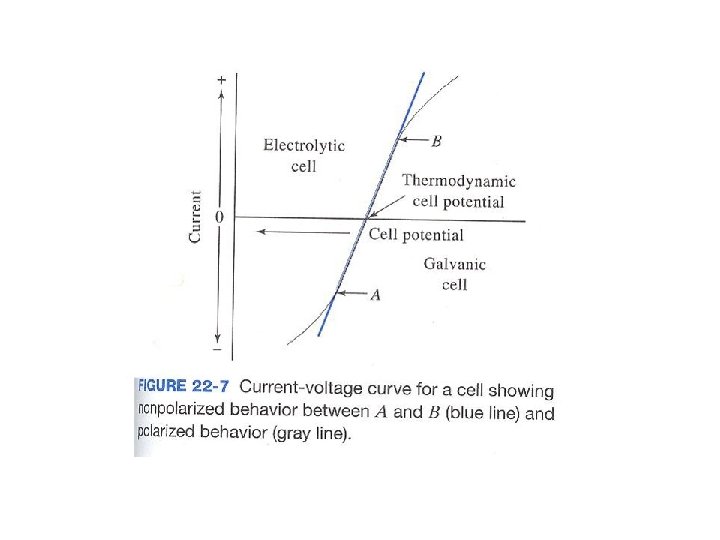
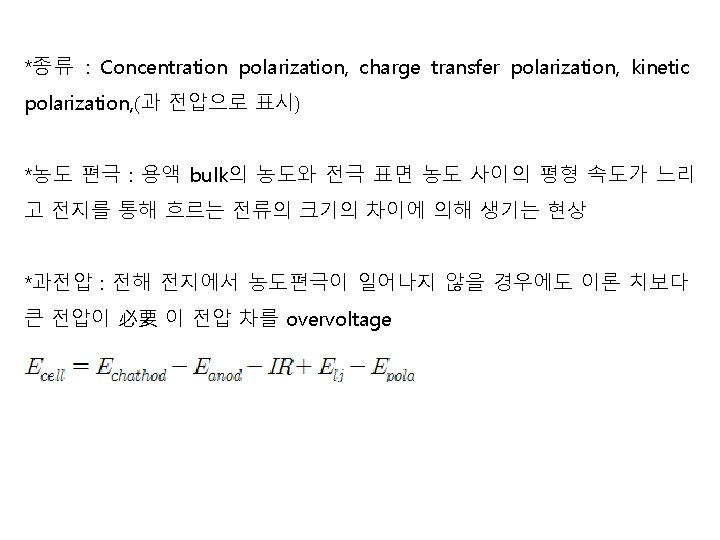
22 E Currents in an electrochemical cell Cell potential (전극 전위의 대수 합) ① Thermodynamic cell potential ② Liquid junction potential ③ Ohmic potential ④ Polarization potential {농도 편극, 과전압}
① Thermodynamic cell potential ② Liquid junction potential
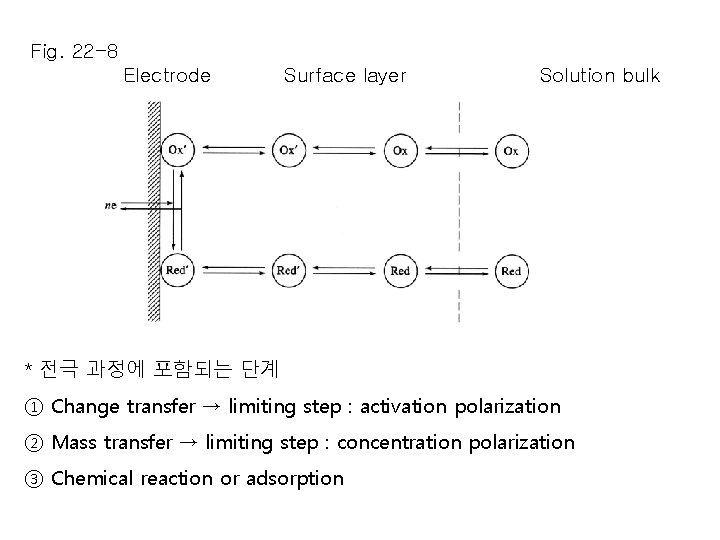
Fig. 22 -8 Electrode Surface layer Solution bulk * 전극 과정에 포함되는 단계 ① Change transfer → limiting step : activation polarization ② Mass transfer → limiting step : concentration polarization ③ Chemical reaction or adsorption
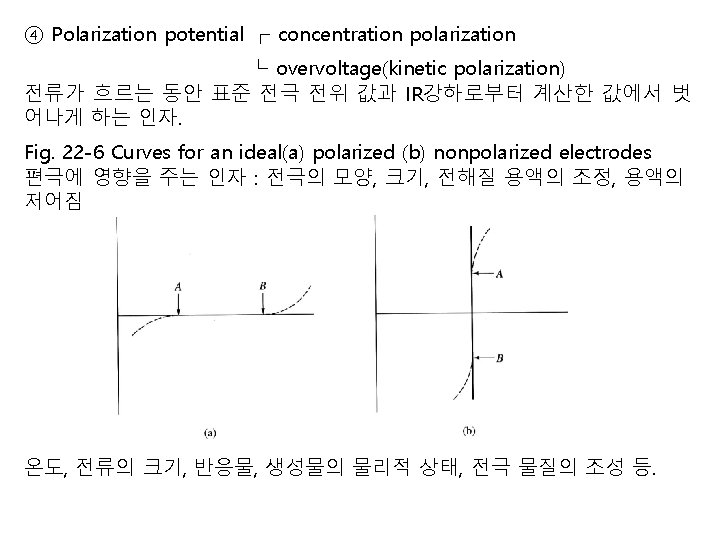
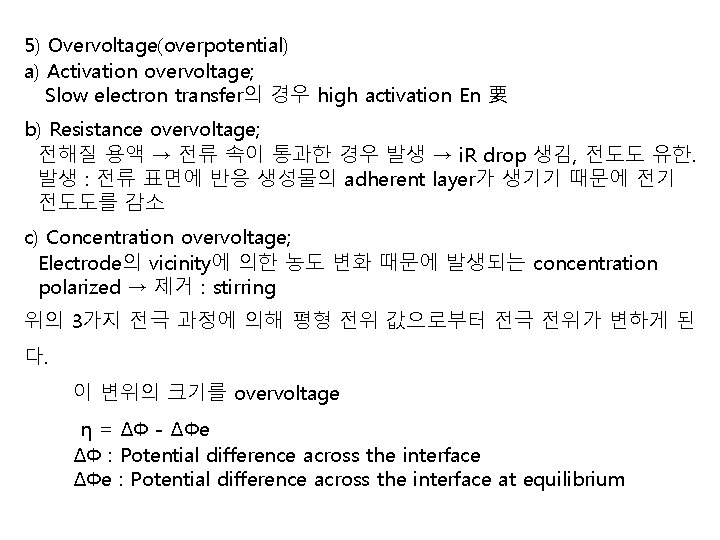
5) Overvoltage(overpotential) a) Activation overvoltage; Slow electron transfer의 경우 high activation En 要 b) Resistance overvoltage; 전해질 용액 → 전류 속이 통과한 경우 발생 → i. R drop 생김, 전도도 유한. 발생 : 전류 표면에 반응 생성물의 adherent layer가 생기기 때문에 전기 전도도를 감소 c) Concentration overvoltage; Electrode의 vicinity에 의한 농도 변화 때문에 발생되는 concentration polarized → 제거 : stirring 위의 3가지 전극 과정에 의해 평형 전위 값으로부터 전극 전위가 변하게 된 다. 이 변위의 크기를 overvoltage η = ΔΦ - ΔΦe ΔΦ : Potential difference across the interface ΔΦe : Potential difference across the interface at equilibrium
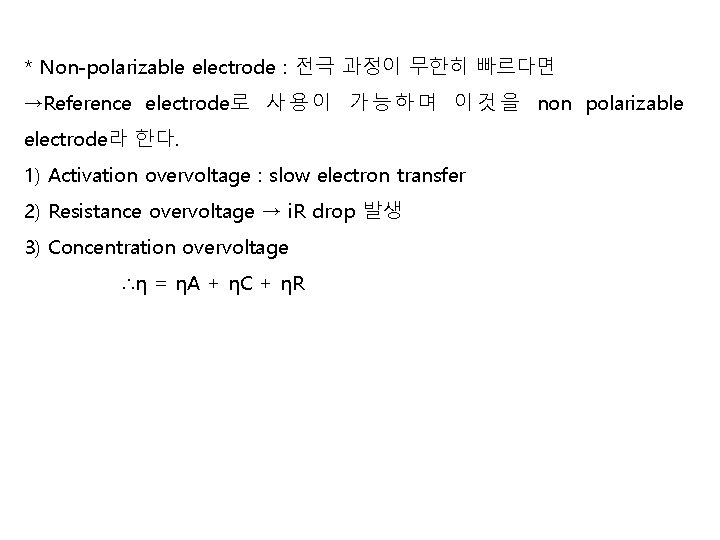
* Non-polarizable electrode : 전극 과정이 무한히 빠르다면 →Reference electrode로 사 용 이 가 능 하 며 이 것 을 non polarizable electrode라 한다. 1) Activation overvoltage : slow electron transfer 2) Resistance overvoltage → i. R drop 발생 3) Concentration overvoltage ∴η = ηA + ηC + ηR
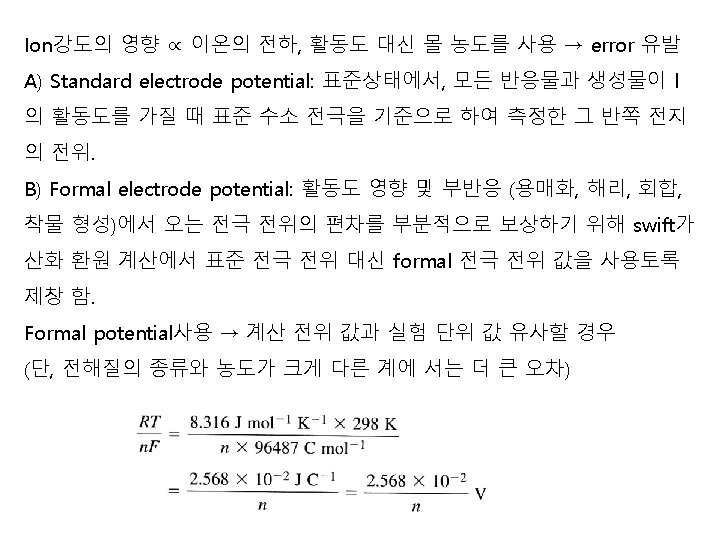
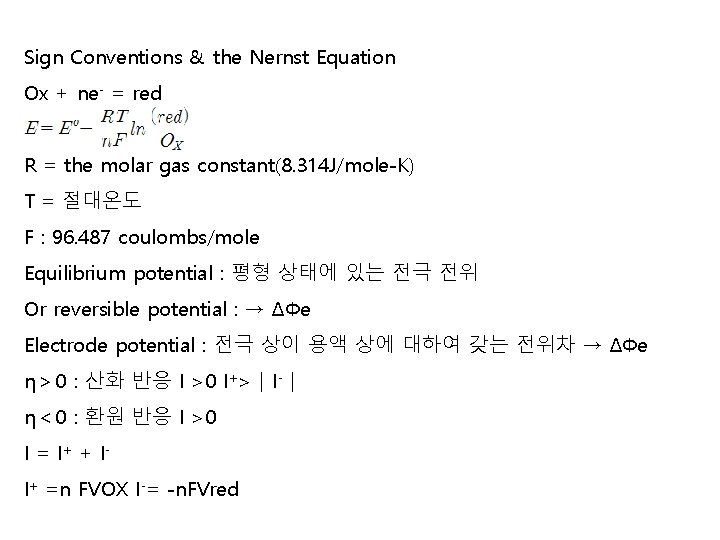
Sign Conventions & the Nernst Equation Ox + ne- = red R = the molar gas constant(8. 314 J/mole-K) T = 절대온도 F : 96. 487 coulombs/mole Equilibrium potential : 평형 상태에 있는 전극 전위 Or reversible potential : → ΔΦe Electrode potential : 전극 상이 용액 상에 대하여 갖는 전위차 → ΔΦe η> 0 : 산화 반응 I >0 I+>┃I-┃ η< 0 : 환원 반응 I >0 I = I+ + II+ =n FVOX I-= -n. FVred