Challenges in implementing the SPS Agreement Gretchen Stanton


- Slides: 88
Challenges in implementing the SPS Agreement Gretchen Stanton Agriculture and Commodities Division
Key Provisions of the SPS Agreement 1. Non-discrimination 2. Scientific justification • • 3. 4. 5. 6. 7. harmonization risk assessment consistency least trade-restrictiveness Equivalence Regionalization Transparency Technical assistance/special treatment Control, inspection and approval procedures 2
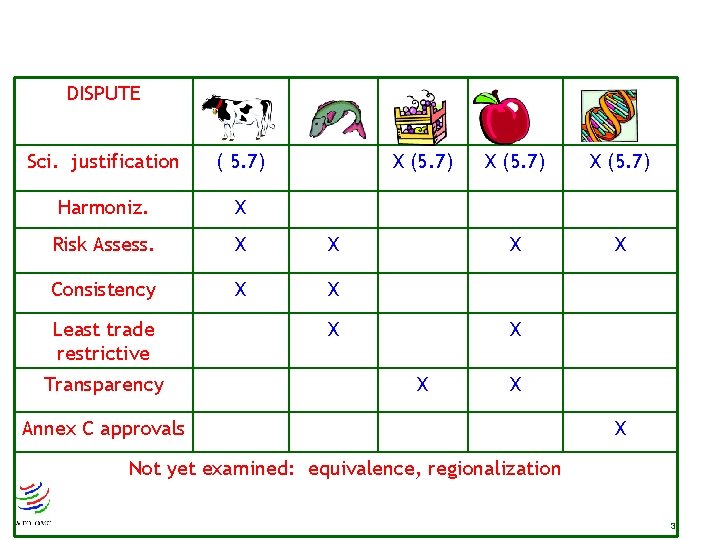
DISPUTE Sci. justification ( 5. 7) Harmoniz. X Risk Assess. X X Consistency X X Least trade restrictive Transparency X (5. 7) X X X Annex C approvals X Not yet examined: equivalence, regionalization 3
Key Provisions of the SPS Agreement 1. Non-discrimination 2. Scientific justification • harmonization • risk assessment • consistency • least trade-restrictiveness 3. Equivalence 4. Regionalization 5. Transparency 6. Technical assistance/special treatment 7. Control, inspection and approval procedures – – Whose science? How long? What is justifiable? What ALOP? 4
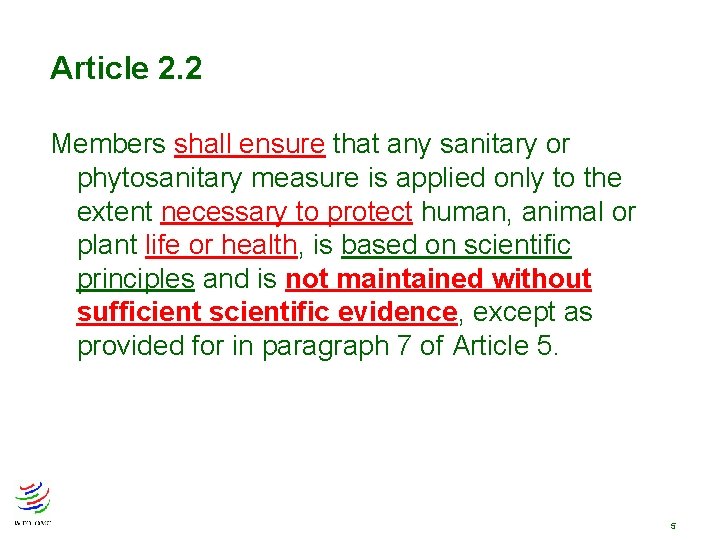
Article 2. 2 Members shall ensure that any sanitary or phytosanitary measure is applied only to the extent necessary to protect human, animal or plant life or health, is based on scientific principles and is not maintained without sufficient scientific evidence, except as provided for in paragraph 7 of Article 5. 5
Article 2. 3 • Members shall ensure that their sanitary and phytosanitary measures do not arbitrarily or unjustifiably discriminate between Members where identical or similar conditions prevail, including between their own territory and that of other Members. Sanitary and phytosanitary measures shall not be applied in a manner which would constitute a disguised restriction on international trade. 6
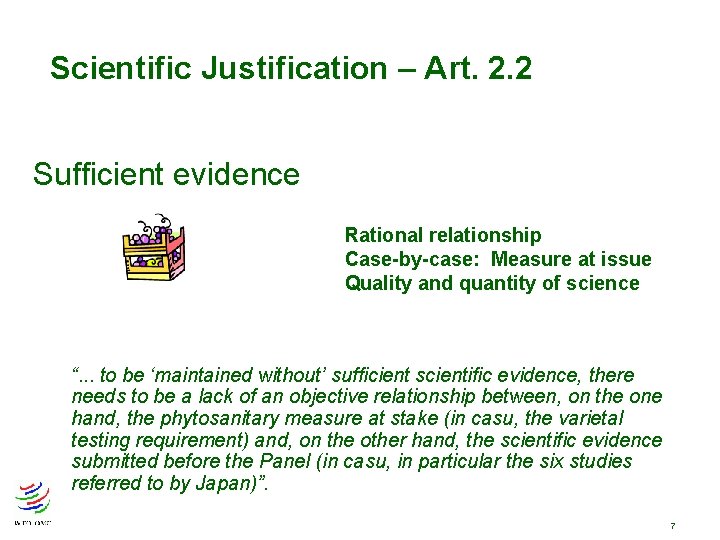
Scientific Justification – Art. 2. 2 Sufficient evidence Rational relationship Case-by-case: Measure at issue Quality and quantity of science “. . . to be ‘maintained without’ sufficient scientific evidence, there needs to be a lack of an objective relationship between, on the one hand, the phytosanitary measure at stake (in casu, the varietal testing requirement) and, on the other hand, the scientific evidence submitted before the Panel (in casu, in particular the six studies referred to by Japan)”. 7
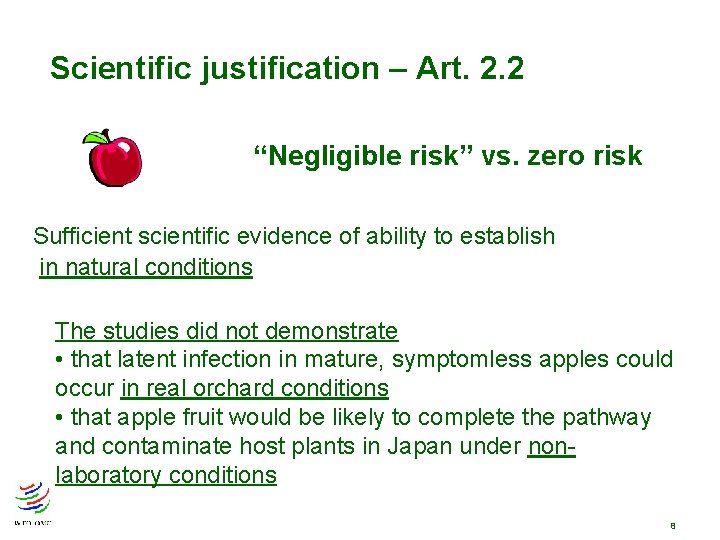
Scientific justification – Art. 2. 2 “Negligible risk” vs. zero risk Sufficient scientific evidence of ability to establish in natural conditions The studies did not demonstrate • that latent infection in mature, symptomless apples could occur in real orchard conditions • that apple fruit would be likely to complete the pathway and contaminate host plants in Japan under nonlaboratory conditions 8
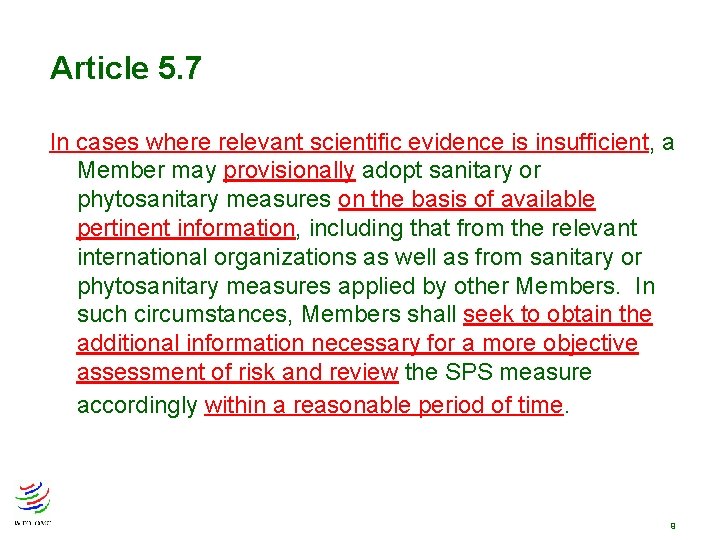
Article 5. 7 In cases where relevant scientific evidence is insufficient, a Member may provisionally adopt sanitary or phytosanitary measures on the basis of available pertinent information, including that from the relevant international organizations as well as from sanitary or phytosanitary measures applied by other Members. In such circumstances, Members shall seek to obtain the additional information necessary for a more objective assessment of risk and review the SPS measure accordingly within a reasonable period of time. 9
Hormones – Precautionary principle • The EC did not invoke Article 5. 7 - import prohibition was not a provisional measure • The EC invoked the “precautionary principle” as a general principle of law and argued that Articles 5. 1 and 5. 2 did not prevent Members from being cautious when setting health standards in the face of conflicting scientific evidence and uncertainty. • Precautionary principle does not override obligation to base measure on risk assessment; precautionary principle reflected in SPS Art. 5. 7 11
Varietals – Article 5. 7 4 Cumulative requirements in order to use Art. 5. 7 Members may provisionally adopt SPS measures only ü when relevant scientific information is insufficient ü on the basis of available information In such circumstances, Members must ü seek to obtain additional information to assess risk ü review the measure within a reasonable period of time 12
Varietals – Article 5. 7 Measure not justified as provisional measure under Art. 5. 7 • • Japan did not actively seek more scientific evidence in order to do risk assessment Did not revise measure within “reasonable period of time” (5 years since entry into force of SPS Agreement) 13
Apples – Article 5. 7 Not justified as a provisional measure (Art. 5. 7) • Sufficient scientific evidence exists to do risk assessment • Scientific uncertainty does not justify measure under Art. 5. 7 14
GMOs – Article 5. 7 EC member State bans Art. 5. 7 inapplicable • Sufficient scientific evidence exists for EC risk assessments • ALOP does not determine sufficiency of evidence • Need evidence that was once sufficient evidence is now insufficient 15
Discussions in the Committee • “reasonable” test – if disease outbreak, new situation, etc (BSE, AI) • Emergency measures not based on international standards • Excessive reactions • Emergency measures maintained despite sufficient evidence 16
Key Provisions of the SPS Agreement 1. Non-discrimination 2. Scientific justification • harmonization • risk assessment • consistency • least trade-restrictiveness 3. Equivalence 4. Regionalization 5. Transparency 6. Technical assistance/special treatment 7. Control, inspection and approval procedures – Who sets agenda? – Developing country participation? – Minimum vs. maximum requirements – How long? – Right to exceed …. 17
Article 3. 1 To harmonize sanitary and phytosanitary measures on as wide a basis as possible, Members shall base their sanitary or phytosanitary measures on international standards, guidelines or recommendations, where they exist, except as otherwise provided for in this Agreement, and in particular in paragraph 3. 18
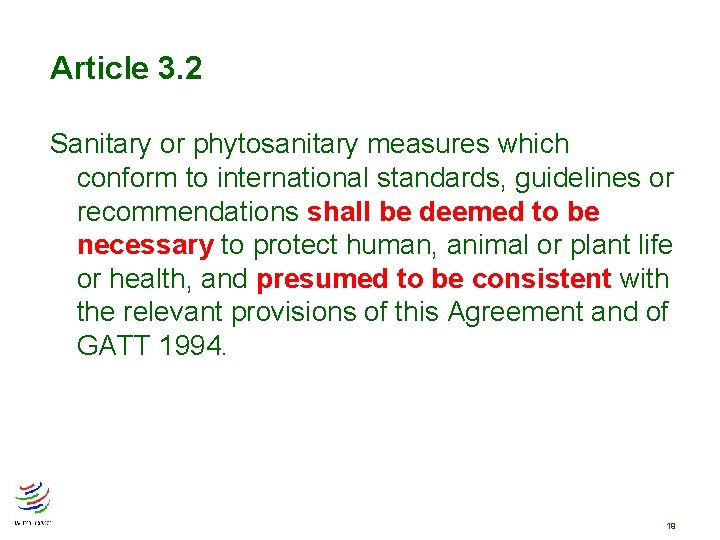
Article 3. 2 Sanitary or phytosanitary measures which conform to international standards, guidelines or recommendations shall be deemed to be necessary to protect human, animal or plant life or health, and presumed to be consistent with the relevant provisions of this Agreement and of GATT 1994. 19
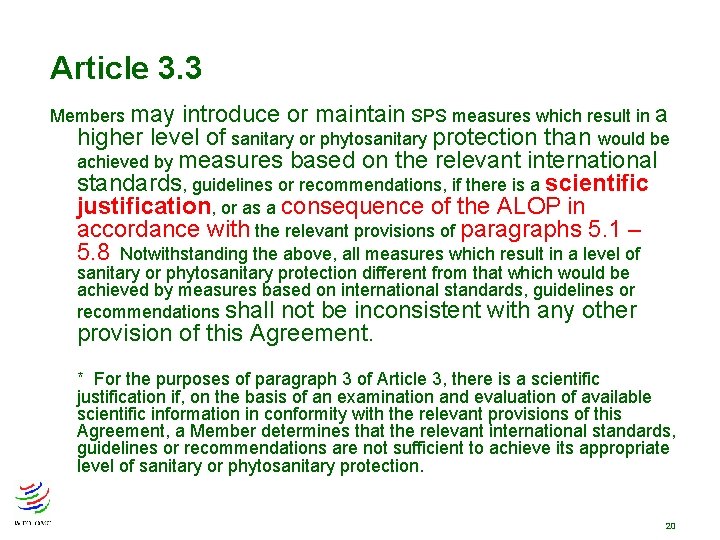
Article 3. 3 Members may introduce or maintain SPS measures which result in a higher level of sanitary or phytosanitary protection than would be achieved by measures based on the relevant international standards, guidelines or recommendations, if there is a scientific justification, or as a consequence of the ALOP in accordance with the relevant provisions of paragraphs 5. 1 – 5. 8 Notwithstanding the above, all measures which result in a level of sanitary or phytosanitary protection different from that which would be achieved by measures based on international standards, guidelines or recommendations shall not be inconsistent with any other provision of this Agreement. * For the purposes of paragraph 3 of Article 3, there is a scientific justification if, on the basis of an examination and evaluation of available scientific information in conformity with the relevant provisions of this Agreement, a Member determines that the relevant international standards, guidelines or recommendations are not sufficient to achieve its appropriate level of sanitary or phytosanitary protection. 20
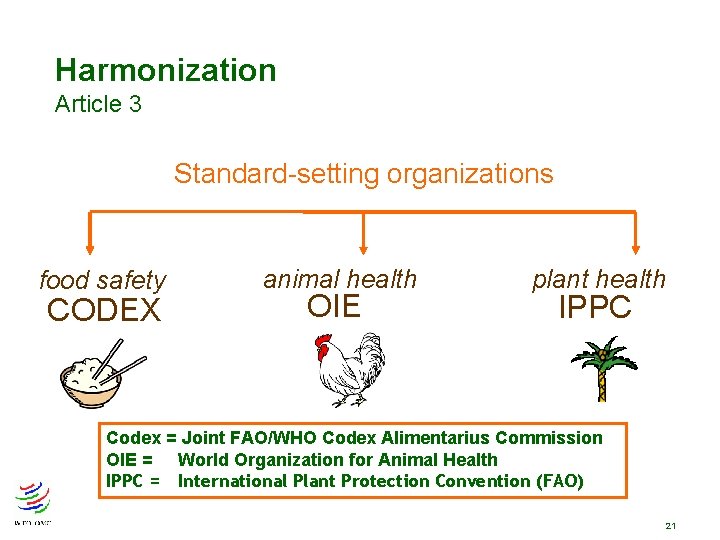
Harmonization Article 3 Standard-setting organizations food safety CODEX animal health OIE plant health IPPC Codex = Joint FAO/WHO Codex Alimentarius Commission OIE = World Organization for Animal Health IPPC = International Plant Protection Convention (FAO) 21
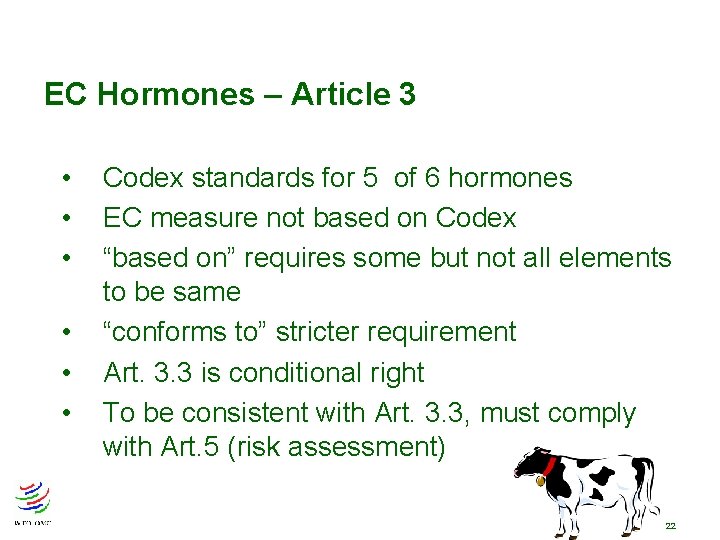
EC Hormones – Article 3 • • • Codex standards for 5 of 6 hormones EC measure not based on Codex “based on” requires some but not all elements to be same “conforms to” stricter requirement Art. 3. 3 is conditional right To be consistent with Art. 3. 3, must comply with Art. 5 (risk assessment) 22
Harmonization — Monitoring G/SPS/11/Rev. 1 • Aim of encouraging Members to use international standards • Identifying where there is a major impact on trade resulting from the non-use of standards • Help to understand when an international standard, guideline or recommendation is needed by: – Identifying the required international standard – Information from Members on their use or non-use of the identified standards, guidelines or recommendations 23
New Notification Procedures Recommendation to notify all new or modified SPS measures, even when based on / conform to relevant international standards, guidelines or recommendations G/SPS/7/Rev. 3 – takes effect 1 December 2008 24
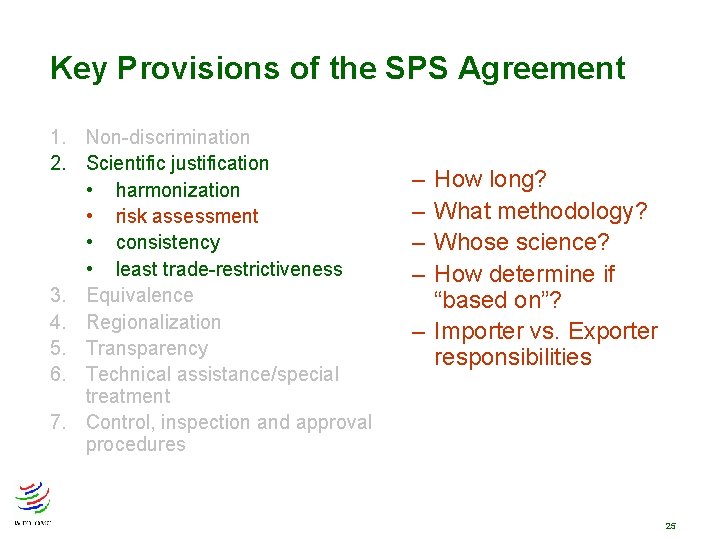
Key Provisions of the SPS Agreement 1. Non-discrimination 2. Scientific justification • harmonization • risk assessment • consistency • least trade-restrictiveness 3. Equivalence 4. Regionalization 5. Transparency 6. Technical assistance/special treatment 7. Control, inspection and approval procedures – – How long? What methodology? Whose science? How determine if “based on”? – Importer vs. Exporter responsibilities 25
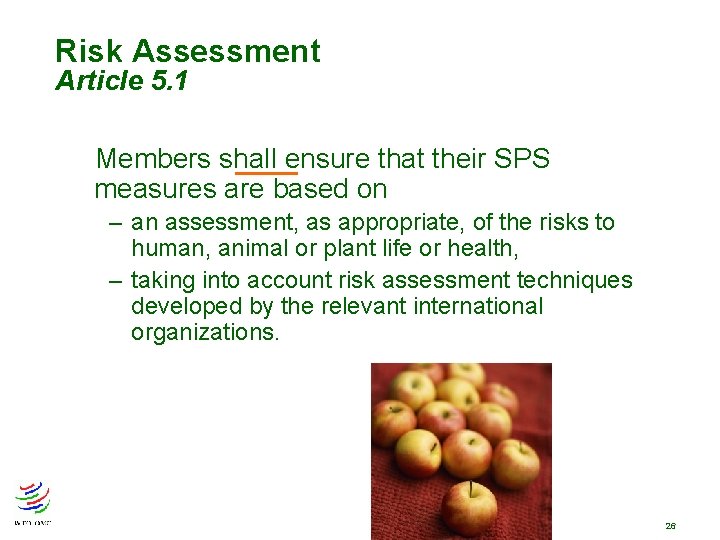
Risk Assessment Article 5. 1 Members shall ensure that their SPS measures are based on – an assessment, as appropriate, of the risks to human, animal or plant life or health, – taking into account risk assessment techniques developed by the relevant international organizations. 26
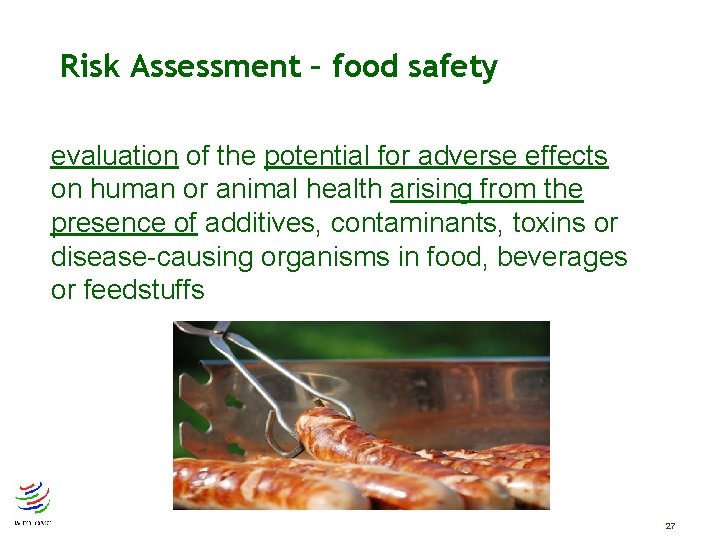
Risk Assessment – food safety evaluation of the potential for adverse effects on human or animal health arising from the presence of additives, contaminants, toxins or disease-causing organisms in food, beverages or feedstuffs 27
Risk assessment – plant / animal health The evaluation of the likelihood of entry, establishment or spread of a pest or disease within the territory of an importing Member according to the sanitary or phytosanitary measures which might be applied, and of the associated potential biological and economic consequences. 28
EC Hormones – risk assessment Measures not based on risk assessment (Art. 5. 1) • • “Based on” requires an objective and observable relationship between the measure and the risk assessment Quantitative or qualitative risk assessment ok Does not exclude factors that cannot be quantitatively assessed Risk assessments provided did not support prohibition 31
Salmon – risk assessment Measures not based on appropriate risk assessment (Art. 5. 1) • Identify the diseases which a Member wants to stop from entering • Evaluate the probability of entry, establishment and dissemination in the case of diseases • As a function of the SPS measures which could be applied. 32
Fire blight – risk assessment Measure not based on risk assessment (Art. 5. 1) • Risk assessment not specific to risk from imports of mature apples • Did not take into account possible risk mitigation measures 33
GMOs – risk assessment EC member State bans • Not supported by EC risk assessment • Not based on new risk assessments - did not evaluate likelihood of entry/ establishment / spread and potential consequences according to risk mitigation measures 34
Key Provisions of the SPS Agreement 1. Non-discrimination 2. Scientific justification • harmonization • risk assessment • consistency • least trade-restrictiveness 3. Equivalence 4. Regionalization 5. Transparency 6. Technical assistance/special treatment 7. Control, inspection and approval procedures – What ALOP? – How determine consistency? – Evolving science – Evolving consumer demands 35
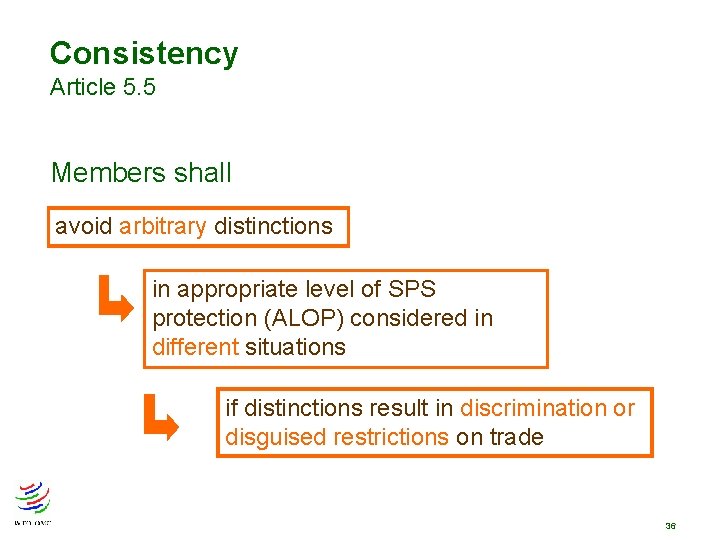
Consistency Article 5. 5 Members shall avoid arbitrary distinctions in appropriate level of SPS protection (ALOP) considered in different situations if distinctions result in discrimination or disguised restrictions on trade 36
Hormones – Article 5. 5 “Consistency” is objective, not obligation 3 requirements for violation of Article 5. 5 ● Different levels of protection in different (but comparable) situations ● Different levels are arbitrary or unjustified ● Differences result in discrimination or disguised restriction to trade 37
Hormones – Article 5. 5 Different treatment for: • administered natural hormones for growth promotion compared to those occurring endogenously in meat and other foods • synthetic hormones for growth promotion compared to natural hormones occurring endogenously in meat and other foods • hormones used for growth-promotion purposes and carbadox (anti-microbial growth-promoter used as a feed additive in swine production) 38
Salmon – Article 5. 5 No consistency in level of risk accepted (Art. 5. 5) Permitted importation of other products capable of transmitting some of the same diseases – e. g. , live bait fish, live ornamental fish 39
Consistency – Committee Guidelines (G/SPS/15) • Two parts: • A) Appropriate level of sanitary or phytosanitary protection (ALOP) • B) SPS Measures • Principal points: • Clear identification of the level of protection • Compare the level of protection / measure with • Previous decisions • International standards / other countries • Transparency and communication between agencies 40
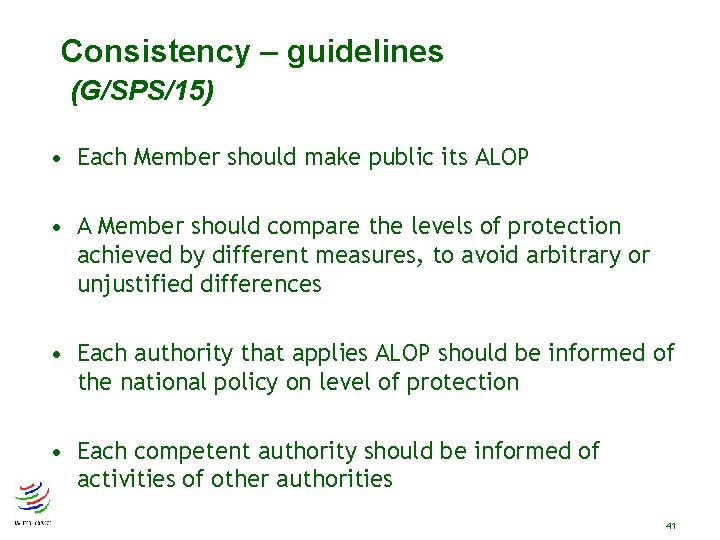
Consistency – guidelines (G/SPS/15) • Each Member should make public its ALOP • A Member should compare the levels of protection achieved by different measures, to avoid arbitrary or unjustified differences • Each authority that applies ALOP should be informed of the national policy on level of protection • Each competent authority should be informed of activities of other authorities 41
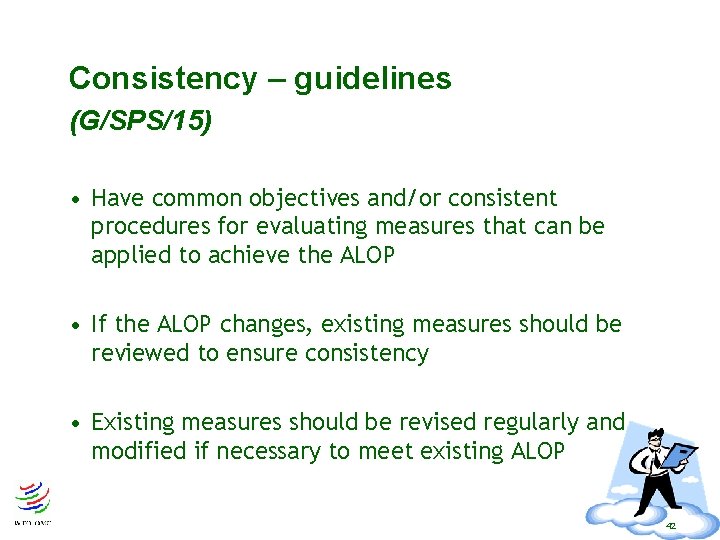
Consistency – guidelines (G/SPS/15) • Have common objectives and/or consistent procedures for evaluating measures that can be applied to achieve the ALOP • If the ALOP changes, existing measures should be reviewed to ensure consistency • Existing measures should be revised regularly and modified if necessary to meet existing ALOP 42
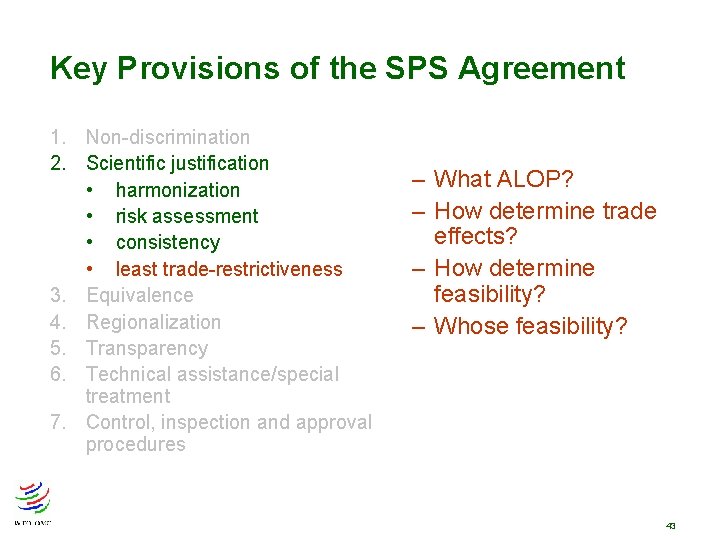
Key Provisions of the SPS Agreement 1. Non-discrimination 2. Scientific justification • harmonization • risk assessment • consistency • least trade-restrictiveness 3. Equivalence 4. Regionalization 5. Transparency 6. Technical assistance/special treatment 7. Control, inspection and approval procedures – What ALOP? – How determine trade effects? – How determine feasibility? – Whose feasibility? 43
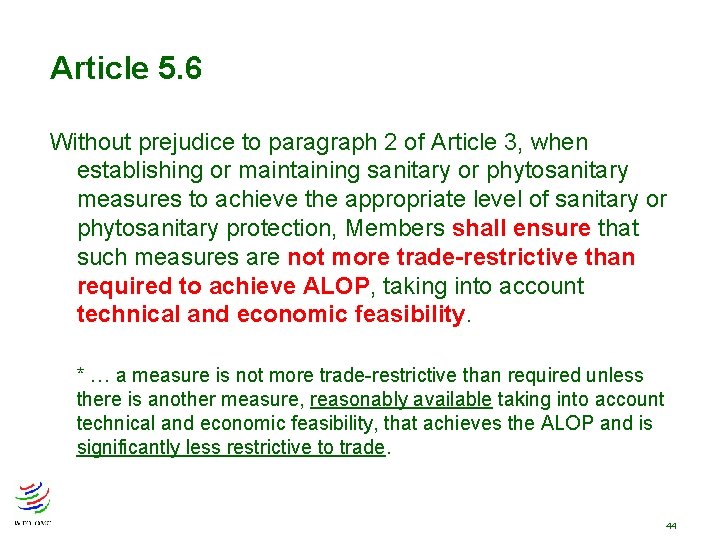
Article 5. 6 Without prejudice to paragraph 2 of Article 3, when establishing or maintaining sanitary or phytosanitary measures to achieve the appropriate level of sanitary or phytosanitary protection, Members shall ensure that such measures are not more trade-restrictive than required to achieve ALOP, taking into account technical and economic feasibility. * … a measure is not more trade-restrictive than required unless there is another measure, reasonably available taking into account technical and economic feasibility, that achieves the ALOP and is significantly less restrictive to trade. 44
Salmon 21. 5 – Article 5. 6 “Consumer ready” requirement – packages of less than 450 g. • More trade restrictive than necessary (Art. 5. 6) 45
Fire blight – Article 5. 6 More trade restrictive than necessary (Art. 5. 6) proposed alternative SPS measure - requiring that only mature, symptomless apples be exported - was • reasonably available; • achieved Japan's ALOP; and • significantly less restrictive to trade 46
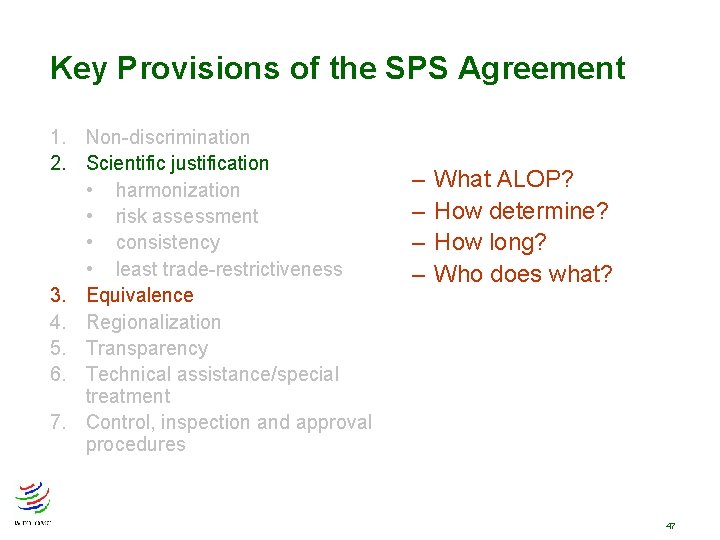
Key Provisions of the SPS Agreement 1. Non-discrimination 2. Scientific justification • harmonization • risk assessment • consistency • least trade-restrictiveness 3. Equivalence 4. Regionalization 5. Transparency 6. Technical assistance/special treatment 7. Control, inspection and approval procedures – – What ALOP? How determine? How long? Who does what? 47
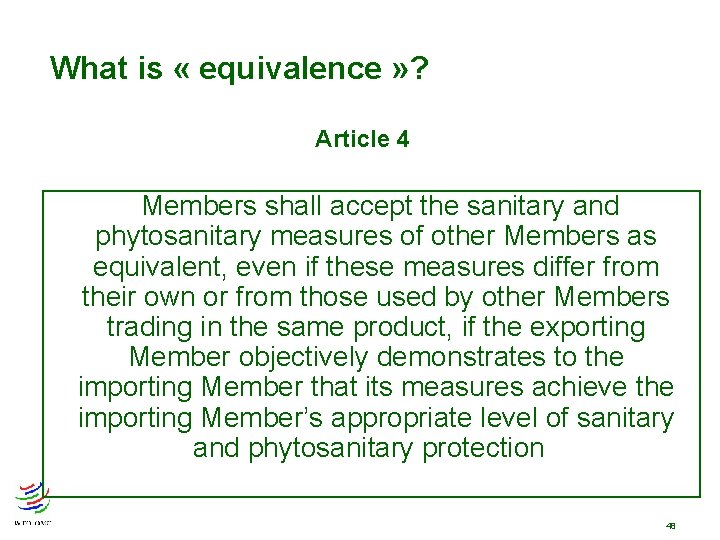
What is « equivalence » ? Article 4 Members shall accept the sanitary and phytosanitary measures of other Members as equivalent, even if these measures differ from their own or from those used by other Members trading in the same product, if the exporting Member objectively demonstrates to the importing Member that its measures achieve the importing Member’s appropriate level of sanitary and phytosanitary protection 48
What is « equivalence » ? • Legal terms - Article 4 • In practice – ? 49
Equivalence – in practice • How determine if another measure / process / product is equally safe? – Is aging equivalent to pasteurization re: cheese safety? – Can cold treatment replace fumigation? – Can vaccination ensure disease freedom? • What is the ALOP (acceptable risk level)? 50
Equivalence – Committee Guidelines (G/SPS/19/Rev. 2) • Can be requested for individual measures / products or whole systems • Importing country should identify risks and explain its ALOP • Importing country should provide its risk assessment or technical justification for its own measure • Respond to requests within 6 months 51
Equivalence – Committee Guidelines (G/SPS/19/Rev. 2) • Take into account current history of trade • Provide technical assistance to developing countries who request recognition of equivalence • Notify SPS Committee when equivalence is recognized • SPS Committee to follow recognition agreements, bilateral arrangements • Encourage Codex, OIE and IPPC to develop guidelines for equivalence 52
Equivalence - Notifications Two notifications so far: • Dominican Republic – USA • Panama – United States 53
Key Provisions of the SPS Agreement 1. Non-discrimination 2. Scientific justification • harmonization • risk assessment • consistency • least trade-restrictiveness 3. Equivalence 4. Regionalization 5. Transparency 6. Technical assistance/special treatment 7. Control, inspection and approval procedures – – How define? How determine? How long? Who does what? 54
Regionalization • Adapt measures to a region – All or part of a country – All or part of several countries – Taking into account eradication and control programmes • Prevalence of pests of diseases – Pest / disease-free zonas or areas of low prevalence • Exporter to provide evidence – Reasonable access for inspection by importer 55
Article 6. 1 Members shall ensure that their sanitary or phytosanitary measures are adapted to the SPS characteristics of the area - whether all of a country, part of a country, or all or parts of several countries - from which the product originated and to which the product is destined. In assessing the sanitary or phytosanitary characteristics of a region, Members shall take into account, inter alia, the level of prevalence of specific diseases or pests, the existence of eradication or control programmes, and appropriate criteria or guidelines which may be developed by the relevant international organizations. 56
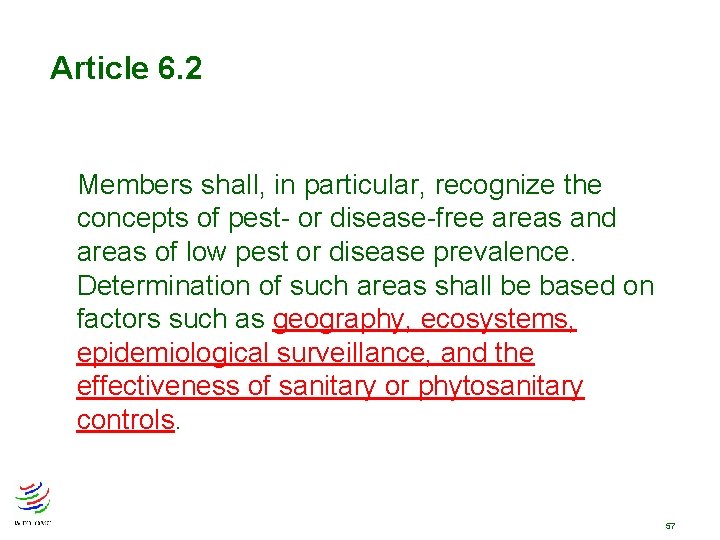
Article 6. 2 Members shall, in particular, recognize the concepts of pest- or disease-free areas and areas of low pest or disease prevalence. Determination of such areas shall be based on factors such as geography, ecosystems, epidemiological surveillance, and the effectiveness of sanitary or phytosanitary controls. 57
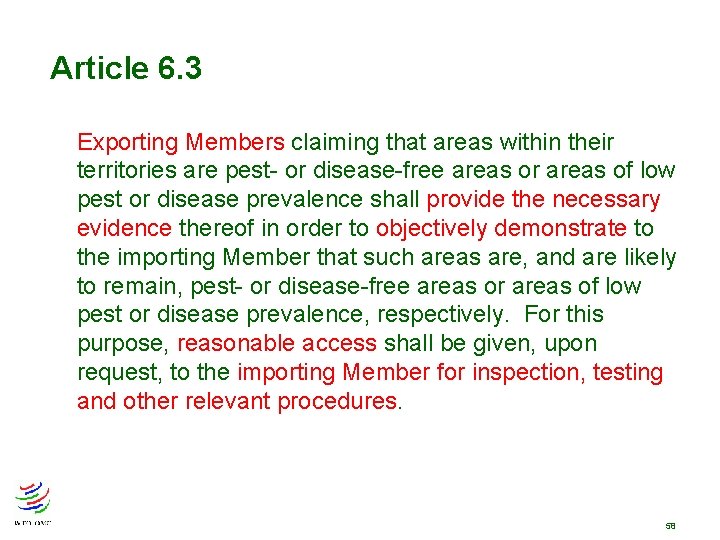
Article 6. 3 Exporting Members claiming that areas within their territories are pest- or disease-free areas or areas of low pest or disease prevalence shall provide the necessary evidence thereof in order to objectively demonstrate to the importing Member that such areas are, and are likely to remain, pest- or disease-free areas or areas of low pest or disease prevalence, respectively. For this purpose, reasonable access shall be given, upon request, to the importing Member for inspection, testing and other relevant procedures. 58
Regionalization – SPS Committee Guidelines adopted May 2008 - G/SPS/48 Objective of the guidelines: • Improve transparency, exchange of information, predictability, confidence and credibility between Importing and Exporting Members 59
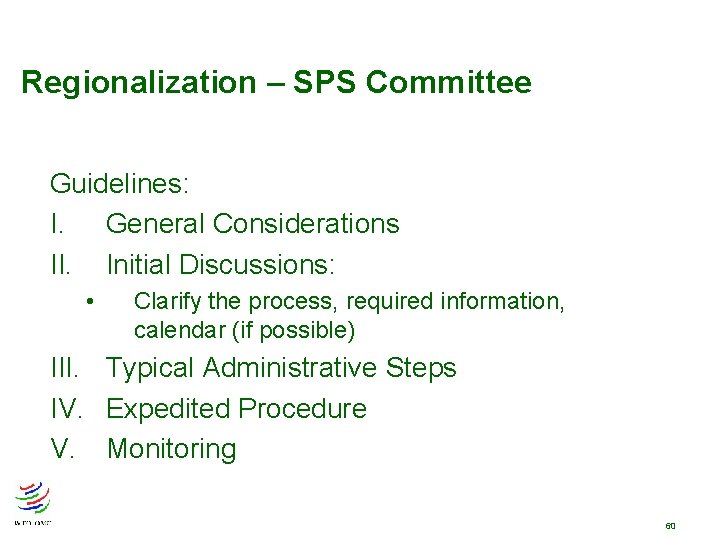
Regionalization – SPS Committee Guidelines: I. General Considerations II. Initial Discussions: • Clarify the process, required information, calendar (if possible) III. Typical Administrative Steps IV. Expedited Procedure V. Monitoring 60
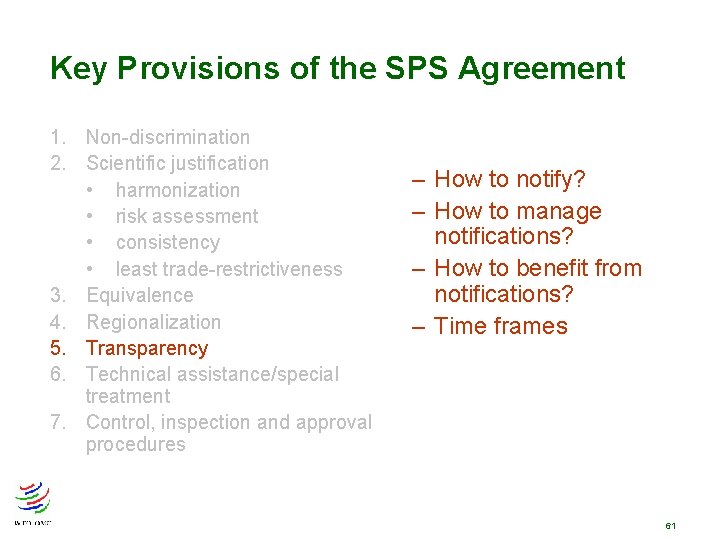
Key Provisions of the SPS Agreement 1. Non-discrimination 2. Scientific justification • harmonization • risk assessment • consistency • least trade-restrictiveness 3. Equivalence 4. Regionalization 5. Transparency 6. Technical assistance/special treatment 7. Control, inspection and approval procedures – How to notify? – How to manage notifications? – How to benefit from notifications? – Time frames 61
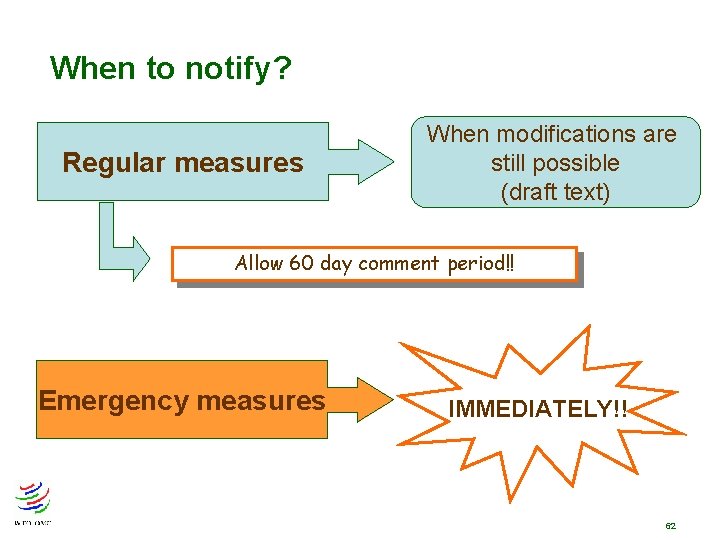
When to notify? Regular measures When modifications are still possible (draft text) Allow 60 day comment period!! Emergency measures IMMEDIATELY!! 62
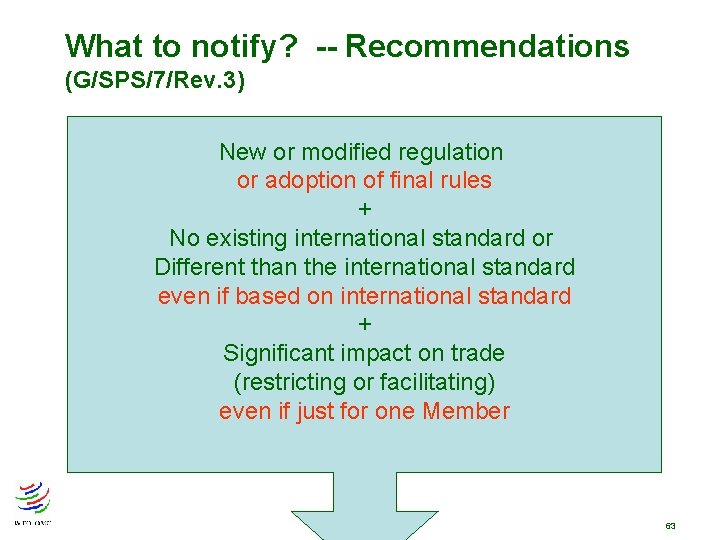
What to notify? -- Recommendations (G/SPS/7/Rev. 3) New or modified regulation or adoption of final rules + No existing international standard or Different than the international standard even if based on international standard + Significant impact on trade (restricting or facilitating) even if just for one Member 63
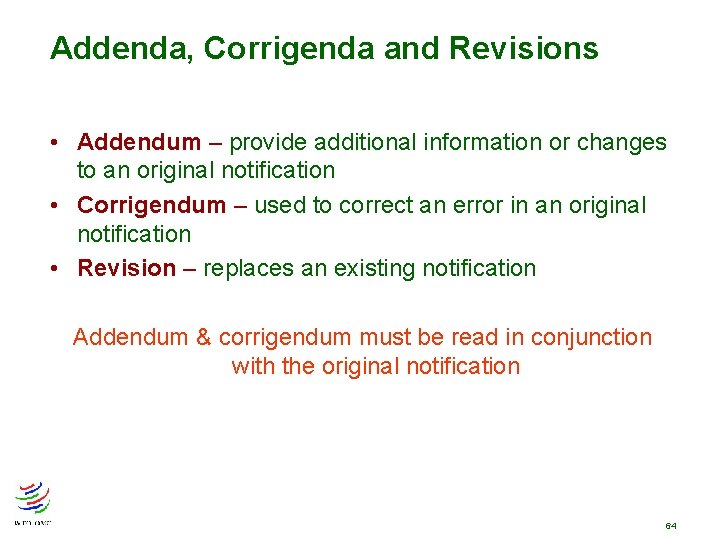
Addenda, Corrigenda and Revisions • Addendum – provide additional information or changes to an original notification • Corrigendum – used to correct an error in an original notification • Revision – replaces an existing notification Addendum & corrigendum must be read in conjunction with the original notification 64
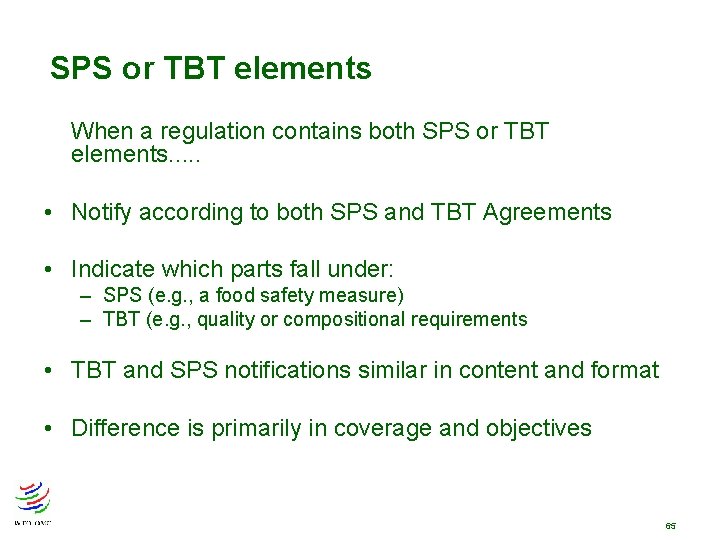
SPS or TBT elements When a regulation contains both SPS or TBT elements. . . • Notify according to both SPS and TBT Agreements • Indicate which parts fall under: – SPS (e. g. , a food safety measure) – TBT (e. g. , quality or compositional requirements • TBT and SPS notifications similar in content and format • Difference is primarily in coverage and objectives 65
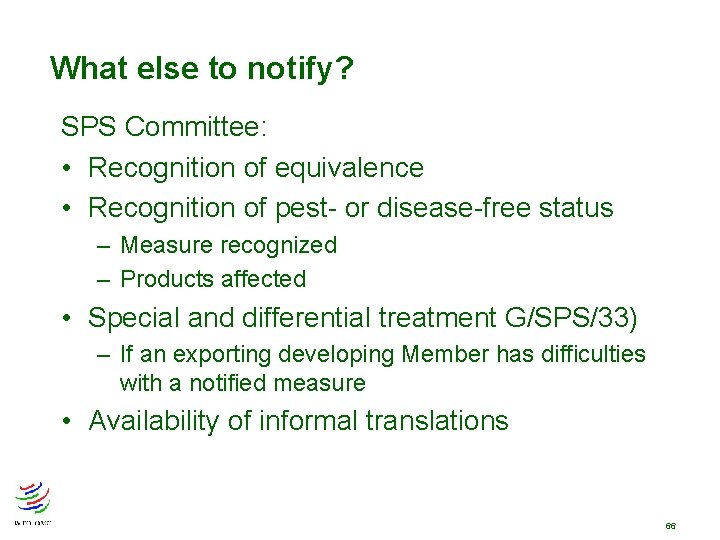
What else to notify? SPS Committee: • Recognition of equivalence • Recognition of pest- or disease-free status – Measure recognized – Products affected • Special and differential treatment G/SPS/33) – If an exporting developing Member has difficulties with a notified measure • Availability of informal translations 66
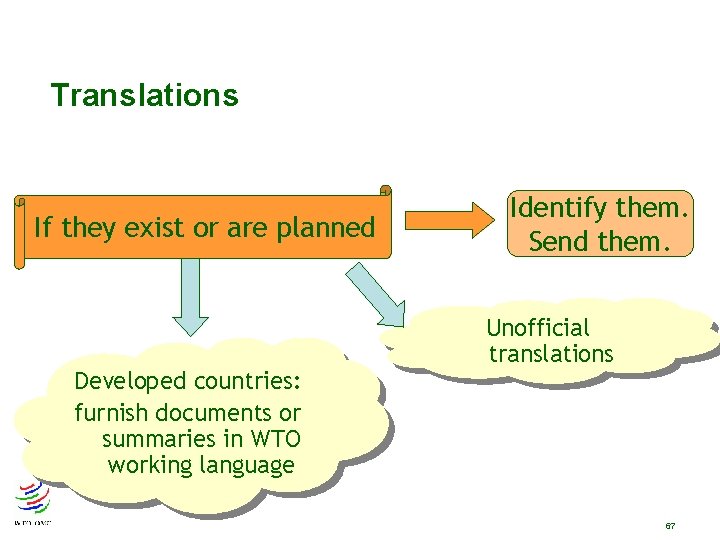
Translations If they exist or are planned Developed countries: furnish documents or summaries in WTO working language Identify them. Send them. Unofficial translations 67
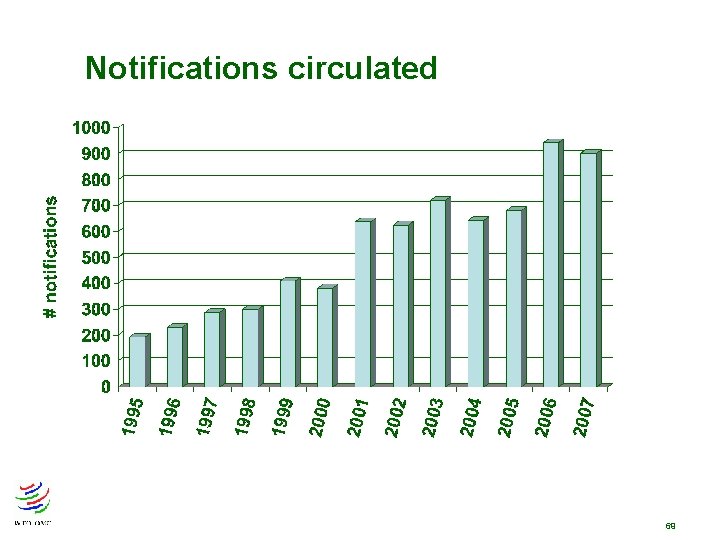
Notifications circulated 69
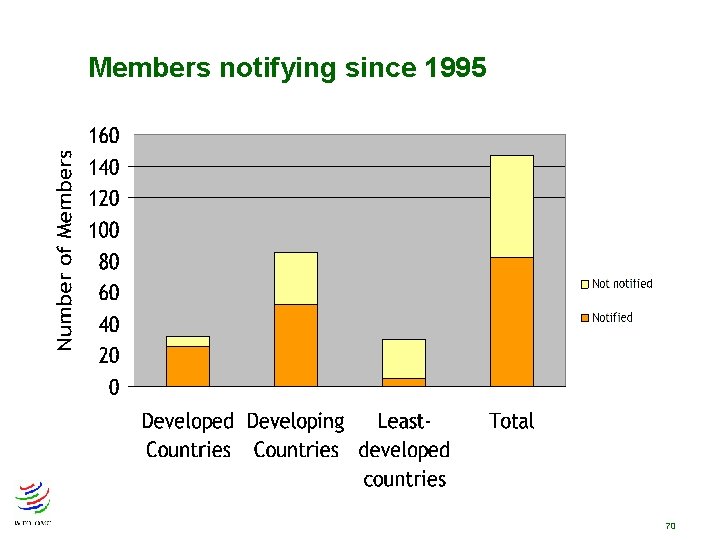
Members notifying since 1995 70
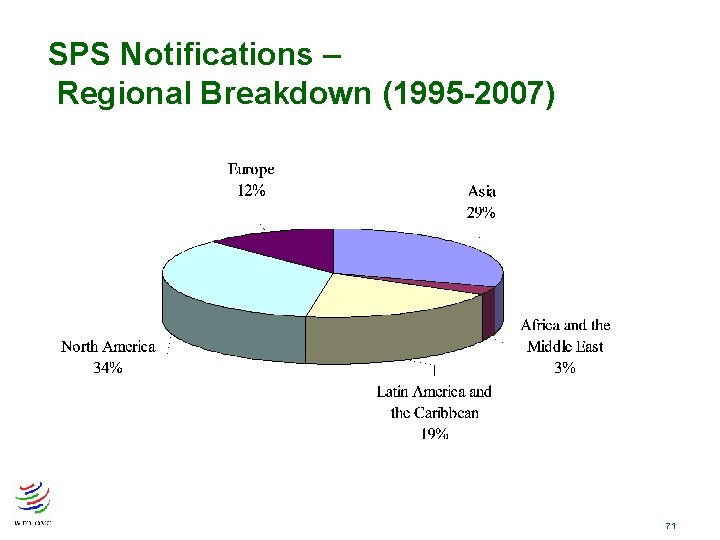
SPS Notifications – Regional Breakdown (1995 -2007) 71
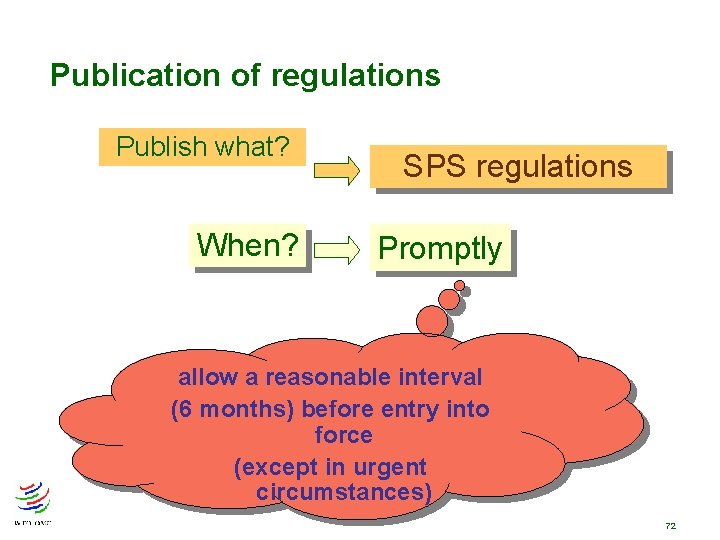
Publication of regulations Publish what? When? SPS regulations Promptly allow a reasonable interval (6 months) before entry into force (except in urgent circumstances) 72
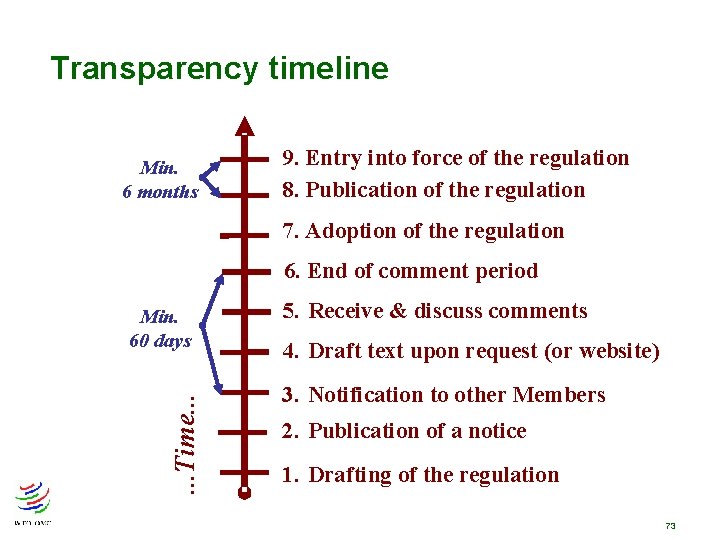
Transparency timeline Min. 6 months 9. Entry into force of the regulation 8. Publication of the regulation 7. Adoption of the regulation 6. End of comment period . . . Time. . . Min. 60 days 5. Receive & discuss comments 4. Draft text upon request (or website) 3. Notification to other Members 2. Publication of a notice 1. Drafting of the regulation 73
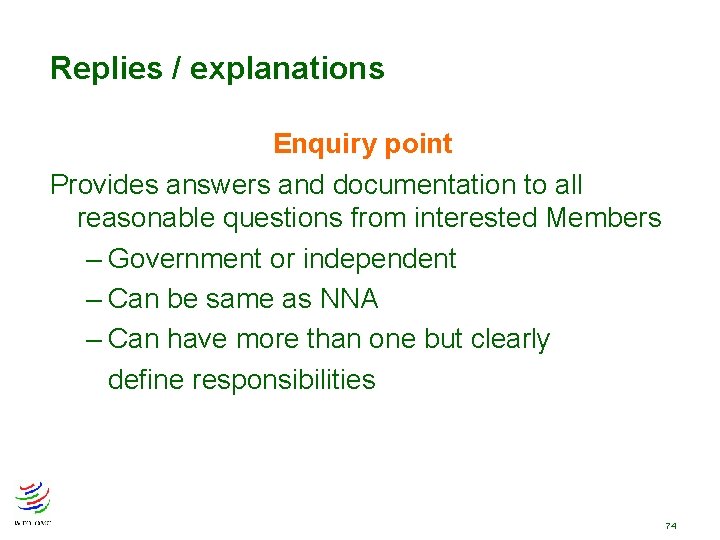
Replies / explanations Enquiry point Provides answers and documentation to all reasonable questions from interested Members – Government or independent – Can be same as NNA – Can have more than one but clearly define responsibilities 74
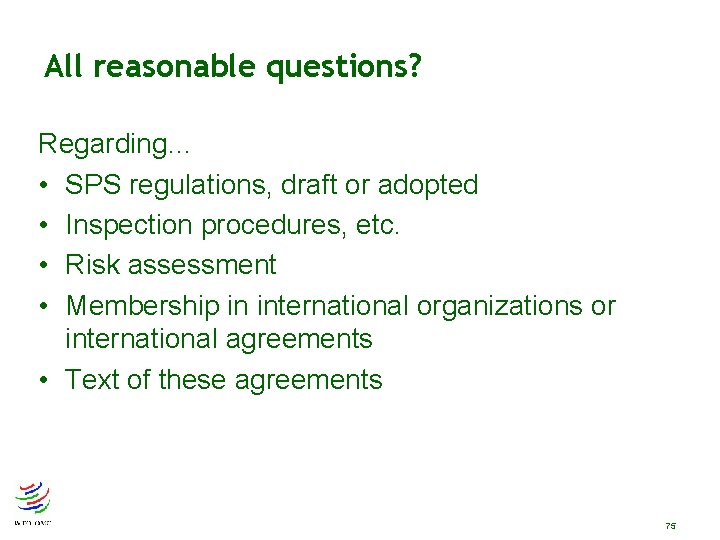
All reasonable questions? Regarding… • SPS regulations, draft or adopted • Inspection procedures, etc. • Risk assessment • Membership in international organizations or international agreements • Text of these agreements 75
Making it work • Resources need not be extensive • Existing infrastructure such as computer, photocopier, telephone, postal services, fax • Additional resources such as email and internet But more importantly 76
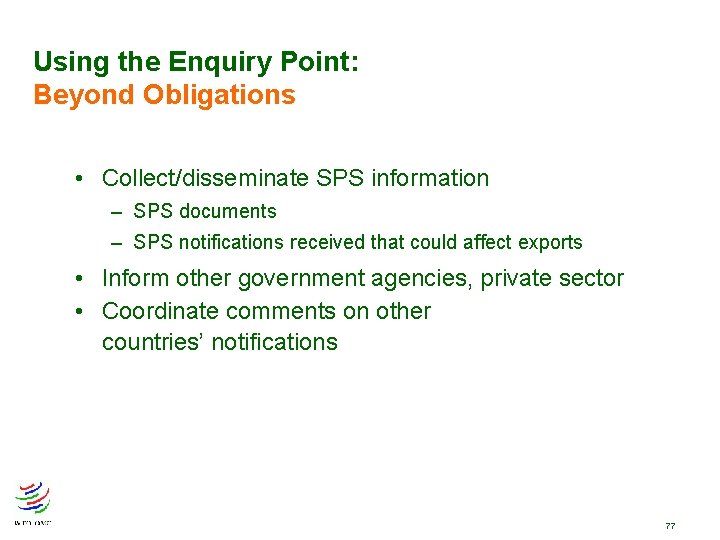
Using the Enquiry Point: Beyond Obligations • Collect/disseminate SPS information – SPS documents – SPS notifications received that could affect exports • Inform other government agencies, private sector • Coordinate comments on other countries’ notifications 77
Enquiry Point Other government bureaus Private sector Geneva mission OIE, Codex, and IPPC WTO Secretariat 78
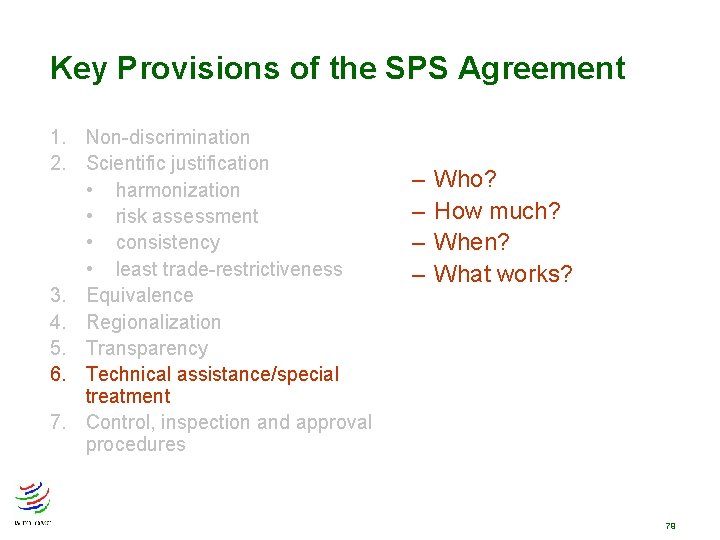
Key Provisions of the SPS Agreement 1. Non-discrimination 2. Scientific justification • harmonization • risk assessment • consistency • least trade-restrictiveness 3. Equivalence 4. Regionalization 5. Transparency 6. Technical assistance/special treatment 7. Control, inspection and approval procedures – – Who? How much? When? What works? 79
Technical Assistance on SPS Agreement (1) Article 9 Technical Assistance “Members agree to facilitate provision of TA…” – help countries comply with SPS measures • technology, research, infrastructure • advice, credits, donations, grants • technical expertise, training, equipment – help countries maintain and expand market access 80
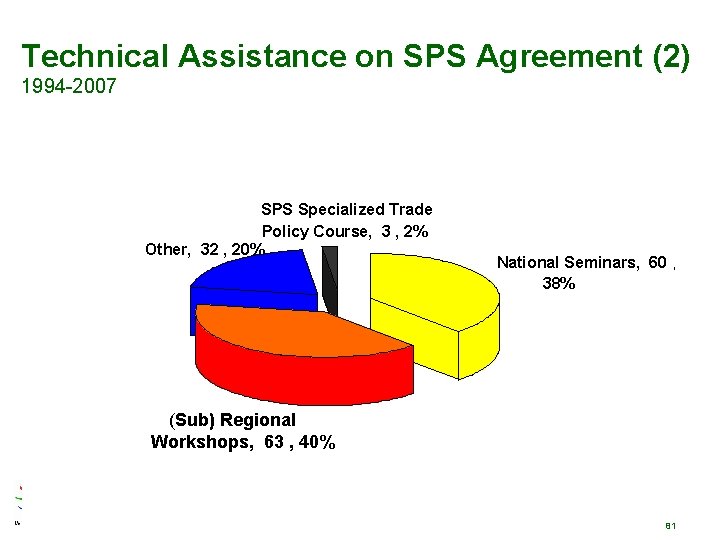
Technical Assistance on SPS Agreement (2) 1994 -2007 SPS Specialized Trade Policy Course, 3 , 2% Other, 32 , 20% National Seminars, 60 , 38% (Sub) Regional Workshops, 63 , 40% 81
Standards and Trade Development Facility (STDF) 82
Strategic aims • Enhancing the expertise and capacity of developing countries to analyze and implement SPS standards. • Acting as a vehicle for coordination in the provision and receipt of SPS-related technical cooperation. 83
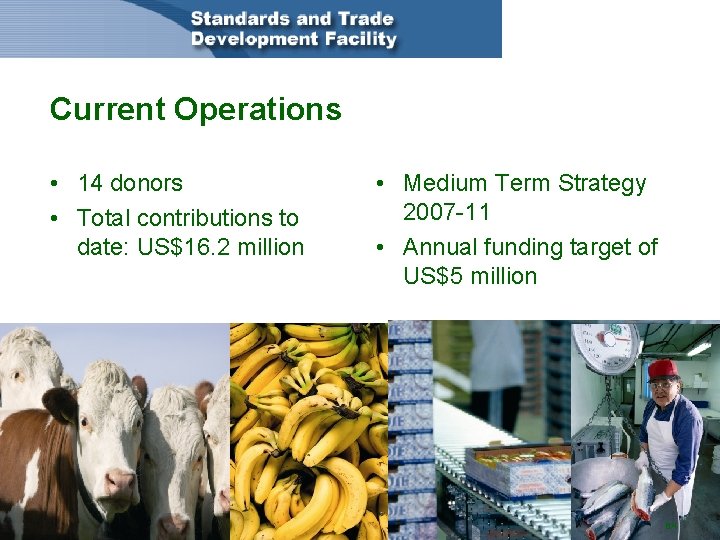
Current Operations • 14 donors • Total contributions to date: US$16. 2 million • Medium Term Strategy 2007 -11 • Annual funding target of US$5 million 84
For more information Standards and Trade Development Facility World Trade Organization Centre William Rappard Rue de Lausanne 154 CH-1211 Geneva Switzerland STDFSecretariat@wto. org www. standardsfacility. org 85
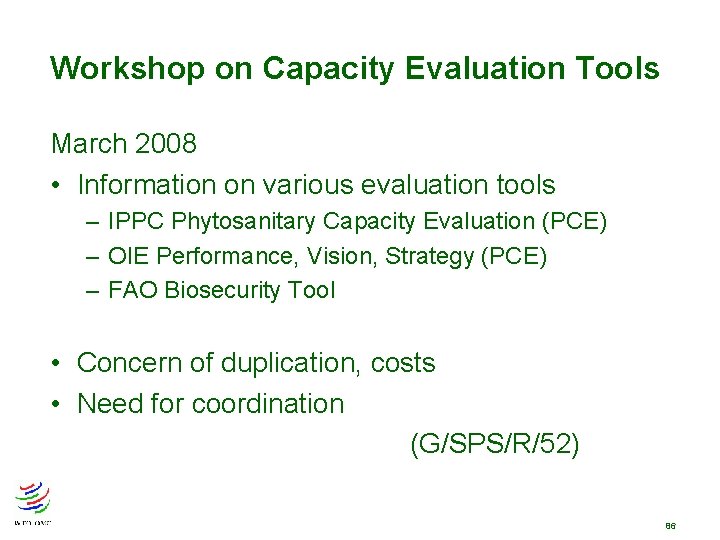
Workshop on Capacity Evaluation Tools March 2008 • Information on various evaluation tools – IPPC Phytosanitary Capacity Evaluation (PCE) – OIE Performance, Vision, Strategy (PCE) – FAO Biosecurity Tool • Concern of duplication, costs • Need for coordination (G/SPS/R/52) 86
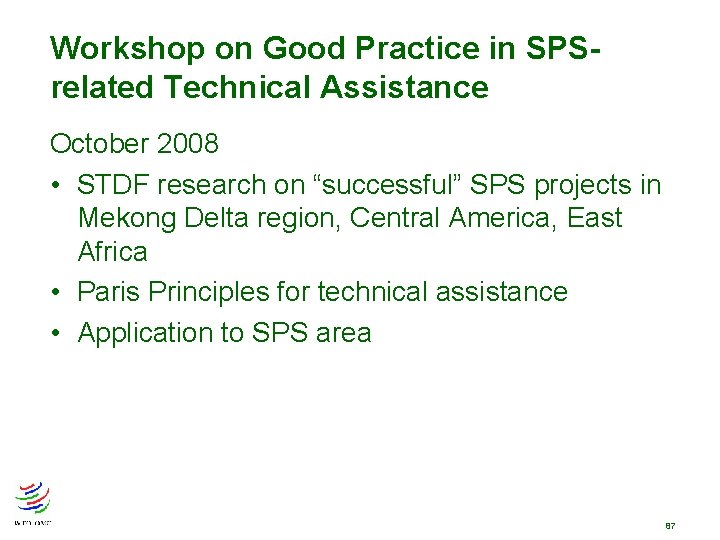
Workshop on Good Practice in SPSrelated Technical Assistance October 2008 • STDF research on “successful” SPS projects in Mekong Delta region, Central America, East Africa • Paris Principles for technical assistance • Application to SPS area 87
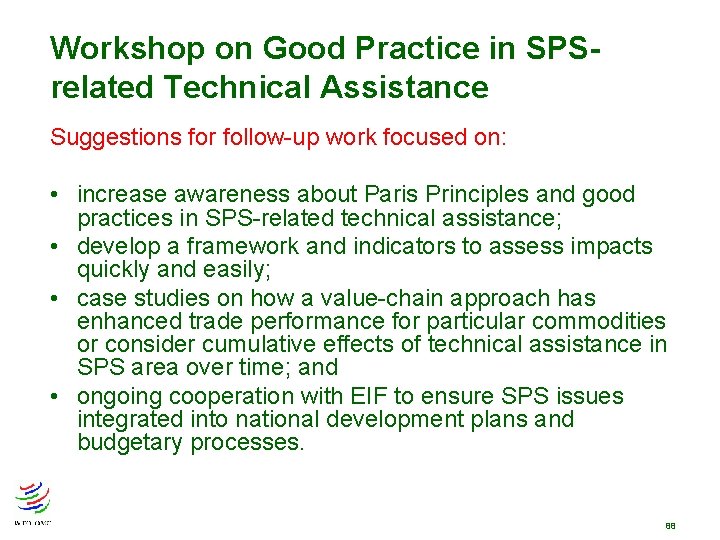
Workshop on Good Practice in SPSrelated Technical Assistance Suggestions for follow-up work focused on: • increase awareness about Paris Principles and good practices in SPS-related technical assistance; • develop a framework and indicators to assess impacts quickly and easily; • case studies on how a value-chain approach has enhanced trade performance for particular commodities or consider cumulative effects of technical assistance in SPS area over time; and • ongoing cooperation with EIF to ensure SPS issues integrated into national development plans and budgetary processes. 88
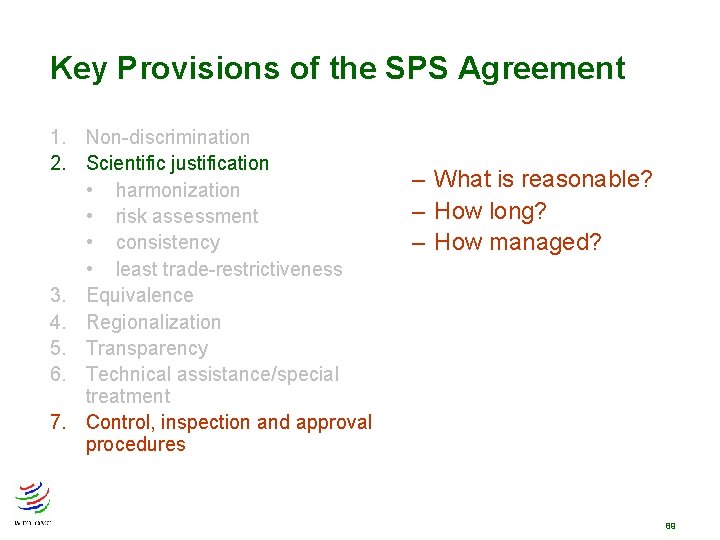
Key Provisions of the SPS Agreement 1. Non-discrimination 2. Scientific justification • harmonization • risk assessment • consistency • least trade-restrictiveness 3. Equivalence 4. Regionalization 5. Transparency 6. Technical assistance/special treatment 7. Control, inspection and approval procedures – What is reasonable? – How long? – How managed? 89
GMOs – Main conclusions • Protection of biodiversity – under SPS • Food allergens – under SPS • SPS measure: approval procedure – but existence of prior approval not challenged Moratorium – found to exist -- application of measure – violation of Annex C • No violation: Art. 2. 2, 2. 3, 5. 1, 5. 5, 5. 6, 7 90
GMOs – Main conclusions Product Specific Measures • Panel examined 27 specific applications • Failure to complete individual approval procedures without undue delay for 24 products • Violation: Article 8, Annex C (1) (a) • No violation: Articles 2. 2, 2. 3, 5. 1, 5. 5, 5. 6, 7 91
GMOs – not considered • If biotech products pose risk to health or environment • Right to have prior approval procedure • EC approval legislation • Conformity with Agreement on Technical Barriers to Trade • If biotech products are “like” conventional products 92