
The WTO Agreement on the Application of SPS
- Slides: 34
The WTO Agreement on the Application of SPS Measures Prof. Elisaveta Stikova M. D. , Ph. D. School of Medicine University “ St. Cyril and Methodius” – Skopje Republic of Macedonia
Why this lecture? z. Need for protection of human, animal and plant life and health, z. Food Safety as a public health priority, z. Need for harmonization of food legislation z. The influence of international recommendations on the national food legislation.
Learning Objectives: y. To introduce the students to the role of international standards, rules, guidelines and recommendations for the protection of human, animal and plant life and health.
Performance Objectives: z. Definition of Sanitary and Phytosanitary (SPS) Measures z. Harmonization of legislation, z. Risk Assessment, z. Appropriate level of SPS measures, z. Transparency.
SPS Agreement, Article 2. 1. All countries have rights to take Sanitary and Phytosanitary (SPS) Measures for protection of human, animal and plant life and health
International trade influences: z. Promotion of the economic development, z. Alleviation of poverty. SPS measures may influence on: zmany restrictions in international trade.
SPS measures: z. Must be based on scientific evidence and risk assessment z. Must not create any sort of unjustified barriers and z. Must not create any restrictions in international trade.
Definition of SPS Measures (1) To protect: yhuman or animal life From: z additives, z contaminants, z toxins z disease-causing organisms
Definition of an SPS Measures (2) To protect zhuman life From zplant-carried or zanimal-carried diseases (zoonoses)
Definition of an SPS Measures (3) To protect From zanimal or plant life zpests, zdiseases or zdisease-causing organisms
Definition of an SPS Measures (4) To protect za country From zdamage caused by the entry, establishment or spread of pests
An important footnote: z“animal” includes wild fauna, fish, z“plant” includes forests, wild flora z“pests” include weeds, z“contaminants” include pesticides, veterinary drug residues, extraneous matter.
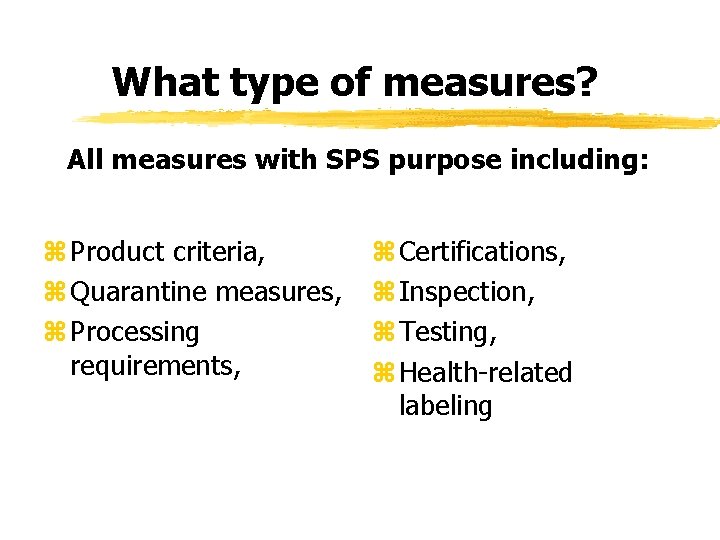
What type of measures? All measures with SPS purpose including: z Product criteria, z Quarantine measures, z Processing requirements, z Certifications, z Inspection, z Testing, z Health-related labeling
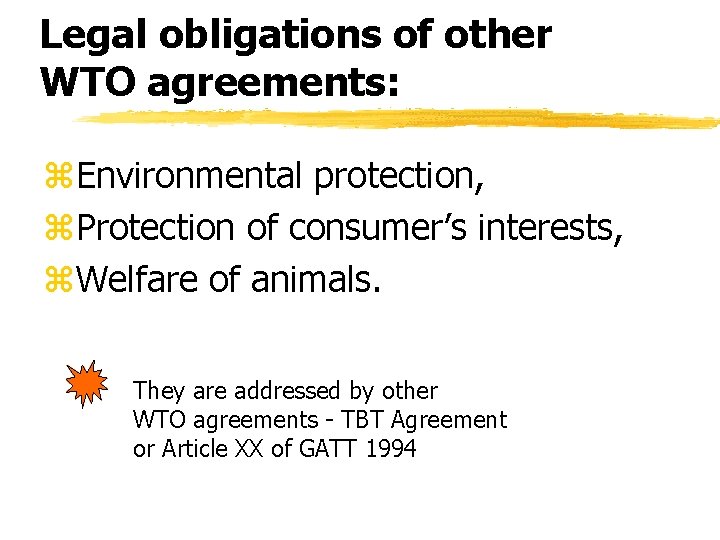
Legal obligations of other WTO agreements: z. Environmental protection, z. Protection of consumer’s interests, z. Welfare of animals. They are addressed by other WTO agreements - TBT Agreement or Article XX of GATT 1994
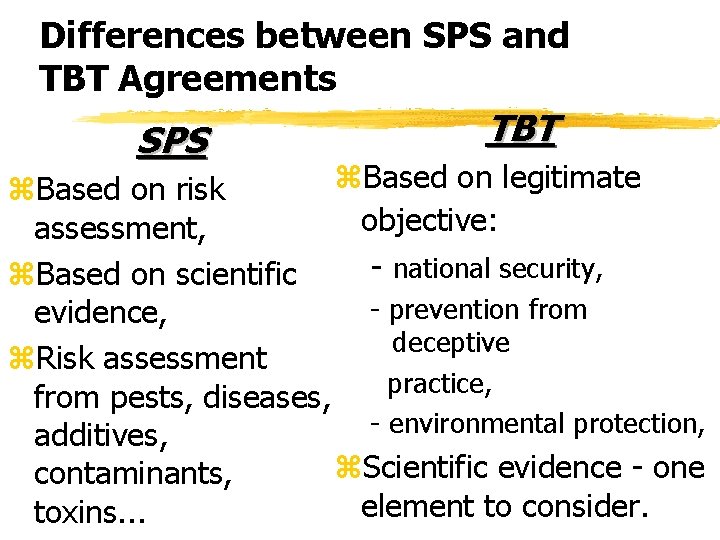
Differences between SPS and TBT Agreements SPS TBT z. Based on legitimate z. Based on risk objective: assessment, - national security, z. Based on scientific - prevention from evidence, deceptive z. Risk assessment practice, from pests, diseases, - environmental protection, additives, z. Scientific evidence - one contaminants, element to consider. toxins. . .
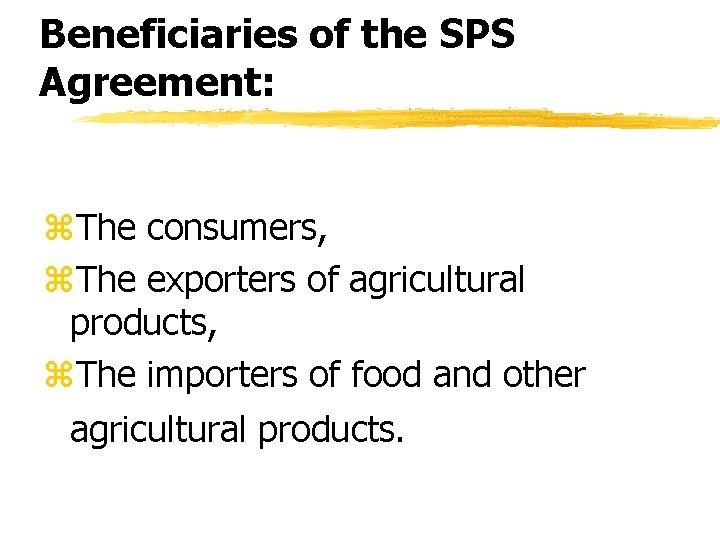
Beneficiaries of the SPS Agreement: z. The consumers, z. The exporters of agricultural products, z. The importers of food and other agricultural products.
The SPS Agreement helps: (1) z. To ensure that consumers are being supplied with safe food to eat – “safe” by the appropriate standards, z. To ensure that safety regulations are not being used as an excuse for protection of domestic producers.
The SPS Agreement helps: (2) z. To eliminate the unnecessary and unjustified trade barriers, z. To support international competition among producers regarding safer and healthier food production, z. To provide greater choice of safe foods for consumers on the market,
The SPS Agreement helps: (3) z. To increase the amount of available information for consumers as a result of greater transparency in governmental procedures, z. To increase the amount of available information for importers and to eliminate unjustified border measures.
Key Principles of SPS Measures: z. Harmonization, z. Risk assessment, z. Appropriate level of protection, z. Regional conditions, z. Transparency.
Harmonization (1) Harmonization means: z. Establishment, z. Recognition and z. Application of Common SPS measures by different countries.
Harmonization (1) Harmonization means: z. Establishment, z. Recognition and z. Application of common SPS measures by different countries.
Harmonization (2) The SPS Agreement identifies 3 International organizations responsible for harmonization and standard setting.
Harmonization (3) The International Organizations are: z. Codex Alimentarius for food safety and human health, z. International Office of Epizootics for animal health and zoonoses, z. International Plant Protection Convention for plant health.
Risk assessment: (1) z. The evaluation of the likelihood of entry, establishment or spread of a pest or disease within the territory of an importing country according to association with potential biological or economic consequences;
Risk assessment: (2) z. The evaluation of the potential for adverse effects on human or animal health arising from the presence of additives, contaminants, toxins or disease-causing organisms in food, beverages or feedstuffs.
Appropriate level of sanitary or phytosanitary protection: z The level of protection deemed appropriate by the country establishing a sanitary or phytosanitary measure to protect human, animal or plant life or health within its territory. Many countries refer to this concept as the “acceptable level of risk”.
Pest- or disease-free area means: z. An area, whether all of a country, part of a country or all or parts of several countries, as identified by the competent authorities, in which a specific pest or disease does not occur.
Area of low pest or disease prevalence: z. An area, whether all of a country, part of a country, or all or parts of several countries, as identified by the competent authorities, in which a specific pest or disease occurs at low levels and which is subject to effective surveillance, control or eradication measures
Transparency (1): Achievement of greater degree of: z. Clarity, z. Predictability and z. Information regarding trade policy, rules and procedures of WTO
Transparency (2): There are three different fields of activities: y. Publishing regulations, y. Notifications, y. Information.
Enquiry points (1) An office designated to receive and respond to any requests for information regarding the country’s SPS measures.
Enquiry Points (2) Locations of the Enquiry Points at the WTO’s home page: http: //www. wto. org ”Documents on Line", search document symbol "SPS/ENQ/").
Committee on Sanitary and Phytosanitary Measures is: z. Forum for consultations about food safety or animal and plant health measures which affect trade, z. Support for the implementation of the SPS Agreement.