NUTRITION IN CHILDREN WHAT IS HEALTHY EATING Carissa





- Slides: 93
NUTRITION IN CHILDREN: WHAT IS HEALTHY EATING? Carissa Stanton, MD Clinical Assistant Professor University of Kansas Pediatrics
Disclosure • I have no relevant financial relationships with the manufacturers(s) of any commercial products(s) and/or provider of commercial services discussed in this CME activity • I do not intend to discuss an unapproved/investigative use of a commercial product/device in my presentation.
Objectives 1. Learn what is healthy eating based on the current clinical evidence 2. Apply nutrition knowledge to patient care during anticipatory guidance on healthy lifestyle 3. Improve patient’s lifestyle through healthy lifestyle changes
Overview • Problem • Barriers • What is Healthy eating? • Portion size • Nutrient dense • Meal choices • Macronutrients • Micronutrients • Industrialized food • Physical activity • Fruits/vegetables • Sugar • Applying to practice
The Problem • Childhood obesity is one of the most serious public health problems of the 21 st century • Childhood obesity has tripled in the last 3 decades • In 2012, approximately 31. 8% of children 2 -19 were overweight or obese in US • Today’s children may have a shorter lifespan their parents Ogden CL, Carroll MD, Kit BK, Flegal KM. Prevalence of childhood and adult obesity in the United States, 2011 -2012. Journal of the American Medical Association 2014; 311(8): 806 -814
Obesity: Definition • Obesity • Condition characterized by the excessive accumulation and storage of fat in the body • Body mass index (BMI) • Kilogram/meter 2 • Body weight adjusted for height • Screening tool that correlates with body fat and health risks • Children: Age and gender specific Kuczmarski RJ, et al. 2000 CDC growth charts for the United States: Methods and development. Vital Health Stat 2002; 246: 1 -190
Obesity: Definition • Normal weight BMI 5 -84% • Following own genetic curve • Overweight BMI 85 -94% • Most will have excess body fat • Some of high lean body mass • Obesity BMI >95% • Almost all have excess body fat • Severe obesity >99% • Proposed new category Barlow SE, et al. Expert committee recommendations regarding the prevention, assessment, and treatment of child and adolescent overweight and obesity: Summary report. Pediatrics 2007; 120: S 164 -192
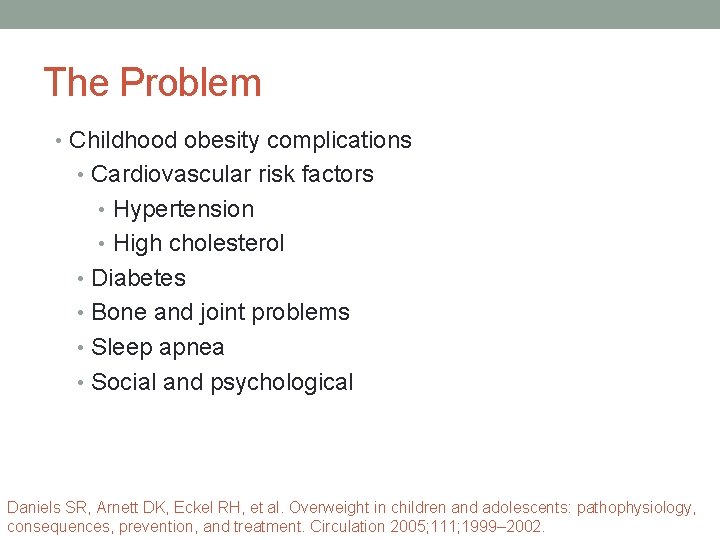
The Problem • Childhood obesity complications • Cardiovascular risk factors • Hypertension • High cholesterol • Diabetes • Bone and joint problems • Sleep apnea • Social and psychological Daniels SR, Arnett DK, Eckel RH, et al. Overweight in children and adolescents: pathophysiology, consequences, prevention, and treatment. Circulation 2005; 111; 1999– 2002.
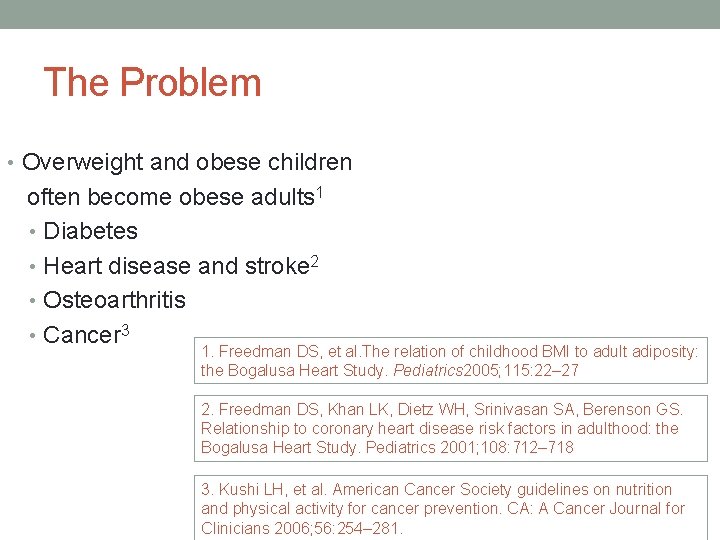
The Problem • Overweight and obese children often become obese adults 1 • Diabetes • Heart disease and stroke 2 • Osteoarthritis • Cancer 3 1. Freedman DS, et al. The relation of childhood BMI to adult adiposity: the Bogalusa Heart Study. Pediatrics 2005; 115: 22– 27 2. Freedman DS, Khan LK, Dietz WH, Srinivasan SA, Berenson GS. Relationship to coronary heart disease risk factors in adulthood: the Bogalusa Heart Study. Pediatrics 2001; 108: 712– 718 3. Kushi LH, et al. American Cancer Society guidelines on nutrition and physical activity for cancer prevention. CA: A Cancer Journal for Clinicians 2006; 56: 254– 281.
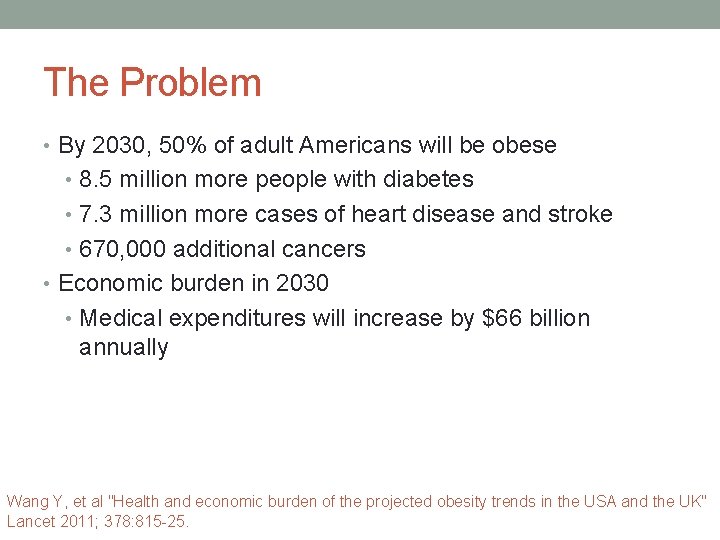
The Problem • By 2030, 50% of adult Americans will be obese • 8. 5 million more people with diabetes • 7. 3 million more cases of heart disease and stroke • 670, 000 additional cancers • Economic burden in 2030 • Medical expenditures will increase by $66 billion annually Wang Y, et al "Health and economic burden of the projected obesity trends in the USA and the UK" Lancet 2011; 378: 815 -25.
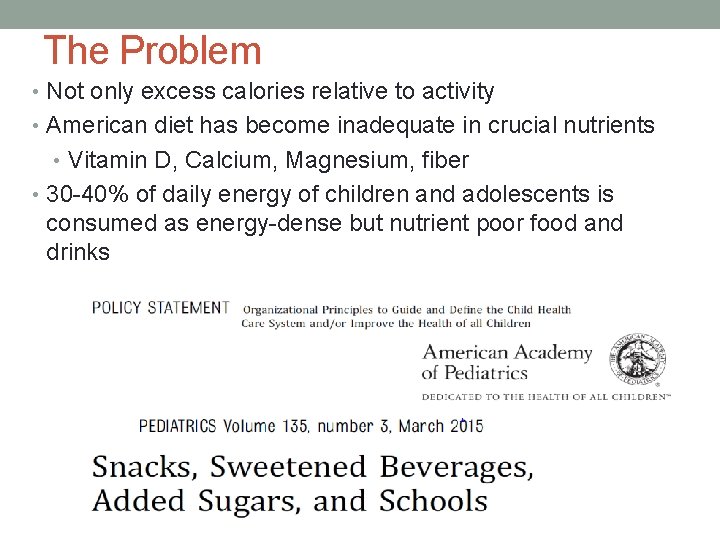
The Problem • Not only excess calories relative to activity • American diet has become inadequate in crucial nutrients • Vitamin D, Calcium, Magnesium, fiber • 30 -40% of daily energy of children and adolescents is consumed as energy-dense but nutrient poor food and drinks
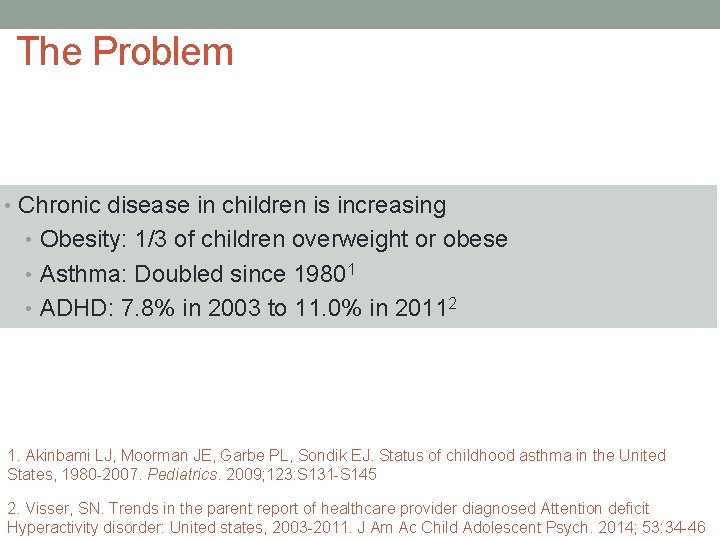
The Problem • Chronic disease in children is increasing • Obesity: 1/3 of children overweight or obese • Asthma: Doubled since 19801 • ADHD: 7. 8% in 2003 to 11. 0% in 20112 1. Akinbami LJ, Moorman JE, Garbe PL, Sondik EJ. Status of childhood asthma in the United States, 1980 -2007. Pediatrics. 2009; 123: S 131 -S 145 2. Visser, SN. Trends in the parent report of healthcare provider diagnosed Attention deficit Hyperactivity disorder: United states, 2003 -2011. J Am Ac Child Adolescent Psych. 2014; 53: 34 -46
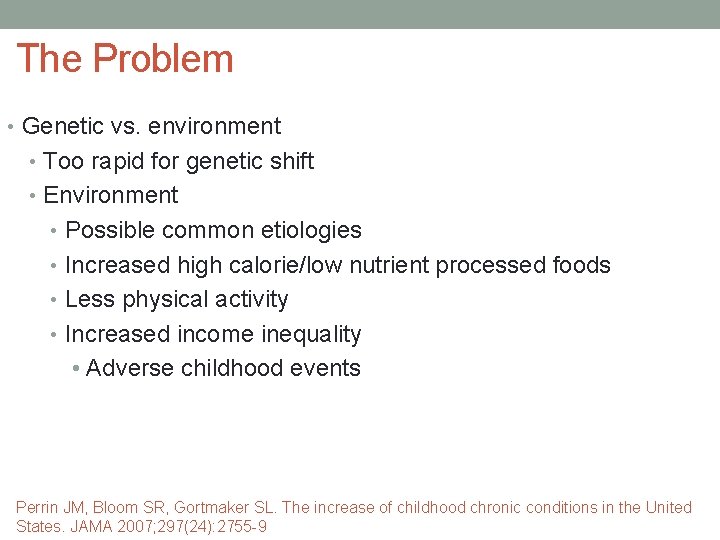
The Problem • Genetic vs. environment • Too rapid for genetic shift • Environment • Possible common etiologies • Increased high calorie/low nutrient processed foods • Less physical activity • Increased income inequality • Adverse childhood events Perrin JM, Bloom SR, Gortmaker SL. The increase of childhood chronic conditions in the United States. JAMA 2007; 297(24): 2755 -9
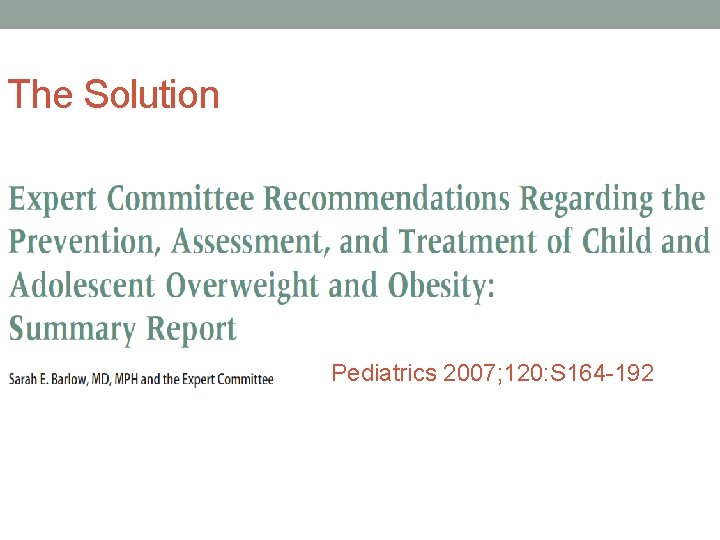
The Solution Pediatrics 2007; 120: S 164 -192
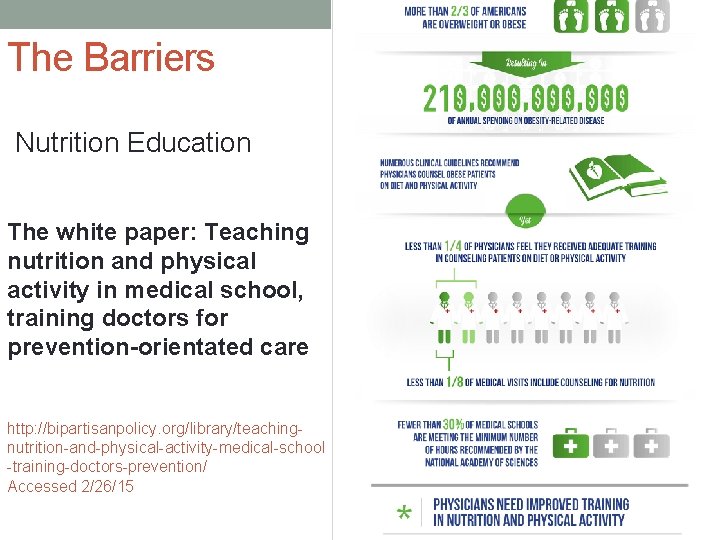
The Barriers Nutrition Education The white paper: Teaching nutrition and physical activity in medical school, training doctors for prevention-orientated care http: //bipartisanpolicy. org/library/teachingnutrition-and-physical-activity-medical-school -training-doctors-prevention/ Accessed 2/26/15
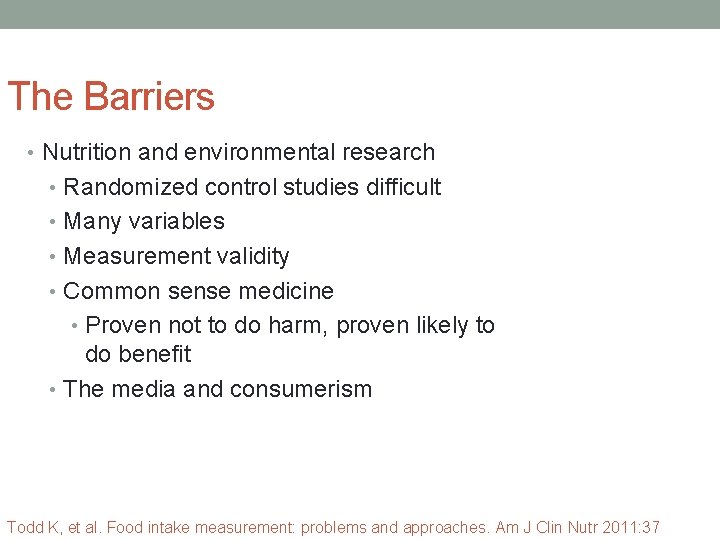
The Barriers • Nutrition and environmental research • Randomized control studies difficult • Many variables • Measurement validity • Common sense medicine • Proven not to do harm, proven likely to do benefit • The media and consumerism Todd K, et al. Food intake measurement: problems and approaches. Am J Clin Nutr 2011: 37
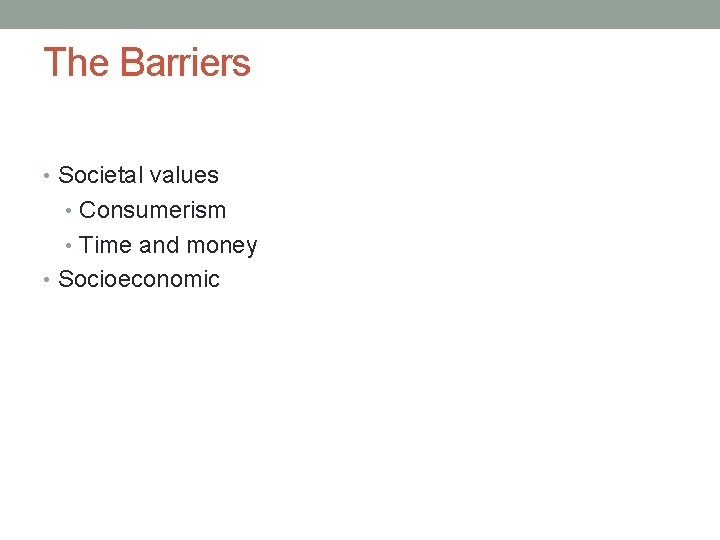
The Barriers • Societal values • Consumerism • Time and money • Socioeconomic
Pediatric Nutrition: What is healthy eating?
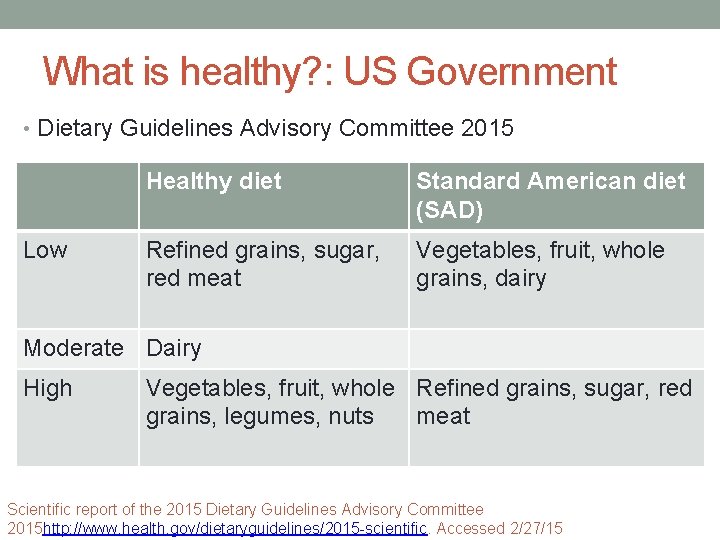
What is healthy? : US Government • Dietary Guidelines Advisory Committee 2015 Low Healthy diet Standard American diet (SAD) Refined grains, sugar, red meat Vegetables, fruit, whole grains, dairy Moderate Dairy High Vegetables, fruit, whole Refined grains, sugar, red grains, legumes, nuts meat Scientific report of the 2015 Dietary Guidelines Advisory Committee 2015 http: //www. health. gov/dietaryguidelines/2015 -scientific. Accessed 2/27/15 -report/
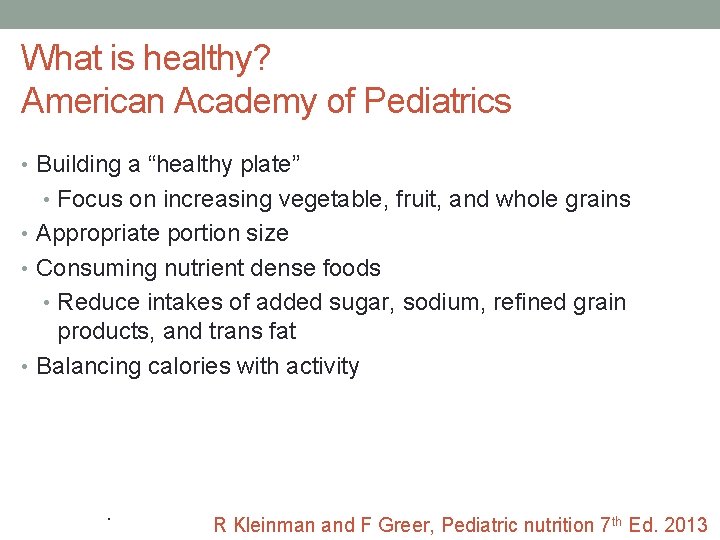
What is healthy? American Academy of Pediatrics • Building a “healthy plate” • Focus on increasing vegetable, fruit, and whole grains • Appropriate portion size • Consuming nutrient dense foods • Reduce intakes of added sugar, sodium, refined grain products, and trans fat • Balancing calories with activity . R Kleinman and F Greer, Pediatric nutrition 7 th Ed. 2013
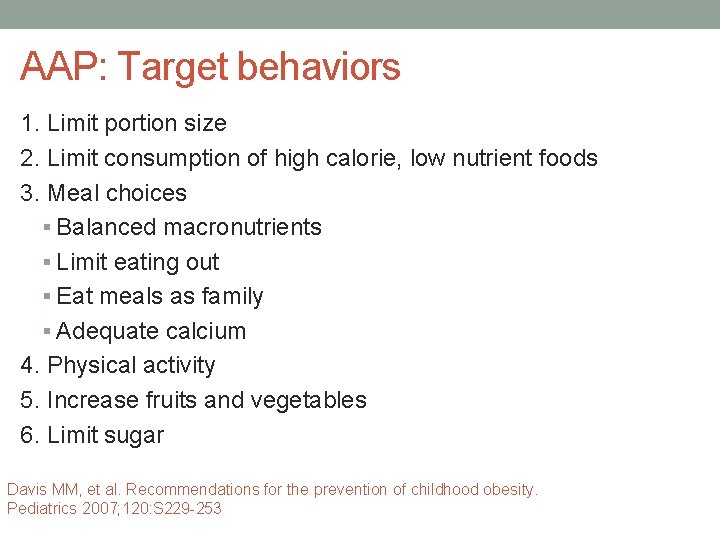
AAP: Target behaviors 1. Limit portion size 2. Limit consumption of high calorie, low nutrient foods 3. Meal choices § Balanced macronutrients § Limit eating out § Eat meals as family § Adequate calcium 4. Physical activity 5. Increase fruits and vegetables 6. Limit sugar Davis MM, et al. Recommendations for the prevention of childhood obesity. Pediatrics 2007; 120: S 229 -253
1. Portion size
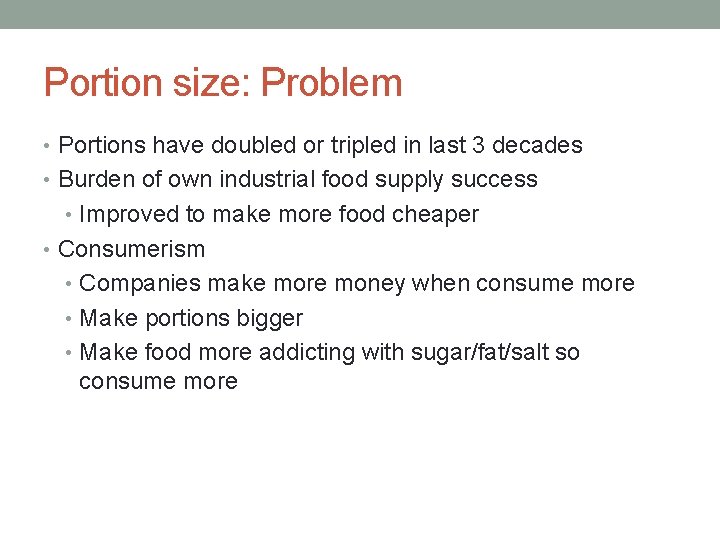
Portion size: Problem • Portions have doubled or tripled in last 3 decades • Burden of own industrial food supply success • Improved to make more food cheaper • Consumerism • Companies make more money when consume more • Make portions bigger • Make food more addicting with sugar/fat/salt so consume more
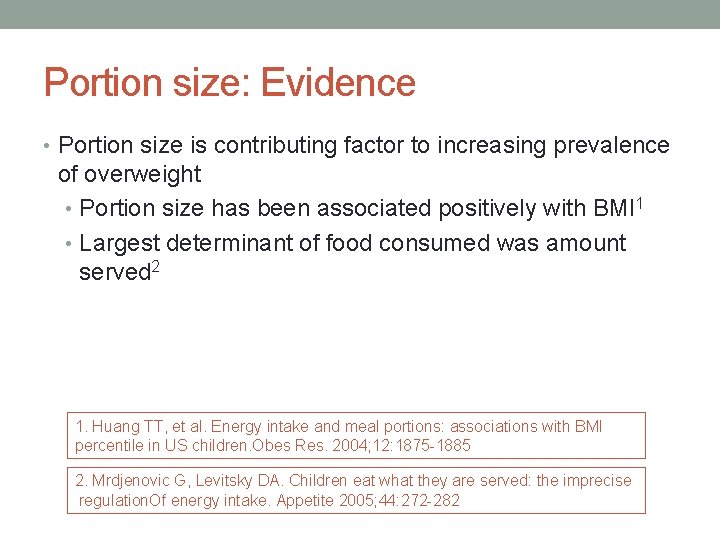
Portion size: Evidence • Portion size is contributing factor to increasing prevalence of overweight • Portion size has been associated positively with BMI 1 • Largest determinant of food consumed was amount served 2 1. Huang TT, et al. Energy intake and meal portions: associations with BMI percentile in US children. Obes Res. 2004; 12: 1875 -1885 2. Mrdjenovic G, Levitsky DA. Children eat what they are served: the imprecise regulation. Of energy intake. Appetite 2005; 44: 272 -282
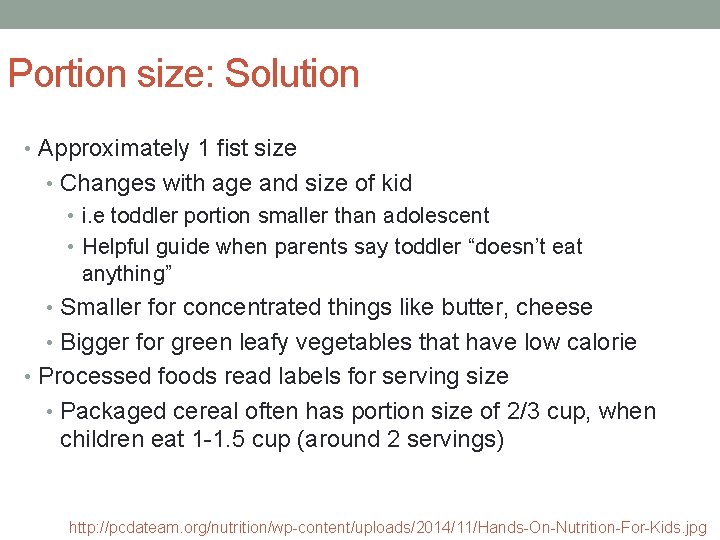
Portion size: Solution • Approximately 1 fist size • Changes with age and size of kid • i. e toddler portion smaller than adolescent • Helpful guide when parents say toddler “doesn’t eat anything” • Smaller for concentrated things like butter, cheese • Bigger for green leafy vegetables that have low calorie • Processed foods read labels for serving size • Packaged cereal often has portion size of 2/3 cup, when children eat 1 -1. 5 cup (around 2 servings) http: //pcdateam. org/nutrition/wp-content/uploads/2014/11/Hands-On-Nutrition-For-Kids. jpg
2. More nutrient to calorie
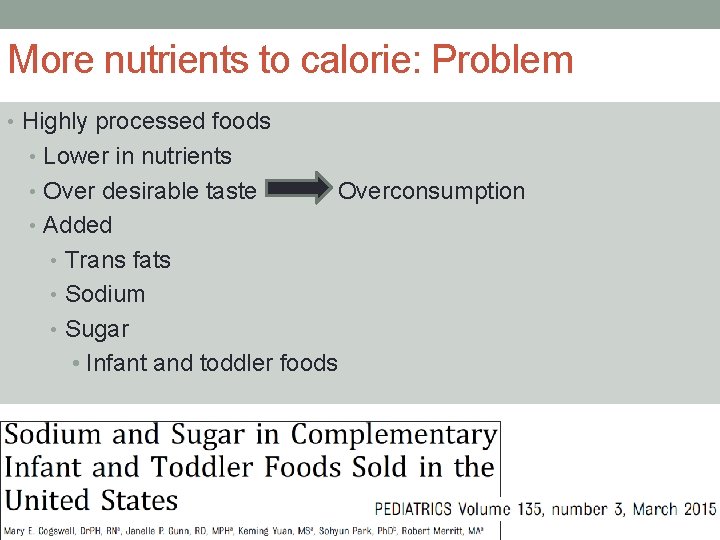
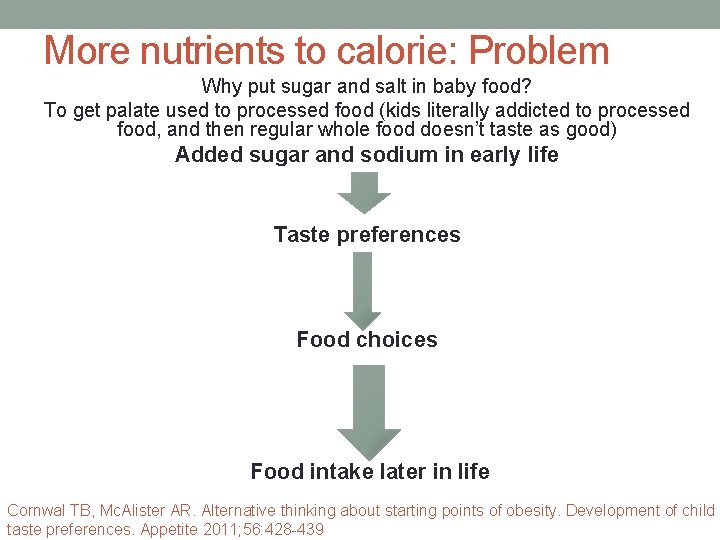
More nutrients to calorie: Problem • Highly processed foods • Lower in nutrients • Over desirable taste Overconsumption • Added • Trans fats • Sodium • Sugar • Infant and toddler foods
More nutrients to calorie: Problem Why put sugar and salt in baby food? To get palate used to processed food (kids literally addicted to processed food, and then regular whole food doesn’t taste as good) Added sugar and sodium in early life Taste preferences Food choices Food intake later in life Cornwal TB, Mc. Alister AR. Alternative thinking about starting points of obesity. Development of child taste preferences. Appetite 2011; 56: 428 -439
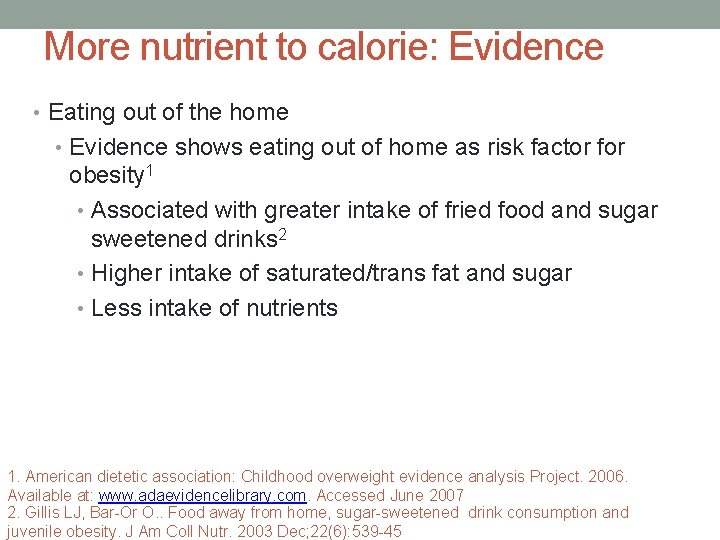
More nutrient to calorie: Evidence • Eating out of the home • Evidence shows eating out of home as risk factor for obesity 1 • Associated with greater intake of fried food and sugar sweetened drinks 2 • Higher intake of saturated/trans fat and sugar • Less intake of nutrients 1. American dietetic association: Childhood overweight evidence analysis Project. 2006. Available at: www. adaevidencelibrary. com. Accessed June 2007 2. Gillis LJ, Bar-Or O. . Food away from home, sugar-sweetened drink consumption and juvenile obesity. J Am Coll Nutr. 2003 Dec; 22(6): 539 -45
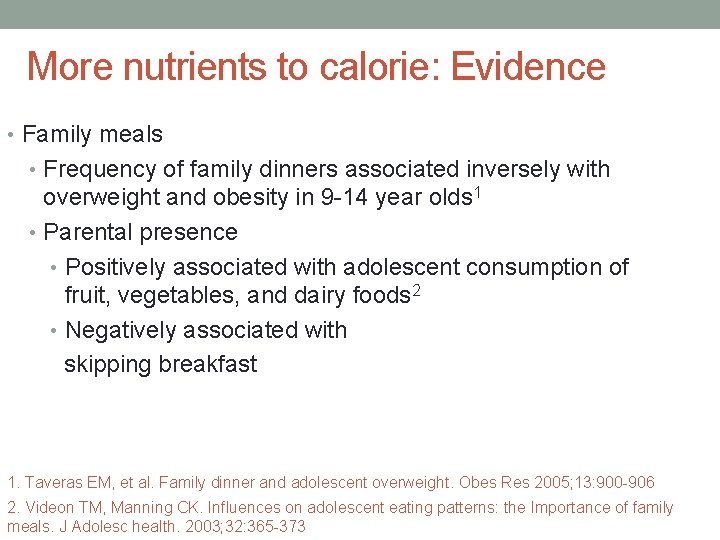
More nutrients to calorie: Evidence • Family meals • Frequency of family dinners associated inversely with overweight and obesity in 9 -14 year olds 1 • Parental presence • Positively associated with adolescent consumption of fruit, vegetables, and dairy foods 2 • Negatively associated with skipping breakfast 1. Taveras EM, et al. Family dinner and adolescent overweight. Obes Res 2005; 13: 900 -906 2. Videon TM, Manning CK. Influences on adolescent eating patterns: the Importance of family meals. J Adolesc health. 2003; 32: 365 -373
More nutrient to calorie: Solution • Eat more family meals in the home • More nutrient per calorie food • Closer to nature
3. Meal choices
Source Pediatric Nutrition 7 th Ed. 2013 R Kleinman and F Greer
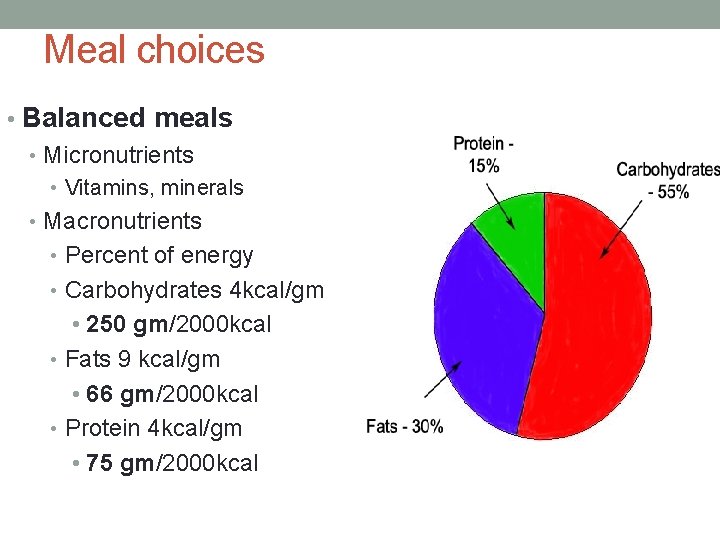
Meal choices • Balanced meals • Micronutrients • Vitamins, minerals • Macronutrients • Percent of energy • Carbohydrates 4 kcal/gm • 250 gm/2000 kcal • Fats 9 kcal/gm • 66 gm/2000 kcal • Protein 4 kcal/gm • 75 gm/2000 kcal
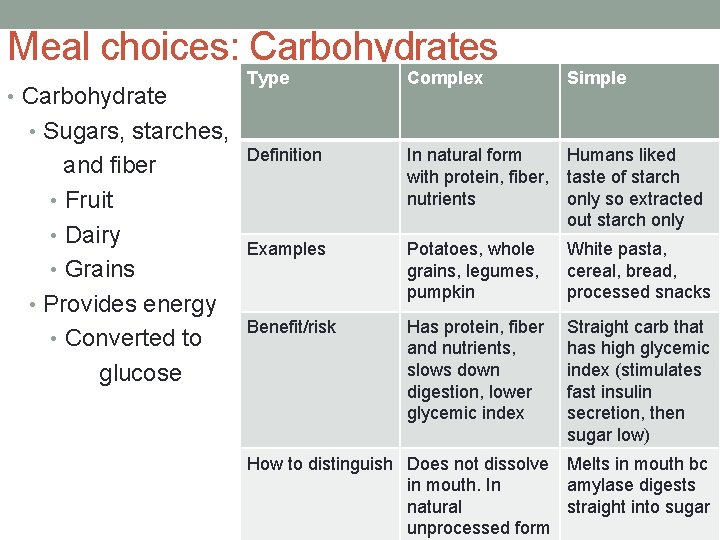
Meal choices: Carbohydrates • Carbohydrate Type Complex Simple Definition In natural form with protein, fiber, nutrients Humans liked taste of starch only so extracted out starch only Examples Potatoes, whole grains, legumes, pumpkin White pasta, cereal, bread, processed snacks Benefit/risk Has protein, fiber and nutrients, slows down digestion, lower glycemic index Straight carb that has high glycemic index (stimulates fast insulin secretion, then sugar low) • Sugars, starches, and fiber • Fruit • Dairy • Grains • Provides energy • Converted to glucose How to distinguish Does not dissolve Melts in mouth bc in mouth. In amylase digests natural straight into sugar unprocessed form
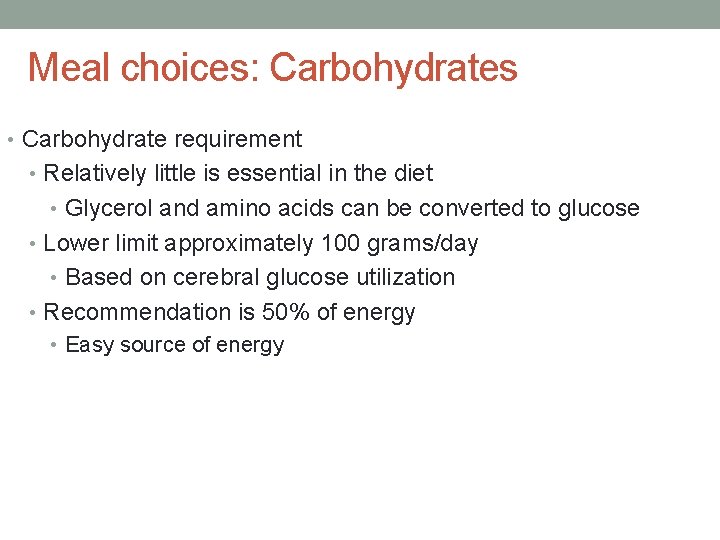
Meal choices: Carbohydrates • Carbohydrate requirement • Relatively little is essential in the diet • Glycerol and amino acids can be converted to glucose • Lower limit approximately 100 grams/day • Based on cerebral glucose utilization • Recommendation is 50% of energy • Easy source of energy
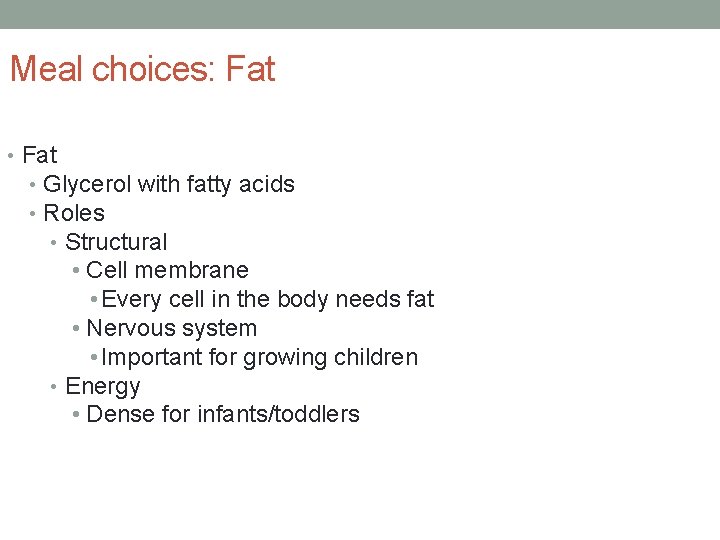
Meal choices: Fat • Glycerol with fatty acids • Roles • Structural • Cell membrane • Every cell in the body needs fat • Nervous system • Important for growing children • Energy • Dense for infants/toddlers
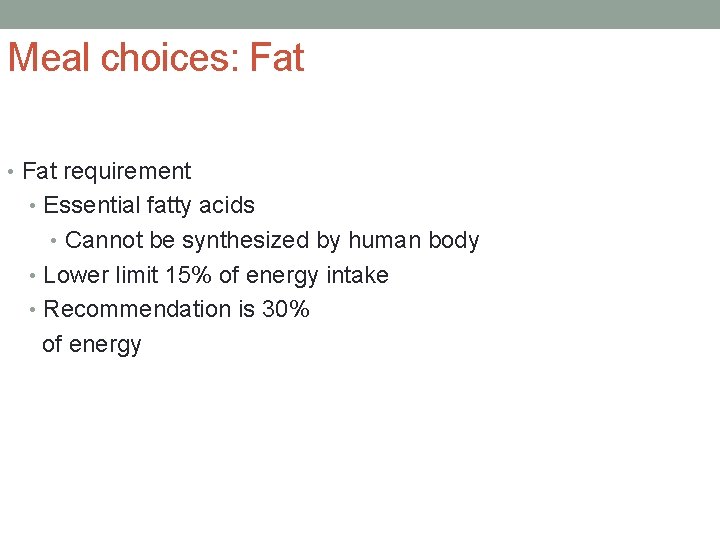
Meal choices: Fat • Fat requirement • Essential fatty acids • Cannot be synthesized by human body • Lower limit 15% of energy intake • Recommendation is 30% of energy
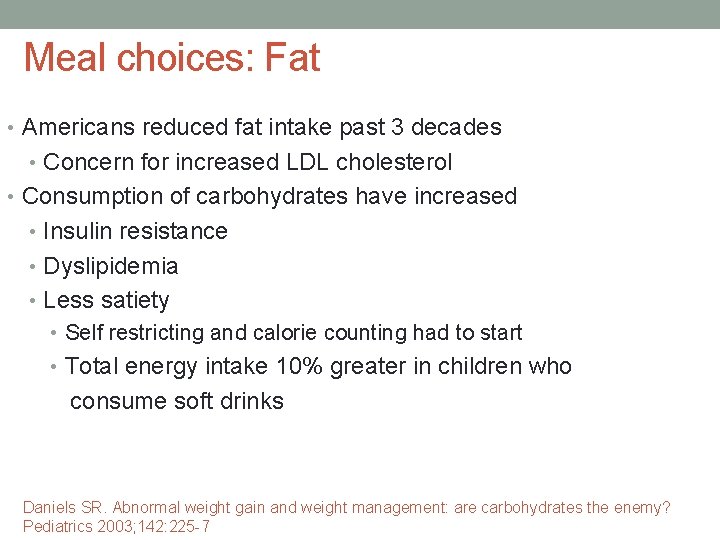
Meal choices: Fat • Americans reduced fat intake past 3 decades • Concern for increased LDL cholesterol • Consumption of carbohydrates have increased • Insulin resistance • Dyslipidemia • Less satiety • Self restricting and calorie counting had to start • Total energy intake 10% greater in children who consume soft drinks Daniels SR. Abnormal weight gain and weight management: are carbohydrates the enemy? Pediatrics 2003; 142: 225 -7
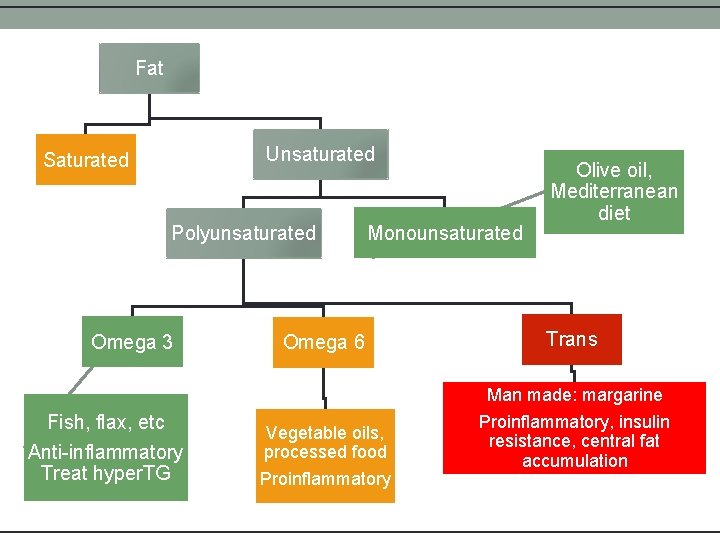
Fat Unsaturated Saturated Polyunsaturated Omega 3 Monounsaturated Omega 6 Olive oil, Mediterranean diet Trans Man made: margarine Fish, flax, etc Anti-inflammatory Treat hyper. TG Vegetable oils, processed food Proinflammatory, insulin resistance, central fat accumulation
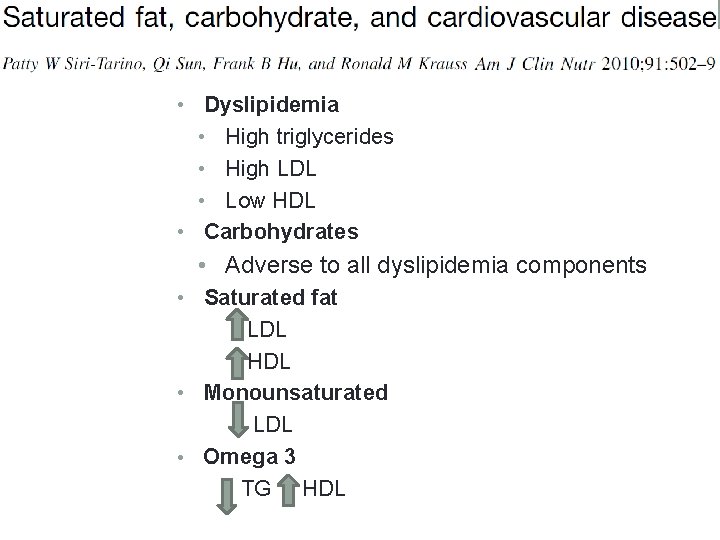
• Dyslipidemia • High triglycerides • High LDL • Low HDL • Carbohydrates • Adverse to all dyslipidemia components • Saturated fat LDL HDL • Monounsaturated LDL • Omega 3 TG HDL
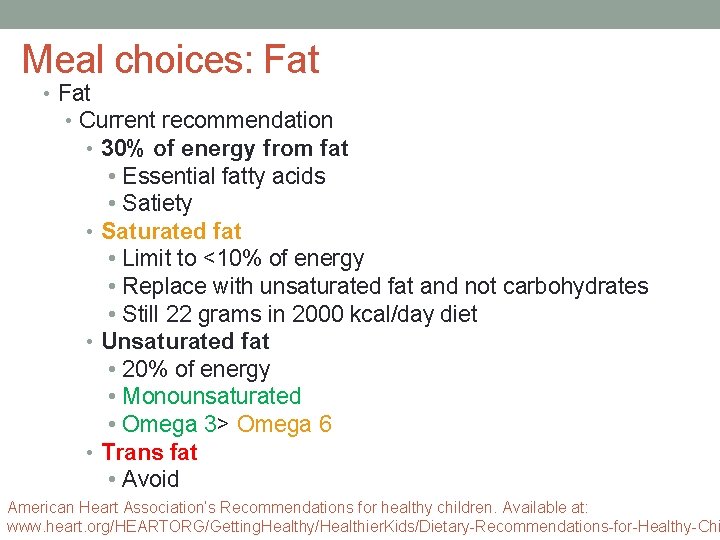
Meal choices: Fat • Fat • Current recommendation • 30% of energy from fat • Essential fatty acids • Satiety • Saturated fat • Limit to <10% of energy • Replace with unsaturated fat and not carbohydrates • Still 22 grams in 2000 kcal/day diet • Unsaturated fat • 20% of energy • Monounsaturated • Omega 3> Omega 6 • Trans fat • Avoid American Heart Association’s Recommendations for healthy children. Available at: www. heart. org/HEARTORG/Getting. Healthy/Healthier. Kids/Dietary-Recommendations-for-Healthy-Chi
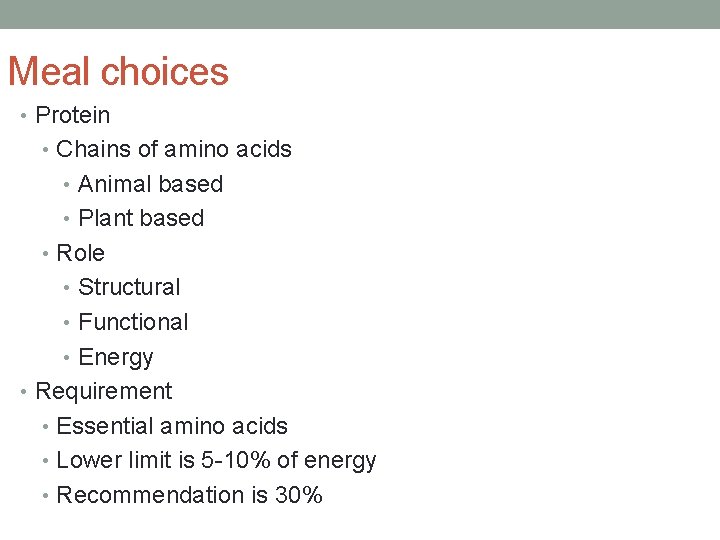
Meal choices • Protein • Chains of amino acids • Animal based • Plant based • Role • Structural • Functional • Energy • Requirement • Essential amino acids • Lower limit is 5 -10% of energy • Recommendation is 30%
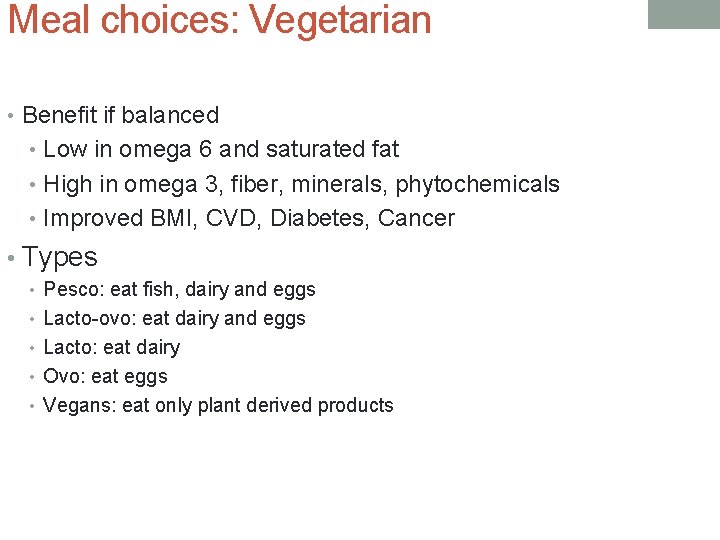
Meal choices: Vegetarian • Benefit if balanced • Low in omega 6 and saturated fat • High in omega 3, fiber, minerals, phytochemicals • Improved BMI, CVD, Diabetes, Cancer • Types • Pesco: eat fish, dairy and eggs • Lacto-ovo: eat dairy and eggs • Lacto: eat dairy • Ovo: eat eggs • Vegans: eat only plant derived products
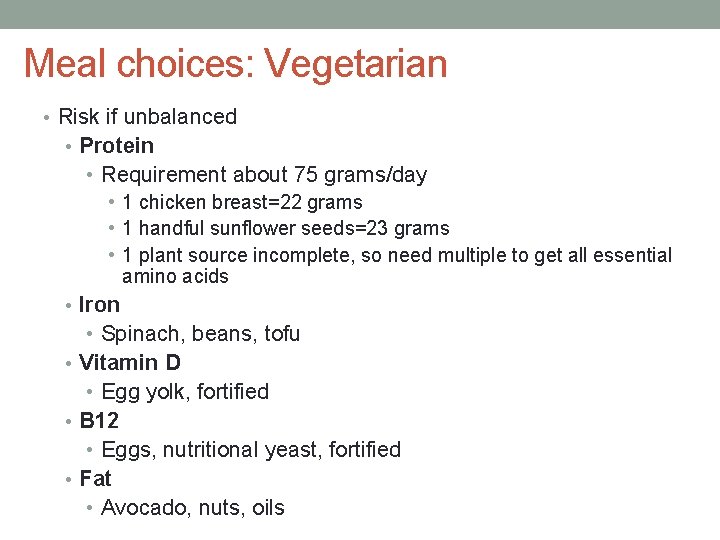
Meal choices: Vegetarian • Risk if unbalanced • Protein • Requirement about 75 grams/day • 1 chicken breast=22 grams • 1 handful sunflower seeds=23 grams • 1 plant source incomplete, so need multiple to get all essential amino acids • Iron • Spinach, beans, tofu • Vitamin D • Egg yolk, fortified • B 12 • Eggs, nutritional yeast, fortified • Fat • Avocado, nuts, oils
Meal choices: Micronutrients
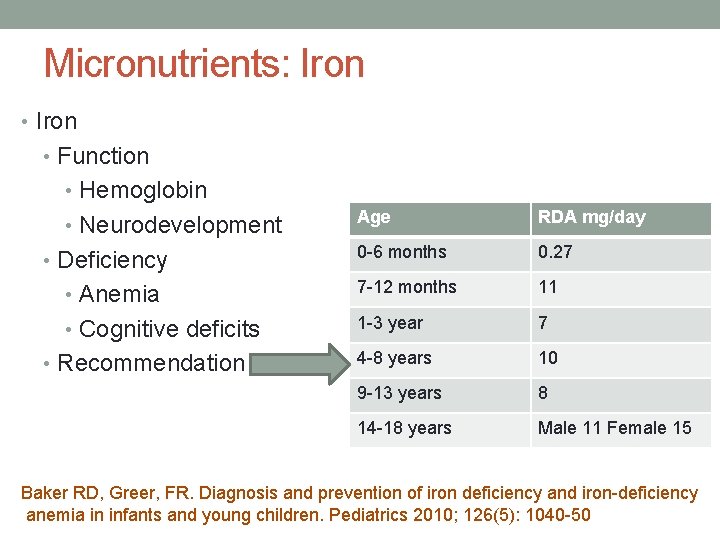
Micronutrients: Iron • Function • Hemoglobin Age RDA mg/day 0 -6 months 0. 27 • Anemia 7 -12 months 11 • Cognitive deficits 1 -3 year 7 4 -8 years 10 9 -13 years 8 14 -18 years Male 11 Female 15 • Neurodevelopment • Deficiency • Recommendation Baker RD, Greer, FR. Diagnosis and prevention of iron deficiency and iron-deficiency anemia in infants and young children. Pediatrics 2010; 126(5): 1040 -50
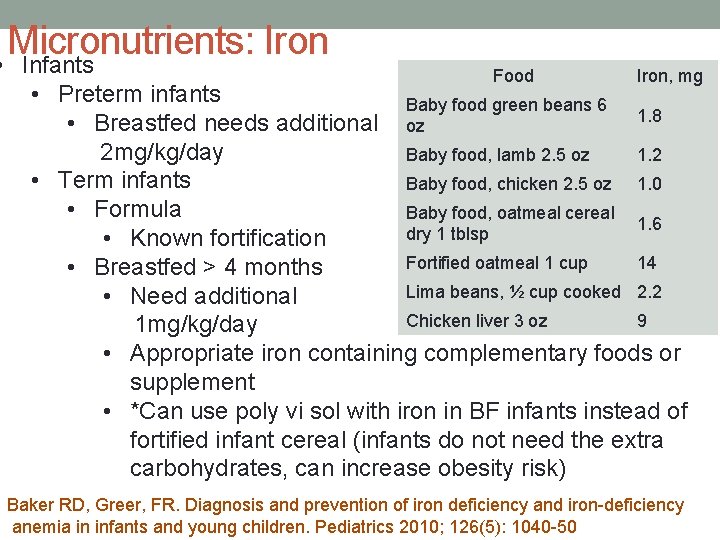
Micronutrients: Iron • Infants Food Iron, mg • Preterm infants Baby food green beans 6 1. 8 • Breastfed needs additional oz 2 mg/kg/day Baby food, lamb 2. 5 oz 1. 2 • Term infants Baby food, chicken 2. 5 oz 1. 0 • Formula Baby food, oatmeal cereal 1. 6 dry 1 tblsp • Known fortification Fortified oatmeal 1 cup 14 • Breastfed > 4 months Lima beans, ½ cup cooked 2. 2 • Need additional Chicken liver 3 oz 9 1 mg/kg/day • Appropriate iron containing complementary foods or supplement • *Can use poly vi sol with iron in BF infants instead of fortified infant cereal (infants do not need the extra carbohydrates, can increase obesity risk) Baker RD, Greer, FR. Diagnosis and prevention of iron deficiency and iron-deficiency anemia in infants and young children. Pediatrics 2010; 126(5): 1040 -50
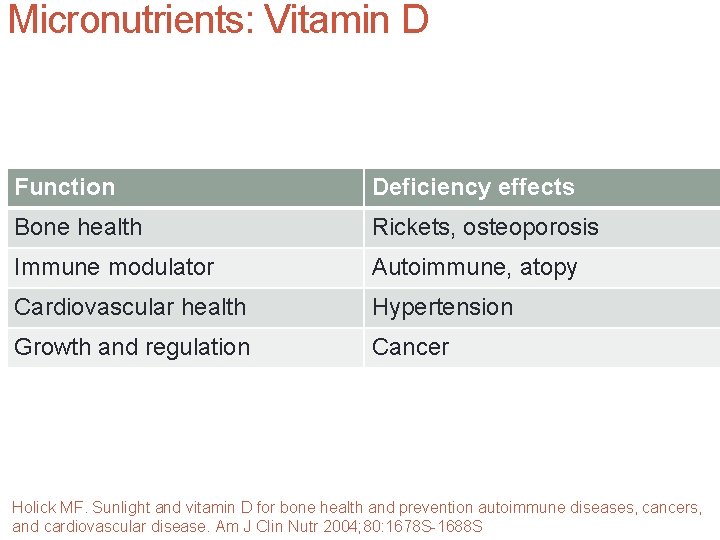
Micronutrients: Vitamin D Function Deficiency effects Bone health Rickets, osteoporosis Immune modulator Autoimmune, atopy Cardiovascular health Hypertension Growth and regulation Cancer Holick MF. Sunlight and vitamin D for bone health and prevention autoimmune diseases, cancers, and cardiovascular disease. Am J Clin Nutr 2004; 80: 1678 S-1688 S
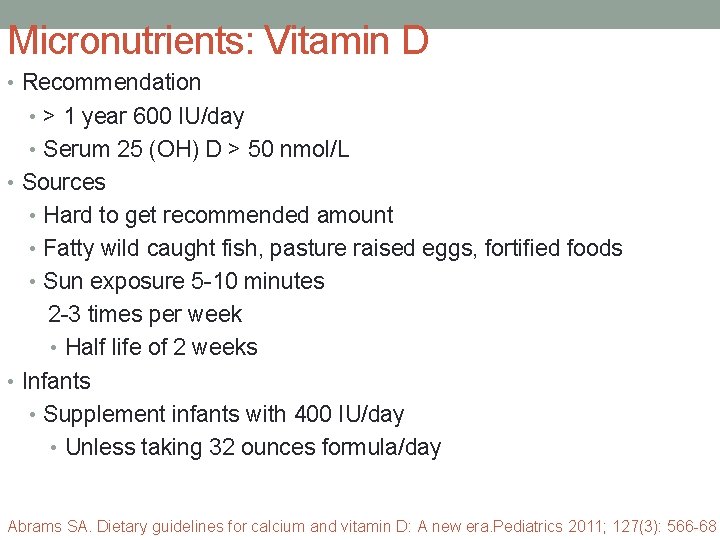
Micronutrients: Vitamin D • Recommendation • > 1 year 600 IU/day • Serum 25 (OH) D > 50 nmol/L • Sources • Hard to get recommended amount • Fatty wild caught fish, pasture raised eggs, fortified foods • Sun exposure 5 -10 minutes 2 -3 times per week • Half life of 2 weeks • Infants • Supplement infants with 400 IU/day • Unless taking 32 ounces formula/day Abrams SA. Dietary guidelines for calcium and vitamin D: A new era. Pediatrics 2011; 127(3): 566 -68
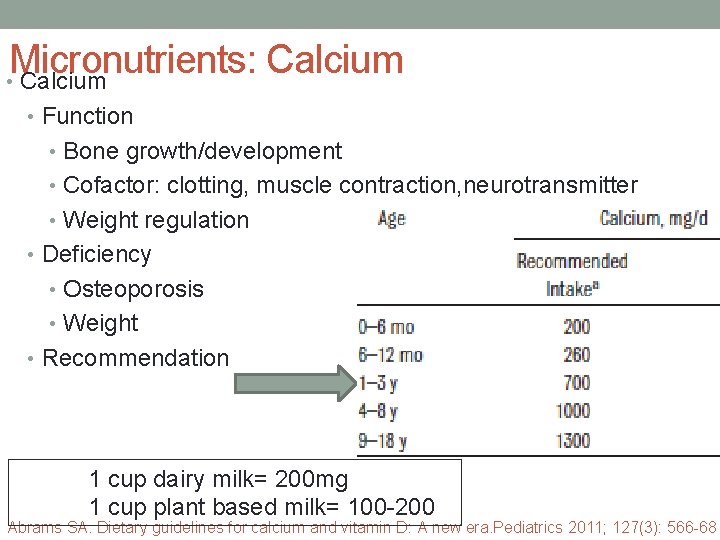
Micronutrients: Calcium • Function • Bone growth/development • Cofactor: clotting, muscle contraction, neurotransmitter • Weight regulation • Deficiency • Osteoporosis • Weight • Recommendation 1 cup dairy milk= 200 mg 1 cup plant based milk= 100 -200 Abrams SA. Dietary guidelines for calcium and vitamin D: A new era. Pediatrics 2011; 127(3): 566 -68
Micronutrient: Calcium • Dairy • Practical source of Calcium, Vit D, Potassium in SAD • Counteract phosphorus in soda • Counteract sodium and low nutrients in processed foods • Low-fat because added fats in SAD • But saturated better than trans • Ideal would be decrease added fats and go back to whole milk • New studies that whole is more filling and fat helps absorption of nutrients Scharf RJ, Demmer RT, De. Boer MD. Longitudinal evaluation of milk typee consumed and weight status in preschoolers. Arch Dis Child 2013; 0: 1 -6
Micronutrients: Magnesium • Function • Every organ in the body needs as a cofactor • Bones • Energy • Muscle • Insulin R Kleinman and F Greer, Pediatric nutrition 7 th Ed. 2013
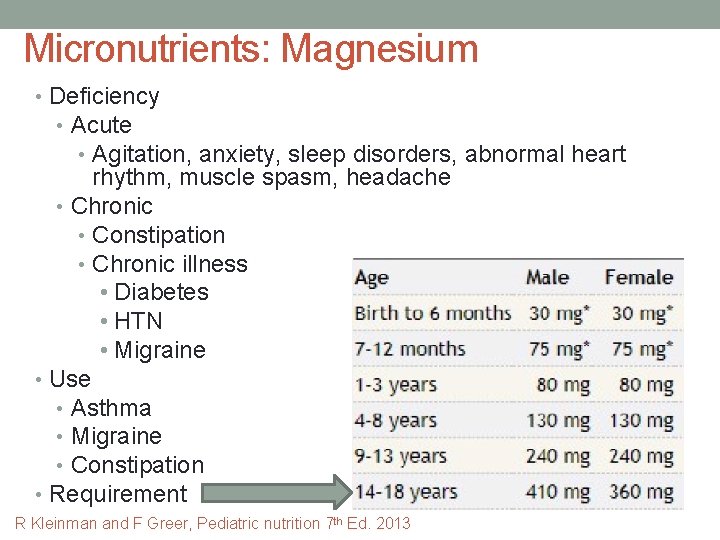
Micronutrients: Magnesium • Deficiency • Acute • Agitation, anxiety, sleep disorders, abnormal heart rhythm, muscle spasm, headache • Chronic • Constipation • Chronic illness • Diabetes • HTN • Migraine • Use • Asthma • Migraine • Constipation • Requirement R Kleinman and F Greer, Pediatric nutrition 7 th Ed. 2013
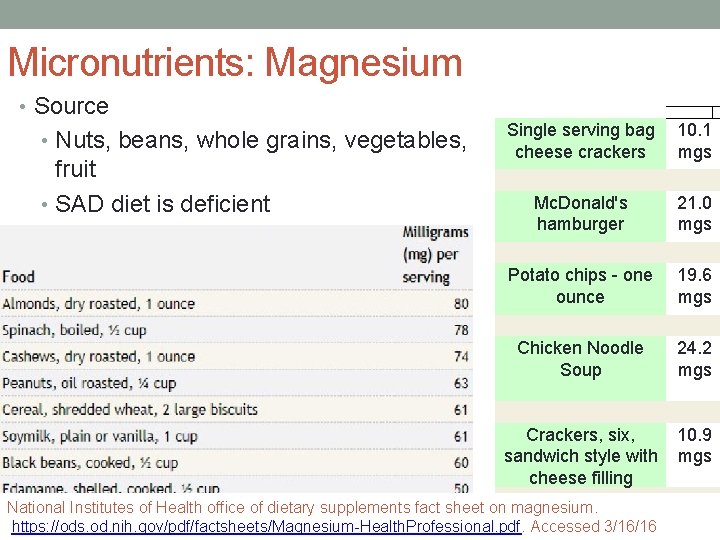
Micronutrients: Magnesium • Source Single serving bag cheese crackers 10. 1 mgs Mc. Donald's hamburger 21. 0 mgs Potato chips - one ounce 19. 6 mgs Chicken Noodle Soup 24. 2 mgs Crackers, six, sandwich style with cheese filling 10. 9 mgs Magnesium Totals National Institutes of Health office of dietary supplements fact sheet on magnesium. https: //ods. od. nih. gov/pdf/factsheets/Magnesium-Health. Professional. pdf. Accessed 3/16/16 85. 80 mgs • Nuts, beans, whole grains, vegetables, fruit • SAD diet is deficient
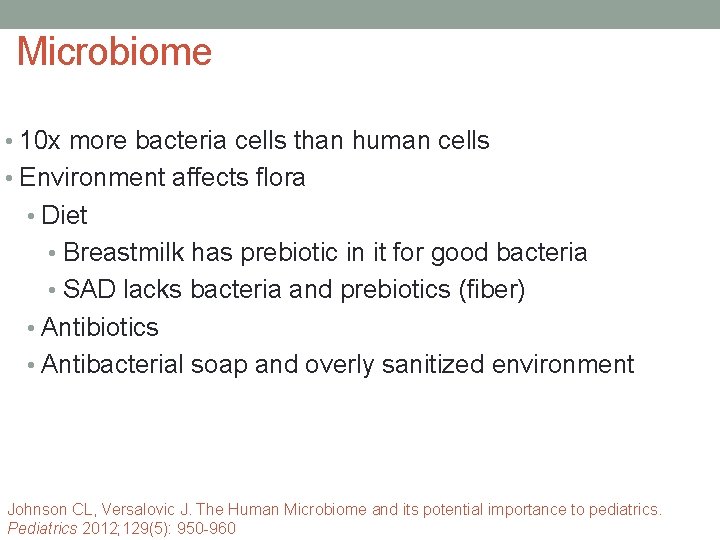
Microbiome • 10 x more bacteria cells than human cells • Environment affects flora • Diet • Breastmilk has prebiotic in it for good bacteria • SAD lacks bacteria and prebiotics (fiber) • Antibiotics • Antibacterial soap and overly sanitized environment Johnson CL, Versalovic J. The Human Microbiome and its potential importance to pediatrics. Pediatrics 2012; 129(5): 950 -960
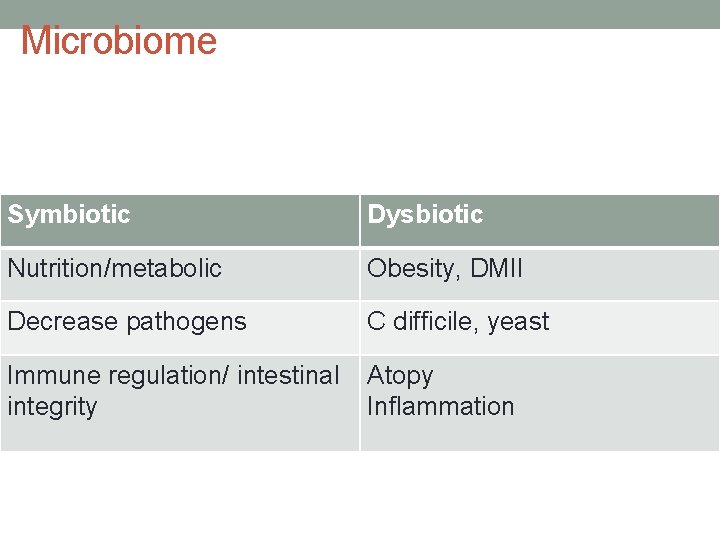
Microbiome Symbiotic Dysbiotic Nutrition/metabolic Obesity, DMII Decrease pathogens C difficile, yeast Immune regulation/ intestinal integrity Atopy Inflammation
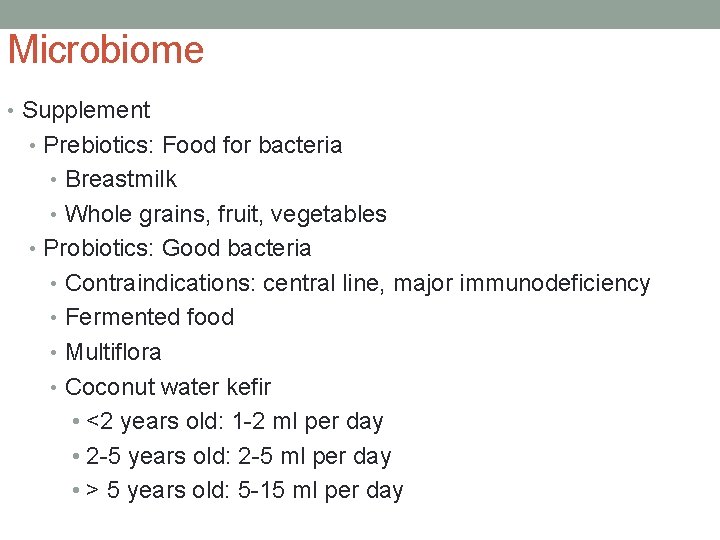
Microbiome • Supplement • Prebiotics: Food for bacteria • Breastmilk • Whole grains, fruit, vegetables • Probiotics: Good bacteria • Contraindications: central line, major immunodeficiency • Fermented food • Multiflora • Coconut water kefir • <2 years old: 1 -2 ml per day • 2 -5 years old: 2 -5 ml per day • > 5 years old: 5 -15 ml per day
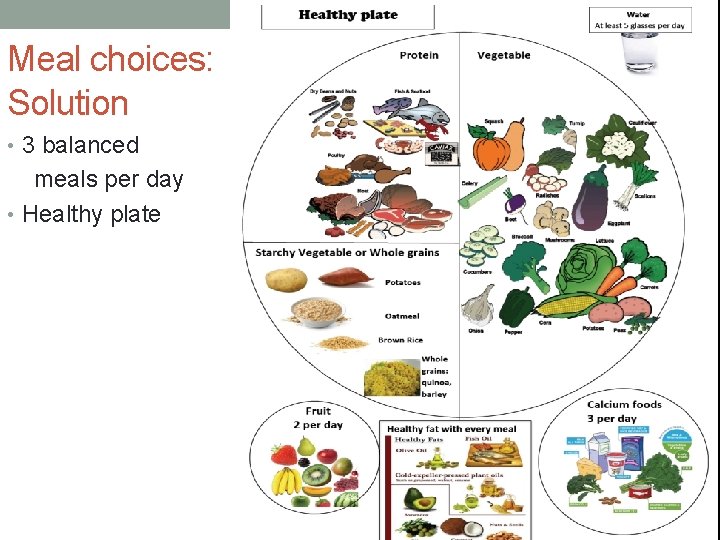
Meal choices: Solution • 3 balanced meals per day • Healthy plate
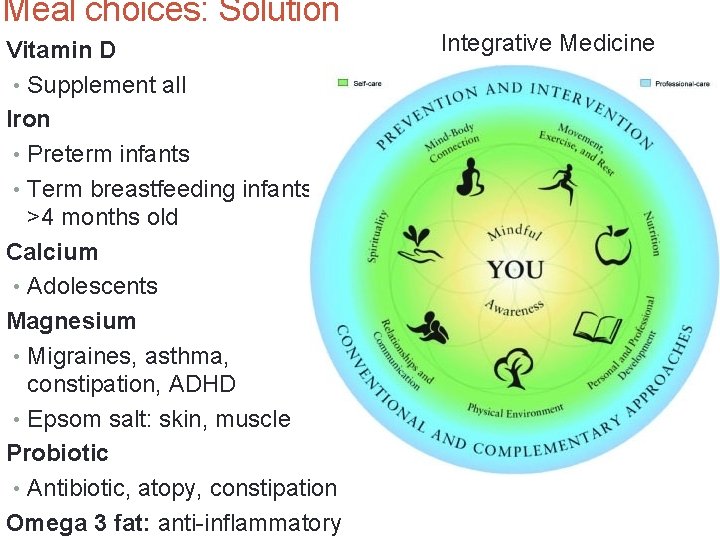
Meal choices: Solution Vitamin D • Supplement all Iron • Preterm infants • Term breastfeeding infants >4 months old Calcium • Adolescents Magnesium • Migraines, asthma, constipation, ADHD • Epsom salt: skin, muscle Probiotic • Antibiotic, atopy, constipation Omega 3 fat: anti-inflammatory Integrative Medicine
Industrialized Food Supply
Meal choices: Industrialized food supply • Another thing that has changed in child’s environment in past 3 decades • Produce • Pesticide • Herbicide • Soil depletion • Less nutrients • Genetically modified Horrigan, et al. How sustainable agriculture can address the environmental and human health harms industrial agriculture. Environmental health 2002; 110: 445 -456
Meal choices: Industrialized food supply • Livestock • Grain vs. grass fed • Omega 6 vs. Omega 3 • Antibiotic • 40 -80% of antibiotics USA • 75% of that is non-therapeutic • Hormones Horrigan, et al. How sustainable agriculture can address the environmental and human health harms industrial agriculture. Environmental health 2002; 110: 445 -456
Meal choices: Industrialized food supply • Highly processed foods • Artificial colors and flavors • Preservatives • High fructose corn syrup • Packaging • Plastic • BPA
Meal choices: Organic • Produce • Not used synthetic pesticides, herbicides, fertilizer, genetic engineering, ionizing radiation • Livestock • Not used antibiotic agents, growth hormones • Access to outdoors
Meal choices: Organic • Pesticide • Primary exposure is diet • Organic has lower levels • Urinary pesticide non-detectable organic diet • Rinsing produce does not decrease exposure • Few studies, not prospective • Prenatal exposure associated with lower mental development, attention problems, smaller head circumference • ADHD increased by 55% with 10 fold increase in urinary organophosphate Forman J, et al. Organic Foods: Health and environmental advantages and disadvantages. Pediatrics 2012 Nov; 130(5): e 1406 -13
Meal choices: Organic • Hormone • Sex steroids • Theorized to play role in earlier puberty and risk breast cancer • No clear studies • Also environmental endocrine disruptors • Antibiotic • Promotes drug resistant organisms that can spread in food chain
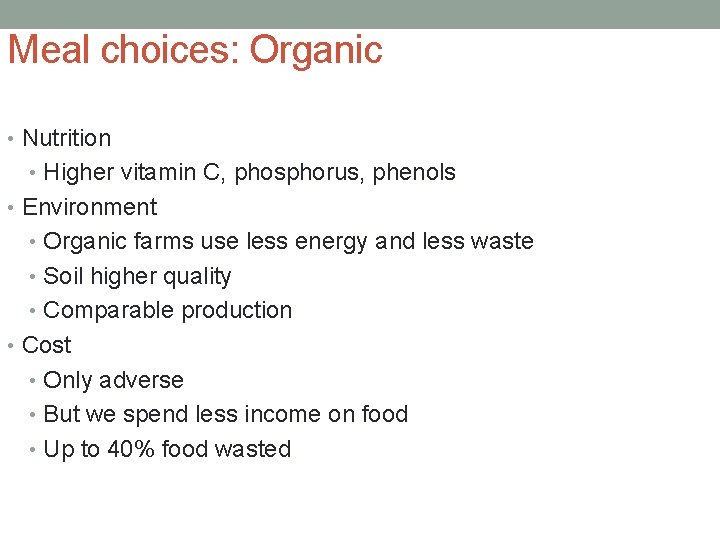
Meal choices: Organic • Nutrition • Higher vitamin C, phosphorus, phenols • Environment • Organic farms use less energy and less waste • Soil higher quality • Comparable production • Cost • Only adverse • But we spend less income on food • Up to 40% food wasted
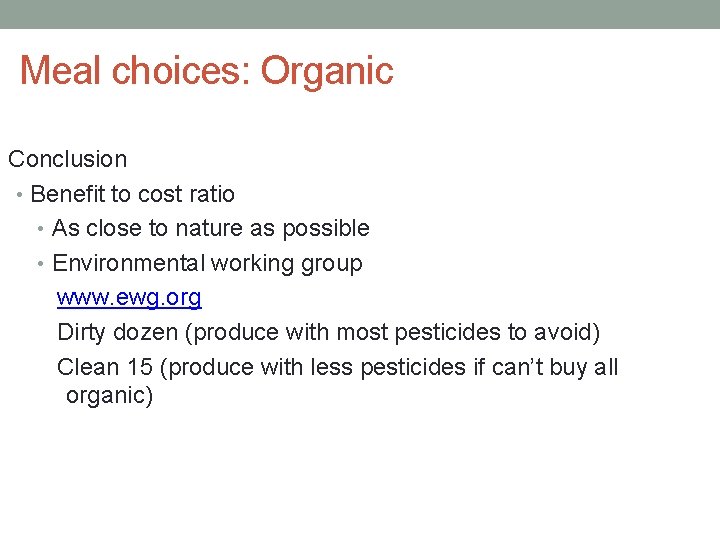
Meal choices: Organic • Conclusion • Benefit to cost ratio • As close to nature as possible • Environmental working group www. ewg. org Dirty dozen (produce with most pesticides to avoid) Clean 15 (produce with less pesticides if can’t buy all organic)
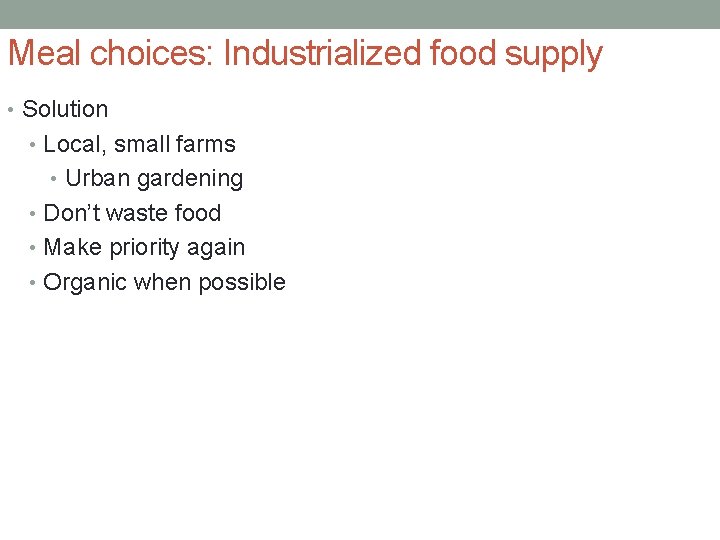
Meal choices: Industrialized food supply • Solution • Local, small farms • Urban gardening • Don’t waste food • Make priority again • Organic when possible
4: Physical activity
Physical activity: Problem • Energy imbalance • Balance between energy intake and expenditure • Expenditure • Basal metabolic rate • Thermogenesis • Physical activity
Physical activity: Problem • Less activity • Daily PE classes decreased from 42% in 1991 to 32% in 2001 • Active transportation decreased by 37% from 1977 to 1995 • More inactivity • Screen time exceeded 2 hours/day in 43% of US high school students Marshall SJ, et all. A descriptive epidemiology of screen-based media use In youth. J Adolesc. 2006; 29: 333 -349 Lowry R, et al. Television viewing and its associations with overweight, Sedetary lifestyle, and insufficient consumption of fruits and vegetables. J Sch Health. 2002; 72: 413 -421
Physical activity: Evidence & Solution • At least 60 minutes of moderate to vigorous activity per day • Comprehensive review 2005 • Supervised programs of 30 -45 minute per day reduction in adiposity among obese children • Panel of reviewers recommend 60 minutes of typically intermittent and unsupervised activity per day Strong WB et al. Evidence based physical activity for school-age youth. J Pediatr. 2005; 146: 732 -737
Physical activity: Evidence & Solution • Less than 2 hours of screen time • 1999 Youth Risk Behavior Survey • 15, 349 US high school students • >2 hours of television per day associated with overweight Lowry R, et al. Television viewing and its associations with overweight, Sedetary lifestyle, and insufficient consumption of fruits and vegetables. J Sch Health. 2002; 72: 413 -421
Physical Activity • Caution: • Can’t just increase activity • Average American child consumes 90 grams of sugar per day • 385 calories • Would have to walk for 1. 5 hours or jog for 45 minutes to burn that off • Obese people sometimes get false stigma of being lazy, when the major problem is eating hidden sugar
5. Vegetables and fruit
Vegetables and fruit: Problem • Most likely food group to be consumed in inadequate amounts in children • Average American child eats only 2 servings per day • Includes iceberg lettuce, french fries, and juice • Literally the healthiest food, but eaten the least • Most nutrient per calorie Baranowski T, et al. Patterns in children’s fruit and vegetable consumption by Meal and day of the week. J Am Coll Nutr. 1997; 16: 216 -223
Vegetables and fruits: Solution • At least 5 vegetables and fruits per day • 3 vegetables • Lunch, snack, dinner • 2 fruit • Breakfast, snack • Juice • Less fiber with the sugar • Recommendation is less than 6 oz/day
6. Limit sugar
Sugar: Problem • Added sugar • “Empty calories” without nutrition • Makes foods more desirable • Taste • Dopamine release • Insulin release • Causes sugar high and low • Consistent with addiction • Not sugar naturally in whole fruit • Has nutrients • Has fiber which slows down absorption • Average American consumes added sugar • 22 teaspoons=90 grams=360 calories per day
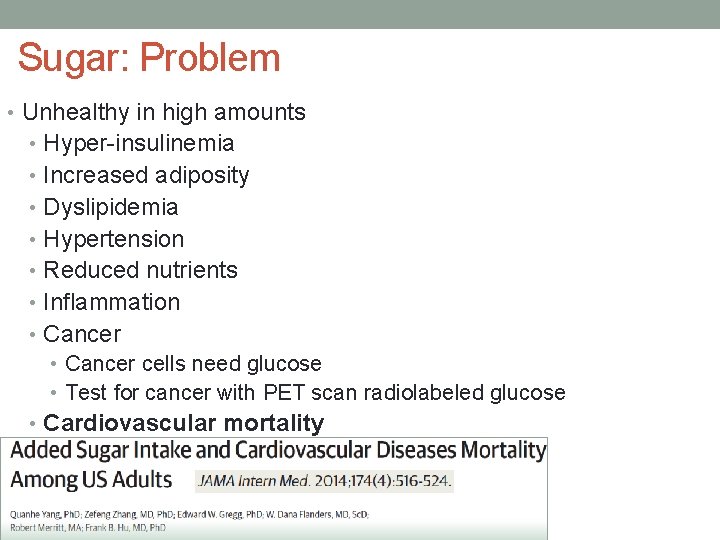
Sugar: Problem • Unhealthy in high amounts • Hyper-insulinemia • Increased adiposity • Dyslipidemia • Hypertension • Reduced nutrients • Inflammation • Cancer cells need glucose • Test for cancer with PET scan radiolabeled glucose • Cardiovascular mortality adults.
Sugar: Solution • American Heart Association Recommendation for children • Maximum 24 grams (6 teaspoons) of added sugar per day • Above this increase heart disease risks (HTN, diabetes II) • 4 grams=1 teaspoon • 24 grams=6 teaspoons Vos MB, et al. Added Sugars and Cardiovascular Disease Risk in Children. Circulation 2016; 134: 1 -18
How to apply to practice
The fight for healthy kids Obesity prevention and treatment is: • Identification of target health behaviors • Influencing families to change behaviors despite habits, culture, and environment that promote less physical activity and more energy intake • To achieve healthy body weight • To improve long term health through permanent healthy lifestyle habits Holt K, et al. Bright futures: Nutrition 3 rd ed. 2011
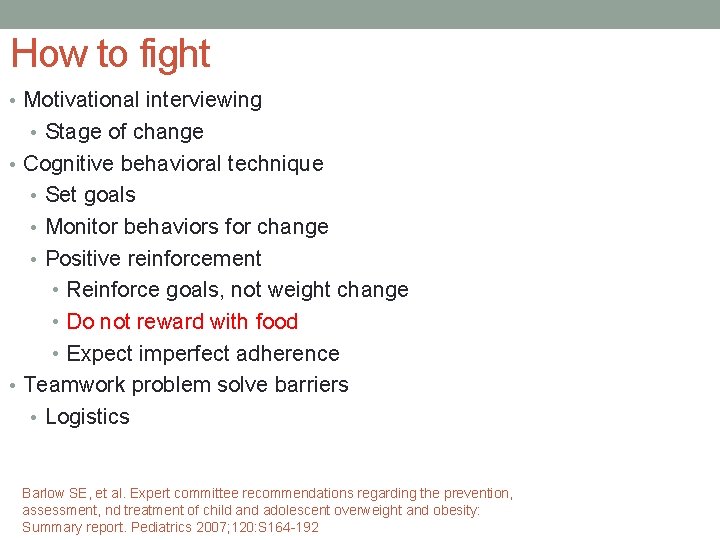
How to fight • Motivational interviewing • Stage of change • Cognitive behavioral technique • Set goals • Monitor behaviors for change • Positive reinforcement • Reinforce goals, not weight change • Do not reward with food • Expect imperfect adherence • Teamwork problem solve barriers • Logistics Barlow SE, et al. Expert committee recommendations regarding the prevention, assessment, nd treatment of child and adolescent overweight and obesity: Summary report. Pediatrics 2007; 120: S 164 -192
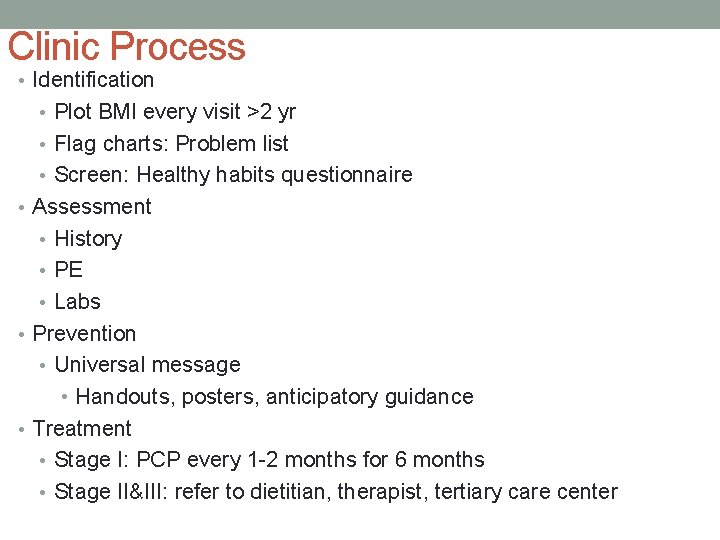
Clinic Process • Identification • Plot BMI every visit >2 yr • Flag charts: Problem list • Screen: Healthy habits questionnaire • Assessment • History • PE • Labs • Prevention • Universal message • Handouts, posters, anticipatory guidance • Treatment • Stage I: PCP every 1 -2 months for 6 months • Stage II&III: refer to dietitian, therapist, tertiary care center
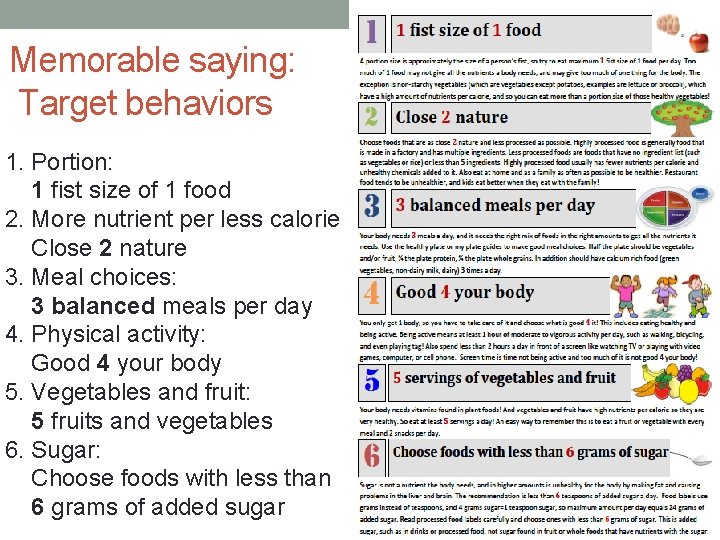
Memorable saying: Target behaviors 1. Portion: 1 fist size of 1 food 2. More nutrient per less calorie Close 2 nature 3. Meal choices: 3 balanced meals per day 4. Physical activity: Good 4 your body 5. Vegetables and fruit: 5 fruits and vegetables 6. Sugar: Choose foods with less than 6 grams of added sugar
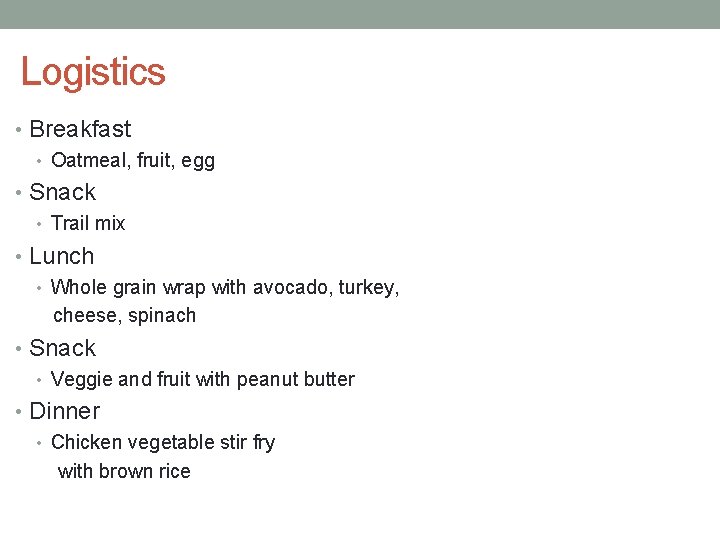
Logistics • Breakfast • Oatmeal, fruit, egg • Snack • Trail mix • Lunch • Whole grain wrap with avocado, turkey, cheese, spinach • Snack • Veggie and fruit with peanut butter • Dinner • Chicken vegetable stir fry with brown rice
Local resources • www. eatlocalkc. net find your local farmer's market and identify local markets that accept SNAP • • • • • • www. beansandgreens. org Contact: Gayla Brockman, Phone# 816 -753 -0606 brings together local farmers and low-income shoppers. Use your SNAP Program toward healthy local food www. kcfoodcircle. org Phone#: 913 -620 -8427, E-mail: coordinators@kcfoodcircle. org Connects you with local organic & free-range food, community supported agriculture (CSA), and farmer's markets www. cultivatekc. org Phone#: 913 -831 -2444 Go to Community Resources link to find information about nutrition and growing food solutions for the community and residents www. facebook. com/ffckc Fresh Food Corridor Phone#: 816 -226 -8246, E-mail: robyne@freshfoodcorridor. org Lets you know who provides fresh produce, meat and dairy products to east Kansas City neighborhoods. www. rosedale. org Rosedale Healthy Kids & Farmer's Market Phone#: 813 -677 -5097, E-mail: info@rosedale. org Promotes healthy kids through healthy food access and physical activity in Rosedale community
Take home message • Unhealthy lifestyle is #1 problem facing American children • Should be #1 priority • Education on the issue and nutrition • Limit highly processed foods: Close to nature! • Less than 24 grams added sugar per day • Most high yield is to stop drinking sugar • My rule: Water and white milk only, anything else to drink is a treat once a week! • Balanced meals at home with family
Thank you • My family • Anna Esparham, MD • Monica Arango, MD • Joy Weydert, MD • Stephen Lauer, Ph. D, MD • Ann Davis, Ph. D, MPH, ABPP • Abby Lowe, RD • Eva Chevreaux ARNP-NP Contact: Cstanton 2@kumc. edu