
Marine Reptiles Birds and Mammals Land vertebrates came
Marine Reptiles, Birds, and Mammals
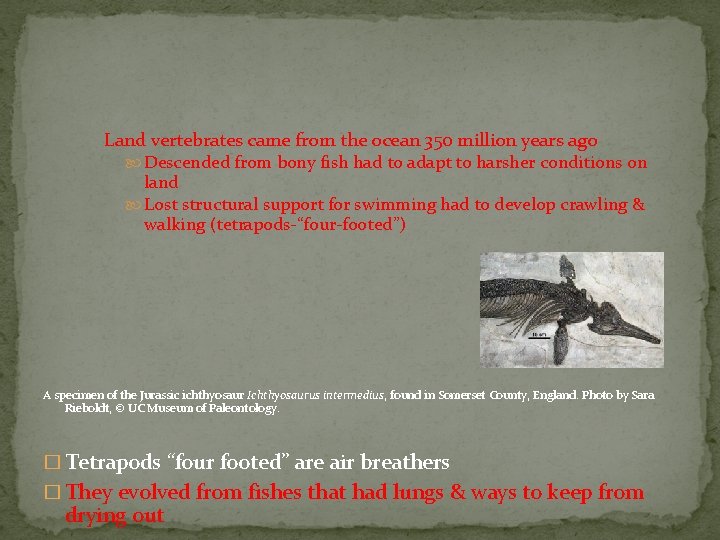
Land vertebrates came from the ocean 350 million years ago Descended from bony fish had to adapt to harsher conditions on land Lost structural support for swimming had to develop crawling & walking (tetrapods-“four-footed”) A specimen of the Jurassic ichthyosaur Ichthyosaurus intermedius, found in Somerset County, England. Photo by Sara Rieboldt, © UC Museum of Paleontology. � Tetrapods “four footed” are air breathers � They evolved from fishes that had lungs & ways to keep from drying out
�Amphibians never really solved this problem that is why they lay eggs in moist environments & none are strictly marine �Reptiles solved the problem of water loss, truly adapted to living on land, and evolved from now-extinct amphibians �Birds and mammals both evolved from different groups of now-extinct reptiles �Some reptiles, birds & mammals have reinvaded the ocean
MARINE REPTILES � 7, 000 living species including lizards, snakes, turtles, and crocodiles �Dry skin covered w/scales to prevent water loss �Leathery eggshells prevent desiccation, so can lay eggs on land �Poikilotherms and ectotherms – “cold-blooded” Activity & metabolic rate depends on temperature of environment Sluggish in cold, stay away from cold regions Stay away from land where temperatures fluctuate & stay in ocean where temperatures are constant
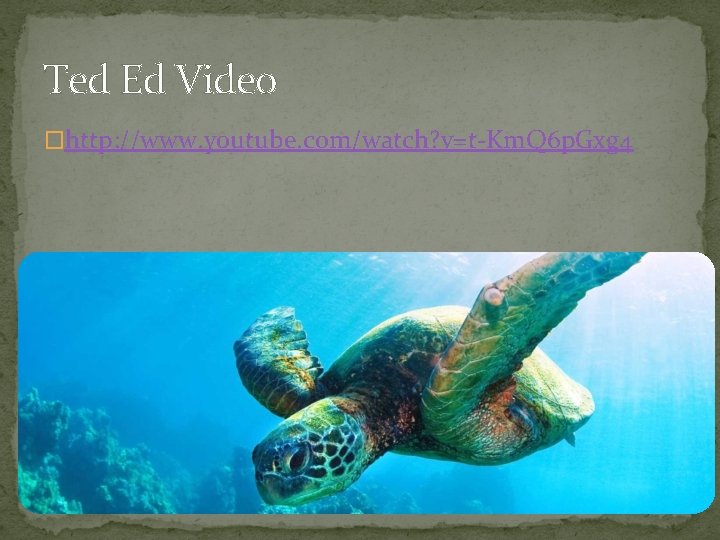
Sea Turtles �Ancient group of reptiles, body enclosed in shell (carapace) fused w/backbone �Cannot retract head into shell �Large forelimbs are modified into flippers � 9 species that live in warm waters � All return to land to reproduce & migrate long distance to lay eggs on remote sandy beaches �Sea turtle laying eggs videos �http: //www. youtube. com/watch? v=h 9 vwoyrg 7 Wc&fe ature=youtu. be �http: //www. youtube. com/watch? v=e. JP 3 Rxzu. HCo
Ted Ed Video �http: //www. youtube. com/watch? v=t-Km. Q 6 p. Gxg 4
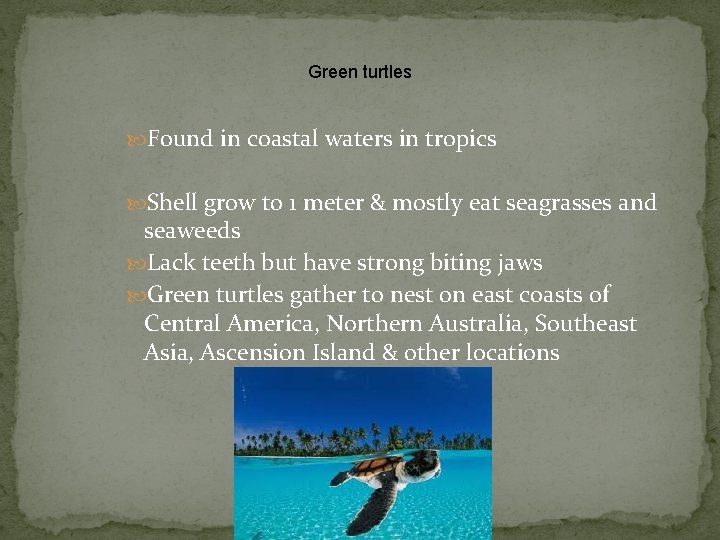
Green turtles Found in coastal waters in tropics Shell grow to 1 meter & mostly eat seagrasses and seaweeds Lack teeth but have strong biting jaws Green turtles gather to nest on east coasts of Central America, Northern Australia, Southeast Asia, Ascension Island & other locations
Hawksbill Reddish-brown with yellow streaks Beak-like mouth & eats encrusting animals (sponges, sea squirts, & barnacles) & seaweeds
Leatherback Largest at 2 m (7 ft) and weighs 540 kg (1, 200 lbs) No solid shell instead have series of small bones buried in dark skin forming longitudinal ridges Live in open water rarely seen except laying eggs on beaches Deep divers-2100 ft down Eat jellyfish Endangered!
Sea Turtle Reproduction �Marine biologist have tagged green turtles to map migration to feeding grounds 2 month journey & 1360 miles along the coast of Brazil Not sure how they find their way, but evidence of sensing earth’s magnetic field Return to nesting area every 2 -4 years against currents Females return to same beach where they were born Copulating pairs seen offshore, but only females venture on shore usually at night
Biologist tag mostly females because easier to tag organisms on land When laying eggs, females excavate a hole using their flippers, lay 100 -160 eggs, and cover eggs w/sand Eggs hatch after 60 days Babies dig out of the sand crawl to the water Eggs eaten by dogs, ghost crabs, wild pigs & other animals Hatchlings easy prey for crabs & birds during the day While in the water taken by variety of fish & seabirds
Sea Turtles Attacked �http: //www. youtube. com/watch? v=t 1 k. Fieh. Gh 9 s �http: //www. youtube. com/watch? v=dl. Gu. R 6 mx. Ajw �Sea turtle and Tiger Shark �http: //www. youtube. com/watch? v=Q_D 51 Ui_XMI
Beaches and Sea Turtles �http: //www. youtube. com/watch? v=Kmns. LR 1 G_7 o
Tracking turtles �http: //www. conserveturtles. org/seaturtletracking. php ? page=trackingprojects
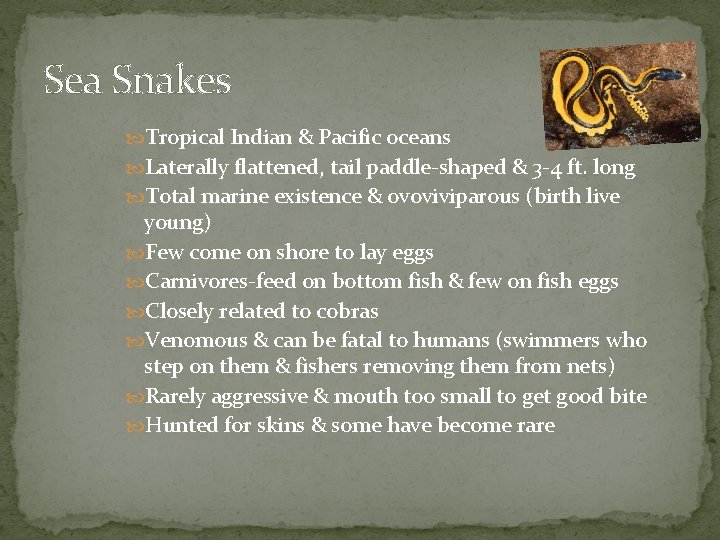
Sea Snakes Tropical Indian & Pacific oceans Laterally flattened, tail paddle-shaped & 3 -4 ft. long Total marine existence & ovoviviparous (birth live young) Few come on shore to lay eggs Carnivores-feed on bottom fish & few on fish eggs Closely related to cobras Venomous & can be fatal to humans (swimmers who step on them & fishers removing them from nets) Rarely aggressive & mouth too small to get good bite Hunted for skins & some have become rare
Other Marine Reptiles �Marine iguana (Galapagos Islands) spend most of time basking in sun Eats seaweeds & dive 33 ft to graze �Salt-water crocodile inhabits mangrove swamps & estuaries along the coast Known to venture into open sea Largest ever recorded is 33 ft, but rarely over 20 ft Most aggressive & known to attack & eat people More feared than sharks
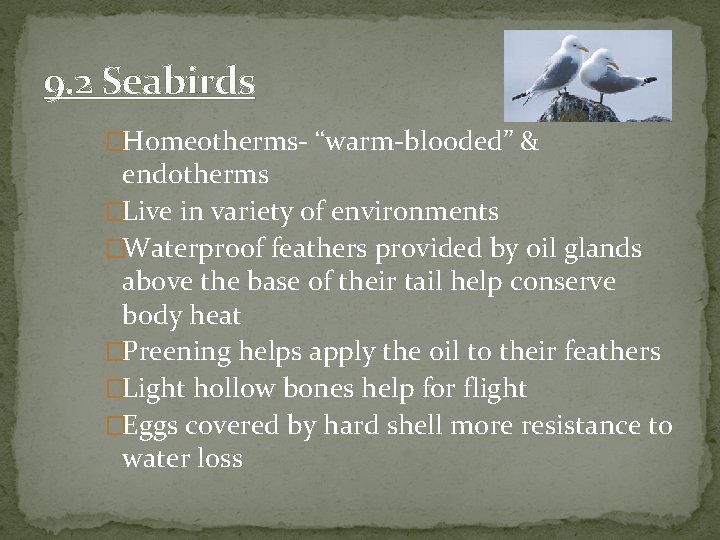
9. 2 Seabirds �Homeotherms- “warm-blooded” & endotherms �Live in variety of environments �Waterproof feathers provided by oil glands above the base of their tail help conserve body heat �Preening helps apply the oil to their feathers �Light hollow bones help for flight �Eggs covered by hard shell more resistance to water loss
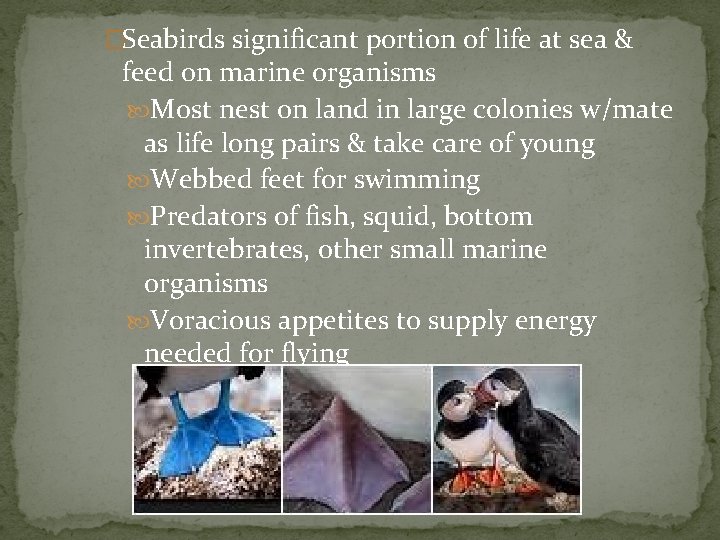
�Seabirds significant portion of life at sea & feed on marine organisms Most nest on land in large colonies w/mate as life long pairs & take care of young Webbed feet for swimming Predators of fish, squid, bottom invertebrates, other small marine organisms Voracious appetites to supply energy needed for flying
Penguins �Flightless, w/wings modified into stubby flippers for swimming �Denser bones reduces buoyancy making diving easier �Streamlined bodies w/powerful strokes of wings makes excellent swimmers �Can jump out of water & cover long distances by alternating swimming & jumping Clumsy on land & nearsighted (eyes adapted for underwater vision) �Protected from cold by layer of fat under skin
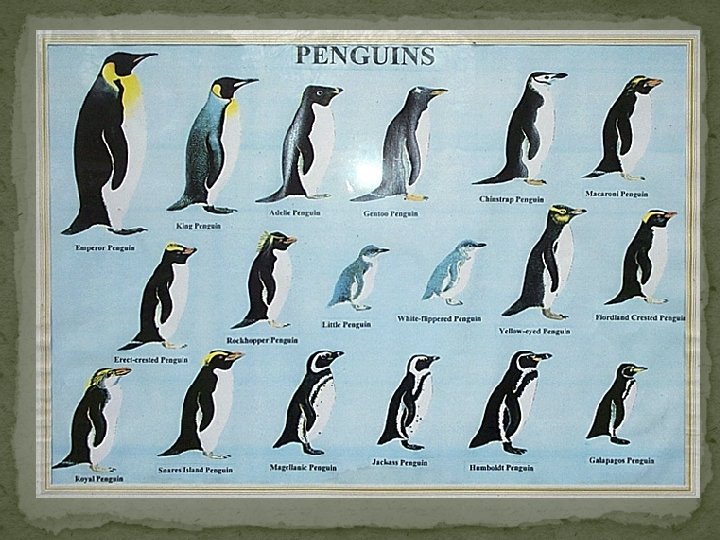
�Dense, water-proof feathers trap air warmed by body heat �All but 1 of 18 species live in Antarctica and other colder temperate regions of S. Hemisphere The Galapagos penguin which lives at Equator but confined to region with cold currents �Emperor penguin hunts fish & squid while most small penguin (Adelie) eat krill Strong beaks like seabirds �Some migrate seasonally between feeding grounds at sea and nesting areas on land or ice �Establish breeding colonies
Emperor penguins mate for life Male incubates one large egg on ice during the Antarctic winter while female leaves to feed as soon as she lays egg Male hold egg on top of feet for 64 days while huddling close together protecting themselves form the cold & storms Lay eggs at the coldest time so that hatching occurs during the productive summer when food is most plentiful When egg hatches female returns and regurgitates food for chick Then both parent take turns feeding When parents feeding chick herded into groups guarded by few adults (babysitters) Returning parent identify chick by voice & appearance Feeding takes place for 5 ½ months
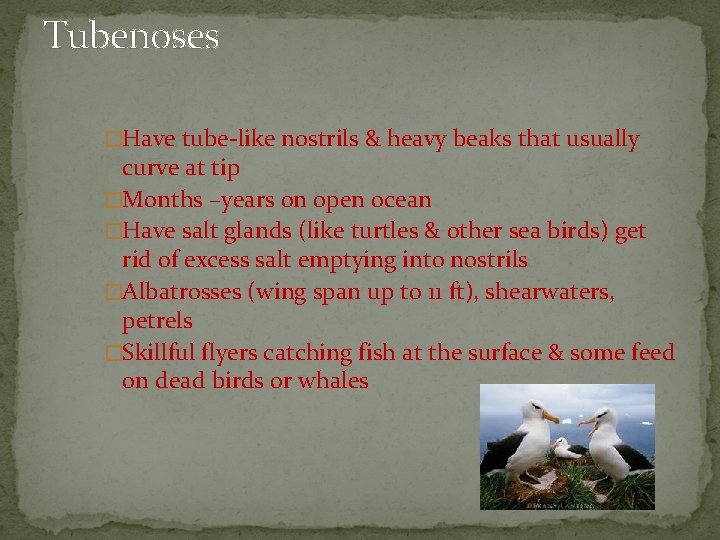
Tubenoses �Have tube-like nostrils & heavy beaks that usually curve at tip �Months –years on open ocean �Have salt glands (like turtles & other sea birds) get rid of excess salt emptying into nostrils �Albatrosses (wing span up to 11 ft), shearwaters, petrels �Skillful flyers catching fish at the surface & some feed on dead birds or whales
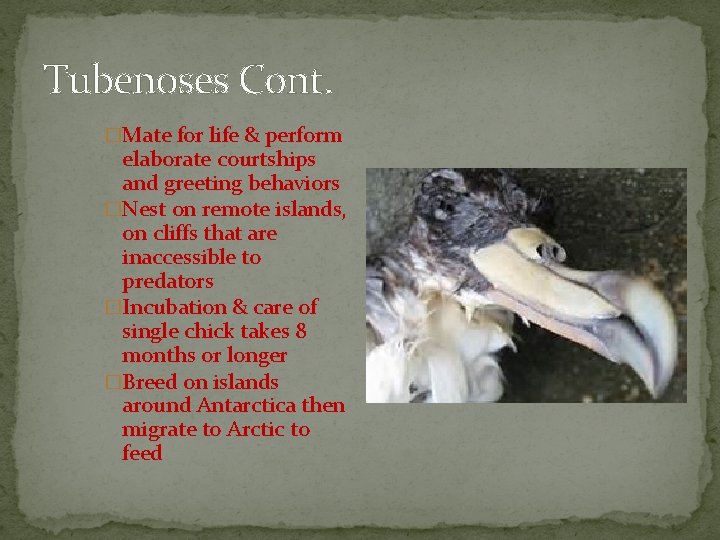
Tubenoses Cont. �Mate for life & perform elaborate courtships and greeting behaviors �Nest on remote islands, on cliffs that are inaccessible to predators �Incubation & care of single chick takes 8 months or longer �Breed on islands around Antarctica then migrate to Arctic to feed
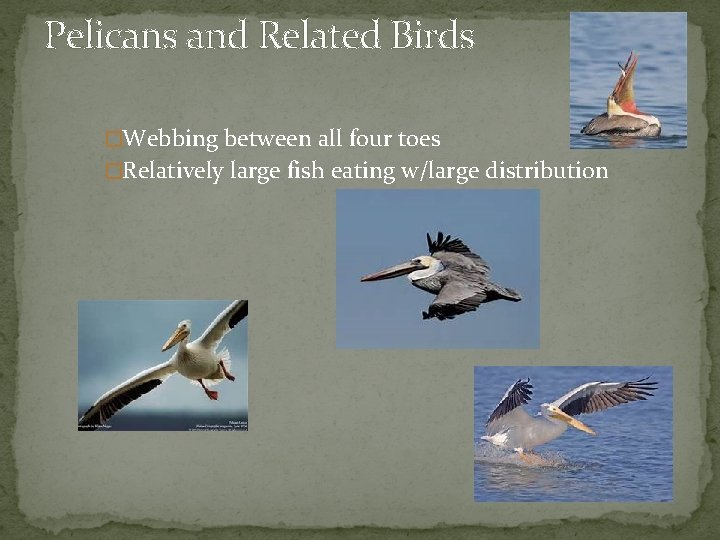
Pelicans and Related Birds �Webbing between all four toes �Relatively large fish eating w/large distribution
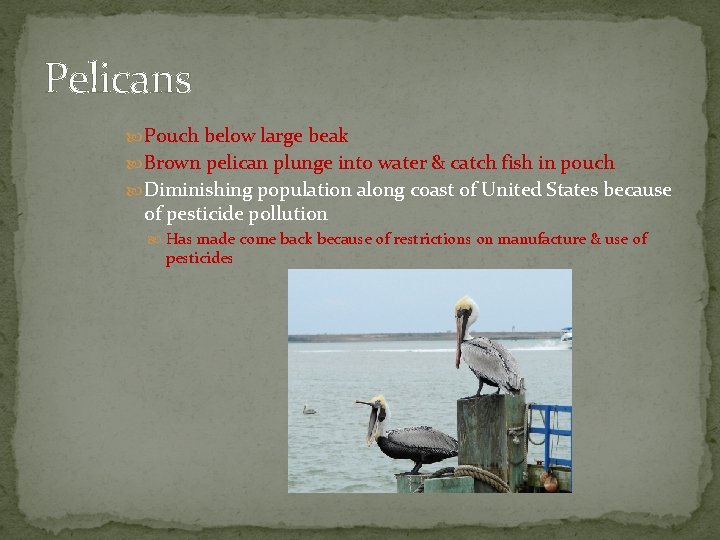
Pelicans Pouch below large beak Brown pelican plunge into water & catch fish in pouch Diminishing population along coast of United States because of pesticide pollution Has made come back because of restrictions on manufacture & use of pesticides
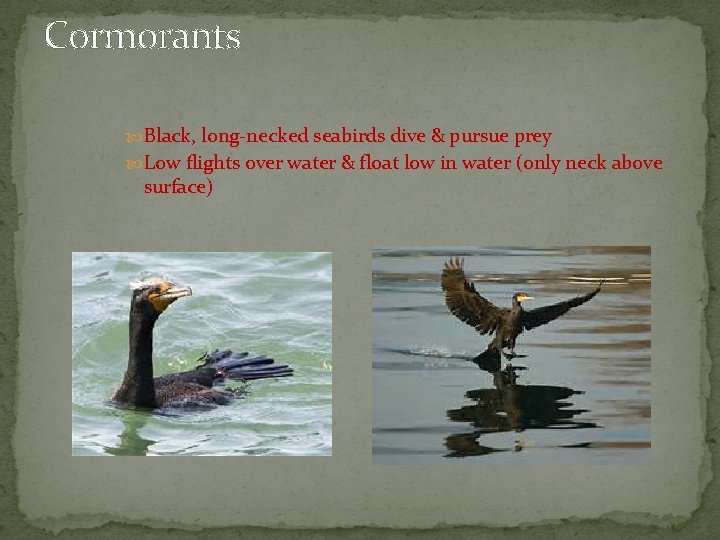
Cormorants Black, long-necked seabirds dive & pursue prey Low flights over water & float low in water (only neck above surface)
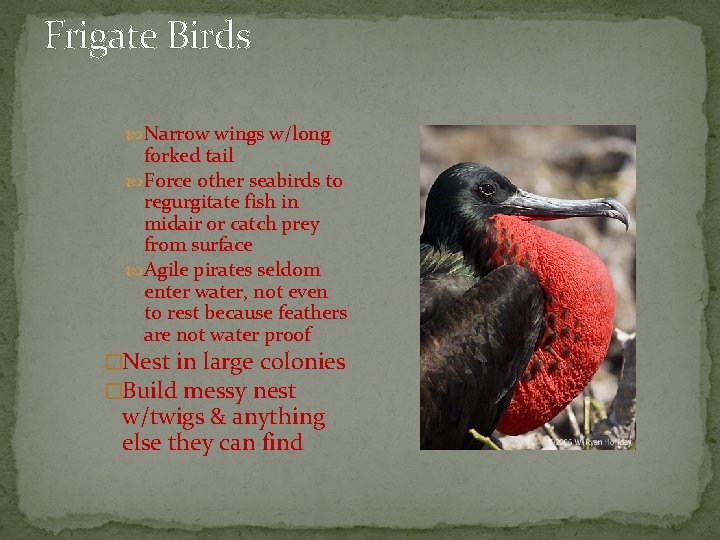
Frigate Birds Narrow wings w/long forked tail Force other seabirds to regurgitate fish in midair or catch prey from surface Agile pirates seldom enter water, not even to rest because feathers are not water proof �Nest in large colonies �Build messy nest w/twigs & anything else they can find
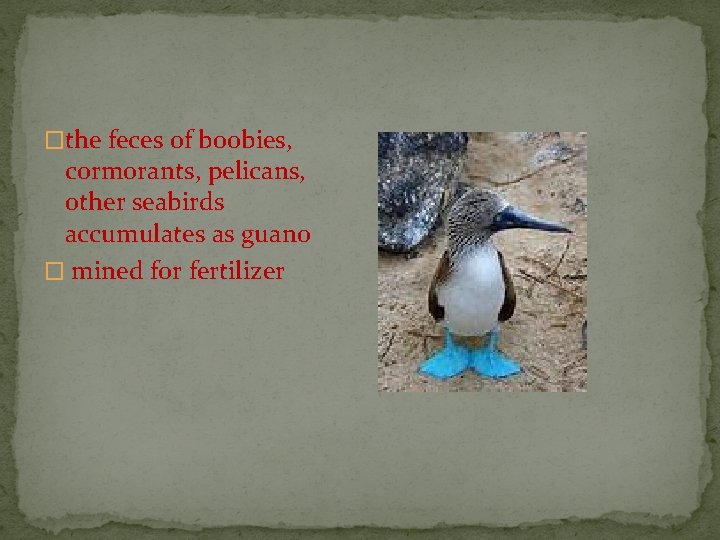
�the feces of boobies, cormorants, pelicans, other seabirds accumulates as guano � mined for fertilizer
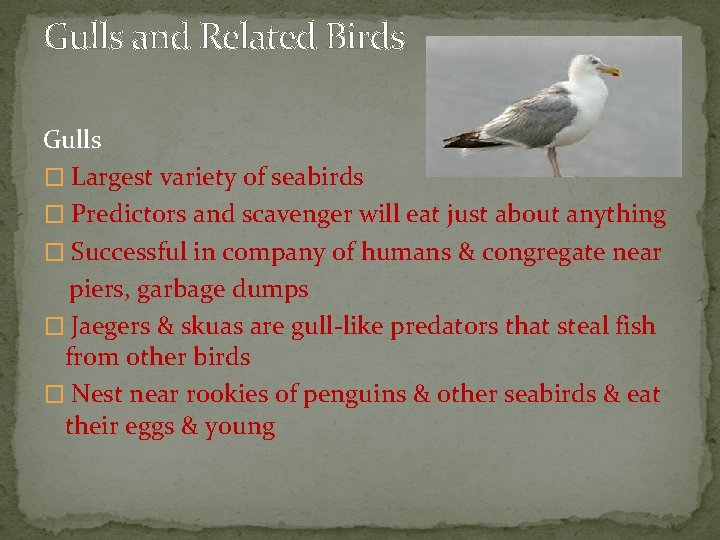
Gulls and Related Birds Gulls � Largest variety of seabirds � Predictors and scavenger will eat just about anything � Successful in company of humans & congregate near piers, garbage dumps � Jaegers & skuas are gull-like predators that steal fish from other birds � Nest near rookies of penguins & other seabirds & eat their eggs & young
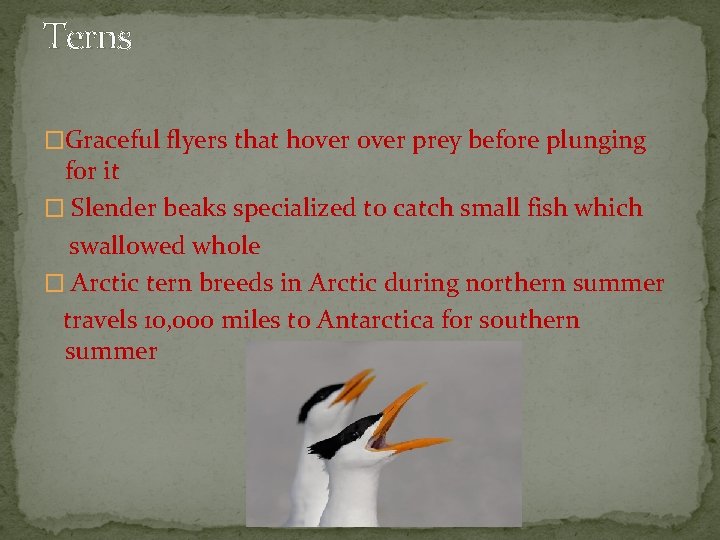
Terns �Graceful flyers that hover prey before plunging for it � Slender beaks specialized to catch small fish which swallowed whole � Arctic tern breeds in Arctic during northern summer travels 10, 000 miles to Antarctica for southern summer
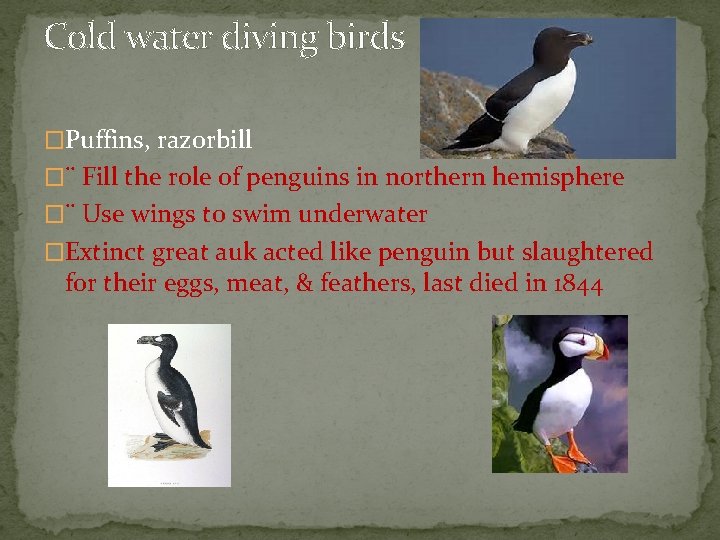
Cold water diving birds �Puffins, razorbill �¨ Fill the role of penguins in northern hemisphere �¨ Use wings to swim underwater �Extinct great auk acted like penguin but slaughtered for their eggs, meat, & feathers, last died in 1844
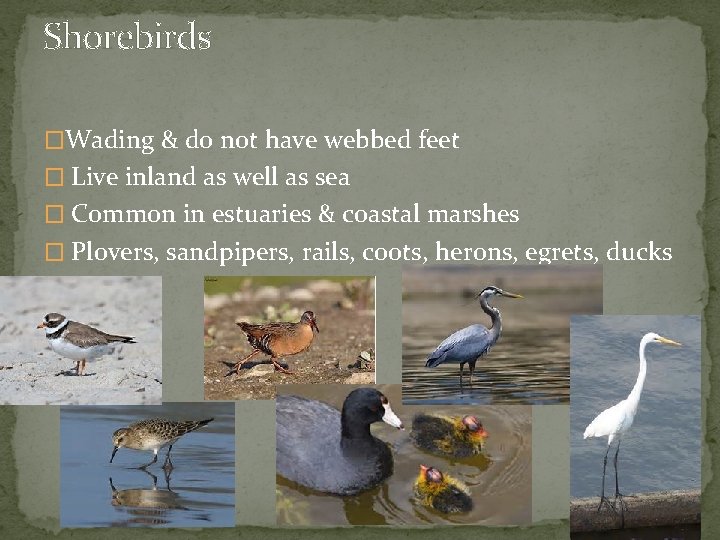
Shorebirds �Wading & do not have webbed feet � Live inland as well as sea � Common in estuaries & coastal marshes � Plovers, sandpipers, rails, coots, herons, egrets, ducks
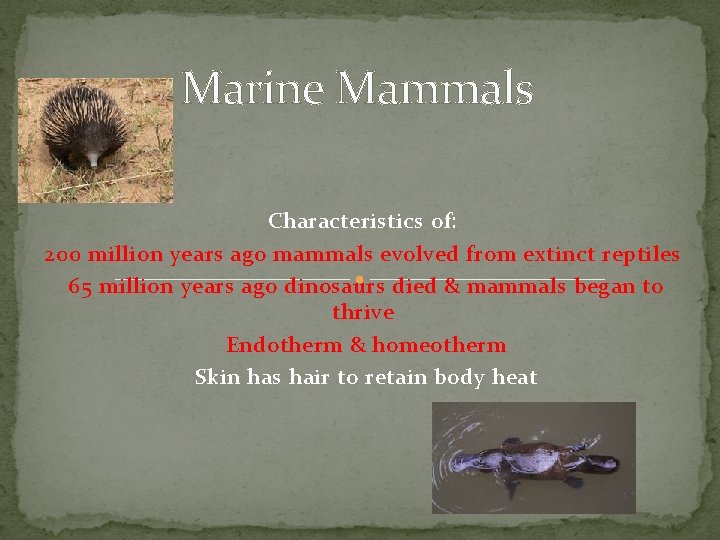
Marine Mammals Characteristics of: 200 million years ago mammals evolved from extinct reptiles 65 million years ago dinosaurs died & mammals began to thrive Endotherm & homeotherm Skin has hair to retain body heat
Marine Mammals Characteristics Cont. �Viviparous (bear live young) w/few exceptions � Embryo receives nutrients through placenta � New born fed by milk from motherefore mother has mammary glands � Few, well-cared offspring � Larger brain in relation to body size- storage & process more information �Dense bones �Breathe air
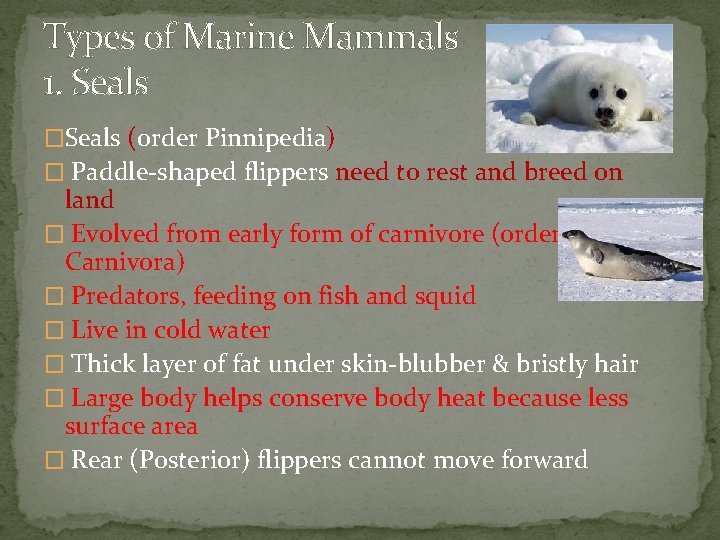
Types of Marine Mammals 1. Seals �Seals (order Pinnipedia) � Paddle-shaped flippers need to rest and breed on land � Evolved from early form of carnivore (order Carnivora) � Predators, feeding on fish and squid � Live in cold water � Thick layer of fat under skin-blubber & bristly hair � Large body helps conserve body heat because less surface area � Rear (Posterior) flippers cannot move forward
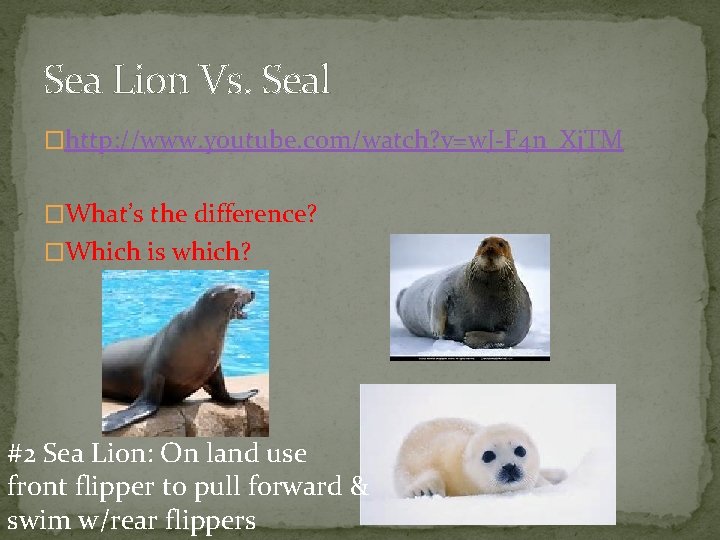
Sea Lion Vs. Seal �http: //www. youtube. com/watch? v=w. J-F 4 n_Xj. TM �What’s the difference? �Which is which? #2 Sea Lion: On land use front flipper to pull forward & swim w/rear flippers
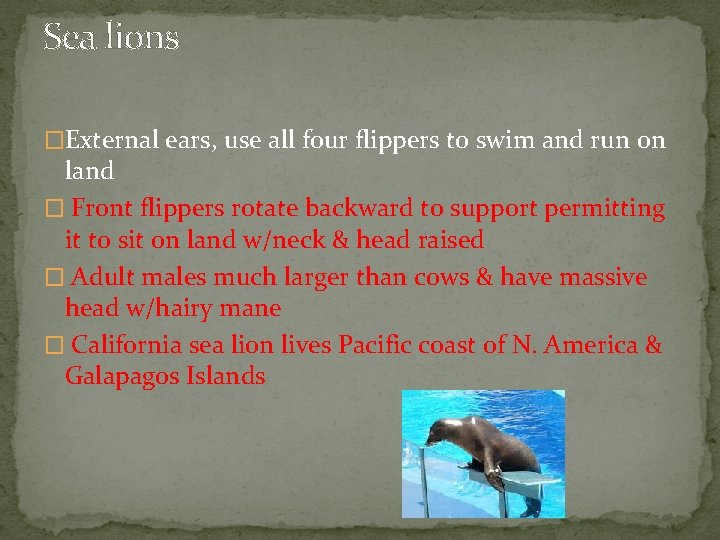
Sea lions �External ears, use all four flippers to swim and run on land � Front flippers rotate backward to support permitting it to sit on land w/neck & head raised � Adult males much larger than cows & have massive head w/hairy mane � California sea lion lives Pacific coast of N. America & Galapagos Islands
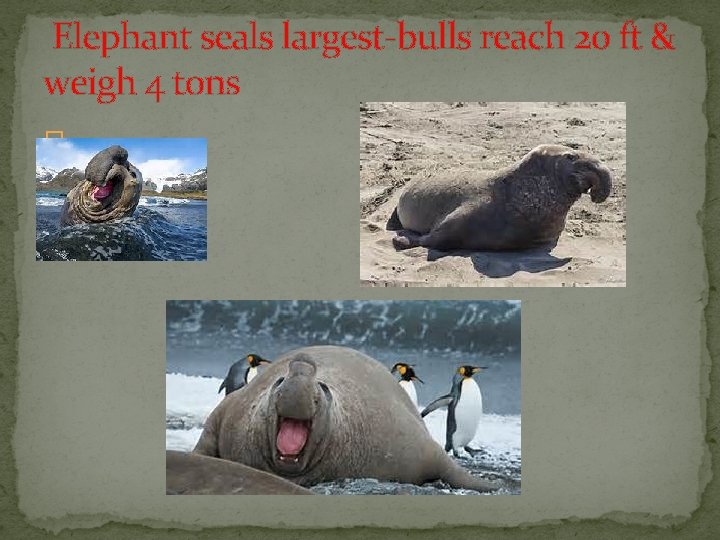
Elephant seals largest-bulls reach 20 ft & weigh 4 tons �
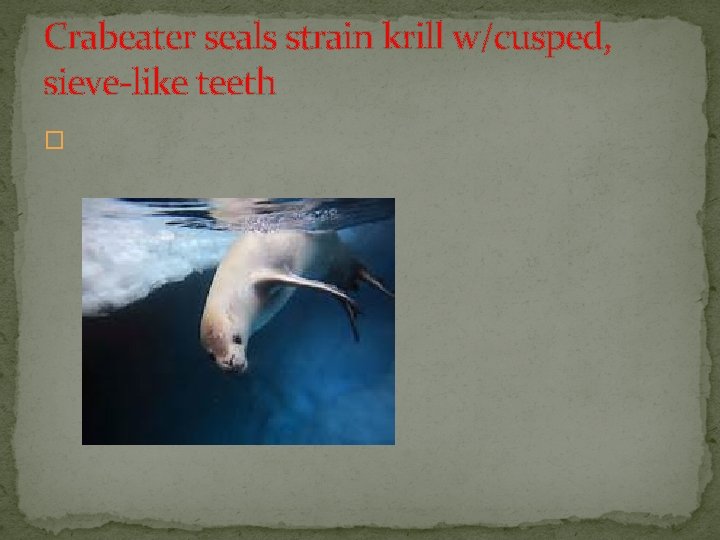
Crabeater seals strain krill w/cusped, sieve-like teeth �
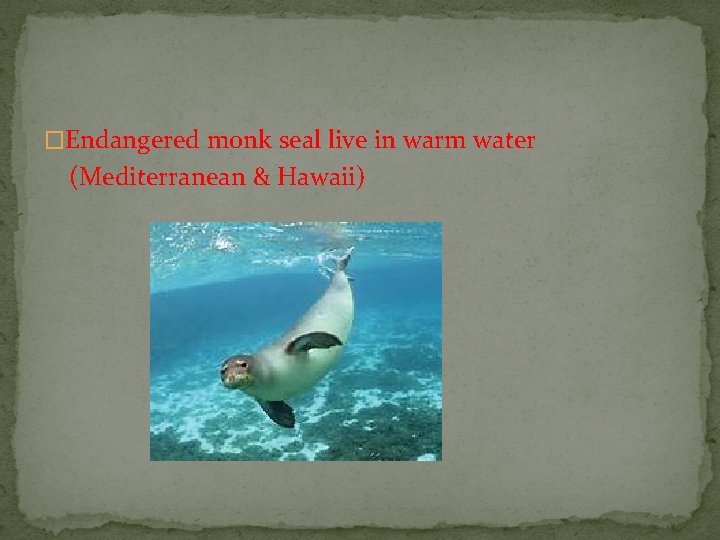
�Endangered monk seal live in warm water (Mediterranean & Hawaii)
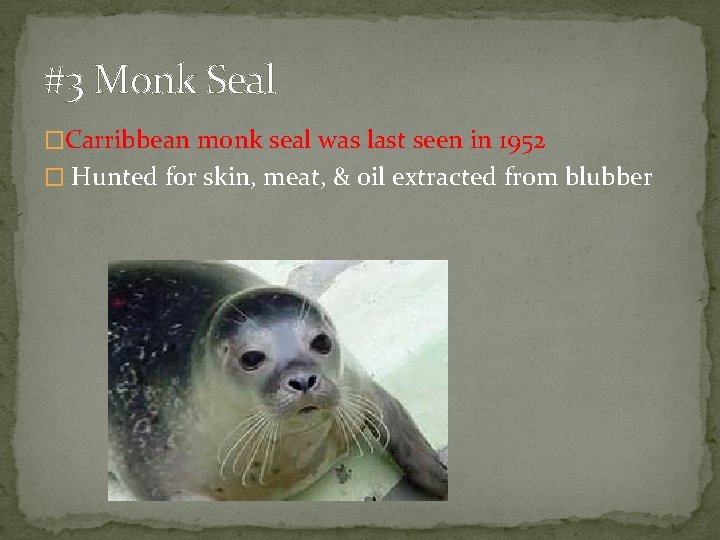
#3 Monk Seal �Carribbean monk seal was last seen in 1952 � Hunted for skin, meat, & oil extracted from blubber
Sea lions Cont. �¨ Do trick for fish in shows �http: //www. youtube. com/watch? v=smhd. TXLHj. K 4 �(start at one minute 30 seconds) � Northern Fur seals almost exterminated for thick fur �¨ Now mostly protected around world, though some are still hunted � Some drowned in nets or shot while stealing fish from fisherman
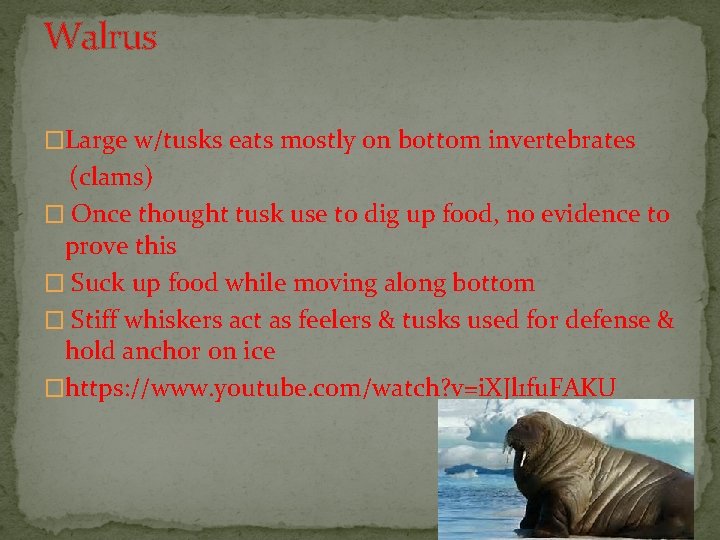
Walrus �Large w/tusks eats mostly on bottom invertebrates (clams) � Once thought tusk use to dig up food, no evidence to prove this � Suck up food while moving along bottom � Stiff whiskers act as feelers & tusks used for defense & hold anchor on ice �https: //www. youtube. com/watch? v=i. XJl 1 fu. FAKU
�Polar Bear vs. Walrus �https: //www. youtube. com/watch? v=v 6 i. Dtv. Gb. IOU �Walrus workout �https: //www. youtube. com/watch? v=i. XJl 1 fu. FAKU
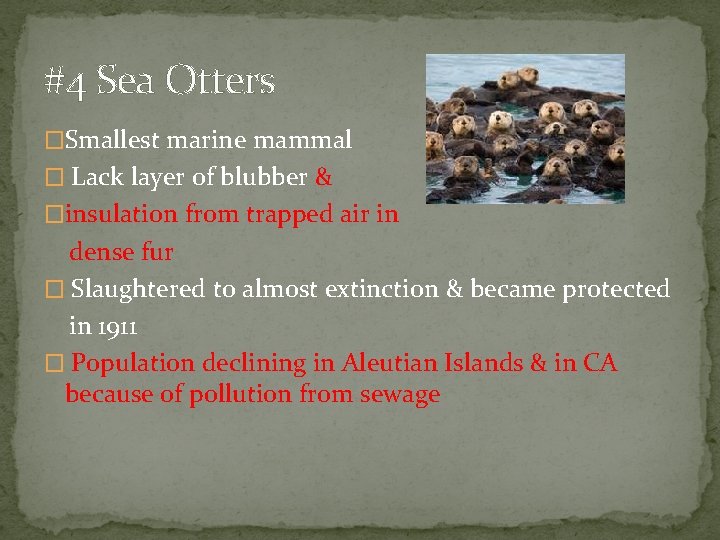
#4 Sea Otters �Smallest marine mammal � Lack layer of blubber & �insulation from trapped air in dense fur � Slaughtered to almost extinction & became protected in 1911 � Population declining in Aleutian Islands & in CA because of pollution from sewage
�Spend most of time in water feeding & giving birth � Pup groomed and nursed constantly by mother � Need to eat 25 -30% of body weight per day & spend most of day looking for food � Eat invertebrates sea urchins, abalone, mussel, crabs, & fishes � Live around kelp beds from Pacific coast of Siberia to central CA & protect kelp beds from sea urchins https: //www. youtube. com/watch? v=8 h_if. Qnd. FCo https: //www. youtube. com/watch? v=ep. Uk 3 T 2 Kfno
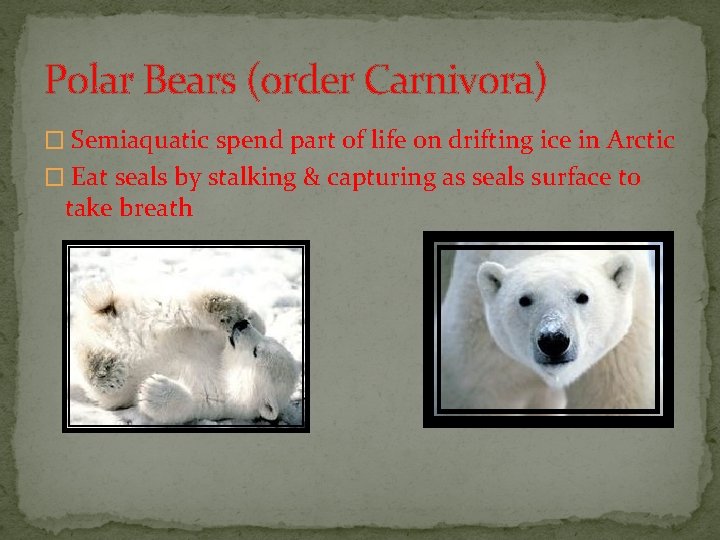
Polar Bears (order Carnivora) � Semiaquatic spend part of life on drifting ice in Arctic � Eat seals by stalking & capturing as seals surface to take breath
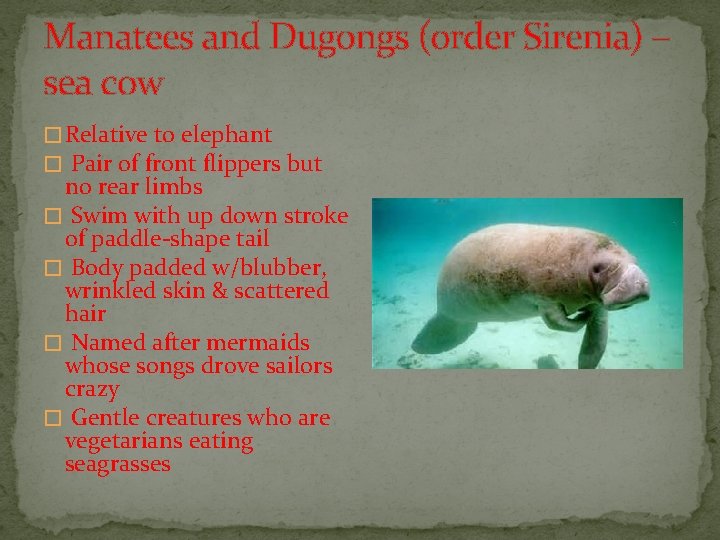
Manatees and Dugongs (order Sirenia) – sea cow � Relative to elephant � Pair of front flippers but no rear limbs � Swim with up down stroke of paddle-shape tail � Body padded w/blubber, wrinkled skin & scattered hair � Named after mermaids whose songs drove sailors crazy � Gentle creatures who are vegetarians eating seagrasses
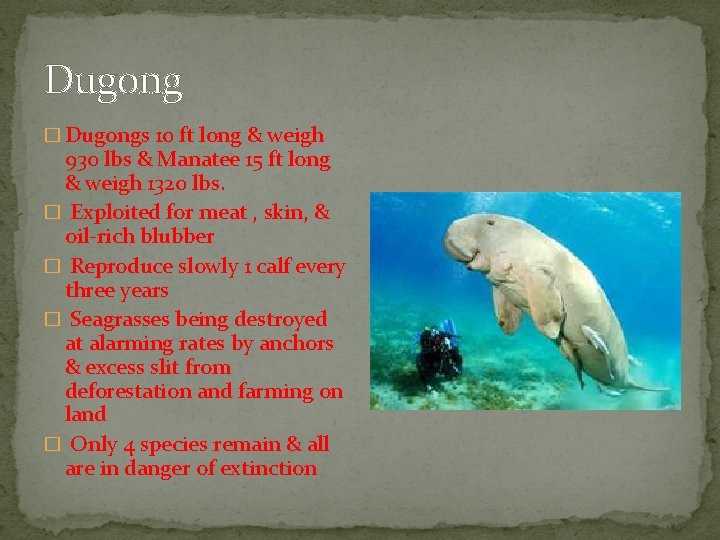
Dugong � Dugongs 10 ft long & weigh 930 lbs & Manatee 15 ft long & weigh 1320 lbs. � Exploited for meat , skin, & oil-rich blubber � Reproduce slowly 1 calf every three years � Seagrasses being destroyed at alarming rates by anchors & excess slit from deforestation and farming on land � Only 4 species remain & all are in danger of extinction
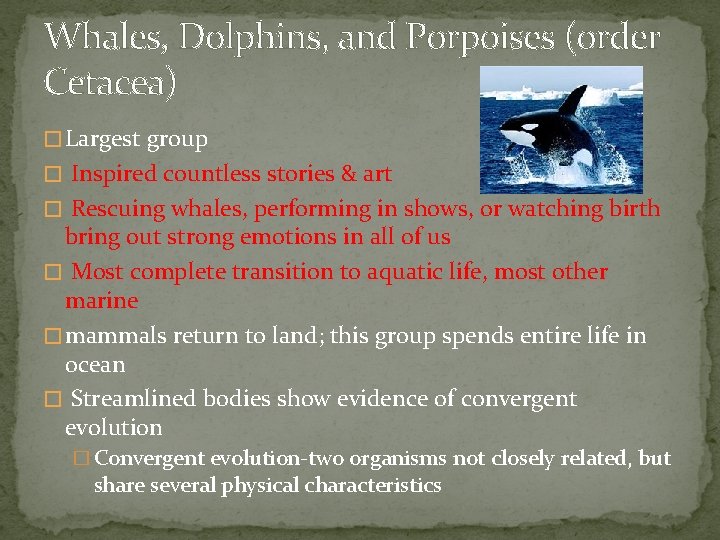
Whales, Dolphins, and Porpoises (order Cetacea) � Largest group � Inspired countless stories & art � Rescuing whales, performing in shows, or watching birth bring out strong emotions in all of us � Most complete transition to aquatic life, most other marine � mammals return to land; this group spends entire life in ocean � Streamlined bodies show evidence of convergent evolution � Convergent evolution-two organisms not closely related, but share several physical characteristics
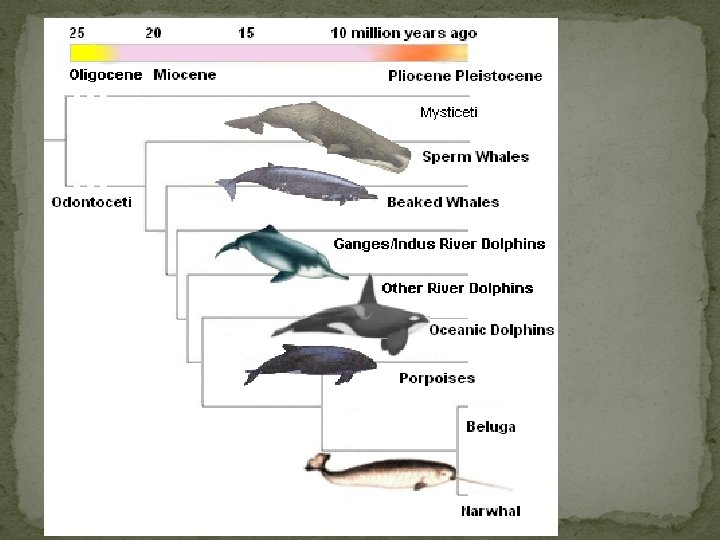
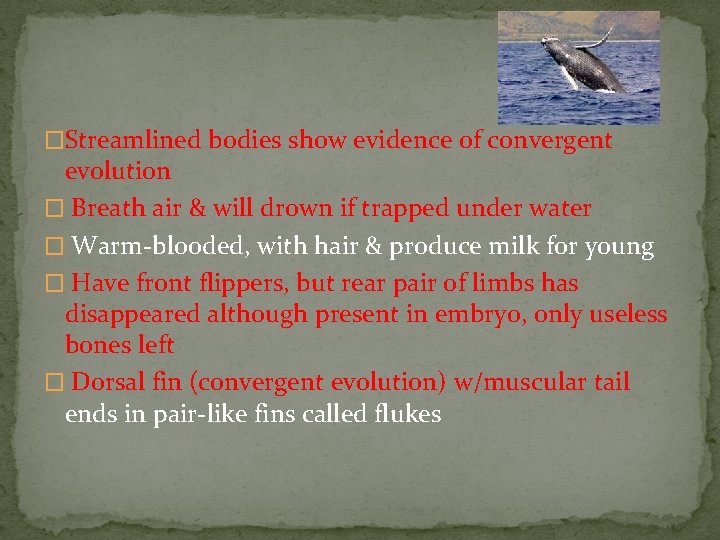
�Streamlined bodies show evidence of convergent evolution � Breath air & will drown if trapped under water � Warm-blooded, with hair & produce milk for young � Have front flippers, but rear pair of limbs has disappeared although present in embryo, only useless bones left � Dorsal fin (convergent evolution) w/muscular tail ends in pair-like fins called flukes
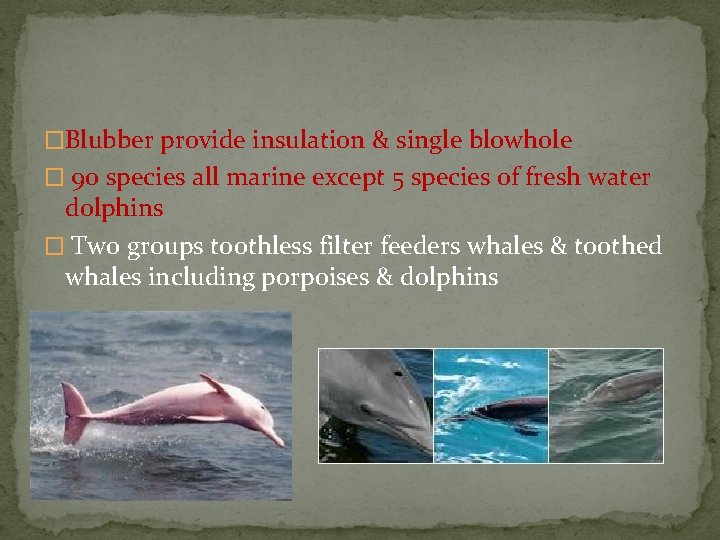
�Blubber provide insulation & single blowhole � 90 species all marine except 5 species of fresh water dolphins � Two groups toothless filter feeders whales & toothed whales including porpoises & dolphins
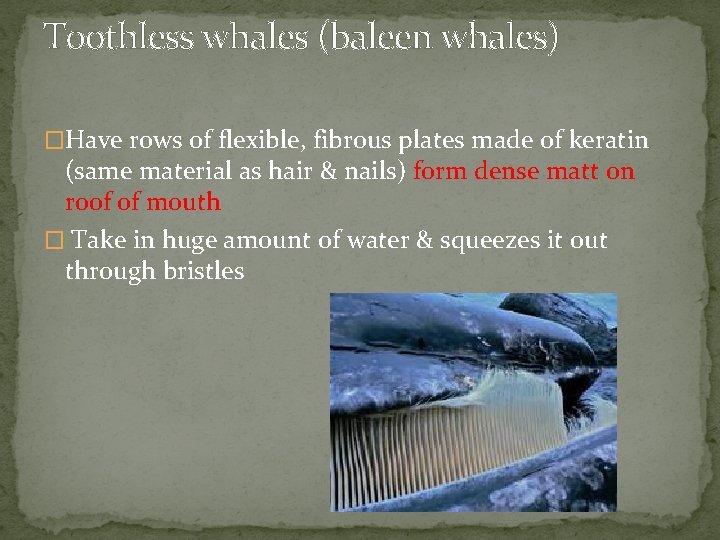
Toothless whales (baleen whales) �Have rows of flexible, fibrous plates made of keratin (same material as hair & nails) form dense matt on roof of mouth � Take in huge amount of water & squeezes it out through bristles
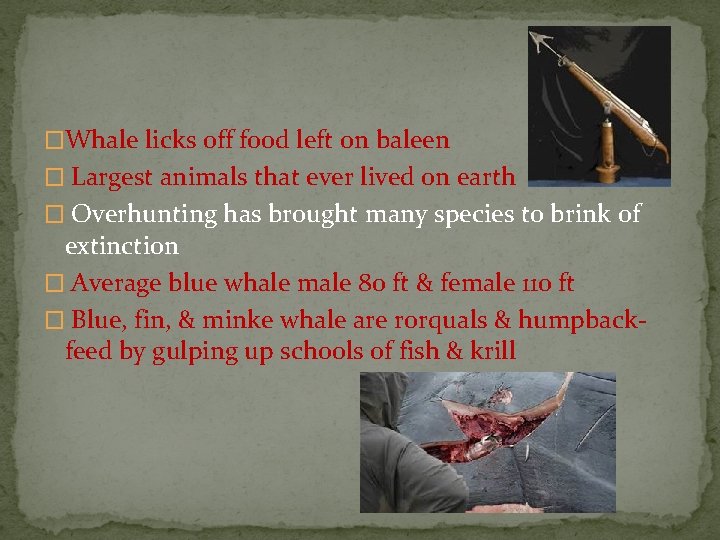
�Whale licks off food left on baleen � Largest animals that ever lived on earth � Overhunting has brought many species to brink of extinction � Average blue whale male 80 ft & female 110 ft � Blue, fin, & minke whale are rorquals & humpbackfeed by gulping up schools of fish & krill
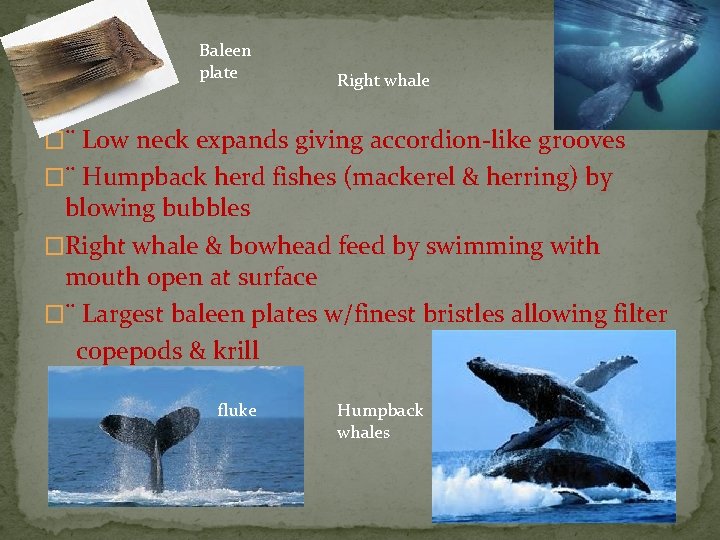
Baleen plate Right whale �¨ Low neck expands giving accordion-like grooves �¨ Humpback herd fishes (mackerel & herring) by blowing bubbles �Right whale & bowhead feed by swimming with mouth open at surface �¨ Largest baleen plates w/finest bristles allowing filter copepods & krill fluke Humpback whales
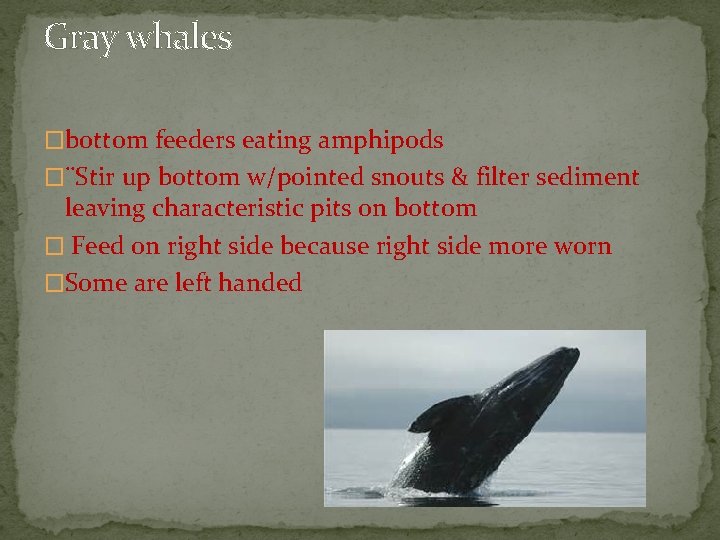
Gray whales �bottom feeders eating amphipods �¨Stir up bottom w/pointed snouts & filter sediment leaving characteristic pits on bottom � Feed on right side because right side more worn �Some are left handed
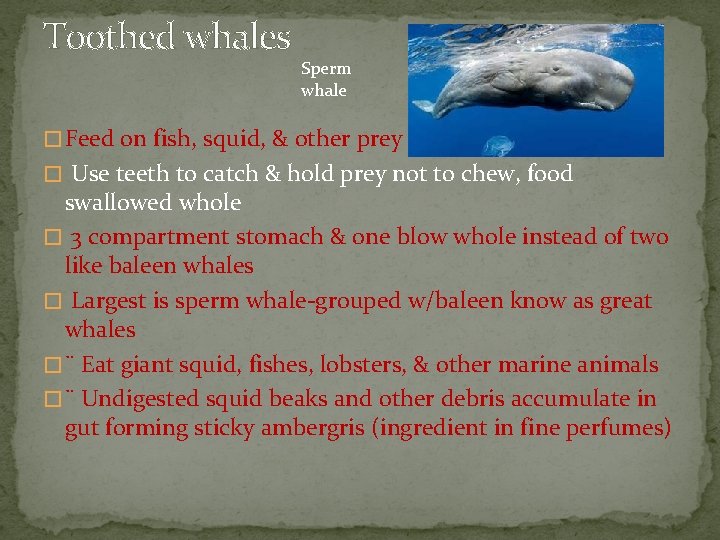
Toothed whales Sperm whale � Feed on fish, squid, & other prey � Use teeth to catch & hold prey not to chew, food swallowed whole � 3 compartment stomach & one blow whole instead of two like baleen whales � Largest is sperm whale-grouped w/baleen know as great whales � ¨ Eat giant squid, fishes, lobsters, & other marine animals � ¨ Undigested squid beaks and other debris accumulate in gut forming sticky ambergris (ingredient in fine perfumes)
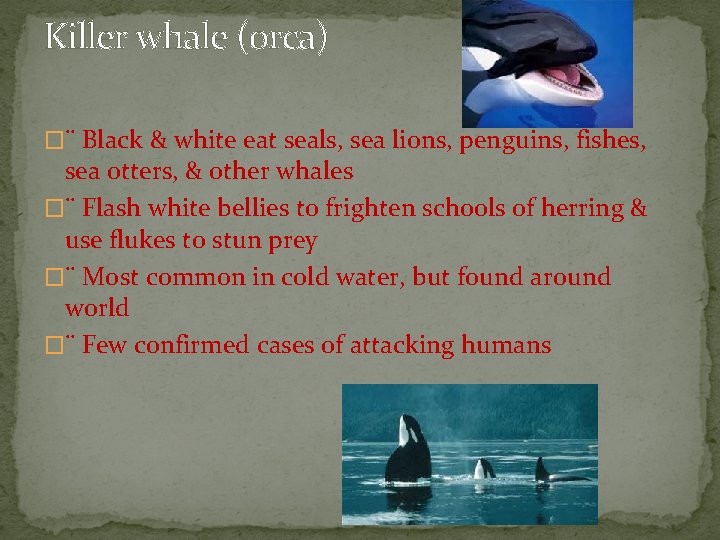
Killer whale (orca) �¨ Black & white eat seals, sea lions, penguins, fishes, sea otters, & other whales �¨ Flash white bellies to frighten schools of herring & use flukes to stun prey �¨ Most common in cold water, but found around world �¨ Few confirmed cases of attacking humans
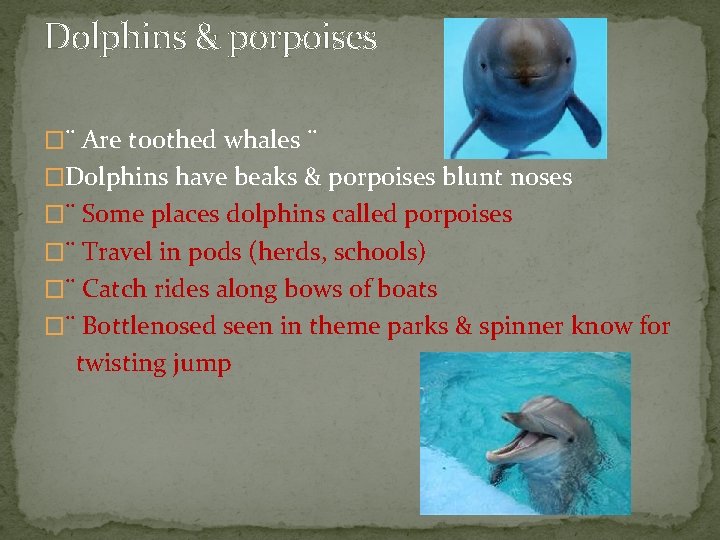
Dolphins & porpoises �¨ Are toothed whales ¨ �Dolphins have beaks & porpoises blunt noses �¨ Some places dolphins called porpoises �¨ Travel in pods (herds, schools) �¨ Catch rides along bows of boats �¨ Bottlenosed seen in theme parks & spinner know for twisting jump
�¨ Dolphins not only cetaceans to be threatened �¨ Whaling old tradition in many different groups of people � Native Americans, Eskimos (still hunt them), Basques � In 1600 s Europeans & Americans started exploiting in N. Atlantic & New England � Blubber provided train oil, soap, & lamp oil � Baleen used for corsets & other goods & meat � Increased w/ steam ships & explosive harpoons
� Low reproductive rate � One calf carried by mother for year or more � Females do not become pregnant for 2 -3 years after giving birth � Because of low reproductive rate, they could not keep up w/ whaling � Population has been reduced due to commercial whaling � Almost all of great whales are classified as endangered � Right whale was the first to deplete because slow moving & float after being harpooned
�Whaling nations developed factory ships to invade the rich waters of Antarctic � Blue whale (largest) especially sought � 80% of whales caught in 1963 were immature � Fin whales (second largest) 1950 -1960 s � Sei Whale in mid 1960 s were hunted
� 1946 20 countries established IWC International Whaling Commission to regulate whaling to stop over fishing � Collected data on number of whales & set annual quotas but could not be enforced � Blue whale hunted until 1971 � Under pressure from conservationist banned hunting of other whales & demand for whale product reduced because of substituted ingredients
� US Congress passed Marine Mammal Protection Act of 1972 bans hunting of all marine mammals in US waters (except traditional hunting by native Alaskans) � Soviet Union halted whaling in 1987 However Japan, � Iceland, & Norway continued hunting minke, fin, & sei � 1994 IWC vast sanctuary for all whale in waters in � Antarctica (main feeding grounds) but Japan decided to continue � Japan’s Famous Cove � http: //www. bing. com/videos/search? q=cnn+video+do lphins+taiji+cove&FORM=HDRSC 3#view=detail&mid =F 1 A 608 BD 7 A 2776868 D 6 F
�Japan has set its quota in 2005 -06 at 850 minkes, 50 humpbacks, and 50 fin � Iceland was allowed to take 38 minkes in 2005 -06 � Norway in defiance of IWC set quota of 796 minkes for 2005 -06 � Small-scale whaling remains as part of tradition of native inhabitants of �Arctic region (Greenland-Siberia), Lesser Antilles � Killer whale, narwhal, and beluga are also hunted � No one knows if the whales will ever recover
� California gray has made a comeback & removed form endangered list in 1997 � IWC allowed 600 gray whales to be hunted by native hinters in Siberia & 20 by Makah Indian tribe in Washington state but tribe has only taken 1 � They are returning to southern reaches of Arctic Ocean north of Norway
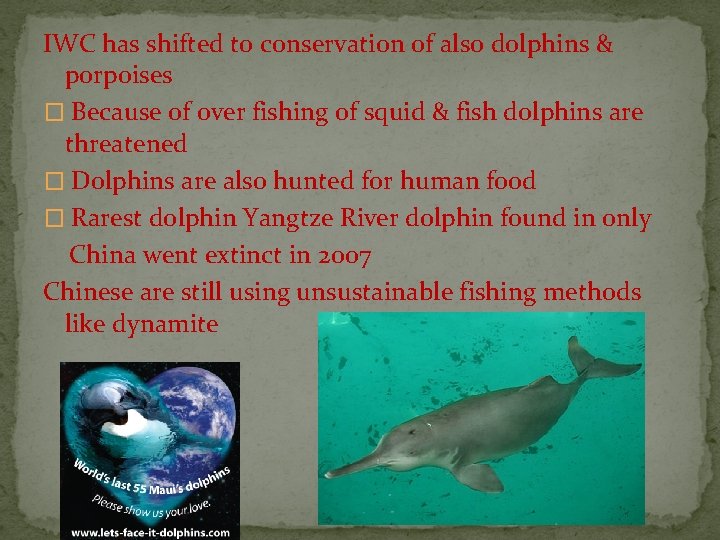
IWC has shifted to conservation of also dolphins & porpoises � Because of over fishing of squid & fish dolphins are threatened � Dolphins are also hunted for human food � Rarest dolphin Yangtze River dolphin found in only China went extinct in 2007 Chinese are still using unsustainable fishing methods like dynamite
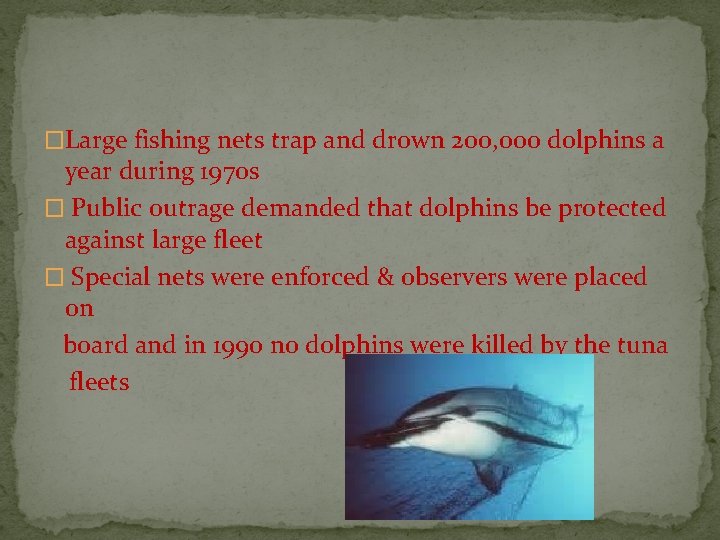
�Large fishing nets trap and drown 200, 000 dolphins a year during 1970 s � Public outrage demanded that dolphins be protected against large fleet � Special nets were enforced & observers were placed on board and in 1990 no dolphins were killed by the tuna fleets
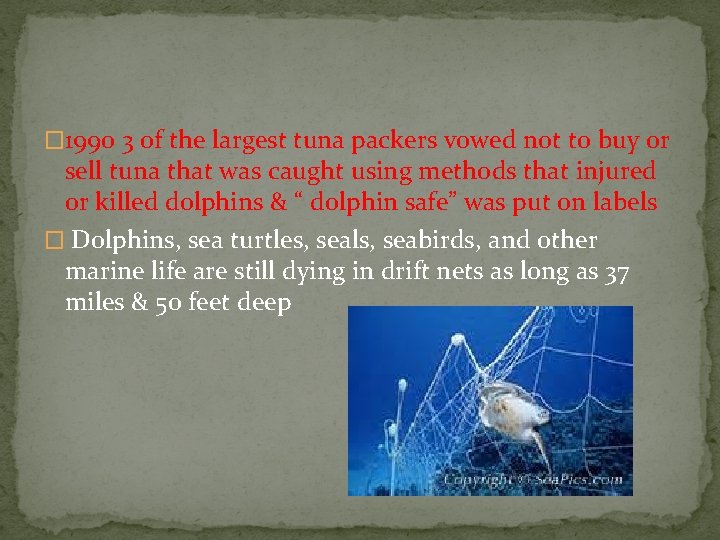
� 1990 3 of the largest tuna packers vowed not to buy or sell tuna that was caught using methods that injured or killed dolphins & “ dolphin safe” was put on labels � Dolphins, sea turtles, seals, seabirds, and other marine life are still dying in drift nets as long as 37 miles & 50 feet deep
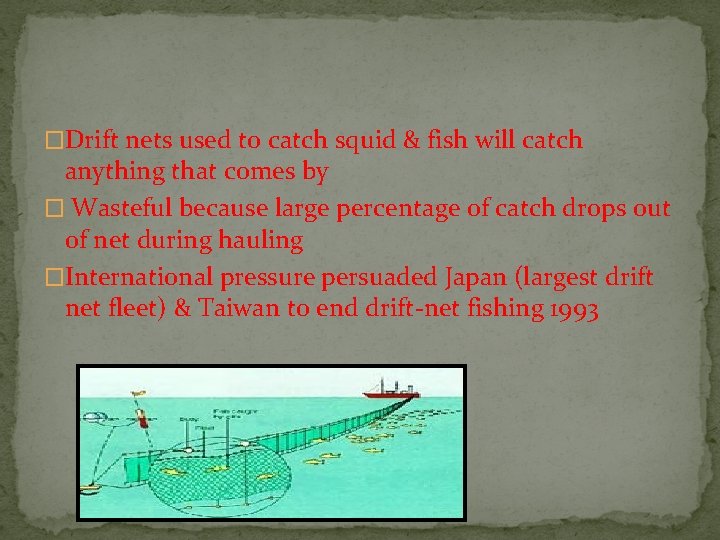
�Drift nets used to catch squid & fish will catch anything that comes by � Wasteful because large percentage of catch drops out of net during hauling �International pressure persuaded Japan (largest drift net fleet) & Taiwan to end drift-net fishing 1993
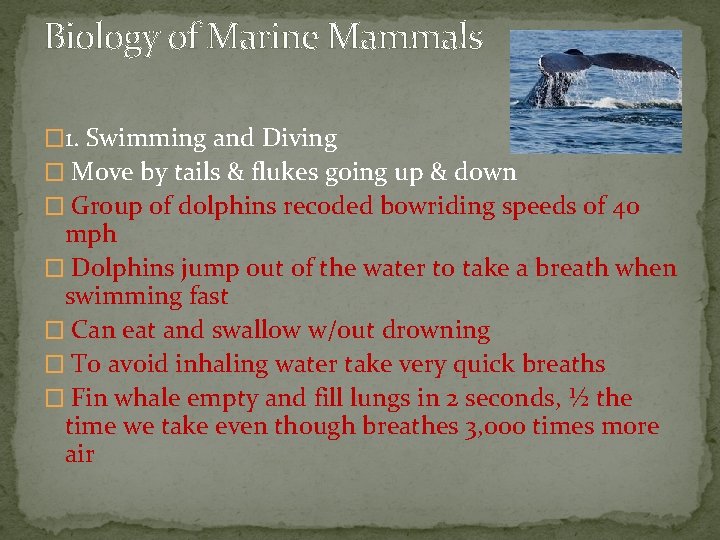
Biology of Marine Mammals � 1. Swimming and Diving � Move by tails & flukes going up & down � Group of dolphins recoded bowriding speeds of 40 mph � Dolphins jump out of the water to take a breath when swimming fast � Can eat and swallow w/out drowning � To avoid inhaling water take very quick breaths � Fin whale empty and fill lungs in 2 seconds, ½ the time we take even though breathes 3, 000 times more air
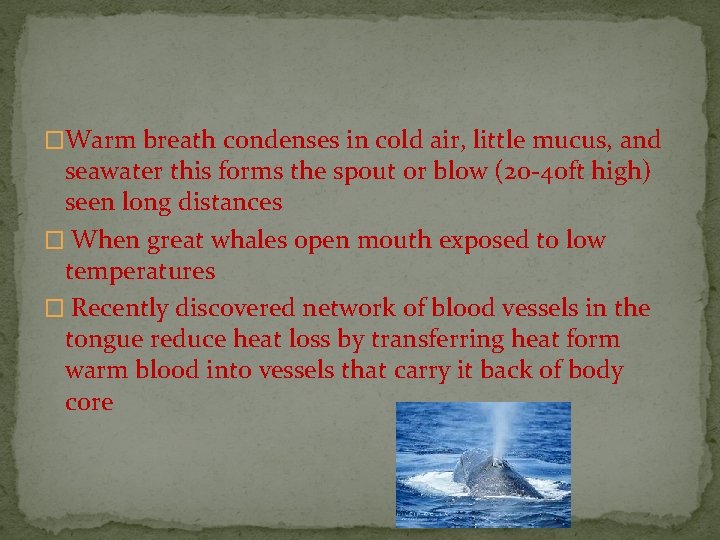
�Warm breath condenses in cold air, little mucus, and seawater this forms the spout or blow (20 -40 ft high) seen long distances � When great whales open mouth exposed to low temperatures � Recently discovered network of blood vessels in the tongue reduce heat loss by transferring heat form warm blood into vessels that carry it back of body core
� Sea otters dive 4 -5 minutes to 180 ft, most pinnipeds (fin footed, semiaquatic animals like seals, sea lions, and walruses) dive for up to 30 minutes to 150 -250 ft but some capable of 1300 ft -5000 ft � Baleen whale seldom go below 300 ft � Toothed whales great divers � Dolphins dive to 990 ft � Sperm whale under at least hour to 7380 ft
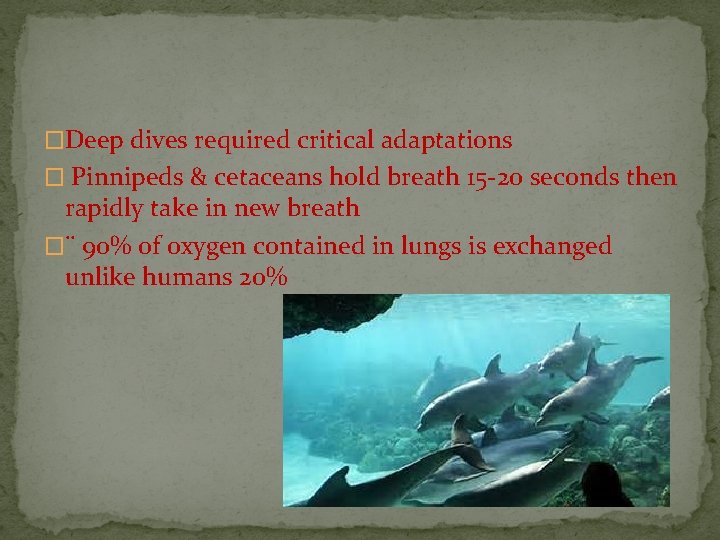
�Deep dives required critical adaptations � Pinnipeds & cetaceans hold breath 15 -20 seconds then rapidly take in new breath �¨ 90% of oxygen contained in lungs is exchanged unlike humans 20%
�¨ Better at absorbing oxygen from air & storing in blood �Have more blood than nondiving mammals �¨ Have higher concentration of erythrocytes carrying more hemoglobin �¨ Muscles rich w/ myoglobin (can store oxygen in blood)
� When diving heart rate slows & blood flow to nonessential parts � (extremities & intestine) but maintained in vital organs � To prevent the bends lungs collapse & rib cage gets pushed in by pressure of water � Air moved into central space where nitrogen is not absorbed � Some pinnipeds exhale before they dive reducing nitrogen in air � Recent evidence shows some diving whales do suffer from the bends
Echolocation �Nature ‘s version of sonar � All toothed whales, some pinnipeds, and baleen whales � Not exclusive to marine (bats) � Emit sound waves, which travels 5 times faster in water, & listen for echoes that are reflected off object � Time it take for echoes tells distance of object � Used to find prey & orient to surroundings
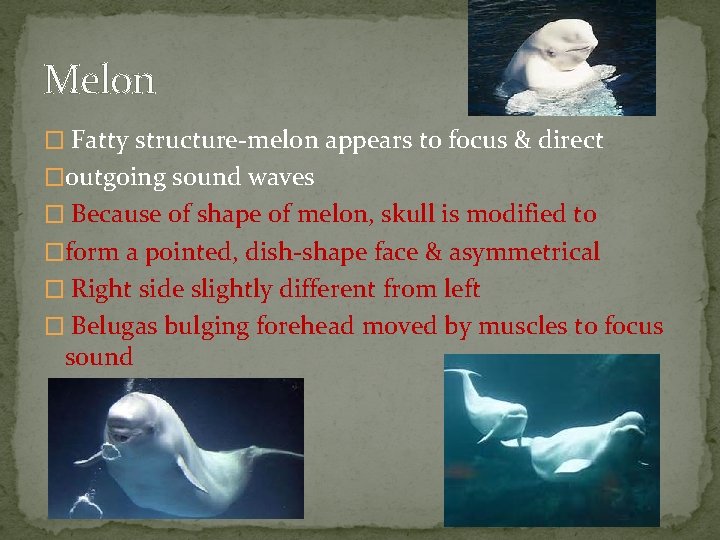
Melon � Fatty structure-melon appears to focus & direct �outgoing sound waves � Because of shape of melon, skull is modified to �form a pointed, dish-shape face & asymmetrical � Right side slightly different from left � Belugas bulging forehead moved by muscles to focus sound
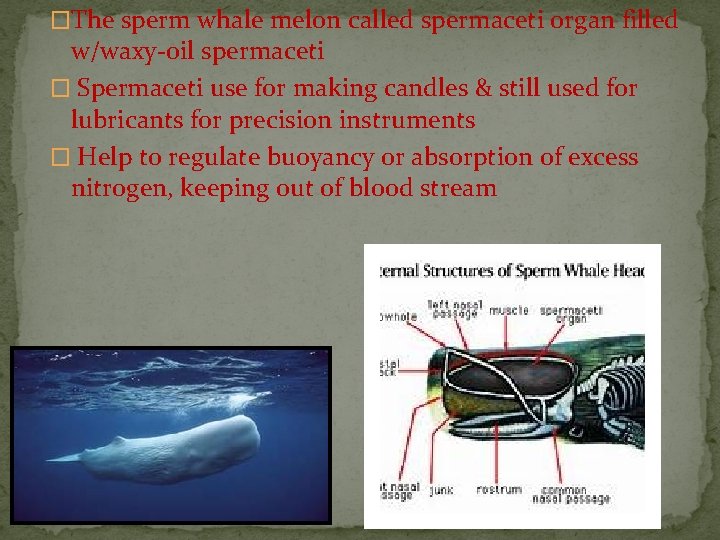
�The sperm whale melon called spermaceti organ filled w/waxy-oil spermaceti � Spermaceti use for making candles & still used for lubricants for precision instruments � Help to regulate buoyancy or absorption of excess nitrogen, keeping out of blood stream
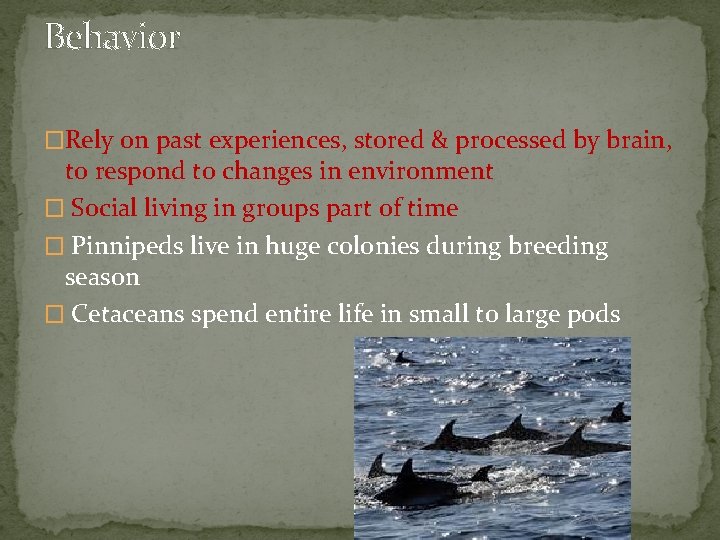
Behavior �Rely on past experiences, stored & processed by brain, to respond to changes in environment � Social living in groups part of time � Pinnipeds live in huge colonies during breeding season � Cetaceans spend entire life in small to large pods
Vocalizations play role in communication � Maintain territories during reproduction � Females and pups/calves recognize each other by sound � Cetaceans can sound of echolocation & communication at same time � Social are low frequency sounds (humans cannot hear) � Different sounds for different moods and sexual signals � 70 calls in killer whales be identified & used by all orcas other calls are dialects that can identify certain pods � Sound used to maintain distances in pods � https: //www. youtube. com/watch? v=Hyj. V 9 BVf. Yw 0 � https: //www. youtube. com/watch? v=P 2 x. URyn. O 03 Q
� Male humpback whales sing to attract females consisting of phrases &themes repeated over ½ hour to hour over days �https: //www. youtube. com/watch? time_continue=31& v=h 8 xdz 92 Ij 60
�Cetaceans known for playful behavior �Play w/food or floating objects by throwing them up in the air or holding on snout � Swim head down � Dolphins play w/ring bubbles they make �Surf �http: //www. bing. com/videos/search? q=dolphins+playing+in +bubbles&qs=n&form=QBVR&pq=dolphins+playing+in+bub bles&sc=8 -14&sp=1&sk=#view=detail&mid=9569 F 6 A 983 EB 5 C 00 E 0709569 F 6 A 9 83 EB 5 C 00 E 070
�Breaching is for play, getting rid of external parasites, warning signal, scanning surface or shoreline � After deep dive sperm whales may breach & fall on backs making splash that can be heard 2. 5 mil and seen 17. 4 miles �http: //www. bing. com/videos/search? q=sperm+whale +breechign&qs=n&form=QBVR&pq=sperm+whale+br eechign&sc=4 -16&sp=1&sk=#view=detail&mid=138 E 04 BDF 9 C 857396259
�Assist in injured members of the group � Whalers know the harpooned whale lures other whales � Dolphins carry individual to surface to breath � Females will carry stillborn calf until it rots
Relationship between dolphins & humans controversial �Swimming among dolphins offered some resort hotel amazing experience � Trained for military purposes by the former soviet navy being used for treatment of children w/ behavior disorders � Some believe it is the exploitation of captive animals
�Stress of captive dolphins decrease life span � Authentic cases of dolphins approaching human swimmers in trouble � Fishers have interpret cues given by dolphins about location and abundance of fish � Generations of dolphins exploited the rows of fishers holding nets
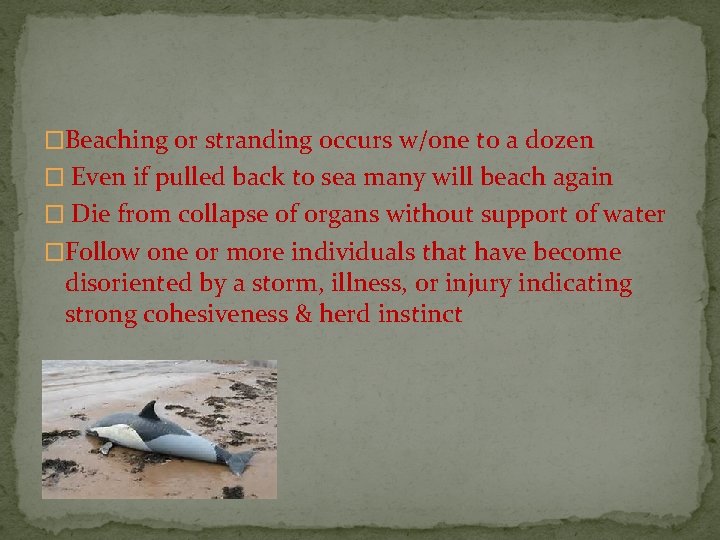
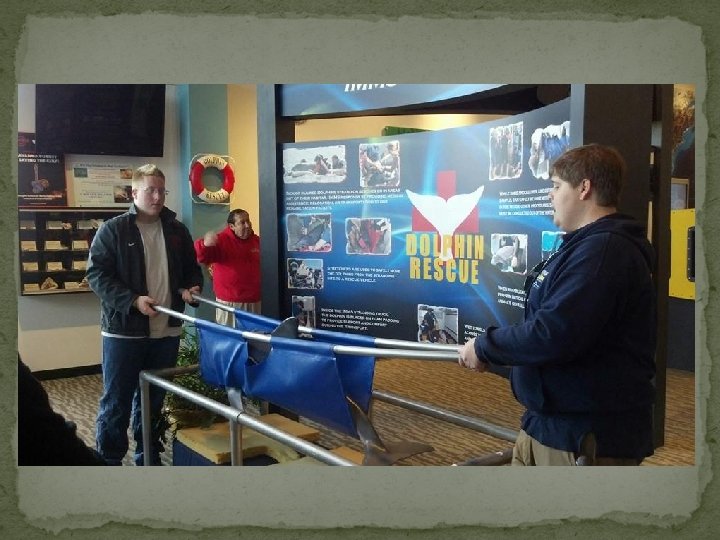
�Beaching or stranding occurs w/one to a dozen � Even if pulled back to sea many will beach again � Die from collapse of organs without support of water �Follow one or more individuals that have become disoriented by a storm, illness, or injury indicating strong cohesiveness & herd instinct
II. Marine Mammal Protection Act of 1972 �extends protection to all marine mammals & restricts sale of Products in US �http: //www. youtube. com/watch? v=a_QMKYFs. O 2 U
- Slides: 92