
Community Eating Disorder Service Children Young People CEDS


- Slides: 20
Community Eating Disorder Service Children & Young People (CEDS – CYP) Dr Rebecca Adams Consultant Psychiatrist Ingrid Skillicorn Family and Systemic Therapist
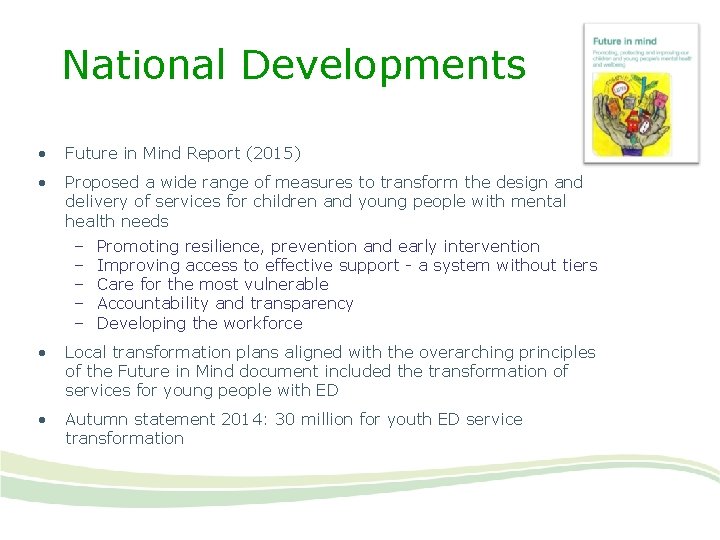
National Developments • Future in Mind Report (2015) • Proposed a wide range of measures to transform the design and delivery of services for children and young people with mental health needs – – – Promoting resilience, prevention and early intervention Improving access to effective support - a system without tiers Care for the most vulnerable Accountability and transparency Developing the workforce • Local transformation plans aligned with the overarching principles of the Future in Mind document included the transformation of services for young people with ED • Autumn statement 2014: 30 million for youth ED service transformation
Eating Disorder Research • The availability of a dedicated CEDS -CYP has been shown to improve outcomes and cost effectiveness • The sooner someone with an ED starts NICE concordant treatment, the better the outcomes (improved recovery rates, fewer relapses, fewer admissions)
National Picture Access and Waiting Time Standard for Children and Young People with an Eating Disorder: Commissioning Guide Informed by the latest research findings and best practice consensus and sets out standards and requirements for providing a CED-S for young people Describes the staffing and skill mix necessary to ensure swift access to an appropriate service NICE concordant treatment should start within a maximum of 4 weeks for routine and 1 week for urgent cases https: //www. england. nhs. uk/wp-content/uploads/2015/07/cyp-eating -disorders-access-waiting-time-standard-comm-guid. pdf
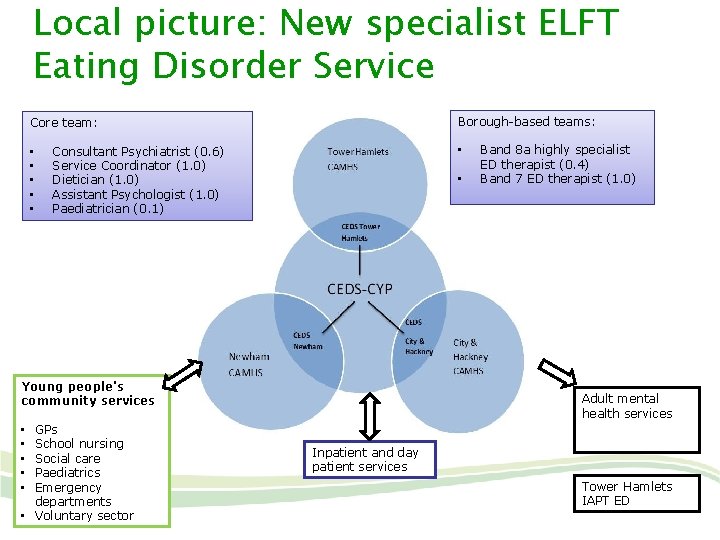
Local picture: New specialist ELFT Eating Disorder Service Borough-based teams: Core team: • • • Consultant Psychiatrist (0. 6) Service Coordinator (1. 0) Dietician (1. 0) Assistant Psychologist (1. 0) Paediatrician (0. 1) • Young people's community services GPs School nursing Social care Paediatrics Emergency departments • Voluntary sector • • • Band 8 a highly specialist ED therapist (0. 4) Band 7 ED therapist (1. 0) Adult mental health services Inpatient and day patient services Tower Hamlets IAPT ED
What is an Eating Disorder? • AN, BN, Atypical AN & BN, BED share a characteristic underlying psychopathology • Morbid dread of fatness and excessive preoccupation with body shape and weight/body image distortion/strive toward sub-optimal ideal weight • Does not include feeding disorders of childhood such as faddy eating, pica
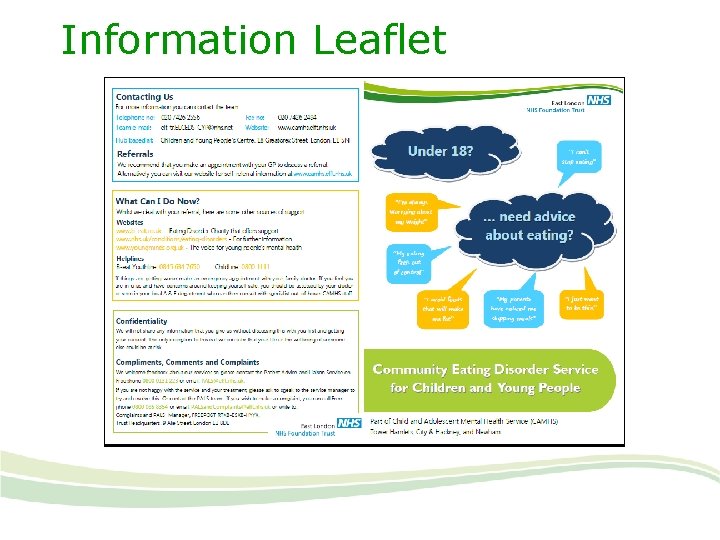
Information Leaflet
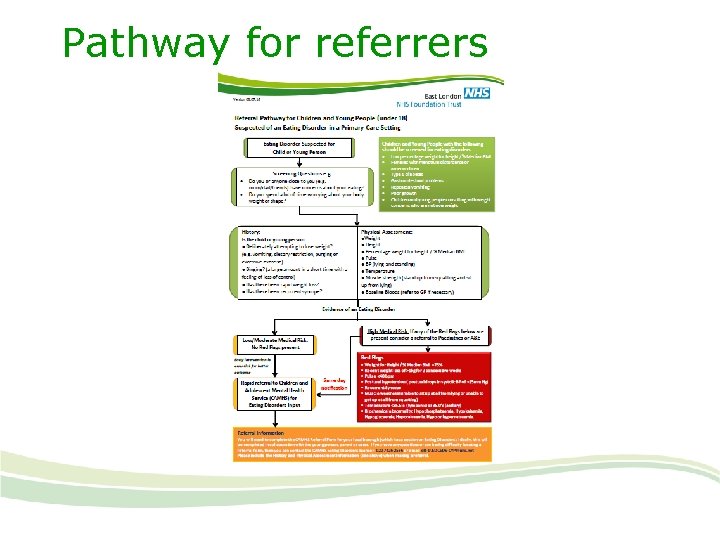
Pathway for referrers
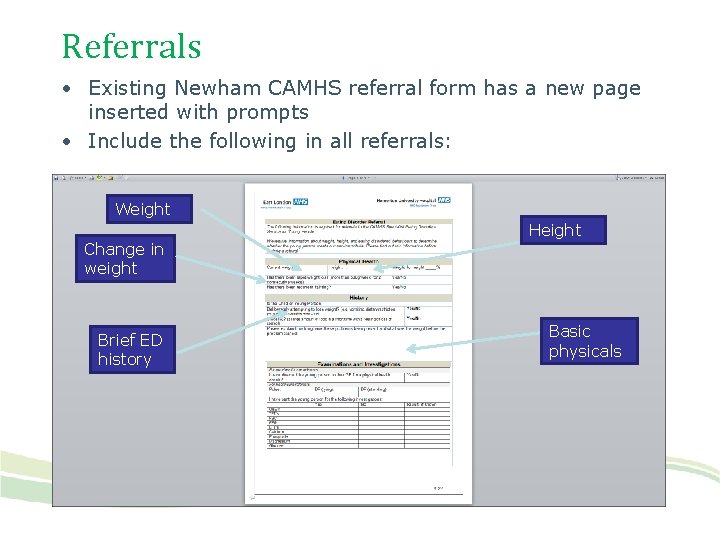
Referrals • Existing Newham CAMHS referral form has a new page inserted with prompts • Include the following in all referrals: Weight Change in weight Brief ED history Height Basic physicals
What happens next? • All referrals are screened by the duty clinician on receipt to decide on appropriateness and how quickly the child/young person and family need to be seen. • All emergency referrals will be seen on the same day, urgent referrals will be seen within 5 days, and routine referrals will be seen within 15 days. • For children and young people with mild or emerging difficulties, universal services (e. g. school pastoral support, family support workers, voluntary community organisations) will be enlisted as a first line of intervention. We will consult and advise you. • Children/young people and their families accepted to the CEDS-CYP will have a multidisciplinary specialist assessment allowing the most suitable intervention to be determined. • Interventions are NICE-concordant and multidisciplinary • Young people’s physical health will be managed in collaboration with their GP and all referred young who have not recently been seen will be directed for a GP physical health check.
And on to Treatment …. . Family Based Treatment for Anorexia Nervosa • Primarily informed by what has become known as the “Maudsley Model” • Focus on supporting parents to restore their child’s eating • http: //www. national. slam. nhs. uk/services/cam hs/camhs-eatingdisorders/resources/
Risk management vs therapy • The restoration of healthy eating, weight gain and the monitoring physical health is more in the foreground initially. The therapist’s interventions are informed by the level of risk • Clinicians are trained to recognise elevated risk and when to consult with medical colleagues
Why Family Based Treatment? • Historically, “dysfunctional” family relationships were considered to “cause” Anorexia • Now families are considered an important resource in treatment • Unusual communication patterns considered to be a response to rather than cause of anorexia
Engagement (Phase 1) • Connecting with all by exploring their different understandings and experiences of the development of anorexia – no definitive view • Exploring family’s resources and strengths • Addressing feelings of guilt and blame
Challenging the symptom (Phase 2) - 1 • Empowering parents to take action to restore healthy eating • Develop team working in parents, enabling each to recognise when the other needs support • Psychoeducation re effects of starvation on mood and motivation for change
Challenging the Symptom (Phase 2) - 2 • Externalization to explore the role of the symptom in family life • How to weaken the power of Anorexia in the family without isolating the young person • Exploring the advantages and disadvantages of change using future focussed “what if” questions
Individual & Family Development (Phase 3) • Separate parental and individual sessions may be indicated • What are the young person’s developmental tasks? • How can parents develop more age appropriate parenting as anorexia loses its power? • What about siblings?
Ending Treatment (Phase 4) • Identifying remaining symptoms which may not be about eating • Predicting relapse and exploring relapse prevention • Developing healthy strategies for managing anxiety
Case Study • 17 year old girl referred by school for self-harm. Assessment of eating because of the passing reference to poor eating in the referral but not mentioned in the initial family appointment • Subsequent diagnosis of anorexia requiring parents’ involvement to support eating
Case Study (2) • The current focus on restoring healthy eating and weight gain does not reflect her goals • Parents have had to revert to an earlier stage of parenting • The challenge of managing medical crises whilst maintaining a therapeutic alliance with the young person