Challenges for the WHO Programme for International Drug
- Slides: 35
Challenges for the WHO Programme for International Drug Monitoring Shanthi Pal Quality Assurance and Safety of Medicines Cecilia Biriell Reports, Analysis and Country Support
2| Technical Briefing Seminar, 1 - 5 November 2010
Risk No medicinal product is entirely or absolutely safe for all people, in all places, at all times. We must always live with some measure of uncertainty. 3| Technical Briefing Seminar, 1 - 5 November 2010
What is Pharmacovigilance? WHO definition: The science and activities relating to the detection, assessment, understanding and prevention of adverse effects or any other drug-related problem. This applies throughout the life-cycle of a medicine equally to the pre-approval stage as to the post-approval. ADR monitoring – Medicines safety – Drug Monitoring 4| Technical Briefing Seminar, 1 - 5 November 2010
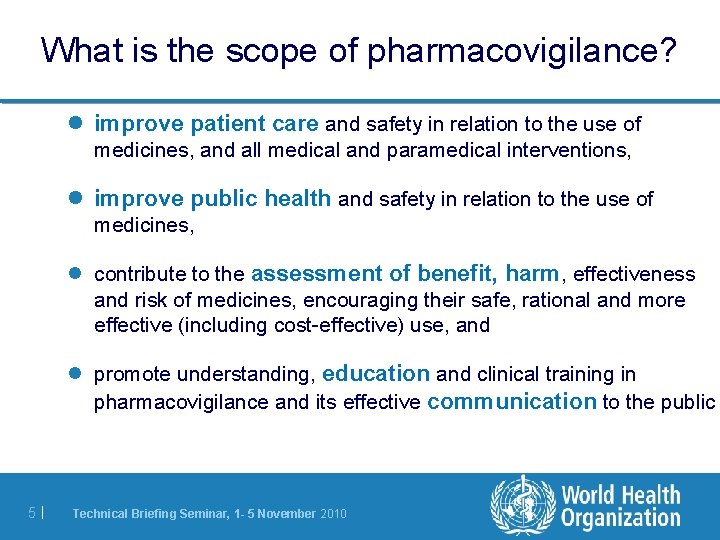
What is the scope of pharmacovigilance? l improve patient care and safety in relation to the use of medicines, and all medical and paramedical interventions, l improve public health and safety in relation to the use of medicines, l contribute to the assessment of benefit, harm, effectiveness and risk of medicines, encouraging their safe, rational and more effective (including cost-effective) use, and l promote understanding, education and clinical training in pharmacovigilance and its effective communication to the public 5| Technical Briefing Seminar, 1 - 5 November 2010
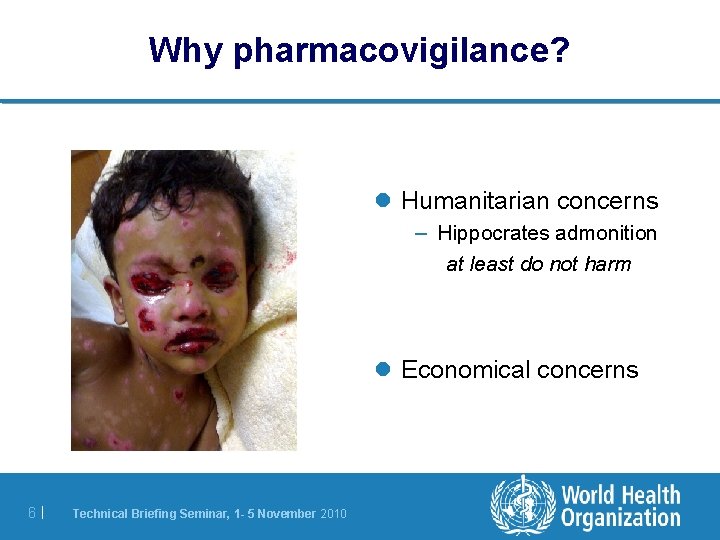
Why pharmacovigilance? l Humanitarian concerns – Hippocrates admonition at least do not harm l Economical concerns 6| Technical Briefing Seminar, 1 - 5 November 2010
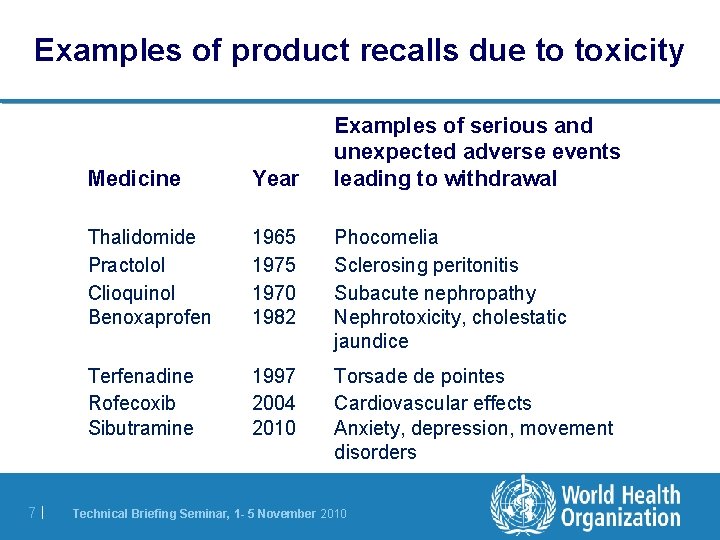
Examples of product recalls due to toxicity 7| Examples of serious and unexpected adverse events leading to withdrawal Medicine Year Thalidomide Practolol Clioquinol Benoxaprofen 1965 1970 1982 Phocomelia Sclerosing peritonitis Subacute nephropathy Nephrotoxicity, cholestatic jaundice Terfenadine Rofecoxib Sibutramine 1997 2004 2010 Torsade de pointes Cardiovascular effects Anxiety, depression, movement disorders Technical Briefing Seminar, 1 - 5 November 2010
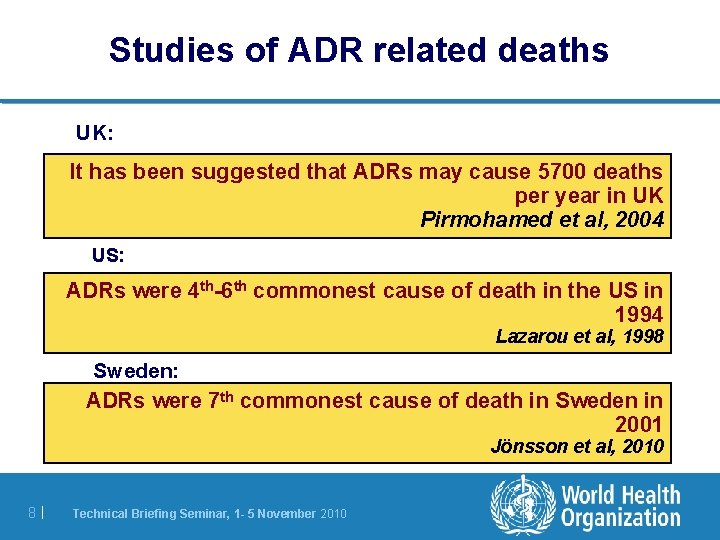
Studies of ADR related deaths UK: It has been suggested that ADRs may cause 5700 deaths per year in UK Pirmohamed et al, 2004 US: ADRs were 4 th-6 th commonest cause of death in the US in 1994 Lazarou et al, 1998 Sweden: ADRs were 7 th commonest cause of death in Sweden in 2001 Jönsson et al, 2010 8| Technical Briefing Seminar, 1 - 5 November 2010
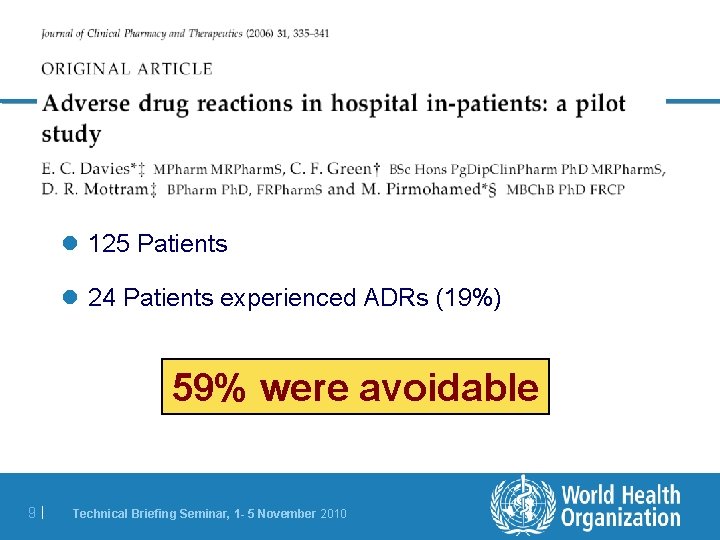
l 125 Patients l 24 Patients experienced ADRs (19%) 59% were avoidable 9| Technical Briefing Seminar, 1 - 5 November 2010
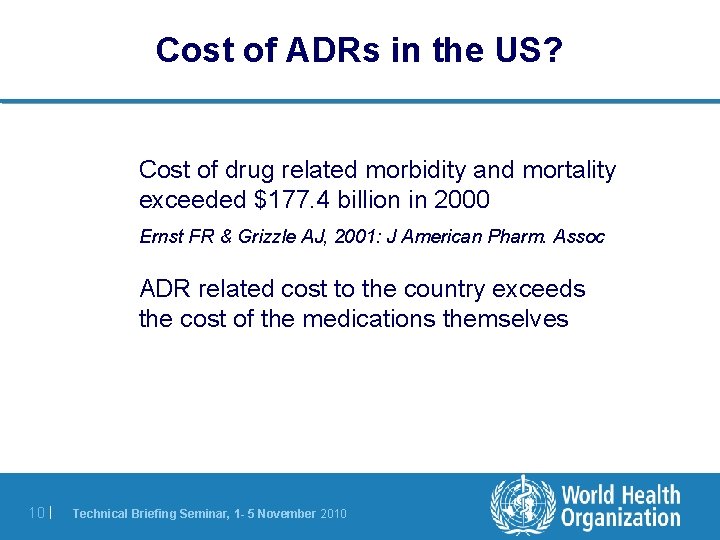
Cost of ADRs in the US? Cost of drug related morbidity and mortality exceeded $177. 4 billion in 2000 Ernst FR & Grizzle AJ, 2001: J American Pharm. Assoc ADR related cost to the country exceeds the cost of the medications themselves 10 | Technical Briefing Seminar, 1 - 5 November 2010
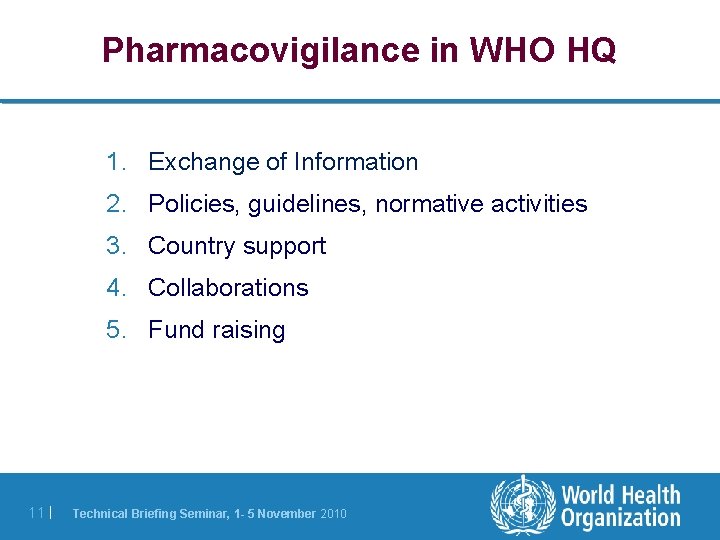
Pharmacovigilance in WHO HQ 1. Exchange of Information 2. Policies, guidelines, normative activities 3. Country support 4. Collaborations 5. Fund raising 11 | Technical Briefing Seminar, 1 - 5 November 2010
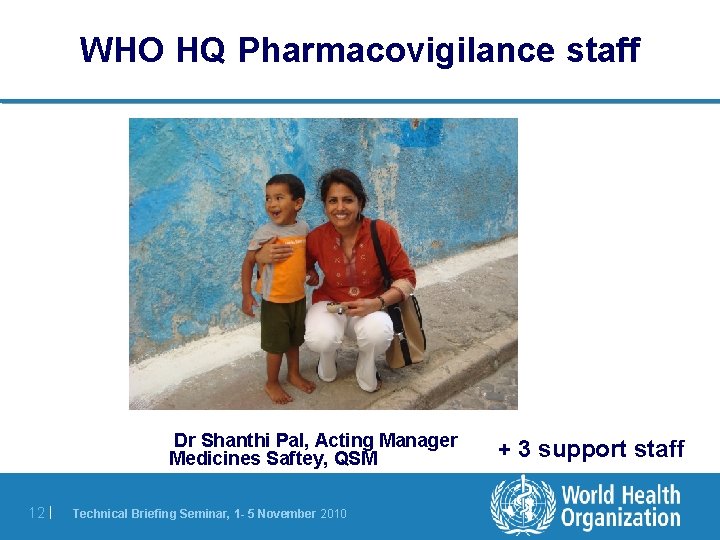
WHO HQ Pharmacovigilance staff Dr Shanthi Pal, Acting Manager Medicines Saftey, QSM 12 | Technical Briefing Seminar, 1 - 5 November 2010 + 3 support staff
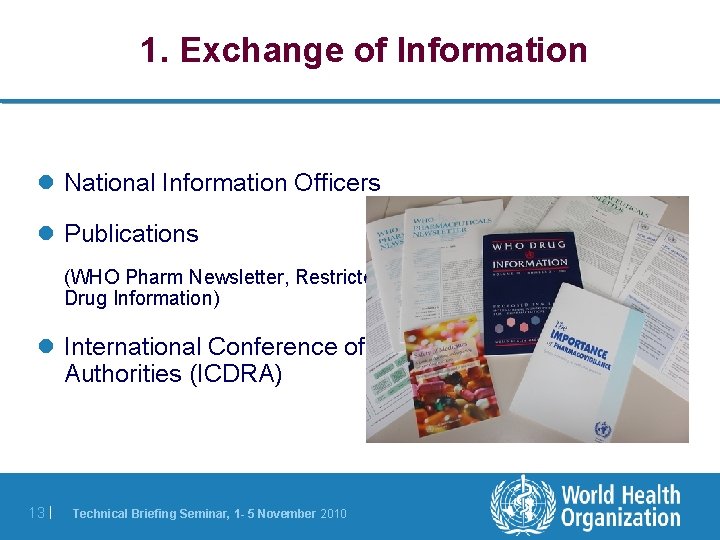
1. Exchange of Information l National Information Officers l Publications (WHO Pharm Newsletter, Restricted Pharm List, Drug Alerts, WHO Drug Information) l International Conference of Drug Regulatory Authorities (ICDRA) 13 | Technical Briefing Seminar, 1 - 5 November 2010
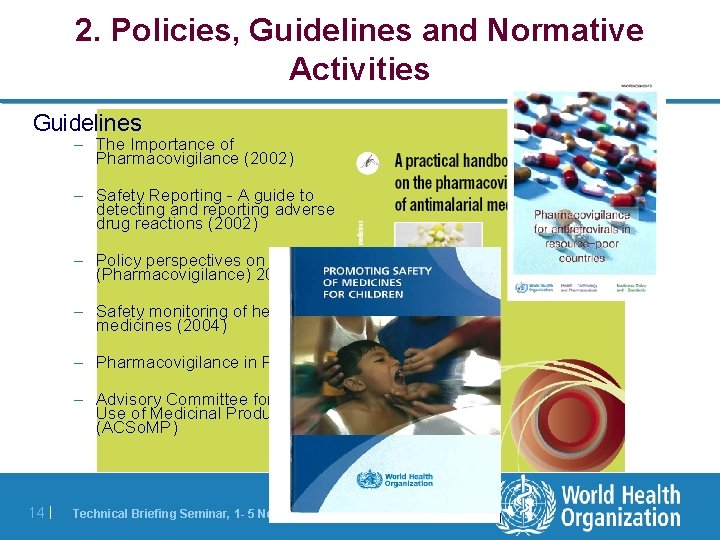
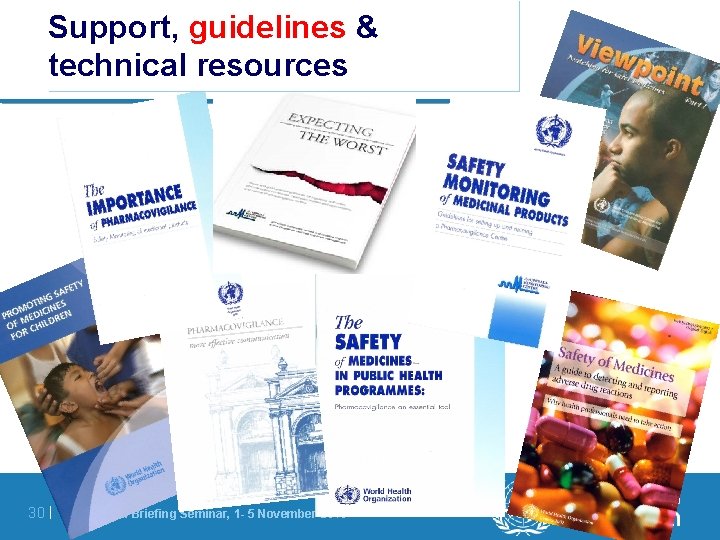
2. Policies, Guidelines and Normative Activities Guidelines – The Importance of Pharmacovigilance (2002) – Safety Reporting - A guide to detecting and reporting adverse drug reactions (2002) – Policy perspectives on medicines (Pharmacovigilance) 2004 – Safety monitoring of herbal medicines (2004) – Pharmacovigilance in Public Health – Advisory Committee for the Safe Use of Medicinal Products (ACSo. MP) 14 | Technical Briefing Seminar, 1 - 5 November 2010
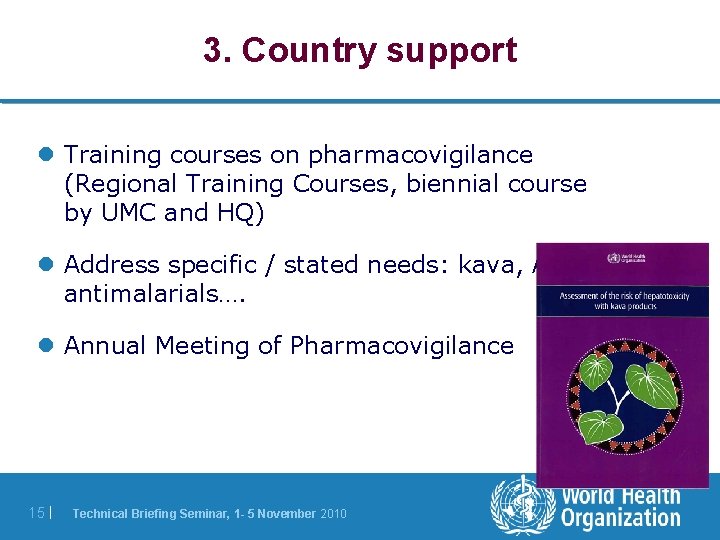
3. Country support l Training courses on pharmacovigilance (Regional Training Courses, biennial course by UMC and HQ) l Address specific / stated needs: kava, ARVs, antimalarials…. l Annual Meeting of Pharmacovigilance 15 | Technical Briefing Seminar, 1 - 5 November 2010 Centres
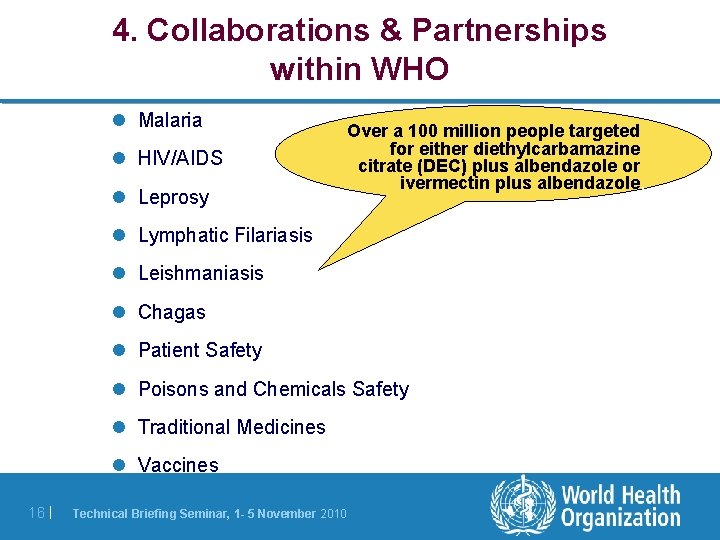
4. Collaborations & Partnerships within WHO l Malaria l HIV/AIDS l Leprosy Over a 100 million people targeted for either diethylcarbamazine citrate (DEC) plus albendazole or ivermectin plus albendazole. l Lymphatic Filariasis l Leishmaniasis l Chagas l Patient Safety l Poisons and Chemicals Safety l Traditional Medicines l Vaccines 16 | Technical Briefing Seminar, 1 - 5 November 2010
5. Resource Mobilisation l Gates foundation l European Commission l Global Fund l Others l Human resources: WHO Consultants Network for Pharmacovigilance (PV) in Africa (Pv. SF – Pharmacovigilance Sans Frontières) 17 | Technical Briefing Seminar, 1 - 5 November 2010
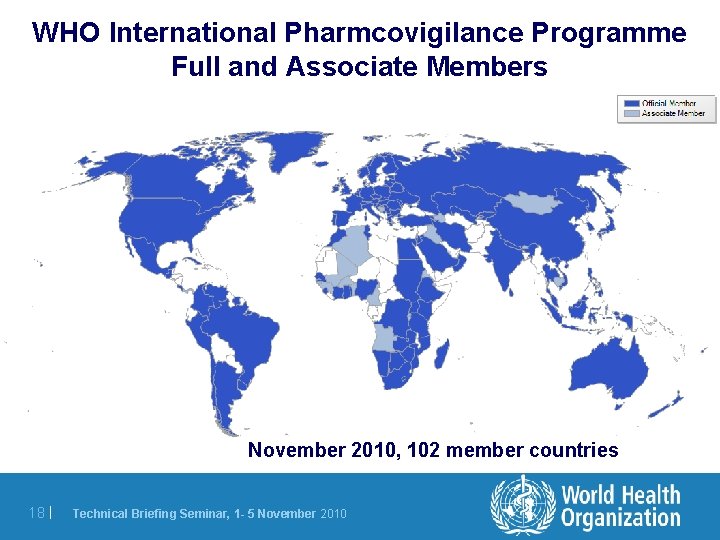
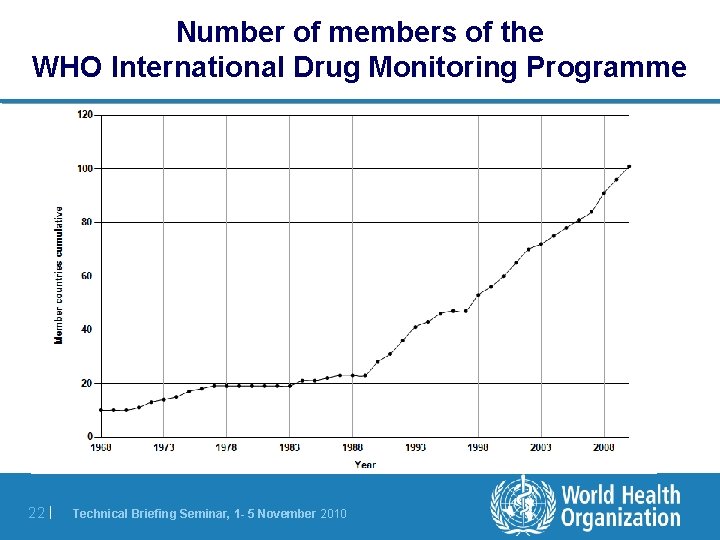
WHO International Pharmcovigilance Programme Full and Associate Members November 2010, 102 member countries 18 | Technical Briefing Seminar, 1 - 5 November 2010
Uppsala Monitoring Centre (UMC) WHO Collaborating Centre for International Drug Monitoring l the operational centre of the WHO PV Programme l established as a foundation 1978 l based on agreement Sweden - WHO l international administrative board l WHO Headquarters responsible for policy l self financed 19 | Technical Briefing Seminar, 1 - 5 November 2010
UMC main tasks - summary l Collect and analyse ICSRs worldwide l Communicate potential drug safety issues l Actively support and provide training l Develop the science of pharmacovigilance 20 | Technical Briefing Seminar, 1 - 5 November 2010
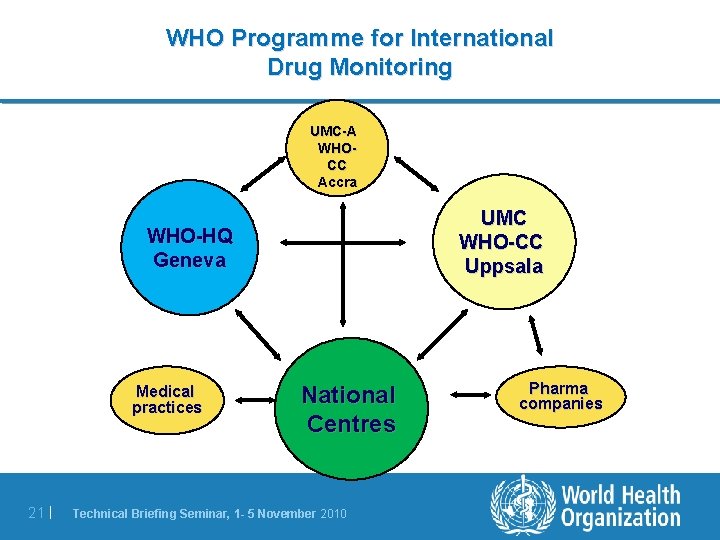
WHO Programme for International Drug Monitoring UMC-A WHOCC Accra UMC WHO-CC Uppsala WHO-HQ Geneva Medical practices 21 | National Centres Technical Briefing Seminar, 1 - 5 November 2010 Pharma companies
Number of members of the WHO International Drug Monitoring Programme 22 | Technical Briefing Seminar, 1 - 5 November 2010
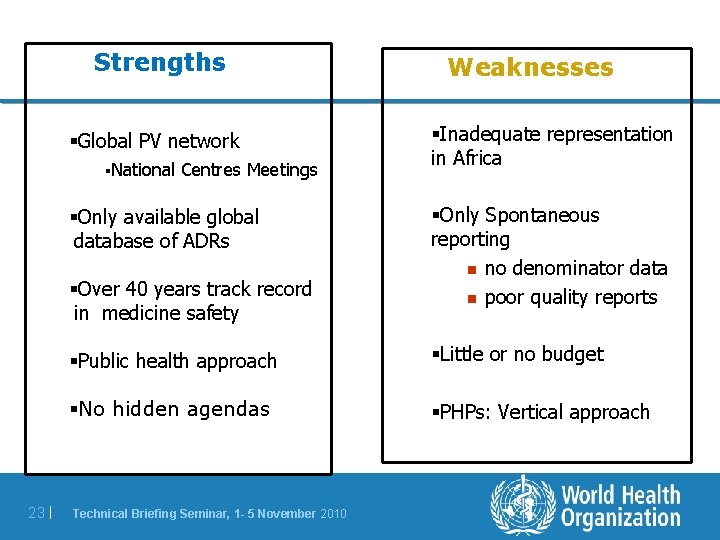
Strengths §Global PV network §National Centres Meetings §Only available global database of ADRs §Over 40 years track record in medicine safety 23 | Weaknesses §Inadequate representation in Africa §Only Spontaneous reporting n no denominator data n poor quality reports §Public health approach §Little or no budget §No hidden agendas §PHPs: Vertical approach Technical Briefing Seminar, 1 - 5 November 2010
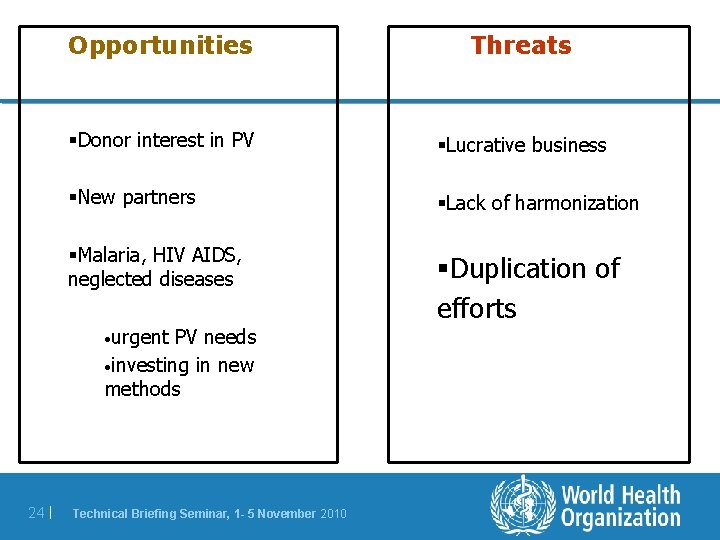
Opportunities Threats §Donor interest in PV §Lucrative business §New partners §Lack of harmonization §Malaria, HIV AIDS, neglected diseases §Duplication of efforts • urgent PV needs • investing in new methods 24 | Technical Briefing Seminar, 1 - 5 November 2010
Challenges to Pharmacovigilance l An analysis of pharmacovigilance activities in 55 low- and middle-income countries – Sten Olssona, Shanthi Palb, Andy Stergachisc, Mary Coupera – Drug Safety 2009/2010 (a: WHO CC, Uppsala; b: WHO QSM; c: UWa) 25 | Technical Briefing Seminar, 1 - 5 November 2010
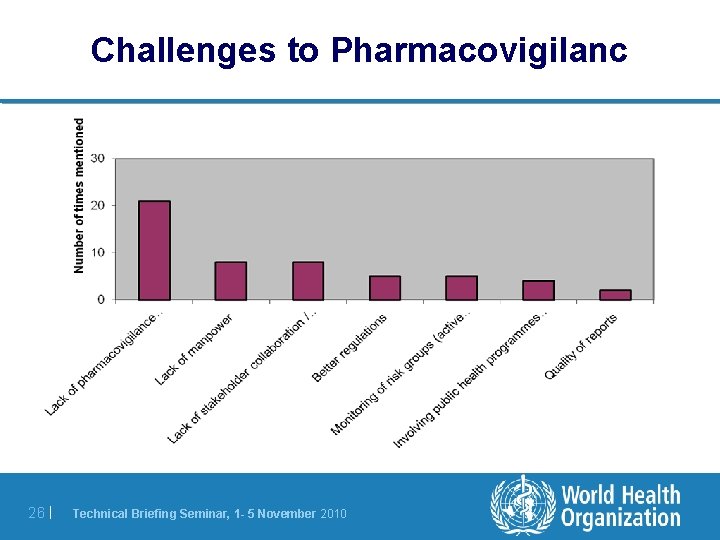
Challenges to Pharmacovigilanc 26 | Technical Briefing Seminar, 1 - 5 November 2010
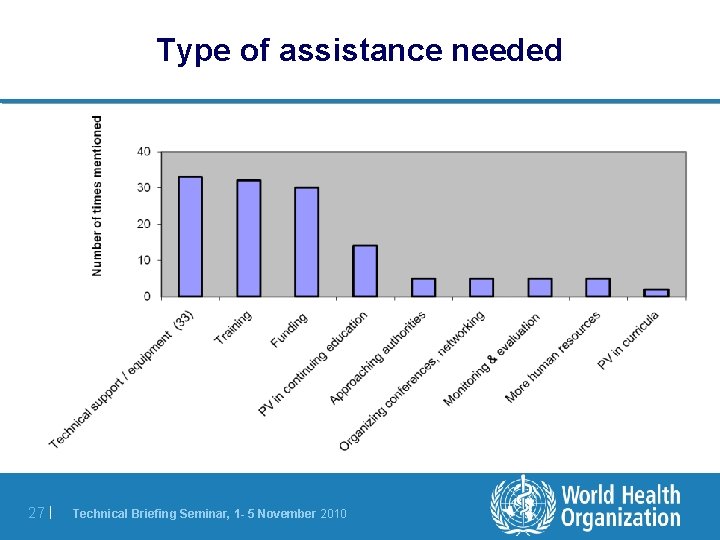
Type of assistance needed 27 | Technical Briefing Seminar, 1 - 5 November 2010
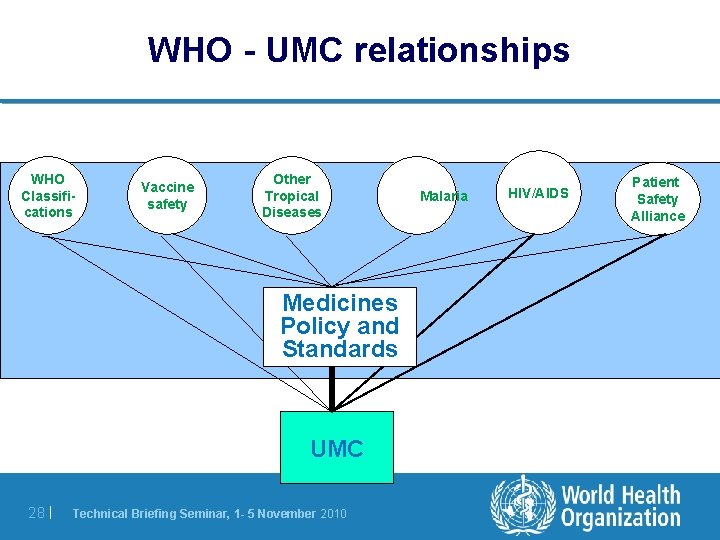
WHO - UMC relationships WHO Classifications Vaccine safety Other Tropical Diseases Medicines Policy and Standards UMC 28 | Technical Briefing Seminar, 1 - 5 November 2010 Malaria HIV/AIDS Patient Safety Alliance
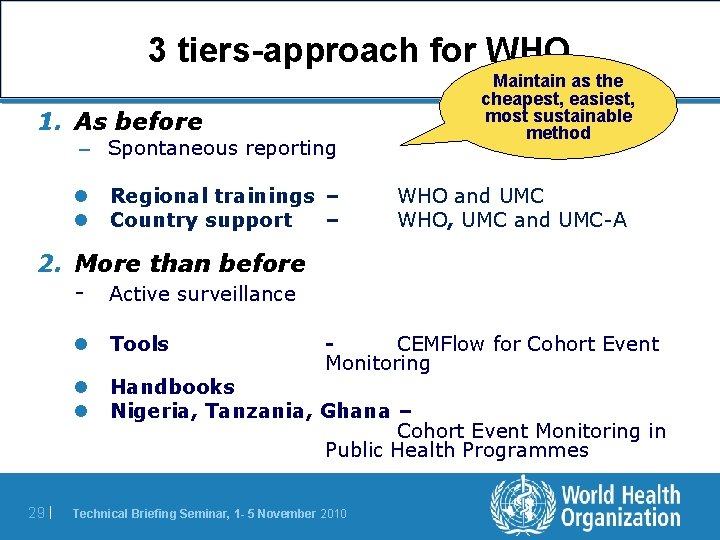
3 tiers-approach for WHO 1. As before – Spontaneous reporting l l Regional trainings – Country support – Maintain as the cheapest, easiest, most sustainable method WHO and UMC WHO, UMC and UMC-A 2. More than before - Active surveillance 29 | l Tools CEMFlow for Cohort Event Monitoring l l Handbooks Nigeria, Tanzania, Ghana – Cohort Event Monitoring in Public Health Programmes Technical Briefing Seminar, 1 - 5 November 2010
Support, guidelines & technical resources Expecting the Worst - Crisis Management 30 | Technical Briefing Seminar, 1 - 5 November 2010
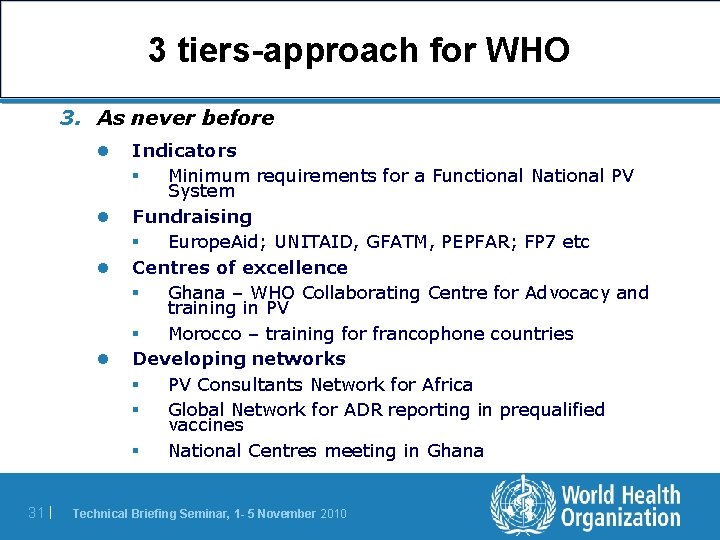
3 tiers-approach for WHO 3. As never before l l 31 | Indicators § Minimum requirements for a Functional National PV System Fundraising § Europe. Aid; UNITAID, GFATM, PEPFAR; FP 7 etc Centres of excellence § Ghana – WHO Collaborating Centre for Advocacy and training in PV § Morocco – training for francophone countries Developing networks § PV Consultants Network for Africa § Global Network for ADR reporting in prequalified vaccines § National Centres meeting in Ghana Technical Briefing Seminar, 1 - 5 November 2010
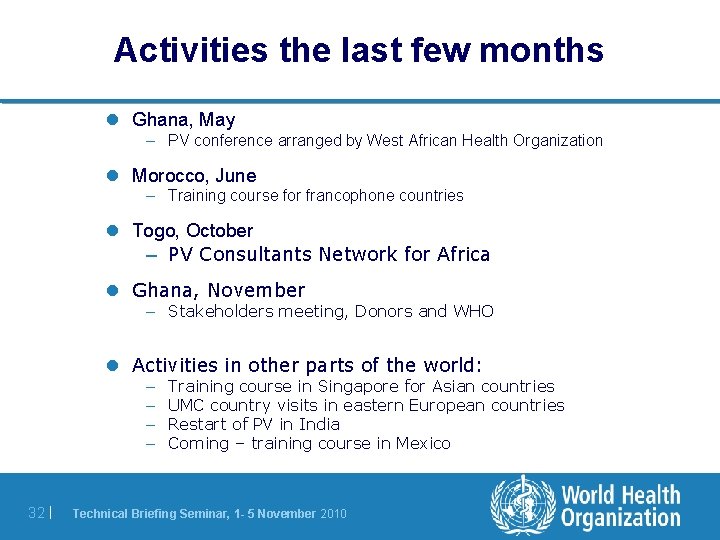
Activities the last few months l Ghana, May – PV conference arranged by West African Health Organization l Morocco, June – Training course for francophone countries l Togo, October – PV Consultants Network for Africa l Ghana, November – Stakeholders meeting, Donors and WHO l Activities in other parts of the world: – – 32 | Training course in Singapore for Asian countries UMC country visits in eastern European countries Restart of PV in India Coming – training course in Mexico Technical Briefing Seminar, 1 - 5 November 2010
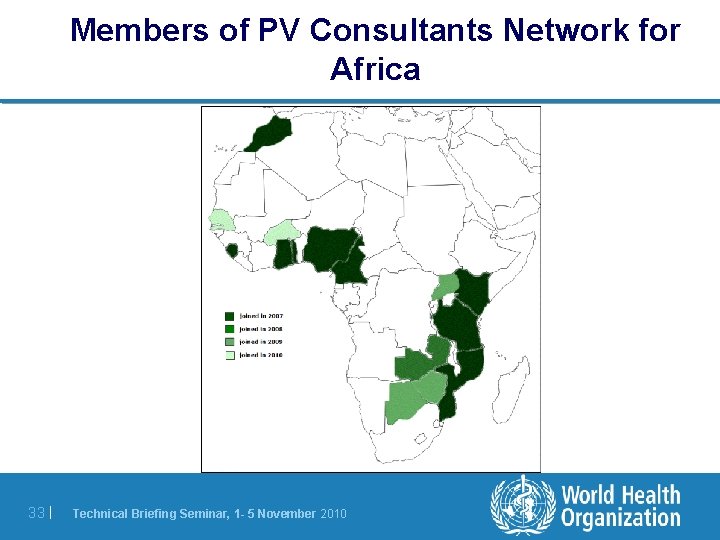
Members of PV Consultants Network for Africa 33 | Technical Briefing Seminar, 1 - 5 November 2010
Challenges for the future To make PV systems sustainable through: – stable financing – trained and dedicated staff Create a culture of reporting – from health professionals – the public 34 | Technical Briefing Seminar, 1 - 5 November 2010
Thank you for your attention www. who. int 35 | info@who-umc. org Technical Briefing Seminar, 1 - 5 November 2010 www. who-umc. org