
INTERNATIONAL ADVOCACY PROGRAMME LIBRARIES DEVELOPMENT AND THE UN
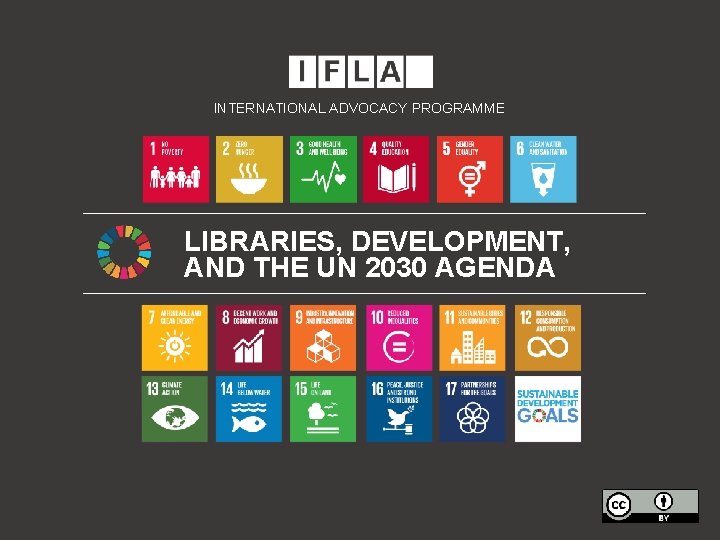
INTERNATIONAL ADVOCACY PROGRAMME LIBRARIES, DEVELOPMENT AND THE UN 2030 AGENDA
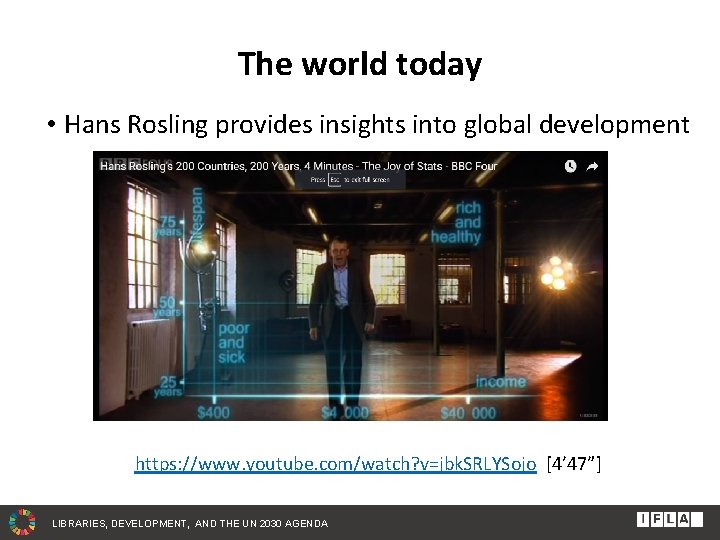
The world today • Hans Rosling provides insights into global development https: //www. youtube. com/watch? v=jbk. SRLYSojo [4’ 47”] LIBRARIES, DEVELOPMENT, AND THE UN 2030 AGENDA
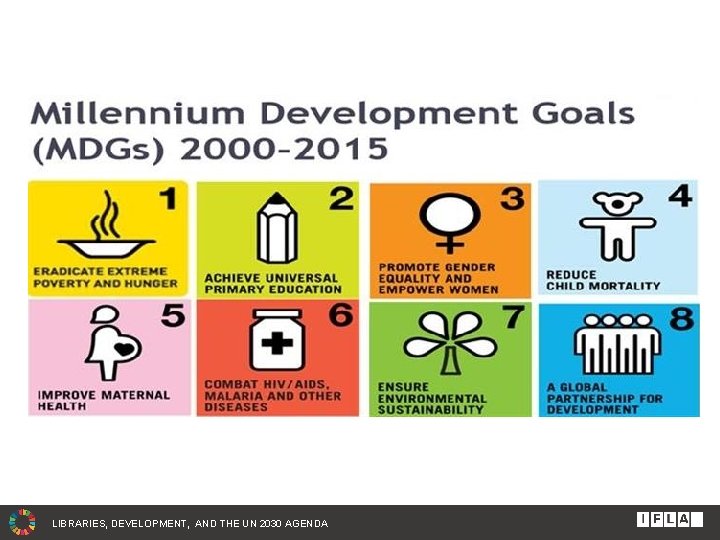
Understanding the UN development agenda • At the beginning of the new millennium, in 2000, world leaders gathered at the UN to shape a broad vision to fight poverty in its many dimensions • That vision was translated into 8 Millennium Development Goals (MDGs) • The MDG framework has guided development work across the world for the past 15 years LIBRARIES, DEVELOPMENT, AND THE UN 2030 AGENDA
LIBRARIES, DEVELOPMENT, AND THE UN 2030 AGENDA
Significant achievements have been made, but many people are being left behind: • Gender inequality persists • Big gaps exist between: • The poorest and richest households • Rural and urban areas • Climate change and environmental degradation undermine any progress achieved; poor people suffer the most • Conflict remains the biggest threat to human development • Millions of people still live in poverty and hunger, without access to basic services LIBRARIES, DEVELOPMENT, AND THE UN 2030 AGENDA
However… • The successes of the MDG agenda prove that global action can work • It is argues that global action is the only path to ensure that the new development agenda leaves noone behind • The world has the opportunity to build on the successes and to embrace new ambitions for the future we want • The new agenda should be “truly universal and transformative” • As the human race, we seek a sustainable future LIBRARIES, DEVELOPMENT, AND THE UN 2030 AGENDA
No point in going half way https: //www. youtube. com/watch? v=Dd. Lqi. Tv. Fw. Jk [2’ 37”] LIBRARIES, DEVELOPMENT, AND THE UN 2030 AGENDA
The origins of the UN 2030 Agenda • 2012 UN Conference on Sustainable Development in Rio de Janeiro (Rio+20) • Appeal made to formulate common goals and include these in the post-2015 development agenda • The MDGs did not consider environmental issues, eg • Emissions of greenhouse gasses • Access to clean drinking water • Management of water resources • New focus on the concept of ‘sustainable development’ • Need to consider the relationship between nature and society • Social, environmental and economic dimensions LIBRARIES, DEVELOPMENT, AND THE UN 2030 AGENDA
Scoping the goals: democratic process • Involved all the member states of the UN • Cooperation with major NGOs and civil society agencies • Open forums and regional consultations around the world • Survey of over 4. 5 million people about the most important goals and how they might be achieved • Collaborative wish for the world to create a better and more equal place to live in • Around 5 million people involved in the process LIBRARIES, DEVELOPMENT, AND THE UN 2030 AGENDA
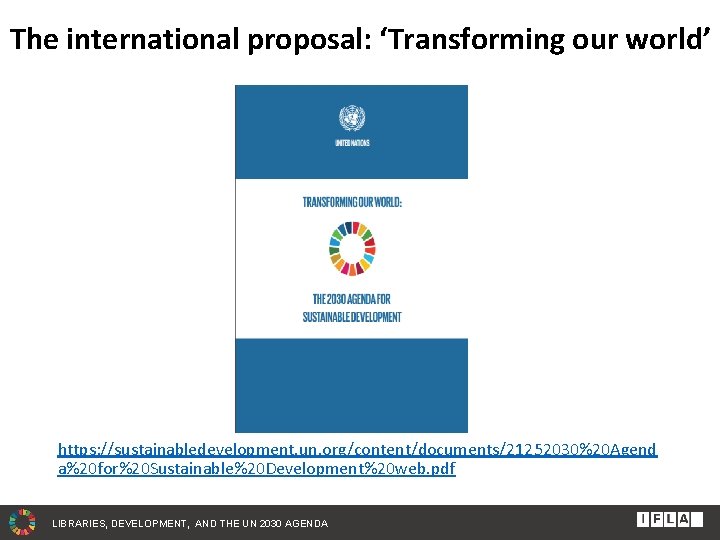
The international proposal: ‘Transforming our world’ https: //sustainabledevelopment. un. org/content/documents/21252030%20 Agend a%20 for%20 Sustainable%20 Development%20 web. pdf LIBRARIES, DEVELOPMENT, AND THE UN 2030 AGENDA
The UN 2030 Agenda • Preamble • Declaration • Sustainable Development Goals • Means of Implementation and Global Partnership • Follow-up and Review https: //sustainabledevelopment. un. org LIBRARIES, DEVELOPMENT, AND THE UN 2030 AGENDA
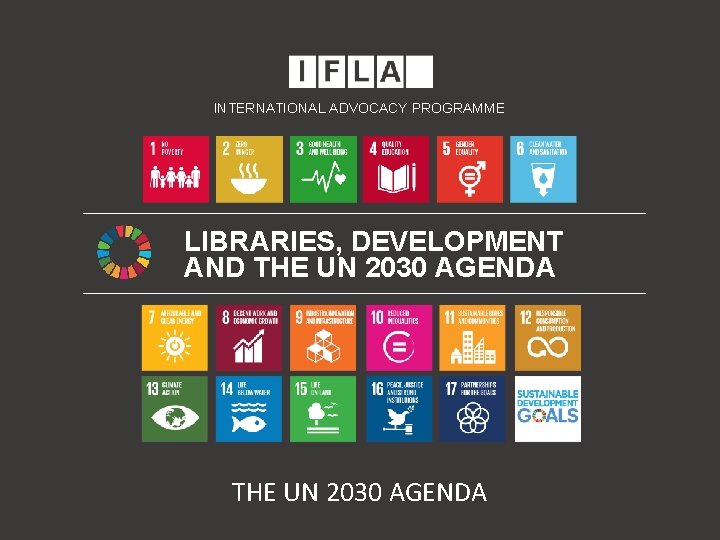
The 2030 Sustainable Development Goals • The main goals focus on the 5 Ps • • • People: the wellbeing of all people Planet: protection of the earth’s ecosystems Prosperity: continued economic & technological growth Peace: securing peace Partnership: improving international cooperation • These five aspects are interdependent • Therefore the SDGs demand integrated thinking as well as integrated approaches to achieving the goals LIBRARIES, DEVELOPMENT, AND THE UN 2030 AGENDA
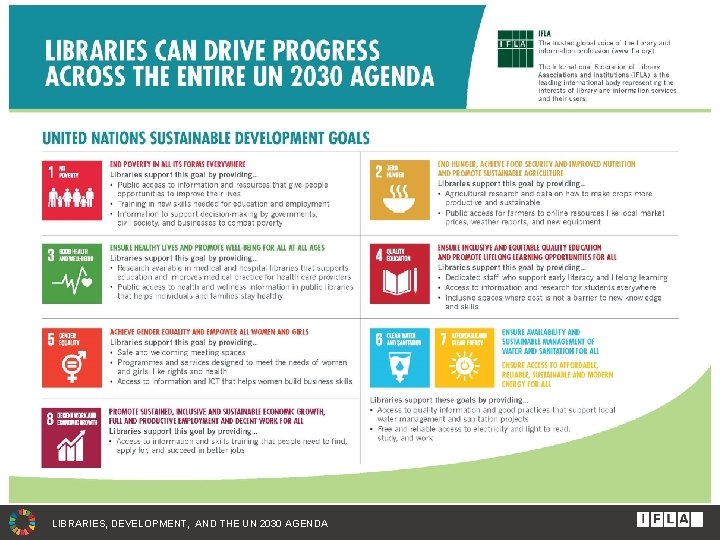
The focus on People 1. End poverty in all its forms everywhere 2. End hunger, achieve food security and improved nutrition and promote sustainable agriculture 3. Ensure healthy lives and promote well-being for all at all ages 4. Ensure inclusive and equitable quality education and promote lifelong learning opportunities for all 5. Achieve gender equality and empower all women and girls LIBRARIES, DEVELOPMENT, AND THE UN 2030 AGENDA
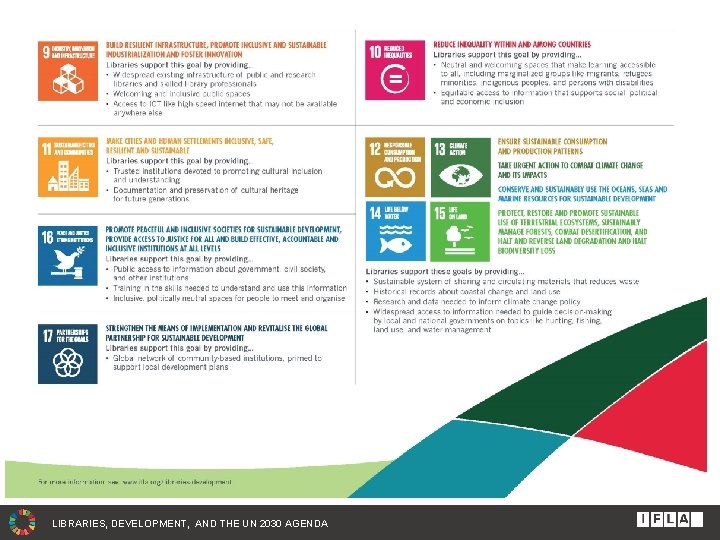
The focus on the Planet and on Prosperity 6. Ensure availability and sustainable management of water and sanitation for all 7. Ensure access to affordable, reliable, sustainable and modern energy for all 8. Promote sustained, inclusive and sustainable economic growth, full and productive employment and decent work for all 9. Build resilient infrastructure, promote inclusive and sustainable industrialization and foster innovation 10. Reduce inequality within and among countries 11. Make cities and human settlements inclusive, safe, resilient and sustainable LIBRARIES, DEVELOPMENT, AND THE UN 2030 AGENDA
The Planet and Prosperity (cont. ) 12. Ensure sustainable consumption and production patterns 13. Take urgent action to combat climate change and its impacts 14. Conserve and sustainably use the oceans, seas and marine resources for sustainable development 15. Protect, restore and promote sustainable use of terrestrial ecosystems, sustainably manage forests, comat desertification, and halt and reverse land degradation and halt biodiversity loss LIBRARIES, DEVELOPMENT, AND THE UN 2030 AGENDA
The focus on Peace 16. Promote peaceful and inclusive societies for sustainable development, provide access to justice for all and build effective, accountable and inclusive institutions at all levels The focus on Partnerships 17. Strengthen the means of implementation and revitalise the global partnership for sustainable development LIBRARIES, DEVELOPMENT, AND THE UN 2030 AGENDA
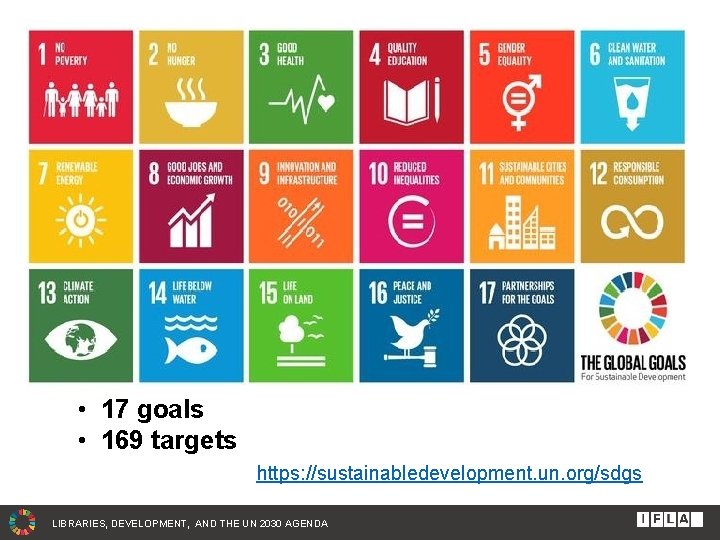
• 17 goals • 169 targets https: //sustainabledevelopment. un. org/sdgs LIBRARIES, DEVELOPMENT, AND THE UN 2030 AGENDA
Desired outcomes for the UN 2030 Agenda Improving policy coherence • • Supporting inclusive growth and well-being • • Leaving no-one behind Ensuring the planet’s sustainability • • Balance between socio-economic progress and sustaining the planet’s resources and ecosystems Promoting partnerships • • • The SDGs are multi-dimensional: require linkages across policy areas Governments, international NGOs, private sector and civil society will need to team up: financial resources, technologies Having accurate data to inform the process and the progress LIBRARIES, DEVELOPMENT, AND THE UN 2030 AGENDA
The value of timely, current, accurate data • Need to strengthen data collection, management and dissemination to capture evidence to inform decision making • Encompasses: • Evidence-based policy for development • Evidence-based management of development projects • What gets measured, gets done • Aligning demand with policy support • There are currently large data gaps, so significant improvements are needed • To strengthen statistical capacity • To use new technology to collect and disseminate data • To achieve global consensus on the data required: standards LIBRARIES, DEVELOPMENT, AND THE UN 2030 AGENDA
The significance of open data • Data for development should be made available to the public in open formats • Supports government transparency & accountability • Improves policy decisions • Increases citizen engagement • Promotes government efficiency and effectiveness • Visualisation and analysis tools • Data literacy skills to ensure data are used and interpreted correctly • Librarians have a role to play in developing these data literacy skills LIBRARIES, DEVELOPMENT, AND THE UN 2030 AGENDA
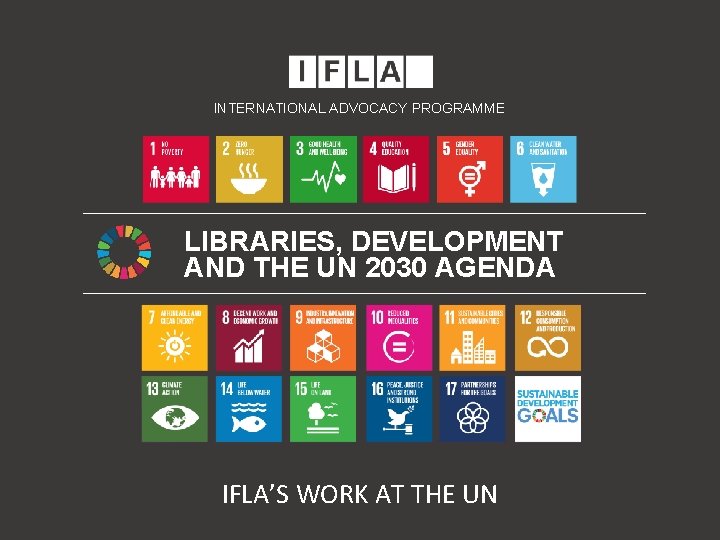
INTERNATIONAL ADVOCACY PROGRAMME LIBRARIES, DEVELOPMENT AND THE UN 2030 AGENDA IFLA’S WORK AT THE UN
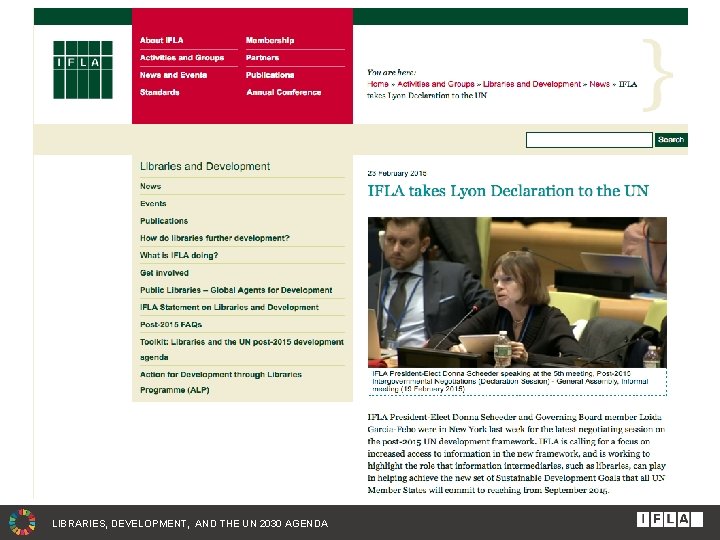
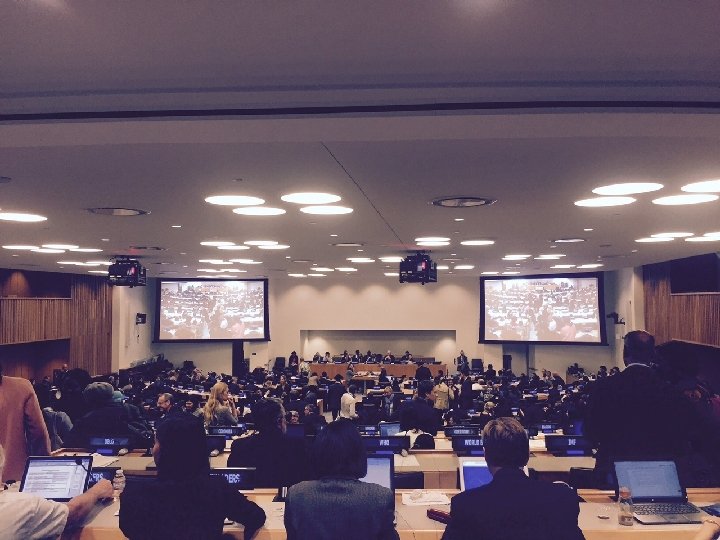
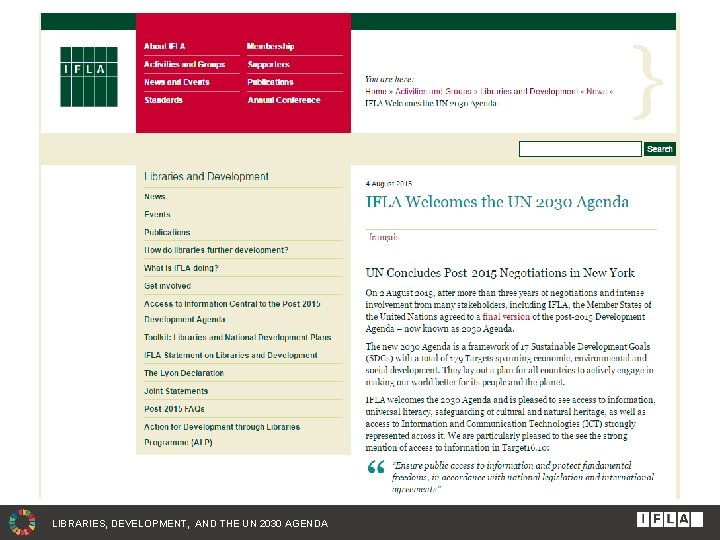
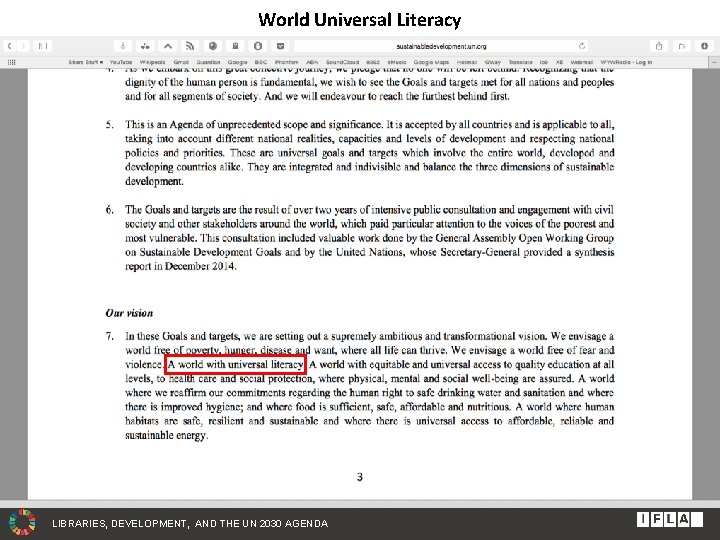
IFLA’s advocacy activities at the UN • Extensive negotiations over the past three years to develop the UN 2030 Agenda • Since 2012, IFLA has been engaged with the creation of the UN 2030 Agenda to advocate for: • • Ensuring access to information Safeguarding of cultural heritage Universal literacy Access to information and communication technologies (ICT) • These aspects are represented in the UN 2030 Agenda LIBRARIES, DEVELOPMENT, AND THE UN 2030 AGENDA
IFLA’s Roadmap to Post-2015 • Rio+20 UN Conference on Sustainable Development (2012) • Outcome: ‘The Future We Want’ (June) • UN Secretary General’s High Level Panel (2013) • Outcome: Report inc. ‘The Data Revolution’ (May) • Open Working Group on Sustainable Development Goals (2014) • Outcome: Draft SDGs (September) • UN General Assembly (2014) • Outcome: Secretary General’s Synthesis Report (December) • Inter-Governmental Negotiations (2015) • Outcome: Zero Draft Post-2015 Framework Document (June) • Post-2015 Development Summit (2015) • Outcome: Post-2015 Development Framework: Declaration, SDGs, Means of Implementation, Monitoring and Accountability (September) LIBRARIES, DEVELOPMENT, AND THE UN 2030 AGENDA
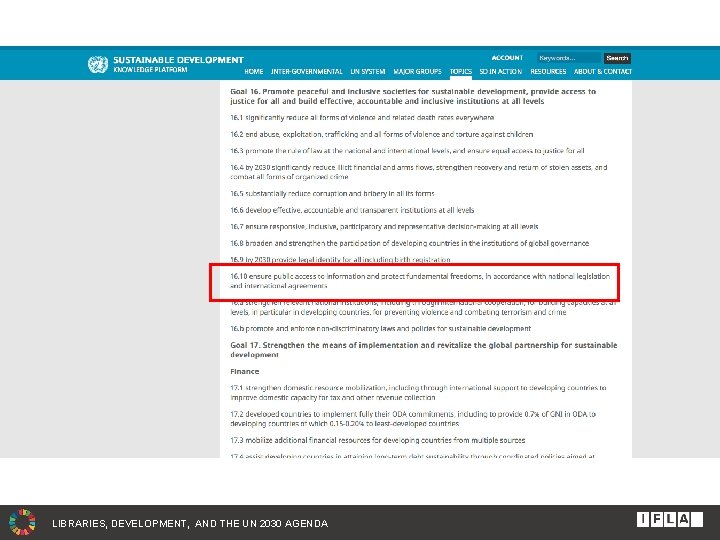
IFLA: Focus on Goal 16. 10 Ensure public access to information and protect fundamental freedoms, in accordance with national legislation and international agreements LIBRARIES, DEVELOPMENT, AND THE UN 2030 AGENDA
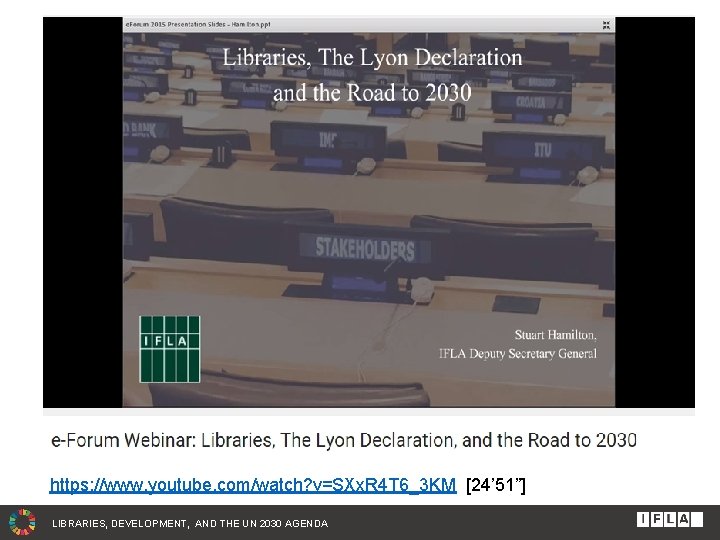
https: //www. youtube. com/watch? v=SXx. R 4 T 6_3 KM [24’ 51”] LIBRARIES, DEVELOPMENT, AND THE UN 2030 AGENDA
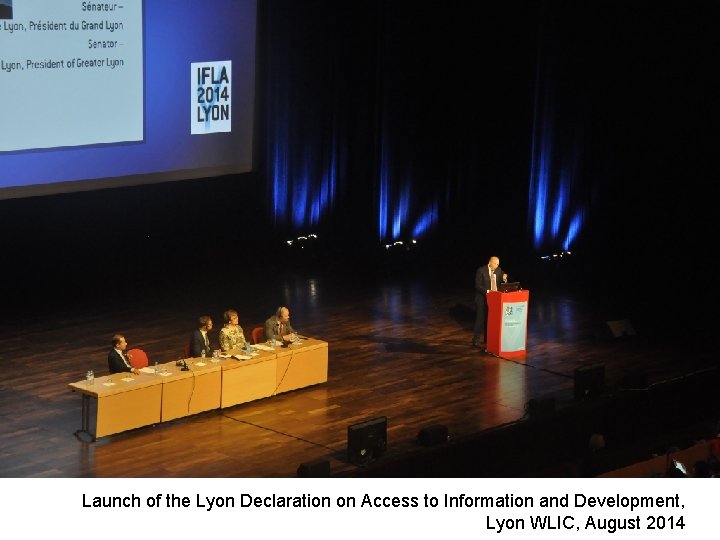
Launch of the Lyon Declaration on Access to Information and Development, Lyon WLIC, August 2014
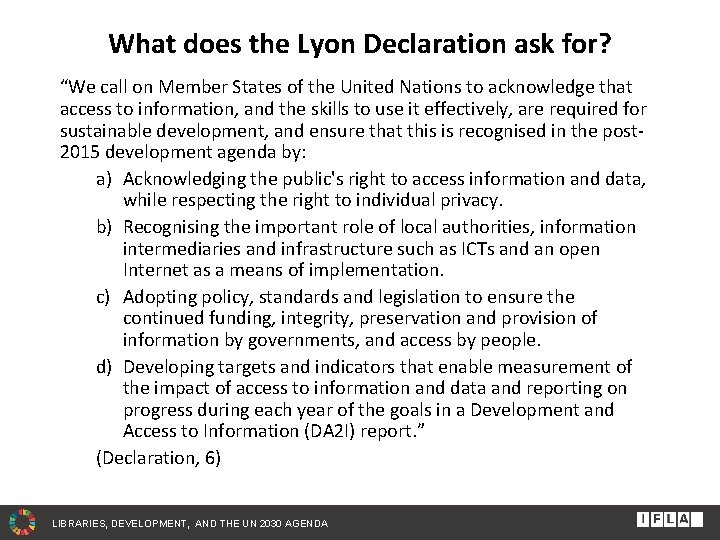
What does the Lyon Declaration ask for? “We call on Member States of the United Nations to acknowledge that access to information, and the skills to use it effectively, are required for sustainable development, and ensure that this is recognised in the post 2015 development agenda by: a) Acknowledging the public's right to access information and data, while respecting the right to individual privacy. b) Recognising the important role of local authorities, information intermediaries and infrastructure such as ICTs and an open Internet as a means of implementation. c) Adopting policy, standards and legislation to ensure the continued funding, integrity, preservation and provision of information by governments, and access by people. d) Developing targets and indicators that enable measurement of the impact of access to information and data and reporting on progress during each year of the goals in a Development and Access to Information (DA 2 I) report. ” (Declaration, 6) LIBRARIES, DEVELOPMENT, AND THE UN 2030 AGENDA
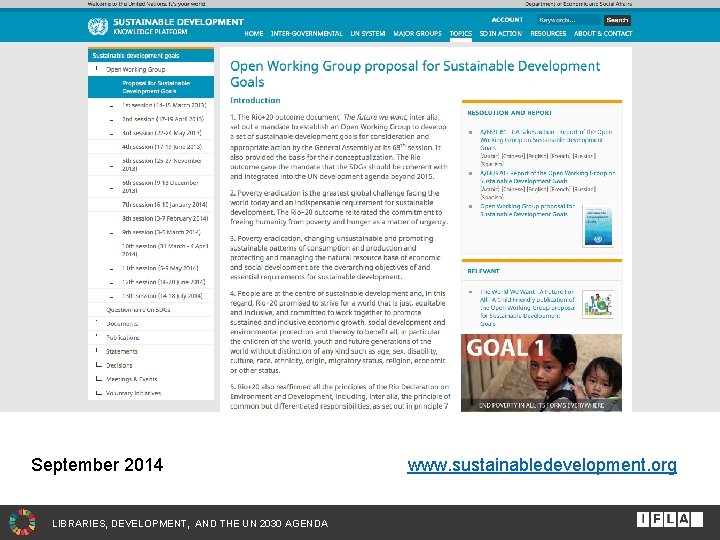
September 2014 LIBRARIES, DEVELOPMENT, AND THE UN 2030 AGENDA www. sustainabledevelopment. org
LIBRARIES, DEVELOPMENT, AND THE UN 2030 AGENDA
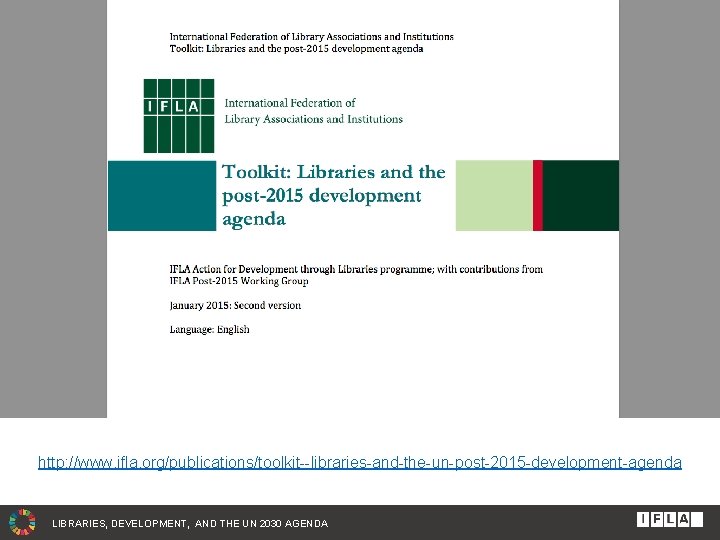
http: //www. ifla. org/publications/toolkit--libraries-and-the-un-post-2015 -development-agenda LIBRARIES, DEVELOPMENT, AND THE UN 2030 AGENDA
LIBRARIES, DEVELOPMENT, AND THE UN 2030 AGENDA
LIBRARIES, DEVELOPMENT, AND THE UN 2030 AGENDA
World Universal Literacy LIBRARIES, DEVELOPMENT, AND THE UN 2030 AGENDA
Selected Goals and Targets • Goal 2: End hunger, achieve food security and improved nutrition, and promote sustainable agriculture • Target 2. 3 by 2030 double the agricultural productivity and the incomes of small-scale food producers, particularly women, indigenous peoples, family farmers, pastoralists and fishers, including through secure and equal access to land, other productive resources and inputs, knowledge, financial services, markets, and opportunities for value addition and non-farm employment • Goal 3: Ensure healthy lives and promote well-being for all at all ages. • 3. 1 by 2030 reduce the global maternal mortality ratio to less than 70 per 100, 000 live births • Goal 4: Ensure inclusive and equitable quality education and promote life-long learning opportunities for all. • 4. 6 by 2030 ensure that all youth and at least x% of adults, both men and women, achieve literacy and numeracy • Goal 5: Achieve gender equality and empower all women and girls • 5 b. enhance the use of enabling technologies, in particular ICT, to promote women’s empowerment • Goal 11: Make cities and human settlements inclusive, safe, resilient and sustainable • 11. 4 strengthen efforts to protect and safeguard the world’s cultural and natural heritage LIBRARIES, DEVELOPMENT, AND THE UN 2030 AGENDA
The journey so far • IFLA worked with the UN to ensure that the concept of ‘access to information’ was included in Goal 16. 10 • It is argued that access to information is fundamental to better decision making, and beyond that, to ensure people have a better life • A number of IFLA documents develop the idea further • IFLA Statement on Libraries and Development (2013) • The Lyon Declaration on Access to Information and Development (2014) • Libraries, The Lyon Declaration and the Road to 2030 (webinar, 2015) [see Topic 1 B: IFLA’s work at the UN] LIBRARIES, DEVELOPMENT, AND THE UN 2030 AGENDA
IFLA Statement on Libraries and Development (2013) • Libraries provide opportunity for all • All locations, all people, marginalised groups, • Libraries empower people for their own self-development • People can learn, create and innovate • Culture of literacy and inquiry • Upskilling in ICT to improve lives and communities • Libraries offer access to the world’s knowledge • Access to information in all its forms • Traditional knowledge, national cultural and scientific heritage • Partnering to ensure equitable access to knowledge resources http: //www. ifla. org/publications/ifla-statement-on-libraries-and-development LIBRARIES, DEVELOPMENT, AND THE UN 2030 AGENDA
IFLA Statement on Libraries and Development (cont. ) • Librarians provide expert guidance • Library staff are trained and trusted intermediaries • Provide learning support for information and media literacies • Libraries are part of a multi-stakeholder society • Working effectively with many groups • Government, education, civil society, business • Experienced partners to deliver policy outcomes • Libraries must be recognised in development policy frameworks • Policy makers should encourage the strengthening and positioning of libraries to solve development problems at community levels • “Libraries have a natural role in providing access to information content and networked services that underpin sustainable development. ” http: //www. ifla. org/publications/ifla-statement-on-libraries-and-development LIBRARIES, DEVELOPMENT, AND THE UN 2030 AGENDA
The Lyon Declaration on Access to Information and Development (2014) • Aimed at UN member states, in order to influence decisions in the 2030 Agenda • Positions libraries as: • Enablers of development • Partners with governments and development agencies • “It’s crucial that the voice of libraries is heard in these negotiations” • The declaration will get the message about the importance of libraries “where it needs to be heard” • For an “active and engaged civil society, ” the involvement of libraries is essential • Opportunities to show libraries can do more than just provide access to information • Libraries also support a culture of critical thinking and inquiry www. lyondeclaration. org LIBRARIES, DEVELOPMENT, AND THE UN 2030 AGENDA
The Lyon Declaration argues that access to information supports development Empowering people to: 1. Exercise their civil, political, economic, social and cultural rights 2. Learn and apply new skills 3. Make decisions and participate in an active and engaged civil society 4. Create community-based solutions to development challenges 5. Ensure accountability, transparency, good governance, and empowerment 6. Measure progress on public and private commitments on sustainable development LIBRARIES, DEVELOPMENT, AND THE UN 2030 AGENDA
The impact of the Lyon Declaration • Over 600 signatories • Supported by IFLA membership, drawn from 150 countries around the world • Facilitated engagement with government policy makers, to underscore the role of libraries in national development • Served as a tool – a document to wave – at the UN • Underscores the fact that universal literacy is a key element of access to information LIBRARIES, DEVELOPMENT, AND THE UN 2030 AGENDA
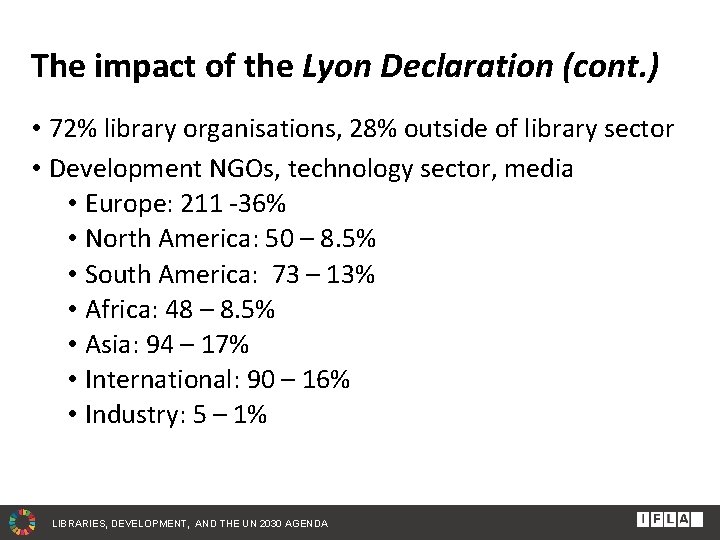
The impact of the Lyon Declaration (cont. ) • 72% library organisations, 28% outside of library sector • Development NGOs, technology sector, media • Europe: 211 -36% • North America: 50 – 8. 5% • South America: 73 – 13% • Africa: 48 – 8. 5% • Asia: 94 – 17% • International: 90 – 16% • Industry: 5 – 1% LIBRARIES, DEVELOPMENT, AND THE UN 2030 AGENDA
The reach of the Lyon Declaration • Visibility • The importance of access to information • The intrinsic value of libraries • Brings together a large group of organisations, reaching beyond the library sector • Signatories: • • Library associations Libraries Universities Agencies relating to peace, human rights, press freedom, open access, health services… LIBRARIES, DEVELOPMENT, AND THE UN 2030 AGENDA
Responsibility for SDGs has been passed to the UN member states • UN 2030 Agenda is handed over to the UN member states • All member states must prepare their national development plans, and report on their progress • Libraries can play a role in the national development plans • To highlight where current and future library services and programmes fit • To change the way libraries are seen; the roles they can play • Librarians must take up the momentum achieved so far LIBRARIES, DEVELOPMENT, AND THE UN 2030 AGENDA
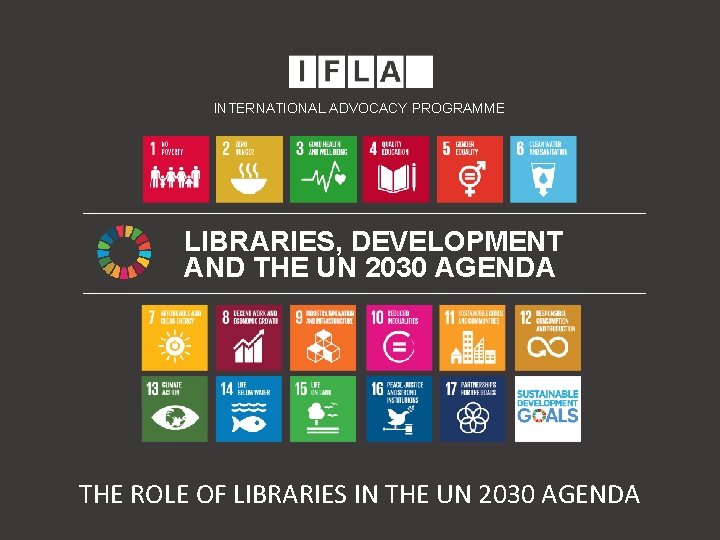
INTERNATIONAL ADVOCACY PROGRAMME LIBRARIES, DEVELOPMENT AND THE UN 2030 AGENDA THE ROLE OF LIBRARIES IN THE UN 2030 AGENDA
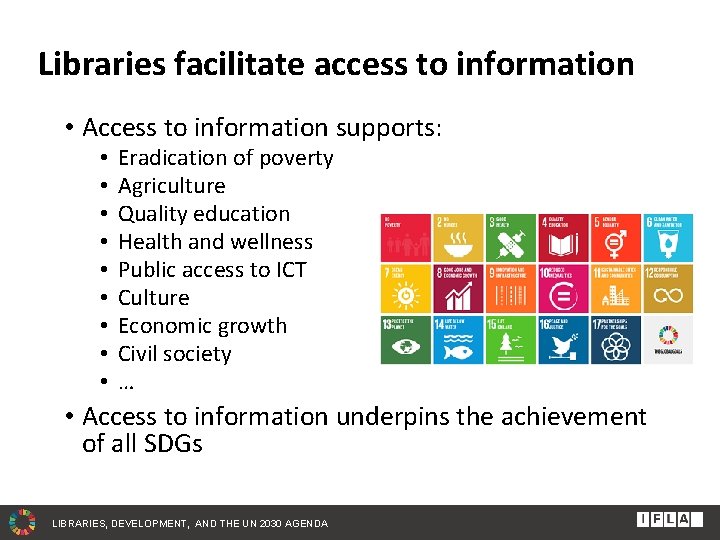
Libraries facilitate access to information • Access to information supports: • • • Eradication of poverty Agriculture Quality education Health and wellness Public access to ICT Culture Economic growth Civil society … • Access to information underpins the achievement of all SDGs LIBRARIES, DEVELOPMENT, AND THE UN 2030 AGENDA
The role of library staff in the context of SDGs • Library staff promote the information rights of citizens • Library staff develop relevant collections and facilitate access to resources • Library staff support access to government information, in all media • Library staff support the development of freedom of access legislation • Library staff model high standards of information ethics • Library staff work with NGOs seeking to ensure transparency in society • …. LIBRARIES, DEVELOPMENT, AND THE UN 2030 AGENDA
Libraries and implementation of the UN 2030 Agenda • Libraries make an important contribution to development • Advocacy is needed to ensure that national and regional policy makers understand that libraries and access to information must be included as part of national and regional development plans • Libraries must now show that they can drive progress across the entire 2030 Agenda. • While the SDGs are universal goals, each country will be responsible for developing and implementing national strategies to achieve them, and will be expected to track and report its own progress toward each target (IFLA Toolkit, p. 1) LIBRARIES, DEVELOPMENT, AND THE UN 2030 AGENDA
Libraries have a huge contribution to make • National development plans will shape many government spending and programme priorities • • • Social development plans Education plans Health and wellness plans ICT infrastructure plans … • The priorities will be different in different countries and regions, as we saw with: • Vision 2030 Jamaica LIBRARIES, DEVELOPMENT, AND THE UN 2030 AGENDA
Libraries need to be in the mix • When governments are discussing funding priorities, it is imperative that libraries are recognised • By promoting the leading role that they play in national and regional development, there should be changes in the way in which libraries, especially public libraries, are funded • The UN 2030 Agenda offers the library sector opportunities to change the assumptions made about libraries – and therefore also the funding provided LIBRARIES, DEVELOPMENT, AND THE UN 2030 AGENDA
Library associations and the library sector need to: • Increase awareness – at all levels of society – about the critical contribution libraries can make • We need very clear statements of the role(s) libraries can play in the development arena • We need to have clear examples of good practice to illustrate and provide evidence of the impact libraries make LIBRARIES, DEVELOPMENT, AND THE UN 2030 AGENDA
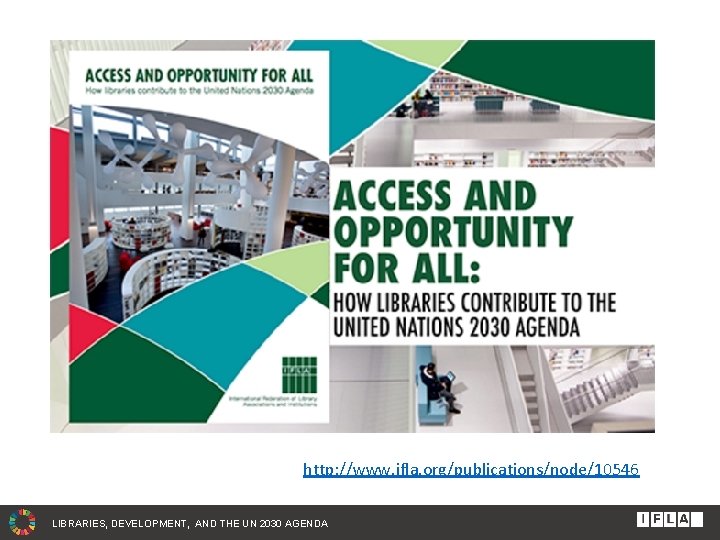
http: //www. ifla. org/publications/node/10546 LIBRARIES, DEVELOPMENT, AND THE UN 2030 AGENDA
LIBRARIES, DEVELOPMENT, AND THE UN 2030 AGENDA
LIBRARIES, DEVELOPMENT, AND THE UN 2030 AGENDA
Libraries are already contributing to SDG outcomes • By promoting universal literacy, including media and information literacy, and digital literacy skills • By closing the gaps in access to information and helping government, civil society and business to better understand local information needs • By providing a network of locations where government programmes and services can be delivered to those who need them • By advancing digital inclusion through access to ICT, and having dedicated staff to help people develop new digital skills • By serving as the heart of the research and academic community • By preserving and providing access to the world’s culture and heritage LIBRARIES, DEVELOPMENT, AND THE UN 2030 AGENDA
INTERNATIONAL ADVOCACY PROGRAMME LIBRARIES, DEVELOPMENT AND THE UN 2030 AGENDA TAKE ACTION!
Library asociations and the library sector can take the lead… • They can increase the community’s awareness of the SDGs • They can work towards making the SDGs mainstream in society • They can talk up the real value of library activities and demonstrate how these are aligned with the UN 2030 Agenda LIBRARIES, DEVELOPMENT, AND THE UN 2030 AGENDA
Increase the community’s awareness • All UN member states are committed to the UN 2030 Agenda • Every country is being asked to make sure that everyone knows about the SDGs, and how they apply nationally and locally • Library staff can make a huge different here • Everyone working in libraries has a role in the UN 2030 Agenda to make sure that everyone who visits the library knows about the Goals • The national library association has the opportunity to play a leading role LIBRARIES, DEVELOPMENT, AND THE UN 2030 AGENDA
Making the SDGs mainstream! • Develop resources to share information about the SDGs in your libraries • https: //sustainabledevelopment. un. org/topics • Learn more about what people in your country want: • The World We Want https: //www. worldwewant 2015. org • My. World data site http: //data. myworld 2015. org • UN Depository Libraries have an essential role in communicating information and research to help decision makers achieve the Goals. LIBRARIES, DEVELOPMENT, AND THE UN 2030 AGENDA
Contributing directly to IFLA’s advocacy role • Increasing access to information and knowledge across society, assisted by the availability of information and communications technologies (ICTs), supports sustainable development and improves people’s lives • IFLA has been advocating over the past two years to ensure that the UN 2030 Agenda recognises the importance of: • Access to information • Access to ICTs • Access to culture LIBRARIES, DEVELOPMENT, AND THE UN 2030 AGENDA
Making the most of this opportunity • The SDGs are an important way to advance the role of libraries as all governments have agreed to meeting the SDGs • Library associations are well positioned to work across society – with citizens, with government and with other stakeholder groups • IFLA will also continue to advocate and build capacity through a number of other forums • The Lyon Declaration remains a key document LIBRARIES, DEVELOPMENT, AND THE UN 2030 AGENDA
Raise awareness in your community • To gain community support for your specific programmes • The more support you have, the more likely you are to be taken seriously • Get your message out to the whole community • The trustworthiness of your campaign will influence the media – the credibility of libraries will increase • You need to understand the local political situation! LIBRARIES, DEVELOPMENT, AND THE UN 2030 AGENDA
Many options for communication • • • Brochures, leaflets Postcards Posters Newsletters Websites Social media Letters – private and public Emails Phone • Planting seeds – being with family and friends who will talk to other people • One-on-one meetings • Group meetings • Public meetings • Submissions • Reports • Public surveys • Media: radio, TV, newspapers
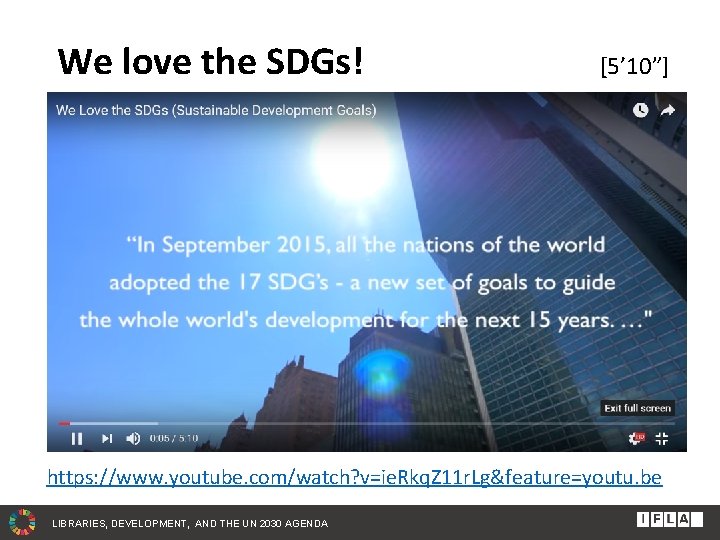
We love the SDGs! [5’ 10”] https: //www. youtube. com/watch? v=ie. Rkq. Z 11 r. Lg&feature=youtu. be LIBRARIES, DEVELOPMENT, AND THE UN 2030 AGENDA
Take action! • Learn to speak the language of development • http: //www. ifla. org/libraries-development • www. beyondaccess. net • Familiarise yourself with the SDGs – where do you think library services can contribute? • Look at the priorities for development in your country, and assess where to pitch libraries’ role • Build cross-sector alliances with development organisations to solve problems – think outside the library community • Actively engage with policymakers to get libraries incorporated into national development plans LIBRARIES, DEVELOPMENT, AND THE UN 2030 AGENDA
Take action! • Raise awareness and build capacity focusing on implementing the UN 2030 Agenda at the national and regional level. • Develop materials and events e. g. in conjunction with conferences and in-country meetings to support awarenessraising around the UN 2030 Agenda. • Organize and attend workshops to assist librarians develop the skills of collecting data and stories to show libraries are contributing to the UN SDGs. • Bring together associations and key institutions in the region to form alliances or partnerships in pursuit of SDG advocacy. • Organize and attend workshops facilitated by experts on different issues in the SDGs who can provide advice or research relating to advocacy, or support meetings with policymakers. LIBRARIES, DEVELOPMENT, AND THE UN 2030 AGENDA
Take action! • Spread the word! Follow IFLA on Twitter (@IFLA and @IFLA_Lib 4 Dev) and Facebook (IFLA) and share the news with your community! • Join the Internet Governance Forum (IGF) Dynamic Coalition on Public Access through Libraries to stay in touch with the latest stories and events regarding libraries and development – including the launch date for the Development training module • Send news or stories on libraries and development to violeta. bertolini@ifla. org • Follow the Calendar of Events to discover if there any libraries and development workshops or conferences near you. LIBRARIES, DEVELOPMENT, AND THE UN 2030 AGENDA
INTERNATIONAL ADVOCACY PROGRAMME LIBRARIES, DEVELOPMENT, AND THE UN 2030 AGENDA
- Slides: 68