Ch 16 Marine Communities Main Concepts 1 2
- Slides: 135
Ch. 16: Marine Communities
Main Concepts 1. 2. 3. 4. A community is all the living things in a defined area. The organisms of a community will interact with and depend on each other, often in complex ways. An organism’s habitat is its “address, ” its niche is its “occupation. ” The distribution of organisms in communities is rarely random; clumped distribution is the most common. Though among Earth’s most rigorous habitats, highenergy rocky and sandy shores are heavily populated by diverse organisms able to take advantage of the abundant nutrients found there.
Main Concepts 5. 6. 7. 8. Highly productive salt marshes and estuaries shelter a great variety of benthic life forms and serve as nurseries for some pelagic organisms. Coral reef communities are exceptions to the general rule that tropical oceans are unproductive. Closely cycled nutrients and zooxanthellae in coral organisms make high productivity, and high biodiversity, possible. The open ocean below 3, 000 meters (10, 000 feet) is among the least densely populated habitats on Earth. Lack of food is the main limiting factor. The deep-sea floor is the ocean’s most uniform habitat. It is populated by large numbers of mostly small, highly specialized organisms.
Main Concepts Earth’s largest community has only recently been discovered. It consists of bacteria and archaeans living in the minute spaces within solid rock, and may extend to a depth of perhaps 7 kilometers (4. 4 miles). 10. Deep vent communities near black smokers and atop cold seeps depend for energy on chemosynthesis by bacteria and archaeans. 11. Whale fall communities may act as “stepping stones” for organisms that colonize hydrothermal vents. 12. Symbiosis is the co-occurrence of two species in which the life of one is closely interwoven with the life of the other. The types of symbiosis are mutualism, commensalism, and the most common symbiosis, parasitism. 9.
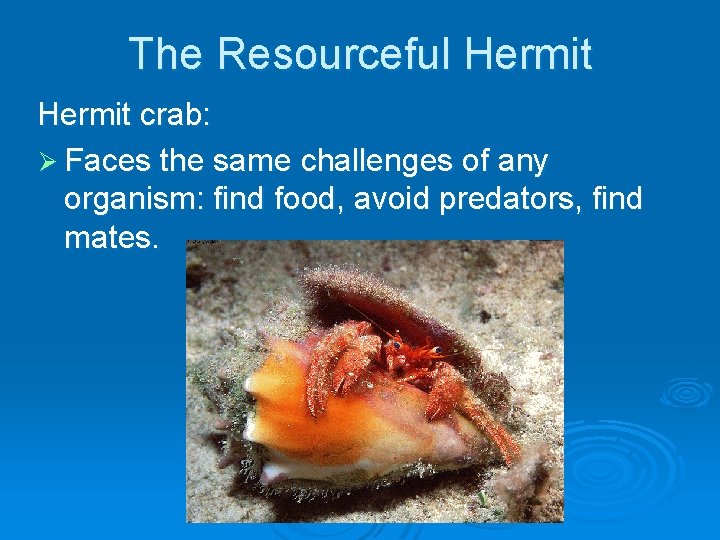
The Resourceful Hermit crab: Ø Faces the same challenges of any organism: find food, avoid predators, find mates.
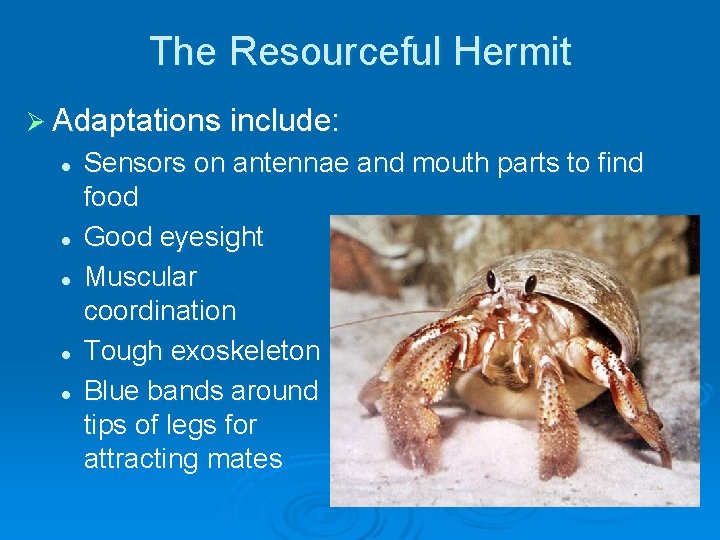
The Resourceful Hermit Ø Adaptations include: l l l Sensors on antennae and mouth parts to find food Good eyesight Muscular coordination Tough exoskeleton Blue bands around tips of legs for attracting mates
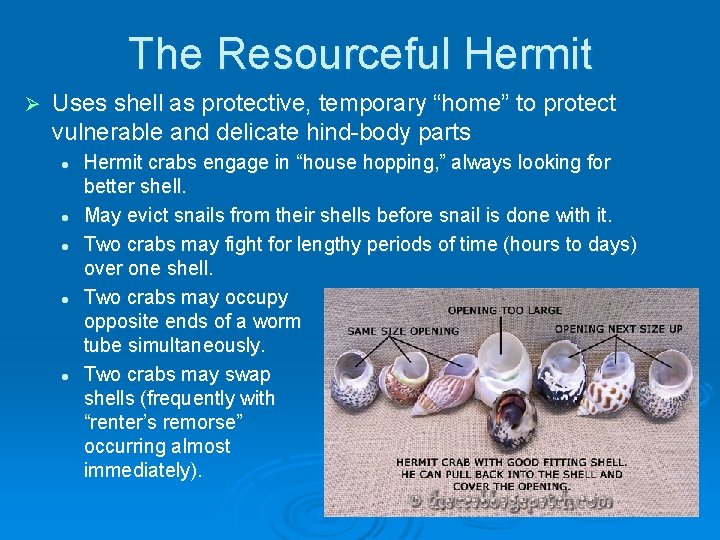
The Resourceful Hermit Ø Uses shell as protective, temporary “home” to protect vulnerable and delicate hind-body parts l l l Hermit crabs engage in “house hopping, ” always looking for better shell. May evict snails from their shells before snail is done with it. Two crabs may fight for lengthy periods of time (hours to days) over one shell. Two crabs may occupy opposite ends of a worm tube simultaneously. Two crabs may swap shells (frequently with “renter’s remorse” occurring almost immediately).
Marine Communities Ø Community:
Marine Communities Community: a group of interacting populations of organisms in a particular location. Ø Population: Ø
Marine Communities Community: a group of interacting populations of organisms in a particular location. Ø Population: a group of individuals of the same species living together in a specific area. Ø Physical and biological characteristics of a location dictate what populations and, thus, what community, lives there. Ø Members of a community usually share similar environmental tolerances. Ø
Marine Communities The scale on which a community is considered can vary greatly.
Marine Communities Deep open-ocean community = largest marine community l l l Sparsely populated Permanently dark Little food availability Mating opportunities are rare In some spp. the male burrows into the female’s body upon first meeting and remains there permanently.
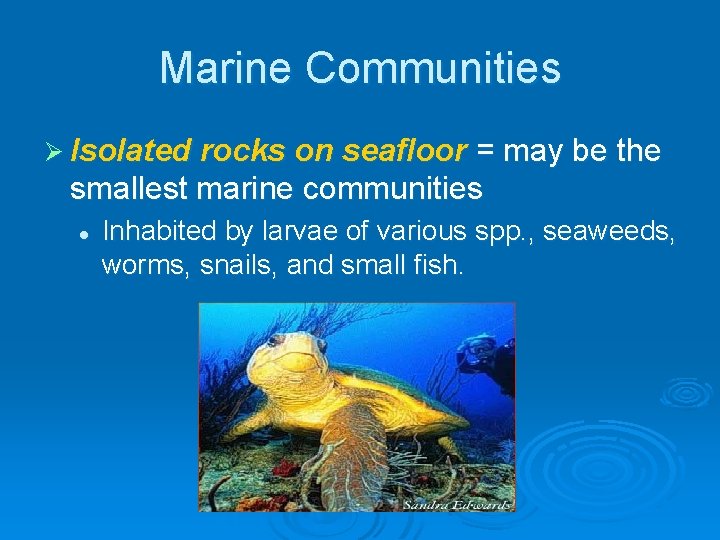
Marine Communities Ø Isolated rocks on seafloor = may be the smallest marine communities l Inhabited by larvae of various spp. , seaweeds, worms, snails, and small fish.
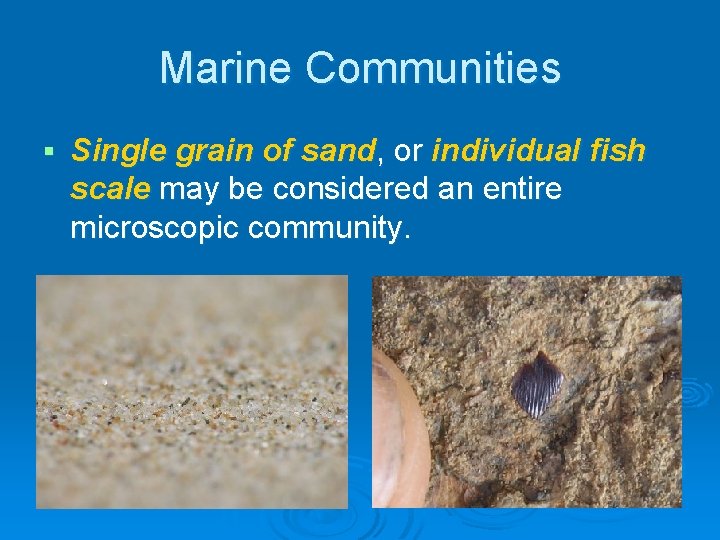
Marine Communities Single grain of sand, or individual fish scale may be considered an entire microscopic community.
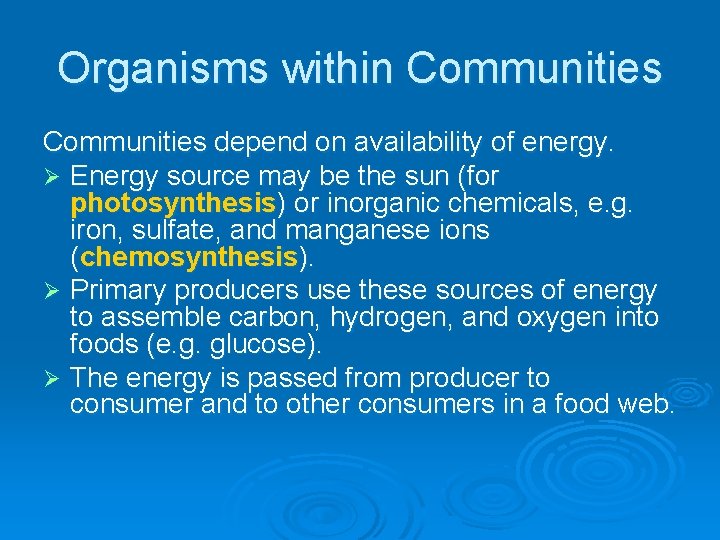
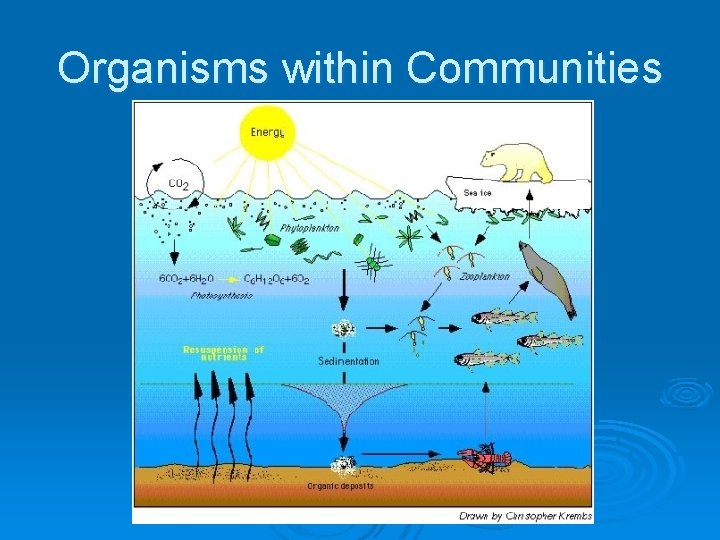
Organisms within Communities depend on availability of energy. Ø Energy source may be the sun (for photosynthesis) or inorganic chemicals, e. g. iron, sulfate, and manganese ions (chemosynthesis). Ø Primary producers use these sources of energy to assemble carbon, hydrogen, and oxygen into foods (e. g. glucose). Ø The energy is passed from producer to consumer and to other consumers in a food web.
Organisms within Communities
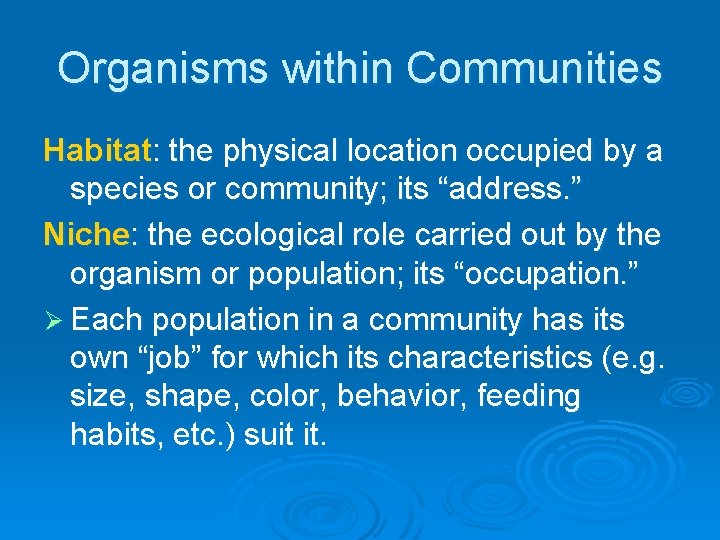
Organisms within Communities Habitat: the physical location occupied by a species or community; its “address. ” Niche: the ecological role carried out by the organism or population; its “occupation. ” Ø Each population in a community has its own “job” for which its characteristics (e. g. size, shape, color, behavior, feeding habits, etc. ) suit it.
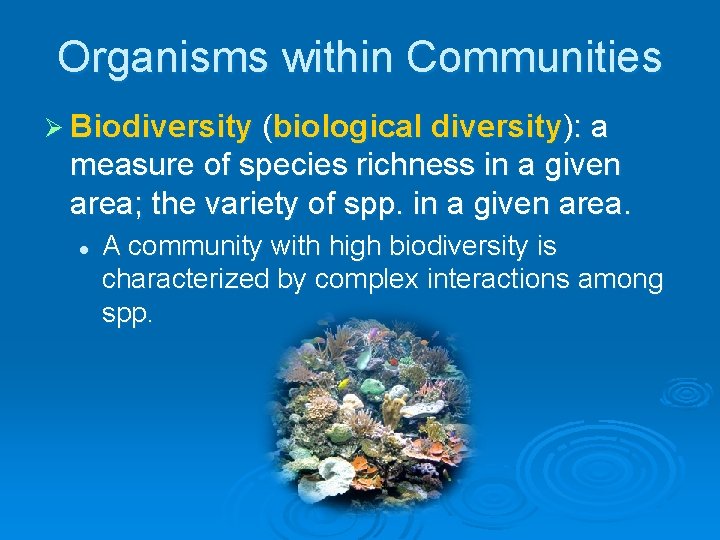
Organisms within Communities Ø Biodiversity (biological diversity): a measure of species richness in a given area; the variety of spp. in a given area. l A community with high biodiversity is characterized by complex interactions among spp.
The Influence of Physical and Biological Factors The location and composition of a community are both influenced by physical and biological factors. Physical factors: temperature, pressure, salinity, etc. Ø Biological factors: crowding, predation, grazing, parasitism, shading from light, generation of waste, competition. Ø
The Influence of Physical and Biological Factors Ø Limiting factor: any physical or biological factor that prevents an organism from feeding, growing, reproducing successfully, defending itself, or otherwise functioning successfully, i. e. any factor that limits an organism’s success in a community, e. g. low water temperature for tropical fish may cause them to become too sluggish to capture food, or avoid predators (see Fig. 16. 2, p. 393).
Physical & Biological Factors Ø Ø Ø Stenothermal (steno = narrow): referring to organisms with a narrow tolerance for temperature fluctuations. Eurythermal (eury = wide, broad): referring to organisms with a wide thermal tolerance. Stenohaline (halos = salt): referring to organisms that require a stable saline environment. Euryhaline: referring to organisms that can withstand a wide range of salinity. Same ideas apply to stenobaric (baros = pressure) and eurybaric.
Physical & Biological Factors
Physical & Biological Factors Ø Usually more than one environmental factor changes simultaneously. l l Even slight changes, which alone may not harm an organism, when combined with others, may be lethal to the organism: synergistic effects. The proper balance of physical and biological factors must be maintained to ensure the success and longevity of any community.
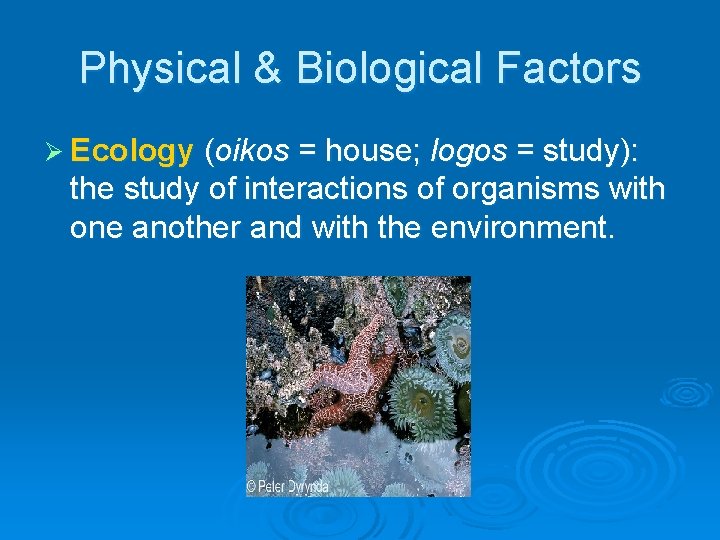
Physical & Biological Factors Ø Ecology (oikos = house; logos = study): the study of interactions of organisms with one another and with the environment.
Competition Ø The availability of food, light, space and other resources will determine the number and composition of populations within a community. Ø Competition may occur between. . .
Competition Ø . . . members of the same species (intraspecific competition): l l Some individuals in a population will be larger, stronger, faster, more adept at gathering food, etc. These will survive; others will either move to a new location, or die. Those that are most successful will produce the greatest number of offspring, which will possess their parents’ adaptive traits. This kind of competition hones population to its environment.
Competition Ø . . . or members of different species (interspecific competition): • One sp. may be so successful that it eliminates competing populations. • Extinction of one sp. by another in this fashion is probably rare. • Such competition can the restriction of one population by another, e. g. .
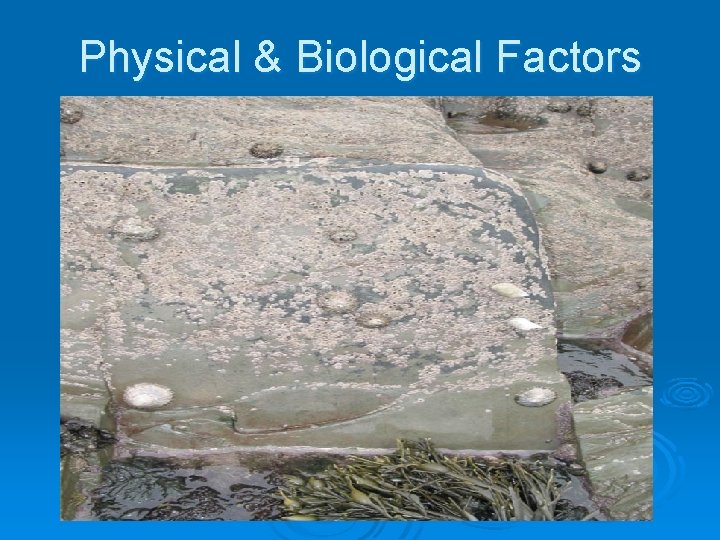
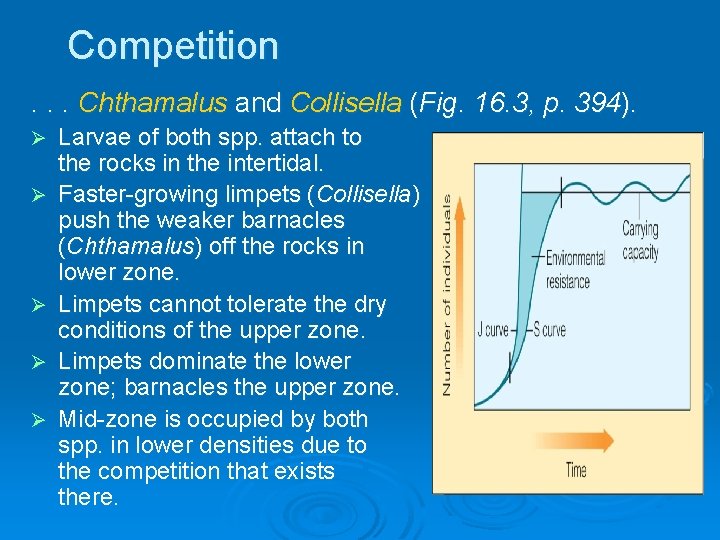
Competition. . . Chthamalus and Collisella (Fig. 16. 3, p. 394). Ø Ø Ø Larvae of both spp. attach to the rocks in the intertidal. Faster-growing limpets (Collisella) push the weaker barnacles (Chthamalus) off the rocks in lower zone. Limpets cannot tolerate the dry conditions of the upper zone. Limpets dominate the lower zone; barnacles the upper zone. Mid-zone is occupied by both spp. in lower densities due to the competition that exists there.
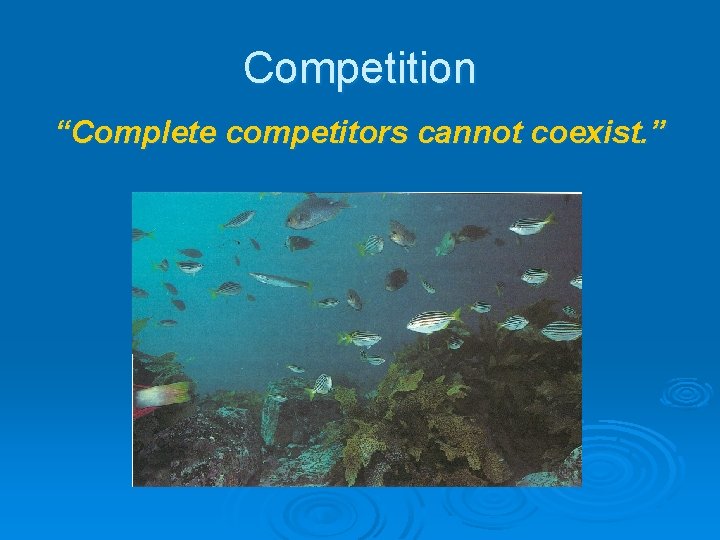
Competition “Complete competitors cannot coexist. ”
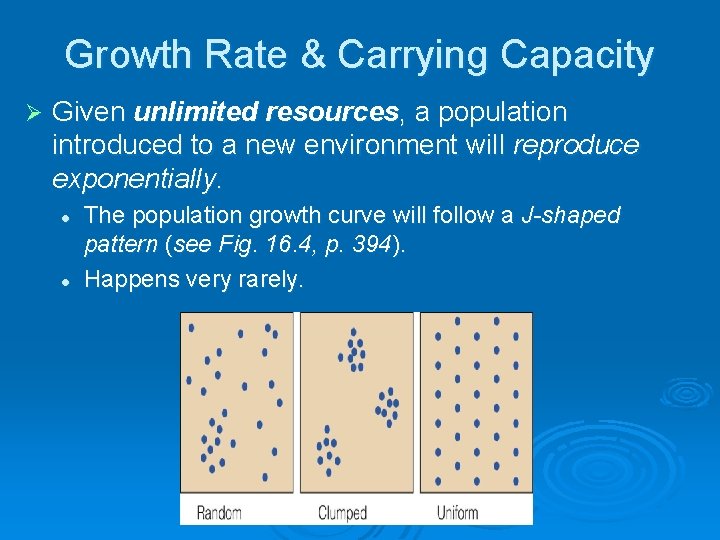
Growth Rate & Carrying Capacity Ø Given unlimited resources, a population introduced to a new environment will reproduce exponentially. l l The population growth curve will follow a J-shaped pattern (see Fig. 16. 4, p. 394). Happens very rarely.
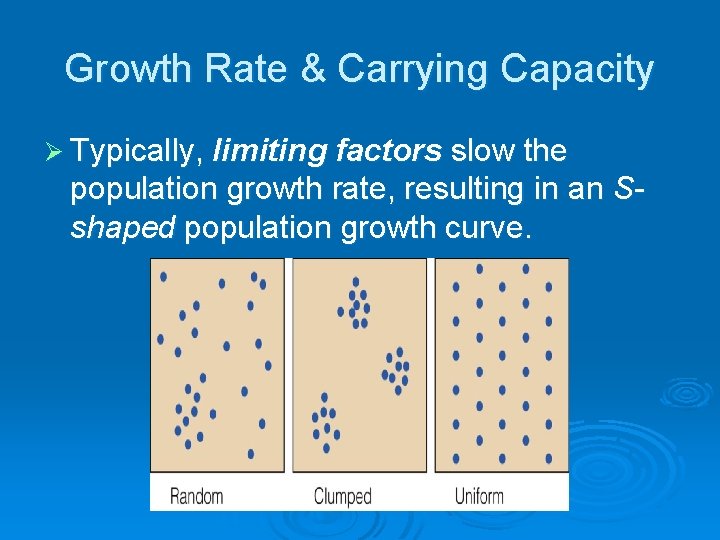
Growth Rate & Carrying Capacity Ø Typically, limiting factors slow the population growth rate, resulting in an Sshaped population growth curve.
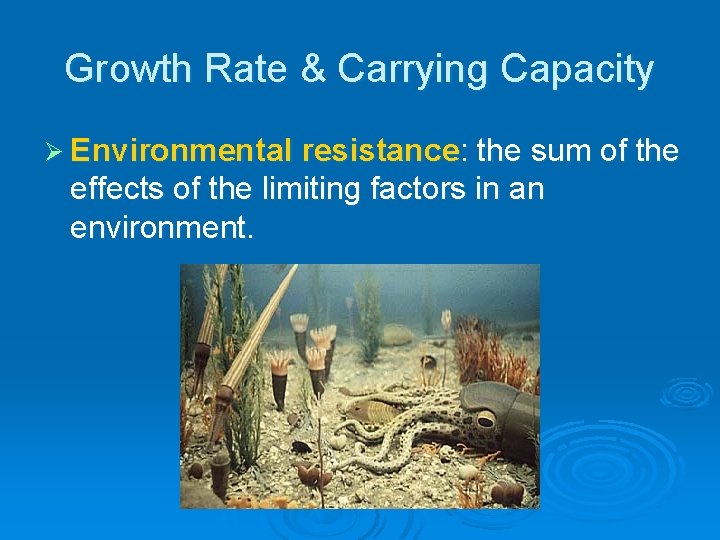
Growth Rate & Carrying Capacity Ø Environmental resistance: the sum of the effects of the limiting factors in an environment.
Growth Rate & Carrying Capacity Carrying capacity: the population size that a community or environment can support indefinitely under a stable set of environmental conditions. Ø But environmental conditions do change: l l l Ø An upwelling may cease A new predator may be introduced Climate may change Food supplies may dwindle A new parasite may invade the population All of these could population crash
Distribution of Organisms Population density: the number of individuals per unit area (or volume) Ø In general, more benign habitats where physical factors remain near the optimum possess a greater variety of niches and a greater biodiversity, e. g. coral reefs, rain forests. Ø Rougher habitats are home to fewer organisms and fewer spp. of organisms, i. e. lower biodiversity, e. g. deserts, beaches. Ø Organisms are rarely distributed randomly throughout their habitat. Ø
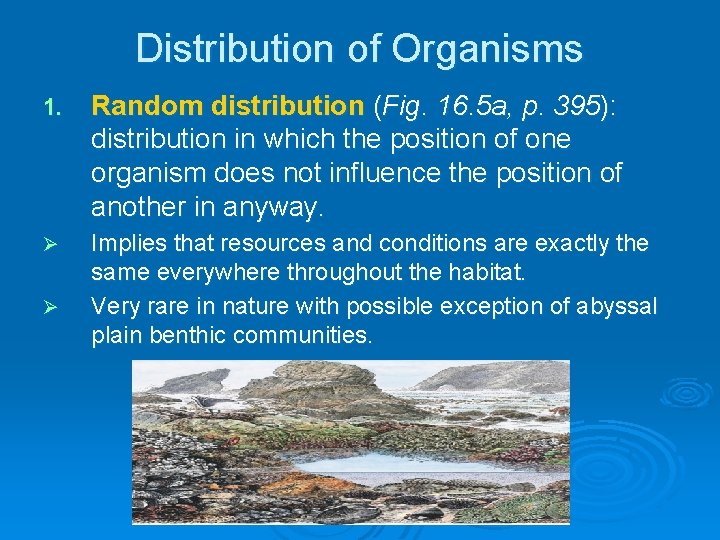
Distribution of Organisms 1. Random distribution (Fig. 16. 5 a, p. 395): distribution in which the position of one organism does not influence the position of another in anyway. Ø Implies that resources and conditions are exactly the same everywhere throughout the habitat. Very rare in nature with possible exception of abyssal plain benthic communities. Ø
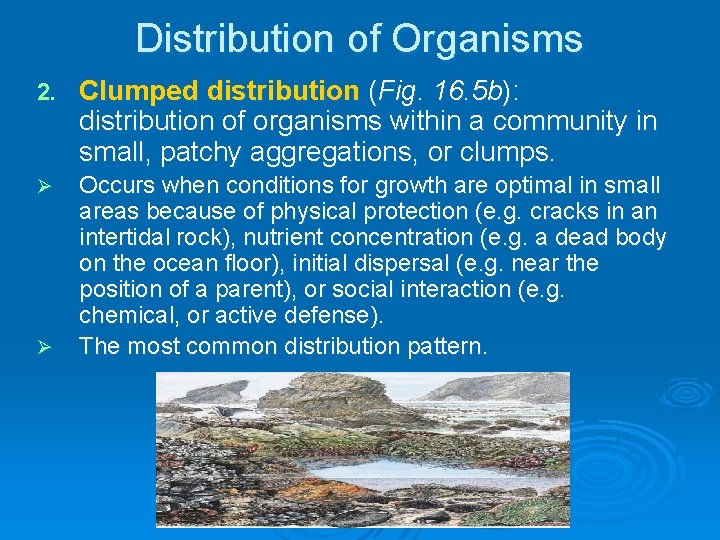
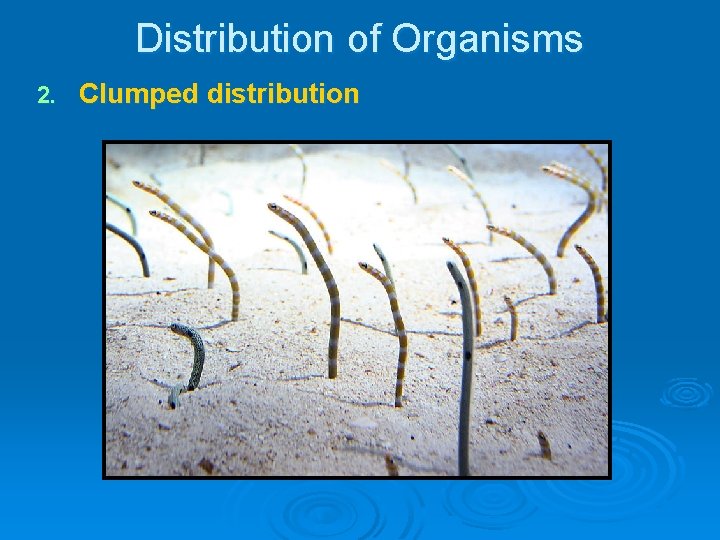
Distribution of Organisms 2. Clumped distribution (Fig. 16. 5 b): distribution of organisms within a community in small, patchy aggregations, or clumps. Ø Occurs when conditions for growth are optimal in small areas because of physical protection (e. g. cracks in an intertidal rock), nutrient concentration (e. g. a dead body on the ocean floor), initial dispersal (e. g. near the position of a parent), or social interaction (e. g. chemical, or active defense). The most common distribution pattern. Ø
Distribution of Organisms 2. Clumped distribution
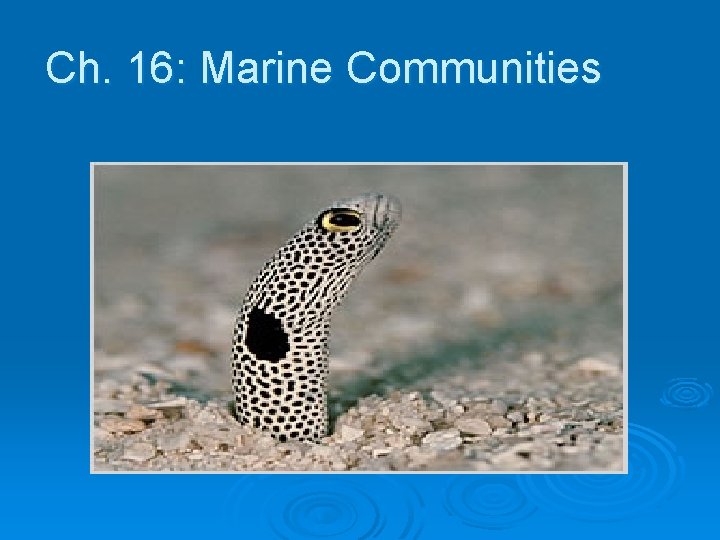
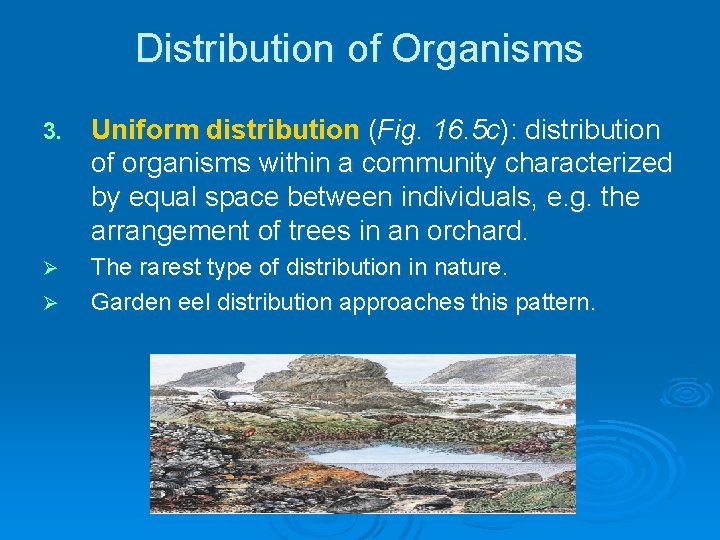
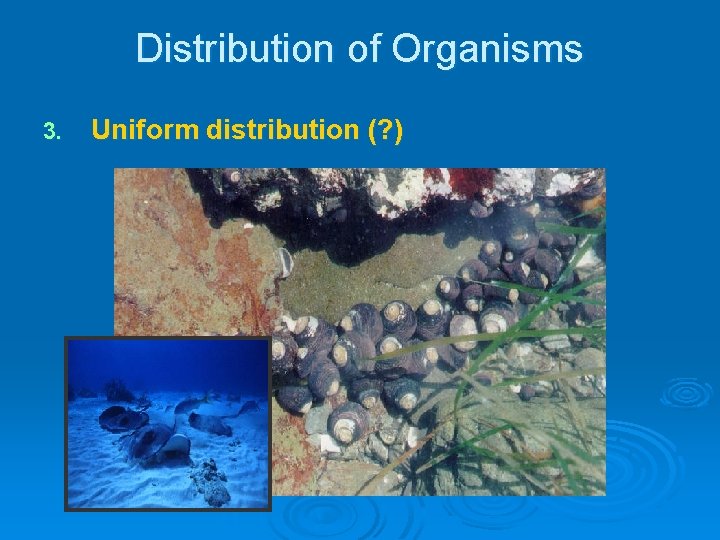
Distribution of Organisms 3. Uniform distribution (Fig. 16. 5 c): distribution of organisms within a community characterized by equal space between individuals, e. g. the arrangement of trees in an orchard. Ø The rarest type of distribution in nature. Garden eel distribution approaches this pattern. Ø
Distribution of Organisms 3. Uniform distribution (? )
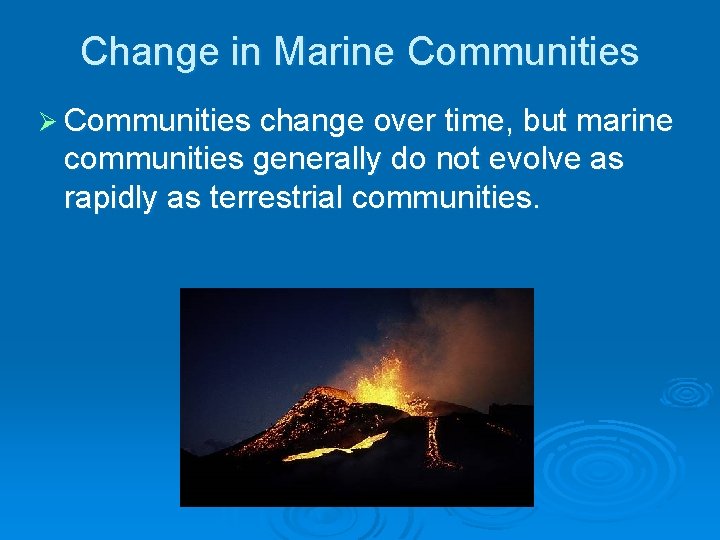
Change in Marine Communities Ø Communities change over time, but marine communities generally do not evolve as rapidly as terrestrial communities.
Change in Marine Communities Ø Causes of slow change include: l l Seafloor spreading Climate cycles Atmospheric composition Newly evolved spp.
Change in Marine Communities Ø Community members can change the physical makeup of their environment. l The accumulation of coral and sediments on a coral reef can influence ocean current patterns, ocean temperature, and the composition of dissolved gases.
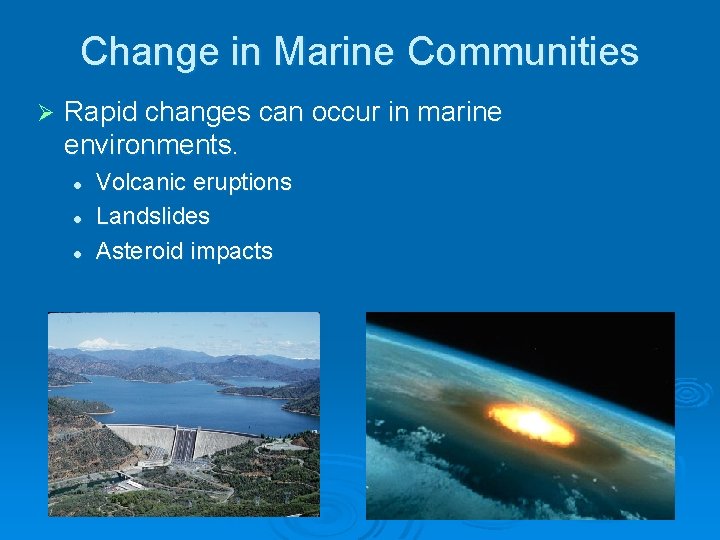
Change in Marine Communities Ø Rapid changes can occur in marine environments. l l l Volcanic eruptions Landslides Asteroid impacts
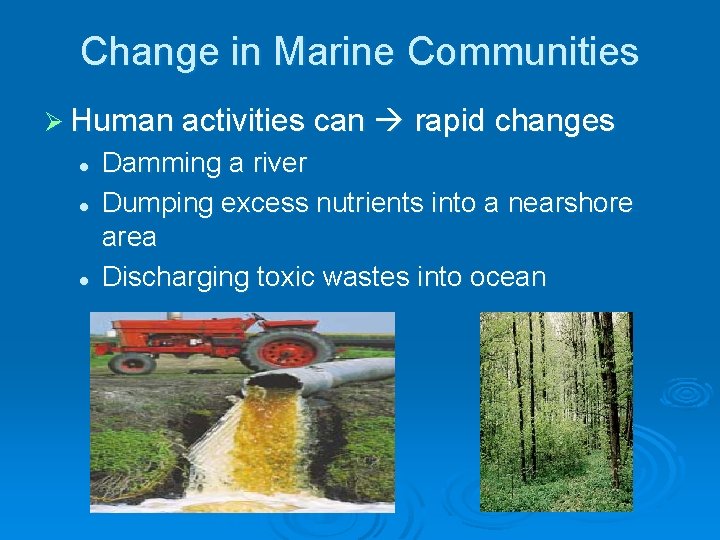
Change in Marine Communities Ø Human activities can rapid changes l l l Damming a river Dumping excess nutrients into a nearshore area Discharging toxic wastes into ocean
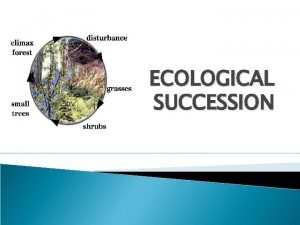
Change in Marine Communities Define the following: Ø Ø Ø Succession Climax community Pioneer species
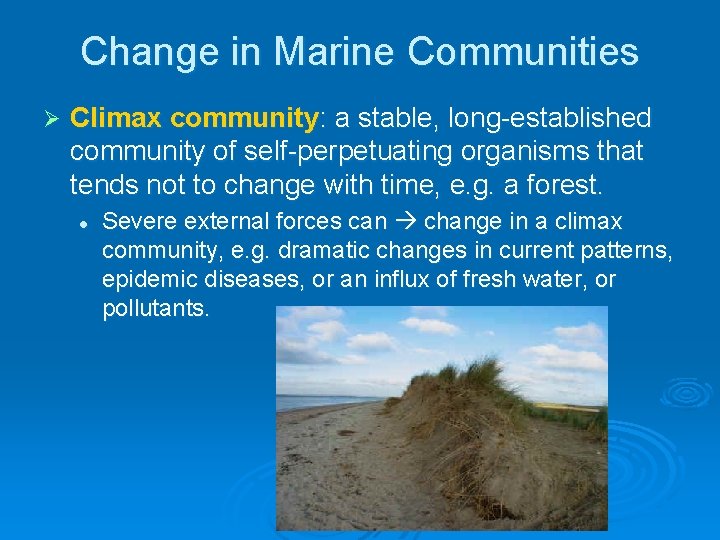
Change in Marine Communities Ø Climax community: a stable, long-established community of self-perpetuating organisms that tends not to change with time, e. g. a forest. l Severe external forces can change in a climax community, e. g. dramatic changes in current patterns, epidemic diseases, or an influx of fresh water, or pollutants.
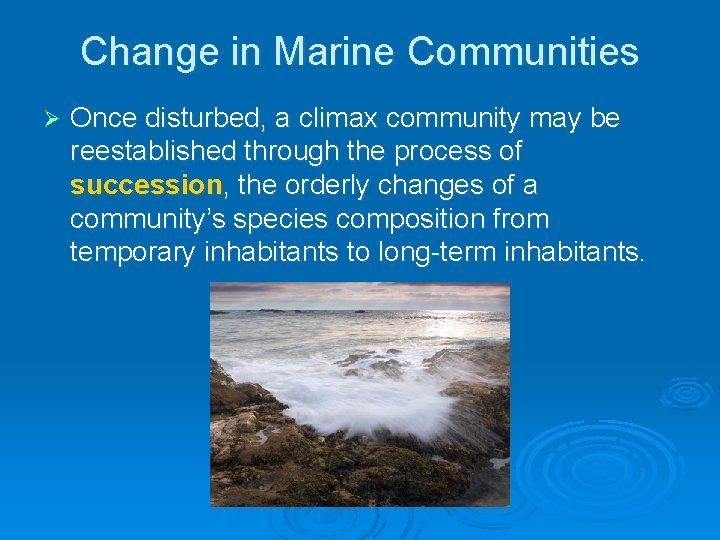
Change in Marine Communities Ø Once disturbed, a climax community may be reestablished through the process of succession, the orderly changes of a community’s species composition from temporary inhabitants to long-term inhabitants.
Change in Marine Communities Ø With the original community members disrupted, habitats and niches are left vacant for occupation by pioneer spp. l l These spp. , in turn, will alter the community, making it more suitable for other spp. to take up residence. Eventually, the climax community may return, or a new climax community may become established.
Examples of Marine Communities Ø Ø Ø Ø Ø Rocky Intertidal Seaweed Sand Beach and Cobble Beach Salt Marshes and Estuaries Coral Reef Open Ocean Deep-Sea Floor Deep Rock Hydrothermal Vent and Cold Seep Whale Fall
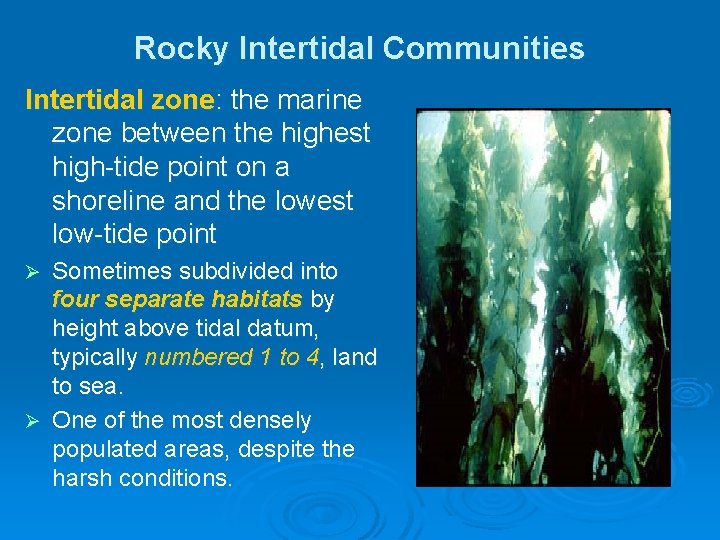
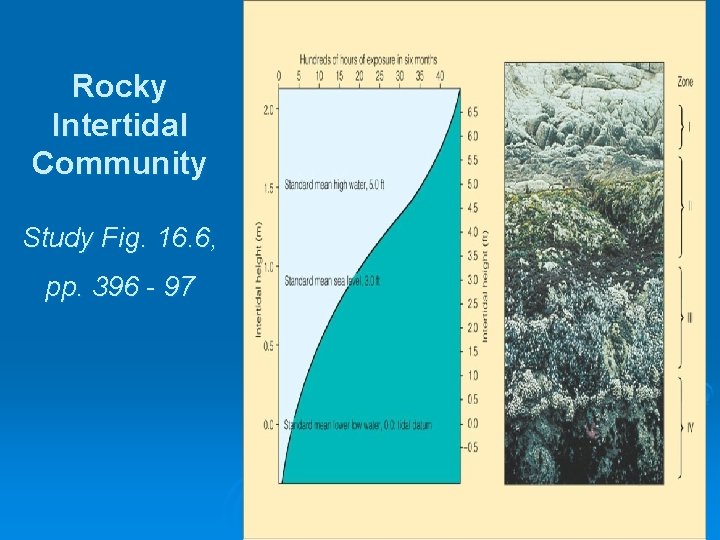
Rocky Intertidal Communities Intertidal zone: the marine zone between the highest high-tide point on a shoreline and the lowest low-tide point Sometimes subdivided into four separate habitats by height above tidal datum, typically numbered 1 to 4, land to sea. Ø One of the most densely populated areas, despite the harsh conditions. Ø
Rocky Intertidal Community Study Fig. 16. 6, pp. 396 - 97
Rocky Intertidal Communities List eight (8) challenges to life in the intertidal.
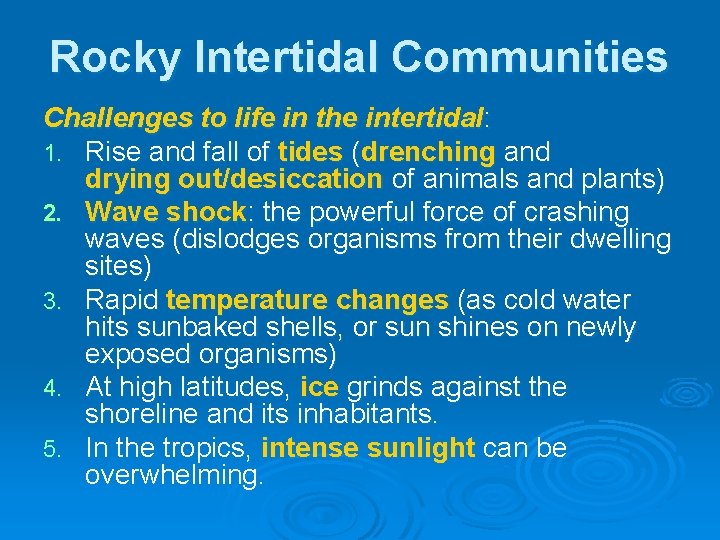
Rocky Intertidal Communities Challenges to life in the intertidal: 1. Rise and fall of tides (drenching and drying out/desiccation of animals and plants) 2. Wave shock: the powerful force of crashing waves (dislodges organisms from their dwelling sites) 3. Rapid temperature changes (as cold water hits sunbaked shells, or sun shines on newly exposed organisms) 4. At high latitudes, ice grinds against the shoreline and its inhabitants. 5. In the tropics, intense sunlight can be overwhelming.
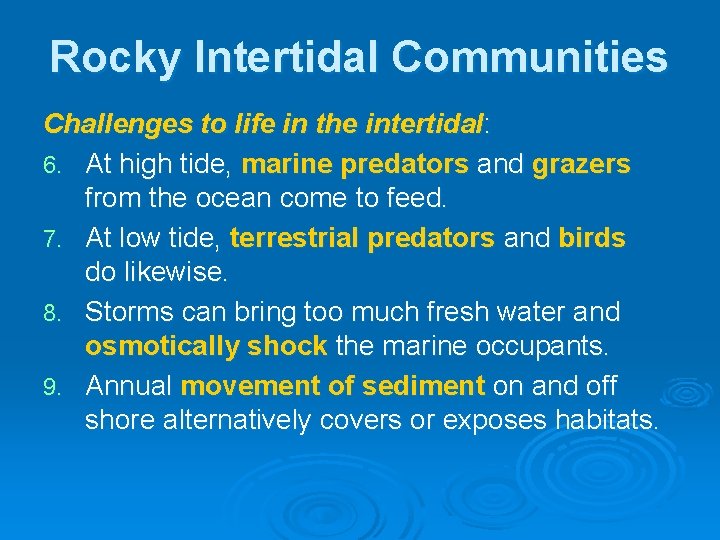
Rocky Intertidal Communities Challenges to life in the intertidal: 6. At high tide, marine predators and grazers from the ocean come to feed. 7. At low tide, terrestrial predators and birds do likewise. 8. Storms can bring too much fresh water and osmotically shock the marine occupants. 9. Annual movement of sediment on and off shore alternatively covers or exposes habitats.
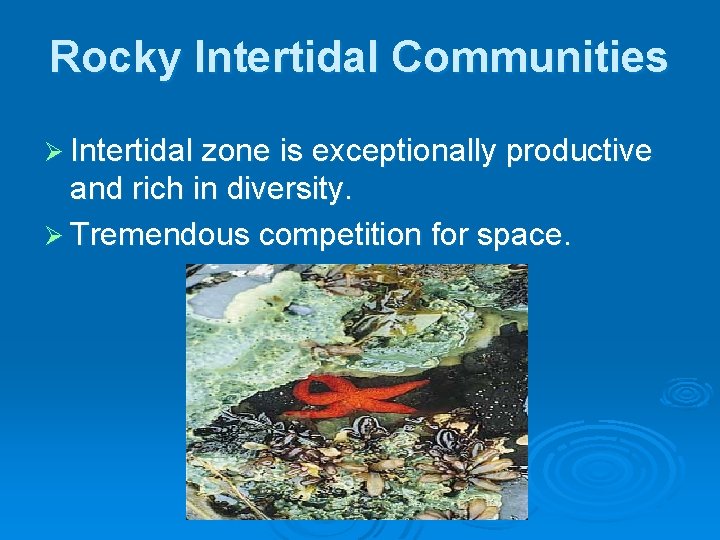
Rocky Intertidal Communities Ø Intertidal zone is exceptionally productive and rich in diversity. Ø Tremendous competition for space.
Rocky Intertidal Communities Abundance of available food: Ø Minerals arrive from the land via runoff and serve as nutrients for plankton Ø Surf and tides maintain a mixing of these nutrients, as well as high concentrations of dissolved oxygen and carbon dioxide Ø A healthy plankton community is thereby supported
Rocky Intertidal Communities Great variety of habitats and niches: Ø Splash pools, crevices, etc. serve as hiding places, attachment sites, jumpingoff spots, places from which to launch surprise predatory attacks. Ø Intertidal is home to algae, crabs, octopuses, et al.
Rocky Intertidal Communities Rise and fall of tides: Ø Different organisms are adapted to different levels of exposure and dryness. Ø Organisms sort themselves according to their tolerance levels for varying degrees of immersion or exposure to sun (Fig. 16. 7, p. 398). 1. 2. 3. 4. Uppermost zone (I): lichens, cyanobacteria Middle zone (II): red algae (Endocladia) Low zone (III): mussels, gooseneck barnacles Bottom zone (IV): Sea stars, sea anemones
Rocky Intertidal Communities
Rocky Intertidal Communities
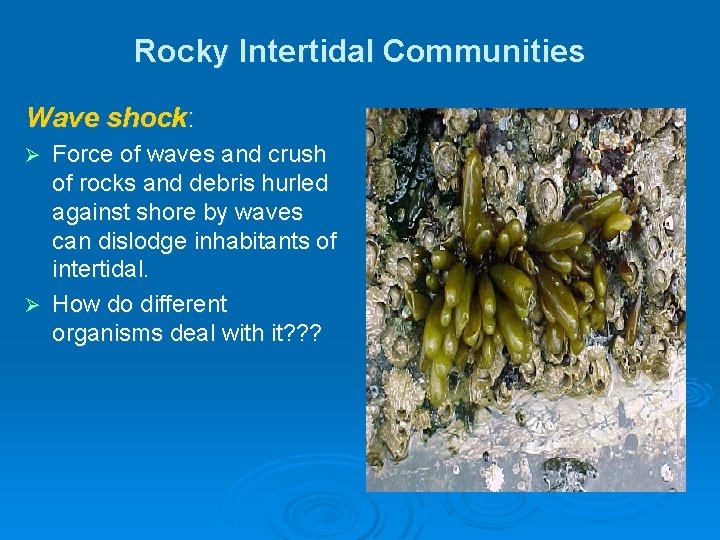
Rocky Intertidal Communities Wave shock: Force of waves and crush of rocks and debris hurled against shore by waves can dislodge inhabitants of intertidal. Ø How do different organisms deal with it? ? ? Ø
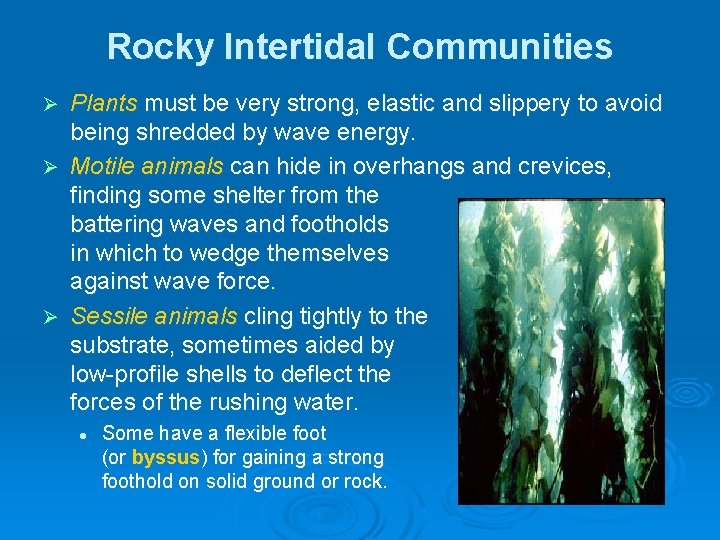
Rocky Intertidal Communities Plants must be very strong, elastic and slippery to avoid being shredded by wave energy. Ø Motile animals can hide in overhangs and crevices, finding some shelter from the battering waves and footholds in which to wedge themselves against wave force. Ø Sessile animals cling tightly to the substrate, sometimes aided by low-profile shells to deflect the forces of the rushing water. Ø l Some have a flexible foot (or byssus) for gaining a strong foothold on solid ground or rock.
Rocky Intertidal Communities Desiccation: Ø Motile animals can follow the water level with the tides. Ø Sessile plants and animals must position themselves in depressions that will hold water while tide is out. Ø Shelled animals keep water inside shell to maintain proper gas exchange function of their gills. Ø Some animals and plants have a protective mucous to prevent them from drying out.
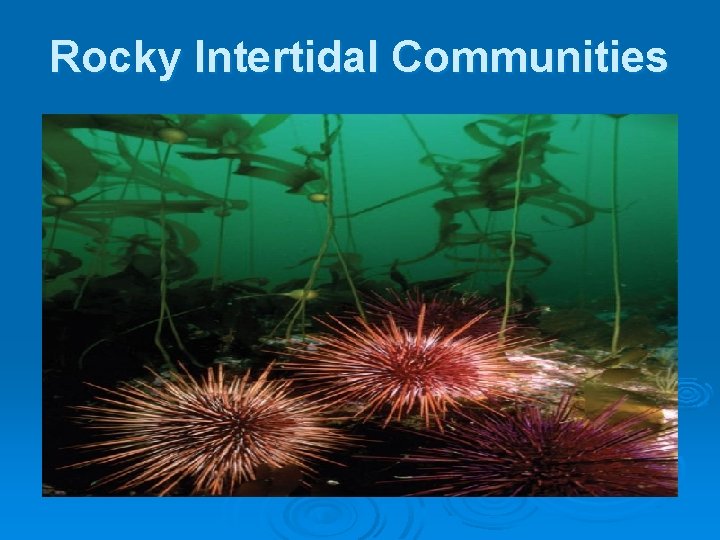
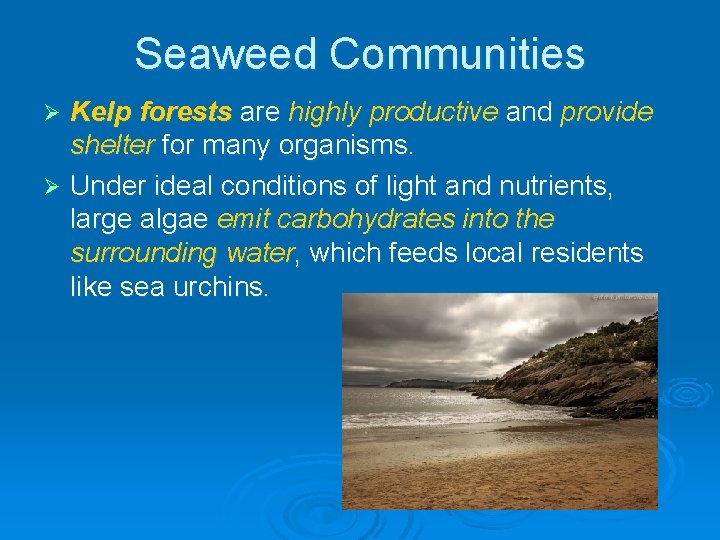
Seaweed Communities Kelp forests are highly productive and provide shelter for many organisms. Ø Under ideal conditions of light and nutrients, large algae emit carbohydrates into the surrounding water, which feeds local residents like sea urchins. Ø
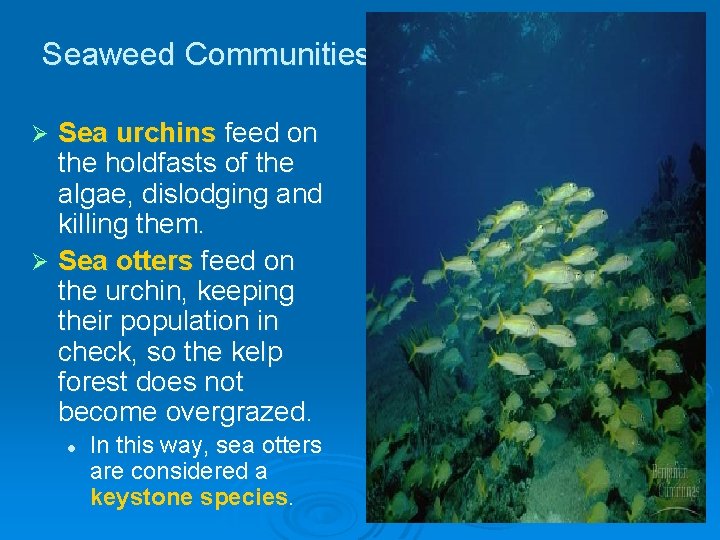
Seaweed Communities Sea urchins feed on the holdfasts of the algae, dislodging and killing them. Ø Sea otters feed on the urchin, keeping their population in check, so the kelp forest does not become overgrazed. Ø l In this way, sea otters are considered a keystone species.
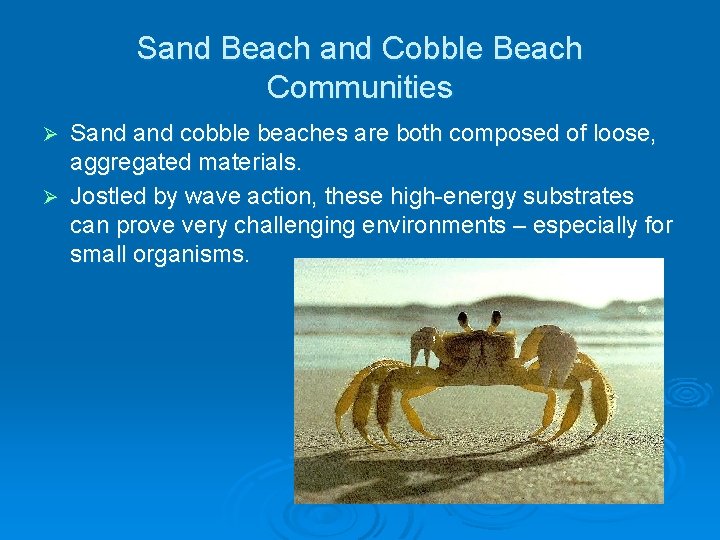
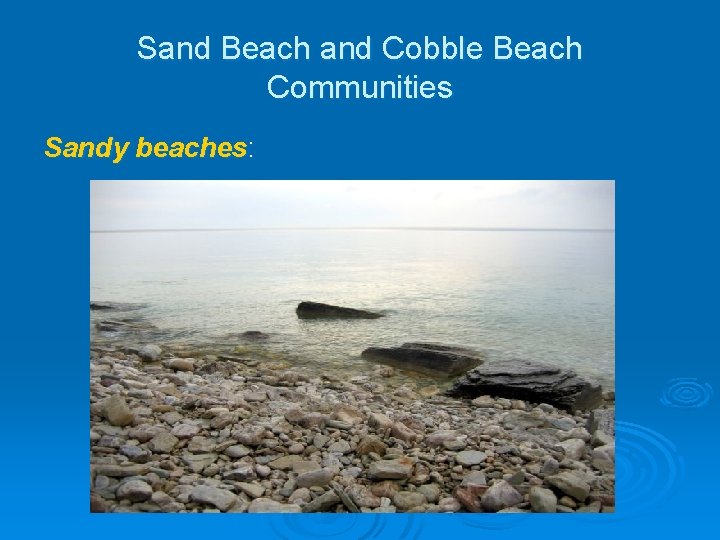
Sand Beach and Cobble Beach Communities Sand cobble beaches are both composed of loose, aggregated materials. Ø Jostled by wave action, these high-energy substrates can prove very challenging environments – especially for small organisms. Ø
Sand Beach and Cobble Beach Communities Sandy beaches:
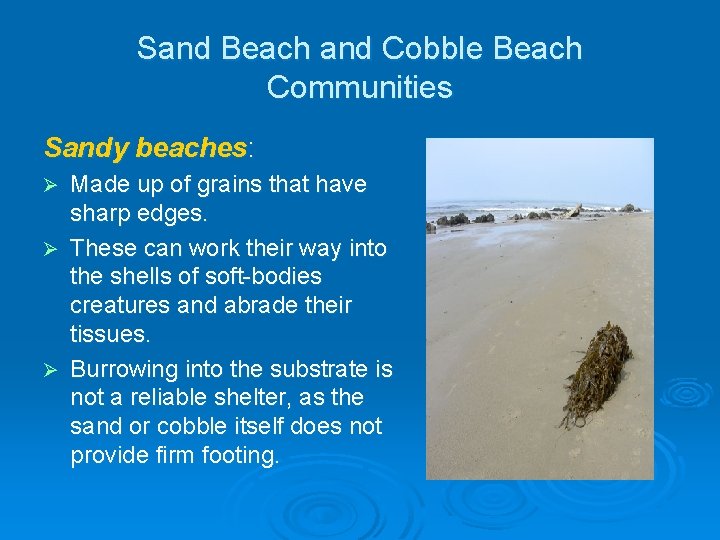
Sand Beach and Cobble Beach Communities Sandy beaches: Made up of grains that have sharp edges. Ø These can work their way into the shells of soft-bodies creatures and abrade their tissues. Ø Burrowing into the substrate is not a reliable shelter, as the sand or cobble itself does not provide firm footing. Ø
Sand Beach and Cobble Beach Communities Capillary forces: Ø Can pin down small animals or prevent them from moving at all. Ø If trapped near the surface, these creatures are subject to the possible effects of sun, heat, freezing, osmotic shock from rainwater, or predation. Ø Organisms must be able to separate their food from the swirling sand, avoid leaving tell-tale signs of their presence in the sand, and deal with their homes being excavated by wave action.
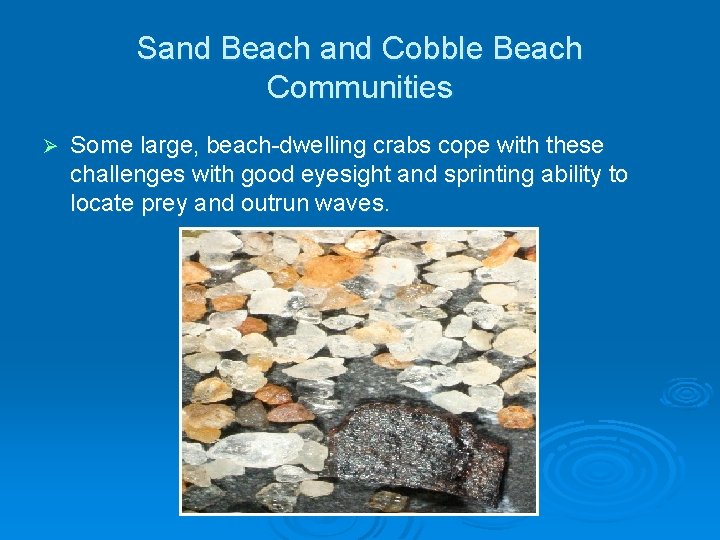
Sand Beach and Cobble Beach Communities Ø Some large, beach-dwelling crabs cope with these challenges with good eyesight and sprinting ability to locate prey and outrun waves.
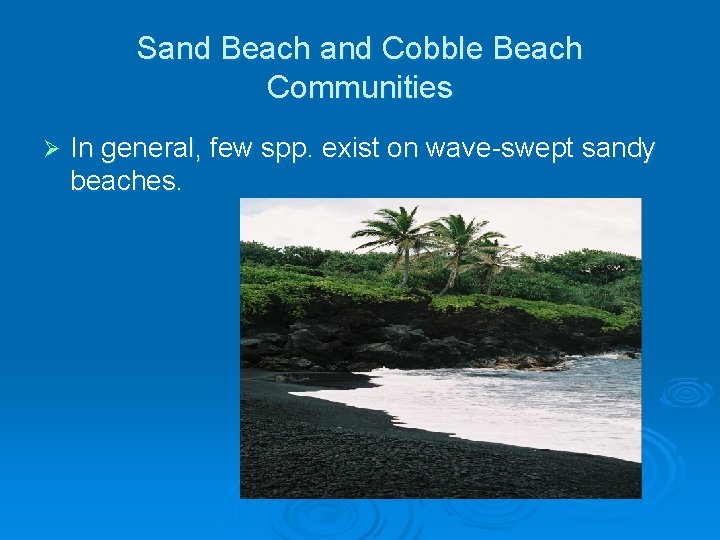
Sand Beach and Cobble Beach Communities Ø In general, few spp. exist on wave-swept sandy beaches.
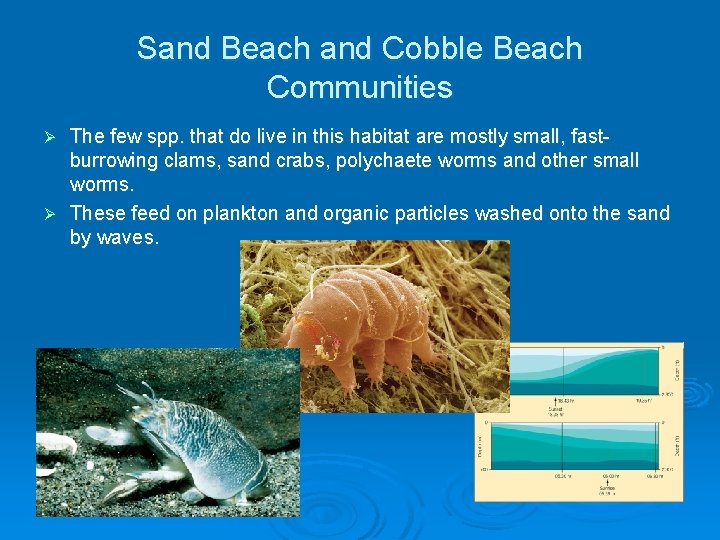
Sand Beach and Cobble Beach Communities The few spp. that do live in this habitat are mostly small, fastburrowing clams, sand crabs, polychaete worms and other small worms. Ø These feed on plankton and organic particles washed onto the sand by waves. Ø
Sand Beach and Cobble Beach Communities Cobble beaches:
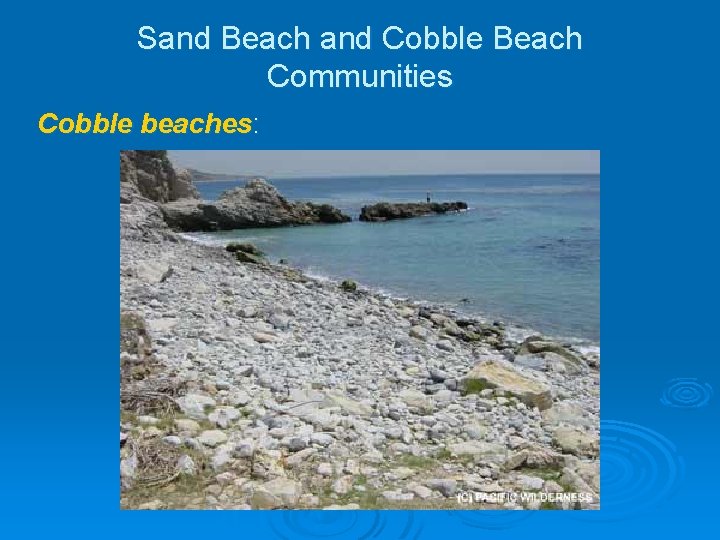
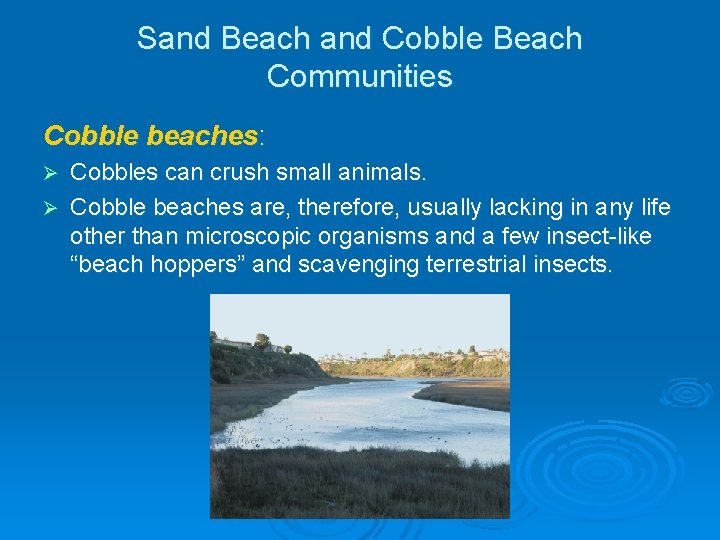
Sand Beach and Cobble Beach Communities Cobble beaches: Cobbles can crush small animals. Ø Cobble beaches are, therefore, usually lacking in any life other than microscopic organisms and a few insect-like “beach hoppers” and scavenging terrestrial insects. Ø
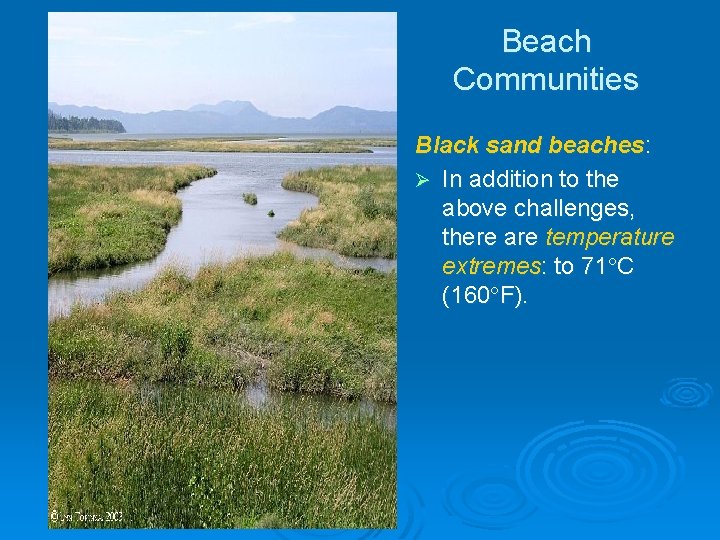
Beach Communities Black sand beaches: Ø In addition to the above challenges, there are temperature extremes: to 71 C (160 F).
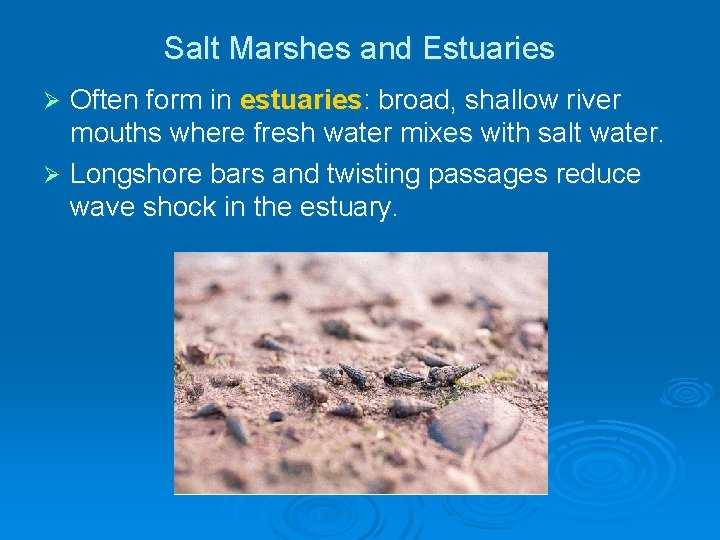
Salt Marshes and Estuaries Often form in estuaries: broad, shallow river mouths where fresh water mixes with salt water. Ø Longshore bars and twisting passages reduce wave shock in the estuary. Ø
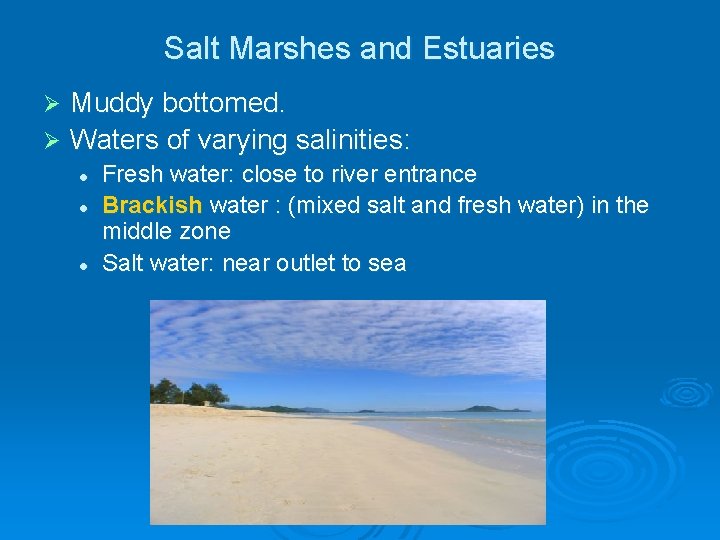
Salt Marshes and Estuaries Muddy bottomed. Ø Waters of varying salinities: Ø l l l Fresh water: close to river entrance Brackish water : (mixed salt and fresh water) in the middle zone Salt water: near outlet to sea
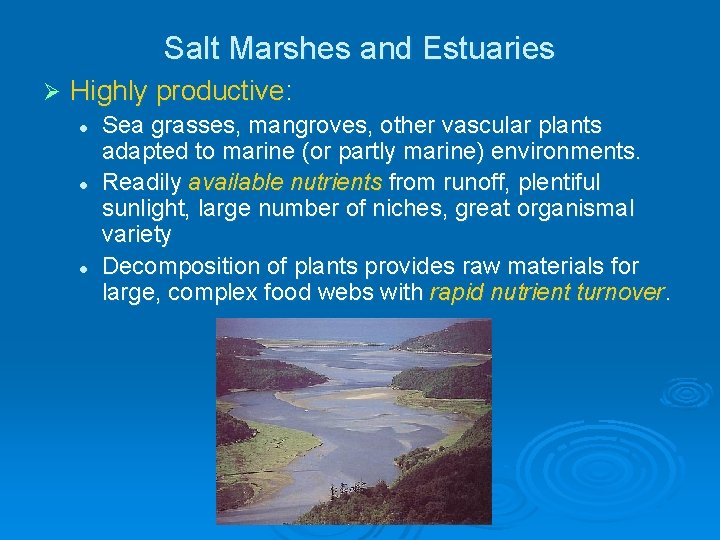
Salt Marshes and Estuaries Ø Highly productive: l l l Sea grasses, mangroves, other vascular plants adapted to marine (or partly marine) environments. Readily available nutrients from runoff, plentiful sunlight, large number of niches, great organismal variety Decomposition of plants provides raw materials for large, complex food webs with rapid nutrient turnover.
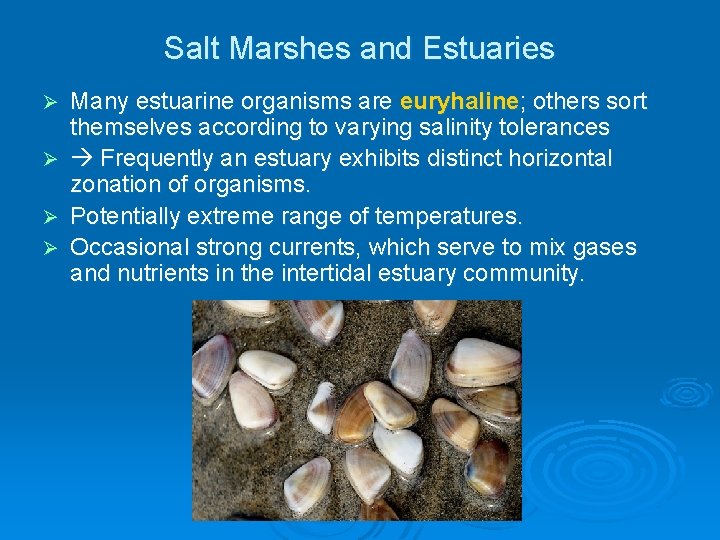
Salt Marshes and Estuaries Ø Ø Many estuarine organisms are euryhaline; others sort themselves according to varying salinity tolerances Frequently an estuary exhibits distinct horizontal zonation of organisms. Potentially extreme range of temperatures. Occasional strong currents, which serve to mix gases and nutrients in the intertidal estuary community.
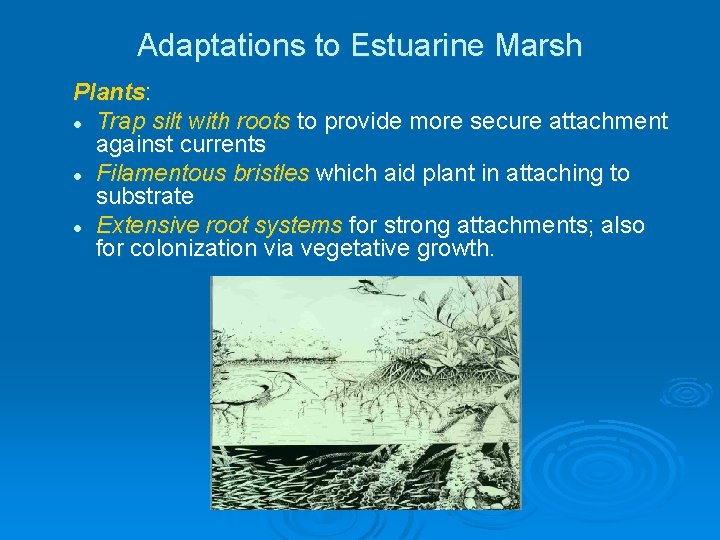
Adaptations to Estuarine Marsh Plants: l Trap silt with roots to provide more secure attachment against currents l Filamentous bristles which aid plant in attaching to substrate l Extensive root systems for strong attachments; also for colonization via vegetative growth.
Adaptations to Estuarine Marsh
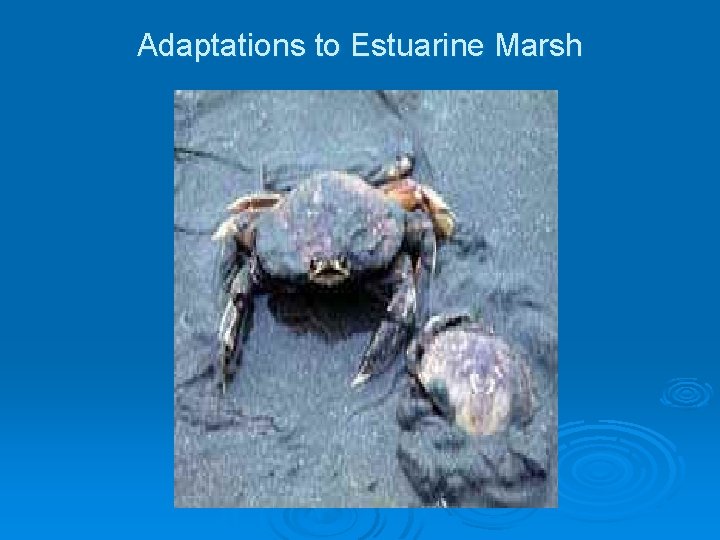
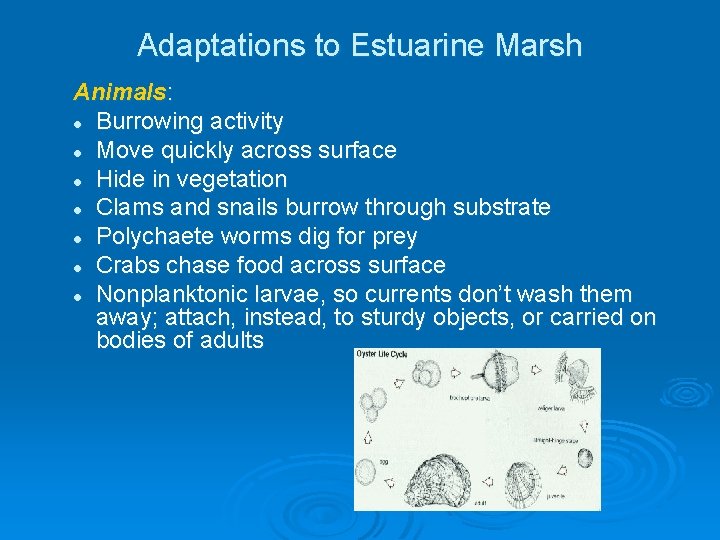
Adaptations to Estuarine Marsh Animals: l Burrowing activity l Move quickly across surface l Hide in vegetation l Clams and snails burrow through substrate l Polychaete worms dig for prey l Crabs chase food across surface l Nonplanktonic larvae, so currents don’t wash them away; attach, instead, to sturdy objects, or carried on bodies of adults
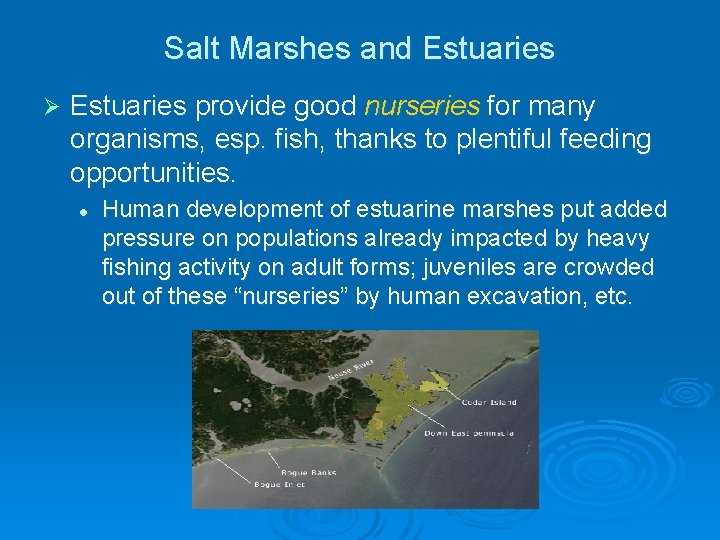
Salt Marshes and Estuaries Ø Estuaries provide good nurseries for many organisms, esp. fish, thanks to plentiful feeding opportunities. l Human development of estuarine marshes put added pressure on populations already impacted by heavy fishing activity on adult forms; juveniles are crowded out of these “nurseries” by human excavation, etc.
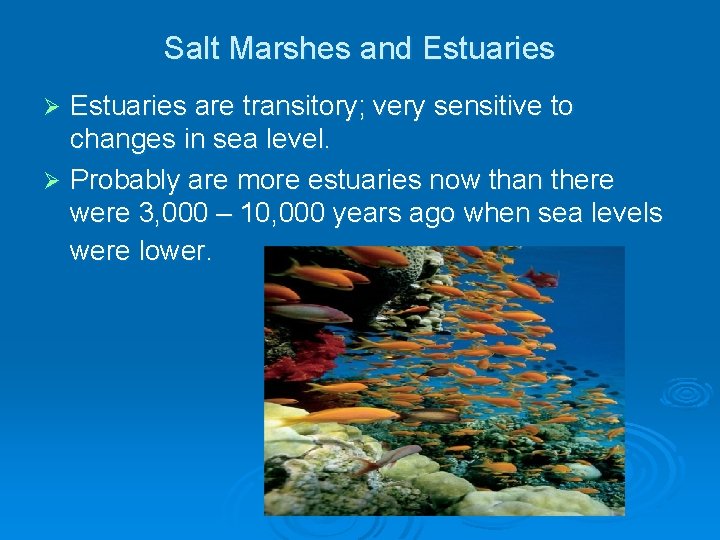
Salt Marshes and Estuaries are transitory; very sensitive to changes in sea level. Ø Probably are more estuaries now than there were 3, 000 – 10, 000 years ago when sea levels were lower. Ø
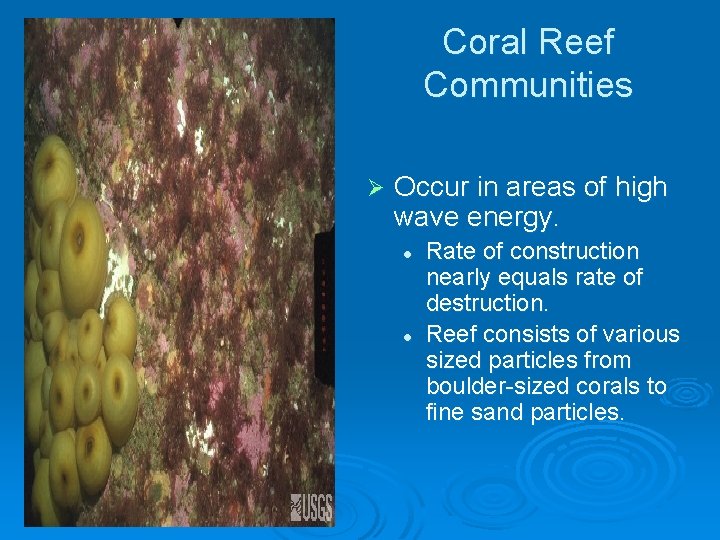
Coral Reef Communities Ø Occur in areas of high wave energy. l l Rate of construction nearly equals rate of destruction. Reef consists of various sized particles from boulder-sized corals to fine sand particles.
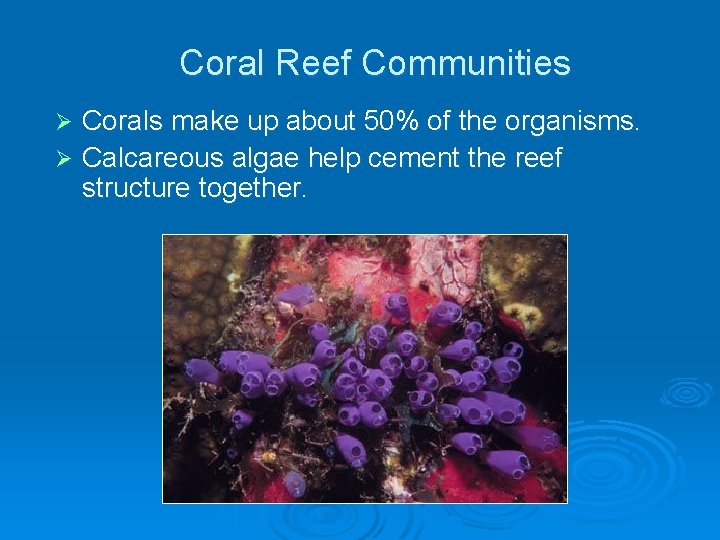
Coral Reef Communities Corals make up about 50% of the organisms. Ø Calcareous algae help cement the reef structure together. Ø
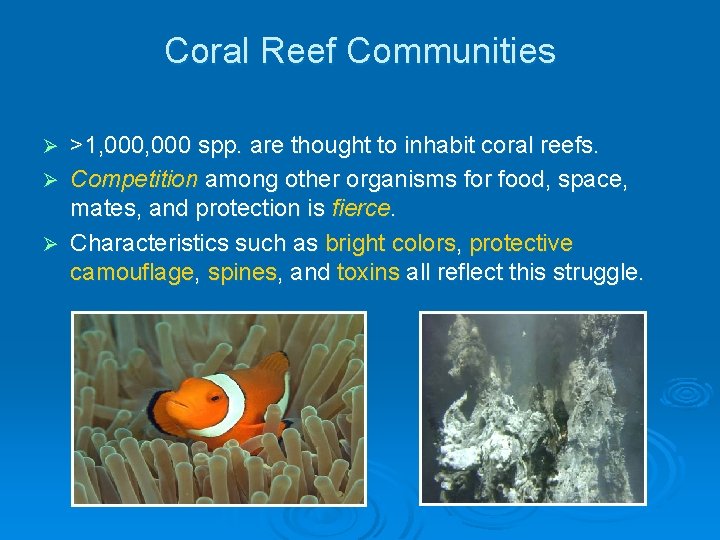
Coral Reef Communities >1, 000 spp. are thought to inhabit coral reefs. Ø Competition among other organisms for food, space, mates, and protection is fierce. Ø Characteristics such as bright colors, protective camouflage, spines, and toxins all reflect this struggle. Ø
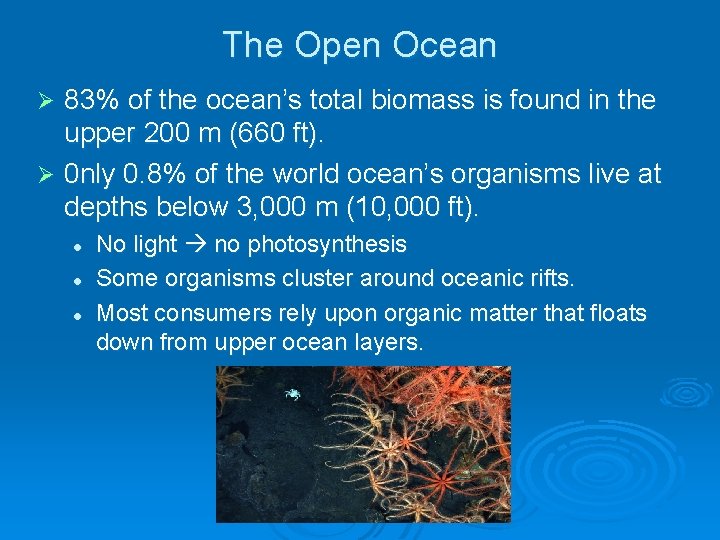
The Open Ocean 83% of the ocean’s total biomass is found in the upper 200 m (660 ft). Ø 0 nly 0. 8% of the world ocean’s organisms live at depths below 3, 000 m (10, 000 ft). Ø l l l No light no photosynthesis Some organisms cluster around oceanic rifts. Most consumers rely upon organic matter that floats down from upper ocean layers.
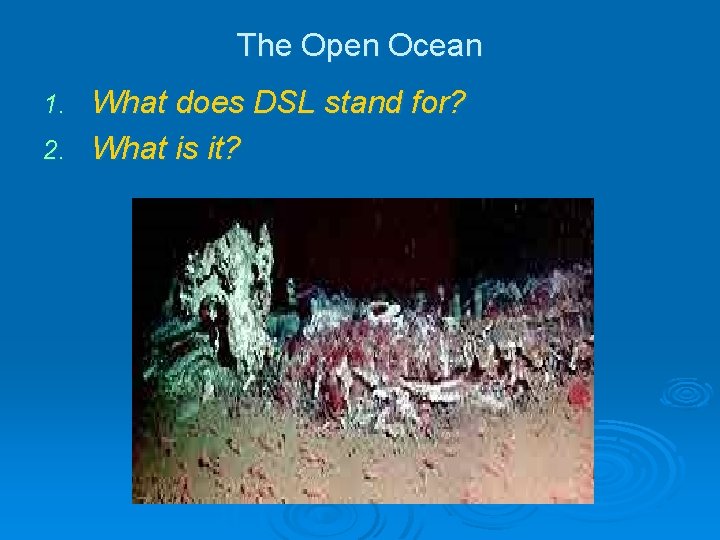
The Open Ocean What does DSL stand for? 2. What is it? 1.
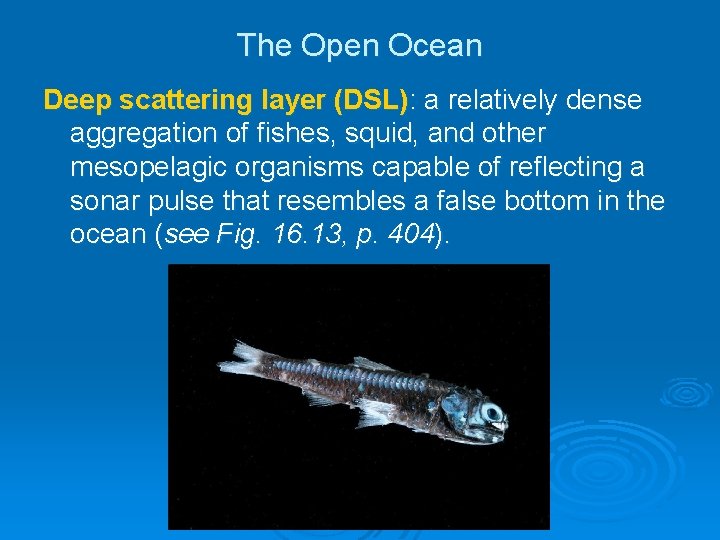
The Open Ocean Deep scattering layer (DSL): a relatively dense aggregation of fishes, squid, and other mesopelagic organisms capable of reflecting a sonar pulse that resembles a false bottom in the ocean (see Fig. 16. 13, p. 404).
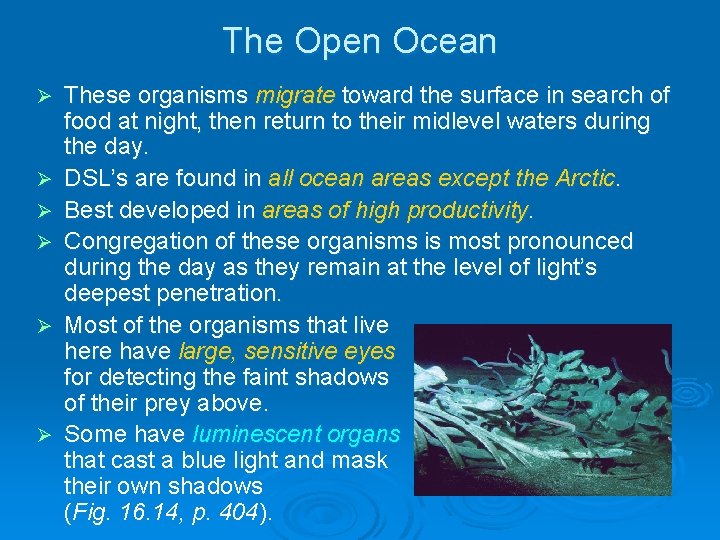
The Open Ocean Ø Ø Ø These organisms migrate toward the surface in search of food at night, then return to their midlevel waters during the day. DSL’s are found in all ocean areas except the Arctic. Best developed in areas of high productivity. Congregation of these organisms is most pronounced during the day as they remain at the level of light’s deepest penetration. Most of the organisms that live here have large, sensitive eyes for detecting the faint shadows of their prey above. Some have luminescent organs that cast a blue light and mask their own shadows (Fig. 16. 14, p. 404).
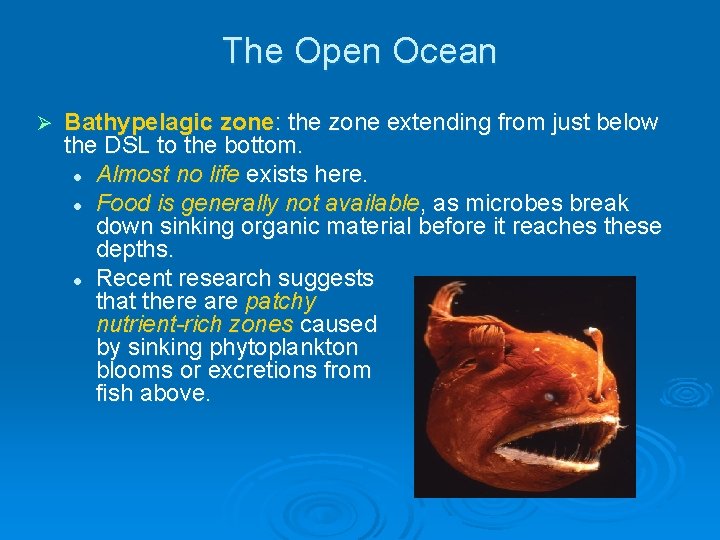
The Open Ocean Ø Bathypelagic zone: the zone extending from just below the DSL to the bottom. l Almost no life exists here. l Food is generally not available, as microbes break down sinking organic material before it reaches these depths. l Recent research suggests that there are patchy nutrient-rich zones caused by sinking phytoplankton blooms or excretions from fish above.
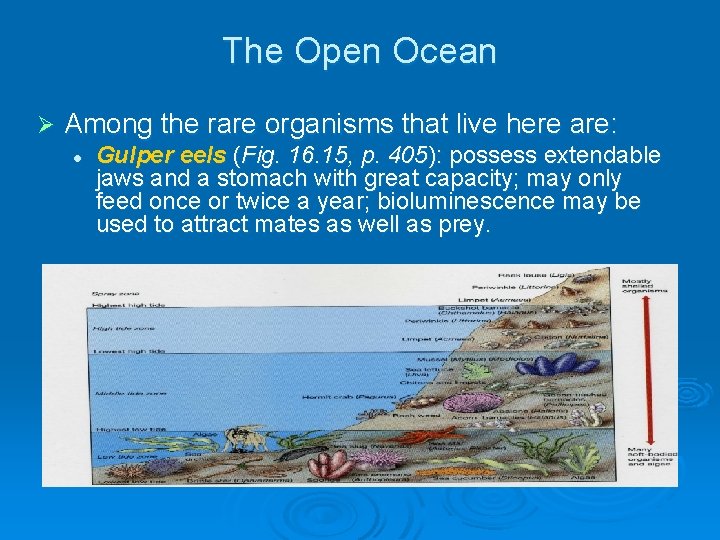
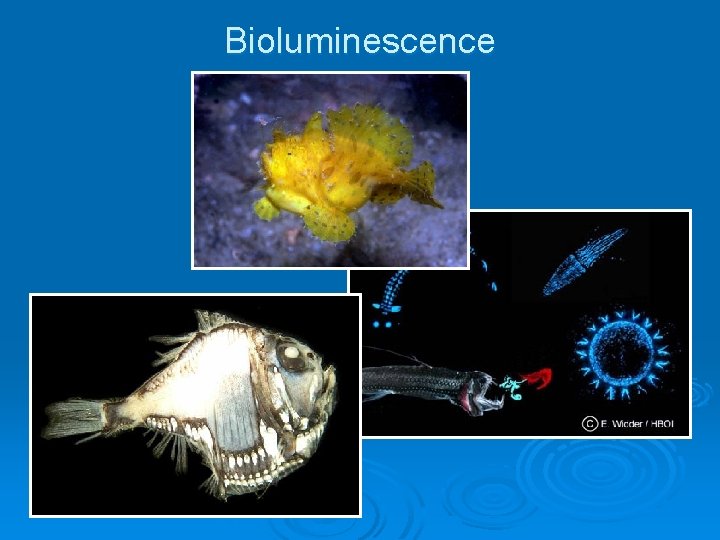
The Open Ocean Ø Among the rare organisms that live here are: l Gulper eels (Fig. 16. 15, p. 405): possess extendable jaws and a stomach with great capacity; may only feed once or twice a year; bioluminescence may be used to attract mates as well as prey.
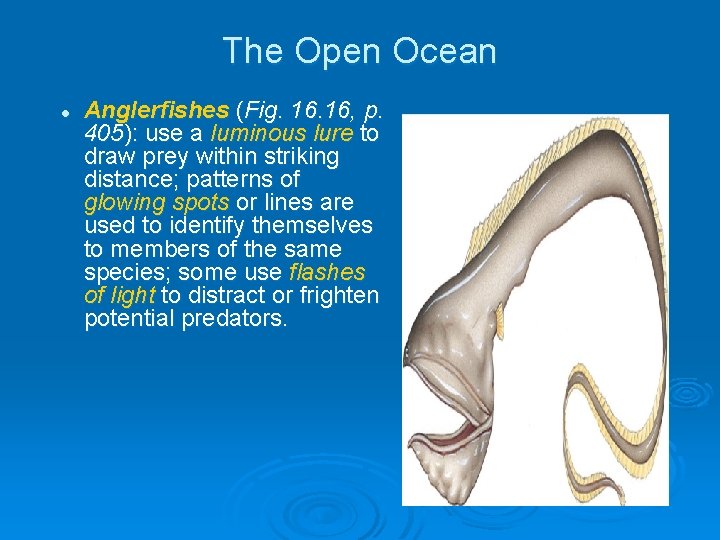
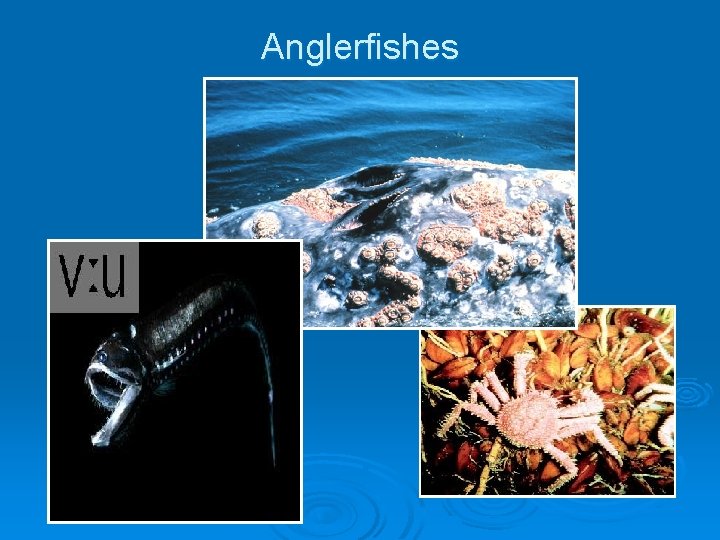
The Open Ocean l Anglerfishes (Fig. 16, p. 405): use a luminous lure to draw prey within striking distance; patterns of glowing spots or lines are used to identify themselves to members of the same species; some use flashes of light to distract or frighten potential predators.
Anglerfishes
Bioluminescence
The Deep-Sea Floor Ø Conditions are relatively constant: l l l Dark, cold, hypersaline (to 36%) and highly pressurized. Modern expeditions have revealed communities with as many as 4, 500 organisms per square meter at depths between 1, 500 and 2, 500 m (5, 000 – 8, 000 ft). One census found 798 spp. in 1 m 2 area. ; 46 of these were new to science.
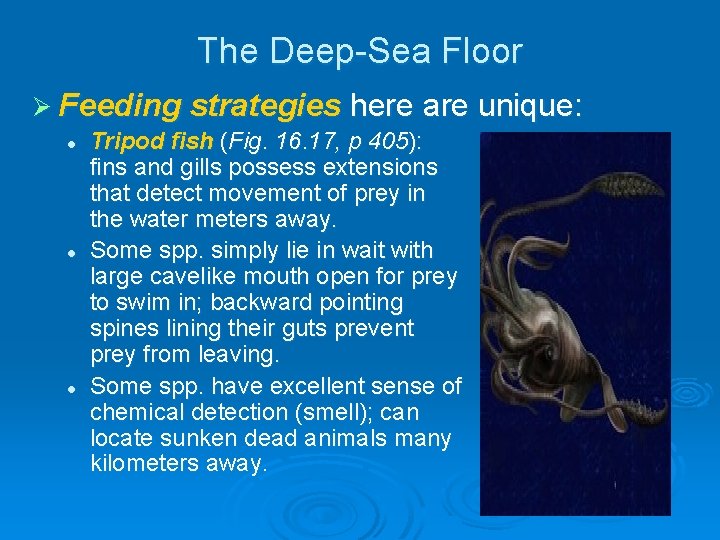
The Deep-Sea Floor Ø Feeding strategies l l l here are unique: Tripod fish (Fig. 16. 17, p 405): fins and gills possess extensions that detect movement of prey in the water meters away. Some spp. simply lie in wait with large cavelike mouth open for prey to swim in; backward pointing spines lining their guts prevent prey from leaving. Some spp. have excellent sense of chemical detection (smell); can locate sunken dead animals many kilometers away.
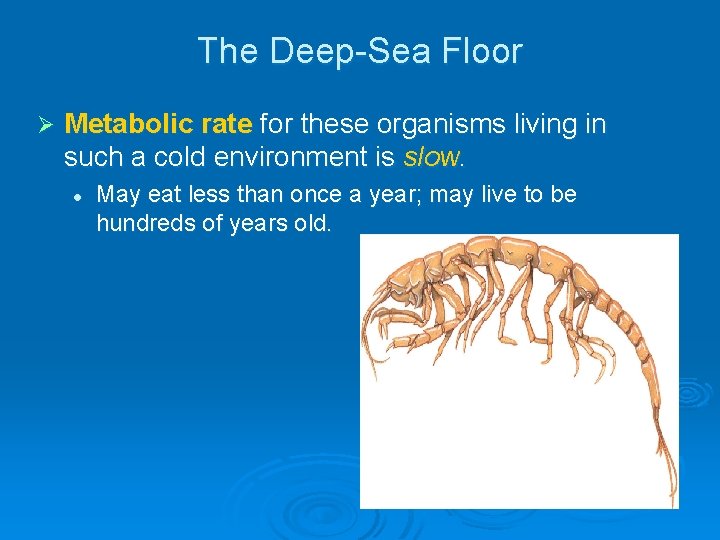
The Deep-Sea Floor Ø Metabolic rate for these organisms living in such a cold environment is slow. l May eat less than once a year; may live to be hundreds of years old.
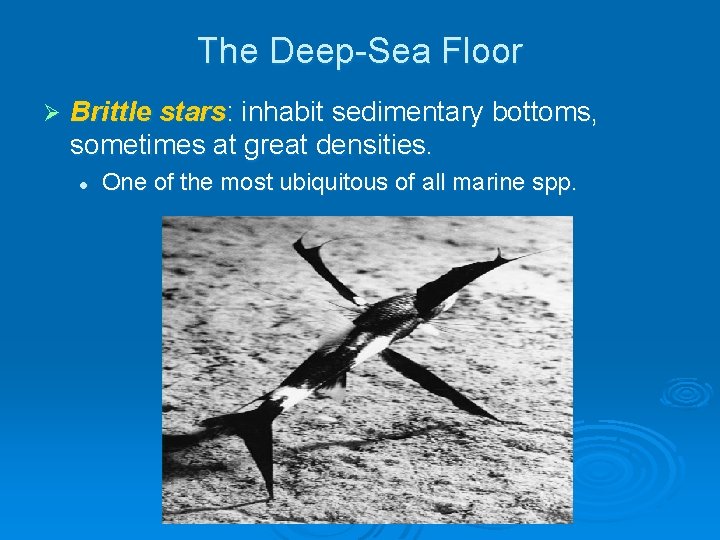
The Deep-Sea Floor Ø Brittle stars: inhabit sedimentary bottoms, sometimes at great densities. l One of the most ubiquitous of all marine spp.
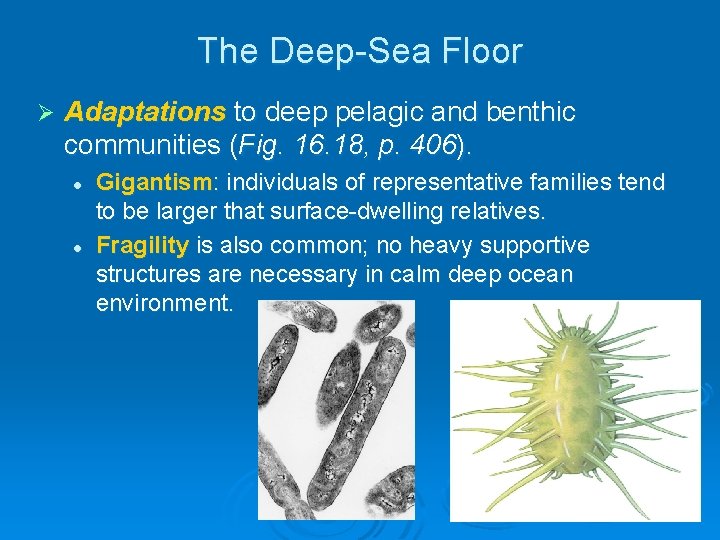
The Deep-Sea Floor Ø Adaptations to deep pelagic and benthic communities (Fig. 16. 18, p. 406). l l Gigantism: individuals of representative families tend to be larger that surface-dwelling relatives. Fragility is also common; no heavy supportive structures are necessary in calm deep ocean environment.
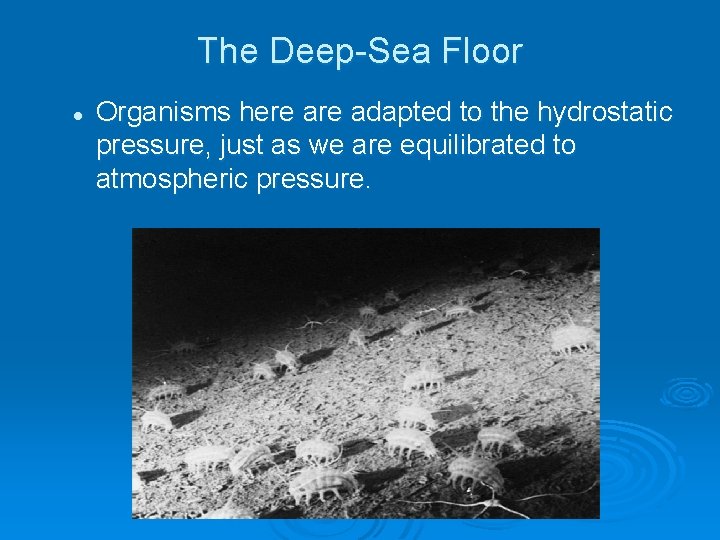
The Deep-Sea Floor l Organisms here adapted to the hydrostatic pressure, just as we are equilibrated to atmospheric pressure.
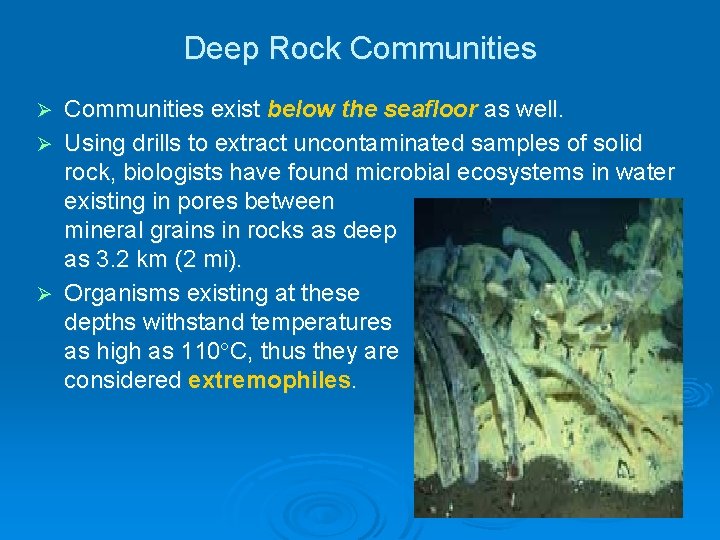
Deep Rock Communities exist below the seafloor as well. Ø Using drills to extract uncontaminated samples of solid rock, biologists have found microbial ecosystems in water existing in pores between mineral grains in rocks as deep as 3. 2 km (2 mi). Ø Organisms existing at these depths withstand temperatures as high as 110 C, thus they are considered extremophiles. Ø
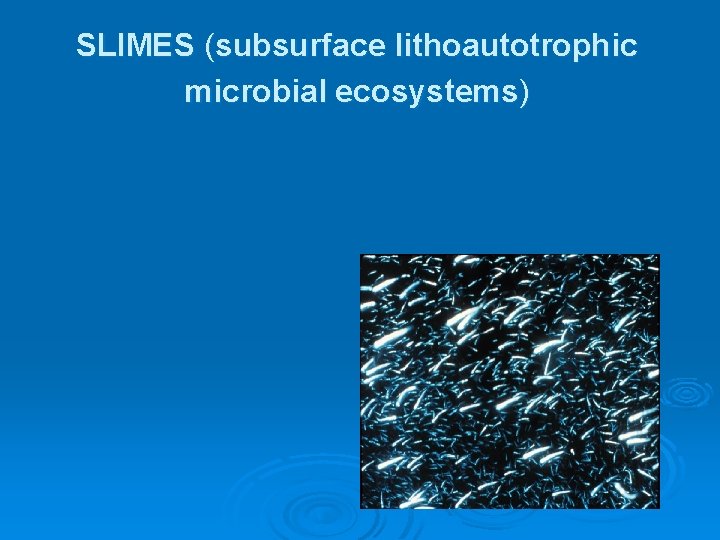
SLIMES (subsurface lithoautotrophic microbial ecosystems) Ø As there is no light in these interstitial spaces, the autotrophic bacteria must be chemosynthesizers. l l l Reduce iron, manganese, or sulfate ions, or generate methane from carbon dioxide to supply the energy to produce glucose. Primary consumers feed on these primary producers. Metabolic rates appear to be slow
SLIMES (subsurface lithoautotrophic microbial ecosystems)
SLIMES (subsurface lithoautotrophic microbial ecosystems) With increasing depth, pores become smaller and chemosynthetic materials become scarcer. Ø New groups of “ultramicrobacteria” adapted to these small spaces have been found. Ø Based on genetics, rates of evolution, and adaptations to extreme environments, it has been suggested that these may be closely related to Earth’s earliest life forms. Ø Estimates suggest these communities may constitute as much as one-third of the Earth’s total biomass! Ø
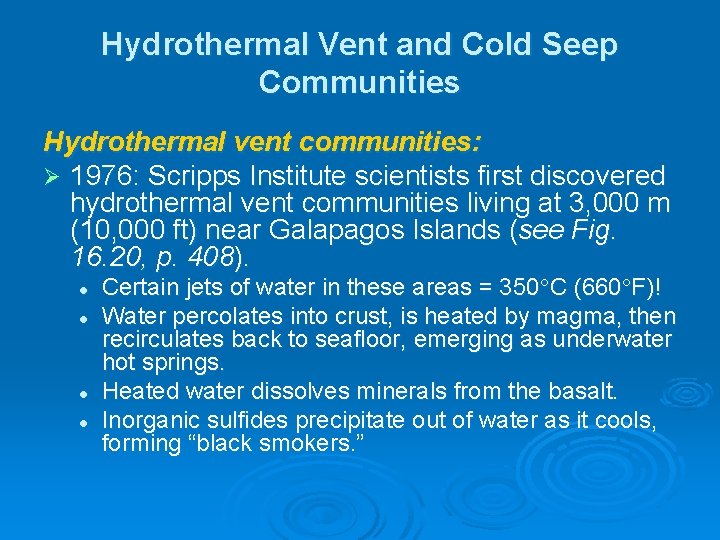
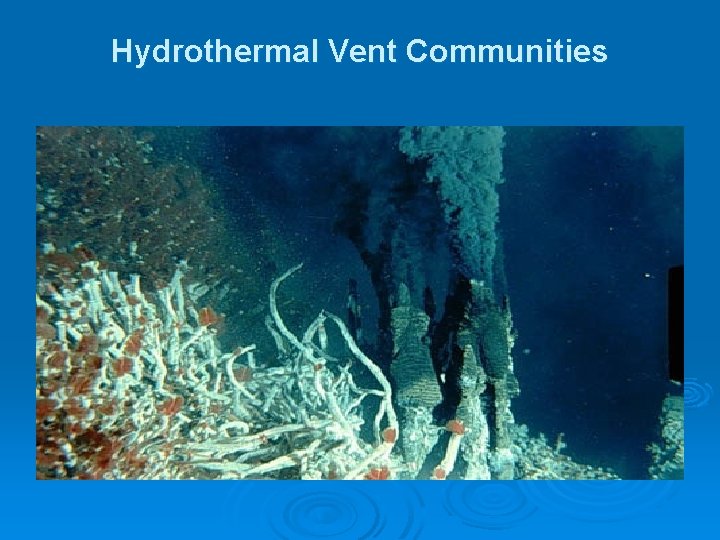
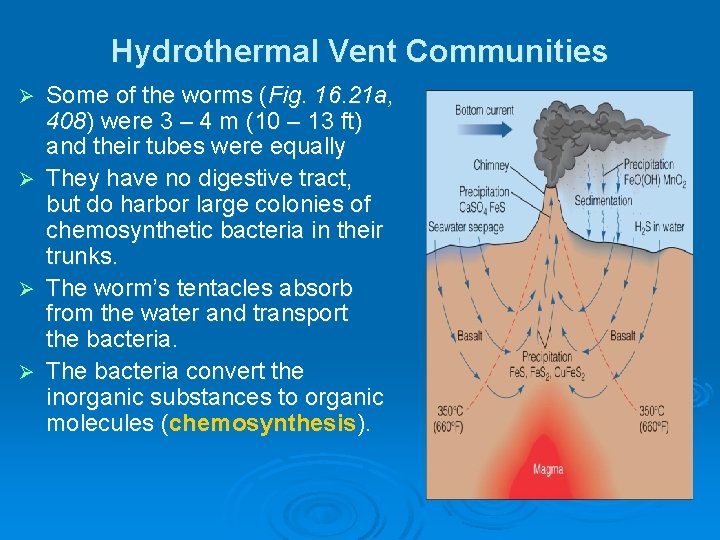
Hydrothermal Vent and Cold Seep Communities Hydrothermal vent communities: Ø 1976: Scripps Institute scientists first discovered hydrothermal vent communities living at 3, 000 m (10, 000 ft) near Galapagos Islands (see Fig. 16. 20, p. 408). l l Certain jets of water in these areas = 350 C (660 F)! Water percolates into crust, is heated by magma, then recirculates back to seafloor, emerging as underwater hot springs. Heated water dissolves minerals from the basalt. Inorganic sulfides precipitate out of water as it cools, forming “black smokers. ”
Hydrothermal Vent Communities
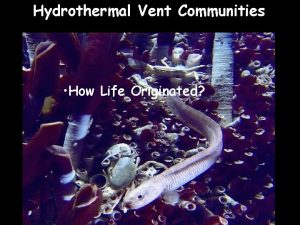
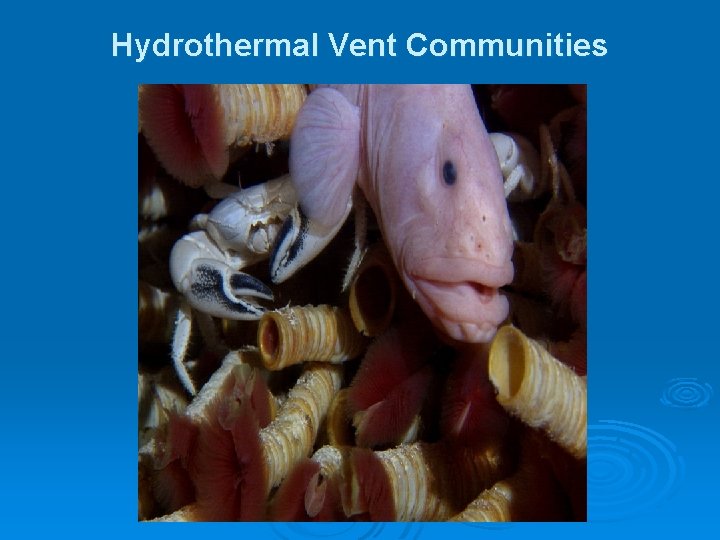
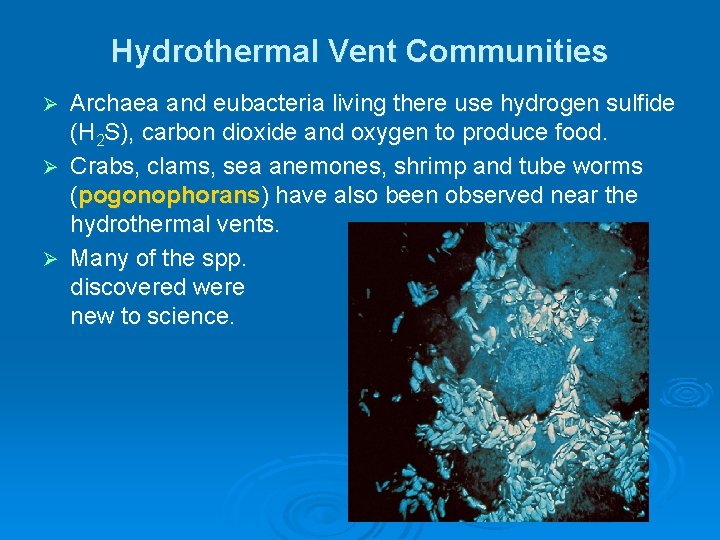
Hydrothermal Vent Communities Archaea and eubacteria living there use hydrogen sulfide (H 2 S), carbon dioxide and oxygen to produce food. Ø Crabs, clams, sea anemones, shrimp and tube worms (pogonophorans) have also been observed near the hydrothermal vents. Ø Many of the spp. discovered were new to science. Ø
Hydrothermal Vent Communities
Hydrothermal Vent Communities Ø Ø Some of the worms (Fig. 16. 21 a, 408) were 3 – 4 m (10 – 13 ft) and their tubes were equally They have no digestive tract, but do harbor large colonies of chemosynthetic bacteria in their trunks. The worm’s tentacles absorb from the water and transport the bacteria. The bacteria convert the inorganic substances to organic molecules (chemosynthesis). p. long large. H 2 S it to
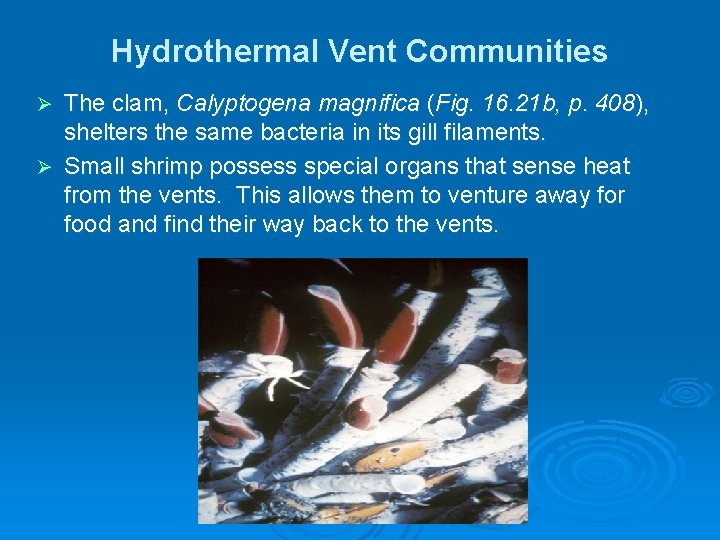
Hydrothermal Vent Communities The clam, Calyptogena magnifica (Fig. 16. 21 b, p. 408), shelters the same bacteria in its gill filaments. Ø Small shrimp possess special organs that sense heat from the vents. This allows them to venture away for food and find their way back to the vents. Ø
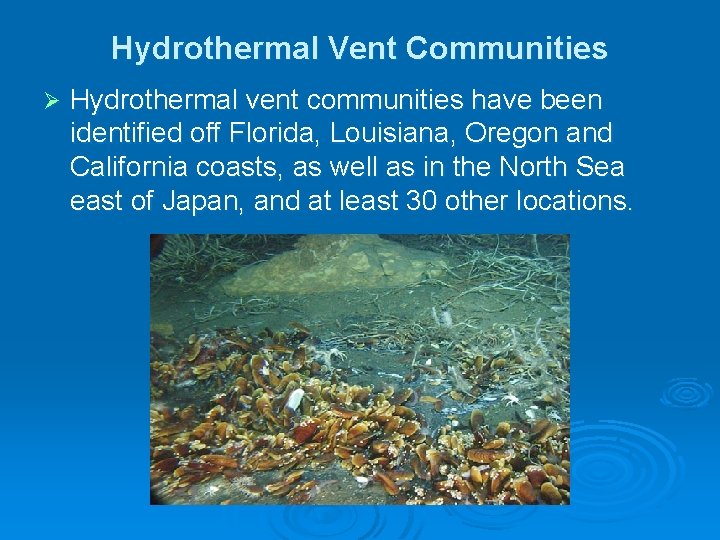
Hydrothermal Vent Communities Ø Hydrothermal vent communities have been identified off Florida, Louisiana, Oregon and California coasts, as well as in the North Sea east of Japan, and at least 30 other locations.
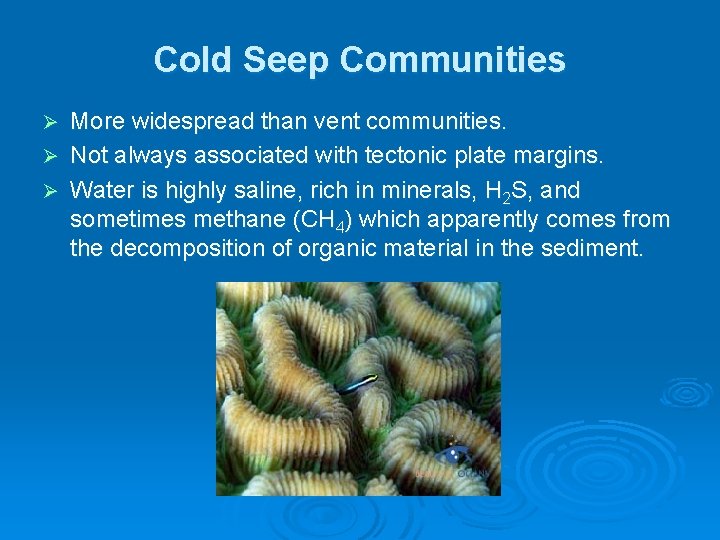
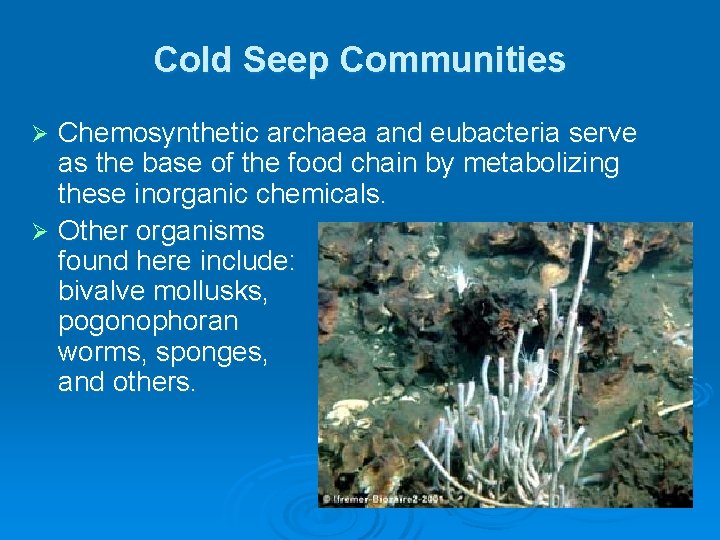
Cold Seep Communities More widespread than vent communities. Ø Not always associated with tectonic plate margins. Ø Water is highly saline, rich in minerals, H 2 S, and sometimes methane (CH 4) which apparently comes from the decomposition of organic material in the sediment. Ø
Cold Seep Communities Chemosynthetic archaea and eubacteria serve as the base of the food chain by metabolizing these inorganic chemicals. Ø Other organisms found here include: bivalve mollusks, pogonophoran worms, sponges, and others. Ø
Cold Seep Communities Questions still to be answered: Ø Do such communities occupy the active central rift valleys of Earth’s oceanic ridges? Ø Did the hot or cold vents – or even seemingly solid rock – serve as the birthplace of life on Earth? Ø Perhaps a graduate research project just waiting for you!!!
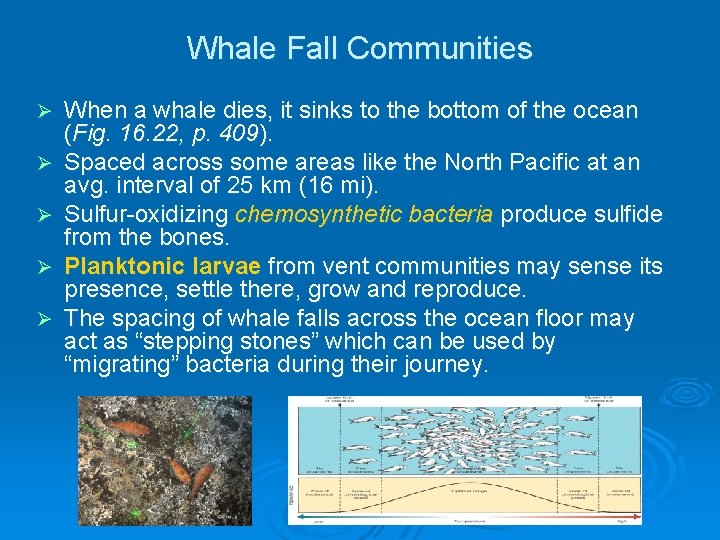
Whale Fall Communities Ø Ø Ø When a whale dies, it sinks to the bottom of the ocean (Fig. 16. 22, p. 409). Spaced across some areas like the North Pacific at an avg. interval of 25 km (16 mi). Sulfur-oxidizing chemosynthetic bacteria produce sulfide from the bones. Planktonic larvae from vent communities may sense its presence, settle there, grow and reproduce. The spacing of whale falls across the ocean floor may act as “stepping stones” which can be used by “migrating” bacteria during their journey.
Whale Fall Communities
Symbiotic Interactions Ø More than half of the known animal species are involved in symbiotic relationships. l l Symbiosis (sym = with; bios = life): the cooccurrence of two species in which the life of one is closely interwoven with the life of the other; the relationship may be mutualistic, commensalistic, or parasitic. In some cases, the symbiotic bond is so strong that one organism (the symbiont) is completely dependent on the other (the host).
Mutualism: an interrelationship in which both species benefit. Ø Rare among marine organisms, but examples include. . .
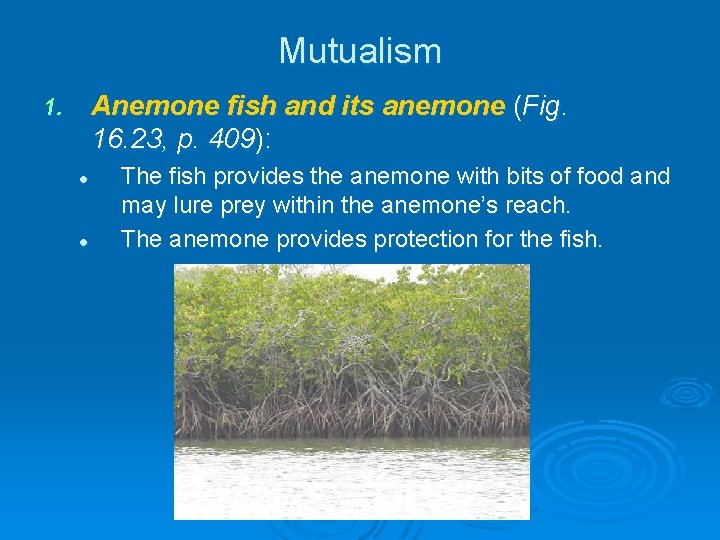
Mutualism Anemone fish and its anemone (Fig. 16. 23, p. 409): 1. l l The fish provides the anemone with bits of food and may lure prey within the anemone’s reach. The anemone provides protection for the fish.
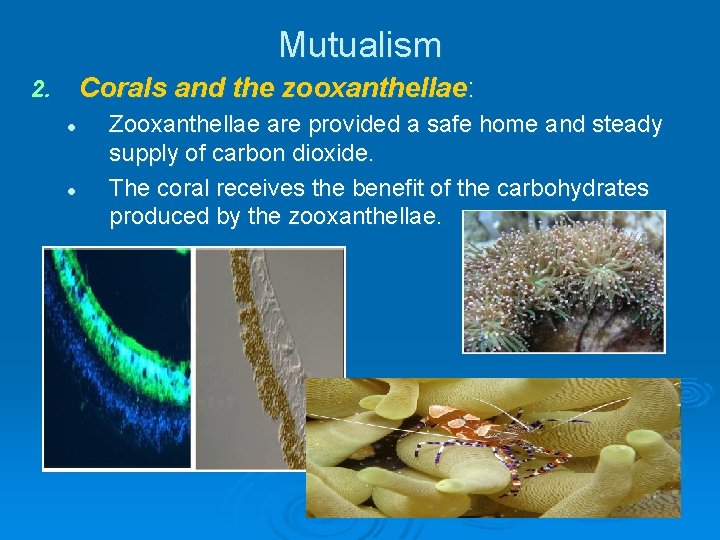
Mutualism Corals and the zooxanthellae: 2. l l Zooxanthellae are provided a safe home and steady supply of carbon dioxide. The coral receives the benefit of the carbohydrates produced by the zooxanthellae.
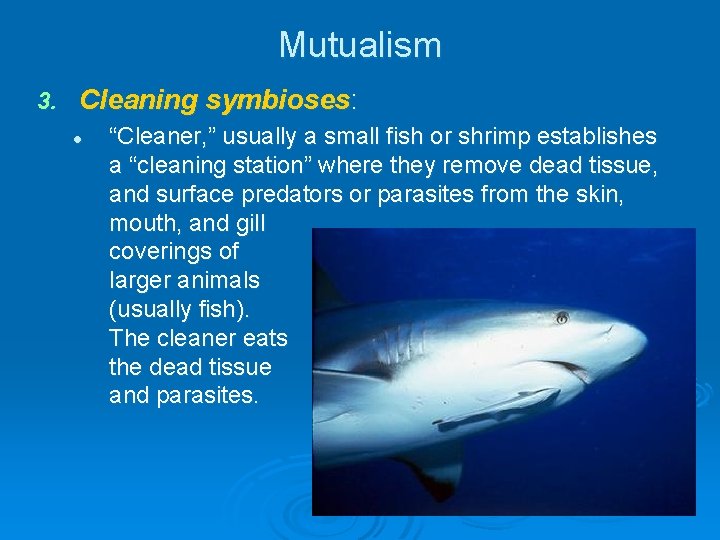
Mutualism 3. Cleaning symbioses: l “Cleaner, ” usually a small fish or shrimp establishes a “cleaning station” where they remove dead tissue, and surface predators or parasites from the skin, mouth, and gill coverings of larger animals (usually fish). The cleaner eats the dead tissue and parasites.
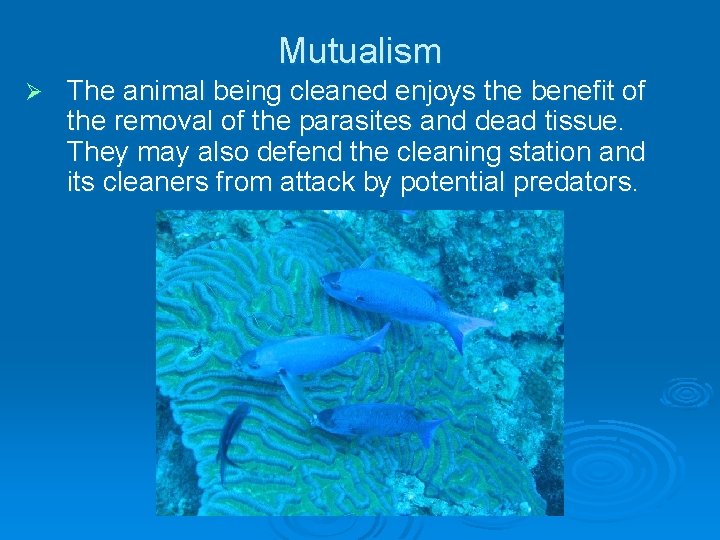
Mutualism Ø The animal being cleaned enjoys the benefit of the removal of the parasites and dead tissue. They may also defend the cleaning station and its cleaners from attack by potential predators.
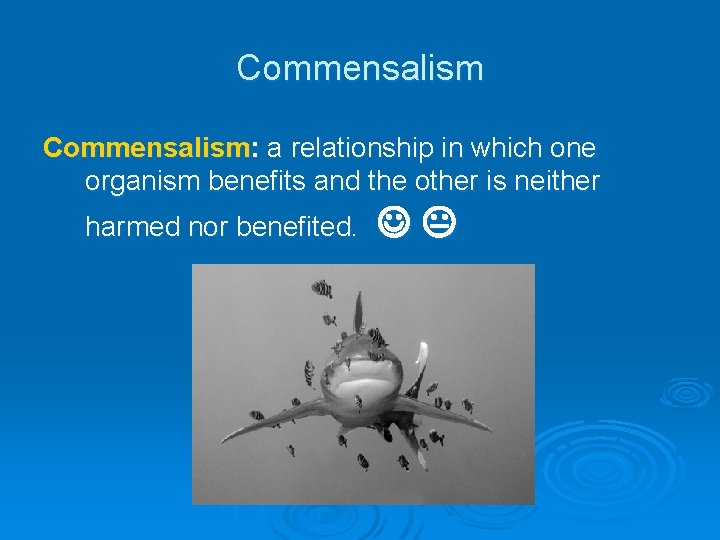
Commensalism: a relationship in which one organism benefits and the other is neither harmed nor benefited.
Commensalism 1. Pilot fish and shark: a. Pilot fish feeds on scraps left behind by the shark. b. Shark is not harmed by pilot fish and derives no benefit either.
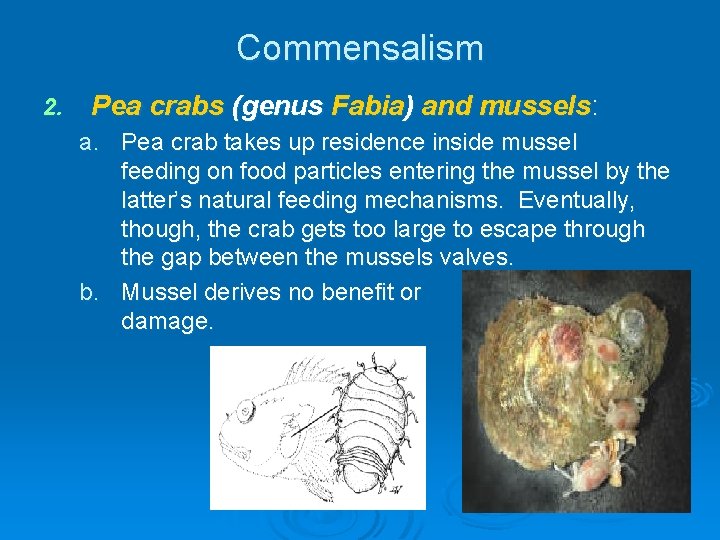
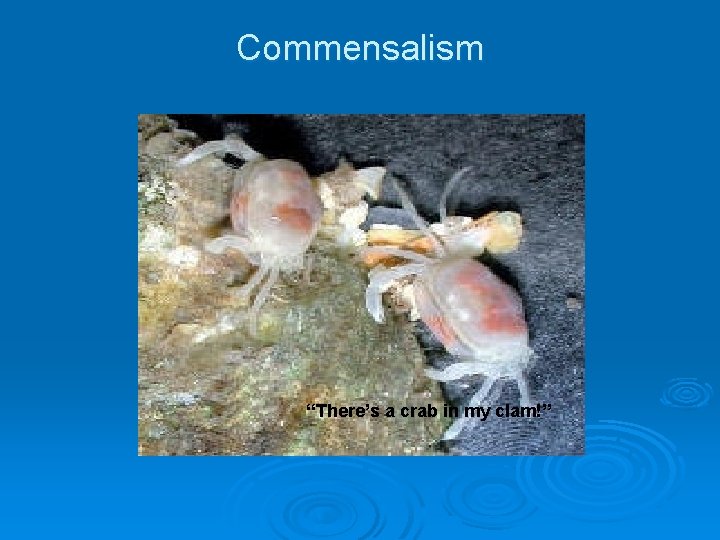
Commensalism 2. Pea crabs (genus Fabia) and mussels: a. Pea crab takes up residence inside mussel feeding on food particles entering the mussel by the latter’s natural feeding mechanisms. Eventually, though, the crab gets too large to escape through the gap between the mussels valves. b. Mussel derives no benefit or damage.
Commensalism “There’s a crab in my clam!”
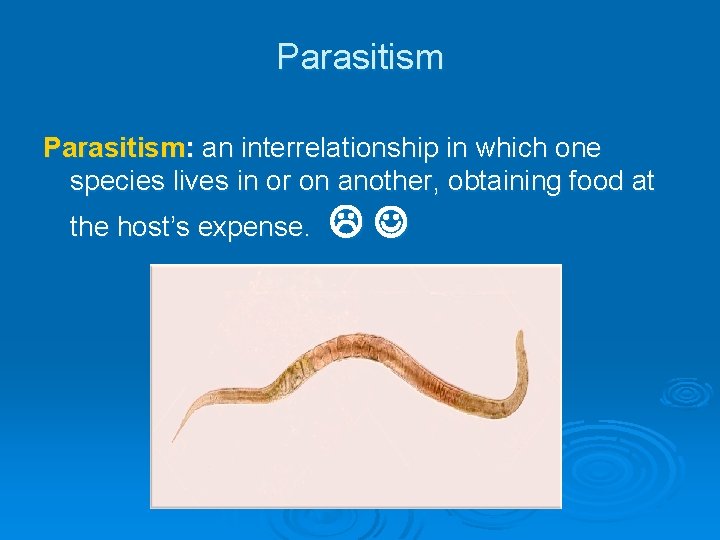
Parasitism: an interrelationship in which one species lives in or on another, obtaining food at the host’s expense.
Parasitism The most highly evolved and the most common sort of symbiotic relationship. Ø The host-parasite relationship is finely balanced and extremely delicate. Ø Parasites do not generally kill their host, but must derive enough of its own needed resources to ensure its own success. Ø All major phyla have parasitic marine representatives. Ø
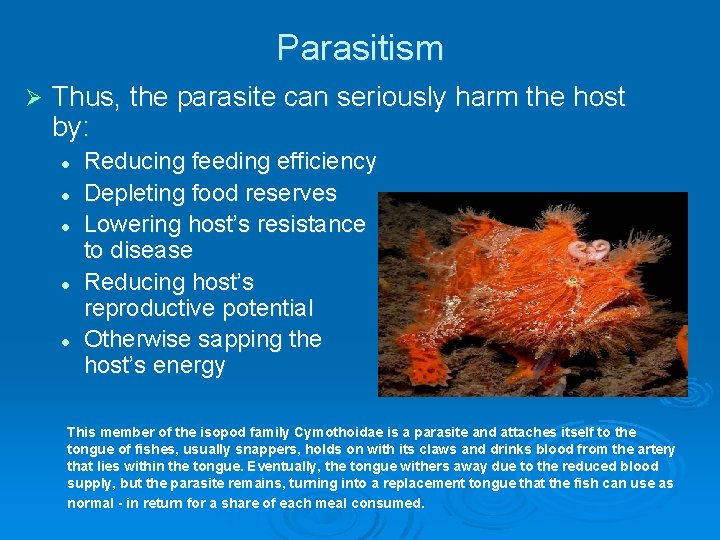
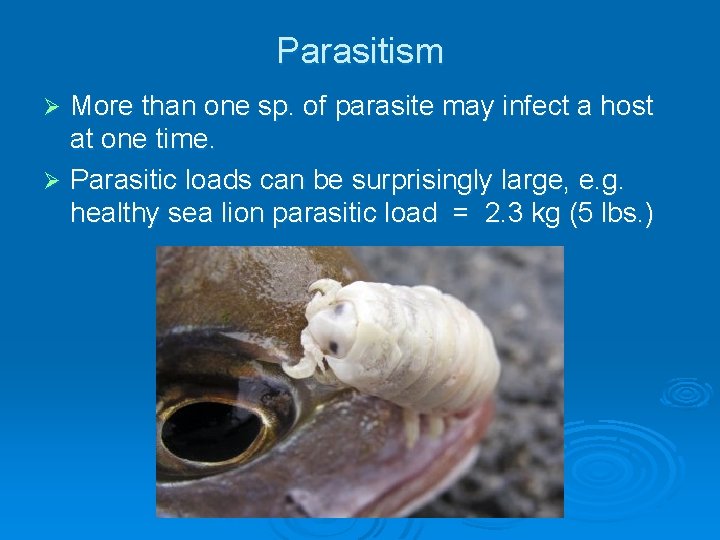
Parasitism Ø Thus, the parasite can seriously harm the host by: l l l Reducing feeding efficiency Depleting food reserves Lowering host’s resistance to disease Reducing host’s reproductive potential Otherwise sapping the host’s energy This member of the isopod family Cymothoidae is a parasite and attaches itself to the tongue of fishes, usually snappers, holds on with its claws and drinks blood from the artery that lies within the tongue. Eventually, the tongue withers away due to the reduced blood supply, but the parasite remains, turning into a replacement tongue that the fish can use as normal - in return for a share of each meal consumed.
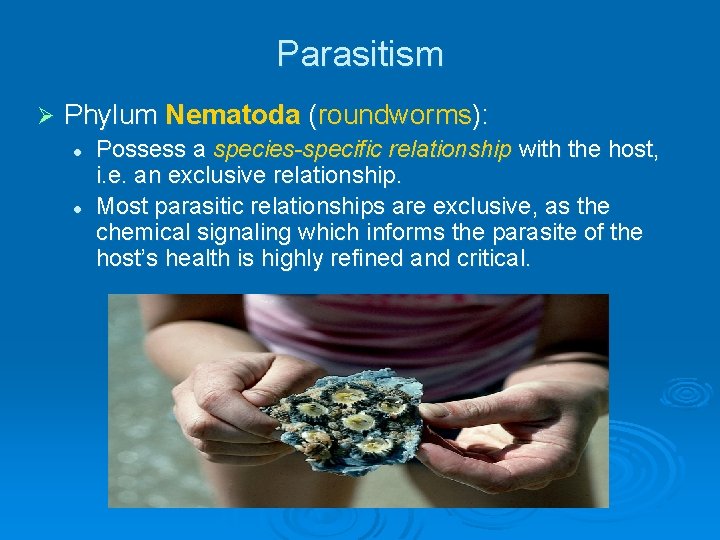
Parasitism Ø Phylum Nematoda (roundworms): l l Possess a species-specific relationship with the host, i. e. an exclusive relationship. Most parasitic relationships are exclusive, as the chemical signaling which informs the parasite of the host’s health is highly refined and critical.
Parasitism More than one sp. of parasite may infect a host at one time. Ø Parasitic loads can be surprisingly large, e. g. healthy sea lion parasitic load = 2. 3 kg (5 lbs. ) Ø
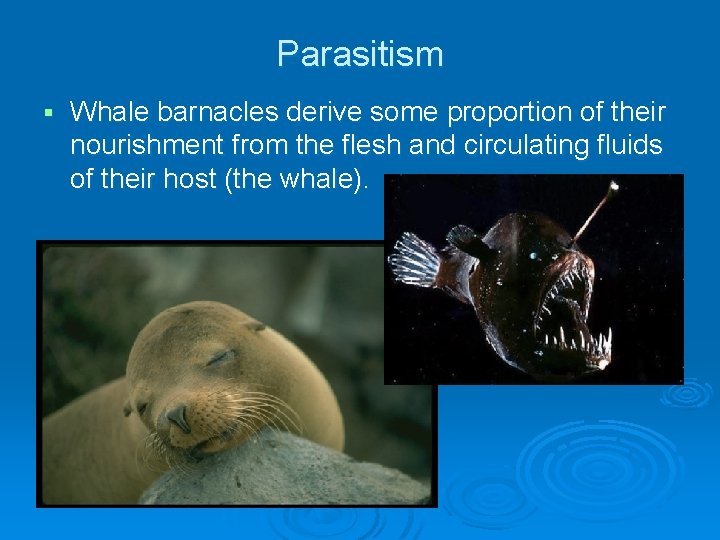
Parasitism Whale barnacles derive some proportion of their nourishment from the flesh and circulating fluids of their host (the whale).
Ø Assignment: (p. 412) l l “Reviewing What You’ve Learned” 1 – 5 “Thinking Critically” 1, 3, 4, 5