
PMEL Telecoms Working Group Pacific Marine Environmental Laboratory
PMEL Telecoms Working Group Pacific Marine Environmental Laboratory Scott Stalin Pacific Marine Environmental Laboratory A leader in developing ocean observational systems to address NOAA’s mission
Outline 1. Iridium Technical Details 2. PMEL Current Telecom Server Capabilities Pacific Marine Environmental Laboratory A leader in developing ocean observational systems to address NOAA’s mission
Iridium Satellite Service & Product Overview Pacific Marine Environmental Laboratory A leader in developing ocean observational systems to address NOAA’s mission
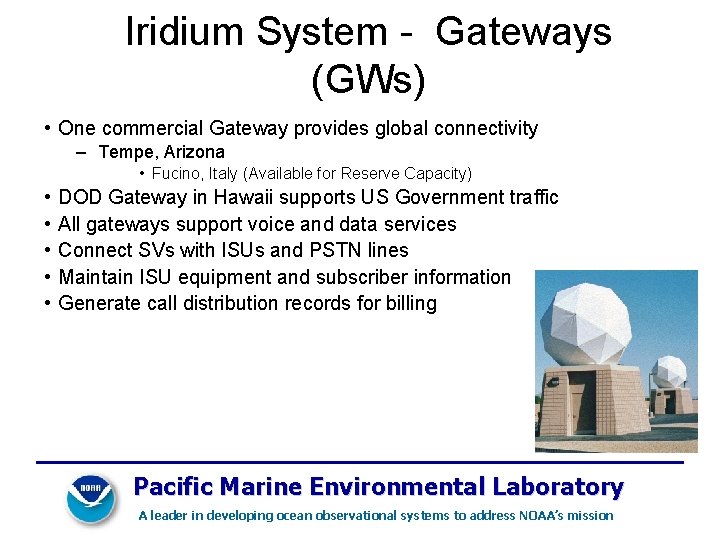
Iridium System - Gateways (GWs) • One commercial Gateway provides global connectivity – Tempe, Arizona • Fucino, Italy (Available for Reserve Capacity) • • • DOD Gateway in Hawaii supports US Government traffic All gateways support voice and data services Connect SVs with ISUs and PSTN lines Maintain ISU equipment and subscriber information Generate call distribution records for billing Pacific Marine Environmental Laboratory A leader in developing ocean observational systems to address NOAA’s mission
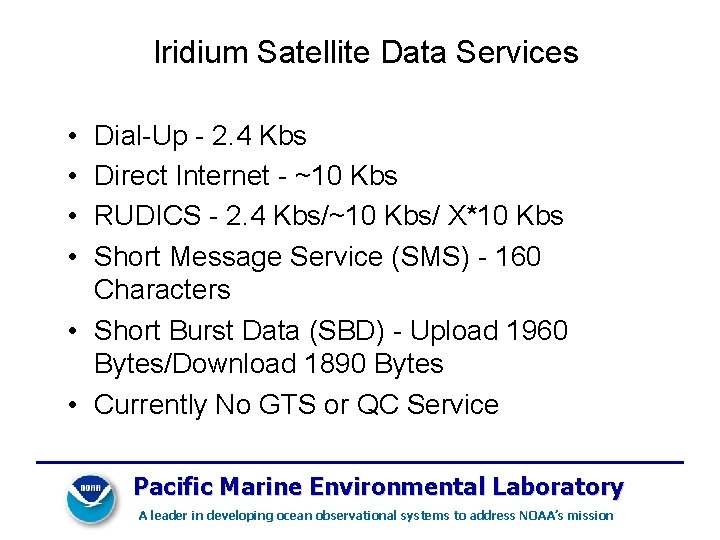
Iridium Satellite Data Services • • Dial-Up - 2. 4 Kbs Direct Internet - ~10 Kbs RUDICS - 2. 4 Kbs/~10 Kbs/ X*10 Kbs Short Message Service (SMS) - 160 Characters • Short Burst Data (SBD) - Upload 1960 Bytes/Download 1890 Bytes • Currently No GTS or QC Service Pacific Marine Environmental Laboratory A leader in developing ocean observational systems to address NOAA’s mission
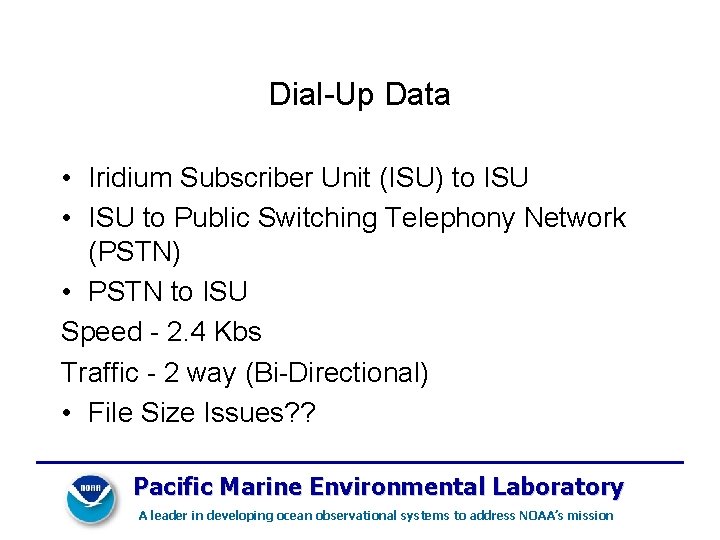
Dial-Up Data • Iridium Subscriber Unit (ISU) to ISU • ISU to Public Switching Telephony Network (PSTN) • PSTN to ISU Speed - 2. 4 Kbs Traffic - 2 way (Bi-Directional) • File Size Issues? ? Pacific Marine Environmental Laboratory A leader in developing ocean observational systems to address NOAA’s mission
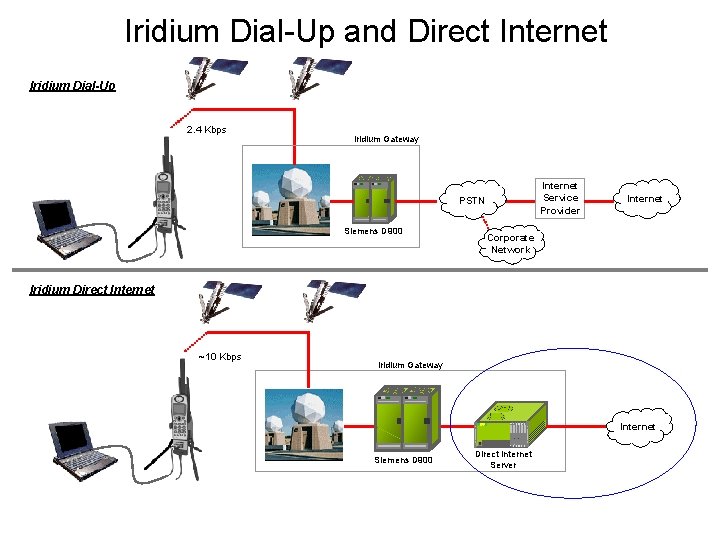
Iridium Dial-Up and Direct Internet Iridium Dial-Up 2. 4 Kbps Iridium Gateway Internet Service Provider PSTN Siemens D 900 Internet Corporate Network Iridium Direct Internet ~10 Kbps Iridium Gateway Internet Siemens D 900 Direct Internet Server
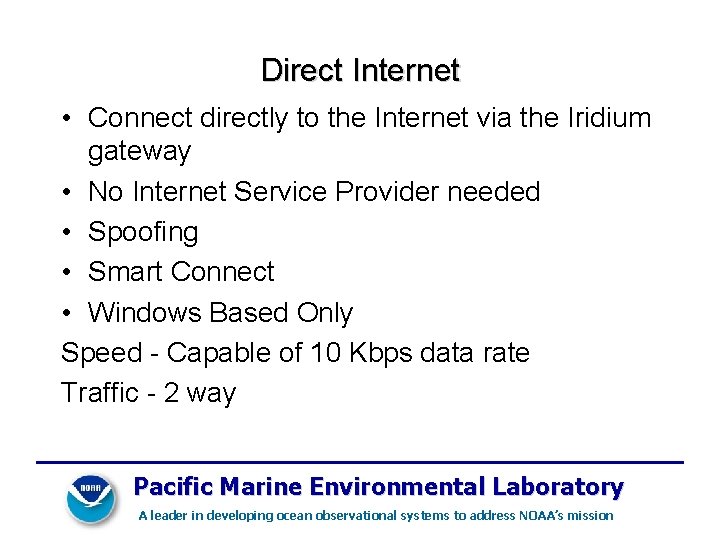
Direct Internet • Connect directly to the Internet via the Iridium gateway • No Internet Service Provider needed • Spoofing • Smart Connect • Windows Based Only Speed - Capable of 10 Kbps data rate Traffic - 2 way Pacific Marine Environmental Laboratory A leader in developing ocean observational systems to address NOAA’s mission
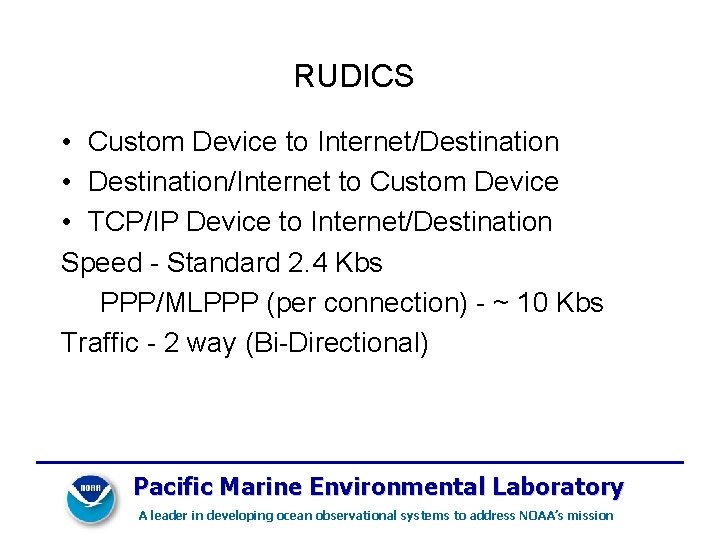
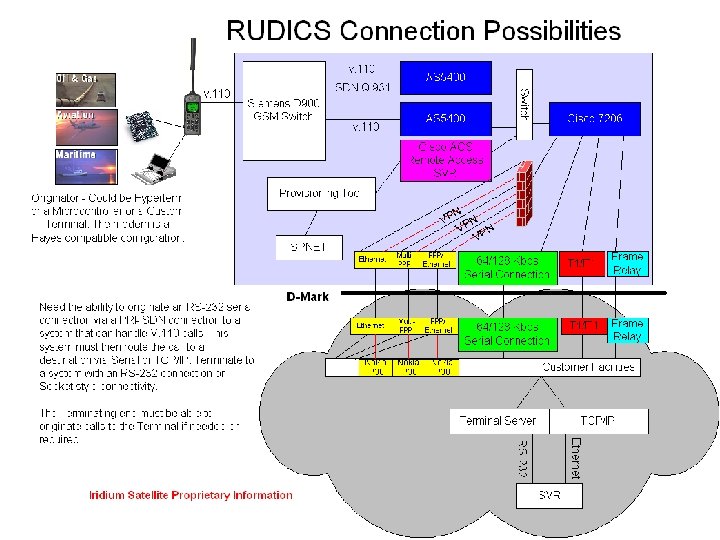
RUDICS • Custom Device to Internet/Destination • Destination/Internet to Custom Device • TCP/IP Device to Internet/Destination Speed - Standard 2. 4 Kbs PPP/MLPPP (per connection) - ~ 10 Kbs Traffic - 2 way (Bi-Directional) Pacific Marine Environmental Laboratory A leader in developing ocean observational systems to address NOAA’s mission
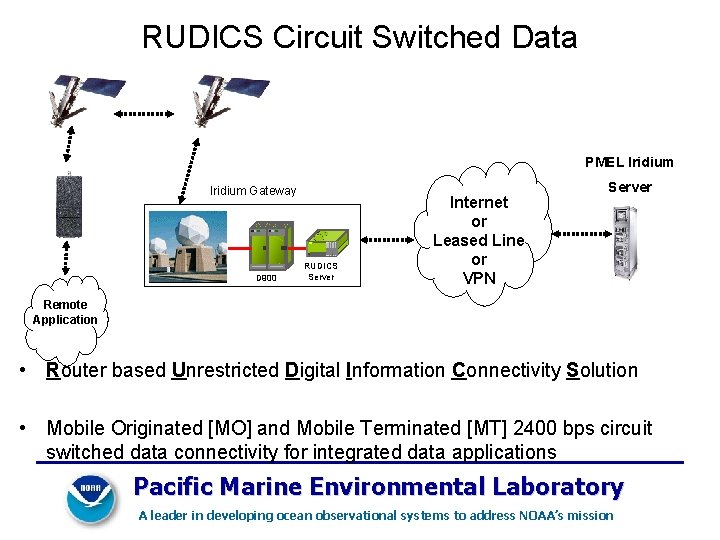
RUDICS Circuit Switched Data PMEL Iridium Gateway D 900 RUDICS Server Internet or Leased Line or VPN Server Remote Application • Router based Unrestricted Digital Information Connectivity Solution • Mobile Originated [MO] and Mobile Terminated [MT] 2400 bps circuit switched data connectivity for integrated data applications Pacific Marine Environmental Laboratory A leader in developing ocean observational systems to address NOAA’s mission
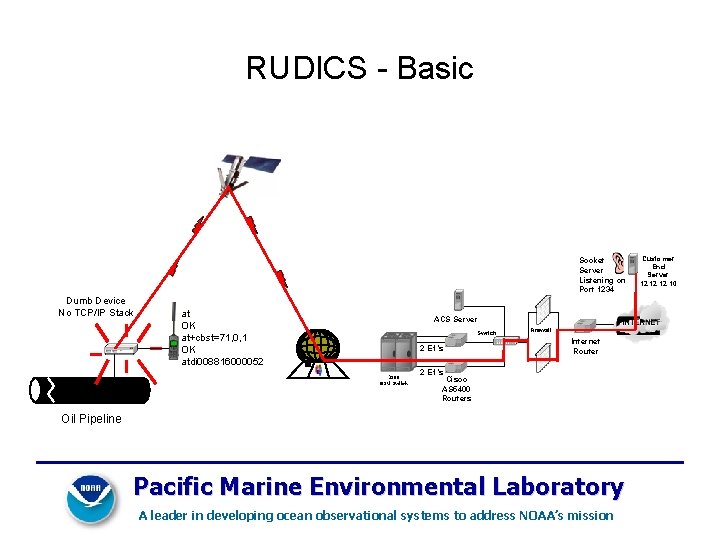
RUDICS - Basic Socket Server Listening on Port 1234 Dumb Device No TCP/IP Stack at OK at+cbst=71, 0, 1 OK atdi 008816000052 ACS Server Switch 2 E 1’s D 900 GSM Switch Firewall Internet Router 2 E 1’s Cisco AS 5400 Routers Oil Pipeline Pacific Marine Environmental Laboratory A leader in developing ocean observational systems to address NOAA’s mission Customer End Server 12. 12. 10
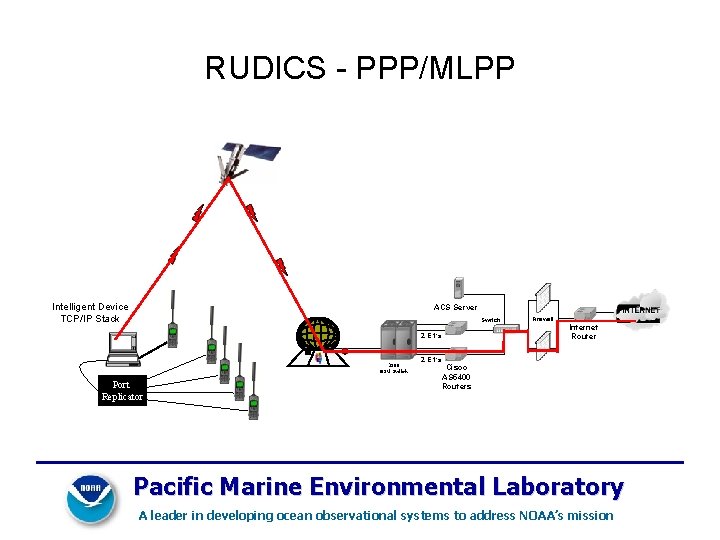
RUDICS - PPP/MLPP Intelligent Device TCP/IP Stack ACS Server Switch 2 E 1’s D 900 GSM Switch Port Replicator 2 E 1’s Firewall Internet Router Cisco AS 5400 Routers Pacific Marine Environmental Laboratory A leader in developing ocean observational systems to address NOAA’s mission
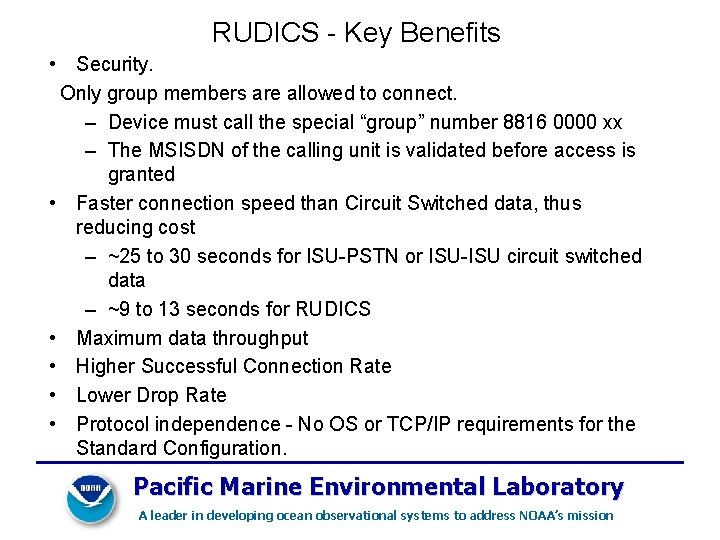
RUDICS - Key Benefits • Security. Only group members are allowed to connect. – Device must call the special “group” number 8816 0000 xx – The MSISDN of the calling unit is validated before access is granted • Faster connection speed than Circuit Switched data, thus reducing cost – ~25 to 30 seconds for ISU-PSTN or ISU-ISU circuit switched data – ~9 to 13 seconds for RUDICS • Maximum data throughput • Higher Successful Connection Rate • Lower Drop Rate • Protocol independence - No OS or TCP/IP requirements for the Standard Configuration. Pacific Marine Environmental Laboratory A leader in developing ocean observational systems to address NOAA’s mission
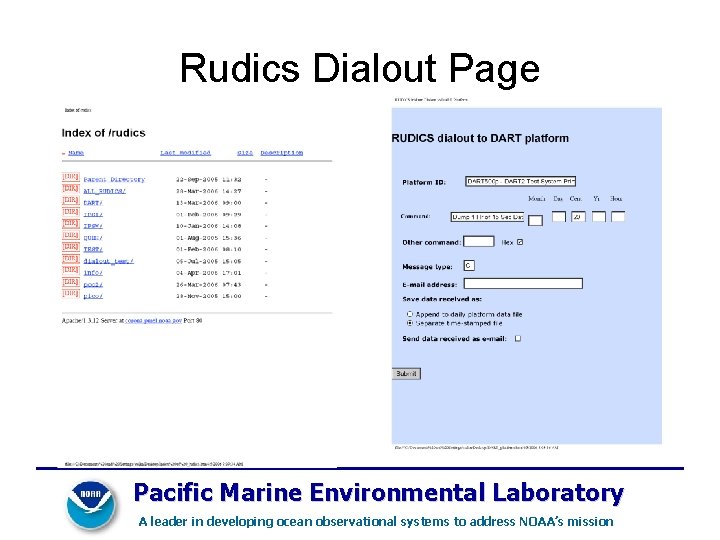
Rudics Dialout Page Pacific Marine Environmental Laboratory A leader in developing ocean observational systems to address NOAA’s mission
Short Message Service (SMS) • ISU to ISU • ISU to Email • WEB/Email/Voice/TAP to ISU Speed - 160 Characters Traffic - Send/Receive/2 -way Pacific Marine Environmental Laboratory A leader in developing ocean observational systems to address NOAA’s mission
Short Burst Data (SBD) • ISU/LBT to Destination Email/Direct IP • Direct IP/Email to ISU/LBT Speed - Upload is 1960 Bytes Download is 1890 Bytes Speed – 9601 – Upload is 205 Bytes Download is 135 Bytes Traffic - 1½ way Pacific Marine Environmental Laboratory A leader in developing ocean observational systems to address NOAA’s mission
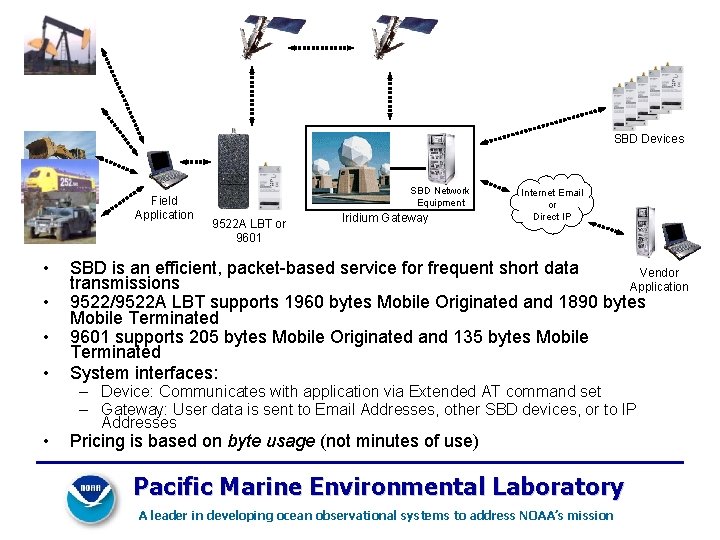
SBD Devices Field Application • SBD Network Equipment 9522 A LBT or 9601 Iridium Gateway Internet Email or Direct IP • SBD is an efficient, packet-based service for frequent short data Vendor transmissions Application 9522/9522 A LBT supports 1960 bytes Mobile Originated and 1890 bytes Mobile Terminated 9601 supports 205 bytes Mobile Originated and 135 bytes Mobile Terminated System interfaces: • Pricing is based on byte usage (not minutes of use) • • – Device: Communicates with application via Extended AT command set – Gateway: User data is sent to Email Addresses, other SBD devices, or to IP Addresses Pacific Marine Environmental Laboratory A leader in developing ocean observational systems to address NOAA’s mission
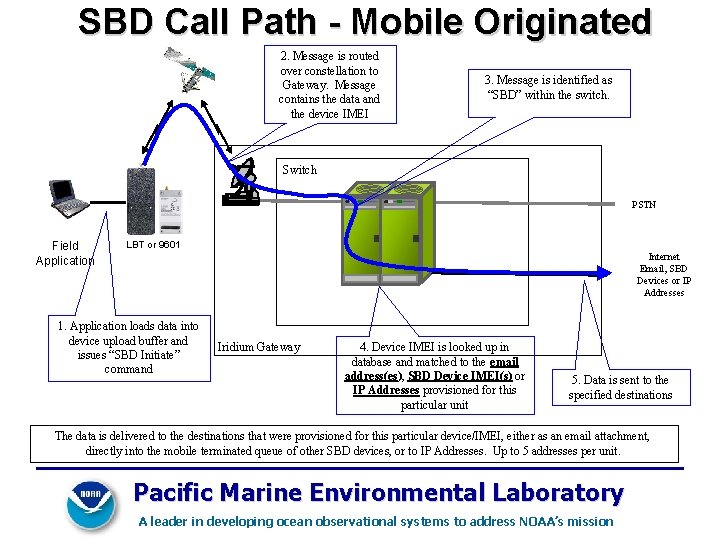
SBD Call Path - Mobile Originated 2. Message is routed over constellation to Gateway. Message contains the data and the device IMEI 3. Message is identified as “SBD” within the switch. Switch PSTN Field Application LBT or 9601 Internet Email, SBD Devices or IP Addresses 1. Application loads data into device upload buffer and issues “SBD Initiate” command Iridium Gateway 4. Device IMEI is looked up in database and matched to the email address(es), SBD Device IMEI(s) or IP Addresses provisioned for this particular unit 5. Data is sent to the specified destinations The data is delivered to the destinations that were provisioned for this particular device/IMEI, either as an email attachment, directly into the mobile terminated queue of other SBD devices, or to IP Addresses. Up to 5 addresses per unit. Pacific Marine Environmental Laboratory A leader in developing ocean observational systems to address NOAA’s mission
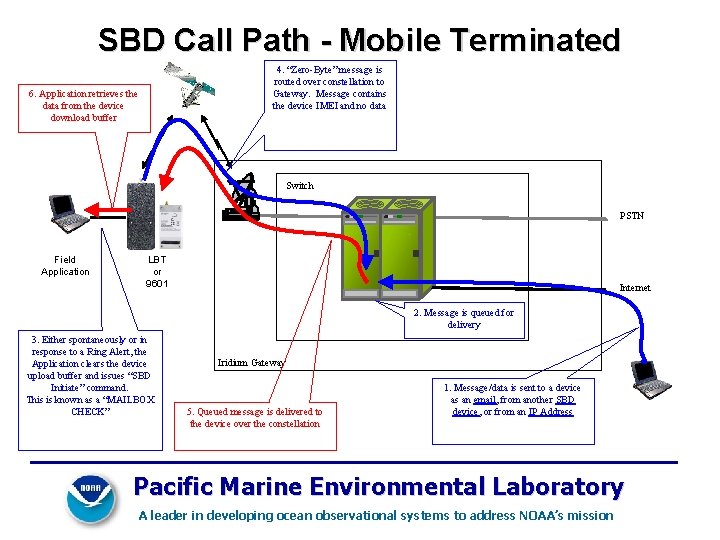
SBD Call Path - Mobile Terminated 4. “Zero-Byte” message is routed over constellation to Gateway. Message contains the device IMEI and no data 6. Application retrieves the data from the device download buffer Switch PSTN Field Application LBT or 9601 Internet 2. Message is queued for delivery 3. Either spontaneously or in response to a Ring Alert, the Application clears the device upload buffer and issues “SBD Initiate” command. This is known as a “MAILBOX CHECK” Iridium Gateway 5. Queued message is delivered to the device over the constellation 1. Message/data is sent to a device as an email, from another SBD device, or from an IP Address Pacific Marine Environmental Laboratory A leader in developing ocean observational systems to address NOAA’s mission
What is an IMEI? • International Mobile Equipment Identity (IMEI) • The IMEI is a serial number that is unique to each device. • Iridium IMEIs are always 15 -digits long and always begin with “ 30”. Product lines can be identified by the IMEI: – 9522 A begins with “ 300124. . . ” or “ 300224. . . ” – 9601 begins with “ 300034. . . ” • The IMEI can be used to “blacklist” equipment if lost or stolen • The IMEI is used to provision, identify and authenticate the device on the Iridium network. Pacific Marine Environmental Laboratory A leader in developing ocean observational systems to address NOAA’s mission
SBD Pricing Elements (Wholesale) 1) The “Device” – Monthly Fee per IMEI – Rated Usage per 1000 bytes, 30 byte minimum billable message size – Mailbox Checks (0 -byte message size) 2) The “SIM Card” (only needed in LBTs. The 9601 is “SIMless”) – Special “SBD Only” Service Package for SIM cards used in SBD devices ($0 monthly recurring fee). – “Regular” Voice/Circuit Switched Data SIM Cards can also be used, but they carry a monthly fee. Pacific Marine Environmental Laboratory A leader in developing ocean observational systems to address NOAA’s mission
Iridium Products Pacific Marine Environmental Laboratory A leader in developing ocean observational systems to address NOAA’s mission
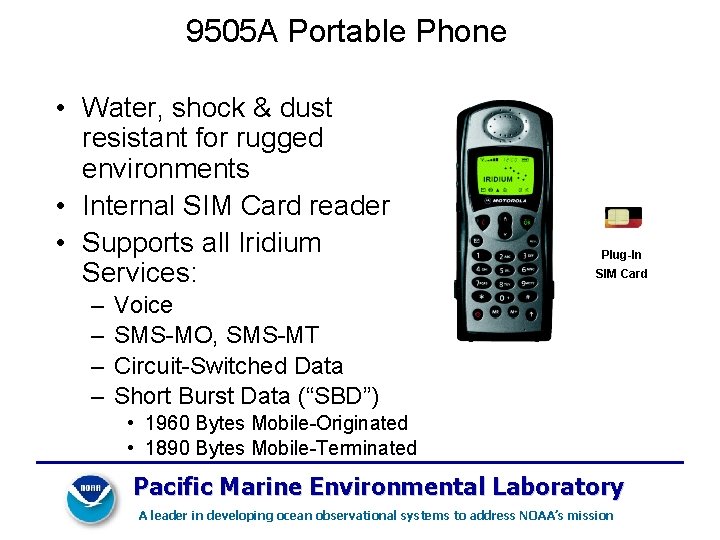
9505 A Portable Phone • Water, shock & dust resistant for rugged environments • Internal SIM Card reader • Supports all Iridium Services: – – Plug-In SIM Card Voice SMS-MO, SMS-MT Circuit-Switched Data Short Burst Data (“SBD”) • 1960 Bytes Mobile-Originated • 1890 Bytes Mobile-Terminated Pacific Marine Environmental Laboratory A leader in developing ocean observational systems to address NOAA’s mission
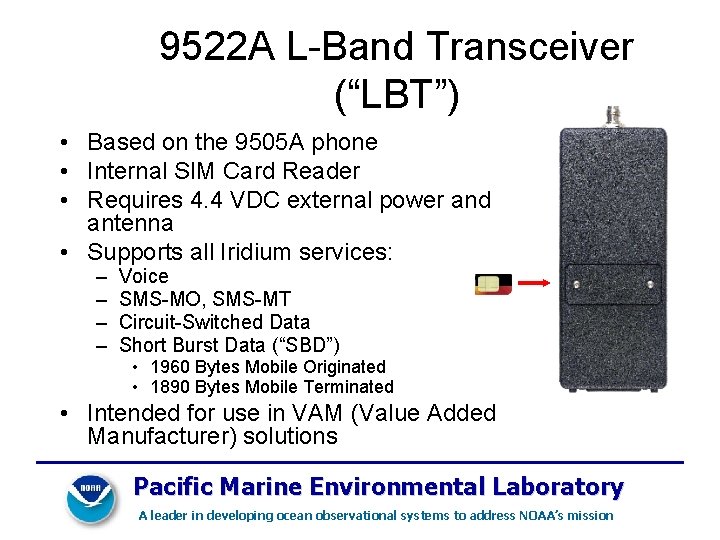
9522 A L-Band Transceiver (“LBT”) • Based on the 9505 A phone • Internal SIM Card Reader • Requires 4. 4 VDC external power and antenna • Supports all Iridium services: – – Voice SMS-MO, SMS-MT Circuit-Switched Data Short Burst Data (“SBD”) • 1960 Bytes Mobile Originated • 1890 Bytes Mobile Terminated • Intended for use in VAM (Value Added Manufacturer) solutions Pacific Marine Environmental Laboratory A leader in developing ocean observational systems to address NOAA’s mission
9522 A Power Specifications • Main Input Voltage – Range: 4. 0 VDC to 4. 8 VDC – Nominal: 4. 4 VDC – Ripple: 40 m. Vpp • Consumption @ 4. 4 VDC – Peak Input transient current: 2. 5 A – Average Input Power (transmit): 2200 m. W – Average Input Power (standby): 570 m. W Pacific Marine Environmental Laboratory A leader in developing ocean observational systems to address NOAA’s mission
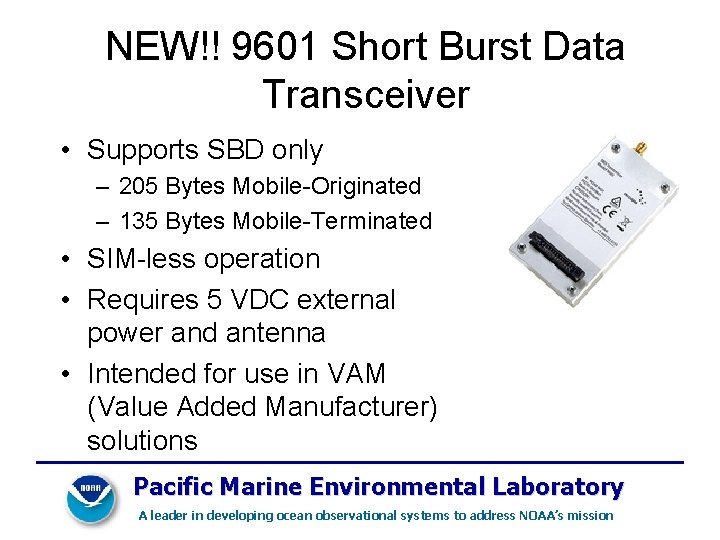
NEW!! 9601 Short Burst Data Transceiver • Supports SBD only – 205 Bytes Mobile-Originated – 135 Bytes Mobile-Terminated • SIM-less operation • Requires 5 VDC external power and antenna • Intended for use in VAM (Value Added Manufacturer) solutions Pacific Marine Environmental Laboratory A leader in developing ocean observational systems to address NOAA’s mission
9601 Power Specifications • Main Input Voltage – Range: 4. 5 VDC to 5. 5 VDC – Nominal: 5. 0 VDC – Ripple: 40 m. Vpp • Consumption @ 5. 0 VDC – Peak input transient current: 1. 5 A – Average input standby current: 66 m. A – Average input current during msg transfer: <= 350 m. A – Average input power during msg transfer: <= 175 m. W Pacific Marine Environmental Laboratory A leader in developing ocean observational systems to address NOAA’s mission
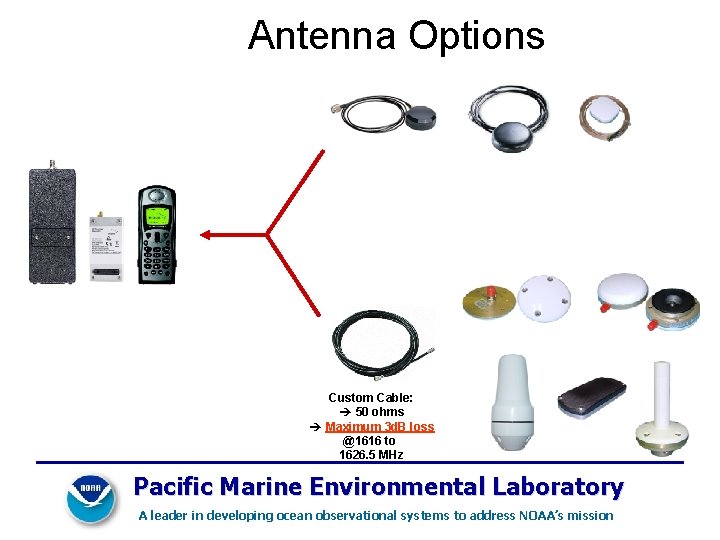
Antenna Options Custom Cable: è 50 ohms è Maximum 3 d. B loss @1616 to 1626. 5 MHz Pacific Marine Environmental Laboratory A leader in developing ocean observational systems to address NOAA’s mission
Outline 1. Iridium Technical Details 2. PMEL Current Telecom Server Capabilities Pacific Marine Environmental Laboratory A leader in developing ocean observational systems to address NOAA’s mission
PMEL’s Current Capabilities • • S- modem protocols RUDICS Dial-in / Dial-out GOES Users (De-Staging Plan) Pacific Marine Environmental Laboratory A leader in developing ocean observational systems to address NOAA’s mission
Other Issues – Broadcast Capabilities for RUDICS – Service for GTS insertion – Bulk US Gov. Minutes Pacific Marine Environmental Laboratory A leader in developing ocean observational systems to address NOAA’s mission
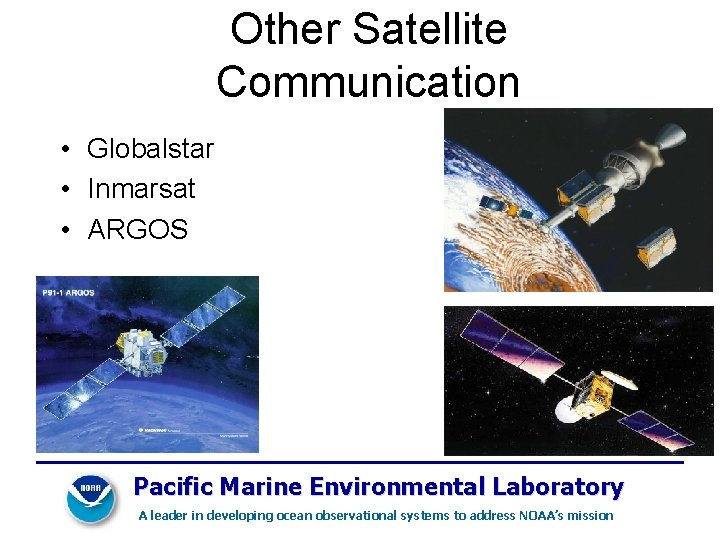
Other Satellite Communication • Globalstar • Inmarsat • ARGOS Pacific Marine Environmental Laboratory A leader in developing ocean observational systems to address NOAA’s mission
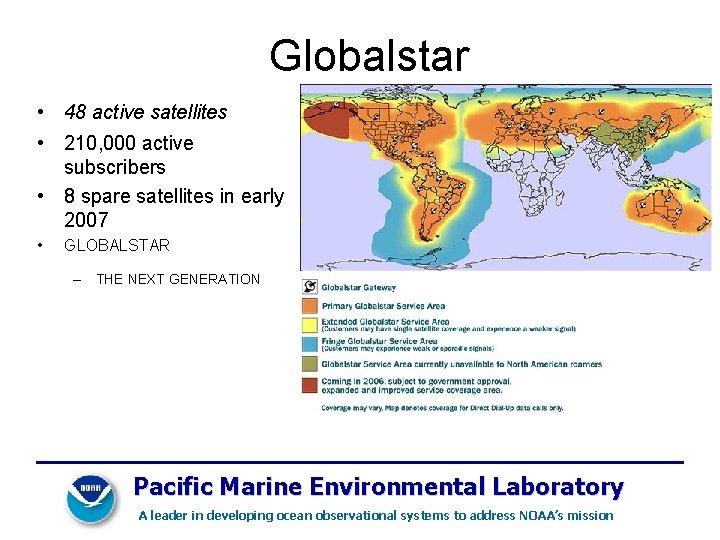
Globalstar • 48 active satellites • 210, 000 active subscribers • 8 spare satellites in early 2007 • GLOBALSTAR – THE NEXT GENERATION Pacific Marine Environmental Laboratory A leader in developing ocean observational systems to address NOAA’s mission
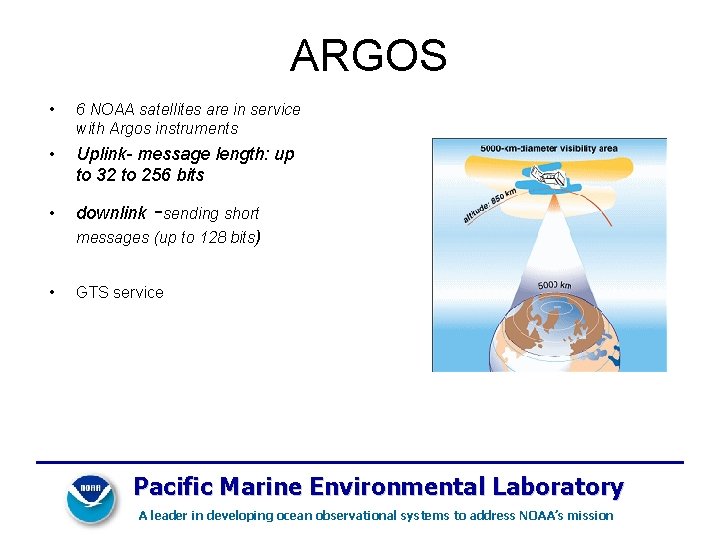
ARGOS • 6 NOAA satellites are in service with Argos instruments • Uplink- message length: up to 32 to 256 bits • downlink -sending short messages (up to 128 bits) • GTS service Pacific Marine Environmental Laboratory A leader in developing ocean observational systems to address NOAA’s mission
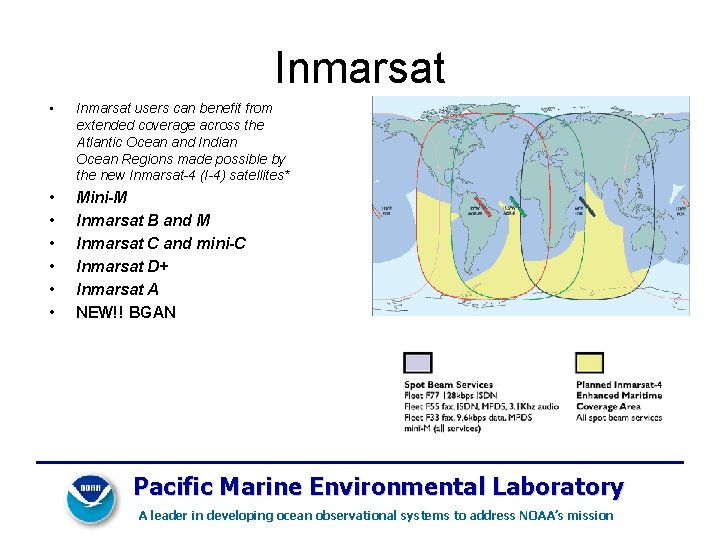
Inmarsat • Inmarsat users can benefit from extended coverage across the Atlantic Ocean and Indian Ocean Regions made possible by the new Inmarsat-4 (I-4) satellites* • • • Mini-M Inmarsat B and M Inmarsat C and mini-C Inmarsat D+ Inmarsat A NEW!! BGAN Pacific Marine Environmental Laboratory A leader in developing ocean observational systems to address NOAA’s mission
- Slides: 36