
Connected Communities CCPilots FOAee doe gov FOA Webinar
Connected Communities CCPilots. FOA@ee. doe. gov FOA Webinar DE-FOA-0002206 November 10, 2020 1 | Energy Efficiency and Renewable Energy eere. energy. gov
Notice • NO NEW INFORMATION OTHER THAN THAT PROVIDED IN THE FOA WILL BE DISCUSSED IN THE WEBINAR. • There are no particular advantages or disadvantages to the application evaluation process with respect to participating on the webinar today. • Your participation is completely voluntary. 2
Notice • All applicants are strongly encouraged to carefully read the Funding Opportunity Announcement “Connected Communities” DE-FOA-0002206 (“FOA”) and adhere to the stated submission requirements. • This presentation summarizes the contents of FOA. If there any inconsistencies between the FOA and this presentation or statements from DOE personnel, the FOA is the controlling document and applicants should rely on the FOA language and seek clarification from EERE at CCPilots. FOA@ee. doe. gov 3
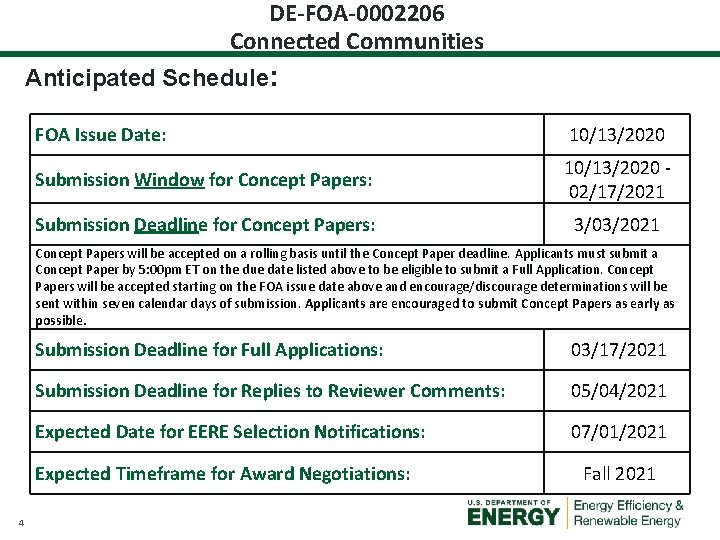
DE-FOA-0002206 Connected Communities Anticipated Schedule: FOA Issue Date: 10/13/2020 Submission Window for Concept Papers: 10/13/2020 02/17/2021 Submission Deadline for Concept Papers: 3/03/2021 Concept Papers will be accepted on a rolling basis until the Concept Paper deadline. Applicants must submit a Concept Paper by 5: 00 pm ET on the due date listed above to be eligible to submit a Full Application. Concept Papers will be accepted starting on the FOA issue date above and encourage/discourage determinations will be sent within seven calendar days of submission. Applicants are encouraged to submit Concept Papers as early as possible. Submission Deadline for Full Applications: 03/17/2021 Submission Deadline for Replies to Reviewer Comments: 05/04/2021 Expected Date for EERE Selection Notifications: 07/01/2021 Expected Timeframe for Award Negotiations: 4 Fall 2021
Agenda 1) 2) 3) 4) 5) 6) 7) 8) 9) 10) 5 FOA Description Topic Areas/Technical Areas of Interest Award Information Statement of Substantial Involvement Cost Sharing FOA Timeline Concept Papers Full Applications Merit Review and Selection Process Registration Requirements
FOA Description (Slide 1 of 2) A Connected Community (CC) is a group of grid-interactive efficient buildings (GEB) with diverse, flexible end use equipment and other distributed energy resources (DERs) that collectively work to maximize building, community, and grid efficiency. The objective of this FOA is to select projects that will demonstrate how groups of buildings combined with other types of DERs , such as electric vehicle (EV) charging and photovoltaic (PV) generation, can reliably and cost-effectively serve as grid assets by strategically deploying efficiency and demand flexibility. By demonstrating the ability of groups of buildings and DERs to modify load, the FOA outcomes will enable increased energy efficiency, reduced energy demand, and reduced environmental impact. Under this FOA, DOE will select a portfolio of “Connected Community” projects totaling up to $65 million in varying climates, geographies, building types, building vintages, DERs utility/grid/regulatory structures and resource bases. Through funding these projects, DOE hopes to find and share technical and market solutions that will increase demand flexibility and energy efficiency. 6
FOA Description (Slide 2 of 2) For the purpose of this FOA, a DER is defined as a resource (community-scale or building-scale) that can provide all or some immediate electric and/or power needs and can also be used by the community to either reduce demand (such as energy efficiency) or supply power to satisfy the energy, capacity, or ancillary service needs of the distribution grid. In addition it should be connected to the distribution system, close to load, and the majority of produced energy should be consumed within the community. Examples of different types of DERs include photovoltaics (PV), energy storage, wind, combined heat and power (CHP), demand response (DR), energy efficiency (EE), microgrids, and electric vehicle charging infrastructure. Beyond a foundation of demand flexibility and energy efficiency, DOE expects to select a diverse portfolio of individual projects so that the combined insights from the whole portfolio will provide scalable solutions that can be applied throughout the country. Individual projects can include new construction, retrofits of existing building, residential, commercial, mixed use, campuses, and appropriate DERs. It is anticipated, but not required, that proposals will come from multi-disciplinary partnerships between energy utilities/providers, building/home developers/owners/operators, manufacturers, researchers and other key players. 7

FOA Description-Technology Space (Slide 1 of 2) The overall desired outcome from this FOA is to demonstrate, through a portfolio of diverse projects, the ability of groups of buildings and DERs to provide cost effective grid services through demand flexibility and efficiency that maximize use of renewable resources and reduce emissions, while maintaining (if not enhancing) occupant satisfaction and productivity. Specific outcomes within that are (1 -8): 1. Data showing if, and how much, diverse groups of buildings can reliably and cost-effectively serve as grid assets by strategically deploying efficiency and demand flexibility in conjunction with DERs, without sacrificing occupant comfort or productivity; 2. Analysis on the interaction between energy efficiency and demand flexibility measures and how GEBs improve energy affordability and grid reliability while offering environmental and community benefits; 3. Demonstration of how DERs, such as managed charging of electric vehicles, can contribute to overall building load management, grid services and reduced cost of DER ownership and operation; 4. Demonstration of proven pathways to install the hardware, software and communications necessary to make buildings grid interactive that decrease cost, set up time for installers and potential disruption to occupants; 8
FOA Description-Technology Space (Slide 2 of 2) 5. Insights on occupant impact, including benefits, resulting from equipment with advanced sensing, controls and capabilities to modify and optimize operational sequencing to balance comfort and grid needs; 6. Perspective into the willingness and ability of the occupants to change the timing and/or duration of their energy use, and any necessary level of compensation to meet grid needs; 7. Demonstrate the value of how demand flexibility and DER integration across buildings will attract customers, utilities, and other key stakeholders; and 8. Public dissemination of case studies of each project, including technical requirements and specifications, synthesized best practices, businesses models, partnership approaches, lessons learned, required analyses (including the results of those analyses) and analytical tools used to conduct the design, operation and evaluation of successful connected communities. DOE will take a coordinated research approach in which selected projects serve as a cohort to share challenges and best practices between each other and publicly. 9
FOA Description- Strategic Goals (Slide 1 of 2) A key goal of this FOA is to select projects that will demonstrate how groups of buildings can reliably and cost-effectively serve as grid assets by strategically deploying efficiency and demand flexibility in conjunction with DERs. The grid issues addressed by Connected Communities FOA should include: • Aiding variable renewable energy integration; And may include, among others: • Providing resource adequacy; • Improve resilience, allowing systems to withstand or recover rapidly from disturbances; • Deferring or avoiding major capital investments in generation, transmission, or distribution grid infrastructure; • Maintaining voltage limits on the transmission and distribution (T&D) system; and • Extending the reliability and resilience of the surrounding electric system through coordinated islanding or the provision of blackstart or other recovery related services. 10
FOA Description- Strategic Goals (Slide 2 of 2) The grid issues can be addressed at either the bulk power system or distribution system. Numerous grid services are required to support reliable grid operations and respond to the inherent variability and uncertainty of electricity supply and demand. While not a requirement of CC FOA proposed projects, we note that in most organized wholesale markets, 100 k. W of load flexibility is the typical minimum threshold for participation of individual or aggregations of demand-side resources in Demand Response (DR) programs. At the distribution system, connected communities can provide additional grid services, some of which have been represented as nonwire alternatives (NWAs). For more detail on grid services please refer to Appendix J. 11
Topic Description This FOA calls for projects that seek an integration of the technological, operational, environmental, and economic aspects to create value for occupants and other participants. Using technology, software, and business models that can integrate DERs across buildings and with the grid should create a bidirectional flow of benefits. Non-electric fuel sources may be applicable, for both distributed generation and building equipment, provided they meet the objectives of the FOA and are allowed by appropriate regulatory agencies to provide grid services (if being used for that purpose). Energy efficient buildings should be used as a foundational resource and utilized to the greatest extent reasonable in project communities. Applicants are strongly encouraged to apply high performance building principles to build and/or retrofit new and existing buildings. Please see Table 1 in the FOA. It lists all of the required categories and identifies the aspects that are required and the ones that are encouraged of the connected community projects proposed in response to this FOA. 12
Critical Aspects for Proposed Projects Category Grid Issues and Services to Address 13 Description Each project must: Address increased integration of renewable energy resources and at least one more electric grid issue relevant to transmission and/or distribution as shown in Figures 2 and 3. Provide at least two defined and quantifiable grid services that reliably and cost effectively address targeted grid issues. Incorporate resilience at a defined scale (e. g. Building, Campus, Community, Feeder, Substation etc. ) enhancing the ability to withstand or recover from disruptions. Include the amount of load flexibility needed to provide a viable demonstration of the provision of grid services at a scale meaningful to participate in wholesale markets and/or at the distribution grid level over multiple seasons. See Appendix J for more detail. Projects are encouraged to: Address more than two grid issues. Provide more than two grid services to address the targeted grid issues. Scale or stage community energy supply and consumption using load control, storage and generation in order to operate the community at varied levels of service during multi-day power outages.
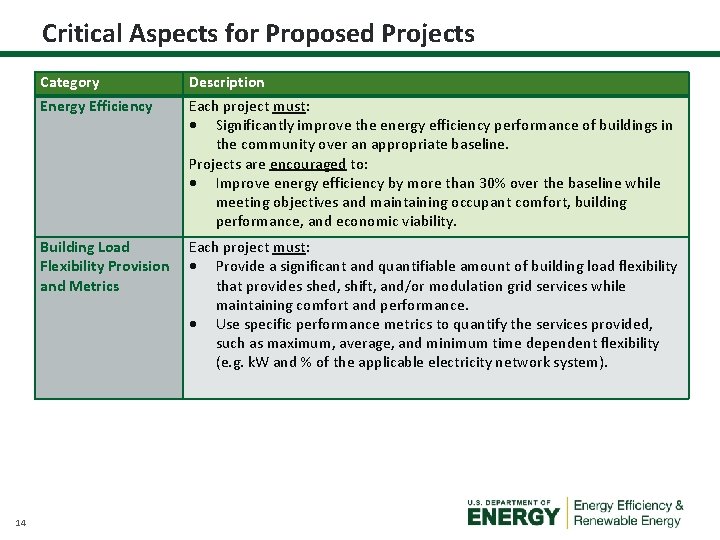
Critical Aspects for Proposed Projects 14 Category Energy Efficiency Description Each project must: Significantly improve the energy efficiency performance of buildings in the community over an appropriate baseline. Projects are encouraged to: Improve energy efficiency by more than 30% over the baseline while meeting objectives and maintaining occupant comfort, building performance, and economic viability. Building Load Flexibility Provision and Metrics Each project must: Provide a significant and quantifiable amount of building load flexibility that provides shed, shift, and/or modulation grid services while maintaining comfort and performance. Use specific performance metrics to quantify the services provided, such as maximum, average, and minimum time dependent flexibility (e. g. k. W and % of the applicable electricity network system).
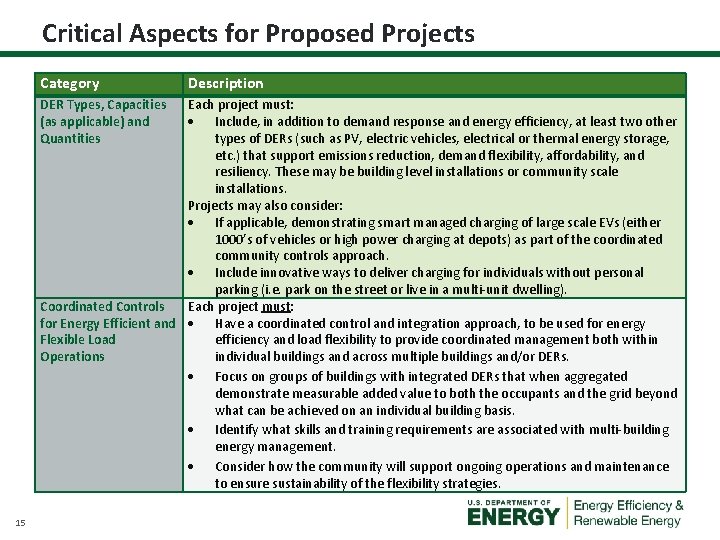
Critical Aspects for Proposed Projects Category DER Types, Capacities (as applicable) and Quantities Description Each project must: Include, in addition to demand response and energy efficiency, at least two other types of DERs (such as PV, electric vehicles, electrical or thermal energy storage, etc. ) that support emissions reduction, demand flexibility, affordability, and resiliency. These may be building level installations or community scale installations. Projects may also consider: If applicable, demonstrating smart managed charging of large scale EVs (either 1000’s of vehicles or high power charging at depots) as part of the coordinated community controls approach. Include innovative ways to deliver charging for individuals without personal parking (i. e. park on the street or live in a multi-unit dwelling). Coordinated Controls Each project must: for Energy Efficient and Have a coordinated control and integration approach, to be used for energy Flexible Load efficiency and load flexibility to provide coordinated management both within Operations individual buildings and across multiple buildings and/or DERs. Focus on groups of buildings with integrated DERs that when aggregated demonstrate measurable added value to both the occupants and the grid beyond what can be achieved on an individual building basis. Identify what skills and training requirements are associated with multi-building energy management. Consider how the community will support ongoing operations and maintenance to ensure sustainability of the flexibility strategies. 15
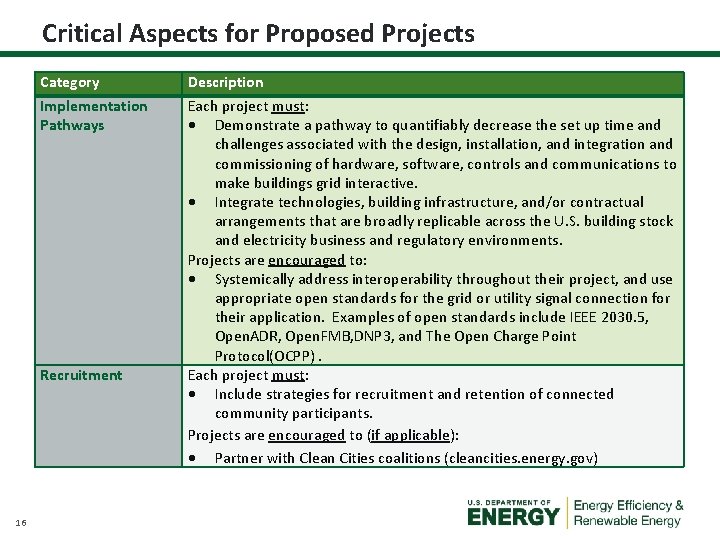
Critical Aspects for Proposed Projects Category Implementation Pathways Recruitment 16 Description Each project must: Demonstrate a pathway to quantifiably decrease the set up time and challenges associated with the design, installation, and integration and commissioning of hardware, software, controls and communications to make buildings grid interactive. Integrate technologies, building infrastructure, and/or contractual arrangements that are broadly replicable across the U. S. building stock and electricity business and regulatory environments. Projects are encouraged to: Systemically address interoperability throughout their project, and use appropriate open standards for the grid or utility signal connection for their application. Examples of open standards include IEEE 2030. 5, Open. ADR, Open. FMB, DNP 3, and The Open Charge Point Protocol(OCPP). Each project must: Include strategies for recruitment and retention of connected community participants. Projects are encouraged to (if applicable): Partner with Clean Cities coalitions (cleancities. energy. gov)
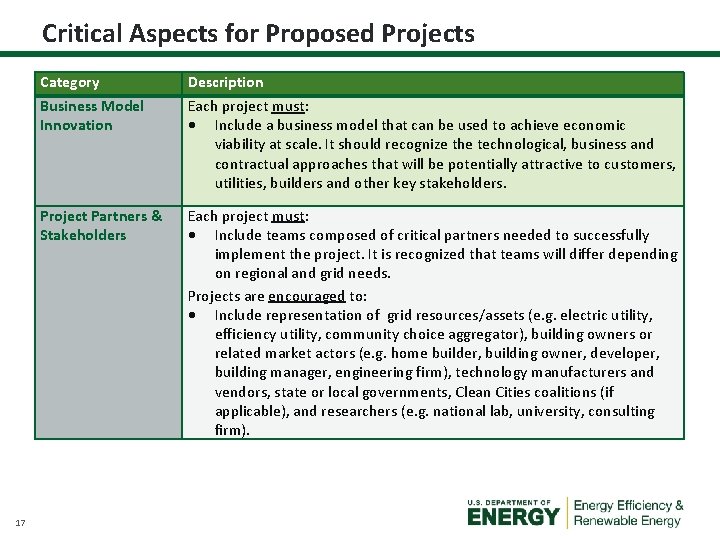
Critical Aspects for Proposed Projects 17 Category Business Model Innovation Description Each project must: Include a business model that can be used to achieve economic viability at scale. It should recognize the technological, business and contractual approaches that will be potentially attractive to customers, utilities, builders and other key stakeholders. Project Partners & Stakeholders Each project must: Include teams composed of critical partners needed to successfully implement the project. It is recognized that teams will differ depending on regional and grid needs. Projects are encouraged to: Include representation of grid resources/assets (e. g. electric utility, efficiency utility, community choice aggregator), building owners or related market actors (e. g. home builder, building owner, developer, building manager, engineering firm), technology manufacturers and vendors, state or local governments, Clean Cities coalitions (if applicable), and researchers (e. g. national lab, university, consulting firm).
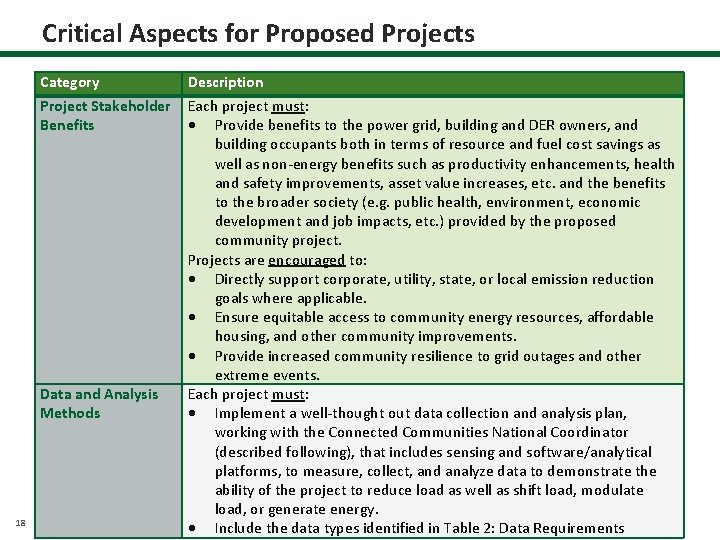
Critical Aspects for Proposed Projects Category Project Stakeholder Benefits Data and Analysis Methods 18 Description Each project must: Provide benefits to the power grid, building and DER owners, and building occupants both in terms of resource and fuel cost savings as well as non-energy benefits such as productivity enhancements, health and safety improvements, asset value increases, etc. and the benefits to the broader society (e. g. public health, environment, economic development and job impacts, etc. ) provided by the proposed community project. Projects are encouraged to: Directly support corporate, utility, state, or local emission reduction goals where applicable. Ensure equitable access to community energy resources, affordable housing, and other community improvements. Provide increased community resilience to grid outages and other extreme events. Each project must: Implement a well-thought out data collection and analysis plan, working with the Connected Communities National Coordinator (described following), that includes sensing and software/analytical platforms, to measure, collect, and analyze data to demonstrate the ability of the project to reduce load as well as shift load, modulate load, or generate energy. Include the data types identified in Table 2: Data Requirements
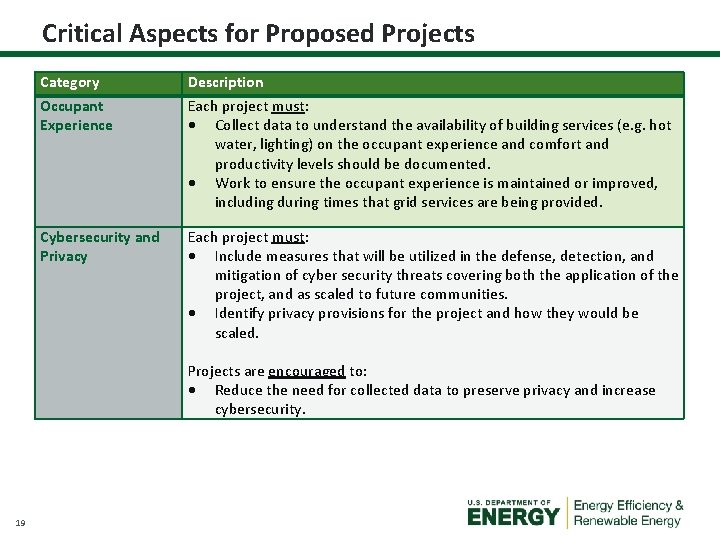
Critical Aspects for Proposed Projects Category Occupant Experience Description Each project must: Collect data to understand the availability of building services (e. g. hot water, lighting) on the occupant experience and comfort and productivity levels should be documented. Work to ensure the occupant experience is maintained or improved, including during times that grid services are being provided. Cybersecurity and Privacy Each project must: Include measures that will be utilized in the defense, detection, and mitigation of cyber security threats covering both the application of the project, and as scaled to future communities. Identify privacy provisions for the project and how they would be scaled. Projects are encouraged to: Reduce the need for collected data to preserve privacy and increase cybersecurity. 19
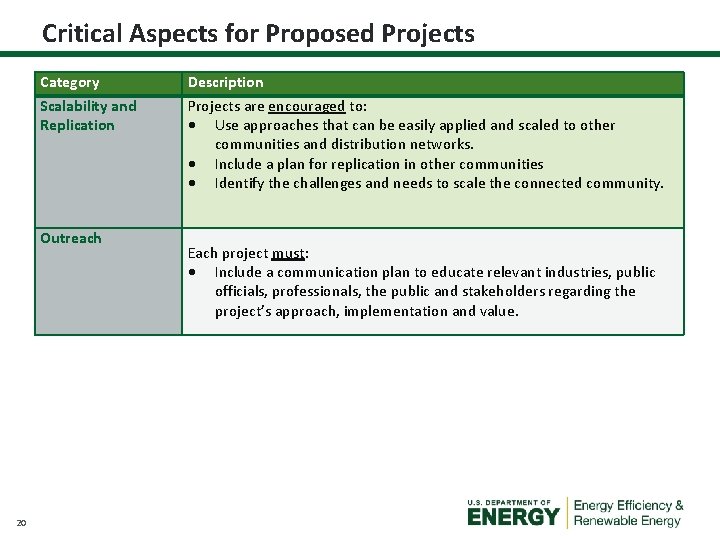
Critical Aspects for Proposed Projects Category Scalability and Replication Outreach 20 Description Projects are encouraged to: Use approaches that can be easily applied and scaled to other communities and distribution networks. Include a plan for replication in other communities Identify the challenges and needs to scale the connected community. Each project must: Include a communication plan to educate relevant industries, public officials, professionals, the public and stakeholders regarding the project’s approach, implementation and value.
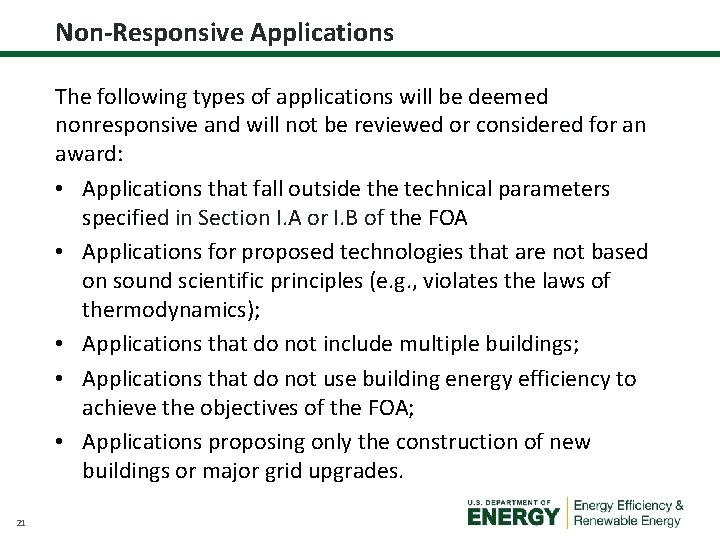
Non-Responsive Applications The following types of applications will be deemed nonresponsive and will not be reviewed or considered for an award: • Applications that fall outside the technical parameters specified in Section I. A or I. B of the FOA • Applications for proposed technologies that are not based on sound scientific principles (e. g. , violates the laws of thermodynamics); • Applications that do not include multiple buildings; • Applications that do not use building energy efficiency to achieve the objectives of the FOA; • Applications proposing only the construction of new buildings or major grid upgrades. 21
Teaming Partner List • EERE is compiling a Teaming Partner List to facilitate the widest possible participation for this FOA. • The Teaming Partner List will be available on https: //eere. Exchange. energy. gov under the Connected Communities FOA (DE-FOA 0002206). It will be updated at least weekly to reflect new Teaming Partners who have provided their information. • If you would like to be included on this list submit the following information to the Teaming List email CCPilots. Teaming. List@hq. doe. gov with the subject line “Teaming Partner Information”: – Organization Name; – Generic Organization Contact Email; – One of the following: Generic Organization Contact Email, Web Site Contact-Us URL, or social media URL (Facebook, Linked. In, Twitter, etc. ); – Organization Type; – Area of Technical Expertise (bulleted list less than 25 words); and – Brief Description of Capabilities (less than 100 words). 22
Teaming Partner List (cont’d) • By submitting a request to be included on the Teaming Partner List, the requesting organization consents to the publication of the submitted information. • By facilitating this Teaming Partner List, EERE does not endorse or otherwise evaluate the qualifications of the entities that self-identify themselves for placement on the Teaming Partner List. • EERE will not pay for the provision of any information, nor will it compensate any applicants or requesting organizations for the development of such information. 23
Award Information Total Amount to be Awarded Average Award Amount Types of Funding Agreements Approximately $65 million EERE anticipates making awards that range from $3 million to $7 million. • Cooperative Agreements • Grants • Technology Investment Agreements • Work Authorizations • Interagency Agreements Period of Performance 36 to 60 months Cost Share Requirement 30% of Total Project Costs *Subject to the availability of appropriated funds 24
Statement of Substantial Involvement EERE has substantial involvement in work performed under awards made following this FOA. EERE does not limit its involvement to the administrative requirements of the award. Instead, EERE has substantial involvement in the direction and redirection of the technical aspects of the project as a whole. Substantial involvement includes, but is not limited to, the following: • EERE shares responsibility with the Recipient for the management, control, direction, and performance of the Project. • EERE may intervene in the conduct or performance of work under this award for programmatic reasons. Intervention includes the interruption or modification of the conduct or performance of project activities. • EERE may redirect or discontinue funding the Project based on the outcome of EERE’s evaluation of the Project at the Go/No Go decision point(s). • EERE participates in major project decision-making processes. 25
Cost Sharing Requirements • The cost share must be at least 30% of the total allowable costs for demonstration projects (i. e. , the sum of the government share, including FFRDC costs if applicable, and the recipient share of allowable costs equals the total allowable cost of the project) and must come from nonfederal sources unless otherwise allowed by law. (See 2 CFR 200. 306 and 2 CFR 910. 130 for the applicable cost sharing requirements. ) • To assist applicants in calculating proper cost share amounts, EERE has included a cost share information sheet and sample cost share calculation as Appendices A and B to this FOA. 26
Cost Share Contributions • Contributions must be: o Specified in the project budget o Verifiable from the Prime Recipient’s records o Necessary and reasonable for proper and efficient accomplishment of the project • If you are selected for award negotiations, every cost share contribution must be reviewed and approved in advance by the Contracting Officer and incorporated into the project budget before the expenditures are incurred • Please note, vendors/contractors may NOT provide cost share. Any partial donation of goods or services is considered a discount and is not allowable. 27
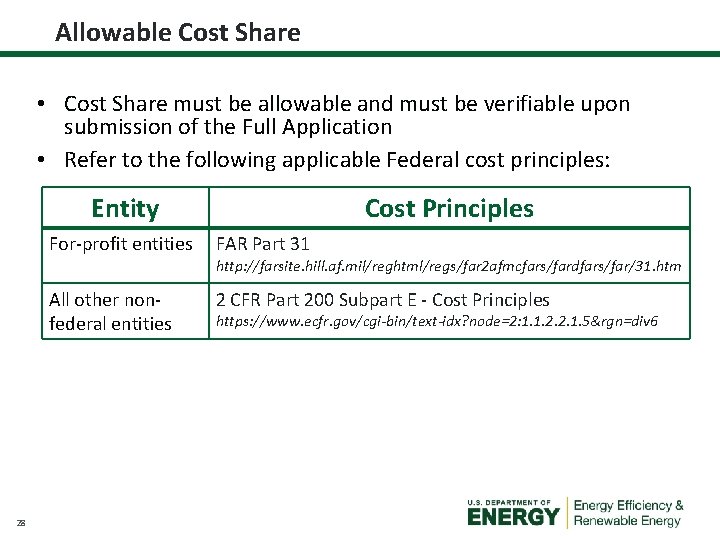
Allowable Cost Share • Cost Share must be allowable and must be verifiable upon submission of the Full Application • Refer to the following applicable Federal cost principles: Entity 28 Cost Principles For-profit entities FAR Part 31 All other nonfederal entities 2 CFR Part 200 Subpart E - Cost Principles http: //farsite. hill. af. mil/reghtml/regs/far 2 afmcfars/fardfars/far/31. htm https: //www. ecfr. gov/cgi-bin/text-idx? node=2: 1. 1. 2. 2. 1. 5&rgn=div 6
Allowable Cost Share • Cash Contributions o May be provided by the Prime Recipient, Subrecipients, or a Third Party (may not be provided by vendors/contractors) • In-Kind Contributions o Can include, but are not limited to: the donation of volunteer time or the donation of space or use of equipment. For more information, see Section III. B Cost Sharing and the Cost Share Appendix in the FOA 29
Unallowable Cost Share The Prime Recipient may NOT use the following sources to meet its cost share obligations including, but not limited to: • Revenues or royalties from the prospective operation of an activity beyond the project period • Proceeds from the prospective sale of an asset of an activity • Federal funding or property • Expenditures reimbursed under a separate Federal Technology Office • The same cash or in-kind contributions for more than one project or program • Vendor/contractor contributions 30
Cost Share Payment • Recipients must provide documentation of the cost share contribution, incrementally over the life of the award • The cumulative cost share percentage provided on each invoice must reflect, at a minimum, the cost sharing percentage negotiated • In limited circumstances, and where it is in the government’s interest, the EERE Contracting Officer may approve a request by the Prime Recipient to meet its cost share requirements on a less frequent basis, such as monthly or quarterly. See Section III. B. vi of the FOA. 31
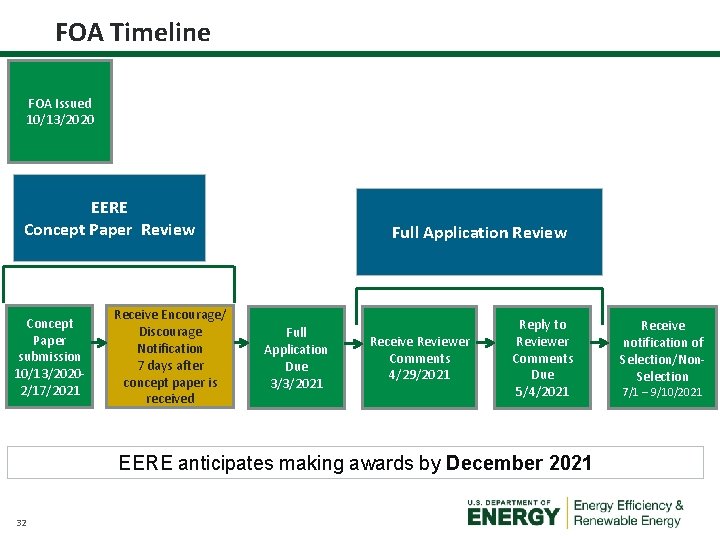
FOA Timeline FOA Issued 10/13/2020 EERE Concept Paper Review Concept Paper submission 10/13/20202/17/2021 Receive Encourage/ Discourage Notification 7 days after concept paper is received Full Application Review Full Application Due 3/3/2021 Receive Reviewer Comments 4/29/2021 Reply to Reviewer Comments Due 5/4/2021 EERE anticipates making awards by December 2021 32 Receive notification of Selection/Non. Selection 7/1 – 9/10/2021
Concept Papers • Applicants must submit a Concept Paper o Each Concept Paper must be limited to a single concept or technology o An entity may submit more than one Concept Paper and Full Application to this FOA, provided that each application describes a unique, distinct project • Section IV. C of the FOA states what information a Concept Paper should include and the page limits. o Failure to include the required content could result in the Concept Paper receiving a “discouraged” determination or the Concept Paper could be found to be ineligible. • Concept Papers may be submitted until the deadline. All Concept papers must be submitted by 3/03/2021, 5: 00 PM ET, through EERE Exchange • EERE provides applicants with: (1) an “encouraged” or “discouraged” notification, and (2) the reviewer comments 7 days after the Concept Paper is received 33
Concept Paper Review Concept Papers are evaluated based on consideration of the following factors. All sub-criteria are of equal weight. Concept Paper Criterion: Overall FOA Responsiveness and Viability of the Project (Weight: 100%) This criterion involves consideration of the following sub-criteria: • • • 34 The applicant clearly presents the proposed connected community project, the technology and approach being demonstrated, the locations, building types/systems, business models and all other salient information; The project’s potential to replicate, scale, validate, advance and deploy the current state-of-the-art; The applicant has identified risks and challenges, including possible mitigation strategies, and has shown the impact that EERE funding and the proposed project would have; The applicant has the qualifications, experience, capabilities and other resources necessary to complete (incl. measurement and evaluation, communications and outreach, etc. ) the proposed project; and The proposed work, if successfully accomplished, would clearly meet the objectives as stated in the FOA.
Full Applications The Full Application includes: • Technical Volume: The key technical submission - info relating to the technical content, project team members, etc. • Resumes • Letters of Commitment • Statement of Project Objectives • SF-424 Application for Federal Assistance: The formal application signed by the authorized representative of the applicant. • Budget Justification: a detailed budget and spend plan for the project. • Summary for Public Release • Summary Slide • Administrative Documents: E. g. , U. S. Manufacturing Plan, FFRDC Authorization (if applicable), Disclosure of Lobbying Activities, etc. 35
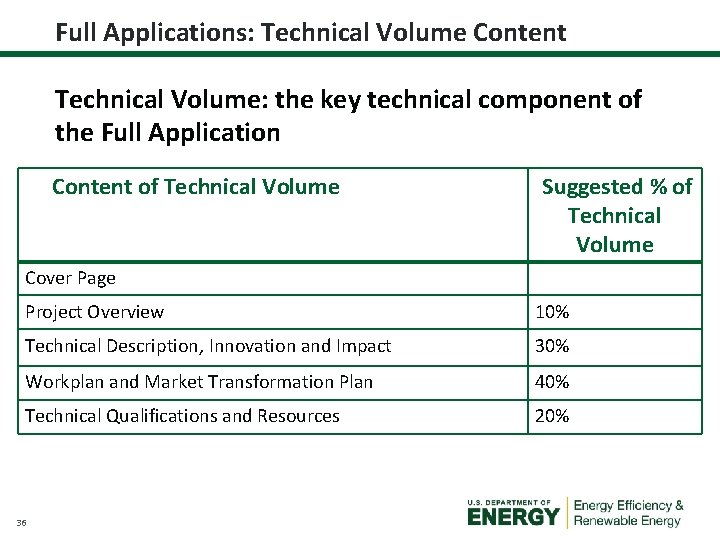
Full Applications: Technical Volume Content Technical Volume: the key technical component of the Full Application Content of Technical Volume (1) Cover Page Suggested % of Technical Volume Cover Page Project Overview 10% Technical Description, Innovation and Impact 30% Workplan and Market Transformation Plan 40% Technical Qualifications and Resources 20% 36
Full Application Eligibility Requirements • Applicants must submit a Full Application by 3/17/2021 • Full Applications are eligible for review if: The Applicant is an eligible entity Section III. A of FOA; The Applicant submitted an eligible Concept Paper; The Cost Share requirement is satisfied Section III. B of FOA; The Full Application is compliant Section III. C of FOA; and The proposed project is responsive to the FOA Section III. D of FOA o The Full Application meets any other eligibility requirements listed in Section III of the FOA. o o o 37
Who is Eligible to Apply? Eligible applicants for this FOA include: 1. U. S. citizens and lawful U. S. permanent residents 2. For-profit entities 3. Educational institutions 4. Nonprofits 5. State, local, and tribal government entities DOE/NNSA FFRDCs, with the exception of Lawrence Berkeley National Laboratory, are eligible to apply for funding as a subrecipient, but are not eligible to apply as a prime recipient. Lawrence Berkeley National Laboratory is not eligible to apply as a prime or subrecipient under this FOA. Non-DOE/NNSA FFRDCs are eligible to apply for funding as a subrecipient, but are not eligible to apply as a prime recipient. For more detail about eligible applicants, please see Section III. A of the FOA Nonprofit organizations described in Section 501(c)(4) of the Internal Revenue Code of 1986 that engaged in lobbying activities after December 31, 1995, are not eligible to apply for funding. Prime Recipients must be incorporated (or otherwise formed) under the laws of a State or territory of the United States and have a physical location for business operations in the United States. See Section III. A. iii for requirements applicable to foreign entities applying under this FOA. 38
Multiple Applications An entity may submit more than one Concept Paper and Full Application to this FOA, provided that each application describes a unique, distinct project and provided that an eligible Concept Paper was submitted for each Full Application. 39
Merit Review and Selection Process (Full Applications) • The Merit Review process consists of multiple phases that each include an eligibility review and a thorough technical review • Rigorous technical reviews are conducted by reviewers that are experts in the subject matter of the FOA • Ultimately, the Selection Official considers the recommendations of the reviewers, along with other considerations such as program policy factors, to make the selection decisions 40
Technical Merit Review Criteria Applications will be evaluated against the merit review criteria. All sub-criteria are of equal weight. Criterion 1: Technical Merit, Innovation, and Impact (50%) This criterion involves consideration of the following sub-criteria: Technical Merit and Innovation • Degree to which the proposed energy efficiency and demand flexibility improvements and the integration of additional DERs included in the project are clearly described and impactful for the grid issues addressed; • Extent to which the application includes multiple grid services, addressing multiple grid issues; • Extent to which the technical solution includes coordinated controls across the connected community to provide enhanced energy efficient and flexible load operations; • Extent to which the technical solution achieves load flexibility and maintains or enhances building (end use) services to occupants (e. g. occupant comfort and productivity), protect data privacy, and provide cybersecurity in the project demonstration and in a scalable implementation of the technology solution, and • Extent to which the application describes a viable technical solution. 41
Technical Merit Review Criteria Criterion 1: Technical Merit, Innovation, and Impact (50%) (Cont. ) Impact of Technology Advancement • How the project supports the topic area objectives and target specifications and metrics; • Extent to which the application specifically and convincingly demonstrates at a sufficient scale how the connected community project will provide grid services to enable maximized use of renewable generation and minimized emissions; and • Extent to which the proposed connected community solution has the potential to be replicable, scalable and advance the state-of-the-art. 42
Technical Merit Review Criteria Criterion 2: Project Research and Market Transformation Plan (30%) This criterion involves consideration of the following factors: Research Approach, Workplan and SOPO • Degree to which the approach and critical path have been clearly described and thoughtfully considered including technology integration, control optimization strategies, target market adoption and incentives, regulatory opportunities and barriers, and occupant preferences ; and • Degree to which the task descriptions are clear, detailed, timely, and reasonable, resulting in a high likelihood that the proposed Workplan and SOPO will succeed in meeting the project goals. Identification of Risks • Discussion and demonstrated understanding of the key technical and nontechnical risk areas involved in the proposed work and the quality of the mitigation strategies to address them. 43
Technical Merit Review Criteria Criterion 2: Project Research and Market Transformation Plan (30%) (Cont. ) This criterion involves consideration of the following factors: Baseline, Metrics, and Deliverables • The level of clarity in the definition of the baseline, metrics, and milestones; and • Relative to a clearly defined experimental baseline, the strength of the quantifiable metrics, milestones, and a mid-point deliverables defined in the application, such that meaningful interim progress will be made. Market Transformation Plan • Degree to which the plan identifies a reasonable path toward commercial viability and success including but not limited to market opportunity, value proposition, competitive differentiation, scalability and distribution channels for the proposed technology or approach, cost and performance drivers, infrastructure and workforce requirements, U. S. manufacturing plan, and legal/regulatory considerations including utility rate structures, intellectual property, cyber security and privacy. 44
Technical Merit Review Criteria Criterion 3: Team and Resources (20%) This criterion involves consideration of the following factors: • • • 45 The capability of the Principal Investigator(s) and the proposed team to address all aspects of the proposed work with a high probability of success. The qualifications, relevant expertise, and time commitment of the individuals on the team; The sufficiency of the facilities to support the work; The degree to which the proposed team demonstrates the ability to facilitate and expedite further development and commercial deployment of the proposed technologies or approaches; The level of participation by project participants as evidenced by letter(s) of commitment and how well they are integrated into the Workplan; and The reasonableness of the budget and spend plan for the proposed project and objectives.
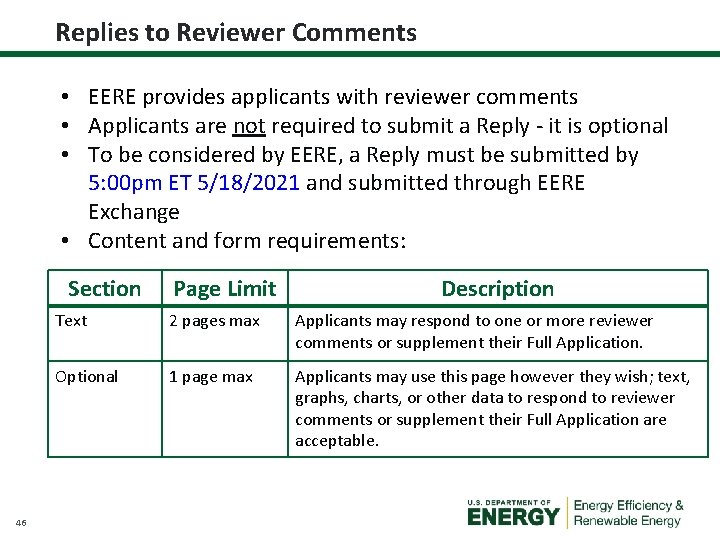
Replies to Reviewer Comments • EERE provides applicants with reviewer comments • Applicants are not required to submit a Reply - it is optional • To be considered by EERE, a Reply must be submitted by 5: 00 pm ET 5/18/2021 and submitted through EERE Exchange • Content and form requirements: Section 46 Page Limit Description Text 2 pages max Applicants may respond to one or more reviewer comments or supplement their Full Application. Optional 1 page max Applicants may use this page however they wish; text, graphs, charts, or other data to respond to reviewer comments or supplement their Full Application are acceptable.
Pre-Selection Interviews • EERE may invite one or more applicants to participate in Pre-Selection Interviews • All interviews will be conducted in the same format • EERE will not reimburse applicants for travel and other expenses relating to the Pre-Selection Interviews, nor will these costs be eligible for reimbursement as pre-award costs • Participation in Pre-Selection Interviews with EERE does not signify that applicants have been selected for award negotiations 47
Selection Factors The Selection Official may consider the merit review recommendation, program policy factors, and the amount of funds available in arriving at selections for this FOA 48
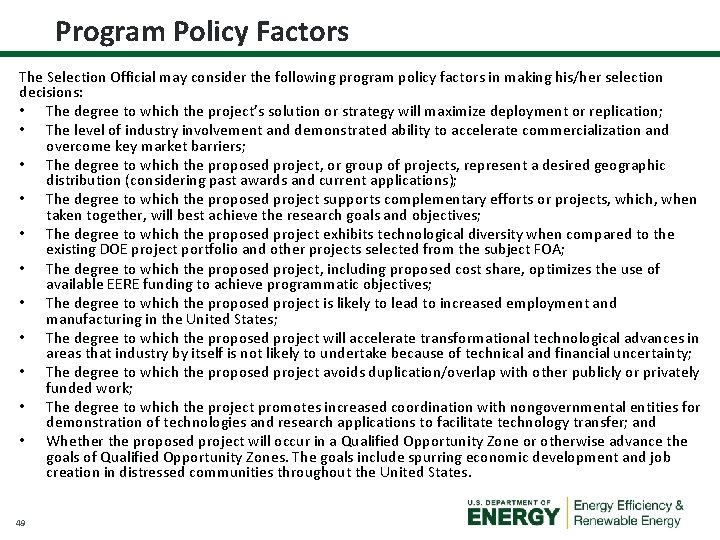
Program Policy Factors The Selection Official may consider the following program policy factors in making his/her selection decisions: • The degree to which the project’s solution or strategy will maximize deployment or replication; • The level of industry involvement and demonstrated ability to accelerate commercialization and overcome key market barriers; • The degree to which the proposed project, or group of projects, represent a desired geographic distribution (considering past awards and current applications); • The degree to which the proposed project supports complementary efforts or projects, which, when taken together, will best achieve the research goals and objectives; • The degree to which the proposed project exhibits technological diversity when compared to the existing DOE project portfolio and other projects selected from the subject FOA; • The degree to which the proposed project, including proposed cost share, optimizes the use of available EERE funding to achieve programmatic objectives; • The degree to which the proposed project is likely to lead to increased employment and manufacturing in the United States; • The degree to which the proposed project will accelerate transformational technological advances in areas that industry by itself is not likely to undertake because of technical and financial uncertainty; • The degree to which the proposed project avoids duplication/overlap with other publicly or privately funded work; • The degree to which the project promotes increased coordination with nongovernmental entities for demonstration of technologies and research applications to facilitate technology transfer; and • Whether the proposed project will occur in a Qualified Opportunity Zone or otherwise advance the goals of Qualified Opportunity Zones. The goals include spurring economic development and job creation in distressed communities throughout the United States. 49
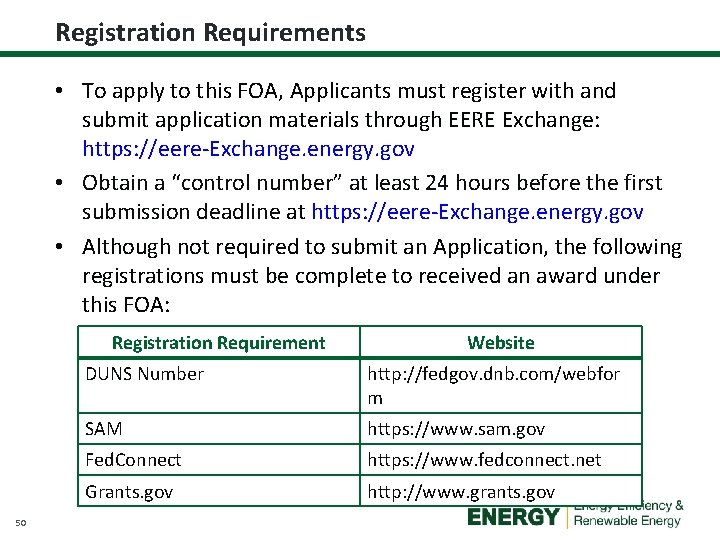
Registration Requirements • To apply to this FOA, Applicants must register with and submit application materials through EERE Exchange: https: //eere-Exchange. energy. gov • Obtain a “control number” at least 24 hours before the first submission deadline at https: //eere-Exchange. energy. gov • Although not required to submit an Application, the following registrations must be complete to received an award under this FOA: Registration Requirement 50 Website DUNS Number http: //fedgov. dnb. com/webfor m SAM https: //www. sam. gov Fed. Connect https: //www. fedconnect. net Grants. gov http: //www. grants. gov
Means of Submission • Concept Papers, Full Applications, and Replies to Reviewer Comments must be submitted through EERE Exchange at https: //eere-Exchange. energy. gov o EERE will not review or consider applications submitted through other means • The Users’ Guide for Applying to the Department of Energy EERE Funding Opportunity Announcements can be found at https: //eere-Exchange. energy. gov/Manuals. aspx 51
Key Submission Points • Check entries in EERE Exchange o Submissions could be deemed ineligible due to an incorrect entry • EERE strongly encourages Applicants to submit 1 -2 days prior to the deadline to allow for full upload of application documents and to avoid any potential technical glitches with EERE Exchange • Make sure you hit the submit button o Any changes made after you hit submit will un-submit your application and you will need to hit the submit button again • For your records, print out the EERE Exchange Confirmation page at each step, which contains the application’s Control Number 52
Applicant Points-of-Contact • Applicants must designate primary and backup points-ofcontact in EERE Exchange with whom EERE will communicate to conduct award negotiations • It is imperative that the Applicant/Selectee be responsive during award negotiations and meet negotiation deadlines o Failure to do so may result in cancellation of further award negotiations and rescission of the Selection 53
Questions • Questions about this FOA? Email CCPilots. FOA@ee. doe. gov o All Q&As related to this FOA will be posted on EERE Exchange o You must select this specific FOA Number in order to view Q&As o EERE will attempt to respond to a question within 3 business days, unless a similar Q&A is already posted on the website • Problems logging into EERE Exchange or uploading and submitting application documents with EERE Exchange? Email EERE-Exchange. Support@hq. doe. gov o Include FOA name and number in subject line • All questions regarding this presentation will be posted on EERE Exchange 54
- Slides: 54