
Unit 7 Introduction Marine Animals sans Backbone Where
Unit 7 Introduction Marine Animals sans Backbone
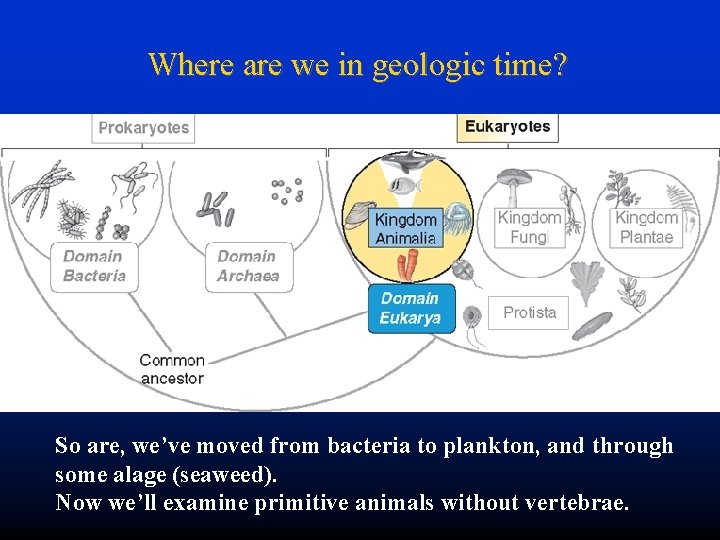
Where are we in geologic time? So are, we’ve moved from bacteria to plankton, and through some alage (seaweed). Now we’ll examine primitive animals without vertebrae.
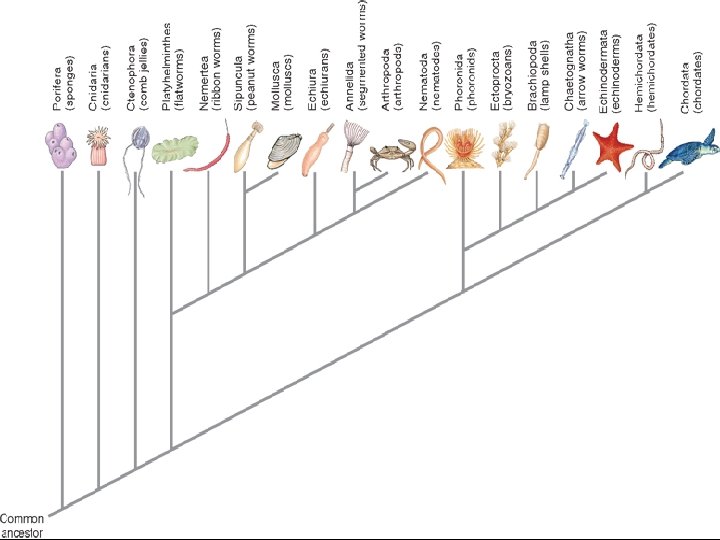
A. Introduction • Most (97%) of the amazing life which is located within the oceans, or anywhere else, doesn't have a backbone! • In every class of invertebrate we can find a marine example

Summary of Invertebrates • • • Porifera - sponge Cnidarians - “jellyfish” comb jellies Symmetrical Worms - flat, round, segmented worms Mollusks - snails, clams, oysters, scallops, octopi Arthropods - shrimp, lobster, insects Echinoderms - seastars, brittlestars, sea urchins

Sponges • Phylum Porifera “pore bearers” • Loose aggregation of specialized cells. • Cells do not actually form organs or tissues, but do serve similar functions, keeping the animal alive.
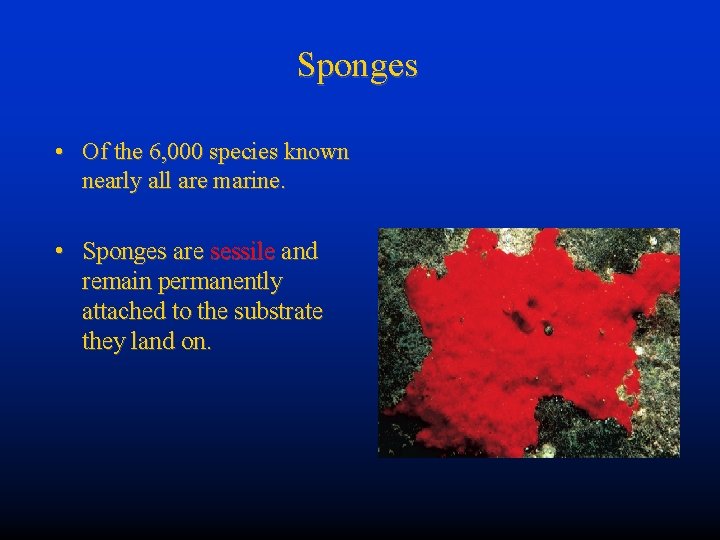
Sponges • Of the 6, 000 species known nearly all are marine. • Sponges are sessile and remain permanently attached to the substrate they land on.
B. Sponges: Composition • Ostia (tiny pores) – allow water to enter and circulate through series of canals where plankton and organic particles are filtered and eaten • If cells separate, can even regroup and form new sponge • Flexible skeletal frame (spicules) gives spongy texture
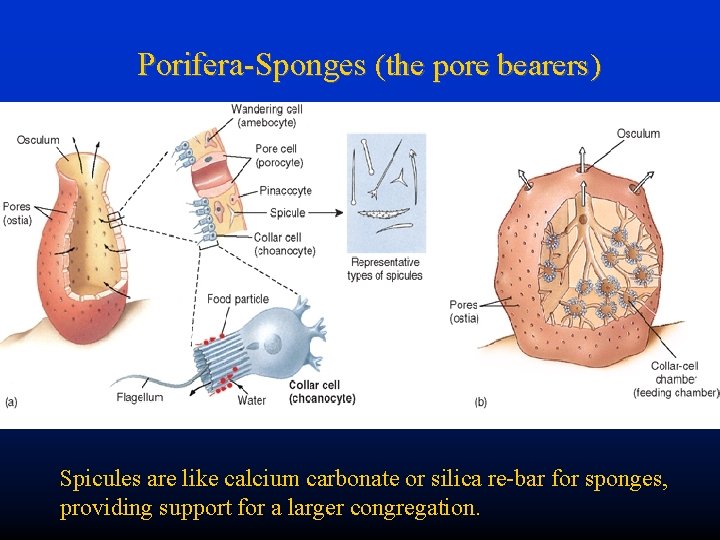
Porifera-Sponges (the pore bearers) Spicules are like calcium carbonate or silica re-bar for sponges, providing support for a larger congregation.
Porifera-Sponges (the pore bearers) Spicules are like calcium carbonate or silica re-bar for sponges, providing support for a larger congregation.
Sponges: Composition • Spicules are transparent and made of siliceous or calcareous supporting structures of different shapes and sizes • Skeleton made of protein spongin, spicules, or both
Sponges: Composition • Wandering cells, amebocytes, secrete spicules and spongin, transport and store food particles, and transform into other types of cells to quickly repair damage

Porifera-Sponges (the pore bearers)
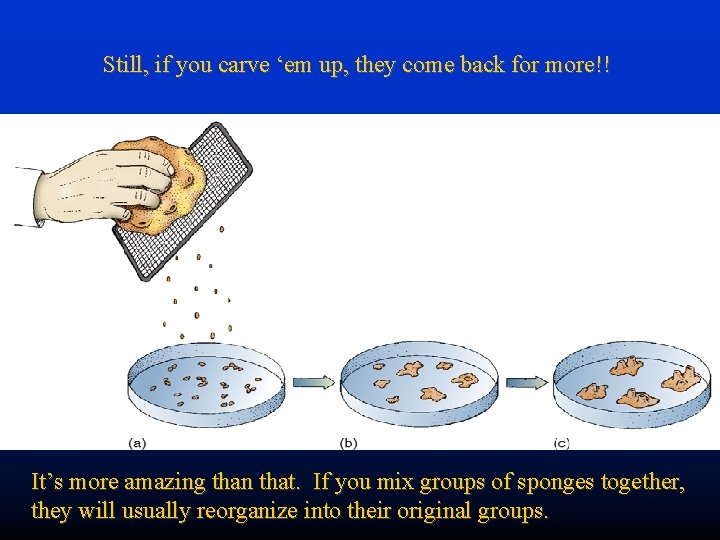
Still, if you carve ‘em up, they come back for more!! It’s more amazing than that. If you mix groups of sponges together, they will usually reorganize into their original groups.
C. Sponges: Feeding • Outer surface covered with flat cells called pinacocytes and pore cells (porocytes) which allows water to enter • Water pumped into larger feeding chamber lined with collar cells (choanocytes) • Each choanocytes have flagellum that creates currents and a thin collar that traps food particles, which is ingested by body of cell
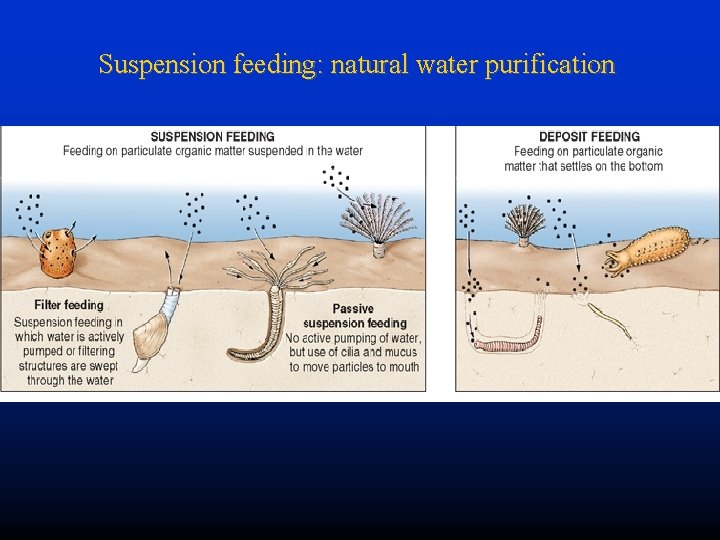
Suspension feeding: natural water purification

Sponges: Feeding • Water leaves through osculum, large opening at top of sponge

http: //www. youtube. com/watch? v= Rm. PTM 965 -1 c
D. Sponges: Reproduction • Asexually • If piece breaks off, it can form new sponge • Sexually • Specialized collar cells or amebocytes can turn into gametes • Large nutrient rich egg and smaller sperm with flagellum
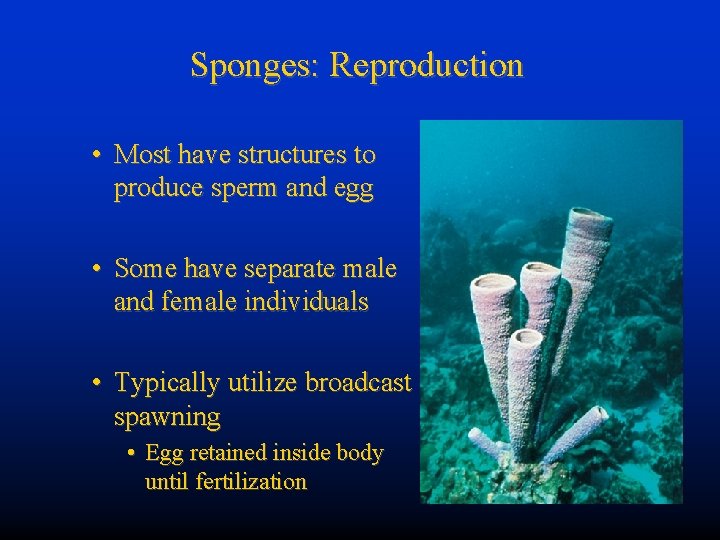
Sponges: Reproduction • Most have structures to produce sperm and egg • Some have separate male and female individuals • Typically utilize broadcast spawning • Egg retained inside body until fertilization
Sponges: Reproduction • Early development takes place internally • Flagellated sphere of cells (larva), parenchymula, is plankton like • Settles and metamorphosis into juvenile

Reproduction: Asexual vs. sexual Damage to a sponge can actually promote asexual reproduction, as “parts” can land elsewhere and form new sponges.
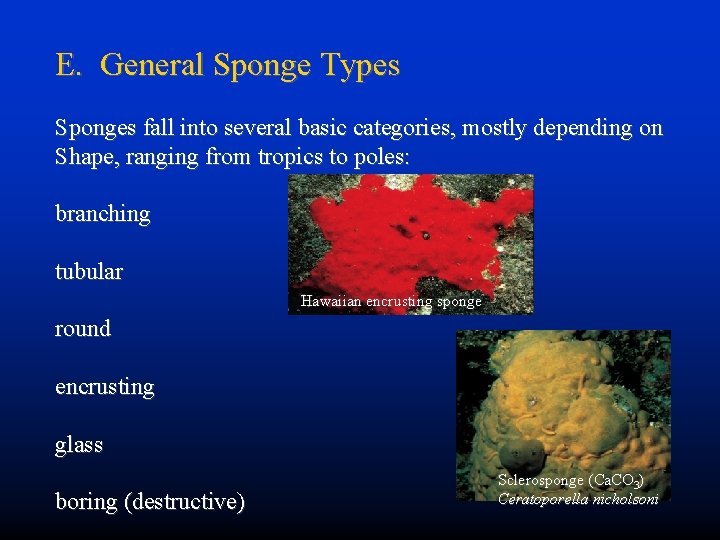
E. General Sponge Types Sponges fall into several basic categories, mostly depending on Shape, ranging from tropics to poles: branching tubular Hawaiian encrusting sponge round encrusting glass boring (destructive) Sclerosponge (Ca. CO 3) Ceratoporella nicholsoni
F. Sponges: Diversity • • • Branching and Tubular – volcano-like masses Encrusting – thin and brightly colored on rocks Glass – anchored in deep water sediments • Siliceous spicules (lace like) • Boring – bore into calcium carbonate (oysters and corals) • Sclerosponges (coral) – calcium carbonate skeleton forms beneath body of sponge
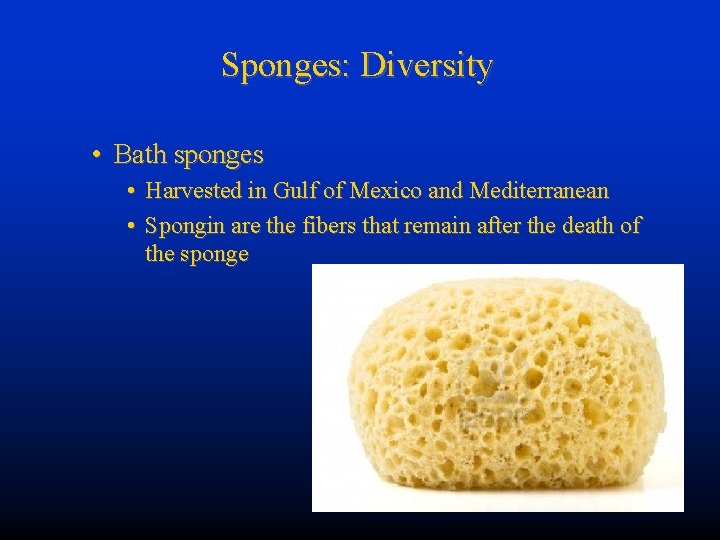
Sponges: Diversity • Bath sponges • Harvested in Gulf of Mexico and Mediterranean • Spongin are the fibers that remain after the death of the sponge
Copyright © The Mc. Graw-Hill Companies, Inc. Permission required for reproduction or display. G. Classification and Uses Skip three lines between each class 1. Class Calcarea 2. Class Hexactinellida 3. Class Demospongiae 12 -26
Copyright © The Mc. Graw-Hill Companies, Inc. Permission required for reproduction or display. Phylum Porifera Class Calcarea n n n BONY Sponges, spicules are made of calcium carbonate Most are small with tubular or vase shapes Many are drab in color, but some are bright yellow, green, red, or lavender 12 -27

Copyright © The Mc. Graw-Hill Companies, Inc. Permission required for reproduction or display. Phylum Porifera Class Hexactinellida n n n Glass sponges with six-rayed spicules of silica to form their skeleton Strong Internal skeleton with fused spicules Nearly all are deep-sea forms, cup shaped 12 -28
Copyright © The Mc. Graw-Hill Companies, Inc. Permission required for reproduction or display. Phylum Porifera Class Demospongiae n n n 12 -29 Contains 95% of living sponge species Spicules or skeletal system contains spongin Leuconoid body form mostly
Copyright © The Mc. Graw-Hill Companies, Inc. Permission required for reproduction or display. Phylum Porifera n Uses: n n n 12 -30 Dolphins attach sponge to nose, then search for food in sand. Serves as a protection. Humans - commercial sponges, washing Medicinal purposes? ? Antimicrobial compounds found on sponges

Copyright © The Mc. Graw-Hill Companies, Inc. Permission required for reproduction or display. Hexactinellid a Calcarea Demospongiae 12 -31
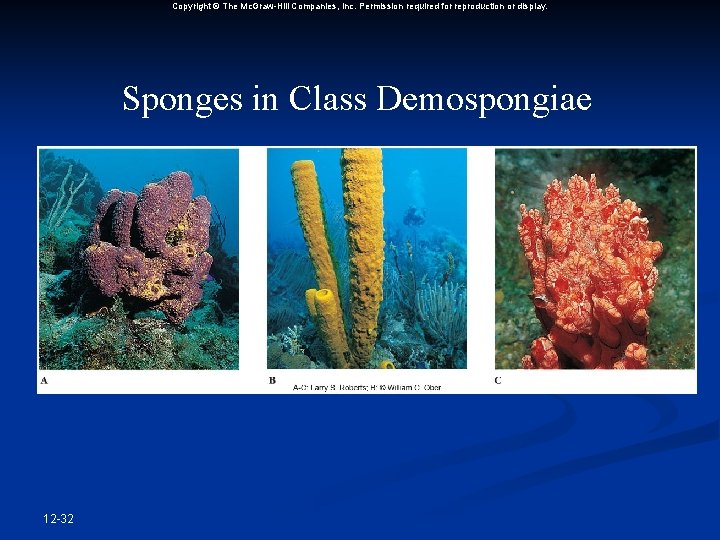
Copyright © The Mc. Graw-Hill Companies, Inc. Permission required for reproduction or display. Sponges in Class Demospongiae 12 -32
- Slides: 32