Cache Craftiness for Fast Multicore KeyValue Storage Yandong


- Slides: 38
Cache Craftiness for Fast Multicore Key-Value Storage Yandong Mao (MIT), Eddie Kohler (Harvard), Robert Morris (MIT)
Let’s build a fast key-value store • KV store systems are important – Google Bigtable, Amazon Dynamo, Yahoo! PNUTS • Single-server KV performance matters – Reduce cost – Easier management • Goal: fast KV store for single multi-core server – Assume all data fits in memory – Redis, Volt. DB
Feature wish list • Clients send queries over network • Persist data across crashes • Range query • Perform well on various workloads – Including hard ones!
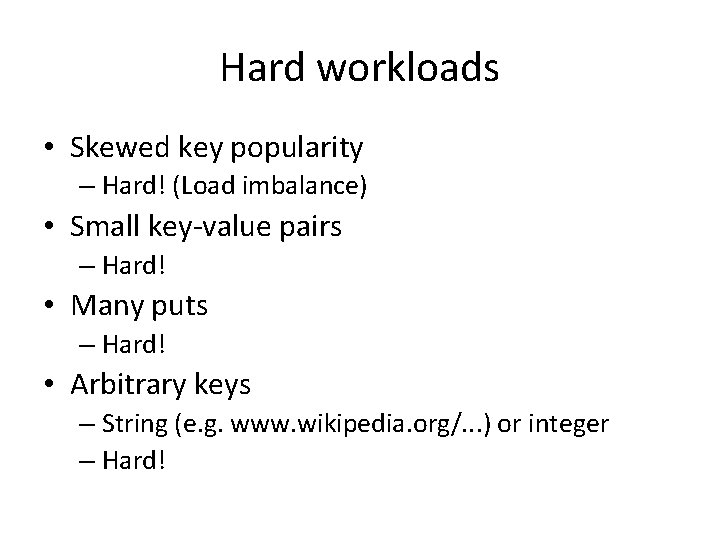
Hard workloads • Skewed key popularity – Hard! (Load imbalance) • Small key-value pairs – Hard! • Many puts – Hard! • Arbitrary keys – String (e. g. www. wikipedia. org/. . . ) or integer – Hard!
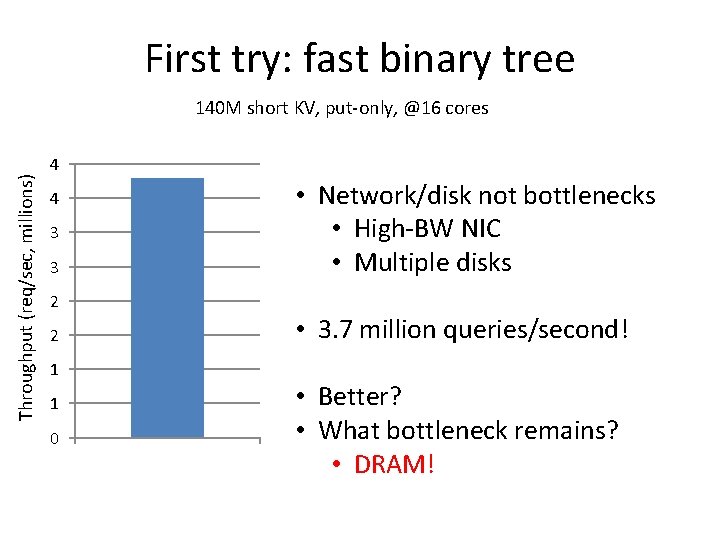
First try: fast binary tree Throughput (req/sec, millions) 140 M short KV, put-only, @16 cores 4 4 3 3 2 2 1 1 0 • Network/disk not bottlenecks • High-BW NIC • Multiple disks • 3. 7 million queries/second! • Better? • What bottleneck remains? • DRAM!
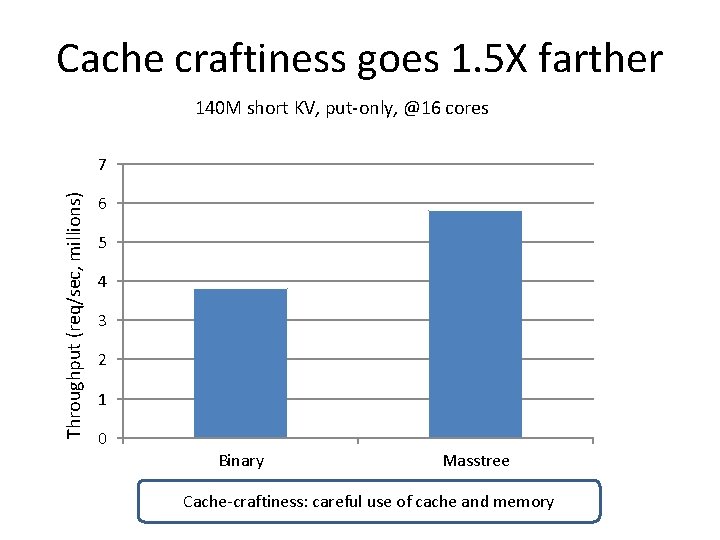
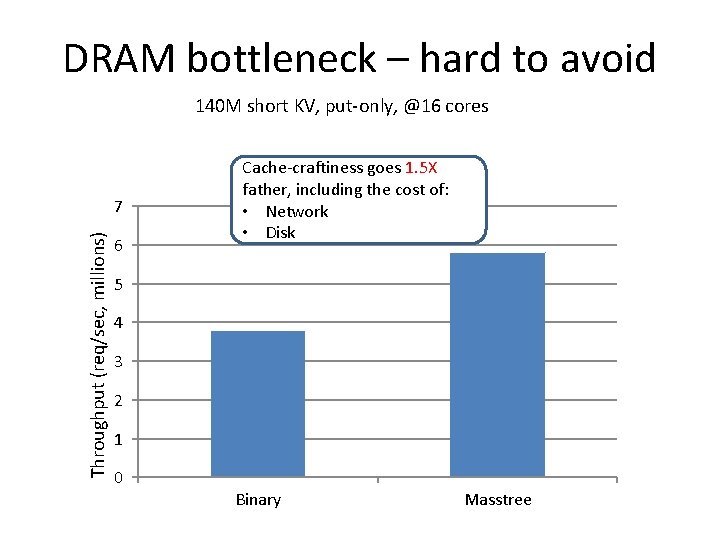
Cache craftiness goes 1. 5 X farther 140 M short KV, put-only, @16 cores Throughput (req/sec, millions) 7 6 5 4 3 2 1 0 Binary Masstree Cache-craftiness: careful use of cache and memory
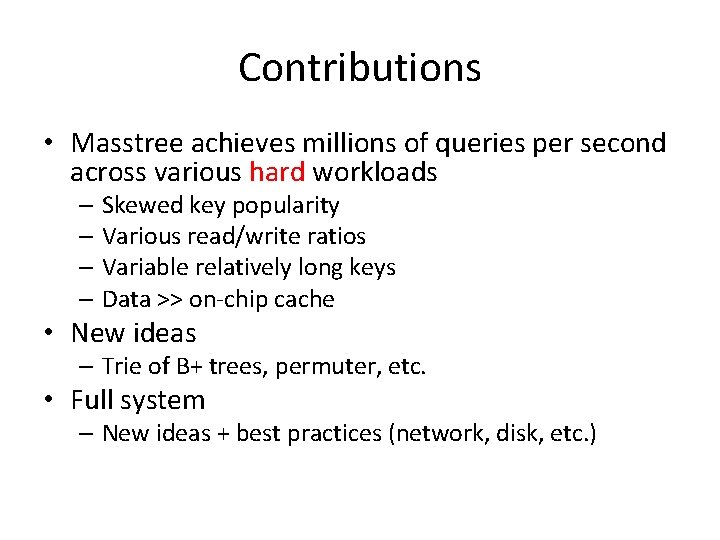
Contributions • Masstree achieves millions of queries per second across various hard workloads – Skewed key popularity – Various read/write ratios – Variable relatively long keys – Data >> on-chip cache • New ideas – Trie of B+ trees, permuter, etc. • Full system – New ideas + best practices (network, disk, etc. )
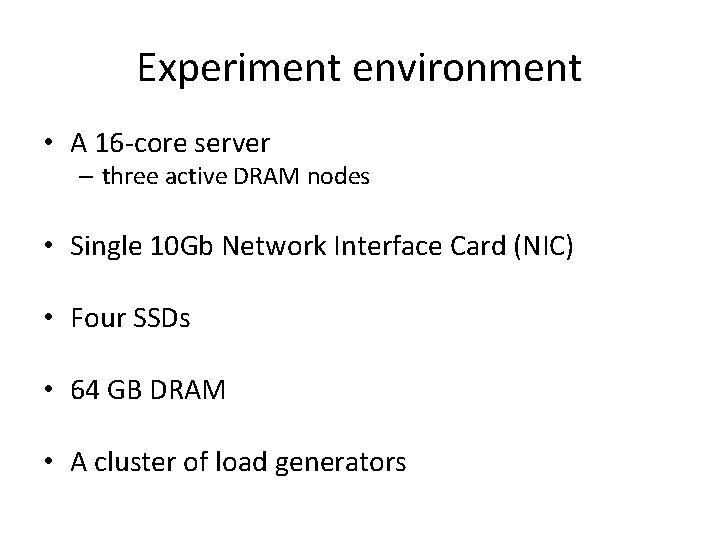
Experiment environment • A 16 -core server – three active DRAM nodes • Single 10 Gb Network Interface Card (NIC) • Four SSDs • 64 GB DRAM • A cluster of load generators
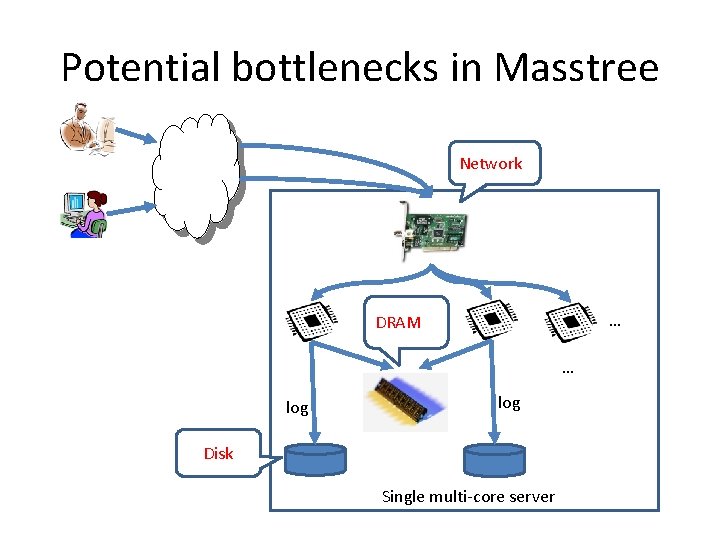
Potential bottlenecks in Masstree Network … DRAM … log Disk Single multi-core server
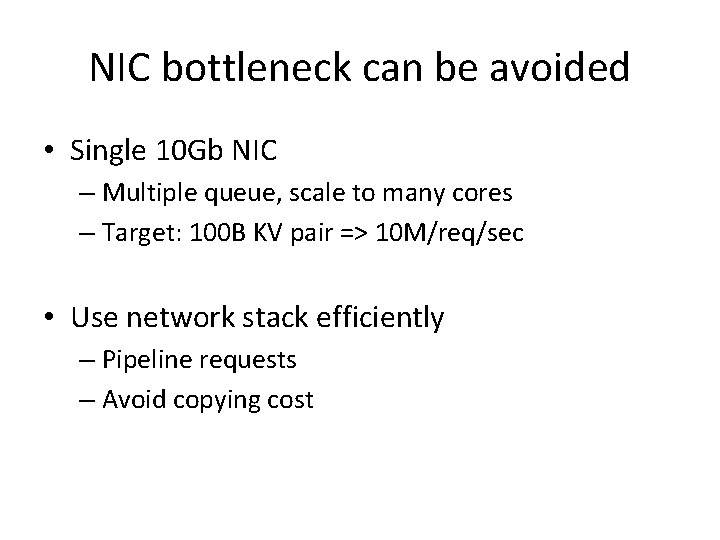
NIC bottleneck can be avoided • Single 10 Gb NIC – Multiple queue, scale to many cores – Target: 100 B KV pair => 10 M/req/sec • Use network stack efficiently – Pipeline requests – Avoid copying cost
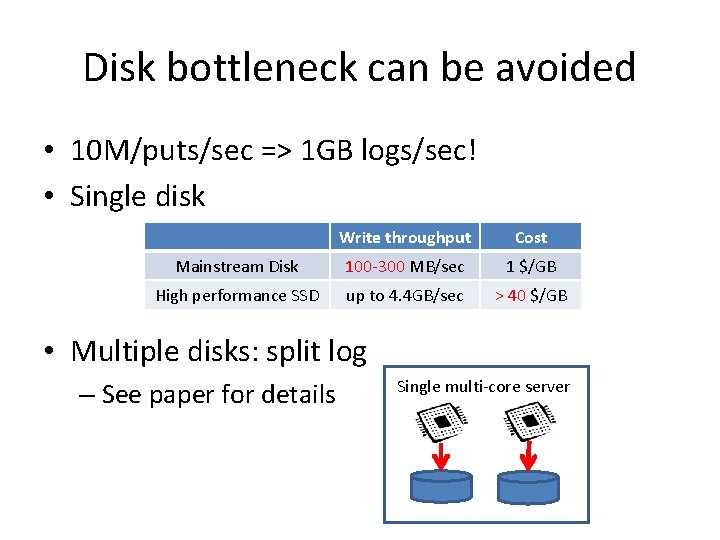
Disk bottleneck can be avoided • 10 M/puts/sec => 1 GB logs/sec! • Single disk Write throughput Cost Mainstream Disk 100 -300 MB/sec 1 $/GB High performance SSD up to 4. 4 GB/sec > 40 $/GB • Multiple disks: split log – See paper for details Single multi-core server
DRAM bottleneck – hard to avoid 140 M short KV, put-only, @16 cores Throughput (req/sec, millions) 7 6 Cache-craftiness goes 1. 5 X father, including the cost of: • Network • Disk 5 4 3 2 1 0 Binary Masstree
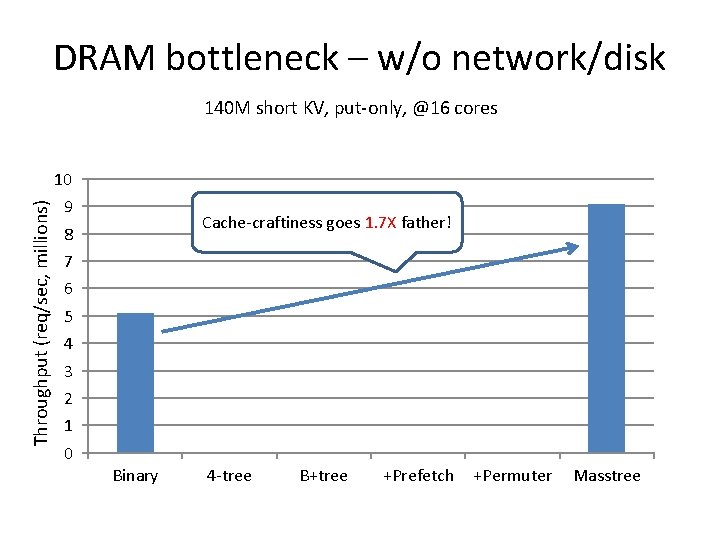
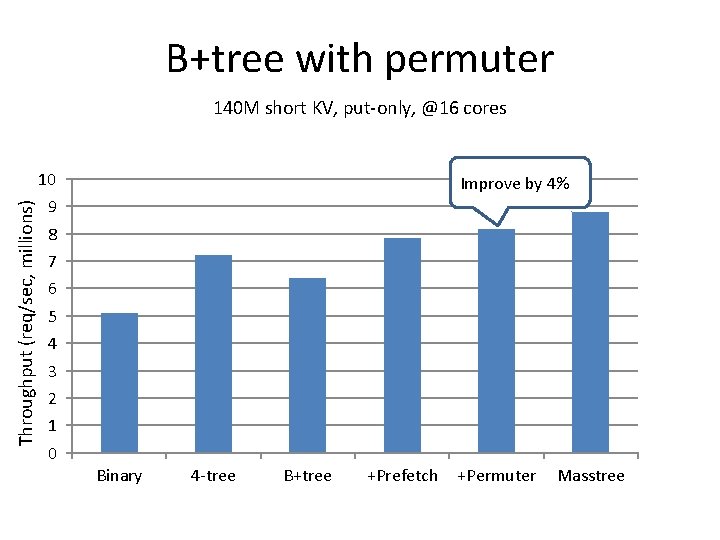
DRAM bottleneck – w/o network/disk 140 M short KV, put-only, @16 cores Throughput (req/sec, millions) 10 9 Cache-craftiness goes 1. 7 X father! 8 7 6 5 4 3 2 1 0 Binary 4 -tree B+tree +Prefetch +Permuter Masstree
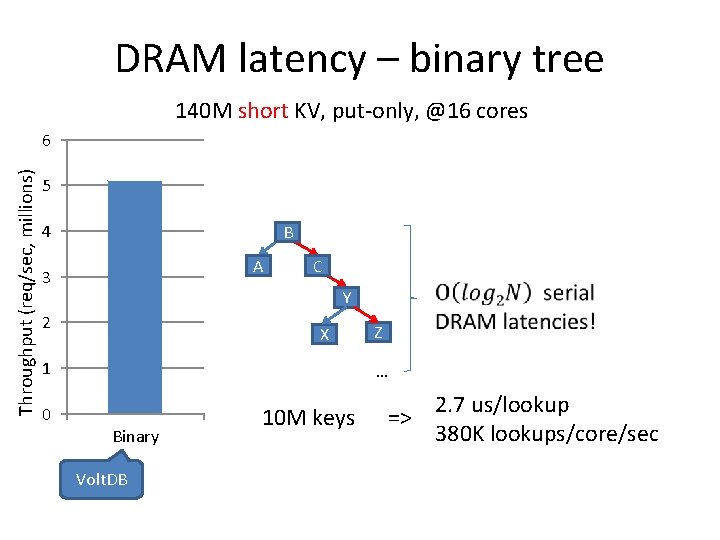
DRAM latency – binary tree 140 M short KV, put-only, @16 cores Throughput (req/sec, millions) 6 5 4 B A 3 C Y 2 X 1 0 Z … Binary Volt. DB 10 M keys 2. 7 us/lookup => 380 K lookups/core/sec
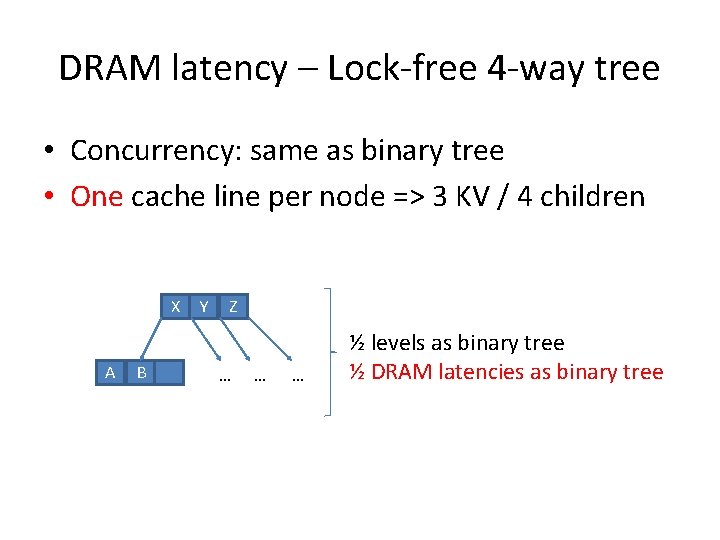
DRAM latency – Lock-free 4 -way tree • Concurrency: same as binary tree • One cache line per node => 3 KV / 4 children X A B Y Z … … … ½ levels as binary tree ½ DRAM latencies as binary tree
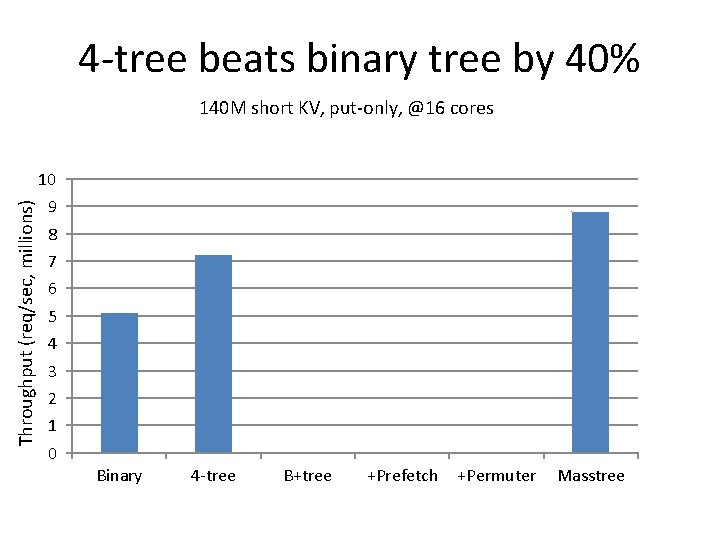
4 -tree beats binary tree by 40% 140 M short KV, put-only, @16 cores Throughput (req/sec, millions) 10 9 8 7 6 5 4 3 2 1 0 Binary 4 -tree B+tree +Prefetch +Permuter Masstree
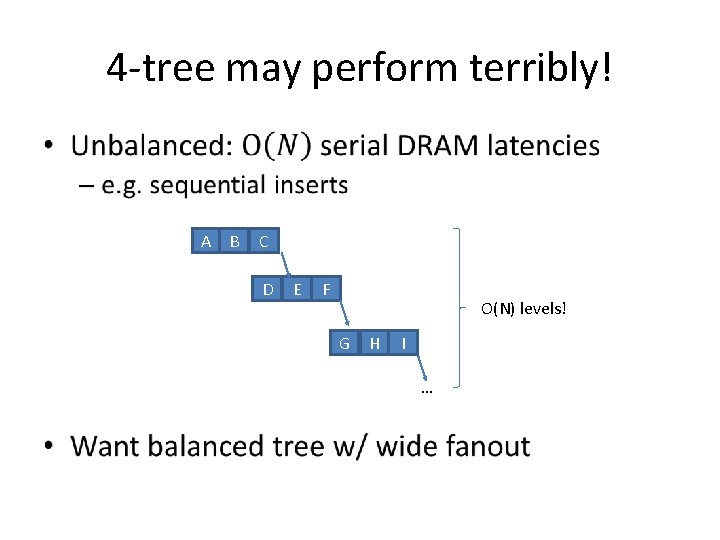
4 -tree may perform terribly! A B C D E F O(N) levels! G H I …
B+tree – Wide and balanced • Balanced! • Concurrent main memory B+tree [OLFIT] – Optimistic concurrency control: version technique – Lookup/scan is lock-free – Puts hold ≤ 3 per-node locks
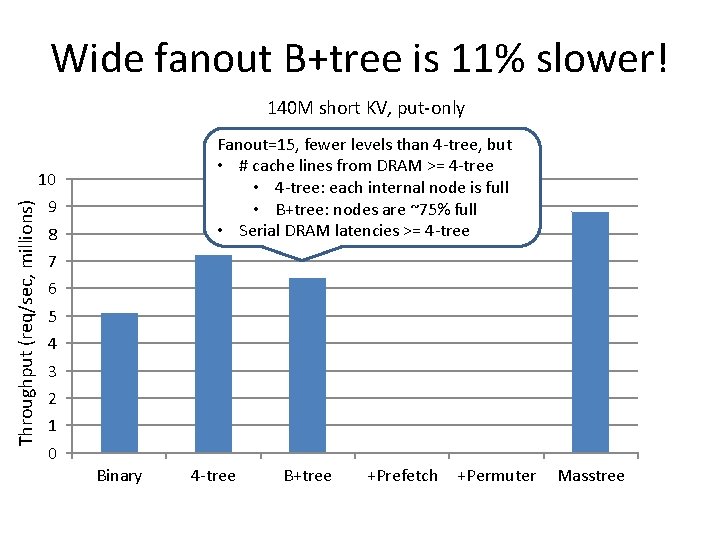
Wide fanout B+tree is 11% slower! 140 M short KV, put-only Fanout=15, fewer levels than 4 -tree, but • # cache lines from DRAM >= 4 -tree • 4 -tree: each internal node is full • B+tree: nodes are ~75% full • Serial DRAM latencies >= 4 -tree Throughput (req/sec, millions) 10 9 8 7 6 5 4 3 2 1 0 Binary 4 -tree B+tree +Prefetch +Permuter Masstree
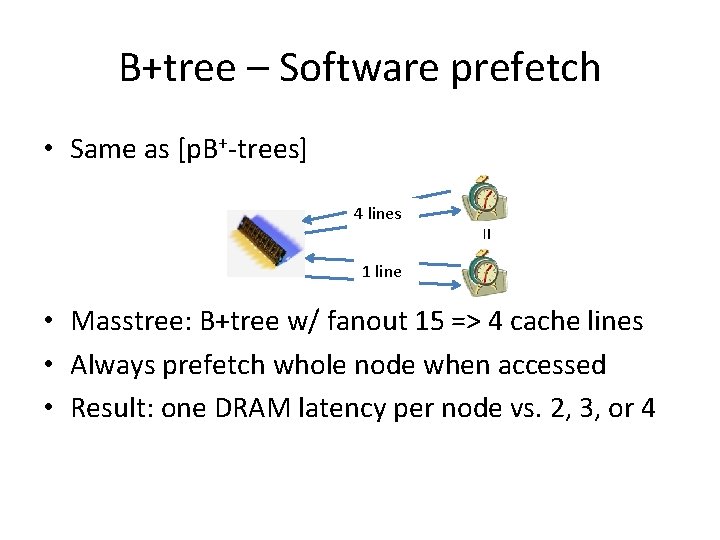
B+tree – Software prefetch • Same as [p. B+-trees] 4 lines = 1 line • Masstree: B+tree w/ fanout 15 => 4 cache lines • Always prefetch whole node when accessed • Result: one DRAM latency per node vs. 2, 3, or 4
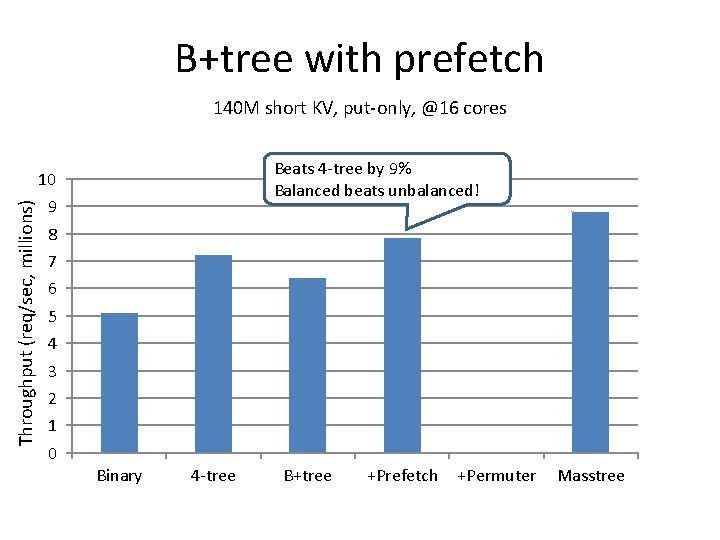
B+tree with prefetch 140 M short KV, put-only, @16 cores Beats 4 -tree by 9% Balanced beats unbalanced! Throughput (req/sec, millions) 10 9 8 7 6 5 4 3 2 1 0 Binary 4 -tree B+tree +Prefetch +Permuter Masstree
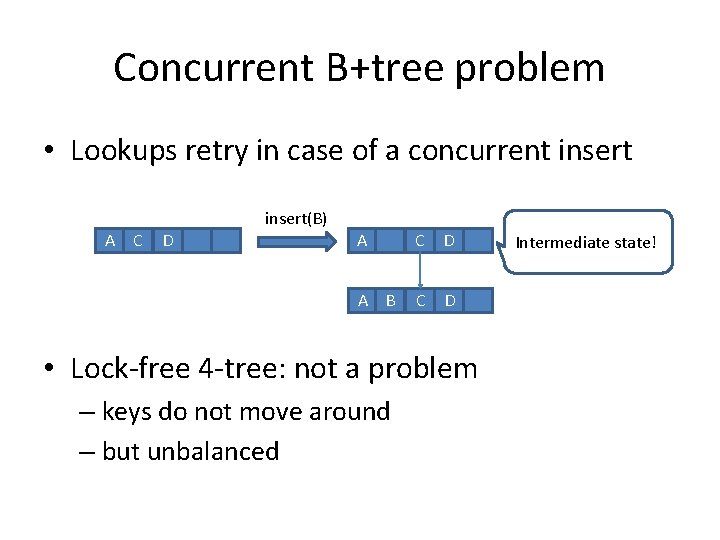
Concurrent B+tree problem • Lookups retry in case of a concurrent insert A C D insert(B) A C D A B C D • Lock-free 4 -tree: not a problem – keys do not move around – but unbalanced Intermediate state!
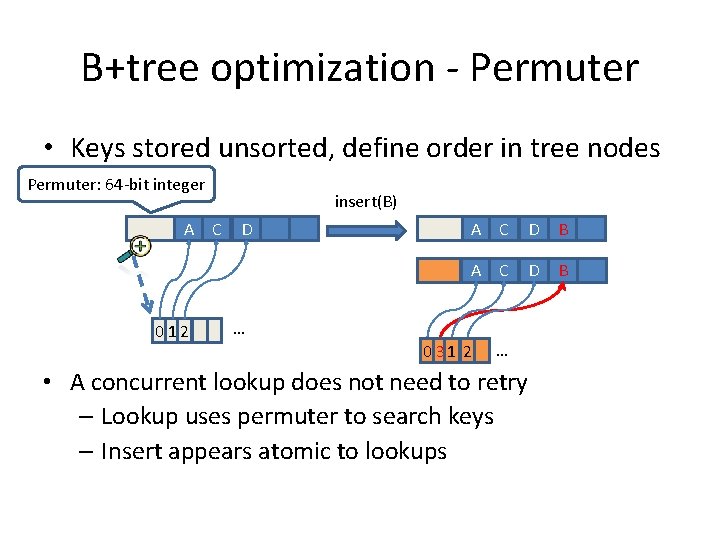
B+tree optimization - Permuter • Keys stored unsorted, define order in tree nodes Permuter: 64 -bit integer A C 0 12 insert(B) D A C D B … 0 31 2 … • A concurrent lookup does not need to retry – Lookup uses permuter to search keys – Insert appears atomic to lookups
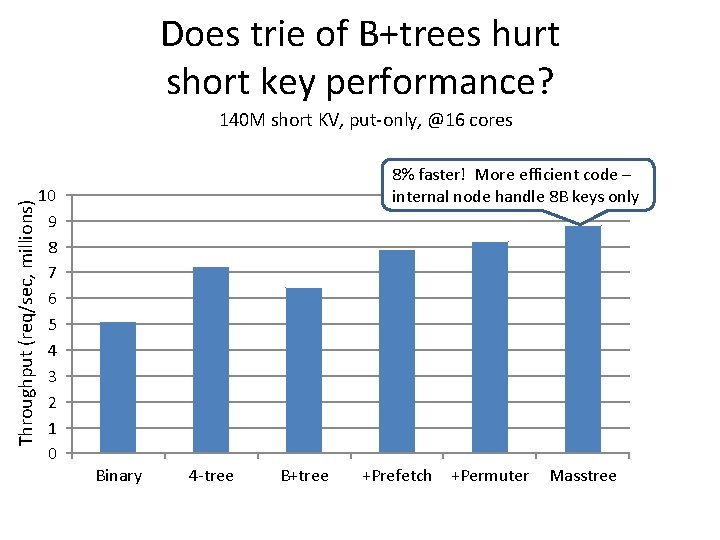
B+tree with permuter 140 M short KV, put-only, @16 cores Throughput (req/sec, millions) 10 Improve by 4% 9 8 7 6 5 4 3 2 1 0 Binary 4 -tree B+tree +Prefetch +Permuter Masstree
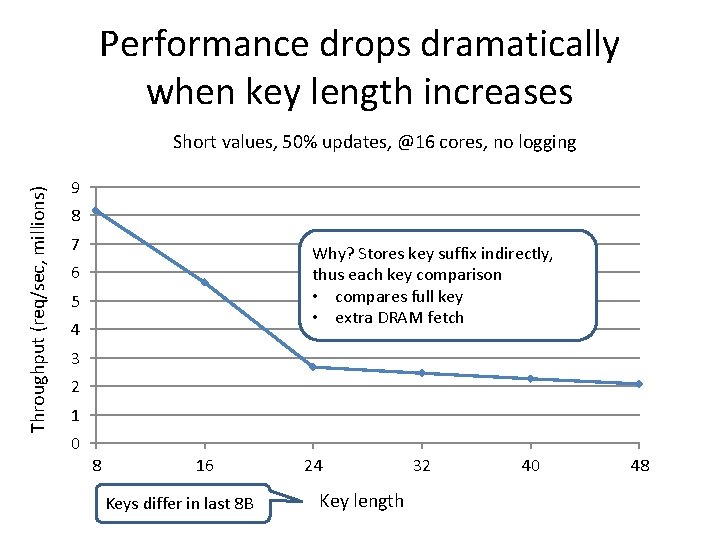
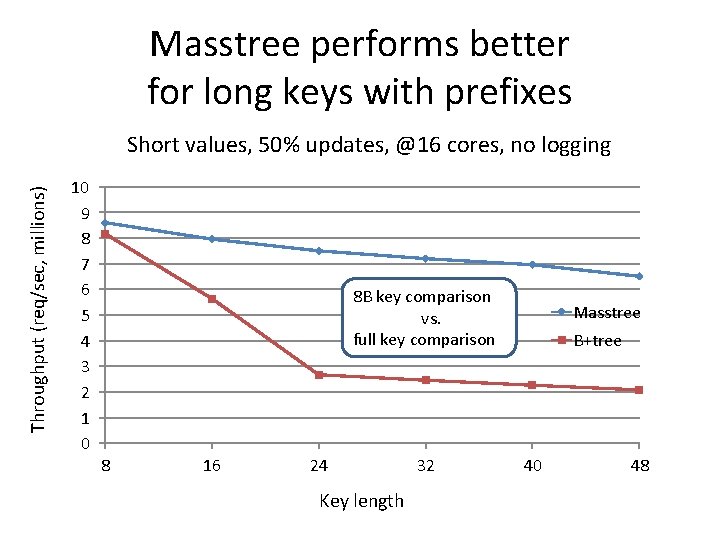
Performance drops dramatically when key length increases Throughput (req/sec, millions) Short values, 50% updates, @16 cores, no logging 9 8 7 Why? Stores key suffix indirectly, thus each key comparison • compares full key • extra DRAM fetch 6 5 4 3 2 1 0 8 16 Keys differ in last 8 B 24 Key length 32 40 48
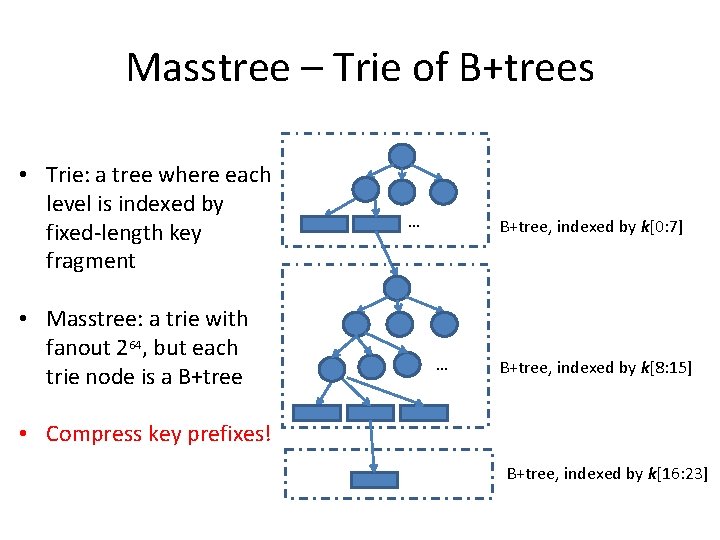
Masstree – Trie of B+trees • Trie: a tree where each level is indexed by fixed-length key fragment • Masstree: a trie with fanout 264, but each trie node is a B+tree … B+tree, indexed by k[0: 7] … B+tree, indexed by k[8: 15] • Compress key prefixes! B+tree, indexed by k[16: 23]
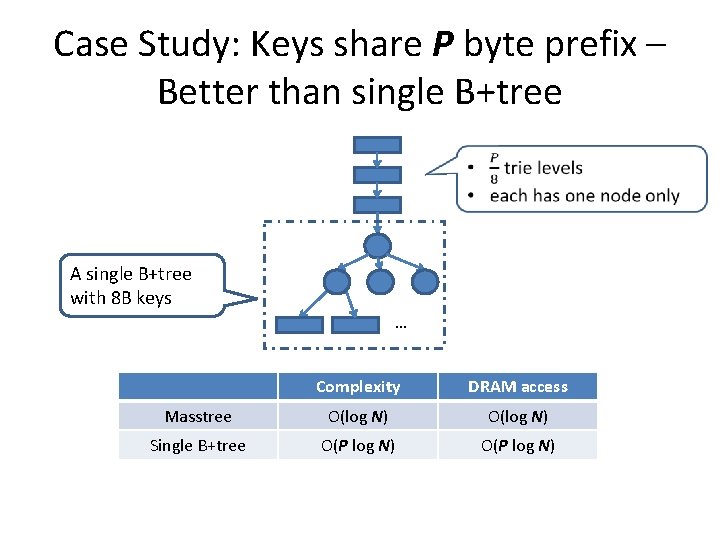
Case Study: Keys share P byte prefix – Better than single B+tree A single B+tree with 8 B keys … Complexity DRAM access Masstree O(log N) Single B+tree O(P log N)
Masstree performs better for long keys with prefixes Throughput (req/sec, millions) Short values, 50% updates, @16 cores, no logging 10 9 8 7 6 5 4 3 2 1 0 8 B key comparison vs. full key comparison 8 16 24 Key length 32 Masstree B+tree 40 48
Does trie of B+trees hurt short key performance? Throughput (req/sec, millions) 140 M short KV, put-only, @16 cores 10 9 8 7 6 5 4 3 2 1 0 8% faster! More efficient code – internal node handle 8 B keys only Binary 4 -tree B+tree +Prefetch +Permuter Masstree
Evaluation • Masstree compare to other systems? • Masstree compare to partitioned trees? – How much do we pay for handling skewed workloads? • Masstree compare with hash table? – How much do we pay for supporting range queries? • Masstree scale on many cores?
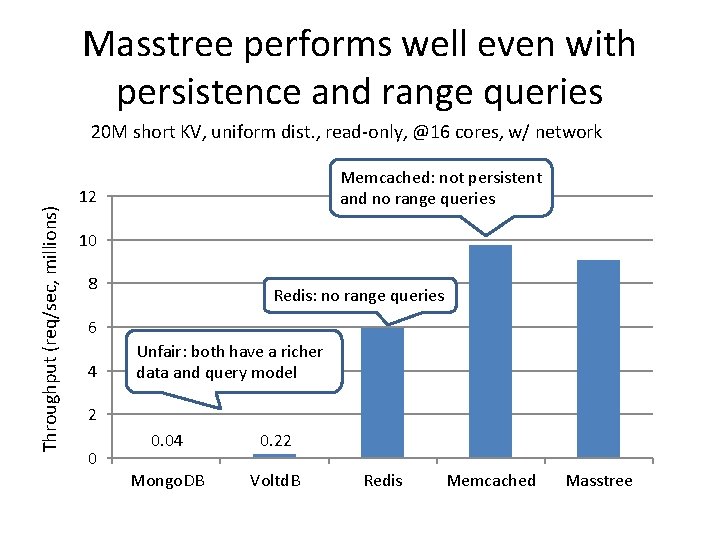
Masstree performs well even with persistence and range queries Throughput (req/sec, millions) 20 M short KV, uniform dist. , read-only, @16 cores, w/ network Memcached: not persistent and no range queries 12 10 8 Redis: no range queries 6 4 Unfair: both have a richer data and query model 2 0 0. 04 0. 22 Mongo. DB Voltd. B Redis Memcached Masstree
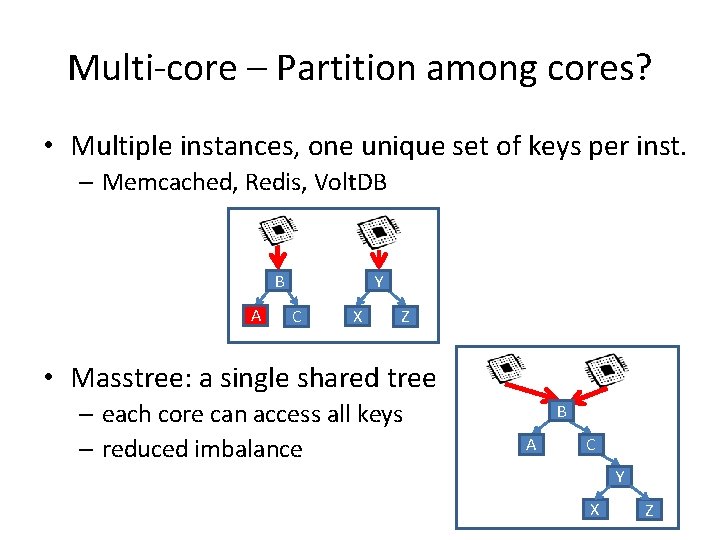
Multi-core – Partition among cores? • Multiple instances, one unique set of keys per inst. – Memcached, Redis, Volt. DB B A Y C X Z • Masstree: a single shared tree – each core can access all keys – reduced imbalance B A C Y X Z
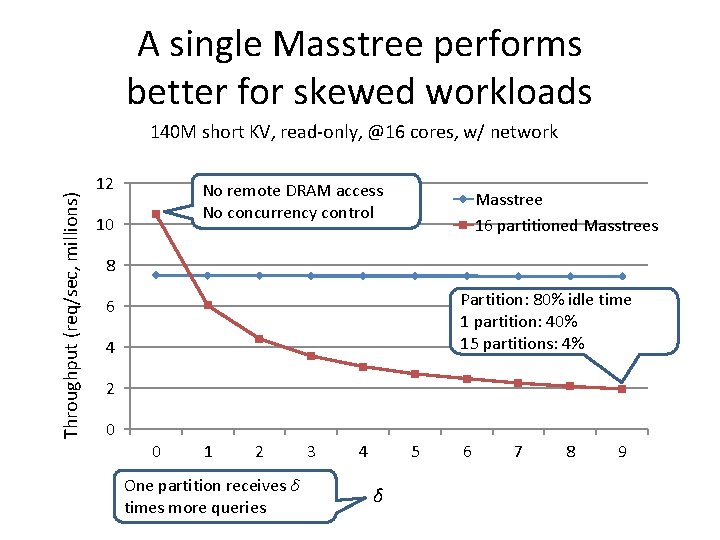
A single Masstree performs better for skewed workloads Throughput (req/sec, millions) 140 M short KV, read-only, @16 cores, w/ network 12 No remote DRAM access No concurrency control 10 Masstree 16 partitioned Masstrees 8 Partition: 80% idle time 1 partition: 40% 15 partitions: 4% 6 4 2 0 0 1 2 One partition receives δ times more queries 3 4 5 δ 6 7 8 9
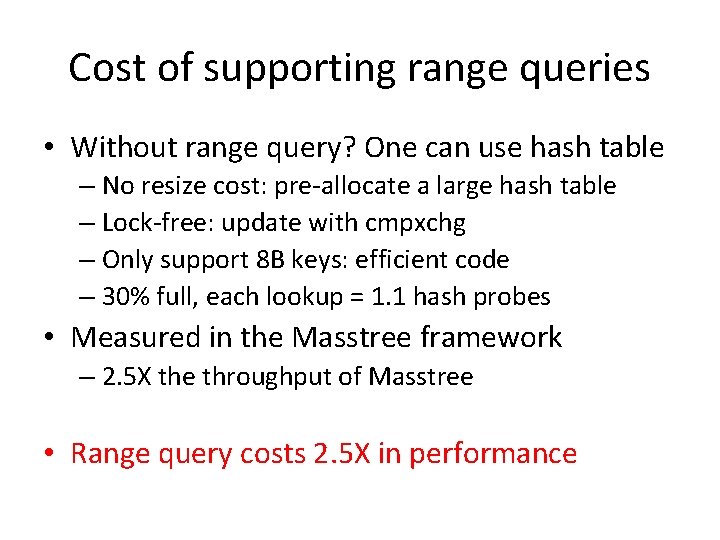
Cost of supporting range queries • Without range query? One can use hash table – No resize cost: pre-allocate a large hash table – Lock-free: update with cmpxchg – Only support 8 B keys: efficient code – 30% full, each lookup = 1. 1 hash probes • Measured in the Masstree framework – 2. 5 X the throughput of Masstree • Range query costs 2. 5 X in performance
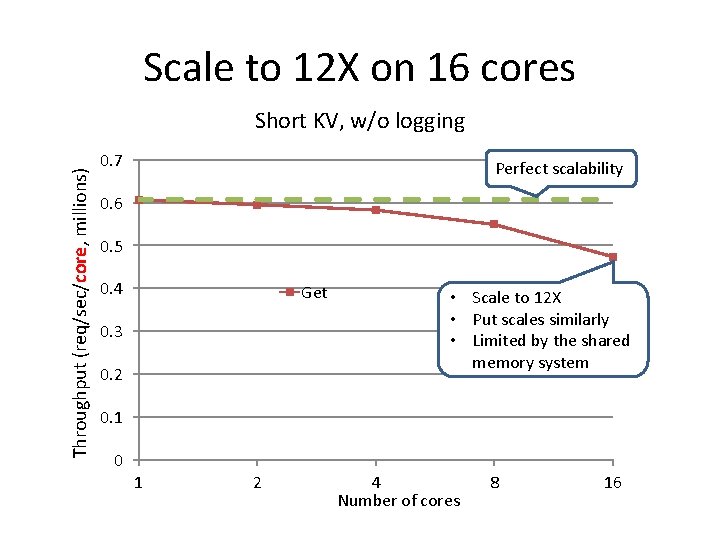
Scale to 12 X on 16 cores Throughput (req/sec/core, millions) Short KV, w/o logging 0. 7 Perfect scalability 0. 6 0. 5 0. 4 Get 0. 3 0. 2 • Scale to 12 X • Put scales similarly • Limited by the shared memory system 0. 1 0 1 2 4 Number of cores 8 16
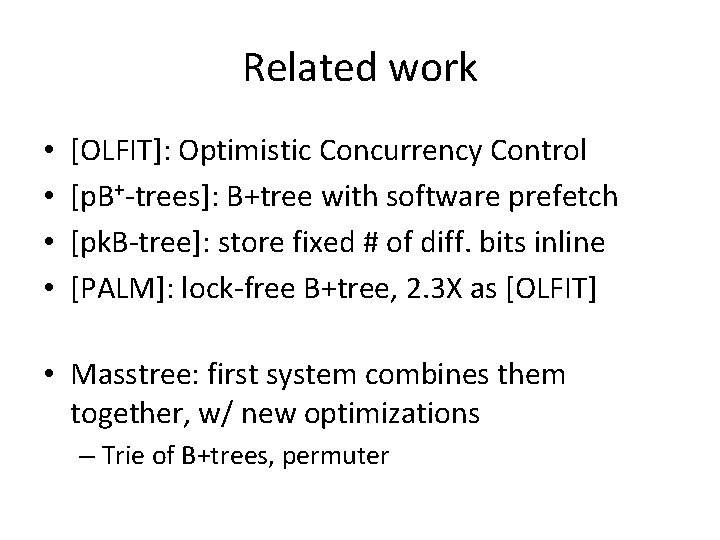
Related work • • [OLFIT]: Optimistic Concurrency Control [p. B+-trees]: B+tree with software prefetch [pk. B-tree]: store fixed # of diff. bits inline [PALM]: lock-free B+tree, 2. 3 X as [OLFIT] • Masstree: first system combines them together, w/ new optimizations – Trie of B+trees, permuter
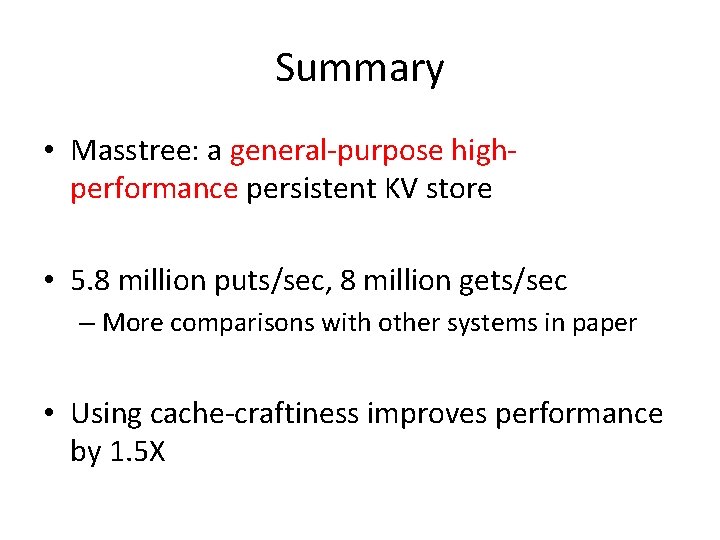
Summary • Masstree: a general-purpose highperformance persistent KV store • 5. 8 million puts/sec, 8 million gets/sec – More comparisons with other systems in paper • Using cache-craftiness improves performance by 1. 5 X
Thank you!