Attention anomalies You have time to take only


- Slides: 106
Attention anomalies • You have time to take only a limited # of courses • How did you choose to take this course? • Investors have time to weigh the merits of only a limited # of stocks. • Why do they consider some stocks and not others? 2/23/2009 Behavioral Finance 1
Attention as a scarce resource • In making decisions we first select which options to consider and then decide which of those options to choose. • When there are many alternatives, options that attract attention are more likely to be considered, hence more likely to be chosen, while the options which do not attrect attention are often ignored. • Attention affects buying – where investors search across thousands of stocks, more then selling – where investors generally choose only for the few stocks that they own. • While each investor does not buy every single stocks that grabs his attention, individual investors are more likely to buy attention-grabbing stocks than to sell them. 2/23/2009 Behavioral Finance 2
All that glitters: buying and selling of stocks Barber and Odean (2008) • In theory, the decisions to buy and sell usually differ only by a minus sign. – However, most individual investors hold relatively few common stocks – Most individual investors only sell stocks that they already own, i. e. do not sell short • For actual investors, the decision to buy and to sell are fundamentally different: – When buying a stock investors are faced with a formidable search problem. Thousands stocks to choose from. – There are cognitive – and temporal – limits to how much information we can process. – We are generally not able to rank hundreds, much less, thousands of alternatives. – Doing so is even more difficult when the alternatives differ on multiple criteria, e. g. risk, return, uncertainty over the distribution of returns etc • The solution: limit the choice set. It is far easier to choose among 10 alternatives than 100. 2/23/2009 Behavioral Finance 3
Narrowing down the search set • How do investor manage the problem of choosing among thousands of possible stock purchases? • How do investor limit their choice set? • They limit their search to stocks that have recently caught their attention • Of course, they do not buy all stock that catch their attention – However, for the most part, they buy stock that do so – Which attention-grabbing stocks investors buy will depend on their personal preferences. – Contrarian investors, for example, will tend to buy out-of-favor stocks that catch their eye. – Momentum investors will chase recent performers 2/23/2009 Behavioral Finance 4
Attention and institutional investors • Attention as a major factor determining the stocks individual investors buy • Does it affect institutional investors in equal way? – Unlike individual investors, institutional investors have a significant searching problem when selling • They hold a large variety of different stocks • Many institutional investors, e. g. hedge funds, routinely sell short – Attention is not as a scarce resource for institutional investors as for individuals • Institutional investors devote more time to investing = searching for stocks to buy and sell - then most individuals • Most institutions use computers to narrow their search • Additionally, they may limit their search to stock in particular sector (e. g. Biotech) or meeting specific criteria (e. g. Low price-to-earnings ratio), thus reducing attention demand. – Individuals may also use computers and/or pre-selection criteria, however on average they are less likely to do so 2/23/2009 Behavioral Finance 5
How does a stock grab investor attention? • News – Of course, chat rooms or word of mouth can play a role – However, event attracting attention of many investors is usually newsworthy • Unusual trading volume – If an unusual number of investors trade a stock it is nearly tautological that an unusual number are paying attention to that stock • Extreme returns – Significant returns will often, in and of themselves, attract attention 2/23/2009 Behavioral Finance 6
Does attention lead to more stocks buying? • Busse and Green (2002) – When Maria Bartiromo mentions a stock during the Midday Call on CNBC volume in the stock increases nearly fivefold (on average) in the minutes following the mention • Hirshleifer, Myers, and Teoh (2003) – Individual investors are net buyers follwoing both positive and negative earning surprises • Odean (1999) – Individual investors tend to buy shares that have experienced greater absolute price changes (either positive or negative large price change) over the previous years than the stocks they sell 2/23/2009 Behavioral Finance 7
Does attention lead to more stocks buying? -2 • Huddard, Lang, Yetman (2009) – Trading volume is strikingly higher when the stock price crosses either the upper or lower limit of its past trading average (52 week high or low) – Sharp increase in volume is more pronounced • the longer the time since the stock price last achieved the price extreme (i. e. if stock’s price does not go out of historic bounds too often) • for stock traded primarily by individual investors, e. g. small stocks – Individual investors are net buyers of the stocks • Barber and Odean (2009) – Individual investors are net buyers on high volume days, following extremely negative and extremely positive one-day returns, and when stocks are in the news. – Institutional investors, especially value strategy investors, do not display attention driven buying 2/23/2009 Behavioral Finance 8
Does investor attention move stock prices? • It does! • Does it have short or long-term effects on prices? • Depends on for how long you are able to capture investors’ attention • Short-term vs long-term effects • Fehle, Tsyplakov and Zdorovtsov (2005) – Firms airing three or more TV commercials during the Super Bowl broadcasts expereince a permanent 0. 45% abnormal increase in stock price. – Goes up till 2% over 20 days, disappears afterwards – Substantial increase in the # of small trades indicating that individual investors are primarily responsible for the price increase 2/23/2009 Behavioral Finance 9
Short-term attention effects -2 • Meschke (2009) – CEO interviews broadcast on CNBC leads to abnormally high trading volume on the day of the interview and surrounding days – Abnormal return of 1. 86% over two days prior to the interview – Additional 1. 65% abnormal price increase on the interview day – Most of the price increase disappears shortly • Over the subsequent 10 trading days abnormal trading return of negative 2. 78% – Proposed explanation: prices react to buying pressure by correlated noise traders 2/23/2009 Behavioral Finance 10
Short-term attention effects -3 • Tetlock (2008) ”All the News that’s Fit to Reprint: Do investors React to Stale Information? ” – Draws from the psychologic phenomenon known as ”truth effect”: repetition increases one’s familiarity with a claim, which generates a feeling of greater likelihoood that the claim is actually true. – This phenomenon occurs regardless of whether the repetition of a statement conveys any new information. – Beyond the truth effect, some readers of a news article may not realize the extent to which other market participants are already aware of the information. This unawareness could these readers to overreact to old information. – Does the repetition of the news published over the previous X days affect returns? • Yes, it does. Substantial, but temporary increase in stock price of the company. • This effect is reversed within several days. Reversal is larger for larger companies, companies with similar news coming most recently • The temporary price deviations seem to be driven by individual investors’ buying pressure. 2/23/2009 Behavioral Finance 11
Short-term attention effects -4 • • • A description of the news stories about Abbott Laboratories before and after June 12 th of 2002 illustrates the potential of the stale information hypothesis. At 8: 27 am on June 11 th, which I label as trading day -1, the Dow Jones News Service (DJNS) released an article entitled “Abbott Cuts View amid Plant, Obesity Drug Woes. ” This event seemingly led to a 14. 5% drop in Abbott‘s stock price, based on its close-toclose returns relative to the value-weighted market index. On the next morning, June 12 th or day 0, the Wall Street Journal (WSJ) published a very similar—but not identical—article entitled “Abbott Labs Reduces Forecast for Earnings, Takes a Charge. ” During trading day 0, Abbott‘s stock price fell by an additional 3. 8%, or $2. 0 billion in market value. Several hours after the market closed on June 12 th, additional similar stories appeared in other news sources such as the CBS television network, which could explain why Abbott‘s price fell by another 1. 9% on June 13 th—i. e. , trading day 1. Curiously, much of the day-0 (and day-1) price reaction to Abbott‘s news was reversed during the rest of the week (i. e. , June 14 th through June 19 th, or days 2 through 5) as Abbott beat the value-weighted index by 3. 7%. 2/23/2009 Behavioral Finance 12
Short-term attention effects -5 • Da, Engelbert, Gao (2009) – Investigate how often the company is being searched in Google – Why is it of interest? # of Google searches could be related to investors paying more or less attention to the stock – In weeks prior to IPO there’s a huge increase in the # of company searches in Google, subsides to the pre-IPO level within weeks after the IPO – The bigger is the spike, the higher the first day IPO return, however, the worse the long -run performance of IPO company – Companies with increase in Google search exhibit a temporary (1 month) abnormal increase in stock prices (about 2. 5%), reverses afterwards 2/23/2009 Behavioral Finance 13
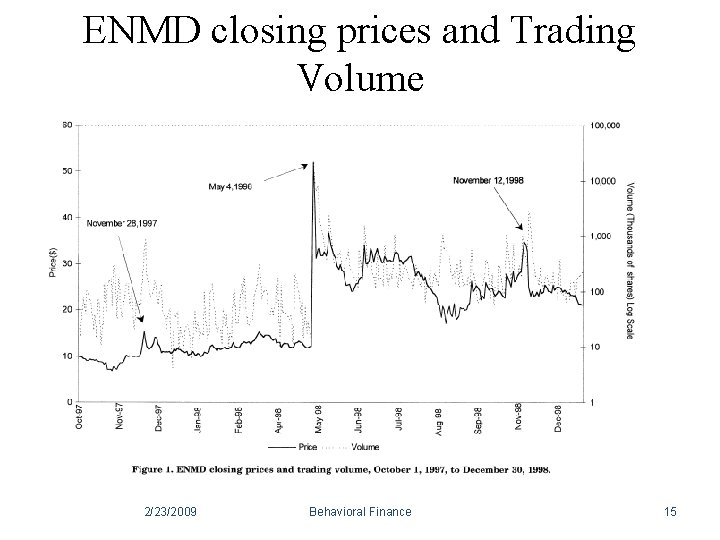
Long-term effects of attention • Huberman and Regev (2001) – Sunday, May 3 rd 1998 NY Times reported on a recent breakthrough in cancer research and mentions ENMD, a company with licensing right to the breakthrough. – The story impact on a stock price was immediate, huge and to a large degree permanent – The news content of the Article was nil • The substance of the story had been published as a scientific piece in Nature and in the popular press including the NY Times itslef more than five times earlier, on November 28 th, 1997 • Major price movement happened on and after May 4 th 1998, and relatively little happened in November 1997 • No-news Times article caused stock price to more than double, on a permanent basis – On November 12 th, 1998 the Wall Street Journal reported that other laboratories failed to replicate the results described earlier in the NYTimes. • ENMD shares fell from 32. 625 to 24. 875 – still more than twice ENMD’s price on May 1 – Moreover, even ENMD’s biotech peers enjoyed abnormal trading voluem and performance on the May 4 th rather then on the date when the breakthrough news actually happened 2/23/2009 Behavioral Finance 14
ENMD closing prices and Trading Volume • A 2/23/2009 Behavioral Finance 15
What made the May’s article special? • Entremed (ENMD) is a small biotechnology company with right to commercialize a potentially cancer-curing process. • The cover of the November 27 th, 1997 issue of Nature prominentaly features the lead headline ”Resistance-free cancer therapy” and a related image – Inside the issue reports on a breakthrough achieved by a team led by a well-known Harvard scientist – In the ”News and Views” feature of the same isssue another expert explans and comments on the findings suggesting that ”The results. . are unprecedeted and could herald a new era of cancer treatment. But that era could be years away” – Reports on the discovery also appeared in popular press as well as in the electronic media such as CNN’s Money. Line and CNBC’s Street Signs. – Seems like the effort was made to bring the news to the attention of circles wider than scientific community. 2/23/2009 Behavioral Finance 16
What made the May’s article special? 2 • NY Times article on Sunday, May 3 rd 1998 presents virtually the same in formation that the newspaper had reported in Novemner • However, this same information has been given much more spotlight – The article appeared in the upper left corner of the front page – Accompanied by the laberl ”A special report” – The article had comments from various experts, some very hopeful and others quite restrained. – The article’s most enthusiastic paragraph was ”. . . Judah (the name of the leader of the research team) is going to cure cancer in two years” which belonged to one of the Nobel prize laureates. • Not surprisingly this story has received a tremendous attention in the national media in subsequent weeks. • Even though that within a week Times acknowledghed that May 3 rd article essentially contained no news that did not adversely affect the price of Entre. Med 2/23/2009 Behavioral Finance 17
Investor Recognition as Long-Term Attention • Merton (1987): theoretical model – If not all investors are ”aware” of all securities and hence do not invest in some companies this should have effect on stock prices and returns – Reasoning: if a company has a small number of shareholders (few investors ”recognize” the company) then existing shareholders on average take more idiosyncratic risk then is optimal should all investors have invested in this company. Therefore, current shareholders will require a compensation for excessive exposure to the firm-specific risk. – Alternative way to think about it: small number of shareholders means that there’s less information produced about company • Why 1? Analyst follow companies with larger number of shareholders = larger number of buyers of their reports • Why 2? Larger number of shareholders creates incentives for informed investors to aggresively trade on their private information, leads to faster incorporation of information into prices – Both of these imply that companies with small # of shareholders (small shareholder base) should be more risky. Henceforth, they shoud trade at lower prices and have higher returns. 2/23/2009 Behavioral Finance 18
• Investor Recognition as Long-Term Attention -2 Bodnaruk and Ӧstberg (2009 a) – Test Merton’s hypothesis. – Find that controlling for many other factors companies with smaller shareholder base do offer higher returns. • • A short note: does # of shareholders affect company decision making? Bodnaruk and Ӧstberg (2009 b) – Since companies with smaller # of shareholders are more risky they should have problems accessing capital – They pay out less to their shareholders and keep higher cash reserves (protection against unexpected downfall in operating performance) – They have less flexibility in their payout policy = much less likely to repurchase shares, do special dividends instead • Lou (2009) – Companies with small number of shareholder drastically increase their product market advertising prior to new equity issuance; decrease by even larger amount afterwards. – Why? More advertising leads to larger number of shareholders = higher valuation. Can sell their shares more expensively at SEO. 2/23/2009 Behavioral Finance 19
Where does higher long-term attention come from? Product market advertisement • Grullon, Kanatas, and Weston (2004) – Companies which spend more on product market advertising have more shareholders. Media Coverage • Fang and Peress (2009) – By reaching a broad population of investors, mass media can promote dissemination of information even if it does not supply genuine news. – Stock with no media coverage earn higher returns. This is particularly the case for small stocks and stocks with high individual ownership, low analyst following 2/23/2009 Behavioral Finance 20
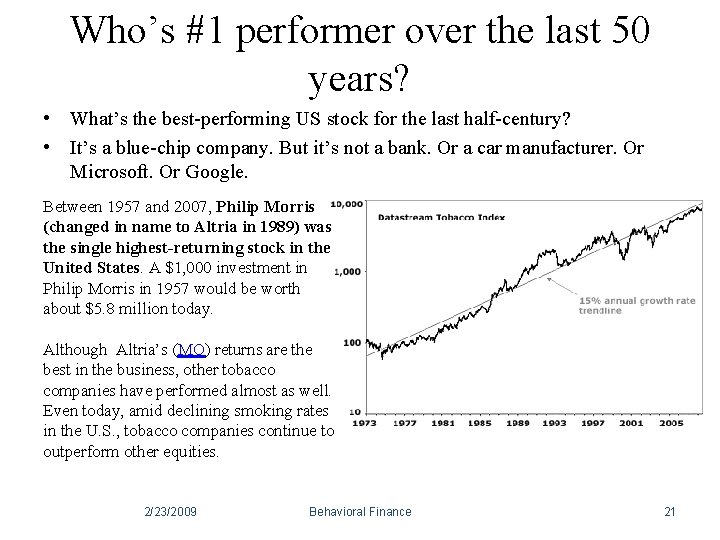
Who’s #1 performer over the last 50 years? • What’s the best-performing US stock for the last half-century? • It’s a blue-chip company. But it’s not a bank. Or a car manufacturer. Or Microsoft. Or Google. Between 1957 and 2007, Philip Morris (changed in name to Altria in 1989) was the single highest-returning stock in the United States. A $1, 000 investment in Philip Morris in 1957 would be worth about $5. 8 million today. Although Altria’s (MO) returns are the best in the business, other tobacco companies have performed almost as well. Even today, amid declining smoking rates in the U. S. , tobacco companies continue to outperform other equities. 2/23/2009 Behavioral Finance 21
• • Every year, Americans spend $4 billion on video pornography, which makes the industry larger than the N. F. L. , the N. B. A. or Major League Baseball. When you include Internet Web sites, porn networks and pay-per-view movies on cable and satellite, phone sex, and magazines, the porn business is estimated to total between $10 billion and $14 billion annually. People spend more money for pornography in America in a year than they do on movie tickets, more than they do on all the performing arts combined. " Sex sites are estimated to account for up to forty percent of all Internet traffic. Yet you barely see people bragging about holding shares in adult entertainment companies 2/23/2009 Behavioral Finance 22
Where does -2? Social norms • Hong and Kacperczyk (2009) – Study the effects of social norms on markets by studying “sin” stocks -- publicly traded companies involved in producing alcohol, tobacco, and gambling. – There is a societal norm against funding operations that promote vice. – Find that sin stocks are less held by norm-constrained institutions such as pension plans; receive less coverage from analysts than stocks of otherwise comparable characteristics. – Sin stocks also have higher expected returns than otherwise comparable stocks – 0. 39% month; sin stock are also priced lower than comparable stocks. • Did anyone try to take advantage of this? – VICE fund -- invests in alcohol, gambling, tobacco, and aerospace and defense industries. 2/23/2009 Behavioral Finance 23
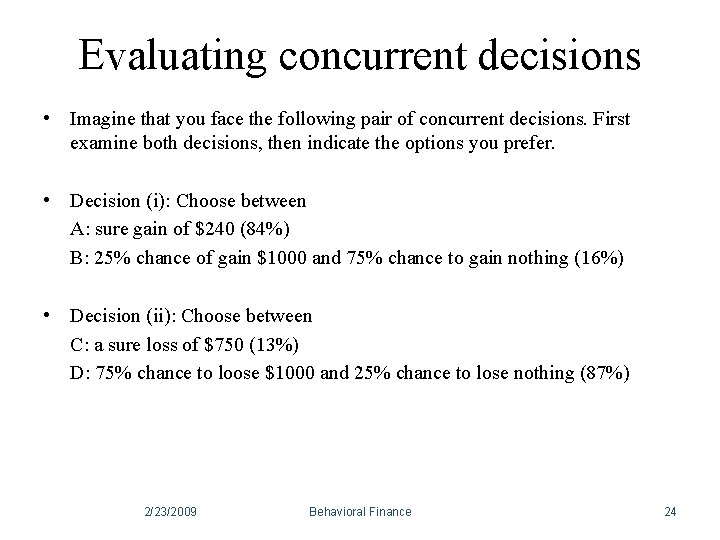
Evaluating concurrent decisions • Imagine that you face the following pair of concurrent decisions. First examine both decisions, then indicate the options you prefer. • Decision (i): Choose between A: sure gain of $240 (84%) B: 25% chance of gain $1000 and 75% chance to gain nothing (16%) • Decision (ii): Choose between C: a sure loss of $750 (13%) D: 75% chance to loose $1000 and 25% chance to lose nothing (87%) 2/23/2009 Behavioral Finance 24
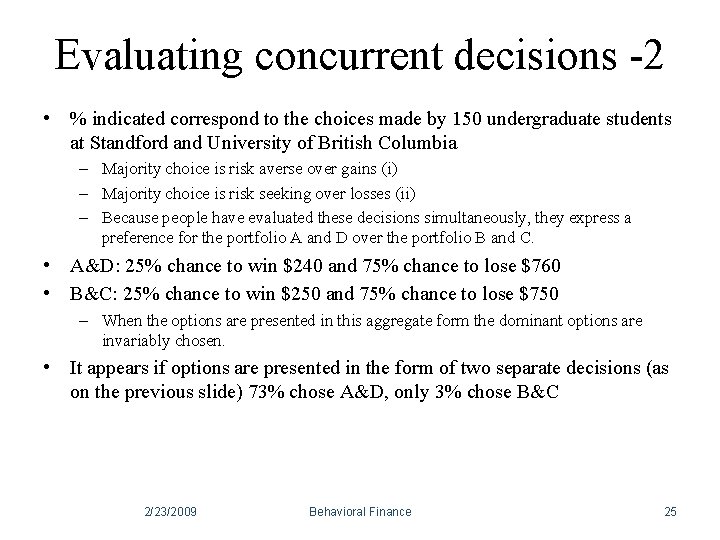
Evaluating concurrent decisions -2 • % indicated correspond to the choices made by 150 undergraduate students at Standford and University of British Columbia – Majority choice is risk averse over gains (i) – Majority choice is risk seeking over losses (ii) – Because people have evaluated these decisions simultaneously, they express a preference for the portfolio A and D over the portfolio B and C. • A&D: 25% chance to win $240 and 75% chance to lose $760 • B&C: 25% chance to win $250 and 75% chance to lose $750 – When the options are presented in this aggregate form the dominant options are invariably chosen. • It appears if options are presented in the form of two separate decisions (as on the previous slide) 73% chose A&D, only 3% chose B&C 2/23/2009 Behavioral Finance 25
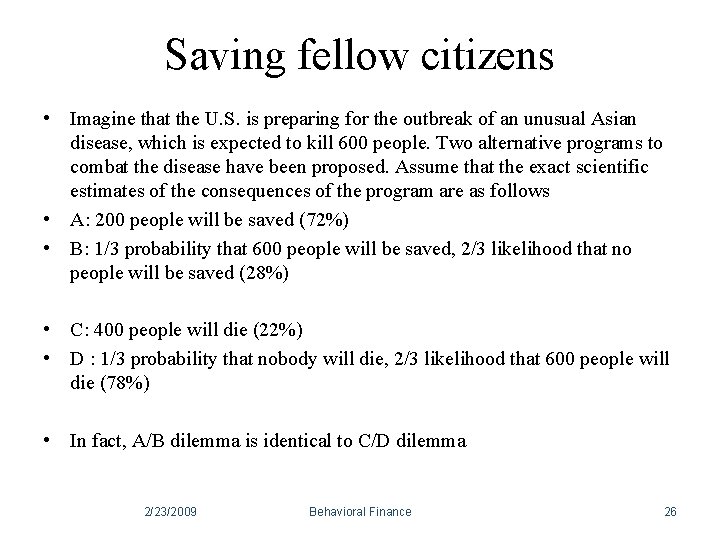
Saving fellow citizens • Imagine that the U. S. is preparing for the outbreak of an unusual Asian disease, which is expected to kill 600 people. Two alternative programs to combat the disease have been proposed. Assume that the exact scientific estimates of the consequences of the program are as follows • A: 200 people will be saved (72%) • B: 1/3 probability that 600 people will be saved, 2/3 likelihood that no people will be saved (28%) • C: 400 people will die (22%) • D : 1/3 probability that nobody will die, 2/3 likelihood that 600 people will die (78%) • In fact, A/B dilemma is identical to C/D dilemma 2/23/2009 Behavioral Finance 26
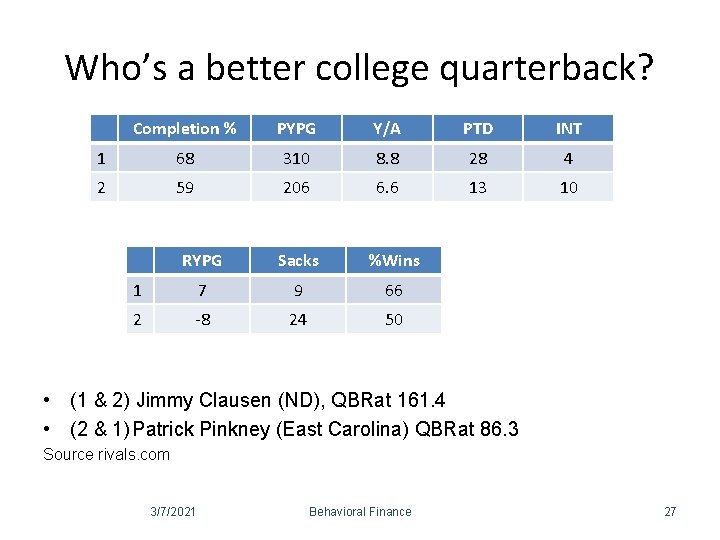
Who’s a better college quarterback? Completion % PYPG Y/A PTD INT 1 68 310 8. 8 28 4 2 59 206 6. 6 13 10 RYPG Sacks %Wins 1 7 9 66 2 -8 24 50 • (1 & 2) Jimmy Clausen (ND), QBRat 161. 4 • (2 & 1) Patrick Pinkney (East Carolina) QBRat 86. 3 Source rivals. com 3/7/2021 Behavioral Finance 27
Framing • These examples demonstrate to us that representation of information matters for choices of people – People evaluate decisions in isolation rather then evaluate aggregate effect on their well-being – Framing outcomes in a different way (good/bad; gain/loss; positive/negative, but also highligting some publicly available information over another) changes the choices that people make • Consider a # of different examples illustrating how framing of information affects human behavior 2/23/2009 Behavioral Finance 28
Forecasting in financial markets • # of influential surveys which are designed to extract market participants expectations wrt future of financial markets – – Livingston Survey of Philadelphia Fed Survey of Consumers of the University of Michigan UBS/Gallup Survey Duke/CFO Business Outlook Survey • Results of these surveys are mentioned in the press and influence economic policy debates • Is optimism about economic outlook is going to increase/decrease? • Used to predict future economic conditions 2/23/2009 Behavioral Finance 29
Forecasting in financial markets -2 Glaser, Langer, Reynders, Weber (2007) • Results of the collected forecasts depend on elicitation mode of return expectations – Do you ask participants about price levels OR returns directly? • Surveys that ask for future stock price levels (like Livingston) are more likely to produce mean-reverting expectations than survey that directly ask for future returns (like Michigan Surveys of Consumers or Duke/CFO Business Outlook) • If past prices drift upwards (downwards) return forecasts stated by investors which forecast returns are significantly higher (lower) than those derived from forecasts offered by investors forecasting prices 2/23/2009 Behavioral Finance 30
Forecasting in financial markets -3 �Isn’t that surprising that market participants come up with different expectations about fundamentally the same issue if being asked about it in different ways? �” 35, 37, 39, 41, 43, 45” � What is the most representative price? � It is likely to be below the final price. � Hence, making a forecast while thinking in terms of price levels people tend to make mean-reverting expectations �”+2, +2, +2, +2” � What is most representative change? � 2. Thus, thinking in terms of changes / returns leads to a belief in a trend continuation. Representativeness of predictions depends on the way investors think about past values of a variable. 2/23/2009 Behavioral Finance 31
Forecasting in financial markets -4 • Which way forecast elicitation is better? – Forecasts errors are similar (return forecasters tend to overshoot, price forecasters tend undershoot) – People are more likely to realize downward potential when they are asked to state prices: • Only 25% of all return forecasts (in the study) were negative • 40% of price forecasts were negative • People are just reluctant to think about negative #s; prices can not be negative • Summary: – Price forecasting seem a more reliable way of eliciting information about future returns – Confidence intervals, rather then point estimates; point estimates make little sense as they reveal nothing about forecast uncertainty 2/23/2009 Behavioral Finance 32
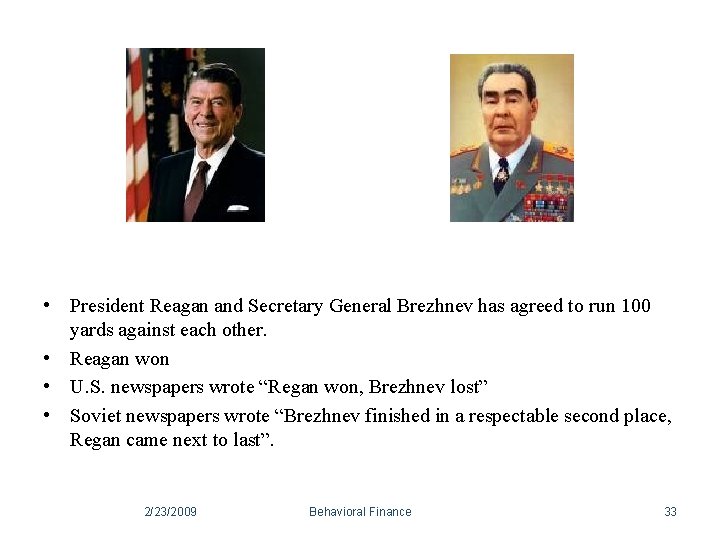
• President Reagan and Secretary General Brezhnev has agreed to run 100 yards against each other. • Reagan won • U. S. newspapers wrote “Regan won, Brezhnev lost” • Soviet newspapers wrote “Brezhnev finished in a respectable second place, Regan came next to last”. 2/23/2009 Behavioral Finance 33
Political Elections • Election campaigns have considerable influence over voting behavior and electoral outcomes • Election campaigns focus on a small set of issues – Voting decisions are made on the basis of an evaluation of the two parties with respect to the issues that are included in the current election agenda – Election agenda varies substantially from one election to next – The shift in agenda may explain alternations in power even though preferences of electorate and polcies of the parties remain constant over time • Holler and Skott (2005, Public Choice) 2/23/2009 Behavioral Finance 34
Political Elections -2 • Some issues favor one party while other issues favor another party • Republican party issues: – National defence – Lower Taxes – Small government / free-markets • Democratic party issues: – Universal Healthcare – Income redistribution / government interventions • ”Issue ownership” is relatively stable over time and primary objective of election campaigns is not to change the views of the voters. Instead, election campaigns aim to politicize issues which favor your party and deemphasize those which favor the opponent. 2/23/2009 Behavioral Finance 35
Political Elections -3 • How the election agenda is being set up? – Of course, there could be many reasons why a ”hot political issue” is outside of the choice set of a particular political party – You could not ignore 9/11 – You could not ignore economic slump in 2008 • Democratic primaries in 2004 – ”Electability” became a dominant concern of these primaries. Given republican focus on terrorism, the war in Iraq and national security Kerry’s status as a Vietnam was hero may have made him look more electable than other democratic candidates • US presidential elections in 2008 – Mc. Cain repeated admissions on his limited knowledge of the economic issues ”the issue of economics is not something I’ve understood as well as I should” in the elections framed around economic problems decreased his appeal with voters 2/23/2009 Behavioral Finance 36
Information campaigns to increase tax compliance • As with any crime people trade-off the benefits of tax avoidance and potential damage in case of being caught • Information campaigns could be framed in two ways: – Highlight potential gains when tax compliance is high – Highlight potential losses when tax compliance is low • Joller, Hoetzl, Kirchler, Leder, Manetti (2008, J. of Econ. Psychology) 2/23/2009 Behavioral Finance 37
Tax compliance -2 • Framing is important when motivating people to file taxes in a certain way 2/23/2009 Behavioral Finance 38
Tax compliance -3 • ”Taxes” have a negative connotation, associated with an expensive and inefficient managerial style of politicians • Often linked not only to the loss of money, but also – especially in the case of self-employed people – to restrictions of personla freedom in deciding how to spend and invest one’s ”own ” money • Information campaigns: do they work? – Information provided about legislative intents can positively influence taxpayers’ acceptance of taxes and fairness perceptions – Goal framing: some evidence exists that male participants are more compliant when presented with a negatively framed scenario; females are more cooperative after reading positively framed message – It is easier to reach out to older tax payers Information campaigns work best when information is framed according to taxpayers’ regulatory focus: benefits of tax budgets beign sufficient (promotion) vs. dangers of tax budgets being insufficient (prevention) 2/23/2009 Behavioral Finance 39
Stock market pariticipation • We know already that – Mean stock market returns are high – Stock market returns exhibit very low correlation with other household risks (labor income risk, house price risk etc) • However, many household are still reluctant to allocate money to financial markets, in particular equities – This is true even for wealthy households for whom transaction costs of participating in stock market are very low (Polkovnichenko, 2005) – This is very surprising since taking even small equity position would lead to better diversification of household’s total portfolio (labor income + house value + financial wealth) 2/23/2009 Behavioral Finance 40
Stock market pariticipation -2 • Barberis, Huang, Thaler (2006, AER) • Solution: narrow framing = evaluation of stock market in isolation to other sources of wealth – when househoulds evaluate the stock market they do not merge its risks with other sources of risk, but rather think about it in isolation, at least to some extent – why would narrow framing arise wrt the decision whether to participate in the stock market or not? – One way to think about it is in terms of regret: we feel pain when we realize that we would be better of today if we have taken a different action in the past – Even if a decision that a person makes is one of many risk that she faces, it is still linked to a specific decision – So even though from the perspective of total effect on wealth stock market participation poses little risk if evaluated separately investing in stock market looks like a very risky decision (with a lot of downside) 2/23/2009 Behavioral Finance 41
Portfolio selection • The way different options are presented to the investor influences investor’s decisions • We have talked about: – presenting the same information in a good or a bad way – stressing some publicly available information over the other • Can people’s choices be manipulated by offering them a different menu of options? – Does offering more equity funds in the retirement portfolio lead to people choosing more equity? – Does offering more mutual funds in a particular style category lead to higher inflow into that category? • Do people choose optimal portfolio allocations or use some simplified heuristics? – Can following these simplified decision rules harm investors in a significant way? 2/23/2009 Behavioral Finance 42
Portfolio selection -2 • Allocations of participants into defined contribution pension plans – Worldwide trend toward defined contribution plans – Contributions are paid into an individual account for each member. The contributions are invested, for example in the stock market, and the returns on the investment (which may be positive or negative) are credited to the individual's account. – Money contributed can either be from employee salary deferral or from employer contributions. – Easily portable (employee switching to a different job can transfer her saving to the plan administered by new employer) – Investment risk and investment rewards are assumed by each individual/employee/retiree and not by the sponsor/employer. – The "cost" of a DC plan is readily calculated, but the benefit from a DC plan depends upon the account balance at the time an employee is looking to use the assets. So, for this arrangement, the contribution is known but the benefit is unknown (until calculated). – Despite the fact that the participant in a DC plan typically has control over investment decisions, the plan sponsor retains a significant degree of fiduciary responsibility over investment of plan assets, including the selection of investment options and administrative providers. 2/23/2009 Behavioral Finance 43
Portfolio selection -3 • People make decisions based on a naive diversification strategy (1/n rule) – Allocate capital evenly among n options offered – Has been confirmed in many experimental settings – Even Talmud offers this allocation advice: • ” A man should always place his money, a third into land, a third into merchandise, and keep a third in hand”. – Harry Markowitz, a father of modern portfolio theory has himself used this rule 2/23/2009 Behavioral Finance 44
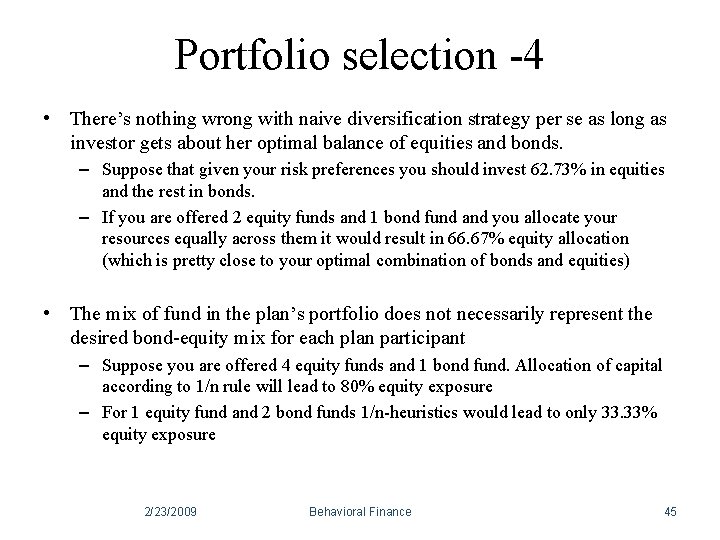
Portfolio selection -4 • There’s nothing wrong with naive diversification strategy per se as long as investor gets about her optimal balance of equities and bonds. – Suppose that given your risk preferences you should invest 62. 73% in equities and the rest in bonds. – If you are offered 2 equity funds and 1 bond fund and you allocate your resources equally across them it would result in 66. 67% equity allocation (which is pretty close to your optimal combination of bonds and equities) • The mix of fund in the plan’s portfolio does not necessarily represent the desired bond-equity mix for each plan participant – Suppose you are offered 4 equity funds and 1 bond fund. Allocation of capital according to 1/n rule will lead to 80% equity exposure – For 1 equity fund and 2 bond funds 1/n-heuristics would lead to only 33. 33% equity exposure 2/23/2009 Behavioral Finance 45
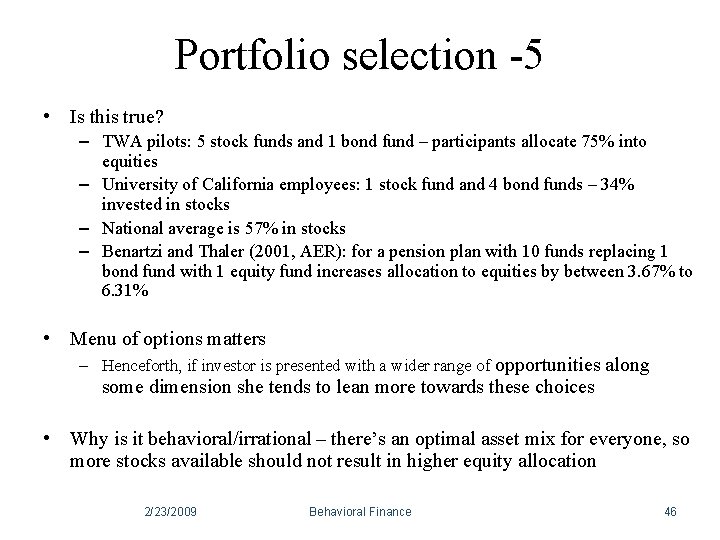
Portfolio selection -5 • Is this true? – TWA pilots: 5 stock funds and 1 bond fund – participants allocate 75% into equities – University of California employees: 1 stock fund and 4 bond funds – 34% invested in stocks – National average is 57% in stocks – Benartzi and Thaler (2001, AER): for a pension plan with 10 funds replacing 1 bond fund with 1 equity fund increases allocation to equities by between 3. 67% to 6. 31% • Menu of options matters – Henceforth, if investor is presented with a wider range of opportunities along some dimension she tends to lean more towards these choices • Why is it behavioral/irrational – there’s an optimal asset mix for everyone, so more stocks available should not result in higher equity allocation 2/23/2009 Behavioral Finance 46
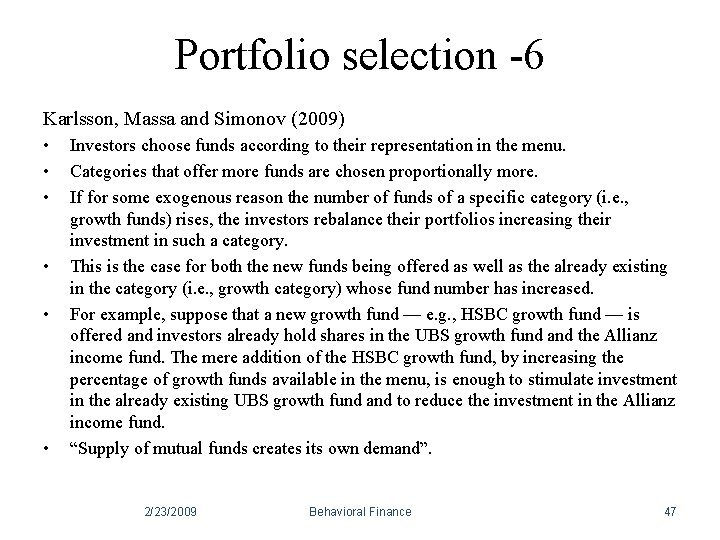
Portfolio selection -6 Karlsson, Massa and Simonov (2009) • • • Investors choose funds according to their representation in the menu. Categories that offer more funds are chosen proportionally more. If for some exogenous reason the number of funds of a specific category (i. e. , growth funds) rises, the investors rebalance their portfolios increasing their investment in such a category. This is the case for both the new funds being offered as well as the already existing in the category (i. e. , growth category) whose fund number has increased. For example, suppose that a new growth fund — e. g. , HSBC growth fund — is offered and investors already hold shares in the UBS growth fund and the Allianz income fund. The mere addition of the HSBC growth fund, by increasing the percentage of growth funds available in the menu, is enough to stimulate investment in the already existing UBS growth fund and to reduce the investment in the Allianz income fund. “Supply of mutual funds creates its own demand”. 2/23/2009 Behavioral Finance 47
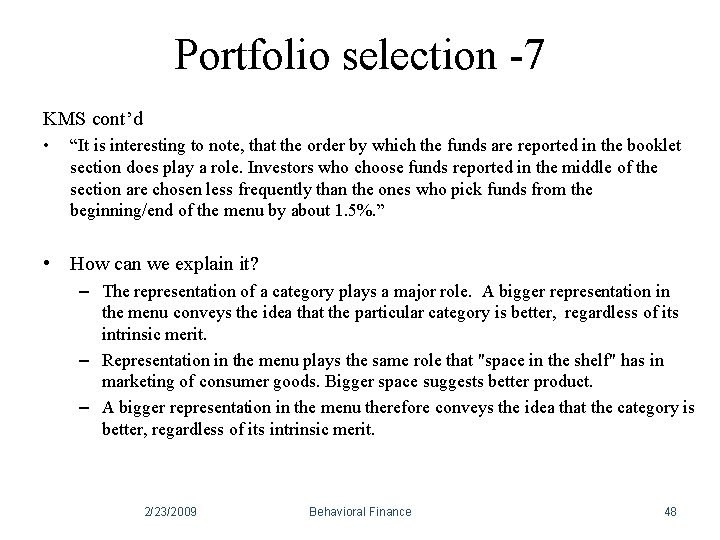
Portfolio selection -7 KMS cont’d • “It is interesting to note, that the order by which the funds are reported in the booklet section does play a role. Investors who choose funds reported in the middle of the section are chosen less frequently than the ones who pick funds from the beginning/end of the menu by about 1. 5%. ” • How can we explain it? – The representation of a category plays a major role. A bigger representation in the menu conveys the idea that the particular category is better, regardless of its intrinsic merit. – Representation in the menu plays the same role that "space in the shelf" has in marketing of consumer goods. Bigger space suggests better product. – A bigger representation in the menu therefore conveys the idea that the category is better, regardless of its intrinsic merit. 2/23/2009 Behavioral Finance 48
Portfolio selection -8 • Why do investors fall in the “trap” of basing their choice on the representation of a category in the menu? – Behavioral "representativeness bias". • Investors tend to give more importance to and believe more in things that they see repeated more often. • The number of funds in a category reiterates and stresses the importance of the category inducing investors who were already investing there, to increase their holdings. – Investors try to compensate for their lack of knowledge by using as a size of the category as a signal of quality • Menu exposure can explain home bias: investors in every country exhibit preference for holding domestic securities rather diversifying internationally – menu of options presented to domestic investors is strongly tilted toward domestic securities 2/23/2009 Behavioral Finance 49
Business reports • Tone of quarterly filings with SEC, press releases etc can affect investors’ view on the company prospects • Loughran and Mc. Donald (2009) – Develop a list of positive and negative (about 1200 words) financial words • Like (misstatement, litigation, misconduct, unanticipated) • But not (foreign, mine, capital, liability, depreciation) – Apply these lists to measure the tone of corporate 10 -K filings with SEC – Stock with low frequency of negative words in their reports have higher returns following the publication of filings 2/23/2009 Behavioral Finance 50
Group Process • No chapter on the decision making in group in corporate finance textbooks • Yet group process is critical for the effectiveness of corporate finance decisions – Major decisions about corporate governance (executive compensation, anti-takeover measures etc) take place in board meetings – Major decision about strategic decisions are done during managerial meetings • Effective groups exploit potential synergies from bringing people together • Complementarities in – Skills – Perspectives – Values • Effective groups are said to experience process gains • It is achieved through a constructive use of individual differences among group members 3/7/2021 Behavioral Finance 51
Process Loss • Certainly, there are potential gains from group process • Many groups are unable to exploit potential synergies, moreover experience process loss • The source of loss is typically psychological – Group psychology often leads people to make different decisions when they operate as part of a group than when they act as individuals. 3/7/2021 Behavioral Finance 52
Group Behavior • Behavioral studies identified three important features about group behavior: – Accuracy: groups tend to outperform individuals in particular types of tasks known as intellectual tasks (=task with “correct” answer that once identified, group members would readily acknowledge as being correct). This, however, is not true for judgment tasks, which are more subjective by nature. – Polarization: groups often become polarized in respect to risk tolerance. For example, if at individual level the members of a group are slightly risk-seeking, group discussion typically amplified the degree of risk-seeking behavior. – Unwarranted acceptance: group discussion leads the members of a group to accept decision readily. However, such acceptance if often unwarranted, producing a phenomenon akin to collective overconfidence known as the illusion of effectiveness. 3/7/2021 Behavioral Finance 53
General reasons for group errors -1 • Groupthink – A drive for achieving group consensus overrides the realistic appraisal of alternative courses of action – In essence people in groups may overweigh information which is consistent with the consensus point of view and underweigh the information which disconfirms this view – Especially likely to emerge if some of the following are met: • • • The group dynamics feature amiability A powerful, opinionated leader leads the group Group members operate under stress or time constraint Group member are strongly influenced by a desire for social conformity There’s no explicit decision maing procedure 2/23/2009 Behavioral Finance 54
General reasons for group errors -2 • Poor information sharing – People are often ineffective when it comes to sharing information within groups – People refrain from sharing relevant information with others in their groups even when the members of the group share a common goal – Example: job candidates • Group task involved ranking job candidates (but similar principals apply to ranking project proposals during capital budgeting) • Case 1: When all groups members were given the same information which strongly favored one candidate, Mr. A most groups chose this candidate 2/23/2009 Behavioral Finance 55
General reasons for group errors -2 a • Case 2: Information was distributed among memebrs of the group rather than shared. Collectively the group had the same information that was wavailable in Case 1. However, in order for all group members to possess full information the group had to find a way to share the distributed pieces among themselves. • Information was distributed in such a way that most of the group members perceived that some other candidate, Ms. B was the dominant choice. When the group members came together to discuss candidates they soon focused on the fact that Ms. B appeared to be the best candidate. 2/23/2009 Behavioral Finance 56
General reasons for group errors -2 a • They did exchange information. However, the information that group members offered was information tha tsupported the choice of Ms. B. That is, the group experienced confirmation bias. • In order to arrive at the correct choice, Mr. A, the group would have needed to find a way to put forward disconfirming evidence in respect to the choice of Ms. B. However, doing so is counterintuitive for most people. • Prominent example of poor information sharing involved the manner in whcih knowledge abotu terrorist threats to the United states was shares within the FBI and between FBI and the CIA, prior to September 11, 2001. – Did you know that INS issued visa approval notices for two of the hijackers six months after they flew airliners into the World Trade Center? 2/23/2009 Behavioral Finance 57
General reasons for group errors -3 • Inadequate motivation – Free-riding in groups leads to agency conflict known as social loafing – Some members of the group might choose to reduce their level of effort, relying on the efforts of others to generate group benefits. – Put it differently, individual who work in groups might not work as hard as individuals who work alone. – Setting incentives to deal appropriately with social loafing is difficult when the link between effort and outcome is weak and when responsibility within the group is diffused. 3/7/2021 Behavioral Finance 58
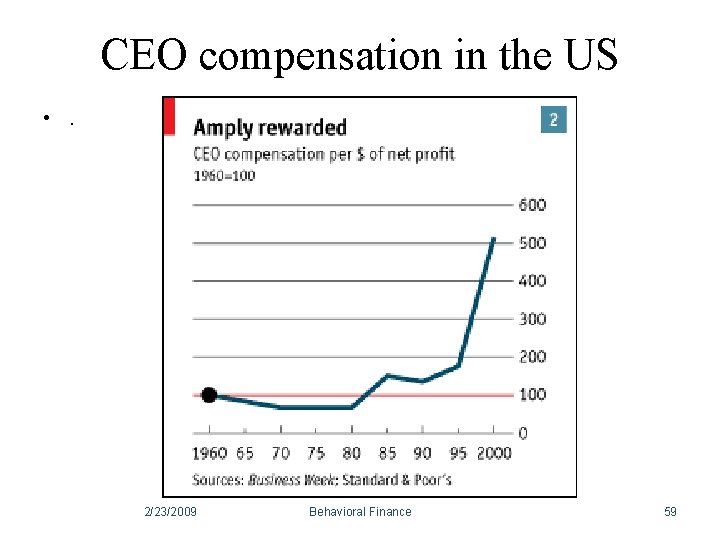
CEO compensation in the US • . 2/23/2009 Behavioral Finance 59
Groupthink and Managerial Compensation • “About five years ago I took a strong stand regarding a guy who ran a major division. He was the architect of some terrible deals for the company. On top of that he never seemed to have a handle on what was going on. All of his projections for his division were wrong. He underestimated what capital expenditures needed to be. He was way off on growth. • So the comp committee has a meeting to talk about bonuses--and if there was ever a person who didn't deserve one, it was this fellow I'm talking about. Nevertheless, the CEO came into the meeting and recommended that this guy get a pretty good-sized bonus. And I said, "How can you do this? This guy's poor decisions have cost the company billions of dollars. If you're going to pay for performance, you have to have both a carrot and a stick. Basically, this guy should be kicked out of the company. But if he's going to be around, you've got to send a message not only to him but even more importantly to the organization that if someone screws up, they don't get a bonus. " 2/23/2009 Behavioral Finance 60
Groupthink and Compensation -2 • Well, I think the committee sort of agreed with me. But ultimately the others said, "We've got to let the CEO have the authority to run his organization, " which I actually think is a bunch of crap. So what happened--and I think this was mainly because of my bitching and complaining--is that the CEO cut this fellow's bonus by half. That meant he ended up getting a reasonable amount for costing the shareholders billions. • I then said to the chairman of the committee, "This stuff is wrong. " And he said, "I agree, but we've got to do it. " Basically, what people understand they have to do is go along with management, because if they don't they won't be part of the club. You sort of get rolled over by the system even if you try to do well. What it comes down to is that directors aren't really independent. CEOs don't want independent directors. “ – From the interview of the CEO of a Fortune 500 company to Forbes 'This Stuff Is Wrong' That's the conclusion of most of the insiders who talked to FORTUNE-candidly--about CEO pay. And you know what's even worse? They don't see how the overreaching can be stopped. 2/23/2009 Behavioral Finance 61
Groupthink and Poor Information Sharing: Ex’s • In 2000 and 2001 corporate fiascos at Enron, World. Com, and PSINet demonstrated that in practice corporate governance does not typically feature rational principals (board members, shareholders) interacting with rational agents (managers). • Effective groups exploit potential synergies from bringing together people with varying skills, perspectives, and values. • The member of effective boards also need to be knowledgeable enough to challenge management and independent enough to be willing to do so. • Yet even boards that look good on paper may fail in practice because of groupthink • Why? 2/23/2009 Behavioral Finance 62
Enron (background) � December 2, 2001 Enron, at that time 7 th largest US firm filed for bankruptcy � Enron management, probably overconfident from its success in the natural gas business in early 1990 s, sought to repeat that success in markets where it lacked expertise: � Broadband � Retail energy � Electric power generation � Water � Steel mills � Enron invested more than $10 bln in ventures generatin nearly 0 return � Enron management discussed acquiring either World. Com or PSINet as a replacement for its failed broadband buisness 2/23/2009 Behavioral Finance 63
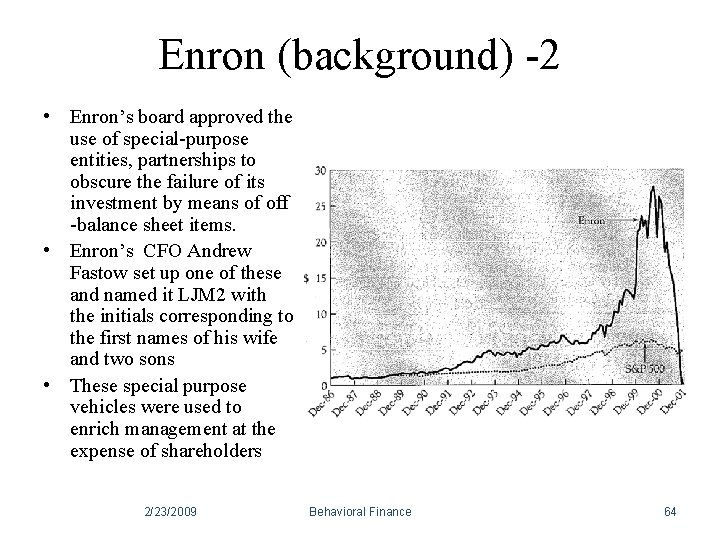
Enron (background) -2 • Enron’s board approved the use of special-purpose entities, partnerships to obscure the failure of its investment by means of off -balance sheet items. • Enron’s CFO Andrew Fastow set up one of these and named it LJM 2 with the initials corresponding to the first names of his wife and two sons • These special purpose vehicles were used to enrich management at the expense of shareholders 2/23/2009 Behavioral Finance 64
Enron: why did the board approve of it? • Possibility 1: non-transparency of special purpose vehicles • Enron’s CFO was selling firm’s losing projects to Merrill Lynch, and to LMJ 2 – With Merrill Lynch Enron agreed to repurchase the losing project (a Nigerian barge) at a future date – With LJM 2 Enron purchased put option insurance for its successful investment. That is, the partnership agreed to compensate Enron if the insured investment fell in value below a specified amount. Who paid for the insurance: Enron paid, mostly in the form of its own stock. That implies that Enron’s investors were effectively selfinsured, which is to say they no insurance. • If some of the information about the future repurchase of the losing project or about details of insurance is concealed than Enron’s board may not have sniffed any foul play. 2/23/2009 Behavioral Finance 65
Enron: why did the board approve of it? -2 • Possibility 2: groupthink and poor information sharing • A large part of the answer is that Enron’s management presented the partnerships to the board as a tool for improving Enron’s earnings. • Enron reported gains from its transactions with partnerships. • The directors asked a few questions, readily accepted the answers they received, and cast no dissenting votes. • They established no mechanism to monitor for conflict of interests on the part of Enron’s CFO (who was also the principal partner in LJM 2) and did not ask to see the partnership prospectus material that identified the conflict. 2/23/2009 Behavioral Finance 66
Enron: why did the board approve of it? -3 • Why did Enron’s directors fail to exercise diligence in carrying out their fiduciary responsibilities? • Were there no enough independent directors, meaning directors without formal business ties to the firm? – No. Enron’s board complied with conventional corporate governance standards. The majority of its board was indeed made up of independent directors. – Additionally, the board had an independent nominating committee. • A more likely answer is groupthink – Virtually every board vote was unanimous (with a notable exception of a decision to acquire a water business). • Financial expert, professor of accounting and former Dean of Stanford Business School Robert Jaedicke chaired the audit committee – Still Enron’s board and managers appears to be totally focused no earning rather than cashflows. 2/23/2009 Behavioral Finance 67
Board meeting • Imagine that you are at a board meeting, where the CEO has asked that the board approve a motion stipulating that he and the CFO be authorized, at their discretion, to increase the debt of the firm by an additional $15 bln irrespective of how much debt the company already has. • Of the following four alternatives which would you choose? 1. Support the idea, no questions asked 2. Vote yes to approve a measure to provide both executives with a large incentive to use debt in order to increase the firm’s stock price 3. Worry that providing management with carte blanche authority is a bad idea, but remain silent because it is clear to you that the motion will pass in any event. 4. Speak up to say that you think that the proposal is not in the interests of shareholder and that you will not support it. • Do you think that this story is made up? • What do you think were actual choices of the board members? 2/23/2009 Behavioral Finance 68
World. Com • This story actually happened in reality, and the company where it happened was World. Com. • The board of directors included the former CEO of MCI, the founder of UUNet Technologies, the former chairman of the National Association of Security Dealers, and the Dean of Georgetown Law School. • None chose the fourth alternative. • Surely, World. Com directors lacked neither intelligence nor experience. • Why did the fail to prevent this disaster from happening? – Groupthink and poor information sharing 2/23/2009 Behavioral Finance 69
General Motors • General Motors has not been a failing company only recently • At the times of CEOs Roger Smith (1981 -1990) and Robert Stempel (19901992) the company also did not do too well. • Fortune reported that during their tenure committees and policy groups essentially became time-consuming formalities where outcomes were rarely in doubt and serious deliberation was an infrequent occurence. • In contrast, at time of Alfred P. Sloan, president and CEO of GM from 1923 to 1946 executives were charges with the task of developing diasgreement about major decisions, in order to gain better understanding of the likely consequnces. 2/23/2009 Behavioral Finance 70
How can we overcome groupthink? • Why does it happen? Desire for conformity leads to collective confirmation bias • How does it happen? Members of the group become reluctant to share information or offer arugments to counter proposals made by other members of the group • What can be done about it? – 1. Ask group members to refrain from stating personal preferences at the outset of a discussion – 2. Explicitly cultivate disagreement and sharing of information – 3. Designate a group member to play devil’s advocate for each major proposal – 4. Regularly invite outside experts to attend meetings, with the charge that they challenge the group not to behave like conformists. • Is this necessarily implementable? Think of Arthur Andersen as outside expert 2/23/2009 Behavioral Finance 71
Polarization and Reluctance to Terminate Project • Project termination illustrates polarization, the accentuation of attitude toward risk • Managers tend to become risk seeking when having to decide on whether or not to terminate losing project – Why? Think of either accepting a sure loss or a gamble (even with lower expected value) which may lead to recovery of a part of the loss • Experimental evidence: – Ongoing project with not attractive future prospects – One description of the project featured a sunk cost, while another featured no sunk cost. – Participants acting alone: if sunk cost not mentioned 29% chose to continue; 69% when sunk costs mentioned – Participants acting in groups: 26% vs 86% – Punchline: behavioral errors were actually amplified when decision was made by a group rather than by an individual 2/23/2009 Behavioral Finance 72
Imitation and social interaction • Our tendency to imitate is invariably related to social interaction – Imitation of behavior of others is an important dimension of learning • Social interaction as imitation offers a crucial benefit: it allows an individual to exploit information possessed by others • Even if imitation does not occur through a “rational” process of analysis, the proclivity to imitate may be attuned to costs and benefits through the guidance of natural selection. – Suppose you do not know whether touching electric wire is dangerous. Are you willing to learn on your own or would follow the advice of others that you should not do that? 3/7/2021 Behavioral Finance 73
Herding and group psychology • In making our decisions we could rely on two sources of information: – Be guided by our own “private” information – Follow the actions of others • Herd behavior is said to occur when many people take the same actions, perhaps because some mimic the actions of others. • Herding (correlated behavior) can occur for three reasons: – (1) People receive correlated signals / information – (2) People try to infer the information from the actions of those who made decisions before them • An information cascade occurs when it is optimal for an individual, having observed the actions of those ahead of him, to follow the behavior of the preceding individual without regard to his own information. – (3) People choose to follow the actions of those who made decisions before them for reputations concerns • I still believe that I am correct, but there’s a slight chance that I am mistaken and it is detrimental for me to be bold and fail 3/7/2021 Behavioral Finance 74
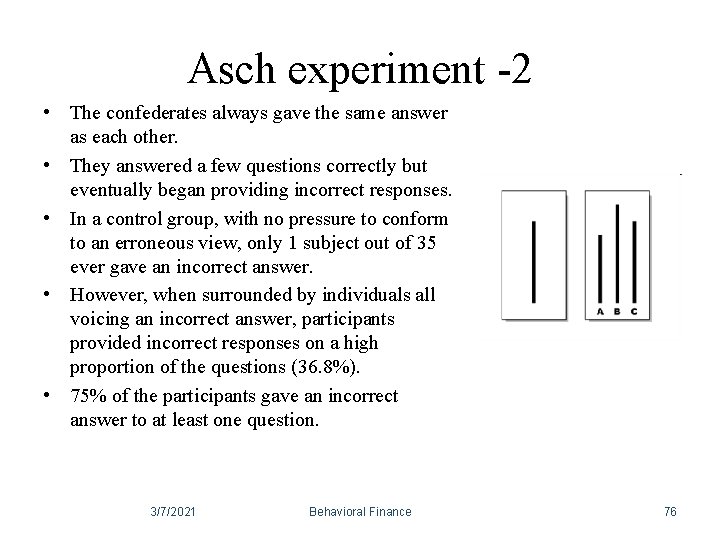
Asch experiment • Experiments led by Solomon Asch (1951) asked groups of students to participate in a "vision test. " • In reality, all but one of the participants were confederates of the experimenter, and the study was really about how the remaining student would react to the confederates' behavior. • In the basic Asch paradigm, the participants — the real subject and the confederates — were all seated in a classroom. They were asked a variety of questions about the lines (which line was longer than the other, which lines were the same length, etc. ) • The group was told to announce their answers to each question out loud and the confederates always provided their answers before the study participant. 3/7/2021 Behavioral Finance 75
Asch experiment -2 • The confederates always gave the same answer as each other. • They answered a few questions correctly but eventually began providing incorrect responses. • In a control group, with no pressure to conform to an erroneous view, only 1 subject out of 35 ever gave an incorrect answer. • However, when surrounded by individuals all voicing an incorrect answer, participants provided incorrect responses on a high proportion of the questions (36. 8%). • 75% of the participants gave an incorrect answer to at least one question. 3/7/2021 Behavioral Finance 76
Asch experiment -3 • "The tendency to conformity in our society is so strong that reasonably intelligent and well-meaning young people are willing to call white black. This is a matter of concern. It raises questions about our ways of education and about the values that guide our conduct. " • Why did the subjects conform so readily? – When they were interviewed after the experiment, most of them said that they did not really believe their conforming answers, but had gone along with the group for fear of being ridiculed or thought "peculiar. " 3/7/2021 Behavioral Finance 77
Asch experiment -4 • There’s another interpretation to Asch’s results: – A rational person may well reason that under the assumption that the answer to the question is as obvious as it seems the probability that someone would make an error should be very small, one in a hundred, let us say – The probability that the other eight group members would make the same error, if all are independent would be (1/100) to the power of 8. – The participant then may reason that the chance of all 8 people being wrong is too small and he or she is incompenent to answer the question. • One of the participants told Asch To me it seems I’m right, but my reason tells me I am wrong, because I doubt that so many people could be wrong and I alone right 3/7/2021 Behavioral Finance 78
Is such herding behavior optimal? • The reasoning process that takes into account the decisions of others could be perfectly rational • Though this may not (or may) lead to the efficient outcome • If people make decision sequentially, use actions of predecessors to infer their information and # of people is high enough information cascade will occur inevitably 3/7/2021 Behavioral Finance 79
Herding behavior: Example – undesirable outcome • • • Let’s go back to the restaurant We have two restaurants A & B and 100 people 98 got the signal that A is better, but 2 got signal that B is better These 2 got to choose first The 3 rd person arrives and sees that 2 people got to choose B. Since she has imperfect information she tries to combine her signal with those of people before her : 2 for B, 1 for A. So she goes to B. • The 4 th person arrives and sees that 3 people went to B. She does not know that 3 rd person had a signal that A is a better place. Trying to infer information from choices of people before her she also ends up in B. • Eventually everyone ends up in B even though A is better. • Effectively, persons from # 3 until #100 do not use their information in making decisions, but completely mimic the decisions of others. 3/7/2021 Behavioral Finance 80
Information cascade - Example: job seeking – Consider a person who’s applying for a job – – Suppose that the employers cannot perfectly assess the quality of the applicant. The candidate has a string of interviews with a # of employers. He is rejected on the first interview. The 2 nd employer learns that the candidate was rejected on the 1 st interview; given that there’s uncertainty over the quality of the candidate knowledge of prior rejection tilts employer toward the rejection – after all the previous prospective employer had some information that the current employer does not have and the latter tries to infer this information from the decision of the latter. – The 3 rd employer learns that there were 2 rejections in the previous interviews and biases his decision toward the rejection even more. – Suppose that candidate has been rejected on several interviews. At some point each subsequent employer will disregard its own perception of the candidate (its own knowledge about the candidate) and will rely on information obtained in the previous decisions. 3/7/2021 Behavioral Finance 81
Information cascades: politics • In 1976 presidential campaign little known candidate Jimmy Carter achieved an important early success by concentrating his efforts toward securing the Democratic nomination in the Iowa caucus. • Similarly in 2008, the republic favorite Rudi Giuliani has lost his electoral appeal by passing on several early caucuses – “Super Tuesday” in which many states coordinate their primaries on the same date is an attempt to avoid the consequences of sequential voting. • Essentially early voting states offer the voter choices that voters in the late voting states trying to infer from 3/7/2021 Behavioral Finance 82
Information cascades: medicine • Sad, but true: most doctors are not well informed about the cutting edge of research • This suggests that when in doubt they may imitate. • Initial adoption of many practices which came and gone (e. g. , tonsillectomy, elective hysterectomy, internal mammary ligation, ileal bypass) was done based on weak evidence. • Burnum (1987) physicians “like lemmings, episodically and with a blind infectious enthusiasm push certain diseases and treatments primarily because everyone else is doing the same”. • Robin (1984) for many decades tonsillectomy was performed in millions of children on a more or less routine basis. In most cases the operation was unnecessary”. 3/7/2021 Behavioral Finance 83
• Information cascades: peer influence and stigma Stigma is the negative typecasting of persons that are outside the norm of the social unit. – A person who has divorced or severed business several times may carry a stigma – Similarly our job seeking candidate – Conversely, a job candidate which receives early job offers may become a “star”. – In the rookie market for professors later schools may give *and do give( offers based on the known interest of earlier schools – Similarly to be granted a promotion it is helpful to receive job offers from elsewhere. 3/7/2021 Behavioral Finance 84
Information cascades: fads • Fads and conventions often change without apparent reasons • In clothing fashion whether “pink is in” or whether a short skirt is acceptable this season depends on who else decides to adopt the fashion. • Suppose a few people have a preference for change per se and are early adopters (switchers) during the fashion season. – Then when other people decide what’s hot they will try to infer the trend from a few early adopters – Once the critical mass is achieved whether each subsequent shopper has a different information / taste. The fad is established and following the actions of other only reinforces it. 3/7/2021 Behavioral Finance 85
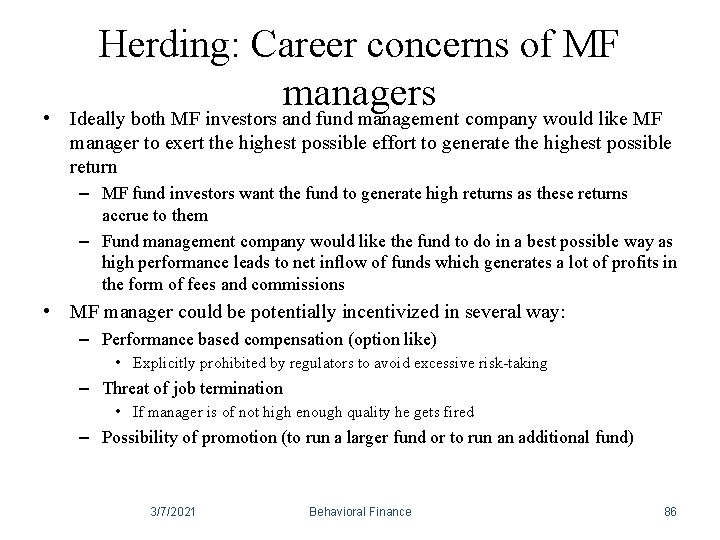
• Herding: Career concerns of MF managers Ideally both MF investors and fund management company would like MF manager to exert the highest possible effort to generate the highest possible return – MF fund investors want the fund to generate high returns as these returns accrue to them – Fund management company would like the fund to do in a best possible way as high performance leads to net inflow of funds which generates a lot of profits in the form of fees and commissions • MF manager could be potentially incentivized in several way: – Performance based compensation (option like) • Explicitly prohibited by regulators to avoid excessive risk-taking – Threat of job termination • If manager is of not high enough quality he gets fired – Possibility of promotion (to run a larger fund or to run an additional fund) 3/7/2021 Behavioral Finance 86
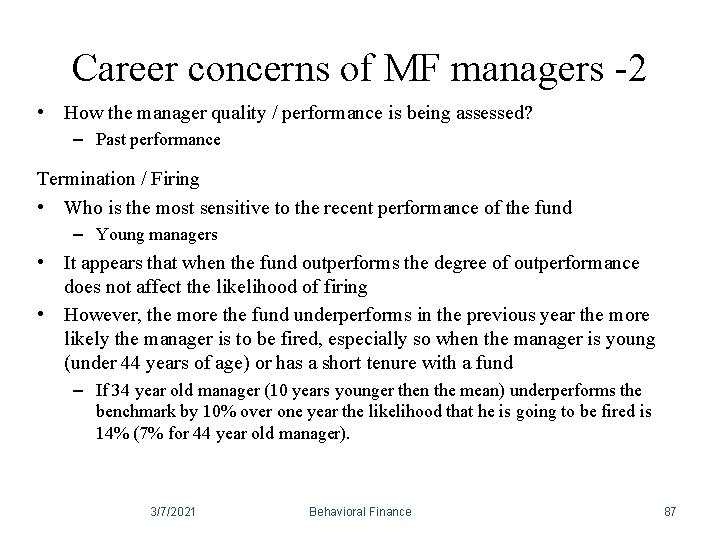
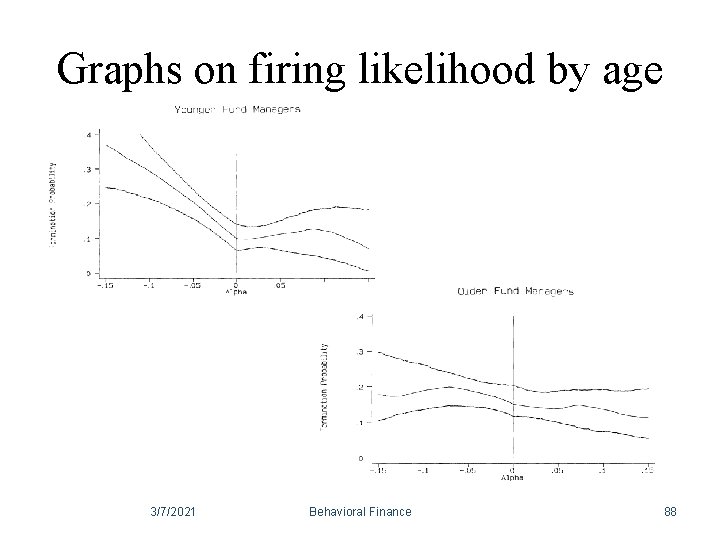
Career concerns of MF managers -2 • How the manager quality / performance is being assessed? – Past performance Termination / Firing • Who is the most sensitive to the recent performance of the fund – Young managers • It appears that when the fund outperforms the degree of outperformance does not affect the likelihood of firing • However, the more the fund underperforms in the previous year the more likely the manager is to be fired, especially so when the manager is young (under 44 years of age) or has a short tenure with a fund – If 34 year old manager (10 years younger then the mean) underperforms the benchmark by 10% over one year the likelihood that he is going to be fired is 14% (7% for 44 year old manager). 3/7/2021 Behavioral Finance 87
Graphs on firing likelihood by age 3/7/2021 Behavioral Finance 88
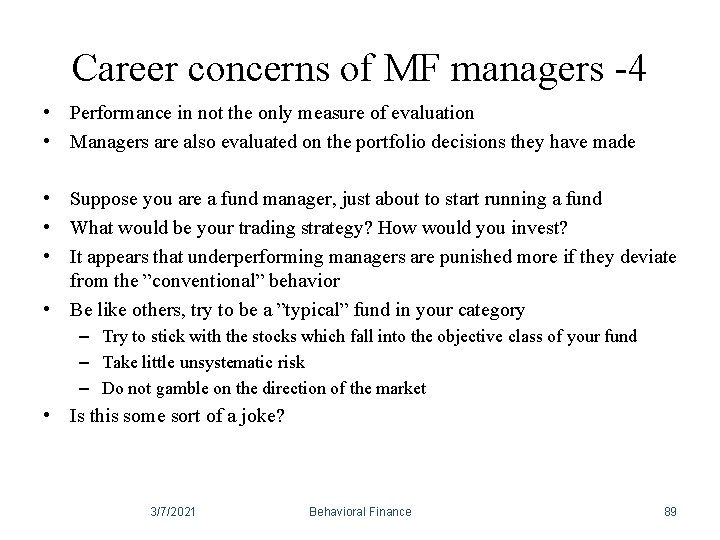
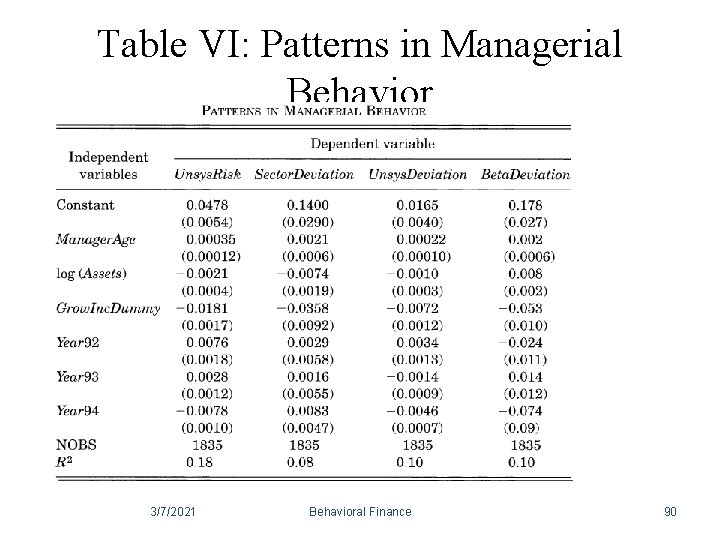
Career concerns of MF managers -4 • Performance in not the only measure of evaluation • Managers are also evaluated on the portfolio decisions they have made • Suppose you are a fund manager, just about to start running a fund • What would be your trading strategy? How would you invest? • It appears that underperforming managers are punished more if they deviate from the ”conventional” behavior • Be like others, try to be a ”typical” fund in your category – Try to stick with the stocks which fall into the objective class of your fund – Take little unsystematic risk – Do not gamble on the direction of the market • Is this some sort of a joke? 3/7/2021 Behavioral Finance 89
Table VI: Patterns in Managerial Behavior 3/7/2021 Behavioral Finance 90
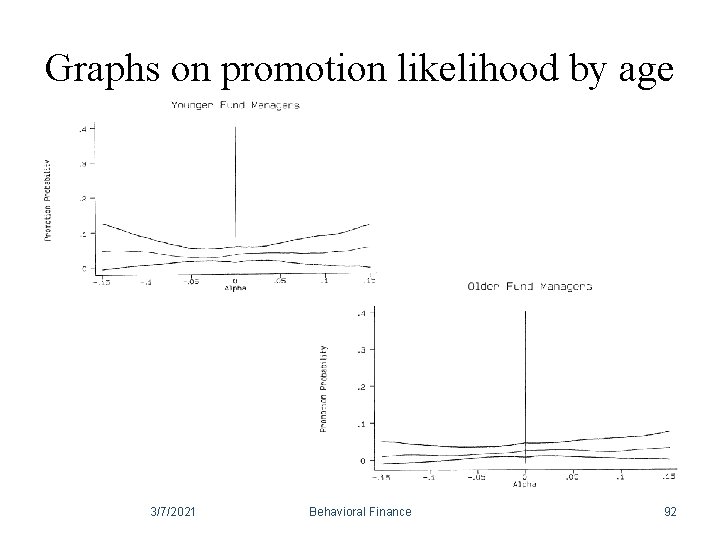
Career concerns of MF managers -3 • More on likelihood of firing – Of course two years of sub-par performance increase manager’s chances of being fired even more regardless of age. – The firing is less likely to happen if markets overall perform well and in general there’s a lot of inflows of new investment – Firing is also more likely to happen in larger funds • Promotion – Good performance helps to win promotion – But that does not seem to depent on age • Whether you are young lad or an old folk past performance affects your chances of moving up the ladder in a similar way 3/7/2021 Behavioral Finance 91
Graphs on promotion likelihood by age 3/7/2021 Behavioral Finance 92
Career concerns of MF managers -4 • Punchline: – Young managers are more severely punished for underperformance, but do not seem to enjoy the greater benefits after outperformance – Underperformance is more heavily punished if it is achieved while pursuing unconvential portfolio allocation • End result: – this type of incentive structure leads to herding among young mutual fund managers. – Because of career concerns they do not dare to take bold actions and take risks as bold behavior can be severly punished if it leads to underperformance. – Instead of trusting their own information and skills they follow actions of others: buy stocks that other funds buy. 3/7/2021 Behavioral Finance 93
Herding: Analyst recommendations • Analysts make purchase recommendations (buy, hold or sell) or EPS forecasts • From time to time they revise their recommendations – This is done on irregular basis and is supposedly motivated by arrival of new information • For many stocks there are several analysts making recommendations; prevailing consensus and most recent revisions by other analysts are publicly available • Ideally each analyst scrupulously analyses all sources of information available to him/her and makes the best possible recommendation 3/7/2021 Behavioral Finance 94
• Analyst recommendations: purchase Are analysts influenced in their decisionsrec’s – Two most recent revisions by other analysts have a strong positive impact on the next analyst’s revision – Particularly so if these revisions are recent – And when they turn out to be more accurate predictors of security returns (essentially if some analyst is known to be good others follow him/her) – Prevailing consensus also has influence on analysts’ choices. – However, this infulence is not stronger when counsensus turn out to be correct in its prediction about subsequent price movements. • Effectively analysts herd toward the consensus even though it does not contain information • In fact, consensus recommendation does not have predictive power over the future stock returns – But changes in consensus forecasts do 3/7/2021 Behavioral Finance 95
Analyst recommendations: EPS Poor history of forecasting EPSrec’s leads to higher likelyhood of termination • • More accurate forecasts lead to promotion • Less experienced analysts are more likely to be punished following bad performance, and less likely to be promoted after good performance • Being bold and bad hurts badly • Being bold and good does not help much End result: • more inexperienced analysts tend to herd more in tha tthey forecast closer to the consensus than experienced anallysts do. • They are also less likely to produce timely earnings forecasts of firms • Additionally, they revise their forecasts more often (both of the latter two indicate less independence in judgment) 3/7/2021 Behavioral Finance 96
Herding: Corporate Investment • When a number of companies invest in similar assets this creates incentives to herd • ”Part of Herrick’s job – an extremely important part as far as the bank was concerned – was to retrieve information about the countries in which the bank did business. But this function collided head on with what Herrick was actually doing out there. . . His job would never be measured by how correct his country risk analysis was. At the very least, Herrick was simply doing what undreds of other larger international banks had already done, and ultimate blame for poor forecasting would be shared by tens of thousands of banker arond the world; this was one of the curious benefits of following the herd”. -- Samual Gwynne, on lending policies to Least Developed Countries 3/7/2021 Behavioral Finance 97
Corporate Investment -2 • Suppose that there are some smart managers and some which are dumb • Smart managers receive signals about quality of investment opportunities, these signals are correlated • Dumb managers also receive signals, but they are just noise, and by default are uncorrelated • It is hard to tell whether you are a smart manager or not until investments pay off • Consequently if one manager mimics the behavior of others this suggests that he received a signal which is correlated with those people and – correlated signals are supposed to be redeived by smart people – therefore more likely to be smart • In contrast if a manager acts different then other people he is perceived as more likely to be dumb. 3/7/2021 Behavioral Finance 98
Corporate Investment -3 • As a result even though a manager gets a signal that investment is unprofitable, but others invest he would also invest. • Similarly, he may refuse investment that he preceives to have positive NPV if others before him also done so. • Example: technologically modified corn in Iowa • It took more then 7 years for farmers to to start implementing the gene enhanced corn • Even though quite a few of people got a positive information about the new product the fact that many people before them passed on the opportunity to grow corn prevented others from planting it as well. 3/7/2021 Behavioral Finance 99
Herding: Managerial Performance • Corporate managers’ job is to create value to shareholders • Value is a relative characteristics and many corporate boards measure the efficiency of managerial performance relatively to other companies in the industry • However, not so much concerned with the failure of industry as a whole • End result: managers within the same industry herd toward similar strategic decisions (investment, capital structure, payout policy etc) 3/7/2021 Behavioral Finance 100
• Herd behavior and security investment. . . it is the long run investor, he who most promotes the public interest, who will in practice come in for most cirticism, whether investment funds are managed by committees or boards or bankds. For it is the essence of his behavior that he should be eccentric, unconventional, and rash in the eyes of average opinion. If he is succesfful, that will only confirm the general belief in his rashness; and if in the short-run he is unsuccessful, which is very likely, he will not receive such mercy. Wordly wisdom teaches that it is better for reputation to fail conventionally that to succeed unconventionally --- John Meynard Keynes, The General Theory, 1936 3/7/2021 Behavioral Finance 101
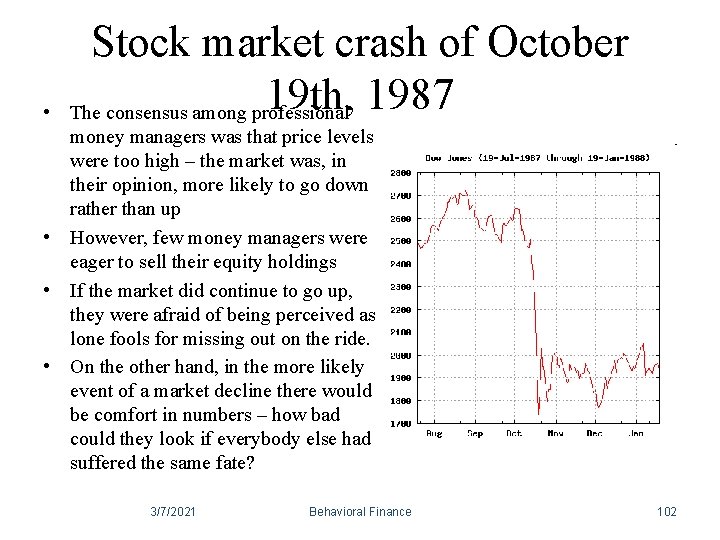
• Stock market crash of October 19 th, 1987 The consensus among professional money managers was that price levels were too high – the market was, in their opinion, more likely to go down rather than up • However, few money managers were eager to sell their equity holdings • If the market did continue to go up, they were afraid of being perceived as lone fools for missing out on the ride. • On the other hand, in the more likely event of a market decline there would be comfort in numbers – how bad could they look if everybody else had suffered the same fate? 3/7/2021 Behavioral Finance 102
Positive feedback trading • Positive feedback investors buy securities after prices rise and sell after prices fall • What can cause positive feedback trading? – Extrapolative expectations about prices (trend chasing) – Herding • Let suppose that mutual funds in a particular MF style category increased their holdings of particular stocks in the previous quarter • Since their positions are only available to other investors with a lag those managers which herd will put additional buying orders on the stocks which experienced more institutional buying recently, pushing prices up even more. 3/7/2021 Behavioral Finance 103
Positive feedback traders and effect ontradingprices • George Soros describes his own as betting on the future crowd behavior. • • • In his view the 1960 s saw a number of poorly informed investors become excited about rises in the reported annual earnings of conglomerates. The truly informed investment in this case, according to Soros, was not to sell short in anticipation of the eventual collapse of conglomerate share (which did not happen until 1970), but instead to buy in anticipation of further buying by uninformed investors. The initial price rise in conglomerate stocks, caused in part by purchases by speculators like Soros, stimulated the appetites of uninformed investors since it created a trend of increasing prices and allowed conglomerates to report earnings increases through acquisitions. As uninformed investors bought more, prices rose further. Eventually price increases stopped, conglomerate failed to perform up to uninformed investors’ expectations and stock price collapsed. 3/7/2021 Behavioral Finance 104
Effect on prices -2 • Essentially positive feedback trading and herding which accompanies it leads to a self-feeding bubble. • At the beginning a few more informed investors buy a stock and its price is being pushed up. • The uninformed investors do not have much idea of the merits of the stock, but they observe that the prices are moving up and they would like to jump on a bandwagon. • This leads to even more price increase which in turn generates even more buying pressure from unsophisticated investors. • At some point the discrepancy between prices and fundamentals become so large and apparent that prices collapse. 3/7/2021 Behavioral Finance 105
• Are there feedback traders in financial Individual investors often trade in themarkets? ways consistent with feedback trading – Think also about time varying risk-aversion we discussed before: if past performance is good it increases risk-tolerance of investors increasing their appetite for risky securities. This pushes the prices further up which generates additional profits and further increases risk-tolerance and so on. • Institutional investors (e. g. , pension funds, mutual funds) exhibit moderate degree of feedback trading 3/7/2021 Behavioral Finance 106