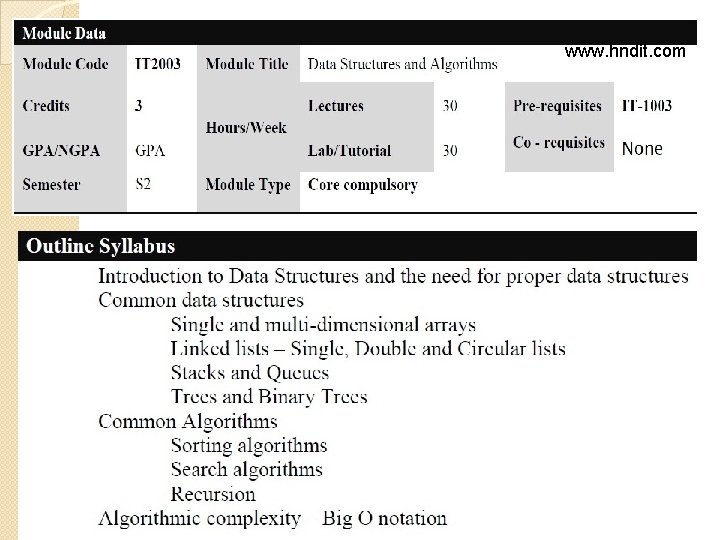
www hndit com Data Structures and Algorithms IT
- Slides: 45
www. hndit. com Data Structures and Algorithms IT 12112 By Wathsala Samarasekara M. Sc. , B. Sc.
www. hndit. com
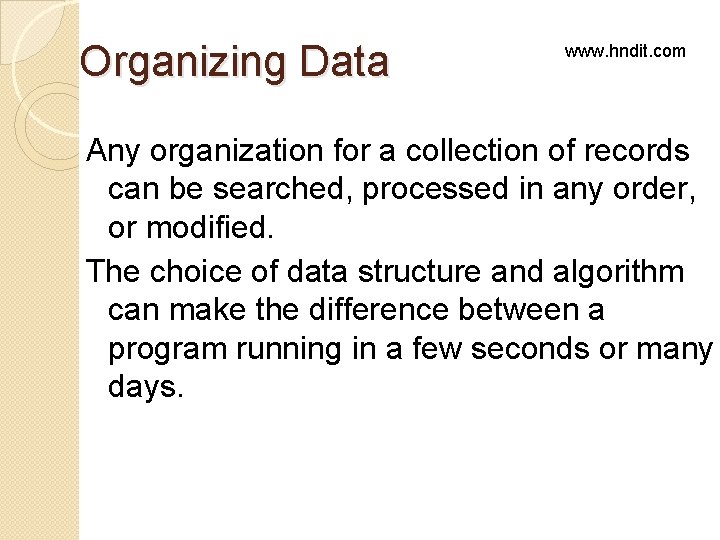
Organizing Data www. hndit. com Any organization for a collection of records can be searched, processed in any order, or modified. The choice of data structure and algorithm can make the difference between a program running in a few seconds or many days.
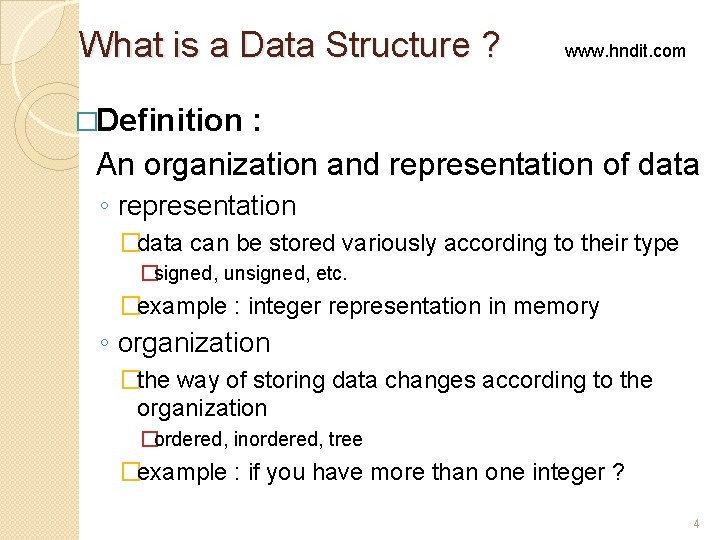
What is a Data Structure ? www. hndit. com �Definition : An organization and representation of data ◦ representation �data can be stored variously according to their type �signed, unsigned, etc. �example : integer representation in memory ◦ organization �the way of storing data changes according to the organization �ordered, inordered, tree �example : if you have more than one integer ? 4
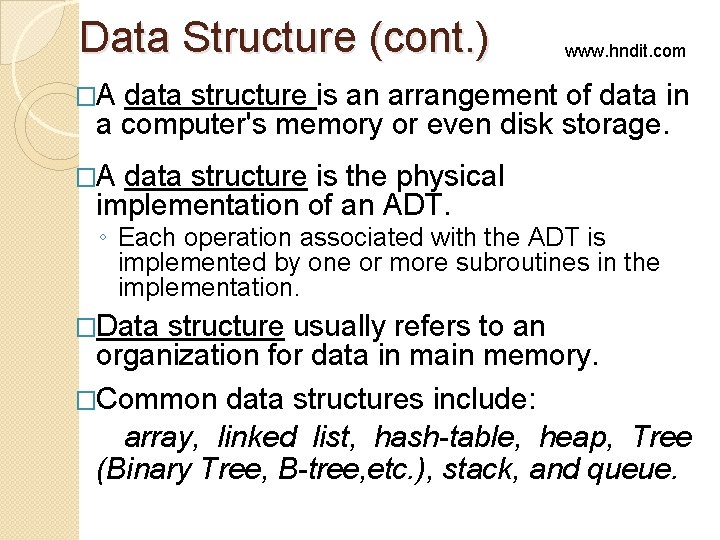
Data Structure (cont. ) www. hndit. com �A data structure is an arrangement of data in a computer's memory or even disk storage. �A data structure is the physical implementation of an ADT. ◦ Each operation associated with the ADT is implemented by one or more subroutines in the implementation. �Data structure usually refers to an organization for data in main memory. �Common data structures include: array, linked list, hash-table, heap, Tree (Binary Tree, B-tree, etc. ), stack, and queue.
The Need for Data Structures www. hndit. com Data structures organize data more efficient programs. More powerful computers more complex applications. More complex applications demand more calculations.
Efficiency www. hndit. com A solution is said to be efficient if it solves the problem within its resource constraints. ◦ Space ◦ Time �The cost of a solution is the amount of resources that the solution consumes.
Selecting a Data Structure www. hndit. com Select a data structure as follows: 1. Analyze the problem to determine the resource constraints a solution must meet. 2. Determine the basic operations that must be supported. Quantify the resource constraints for each operation. 3. Select the data structure that best meets these requirements.
Some Questions to Ask �Are www. hndit. com all data inserted into the data structure at the beginning, or are insertions interspersed with other operations? �Can data be deleted? �Are all data processed in some welldefined order, or is random access allowed?
Data Structure Philosophy www. hndit. com Each data structure has costs and benefits. Rarely is one data structure better than another in all situations. A data structure requires: ◦ space for each data item it stores, ◦ time to perform each basic operation, ◦ programming effort.
Properties of a Data Structure www. hndit. com ? �Efficient utilization of medium �Efficient algorithms for ◦ creation ◦ manipulation (insertion/deletion) ◦ data retrieval (Find) �A well-designed data structure allows using little ◦ resources ◦ execution time ◦ memory space 11
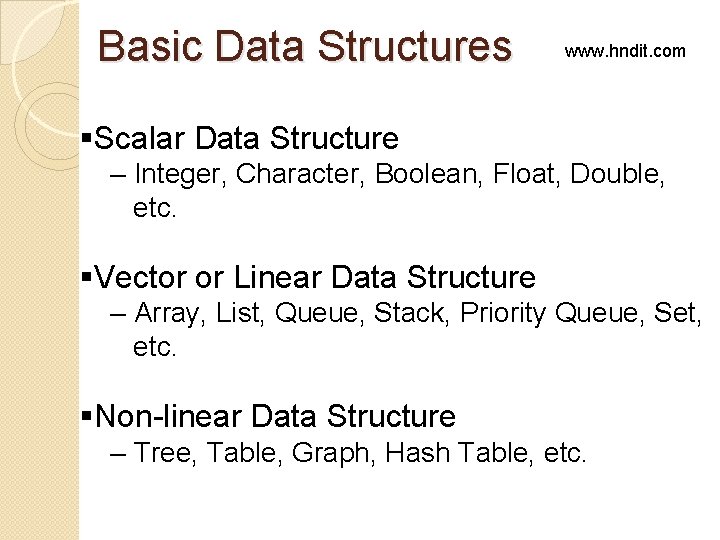
Basic Data Structures www. hndit. com §Scalar Data Structure – Integer, Character, Boolean, Float, Double, etc. §Vector or Linear Data Structure – Array, List, Queue, Stack, Priority Queue, Set, etc. §Non-linear Data Structure – Tree, Table, Graph, Hash Table, etc.
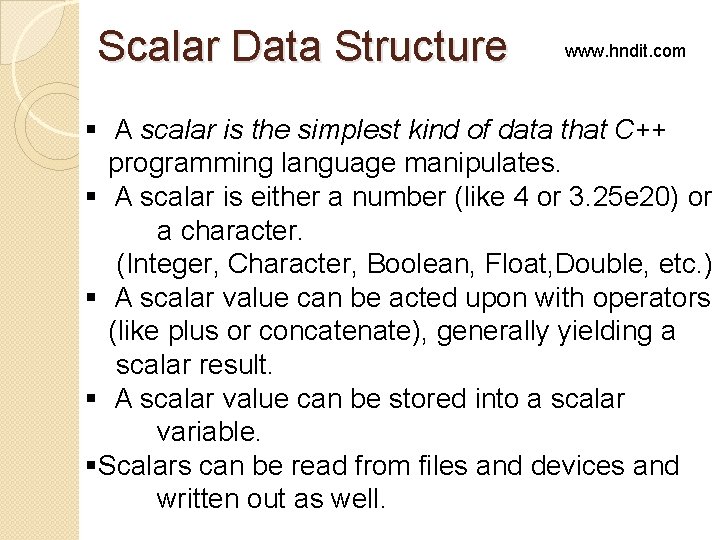
Scalar Data Structure www. hndit. com § A scalar is the simplest kind of data that C++ programming language manipulates. § A scalar is either a number (like 4 or 3. 25 e 20) or a character. (Integer, Character, Boolean, Float, Double, etc. ) § A scalar value can be acted upon with operators (like plus or concatenate), generally yielding a scalar result. § A scalar value can be stored into a scalar variable. §Scalars can be read from files and devices and written out as well.
Linear Data Structure �Linear www. hndit. com data structures organize their data elements in a linear fashion, where data elements are attached one after the other. �Linear data structures are very easy to implement, since the memory of the computer is also organized in a linear fashion. �E. g. Array, Linked List, Stack, Queue
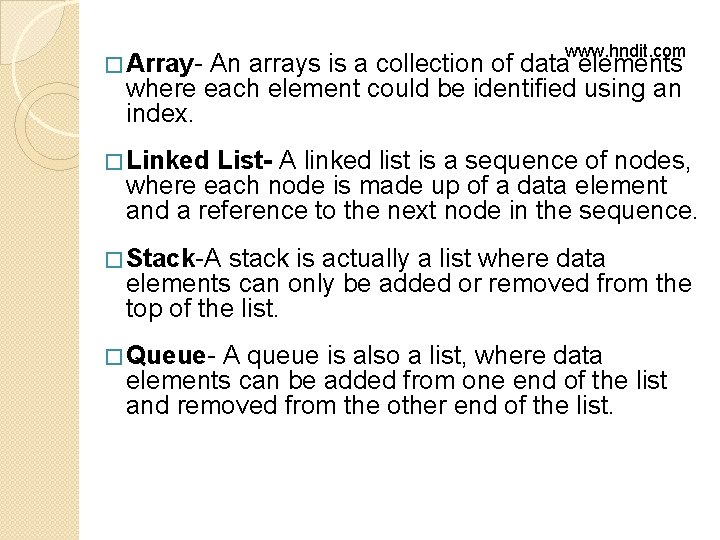
� Array- www. hndit. com An arrays is a collection of data elements where each element could be identified using an index. � Linked List- A linked list is a sequence of nodes, where each node is made up of a data element and a reference to the next node in the sequence. � Stack-A stack is actually a list where data elements can only be added or removed from the top of the list. � Queue- A queue is also a list, where data elements can be added from one end of the list and removed from the other end of the list.
Non Linear data structure www. hndit. com § The Elements are not arranged in sequence. § The data members are arranged in any Manner. § The data items are not processed one after ano E. g. Trees and graphs, multidimensional arrays
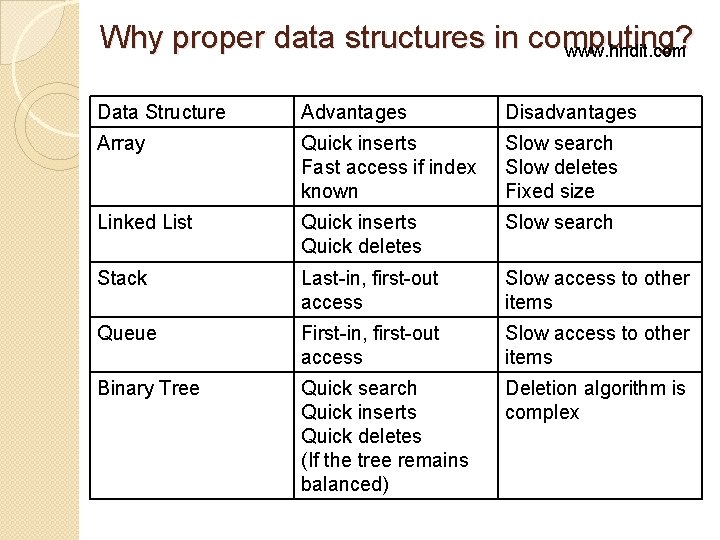
Why proper data structures in computing? www. hndit. com Data Structure Advantages Disadvantages Array Quick inserts Fast access if index known Slow search Slow deletes Fixed size Linked List Quick inserts Quick deletes Slow search Stack Last-in, first-out access Slow access to other items Queue First-in, first-out access Slow access to other items Binary Tree Quick search Quick inserts Quick deletes (If the tree remains balanced) Deletion algorithm is complex
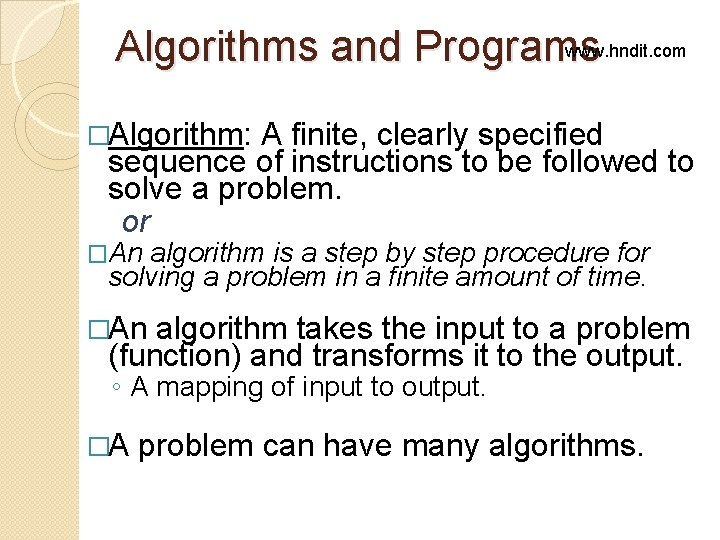
www. hndit. com Algorithms and Programs �Algorithm: A finite, clearly specified sequence of instructions to be followed to solve a problem. or �An algorithm is a step by step procedure for solving a problem in a finite amount of time. �An algorithm takes the input to a problem (function) and transforms it to the output. ◦ A mapping of input to output. �A problem can have many algorithms.
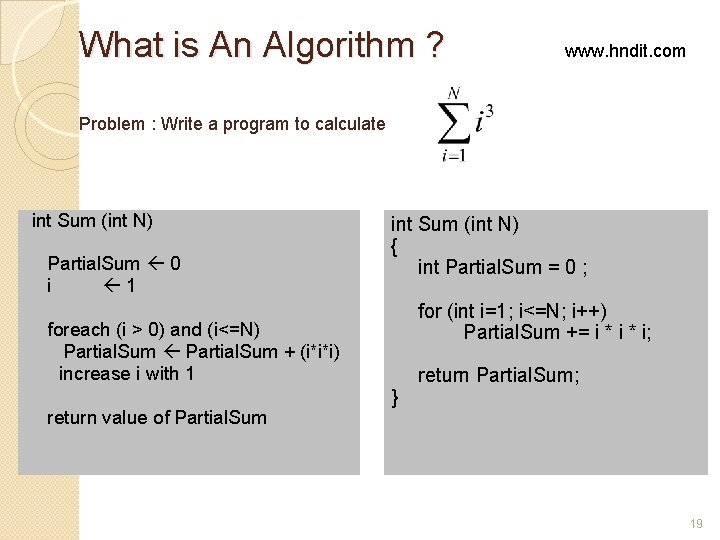
What is An Algorithm ? www. hndit. com Problem : Write a program to calculate int Sum (int N) Partial. Sum 0 i 1 int Sum (int N) { int Partial. Sum = 0 ; for (int i=1; i<=N; i++) Partial. Sum += i * i; foreach (i > 0) and (i<=N) Partial. Sum + (i*i*i) increase i with 1 return value of Partial. Sum } return Partial. Sum; 19
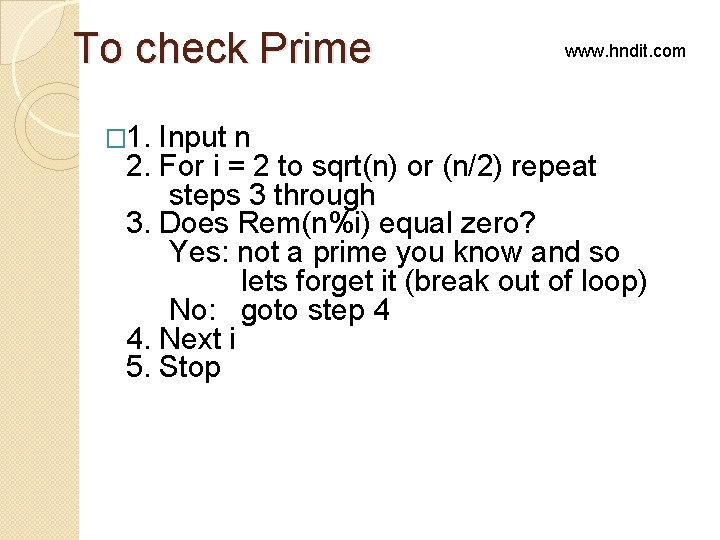
To check Prime � 1. www. hndit. com Input n 2. For i = 2 to sqrt(n) or (n/2) repeat steps 3 through 3. Does Rem(n%i) equal zero? Yes: not a prime you know and so lets forget it (break out of loop) No: goto step 4 4. Next i 5. Stop
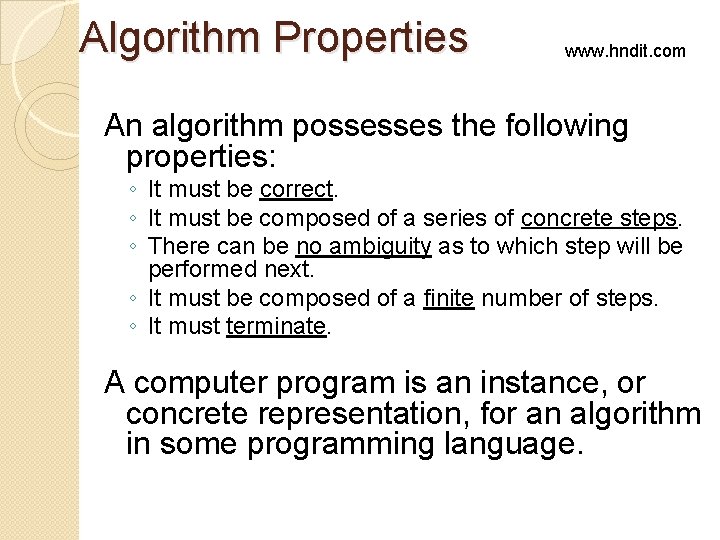
Algorithm Properties www. hndit. com An algorithm possesses the following properties: ◦ It must be correct. ◦ It must be composed of a series of concrete steps. ◦ There can be no ambiguity as to which step will be performed next. ◦ It must be composed of a finite number of steps. ◦ It must terminate. A computer program is an instance, or concrete representation, for an algorithm in some programming language.
Algorithm Efficiency www. hndit. com There are often many approaches (algorithms) to solve a problem. How do we choose between them? At the heart of computer program design are two (sometimes conflicting) goals. 1. To design an algorithm that is easy to understand, code, debug. 2. To design an algorithm that makes efficient use of the computer’s resources.
Algorithm Efficiency (cont) www. hndit. com � Some algorithms are more efficient than others. We would prefer to chose an efficient algorithm, so it would be nice to have metrics for comparing algorithm efficiency. • The complexity of an algorithm is a function describing the efficiency of the algorithm in terms of the amount of data the algorithm must process. • There are two main complexity measures of the efficiency of an algorithm: • Time complexity is a function describing the amount of time an algorithm takes in terms of the amount of input to the algorithm. • Space complexity is a function describing the amount of memory (space) an algorithm takes in terms of the amount of input to the algorithm.
How to Measure Efficiency? www. hndit. com 1. Empirical comparison (run programs) 2. Asymptotic Algorithm Analysis Critical resources: Factors affecting running time: For most algorithms, running time depends on “size” of the input. Running time is expressed as T(n) for some function T on input size n.
The Process of Algorithm Development www. hndit. com �Design ◦ divide&conquer, greedy, dynamic programming �Validation ◦ check whether it is correct �Analysis ◦ determine the properties of algorithm �Implementation �Testing ◦ check whether it works for all possible cases 25
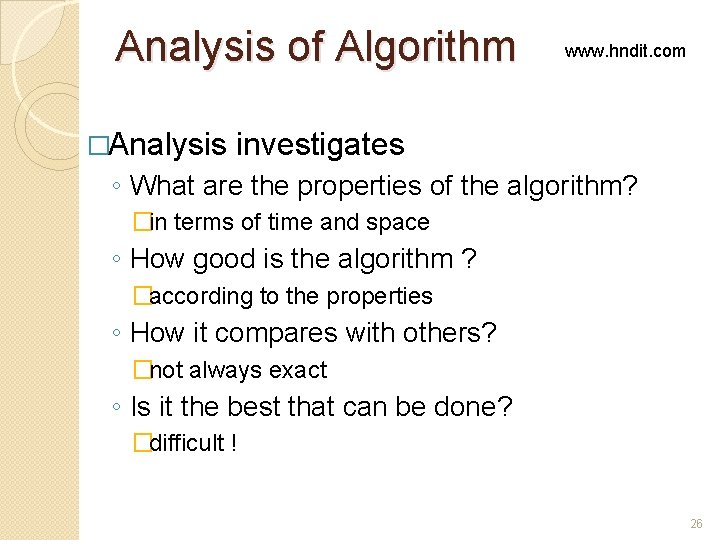
Analysis of Algorithm �Analysis www. hndit. com investigates ◦ What are the properties of the algorithm? �in terms of time and space ◦ How good is the algorithm ? �according to the properties ◦ How it compares with others? �not always exact ◦ Is it the best that can be done? �difficult ! 26
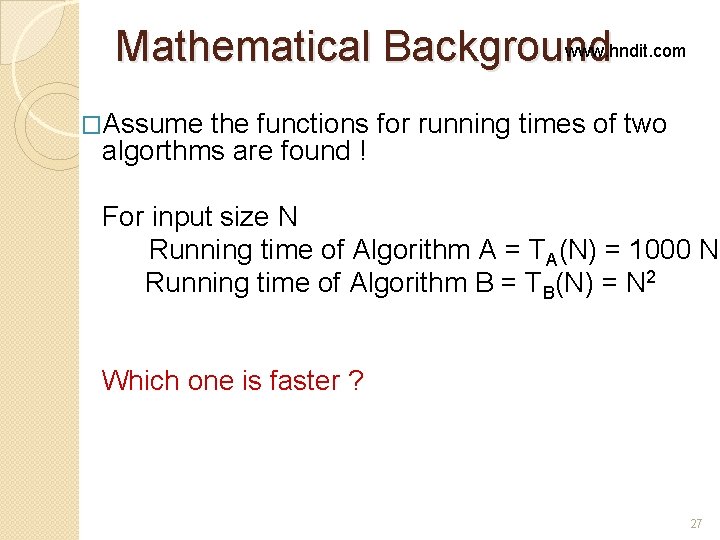
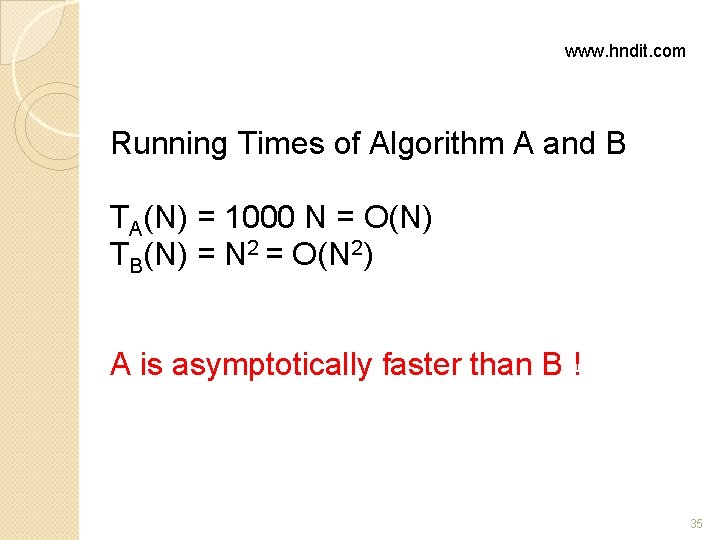
www. hndit. com Mathematical Background �Assume the functions for running times of two algorthms are found ! For input size N Running time of Algorithm A = TA(N) = 1000 N Running time of Algorithm B = TB(N) = N 2 Which one is faster ? 27
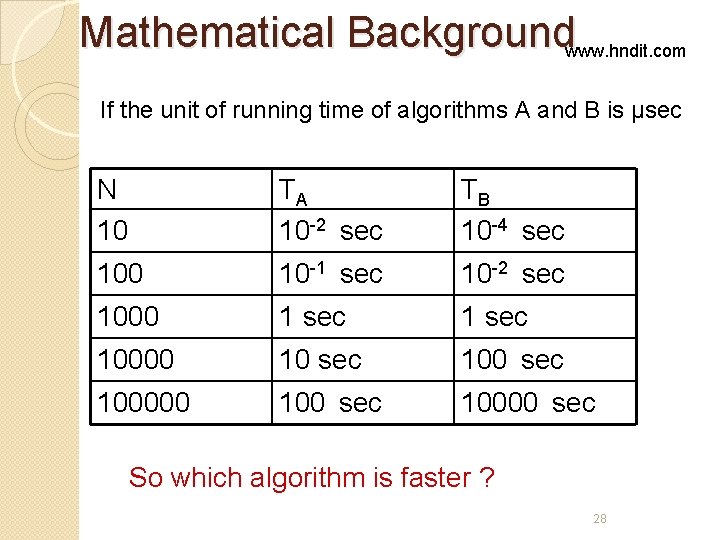
Mathematical Backgroundwww. hndit. com If the unit of running time of algorithms A and B is µsec N 10 TA 10 -2 sec TB 10 -4 sec 100 10 -1 sec 10 -2 sec 1000 1 sec 10000 10 sec 100000 100 sec 10000 sec So which algorithm is faster ? 28
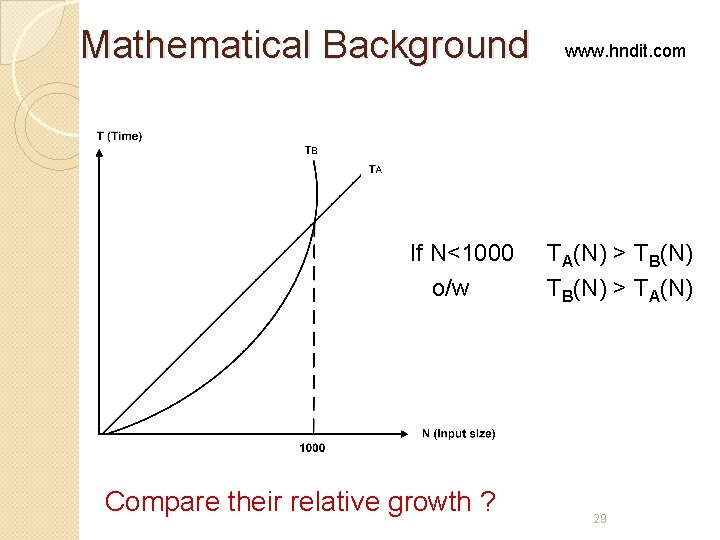
Mathematical Background If N<1000 o/w Compare their relative growth ? www. hndit. com TA(N) > TB(N) > TA(N) 29
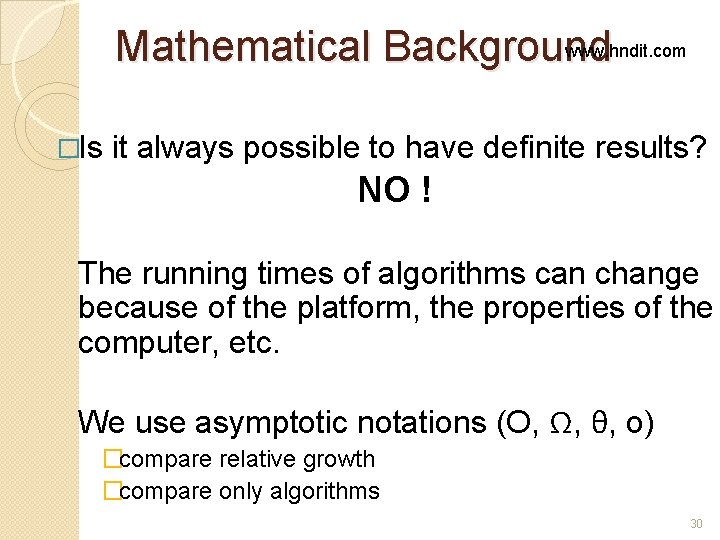
www. hndit. com Mathematical Background �Is it always possible to have definite results? NO ! The running times of algorithms can change because of the platform, the properties of the computer, etc. We use asymptotic notations (O, Ω, θ, o) �compare relative growth �compare only algorithms 30
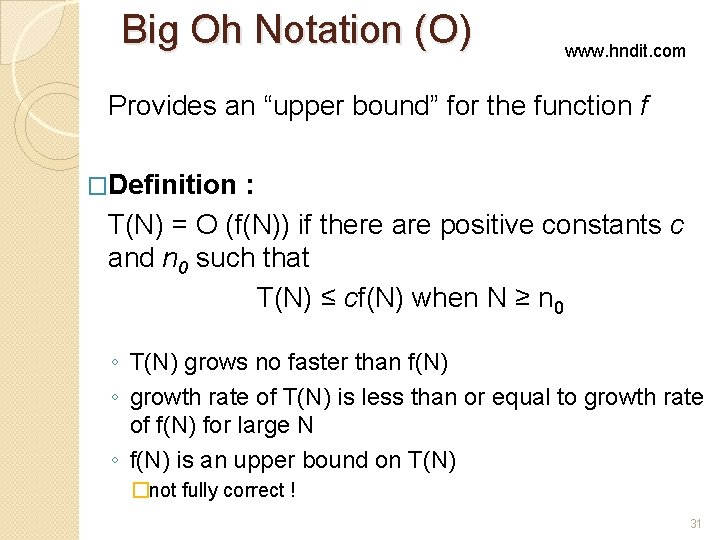
Big Oh Notation (O) www. hndit. com Provides an “upper bound” for the function f �Definition : T(N) = O (f(N)) if there are positive constants c and n 0 such that T(N) ≤ cf(N) when N ≥ n 0 ◦ T(N) grows no faster than f(N) ◦ growth rate of T(N) is less than or equal to growth rate of f(N) for large N ◦ f(N) is an upper bound on T(N) �not fully correct ! 31
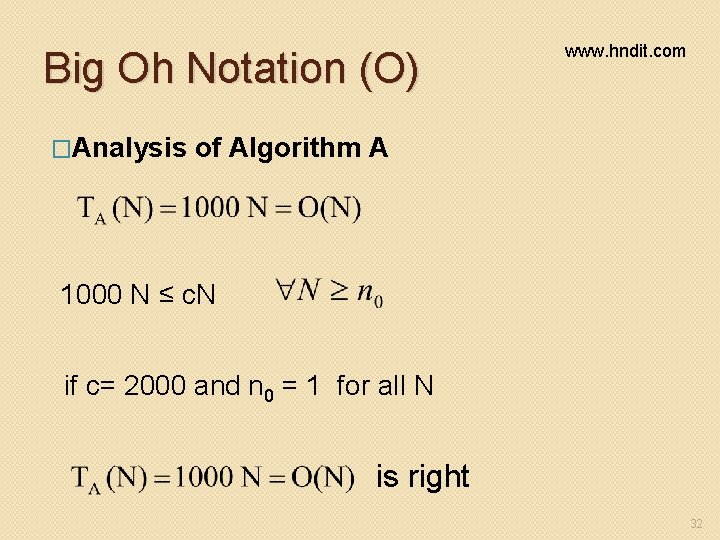
Big Oh Notation (O) �Analysis www. hndit. com of Algorithm A 1000 N ≤ c. N if c= 2000 and n 0 = 1 for all N is right 32
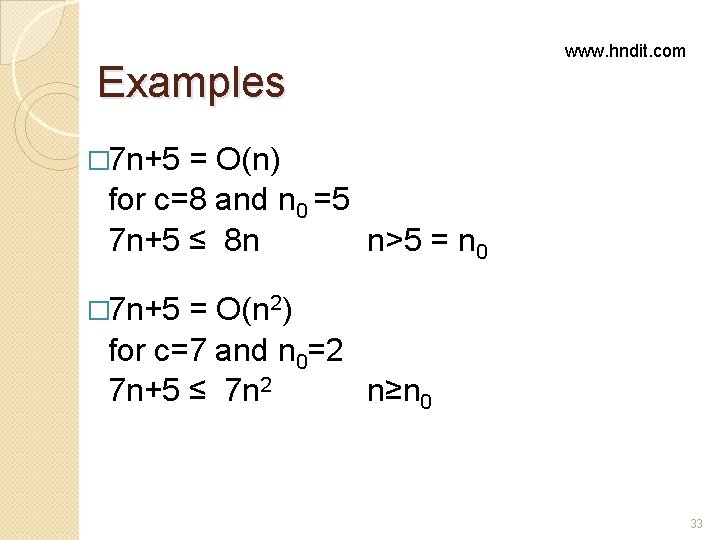
Examples www. hndit. com � 7 n+5 = O(n) for c=8 and n 0 =5 7 n+5 ≤ 8 n n>5 = n 0 � 7 n+5 = O(n 2) for c=7 and n 0=2 7 n+5 ≤ 7 n 2 n≥n 0 33
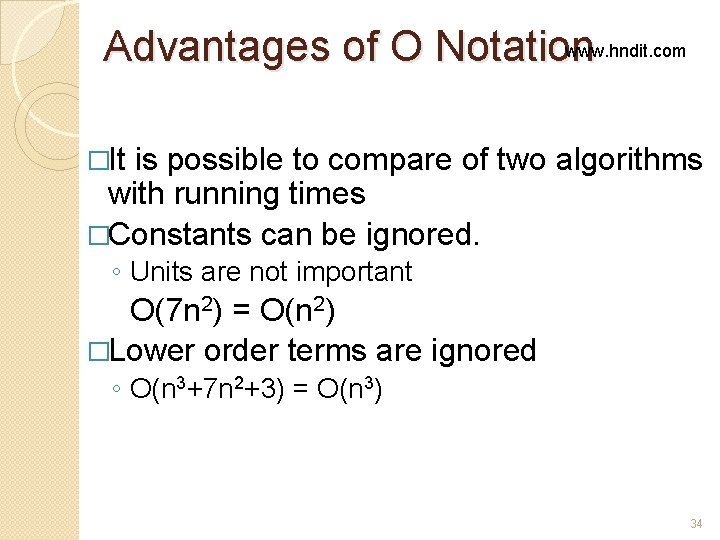
www. hndit. com Advantages of O Notation �It is possible to compare of two algorithms with running times �Constants can be ignored. ◦ Units are not important O(7 n 2) = O(n 2) �Lower order terms are ignored ◦ O(n 3+7 n 2+3) = O(n 3) 34
www. hndit. com Running Times of Algorithm A and B TA(N) = 1000 N = O(N) TB(N) = N 2 = O(N 2) A is asymptotically faster than B ! 35
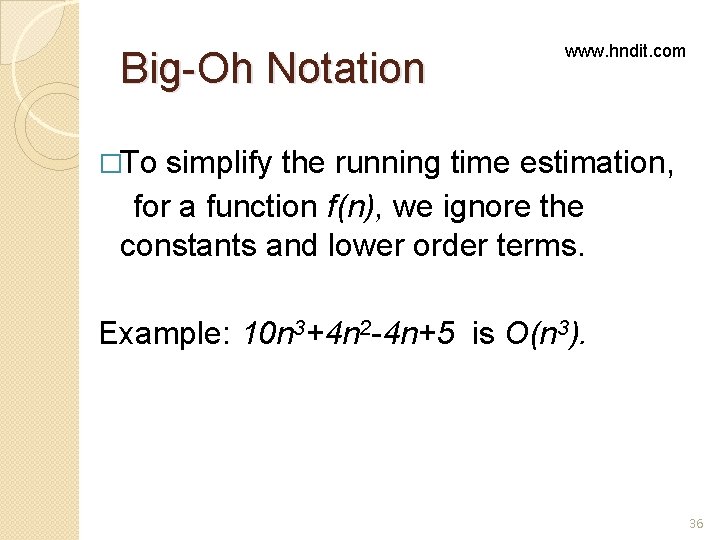
Big-Oh Notation www. hndit. com �To simplify the running time estimation, for a function f(n), we ignore the constants and lower order terms. Example: 10 n 3+4 n 2 -4 n+5 is O(n 3). 36
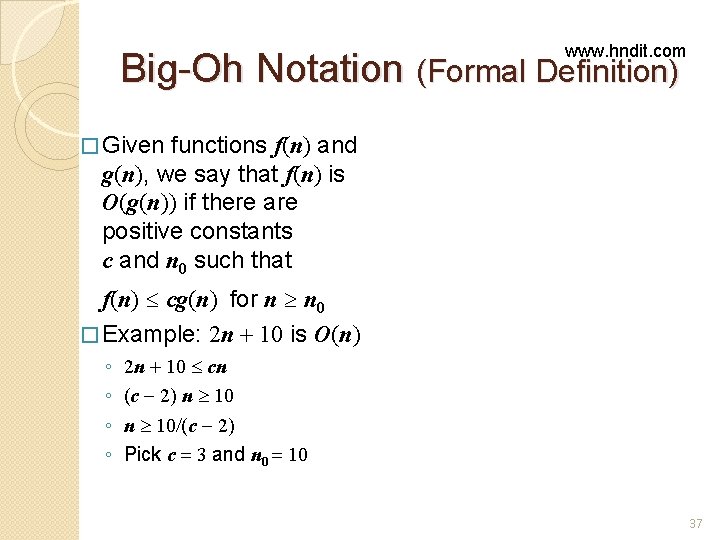
www. hndit. com Big-Oh Notation (Formal Definition) � Given functions f(n) and g(n), we say that f(n) is O(g(n)) if there are positive constants c and n 0 such that f(n) cg(n) for n n 0 � Example: 2 n + 10 is O(n) ◦ ◦ 2 n + 10 cn (c 2) n 10/(c 2) Pick c = 3 and n 0 = 10 37
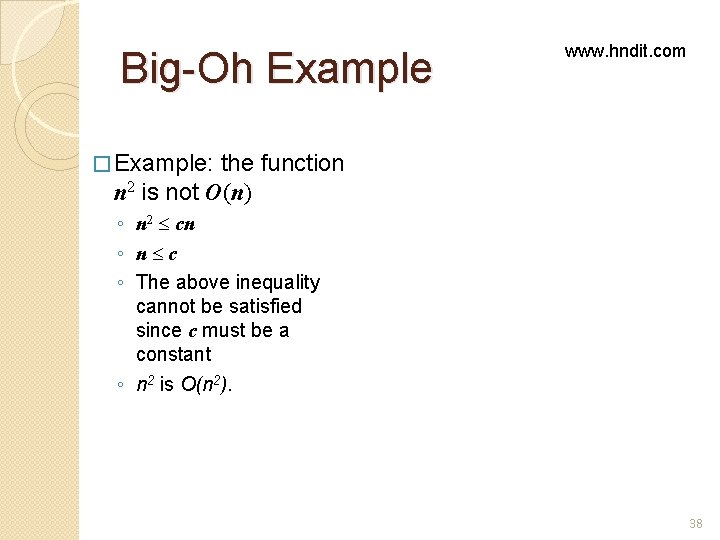
Big-Oh Example www. hndit. com � Example: the function n 2 is not O(n) ◦ n 2 cn ◦ n c ◦ The above inequality cannot be satisfied since c must be a constant ◦ n 2 is O(n 2). 38
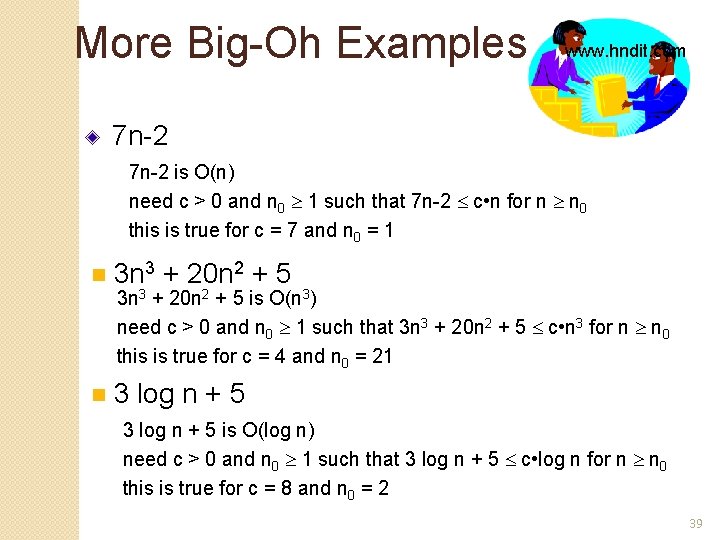
More Big-Oh Examples www. hndit. com 7 n-2 is O(n) need c > 0 and n 0 1 such that 7 n-2 c • n for n n 0 this is true for c = 7 and n 0 = 1 n 3 n 3 + 20 n 2 + 5 n 3 log n + 5 3 n 3 + 20 n 2 + 5 is O(n 3) need c > 0 and n 0 1 such that 3 n 3 + 20 n 2 + 5 c • n 3 for n n 0 this is true for c = 4 and n 0 = 21 3 log n + 5 is O(log n) need c > 0 and n 0 1 such that 3 log n + 5 c • log n for n n 0 this is true for c = 8 and n 0 = 2 39
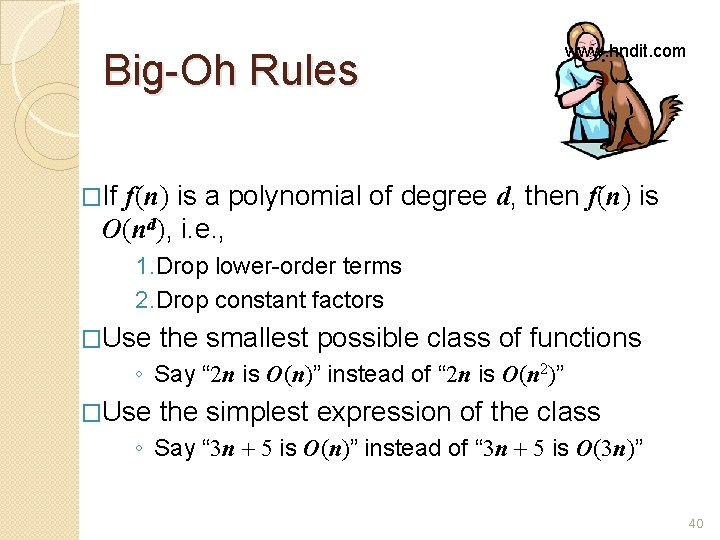
Big-Oh Rules www. hndit. com �If f(n) is a polynomial of degree d, then f(n) is O(nd), i. e. , 1. Drop lower-order terms 2. Drop constant factors �Use the smallest possible class of functions ◦ Say “ 2 n is O(n)” instead of “ 2 n is O(n 2)” �Use the simplest expression of the class ◦ Say “ 3 n + 5 is O(n)” instead of “ 3 n + 5 is O(3 n)” 40
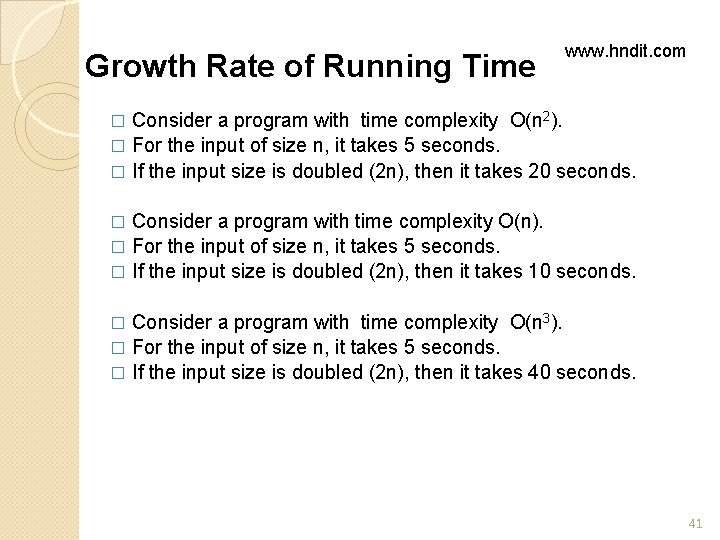
Growth Rate of Running Time www. hndit. com Consider a program with time complexity O(n 2). � For the input of size n, it takes 5 seconds. � If the input size is doubled (2 n), then it takes 20 seconds. � Consider a program with time complexity O(n). � For the input of size n, it takes 5 seconds. � If the input size is doubled (2 n), then it takes 10 seconds. � Consider a program with time complexity O(n 3). � For the input of size n, it takes 5 seconds. � If the input size is doubled (2 n), then it takes 40 seconds. � 41
Efficiency of Algorithms www. hndit. com � Running time of algorithms typically depends on the input set, and its size (n). • Worst case efficiency is the maximum number of steps that an algorithm can take for any collection of data values. In certain apps (air traffic control, weapon systems, etc) knowing the worst case time is important. • Best case efficiency is the minimum number of steps that an algorithm can take any collection of data values. • Average case efficiency • the efficiency averaged on all possible inputs • must assume a distribution of the input • we normally assume uniform distribution (all keys are equally probable)
Efficiency of Algorithmswww. hndit. com (Cont. ) ◦ The average case behavior is harder to analyze since we need to know a probability distribution of input. • If the input has size n, efficiency will be a function of n • Analyzing the efficiency of an algorithm involves determining the quantity of computer resources (computational time or memory) consumed by the algorithm.
Best, Worst, Average Cases www. hndit. com Not all inputs of a given size take the same time to run. Sequential search for K in an array of n integers: • Begin at first element in array and look at each element in turn until K is found Best case: Find at first position. Cost is 1 compare. Worst case: Find at last position. Cost is n compares. Average case: IF we assume the element with value K is equally likely to be in any position in the array. (n+1)/2 compares.
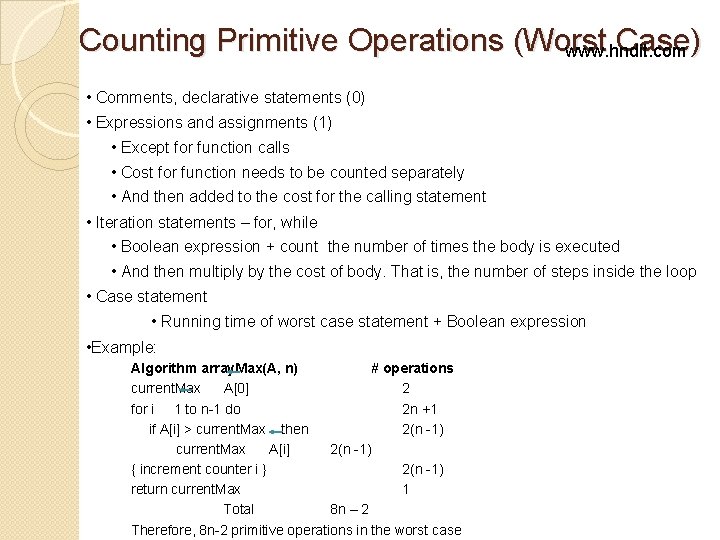
Counting Primitive Operations (Worst Case) www. hndit. com • Comments, declarative statements (0) • Expressions and assignments (1) • Except for function calls • Cost for function needs to be counted separately • And then added to the cost for the calling statement • Iteration statements – for, while • Boolean expression + count the number of times the body is executed • And then multiply by the cost of body. That is, the number of steps inside the loop • Case statement • Running time of worst case statement + Boolean expression • Example: Algorithm array. Max(A, n) # operations current. Max A[0] 2 for i 1 to n-1 do 2 n +1 if A[i] > current. Max then 2(n -1) current. Max A[i] 2(n -1) { increment counter i } 2(n -1) return current. Max 1 Total 8 n – 2 Therefore, 8 n-2 primitive operations in the worst case