www hndit com IT 11004 Data Representation and

- Slides: 10
www. hndit. com IT 11004: Data Representation and Organization Floating Point Representation
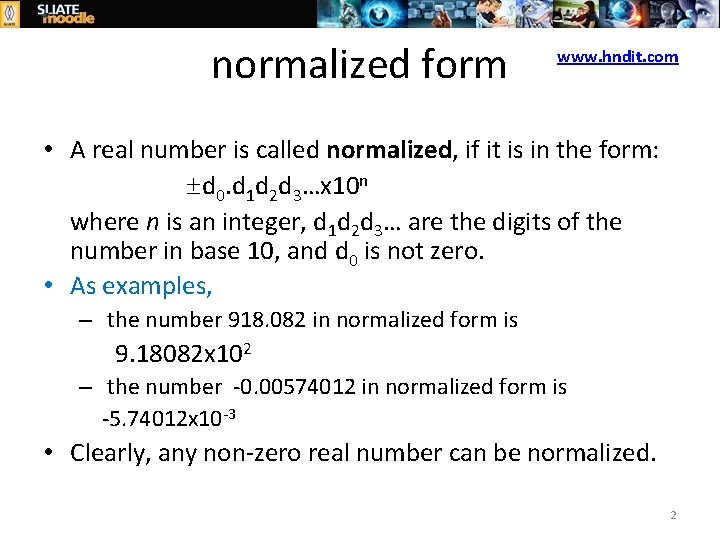
normalized form www. hndit. com • A real number is called normalized, if it is in the form: d 0. d 1 d 2 d 3…x 10 n where n is an integer, d 1 d 2 d 3… are the digits of the number in base 10, and d 0 is not zero. • As examples, – the number 918. 082 in normalized form is 9. 18082 x 102 – the number -0. 00574012 in normalized form is -5. 74012 x 10 -3 • Clearly, any non-zero real number can be normalized. 2
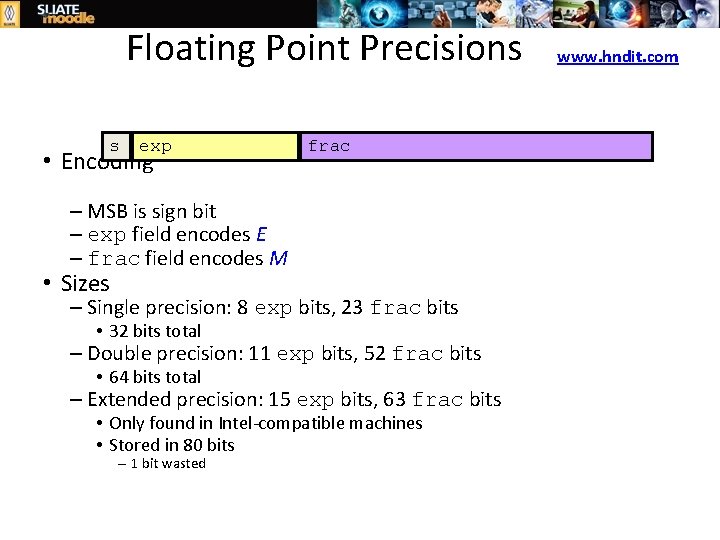
Floating Point Precisions s exp • Encoding frac – MSB is sign bit – exp field encodes E – frac field encodes M • Sizes – Single precision: 8 exp bits, 23 frac bits • 32 bits total – Double precision: 11 exp bits, 52 frac bits • 64 bits total – Extended precision: 15 exp bits, 63 frac bits • Only found in Intel-compatible machines • Stored in 80 bits – 1 bit wasted www. hndit. com
www. hndit. com Single-precision floating-point format (binary 32) • A computer number format that occupies 4 bytes (32 bits) in computer memory and represents a wide dynamic range of values by using a floating point. • One of the first programming languages to provide single- and double-precision floating-point data types was Fortran. • Single-precision binary floating-point is used due to its wider range over fixed point • Single precision is known as – float in C, C++, C#, Java[1], and Haskell, and – single in Pascal, Visual Basic, and MATLAB. 4
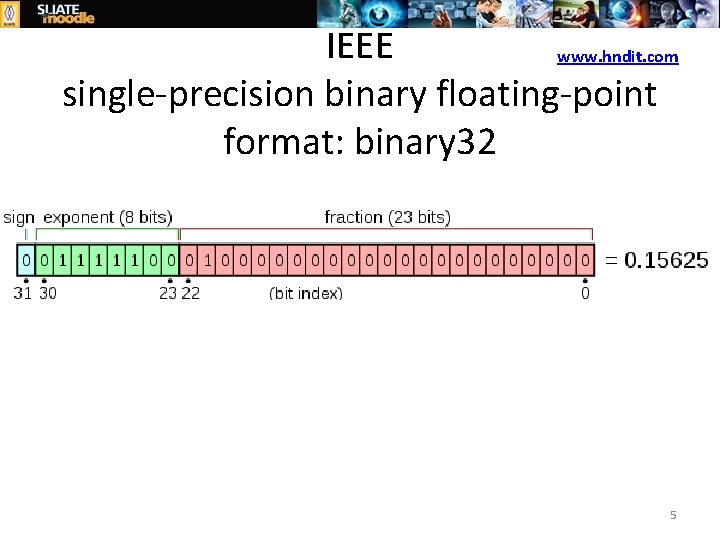
IEEE www. hndit. com single-precision binary floating-point format: binary 32 5
www. hndit. com convert a base 10 real number into binary 32 format • consider a real number with an integer and a fraction part such as 12. 375 – Convert the integer part into binary – convert the fraction part using the following technique – add the two results and adjust them to produce a proper final conversion • Conversion of the fractional part 0. 375 x 2 = 0. 750 x 2 = 1. 500 0. 500 x 2 = 1. 000 fraction = 0. 000, terminate (0. 375)10 can be exactly represented in binary as (0. 011)2 Therefore (12. 375)10 = (12)10 + (0. 375)10 = (1100)2 + (0. 011)2 = (1100. 011)2 In normalized form (12. 375)10 = 1. 1000112 x 23 6
convert a base 10 real number into binary 32 format… www. hndit. com In normalized form (12. 375)10 = 1. 1000112 x 23 • From which we deduce: – The exponent is 3 (and in the biased form it is therefore 127+3 =130 = 1000 0010) – The fraction is 100011 (looking to the right of the binary point) • From these we can form the resulting 32 bit IEEE 754 binary 32 format representation of 12. 375 as: 0 -10000010 -100011000000000 = 41460000 H 7
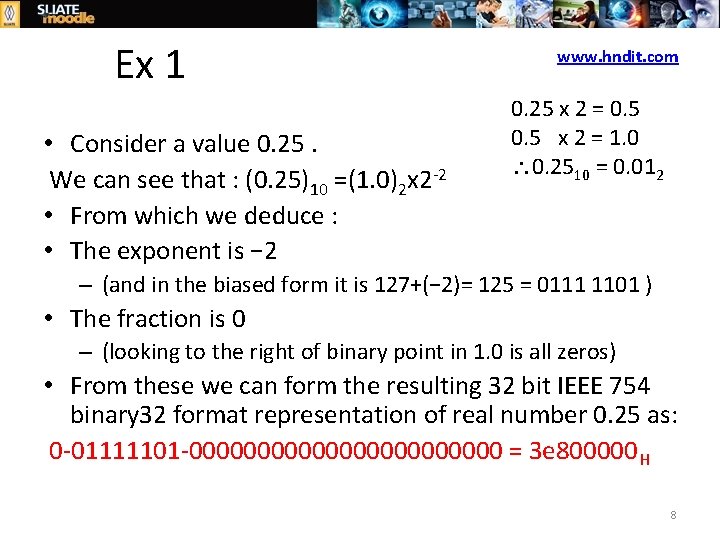
Ex 1 • Consider a value 0. 25. We can see that : (0. 25)10 =(1. 0)2 x 2 -2 • From which we deduce : • The exponent is − 2 www. hndit. com 0. 25 x 2 = 0. 5 x 2 = 1. 0 0. 2510 = 0. 012 – (and in the biased form it is 127+(− 2)= 125 = 0111 1101 ) • The fraction is 0 – (looking to the right of binary point in 1. 0 is all zeros) • From these we can form the resulting 32 bit IEEE 754 binary 32 format representation of real number 0. 25 as: 0 -01111101 -000000000000 = 3 e 800000 H 8
Ex 2 www. hndit. com • Convert 113. 21 into binary 32 floating point format 9
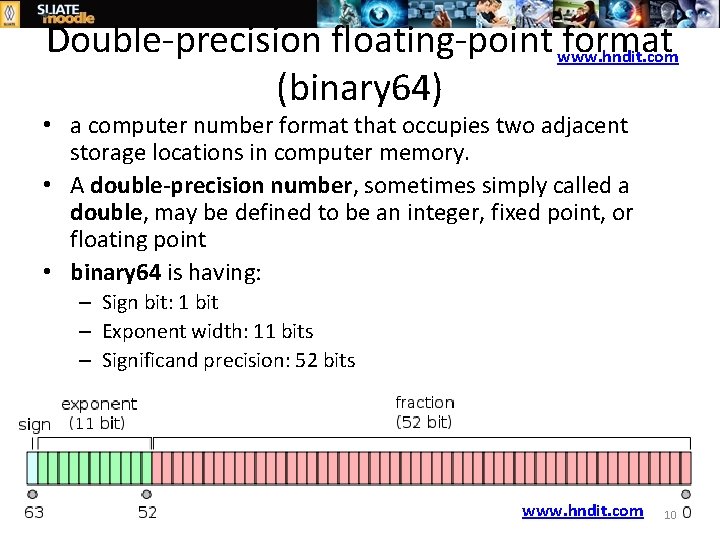
Double-precision floating-point format www. hndit. com (binary 64) • a computer number format that occupies two adjacent storage locations in computer memory. • A double-precision number, sometimes simply called a double, may be defined to be an integer, fixed point, or floating point • binary 64 is having: – Sign bit: 1 bit – Exponent width: 11 bits – Significand precision: 52 bits www. hndit. com 10