
www hndit com Object Oriented Programming Access Modifiers
www. hndit. com Object Oriented Programming Access Modifiers Lecture 10
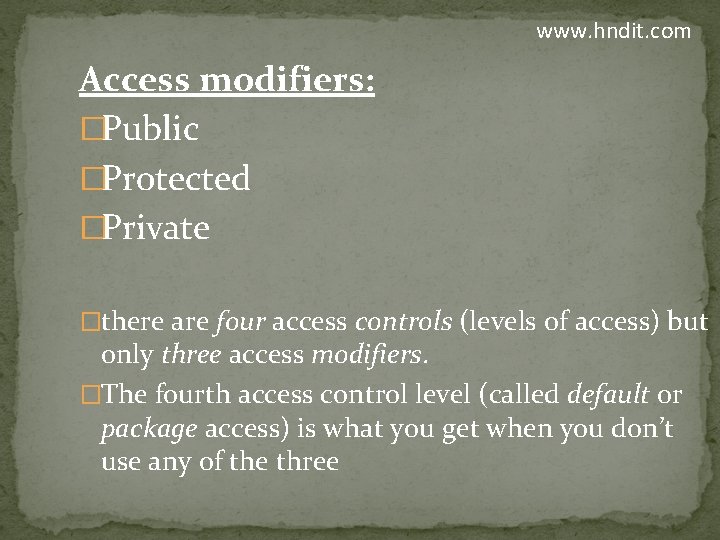
www. hndit. com Access modifiers: �Public �Protected �Private �there are four access controls (levels of access) but only three access modifiers. �The fourth access control level (called default or package access) is what you get when you don’t use any of the three
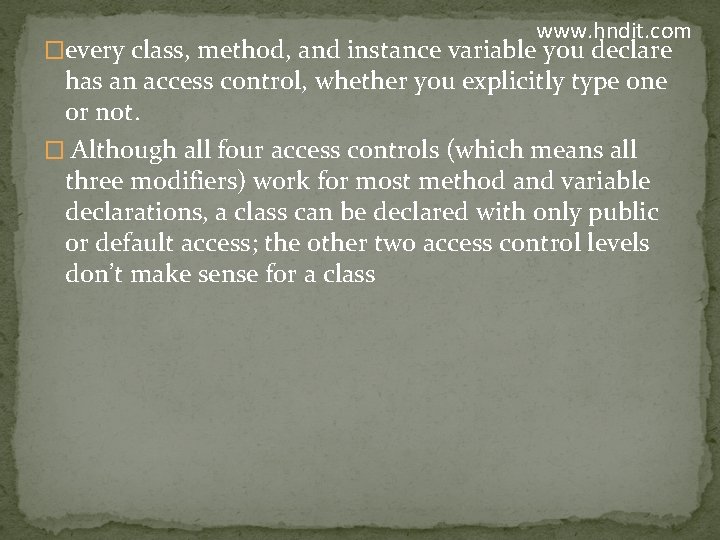
www. hndit. com �every class, method, and instance variable you declare has an access control, whether you explicitly type one or not. � Although all four access controls (which means all three modifiers) work for most method and variable declarations, a class can be declared with only public or default access; the other two access control levels don’t make sense for a class

www. hndit. com CLASS ACCESS

www. hndit. com Default Access �A class with default access has no modifier preceding it in the declaration. In other words, it’s the access control you get when you don’t type a modifier in the class declaration. Think of default access as package-level access, because a class with default access can be seen only by classes within the same package. For example, if class A and class B are in different packages, and class A has default access, class B won’t be able to create an instance of class A, or even declare a variable or return type of class A.

www. hndit. com Public Access �A class declaration with the public keyword gives all classes from all packages access to the public class. In other words, all classes in the Java Universe (JU) have access to a public class.
www. hndit. com Other (Nonaccess) Class Modifiers

www. hndit. com Final Classes �When used in a class declaration, the final keyword means the class can’t be subclassed. In other words, no other class can ever extend (inherit from) a final class, and any attempts to do so will give you a compiler error.
www. hndit. com Method and Variable Declarations and Modifiers
www. hndit. com Member Access �Whereas a class can use just two of the four access control levels (default or public), members can use all four: ■ public ■ protected ■ default ■ private
www. hndit. com Public Members �When a method or variable member is declared public, it means all other classes, regardless of the package they belong to, can access the member
www. hndit. com Private Members �Members marked private can’t be accessed by code in any class other than the class in which the private member was declared.
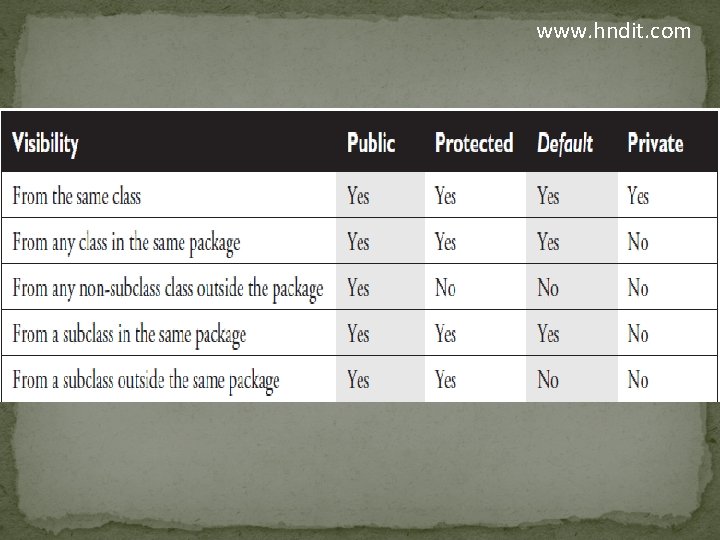
www. hndit. com Protected and Default Members �The protected and default access control levels are almost identical, but with one critical difference. A default member maybe accessed only if the class accessing the member belongs to the same package, whereas a protected member can be accessed (through inheritance) by a subclass even if the subclass is in a different package.
www. hndit. com
- Slides: 14