Welcome to Comp 411 Computer Organization and Design



- Slides: 41
Welcome to Comp 411! Computer Organization and Design Montek Singh Wed, Aug 22, 2012 Lecture 1 David Macaulay
Topics for today ã Course Mechanics ã Course Objectives ã What is Information? ã Computer Abstractions
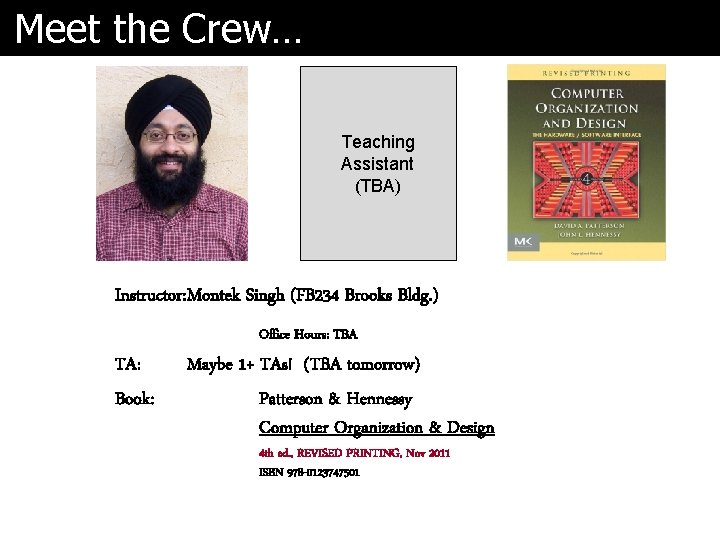
Meet the Crew… Teaching Assistant (TBA) Instructor: Montek Singh (FB 234 Brooks Bldg. ) Office Hours: TBA TA: Book: Maybe 1+ TAs! (TBA tomorrow) Patterson & Hennessy Computer Organization & Design 4 th ed. , REVISED PRINTING, Nov 2011 ISBN 978 -0123747501
Credits ã Some of these slides were developed by Leonard Mc. Millan and adapted by Gary Bishop and me.
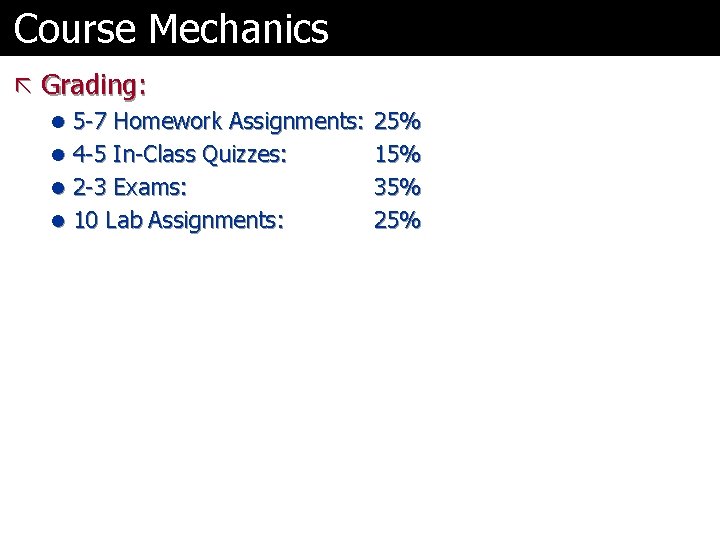
Course Mechanics ã Grading: l 5 -7 Homework Assignments: 25% l 4 -5 In-Class Quizzes: l 2 -3 Exams: l 10 Lab Assignments: 15% 35% 25%
Course Mechanics ã Policies: l Problem Sets: Ø Will be distributed on the web. You will typically have 1 week to do them, but sometimes more or less time. l Honor Code: Ø The honor code is in effect for all homework, labs, exams etc. Please review the policy on the course website. l Lecture Notes: Ø I will attempt to make Lecture Slides, Problem Sets, and other course materials available on the web either before class, or soon after, on the day they are given.
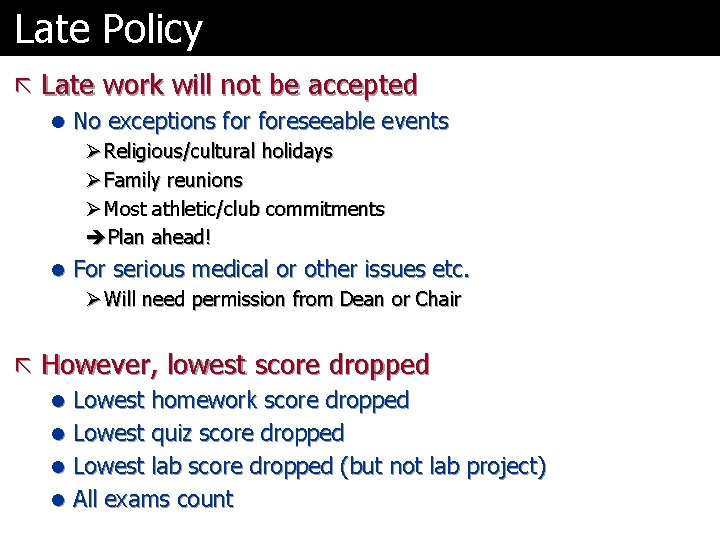
Late Policy ã Late work will not be accepted l No exceptions foreseeable events Ø Religious/cultural holidays Ø Family reunions Ø Most athletic/club commitments èPlan ahead! l For serious medical or other issues etc. Ø Will need permission from Dean or Chair ã However, lowest score dropped l Lowest homework score dropped l Lowest quiz score dropped l Lowest lab score dropped (but not lab project) l All exams count
Prerequisites ã COMP 401: Foundations of Programming l This is a hard prerequisite l You may be able to substitute another programming course, but please first talk to me! ã You need to know at least the following concepts: l basic data types: integers, characters, Boolean, etc. l basic arithmetic operators and expressions l "if-then-else" constructs, and "while"/"for" loops l function and procedure calls l basic Boolean operators (AND, OR, XOR, etc. ) ã If you don’t know many of the above concepts, please talk to me!
How to do well in this course ã Attend lectures (stay awake!) ã Read the book! l Big mistake = only reviewing lecture slides ã Do all homework l Start early. Many problem sets are too hard to attempt the night before. ã Ask questions in class ã Discuss with other students l But all work handed must be your own (see Honor Code) ã Remember: Use all materials from this semester only l Much of the material (lecture slides, homework) has changed l Looking up solutions from earlier semesters = cheating. Not worth it.
Comp 411: Course Website Linked from http: //www. cs. unc. edu/~montek/
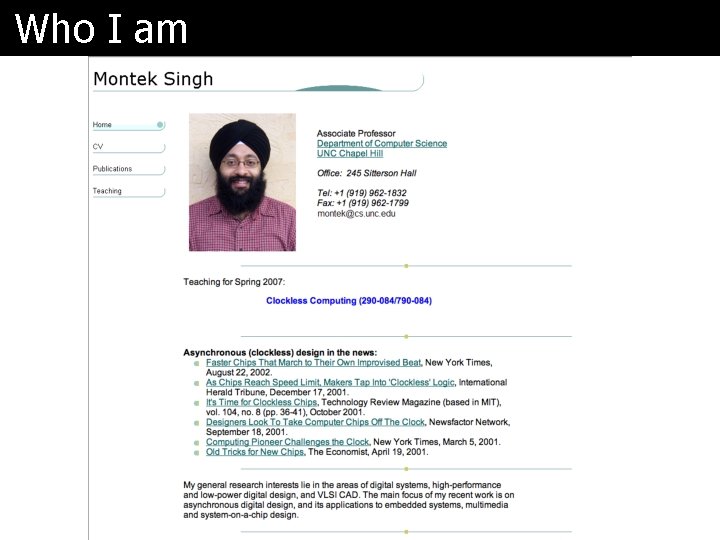
Who I am
Who are you? ã By year? ã By major?
Why take this course? ã Let’s hear your reasons!
Goal 1: Demystify Computers ã Strangely, most people (even some computer scientists) are afraid of computers. l We are only afraid of things we do not understand! Ø I do not fear computers. I fear the lack of them. - Isaac Asimov (1920 - 1992) Ø Fear is the main source of superstition, and one of the main sources of cruelty. To conquer fear is the beginning of wisdom. - Bertrand Russell (1872 – 1970)
Where do you find computers today? ã Besides on your desk, or in your lap, of course! l Let’s hear from you! ã How have computers revolutionized life in the 21 st century? l Automobiles l Mobile phones, PDAs, games l Massive distributed projects: e. g. , human genome project l World Wide Web l Search engines
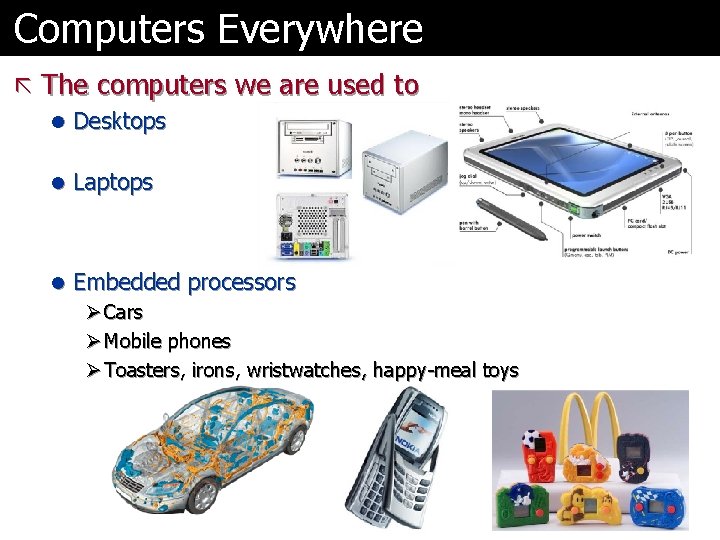
Computers Everywhere ã The computers we are used to l Desktops l Laptops l Embedded processors Ø Cars Ø Mobile phones Ø Toasters, irons, wristwatches, happy-meal toys
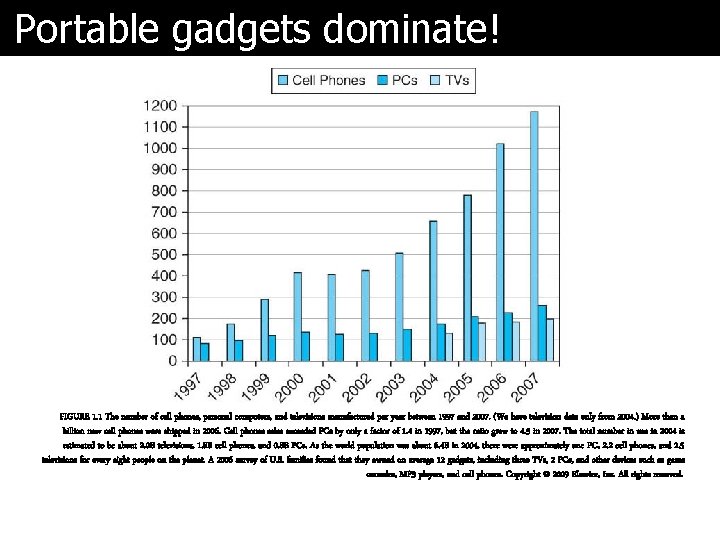
Portable gadgets dominate! FIGURE 1. 1 The number of cell phones, personal computers, and televisions manufactured per year between 1997 and 2007. (We have television data only from 2004. ) More than a billion new cell phones were shipped in 2006. Cell phones sales exceeded PCs by only a factor of 1. 4 in 1997, but the ratio grew to 4. 5 in 2007. The total number in use in 2004 is estimated to be about 2. 0 B televisions, 1. 8 B cell phones, and 0. 8 B PCs. As the world population was about 6. 4 B in 2004, there were approximately one PC, 2. 2 cell phones, and 2. 5 televisions for every eight people on the planet. A 2006 survey of U. S. families found that they owned on average 12 gadgets, including three TVs, 2 PCs, and other devices such as game consoles, MP 3 players, and cell phones. Copyright © 2009 Elsevier, Inc. All rights reserved.
Goal 2: Power of Abstraction ã What is abstraction? l Define a function, develop a robust implementation, and then put a box around it. ã Why is abstraction useful? l enables us to create unfathomable machines called computers l imagine a billion --- 1, 000, 000
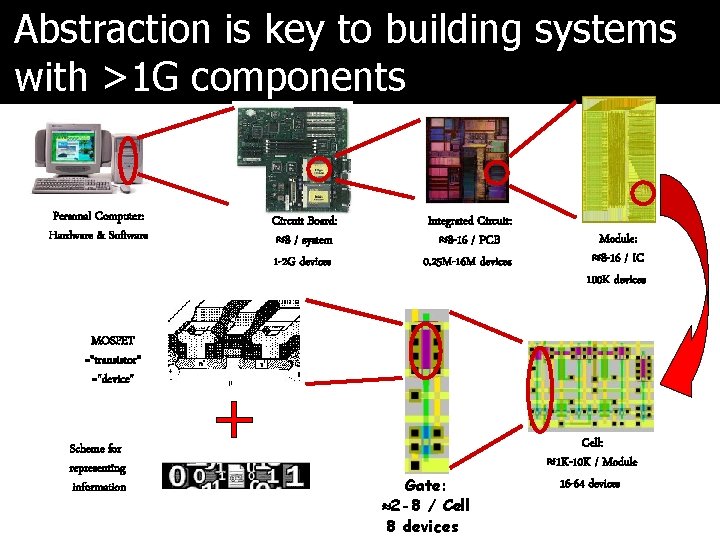
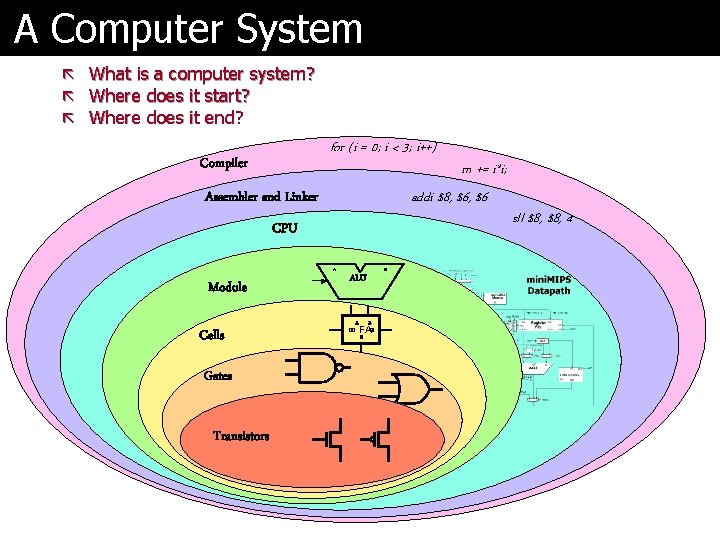
Abstraction is key to building systems with >1 G components Personal Computer: Hardware & Software Circuit Board: 8 / system 1 -2 G devices Integrated Circuit: 8 -16 / PCB 0. 25 M-16 M devices Module: 8 -16 / IC 100 K devices MOSFET ="transistor" ="device" Scheme for representing information Gate: 2 -8 / Cell 8 devices Cell: 1 K-10 K / Module 16 -64 devices
Our Plan of Attack… w Understand how things work, by alternating between low-level ( bottom-up) and high level (top-down) concepts w Encapsulate our understanding using appropriate abstractions w Study organizational principles: abstractions, interfaces, APIs. w Roll up our sleeves and design at each level of hierarchy w Learn engineering tricks at each level
A Computer System ã ã ã What is a computer system? Where does it start? Where does it end? for (i = 0; i < 3; i++) Compiler m += i*i; addi $8, $6 Assembler and Linker CPU A Module Cells Gates Transistors B ALU CO A B FACI S sll $8, 4
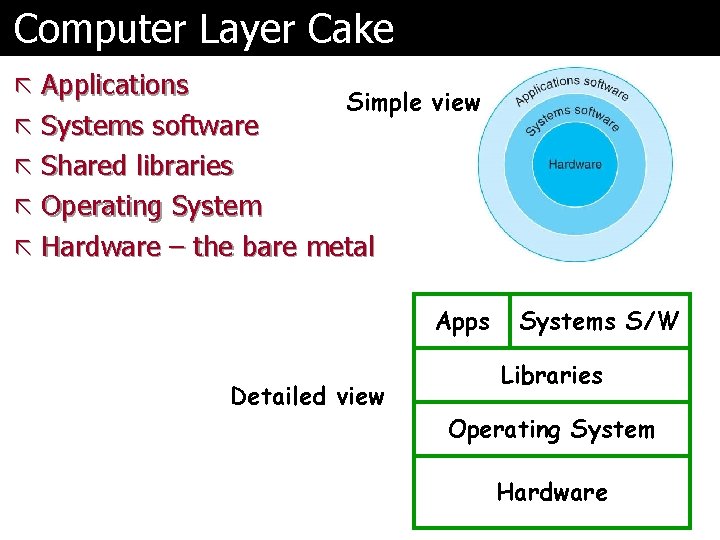
Computer Layer Cake ã Applications ã Systems software Simple view ã Shared libraries ã Operating System ã Hardware – the bare metal Apps Detailed view Systems S/W Libraries Operating System Hardware
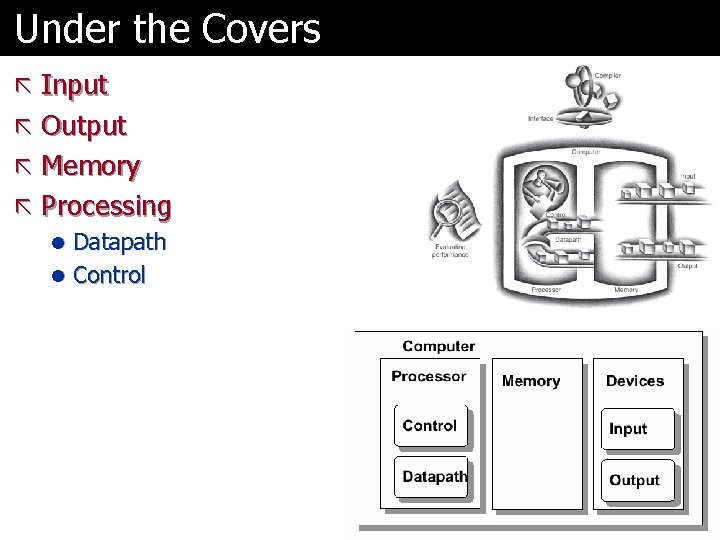
Under the Covers ã Input ã Output ã Memory ã Processing l Datapath l Control
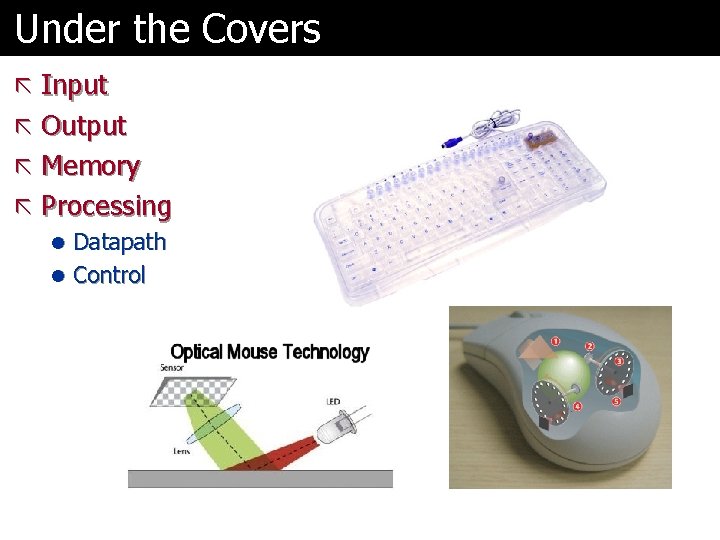
Under the Covers ã Input ã Output ã Memory ã Processing l Datapath l Control
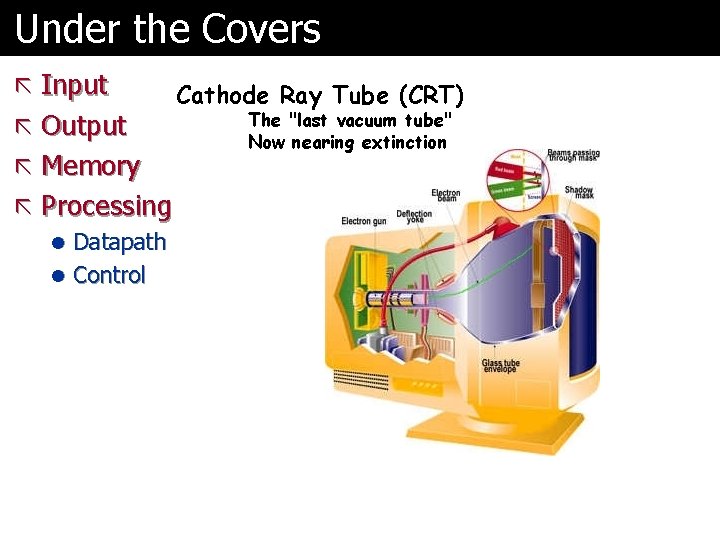
Under the Covers ã Input ã Output ã Memory ã Processing l Datapath l Control Cathode Ray Tube (CRT) The "last vacuum tube" Now nearing extinction
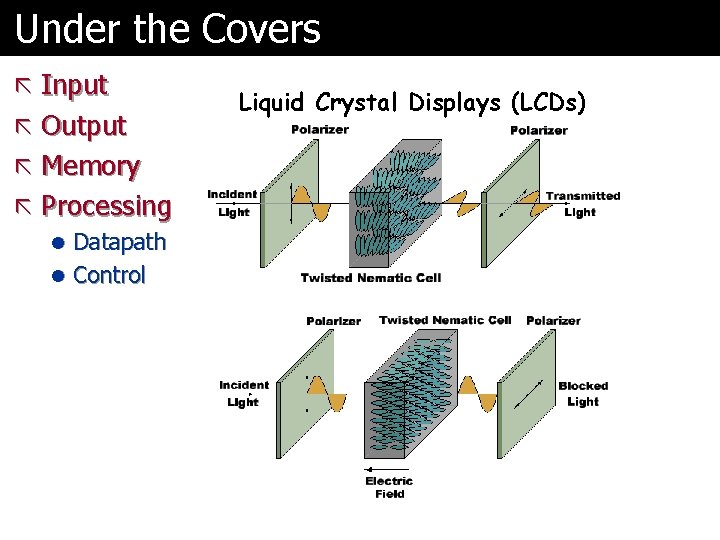
Under the Covers ã Input ã Output ã Memory ã Processing l Datapath l Control Liquid Crystal Displays (LCDs)
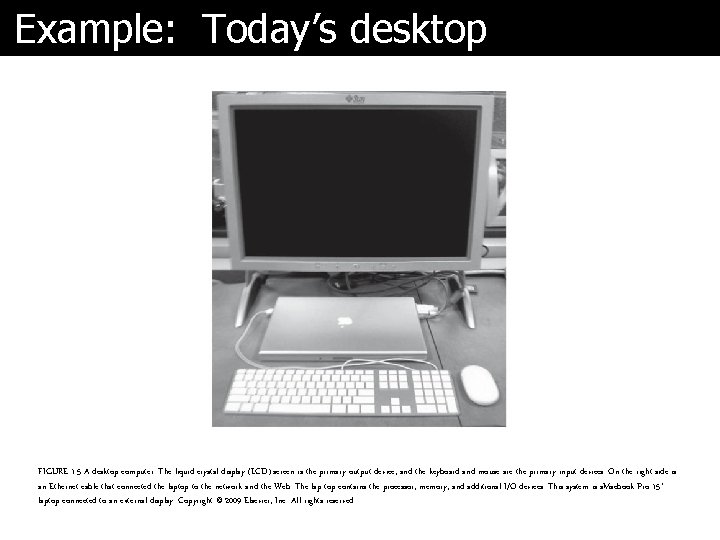
Example: Today’s desktop FIGURE 1. 5 A desktop computer. The liquid crystal display (LCD) screen is the primary output device, and the keyboard and mouse are the primary input devices. On the right side is an Ethernet cable that connected the laptop to the network and the Web. The lap top contains the processor, memory, and additional I/O devices. This system is a. Macbook Pro 15" laptop connected to an external display. Copyright © 2009 Elsevier, Inc. All rights reserved.
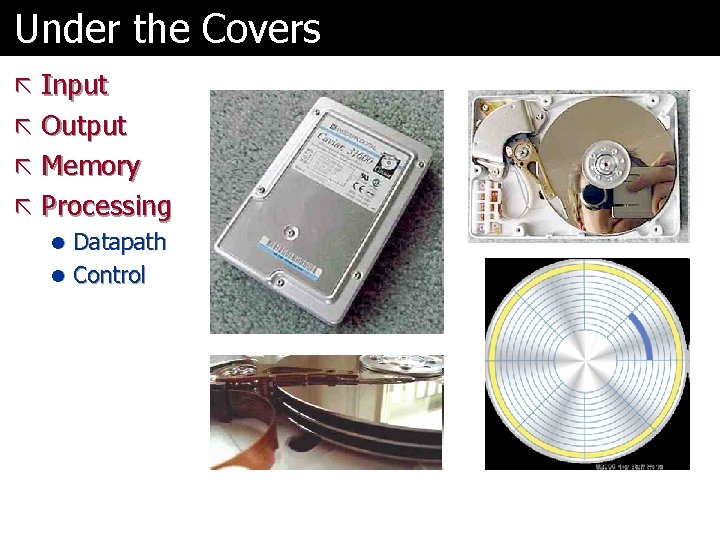
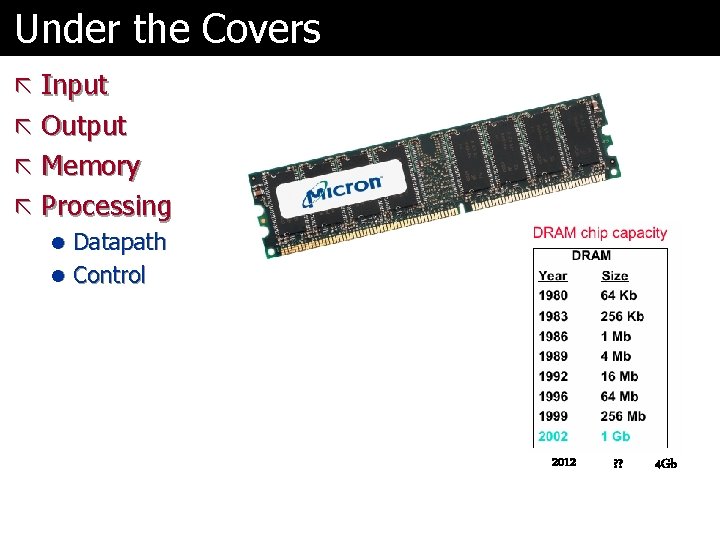
Under the Covers ã Input ã Output ã Memory ã Processing l Datapath l Control
Under the Covers ã Input ã Output ã Memory ã Processing l Datapath l Control 2012 ? ? 4 Gb
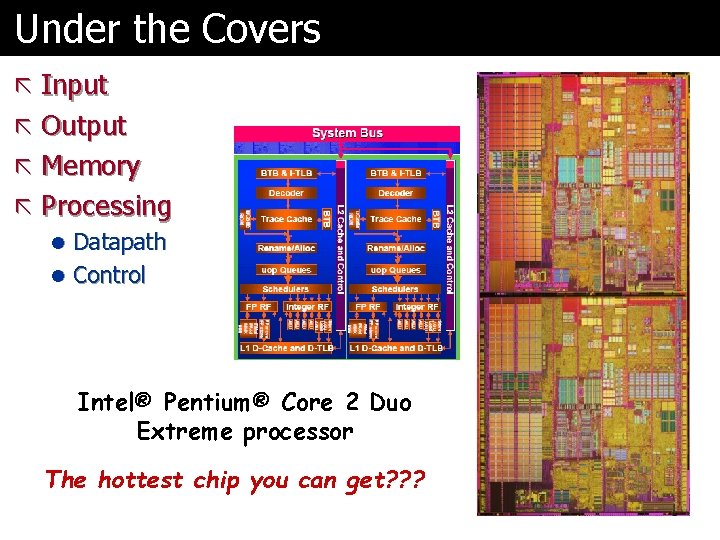
Under the Covers ã Input ã Output ã Memory ã Processing l Datapath l Control Intel® Pentium® Core 2 Duo Extreme processor The hottest chip you can get? ? ?
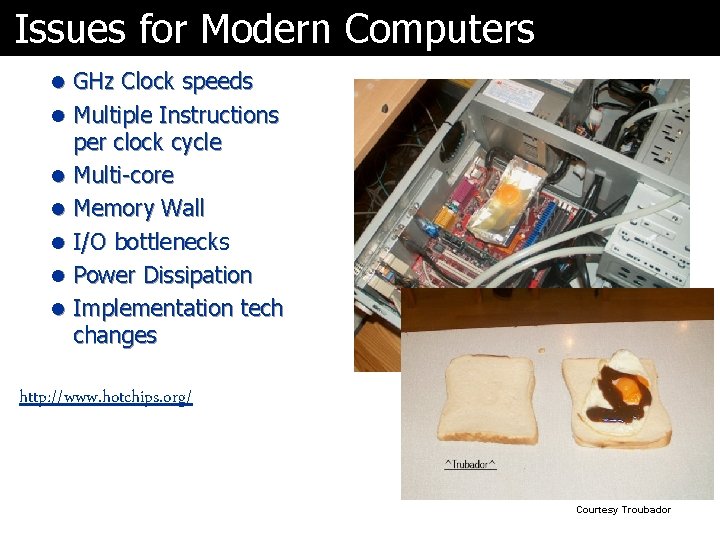
Issues for Modern Computers l GHz Clock speeds l Multiple Instructions per clock cycle l Multi-core l Memory Wall l I/O bottlenecks l Power Dissipation l Implementation tech changes http: //www. hotchips. org/ Courtesy Troubador
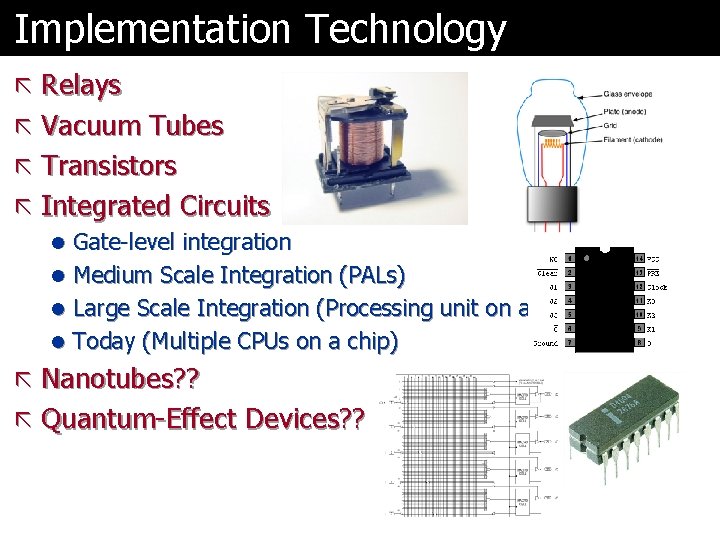
Implementation Technology ã Relays ã Vacuum Tubes ã Transistors ã Integrated Circuits l Gate-level integration l Medium Scale Integration (PALs) l Large Scale Integration (Processing unit on a chip) l Today (Multiple CPUs on a chip) ã Nanotubes? ? ã Quantum-Effect Devices? ?
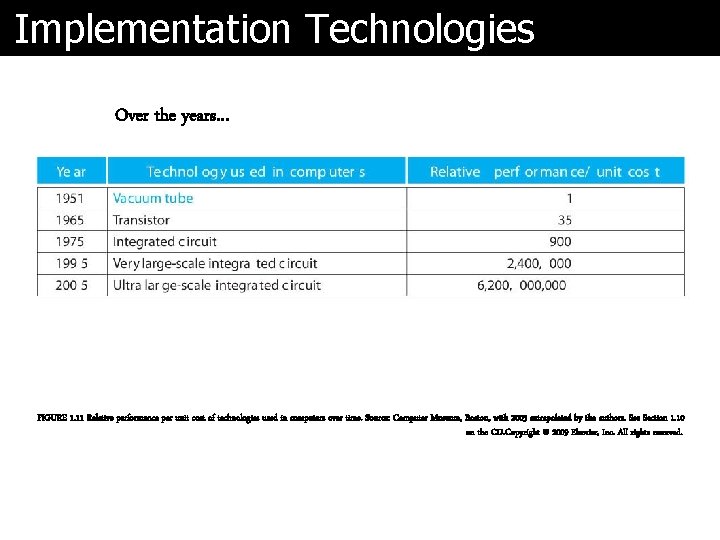
Implementation Technologies Over the years… FIGURE 1. 11 Relative performance per unit cost of technologies used in computers over time. Source: Computer Museum, Boston, with 2005 extrapolated by the authors. See Section 1. 10 on the CD. Copyright © 2009 Elsevier, Inc. All rights reserved.
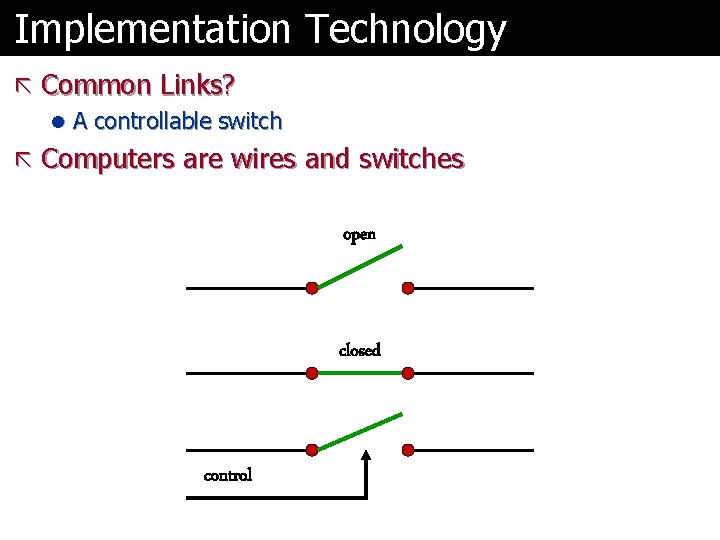
Implementation Technology ã Common Links? l A controllable switch ã Computers are wires and switches open closed control
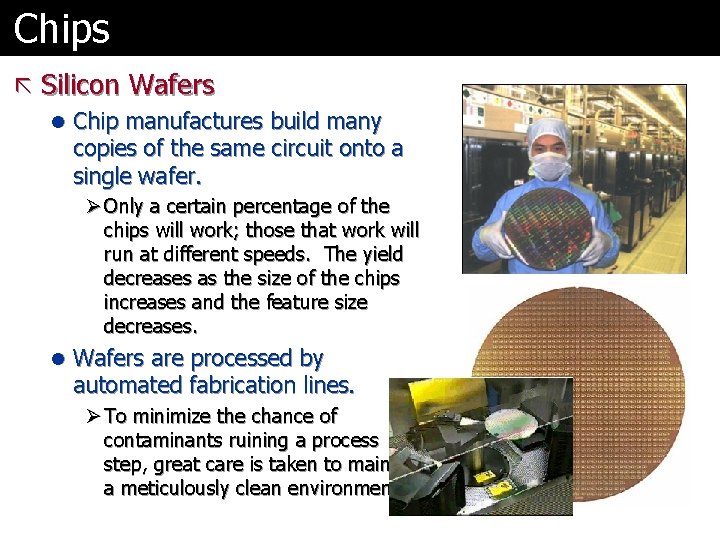
Chips ã Silicon Wafers l Chip manufactures build many copies of the same circuit onto a single wafer. Ø Only a certain percentage of the chips will work; those that work will run at different speeds. The yield decreases as the size of the chips increases and the feature size decreases. l Wafers are processed by automated fabrication lines. Ø To minimize the chance of contaminants ruining a process step, great care is taken to maintain a meticulously clean environment.
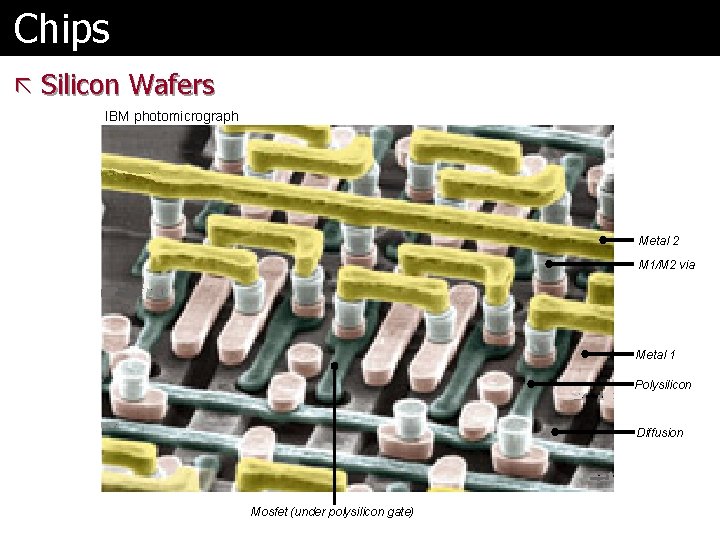
Chips ã Silicon Wafers IBM photomicrograph Metal 2 M 1/M 2 via Metal 1 Polysilicon Diffusion Mosfet (under polysilicon gate)
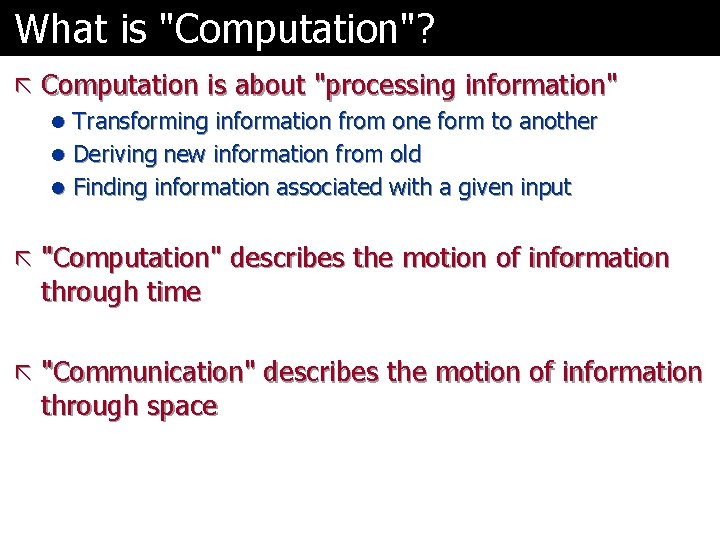
What is "Computation"? ã Computation is about "processing information" l Transforming information from one form to another l Deriving new information from old l Finding information associated with a given input ã "Computation" describes the motion of information through time ã "Communication" describes the motion of information through space
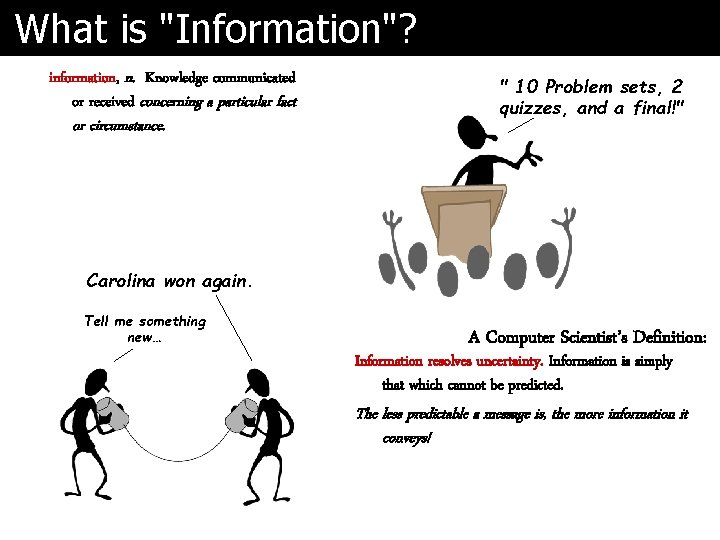
What is "Information"? information, n. Knowledge communicated or received concerning a particular fact or circumstance. " 10 Problem sets, 2 quizzes, and a final!" Carolina won again. Tell me something new… A Computer Scientist’s Definition: Information resolves uncertainty. Information is simply that which cannot be predicted. The less predictable a message is, the more information it conveys!
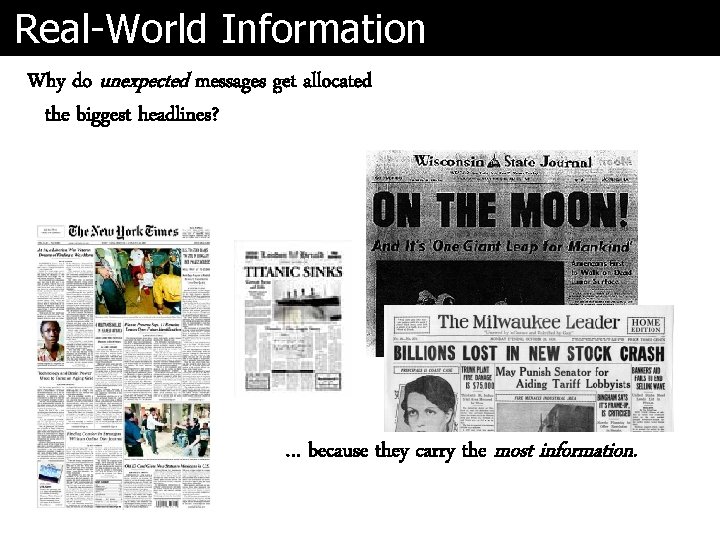
Real-World Information Why do unexpected messages get allocated the biggest headlines? … because they carry the most information.
What Does A Computer Process? ã A Toaster processes bread and bagels ã A Blender processes smoothies and margaritas ã What does a computer process? l Information l Bits ã What is the mapping from information to bits?
Next Lecture ã Computer Representations ã How do computers represent: l Text? l Numbers? l Everything else?