UNIT 05 NOTES Cellular Division UNIT 05 LATIN
- Slides: 77
UNIT 05 NOTES Cellular Division
UNIT 05 LATIN ROOT WORDS
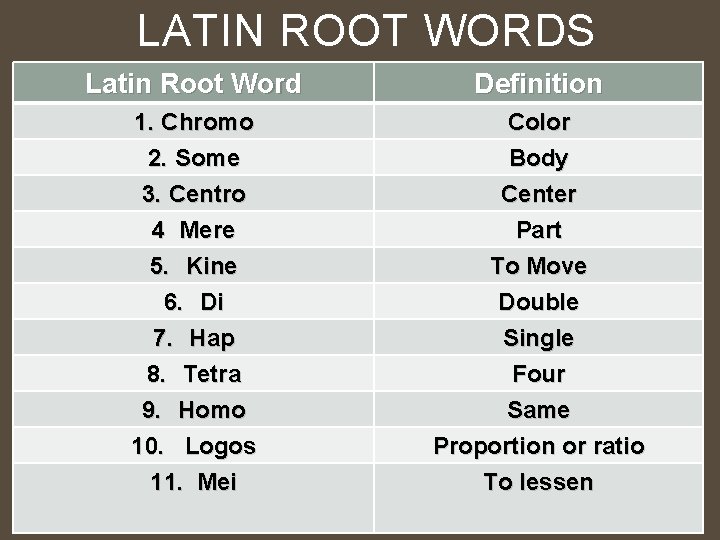
LATIN ROOT WORDS Latin Root Word Definition 1. Chromo 2. Some 3. Centro 4 Mere 5. Kine 6. Di 7. Hap 8. Tetra 9. Homo 10. Logos 11. Mei Color Body Center Part To Move Double Single Four Same Proportion or ratio To lessen
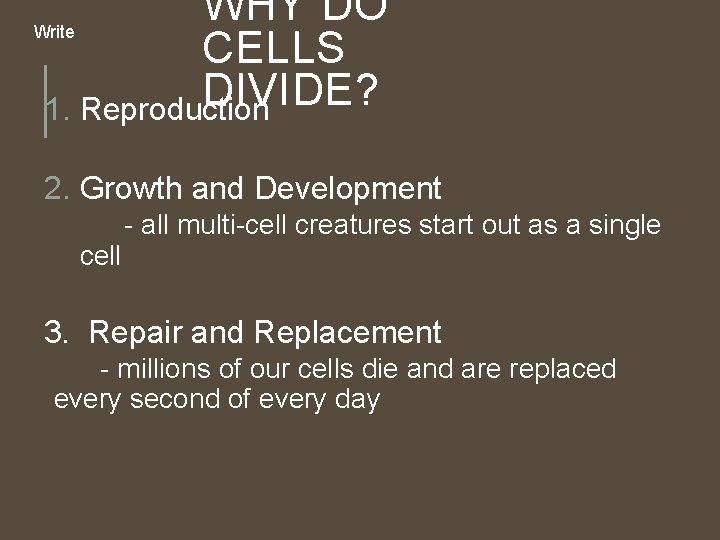
OBJECTIVE 1 I can explain the importance of cell division to living things
WHY DO Write CELLS DIVIDE? 1. Reproduction 2. Growth and Development cell - all multi-cell creatures start out as a single 3. Repair and Replacement - millions of our cells die and are replaced every second of every day
REPLICATION VIA MITOSIS VIDEO https: //www. youtube. com/watch? v=m 73 i 1 Zk 8 EA 0
BACTERIA GROWTH https: //www. youtube. com/watch? v=g. Ewz. Dydci. Wc
GROWTH AND DEVELOPMENT VIDEO https: //www. youtube. com/watch? v=P 1 h 611 s. Nji 8
REPAIR AND REPLACEMENT VIDEO https: //www. youtube. com/watch? v=Cf 3 c 5 Um 5 g. Hc
WHY CAN’T WE REGENERATE LIMBS? https: //www. youtube. com/watch? v=QFa 6 j. P 6 Wgz. M
CHROMOSOMES Objective 2: I know the two components that make up a chromosome.
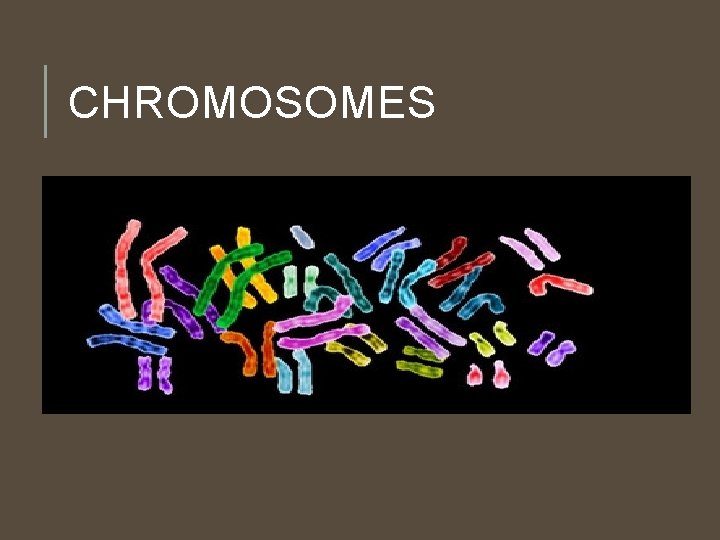
CHROMOSOMES
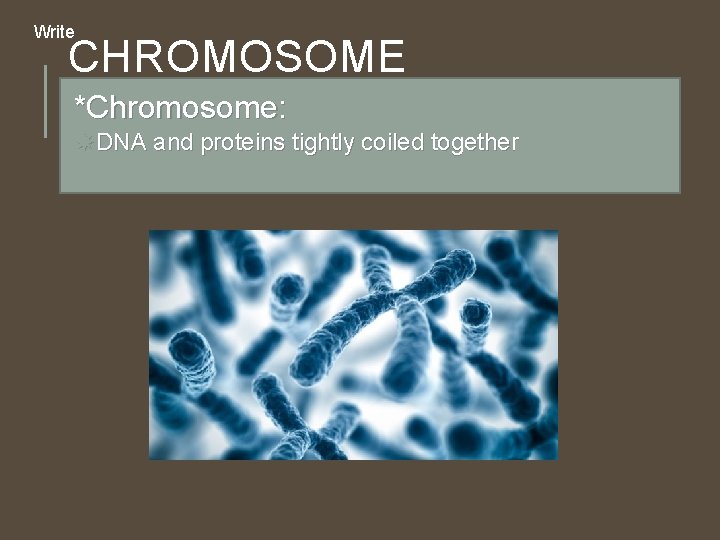
Write CHROMOSOME *Chromosome: DNA and proteins tightly coiled together
DID YOU KNOW: If you put all the DNA molecules in your body end to end, the DNA would reach from the Earth to the Sun and back over 600 times (100 trillion times six feet divided by 92 million miles)
ACTIVITY In every cell of your body is about 6 feet of DNA! How does it all fit? Try to fit your DNA (string) into your Nucleus (Circle on Paper) You can try using some proteins (beads) to help you out.
CHROMOSOME CONDENSATION Objective 3: I know the four levels of condensation for DNA.
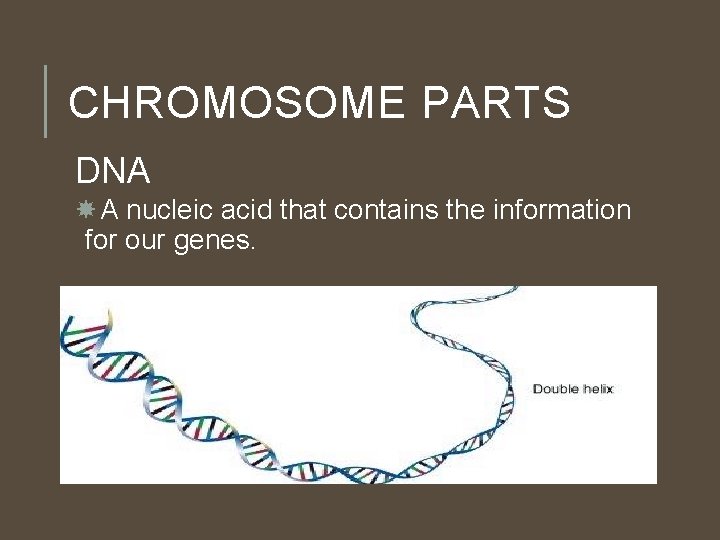
CHROMOSOME PARTS DNA A nucleic acid that contains the information for our genes.
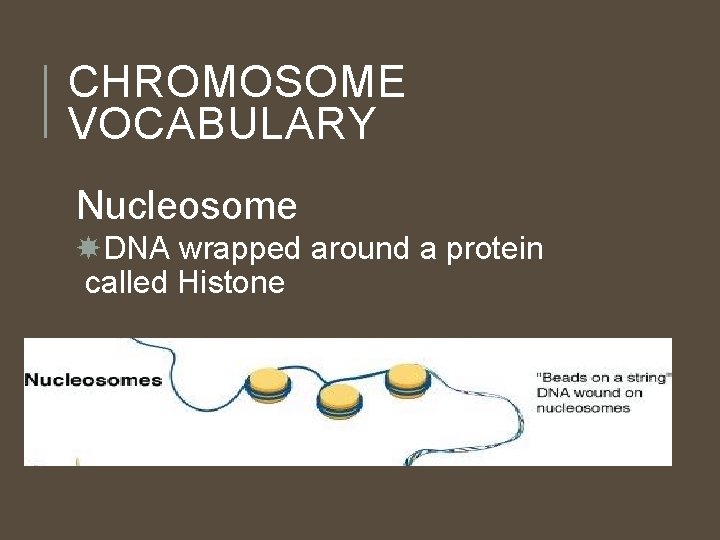
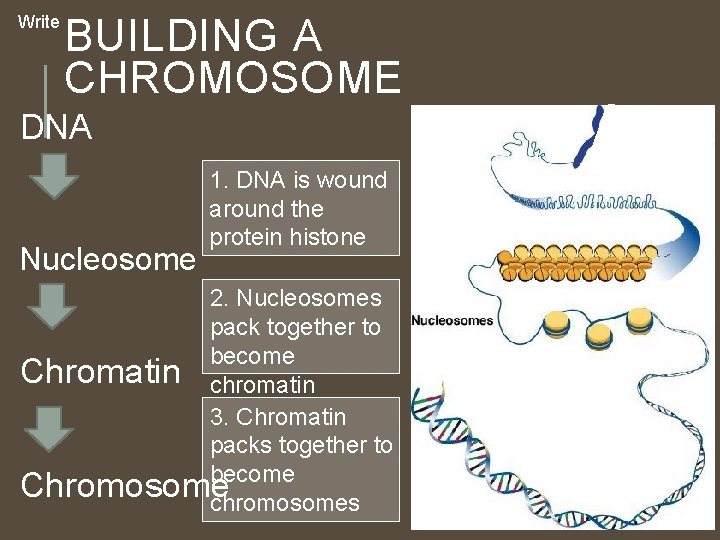
CHROMOSOME VOCABULARY Nucleosome DNA wrapped around a protein called Histone
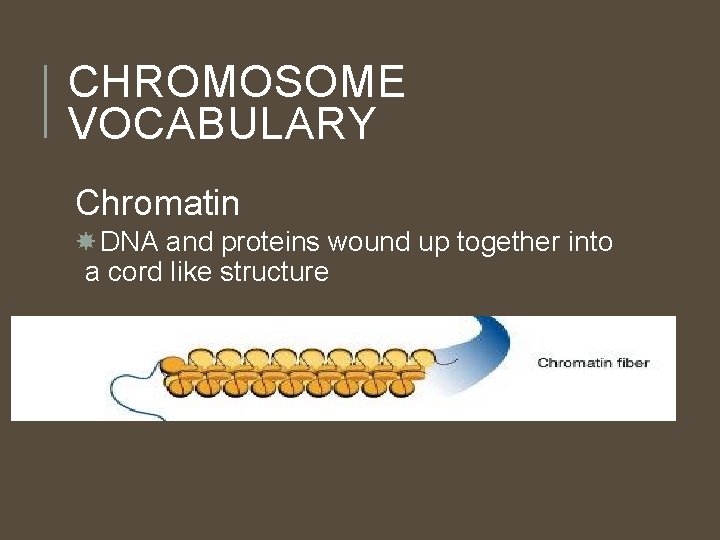
CHROMOSOME VOCABULARY Chromatin DNA and proteins wound up together into a cord like structure
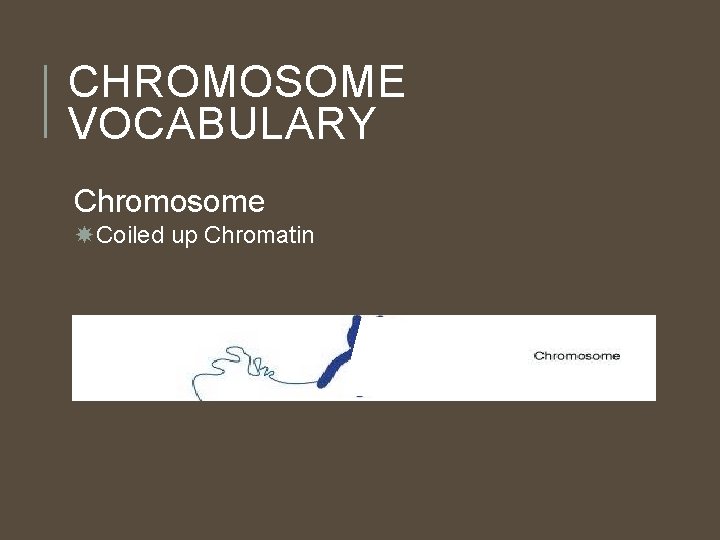
CHROMOSOME VOCABULARY Chromosome Coiled up Chromatin
Write BUILDING A CHROMOSOME DNA Nucleosome 1. DNA is wound around the protein histone 2. Nucleosomes pack together to become Chromatin chromatin 3. Chromatin packs together to become Chromosome chromosomes
DIPLOID AND HAPLOID CELLS Objective 4: I know the difference between Haploid and Diploid Cells
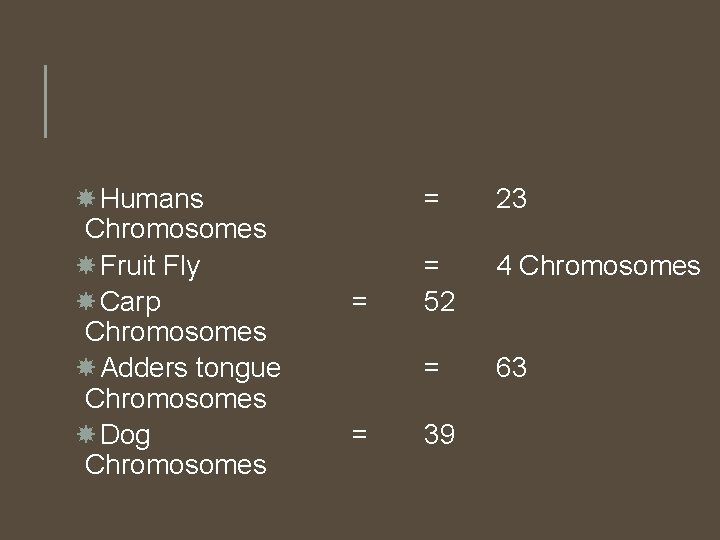
Humans Chromosomes Fruit Fly Carp Chromosomes Adders tongue Chromosomes Dog Chromosomes = = = 23 = 52 4 Chromosomes = 63 39
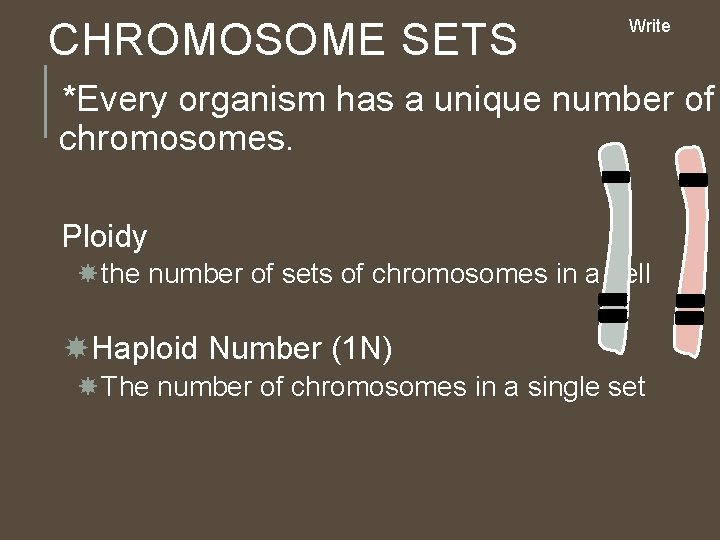
CHROMOSOME SETS Write *Every organism has a unique number of chromosomes. Ploidy the number of sets of chromosomes in a cell Haploid Number (1 N) The number of chromosomes in a single set
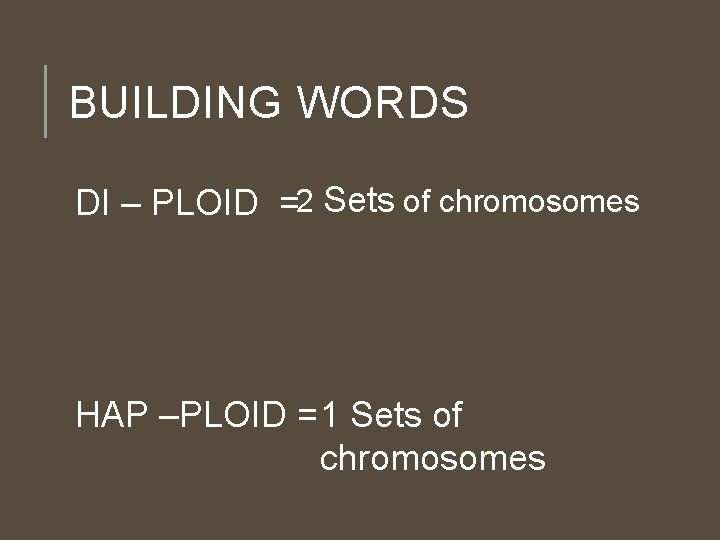
BUILDING WORDS DI – PLOID =2 Sets of chromosomes HAP –PLOID = 1 Sets of chromosomes
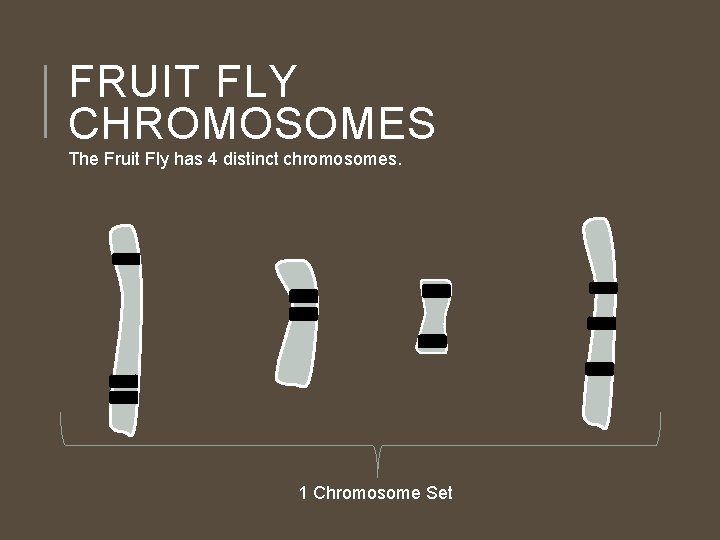
FRUIT FLY CHROMOSOMES The Fruit Fly has 4 distinct chromosomes. 1 Chromosome Set
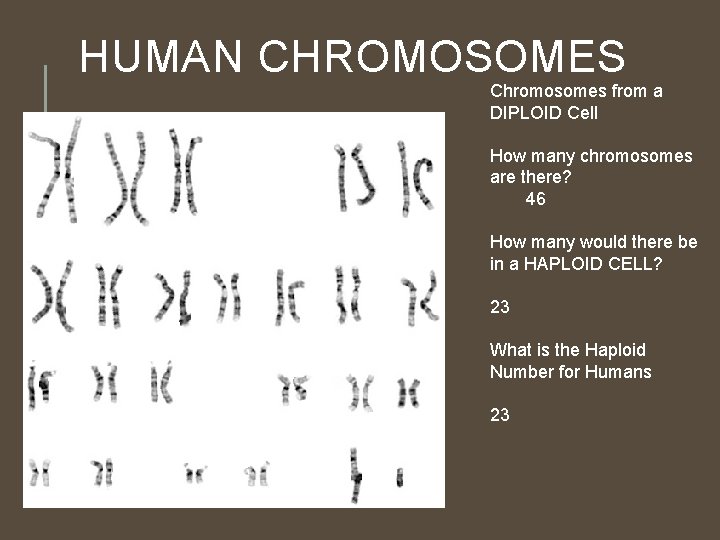
HUMAN CHROMOSOMES Chromosomes from a DIPLOID Cell How many chromosomes are there? 46 How many would there be in a HAPLOID CELL? 23 What is the Haploid Number for Humans 23
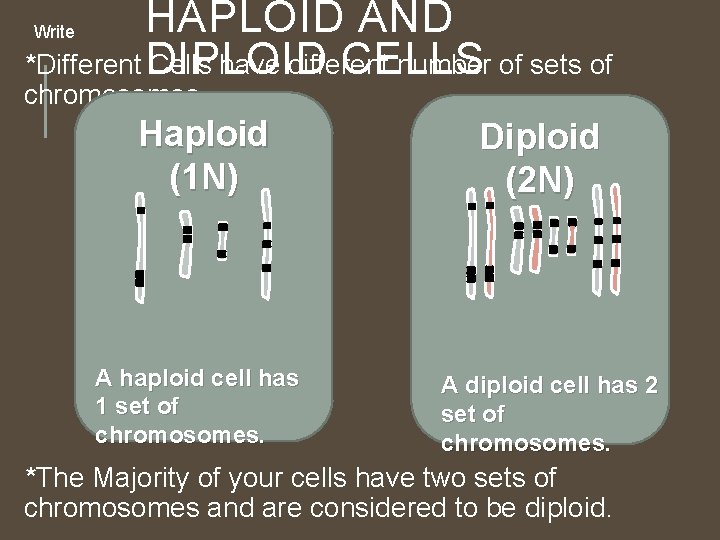
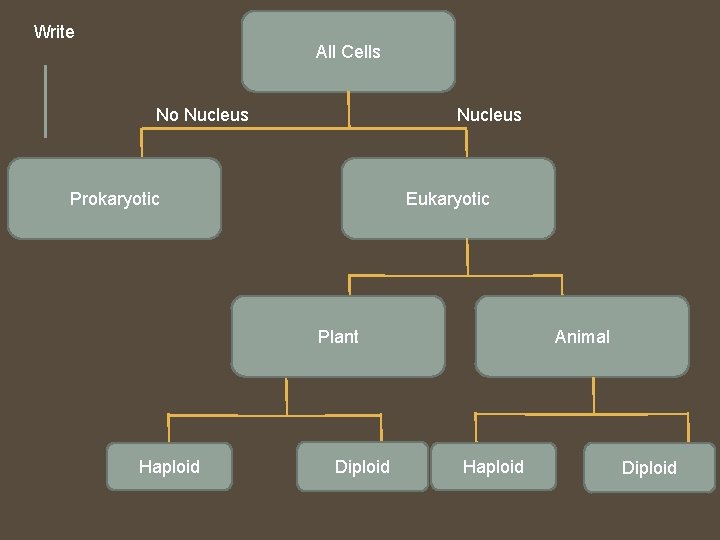
HAPLOID AND CELLS *Different DIPLOID Cells have different number of sets of Write chromosomes. Haploid (1 N) A haploid cell has 1 set of chromosomes. Diploid (2 N) A diploid cell has 2 set of chromosomes. *The Majority of your cells have two sets of chromosomes and are considered to be diploid.
Write All Cells No Nucleus Prokaryotic Eukaryotic Plant Haploid Diploid Animal Haploid Diploid
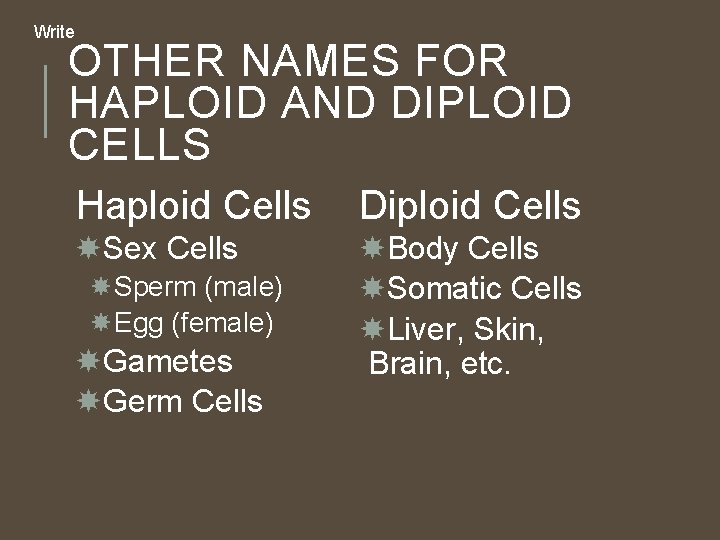
Write OTHER NAMES FOR HAPLOID AND DIPLOID CELLS Haploid Cells Diploid Cells Sex Cells Body Cells Somatic Cells Liver, Skin, Brain, etc. Sperm (male) Egg (female) Gametes Germ Cells
CHROMOSOME WORKSHEET Do 1 -20 Do not turn in when you are done. Ask for Ms. Roderick to check We will complete the rest of the worksheet on Tuesday.
HOMOLOGOUS CHROMOSOMES Objective 5. I can describe what makes two chromosomes homologous
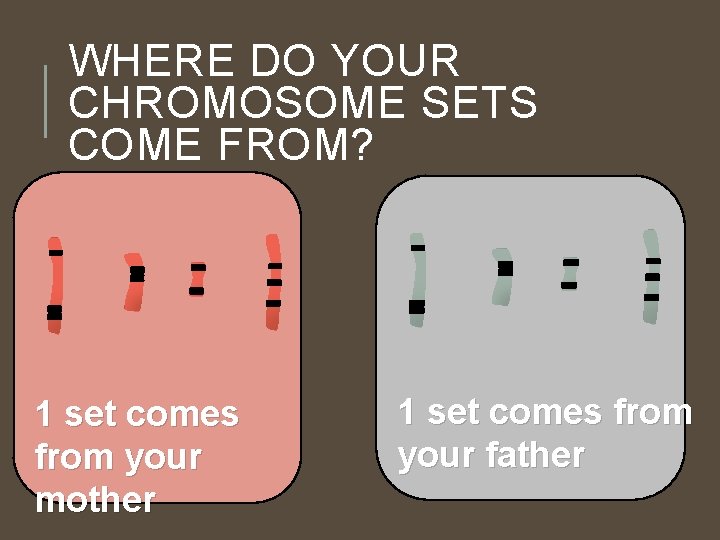
WHERE DO YOUR CHROMOSOME SETS COME FROM? 1 set comes from your mother 1 set comes from your father
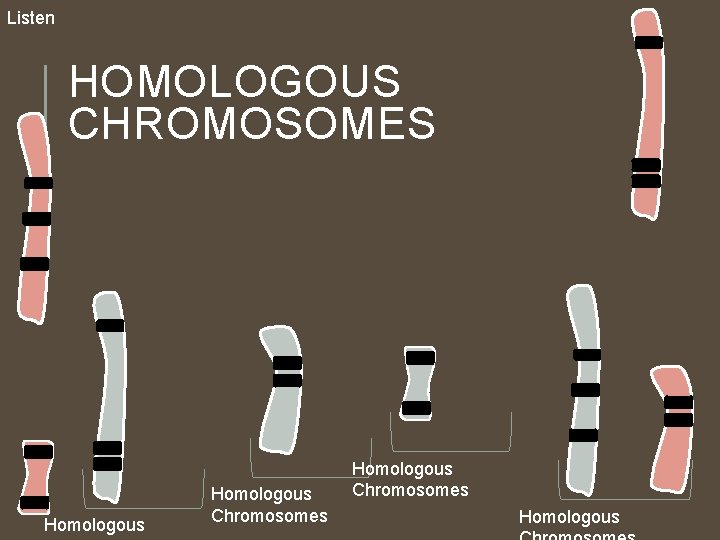
Listen HOMOLOGOUS CHROMOSOMES Homologous Chromosomes Homologous
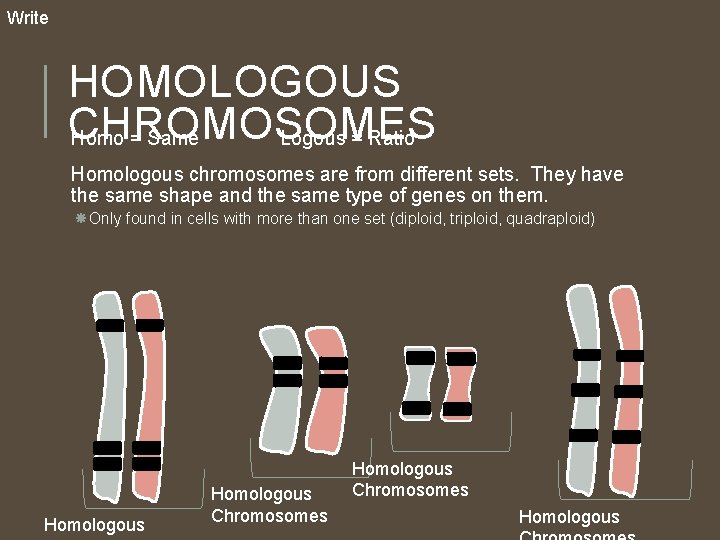
Write HOMOLOGOUS CHROMOSOMES Homo = Same Logous = Ratio Homologous chromosomes are from different sets. They have the same shape and the same type of genes on them. Only found in cells with more than one set (diploid, triploid, quadraploid) Homologous Chromosomes Homologous
HOMOLOGOUS CHROMOSOMES PRACTICE http: //www. execulink. com/~ekimmel/karyotype_drag_and_drop. swf
TYPES OF CHROMOSOMES Objective 6. I know the two types of chromosomes
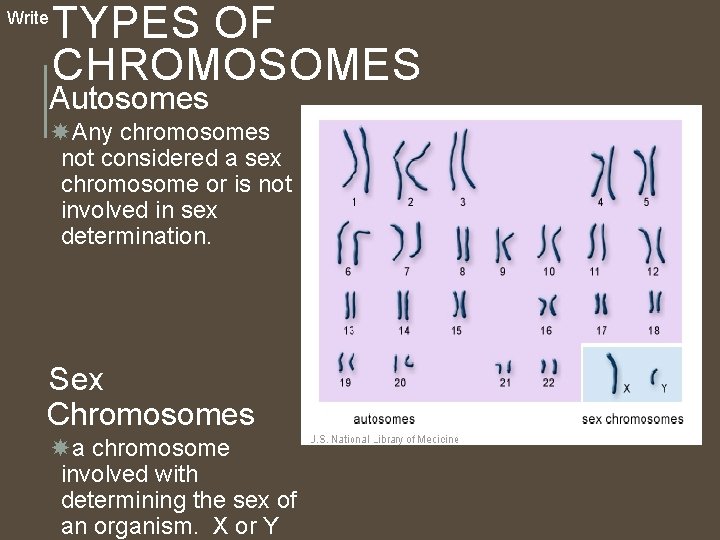
Write TYPES OF CHROMOSOMES Autosomes Any chromosomes not considered a sex chromosome or is not involved in sex determination. Sex Chromosomes a chromosome involved with determining the sex of an organism. X or Y
Write GENDER DETERMINATION Two X chromosomes (XX) = Girl 1 X and 1 Y Chromosomes (XY) = Boy
KARYOTYPES Objective 7. I know what a karyotype is and how it can be used to find diseases.
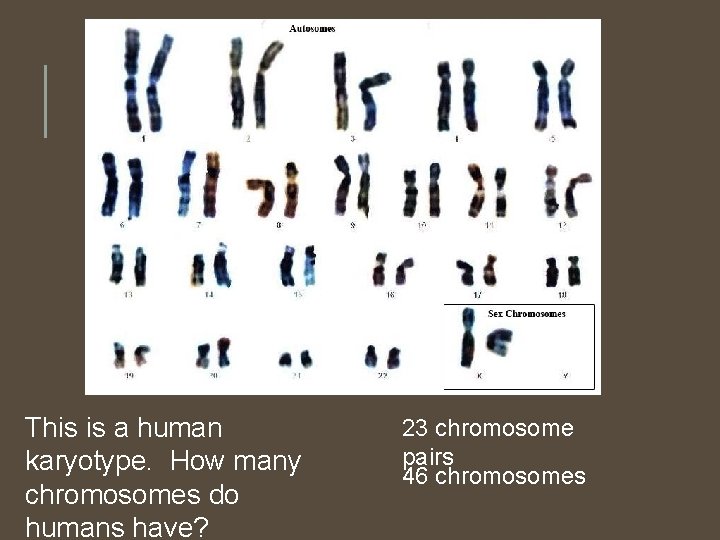
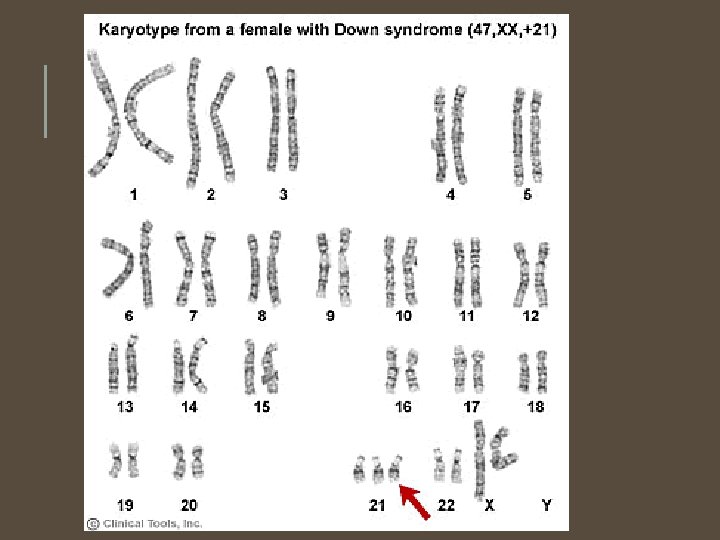
This is a human karyotype. How many chromosomes do humans have? 23 chromosome pairs 46 chromosomes
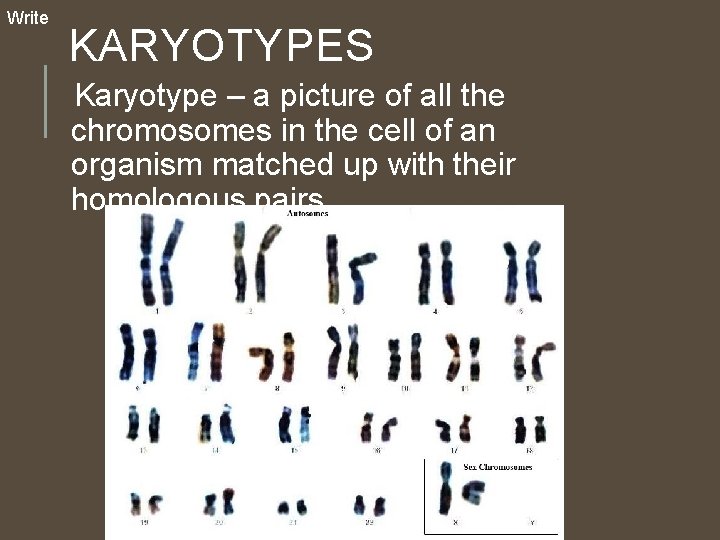
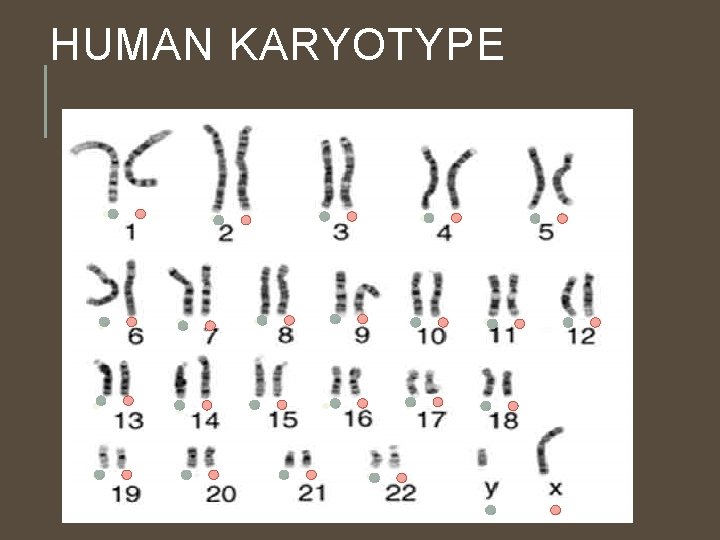
Write KARYOTYPES Karyotype – a picture of all the chromosomes in the cell of an organism matched up with their homologous pairs.
HUMAN KARYOTYPE
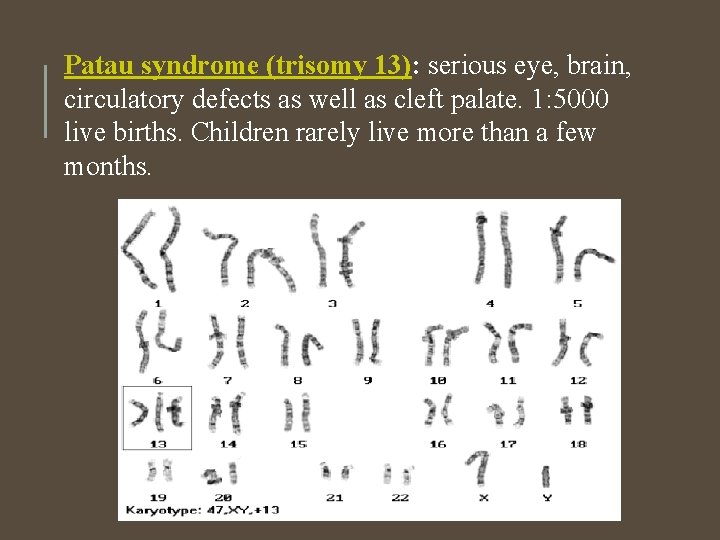
Patau syndrome (trisomy 13): serious eye, brain, circulatory defects as well as cleft palate. 1: 5000 live births. Children rarely live more than a few months.
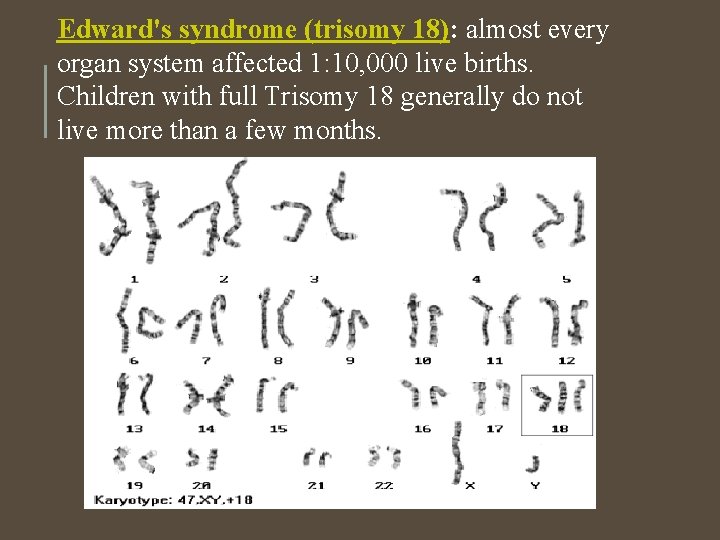
Edward's syndrome (trisomy 18): almost every organ system affected 1: 10, 000 live births. Children with full Trisomy 18 generally do not live more than a few months.
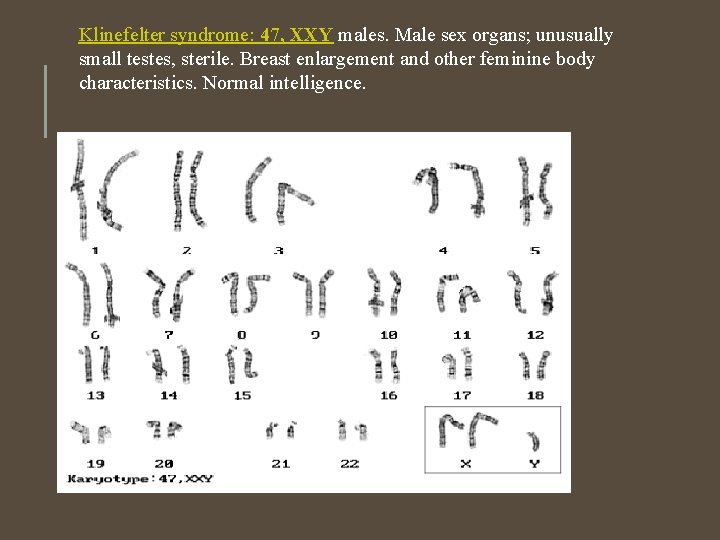
Klinefelter syndrome: 47, XXY males. Male sex organs; unusually small testes, sterile. Breast enlargement and other feminine body characteristics. Normal intelligence.
HUMAN CHROMOSOMES Objective 8. I know the Ploidy or (set) number of chromosomes for humans.
HUMANS All human cells, except for gametes, are diploid. They have 2 sets of 23 chromosomes (Haploid Number = 23) 1 set comes from your father 1 set comes from your mother Humans have two sets of chromosomes Two sets of 23 for a total of 46 chromosomes
CHROMOSOME Write me a half page on everything you’ve learned about Chromosomes so far. 5 -10 Minutes Turn it into the basket when you are done.
TYPES OF REPRODUCTION Objective 9. I can describe the difference between asexual and sexual reproduction.
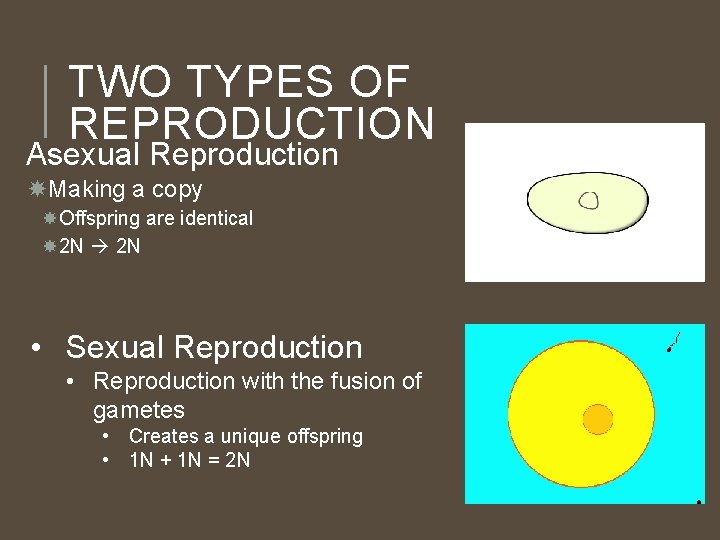
TWO TYPES OF REPRODUCTION Asexual Reproduction Making a copy Offspring are identical 2 N • Sexual Reproduction • Reproduction with the fusion of gametes • Creates a unique offspring • 1 N + 1 N = 2 N
FERTILIZATION Objective 10. I can describe what fertilization is.
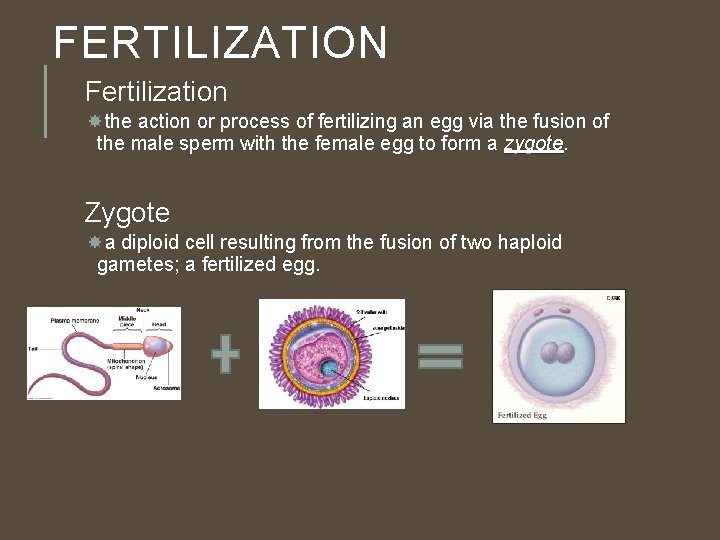
FERTILIZATION Fertilization the action or process of fertilizing an egg via the fusion of the male sperm with the female egg to form a zygote Zygote a diploid cell resulting from the fusion of two haploid gametes; a fertilized egg.
FERTILIZATION VIDEO https: //www. youtube. com/watch? v=BFr. Vm. Dgh 4 v 4
FINISH CHROMOSOME NUMBER WORKSHEET Work on your Chromosome Number Worksheet Turn it into the basket when you are done Ova = egg
THE CELL CYCLE 11. I know the major phases of the cell cycle and what happens in each.
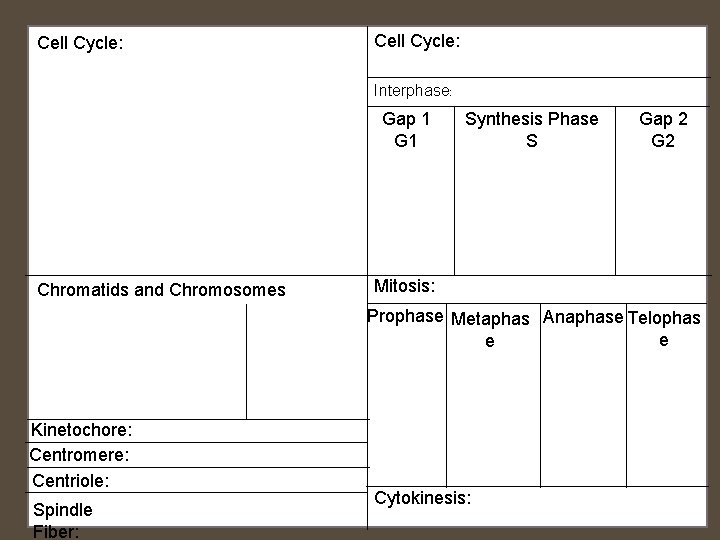
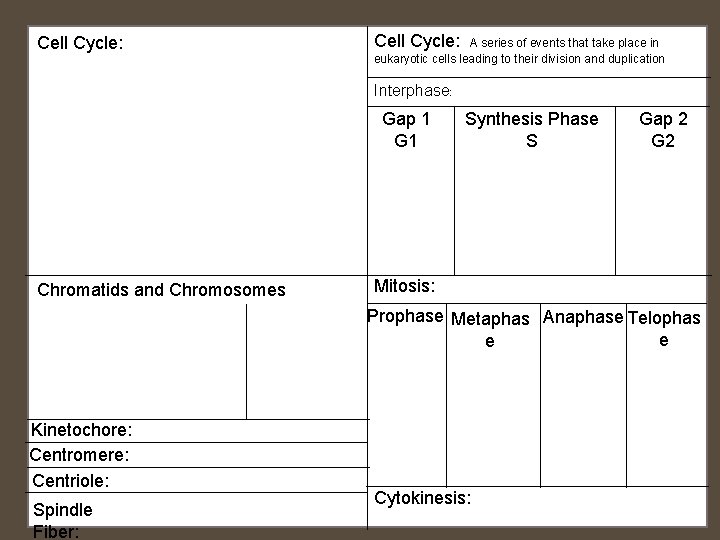
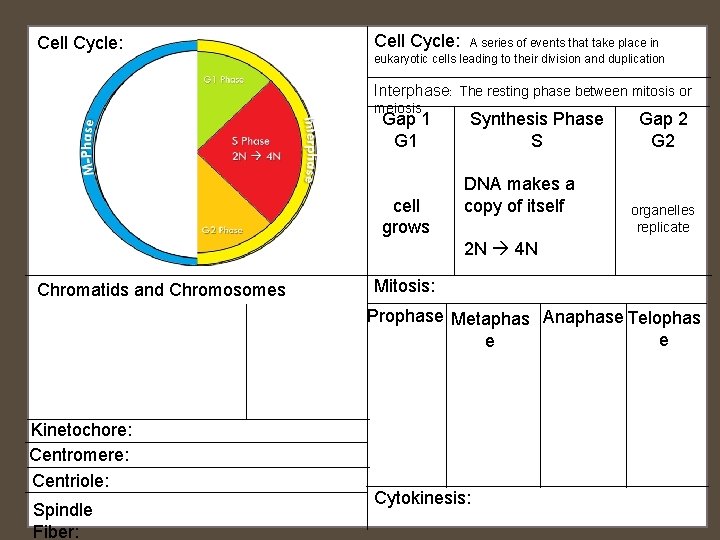
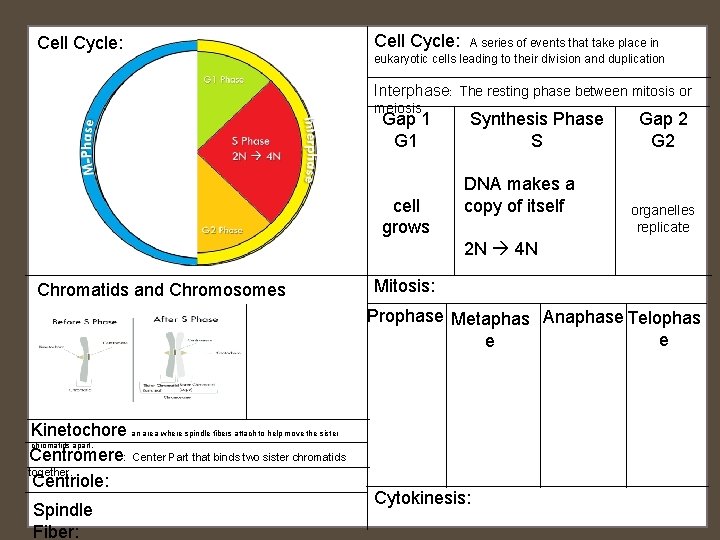
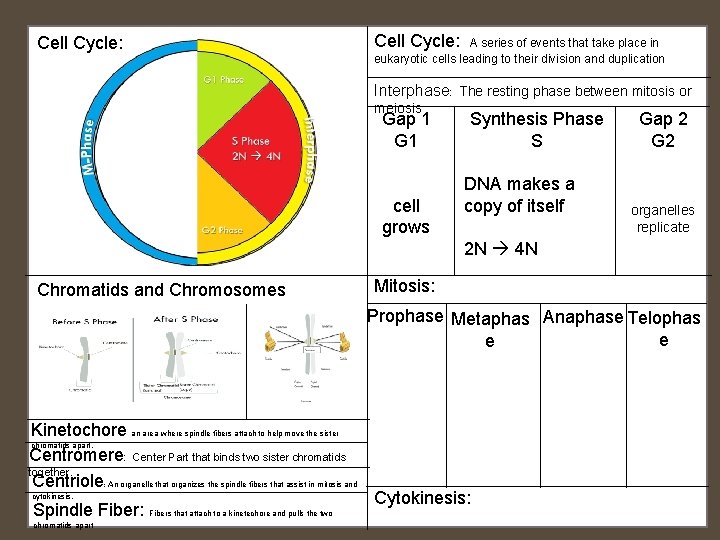
Cell Cycle: Interphase: Gap 1 G 1 Chromatids and Chromosomes Synthesis Phase S Gap 2 G 2 Mitosis: Prophase Metaphas Anaphase Telophas e e Kinetochore: Centromere: Centriole: Spindle Fiber: Cytokinesis:
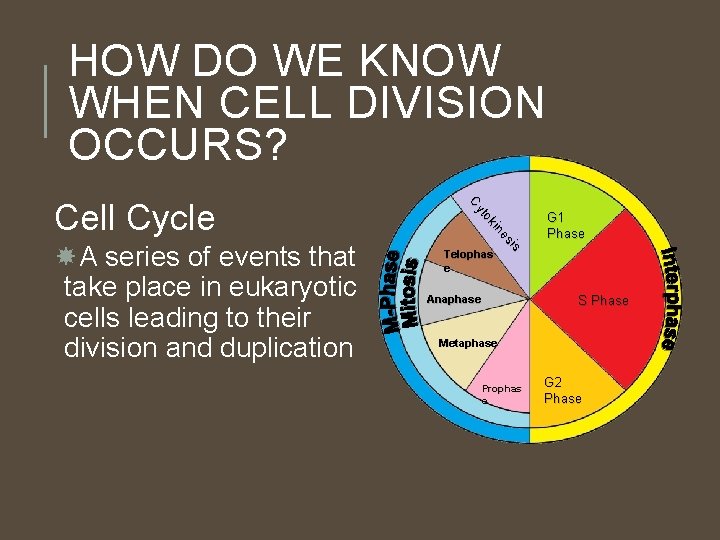
HOW DO WE KNOW WHEN CELL DIVISION OCCURS? A series of events that take place in eukaryotic cells leading to their division and duplication is es kin to Cy Cell Cycle G 1 Phase Telophas e Anaphase S Phase Metaphase Prophas e G 2 Phase
Cell Cycle: A series of events that take place in eukaryotic cells leading to their division and duplication Interphase: Gap 1 G 1 Chromatids and Chromosomes Synthesis Phase S Gap 2 G 2 Mitosis: Prophase Metaphas Anaphase Telophas e e Kinetochore: Centromere: Centriole: Spindle Fiber: Cytokinesis:
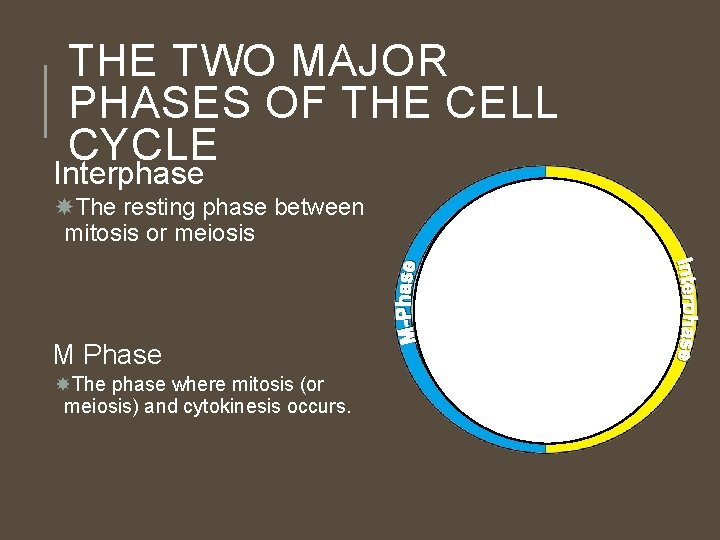
THE TWO MAJOR PHASES OF THE CELL CYCLE Interphase The resting phase between mitosis or meiosis Cytokine sis G 1 Phase Telophas e Anapha se M Phase The phase where mitosis (or meiosis) and cytokinesis occurs. S Phase Metaphase Prophas e G 2 Phase
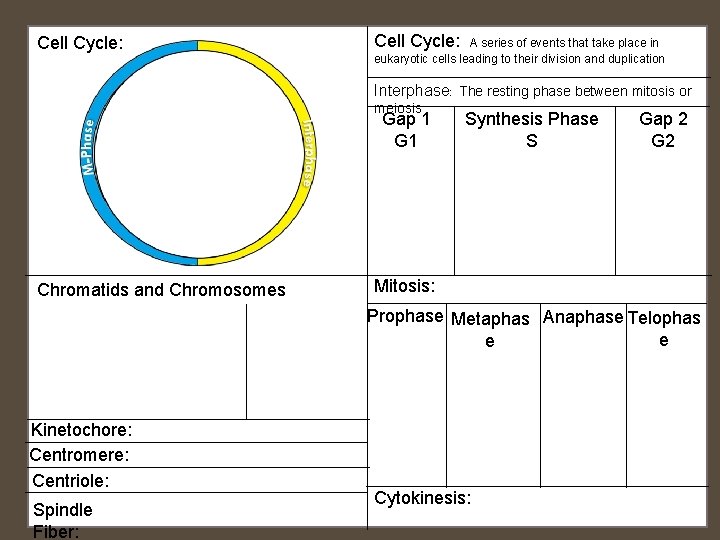
Cell Cycle: A series of events that take place in eukaryotic cells leading to their division and duplication Interphase: The resting phase between mitosis or meiosis Gap 1 G 1 Chromatids and Chromosomes Synthesis Phase S Gap 2 G 2 Mitosis: Prophase Metaphas Anaphase Telophas e e Kinetochore: Centromere: Centriole: Spindle Fiber: Cytokinesis:
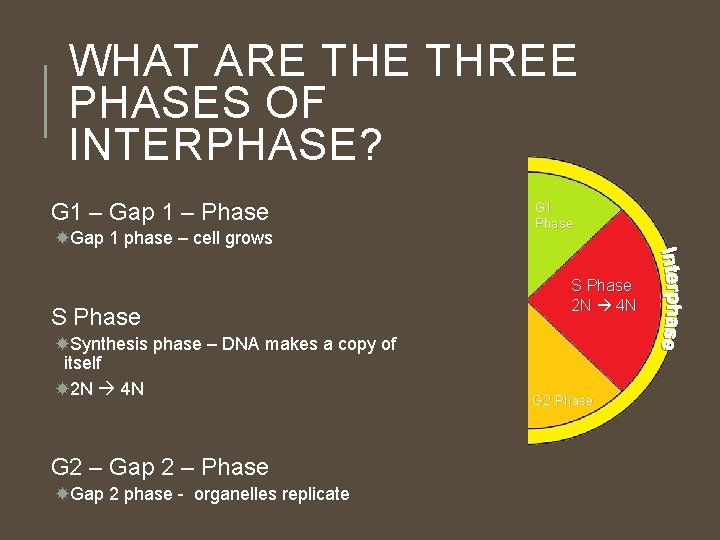
WHAT ARE THREE PHASES OF INTERPHASE? G 1 – Gap 1 – Phase Gap 1 phase – cell grows S Phase Synthesis phase – DNA makes a copy of itself 2 N 4 N G 2 – Gap 2 – Phase Gap 2 phase - organelles replicate G 1 Phase S Phase 2 N 4 N G 2 Phase
Cell Cycle: A series of events that take place in eukaryotic cells leading to their division and duplication Interphase: The resting phase between mitosis or meiosis Gap 1 G 1 cell grows Synthesis Phase S DNA makes a copy of itself Gap 2 G 2 organelles replicate 2 N 4 N Chromatids and Chromosomes Mitosis: Prophase Metaphas Anaphase Telophas e e Kinetochore: Centromere: Centriole: Spindle Fiber: Cytokinesis:
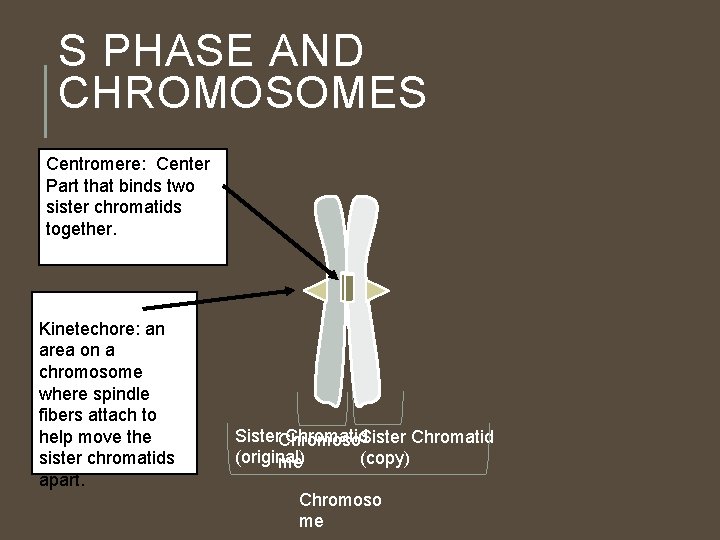
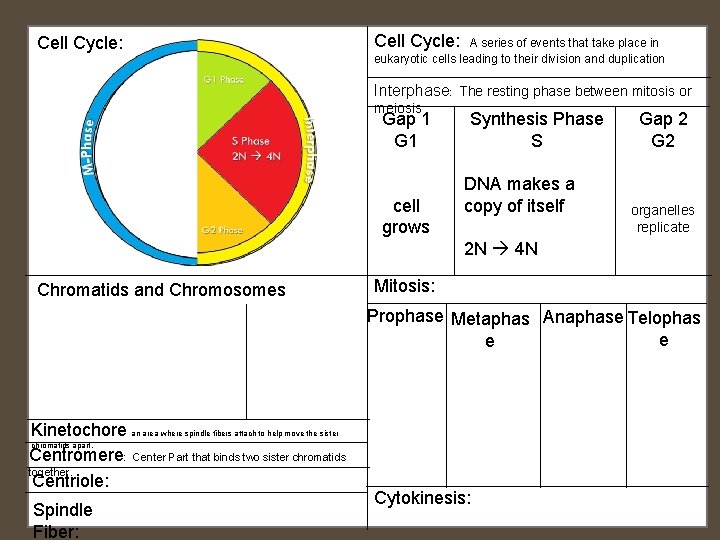
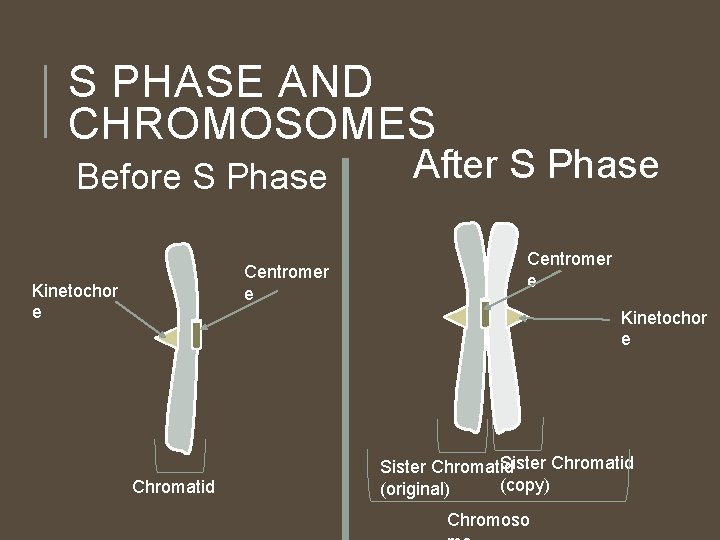
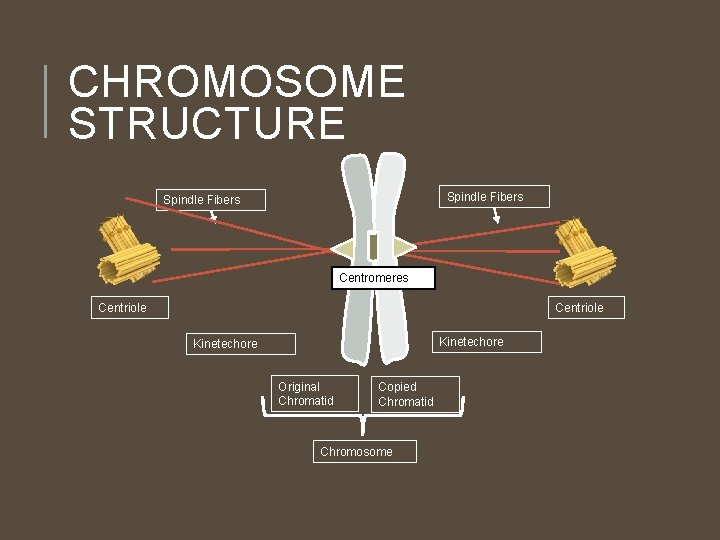
S PHASE AND CHROMOSOMES Centromere: Center Part that binds two sister chromatids together. Kinetechore: an area on a chromosome where spindle fibers attach to help move the sister chromatids apart. Sister. Chromoso Chromatid. Sister Chromatid (original) (copy) me Chromoso me
Cell Cycle: A series of events that take place in eukaryotic cells leading to their division and duplication Interphase: The resting phase between mitosis or meiosis Gap 1 G 1 cell grows Synthesis Phase S DNA makes a copy of itself Gap 2 G 2 organelles replicate 2 N 4 N Chromatids and Chromosomes Mitosis: Prophase Metaphas Anaphase Telophas e e Kinetochore an area where spindle fibers attach to help move the sister chromatids apart. Centromere: Center Part that binds two sister chromatids together. Centriole: : Spindle Fiber: Cytokinesis:
S PHASE AND CHROMOSOMES Before S Phase Centromer e Kinetochor e After S Phase Centromer e Kinetochor e Chromatid Sister Chromatid (copy) (original) Chromoso
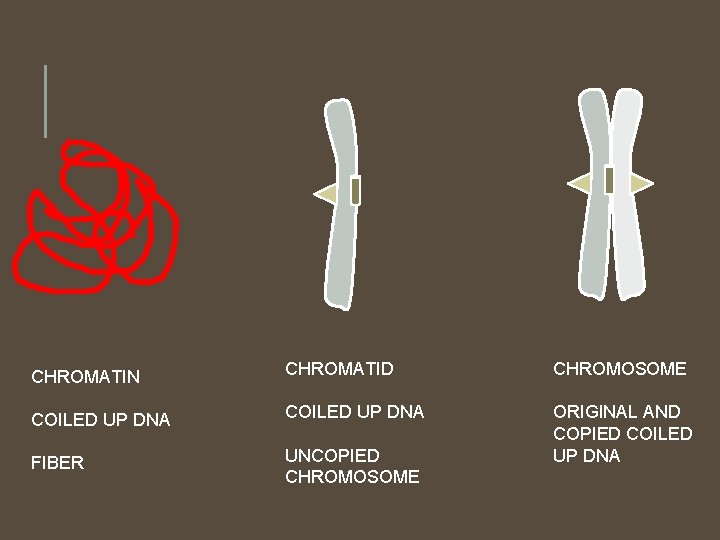
CHROMATIN CHROMATID CHROMOSOME COILED UP DNA FIBER UNCOPIED CHROMOSOME ORIGINAL AND COPIED COILED UP DNA
Cell Cycle: A series of events that take place in eukaryotic cells leading to their division and duplication Interphase: The resting phase between mitosis or meiosis Gap 1 G 1 cell grows Synthesis Phase S DNA makes a copy of itself Gap 2 G 2 organelles replicate 2 N 4 N Chromatids and Chromosomes Mitosis: Prophase Metaphas Anaphase Telophas e e Kinetochore an area where spindle fibers attach to help move the sister chromatids apart. Centromere: Center Part that binds two sister chromatids together. Centriole: : Spindle Fiber: Cytokinesis:
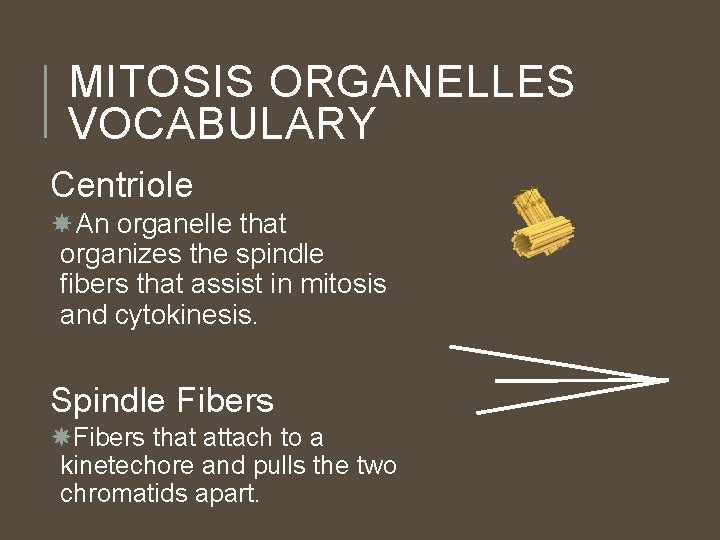
MITOSIS ORGANELLES VOCABULARY Centriole An organelle that organizes the spindle fibers that assist in mitosis and cytokinesis. Spindle Fibers that attach to a kinetechore and pulls the two chromatids apart.
CHROMOSOME STRUCTURE Spindle Fibers Centromeres Centriole Kinetechore Original Chromatid Copied Chromatid Chromosome
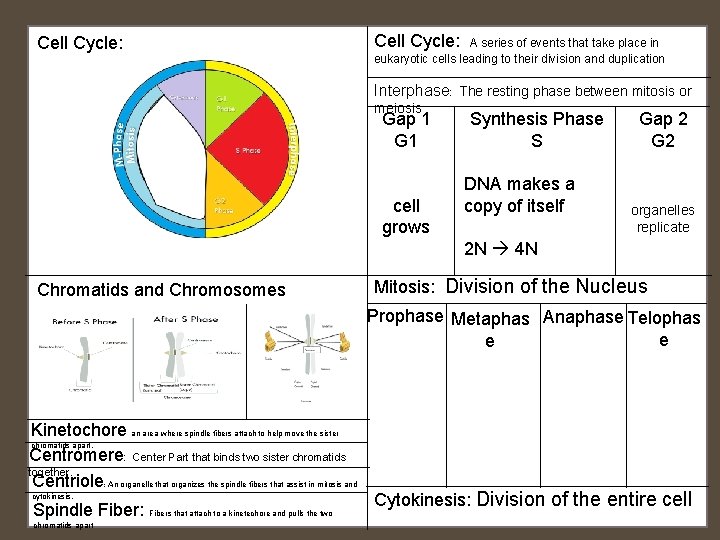
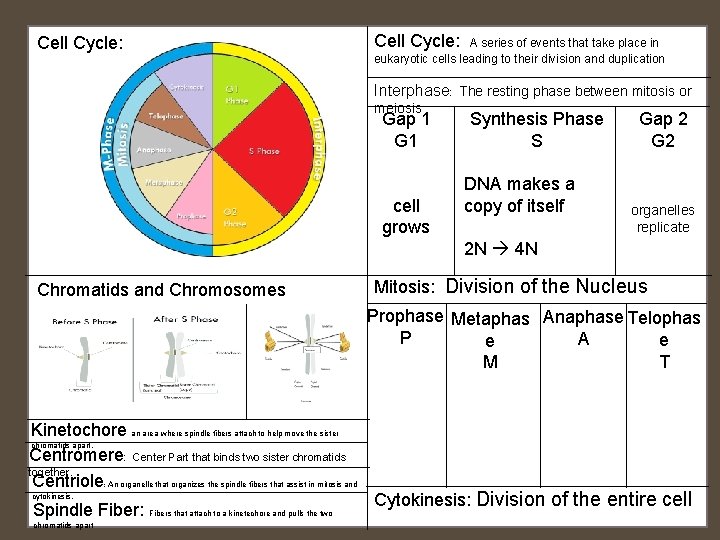
Cell Cycle: A series of events that take place in eukaryotic cells leading to their division and duplication Interphase: The resting phase between mitosis or meiosis Gap 1 G 1 cell grows Synthesis Phase S DNA makes a copy of itself Gap 2 G 2 organelles replicate 2 N 4 N Chromatids and Chromosomes Mitosis: Prophase Metaphas Anaphase Telophas e e Kinetochore an area where spindle fibers attach to help move the sister chromatids apart. Centromere: Center Part that binds two sister chromatids together. Centriole An organelle that organizes the spindle fibers that assist in mitosis and : : cytokinesis. Spindle Fiber: Fibers that attach to a kinetechore and pulls the two chromatids apart Cytokinesis:
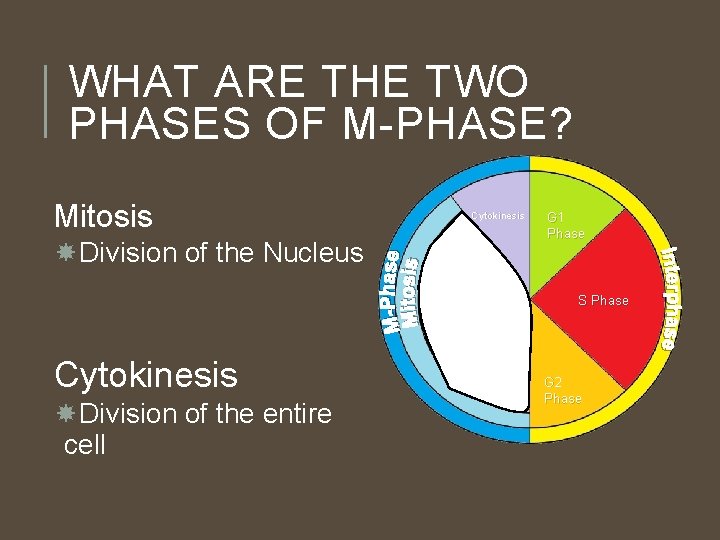
WHAT ARE THE TWO PHASES OF M-PHASE? Mitosis Division of the Nucleus Cytokinesis G 1 Phase Telophas e Anapha se S Phase Metaphase Cytokinesis Division of the entire cell Prophas e G 2 Phase
Cell Cycle: A series of events that take place in eukaryotic cells leading to their division and duplication Interphase: The resting phase between mitosis or meiosis Gap 1 G 1 cell grows Synthesis Phase S DNA makes a copy of itself Gap 2 G 2 organelles replicate 2 N 4 N Chromatids and Chromosomes Mitosis: Division of the Nucleus Prophase Metaphas Anaphase Telophas e e Kinetochore an area where spindle fibers attach to help move the sister chromatids apart. Centromere: Center Part that binds two sister chromatids together. Centriole An organelle that organizes the spindle fibers that assist in mitosis and : : cytokinesis. Spindle Fiber: Fibers that attach to a kinetechore and pulls the two chromatids apart Cytokinesis: Division of the entire cell
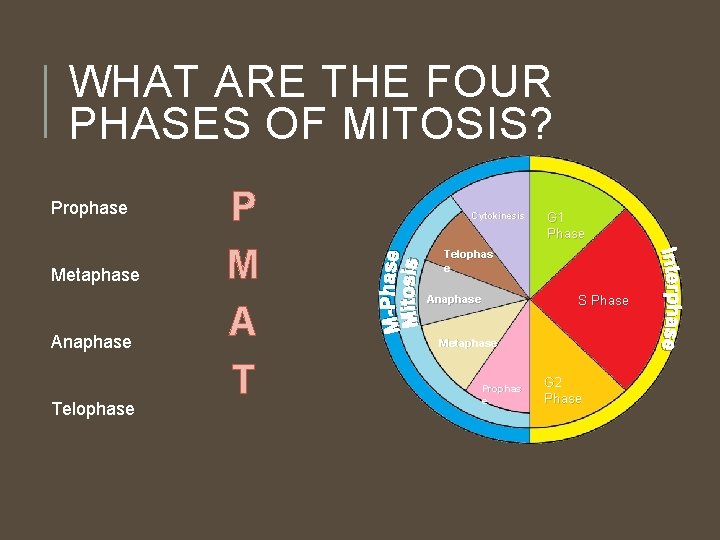
WHAT ARE THE FOUR PHASES OF MITOSIS? Prophase Metaphase Anaphase Telophase P M A T Cytokinesis G 1 Phase Telophas e Anaphase S Phase Metaphase Prophas e G 2 Phase
Cell Cycle: A series of events that take place in eukaryotic cells leading to their division and duplication Interphase: The resting phase between mitosis or meiosis Gap 1 G 1 cell grows Synthesis Phase S DNA makes a copy of itself Gap 2 G 2 organelles replicate 2 N 4 N Chromatids and Chromosomes Mitosis: Division of the Nucleus Prophase Metaphas Anaphase Telophas P A e e T M Kinetochore an area where spindle fibers attach to help move the sister chromatids apart. Centromere: Center Part that binds two sister chromatids together. Centriole An organelle that organizes the spindle fibers that assist in mitosis and : : cytokinesis. Spindle Fiber: Fibers that attach to a kinetechore and pulls the two chromatids apart Cytokinesis: Division of the entire cell