
WJEC Level 3 Criminology Unit 4 Crime and

- Slides: 40
WJEC Level 3 Criminology Unit 4: Crime and Punishment Jade Bennett
Reflection Activity Purple books �Describe the role of the CPS within the criminal justice system. �Describe the relationship between the police and other agencies within the criminal justice system. Feedback through class discussion.
Learning objectives AC 2. 1 Explain forms of social control Forms of social control Internal forms o rational ideology o tradition o Internalisation of social rules and morality Candidates should have an understanding of different forms of social control with reference to theory. External forms o coercion o fear of punishment Synoptic links: Learners will need to relate their understanding to theoretical knowledge acquired through Unit 2. They should also be Control theory o reasons for abiding by the law
Social Control �It is essential that you understand this term �It appeared 6 times in last years exam paper covering a nearly 50% of the overall marks!!!!
Example questions referring to social control �Explain why imprisonment acts as an external form of social control. [4] �Evaluate the effectiveness of social control inside prisons. [8] �Describe two environmental measures used by agencies to achieve social control. [4] �Using examples, explain what is meant by internal forms of social control. [4]
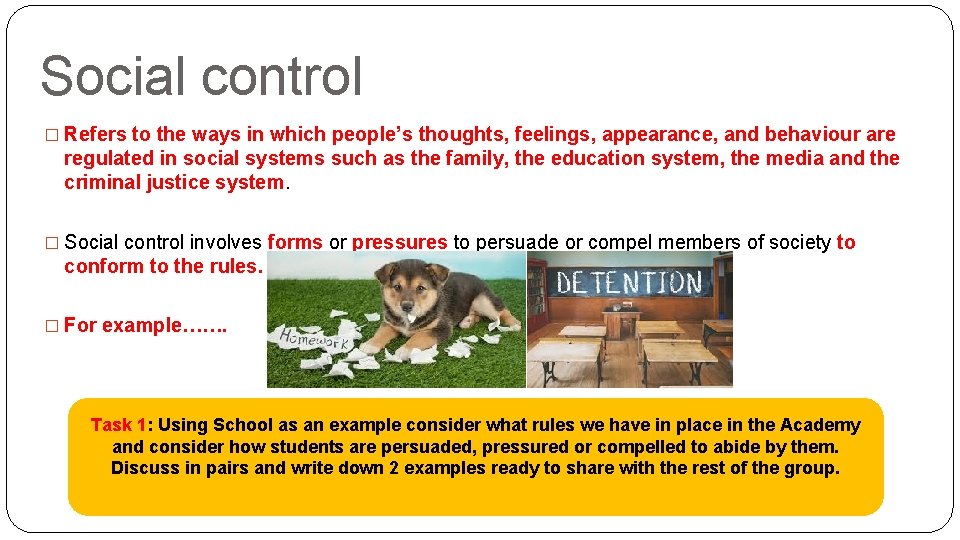
Social control � Refers to the ways in which people’s thoughts, feelings, appearance, and behaviour are regulated in social systems such as the family, the education system, the media and the criminal justice system. � Social control involves forms or pressures to persuade or compel members of society to conform to the rules. � For example……. Task 1: Using School as an example consider what rules we have in place in the Academy and consider how students are persuaded, pressured or compelled to abide by them. Discuss in pairs and write down 2 examples ready to share with the rest of the group.
Social control and criminality �There are 2 categories of social control; External and Internal �Today we are focusing on Internal forms of social control.
Control Theory Basics of the Control Theory: - into booklet � Attempts to explain ways to train people to engage in law- abiding behaviour � Humans require ? ? ? ? ? in order to develop attachments or bonds to people � Personal bonds e. g. ? examples are key in producing internal controls such as conscience � Crime is the result of insufficient attachment and commitment to others
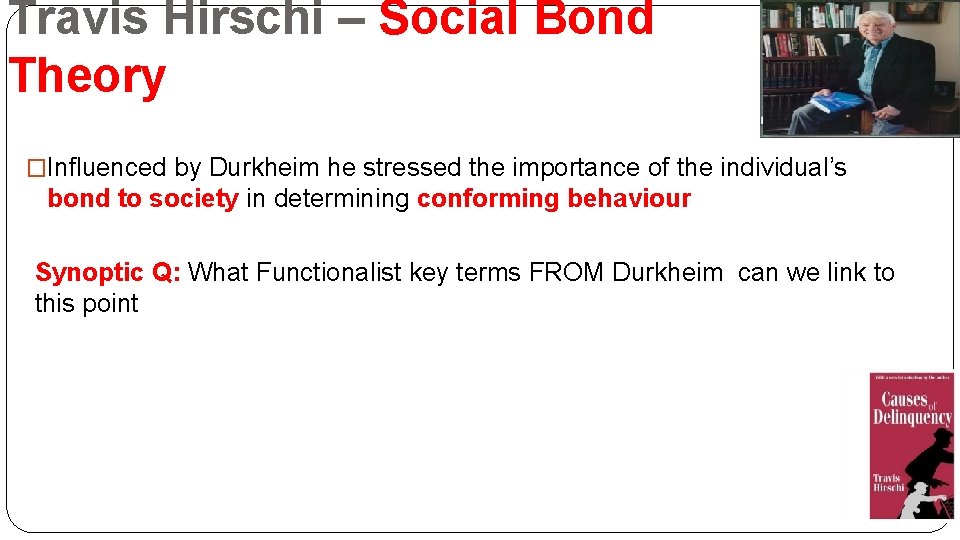
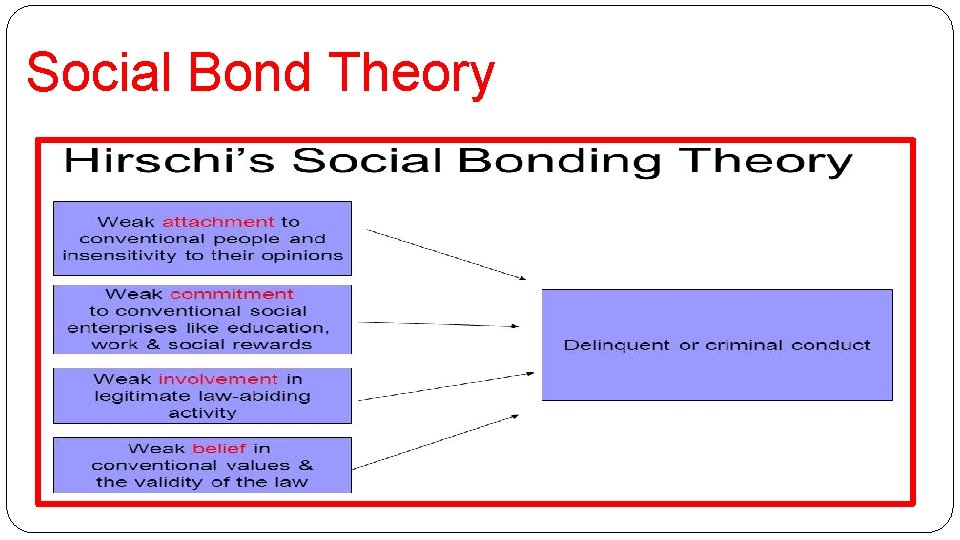
Travis Hirschi – Social Bond Theory �Influenced by Durkheim he stressed the importance of the individual’s bond to society in determining conforming behaviour Synoptic Q: What Functionalist key terms FROM Durkheim can we link to this point
Social Bond Theory
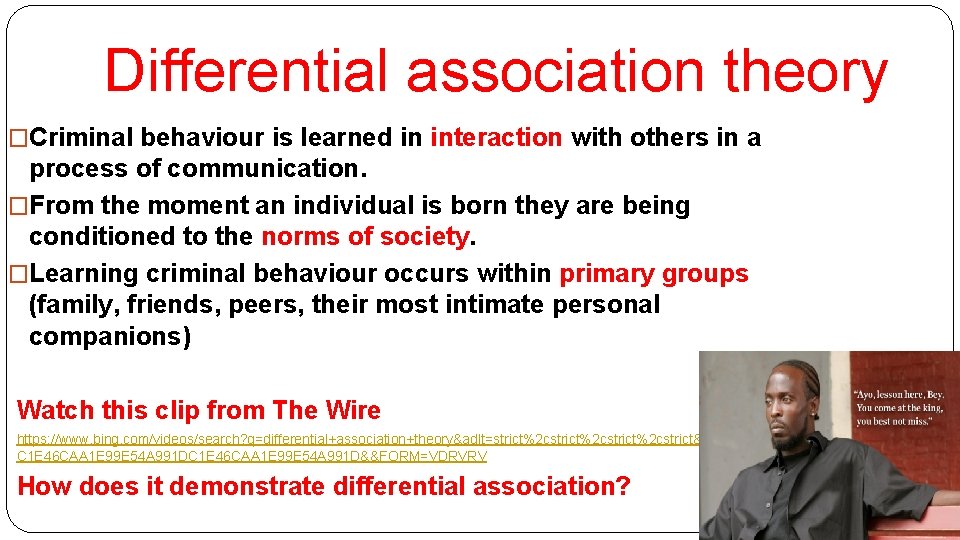
Differential association theory �Criminal behaviour is learned in interaction with others in a process of communication. �From the moment an individual is born they are being conditioned to the norms of society. �Learning criminal behaviour occurs within primary groups (family, friends, peers, their most intimate personal companions) Watch this clip from The Wire https: //www. bing. com/videos/search? q=differential+association+theory&adlt=strict%2 cstrict%2 cstrict&view=detail&mid= C 1 E 46 CAA 1 E 99 E 54 A 991 D&&FORM=VDRVRV How does it demonstrate differential association?
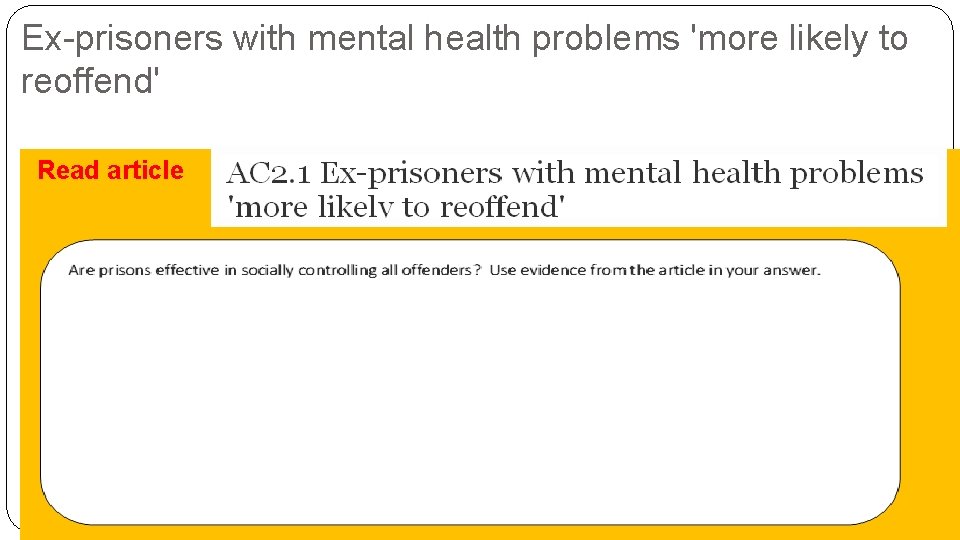
Ex-prisoners with mental health problems 'more likely to reoffend' Read article
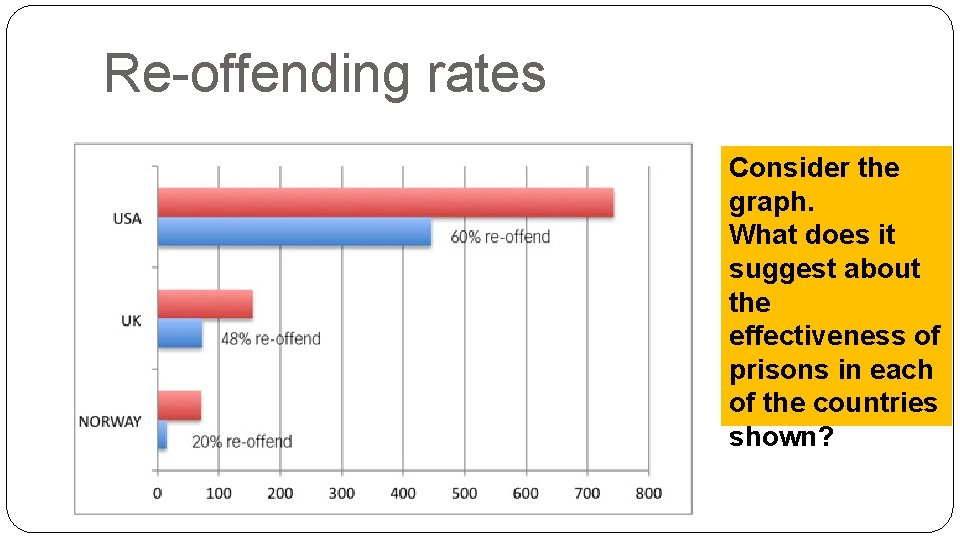
Re-offending rates Consider the graph. What does it suggest about the effectiveness of prisons in each of the countries shown?
Words There is quite a lot of theory in this AC. It all relates to forms of social control, such as: �Forms �Social �Control �= refer to the definitions on p 10 of your booklet.
Moral dilemmas – P. 10 Booklet 1. 2. You are an eyewitness to a crime… You are involved in a 2 -car crash… �How did you answer these moral dilemmas? – Class Discussion �How do we ‘know’ it is a moral dilemma? �Where did we ‘learn’ about this? Our responses are viewed as ‘internal’ forms of social controls
Internal forms of social control A Conscience – what is it? If we are aware of a conscience, how does it make us feel? How do we ‘develop’ a conscience? - link to differential association? We conform to rules because our sense of self-respect demands it, therefore the process of social control is internal.
Internal social control examples – What feelings would stop us committing crime? Regulating own behaviour in accordance with accepted forms
Rational Ideology – internal controls �Read page 11 and highlight examples of ‘acts’ formerly considered ‘sins’ within formalised religions, which are now considered ‘law breaking’ �Why would we ‘rationalise’ to ourselves that it would be wrong to commit those Acts?
Exam example – page 12 �Rational ideology - such as an individual's conscience, feelings of guilt, anxiety or worry from within. May be a result of upbringing. For example stealing a pen from school. Interna l Add some examples to your booklet
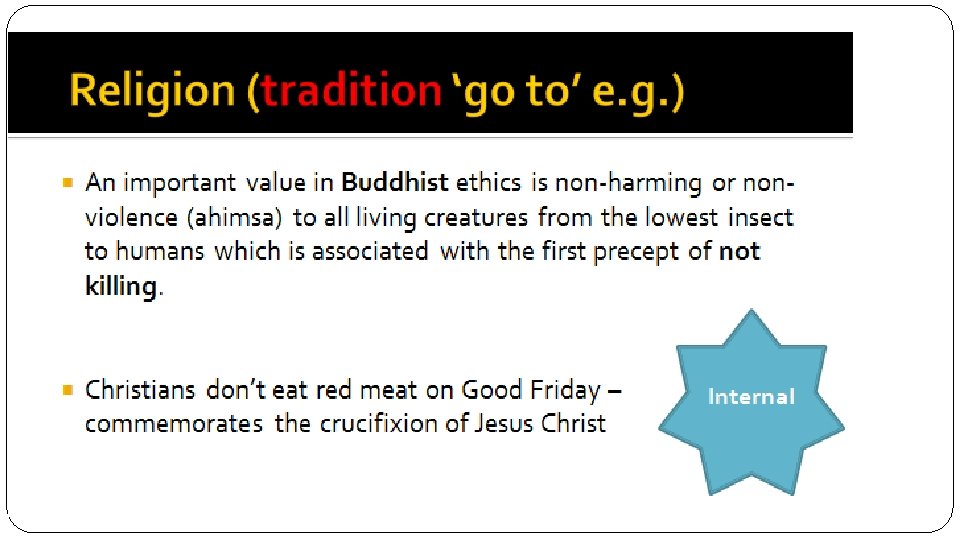
Tradition – P. 12 �Customs and norms �Religion or culture - or just your upbringing – complete task Identify any traditions you are your household have that socially control you They don’t have to be religious Just something you all abide by In the Bentley household… Salute single magpies Don’t cross on the stairs No alcohol on a school night
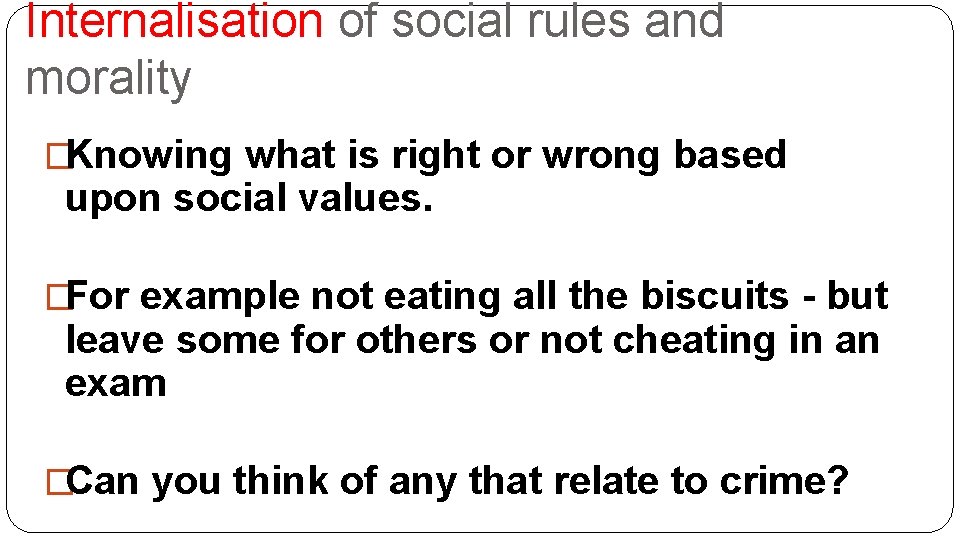
Internalisation of social rules and morality �Knowing what is right or wrong based upon social values. �For example not eating all the biscuits - but leave some for others or not cheating in an exam �Can you think of any that relate to crime?
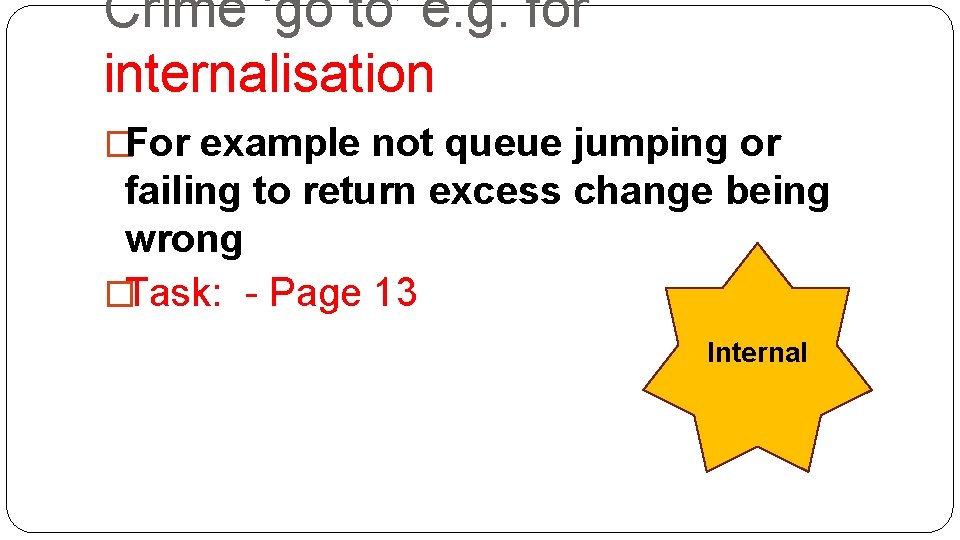
Crime ‘go to’ e. g. for internalisation �For example not queue jumping or failing to return excess change being wrong �Task: - Page 13 Internal
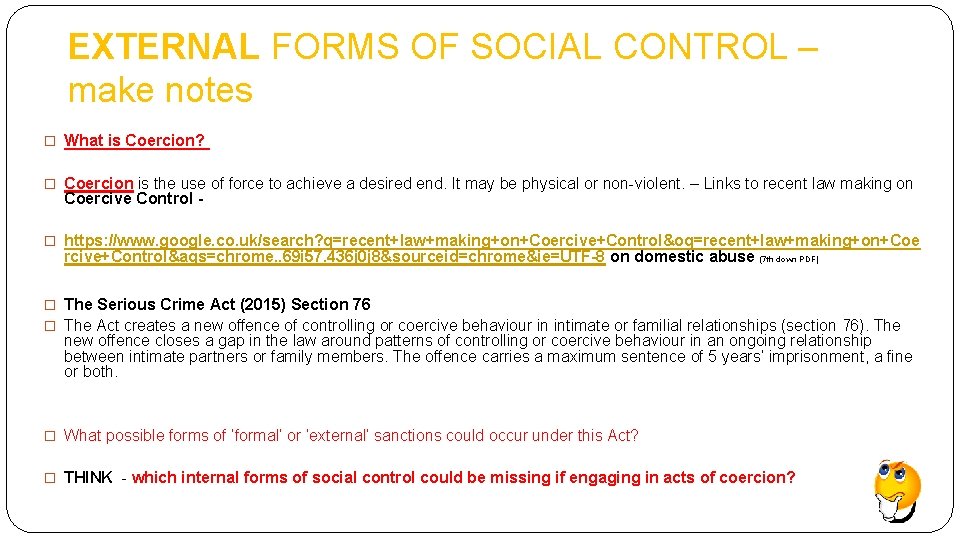
EXTERNAL FORMS OF SOCIAL CONTROL – make notes � What is Coercion? � Coercion is the use of force to achieve a desired end. It may be physical or non-violent. – Links to recent law making on Coercive Control - � https: //www. google. co. uk/search? q=recent+law+making+on+Coercive+Control&oq=recent+law+making+on+Coe rcive+Control&aqs=chrome. . 69 i 57. 436 j 0 j 8&sourceid=chrome&ie=UTF-8 on domestic abuse (7 th down PDF) � The Serious Crime Act (2015) Section 76 � The Act creates a new offence of controlling or coercive behaviour in intimate or familial relationships (section 76). The new offence closes a gap in the law around patterns of controlling or coercive behaviour in an ongoing relationship between intimate partners or family members. The offence carries a maximum sentence of 5 years’ imprisonment, a fine or both. � What possible forms of ‘formal’ or ‘external’ sanctions could occur under this Act? � THINK - which internal forms of social control could be missing if engaging in acts of coercion?
External – formal sanctions – note down a couple of examples of sanctions you are not familiar with �Court �Out of court disposals (no court but criminal record) �Caution/reprimand �Restorative justice �Fixed penalty notices - e. g speeding �Warnings
External forms of social control - Police �Visible presence – “bobbies on the beat” Synoptic Q: how does the presence of ‘bobbies’ affect our understanding of crime? Synotpic Q: Which Unit …and what did we learn in it? �Crowd control – public order eg football matches – case study? �Police bail/bail conditions �Road policing
Quick test on half term work 1. Individual deterrence 2. 3. General deterrence �Define these and give examples of punishment to go with them
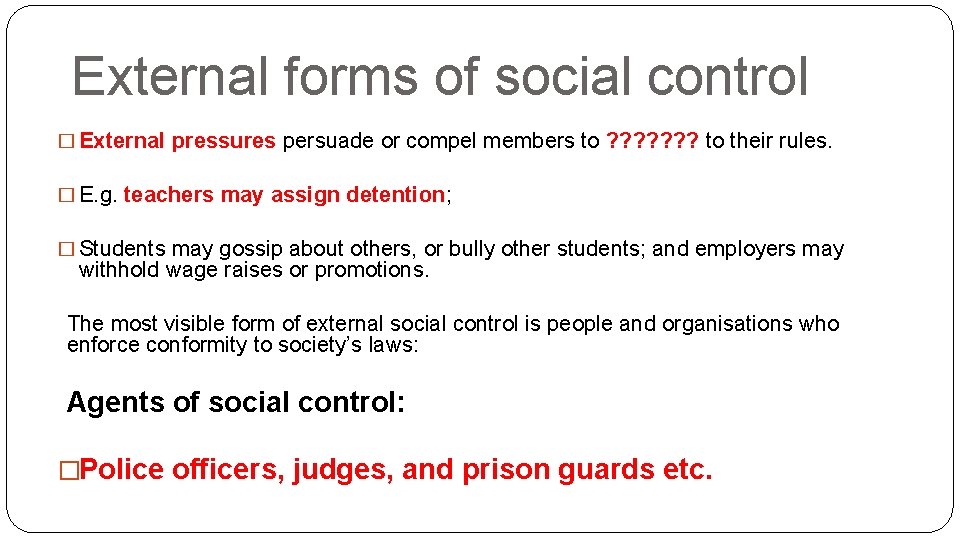
External forms of social control � External pressures persuade or compel members to ? ? ? ? to their rules. � E. g. teachers may assign detention; � Students may gossip about others, or bully other students; and employers may withhold wage raises or promotions. The most visible form of external social control is people and organisations who enforce conformity to society’s laws: Agents of social control: �Police officers, judges, and prison guards etc.
EXTERNAL FORMS OF SOCIAL CONTROL �Non co-operation – note down 5 examples of how we may demonstrate our non-cooperation. �THINK - How effective is this approach to social control?
External forms continued �Nonviolent coercion - includes ? ? ? List 5 examples from your own understanding of non-violent coercion �- coercion – to pressure or to force someone/organisation to bring change �- non-violent – self explanatory …. . �- Raising Awareness through campaigns… �How effective is this strategy? Examples…. .
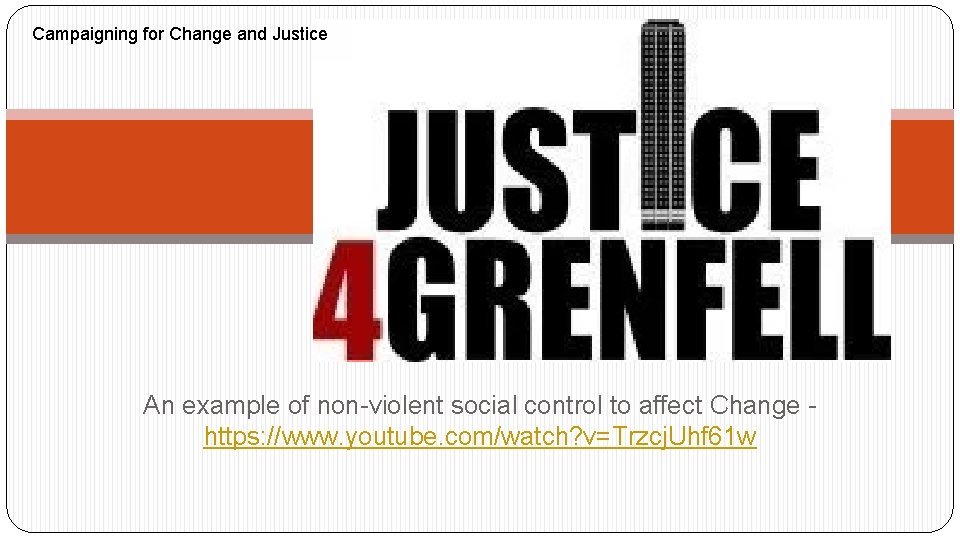
Campaigning for Change and Justice An example of non-violent social control to affect Change https: //www. youtube. com/watch? v=Trzcj. Uhf 61 w
Fear of punishment: Deterrence is the use of ? ? ? ? as a threat to deter people from offending. The concept of deterrence has two key assumptions: 1. Individual deterrence 2. General deterrence Discuss with your neighbour what be the difference might be
Individual Deterrence �Individual deterrence - punishments imposed on offenders will "deter" or prevent them from committing further crimes �What is the term given to repeat offending? �Think of a punishment for this ? �Suspended sentence or conditional discharge
General Deterrence �General deterrence - the fear of punishment will prevent others from committing similar crimes. �Think of a punishment ? �Eg’s: Lengthy prison sentence or a large fine
General deterrence policy example ‘Getting tough on crime’ Under the notion of "getting tough on crime", policies such as: �"mandatory minimums" life for murder, 7 years for 3 rd drug offence, 3 years for 3 rd burglary
Policies - cont’ �‘truth in sentencing’ – policies to serve whole sentence rather than any remission. Life means life. �"three strikes and you’re out" - 3 rd conviction for a violent crime likely to be life sentence (USA)
"three strikes and you’re out" 3 rd conviction for a violent crime likely to be life sentence (USA) Watch this video and make notes on whether the policy worked? https: //www. bing. com/videos/search? q=three+strikes+policy&adlt=strict&view=detail&mid=A 59 F 6247 DB 3 CEFF 27 B 79&&FORM=VDR VRV What are the consequences of the policy? Watch video and make notes below https: //www. bing. com/videos/search? q=american+13+prison+system&adlt=strict%2 cstrict&view =detail&mid=2 F 21 FF 53 C 7138 AC 2332 A&rvsmid=420 E 8 FFB 79 FE 94 E 31 EF 6420 E 8 FFB 79 FE 94 E 31 EF 6&FORM=VDQVAP UK approach to ‘three strikes”:
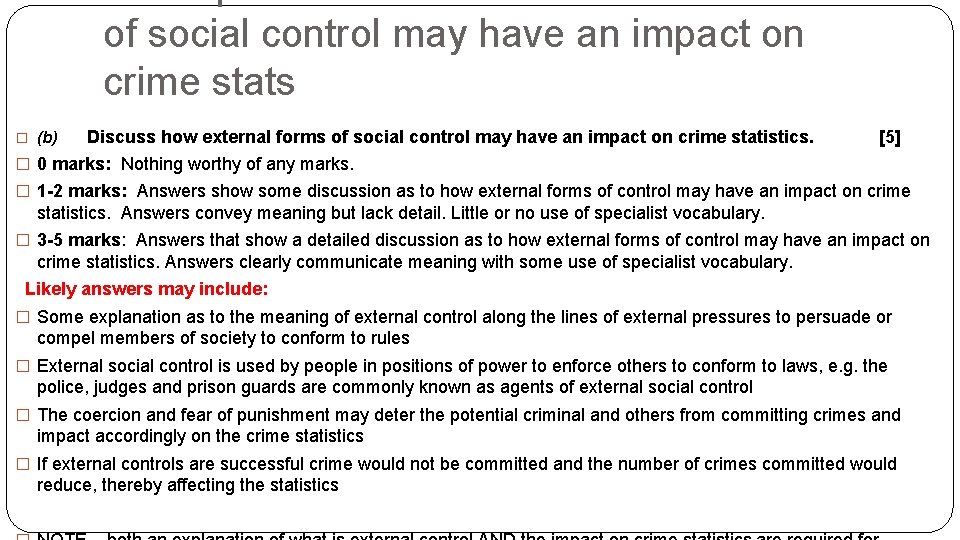
of social control may have an impact on crime stats � (b) Discuss how external forms of social control may have an impact on crime statistics. [5] � 0 marks: Nothing worthy of any marks. � 1 -2 marks: Answers show some discussion as to how external forms of control may have an impact on crime statistics. Answers convey meaning but lack detail. Little or no use of specialist vocabulary. � 3 -5 marks: Answers that show a detailed discussion as to how external forms of control may have an impact on crime statistics. Answers clearly communicate meaning with some use of specialist vocabulary. Likely answers may include: � Some explanation as to the meaning of external control along the lines of external pressures to persuade or compel members of society to conform to rules � External social control is used by people in positions of power to enforce others to conform to laws, e. g. the police, judges and prison guards are commonly known as agents of external social control � The coercion and fear of punishment may deter the potential criminal and others from committing crimes and impact accordingly on the crime statistics � If external controls are successful crime would not be committed and the number of crimes committed would reduce, thereby affecting the statistics
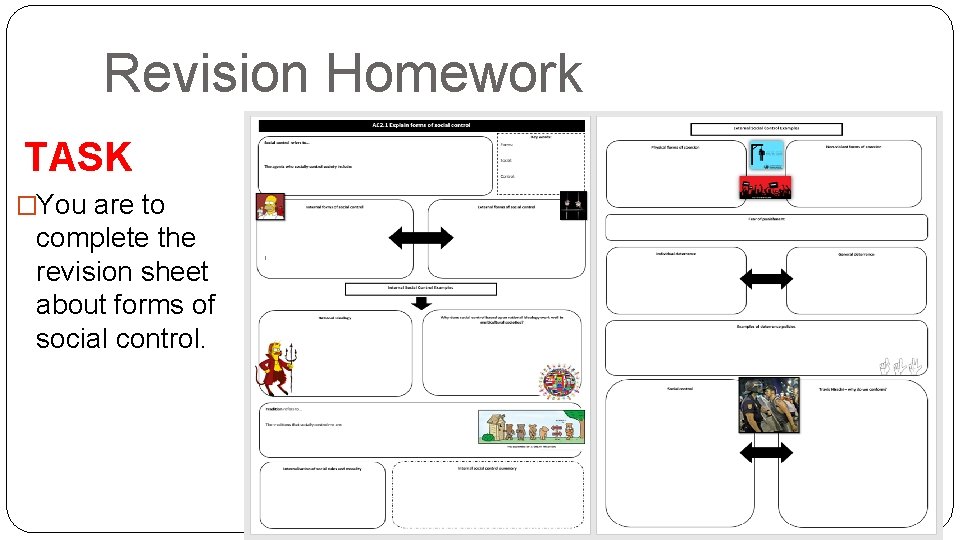
Revision Homework TASK �You are to complete the revision sheet about forms of social control.