Topic Chemistry 111511 Aim How are elements classified
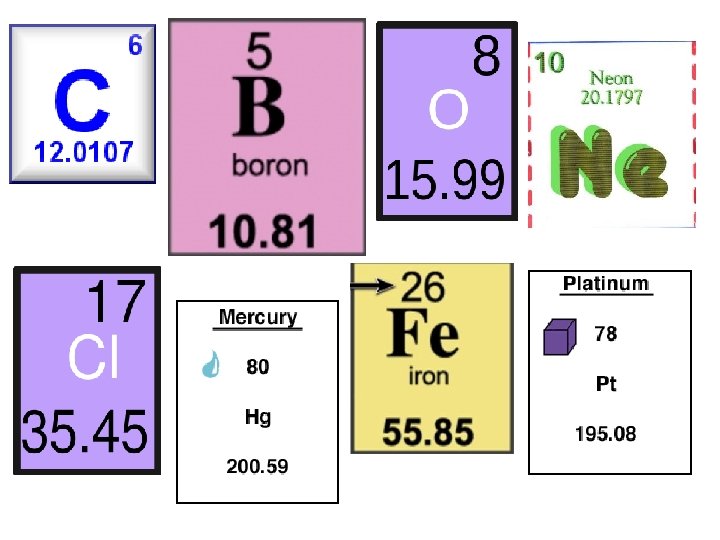
- Slides: 69
Topic: Chemistry 11/15/11 Aim: How are elements classified in the Periodic Table? Do Now: What is the Periodic Table of Elements?
Meet the Elements • Write down all of the ELEMENTS you see in this video. It goes by quickly, so pay attention!!!!!!!
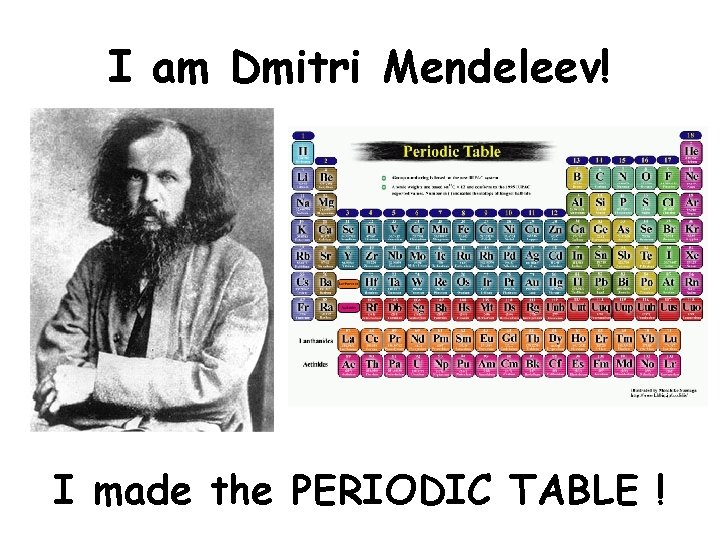
I am Dmitri Mendeleev! I made the PERIODIC TABLE !
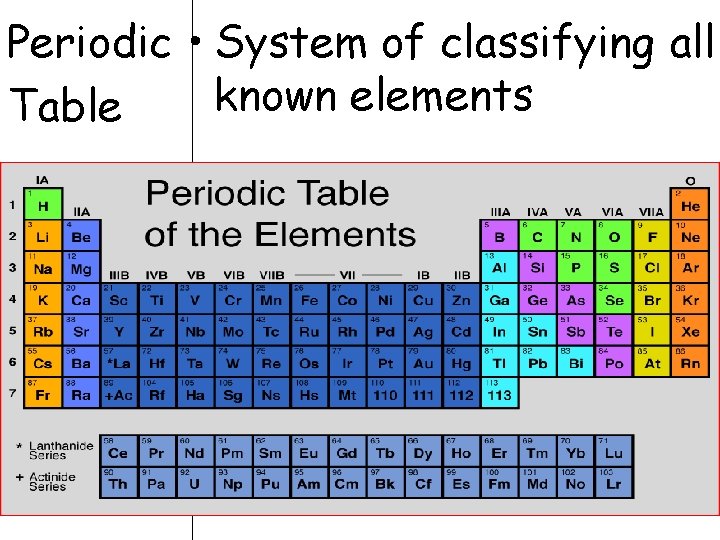
Periodic • System of classifying all known elements Table
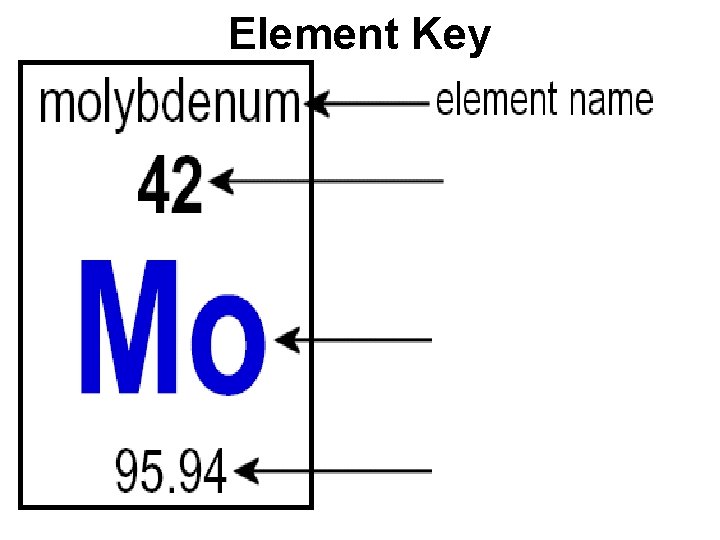
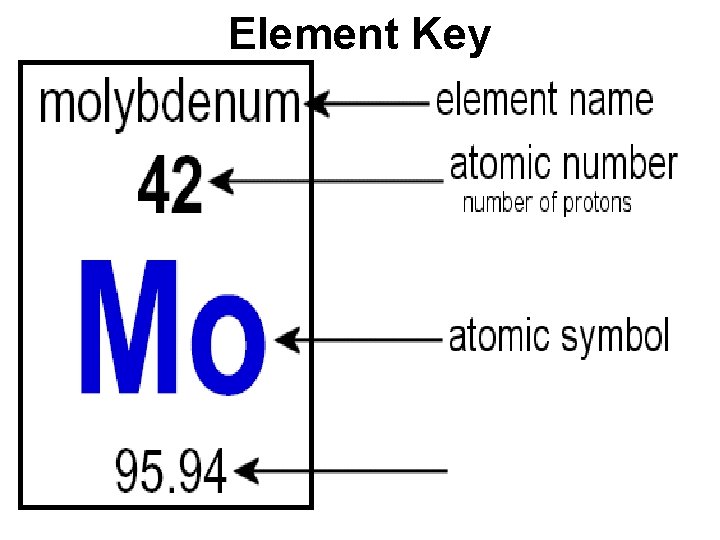
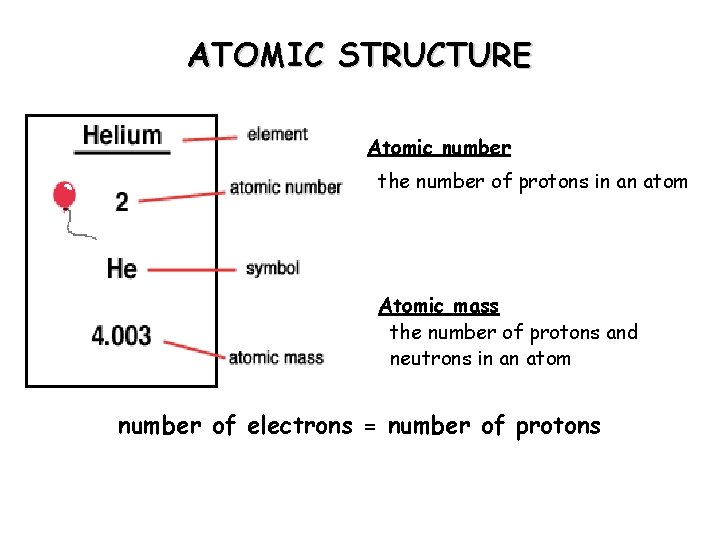
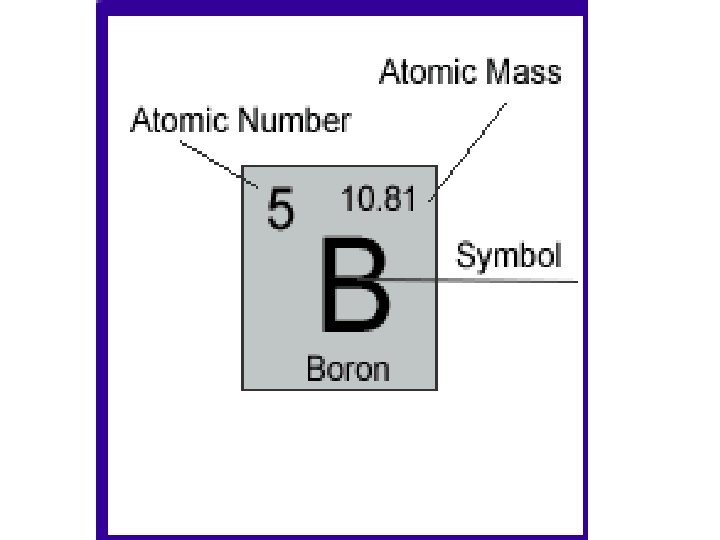
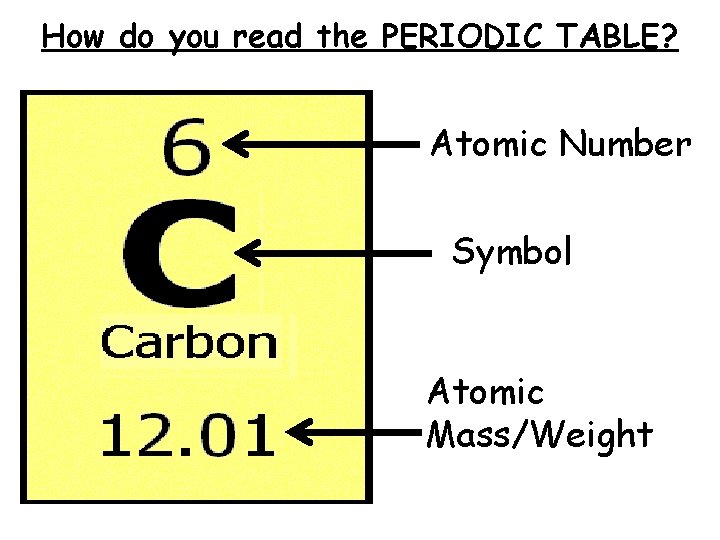
Element Key
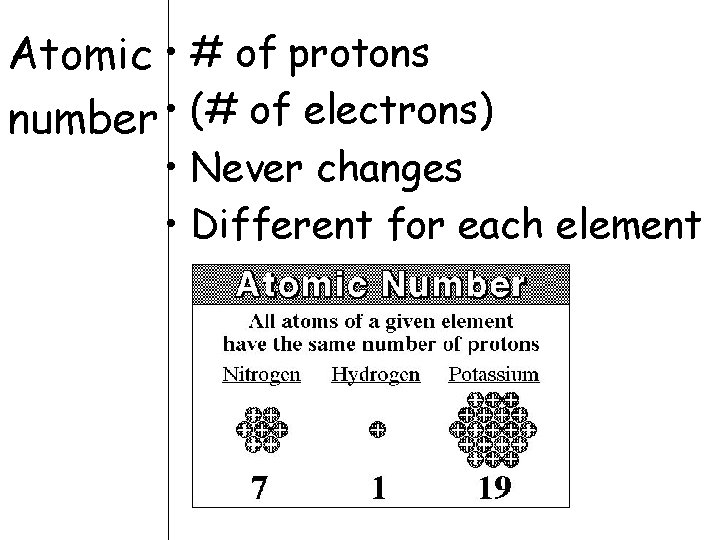
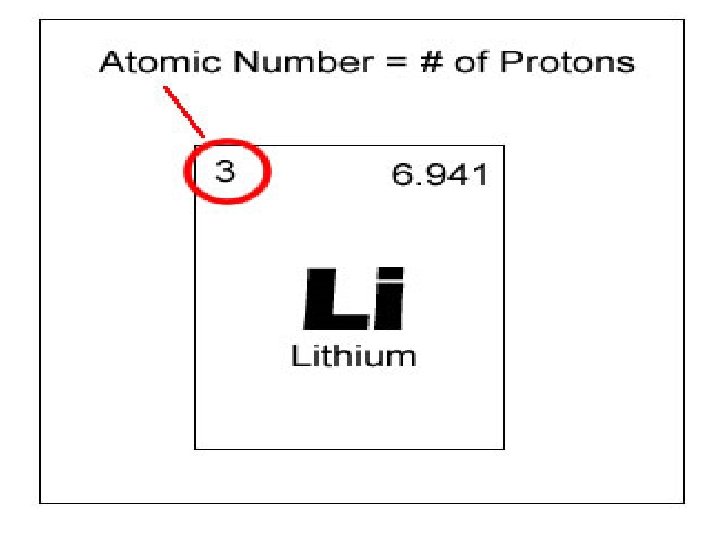
Atomic • # of protons number • (# of electrons) • Never changes • Different for each element
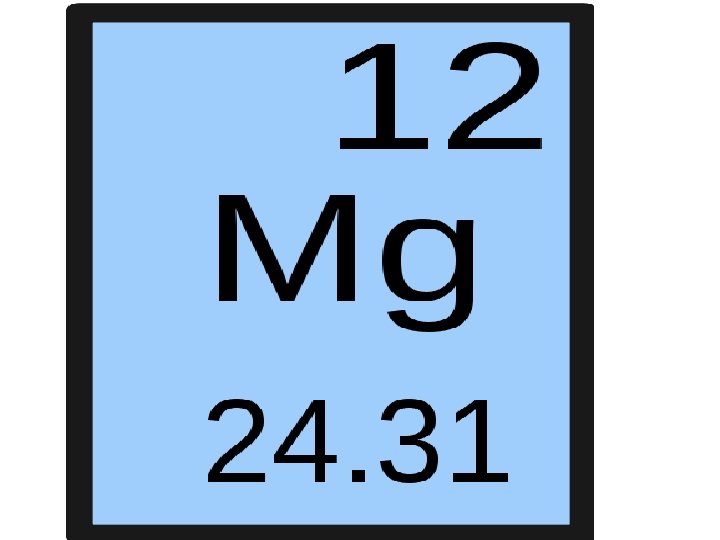
Element Key
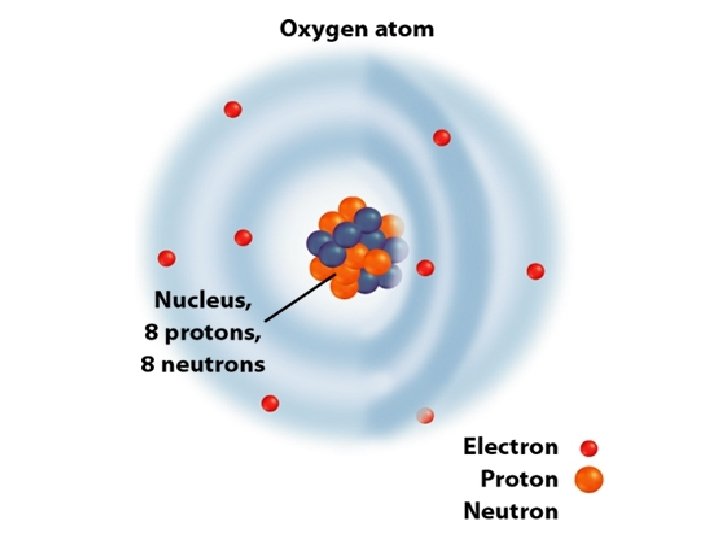
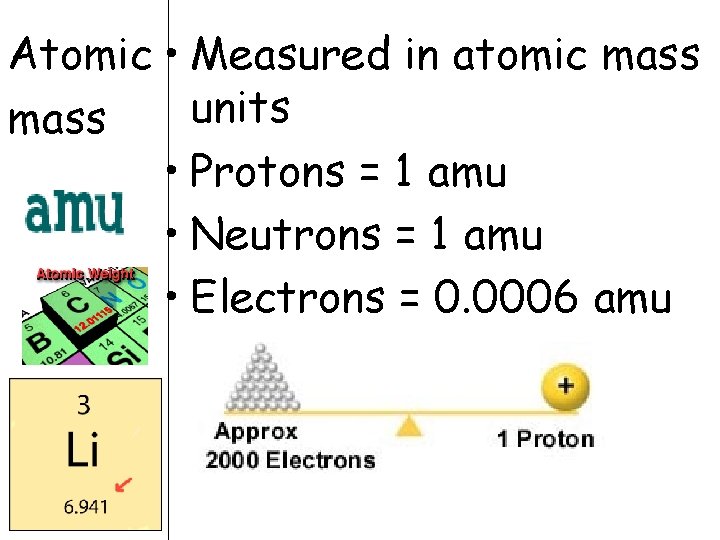
Atomic • Measured in atomic mass units mass • Protons = 1 amu • Neutrons = 1 amu • Electrons = 0. 0006 amu
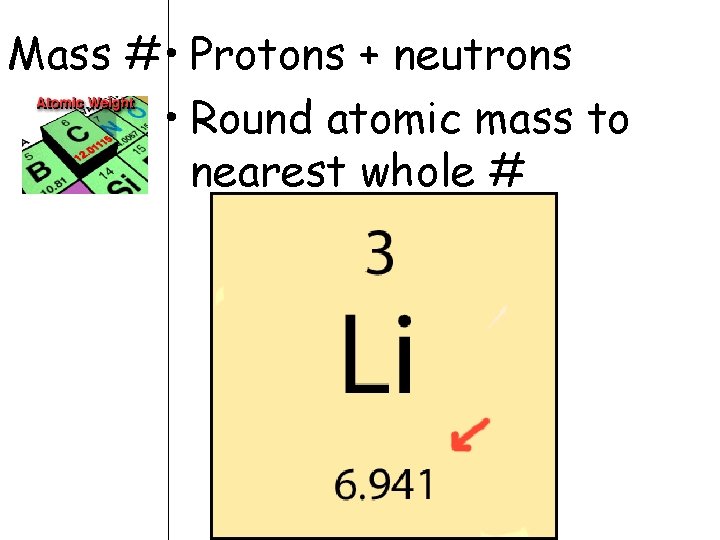
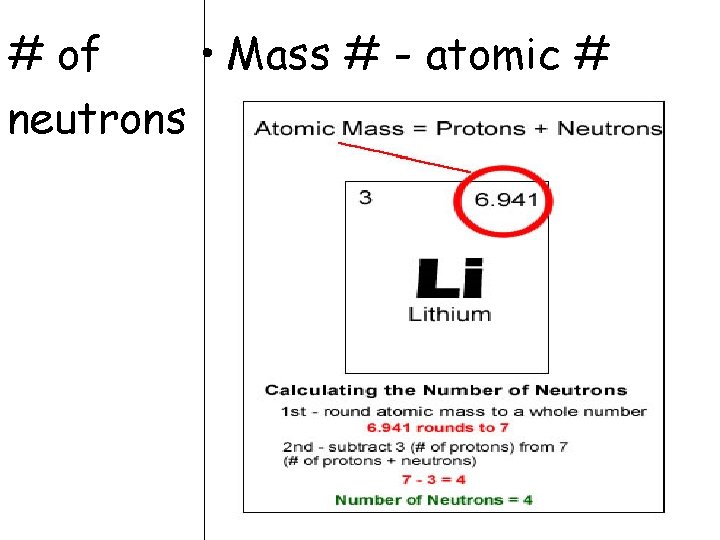
Mass # • Protons + neutrons • Round atomic mass to nearest whole #
ATOMIC STRUCTURE Atomic number the number of protons in an atom Atomic mass the number of protons and neutrons in an atom number of electrons = number of protons
# of • Mass # - atomic # neutrons
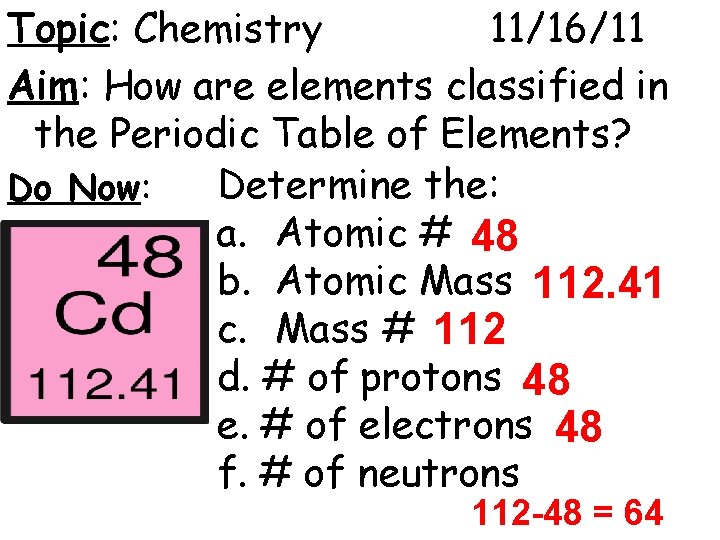
Topic: Chemistry 11/16/11 Aim: How are elements classified in the Periodic Table of Elements? Determine the: Do Now: a. Atomic # 48 b. Atomic Mass 112. 41 c. Mass # 112 d. # of protons 48 e. # of electrons 48 f. # of neutrons 112 -48 = 64
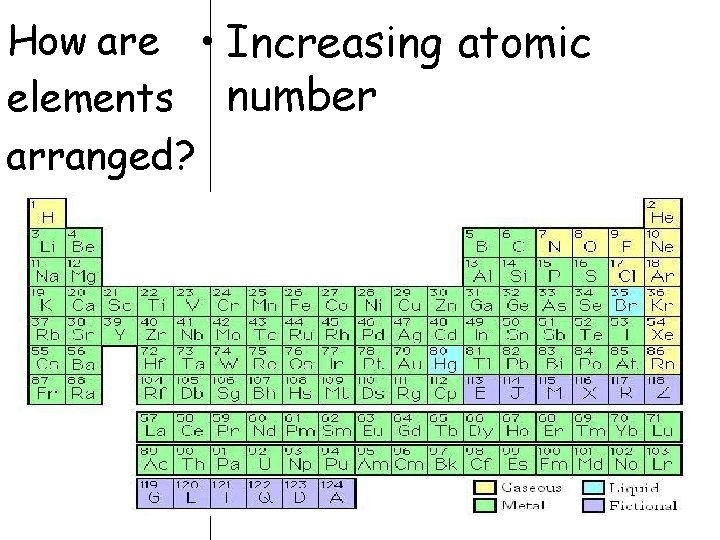
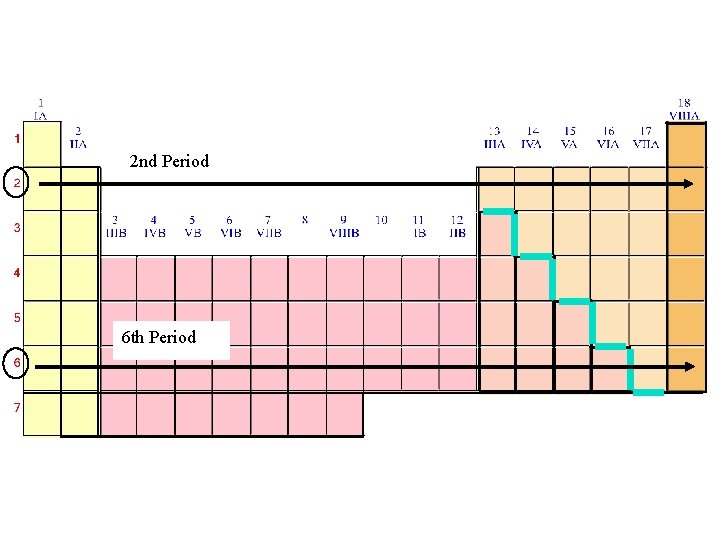
How are • Increasing atomic elements number arranged?
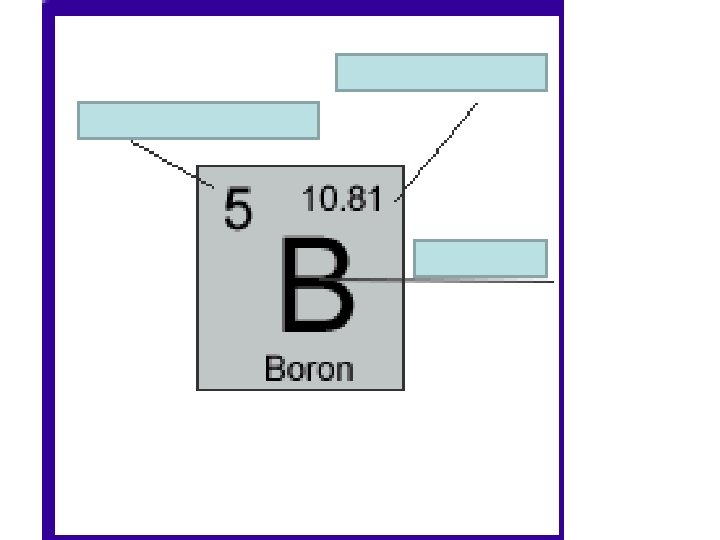
How do you read the PERIODIC TABLE? Atomic Number Symbol Atomic Mass/Weight
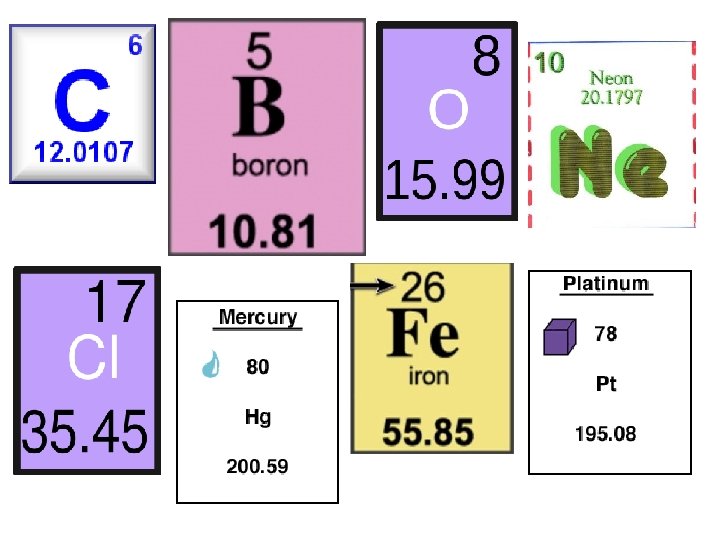
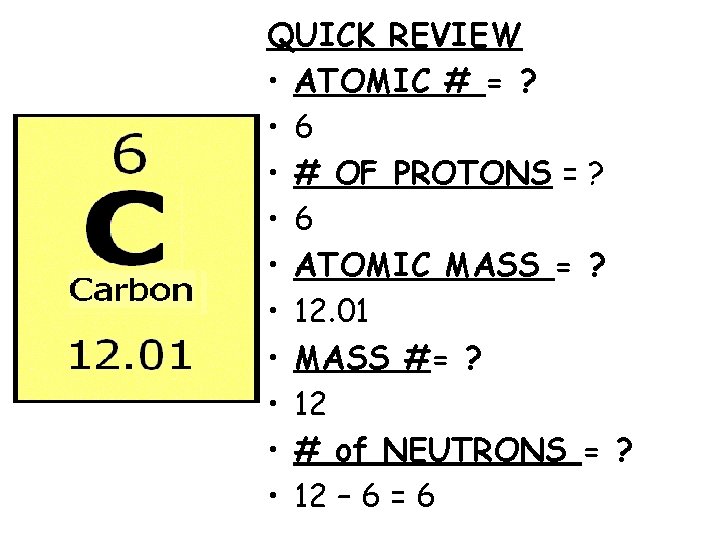
QUICK REVIEW • ATOMIC # = ? • 6 • # OF PROTONS = ? • 6 • ATOMIC MASS = ? • 12. 01 • MASS #= ? • 12 • # of NEUTRONS = ? • 12 – 6 = 6
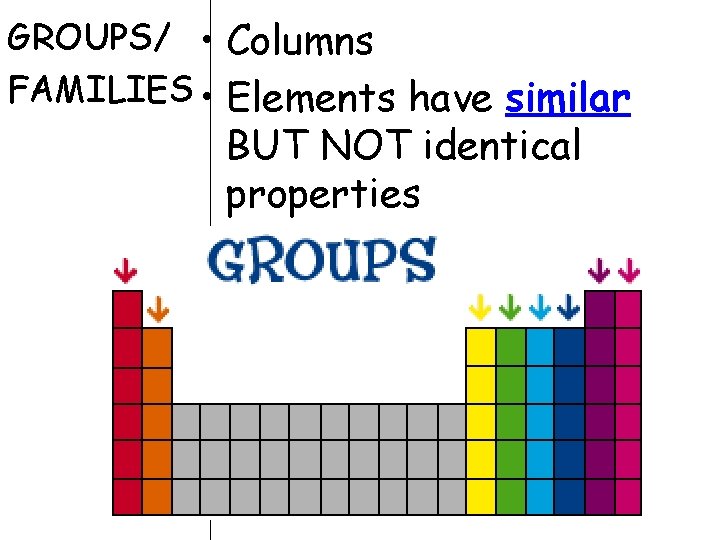
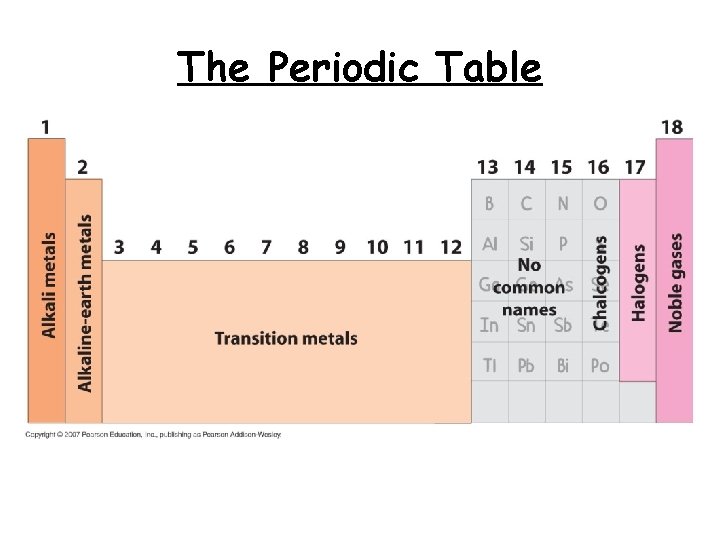
GROUPS/ • Columns FAMILIES • Elements have similar BUT NOT identical properties
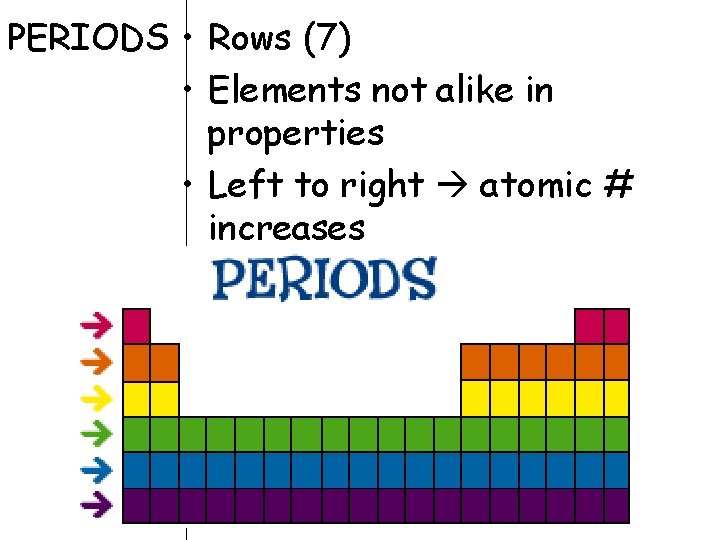
PERIODS • Rows (7) • Elements not alike in properties • Left to right atomic # increases
2 nd Period 6 th Period
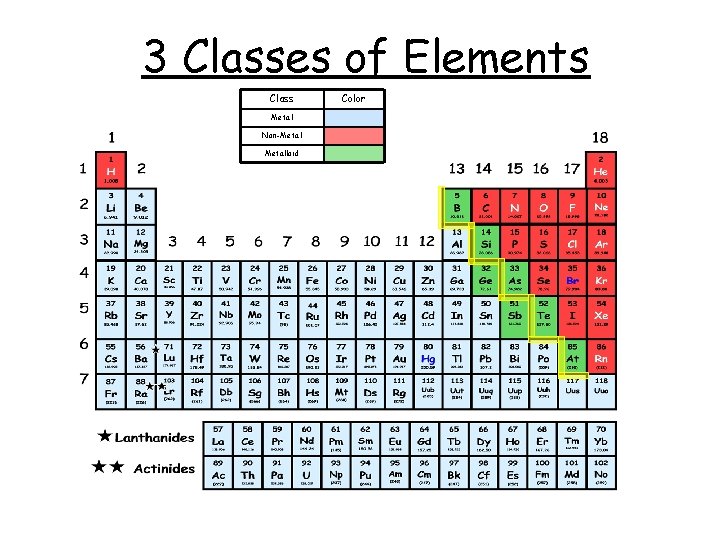
3 Classes of Elements Class Metal Non-Metalloid Color
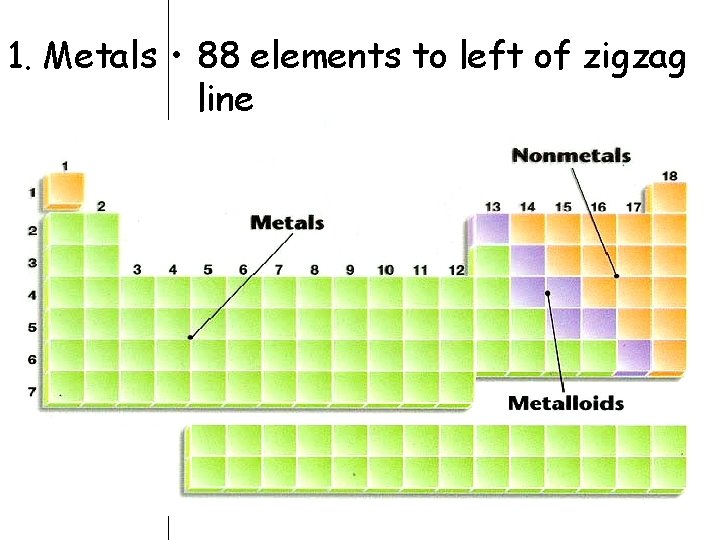
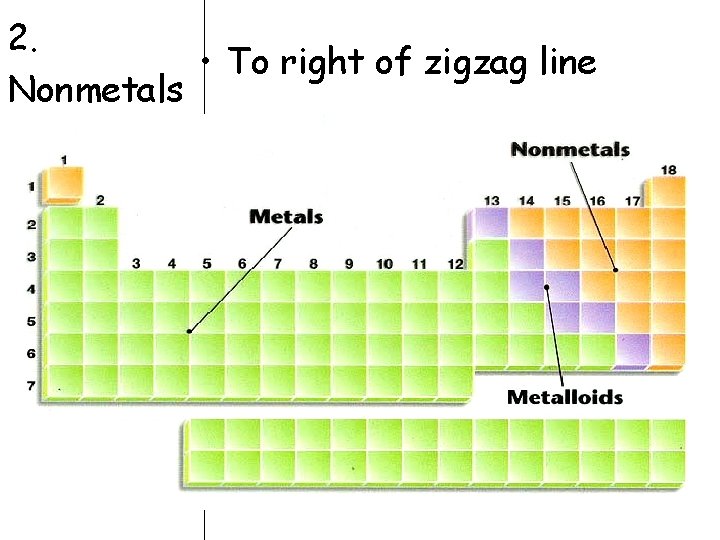
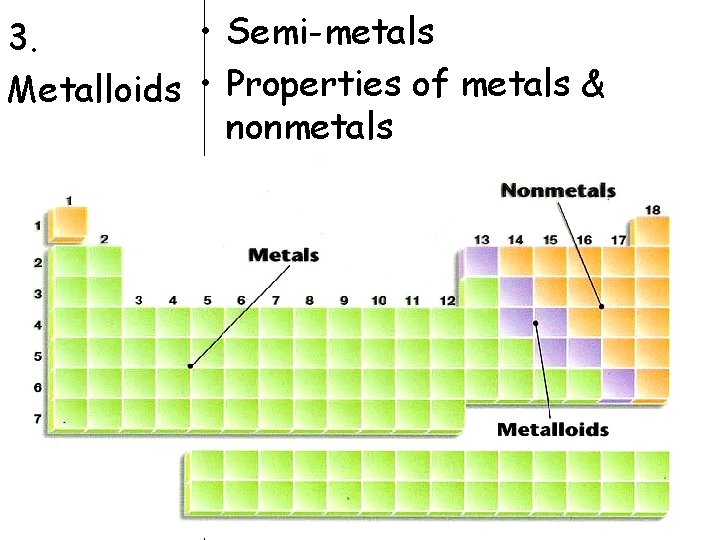
1. Metals • 88 elements to left of zigzag line
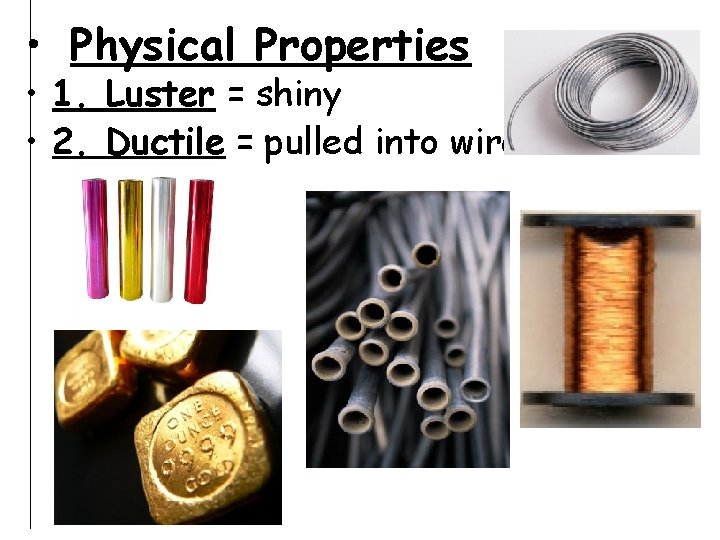
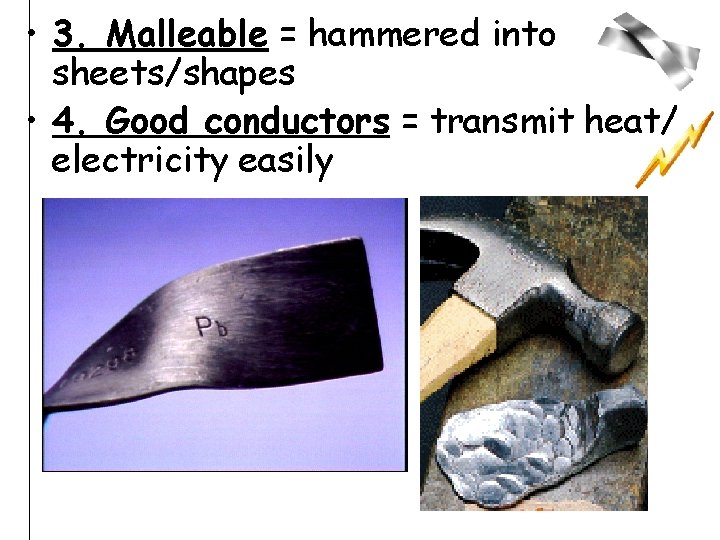
• Physical Properties • 1. Luster = shiny • 2. Ductile = pulled into wires
• 3. Malleable = hammered into sheets/shapes • 4. Good conductors = transmit heat/ electricity easily
2. • To right of zigzag line Nonmetals
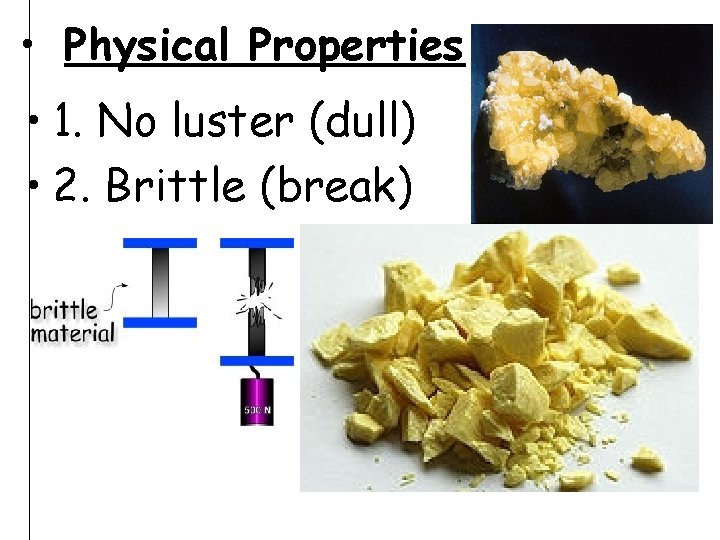
• Physical Properties • 1. No luster (dull) • 2. Brittle (break)
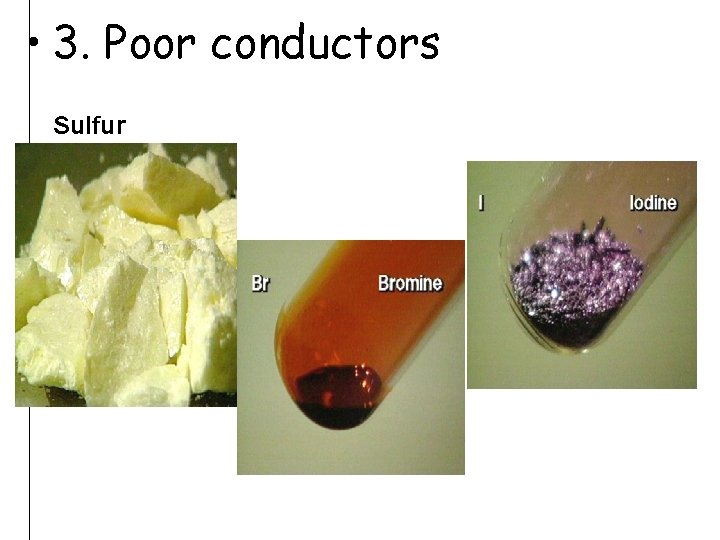
• 3. Poor conductors Sulfur
• Semi-metals 3. Metalloids • Properties of metals & nonmetals
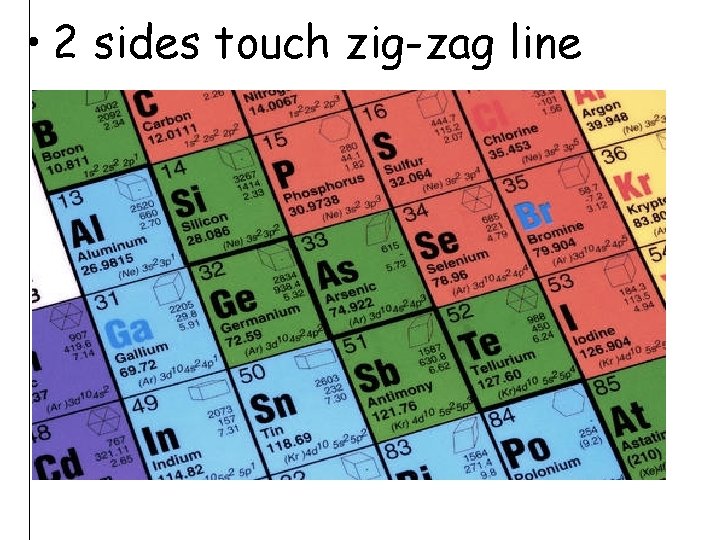
• 2 sides touch zig-zag line
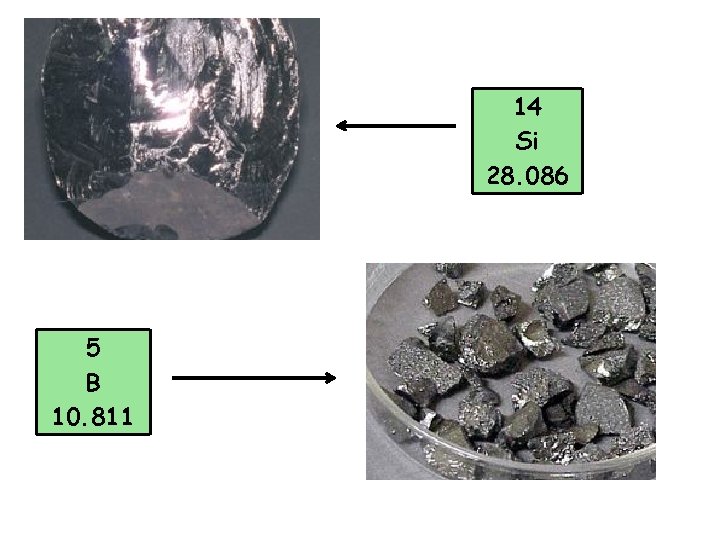
14 Si 28. 086 5 B 10. 811
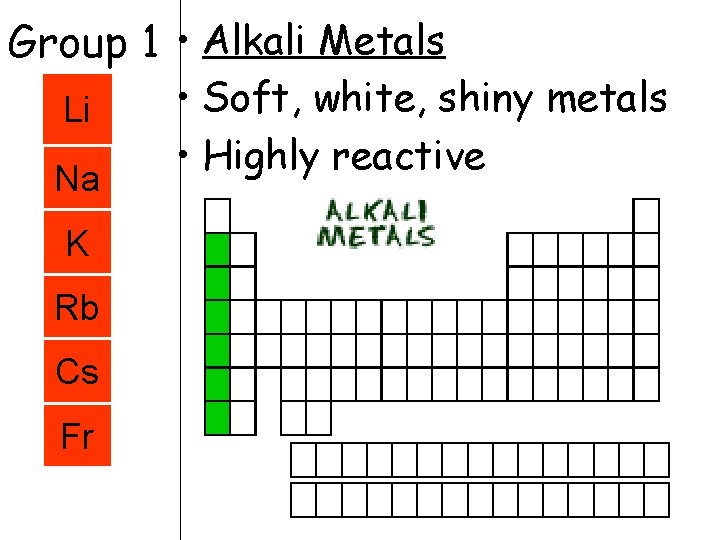
Group 1 • Alkali Metals Li Na K Rb Cs Fr • Soft, white, shiny metals • Highly reactive
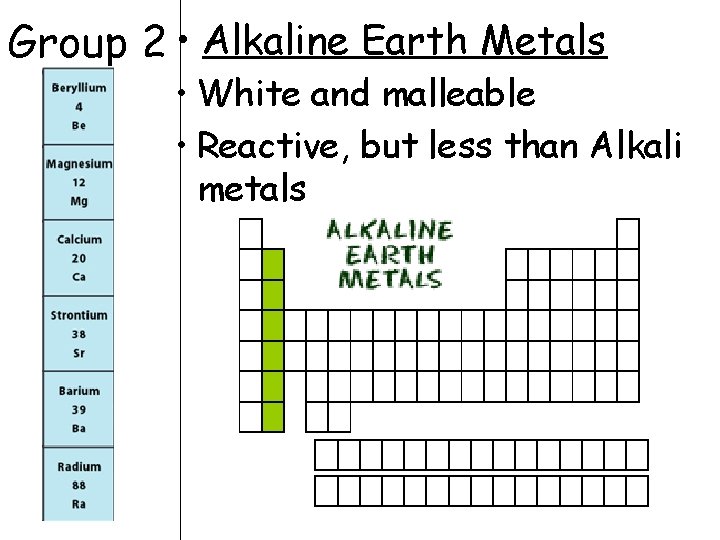
Group 2 • Alkaline Earth Metals • White and malleable • Reactive, but less than Alkali metals
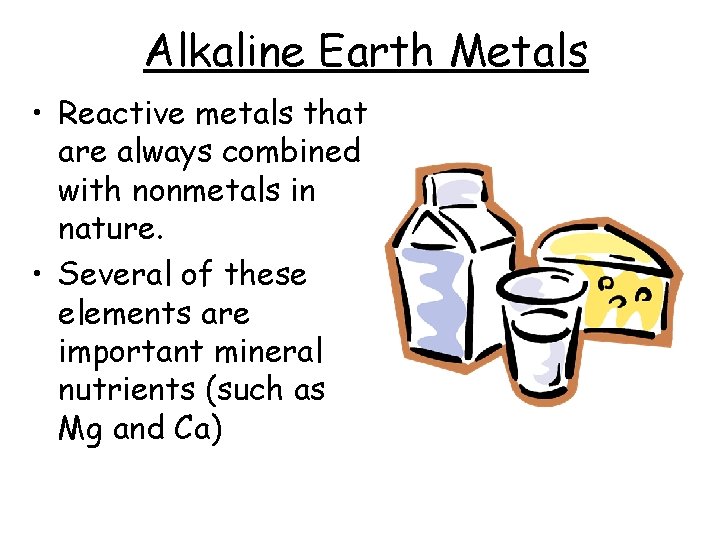
Alkaline Earth Metals • Reactive metals that are always combined with nonmetals in nature. • Several of these elements are important mineral nutrients (such as Mg and Ca)
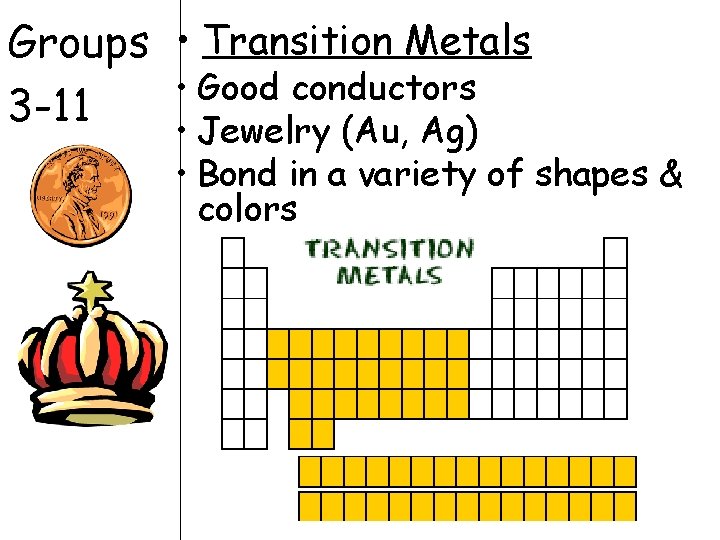
Groups • Transition Metals • Good conductors 3 -11 • Jewelry (Au, Ag) • Bond in a variety of shapes & colors
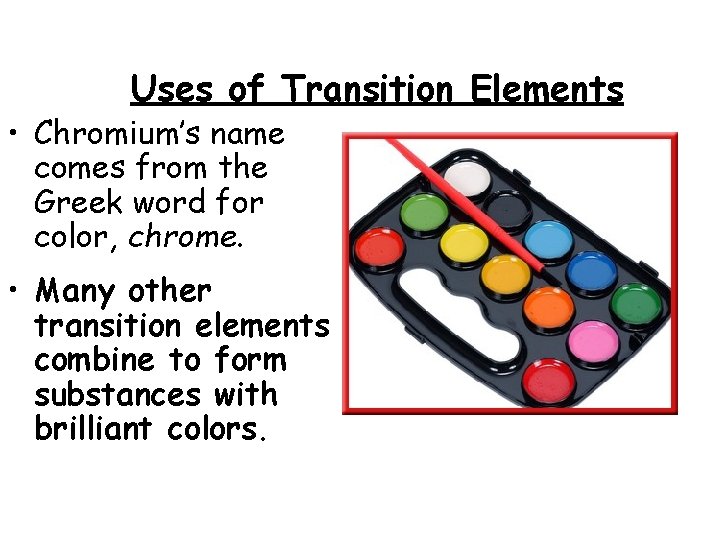
Uses of Transition Elements • Chromium’s name comes from the Greek word for color, chrome. • Many other transition elements combine to form substances with brilliant colors.
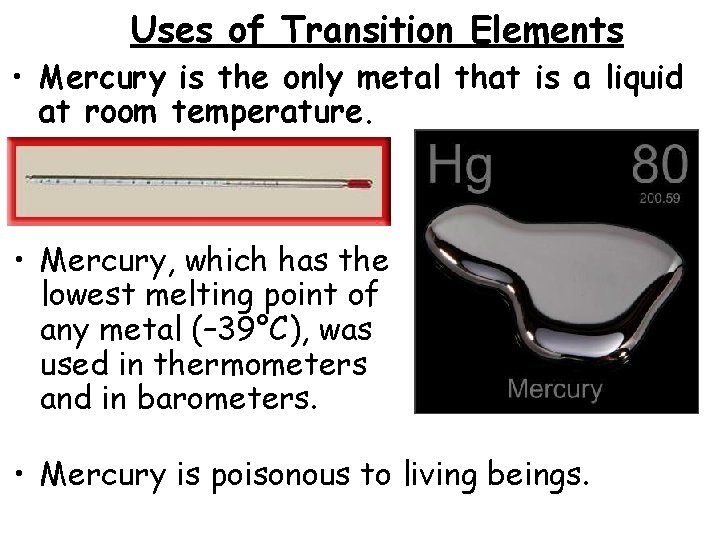
Uses of Transition Elements • Mercury is the only metal that is a liquid at room temperature. • Mercury, which has the lowest melting point of any metal (– 39°C), was used in thermometers and in barometers. • Mercury is poisonous to living beings.
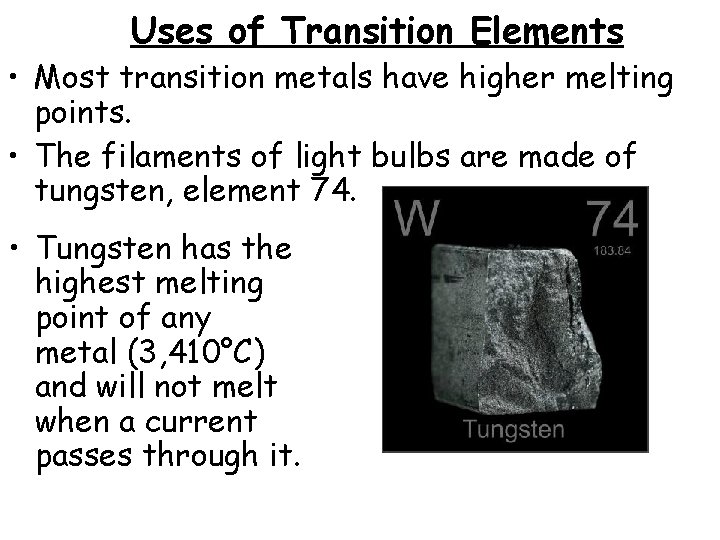
Uses of Transition Elements • Most transition metals have higher melting points. • The filaments of light bulbs are made of tungsten, element 74. • Tungsten has the highest melting point of any metal (3, 410°C) and will not melt when a current passes through it.
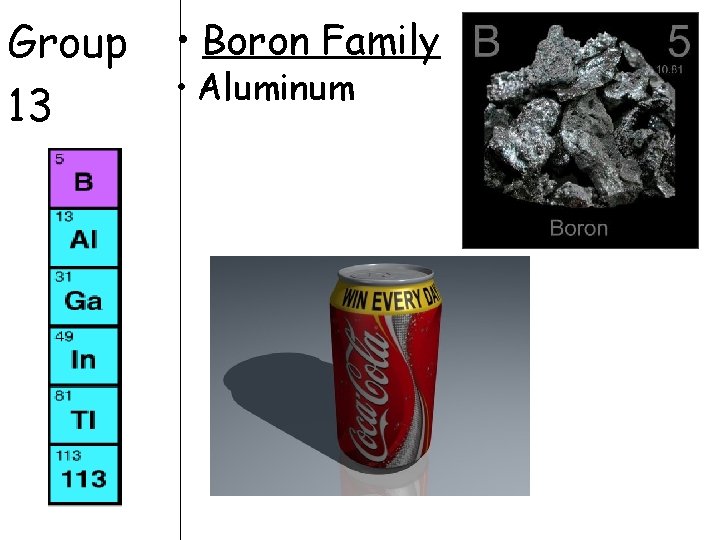
Group 13 • Boron Family • Aluminum
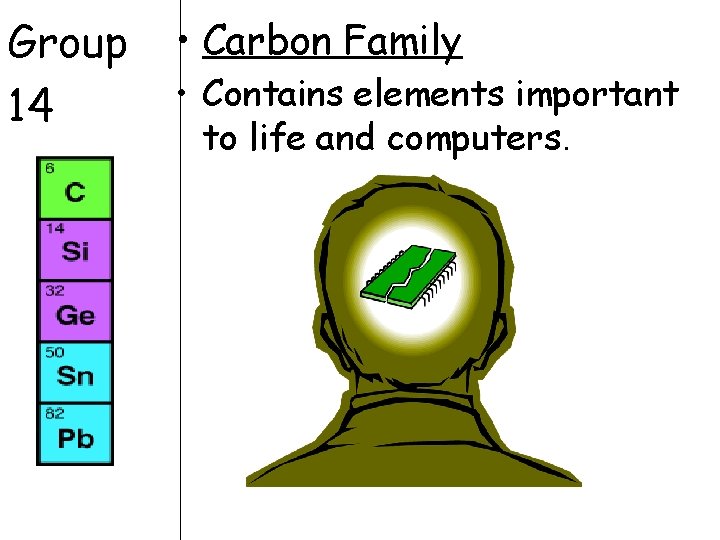
Group 14 • Carbon Family • Contains elements important to life and computers.
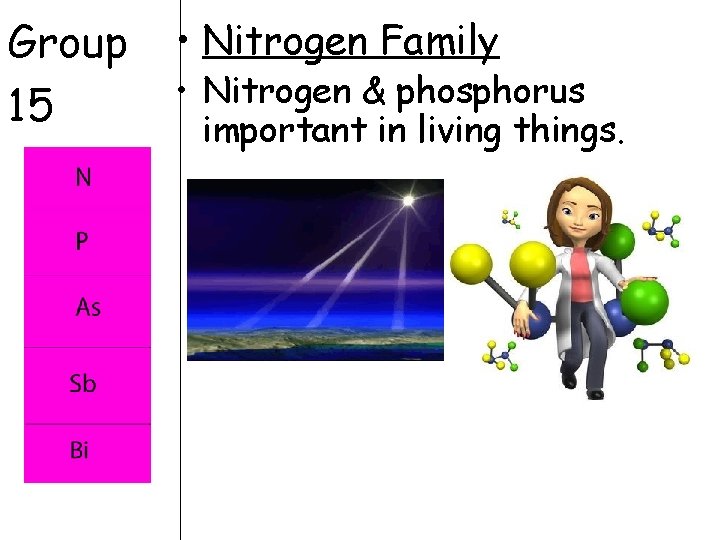
Group 15 • Nitrogen Family • Nitrogen & phosphorus important in living things.
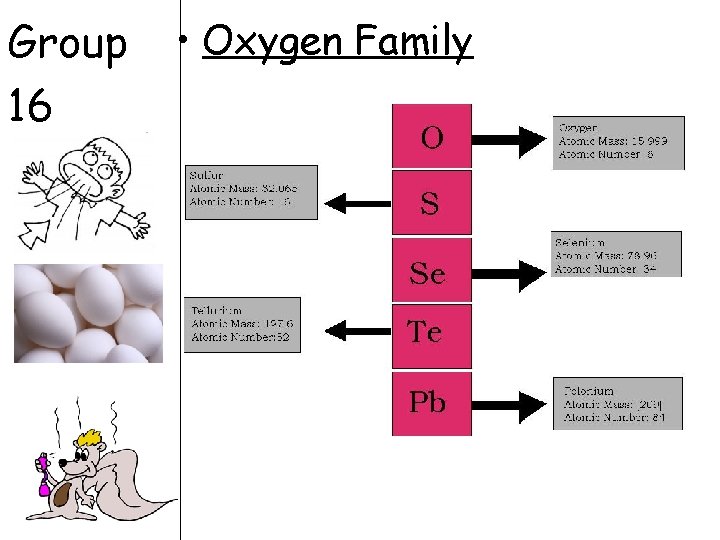
Group 16 • Oxygen Family
Topic: Chemistry 11/17/11 Aim: How are elements classified in the Periodic Table of Elements? Do Now: Identify the group of the periodic table being described: a. Salt formers b. Very reactive metals c. Group 2
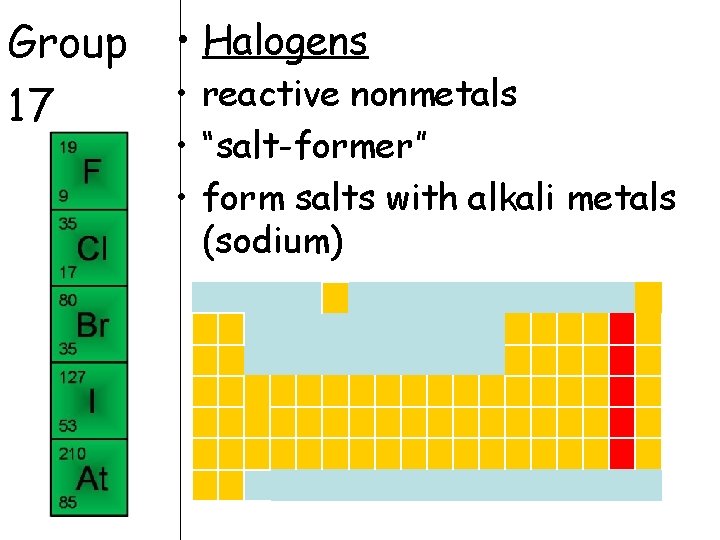
Group 17 • Halogens • reactive nonmetals • “salt-former” • form salts with alkali metals (sodium)
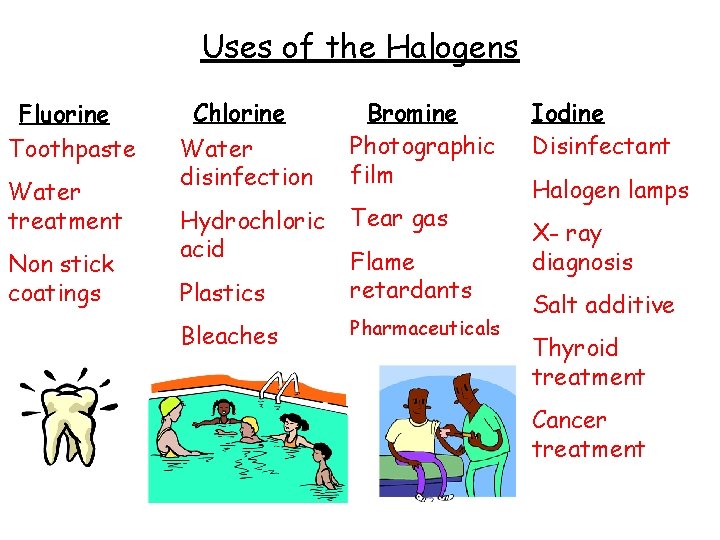
Uses of the Halogens Fluorine Toothpaste Water treatment Non stick coatings Chlorine Water disinfection Hydrochloric acid Bromine Photographic film Tear gas Plastics Flame retardants Bleaches Pharmaceuticals Iodine Disinfectant Halogen lamps X- ray diagnosis Salt additive Thyroid treatment Cancer treatment
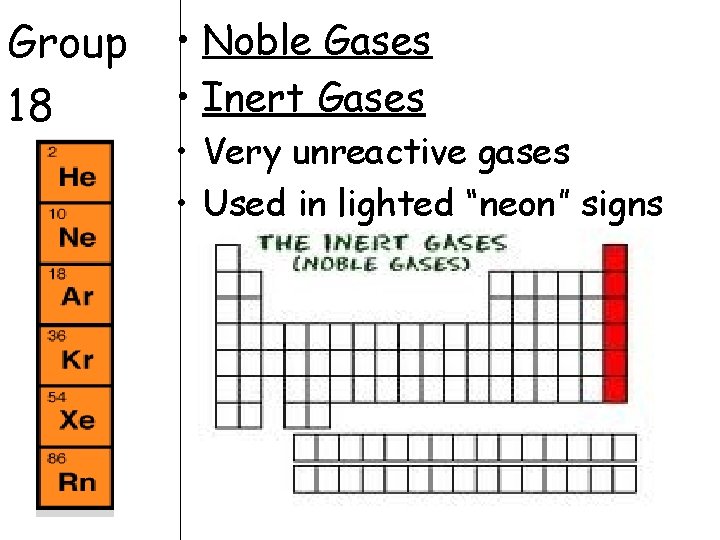
Group 18 • Noble Gases • Inert Gases • Very unreactive gases • Used in lighted “neon” signs
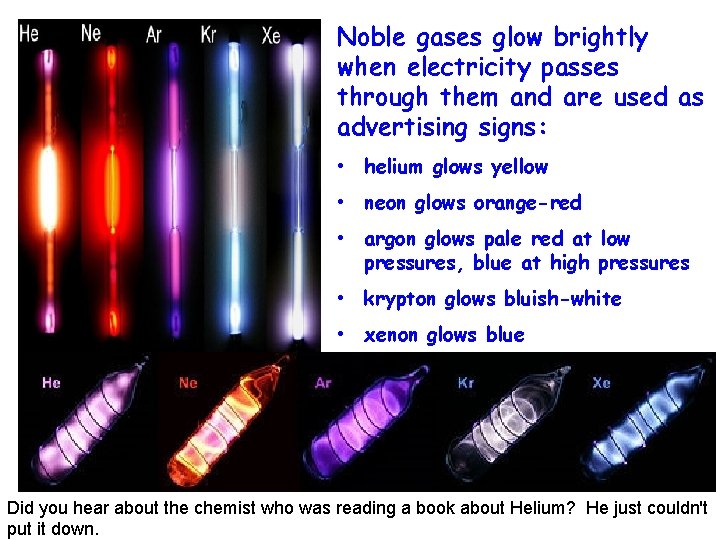
Noble gases glow brightly when electricity passes through them and are used as advertising signs: • helium glows yellow • neon glows orange-red • argon glows pale red at low pressures, blue at high pressures • krypton glows bluish-white • xenon glows blue Did you hear about the chemist who was reading a book about Helium? He just couldn't put it down.
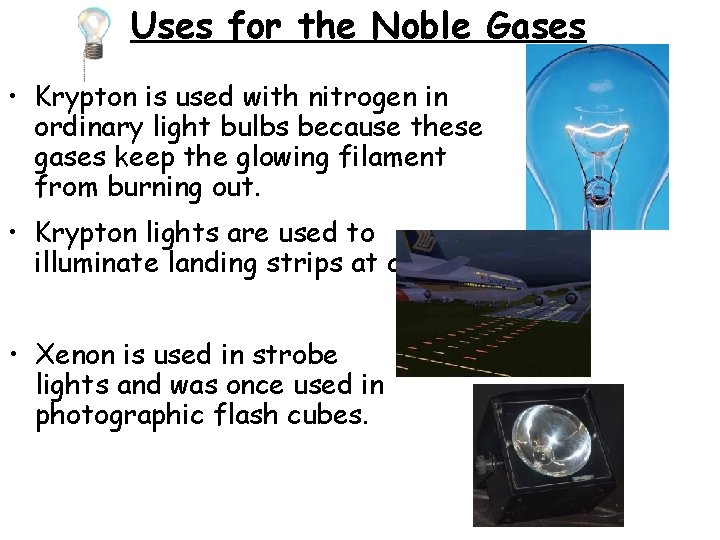
Uses for the Noble Gases • Krypton is used with nitrogen in ordinary light bulbs because these gases keep the glowing filament from burning out. • Krypton lights are used to illuminate landing strips at airports. • Xenon is used in strobe lights and was once used in photographic flash cubes.
The Periodic Table
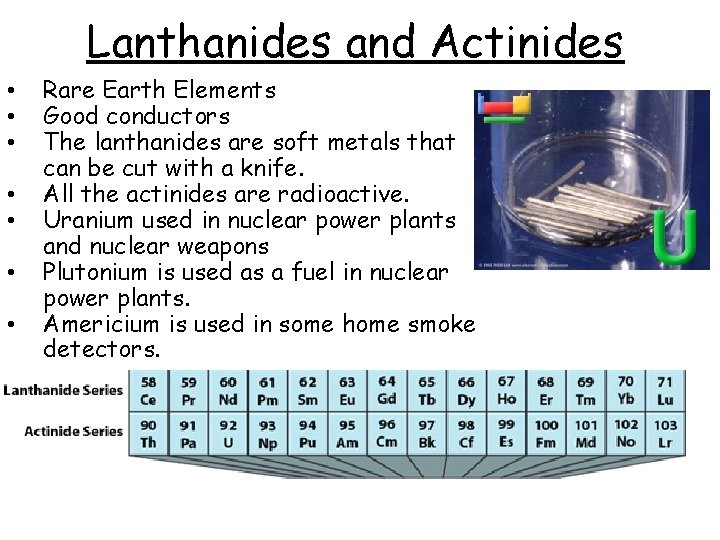
Lanthanides and Actinides • • Rare Earth Elements Good conductors The lanthanides are soft metals that can be cut with a knife. All the actinides are radioactive. Uranium used in nuclear power plants and nuclear weapons Plutonium is used as a fuel in nuclear power plants. Americium is used in some home smoke detectors.
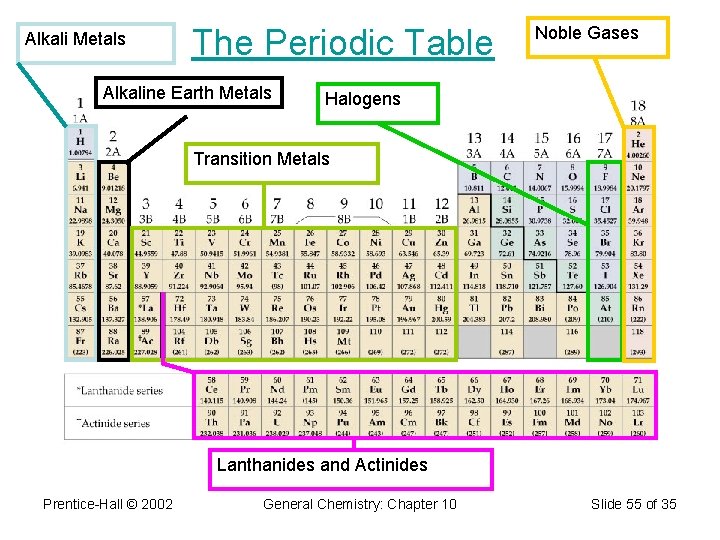
Alkali Metals The Periodic Table Alkaline Earth Metals Noble Gases Halogens Transition Metals Lanthanides and Actinides Prentice-Hall © 2002 General Chemistry: Chapter 10 Slide 55 of 35
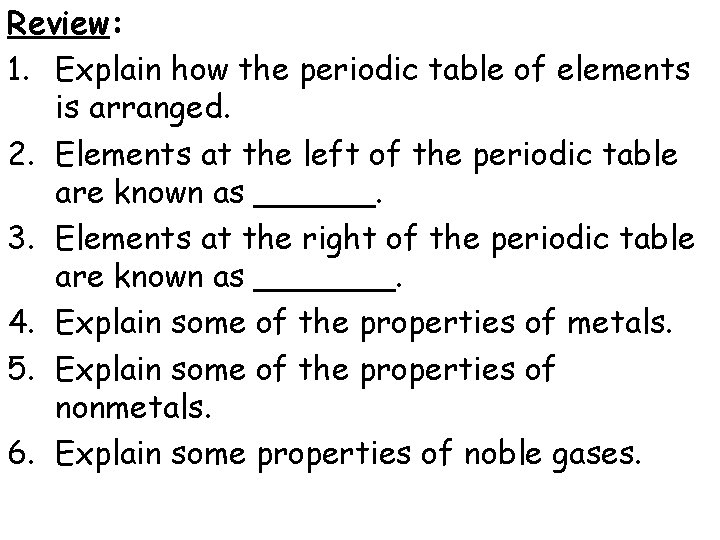
Review: 1. Explain how the periodic table of elements is arranged. 2. Elements at the left of the periodic table are known as ______. 3. Elements at the right of the periodic table are known as _______. 4. Explain some of the properties of metals. 5. Explain some of the properties of nonmetals. 6. Explain some properties of noble gases.
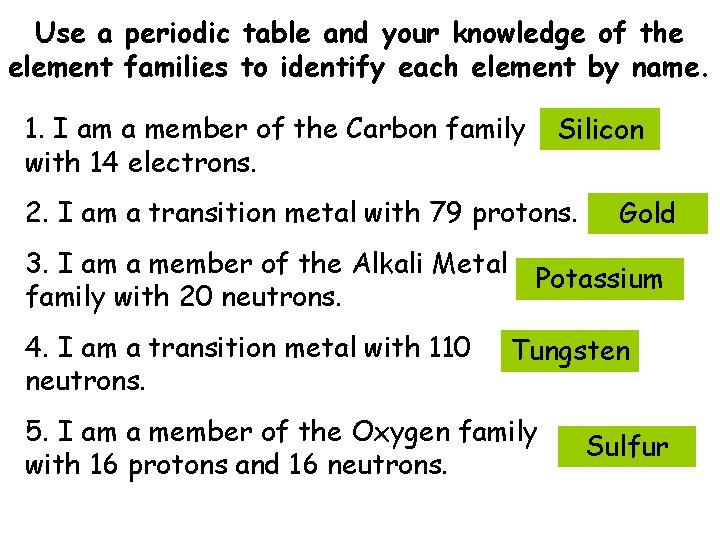
Use a periodic table and your knowledge of the element families to identify each element by name. 1. I am a member of the Carbon family with 14 electrons. Silicon 2. I am a transition metal with 79 protons. 3. I am a member of the Alkali Metal family with 20 neutrons. 4. I am a transition metal with 110 neutrons. Gold Potassium Tungsten 5. I am a member of the Oxygen family with 16 protons and 16 neutrons. Sulfur
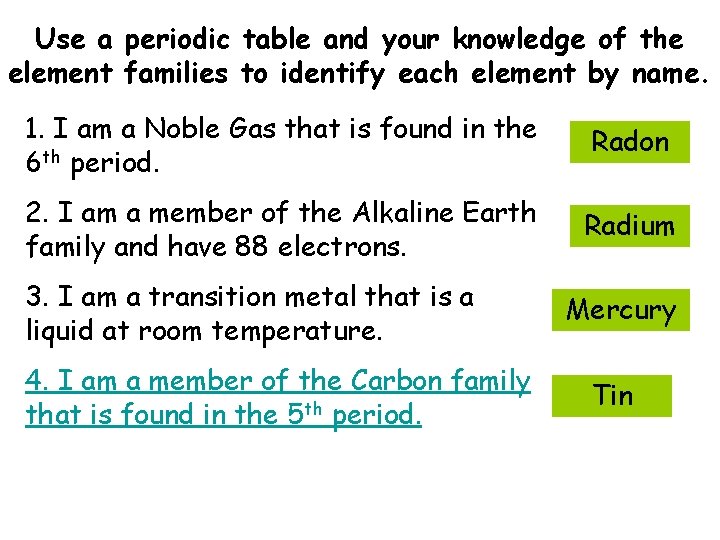
Use a periodic table and your knowledge of the element families to identify each element by name. 1. I am a Noble Gas that is found in the 6 th period. Radon 2. I am a member of the Alkaline Earth family and have 88 electrons. Radium 3. I am a transition metal that is a liquid at room temperature. 4. I am a member of the Carbon family that is found in the 5 th period. Mercury Tin
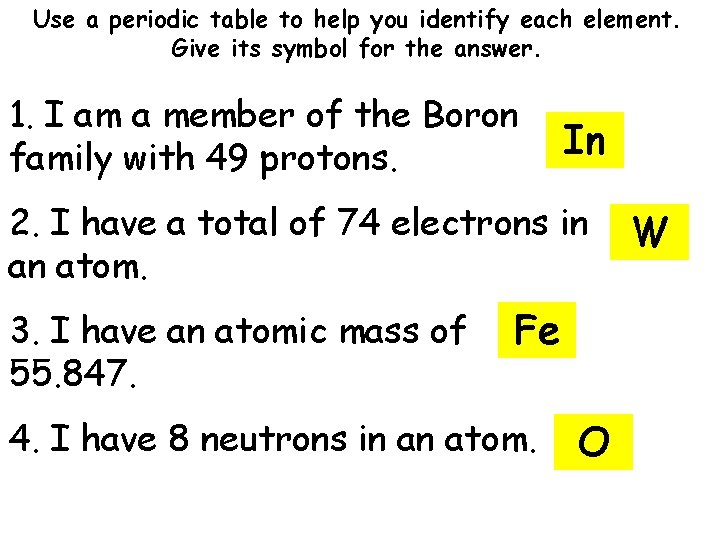
Use a periodic table to help you identify each element. Give its symbol for the answer. 1. I am a member of the Boron family with 49 protons. In 2. I have a total of 74 electrons in an atom. 3. I have an atomic mass of 55. 847. Fe 4. I have 8 neutrons in an atom. O W
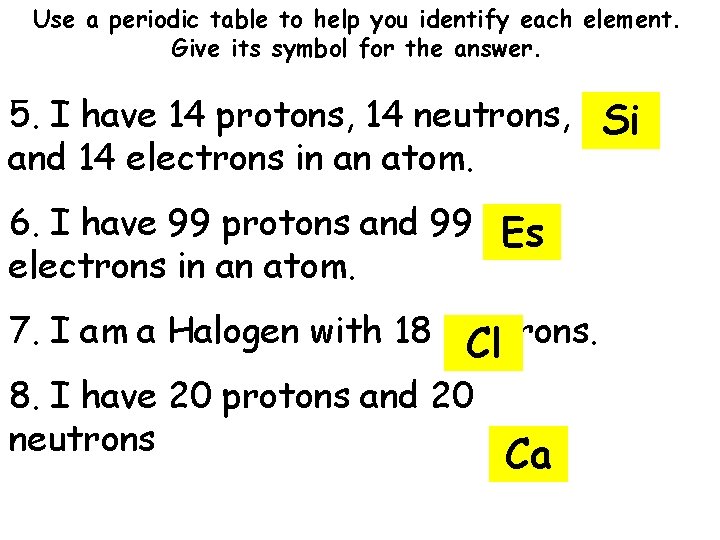
Use a periodic table to help you identify each element. Give its symbol for the answer. 5. I have 14 protons, 14 neutrons, Si and 14 electrons in an atom. 6. I have 99 protons and 99 Es electrons in an atom. 7. I am a Halogen with 18 neutrons. Cl 8. I have 20 protons and 20 neutrons Ca
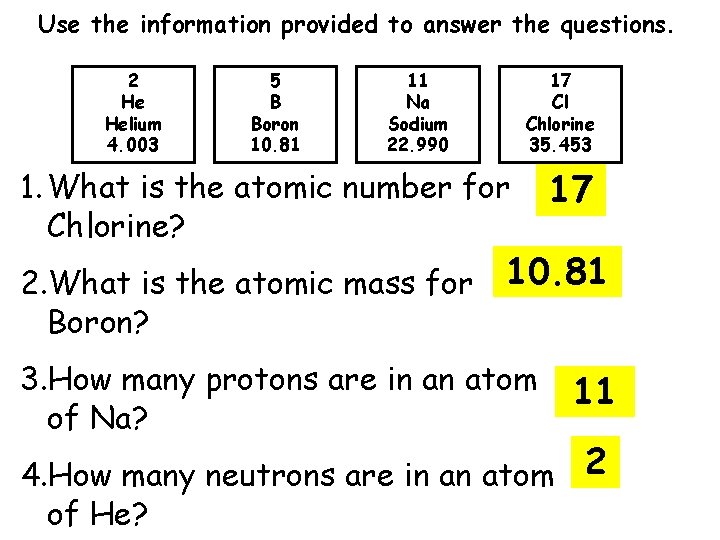
Use the information provided to answer the questions. 2 He Helium 4. 003 5 B Boron 10. 81 11 Na Sodium 22. 990 17 Cl Chlorine 35. 453 1. What is the atomic number for Chlorine? 17 2. What is the atomic mass for 10. 81 Boron? 3. How many protons are in an atom of Na? 11 4. How many neutrons are in an atom 2 of He?
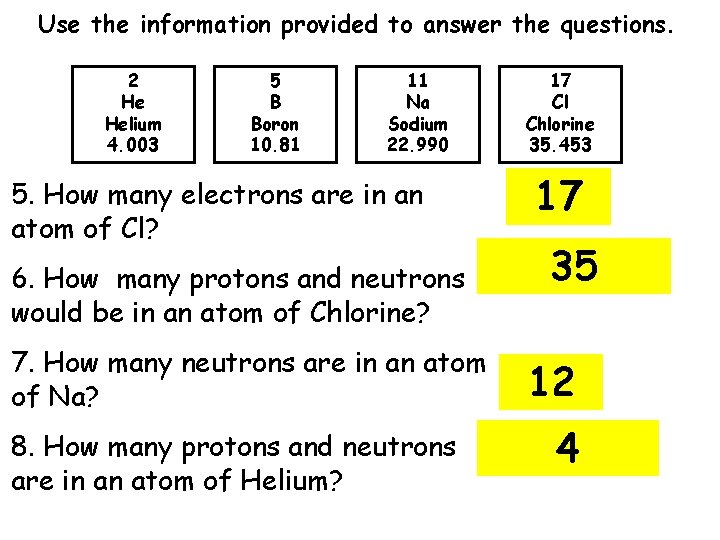
Use the information provided to answer the questions. 2 He Helium 4. 003 5 B Boron 10. 81 11 Na Sodium 22. 990 5. How many electrons are in an atom of Cl? 6. How many protons and neutrons would be in an atom of Chlorine? 7. How many neutrons are in an atom of Na? 8. How many protons and neutrons are in an atom of Helium? 17 Cl Chlorine 35. 453 17 35 12 4
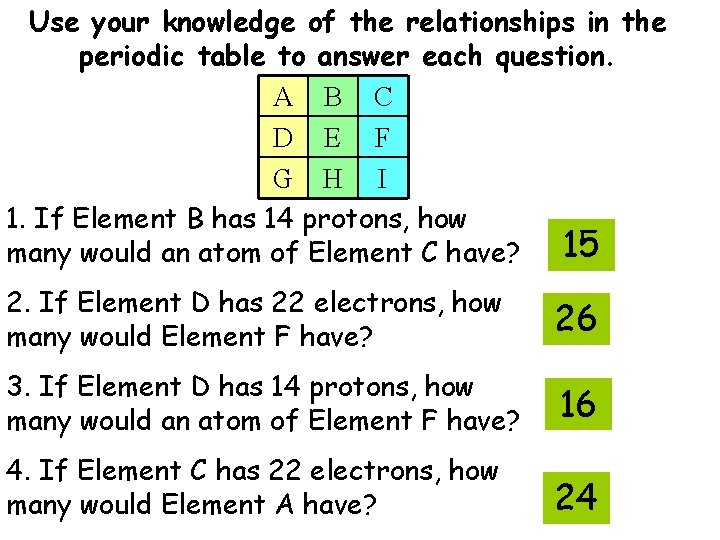
Use your knowledge of the relationships in the periodic table to answer each question. A B C D E F G H I 1. If Element B has 14 protons, how many would an atom of Element C have? 15 2. If Element D has 22 electrons, how many would Element F have? 26 3. If Element D has 14 protons, how many would an atom of Element F have? 16 4. If Element C has 22 electrons, how many would Element A have? 24
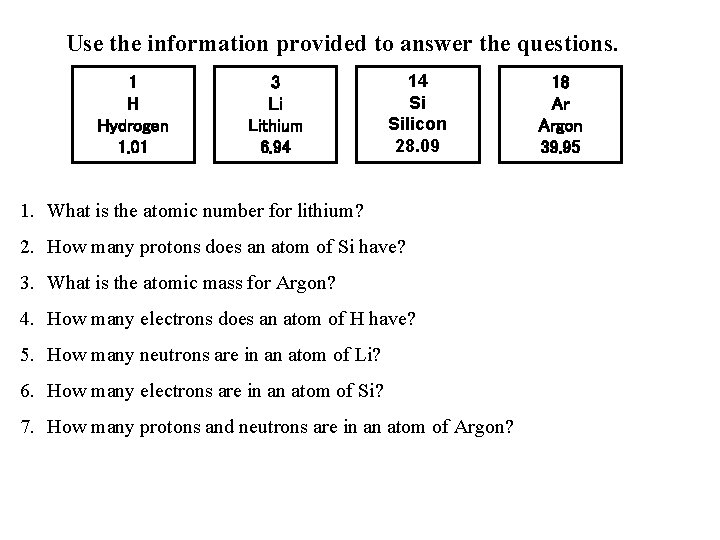
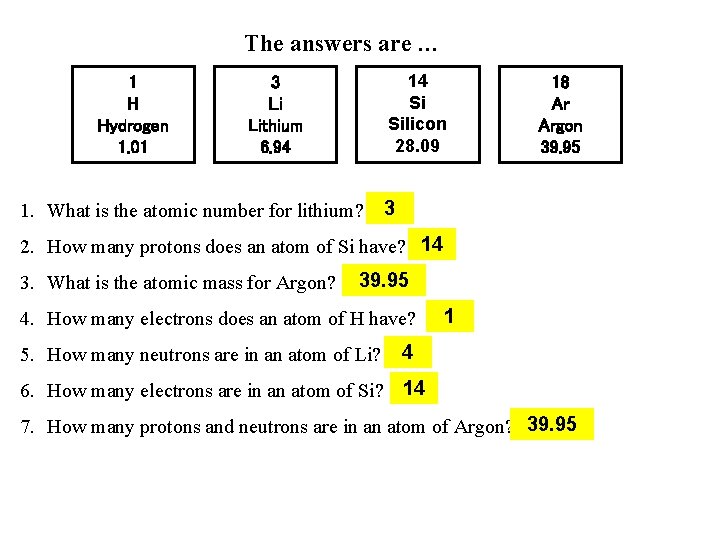
Use the information provided to answer the questions. 1 H Hydrogen 1. 01 3 Li Lithium 6. 94 14 Si Silicon 28. 09 1. What is the atomic number for lithium? 2. How many protons does an atom of Si have? 3. What is the atomic mass for Argon? 4. How many electrons does an atom of H have? 5. How many neutrons are in an atom of Li? 6. How many electrons are in an atom of Si? 7. How many protons and neutrons are in an atom of Argon? 18 Ar Argon 39. 95
The answers are … 1 H Hydrogen 1. 01 14 Si Silicon 28. 09 3 Li Lithium 6. 94 1. What is the atomic number for lithium? 18 Ar Argon 39. 95 3 2. How many protons does an atom of Si have? 14 3. What is the atomic mass for Argon? 39. 95 4. How many electrons does an atom of H have? 5. How many neutrons are in an atom of Li? 1 4 6. How many electrons are in an atom of Si? 14 7. How many protons and neutrons are in an atom of Argon? 39. 95
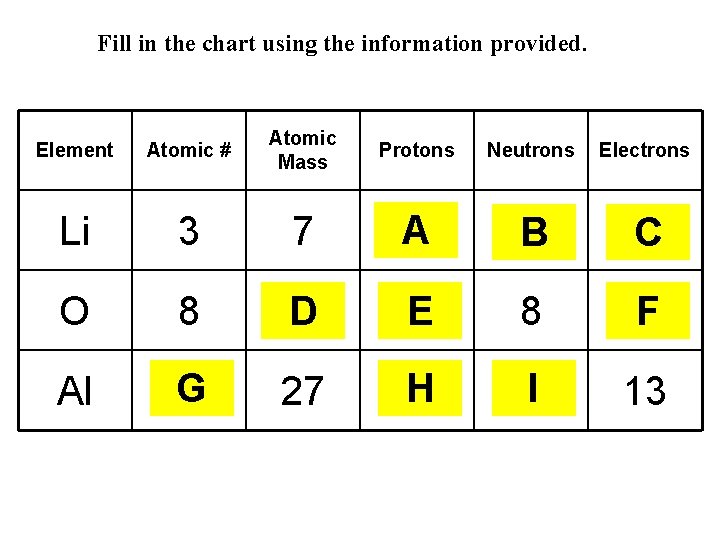
Fill in the chart using the information provided. Element Atomic # Atomic Mass Protons Neutrons Electrons Li 3 7 A B C O 8 D E 8 F Al G 27 H I 13
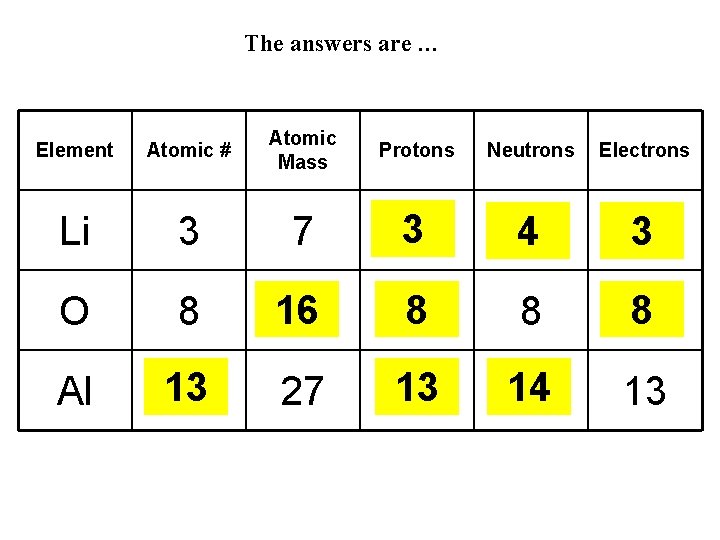
The answers are … Element Atomic # Atomic Mass Protons Neutrons Electrons Li 3 7 3 A B 4 C 3 O 8 16 D 8 E 8 8 F Al 13 G 27 13 H 14 I 13
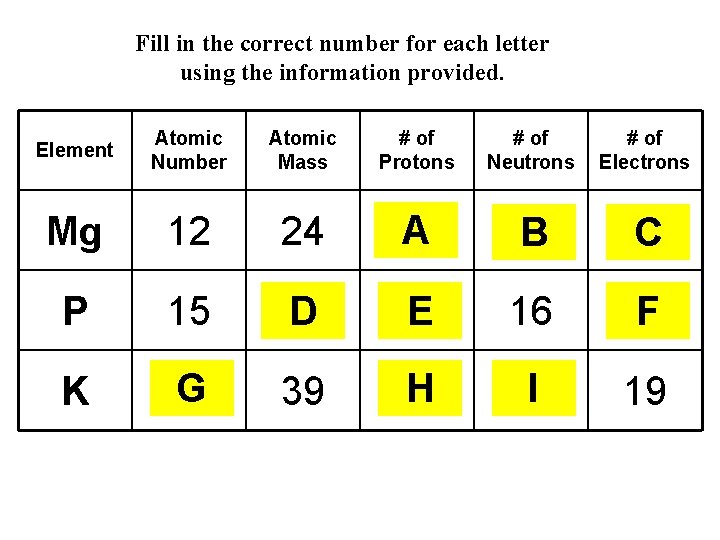
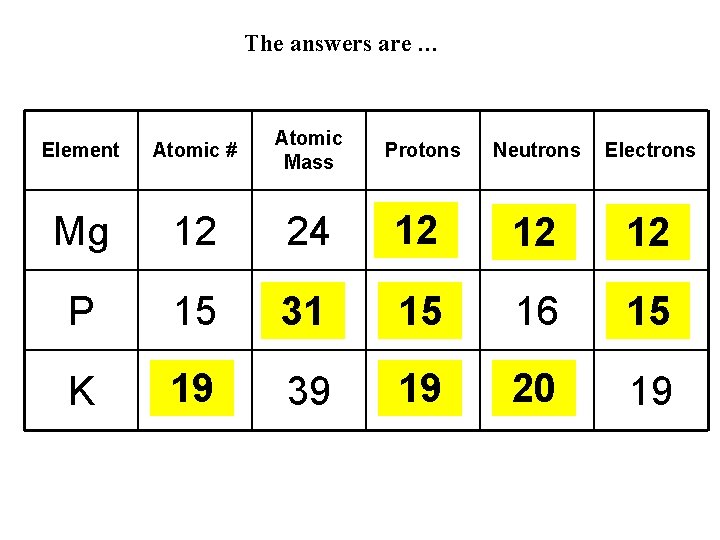
Fill in the correct number for each letter using the information provided. Element Atomic Number Atomic Mass # of Protons # of Neutrons # of Electrons Mg 12 24 A B C P 15 D E 16 F K G 39 H I 19
The answers are … Element Atomic # Atomic Mass Mg 12 24 P 15 K 19 G Protons Neutrons Electrons 12 A B 12 C 12 D 31 E 15 16 F 15 39 19 H 20 I 19