
How Stars are Classified 1 Temperature 2 Brightness
How Stars are Classified 1. Temperature 2. Brightness
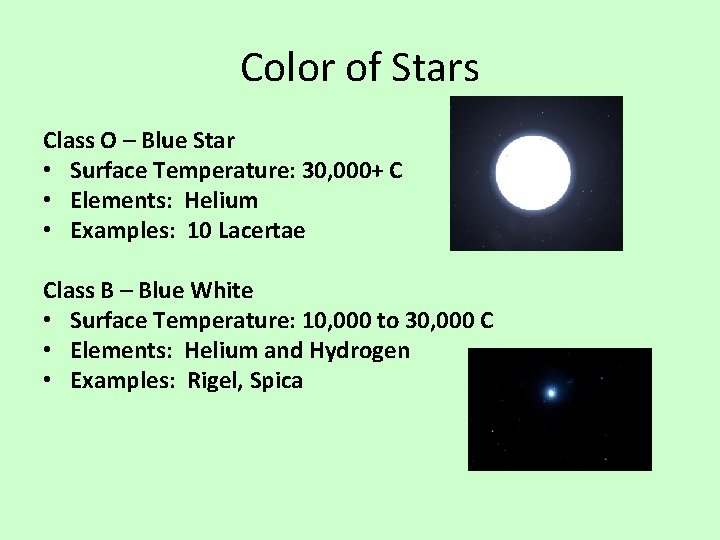
Color of Stars Class O – Blue Star • Surface Temperature: 30, 000+ C • Elements: Helium • Examples: 10 Lacertae Class B – Blue White • Surface Temperature: 10, 000 to 30, 000 C • Elements: Helium and Hydrogen • Examples: Rigel, Spica
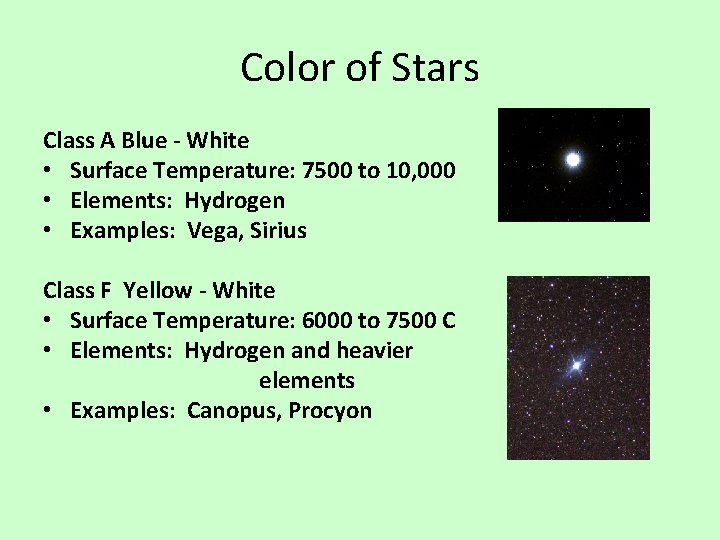
Color of Stars Class A Blue - White • Surface Temperature: 7500 to 10, 000 • Elements: Hydrogen • Examples: Vega, Sirius Class F Yellow - White • Surface Temperature: 6000 to 7500 C • Elements: Hydrogen and heavier elements • Examples: Canopus, Procyon
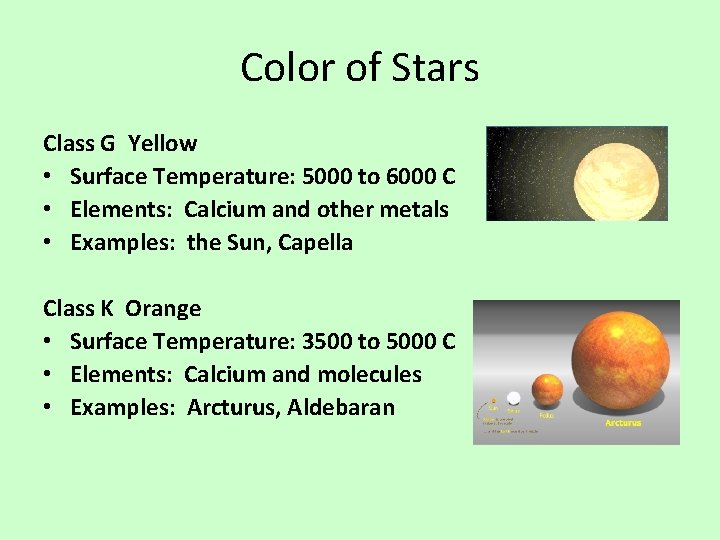
Color of Stars Class G Yellow • Surface Temperature: 5000 to 6000 C • Elements: Calcium and other metals • Examples: the Sun, Capella Class K Orange • Surface Temperature: 3500 to 5000 C • Elements: Calcium and molecules • Examples: Arcturus, Aldebaran
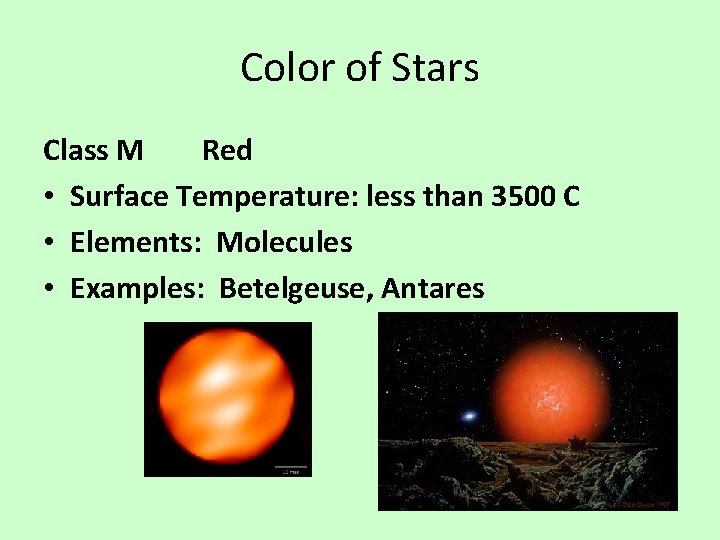
Color of Stars Class M Red • Surface Temperature: less than 3500 C • Elements: Molecules • Examples: Betelgeuse, Antares
How Bright is the Star? First Magnitude: brightest stars in the sky. Magnitude means size or in this case, brightness. Sixth Magnitude: faintest stars in the sky Apparent Magnitude is how bright a light looks. Absolute Magnitude is the actual brightness of a star • Example: Our sun’s absolute magnitude +4. 8; apparent magnitude – 26. 8 • • •
Distance to the Stars • A light year is the distance that light travels in one year. • The speed of light is about 300, 000 km/s. • It travels about 9. 5 trillion km in one year. • Light years make it easier to give distances without using large numbers.
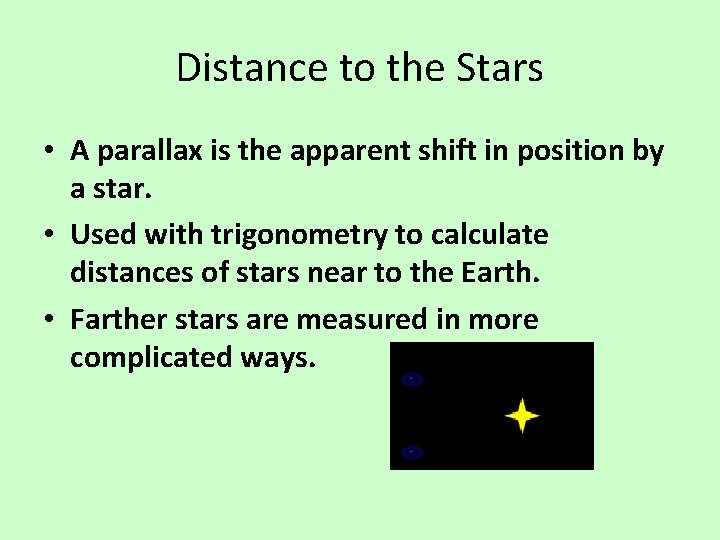
Distance to the Stars • A parallax is the apparent shift in position by a star. • Used with trigonometry to calculate distances of stars near to the Earth. • Farther stars are measured in more complicated ways.
How Long is a Light Year • 20 light years away, look at White House • Who is president and who is the first lady? Answer: 20 light years away is 1992 Clinton elected but did not take office until 1993 Answer – George H. W. Bush – wife Barbara
How Long is a Light Year Worksheet Year 2000 – you are on a planet 94. 6 trillion kilometers away from Earth How old is the child on Earth at the time you are watching the child’s 3 rd birthday? Light year is 9. 5 trillion kilometer 94. 6 divided by 9. 5 = approximately 10 light years 10 + 3 = 13 years old
How Long is a Light Year Worksheet Are any of the 9 planets within our solar system a light year away or more from Earth? Pluto is 5, 913, 520, 000 miles from Earth (5. 9 trillion) 1 light year is 9, 500, 000 miles (9. 5 trillion) Answer is No Measure distances of planets in astronomical units (AU)
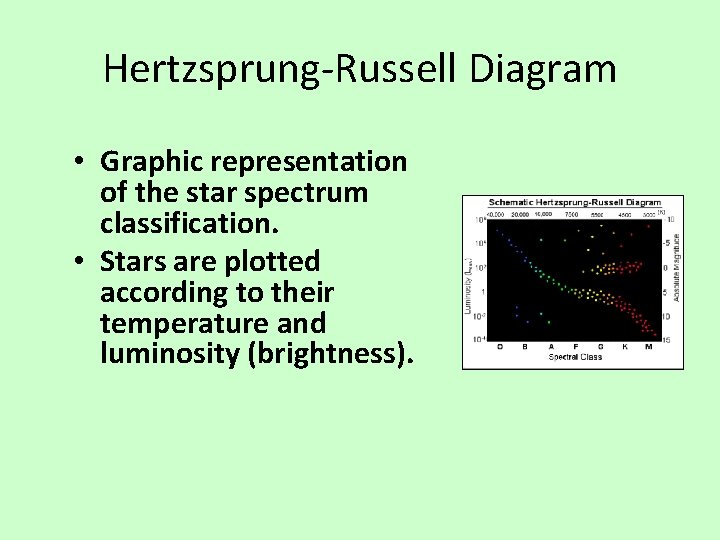
Hertzsprung-Russell Diagram • Graphic representation of the star spectrum classification. • Stars are plotted according to their temperature and luminosity (brightness).
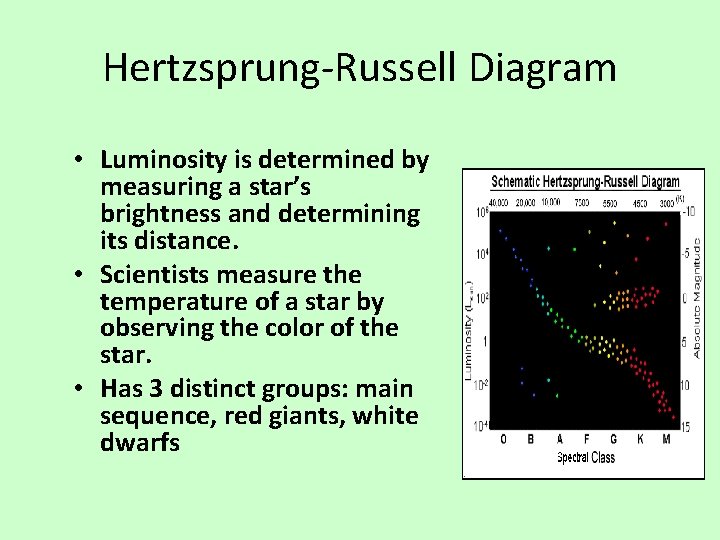
Hertzsprung-Russell Diagram • Luminosity is determined by measuring a star’s brightness and determining its distance. • Scientists measure the temperature of a star by observing the color of the star. • Has 3 distinct groups: main sequence, red giants, white dwarfs
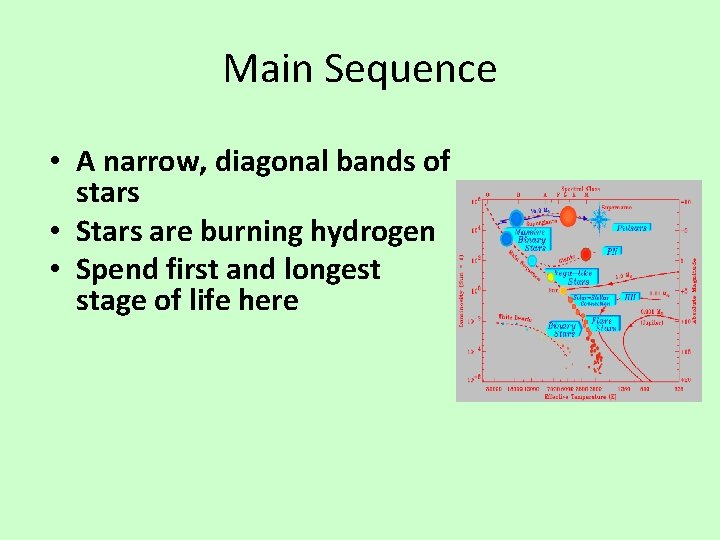
Main Sequence • A narrow, diagonal bands of stars • Stars are burning hydrogen • Spend first and longest stage of life here
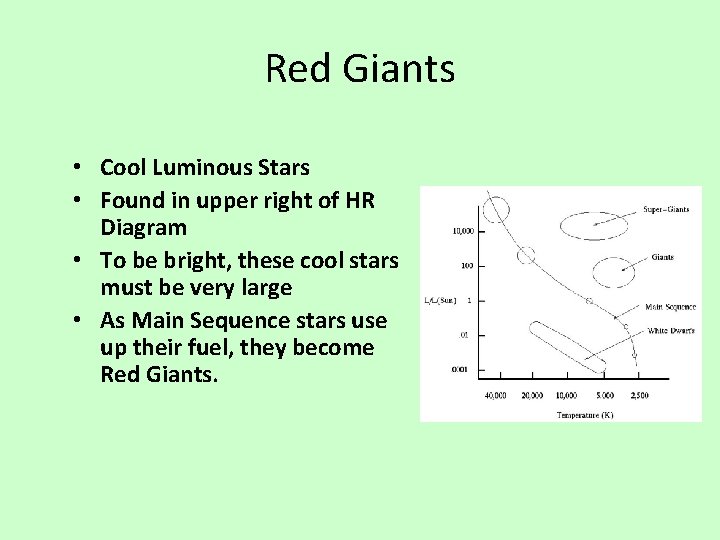
Red Giants • Cool Luminous Stars • Found in upper right of HR Diagram • To be bright, these cool stars must be very large • As Main Sequence stars use up their fuel, they become Red Giants.
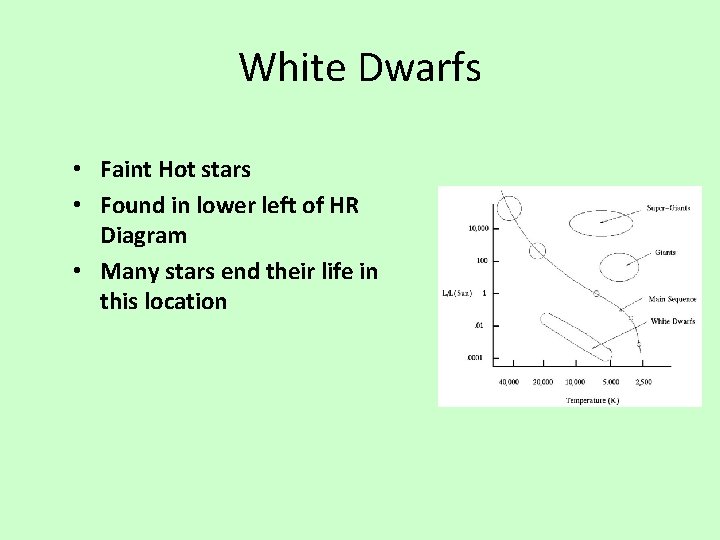
White Dwarfs • Faint Hot stars • Found in lower left of HR Diagram • Many stars end their life in this location
Using A Hertzsprung-Russell Diagram Absolute Magnitude 1. Shown on the Y axis 2. The bottom of the chart indicate low absolute magnitude. 3. The top of the chart indicate high absolute magnitude. Temperature 1. Shown the x axis. 2. Temperatures get hotter as the star moves to the left side of the diagram. 3. Temperatures get cooler as the star moves to the right of the diagram.
- Slides: 17