
Medical Chemistry Aim of the Medical Chemistry Laboratory
ﺍﻻﻭﻟﻰ ﺍﻟﺴﻨﺔ / ﻋﻤﻠﻲ ﺍﻷﻮﻟﻰ ﺍﻟﻤﺤﺎﺿﺮﺓ Medical Chemistry Aim of the Medical Chemistry Laboratory 1 -To give you the chance to observe some of the substances, its reactions discussed in the lectures and textbooks. 2 - To gain some skills, and techniques used, such as quantitative, and categorical analytical work. 3 - To offer you training by careful and complete observation of certain phenomena, then recording your data about them. Data followed by analysis, to determine the significant value of your work, and then write your decision of what can you conclude from your data. This is shown in the report written at the end of each experiment.
SAETY RULES 1 - No drinking, eating, chewing, & smoking are allowed in the lab. 2 - Avoid inhaling any chemical fumes. If necessary, a substance may be smelt by wafting (fanning) its vapor gently towered your face. 3 - Never point a test-tube nozzle when boiling a liquid at your neighbor, It may pump. 4 - Also never transfer any reagent bottle, keep it (some containers emitting noxious fumes should be placed in the fume cupboard or Hood. ). 5 - Chemical contact should be washed immediately with copious amount of water, and to notify the instructor. 6 - Discarding the reagent in the sink should be flushed down the drain with copious amount of the tap water, always noxious fumes evolve from residual reagents in the bottom of the drain.
SAETY RULES 6 - Discarding the reagent in the sink should be flushed down the drain with copious amount of the tap water, always noxious fumes evolve from residual reagents in the bottom of the drain. 7 - Avoid self-contamination, by keeping your hands away from your mouth, nose, and eyes. Always use gloves, & mask. 8 - Electrical equipments, and connections shouldn't be handed with wet hands, nor should electrical equipments be used after a liquid has been spilled on it. 9 - If you see any dangerous procedures taking place in the lab, please inform the instructor immediately. 10 - Hands washing is mandatory on leaving laboratory.
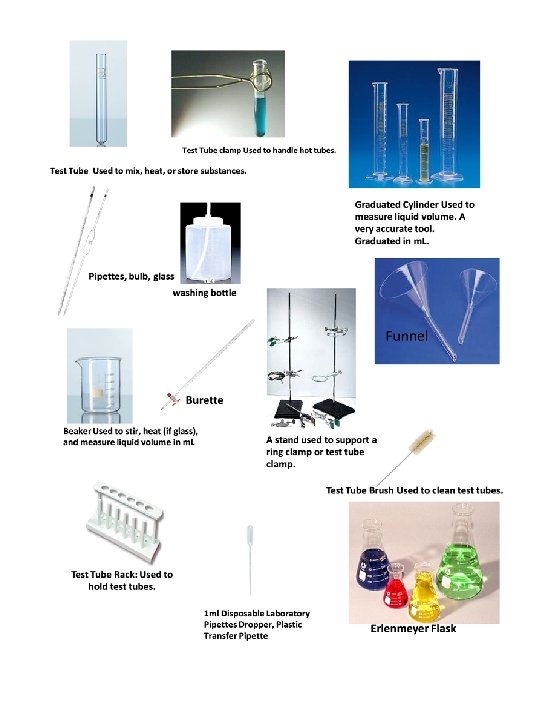
GENERAL INSTRUCTION 1 - It’s the responsibility of each student, to study the experiment before his lab time, and to answer the questions of pre-lab Quiz. 2 - Attendance at laboratory is compulsory for there is simply no other way to accomplish of the study program. 3 - Read the label of the chemical reagent TWICE before using anything from the bottle. 4 - Leave the reagent bottles at the side bench. Bring test tube by using test- tube holder, or beaker to the bench, then transfer the chemicals, and carry them to your bench. 5 - Instructor provides you with pipette or dropper, besides reagent bottles are provided with their own pipettes or droppers. Don’t insert your own pipette or dropper into the chemical reagent bottles. 6 - Glass wears used are cleaned with brush, detergent, and water, and then rinsed thoroughly with tap water, after that with small amount of distilled water. Allow the Glass wears to dry. If you must use a piece of Glass wears while it is still wet, rinse it with the solution to be used. 7 - Keep your bench, Glass wears clean, and leave the laboratory after washing your hands.
ACID-BASE TITRATION.
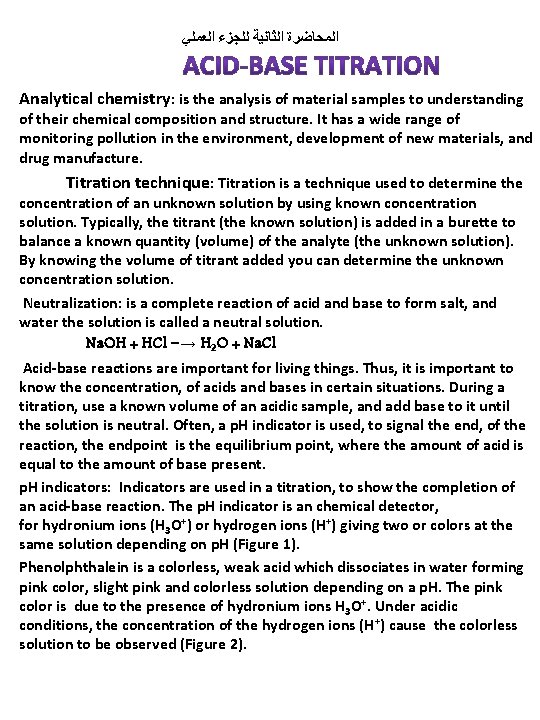
ﺍﻟﻤﺤﺎﺿﺮﺓ ﺍﻟﺜﺎﻧﻴﺔ ﻟﻠﺠﺰﺀ ﺍﻟﻌﻤﻠﻲ Analytical chemistry: is the analysis of material samples to understanding of their chemical composition and structure. It has a wide range of monitoring pollution in the environment, development of new materials, and drug manufacture. Titration technique: Titration is a technique used to determine the concentration of an unknown solution by using known concentration solution. Typically, the titrant (the known solution) is added in a burette to balance a known quantity (volume) of the analyte (the unknown solution). By knowing the volume of titrant added you can determine the unknown concentration solution. Neutralization: is a complete reaction of acid and base to form salt, and water the solution is called a neutral solution. Na. OH + HCl −→ H₂O + Na. Cl Acid-base reactions are important for living things. Thus, it is important to know the concentration, of acids and bases in certain situations. During a titration, use a known volume of an acidic sample, and add base to it until the solution is neutral. Often, a p. H indicator is used, to signal the end, of the reaction, the endpoint is the equilibrium point, where the amount of acid is equal to the amount of base present. p. H indicators: Indicators are used in a titration, to show the completion of an acid-base reaction. The p. H indicator is an chemical detector, for hydronium ions (H 3 O+) or hydrogen ions (H+) giving two or colors at the same solution depending on p. H (Figure 1). Phenolphthalein is a colorless, weak acid which dissociates in water forming pink color, slight pink and colorless solution depending on a p. H. The pink color is due to the presence of hydronium ions H 3 O+. Under acidic conditions, the concentration of the hydrogen ions (H+) cause the colorless solution to be observed (Figure 2).
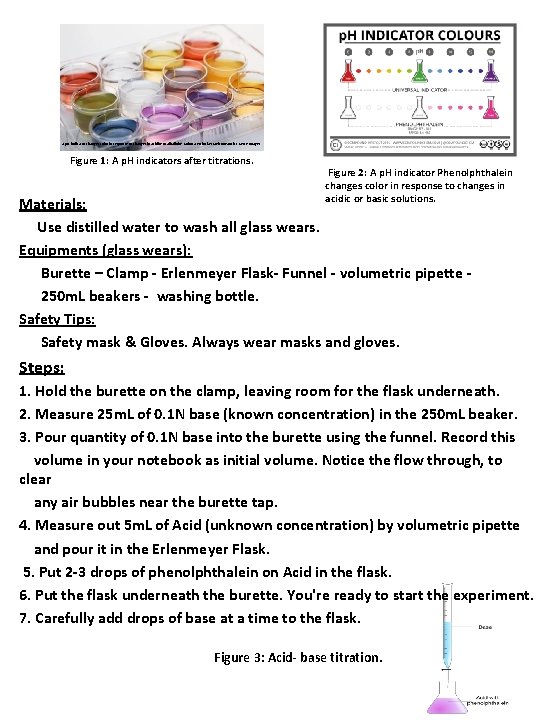
A p. H indicator changes color in response to changes in acidity or alkalinity. Cultura Exclusive/GIPhoto. Stock / Getty Images Figure 1: A p. H indicators after titrations. Figure 2: A p. H indicator Phenolphthalein changes color in response to changes in acidic or basic solutions. Materials: Use distilled water to wash all glass wears. Equipments (glass wears): Burette – Clamp - Erlenmeyer Flask- Funnel - volumetric pipette - 250 m. L beakers - washing bottle. Safety Tips: Safety mask & Gloves. Always wear masks and gloves. Steps: 1. Hold the burette on the clamp, leaving room for the flask underneath. 2. Measure 25 m. L of 0. 1 N base (known concentration) in the 250 m. L beaker. 3. Pour quantity of 0. 1 N base into the burette using the funnel. Record this volume in your notebook as initial volume. Notice the flow through, to clear any air bubbles near the burette tap. 4. Measure out 5 m. L of Acid (unknown concentration) by volumetric pipette and pour it in the Erlenmeyer Flask. 5. Put 2 -3 drops of phenolphthalein on Acid in the flask. 6. Put the flask underneath the burette. You're ready to start the experiment. 7. Carefully add drops of base at a time to the flask. Figure 3: Acid- base titration.
8. Phenolphthalein is clear when the p. H is acidic and turns pink if the p. H is basic. Continue to add drop by drop of Base causing the acid turns a very light pink. This is the equilibrium point. 9 - Record the reading of burette after titration(the acid turns a very light pink). 10 - Rinse your equipment with distelled water, and repeat steps two times, to validate your data. Take an average of the readings. Calculations: 1. Calculate the volume of titrant (Sodium Hydroxide solution). Subtract the Initial volume from the Final volume to gain the Real Volume (the volume of titrant ). Final volume Initial volume = Real Volume 2. At end point the equivalent of acid = the equivalent of base. Na. Va = equivalent of acid. Nb. Vb = equivalent of Base. 3. Normality of Base given by lab. = N b The Real Volume of Base from burette readings = V b Acid Volume = 5 ml = V a Unknown concentration of Acid = Na is measured by the following equation: N b. V b = Na. V a Molarity and Normality : The concentration of each solution is expressed by Molarity and Normality. 1 -Molarity (M) is defined as the number of moles of solute/ liter of solution. (M) = moles of solute / liters of solution. 2 -Normality is defined as the gram equivalent weight per liter of solution. Normality of Acid = (M)(number of hydrogen or hydroxide ions) Normality of Base = (M)(number of hydrogen or hydroxide ions) Normality(N) is equal to the molarity multiplied by the number of
ﺍﻟﻤﺨﺘﺒﺮ ﺍﻟﺮﺍﺑﻊ Determination of Solution Strength For Acetic Acid Content In Vinegar By Titration. The aim is to calculate the concentration of solute by comparing the weight of solute with the total volume of solution percent. Its similar to express the level of any blood or urine component, in milligram of component per 100 milliliter of blood or urine samples. Vinegar solution consists of (4 -5%) acetic acid concentration, flavoring, and coloring agent. This means the vinegar solution prepared by dissolving a measured weight, of solute, or acetic acid (gm. ) dissolved, in a solvent , or water to give (100 ml. ), of the final solution. So the Weight/ Volume percentage (W/V%) indicates the Solution Strength of solution were: Weight of Solute Weight/ Volume percentage = ………………… X 100%. Volume of Solvent Some of the possible health benefits of vinegar include: • Blood sugar control: ingesting vinegar may reduce both blood sugar after a meal, and Insulin. • Weight management: consuming vinegar may leads to reduced calorie intake. • Reduced cholesterol: Animal studies have shown reduced cholesterol in mice given vinegar. • Antimicrobial: Because of its antimicrobial properties, vinegar is useful and effective for treatment skin infections and burns. 10
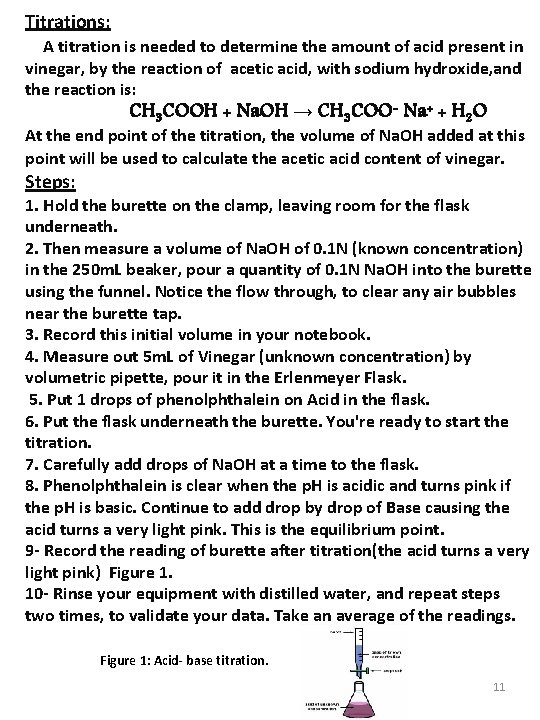
Titrations: A titration is needed to determine the amount of acid present in vinegar, by the reaction of acetic acid, with sodium hydroxide, and the reaction is: CH 3 COOH + Na. OH → CH 3 COO- Na+ + H 2 O At the end point of the titration, the volume of Na. OH added at this point will be used to calculate the acetic acid content of vinegar. Steps: 1. Hold the burette on the clamp, leaving room for the flask underneath. 2. Then measure a volume of Na. OH of 0. 1 N (known concentration) in the 250 m. L beaker, pour a quantity of 0. 1 N Na. OH into the burette using the funnel. Notice the flow through, to clear any air bubbles near the burette tap. 3. Record this initial volume in your notebook. 4. Measure out 5 m. L of Vinegar (unknown concentration) by volumetric pipette, pour it in the Erlenmeyer Flask. 5. Put 1 drops of phenolphthalein on Acid in the flask. 6. Put the flask underneath the burette. You're ready to start the titration. 7. Carefully add drops of Na. OH at a time to the flask. 8. Phenolphthalein is clear when the p. H is acidic and turns pink if the p. H is basic. Continue to add drop by drop of Base causing the acid turns a very light pink. This is the equilibrium point. 9 - Record the reading of burette after titration(the acid turns a very light pink) Figure 1. 10 - Rinse your equipment with distilled water, and repeat steps two times, to validate your data. Take an average of the readings. Figure 1: Acid- base titration. 11
Calculations: 1 -Calculate the Normality of acid = N a. The Real Volume of Base from burette readings = V b, Acid Volume = 5 ml = V a, unknown concentration of Acid = Na is measured by the following equation: Na = N b. V b / V a 2 -Find Normality of Acid. 3 -For acetic acid the number of equivalents x Normality = gram molecular weight. W = Na. eq. Normality = Na number of equivalents = W/MW/1 = W/60. 035 gm. Weight (gm. ), of acetic acid = unknown. MW of acetic acid = 60. 035 ≈ 60. W = Na. 60. 035. Solution Strength (Percent Composition): Solution Strength : is the concentration of a solution, expressed as a composition percentage. Composition % = W / VC . 100 % W Composition % = ----- x 100 % 1000 Weight/ Volume percentage % of (acetic acid ) = Composition % Weight of Solute (acetic acid )= W. A volume of a solution concentration (acetic acid) concentration in Vinegar= VC = 1000 ml. Its important to know that, at the end point, calculate the concentration of solute, by comparing the percent (%) of weight of solute with the total volume of solution. Its similar to express the level of any blood or urine component, in milligram of component 12 per 100 milliliter (mg/100 ml)of blood or urine samples.
Qualitative Analysis Of A Mixture of A Group 1 Ions. The aim : is to learn a systematic procedure to separate ions and identify them. Analysis : means separation and identification of a substance in a mixture. Analysis should be either Qualitative Quantitative Analysis means determination of actual amount of a substance in a mixture in unknown sample, its units are mg/L, mmole/L, or IU/L (this unit to measure enzyme activity). Qualitative Analysis is used to detect wither a particular substance is present in unknown sample or not. Its i. e. yes or no test. There are many theoretical methods used to separate a substance in from a mixture, the simplest one is based on solubility behaviors of a substance in different solutions(which depend on ionic equilibrium), so that by adding a precipitating agent then filtration , you can separate a particular substance

Table 1: The Practical Flow Chart Of Group 1 Cations. Diluted HCl K 2 Cr. O 4 NH 4 OH ammonia solution HNO 3 Hg(black ppt)&Hg 2²+ (white ppt)
- Slides: 14